www.mertanen.info
HOW TO DO MARKETING
MIX MODELLING
10.11.2020 @mertanen
Experiences from Finland
Petri Mertanen
• Speaker, analytics coach & consultant
• BBA, Specialist Qualification in Management
• (Digital) Analytics experience since 2005
• Lecturer at Aalto University and Laurea University
of Applied Sciences
• Presentations at SlideShare
• Certifications for Analytics and Data Science:
• Elements of AI
• Cookie Consent Expert
• Statistical thinking for Data Science & Analytics
• Google Analytics Individual Qualification,
Google Tag Manager Fundamentals,
Introduction to Data Studio
Agenda today
• Problems with traditional digital analytics
• What is Marketing Mix Modelling?
• The math behind the model
• Common steps in modelling
• Challenges with MMM
• Tools for modelling
• Results and insights & benefits
• Future development
• Greetings from Finland
• Credits
• Q&A
Problems with digital analytics
• Heuristic analysis
• Interpretations depends on people
• Time consuming, not cost effective
• Not able to work with large amount
of complex data sets
• Insights may be too simple
• Mainly data from digital channels
• Analysis on promotions →
optimizing advertising mix
• A/B and multivariate testing →
conversion rate optimization
• Predictive analytics lack more or less
Advertising ≠ Marketing
Unfortunately, no one can be told what the MMM is.
You have to see it for yourself.
What is Marketing Mix Modelling?
“Marketing Mix Modelling is statistical analysis on sales.
With MMM you use marketing data to to estimate the impact of
various marketing mix tactics on sales.
You use the model to forecast the future sets of tactics.
MMM is often used to optimize advertising mix and promotional
tactics with respect to sales revenue or profit.”
https://en.wikipedia.org/wiki/Marketing_mix_modeling
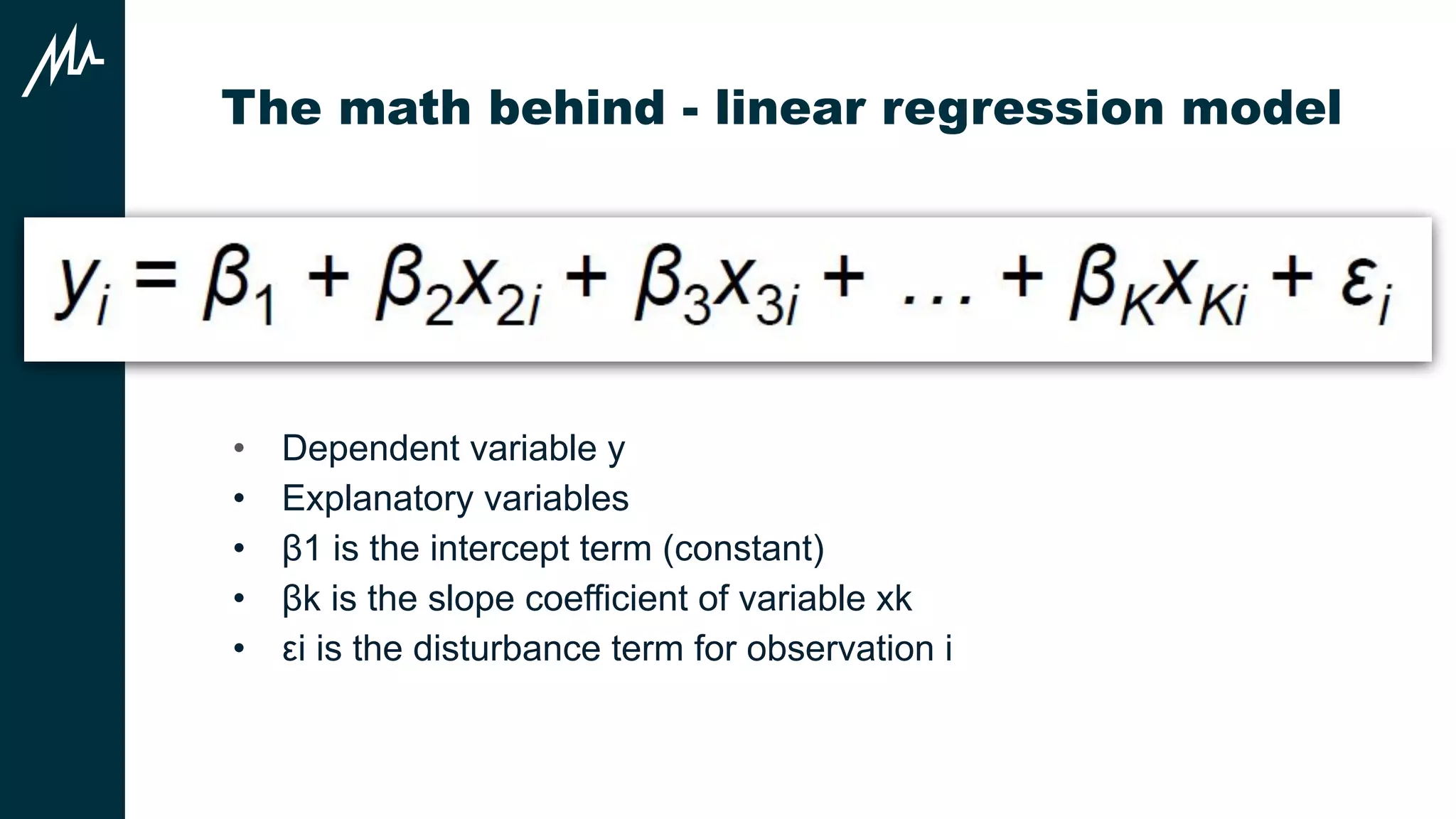
The math behind - linear regression model
• Dependent variable y
• Explanatory variables
• β1 is the intercept term (constant)
• βk is the slope coefficient of variable xk
• εi is the disturbance term for observation i
The linear regression model explained
• Dependent variable y = we are trying to explain the total sales
• Explanatory variables, for example:
• Advertising spend (in different channels)
• Discounts or seasonality
• External factors, like weather, COVID-19 or competitor’s activities
• β1 is the intercept term (constant) = it’s important to know baseline sales
• βk is the slope coefficient of variable xk (marginal effect on sales)
• εi is the disturbance term for observation i = the residual of total sales that cannot be
explained by the model
And little bit more about Data Science...
• Bayesian linear model used
• Usually with non-linear transformations
• Markov Chain Monte Carlo methods used (can be compared to data
driven attribution model in Google Analytics)
• Actually instead of one model, we may use thousands of models
• We do this to make sure the results are reliable
Common steps in modelling
• Define the model (with the customer)
• Select the variables for the model
• Collect, clean and validate the data
• Create the model
• Modelling and analysis with the historical data
• Evaluate the model
• Go through outputs and recommendations
• Move to ongoing phase
• Track the changes
• Develop and evaluate the model
https://marketingeffectiveness.nielsen.com/our-solutions/marketing-mix-modeling/
Challenges with MMM
• Volume of data is small
• Data is spread in different systems
• Data is in several different formats
• Data quality is bad
• There is no automatization in place
• There is a time lag (adstock effect)
• There is a shape effect (or the S-curve)
• Math is difficult (for clients)
• There is no one model that fits for all
• Decision making can be insufficient
Tools for modelling
• Traditional:
• Excel (Analysis ToolPak)
• SPSS
• XLSTAT
• Data science:
• R
• Python
• SaaS:
• Sellforte
• Exactag
• BigML
What is exactly causing the sales?
Results
• Marketing activities always create sales
• Reliable ROMI / ROAS / ROI
calculations for advertising and margin
• Real knowledge of how different
marketing activities perform over time
• Evaluated, mathematical model
(degree of explanation)
• Predictions and hypothesis for planning
• Increases the credibility of CMO
Insights & benefits
• Advertising alone doesn’t explain
the additional sales
• Usually we give too much credit
on advertising
• Less wrong kind of activities
• Less budget for wrong channels
• Cost savings and more sales
• Better profitability
• Increased competitive edge
• MMM is not for all companies
Future development
• Increase data maturity (daily level)
• Create Marketing Data Warehouse
• Develop the model case by case
• Automate modelling
• Try different creatives in the model
• Will there be a cookieless future?
• The more you use offline advertising or
have different kind of sales channels, the
more important the MMM is
• With Marketing Mix Modelling you really
get the big picture of Marketing!
Create Marketing Data Warehouse with Supermetrics for BigQuery
GREETINGS FROM FINLAND
“Linear regression was invented already in the 19th century.”
“Measuring with cookies is getting more difficult.”
GREETINGS FROM FINLAND
“Predictive model requires lots of quality data.”
GREETINGS FROM FINLAND
“Companies should put their marketing data in order!”
GREETINGS FROM FINLAND
Ismo Tenkanen
CEO
Econometrics
Finland
Data Scientist
BC Platforms
Chief Science
Officer
Sellforte Solutions
Karita Hakala Mikko Ervasti Erik Grönroos
Leading Analyst
Generaxion
Questions?
@mertanen
www.mertanen.info
Mertanen Analytics Oy
petri@mertanen.info
Puh. 0400 792 616
Petri Mertanen
https://www.linkedin.com/in/petrimertanen/
https://twitter.com/mertanen

Marketing Mix Modelling - Marketing Analytics Summit

  • 1.
  • 2.
    HOW TO DOMARKETING MIX MODELLING 10.11.2020 @mertanen Experiences from Finland
  • 3.
    Petri Mertanen • Speaker,analytics coach & consultant • BBA, Specialist Qualification in Management • (Digital) Analytics experience since 2005 • Lecturer at Aalto University and Laurea University of Applied Sciences • Presentations at SlideShare • Certifications for Analytics and Data Science: • Elements of AI • Cookie Consent Expert • Statistical thinking for Data Science & Analytics • Google Analytics Individual Qualification, Google Tag Manager Fundamentals, Introduction to Data Studio
  • 4.
    Agenda today • Problemswith traditional digital analytics • What is Marketing Mix Modelling? • The math behind the model • Common steps in modelling • Challenges with MMM • Tools for modelling • Results and insights & benefits • Future development • Greetings from Finland • Credits • Q&A
  • 5.
    Problems with digitalanalytics • Heuristic analysis • Interpretations depends on people • Time consuming, not cost effective • Not able to work with large amount of complex data sets • Insights may be too simple • Mainly data from digital channels • Analysis on promotions → optimizing advertising mix • A/B and multivariate testing → conversion rate optimization • Predictive analytics lack more or less
  • 6.
  • 7.
    Unfortunately, no onecan be told what the MMM is. You have to see it for yourself.
  • 8.
    What is MarketingMix Modelling? “Marketing Mix Modelling is statistical analysis on sales. With MMM you use marketing data to to estimate the impact of various marketing mix tactics on sales. You use the model to forecast the future sets of tactics. MMM is often used to optimize advertising mix and promotional tactics with respect to sales revenue or profit.” https://en.wikipedia.org/wiki/Marketing_mix_modeling
  • 9.
    The math behind- linear regression model • Dependent variable y • Explanatory variables • β1 is the intercept term (constant) • βk is the slope coefficient of variable xk • εi is the disturbance term for observation i
  • 10.
    The linear regressionmodel explained • Dependent variable y = we are trying to explain the total sales • Explanatory variables, for example: • Advertising spend (in different channels) • Discounts or seasonality • External factors, like weather, COVID-19 or competitor’s activities • β1 is the intercept term (constant) = it’s important to know baseline sales • βk is the slope coefficient of variable xk (marginal effect on sales) • εi is the disturbance term for observation i = the residual of total sales that cannot be explained by the model
  • 11.
    And little bitmore about Data Science... • Bayesian linear model used • Usually with non-linear transformations • Markov Chain Monte Carlo methods used (can be compared to data driven attribution model in Google Analytics) • Actually instead of one model, we may use thousands of models • We do this to make sure the results are reliable
  • 12.
    Common steps inmodelling • Define the model (with the customer) • Select the variables for the model • Collect, clean and validate the data • Create the model • Modelling and analysis with the historical data • Evaluate the model • Go through outputs and recommendations • Move to ongoing phase • Track the changes • Develop and evaluate the model
  • 13.
  • 14.
    Challenges with MMM •Volume of data is small • Data is spread in different systems • Data is in several different formats • Data quality is bad • There is no automatization in place • There is a time lag (adstock effect) • There is a shape effect (or the S-curve) • Math is difficult (for clients) • There is no one model that fits for all • Decision making can be insufficient
  • 15.
    Tools for modelling •Traditional: • Excel (Analysis ToolPak) • SPSS • XLSTAT • Data science: • R • Python • SaaS: • Sellforte • Exactag • BigML
  • 16.
    What is exactlycausing the sales?
  • 17.
    What is exactlycausing the sales?
  • 18.
    Results • Marketing activitiesalways create sales • Reliable ROMI / ROAS / ROI calculations for advertising and margin • Real knowledge of how different marketing activities perform over time • Evaluated, mathematical model (degree of explanation) • Predictions and hypothesis for planning • Increases the credibility of CMO
  • 19.
    Insights & benefits •Advertising alone doesn’t explain the additional sales • Usually we give too much credit on advertising • Less wrong kind of activities • Less budget for wrong channels • Cost savings and more sales • Better profitability • Increased competitive edge • MMM is not for all companies
  • 20.
    Future development • Increasedata maturity (daily level) • Create Marketing Data Warehouse • Develop the model case by case • Automate modelling • Try different creatives in the model • Will there be a cookieless future? • The more you use offline advertising or have different kind of sales channels, the more important the MMM is • With Marketing Mix Modelling you really get the big picture of Marketing!
  • 21.
    Create Marketing DataWarehouse with Supermetrics for BigQuery
  • 22.
    Create Marketing DataWarehouse with Supermetrics for BigQuery
  • 23.
    GREETINGS FROM FINLAND “Linearregression was invented already in the 19th century.”
  • 24.
    “Measuring with cookiesis getting more difficult.” GREETINGS FROM FINLAND
  • 25.
    “Predictive model requireslots of quality data.” GREETINGS FROM FINLAND
  • 26.
    “Companies should puttheir marketing data in order!” GREETINGS FROM FINLAND
  • 27.
    Ismo Tenkanen CEO Econometrics Finland Data Scientist BCPlatforms Chief Science Officer Sellforte Solutions Karita Hakala Mikko Ervasti Erik Grönroos Leading Analyst Generaxion
  • 28.
  • 29.
    www.mertanen.info Mertanen Analytics Oy petri@mertanen.info Puh.0400 792 616 Petri Mertanen https://www.linkedin.com/in/petrimertanen/ https://twitter.com/mertanen