
1
MARKETING MANAGEMENT
Definition of Marketing
According to American Marketing Association, "Marketing is an organizational function and a set
of processes for creating, communicating and delivering value to customers and for managing
customer relationships in ways that benefit the organization and its stakeholders."
Definition of Management
According to Harold Koontz, "Management is the art of getting things done through and with people
in formally organized groups." Management consists of the interlocking functions of creating
corporate policy and organizing, planning, controlling, directing an organization’s resources in order
to achieve the objectives of the policy.
Definition of Marketing Management
According to Philip Kotler, "Marketing Management is the analysis, planning, implementation and
control of programmes designed to bring about desired exchanges with target audiences for the
purpose of personal and of mutual gain. It relies heavily on the adoption and coordination of product,
price, promotion and place for achieving responses.".
Marketing management is a business process, to manage marketing activities in profit seeking
and non profit organizations at different levels of management. Marketing management decisions are
based on strong knowledge of marketing functions and clear understanding and application of
supervisory and managerial techniques.
Nature of Marketing Management
It Combines the Fields of Marketing and Management As the name implies, marketing management
combines the fields of marketing and management. Marketing consists of discovering consumer needs
and wants, creating the goods and services that meet those needs and wants; and pricing, promoting,
and delivering those goods and services. Doing so requires attention to six major areas - markets,
products, prices, places, promotion, and people. Management is getting things done through other
people. Managers engage in five key activities - planning, organizing, staffing, directing, and
controlling. Marketing management implies the integration of these concepts.
Marketing Management is a Business Process
Marketing management is a business process, to manage marketing activities in profit seeking and non
profit organizations at different levels of management, i.e. supervisory, middle-management, and
executive levels. Marketing management decisions are based on strong knowledge of marketing
functions and clear understanding and application of supervisory and managerial techniques.
Marketing managers and product managers are there to execute the processes of marketing
management. We, as customers, see the results of such process in the form of products, prices,
advertisements, promotions, etc.
Marketing Management is Both Science and Art
“Marketing management is art and science of choosing target markets and getting, keeping and
growing customers through creating, delivering and communicating superior customer value.” (Kotler,
2006). Marketing management is a science because it follows a general principle that guides the
marketing managers in decision making. The Art of Marketing management consists in tackling every
2
situation in an creative and effective manner. Marketing Management is thus a science as well as an
art.
Definition and Meaning of Marketing
According to American Marketing Association (1948) - "Marketing is the performance of
business activities directed toward, and incident to, the flow of goods and services from producer to
consumer or user."
AMA (1960) - "Marketing is the performance of business activities that direct the flow of goods and
services from producer to consumer or user."
The above definitions are based on the economic approach of marketing. Marketing embraces
all the business activities involved in getting goods and services, from the hands of producers into the
hands of final consumers. The business steps through which goods progress on their way to final
consumers is the concern of marketing.
CONCEPTS OF MARKETING
Studies reveal that different organizations have different perceptions of marketing. And these
differing perceptions have led to the formation of different concepts of marketing. It is found that at
least five distinct concepts of marketing have guided and are still guiding business firms. They are:
1. The exchange concept
2. The production concept
3. The product concept
4. The sales concept
5. The marketing concept
1. THE EXCHANGE CONCEPT
The Exchange Concept of marketing, as the very name indicates, holds that the exchange of a product
between the seller and the buyer is the central idea of marketing. While exchange does form a
significant part of marketing, to view marketing as a mere exchange process would amount to a gross
undermining of the essence of marketing. A proper scrutiny of the marketing process would readily
reveal that marketing is very much broader than exchange. Exchange, at best, covers the distribution
aspect and the price mechanism involved in marketing. The other important aspects of marketing, such
as concern for the customer, the generation of value, satisfactions, the creative selling and integrated
action for serving the customer get completely overshadowed in the Exchange Concept of marketing.
2. THE PRODUCTION CONCEPT
According to the Production Concept, marketing is a mere appendage, to production. Production and
technology dominate the thinking process of the key people in the business. They believe that
marketing can be managed by managing production. The concept holds that consumers would, as a
rule, support those products that are produced in great volume at a low unit cost. Organizations voting
for this concept are influenced by a drive to produce all that they can. They do achieve high production
efficiency and a substantial reduction in the unit cost of production; and in quite a few cases they also
do well with the distribution task and make the products widely available. Yet, they often do not get
customers as they expected. Customers, after all, are motivated by a variety of
3
considerations in their purchases. Easy availability and low cost are not the only parameters governing
the customer's buying action. And the production concept thus fails to serve as the right marketing
philosophy.
3. THE PRODUCT CONCEPT
The Product Concept is somewhat different from the Production Concept. The Production Concept
seeks to win markets and profits via high volume of production and low unit costs of production,
where as the Product Concept seeks to achieve the same result via product excellence, improved
products, new products and ideally designed and engineered products. It also places emphasis on
quality assurance. In general, it tries to take care of the marketing task through the product attributes.
Organizations that subscribe to the Product Concept of marketing believe that the consumers would
automatically vote for products of high quality. They concentrate on achieving product excellence. In
addition, many of them also spend considerable energy, time and money on research and development
and bring in a variety of new products. Yet, in many cases, these organizations fail in the market. They
do not bother to study the market and the consumer in depth. They get totally engrossed with the
product and almost forget the consumer for whom the product is actually meant; they fail to find out
what the consumers actually need and what they would gladly accept.
4. THE SALES CONCEPT
The Sales Concept became the dominant idea guiding marketing as more and more markets became
buyers' markets and as the entrepreneurial problem became one of solving the shortage of customers
rather than the shortage of goods. The Sales Concept maintains that a company cannot expect its
products to get picked up automatically by the customers. The company has to consciously promote
and push its products. Heavy advertising, high-power personal selling, large-scale sales promotion,
heavy price discounts and strong publicity and public relations are the normal tools used by the
organizations that rely on this concept.
5. THE MARKETING CONCEPT
While the foregoing discussion on the difference between selling and marketing make it clear that
marketing is a more fully evolved idea compared with selling, one has to delve a little deeper for
obtaining a full understanding of the marketing concept as such. The Marketing Concept was born out
of the awareness that marketing starts with the determination of consumer wants and ends with the
satisfaction of those wants. The concept puts the consumer at both the beginning and end of the
business. It stipulates that the company should be organized totally around the marketing function,
anticipating, and stimulating and meeting customers' requirements. The customer, not the corporation,
has to be the centre of the business universe.
Scope of Marketing
1. Study of Consumer Wants and Needs
Goods are produced to satisfy consumer wants. Therefore study is done to identify consumer needs
and wants. These needs and wants motivates consumer to purchase.
2. Study of Consumer behavior
Marketers perform study of consumer behavior. Analysis of buyer behavior helps marketer in market
segmentation and targeting.
3. Production planning and development
Product planning and development starts with the generation of product idea and ends with the product
development and commercialization. Product planning includes everything from branding and
packaging to product line expansion and contraction.
4. Pricing Policies
4
Marketer has to determine pricing policies for their products. Pricing policies differs from product to
product. It depends on the level of competition, product life cycle, marketing goals and objectives, etc.
5. Distribution
Study of distribution channel is important in marketing. For maximum sales and profit goods are
required to be distributed to the maximum consumers at minimum cost.
6. Promotion
Promotion includes personal selling, sales promotion, and advertising. Right promotion mix is crucial
in accomplishment of marketing goals.
7. Consumer Satisfaction
The product or service offered must satisfy consumer. Consumer satisfaction is the major objective of
marketing.
8. Marketing Control
Marketing audit is done to control the marketing activities.
Functions of Marketing Management
Marketing Management focuses upon the psychological and physical factors of Marketing. The
Marketing managers are responsible for influencing the level, timing, and composition of customer
demand accepted definition of the term. While the psychological factors focus upon discovering the
needs and wants of the consumer and the changing patterns of buying behavior, habit etc. the physical
factors focus upon fulfilling those needs and demands buy better product design, channel of
distribution and other functions.
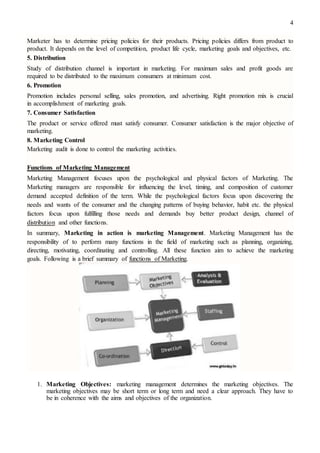
In summary, Marketing in action is marketing Management. Marketing Management has the
responsibility of to perform many functions in the field of marketing such as planning, organizing,
directing, motivating, coordinating and controlling. All these function aim to achieve the marketing
goals. Following is a brief summary of functions of Marketing.
1. Marketing Objectives: marketing management determines the marketing objectives. The
marketing objectives may be short term or long term and need a clear approach. They have to
be in coherence with the aims and objectives of the organization.
5
2. Planning: After objectively determining the marketing Objectives, the important function of
the marketing Management is to plan how to achieve those objectives. This includes sales
forecast, marketing programmes formulation, marketing strategies.
3. Organization: A plan once formulated needs implementation. Organizing functions of
marketing management involves the collection and coordination of required means to
implement a plan and to achieve pre determined objectives. The organization involves structure
of marketing organization, duties, responsibilities and powers of various members of the
marketing organization.
4. Coordination: Coordination refers to harmonious adjustment of the activities of the marketing
organization. It involves coordination among various activities such as sales forecasting,
product planning, product development, transportation, warehousing etc.
5. Direction: Direction in marketing management refers to development of new markets,
leadership of employees, motivation, inspiration, guiding and supervision of the employees.
6. Control: Control refers to the effectiveness with which a marketing plan is implemented. It
involves the determination of standards, evaluation of actual performance, adoption of
corrective measures,
7. Staffing: Employment of right and able employees is very crucial to success of a market plan.
The market manager coordinates with the Human Resource Manager of an organization to be
able to hire the staff with desired capability.
8. Analysis and Evaluation: The marketing management involves the analysis and evaluation of
the productivity and performs mace of individual employees.
Meaning of Marketing Process
The Marketing Process of a company typically involves identifying the viable and potential
marketing opportunities in the environment, developing strategies to effective utilize the opportunities,
evolving suitable marketing strategies, and supervising the implementation of these marketing efforts.
Marketing process involves ways that value can be created for the customers to satisfy their
needs. Marketing process is a continual series of actions and reactions between the customers and the
organizations which are making attempt to create value for and satisfy needs of customers. In
marketing process the situation is analyzed to identify opportunities, the strategy is formulated for a
value proposition, tactical decisions are taken, plan is implemented, and results are monitored.
Steps in Marketing Process
Following are the steps involved in the Marketing Process:-
 Situation Analysis 

 Marketing Strategy 

 Marketing Mix Decision 

 Implementation and Control 

1. Situation Analysis: Analysis of situation in which the organization finds itself serves as the basis
for identifying opportunities to satisfy unfulfilled customer needs. Situational and environmental
analysis is done to identify the marketing opportunities, to understand firms own capabilities, and to
understand the environment in which the firm is operating.
2. Marketing Strategy: After identifying the marketing opportunities a strategic plan is developed to
pursue the identified opportunities.
6
3. Marketing Mix Decisions At this step detailed tactical decisions are made for the controllable
parameters of the marketing mix. It includes - product development decisions, product pricing
decisions, product distribution decisions, and product promotional decisions.
4. Implementation and Control
Finally, the marketing plan is implemented and the results of marketing efforts are monitored to adjust
the marketing mix according to the market changes.
Marketing Environment
The term Marketing Environment refers to the forces and factors that affect the organization ability to
build and maintain good relationship with its customers. Marketing environment surrounds the
organization and it impacts upon the organization. Marketers have to interact with internal and
external people at micro and macro level and builds internal and external relationships. The key
elements of marketing environment are as follows:-
1. Internal Environment,
2. Micro Environment, and
3. Macro Environment.
Internal Environment
Internal factors like men, machine, money, material, etc., on which marketing decision depends
consists internal marketing environment. The internal environment refers to the forces that are within
the organization and affects its ability to serve its customers. It includes marketing managers, sales
representatives, marketing budget, marketing plans, procedures, inventory, logistics, and anything
within organization which affects marketing decisions and its relationship with its customers.
Micro Environment
Individuals and organizations that are close to the marketing organization and directly impacts its
ability to serve its customers, makes Marketing Micro Environment. The micro environment refers to
the forces that are close to the marketing organization and directly impact the customer experience. It
includes the organization itself, its suppliers, marketing intermediaries, customers, markets or
segments, competitors, and publics. Happenings in micro environment are relatively controllable for
the marketing organization.
Macro Environment
Macro environment refers to all forces that are part of the larger society and affects the micro
environment. It includes demography, economy, politics, culture, technology, and natural forces.
Macro environment is less controllable.
Definition of Marketing Planning
"Marketing Planning is the process of developing marketing plan incorporating overall marketing
objectives, strategies, and programs of actions designed to achieve these objectives."
7
Marketing Planning involves setting objectives and targets, and communicating these targets to people
responsible to achieve them. It also involves careful examination of all strategic issues, including the
business environment, the market itself, the corporate mission statement, competitors, and
organizational capabilities.
"Marketing Plan is a comprehensive blue print which outlines an organization’s overall marketing
efforts."
Marketing Plan is a written document that describes an organization’s advertising and marketing
efforts for a coming period of time. It includes description of target markets; marketing situation,
organization position, competition, and description of marketing mix the organization intend to use to
reach their marketing goals.
Marketing Planning Process
Marketing planning process is a series of stages that are usually followed in a sequence. Organizations
can adapt their marketing plan to suit the circumstances and their requirements. Marketing planning
process involves both the development of objectives and specifications for how to achieve the
objectives. Following are the steps involved in a marketing plan.
1) Mission
Mission is the reason for which an organization exists. Mission statement is a straightforward
statement that shows why an organization is in business, provides basic guidelines for further
planning, and establishes broad parameters for the future. Many of the useful mission statements
motivate staff and customers.
2) Corporate Objectives
Objectives are the set of goals to be achieved within a specified period of time. Corporate
objectives are most important goals the organization as a whole wishes to achieve within a specified
period of time, say one or five years. All the departments of an organization including marketing
department works in harmony to achieve the corporate objectives of the organization. Marketing
department must appreciate the corporate objectives and ensure its actions and decisions support the
overall objectives of the organization.
Mission statement and corporate objectives are determined by the top level management
(including Board of Directors) of the organization. The rest of the steps of marketing planning process
are performed by marketing department. All the actions and decisions of the marketing department
must be directed to achieve organization mission and its corporate objectives.
3) Marketing Audit
Marketing audit helps in analyzing and evaluating the marketing strategies, activities, problems,
goals, and results. Marketing audit is done to check all the aspects of business directly related to
marketing department. It is done not only at the beginning of the marketing planning process but, also
at a series of points during the implementation of plan. The marketing audit clarifies opportunities and
threats, so that required alterations can be done to the plan if necessary.
4) SWOT Analysis
The information gathered through the marketing audit process is used in development of SWOT
Analysis. It is a look at organization’s marketing efforts, and its strengths, weaknesses, opportunities,
and threats related to marketing functions.
8
 Strengths and Weaknesses are factors inside the organization that can be controlled by the
organization. USP of a product can be the example of strength, whereas lack of innovation can
be the example of weakness. 

 Opportunities and Threats are factors outside the organization which are beyond the direct
control of an organization. Festive season can be an example of opportunity to make maximum
sales, whereas increasing FDI in a nation can be the example of threat to domestic players of
that nation. 

5) Marketing Assumptions
a good marketing plan is based on deep customer understanding and knowledge, but it is not possible
to know everything about the customer, so lot of different things are assumed about customer.
For example:-
 Target Buyer Assumptions - assumptions about who the target buyers are. 

 Messaging/Offering Assumptions - assumptions about what customers think are the most
important features of product to be offered. 

6) Marketing Objectives and Strategies
After identification of opportunities and challenges, the next step is to develop marketing objectives
that indicate the end state to achieve. Marketing objective reflects what an organization can
accomplish through marketing in the coming years. Objective identifies the end point to achieve.
Marketing strategies are formed to achieve the marketing objectives. Marketing strategies are formed
to determine how to achieve those end points. Strategies are broad statements of activities to be
performed to achieve those end points.
7) Forecast the Expected Results
Marketing managers have to forecast the expected results. They have to project the future numbers,
characteristics, and trends in the target market. Without proper forecasting, the marketing plan could
have unrealistic goals or fall short on what is promised to deliver.
 Forecasting Customer Response - Marketing managers have to forecast the response that the
average customers will have to marketing efforts. Without some idea how the marketing will
be received, managers can't accurately plan the promotions. 

 Forecasting Marketing cost - To make the marketing plan stronger, accurate forecast of
marketing cost is required to be done. 

 Forecasting the Market - To accurately forecast the market, marketing managers have to gain
an intimate understanding of customers, their buying behavior, and tendencies. 

 Forecasting the Competition - Forecast of competition like - what they market, how they
market, what incentives they use in their marketing can help to counter what they are doing. 

8) Create Alternative Plan
An alternate marketing plan is created and kept ready to be implement at the place of primary
marketing plan if the whole or some part of the primary marketing plan is dropped.
9) Marketing Budget
The marketing budget is the process of documenting the expected costs of the proposed marketing
plan. One common method to allocate marketing budgeting is based on a percentage of revenue. Other
methods are - comparative, all you can afford, and task method.
10) Implementation and Evaluation
9
At this stage the marketing team is ready to actually start putting their plans into action. This may
involve spending money on advertising, launching new products, interacting with potential new
customers, opening new retail outlets etc. The marketing planning process is required to be evaluated
and updated regular. Regular evaluation of marketing efforts helps in achieving marketing goals.
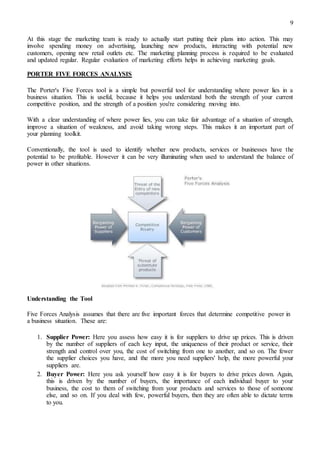
PORTER FIVE FORCES ANALYSIS
The Porter's Five Forces tool is a simple but powerful tool for understanding where power lies in a
business situation. This is useful, because it helps you understand both the strength of your current
competitive position, and the strength of a position you're considering moving into.
With a clear understanding of where power lies, you can take fair advantage of a situation of strength,
improve a situation of weakness, and avoid taking wrong steps. This makes it an important part of
your planning toolkit.
Conventionally, the tool is used to identify whether new products, services or businesses have the
potential to be profitable. However it can be very illuminating when used to understand the balance of
power in other situations.
Understanding the Tool
Five Forces Analysis assumes that there are five important forces that determine competitive power in
a business situation. These are:
1. Supplier Power: Here you assess how easy it is for suppliers to drive up prices. This is driven
by the number of suppliers of each key input, the uniqueness of their product or service, their
strength and control over you, the cost of switching from one to another, and so on. The fewer
the supplier choices you have, and the more you need suppliers' help, the more powerful your
suppliers are.
2. Buyer Power: Here you ask yourself how easy it is for buyers to drive prices down. Again,
this is driven by the number of buyers, the importance of each individual buyer to your
business, the cost to them of switching from your products and services to those of someone
else, and so on. If you deal with few, powerful buyers, then they are often able to dictate terms
to you.
10
3. Competitive Rivalry: What is important here is the number and capability of your
competitors. If you have many competitors, and they offer equally attractive products and
services, then you'll most likely have little power in the situation, because suppliers and buyers
will go elsewhere if they don't get a good deal from you. On the other hand, if no-one else can
do what you do, then you can often have tremendous strength.
4. Threat of Substitution: This is affected by the ability of your customers to find a different
way of doing what you do – for example, if you supply a unique software product that
automates an important process, people may substitute by doing the process manually or by
outsourcing it. If substitution is easy and substitution is viable, then this weakens your power.
5. Threat of New Entry: Power is also affected by the ability of people to enter your market. If it
costs little in time or money to enter your market and compete effectively, if there are few
economies of scale in place, or if you have little protection for your key technologies, then new
competitors can quickly enter your market and weaken your position. If you have strong and
durable barriers to entry, then you can preserve a favorable position and take fair advantage of
it.
MARKETING RESEARCH
Marketing research has been variously defined. It is the systematic, objective and exhaustive search
for and study of the facts relating to any problem in the field of marketing. (Richard Crisp).
The American Marketing Association has defined marketing research as the systematic gathering,
recording and analyzing of data about problems relating to the marketing of goods and services.
A marketing information system is ongoing and information is collected whether or not it will be
used. Many colleges have a student information system, a type of marketing information system that
routinely gathers information such as number of majors by discipline, number of students taking
courses at various hours, number of closed sections by discipline, etc. One college recently did a study
to determine the number of students by zip code of residence and by high school. This information
was in their information system and they found that a large number of their students came from a
small number of zip codes and high schools.
Marketing research is used to identify problems and opportunities and usually has a specific
objective. It is also used to solve a specific problem or to provide assistance in making a decision.
Marketing Information System-Vs. Marketing Research
A marketing Information system is an ongoing future-oriented structure designed to generate,
process, store and later retrieve information to aid decision-making in an organization’s marketing
programme. It is a set of procedures and methods for the regular and planned collection, analysis and
presentation of information in making marketing decisions. It consists of people, equipment and
procedures to gather, sort, analyze, evaluate and distribute needed, timely and accurate information to
marketing decision makers.
In order to carry out their analysis planning, Implementation and control responsibilities, the
marketing managers need Information about developments in the marketing environment. The role of
the MIS is to assess the manager's information needs, develop the needed information and distribute
the information in time to marketing managers.
Marketing ResearchProcess
The marketing research begins with the recognition of a marketing related problem. Identifying
and stating the right problems is like winning half of the marketing war. This is followed by a
formulation of the objectives of the study and the methodology to be used to achieve these objectives.
The detailed steps involved in the marketing process are explained in the following flow chart.
11
Definition of Problem:
This is the first step In Marketing Research process. The problem may be of different types
depending on the marketing situation e.g. product failure, sales decrease, market gossip etc. The
problem may be solved internally or external assistance from a marketing research agency is required
depending on the gravity of the problem. The problems then are formulated into statements known as
hypotheses. These hypotheses can be translated into research objectives which give an indication on
information to be collected and variables to be studied.
Statement of ResearchObjectives:
The hypotheses are translated into research objectives. The information so obtained while formulating
the problems pass through a subjective exercise to assess the possible outcomes. The hypothesis and
objectives are formulated having the idea about the possible set of outcomes, the subjective
probabilities associated with each outcome and the pay-offs associated with each outcome.
List of NeededInformation’s:
Information is required about attitudes, beliefs, values, knowledge, intention and socioeconomic status
of prospects. The main source of information may be the prospects themselves. The data may be
primary or secondary in character. The primary data are original data gathered specifically for the
project at hand. The secondary data have already been gathered for some other purpose. The sources
of secondary data are libraries, government, trade, professional and business associations, private
business firms, Advertising media, University research organizations and foundation. The primary
sources of data are obtained from respondents on their attitude, opinion, preference, behaviour etc. for
the specific research purpose.
Designof Data Collection Project
This covers two broad concepts via; the type of research design and the methods to collect information
for the project. The development of research design largely depends upon the purpose for which the
research is conducted. The depth and extent of data required the costs and benefits of the research, the
urgency of the work and the tone available for the work also affects the research design. It provides the
blueprint for research work. All marketing research projects start with exploratory research. This is
required to obtain a proper definition of the problem and helps in providing insight to the-problem.
a) Survey Method:
A survey consists of gathering data by interviewing a limited number of people selected from a larger
group. It has the advantage of getting original information. The interviewing in a survey method can
be done by the researcher by person, telephone and mall. Personal Interviews are more flexible
because they are able to probe more deeply if the answer is not satisfactory. In addition to high cost
and time consuming, personal Interviews also face the possible limitation of inviting respondent's bias.
Telephone surveys can be conducted more rapidly and at least cost but it is time specific and it leaves
the scope of reaching non-telephone holders. Interviewing by mail involves mailing a questionnaire to
potential respondents and having them returned the completed form by mail.
b) Observational Method:
In this method data are collected by observing some action of the respondent. It is the observation of
some occurrence, people and incident. The observation can be personal and mechanical but this
method suffers from recording covert behavior.
c) Experimental Method:
This method of gathering primary data involves the establishment of a controlled experiment that
stimulates the real market situation as much as possible. This small scale experiment will provide
valuable information for designing a large scale marketing programmed.
12
Selecting the Sampling Scheme & Sample Size:
A complete enumeration or census Involves in decisive data gathering and the cost involved is
prohibitive in character: So it is prudent in marketing to select a small group (sample) out of the
population (universe). This process of selecting small number of items out of a larger number of items
is called sampling. This process of sampling can be probabilistic as well a non-probabilistic or
judgmental. A probabilistic or random sample is one that is selected in such a way that every unit in
the predetermined universe has a known and equal chance of being selected. Some common
probabilistic sampling methods are simple random sampling and quota sampling, in non probabilistic,
there is an unequal chance of few members being selected and rest others of being not selected out of
the whole population.
Organizing the Field Work:
This step involves the res research work on the field. The actual collection of data in the field by
interviewing, observation is the weakest link in the entire research process. In other steps, marketing
prudent are involved to ensure the accuracy of the result so if the field workers are inadequately
trained and supervised, the whole labour will be lost. There is the chance of bias because people in the
sample may not feel at home and refuse to answer; the field workers may be unable to establish
rapport with respondents. So organizing the field work is an uphill task for the researcher.
Analyzing the Data, Findings and Conclusions:
The data so obtained from field survey are subjected to editing. Editing is a process of reviewing the
data to avoid and check the error arising out of Illegibility, non-response and response from non-
competent respondents. Then these data are categorized by tabulation. Tabulation process involves
manual as well as mechanical tabulation by using punched card, computers etc. After data processing
various statistical and non statistical tools are used to analyze the data quickly and inexpensively
which invariably leads to ' finding solutions to the marketing problem and conclusions. These findings
and conclusions are presented in the form of a report. Marketing research process to be effective
should be always regulated with a follow up action. This helps the decision makers in finding out the
effectiveness of the research.
SUMMARY
Marketing research has become a vital weapon in the armory of a modern marketer. It is an activity,
the results of which are useful in enhancing the ability of the marketer to make marketing decisions in
the ever changing world. He has to gather information and process them for taking a decision on any
marketing aspect. The scope of marketing research is widening. It has embraced with itself consumer
research, advertising research, and product and price research. MR involves a number of steps starting
with definition of problem and ending with findings and conclusions. The future of marketing research
in India is bright on account of the growing business awareness about its usefulness and the steady
growth of data base. Specialized research skill and data processing facilities are also improving.
DATABASE AND DATA WAREHOUSE
Database, in the more common meaning of the word, is repository of information that is used as a
backing storage for some specific application or set of applications. Databases are usually structured,
but this is not a definitive technical requirement. Databases are often used in contexts where you need
to be able to access and update data online, in near real time, and with multiple concurrent accesses.
Real world, professional-use databases have stricter requirements; for example, security, and also
consistency, in the form of transactions, that guarantee that the information can be reliably used by
their clients.
13
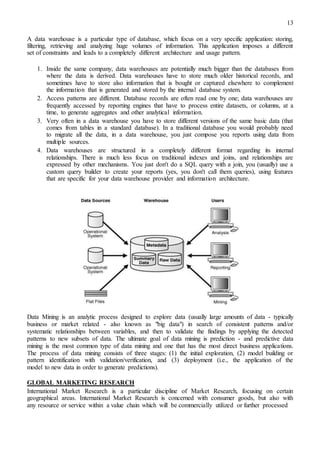
A data warehouse is a particular type of database, which focus on a very specific application: storing,
filtering, retrieving and analyzing huge volumes of information. This application imposes a different
set of constraints and leads to a completely different architecture and usage pattern.
1. Inside the same company, data warehouses are potentially much bigger than the databases from
where the data is derived. Data warehouses have to store much older historical records, and
sometimes have to store also information that is bought or captured elsewhere to complement
the information that is generated and stored by the internal database system.
2. Access patterns are different. Database records are often read one by one; data warehouses are
frequently accessed by reporting engines that have to process entire datasets, or columns, at a
time, to generate aggregates and other analytical information.
3. Very often in a data warehouse you have to store different versions of the same basic data (that
comes from tables in a standard database). In a traditional database you would probably need
to migrate all the data, in a data warehouse, you just compose you reports using data from
multiple sources.
4. Data warehouses are structured in a completely different format regarding its internal
relationships. There is much less focus on traditional indexes and joins, and relationships are
expressed by other mechanisms. You just don't do a SQL query with a join, you (usually) use a
custom query builder to create your reports (yes, you don't call them queries), using features
that are specific for your data warehouse provider and information architecture.
Data Mining is an analytic process designed to explore data (usually large amounts of data - typically
business or market related - also known as "big data") in search of consistent patterns and/or
systematic relationships between variables, and then to validate the findings by applying the detected
patterns to new subsets of data. The ultimate goal of data mining is prediction - and predictive data
mining is the most common type of data mining and one that has the most direct business applications.
The process of data mining consists of three stages: (1) the initial exploration, (2) model building or
pattern identification with validation/verification, and (3) deployment (i.e., the application of the
model to new data in order to generate predictions).
GLOBAL MARKETING RESEARCH
International Market Research is a particular discipline of Market Research, focusing on certain
geographical areas. International Market Research is concerned with consumer goods, but also with
any resource or service within a value chain which will be commercially utilized or further processed
1
4
– which is the area of industrial goods and B2B-Marketing. International market research projects
may have various objectives and purposes. Classical market research very often covers cross-
country issues. Same question, but being raised internationally. This may however lead to differing
answers from country to country – due to historical or cultural reasons. This implies that country-
specific answers will also lead to internationally differing marketing decision.
Research topics usually include the following aspects:
 development of customer needs and customer desires 
 customer´s perception of the company, compared to competitor companies 

 performance and adequacy of marketing tools such as product and services, branding,
direct sales and distribution channels, communications including internet marketing,
pricing – all this being challenged by standardization (“world product”) or country-specific
features (local specialty). 

 marketing innovation: new business models and billing schemes, new variations of
marketing tools, new technology applications 

 service quality of business relations between customers and sales persons or service
technicians, to be examined by mystery shopping 

 openness for and acceptance of new technology applications 
CONSUMERS BEHAVIOR
Buying Behavior is the decision processes and acts of people involved in buying and using
products. Need to understand:
 Why consumers make the purchases that they make? 
 What factors influence consumer purchases? 
 The changing factors in our society. 
Consumer Buying Behavior refers to the buying behavior of the ultimate consumer. A firm
needs to analyze buying behavior for:
 Buyer’s reactions to a firms marketing strategy has a great impact on the firm’s success. 

 The marketing concept stresses that a firm should create a Marketing Mix (MM) that
satisfies (gives utility to) customers, therefore need to analyze the what, where, when and
how consumers buy. 
 Marketers can better predict how consumers will respond to marketing strategies. 
Stages of the Consumer Buying Process
Six Stages to the Consumer Buying Decision Process (For complex decisions). Actual purchasing
is only one stage of the process. Not all decision processes lead to a purchase. All consumer
decisions do not always include all 6 stages, determined by the degree of complexity...discussed
next.
The 6 stages are:
1. Problem Recognition (awareness of need)--difference between the desired state and the
actual condition. Deficit in assortment of products. Hunger--Food. Hunger stimulates your
need to eat.
Can be stimulated by the marketer through product information--did not know you were
deficient? I.E., see a commercial for a new pair of shoes, stimulates your recognition that
you need a new pair of shoes.
15
2. Information search--
Internal search, memory.
External search if you need more information. Friends and relatives (word of mouth).
Marketer dominated sources; comparison shopping; public sources etc.
A successful information search leaves a buyer with possible alternatives, the evoked set. Hungry,
want to go out and eat, evoked set is
OChinese
food
o Indian
food
o burger
king
o Klondike kates etc
3. Evaluation of Alternatives--need to establish criteria for evaluation, features the buyer
wants or does not want. Rank/weight alternatives or resume search. May decide that you
want to eat something spicy, Indian gets highest rank etc.
If not satisfied with your choice then returns to the search phase. Can you think of
another restaurant? Look in the yellow pages etc. Information from different sources
may be treated differently. Marketers try to influence by "framing" alternatives.
4. Purchase decision--Choose buying alternative, includes product, package, store,
method of purchase etc.
5. Purchase--May differ from decision, time lapse between 4 & 5, product availability.
6. Post-Purchase Evaluation--outcome: Satisfaction or Dissatisfaction. Cognitive
Dissonance, have you made the right decision. This can be reduced by warranties, after
sales communication etc.
After eating an Indian meal, may think that really you wanted a Chinese meal instead.
Types of Consumer Buying Behavior
Types of consumer buying behavior are determined by:
 Level of Involvement in purchase decision. Importance and intensity of interest in a
product in a particular situation. 

 Buyer’s level of involvement determines why he/she is motivated to seek information
about a certain products and brands but virtually ignores others. 
High involvement purchases--Honda Motorbike, high priced goods, products visible to others, and
the higher the risk the higher the involvement. Types of risk:
 Personal risk 
 Social risk 
 Economic risk 
The four type of consumer buying behavior are:
 Routine Response/Programmed Behavior--buying low involvement frequently purchased
low cost items; need very little search and decision effort; purchased almost automatically.
Examples include soft drinks, snack foods, milk etc. 

 Limited Decision Making--buying product occasionally. When you need to obtain
information about unfamiliar brand in a familiar product category, perhaps. Requires a
moderate amount of time for information gathering. Examples include Clothes--know
product class but not the brand. 

 Extensive Decision Making/Complex high involvement, unfamiliar, expensive and/or
infrequently bought products. High degree of economic/performance/psychological risk. 
16
Examples include cars, homes, computers, education. Spend a lot of time seeking
information and deciding.
 Information from the companies MM; friends and relatives, store personnel etc. Go through
all six stages of the buying process. 

 Impulse buying, no conscious planning. 
The purchase of the same product does not always elicit the same Buying Behavior. Product can
shift from one category to the next.
For example:
Going out for dinner for one person may be extensive decision making (for someone that does not
go out often at all), but limited decision making for someone else. The reason for the dinner,
whether it is an anniversary celebration, or a meal with a couple of friends will also determine the
extent of the decision making.
Categories that Effect the Consumer Buying Decision Process
A consumer, making a purchase decision will be affected by the following three factors:
1. Personal
2. Psychological
3. Social
The marketer must be aware of these factors in order to develop an appropriate MM for its
target market.
Personal
Unique to a particular person. Demographic Factors. Sex, Race, Age etc. Who in the family is
responsible for the decision making. Young people purchase things for different reasons than older
people.
Handout...From choices to checkout...
Highlights the differences between male and female shoppers in the supermarket.
Psychological factors
Psychological factors include:
 Motives-- 

A motive is an internal energizing force that orients a person's activities toward
satisfying a need or achieving a goal. 
Actions are effected by a set of motives, not just one. If marketers can identify motives
then they can better develop a marketing mix.
MASLOW hierarchy of needs!!
o Physiological
o Safety
o Love and Belonging
o Esteem
o Self Actualization
Need to determine what level of the hierarchy the consumers are at to determine
what motivates their purchases.
 Perception-- 

What do you see?? Perception is the process of selecting, organizing and interpreting
information inputs to produce meaning. IE we chose what info we pay attention to,
organize it 
17
and interpret it. Information inputs are the sensations received through sight, taste, hearing,
smell and touch.
Selective Exposure-select inputs to be exposed to our awareness. More likely if it is linked to
an event, satisfies current needs, intensity of input changes (sharp price drop).
Selective Distortion-Changing/twisting current received information, inconsistent with beliefs.
Advertisers that use comparative advertisements (pitching one product against another), have
to be very careful that consumers do not distort the facts and perceive that the advertisement
was for the competitor. A current example...MCI and AT&T...do you ever get confused?
Selective Retention-Remember inputs that support beliefs, forgets those that don't. Average
supermarket shopper is exposed to 17,000 products in a shopping visit lasting 30 minutes-60%
of purchases are unplanned. Exposed to 1,500 advertisements per day. Can't be expected to be
aware of all these inputs, and certainly will not retain many.
Interpreting information is based on what is already familiar, on knowledge that is stored in the
memory.
 Ability and Knowledge-- 

Need to understand individual’s capacity to learn. Learning, changes in a person's behavior
caused by information and experience. Therefore to change consumers' behavior about your
product, need to give them new information re: product...free sample etc. 

South Africa...open bottle of wine and pour it!! Also educate American consumers about
changes in SA. Need to sell a whole new country. 

When making buying decisions, buyers must process information.
Knowledge is the familiarity with the product and expertise. 

Inexperience buyers often use prices as an indicator of quality more than those who have
knowledge of a product. 

Non-alcoholic Beer example: consumers chose the most expensive six-pack, because they
assume that the greater price indicates greater quality. 

Learning is the process through which a relatively permanent change in behavior results from
the consequences of past behavior. 

 Attitudes-- 

Knowledge and positive and negative feelings about an object or activity-maybe tangible or
intangible, living or non- living.....Drive perceptions 

Individual learns attitudes through experience and interaction with other people. 

Consumer attitudes toward a firm and its products greatly influence the success or failure
of the firm's marketing strategy. 

 Lifestyles-- 
18
Recent US trends in lifestyles are a shift towards personal independence and individualism and
a preference for a healthy, natural lifestyle.
Lifestyles are the consistent patterns people follow in their lives.
EXAMPLE healthy foods for a healthy lifestyle. Sun tan not considered fashionable in US
Social Factors
Consumer wants, learning, motives etc. are influenced by opinion leaders, person's family,
reference groups, social class and culture.
 Opinion leaders-- 

Spokespeople etc. Marketers try to attract opinion leaders...they actually use (pay)
spokespeople to market their products. Michael Jordon (Nike, McDonalds, Gatorade etc.) 

Can be risky...Michael Jackson...OJ Simpson...Chevy Chase 

 Roles and Family Influences-- 

Role...things you should do based on the expectations of you from your position within a
group. 

People have many roles. 

Husband, father, employer/ee. Individuals role are continuing to change therefore marketers
must continue to update information. 
Family is the most basic group a person belongs to. Marketers must understand:
o that many family decisions are made by the family unit
o consumer behavior starts in the family unit
o family roles and preferences are the model for children's future family (can
reject/alter/etc)
o family buying decisions are a mixture of family interactions and individual decision
making
o Family acts an interpreter of social and cultural values for the individual.
The Family life cycle: families go through stages; each stage creates different consumer
demands:
o bachelor stage...most of BUAD301
o newly married, young, no children...me
o full nest I, youngest child under 6
o full nest II, youngest child 6 or over
o full nest III, older married couples with dependent children
o empty nest I, older married couples with no children living with them, head in labor
force
o empty nest II, older married couples, no children living at home, head retired
o solitary survivor, in labor force
o solitary survivor, retired
o Modernized life cycle includes divorced and no children.
1
9
 Reference Groups-- 

Individual identifies with the group to the extent that he takes on many of the values,
attitudes or behaviors of the group members. 

Families, friends, sororities, civic and professional organizations. Any group that has a
positive or negative influence on a person’s attitude and behavior. Membership groups
(belong to) Affinity marketing is focused on the desires of consumers that belong to
reference groups. Marketers get the groups to approve the product and communicate that
approval to its members. Credit Cards etc.!! 

Aspiration groups (want to belong to)
Disassociate groups (do not want to
belong to) 

Honda, tries to disassociate from the "biker" group. 

The degree to which a reference group will affect a purchase decision depends on an
individual’s susceptibility to reference group influence and the strength of his/her
involvement with the group. 

 Social Class-- 
An open group of individuals who have similar social rank. US are not a classless society.
US criteria; occupation, education, income, wealth, race, ethnic groups and possessions. 

Social class influences many aspects of our lives. IE upper middle class Americans
prefer luxury cars Mercedes. 
o Upper Americans-upper-upper class, .3%, inherited wealth, aristocratic names.
o Lower-upper class, 1.2%, newer social elite, from current professionals and
corporate elite
o Upper-middle class, 12.5%, college graduates, managers and professionals
o Middle Americans-middle class, 32%, average pay white collar workers and blue
collar friends
o Working class, 38%, average pay blue collar workers
o Lower Americans-lower class, 9%, working, not on
welfare o Lower-lower class, 7%, on welfare
Social class determines to some extent, the types, quality, and quantity of products
that a person buys or uses.
Lower class people tend to stay close to home when shopping; do not engage in
much repurchase information gathering.
Stores project definite class images.
Family, reference groups and social classes are all social influences on consumer behavior.
All operate within a larger culture.
 Culture and Sub-culture-- 
Culture refers to the set of values, ideas, and attitudes that are accepted by a
homogenous group of people and transmitted to the next generation.
Culture also determines what is acceptable with product advertising. Culture determines what
people wear, eat, reside and travel. Cultural values in the US are good health, education,
individualism and freedom. In American culture time scarcity is a growing problem. IE change
in meals. Big impact on international marketing.
Marketing Management Notes

Marketing Management Notes

  • 1.
    1 MARKETING MANAGEMENT Definition ofMarketing According to American Marketing Association, "Marketing is an organizational function and a set of processes for creating, communicating and delivering value to customers and for managing customer relationships in ways that benefit the organization and its stakeholders." Definition of Management According to Harold Koontz, "Management is the art of getting things done through and with people in formally organized groups." Management consists of the interlocking functions of creating corporate policy and organizing, planning, controlling, directing an organization’s resources in order to achieve the objectives of the policy. Definition of Marketing Management According to Philip Kotler, "Marketing Management is the analysis, planning, implementation and control of programmes designed to bring about desired exchanges with target audiences for the purpose of personal and of mutual gain. It relies heavily on the adoption and coordination of product, price, promotion and place for achieving responses.". Marketing management is a business process, to manage marketing activities in profit seeking and non profit organizations at different levels of management. Marketing management decisions are based on strong knowledge of marketing functions and clear understanding and application of supervisory and managerial techniques. Nature of Marketing Management It Combines the Fields of Marketing and Management As the name implies, marketing management combines the fields of marketing and management. Marketing consists of discovering consumer needs and wants, creating the goods and services that meet those needs and wants; and pricing, promoting, and delivering those goods and services. Doing so requires attention to six major areas - markets, products, prices, places, promotion, and people. Management is getting things done through other people. Managers engage in five key activities - planning, organizing, staffing, directing, and controlling. Marketing management implies the integration of these concepts. Marketing Management is a Business Process Marketing management is a business process, to manage marketing activities in profit seeking and non profit organizations at different levels of management, i.e. supervisory, middle-management, and executive levels. Marketing management decisions are based on strong knowledge of marketing functions and clear understanding and application of supervisory and managerial techniques. Marketing managers and product managers are there to execute the processes of marketing management. We, as customers, see the results of such process in the form of products, prices, advertisements, promotions, etc. Marketing Management is Both Science and Art “Marketing management is art and science of choosing target markets and getting, keeping and growing customers through creating, delivering and communicating superior customer value.” (Kotler, 2006). Marketing management is a science because it follows a general principle that guides the marketing managers in decision making. The Art of Marketing management consists in tackling every
  • 2.
    2 situation in ancreative and effective manner. Marketing Management is thus a science as well as an art. Definition and Meaning of Marketing According to American Marketing Association (1948) - "Marketing is the performance of business activities directed toward, and incident to, the flow of goods and services from producer to consumer or user." AMA (1960) - "Marketing is the performance of business activities that direct the flow of goods and services from producer to consumer or user." The above definitions are based on the economic approach of marketing. Marketing embraces all the business activities involved in getting goods and services, from the hands of producers into the hands of final consumers. The business steps through which goods progress on their way to final consumers is the concern of marketing. CONCEPTS OF MARKETING Studies reveal that different organizations have different perceptions of marketing. And these differing perceptions have led to the formation of different concepts of marketing. It is found that at least five distinct concepts of marketing have guided and are still guiding business firms. They are: 1. The exchange concept 2. The production concept 3. The product concept 4. The sales concept 5. The marketing concept 1. THE EXCHANGE CONCEPT The Exchange Concept of marketing, as the very name indicates, holds that the exchange of a product between the seller and the buyer is the central idea of marketing. While exchange does form a significant part of marketing, to view marketing as a mere exchange process would amount to a gross undermining of the essence of marketing. A proper scrutiny of the marketing process would readily reveal that marketing is very much broader than exchange. Exchange, at best, covers the distribution aspect and the price mechanism involved in marketing. The other important aspects of marketing, such as concern for the customer, the generation of value, satisfactions, the creative selling and integrated action for serving the customer get completely overshadowed in the Exchange Concept of marketing. 2. THE PRODUCTION CONCEPT According to the Production Concept, marketing is a mere appendage, to production. Production and technology dominate the thinking process of the key people in the business. They believe that marketing can be managed by managing production. The concept holds that consumers would, as a rule, support those products that are produced in great volume at a low unit cost. Organizations voting for this concept are influenced by a drive to produce all that they can. They do achieve high production efficiency and a substantial reduction in the unit cost of production; and in quite a few cases they also do well with the distribution task and make the products widely available. Yet, they often do not get customers as they expected. Customers, after all, are motivated by a variety of
  • 3.
    3 considerations in theirpurchases. Easy availability and low cost are not the only parameters governing the customer's buying action. And the production concept thus fails to serve as the right marketing philosophy. 3. THE PRODUCT CONCEPT The Product Concept is somewhat different from the Production Concept. The Production Concept seeks to win markets and profits via high volume of production and low unit costs of production, where as the Product Concept seeks to achieve the same result via product excellence, improved products, new products and ideally designed and engineered products. It also places emphasis on quality assurance. In general, it tries to take care of the marketing task through the product attributes. Organizations that subscribe to the Product Concept of marketing believe that the consumers would automatically vote for products of high quality. They concentrate on achieving product excellence. In addition, many of them also spend considerable energy, time and money on research and development and bring in a variety of new products. Yet, in many cases, these organizations fail in the market. They do not bother to study the market and the consumer in depth. They get totally engrossed with the product and almost forget the consumer for whom the product is actually meant; they fail to find out what the consumers actually need and what they would gladly accept. 4. THE SALES CONCEPT The Sales Concept became the dominant idea guiding marketing as more and more markets became buyers' markets and as the entrepreneurial problem became one of solving the shortage of customers rather than the shortage of goods. The Sales Concept maintains that a company cannot expect its products to get picked up automatically by the customers. The company has to consciously promote and push its products. Heavy advertising, high-power personal selling, large-scale sales promotion, heavy price discounts and strong publicity and public relations are the normal tools used by the organizations that rely on this concept. 5. THE MARKETING CONCEPT While the foregoing discussion on the difference between selling and marketing make it clear that marketing is a more fully evolved idea compared with selling, one has to delve a little deeper for obtaining a full understanding of the marketing concept as such. The Marketing Concept was born out of the awareness that marketing starts with the determination of consumer wants and ends with the satisfaction of those wants. The concept puts the consumer at both the beginning and end of the business. It stipulates that the company should be organized totally around the marketing function, anticipating, and stimulating and meeting customers' requirements. The customer, not the corporation, has to be the centre of the business universe. Scope of Marketing 1. Study of Consumer Wants and Needs Goods are produced to satisfy consumer wants. Therefore study is done to identify consumer needs and wants. These needs and wants motivates consumer to purchase. 2. Study of Consumer behavior Marketers perform study of consumer behavior. Analysis of buyer behavior helps marketer in market segmentation and targeting. 3. Production planning and development Product planning and development starts with the generation of product idea and ends with the product development and commercialization. Product planning includes everything from branding and packaging to product line expansion and contraction. 4. Pricing Policies
  • 4.
    4 Marketer has todetermine pricing policies for their products. Pricing policies differs from product to product. It depends on the level of competition, product life cycle, marketing goals and objectives, etc. 5. Distribution Study of distribution channel is important in marketing. For maximum sales and profit goods are required to be distributed to the maximum consumers at minimum cost. 6. Promotion Promotion includes personal selling, sales promotion, and advertising. Right promotion mix is crucial in accomplishment of marketing goals. 7. Consumer Satisfaction The product or service offered must satisfy consumer. Consumer satisfaction is the major objective of marketing. 8. Marketing Control Marketing audit is done to control the marketing activities. Functions of Marketing Management Marketing Management focuses upon the psychological and physical factors of Marketing. The Marketing managers are responsible for influencing the level, timing, and composition of customer demand accepted definition of the term. While the psychological factors focus upon discovering the needs and wants of the consumer and the changing patterns of buying behavior, habit etc. the physical factors focus upon fulfilling those needs and demands buy better product design, channel of distribution and other functions. In summary, Marketing in action is marketing Management. Marketing Management has the responsibility of to perform many functions in the field of marketing such as planning, organizing, directing, motivating, coordinating and controlling. All these function aim to achieve the marketing goals. Following is a brief summary of functions of Marketing. 1. Marketing Objectives: marketing management determines the marketing objectives. The marketing objectives may be short term or long term and need a clear approach. They have to be in coherence with the aims and objectives of the organization.
  • 5.
    5 2. Planning: Afterobjectively determining the marketing Objectives, the important function of the marketing Management is to plan how to achieve those objectives. This includes sales forecast, marketing programmes formulation, marketing strategies. 3. Organization: A plan once formulated needs implementation. Organizing functions of marketing management involves the collection and coordination of required means to implement a plan and to achieve pre determined objectives. The organization involves structure of marketing organization, duties, responsibilities and powers of various members of the marketing organization. 4. Coordination: Coordination refers to harmonious adjustment of the activities of the marketing organization. It involves coordination among various activities such as sales forecasting, product planning, product development, transportation, warehousing etc. 5. Direction: Direction in marketing management refers to development of new markets, leadership of employees, motivation, inspiration, guiding and supervision of the employees. 6. Control: Control refers to the effectiveness with which a marketing plan is implemented. It involves the determination of standards, evaluation of actual performance, adoption of corrective measures, 7. Staffing: Employment of right and able employees is very crucial to success of a market plan. The market manager coordinates with the Human Resource Manager of an organization to be able to hire the staff with desired capability. 8. Analysis and Evaluation: The marketing management involves the analysis and evaluation of the productivity and performs mace of individual employees. Meaning of Marketing Process The Marketing Process of a company typically involves identifying the viable and potential marketing opportunities in the environment, developing strategies to effective utilize the opportunities, evolving suitable marketing strategies, and supervising the implementation of these marketing efforts. Marketing process involves ways that value can be created for the customers to satisfy their needs. Marketing process is a continual series of actions and reactions between the customers and the organizations which are making attempt to create value for and satisfy needs of customers. In marketing process the situation is analyzed to identify opportunities, the strategy is formulated for a value proposition, tactical decisions are taken, plan is implemented, and results are monitored. Steps in Marketing Process Following are the steps involved in the Marketing Process:-  Situation Analysis    Marketing Strategy    Marketing Mix Decision    Implementation and Control   1. Situation Analysis: Analysis of situation in which the organization finds itself serves as the basis for identifying opportunities to satisfy unfulfilled customer needs. Situational and environmental analysis is done to identify the marketing opportunities, to understand firms own capabilities, and to understand the environment in which the firm is operating. 2. Marketing Strategy: After identifying the marketing opportunities a strategic plan is developed to pursue the identified opportunities.
  • 6.
    6 3. Marketing MixDecisions At this step detailed tactical decisions are made for the controllable parameters of the marketing mix. It includes - product development decisions, product pricing decisions, product distribution decisions, and product promotional decisions. 4. Implementation and Control Finally, the marketing plan is implemented and the results of marketing efforts are monitored to adjust the marketing mix according to the market changes. Marketing Environment The term Marketing Environment refers to the forces and factors that affect the organization ability to build and maintain good relationship with its customers. Marketing environment surrounds the organization and it impacts upon the organization. Marketers have to interact with internal and external people at micro and macro level and builds internal and external relationships. The key elements of marketing environment are as follows:- 1. Internal Environment, 2. Micro Environment, and 3. Macro Environment. Internal Environment Internal factors like men, machine, money, material, etc., on which marketing decision depends consists internal marketing environment. The internal environment refers to the forces that are within the organization and affects its ability to serve its customers. It includes marketing managers, sales representatives, marketing budget, marketing plans, procedures, inventory, logistics, and anything within organization which affects marketing decisions and its relationship with its customers. Micro Environment Individuals and organizations that are close to the marketing organization and directly impacts its ability to serve its customers, makes Marketing Micro Environment. The micro environment refers to the forces that are close to the marketing organization and directly impact the customer experience. It includes the organization itself, its suppliers, marketing intermediaries, customers, markets or segments, competitors, and publics. Happenings in micro environment are relatively controllable for the marketing organization. Macro Environment Macro environment refers to all forces that are part of the larger society and affects the micro environment. It includes demography, economy, politics, culture, technology, and natural forces. Macro environment is less controllable. Definition of Marketing Planning "Marketing Planning is the process of developing marketing plan incorporating overall marketing objectives, strategies, and programs of actions designed to achieve these objectives."
  • 7.
    7 Marketing Planning involvessetting objectives and targets, and communicating these targets to people responsible to achieve them. It also involves careful examination of all strategic issues, including the business environment, the market itself, the corporate mission statement, competitors, and organizational capabilities. "Marketing Plan is a comprehensive blue print which outlines an organization’s overall marketing efforts." Marketing Plan is a written document that describes an organization’s advertising and marketing efforts for a coming period of time. It includes description of target markets; marketing situation, organization position, competition, and description of marketing mix the organization intend to use to reach their marketing goals. Marketing Planning Process Marketing planning process is a series of stages that are usually followed in a sequence. Organizations can adapt their marketing plan to suit the circumstances and their requirements. Marketing planning process involves both the development of objectives and specifications for how to achieve the objectives. Following are the steps involved in a marketing plan. 1) Mission Mission is the reason for which an organization exists. Mission statement is a straightforward statement that shows why an organization is in business, provides basic guidelines for further planning, and establishes broad parameters for the future. Many of the useful mission statements motivate staff and customers. 2) Corporate Objectives Objectives are the set of goals to be achieved within a specified period of time. Corporate objectives are most important goals the organization as a whole wishes to achieve within a specified period of time, say one or five years. All the departments of an organization including marketing department works in harmony to achieve the corporate objectives of the organization. Marketing department must appreciate the corporate objectives and ensure its actions and decisions support the overall objectives of the organization. Mission statement and corporate objectives are determined by the top level management (including Board of Directors) of the organization. The rest of the steps of marketing planning process are performed by marketing department. All the actions and decisions of the marketing department must be directed to achieve organization mission and its corporate objectives. 3) Marketing Audit Marketing audit helps in analyzing and evaluating the marketing strategies, activities, problems, goals, and results. Marketing audit is done to check all the aspects of business directly related to marketing department. It is done not only at the beginning of the marketing planning process but, also at a series of points during the implementation of plan. The marketing audit clarifies opportunities and threats, so that required alterations can be done to the plan if necessary. 4) SWOT Analysis The information gathered through the marketing audit process is used in development of SWOT Analysis. It is a look at organization’s marketing efforts, and its strengths, weaknesses, opportunities, and threats related to marketing functions.
  • 8.
    8  Strengths andWeaknesses are factors inside the organization that can be controlled by the organization. USP of a product can be the example of strength, whereas lack of innovation can be the example of weakness.    Opportunities and Threats are factors outside the organization which are beyond the direct control of an organization. Festive season can be an example of opportunity to make maximum sales, whereas increasing FDI in a nation can be the example of threat to domestic players of that nation.   5) Marketing Assumptions a good marketing plan is based on deep customer understanding and knowledge, but it is not possible to know everything about the customer, so lot of different things are assumed about customer. For example:-  Target Buyer Assumptions - assumptions about who the target buyers are.    Messaging/Offering Assumptions - assumptions about what customers think are the most important features of product to be offered.   6) Marketing Objectives and Strategies After identification of opportunities and challenges, the next step is to develop marketing objectives that indicate the end state to achieve. Marketing objective reflects what an organization can accomplish through marketing in the coming years. Objective identifies the end point to achieve. Marketing strategies are formed to achieve the marketing objectives. Marketing strategies are formed to determine how to achieve those end points. Strategies are broad statements of activities to be performed to achieve those end points. 7) Forecast the Expected Results Marketing managers have to forecast the expected results. They have to project the future numbers, characteristics, and trends in the target market. Without proper forecasting, the marketing plan could have unrealistic goals or fall short on what is promised to deliver.  Forecasting Customer Response - Marketing managers have to forecast the response that the average customers will have to marketing efforts. Without some idea how the marketing will be received, managers can't accurately plan the promotions.    Forecasting Marketing cost - To make the marketing plan stronger, accurate forecast of marketing cost is required to be done.    Forecasting the Market - To accurately forecast the market, marketing managers have to gain an intimate understanding of customers, their buying behavior, and tendencies.    Forecasting the Competition - Forecast of competition like - what they market, how they market, what incentives they use in their marketing can help to counter what they are doing.   8) Create Alternative Plan An alternate marketing plan is created and kept ready to be implement at the place of primary marketing plan if the whole or some part of the primary marketing plan is dropped. 9) Marketing Budget The marketing budget is the process of documenting the expected costs of the proposed marketing plan. One common method to allocate marketing budgeting is based on a percentage of revenue. Other methods are - comparative, all you can afford, and task method. 10) Implementation and Evaluation
  • 9.
    9 At this stagethe marketing team is ready to actually start putting their plans into action. This may involve spending money on advertising, launching new products, interacting with potential new customers, opening new retail outlets etc. The marketing planning process is required to be evaluated and updated regular. Regular evaluation of marketing efforts helps in achieving marketing goals. PORTER FIVE FORCES ANALYSIS The Porter's Five Forces tool is a simple but powerful tool for understanding where power lies in a business situation. This is useful, because it helps you understand both the strength of your current competitive position, and the strength of a position you're considering moving into. With a clear understanding of where power lies, you can take fair advantage of a situation of strength, improve a situation of weakness, and avoid taking wrong steps. This makes it an important part of your planning toolkit. Conventionally, the tool is used to identify whether new products, services or businesses have the potential to be profitable. However it can be very illuminating when used to understand the balance of power in other situations. Understanding the Tool Five Forces Analysis assumes that there are five important forces that determine competitive power in a business situation. These are: 1. Supplier Power: Here you assess how easy it is for suppliers to drive up prices. This is driven by the number of suppliers of each key input, the uniqueness of their product or service, their strength and control over you, the cost of switching from one to another, and so on. The fewer the supplier choices you have, and the more you need suppliers' help, the more powerful your suppliers are. 2. Buyer Power: Here you ask yourself how easy it is for buyers to drive prices down. Again, this is driven by the number of buyers, the importance of each individual buyer to your business, the cost to them of switching from your products and services to those of someone else, and so on. If you deal with few, powerful buyers, then they are often able to dictate terms to you.
  • 10.
    10 3. Competitive Rivalry:What is important here is the number and capability of your competitors. If you have many competitors, and they offer equally attractive products and services, then you'll most likely have little power in the situation, because suppliers and buyers will go elsewhere if they don't get a good deal from you. On the other hand, if no-one else can do what you do, then you can often have tremendous strength. 4. Threat of Substitution: This is affected by the ability of your customers to find a different way of doing what you do – for example, if you supply a unique software product that automates an important process, people may substitute by doing the process manually or by outsourcing it. If substitution is easy and substitution is viable, then this weakens your power. 5. Threat of New Entry: Power is also affected by the ability of people to enter your market. If it costs little in time or money to enter your market and compete effectively, if there are few economies of scale in place, or if you have little protection for your key technologies, then new competitors can quickly enter your market and weaken your position. If you have strong and durable barriers to entry, then you can preserve a favorable position and take fair advantage of it. MARKETING RESEARCH Marketing research has been variously defined. It is the systematic, objective and exhaustive search for and study of the facts relating to any problem in the field of marketing. (Richard Crisp). The American Marketing Association has defined marketing research as the systematic gathering, recording and analyzing of data about problems relating to the marketing of goods and services. A marketing information system is ongoing and information is collected whether or not it will be used. Many colleges have a student information system, a type of marketing information system that routinely gathers information such as number of majors by discipline, number of students taking courses at various hours, number of closed sections by discipline, etc. One college recently did a study to determine the number of students by zip code of residence and by high school. This information was in their information system and they found that a large number of their students came from a small number of zip codes and high schools. Marketing research is used to identify problems and opportunities and usually has a specific objective. It is also used to solve a specific problem or to provide assistance in making a decision. Marketing Information System-Vs. Marketing Research A marketing Information system is an ongoing future-oriented structure designed to generate, process, store and later retrieve information to aid decision-making in an organization’s marketing programme. It is a set of procedures and methods for the regular and planned collection, analysis and presentation of information in making marketing decisions. It consists of people, equipment and procedures to gather, sort, analyze, evaluate and distribute needed, timely and accurate information to marketing decision makers. In order to carry out their analysis planning, Implementation and control responsibilities, the marketing managers need Information about developments in the marketing environment. The role of the MIS is to assess the manager's information needs, develop the needed information and distribute the information in time to marketing managers. Marketing ResearchProcess The marketing research begins with the recognition of a marketing related problem. Identifying and stating the right problems is like winning half of the marketing war. This is followed by a formulation of the objectives of the study and the methodology to be used to achieve these objectives. The detailed steps involved in the marketing process are explained in the following flow chart.
  • 11.
    11 Definition of Problem: Thisis the first step In Marketing Research process. The problem may be of different types depending on the marketing situation e.g. product failure, sales decrease, market gossip etc. The problem may be solved internally or external assistance from a marketing research agency is required depending on the gravity of the problem. The problems then are formulated into statements known as hypotheses. These hypotheses can be translated into research objectives which give an indication on information to be collected and variables to be studied. Statement of ResearchObjectives: The hypotheses are translated into research objectives. The information so obtained while formulating the problems pass through a subjective exercise to assess the possible outcomes. The hypothesis and objectives are formulated having the idea about the possible set of outcomes, the subjective probabilities associated with each outcome and the pay-offs associated with each outcome. List of NeededInformation’s: Information is required about attitudes, beliefs, values, knowledge, intention and socioeconomic status of prospects. The main source of information may be the prospects themselves. The data may be primary or secondary in character. The primary data are original data gathered specifically for the project at hand. The secondary data have already been gathered for some other purpose. The sources of secondary data are libraries, government, trade, professional and business associations, private business firms, Advertising media, University research organizations and foundation. The primary sources of data are obtained from respondents on their attitude, opinion, preference, behaviour etc. for the specific research purpose. Designof Data Collection Project This covers two broad concepts via; the type of research design and the methods to collect information for the project. The development of research design largely depends upon the purpose for which the research is conducted. The depth and extent of data required the costs and benefits of the research, the urgency of the work and the tone available for the work also affects the research design. It provides the blueprint for research work. All marketing research projects start with exploratory research. This is required to obtain a proper definition of the problem and helps in providing insight to the-problem. a) Survey Method: A survey consists of gathering data by interviewing a limited number of people selected from a larger group. It has the advantage of getting original information. The interviewing in a survey method can be done by the researcher by person, telephone and mall. Personal Interviews are more flexible because they are able to probe more deeply if the answer is not satisfactory. In addition to high cost and time consuming, personal Interviews also face the possible limitation of inviting respondent's bias. Telephone surveys can be conducted more rapidly and at least cost but it is time specific and it leaves the scope of reaching non-telephone holders. Interviewing by mail involves mailing a questionnaire to potential respondents and having them returned the completed form by mail. b) Observational Method: In this method data are collected by observing some action of the respondent. It is the observation of some occurrence, people and incident. The observation can be personal and mechanical but this method suffers from recording covert behavior. c) Experimental Method: This method of gathering primary data involves the establishment of a controlled experiment that stimulates the real market situation as much as possible. This small scale experiment will provide valuable information for designing a large scale marketing programmed.
  • 12.
    12 Selecting the SamplingScheme & Sample Size: A complete enumeration or census Involves in decisive data gathering and the cost involved is prohibitive in character: So it is prudent in marketing to select a small group (sample) out of the population (universe). This process of selecting small number of items out of a larger number of items is called sampling. This process of sampling can be probabilistic as well a non-probabilistic or judgmental. A probabilistic or random sample is one that is selected in such a way that every unit in the predetermined universe has a known and equal chance of being selected. Some common probabilistic sampling methods are simple random sampling and quota sampling, in non probabilistic, there is an unequal chance of few members being selected and rest others of being not selected out of the whole population. Organizing the Field Work: This step involves the res research work on the field. The actual collection of data in the field by interviewing, observation is the weakest link in the entire research process. In other steps, marketing prudent are involved to ensure the accuracy of the result so if the field workers are inadequately trained and supervised, the whole labour will be lost. There is the chance of bias because people in the sample may not feel at home and refuse to answer; the field workers may be unable to establish rapport with respondents. So organizing the field work is an uphill task for the researcher. Analyzing the Data, Findings and Conclusions: The data so obtained from field survey are subjected to editing. Editing is a process of reviewing the data to avoid and check the error arising out of Illegibility, non-response and response from non- competent respondents. Then these data are categorized by tabulation. Tabulation process involves manual as well as mechanical tabulation by using punched card, computers etc. After data processing various statistical and non statistical tools are used to analyze the data quickly and inexpensively which invariably leads to ' finding solutions to the marketing problem and conclusions. These findings and conclusions are presented in the form of a report. Marketing research process to be effective should be always regulated with a follow up action. This helps the decision makers in finding out the effectiveness of the research. SUMMARY Marketing research has become a vital weapon in the armory of a modern marketer. It is an activity, the results of which are useful in enhancing the ability of the marketer to make marketing decisions in the ever changing world. He has to gather information and process them for taking a decision on any marketing aspect. The scope of marketing research is widening. It has embraced with itself consumer research, advertising research, and product and price research. MR involves a number of steps starting with definition of problem and ending with findings and conclusions. The future of marketing research in India is bright on account of the growing business awareness about its usefulness and the steady growth of data base. Specialized research skill and data processing facilities are also improving. DATABASE AND DATA WAREHOUSE Database, in the more common meaning of the word, is repository of information that is used as a backing storage for some specific application or set of applications. Databases are usually structured, but this is not a definitive technical requirement. Databases are often used in contexts where you need to be able to access and update data online, in near real time, and with multiple concurrent accesses. Real world, professional-use databases have stricter requirements; for example, security, and also consistency, in the form of transactions, that guarantee that the information can be reliably used by their clients.
  • 13.
    13 A data warehouseis a particular type of database, which focus on a very specific application: storing, filtering, retrieving and analyzing huge volumes of information. This application imposes a different set of constraints and leads to a completely different architecture and usage pattern. 1. Inside the same company, data warehouses are potentially much bigger than the databases from where the data is derived. Data warehouses have to store much older historical records, and sometimes have to store also information that is bought or captured elsewhere to complement the information that is generated and stored by the internal database system. 2. Access patterns are different. Database records are often read one by one; data warehouses are frequently accessed by reporting engines that have to process entire datasets, or columns, at a time, to generate aggregates and other analytical information. 3. Very often in a data warehouse you have to store different versions of the same basic data (that comes from tables in a standard database). In a traditional database you would probably need to migrate all the data, in a data warehouse, you just compose you reports using data from multiple sources. 4. Data warehouses are structured in a completely different format regarding its internal relationships. There is much less focus on traditional indexes and joins, and relationships are expressed by other mechanisms. You just don't do a SQL query with a join, you (usually) use a custom query builder to create your reports (yes, you don't call them queries), using features that are specific for your data warehouse provider and information architecture. Data Mining is an analytic process designed to explore data (usually large amounts of data - typically business or market related - also known as "big data") in search of consistent patterns and/or systematic relationships between variables, and then to validate the findings by applying the detected patterns to new subsets of data. The ultimate goal of data mining is prediction - and predictive data mining is the most common type of data mining and one that has the most direct business applications. The process of data mining consists of three stages: (1) the initial exploration, (2) model building or pattern identification with validation/verification, and (3) deployment (i.e., the application of the model to new data in order to generate predictions). GLOBAL MARKETING RESEARCH International Market Research is a particular discipline of Market Research, focusing on certain geographical areas. International Market Research is concerned with consumer goods, but also with any resource or service within a value chain which will be commercially utilized or further processed
  • 14.
    1 4 – which isthe area of industrial goods and B2B-Marketing. International market research projects may have various objectives and purposes. Classical market research very often covers cross- country issues. Same question, but being raised internationally. This may however lead to differing answers from country to country – due to historical or cultural reasons. This implies that country- specific answers will also lead to internationally differing marketing decision. Research topics usually include the following aspects:  development of customer needs and customer desires   customer´s perception of the company, compared to competitor companies    performance and adequacy of marketing tools such as product and services, branding, direct sales and distribution channels, communications including internet marketing, pricing – all this being challenged by standardization (“world product”) or country-specific features (local specialty).    marketing innovation: new business models and billing schemes, new variations of marketing tools, new technology applications    service quality of business relations between customers and sales persons or service technicians, to be examined by mystery shopping    openness for and acceptance of new technology applications  CONSUMERS BEHAVIOR Buying Behavior is the decision processes and acts of people involved in buying and using products. Need to understand:  Why consumers make the purchases that they make?   What factors influence consumer purchases?   The changing factors in our society.  Consumer Buying Behavior refers to the buying behavior of the ultimate consumer. A firm needs to analyze buying behavior for:  Buyer’s reactions to a firms marketing strategy has a great impact on the firm’s success.    The marketing concept stresses that a firm should create a Marketing Mix (MM) that satisfies (gives utility to) customers, therefore need to analyze the what, where, when and how consumers buy.   Marketers can better predict how consumers will respond to marketing strategies.  Stages of the Consumer Buying Process Six Stages to the Consumer Buying Decision Process (For complex decisions). Actual purchasing is only one stage of the process. Not all decision processes lead to a purchase. All consumer decisions do not always include all 6 stages, determined by the degree of complexity...discussed next. The 6 stages are: 1. Problem Recognition (awareness of need)--difference between the desired state and the actual condition. Deficit in assortment of products. Hunger--Food. Hunger stimulates your need to eat. Can be stimulated by the marketer through product information--did not know you were deficient? I.E., see a commercial for a new pair of shoes, stimulates your recognition that you need a new pair of shoes.
  • 15.
    15 2. Information search-- Internalsearch, memory. External search if you need more information. Friends and relatives (word of mouth). Marketer dominated sources; comparison shopping; public sources etc. A successful information search leaves a buyer with possible alternatives, the evoked set. Hungry, want to go out and eat, evoked set is OChinese food o Indian food o burger king o Klondike kates etc 3. Evaluation of Alternatives--need to establish criteria for evaluation, features the buyer wants or does not want. Rank/weight alternatives or resume search. May decide that you want to eat something spicy, Indian gets highest rank etc. If not satisfied with your choice then returns to the search phase. Can you think of another restaurant? Look in the yellow pages etc. Information from different sources may be treated differently. Marketers try to influence by "framing" alternatives. 4. Purchase decision--Choose buying alternative, includes product, package, store, method of purchase etc. 5. Purchase--May differ from decision, time lapse between 4 & 5, product availability. 6. Post-Purchase Evaluation--outcome: Satisfaction or Dissatisfaction. Cognitive Dissonance, have you made the right decision. This can be reduced by warranties, after sales communication etc. After eating an Indian meal, may think that really you wanted a Chinese meal instead. Types of Consumer Buying Behavior Types of consumer buying behavior are determined by:  Level of Involvement in purchase decision. Importance and intensity of interest in a product in a particular situation.    Buyer’s level of involvement determines why he/she is motivated to seek information about a certain products and brands but virtually ignores others.  High involvement purchases--Honda Motorbike, high priced goods, products visible to others, and the higher the risk the higher the involvement. Types of risk:  Personal risk   Social risk   Economic risk  The four type of consumer buying behavior are:  Routine Response/Programmed Behavior--buying low involvement frequently purchased low cost items; need very little search and decision effort; purchased almost automatically. Examples include soft drinks, snack foods, milk etc.    Limited Decision Making--buying product occasionally. When you need to obtain information about unfamiliar brand in a familiar product category, perhaps. Requires a moderate amount of time for information gathering. Examples include Clothes--know product class but not the brand.    Extensive Decision Making/Complex high involvement, unfamiliar, expensive and/or infrequently bought products. High degree of economic/performance/psychological risk. 
  • 16.
    16 Examples include cars,homes, computers, education. Spend a lot of time seeking information and deciding.  Information from the companies MM; friends and relatives, store personnel etc. Go through all six stages of the buying process.    Impulse buying, no conscious planning.  The purchase of the same product does not always elicit the same Buying Behavior. Product can shift from one category to the next. For example: Going out for dinner for one person may be extensive decision making (for someone that does not go out often at all), but limited decision making for someone else. The reason for the dinner, whether it is an anniversary celebration, or a meal with a couple of friends will also determine the extent of the decision making. Categories that Effect the Consumer Buying Decision Process A consumer, making a purchase decision will be affected by the following three factors: 1. Personal 2. Psychological 3. Social The marketer must be aware of these factors in order to develop an appropriate MM for its target market. Personal Unique to a particular person. Demographic Factors. Sex, Race, Age etc. Who in the family is responsible for the decision making. Young people purchase things for different reasons than older people. Handout...From choices to checkout... Highlights the differences between male and female shoppers in the supermarket. Psychological factors Psychological factors include:  Motives--   A motive is an internal energizing force that orients a person's activities toward satisfying a need or achieving a goal.  Actions are effected by a set of motives, not just one. If marketers can identify motives then they can better develop a marketing mix. MASLOW hierarchy of needs!! o Physiological o Safety o Love and Belonging o Esteem o Self Actualization Need to determine what level of the hierarchy the consumers are at to determine what motivates their purchases.  Perception--   What do you see?? Perception is the process of selecting, organizing and interpreting information inputs to produce meaning. IE we chose what info we pay attention to, organize it 
  • 17.
    17 and interpret it.Information inputs are the sensations received through sight, taste, hearing, smell and touch. Selective Exposure-select inputs to be exposed to our awareness. More likely if it is linked to an event, satisfies current needs, intensity of input changes (sharp price drop). Selective Distortion-Changing/twisting current received information, inconsistent with beliefs. Advertisers that use comparative advertisements (pitching one product against another), have to be very careful that consumers do not distort the facts and perceive that the advertisement was for the competitor. A current example...MCI and AT&T...do you ever get confused? Selective Retention-Remember inputs that support beliefs, forgets those that don't. Average supermarket shopper is exposed to 17,000 products in a shopping visit lasting 30 minutes-60% of purchases are unplanned. Exposed to 1,500 advertisements per day. Can't be expected to be aware of all these inputs, and certainly will not retain many. Interpreting information is based on what is already familiar, on knowledge that is stored in the memory.  Ability and Knowledge--   Need to understand individual’s capacity to learn. Learning, changes in a person's behavior caused by information and experience. Therefore to change consumers' behavior about your product, need to give them new information re: product...free sample etc.   South Africa...open bottle of wine and pour it!! Also educate American consumers about changes in SA. Need to sell a whole new country.   When making buying decisions, buyers must process information. Knowledge is the familiarity with the product and expertise.   Inexperience buyers often use prices as an indicator of quality more than those who have knowledge of a product.   Non-alcoholic Beer example: consumers chose the most expensive six-pack, because they assume that the greater price indicates greater quality.   Learning is the process through which a relatively permanent change in behavior results from the consequences of past behavior.    Attitudes--   Knowledge and positive and negative feelings about an object or activity-maybe tangible or intangible, living or non- living.....Drive perceptions   Individual learns attitudes through experience and interaction with other people.   Consumer attitudes toward a firm and its products greatly influence the success or failure of the firm's marketing strategy.    Lifestyles-- 
  • 18.
    18 Recent US trendsin lifestyles are a shift towards personal independence and individualism and a preference for a healthy, natural lifestyle. Lifestyles are the consistent patterns people follow in their lives. EXAMPLE healthy foods for a healthy lifestyle. Sun tan not considered fashionable in US Social Factors Consumer wants, learning, motives etc. are influenced by opinion leaders, person's family, reference groups, social class and culture.  Opinion leaders--   Spokespeople etc. Marketers try to attract opinion leaders...they actually use (pay) spokespeople to market their products. Michael Jordon (Nike, McDonalds, Gatorade etc.)   Can be risky...Michael Jackson...OJ Simpson...Chevy Chase    Roles and Family Influences--   Role...things you should do based on the expectations of you from your position within a group.   People have many roles.   Husband, father, employer/ee. Individuals role are continuing to change therefore marketers must continue to update information.  Family is the most basic group a person belongs to. Marketers must understand: o that many family decisions are made by the family unit o consumer behavior starts in the family unit o family roles and preferences are the model for children's future family (can reject/alter/etc) o family buying decisions are a mixture of family interactions and individual decision making o Family acts an interpreter of social and cultural values for the individual. The Family life cycle: families go through stages; each stage creates different consumer demands: o bachelor stage...most of BUAD301 o newly married, young, no children...me o full nest I, youngest child under 6 o full nest II, youngest child 6 or over o full nest III, older married couples with dependent children o empty nest I, older married couples with no children living with them, head in labor force o empty nest II, older married couples, no children living at home, head retired o solitary survivor, in labor force o solitary survivor, retired o Modernized life cycle includes divorced and no children.
  • 19.
    1 9  Reference Groups--  Individual identifies with the group to the extent that he takes on many of the values, attitudes or behaviors of the group members.   Families, friends, sororities, civic and professional organizations. Any group that has a positive or negative influence on a person’s attitude and behavior. Membership groups (belong to) Affinity marketing is focused on the desires of consumers that belong to reference groups. Marketers get the groups to approve the product and communicate that approval to its members. Credit Cards etc.!!   Aspiration groups (want to belong to) Disassociate groups (do not want to belong to)   Honda, tries to disassociate from the "biker" group.   The degree to which a reference group will affect a purchase decision depends on an individual’s susceptibility to reference group influence and the strength of his/her involvement with the group.    Social Class--  An open group of individuals who have similar social rank. US are not a classless society. US criteria; occupation, education, income, wealth, race, ethnic groups and possessions.   Social class influences many aspects of our lives. IE upper middle class Americans prefer luxury cars Mercedes.  o Upper Americans-upper-upper class, .3%, inherited wealth, aristocratic names. o Lower-upper class, 1.2%, newer social elite, from current professionals and corporate elite o Upper-middle class, 12.5%, college graduates, managers and professionals o Middle Americans-middle class, 32%, average pay white collar workers and blue collar friends o Working class, 38%, average pay blue collar workers o Lower Americans-lower class, 9%, working, not on welfare o Lower-lower class, 7%, on welfare Social class determines to some extent, the types, quality, and quantity of products that a person buys or uses. Lower class people tend to stay close to home when shopping; do not engage in much repurchase information gathering. Stores project definite class images. Family, reference groups and social classes are all social influences on consumer behavior. All operate within a larger culture.  Culture and Sub-culture--  Culture refers to the set of values, ideas, and attitudes that are accepted by a homogenous group of people and transmitted to the next generation. Culture also determines what is acceptable with product advertising. Culture determines what people wear, eat, reside and travel. Cultural values in the US are good health, education, individualism and freedom. In American culture time scarcity is a growing problem. IE change in meals. Big impact on international marketing.