What Is Bank?
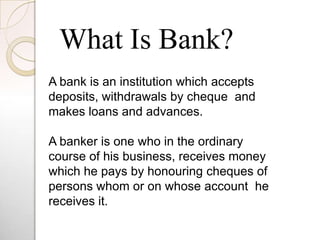
A bank is an institution which accepts
deposits, withdrawals by cheque and
makes loans and advances.

A banker is one who in the ordinary
course of his business, receives money
which he pays by honouring cheques of
persons whom or on whose account he
receives it.
Types of Banks
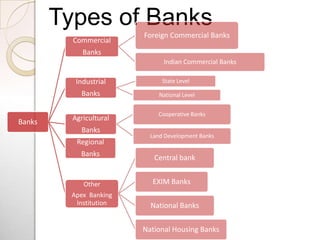
                         Foreign Commercial Banks
          Commercial
             Banks
                               Indian Commercial Banks

           Industrial          State Level

            Banks             National Level


                             Cooperative Banks
Banks     Agricultural
            Banks
                           Land Development Banks
           Regional
            Banks
                            Central bank


             Other         EXIM Banks
         Apex Banking
          Institution      National Banks

                         National Housing Banks
Lists of Banks in India
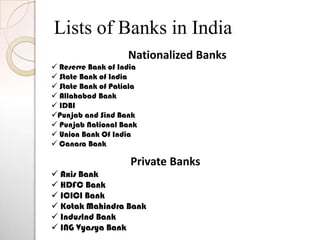
                    Nationalized Banks
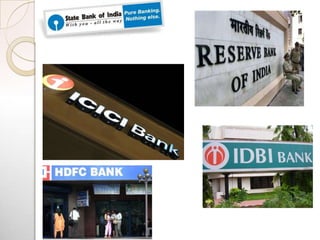
 Reserve Bank of India
 State Bank of India
 State Bank of Patiala
 Allahabad Bank
 IDBI
Punjab and Sind Bank
 Punjab National Bank
 Union Bank Of India
 Canara Bank

                     Private Banks
 Axis Bank
 HDFC Bank
 ICICI Bank
 Kotak Mahindra Bank
 Induslnd Bank
 ING Vyasya Bank
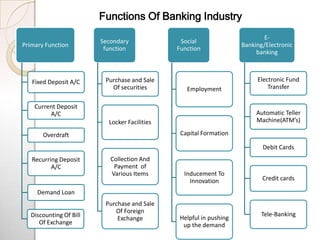
Functions Of Banking Industry
                                                                           E-
                        Secondary              Social
Primary Function                                                    Banking/Electronic
                         function             Function
                                                                         banking


   Fixed Deposit A/C     Purchase and Sale                               Electronic Fund
                           Of securities         Employment                  Transfer

    Current Deposit
         A/C                                                             Automatic Teller
                          Locker Facilities                              Machine(ATM’s)

       Overdraft                               Capital Formation

                                                                           Debit Cards
   Recurring Deposit       Collection And
          A/C               Payment of
                           Various Items        Inducement To
                                                  Innovation               Credit cards

     Demand Loan
                         Purchase and Sale
                            Of Foreign                                    Tele-Banking
  Discounting Of Bill        Exchange          Helpful in pushing
     Of Exchange                                up the demand
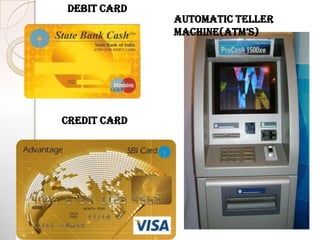
DEBIT CARD
              Automatic Teller
              Machine(aTM’s)


CREDIT CARD
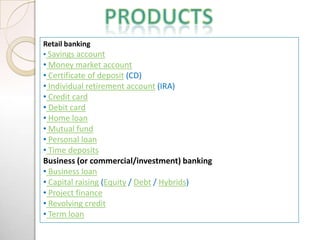
Retail banking
• Savings account
• Money market account
• Certificate of deposit (CD)
• Individual retirement account (IRA)
• Credit card
• Debit card
• Home loan
• Mutual fund
• Personal loan
• Time deposits
Business (or commercial/investment) banking
• Business loan
• Capital raising (Equity / Debt / Hybrids)
• Project finance
• Revolving credit
• Term loan
ULIP- UNIT LINKED INSURANCE PLANS
Unit linked insurance plan (ULIP) is life
insurance solution that provides for the
benefits of risk protection and flexibility in
investment. The investment is denoted as units
and is represented by the value that it has
attained called as Net Asset Value (NAV). The
policy value at any time varies according to the
value of the underlying assets at the time.
Mutual Fund
An investment vehicle that is made up of a pool
of funds collected from many investors for the
purpose of investing in securities such as stocks,
bonds, money market instruments and similar
assets. Mutual funds are operated by money
managers, who invest the fund's capital and
attempt to produce capital gains and income for
the fund's investors. A mutual fund's portfolio is
structured and maintained to match the
investment objectives stated in its prospectus.
Online banking (or Internet banking or E-banking) allows customers of a
institution to conduct financial transactions on a secure website operate
institution
To access a financial institution's online banking facility, a customer havi
personal Internet access must register with the institution for the service
set up some password (under various names) for customer verification.
institutions now routinely allocate customer numbers (also under variou
names), whether or not customers intend to access their online banking
Customer numbers are normally not the same as account numbers. The
customer will link to the facility those accounts which the customer cont
which may be cheque, savings, credit card and other accounts. To access
banking, the customer would go to their financial institution's website, a
the online banking facility using the customer number and password. So
financial institutions have set up additional security steps for access, but
no consistency to the approach adopted.
Mobile Banking

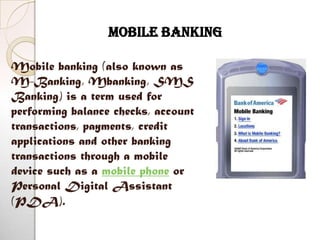
Mobile banking (also known as
M-Banking, Mbanking, SMS
Banking) is a term used for
performing balance checks, account
transactions, payments, credit
applications and other banking
transactions through a mobile
device such as a mobile phone or
Personal Digital Assistant
(PDA).
Growth of banking sectors in
India
The banking system in India is the most extensive.
The total asset value of the entire banking sector in
India is nearly US$ 270 billion. The total deposits is
nearly US$ 220 billion. Banking sector in India has
been transformed completely. Presently the latest
inclusions such as Internet banking and Core
banking have made banking operations more user
friendly andto researches carried out by the
 According easy.
 Reserve Bank of India (RBI), on an all India
 basis, 59 per cent of the adult population in the
 country has bank accounts and 41 per cent don’t.
 In rural areas, the coverage of banks is 39 per
 cent, against 60 per cent in urban areas. There is
 only one bank for a population of13000.
Problems Related to Banking industry

 Competitions amongst Nationalized   and Non-Nationalized bank.
 Problem relating to surplus fund and deficit fund.
 Recovery of Bad Debts In Long term loans.
 Implementing the policies Layed down by RBI.
 Costumer Awareness
 Communication Gap Between The Costumer And Banking
Industry.
 Insecurity in the minds of people related to the Net Banking
Facility.
 Private banks have more advanced computer technology as
compared to Nationalized Bank
Conclusion
Banks provide security and convenience for managing your money
and sometimes allow you to make money by earning interest.
Writing and depositing checks are perhaps the most fundamental
ways to move money in and out of a checking account, but
advancements in technology have added ATM and debit card
transactions. Debit cards provide easy access to the cash in your
account. To protect your money from electronic theft, identity
theft, and other forms of fraud, it's important to implement basic
precautions such as shredding account statements, having
complex passwords and only doing online banking through secure
internet connections.
Banking industry

Banking industry

  • 2.
    What Is Bank? Abank is an institution which accepts deposits, withdrawals by cheque and makes loans and advances. A banker is one who in the ordinary course of his business, receives money which he pays by honouring cheques of persons whom or on whose account he receives it.
  • 3.
    Types of Banks Foreign Commercial Banks Commercial Banks Indian Commercial Banks Industrial State Level Banks National Level Cooperative Banks Banks Agricultural Banks Land Development Banks Regional Banks Central bank Other EXIM Banks Apex Banking Institution National Banks National Housing Banks
  • 4.
    Lists of Banksin India Nationalized Banks  Reserve Bank of India  State Bank of India  State Bank of Patiala  Allahabad Bank  IDBI Punjab and Sind Bank  Punjab National Bank  Union Bank Of India  Canara Bank Private Banks  Axis Bank  HDFC Bank  ICICI Bank  Kotak Mahindra Bank  Induslnd Bank  ING Vyasya Bank
  • 6.
    Functions Of BankingIndustry E- Secondary Social Primary Function Banking/Electronic function Function banking Fixed Deposit A/C Purchase and Sale Electronic Fund Of securities Employment Transfer Current Deposit A/C Automatic Teller Locker Facilities Machine(ATM’s) Overdraft Capital Formation Debit Cards Recurring Deposit Collection And A/C Payment of Various Items Inducement To Innovation Credit cards Demand Loan Purchase and Sale Of Foreign Tele-Banking Discounting Of Bill Exchange Helpful in pushing Of Exchange up the demand
  • 7.
    DEBIT CARD Automatic Teller Machine(aTM’s) CREDIT CARD
  • 8.
    Retail banking • Savingsaccount • Money market account • Certificate of deposit (CD) • Individual retirement account (IRA) • Credit card • Debit card • Home loan • Mutual fund • Personal loan • Time deposits Business (or commercial/investment) banking • Business loan • Capital raising (Equity / Debt / Hybrids) • Project finance • Revolving credit • Term loan
  • 9.
    ULIP- UNIT LINKEDINSURANCE PLANS Unit linked insurance plan (ULIP) is life insurance solution that provides for the benefits of risk protection and flexibility in investment. The investment is denoted as units and is represented by the value that it has attained called as Net Asset Value (NAV). The policy value at any time varies according to the value of the underlying assets at the time.
  • 10.
    Mutual Fund An investmentvehicle that is made up of a pool of funds collected from many investors for the purpose of investing in securities such as stocks, bonds, money market instruments and similar assets. Mutual funds are operated by money managers, who invest the fund's capital and attempt to produce capital gains and income for the fund's investors. A mutual fund's portfolio is structured and maintained to match the investment objectives stated in its prospectus.
  • 11.
    Online banking (orInternet banking or E-banking) allows customers of a institution to conduct financial transactions on a secure website operate institution To access a financial institution's online banking facility, a customer havi personal Internet access must register with the institution for the service set up some password (under various names) for customer verification. institutions now routinely allocate customer numbers (also under variou names), whether or not customers intend to access their online banking Customer numbers are normally not the same as account numbers. The customer will link to the facility those accounts which the customer cont which may be cheque, savings, credit card and other accounts. To access banking, the customer would go to their financial institution's website, a the online banking facility using the customer number and password. So financial institutions have set up additional security steps for access, but no consistency to the approach adopted.
  • 12.
    Mobile Banking Mobile banking(also known as M-Banking, Mbanking, SMS Banking) is a term used for performing balance checks, account transactions, payments, credit applications and other banking transactions through a mobile device such as a mobile phone or Personal Digital Assistant (PDA).
  • 13.
    Growth of bankingsectors in India The banking system in India is the most extensive. The total asset value of the entire banking sector in India is nearly US$ 270 billion. The total deposits is nearly US$ 220 billion. Banking sector in India has been transformed completely. Presently the latest inclusions such as Internet banking and Core banking have made banking operations more user friendly andto researches carried out by the According easy. Reserve Bank of India (RBI), on an all India basis, 59 per cent of the adult population in the country has bank accounts and 41 per cent don’t. In rural areas, the coverage of banks is 39 per cent, against 60 per cent in urban areas. There is only one bank for a population of13000.
  • 14.
    Problems Related toBanking industry  Competitions amongst Nationalized and Non-Nationalized bank.  Problem relating to surplus fund and deficit fund.  Recovery of Bad Debts In Long term loans.  Implementing the policies Layed down by RBI.  Costumer Awareness  Communication Gap Between The Costumer And Banking Industry.  Insecurity in the minds of people related to the Net Banking Facility.  Private banks have more advanced computer technology as compared to Nationalized Bank
  • 15.
    Conclusion Banks provide securityand convenience for managing your money and sometimes allow you to make money by earning interest. Writing and depositing checks are perhaps the most fundamental ways to move money in and out of a checking account, but advancements in technology have added ATM and debit card transactions. Debit cards provide easy access to the cash in your account. To protect your money from electronic theft, identity theft, and other forms of fraud, it's important to implement basic precautions such as shredding account statements, having complex passwords and only doing online banking through secure internet connections.