DESIGNING & MANAGING
INTEGRATED MARKETING
CHANNELS
Presented By:
Dhruv Maniar (M1603)
R.Harish (M1605)
Satarupa Mohapatra (M1613)
Vivek Kumar (M1617)
Marketing Management - Group 2 1
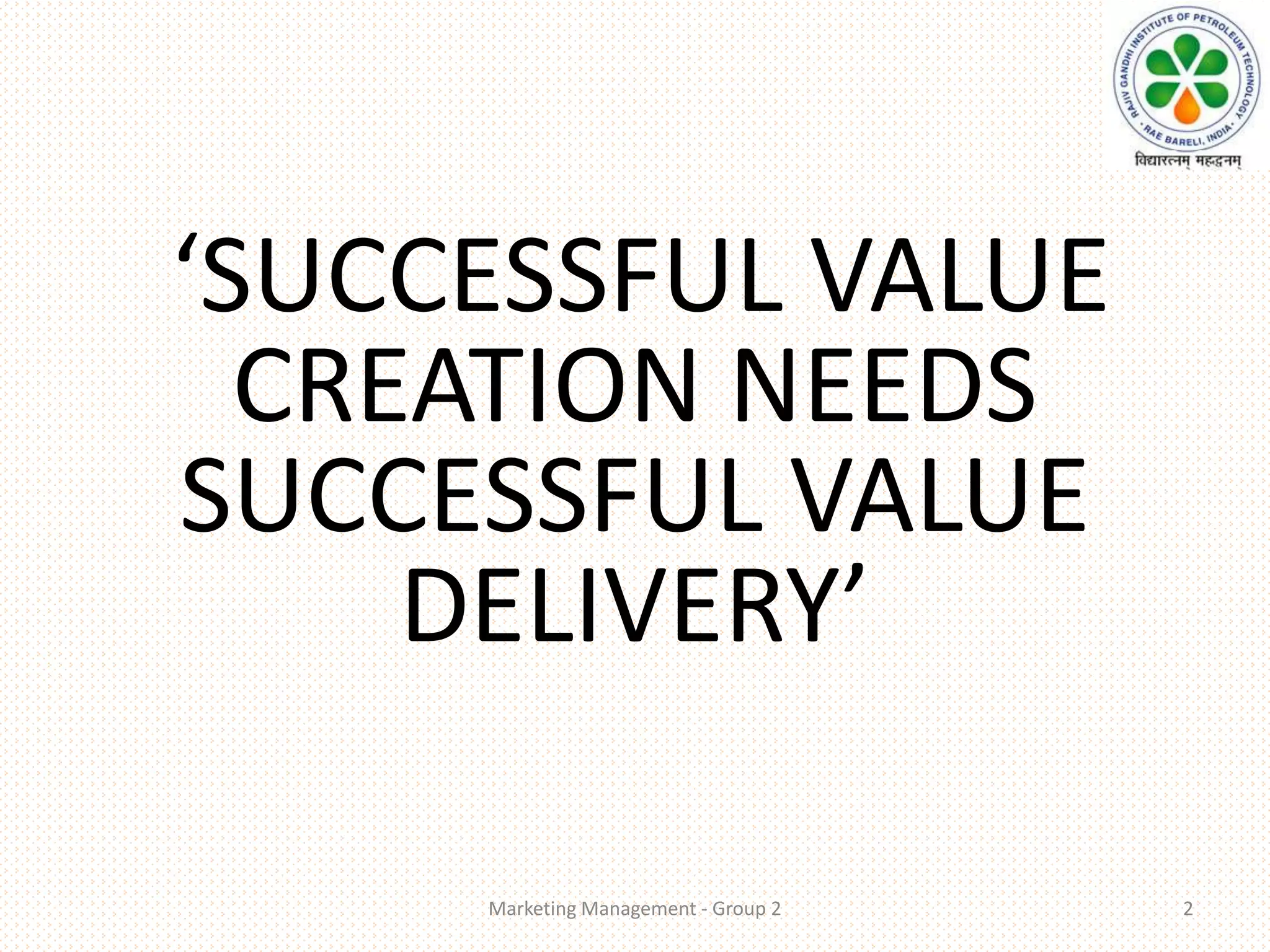
‘SUCCESSFUL VALUE
CREATION NEEDS
SUCCESSFUL VALUE
DELIVERY’
Marketing Management - Group 2 2
• Marketing Channel/Trade
Channel/Distribution Channel
Importance of Marketing Channel:
• To convert potential buyers to profitable
customers.
• Firm’s pricing depends on selection of
marketing channels.
Marketing Management - Group 2 3
Categories of Channel Partners
Merchants
Agents
Facilitators
Marketing Management - Group 2 4
Understanding Customer’s Needs
• Factors based on which customers chooses a
particular channel are :-
1. Price.
2. Product assortment.
3. Convenience.
4. Own shopping goals like economic, social and
experimental.
Marketing Management - Group 2 5
Categories of Buyer
1. Habitual shoppers
2. High value deal seekers
3. Variety loving shoppers
4. High involvement buyers
Marketing Management - Group 2 6
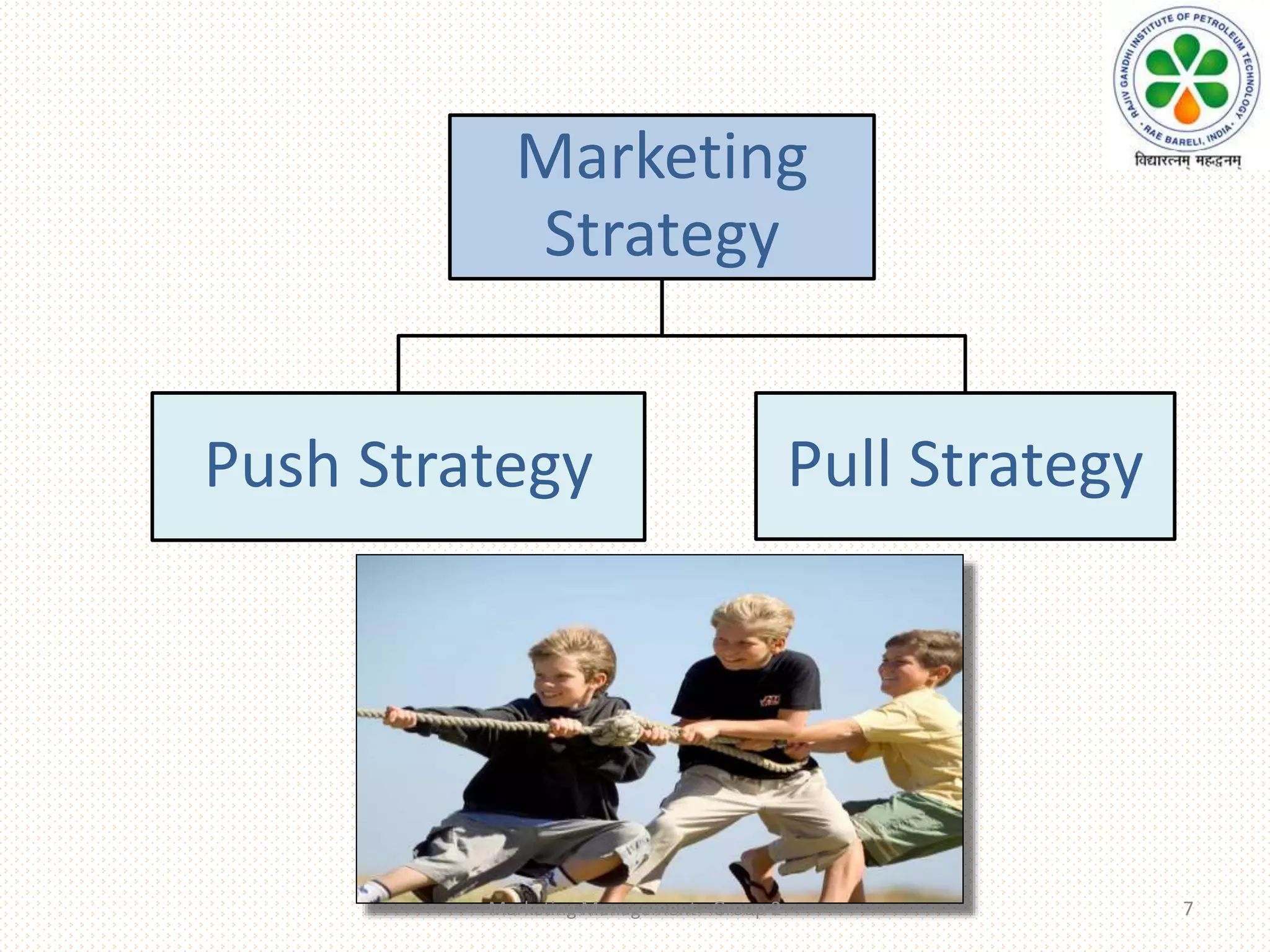
Marketing
Strategy
Push Strategy Pull Strategy
Marketing Management - Group 2 7
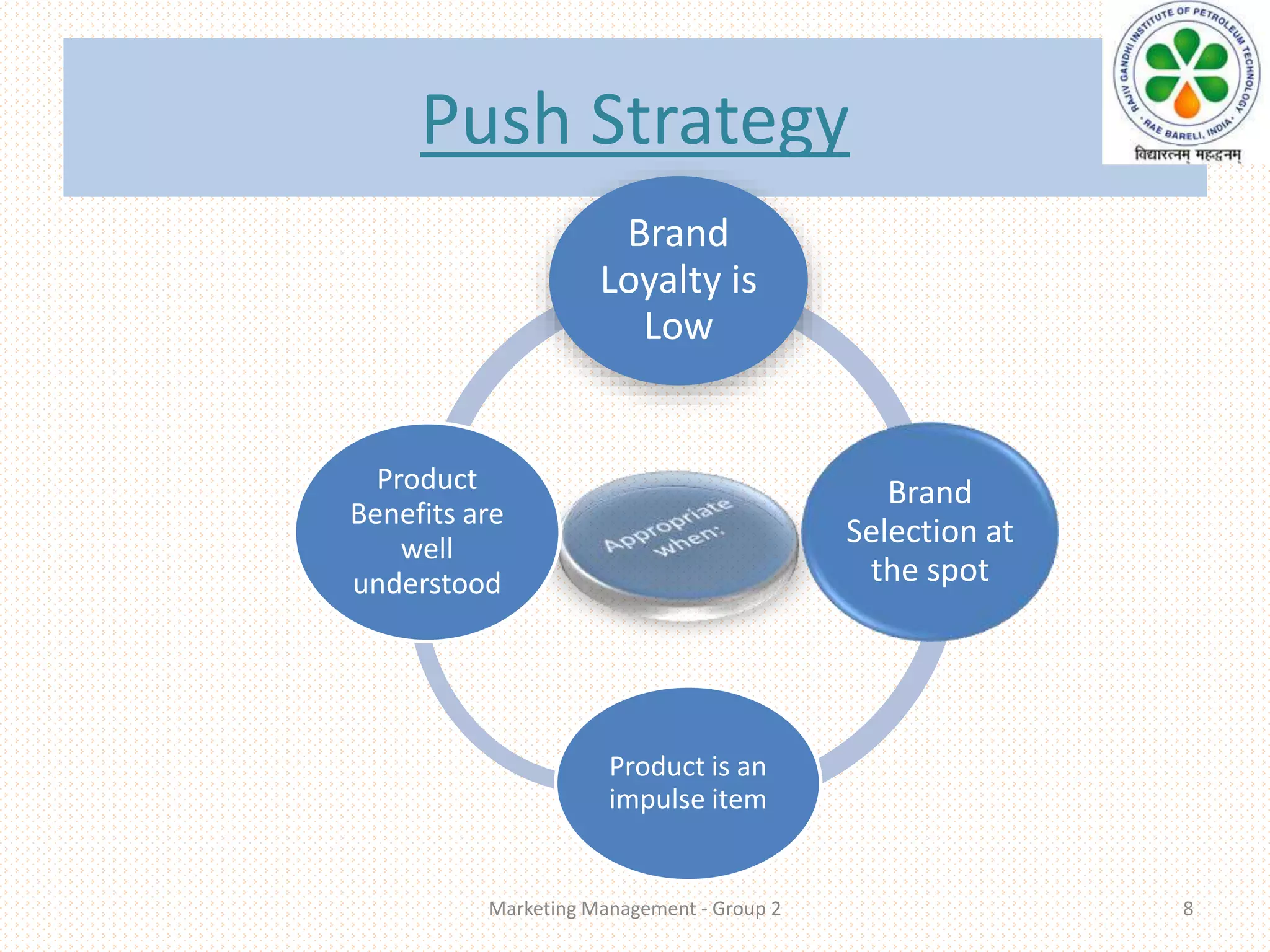
Push Strategy
Brand
Loyalty is
Low
Brand
Selection at
the spot
Product is an
impulse item
Product
Benefits are
well
understood
Marketing Management - Group 2 8
Pull Strategy
Appropriate
when :
Brand
Loyalty is
High
High
Involvement
product
Brand
Distinction
is Possible
Brand
Selection
Prior to
Purchase
Marketing Management - Group 2 9
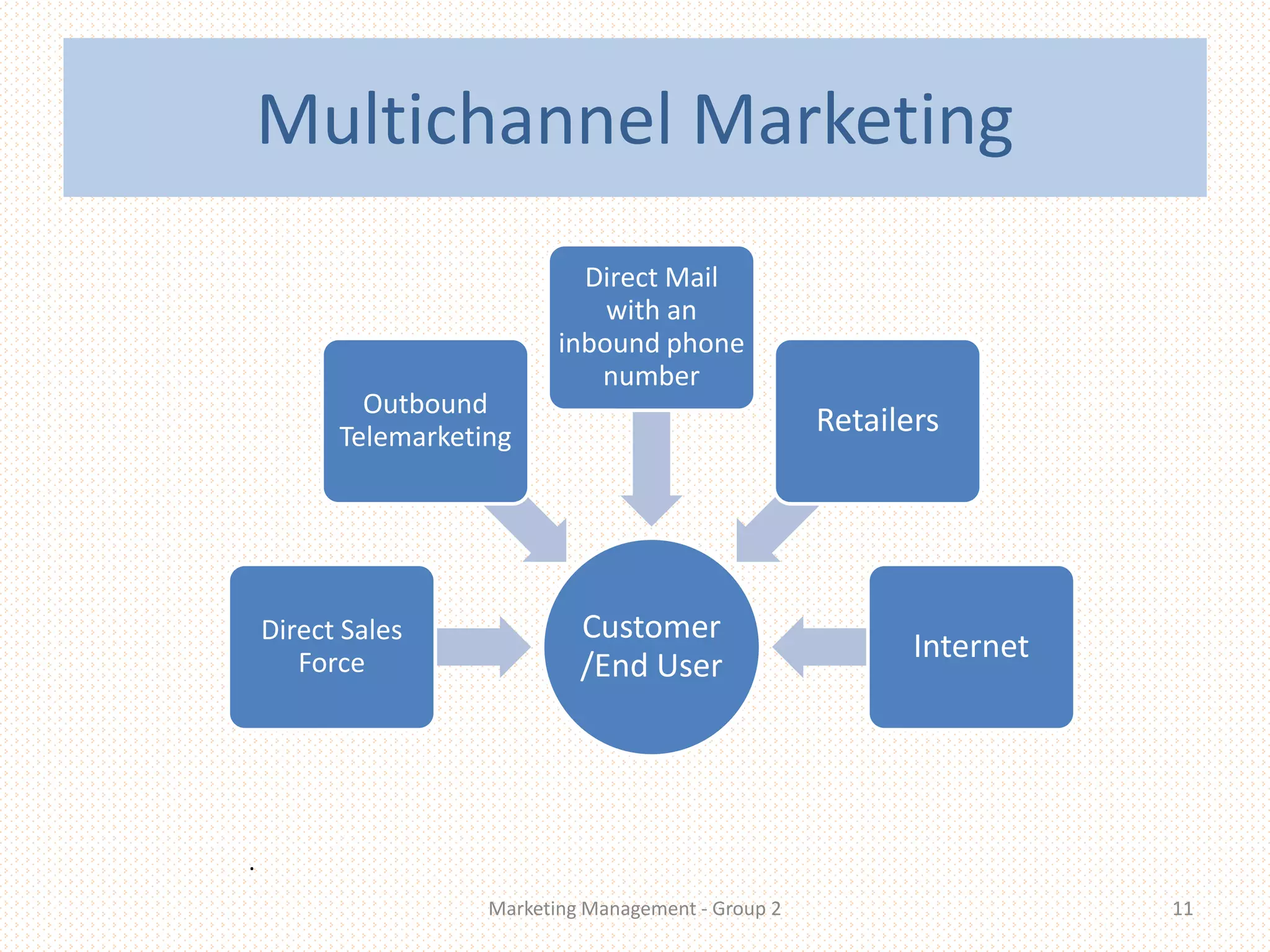
MULTICHANNEL MARKETING
Benefits of adding multiple channels:
• Increased market coverage
• Lower channel cost
• Ability to do more customized selling
Marketing Management - Group 2 10
Multichannel Marketing
Customer
/End User
Direct Sales
Force
Outbound
Telemarketing
Direct Mail
with an
inbound phone
number
Retailers
Internet
.
Marketing Management - Group 2 11
Integrating Multichannel Marketing
Systems – Omni-channel Marketing
Traditional
Marketing
Channels
Internet/Tele
-marketing
Consumers/End
Users
Marketing Management - Group 2 12
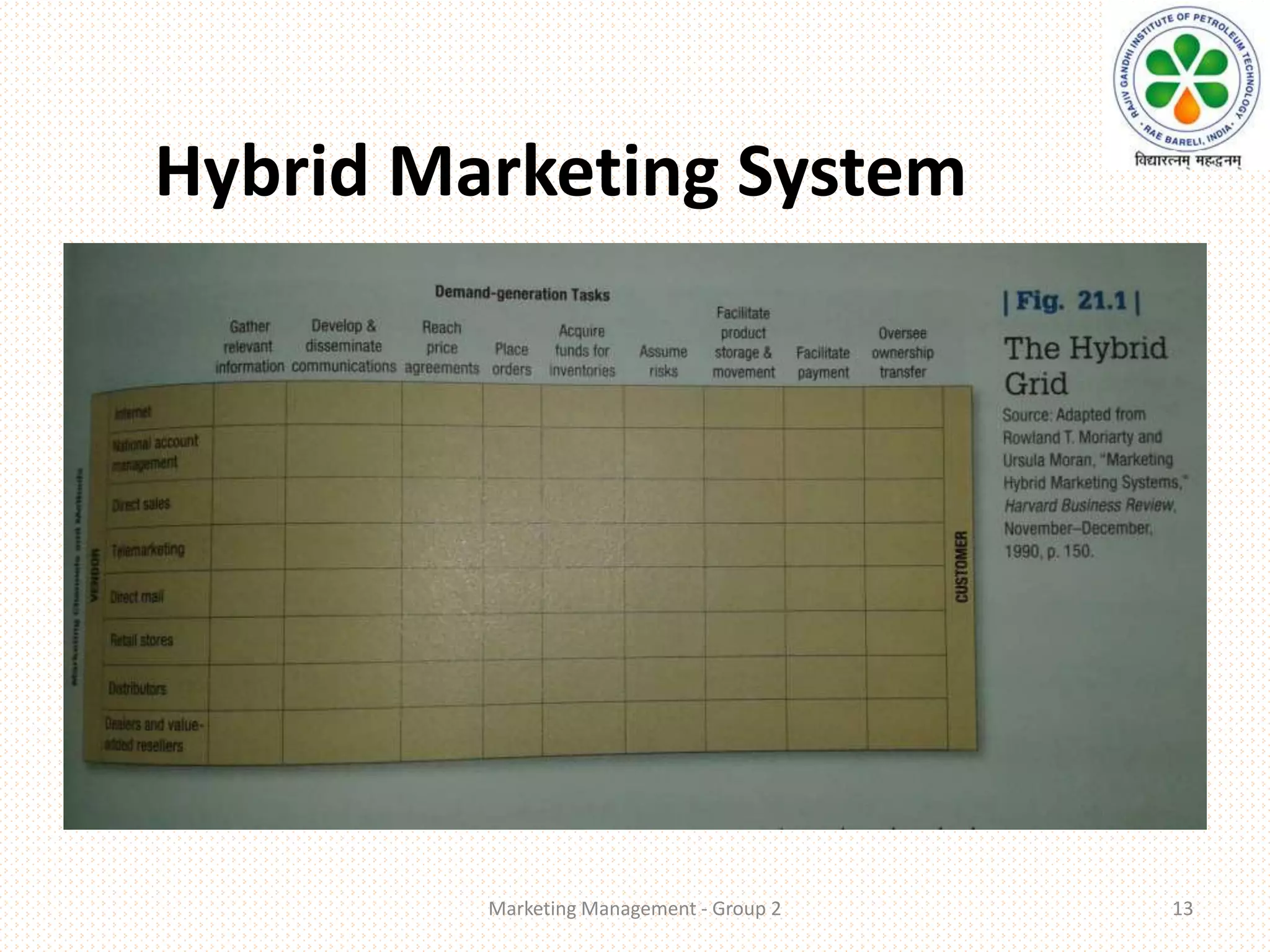
Hybrid Marketing System
Marketing Management - Group 2 13
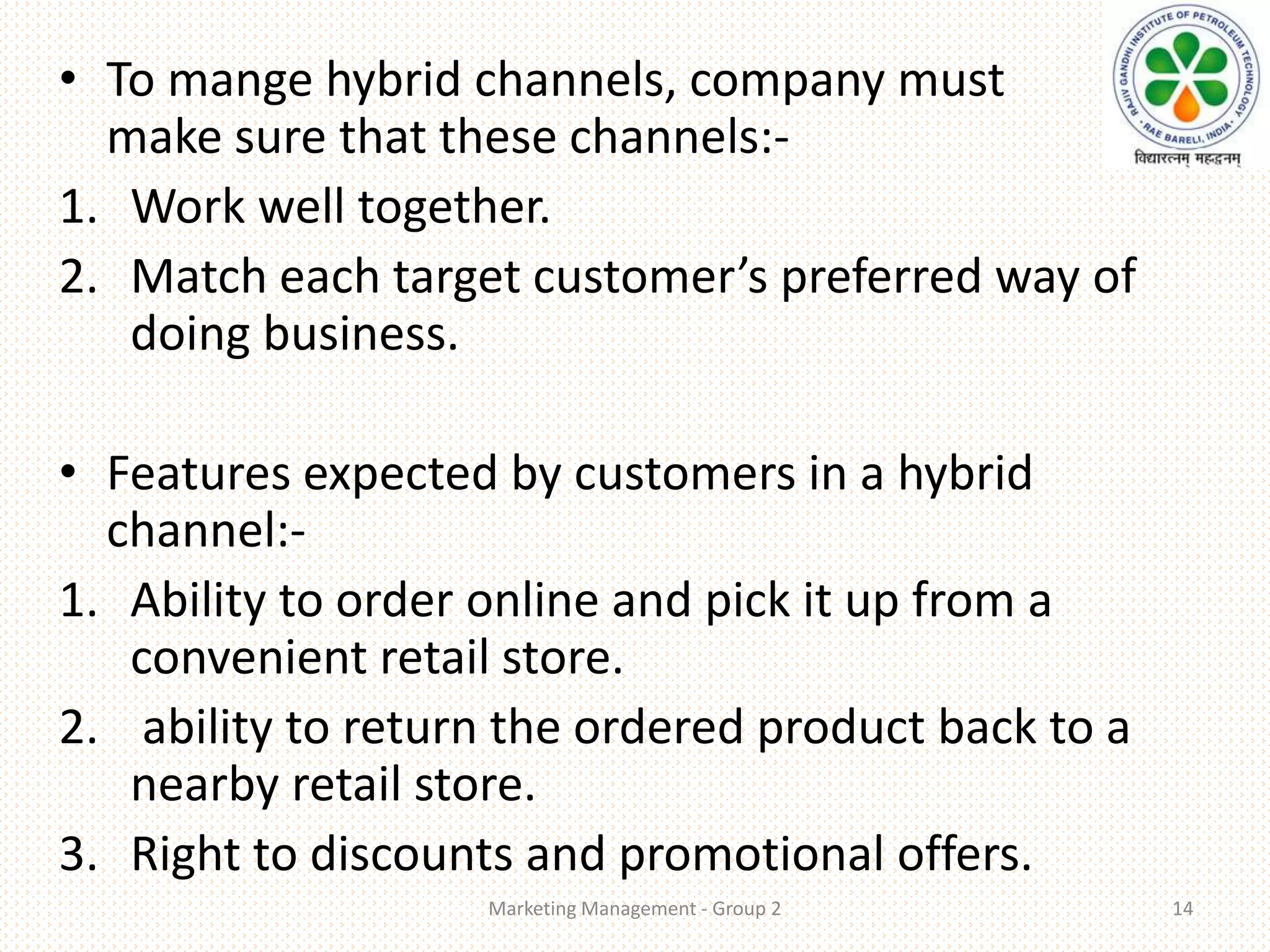
• To mange hybrid channels, company must
make sure that these channels:-
1. Work well together.
2. Match each target customer’s preferred way of
doing business.
• Features expected by customers in a hybrid
channel:-
1. Ability to order online and pick it up from a
convenient retail store.
2. ability to return the ordered product back to a
nearby retail store.
3. Right to discounts and promotional offers.
Marketing Management - Group 2 14
Value Networks
• A value network includes:-
1. Firm’s suppliers.
2. Its supplier’s supplier.
3. Its intermediate customers.
4. End customers
5. Demand Chain Planning
• Managing a value network:
SCM – ERP Systems: Cash Flow, Manufacturing, Human Resources,
purchasing and other
CRM
Marketing Management - Group 2 15
Marketing Channel Flow
Marketing Management - Group 2 16
Channel Function and Flows
1. Gathers information
2. Negotiate and reach agreement on price.
3. Place orders with manufacturers.
4. Acquire the funds to finance inventories.
5. Provide storage and movement of goods.
6. Payment of the bills by buyers.
Marketing Management - Group 2 17
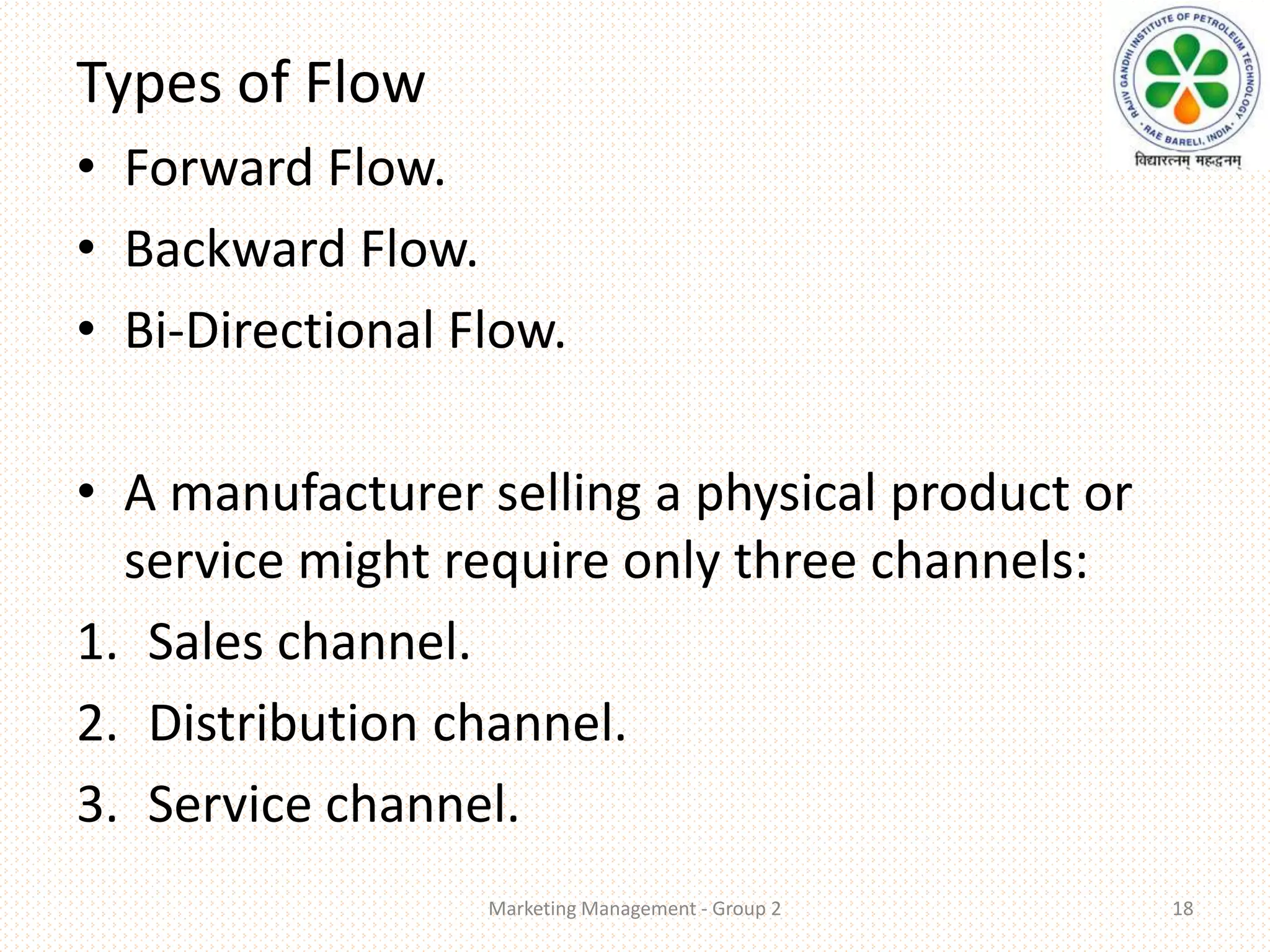
Types of Flow
• Forward Flow.
• Backward Flow.
• Bi-Directional Flow.
• A manufacturer selling a physical product or
service might require only three channels:
1. Sales channel.
2. Distribution channel.
3. Service channel.
Marketing Management - Group 2 18
Marketing Channels
Consumer Marketing
Channels
Industrial Marketing
Channels
Marketing Management - Group 2 19
Channel Levels
• The producers and final customers are part of
every channel.
• A zero level channel (Tupperware, TVC
Product).
• The one level channel.
• Two level channel.
• Three level channel.
Marketing Management - Group 2 20
Channel-Design Decisions
Designing a marketing channel requires:-
1. Analyzing customer needs.
2. Establishing channel objectives.
3. Identifying major channel alternatives.
4. Evaluating major channel alternatives.
Marketing Management - Group 2 21
1. Analyzing Customer Needs
Channels produce five service outputs:-
1. Lot Size.
2. Waiting and Delivery Time.
3. Spatial Convenience:- Exide batteries has
made it easier for consumers to access them.
4. Product Variety.
5. Service Backup.
Marketing Management - Group 2 22
2. Establishing Objectives and Constraints
• Channel objectives vary with product
characteristics :-
1. Perishable products - direct marketing.
2. Bulky products - channels that minimize
shipping distance and amount of handling.
3. Custom built machinery - company sales
representatives.
4. Products requiring installations and regular
check ups – company owned or leased
franchisees.
Marketing Management - Group 2 23
3. Identifying Major Channel Alternatives
A firm can choose from a wide variety channels
for reaching customers:-
1. Sales force.
2. Internet.
3. Distributors.
4. Manufacturer Representatives.
Marketing Management - Group 2 24
Number of Intermediaries
A firm can decide on number of intermediaries
to use at each level by using these three
strategies :-
1. Exclusive distribution.
2. Selective distribution.
3. Intensive distribution.
Marketing Management - Group 2 25
4. Evaluating Major Channel Alternatives
• Each channel alternative needs to be
evaluated against economic, control &
adaptive criteria.
Marketing Management - Group 2 26
The Value-Adds versus Costs of
Different Channels
Marketing Management - Group 2 27
Terms and Responsibilities of Channel
Members
 Each channel member must be treated
respectfully and must be given opportunity to
be profitable.
 Main policies are:-
1. Price policies.
2. Condition of sales.
3. Territorial rights.
4. Mutual services and responsibilities.
Marketing Management - Group 2 28
1. Selecting Channel Members
 To select a channel member producer should
determine:-
1. No. of years in business.
2. Other lines carried out.
3. Growth and profit record.
4. Financial strength.
5. Cooperativeness.
6. Service reputation.
Marketing Management - Group 2 29
2. Training and Motivating Channel
Members
 After a channel has been chosen, company
must Select, Train & Motivate individual
intermediaries for each channel.
Marketing Management - Group 2 30
Powers a manufacturer posses to
elicit cooperation from intermediaries
1. Coercive power:- threatening intermediaries to
terminate relationship if they fail to cooperate.
2. Reward power:- offering extra benefits on
performing specific act or function.
3. Legitimate power:- demand for behavior that is
warranted under contract.
4. Expert power:- having a special knowledge that
intermediaries value and doesn’t posses.
Marketing Management - Group 2 31
 Channel Partnership:- Efficient Consumer
Response (ECR) opted by manufacturer and
intermediaries to streamline supply chain and
cut costs.ECR organizes relationship between
manufacturer and intermediaries in two
areas:-
1. Demand side management:- collaborative
activities to stimulate demand from
consumer side by promoting joint marketing
and sales activities.
2. Supply side management:- collaborative
practices to optimize supply.Marketing Management - Group 2 32
3. Evaluating Channel Members
 Manufacturers regularly check performance
against standards such as:-
sales quotas
inventory levels
customer delivery time
treatment of damaged and lost goods
cooperation in promotional and training
programs.
Marketing Management - Group 2 33
4. Modifying Channel Design
 A channel is modified when:-
1. Channel is not working well as planned.
2. Consumer buying pattern change.
3. Market expands.
4. New competition arises.
5. Product moves into latter stage of its product
life cycle.
Marketing Management - Group 2 34
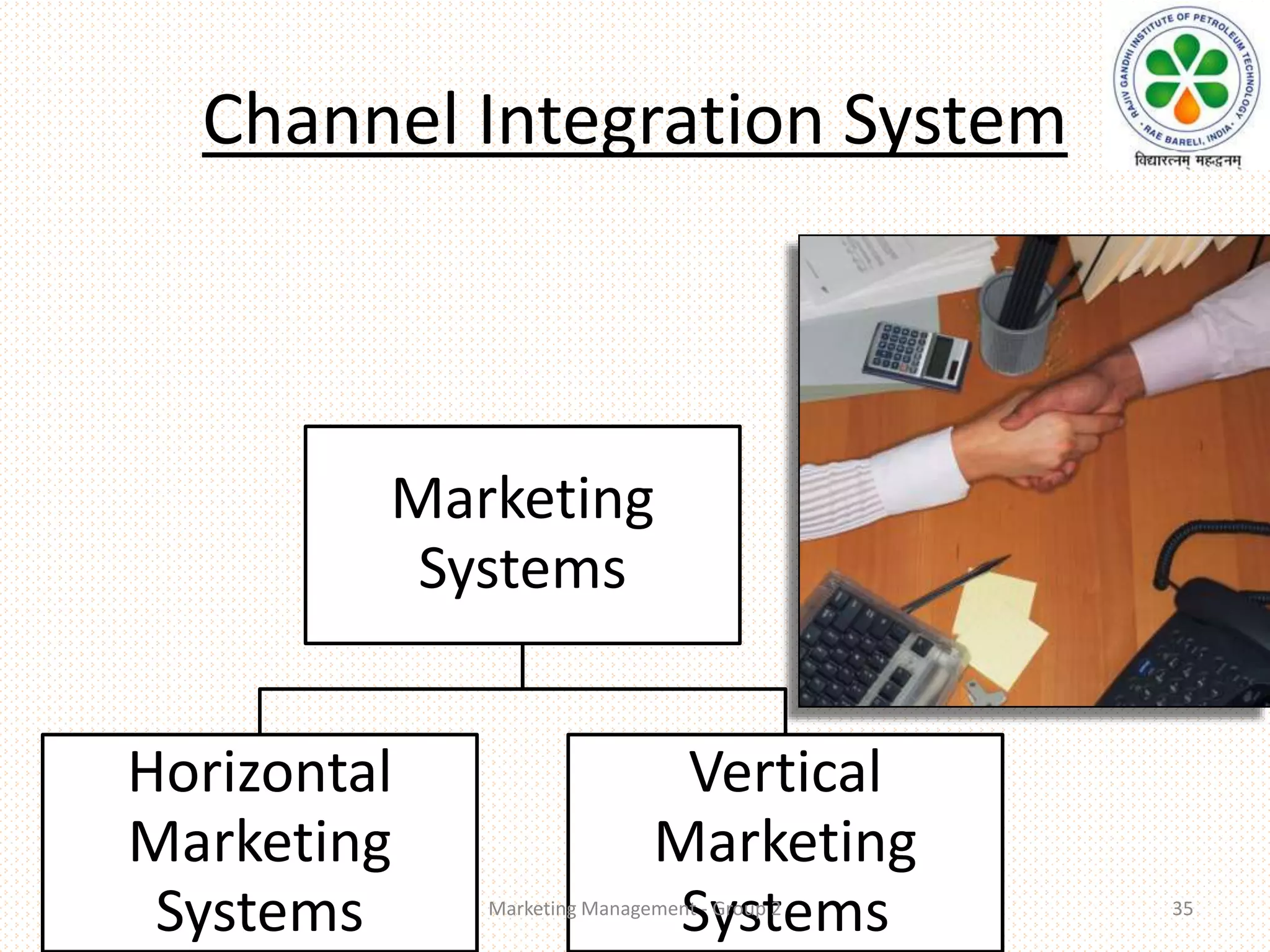
Channel Integration System
Marketing
Systems
Horizontal
Marketing
Systems
Vertical
Marketing
SystemsMarketing Management - Group 2 35
Horizontal Marketing System
• A horizontal marketing system is one in which
two or more unrelated companies put
together resources or programs to exploit an
emerging market opportunity.
• Each one lacks capital, know how production,
marketing resources to venture alone.
• Companies might work with each other on
temporary or permanent basis.
Marketing Management - Group 2 36
Vertical Marketing System
• The producer, wholesaler and retailer
acts a unified system.
• One channel member, the channel
captain owns or franchises the others
or has so much power that they all
cooperate.
• VMS arose as a result of strong channel
members’ attempt to control behavior
and eliminate the conflict.
Marketing Management - Group 2 37
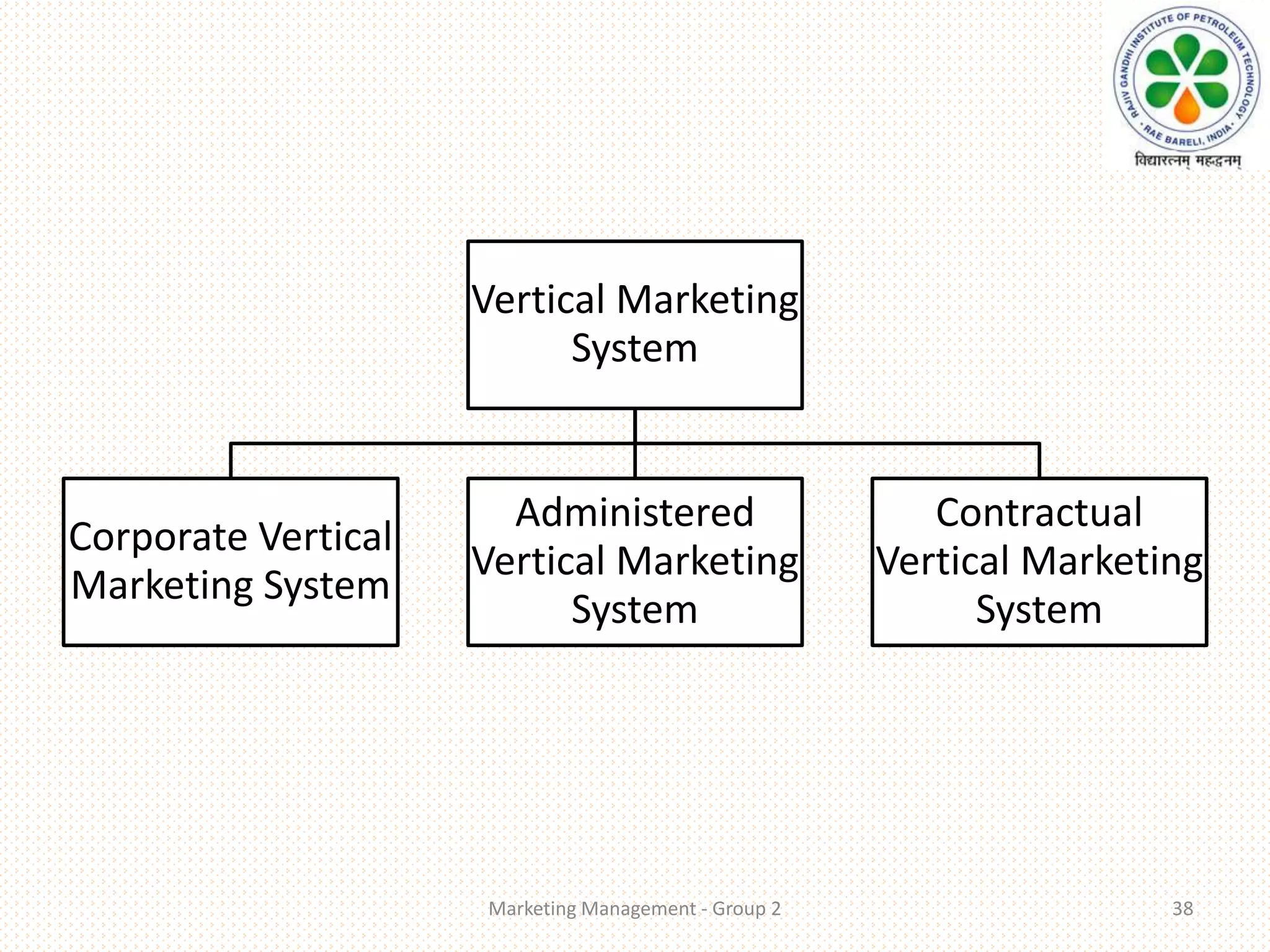
Vertical Marketing
System
Corporate Vertical
Marketing System
Administered
Vertical Marketing
System
Contractual
Vertical Marketing
System
Marketing Management - Group 2 38
• Corporate Vertical Marketing System:- It
combines successive stages of production
and distribution under single ownership.
• Administered Vertical Marketing System:- It
coordinates successive stages of production
and distribution through size and power of
one of the members.
• Contractual Vertical Marketing System:- It
consists of independent firms at different
levels of production and distribution, in order
to obtain more economies or sales impact
what they had achieved alone.
Marketing Management - Group 2 39
Contractual
Vertical Marketing
Systems
Wholesalers
Sponsored
Voluntary Chain
Retailer
Cooperatives
Franchisee
Organizations
Marketing Management - Group 2 40
• Wholesalers Sponsored Voluntary Chain:- Wholesalers
organize voluntary chains of retailers to help them
standardize their selling practices and help them achieve
buying economies in order to compete with large chain
organizations.
Eg: Coca-Cola bottler is a manufacturer-sponsored
wholesaler.
• Retailer Cooperatives:- Retailers take the initiative and
organize new business entity to carry on wholesaling with
some production. Members concentrate their purchases
through retailer co-op and plan their advertising jointly.
Profits pass back to members in proportion to their
purchase.
Eg: Mother Dairy, AMUL etc.
• Franchisee Organization:- A channel member called
franchisor might link several successive stage in the
production-distribution process.
Eg: McDonalds
Marketing Management - Group 2 41
Conflict, Cooperation and Competition
• Channel conflict is generated when one
channel members’ action prevent another
channel from achieving its goals.
• Channel coordination occurs when channel
members are brought together to advance
goals of the channel as opposed to their own
potentially incompatible goals.
Marketing Management - Group 2 42
Conflict
Types of Conflict
Causes of Conflict
Managing
Conflicts
Marketing Management - Group 2 43
Types of Conflicts
1. Horizontal Conflict- It occurs among firms at the
same level of channel. Eg- One dealer may
complain about other.
2. Vertical Conflict- It occurs among different levels
of the same channel. Eg- The wholesaler may
complain about Distributer/Retailer.
3. Multichannel- Occurs when the manufacturer
establishes two or more channels that sell to
same market. Eg- Goodyear selling tires through
independent Dealers & Wallmart.
Marketing Management - Group 2 44
Causes of Channel Conflict
1. Goal incompatibility :- Manufacturers want
to achieve rapid market penetration through
low price policy.
2. Unclear Roles and Rights :- HP may sell
personal computers to large accounts
through its own sales force, but its licensed
dealers may also be trying to sell to large
accounts.
Marketing Management - Group 2 45
3. Differences in Perception:- Disputes between
manufacturers and distributors about optimal
advertising strategy.
4. Intermediaries Dependence on Manufacturer:-
Fortune of exclusive dealers depend totally
upon manufacturers’ products and pricing
decisions which creates high potential for
conflict.
Marketing Management - Group 2 46
Managing Channel Conflict
1. Strategic Justification
2. Dual Compensation
3. Adoption of Superordinate Goal:- Channel
members come to an agreement on
fundamental goals they are jointly seeking,
weather it is survival, market share, high
quality or customer satisfaction.
4. Exchange of Employees
Marketing Management - Group 2 47
5. Joint Membership in Trade Association:- The
manufacturer and the intermediaries come
together in good cooperation which may lead to
better understanding between them.
6. Co-optation:- It is an effort by one organization
to win the support of leaders of other
organization by including them in advisory
council, board of directors, which reduces the
chances of conflicts.
7. Diplomacy, Mediation or Arbitration:- when
conflict is chronic, the companies may need to
resort to diplomacy, mediation or arbitration.
Marketing Management - Group 2 48
• Diplomacy:- It takes place when each
sends a person or groups to meet with its
counterparts to resolve the conflict.
• Mediation:- It means resorting to a neutral
third party skilled in conciliating the two
parties interest.
• Arbitration:- It occurs when both the parties
agree to present their arguments to one or
more arbitrators and accept their decisions.
8. Legal Recourse:- when none of the above
methods prove effective, company or
channel partners may choose to file a law
suit. Marketing Management - Group 2 49
Thank You!!
Marketing Management - Group 2 50

Marketing group 2 imc

  • 1.
    DESIGNING & MANAGING INTEGRATEDMARKETING CHANNELS Presented By: Dhruv Maniar (M1603) R.Harish (M1605) Satarupa Mohapatra (M1613) Vivek Kumar (M1617) Marketing Management - Group 2 1
  • 2.
    ‘SUCCESSFUL VALUE CREATION NEEDS SUCCESSFULVALUE DELIVERY’ Marketing Management - Group 2 2
  • 3.
    • Marketing Channel/Trade Channel/DistributionChannel Importance of Marketing Channel: • To convert potential buyers to profitable customers. • Firm’s pricing depends on selection of marketing channels. Marketing Management - Group 2 3
  • 4.
    Categories of ChannelPartners Merchants Agents Facilitators Marketing Management - Group 2 4
  • 5.
    Understanding Customer’s Needs •Factors based on which customers chooses a particular channel are :- 1. Price. 2. Product assortment. 3. Convenience. 4. Own shopping goals like economic, social and experimental. Marketing Management - Group 2 5
  • 6.
    Categories of Buyer 1.Habitual shoppers 2. High value deal seekers 3. Variety loving shoppers 4. High involvement buyers Marketing Management - Group 2 6
  • 7.
    Marketing Strategy Push Strategy PullStrategy Marketing Management - Group 2 7
  • 8.
    Push Strategy Brand Loyalty is Low Brand Selectionat the spot Product is an impulse item Product Benefits are well understood Marketing Management - Group 2 8
  • 9.
    Pull Strategy Appropriate when : Brand Loyaltyis High High Involvement product Brand Distinction is Possible Brand Selection Prior to Purchase Marketing Management - Group 2 9
  • 10.
    MULTICHANNEL MARKETING Benefits ofadding multiple channels: • Increased market coverage • Lower channel cost • Ability to do more customized selling Marketing Management - Group 2 10
  • 11.
    Multichannel Marketing Customer /End User DirectSales Force Outbound Telemarketing Direct Mail with an inbound phone number Retailers Internet . Marketing Management - Group 2 11
  • 12.
    Integrating Multichannel Marketing Systems– Omni-channel Marketing Traditional Marketing Channels Internet/Tele -marketing Consumers/End Users Marketing Management - Group 2 12
  • 13.
    Hybrid Marketing System MarketingManagement - Group 2 13
  • 14.
    • To mangehybrid channels, company must make sure that these channels:- 1. Work well together. 2. Match each target customer’s preferred way of doing business. • Features expected by customers in a hybrid channel:- 1. Ability to order online and pick it up from a convenient retail store. 2. ability to return the ordered product back to a nearby retail store. 3. Right to discounts and promotional offers. Marketing Management - Group 2 14
  • 15.
    Value Networks • Avalue network includes:- 1. Firm’s suppliers. 2. Its supplier’s supplier. 3. Its intermediate customers. 4. End customers 5. Demand Chain Planning • Managing a value network: SCM – ERP Systems: Cash Flow, Manufacturing, Human Resources, purchasing and other CRM Marketing Management - Group 2 15
  • 16.
    Marketing Channel Flow MarketingManagement - Group 2 16
  • 17.
    Channel Function andFlows 1. Gathers information 2. Negotiate and reach agreement on price. 3. Place orders with manufacturers. 4. Acquire the funds to finance inventories. 5. Provide storage and movement of goods. 6. Payment of the bills by buyers. Marketing Management - Group 2 17
  • 18.
    Types of Flow •Forward Flow. • Backward Flow. • Bi-Directional Flow. • A manufacturer selling a physical product or service might require only three channels: 1. Sales channel. 2. Distribution channel. 3. Service channel. Marketing Management - Group 2 18
  • 19.
    Marketing Channels Consumer Marketing Channels IndustrialMarketing Channels Marketing Management - Group 2 19
  • 20.
    Channel Levels • Theproducers and final customers are part of every channel. • A zero level channel (Tupperware, TVC Product). • The one level channel. • Two level channel. • Three level channel. Marketing Management - Group 2 20
  • 21.
    Channel-Design Decisions Designing amarketing channel requires:- 1. Analyzing customer needs. 2. Establishing channel objectives. 3. Identifying major channel alternatives. 4. Evaluating major channel alternatives. Marketing Management - Group 2 21
  • 22.
    1. Analyzing CustomerNeeds Channels produce five service outputs:- 1. Lot Size. 2. Waiting and Delivery Time. 3. Spatial Convenience:- Exide batteries has made it easier for consumers to access them. 4. Product Variety. 5. Service Backup. Marketing Management - Group 2 22
  • 23.
    2. Establishing Objectivesand Constraints • Channel objectives vary with product characteristics :- 1. Perishable products - direct marketing. 2. Bulky products - channels that minimize shipping distance and amount of handling. 3. Custom built machinery - company sales representatives. 4. Products requiring installations and regular check ups – company owned or leased franchisees. Marketing Management - Group 2 23
  • 24.
    3. Identifying MajorChannel Alternatives A firm can choose from a wide variety channels for reaching customers:- 1. Sales force. 2. Internet. 3. Distributors. 4. Manufacturer Representatives. Marketing Management - Group 2 24
  • 25.
    Number of Intermediaries Afirm can decide on number of intermediaries to use at each level by using these three strategies :- 1. Exclusive distribution. 2. Selective distribution. 3. Intensive distribution. Marketing Management - Group 2 25
  • 26.
    4. Evaluating MajorChannel Alternatives • Each channel alternative needs to be evaluated against economic, control & adaptive criteria. Marketing Management - Group 2 26
  • 27.
    The Value-Adds versusCosts of Different Channels Marketing Management - Group 2 27
  • 28.
    Terms and Responsibilitiesof Channel Members  Each channel member must be treated respectfully and must be given opportunity to be profitable.  Main policies are:- 1. Price policies. 2. Condition of sales. 3. Territorial rights. 4. Mutual services and responsibilities. Marketing Management - Group 2 28
  • 29.
    1. Selecting ChannelMembers  To select a channel member producer should determine:- 1. No. of years in business. 2. Other lines carried out. 3. Growth and profit record. 4. Financial strength. 5. Cooperativeness. 6. Service reputation. Marketing Management - Group 2 29
  • 30.
    2. Training andMotivating Channel Members  After a channel has been chosen, company must Select, Train & Motivate individual intermediaries for each channel. Marketing Management - Group 2 30
  • 31.
    Powers a manufacturerposses to elicit cooperation from intermediaries 1. Coercive power:- threatening intermediaries to terminate relationship if they fail to cooperate. 2. Reward power:- offering extra benefits on performing specific act or function. 3. Legitimate power:- demand for behavior that is warranted under contract. 4. Expert power:- having a special knowledge that intermediaries value and doesn’t posses. Marketing Management - Group 2 31
  • 32.
     Channel Partnership:-Efficient Consumer Response (ECR) opted by manufacturer and intermediaries to streamline supply chain and cut costs.ECR organizes relationship between manufacturer and intermediaries in two areas:- 1. Demand side management:- collaborative activities to stimulate demand from consumer side by promoting joint marketing and sales activities. 2. Supply side management:- collaborative practices to optimize supply.Marketing Management - Group 2 32
  • 33.
    3. Evaluating ChannelMembers  Manufacturers regularly check performance against standards such as:- sales quotas inventory levels customer delivery time treatment of damaged and lost goods cooperation in promotional and training programs. Marketing Management - Group 2 33
  • 34.
    4. Modifying ChannelDesign  A channel is modified when:- 1. Channel is not working well as planned. 2. Consumer buying pattern change. 3. Market expands. 4. New competition arises. 5. Product moves into latter stage of its product life cycle. Marketing Management - Group 2 34
  • 35.
  • 36.
    Horizontal Marketing System •A horizontal marketing system is one in which two or more unrelated companies put together resources or programs to exploit an emerging market opportunity. • Each one lacks capital, know how production, marketing resources to venture alone. • Companies might work with each other on temporary or permanent basis. Marketing Management - Group 2 36
  • 37.
    Vertical Marketing System •The producer, wholesaler and retailer acts a unified system. • One channel member, the channel captain owns or franchises the others or has so much power that they all cooperate. • VMS arose as a result of strong channel members’ attempt to control behavior and eliminate the conflict. Marketing Management - Group 2 37
  • 38.
    Vertical Marketing System Corporate Vertical MarketingSystem Administered Vertical Marketing System Contractual Vertical Marketing System Marketing Management - Group 2 38
  • 39.
    • Corporate VerticalMarketing System:- It combines successive stages of production and distribution under single ownership. • Administered Vertical Marketing System:- It coordinates successive stages of production and distribution through size and power of one of the members. • Contractual Vertical Marketing System:- It consists of independent firms at different levels of production and distribution, in order to obtain more economies or sales impact what they had achieved alone. Marketing Management - Group 2 39
  • 40.
  • 41.
    • Wholesalers SponsoredVoluntary Chain:- Wholesalers organize voluntary chains of retailers to help them standardize their selling practices and help them achieve buying economies in order to compete with large chain organizations. Eg: Coca-Cola bottler is a manufacturer-sponsored wholesaler. • Retailer Cooperatives:- Retailers take the initiative and organize new business entity to carry on wholesaling with some production. Members concentrate their purchases through retailer co-op and plan their advertising jointly. Profits pass back to members in proportion to their purchase. Eg: Mother Dairy, AMUL etc. • Franchisee Organization:- A channel member called franchisor might link several successive stage in the production-distribution process. Eg: McDonalds Marketing Management - Group 2 41
  • 42.
    Conflict, Cooperation andCompetition • Channel conflict is generated when one channel members’ action prevent another channel from achieving its goals. • Channel coordination occurs when channel members are brought together to advance goals of the channel as opposed to their own potentially incompatible goals. Marketing Management - Group 2 42
  • 43.
    Conflict Types of Conflict Causesof Conflict Managing Conflicts Marketing Management - Group 2 43
  • 44.
    Types of Conflicts 1.Horizontal Conflict- It occurs among firms at the same level of channel. Eg- One dealer may complain about other. 2. Vertical Conflict- It occurs among different levels of the same channel. Eg- The wholesaler may complain about Distributer/Retailer. 3. Multichannel- Occurs when the manufacturer establishes two or more channels that sell to same market. Eg- Goodyear selling tires through independent Dealers & Wallmart. Marketing Management - Group 2 44
  • 45.
    Causes of ChannelConflict 1. Goal incompatibility :- Manufacturers want to achieve rapid market penetration through low price policy. 2. Unclear Roles and Rights :- HP may sell personal computers to large accounts through its own sales force, but its licensed dealers may also be trying to sell to large accounts. Marketing Management - Group 2 45
  • 46.
    3. Differences inPerception:- Disputes between manufacturers and distributors about optimal advertising strategy. 4. Intermediaries Dependence on Manufacturer:- Fortune of exclusive dealers depend totally upon manufacturers’ products and pricing decisions which creates high potential for conflict. Marketing Management - Group 2 46
  • 47.
    Managing Channel Conflict 1.Strategic Justification 2. Dual Compensation 3. Adoption of Superordinate Goal:- Channel members come to an agreement on fundamental goals they are jointly seeking, weather it is survival, market share, high quality or customer satisfaction. 4. Exchange of Employees Marketing Management - Group 2 47
  • 48.
    5. Joint Membershipin Trade Association:- The manufacturer and the intermediaries come together in good cooperation which may lead to better understanding between them. 6. Co-optation:- It is an effort by one organization to win the support of leaders of other organization by including them in advisory council, board of directors, which reduces the chances of conflicts. 7. Diplomacy, Mediation or Arbitration:- when conflict is chronic, the companies may need to resort to diplomacy, mediation or arbitration. Marketing Management - Group 2 48
  • 49.
    • Diplomacy:- Ittakes place when each sends a person or groups to meet with its counterparts to resolve the conflict. • Mediation:- It means resorting to a neutral third party skilled in conciliating the two parties interest. • Arbitration:- It occurs when both the parties agree to present their arguments to one or more arbitrators and accept their decisions. 8. Legal Recourse:- when none of the above methods prove effective, company or channel partners may choose to file a law suit. Marketing Management - Group 2 49
  • 50.

Editor's Notes

  • #18 Gathers information about potential and current customers and competitors.
  • #23 Lot Size:- the number of units the channel permits a typical customer to purchase on one occasion. Waiting and Delivery Time:- the average time customers wait for receipt of goods.
  • #25 Sales force – complex product and transactions. Internet – less expensive but not effective with complex products. Distributors – can create sales but contact with customers is lost. Manufacturer Representatives – reach to different segment of customers and delivers the right product at low cost. If fails then leads to channel conflicts and excessive costs.