CHAPTER 7
MANAGING MARKETING CHANNELS
Defining Marketing Channel
A marketing channel system is the particular set of interdependent
organizations involved in the process of making a product or service
available for use or consumption.
General Channel Strategies
• A push strategy uses the manufacturer’s sales force, trade promotion
money, and other means to induce intermediaries to carry, promote,
and sell the product to end users.
• A pull strategy uses advertising, promotion, and other forms of
communication to persuade consumers to demand the product from
intermediaries.
Channel Member Functions
 Gather information
 Develop and disseminate persuasive communications
 Reach agreements on price and terms
 Acquire funds to finance inventories
 Assume risks
 Provide for storage
 Provide for buyers’ payment of their bills
 Oversee actual transfer of ownership
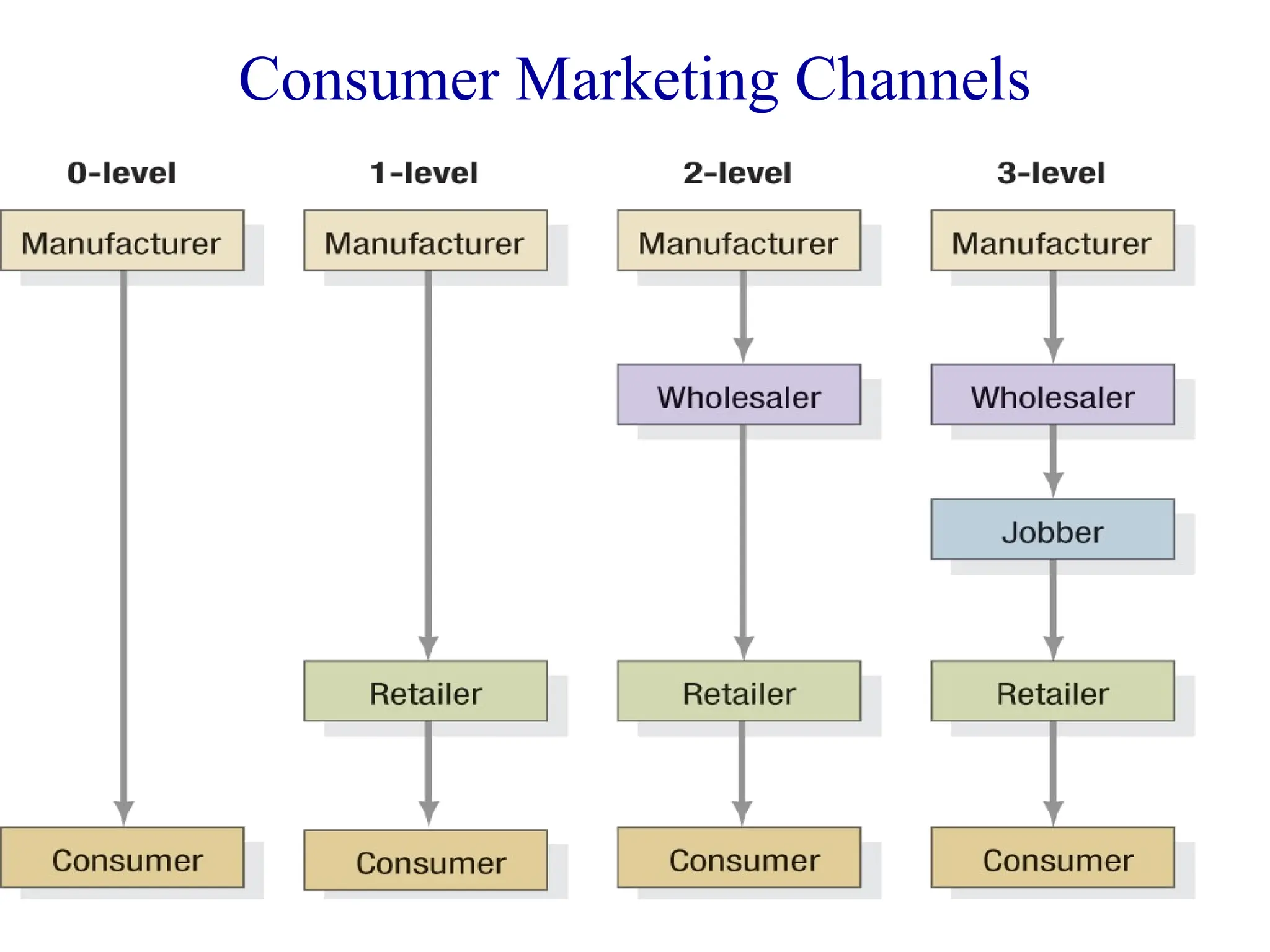
Consumer Marketing Channels
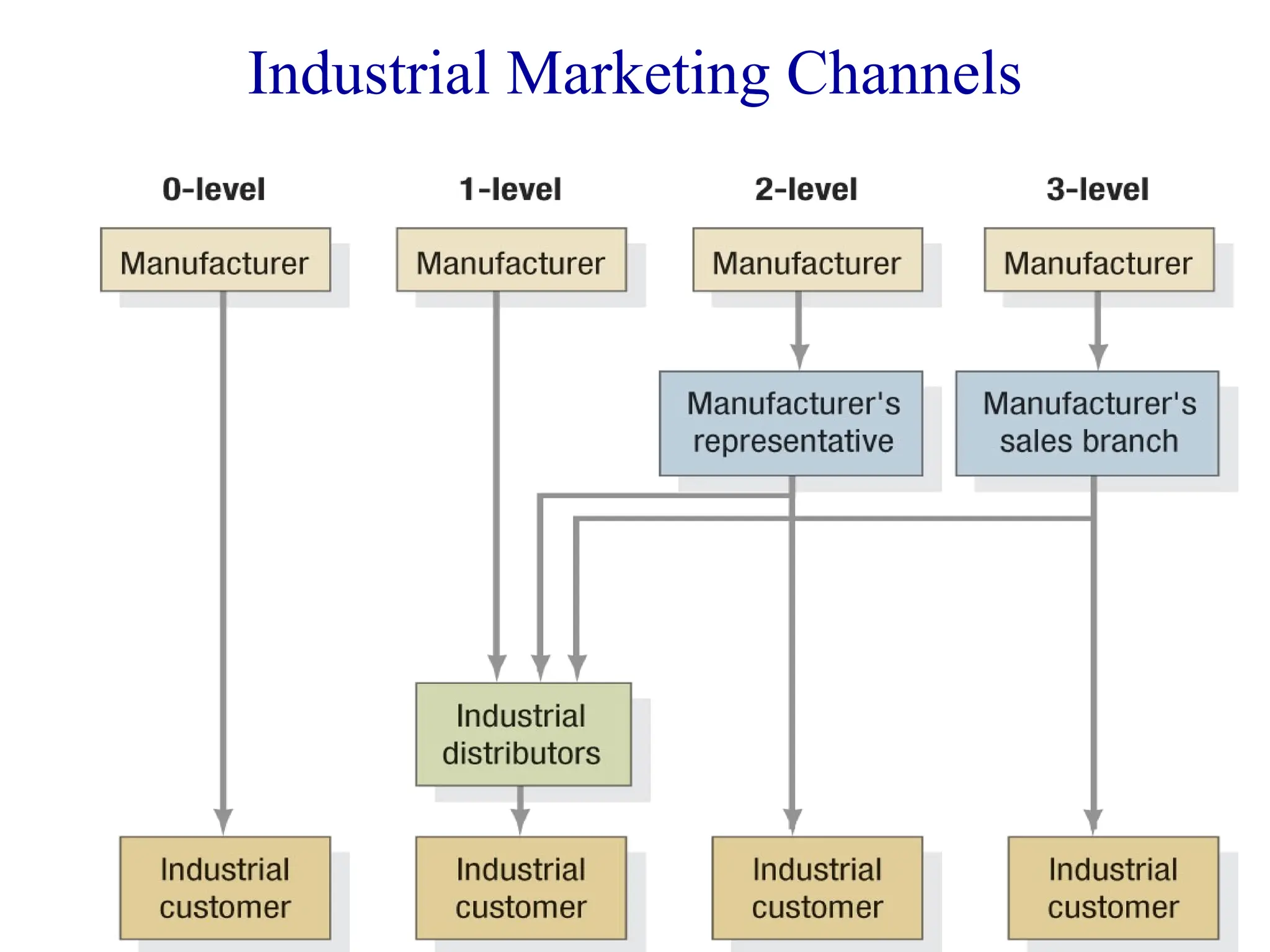
Industrial Marketing Channels
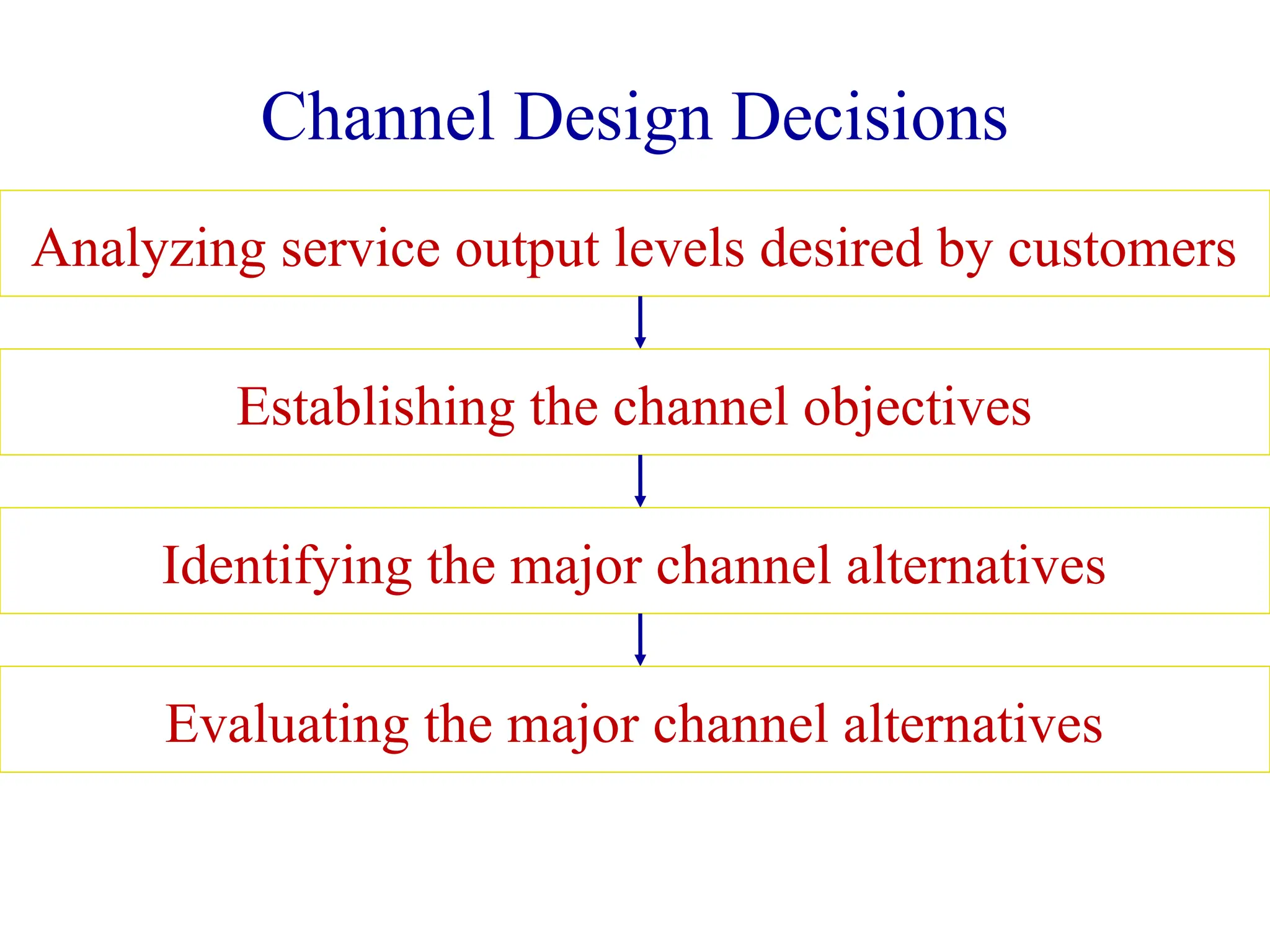
Channel Design Decisions
Analyzing service output levels desired by customers
Establishing the channel objectives
Identifying the major channel alternatives
Evaluating the major channel alternatives
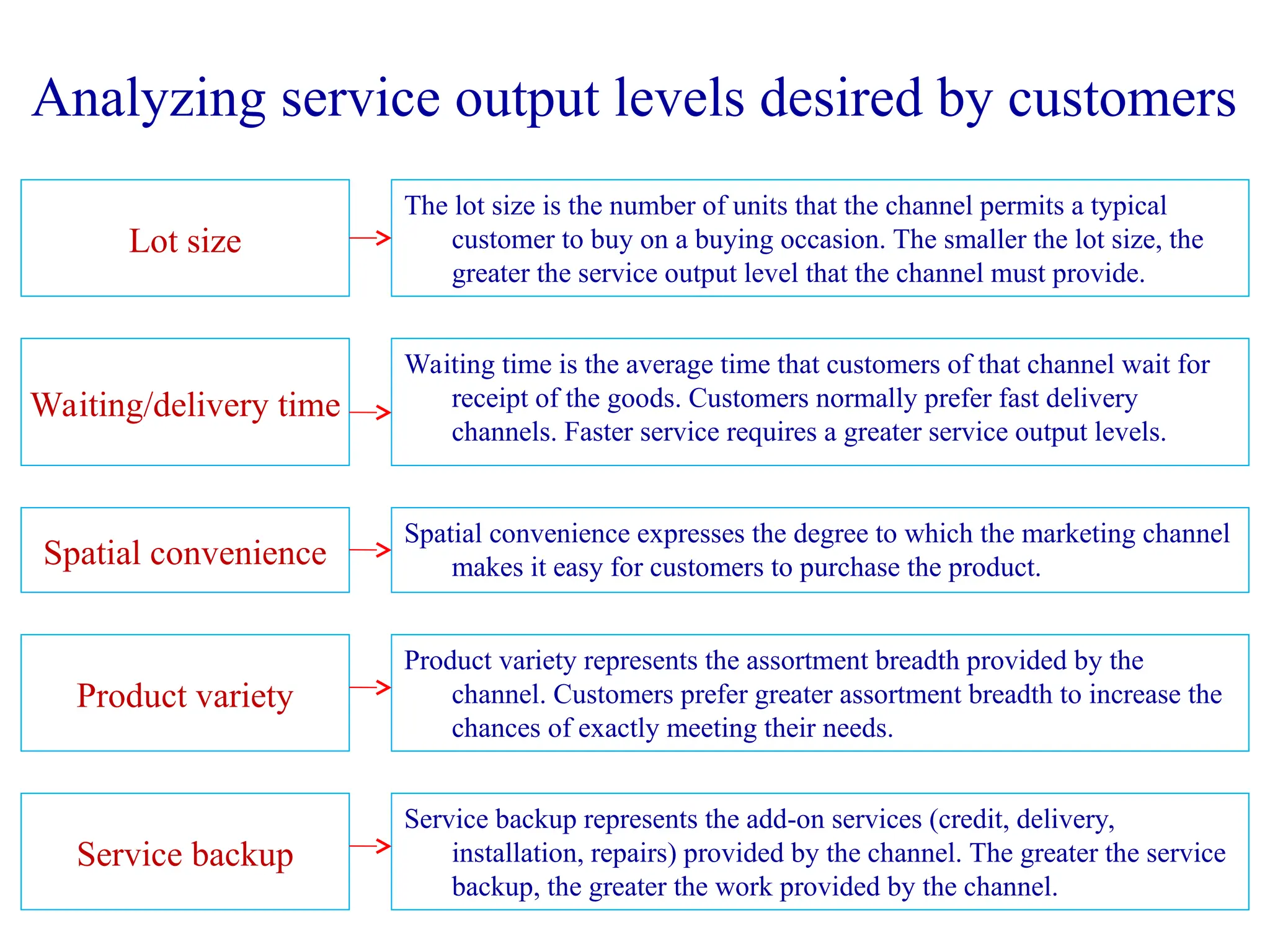
Lot size
Waiting/delivery time
Spatial convenience
Product variety
Service backup
Analyzing service output levels desired by customers
The lot size is the number of units that the channel permits a typical
customer to buy on a buying occasion. The smaller the lot size, the
greater the service output level that the channel must provide.
Waiting time is the average time that customers of that channel wait for
receipt of the goods. Customers normally prefer fast delivery
channels. Faster service requires a greater service output levels.
Spatial convenience expresses the degree to which the marketing channel
makes it easy for customers to purchase the product.
Product variety represents the assortment breadth provided by the
channel. Customers prefer greater assortment breadth to increase the
chances of exactly meeting their needs.
Service backup represents the add-on services (credit, delivery,
installation, repairs) provided by the channel. The greater the service
backup, the greater the work provided by the channel.
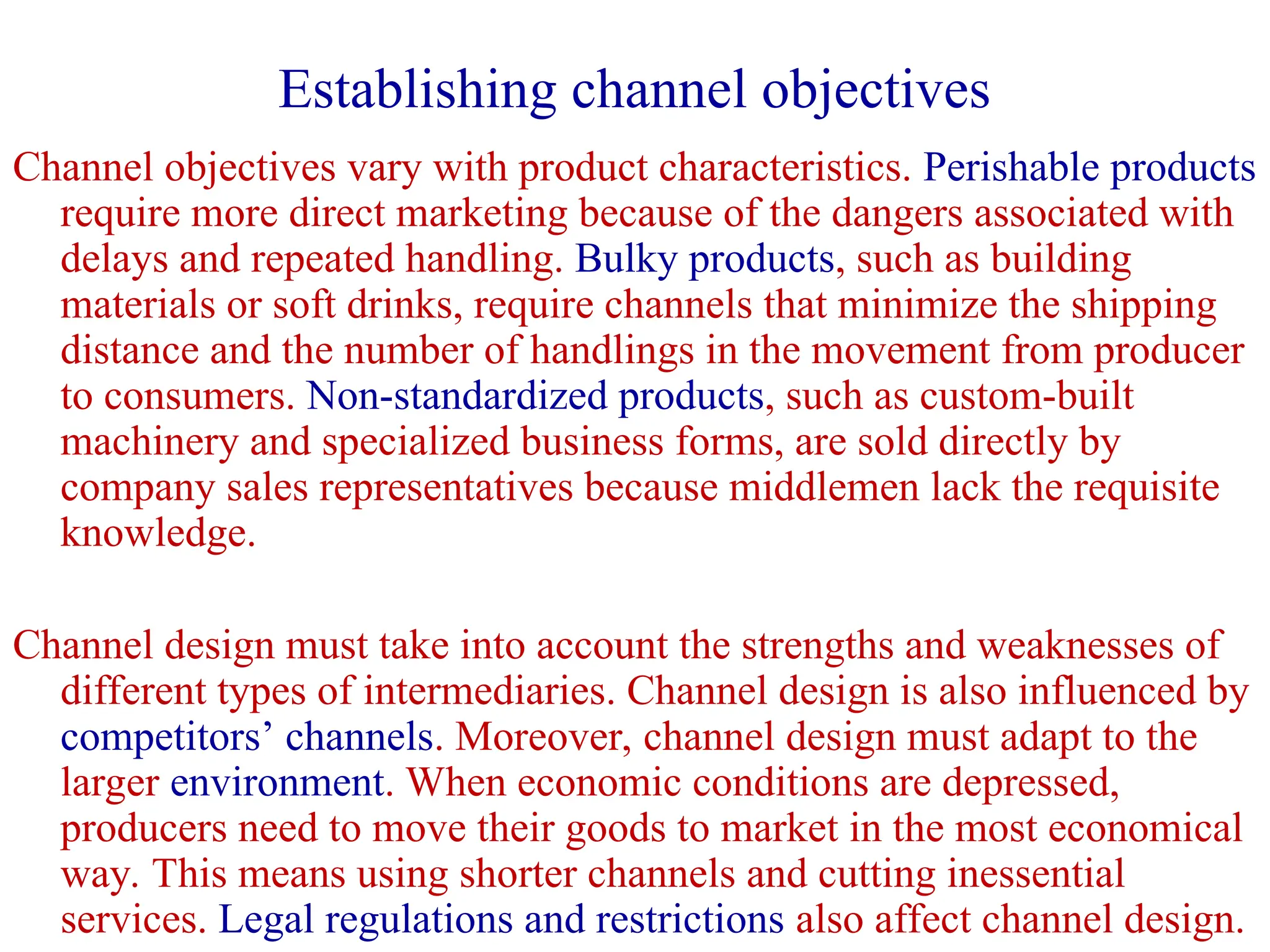
Establishing channel objectives
Channel objectives vary with product characteristics. Perishable products
require more direct marketing because of the dangers associated with
delays and repeated handling. Bulky products, such as building
materials or soft drinks, require channels that minimize the shipping
distance and the number of handlings in the movement from producer
to consumers. Non-standardized products, such as custom-built
machinery and specialized business forms, are sold directly by
company sales representatives because middlemen lack the requisite
knowledge.
Channel design must take into account the strengths and weaknesses of
different types of intermediaries. Channel design is also influenced by
competitors’ channels. Moreover, channel design must adapt to the
larger environment. When economic conditions are depressed,
producers need to move their goods to market in the most economical
way. This means using shorter channels and cutting inessential
services. Legal regulations and restrictions also affect channel design.
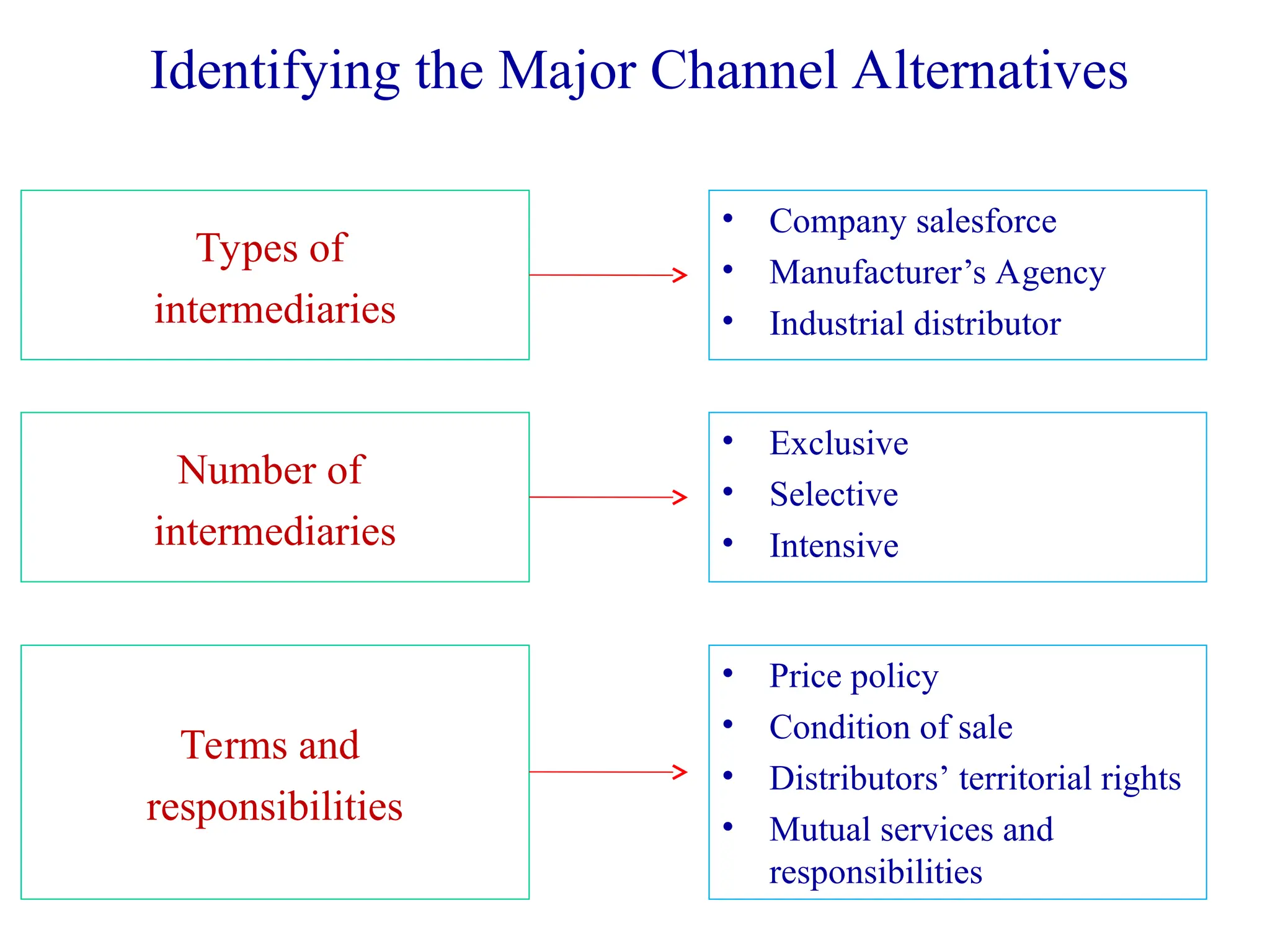
Identifying the Major Channel Alternatives
Types of
intermediaries
Number of
intermediaries
Terms and
responsibilities
• Price policy
• Condition of sale
• Distributors’ territorial rights
• Mutual services and
responsibilities
• Exclusive
• Selective
• Intensive
• Company salesforce
• Manufacturer’s Agency
• Industrial distributor
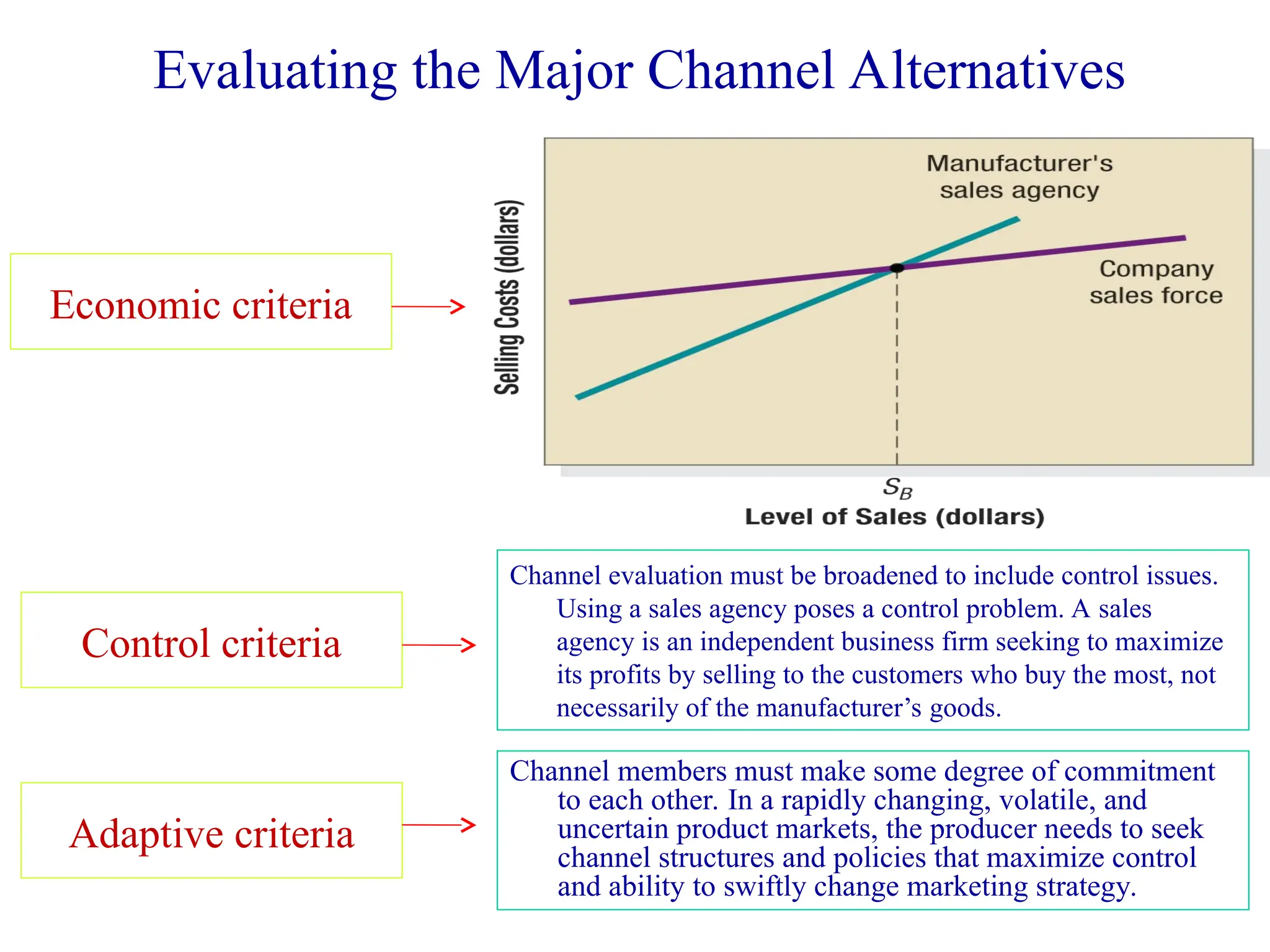
Evaluating the Major Channel Alternatives
Economic criteria
Control criteria
Adaptive criteria
Channel evaluation must be broadened to include control issues.
Using a sales agency poses a control problem. A sales
agency is an independent business firm seeking to maximize
its profits by selling to the customers who buy the most, not
necessarily of the manufacturer’s goods.
Channel members must make some degree of commitment
to each other. In a rapidly changing, volatile, and
uncertain product markets, the producer needs to seek
channel structures and policies that maximize control
and ability to swiftly change marketing strategy.
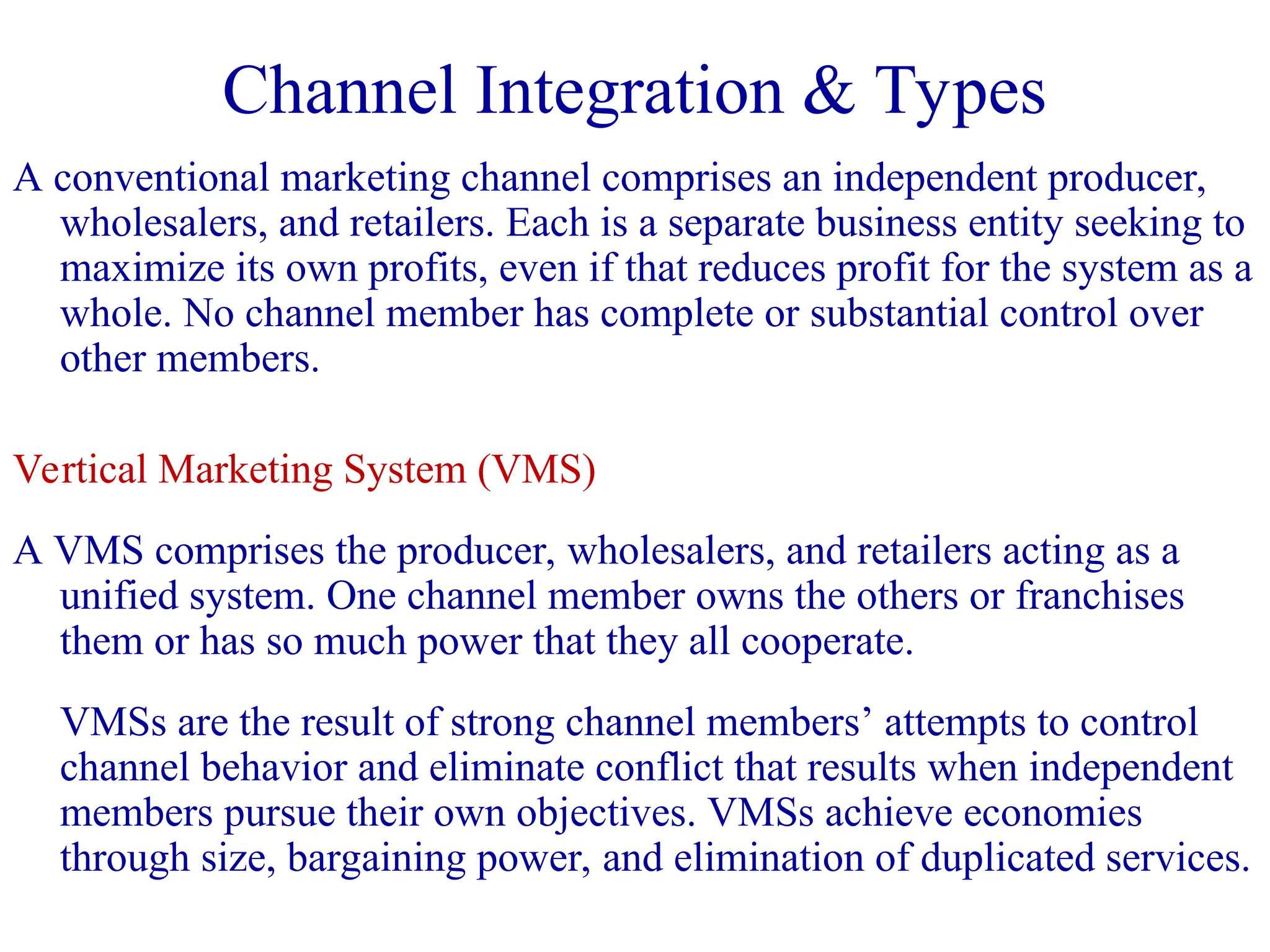
A conventional marketing channel comprises an independent producer,
wholesalers, and retailers. Each is a separate business entity seeking to
maximize its own profits, even if that reduces profit for the system as a
whole. No channel member has complete or substantial control over
other members.
Vertical Marketing System (VMS)
A VMS comprises the producer, wholesalers, and retailers acting as a
unified system. One channel member owns the others or franchises
them or has so much power that they all cooperate.
VMSs are the result of strong channel members’ attempts to control
channel behavior and eliminate conflict that results when independent
members pursue their own objectives. VMSs achieve economies
through size, bargaining power, and elimination of duplicated services.
Channel Integration & Types
VMSs take three different forms:
 Corporate VMS: A corporate VMS combines successive stages of
production and distribution under single ownership.
For example, Sears obtains 50% of the goods it sells from companies
that it partly or fully owns. Sherwin-Williams not only makes paints,
but also owns and operates 3000 retail outlets in the U.S.
 Administered VMS: An administered VMS coordinates successive
stages of production and distribution through the size and power of
one of the members in the channel. Manufacturers of a dominant
brand are able to secure strong trade cooperation and support from
resellers.
For example, Kodak, Gillette, and Procter & Gamble are capable of
commanding high levels of cooperation from their resellers with
respect to displays, shelf space, promotion, and price policies.
 Contractual VMS: A contractual VMS consists of independent firms
at different levels of production and distribution, integrating their
programs on a contractual basis to obtain more economies or sales
impact than they could achieve alone. It takes three different forms:
 Wholesaler-sponsored voluntary chains: Wholesalers organize voluntary
chains of independent retailers to help them standardize their selling
practices and achieve buying economies in order to compete with large
chain organizations.
 Retailer cooperatives: Retailers take initiative and organize a new
business entity to carry on wholesaling and possibly some production.
Members concentrate their purchases through the retailer cooperative
and plan their advertising jointly. Profits pass back to members in
proportion to their purchases. Non-member retailers can also buy
through the cooperative but do not take part in sharing the profits.
 Franchise organizations: A channel member called a franchiser might
link several successive stages of production-distribution process.
Franchising has been the fastest-growing retailing formats in recent
years.
Horizontal Marketing System (HMS)
A horizontal marketing system is another type of marketing channel in
which two or more unrelated companies put together their resources
and programs to exploit an emerging market opportunity. Each
company lacks the capital, know-how, production, or marketing
resources to venture alone, or it is afraid of the risk. The companies
might work with each other on a temporary or permanent basis to
create a joint venture company.
For example, Hindustan Unilever enters into a strategic tie-up with
PepsiCo India for bottling and distribution of Lipton’s ready-to-drink
and other beverages.
Multichannel Marketing System (MMS)
Multichannel marketing system occurs when a single firm uses two or
more channels to reach one or more segments of customer segments.
Channel conflict occurs when one member’s actions prevent another
channel from achieving its goal.
Types of channel conflict:
– Vertical channel conflict
– Horizontal channel conflict
– Multichannel conflict
Channel Conflict, Cooperation, &
Competition
Types of Channel Conflict
Vertical channel conflict: It exists when there is conflict between
different levels within the same channel. For example, Coca-Cola
came into conflict with some of its bottlers who agreed to also
bottle Dr Pepper.
Horizontal channel conflict: It exists when there is conflict between
members at the same level within the channel. For example, some
Pizza Inn franchisees complained about other Pizza Inn
franchisees cheating on the ingredients, maintaining poor service,
and hurting the overall Pizza Inn image. Some Ford car dealers in
Chicago complained about other Ford Chicago dealers advertising
and pricing being too aggressive. Benetton has been accused of
franchising too many stores near to each other, depressing their
profits.
Multichannel conflict: It exists when the manufacturer establishes
two or more channels that compete with each other for the same
market. For example, when several clothing designers &
manufacturers- Ralph Lauren, Liz Claiborne, and Anne Klein-
opened their own stores, the department stores that carried their
(designers) clothes went mad. When Levi Strauss, parallel to its
normal specialty-store channel, agreed to distribute its jeans
through Sears and Penny, it was highly resented by the specialty-
stores.
Channel conflict may arise from:
 Goal incompatibility: For example, the manufacturer may want
market penetration through a low-price policy. Dealers, in contrast,
may prefer to work to make high margins and pursue short-run
profitability.
 Unclear roles and rights: Territory boundaries and credit for sales
often produce conflict. For example, the manufacturer may sell to
specific accounts through its own showrooms; whereas its licensed
dealers may also be trying to reach the same accounts.
 Differences in perception: The manufacturer and its dealers may
have different perception regarding inventory or advertising
strategy and the like.
 Intermediaries’ dependence on the manufacturer: Sometimes, the
manufacturer’s poor product quality, product assortment, or pricing
policy affects the business goals of the intermediaries.
Causes of Channel Conflict
Multiple strategies can be used to manage channel conflict:
 Adoption of superordinate goals: Channel members come to an
agreement on the fundamental goals they are jointly seeking, whether
it is survival, market share, high quality, or customer satisfaction.
They usually do this when the channel faces an outside threat, such as
a more efficient competing channel, an adverse piece of legislation, or
a shift in consumer desires.
 Exchange of employees: A useful step is to exchange persons between
two or more channel levels. The hope is that participants of the
exchanging parties will grow to appreciate each other’s point of view.
 Joint membership in trade associations: Another strategy could be by
encouraging joint membership in and between trade associations. For
example, the association between Grocery Manufacturers of America
and Food Marketing Institute led to the development of the Universal
Product Code (UPC)
Managing Channel Conflict
 Co-optation: Co-optation is an effort by one organization to win the
support of the leaders of another organization by including them in
advisory councils, boards of directors, and the like. As long as the
initiating organization treats the leaders seriously and listens to their
opinions, co-optation can reduce conflict. However, the initiating
organization may need to compromise its policies and plans to win
their support.
 Diplomacy, mediation, and arbitration: When conflict is acute, the
parties may need to resort to diplomacy, mediation or arbitration.
Diplomacy takes place when each side sends a person or group to
deal with its counterpart to resolve the conflict. Mediation refers to
resorting to a neutral third party skilled in conciliating the two
parties’ interests. Arbitration occurs when the two parties agree to
present their arguments to one or more arbitrators and accept the
arbitration decision.
 Lawsuits: In a worse case scenario, a conflicting channel member
might choose to file a lawsuit.
Marketers must be careful not to dilute their brand through inappropriate
channels. This is especially a concern with luxury brands whose
images are often built on the basis of exclusivity and personalized
service.
For example, Calvin Klein and Tommy Hilfiger took a hit when
they sold too many of their products in discount channels.
Dilution and Cannibalization
In general, companies are legally free to develop whatever channel
arrangements suit them. However, the law seeks to prevent
companies from using exclusionary tactics that might keep
competitors from using a channel. The legality of certain practices
including exclusive dealing, exclusive territories, tying agreements,
and dealers’ rights are noteworthy as follows:
 Exclusive Dealing: When the seller/ manufacturer requires that
certain dealers/ outlets carry its products exclusively and not handle
other competitors’ products, this is called exclusive dealing. For the
most part, exclusive dealing is not illegal if the agreement between
the seller and dealers is voluntary and as long as such an
arrangement does not create a monopoly.
Legal & Ethical Issues in Channel Relations
 Exclusive Territories: The seller might want to make sure that the
selected dealers confine to the designated territories when making
sales. It has become a major legal issue as the producer/ seller tries
to keep a dealer from selling outside its territory.
 Tying Agreements: Producers of a strong brand sometimes sell it to
dealers only if they will take some of the line or all of the rest of the
line. This practice is called full-line forcing. Such tying agreements
are not necessarily illegal, but they do violate the law if they tend to
lessen competition substantially.
 Dealers’ Rights: Producers are free to select their dealers, but their
right to terminate dealers is somewhat restricted. In general, sellers
can drop dealers for reasons. But they cannot drop dealers if they
(the dealers) refuse to cooperate in a doubtful legal arrangement,
such as exclusive dealing or tying agreements.
thank you

Marketing Management: Distribution strategies

  • 1.
  • 2.
    Defining Marketing Channel Amarketing channel system is the particular set of interdependent organizations involved in the process of making a product or service available for use or consumption.
  • 3.
    General Channel Strategies •A push strategy uses the manufacturer’s sales force, trade promotion money, and other means to induce intermediaries to carry, promote, and sell the product to end users. • A pull strategy uses advertising, promotion, and other forms of communication to persuade consumers to demand the product from intermediaries.
  • 4.
    Channel Member Functions Gather information  Develop and disseminate persuasive communications  Reach agreements on price and terms  Acquire funds to finance inventories  Assume risks  Provide for storage  Provide for buyers’ payment of their bills  Oversee actual transfer of ownership
  • 5.
  • 6.
  • 7.
    Channel Design Decisions Analyzingservice output levels desired by customers Establishing the channel objectives Identifying the major channel alternatives Evaluating the major channel alternatives
  • 8.
    Lot size Waiting/delivery time Spatialconvenience Product variety Service backup Analyzing service output levels desired by customers The lot size is the number of units that the channel permits a typical customer to buy on a buying occasion. The smaller the lot size, the greater the service output level that the channel must provide. Waiting time is the average time that customers of that channel wait for receipt of the goods. Customers normally prefer fast delivery channels. Faster service requires a greater service output levels. Spatial convenience expresses the degree to which the marketing channel makes it easy for customers to purchase the product. Product variety represents the assortment breadth provided by the channel. Customers prefer greater assortment breadth to increase the chances of exactly meeting their needs. Service backup represents the add-on services (credit, delivery, installation, repairs) provided by the channel. The greater the service backup, the greater the work provided by the channel.
  • 9.
    Establishing channel objectives Channelobjectives vary with product characteristics. Perishable products require more direct marketing because of the dangers associated with delays and repeated handling. Bulky products, such as building materials or soft drinks, require channels that minimize the shipping distance and the number of handlings in the movement from producer to consumers. Non-standardized products, such as custom-built machinery and specialized business forms, are sold directly by company sales representatives because middlemen lack the requisite knowledge. Channel design must take into account the strengths and weaknesses of different types of intermediaries. Channel design is also influenced by competitors’ channels. Moreover, channel design must adapt to the larger environment. When economic conditions are depressed, producers need to move their goods to market in the most economical way. This means using shorter channels and cutting inessential services. Legal regulations and restrictions also affect channel design.
  • 10.
    Identifying the MajorChannel Alternatives Types of intermediaries Number of intermediaries Terms and responsibilities • Price policy • Condition of sale • Distributors’ territorial rights • Mutual services and responsibilities • Exclusive • Selective • Intensive • Company salesforce • Manufacturer’s Agency • Industrial distributor
  • 11.
    Evaluating the MajorChannel Alternatives Economic criteria Control criteria Adaptive criteria Channel evaluation must be broadened to include control issues. Using a sales agency poses a control problem. A sales agency is an independent business firm seeking to maximize its profits by selling to the customers who buy the most, not necessarily of the manufacturer’s goods. Channel members must make some degree of commitment to each other. In a rapidly changing, volatile, and uncertain product markets, the producer needs to seek channel structures and policies that maximize control and ability to swiftly change marketing strategy.
  • 12.
    A conventional marketingchannel comprises an independent producer, wholesalers, and retailers. Each is a separate business entity seeking to maximize its own profits, even if that reduces profit for the system as a whole. No channel member has complete or substantial control over other members. Vertical Marketing System (VMS) A VMS comprises the producer, wholesalers, and retailers acting as a unified system. One channel member owns the others or franchises them or has so much power that they all cooperate. VMSs are the result of strong channel members’ attempts to control channel behavior and eliminate conflict that results when independent members pursue their own objectives. VMSs achieve economies through size, bargaining power, and elimination of duplicated services. Channel Integration & Types
  • 13.
    VMSs take threedifferent forms:  Corporate VMS: A corporate VMS combines successive stages of production and distribution under single ownership. For example, Sears obtains 50% of the goods it sells from companies that it partly or fully owns. Sherwin-Williams not only makes paints, but also owns and operates 3000 retail outlets in the U.S.  Administered VMS: An administered VMS coordinates successive stages of production and distribution through the size and power of one of the members in the channel. Manufacturers of a dominant brand are able to secure strong trade cooperation and support from resellers. For example, Kodak, Gillette, and Procter & Gamble are capable of commanding high levels of cooperation from their resellers with respect to displays, shelf space, promotion, and price policies.
  • 14.
     Contractual VMS:A contractual VMS consists of independent firms at different levels of production and distribution, integrating their programs on a contractual basis to obtain more economies or sales impact than they could achieve alone. It takes three different forms:  Wholesaler-sponsored voluntary chains: Wholesalers organize voluntary chains of independent retailers to help them standardize their selling practices and achieve buying economies in order to compete with large chain organizations.  Retailer cooperatives: Retailers take initiative and organize a new business entity to carry on wholesaling and possibly some production. Members concentrate their purchases through the retailer cooperative and plan their advertising jointly. Profits pass back to members in proportion to their purchases. Non-member retailers can also buy through the cooperative but do not take part in sharing the profits.  Franchise organizations: A channel member called a franchiser might link several successive stages of production-distribution process. Franchising has been the fastest-growing retailing formats in recent years.
  • 15.
    Horizontal Marketing System(HMS) A horizontal marketing system is another type of marketing channel in which two or more unrelated companies put together their resources and programs to exploit an emerging market opportunity. Each company lacks the capital, know-how, production, or marketing resources to venture alone, or it is afraid of the risk. The companies might work with each other on a temporary or permanent basis to create a joint venture company. For example, Hindustan Unilever enters into a strategic tie-up with PepsiCo India for bottling and distribution of Lipton’s ready-to-drink and other beverages. Multichannel Marketing System (MMS) Multichannel marketing system occurs when a single firm uses two or more channels to reach one or more segments of customer segments.
  • 16.
    Channel conflict occurswhen one member’s actions prevent another channel from achieving its goal. Types of channel conflict: – Vertical channel conflict – Horizontal channel conflict – Multichannel conflict Channel Conflict, Cooperation, & Competition
  • 17.
    Types of ChannelConflict Vertical channel conflict: It exists when there is conflict between different levels within the same channel. For example, Coca-Cola came into conflict with some of its bottlers who agreed to also bottle Dr Pepper. Horizontal channel conflict: It exists when there is conflict between members at the same level within the channel. For example, some Pizza Inn franchisees complained about other Pizza Inn franchisees cheating on the ingredients, maintaining poor service, and hurting the overall Pizza Inn image. Some Ford car dealers in Chicago complained about other Ford Chicago dealers advertising and pricing being too aggressive. Benetton has been accused of franchising too many stores near to each other, depressing their profits.
  • 18.
    Multichannel conflict: Itexists when the manufacturer establishes two or more channels that compete with each other for the same market. For example, when several clothing designers & manufacturers- Ralph Lauren, Liz Claiborne, and Anne Klein- opened their own stores, the department stores that carried their (designers) clothes went mad. When Levi Strauss, parallel to its normal specialty-store channel, agreed to distribute its jeans through Sears and Penny, it was highly resented by the specialty- stores.
  • 19.
    Channel conflict mayarise from:  Goal incompatibility: For example, the manufacturer may want market penetration through a low-price policy. Dealers, in contrast, may prefer to work to make high margins and pursue short-run profitability.  Unclear roles and rights: Territory boundaries and credit for sales often produce conflict. For example, the manufacturer may sell to specific accounts through its own showrooms; whereas its licensed dealers may also be trying to reach the same accounts.  Differences in perception: The manufacturer and its dealers may have different perception regarding inventory or advertising strategy and the like.  Intermediaries’ dependence on the manufacturer: Sometimes, the manufacturer’s poor product quality, product assortment, or pricing policy affects the business goals of the intermediaries. Causes of Channel Conflict
  • 20.
    Multiple strategies canbe used to manage channel conflict:  Adoption of superordinate goals: Channel members come to an agreement on the fundamental goals they are jointly seeking, whether it is survival, market share, high quality, or customer satisfaction. They usually do this when the channel faces an outside threat, such as a more efficient competing channel, an adverse piece of legislation, or a shift in consumer desires.  Exchange of employees: A useful step is to exchange persons between two or more channel levels. The hope is that participants of the exchanging parties will grow to appreciate each other’s point of view.  Joint membership in trade associations: Another strategy could be by encouraging joint membership in and between trade associations. For example, the association between Grocery Manufacturers of America and Food Marketing Institute led to the development of the Universal Product Code (UPC) Managing Channel Conflict
  • 21.
     Co-optation: Co-optationis an effort by one organization to win the support of the leaders of another organization by including them in advisory councils, boards of directors, and the like. As long as the initiating organization treats the leaders seriously and listens to their opinions, co-optation can reduce conflict. However, the initiating organization may need to compromise its policies and plans to win their support.  Diplomacy, mediation, and arbitration: When conflict is acute, the parties may need to resort to diplomacy, mediation or arbitration. Diplomacy takes place when each side sends a person or group to deal with its counterpart to resolve the conflict. Mediation refers to resorting to a neutral third party skilled in conciliating the two parties’ interests. Arbitration occurs when the two parties agree to present their arguments to one or more arbitrators and accept the arbitration decision.  Lawsuits: In a worse case scenario, a conflicting channel member might choose to file a lawsuit.
  • 22.
    Marketers must becareful not to dilute their brand through inappropriate channels. This is especially a concern with luxury brands whose images are often built on the basis of exclusivity and personalized service. For example, Calvin Klein and Tommy Hilfiger took a hit when they sold too many of their products in discount channels. Dilution and Cannibalization
  • 23.
    In general, companiesare legally free to develop whatever channel arrangements suit them. However, the law seeks to prevent companies from using exclusionary tactics that might keep competitors from using a channel. The legality of certain practices including exclusive dealing, exclusive territories, tying agreements, and dealers’ rights are noteworthy as follows:  Exclusive Dealing: When the seller/ manufacturer requires that certain dealers/ outlets carry its products exclusively and not handle other competitors’ products, this is called exclusive dealing. For the most part, exclusive dealing is not illegal if the agreement between the seller and dealers is voluntary and as long as such an arrangement does not create a monopoly. Legal & Ethical Issues in Channel Relations
  • 24.
     Exclusive Territories:The seller might want to make sure that the selected dealers confine to the designated territories when making sales. It has become a major legal issue as the producer/ seller tries to keep a dealer from selling outside its territory.  Tying Agreements: Producers of a strong brand sometimes sell it to dealers only if they will take some of the line or all of the rest of the line. This practice is called full-line forcing. Such tying agreements are not necessarily illegal, but they do violate the law if they tend to lessen competition substantially.  Dealers’ Rights: Producers are free to select their dealers, but their right to terminate dealers is somewhat restricted. In general, sellers can drop dealers for reasons. But they cannot drop dealers if they (the dealers) refuse to cooperate in a doubtful legal arrangement, such as exclusive dealing or tying agreements.
  • 25.