Marketing functions
The term “ marketing functions” is used to refer specially to commodity transformations
in time ,space and form that are associated with storage ,transportation and processing.it
helps to transfer the ownership of the product from producer to intermediaries and
intermediaries to ultimate consumers.
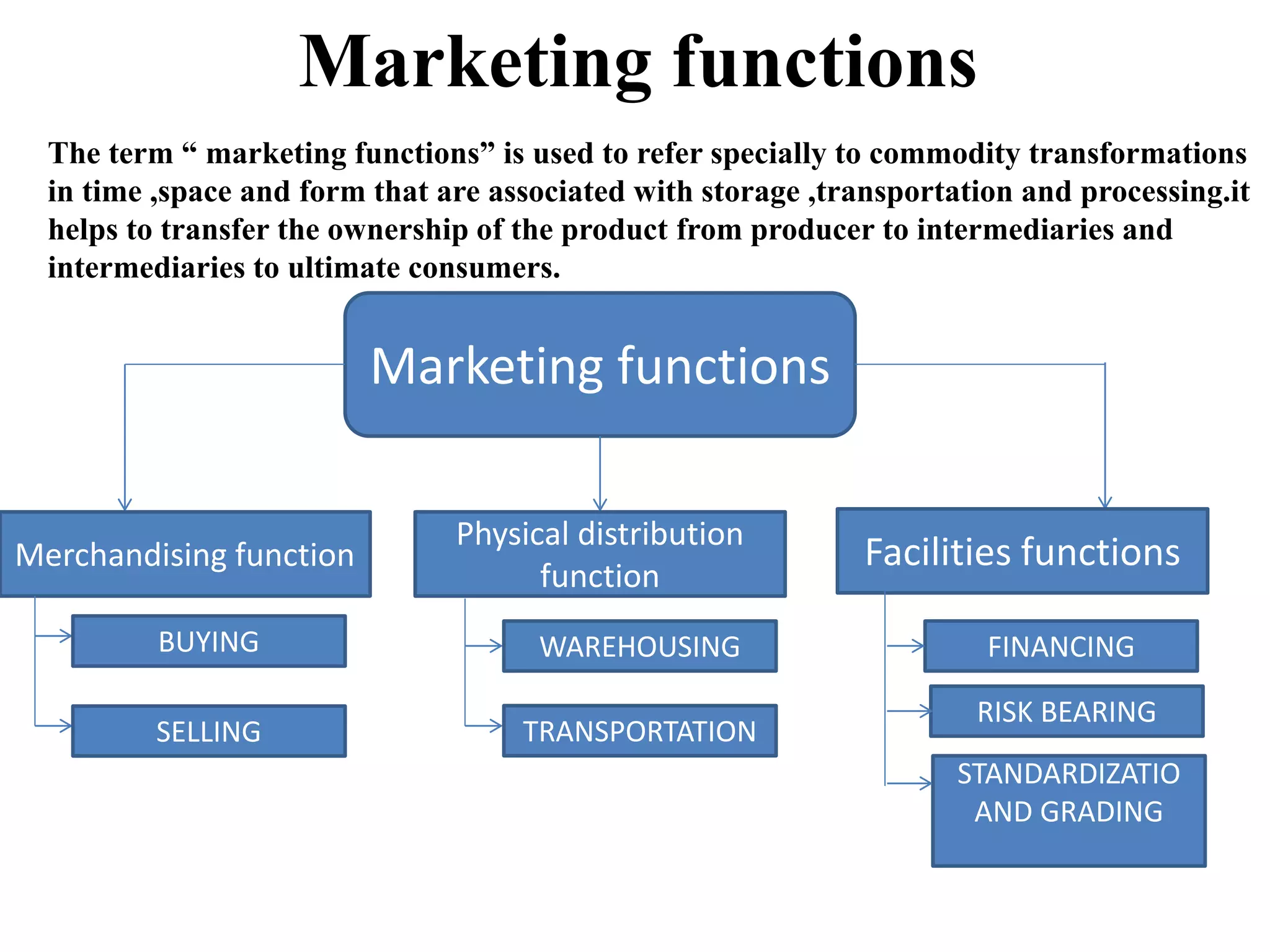
Marketing functions
Merchandising function
Physical distribution
function
Facilities functions
BUYING
SELLING
WAREHOUSING
TRANSPORTATION
FINANCING
RISK BEARING
STANDARDIZATIO
AND GRADING
MERCHANDISING FUNCTIONS
It is also known as exchange function. This functions helps
to transfer the goods as well as ownership from one party to
others party .
BUYING
It is the process to transfer of ownership from seller to buyer .
The buying and selling are very important . There are some
basic objectives of buying .such as ,to get the right quantity
,to get the right quality ,to get in right time and to get in right
place.
According to still and cundiff , “ Buying is the procurement of
goods or services for eventual resale to the consumers or
industrial users.”
Step 1
planning to
purchase
Step 2
contact
Step 3
negotiation
Step 4
Assembling
Step 5
contract
Elements / functions of Buying :-
Elements
of Buying
Step 1 planning to purchase :- the buyers should be make the plan to
purchase the goods which should be fulfill their needs and wants and also satisfied
their requirements. they were focus on the preparation of budget, change in price and
alternatives availability.
Step 2 contact :- the buyers should be contact to the various suppliers and
buyers should analysis the every supplier with their efficiency ,financial strength ,
reputation and goodwill.
Step 3 negotiation :-it refers to the bargaining power of the both parties
buyer and seller. Both part will be come together with their view to discuss the
contents of contract such as product quality , price , payment , quantity, time period
,transportation and discount /offers.
Step 4 assembling :- it means collecting a large number of similar
good from the various manufactures at a proper place at proper time. It also known
as centralization.
Step 5 contract :- it is a written document where all the terms and
conditions such as quality, quantity ,price ,discounts terms of delivery and payment
etc. are clearly written .if anyone party will be break this contact ,another party can
be appeal to the court for justice and penalty which should mention on contract
agreement.
TYPES OF BUYING:-
1.Concentrated buying
2.Diversified buying
3.Reciprocal buying
4.Hand to mouth buying
5.Speculative buying
6.Buying by samples
7.Buying by inspection
8.Buying by description
9.Buying by contract
SELLING FUNCTION :-
Selling means exchanging goods for money or transferring
ownership of goods and services through the process of
exchange.
Elements / functions of selling
Step 1 : product
planning and
development
Step 2 :contact
function
Step 3 :Creation of
demand
Step 4 : negotiation
Step 5 : contract
PHYSICAL DISTRIBUTION FUNCTION
Transportation:- Any device used to move an item from one
location to another . Its helps in physical movement of goods from
production Centre or manufacturing place to the place where it is
consumed.
Functions of transportation
1. Widens market
2. Increase of mobility if labour and capital
3. Creates time and place utility
4. Price equalization
5. Employment opportunities
6. Transformation of the economy
7. Large scale of production
8. Overall economic development
MODES OF TRANSPORTATION
1. ROAD TRANSPORTATION
2. RAIL TRANSPORTATION
3. PIPELINE TRANSPORTATION
4. WATER TRANSPORTATION
5. AIR TRANSPORTATION
ROAD TRANSPORTATION
Features Of Road Transportation:
1.Small Investment
2.Multipurpose
3.Freedom of movement
4.Door to door service
5.Economy of time
Advantages Disadvantages
Flexibility Unsuitability
Economy Less speed
Feeder services Unreliable
Safety Unstable freight
Rural development
Suitable for perishable products
Features of railways transportation :
1. Monopoly
2. Huge investment
3. Specific infrastructure
4. No uniform pricing
5. Large carrying capacity
Strengths Weakness
Suitable for bulky products Heavy investment
Greater speed Costly
Cheaper Inflexible
Dependable and regular services Unsafe for perishable products
Safe Evils of Monopoly
Flexible carrier Risk of damage
Features of waterway transportation
1. Natural waterway
2. Little power consumption
3. Low operational cost
4. Flexibility
5. Slow movement
6. Natural hindrance
Strengths Weakness
Cheapest Slow speed
Large carrying capacity Limited area of operation
Safer Seasonal difficulties
International trade Risky
Unsuitable
Features of Air transportation
1. High speed
2. Unbroken journey
3. Expensive
4. Extensive network
Strengths Weakness
Highest speed Expensive
Boon to perishable product Uncertainties and unreliable
Regular ,comfortable and punctual Limited capacity
Shortest route High construction and operational cost
Access to all areas Accidents
International laws and relations

Marketing functions

  • 1.
    Marketing functions The term“ marketing functions” is used to refer specially to commodity transformations in time ,space and form that are associated with storage ,transportation and processing.it helps to transfer the ownership of the product from producer to intermediaries and intermediaries to ultimate consumers. Marketing functions Merchandising function Physical distribution function Facilities functions BUYING SELLING WAREHOUSING TRANSPORTATION FINANCING RISK BEARING STANDARDIZATIO AND GRADING
  • 2.
    MERCHANDISING FUNCTIONS It isalso known as exchange function. This functions helps to transfer the goods as well as ownership from one party to others party . BUYING It is the process to transfer of ownership from seller to buyer . The buying and selling are very important . There are some basic objectives of buying .such as ,to get the right quantity ,to get the right quality ,to get in right time and to get in right place. According to still and cundiff , “ Buying is the procurement of goods or services for eventual resale to the consumers or industrial users.”
  • 3.
    Step 1 planning to purchase Step2 contact Step 3 negotiation Step 4 Assembling Step 5 contract Elements / functions of Buying :- Elements of Buying
  • 4.
    Step 1 planningto purchase :- the buyers should be make the plan to purchase the goods which should be fulfill their needs and wants and also satisfied their requirements. they were focus on the preparation of budget, change in price and alternatives availability. Step 2 contact :- the buyers should be contact to the various suppliers and buyers should analysis the every supplier with their efficiency ,financial strength , reputation and goodwill. Step 3 negotiation :-it refers to the bargaining power of the both parties buyer and seller. Both part will be come together with their view to discuss the contents of contract such as product quality , price , payment , quantity, time period ,transportation and discount /offers. Step 4 assembling :- it means collecting a large number of similar good from the various manufactures at a proper place at proper time. It also known as centralization. Step 5 contract :- it is a written document where all the terms and conditions such as quality, quantity ,price ,discounts terms of delivery and payment etc. are clearly written .if anyone party will be break this contact ,another party can be appeal to the court for justice and penalty which should mention on contract agreement.
  • 5.
    TYPES OF BUYING:- 1.Concentratedbuying 2.Diversified buying 3.Reciprocal buying 4.Hand to mouth buying 5.Speculative buying 6.Buying by samples 7.Buying by inspection 8.Buying by description 9.Buying by contract
  • 6.
    SELLING FUNCTION :- Sellingmeans exchanging goods for money or transferring ownership of goods and services through the process of exchange. Elements / functions of selling Step 1 : product planning and development Step 2 :contact function Step 3 :Creation of demand Step 4 : negotiation Step 5 : contract
  • 7.
    PHYSICAL DISTRIBUTION FUNCTION Transportation:-Any device used to move an item from one location to another . Its helps in physical movement of goods from production Centre or manufacturing place to the place where it is consumed. Functions of transportation 1. Widens market 2. Increase of mobility if labour and capital 3. Creates time and place utility 4. Price equalization 5. Employment opportunities 6. Transformation of the economy 7. Large scale of production 8. Overall economic development
  • 8.
    MODES OF TRANSPORTATION 1.ROAD TRANSPORTATION 2. RAIL TRANSPORTATION 3. PIPELINE TRANSPORTATION 4. WATER TRANSPORTATION 5. AIR TRANSPORTATION ROAD TRANSPORTATION Features Of Road Transportation: 1.Small Investment 2.Multipurpose 3.Freedom of movement 4.Door to door service 5.Economy of time
  • 9.
    Advantages Disadvantages Flexibility Unsuitability EconomyLess speed Feeder services Unreliable Safety Unstable freight Rural development Suitable for perishable products Features of railways transportation : 1. Monopoly 2. Huge investment 3. Specific infrastructure 4. No uniform pricing 5. Large carrying capacity
  • 10.
    Strengths Weakness Suitable forbulky products Heavy investment Greater speed Costly Cheaper Inflexible Dependable and regular services Unsafe for perishable products Safe Evils of Monopoly Flexible carrier Risk of damage Features of waterway transportation 1. Natural waterway 2. Little power consumption 3. Low operational cost 4. Flexibility 5. Slow movement 6. Natural hindrance
  • 11.
    Strengths Weakness Cheapest Slowspeed Large carrying capacity Limited area of operation Safer Seasonal difficulties International trade Risky Unsuitable Features of Air transportation 1. High speed 2. Unbroken journey 3. Expensive 4. Extensive network
  • 12.
    Strengths Weakness Highest speedExpensive Boon to perishable product Uncertainties and unreliable Regular ,comfortable and punctual Limited capacity Shortest route High construction and operational cost Access to all areas Accidents International laws and relations