Marketing InsightsMarketing Basics & Social MediaFor Small & Medium Businesses
Renee Clydesdale – Owner &Marketing StrategistPrepared and Presented by:
Topics What is Marketing?
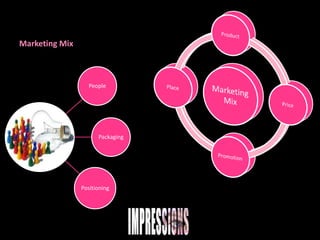
 Marketing Mix (7 P’s)
Research (what do you research)
Marketing Plan Elements
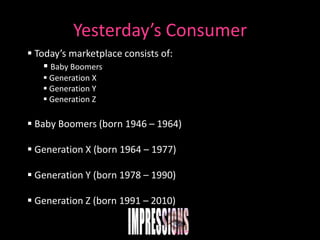
 Understanding Consumers
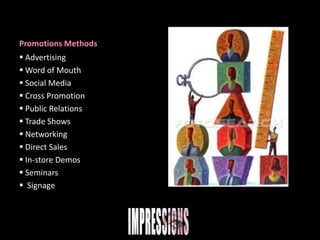
 Promotion Channels
Establishing a Marketing Budget
 Social Media
ConclusionThe who what when how Where & whyMarketing Overview
What is Marketing?Basic Definition:Marketing is the process whereby society, to supply its consumption needs, evolves distributive systems composed of participants, who, interacting under constraints - technical (economic) and ethical (social) - create the transactions or flows which resolve market separations and result in exchange and consumption. Bartles
Traditional v InteractiveTraditional MarketingPromoting a product or service through USP
Impression of greed and profit hungry
Lack of interest in consumerInteractive Marketing Establishing a relationship
 Identify with you consumer’s needs
Promote your product based on consumer needsImportance of MarketingResearch and development
 Developing products that meet the needs of clients.
 Production team
Keep up with demand created and live up to promises
 Your human resources

Marketing Basics

Editor's Notes

  • #2 Thank you to the Wheatland Business Women’s Group for having me here and thank you to Jill and Marcy for inviting me. Today I am going to talk to you about marketing your business and areas how this industry is changing and what you need to do to keep up. After looking at your website and visiting your individual websites, I see many of you have been in business for 4 to 5 years now…. Some longer and some not as long!
  • #3 To give you a brief intro into me…. I accidently fell into marketing back in 1998 and haven’t looked back. It’s been an exciting and challenging career to date with more challengers to come as I grow my Canadian business now. I have worked with small mum and dad businesses through to large international companies including Ansett Airlines, Syndey Olympics, Red Bull Air Show and Planet X (major companies) through to Natural Healing, National Property Developers, Sporting Organisations, Interior Designers, Landscape Architects, Trade Show Exhibitors, Fashion Houses and various retailers.In 2009 I moved to Calgary and through circumstances, decided to open my own Boutique Marketing Agency here and concentrate on Small and Medium Enterprises/Businesses SME or SMB
  • #4 Go over topics and provide brief synopsis…..
  • #5 Refresher course and some new information for you – how has this market changed over the years
  • #7 As money and economies tighten, and with the new consumers (Generation Y) amongst some of the biggest purchasers around, we have moved from a ‘what we can do for you’ to a ‘what can you do for me’ consumer – hence companies now having to build relationships with customers and find out exactly what is it that we want/need and how their products can suit our needs.However Interactive Marketing also extends to companies been able to remember what we have done and how they can build on that experience or complement what we have – DATABASESLet’s look at Amazon here
  • #8 This list is an importance of marketing internally. Each of the above departments must know where they stand not only within their own department but inter departmental
  • #10 People = staff…. Training, passions and believe in your business and the brandPackaging = how does you product present itself in the market placePositioning = how are you sitting in the market? Do you know how you fair against your competitors ‘Evoke Set’
  • #13 Who are we dealing with???3 main consumer groups at the moment in our marketplace – Baby Boomers, Generation X and Generation Y
  • #14 Baby Boombers – born during post ww2… deemed more affluent (compared to their parents) and they tended to reject traditional values – think about the 1960’s era!Gen X – Later gen x’s are the beginning of the educated population…. They value some traditional thoughts such as purchasing homes and large investments, they are a more solid consumer with researching of higher prices etcGen Y – generation growing up without knowing a world without computers and for late gen y’s the internet and mobile phones. Self absorbed and many early gen y’s are the parents of gen z. Highly educated with most holding degrees and a large number holding masters degreesGen z – future generation…. Don’t know the world without computers, internet, blackberries – forget mobile phones – these kids are blackberry/smart phone kids….. Use Louise for eg.
  • #16 Touch a bit on each topic esp:Word of MouthCross Promotion
  • #17 A question commonly asked, particularly among the small business owners out there. Allocating a workable and affordable budget is the key to creating a successful marketing program. Without establishing a budget – it makes planning and measuring results quiet difficult and before you know it you have overspent and returns are very small. To establish a budget... it is a matter of determining what your overall goal is then selecting a budget planning method to suit. Regardless of the method, a marketing budget is a projection only and should be used as a guide and constantly updated. 
  • #18 % of expected revenueGeneral rule of thumb is allocated 20% of expected revenue. Eg if you expect to make $100,000 this year, you would allocate $20,000 as your budget. Everything you can affordFor a business who wants to grow fast this is a option but is fraught with a bit of danger!. You set aside the money you need for business expenses like wages etc and, set aside funds for your family then what ever is remaining you throw into marketing. This is an aggressive & risky approach and you need to make sure you have funds behind you. Desired Customer GrowthYou need to establish how much it is costing to bring in one customer. Multiple the number of desired customers by the cost per customer. Your figures need to be accurate and you need to make sure that you can accommodate the customer growth. Industry specificResearching the industry average-spend on marketing is a great way of establishing what your competitors are allocating to marketing. BUT this average figure also takes into account the big and major players in the industry that have big and major budgets. Please note this method takes a bit of time! Spend NothingWhat is a popular belief among many business owners – I will spend nothing on marketing and do it all myself ultimately costs more in the end. Time is money and money is time. Do you, as a business owner – running your own business, have a spare 40 hours per week? Also don’t forget, there is still the cost of purchasing supplies like paper and ink, stamps and so on.
  • #19 Today, consumers start their shopping experience by looking on the Internet, in the search engines, the blogosphere, and social media sites. In order to remain competitive, businesses' websites need to be found online by the consumers already searching for the products and services that they sell. Learn how to get found by more potential customers online
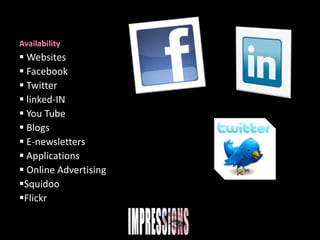
  • #21 Each of the above are a lesson in themselves…. But let’s go through some tips to prevent you making some common mistakes….1. Duplicate your Twitter Strategy on Facebook2. Post Only Plain-Text Status Updates3. Don’t Allow Fans to Share Content4. Don’t Comment on Your Fans’ Content5. Don’t Share Your Fans’ Content6. Don’t use Facebook Questions to Find More Fans7. Image quality, no website and no personality
  • #22 We have looked at the world in marketing and how it has changed…. Notable changes are:4P’s to 7P’sNew ConsumersInternet as a marketing toolSocial MediaThese notes will be available on my fb, please feel free to download and pass on and I will be producing a series of online books with the first available in January. Each book covers a different topic . I will keep you posted in December on availability and costs.Thank you so very much again for having me here and please feel free to ask your questions!