Introduction to Marketing


           Prof Sujata Umesh Bolake
What is Marketing?
• Marketing is managing profitable
  customer relationships
  – Attracting new customers
  – Retaining and growing current
    customers


                   1-2
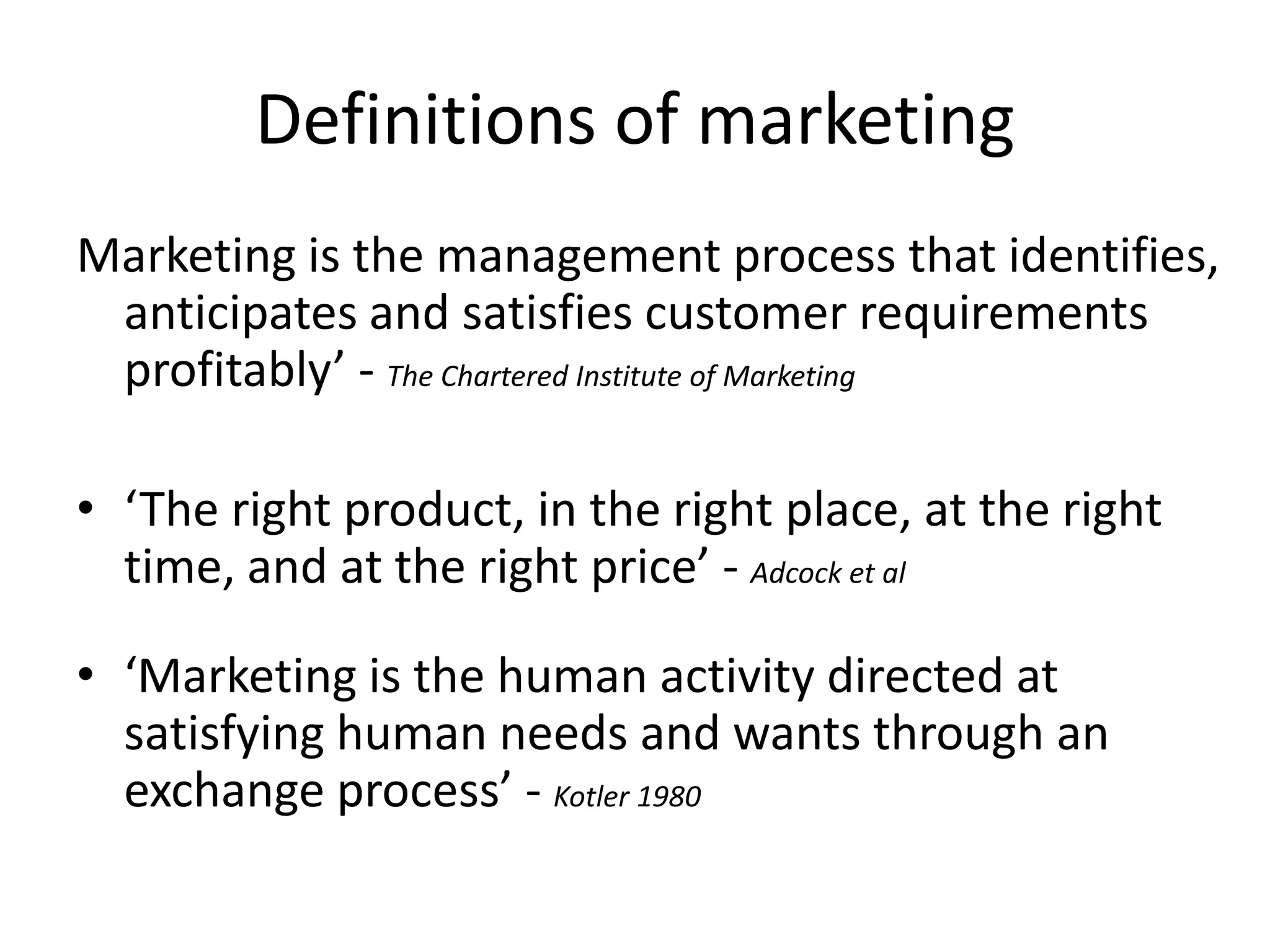
Definitions of marketing
Marketing is the management process that identifies,
 anticipates and satisfies customer requirements
 profitably’ - The Chartered Institute of Marketing

• ‘The right product, in the right place, at the right
  time, and at the right price’ - Adcock et al

• ‘Marketing is the human activity directed at
  satisfying human needs and wants through an
  exchange process’ - Kotler 1980
What is Marketing?

• Kotler’s social definition:

   “Marketing is a social and managerial process
    by which individuals and groups obtain what
    they need and want through creating and
    exchanging products and value with others.”


                       1-4
Marketing management process
                                                     1. Analysis
                                                       Audit
1. Where are we now?
2. Where do we want to
   be?                                                                            2.
                             5. Control
                                                                              Objectives
3. Which way is best?
                                                  Marketing
4. Tactics - how do we get                       management
   there? Getting there!                           process

5. Ensuring arrival

                                          4.                       3. Strategies
                                    Implementation
Core Concepts
•   Managerial Process involving analysis, planning and control.

•   Carefully formulated programs and not just random actions
•   Voluntary exchange of values; no use of force or coercion. Offer benefits.

•   Selection of Target Markets rather than a quixotic attempt to win every market and
    be all things to all men.

•   Purpose of marketing is to achieve Organizational Objectives.

•   Marketing relies on designing the organization’s offering in terms of the target
    market’s needs and desires rather than in terms of seller’s personal tastes or
    internal dynamics. User-oriented and not seller-oriented.

•   Marketing utilizes and blends a set of tools called the marketing mix – product
    design, pricing, distribution and communication. Too often marketing is equated
    either with just advertising or with just personal selling.
Marketing Functions

Buying & Assembling      Advertising           Financing


      Selling         Marketing Research   Market Information


    Storage &            Branding &
                                                Pricing
   Warehousing           Packaging


                      Standardization &
  Transportation                            Sales Promotion
                          Grading
Evolution of Marketing

                                                 Societal
Production                        Marketing
              Sales Orientation                 Marketing
Orientation                       Orientation
                                                Orientation


Late 1800s     Early 1930s        Mid 1950s     1990s
MARKETING vs. SELLING
Marketing starts with the buyer and       Selling starts with the seller and is
focuses constantly on buyer’s             preoccupied all the time with needs


Seeks to convert “customer needs” into    Seeks to convert ‘products’ into “Cash
‘products
Views business as a customer satisfying   Views business as a goods producing
process                                   process
Marketing effort leads to the products    The company makes the product first and
that the customers actually need          then figures out how to sell


Marketing views the customer as the       Selling views the customer as the last link
very purpose of the business              in the business
Marketing communication is looked upon Seller’s motives dominate marketing
as a tool for communicating            communication (promotions)
• WANTS AND DEMANDS
Human wants are desires for specific satisfiers of these deeper needs.
Demands are wants for specific products that are backed by an ability
   and
willingness to buy them.

• VALUE AND SATISFACTION

Value = Benefits = Functional Benefits Emotional Benefits
        Cost Monetary Costs + Time Costs + Energy Costs +Psychic
   Costs

Tools for tracking and measuring Customer Satisfaction:

Complaint and Suggestion systems, Customer satisfaction surveys
• Marketing Myopia

• It was developed by American Professor ‘Theodore Levitt –
  1960.
• Acco to him Marketing Myopia is a short sighted, narrow
  minded view of marketing and its environment and it must
  be avoided at all cost.
• It is an Inefficient ,complacement marketing approach
• Mr. Levitt is of opinion that the business must be viewed as a
  customer satisfaction process rather than o goods producing
  process
Holistic Marketing Orientation & Customer Value

• Marketing is becoming more complex & dynamic.
• Earlier production was with accordance to order of
  customers. Producer ↔ Customer
• Due to expansion of production market has also expanded
• Appointment of Middle man & sales person to collect the
  order
• Need of buyer were also consider as important aspect of
  business
CUSTOMER VALUE
• Value Exploring – How can
  company identify new value
  opportunities                                     Value
                                                  Exploration
• Value Creating – How can a         Value
                                    Creation

  company create more
                                                Value
  promising new values                         Delivery


  offering?
• Value Delivering – How
  companies use into                 Marketing
  capabilities and infrastructure
  to deliver the new value
  offering more efficiently.
Importance of Marketing

•   Increasing National Income
•   Low Prices
•   Better Standard of Living
•   Employment Orientation

Introduction to marketing

  • 1.
    Introduction to Marketing Prof Sujata Umesh Bolake
  • 2.
    What is Marketing? •Marketing is managing profitable customer relationships – Attracting new customers – Retaining and growing current customers 1-2
  • 3.
    Definitions of marketing Marketingis the management process that identifies, anticipates and satisfies customer requirements profitably’ - The Chartered Institute of Marketing • ‘The right product, in the right place, at the right time, and at the right price’ - Adcock et al • ‘Marketing is the human activity directed at satisfying human needs and wants through an exchange process’ - Kotler 1980
  • 4.
    What is Marketing? •Kotler’s social definition: “Marketing is a social and managerial process by which individuals and groups obtain what they need and want through creating and exchanging products and value with others.” 1-4
  • 5.
    Marketing management process 1. Analysis Audit 1. Where are we now? 2. Where do we want to be? 2. 5. Control Objectives 3. Which way is best? Marketing 4. Tactics - how do we get management there? Getting there! process 5. Ensuring arrival 4. 3. Strategies Implementation
  • 6.
    Core Concepts • Managerial Process involving analysis, planning and control. • Carefully formulated programs and not just random actions • Voluntary exchange of values; no use of force or coercion. Offer benefits. • Selection of Target Markets rather than a quixotic attempt to win every market and be all things to all men. • Purpose of marketing is to achieve Organizational Objectives. • Marketing relies on designing the organization’s offering in terms of the target market’s needs and desires rather than in terms of seller’s personal tastes or internal dynamics. User-oriented and not seller-oriented. • Marketing utilizes and blends a set of tools called the marketing mix – product design, pricing, distribution and communication. Too often marketing is equated either with just advertising or with just personal selling.
  • 7.
    Marketing Functions Buying &Assembling Advertising Financing Selling Marketing Research Market Information Storage & Branding & Pricing Warehousing Packaging Standardization & Transportation Sales Promotion Grading
  • 8.
    Evolution of Marketing Societal Production Marketing Sales Orientation Marketing Orientation Orientation Orientation Late 1800s Early 1930s Mid 1950s 1990s
  • 9.
    MARKETING vs. SELLING Marketingstarts with the buyer and Selling starts with the seller and is focuses constantly on buyer’s preoccupied all the time with needs Seeks to convert “customer needs” into Seeks to convert ‘products’ into “Cash ‘products Views business as a customer satisfying Views business as a goods producing process process Marketing effort leads to the products The company makes the product first and that the customers actually need then figures out how to sell Marketing views the customer as the Selling views the customer as the last link very purpose of the business in the business Marketing communication is looked upon Seller’s motives dominate marketing as a tool for communicating communication (promotions)
  • 10.
    • WANTS ANDDEMANDS Human wants are desires for specific satisfiers of these deeper needs. Demands are wants for specific products that are backed by an ability and willingness to buy them. • VALUE AND SATISFACTION Value = Benefits = Functional Benefits Emotional Benefits Cost Monetary Costs + Time Costs + Energy Costs +Psychic Costs Tools for tracking and measuring Customer Satisfaction: Complaint and Suggestion systems, Customer satisfaction surveys
  • 11.
    • Marketing Myopia •It was developed by American Professor ‘Theodore Levitt – 1960. • Acco to him Marketing Myopia is a short sighted, narrow minded view of marketing and its environment and it must be avoided at all cost. • It is an Inefficient ,complacement marketing approach • Mr. Levitt is of opinion that the business must be viewed as a customer satisfaction process rather than o goods producing process
  • 12.
    Holistic Marketing Orientation& Customer Value • Marketing is becoming more complex & dynamic. • Earlier production was with accordance to order of customers. Producer ↔ Customer • Due to expansion of production market has also expanded • Appointment of Middle man & sales person to collect the order • Need of buyer were also consider as important aspect of business
  • 13.
    CUSTOMER VALUE • ValueExploring – How can company identify new value opportunities Value Exploration • Value Creating – How can a Value Creation company create more Value promising new values Delivery offering? • Value Delivering – How companies use into Marketing capabilities and infrastructure to deliver the new value offering more efficiently.
  • 14.
    Importance of Marketing • Increasing National Income • Low Prices • Better Standard of Living • Employment Orientation