
Market segmentation, Market
positioning and source, message and
media effects of marketing
communication
Market segmentation is a marketing strategy that involves dividing
a broad target market into subsets of consumers who have
common needs and priorities, and then designing and
implementing strategies to target them.
 Market segmentation strategies may be used to identify the target
customers, and provide supporting data for positioning to achieve
a marketing plan objective.
Its objective is to design a marketing mix that precisely matches
the expectations of customers in the targeted segment.
Geographic Segmentation:
In the geographic segmentation ,the market is subdivided on the basis of
area. Marketers can segment according to geographic criteria—nations,
states, regions, countries, languages, cities, neighborhoods, or postal
codes.ie Regional, Urban/Rural, Locality.
Demographic Segmentation:
Demographic segmentation is a statistical study of population in favour of
age,gender,education.The various demographic factors are
Age,Gender,Income,Education etc.
Sociographic Segmentation:
The market can be segmented on the basis of sociological factors such as
Cultural influence and influence of social class.
Psychographic Segmentation
It refers to individual aspects like life style and personality.
Behavioral Segmentation:
Behavior Segmentation divides consumer into groups according to their
knowledge and attitudes towards usage rate to a product.
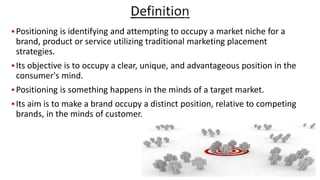
Positioning is identifying and attempting to occupy a market niche for a
brand, product or service utilizing traditional marketing placement
strategies.
Its objective is to occupy a clear, unique, and advantageous position in the
consumer's mind.
Positioning is something happens in the minds of a target market.
Its aim is to make a brand occupy a distinct position, relative to competing
brands, in the minds of customer.
Identifying the business's direct competition (could include players that offer
your product/service amongst a larger portfolio of solutions)
Understanding how each competitor is positioning their business today .
Documenting the provider's own positioning as it exists today.
Comparing the company's positioning to its competitors' to identify viable
areas for differentiation
Developing a distinctive, differentiating and value-based positioning concept
Creating a positioning statement with key messages and customer value
propositions to be used for communications development across the
organisation
Defining the market in which the product or brand will compete.
Identifying the attributes that define the product 'space‘.
Collecting information from a sample of customers about their perceptions
of each product on the relevant attributes
Determine each product's share of mind
Determine each product's current location in the product space
Determine the target market's preferred combination of attributes.
Examine the fit between the product and the market.
Marketing communication (MarCom) is a fundamental and complex part of
a company’s marketing efforts.
Marketing communications are messages and related media used to
communicate with a market.
Marketing communications are messages and related media used to
communicate with a market.
Those who practice advertising, branding, brand language, direct marketing,
graphic design, marketing, packaging, promotion, publicity, sponsorship,
public relations, sales, sales promotion and online marketing are termed
marketing communicators.
In a marketing context, several sources can be employed in an attempt to
reach consumers with persuasive communications.
Consumers perceive companies as sources of information, and some are
been as highly credible but others are viewed wit suspicion.
Because of their face to face contacts with current customers’ sales
representation themselves are viewed by consumers as information
sources.
Media are actually channel links between companies’ and consumers
people view them as sources.
At the local level, retailers often act as sources for marketing
communications.
Social media has drastically changed how we communicate.
Not too long ago, we communicated through the mail, on a land-line
telephone, and in person.
Today we send text message, leave voice messages, instant messenger, online
video phone, and of course interact through internet.
Social commercials market share is rising, thanks to services like YouTube,
Facebook .
 According to a 2011 study, "88% of all companies that have conducted social
media advertising are satisfied with it.
There is a large increase of businesses using video via YouTube for local
business pages such as Google Local which was integrated as part of the
Google Plus network in 2012.
Messaging is a popular medium for both social and work related
communication.
message strategy consists of a positioning statement and three to four
support points. The positioning statement addresses the target market’s
most pressing problem by stating a benefit.
A message strategy can be extremely detailed and is like a recipe for all
marketing communication.
 message strategy makes it easier to deliver the same message in all your
marketing communications.
Messages that Matter uses a formal, systematic business process that helps
you develop a unique message strategy; one that communicates concrete
benefits and sets you apart from the competition.
www.Wikipedia.com
www.solari.net
www.bussinessdictionart.com
www.investopedia.com
www.messagesthatmatter.com
www.google.com
market segmentation and market positioning

market segmentation and market positioning

  • 1.
    Market segmentation, Market positioningand source, message and media effects of marketing communication
  • 3.
    Market segmentation isa marketing strategy that involves dividing a broad target market into subsets of consumers who have common needs and priorities, and then designing and implementing strategies to target them.  Market segmentation strategies may be used to identify the target customers, and provide supporting data for positioning to achieve a marketing plan objective. Its objective is to design a marketing mix that precisely matches the expectations of customers in the targeted segment.
  • 4.
    Geographic Segmentation: In thegeographic segmentation ,the market is subdivided on the basis of area. Marketers can segment according to geographic criteria—nations, states, regions, countries, languages, cities, neighborhoods, or postal codes.ie Regional, Urban/Rural, Locality. Demographic Segmentation: Demographic segmentation is a statistical study of population in favour of age,gender,education.The various demographic factors are Age,Gender,Income,Education etc.
  • 5.
    Sociographic Segmentation: The marketcan be segmented on the basis of sociological factors such as Cultural influence and influence of social class. Psychographic Segmentation It refers to individual aspects like life style and personality. Behavioral Segmentation: Behavior Segmentation divides consumer into groups according to their knowledge and attitudes towards usage rate to a product.
  • 7.
    Positioning is identifyingand attempting to occupy a market niche for a brand, product or service utilizing traditional marketing placement strategies. Its objective is to occupy a clear, unique, and advantageous position in the consumer's mind. Positioning is something happens in the minds of a target market. Its aim is to make a brand occupy a distinct position, relative to competing brands, in the minds of customer.
  • 8.
    Identifying the business'sdirect competition (could include players that offer your product/service amongst a larger portfolio of solutions) Understanding how each competitor is positioning their business today . Documenting the provider's own positioning as it exists today. Comparing the company's positioning to its competitors' to identify viable areas for differentiation Developing a distinctive, differentiating and value-based positioning concept Creating a positioning statement with key messages and customer value propositions to be used for communications development across the organisation
  • 9.
    Defining the marketin which the product or brand will compete. Identifying the attributes that define the product 'space‘. Collecting information from a sample of customers about their perceptions of each product on the relevant attributes Determine each product's share of mind Determine each product's current location in the product space Determine the target market's preferred combination of attributes. Examine the fit between the product and the market.
  • 11.
    Marketing communication (MarCom)is a fundamental and complex part of a company’s marketing efforts. Marketing communications are messages and related media used to communicate with a market. Marketing communications are messages and related media used to communicate with a market. Those who practice advertising, branding, brand language, direct marketing, graphic design, marketing, packaging, promotion, publicity, sponsorship, public relations, sales, sales promotion and online marketing are termed marketing communicators.
  • 12.
    In a marketingcontext, several sources can be employed in an attempt to reach consumers with persuasive communications. Consumers perceive companies as sources of information, and some are been as highly credible but others are viewed wit suspicion. Because of their face to face contacts with current customers’ sales representation themselves are viewed by consumers as information sources. Media are actually channel links between companies’ and consumers people view them as sources. At the local level, retailers often act as sources for marketing communications.
  • 13.
    Social media hasdrastically changed how we communicate. Not too long ago, we communicated through the mail, on a land-line telephone, and in person. Today we send text message, leave voice messages, instant messenger, online video phone, and of course interact through internet. Social commercials market share is rising, thanks to services like YouTube, Facebook .  According to a 2011 study, "88% of all companies that have conducted social media advertising are satisfied with it. There is a large increase of businesses using video via YouTube for local business pages such as Google Local which was integrated as part of the Google Plus network in 2012.
  • 14.
    Messaging is apopular medium for both social and work related communication. message strategy consists of a positioning statement and three to four support points. The positioning statement addresses the target market’s most pressing problem by stating a benefit. A message strategy can be extremely detailed and is like a recipe for all marketing communication.  message strategy makes it easier to deliver the same message in all your marketing communications. Messages that Matter uses a formal, systematic business process that helps you develop a unique message strategy; one that communicates concrete benefits and sets you apart from the competition.
  • 15.