Mario A. González-Corzo, Ph.D. 
Department of Economics and Business 
LEHMAN COLLEGE, CUNY 
1
OUTLINE 
I. INSTITUTIONAL FRAMEWORK 
II. METRICS, EXPECTED OUTCOMES & 
STATISTICAL ISSUES 
III. PRELIMINARY FINDINGS 
IV. CONCLUSIONS 
2
I. Institutional Framework 
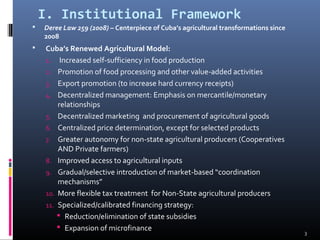
 Deree Law 259 (2008) – Centerpiece of Cuba’s agricultural transformations since 
2008 
 Cuba’s Renewed Agricultural Model: 
1. Increased self-sufficiency in food production 
2. Promotion of food processing and other value-added activities 
3. Export promotion (to increase hard currency receipts) 
4. Decentralized management: Emphasis on mercantile/monetary 
relationships 
5. Decentralized marketing and procurement of agricultural goods 
6. Centralized price determination, except for selected products 
7. Greater autonomy for non-state agricultural producers (Cooperatives 
AND Private farmers) 
8. Improved access to agricultural inputs 
9. Gradual/selective introduction of market-based “coordination 
mechanisms” 
10. More flexible tax treatment for Non-State agricultural producers 
11. Specialized/calibrated financing strategy: 
 Reduction/elimination of state subsidies 
 Expansion of microfinance 
3
II. METRICS, EXPECTED OUTCOMES & 
STATISTICAL ISSUES 
BASIC STANDARD METRICS (Cited in the literature on agricultural transition): 
 Labor productivity (APL = TP/L) : Output/Input ratio measures efficiency 
 GDP and agricultural product (output) 
 Agricultural yields 
 Expected Outcomes/Results: As non-State actors increase their share of agricultural output 
 Initial decreases in output, as agriculture migrates from capital-intensive, State-subsidized, collectivist model 
( 5 years) 
 Second state: GDP growth (recovery) drives increases in agricultural product (output) 
 Higher yields, as output shrinks, but area under cultivation increases. 
 Changes in the productivity of labor 
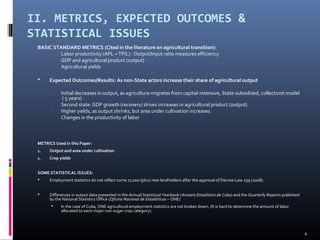
METRICS Used in this Paper: 
1. Output and area under cultivation 
2. Crop yields 
SOME STATISTICAL ISSUES: 
 Employment statistics do not reflect some 71,000 (plus) new landholders after the approval of Decree-Law 259 (2008). 
 Differences in output data presented in the Annual Statistical Yearbook (Anuario Estadístico de Cuba) and the Quarterly Reports published 
by the National Statistics Office (Oficina Nacional de Estadísticas – ONE) 
 In the case of Cuba, ONE agricultural employment statistics are not broken down. (It is hard to determine the amount of labor 
allocated to each major non-sugar crop category). 
4
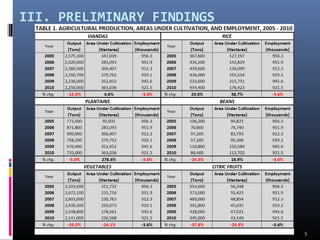
III. PRELIMINARY FINDINGS 
5
III. PRELIMINARY FINDINGS: Regression 
TARBLeE s2. uSElLEtCTEsD REGRESSION OUTPUT SUMMARY 
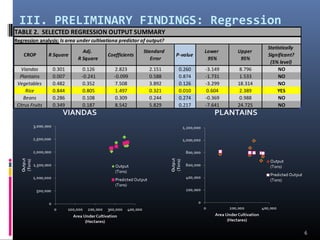
Regression analysis: Is area under cultivationa predictor of output? 
CROP R Square 
Adj. 
R Square 
Coefficients 
Standard 
Error 
P-value 
Lower 
95% 
Upper 
95% 
Statistically 
Significant? 
(5% level) 
Viandas 0.301 0.126 2.823 2.151 0.260 -3.149 8.796 NO 
Plantains 0.007 -0.241 -0.099 0.588 0.874 -1.731 1.533 NO 
Vegetables 0.482 0.352 7.508 3.892 0.126 -3.299 18.314 NO 
Rice 0.844 0.805 1.497 0.321 0.010 0.604 2.389 YES 
Beans 0.286 0.108 0.309 0.244 0.274 -0.369 0.988 NO 
Citrus Fruits 0.349 0.187 8.542 5.829 0.217 -7.641 24.725 NO 
6
III. PRELIMINARY FINDINGS: Regression Results 
7
III. PRELIMINARY FINDINGS: Crop Yields 
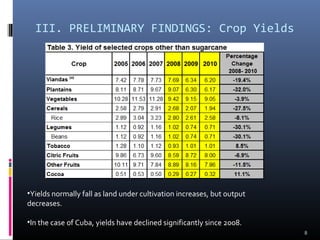
•Yields normally fall as land under cultivation increases, but output 
decreases. 
•In the case of Cuba, yields have declined significantly since 2008. 
8
III. PRELIMINARY FINDINGS: Crop Yields 
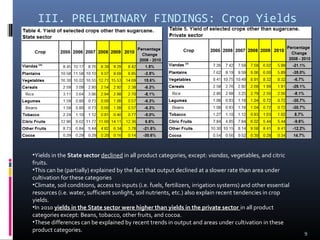
•Yields in the State sector declined in all product categories, except: viandas, vegetables, and citric 
fruits. 
•This can be (partially) explained by the fact that output declined at a slower rate than area under 
cultivation for these categories 
•Climate, soil conditions, access to inputs (i.e. fuels, fertilizers, irrigation systems) and other essential 
resources (i.e. water, sufficient sunlight, soil nutrients, etc.) also explain recent tendencies in crop 
yields. 
•In 2010 yields in the State sector were higher than yields in the private sector in all product 
categories except: Beans, tobacco, other fruits, and cocoa. 
•These differences can be explained by recent trends in output and areas under cultivation in these 
product categories. 9
IV. CONCLUSIONS 
 BETWEEN 2008 AND 2010: 
 OUTPUT declined in 5 out of 9 product categories (non-sugar agriculture) 
 During the same period, output in the State sector fell all product categories 
(7 out of 9) except beans and cocoa. 
 Output in the private sector was also mixed, with decreases in 5 out of 9 
product categories. 
 2006 appears to be an “inflection point” after which output gradually 
recovers in some products, while it declines in others. 
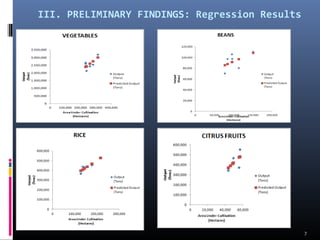
 With the exception of rice, area under cultivation seems to be a poor 
predictor of output. 
 YIELDS experienced a downward trend in both the State and non-State 
sectors. 
 Paradoxically, yields in the non-State sector were lower , except for beans, 
tobacco, an d cocoa. 
 These trends suggest that Cuban agriculture is following, albeit at a 
moderate rate, the path of other centrally-planned economies in which non- 
State actors are given a greater role. 
10

Measuring Cuba's Agricultural Transformations: Preliminary Findings

  • 1.
    Mario A. González-Corzo,Ph.D. Department of Economics and Business LEHMAN COLLEGE, CUNY 1
  • 2.
    OUTLINE I. INSTITUTIONALFRAMEWORK II. METRICS, EXPECTED OUTCOMES & STATISTICAL ISSUES III. PRELIMINARY FINDINGS IV. CONCLUSIONS 2
  • 3.
    I. Institutional Framework  Deree Law 259 (2008) – Centerpiece of Cuba’s agricultural transformations since 2008  Cuba’s Renewed Agricultural Model: 1. Increased self-sufficiency in food production 2. Promotion of food processing and other value-added activities 3. Export promotion (to increase hard currency receipts) 4. Decentralized management: Emphasis on mercantile/monetary relationships 5. Decentralized marketing and procurement of agricultural goods 6. Centralized price determination, except for selected products 7. Greater autonomy for non-state agricultural producers (Cooperatives AND Private farmers) 8. Improved access to agricultural inputs 9. Gradual/selective introduction of market-based “coordination mechanisms” 10. More flexible tax treatment for Non-State agricultural producers 11. Specialized/calibrated financing strategy:  Reduction/elimination of state subsidies  Expansion of microfinance 3
  • 4.
    II. METRICS, EXPECTEDOUTCOMES & STATISTICAL ISSUES BASIC STANDARD METRICS (Cited in the literature on agricultural transition):  Labor productivity (APL = TP/L) : Output/Input ratio measures efficiency  GDP and agricultural product (output)  Agricultural yields  Expected Outcomes/Results: As non-State actors increase their share of agricultural output  Initial decreases in output, as agriculture migrates from capital-intensive, State-subsidized, collectivist model ( 5 years)  Second state: GDP growth (recovery) drives increases in agricultural product (output)  Higher yields, as output shrinks, but area under cultivation increases.  Changes in the productivity of labor METRICS Used in this Paper: 1. Output and area under cultivation 2. Crop yields SOME STATISTICAL ISSUES:  Employment statistics do not reflect some 71,000 (plus) new landholders after the approval of Decree-Law 259 (2008).  Differences in output data presented in the Annual Statistical Yearbook (Anuario Estadístico de Cuba) and the Quarterly Reports published by the National Statistics Office (Oficina Nacional de Estadísticas – ONE)  In the case of Cuba, ONE agricultural employment statistics are not broken down. (It is hard to determine the amount of labor allocated to each major non-sugar crop category). 4
  • 5.
  • 6.
    III. PRELIMINARY FINDINGS:Regression TARBLeE s2. uSElLEtCTEsD REGRESSION OUTPUT SUMMARY Regression analysis: Is area under cultivationa predictor of output? CROP R Square Adj. R Square Coefficients Standard Error P-value Lower 95% Upper 95% Statistically Significant? (5% level) Viandas 0.301 0.126 2.823 2.151 0.260 -3.149 8.796 NO Plantains 0.007 -0.241 -0.099 0.588 0.874 -1.731 1.533 NO Vegetables 0.482 0.352 7.508 3.892 0.126 -3.299 18.314 NO Rice 0.844 0.805 1.497 0.321 0.010 0.604 2.389 YES Beans 0.286 0.108 0.309 0.244 0.274 -0.369 0.988 NO Citrus Fruits 0.349 0.187 8.542 5.829 0.217 -7.641 24.725 NO 6
  • 7.
    III. PRELIMINARY FINDINGS:Regression Results 7
  • 8.
    III. PRELIMINARY FINDINGS:Crop Yields •Yields normally fall as land under cultivation increases, but output decreases. •In the case of Cuba, yields have declined significantly since 2008. 8
  • 9.
    III. PRELIMINARY FINDINGS:Crop Yields •Yields in the State sector declined in all product categories, except: viandas, vegetables, and citric fruits. •This can be (partially) explained by the fact that output declined at a slower rate than area under cultivation for these categories •Climate, soil conditions, access to inputs (i.e. fuels, fertilizers, irrigation systems) and other essential resources (i.e. water, sufficient sunlight, soil nutrients, etc.) also explain recent tendencies in crop yields. •In 2010 yields in the State sector were higher than yields in the private sector in all product categories except: Beans, tobacco, other fruits, and cocoa. •These differences can be explained by recent trends in output and areas under cultivation in these product categories. 9
  • 10.
    IV. CONCLUSIONS BETWEEN 2008 AND 2010:  OUTPUT declined in 5 out of 9 product categories (non-sugar agriculture)  During the same period, output in the State sector fell all product categories (7 out of 9) except beans and cocoa.  Output in the private sector was also mixed, with decreases in 5 out of 9 product categories.  2006 appears to be an “inflection point” after which output gradually recovers in some products, while it declines in others.  With the exception of rice, area under cultivation seems to be a poor predictor of output.  YIELDS experienced a downward trend in both the State and non-State sectors.  Paradoxically, yields in the non-State sector were lower , except for beans, tobacco, an d cocoa.  These trends suggest that Cuban agriculture is following, albeit at a moderate rate, the path of other centrally-planned economies in which non- State actors are given a greater role. 10

Editor's Notes

  • #6 Increasing the areas under cultivation in order to increase domestic food production is one of the principal policy objectives of Cuba’s renewed agricultural model. Since 2008, the relationship between output and area under cultivation seems to be positive for the majority of non-sugar agriculture categories, with 2009 as an observable “inflection point.” Some notable exceptions were: Plantains, Rice, and Beans Output typically falls even as the areas under cultivation increase during the process of economic reforms. This can be attributed to declining factor productivity, inefficiencies, existing bureaucratic, technological, financial, and regulatory constrains, imperfect input markets, etc.