
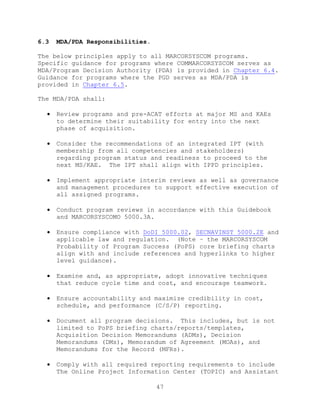
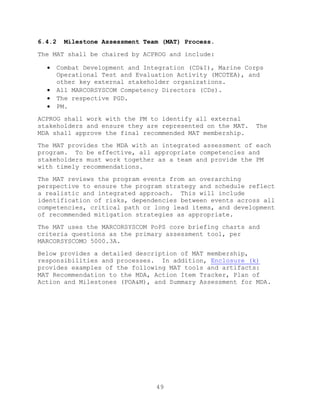


TABLE OF CONTENTS
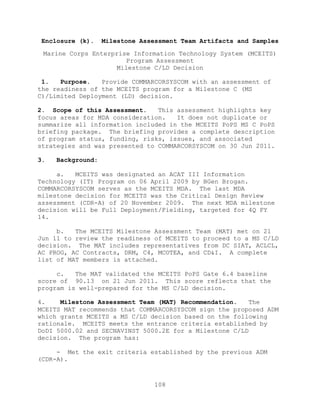
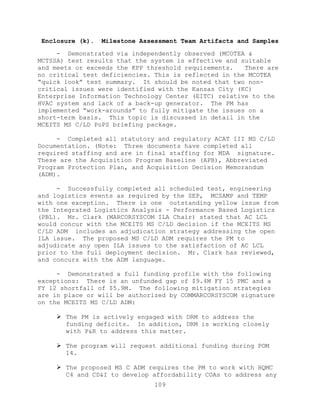
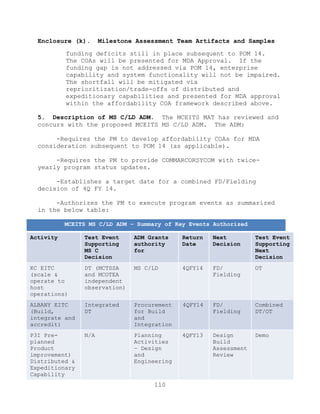
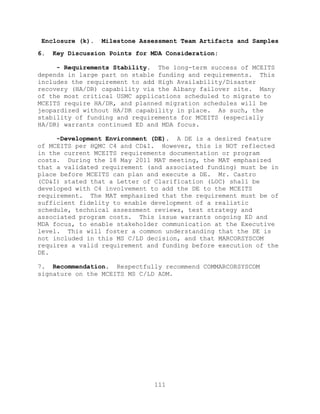
Chapter 1: EXECUTIVE SUMMARY ..............................1
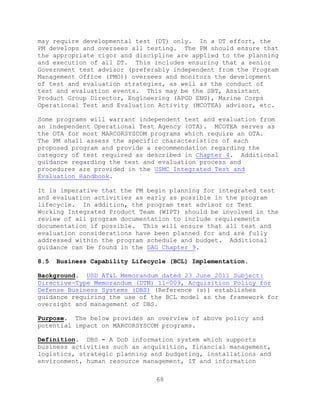
1.1 Scope of this Guidebook................................... 1
1.2 When Should this Guidebook Be Used?....................... 2
1.2.1 MARCORSYSCOM IMDP SharePoint............................ 2
1.2.2 PoPS V2 & MARCORSYSCOMO 5000.3A......................... 4
Chapter 2: MARCORSYSCOM IMPLEMENTATION OF THE DEFENSE
ACQUISITION MANAGEMENT SYSTEM ..................6
2.1 Transition of Requirements to the Acquisition Process..... 6
2.2 Overview.................................................. 9
2.3 Defense Acquisition Framework - Summary of Milestones (MS),
Key Acquisition Events (KAEs), and Acquisition Phases.... 10
2.3.1 Milestones and Key Acquisition Events.................. 12
2.3.2 Summary of Acquisition Phases.......................... 14
2.3.3 Fielding............................................... 24
2.3.4 Initial Operational Capability (IOC) and Full Operational
Capability (FOC)....................................... 25
2.4 Evolutionary Acquisition................................. 27
Chapter 3: MARCORSYSCOM PoPS IMPLEMENTATION PROCEDURES ...30
3.1 Background............................................... 30
3.1.1 PoPS Process Overview.................................. 30
3.2 Tools for Implementing PoPS – SharePoint and PoPS Database.
32
3.3 MARCORSYSCOM PoPS Review Process......................... 33
3.3.1 Gate Reviews........................................... 34
3.3.1.1 Combat Development and Integration (CD&I) Gate Review
Responsibilities..................................... 34
3.3.2 Transitioning Ongoing Efforts to an ACAT Framework and
Tailoring of PoPS...................................... 36
Chapter 4: ACAT LEVELS ...................................38
4.1 Background............................................... 38
4.2 ACAT Designation Criteria................................ 39
4.3 Description of ACAT Categories........................... 40
Chapter 5: ACAT DESIGNATION REQUESTS & DELEGATION OF
MDA/PDA .......................................42
5.1 ACAT III, IV, and Abbreviated Acquisition Program (AAP)
Designation Requests..................................... 42
5.2 ACAT III, IV, and AAP Designation Process................ 42
5.3 ACAT Change Requests..................................... 43
5.4 Delegation of MDA........................................ 43
Chapter 6: MANAGEMENT OF MARCORSYSCOM ACAT PROGRAMS AND
PRE-ACAT EFFORTS ..............................45
6.1 DoD Process for Assigning MDA............................ 45
6.2 DoD Process for Managing ACAT Programs................... 46
6.3 MDA/PDA Responsibilities................................. 47
6.3.1 Program Manager Responsibilities....................... 48
6.4 Management Procedures for Programs Where COMMARCORSYSCOM
Serves as MDA/PDA........................................ 48
6.4.1 General................................................ 48
6.4.2 Milestone Assessment Team (MAT) Process................ 49
6.4.3 MAT Member Roles and Responsibilities.................. 52
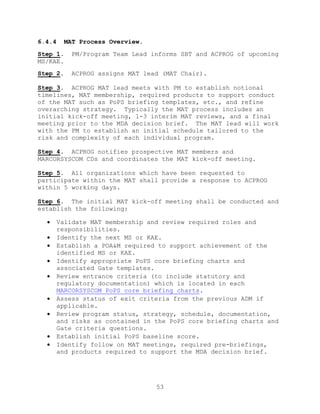
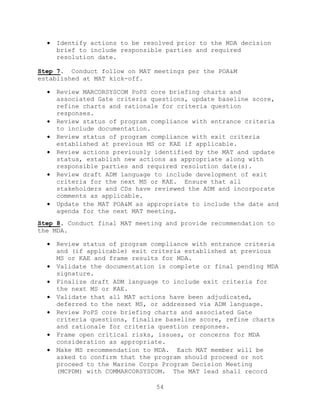
6.4.4 MAT Process Overview................................... 53
6.4.5 MAT Issue Resolution Process........................... 57
6.5 Management Procedures for Programs Where the PGD Serves as
MDA/PDA.................................................. 57
Chapter 7: TAILORING & PROGRAM DOCUMENTATION .............59
7.1 MDA Tailoring............................................ 59
7.2 Program Documentation.................................... 60
7.2.1 AAP Documentation...................................... 60
7.2.2 Streamlining Documentation............................. 61
Chapter 8: TOOLS & ADDITIONAL GUIDANCE ...................63
8.1 Integrated Master Plan (IMP)/Integrated Master Schedule
(IMS).................................................... 63
8.2 Risk..................................................... 65
8.2.1 Risk Reporting Matrix.................................. 66
8.3 Clinger-Cohen Act (CCA).................................. 67
8.4 Test and Evaluation Planning............................. 67
8.5 Business Capability Lifecycle (BCL) Implementation....... 68
8.5.1 MARCORSYSCOM BCL Implementation Plans.................. 70
8.6 Dr. Carter Guidance – Better Buying Power Memoranda...... 71
8.7 Memorandum of Agreement (MOA)............................ 74
8.8 Modifications............................................ 75
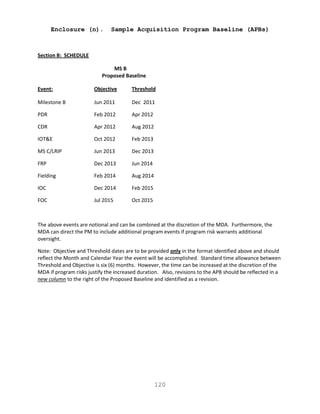
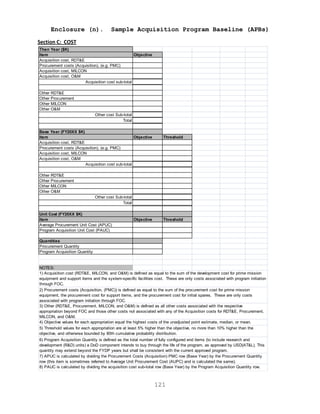
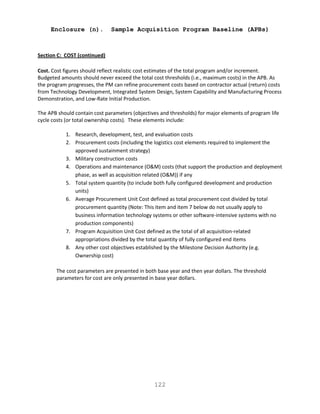
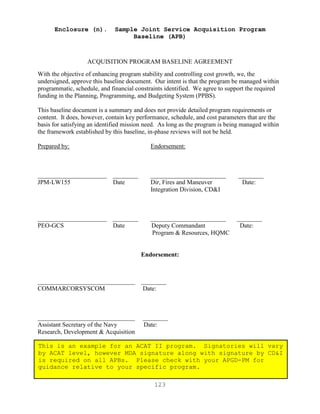
8.9 Acquisition Program Baseline (APB)....................... 75
8.10 MARCORSYSCOM Program Objective Memorandum (POM) Process. 78
Chapter 9: REPORTING TOOLS (DASHBOARD/TOPIC) .............80
9.1 Assistant Secretary of the Navy for Research, Development,
and Acquisition (ASN RDA) DASHBOARD Reporting............ 80
9.1.1 Background and Overview................................ 80
9.1.2 Responsibilities for Creation and Update of DASHBOARD
Information............................................ 80
9.1.2.1 PM Responsibilities.................................. 80
9.1.2.2 ACPROG Responsibilities.............................. 81
9.1.2.3 ASN RDA Responsibilities............................. 81
9.1.3 MARCORSYSCOM Required Quarterly DASHBOARD Reporting.... 81
9.2 TOPIC.................................................... 83
9.2.1 Background and Overview................................ 83
9.2.2 PM Responsibilities.................................... 83
9.2.3 Future Plans - TOPIC 2.0............................... 83
Chapter 10: JOINT PROGRAMS ...............................84
10.1 Overview................................................ 84
10.2 Request to Participate (RTP)............................ 85
Chapter 11: REMOVAL OF PROGRAMS FROM ACTIVE ACAT STATUS ..86
Chapter 12: ROLES AND RESPONSIBILITIES ...................87
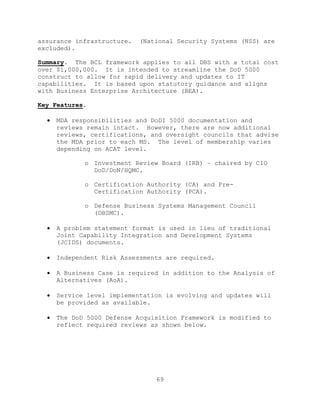
TABLES
Table 3A. MS/KAE & Supporting PoPS Gate Criteria Templates... 36
Table 4A. ACAT Categories.................................... 39
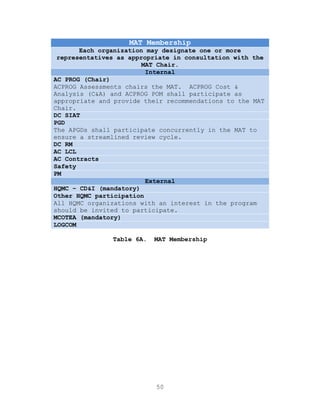
Table 6A. MAT Membership..................................... 50
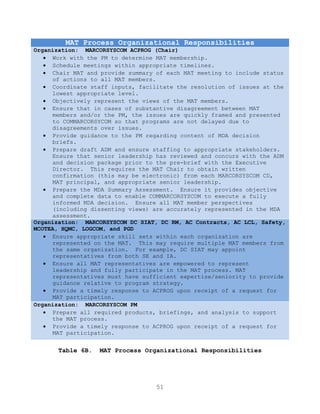
Table 6B. MAT Process Organizational Responsibilities........ 51
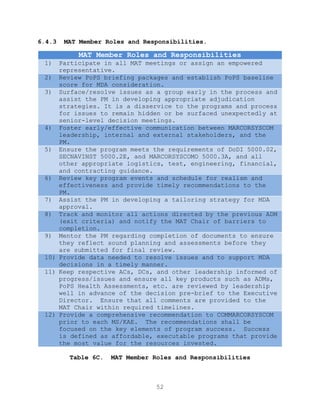
Table 6C. MAT Member Roles and Responsibilities.............. 52
Table 9A. DASHBOARD Quarterly Responsibilities............... 82
FIGURES
Figure 1A. IMDP SharePoint Site............................... 4
Figure 2A. Top Level View of the Requirements Process......... 9
Figure 2B. Defense Acquisition Framework..................... 10
Figure 2C. Graphical Depiction of an Example Evolutionary
Acquisition Program........................... 29
Figure 3A. Instructions & Process Flow for PoPS Database..... 33
Figure 3B. MARCORSYSCOM Implementation of the DoD Defense
Acquisition Framework with PoPS............... 35
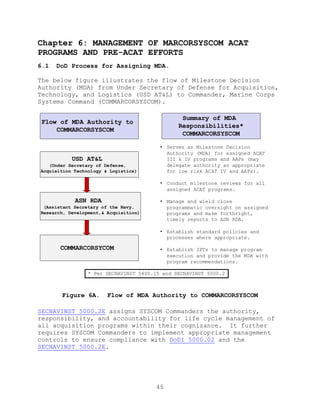
Figure 6A. Flow of MDA Authority to COMMARCORSYSCOM.......... 45
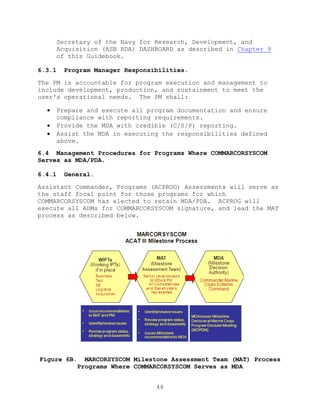
Figure 6B. MARCORSYSCOM Milestone Assessment Team (MAT) Process
Programs Where COMMARCORSYSCOM Serves as MDA.. 48
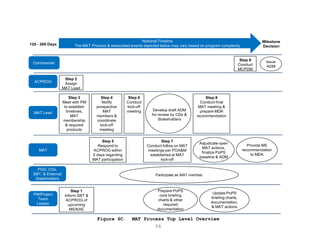
Figure 6C. MAT Process Top Level Overview.................... 56
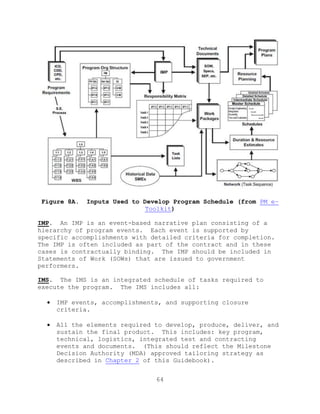
Figure 8A. Inputs Used to Develop Program Schedule (from PM e–
Toolkit)...................................... 64
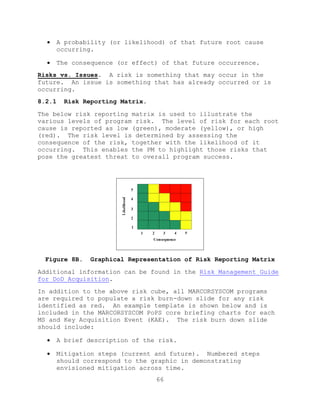
Figure 8B. Graphical Representation of Risk Reporting Matrix. 66
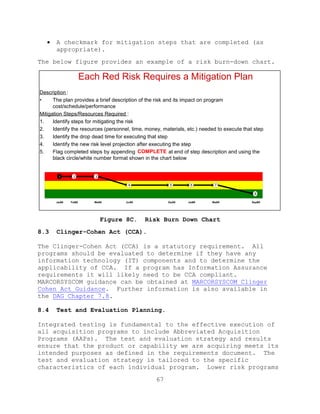
Figure 8C. Risk Burn Down Chart.............................. 67
Figure 8D. BCL Process Overlay with DoDI 5000.02 Framework... 70
Figure 8E. BCL Framework..................................... 71
Figure 8F. Better Buying Power............................... 71
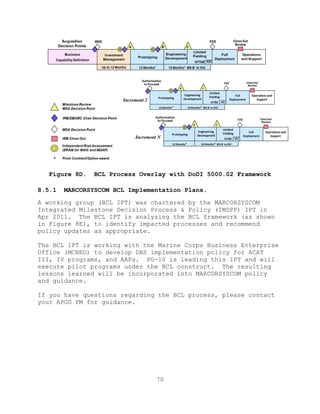
ENCLOSURES
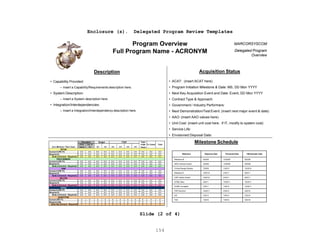
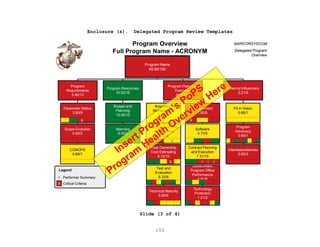
Enclosure (a). Example of PoPS Summary Chart and PoPS Health
Assessment.................................... 90
Enclosure (b). Example of Entry and Exit Criteria for
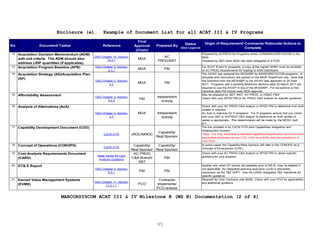
Milestones and Key Acquisition Events......... 91
Enclosure (c). Example of Notional Timeline.................. 92
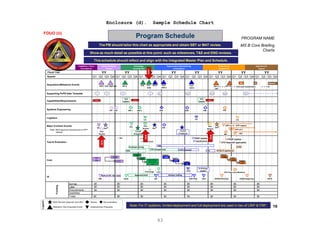
Enclosure (d). Sample Schedule Chart......................... 93
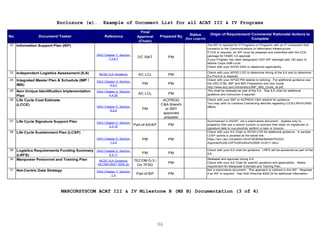
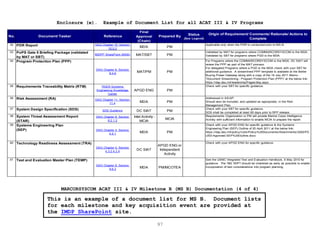
Enclosure (e). Example of Document List for all ACAT III & IV
Programs...................................... 94
Enclosure (f). Tools – List of Subject Matter Experts,
Knowledge Centers, and Hyperlinks............. 98
Enclosure (g). Sample ACAT Designation and Delegation Request
(AAP)........................................ 100
Enclosure (h). Sample ACAT Designation and Delegation Request
(ACAT III & IV) (includes ACAT Change Request
Instructions)................................ 102
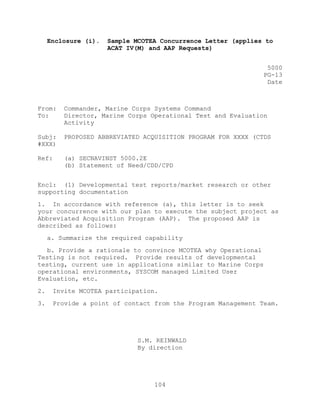
Enclosure (i). Sample MCOTEA Concurrence Letter (applies to
ACAT IV(M) and AAP Requests)................. 104
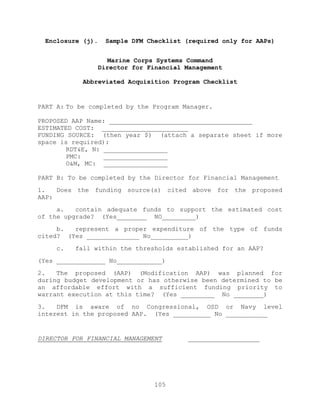
Enclosure (j). Sample DFM Checklist (required only for AAPs) 105
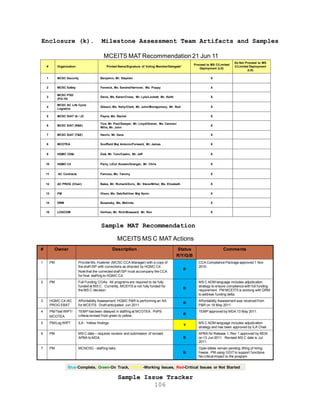
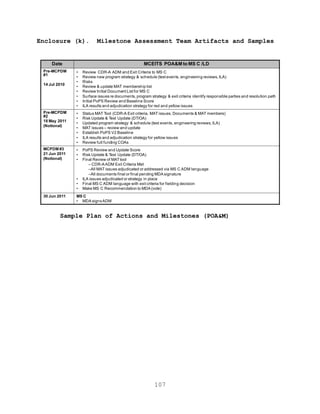
Enclosure (k). Milestone Assessment Team Artifacts and Samples
............................................. 106
Enclosure (l). Example of Request to Participate............ 112
Enclosure (m). Database Rules (Special Instructions for PoPS
Database).................................... 116
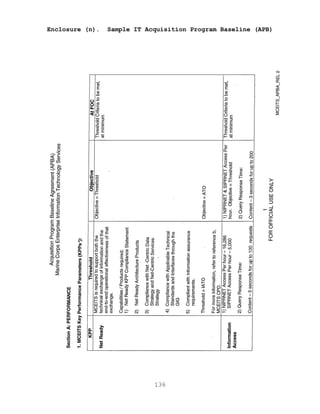
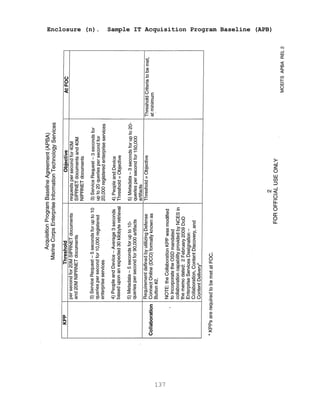
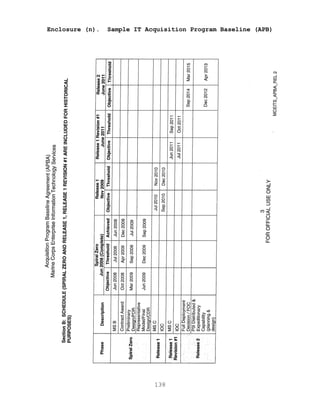
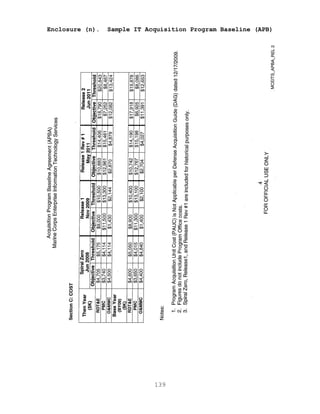
Enclosure (n). Sample Acquisition Program Baseline (APBs)... 117
Enclosure (o). 12 Steps to Program Success Tips for the PM.. 140
Enclosure (p). Example of Initial Operational Capability (IOC)
Declaration.................................. 147
Enclosure (q). MARCORSYSCOM Decision Review Scheduling Process
............................................. 148
Enclosure (r). Example of Memorandum of Agreement (MOA)..... 149
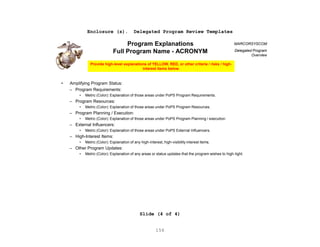
Enclosure (s). Delegated Program Review Templates........... 153
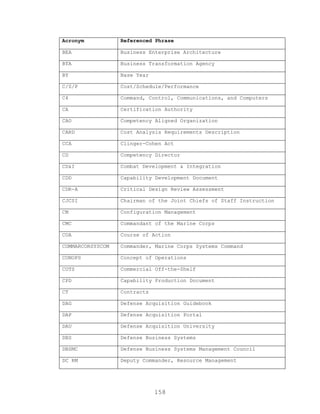
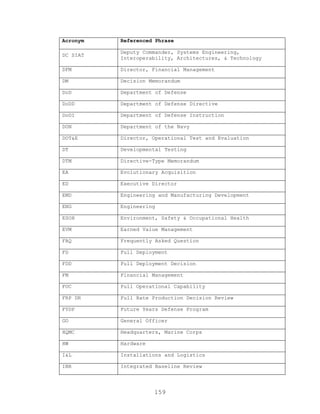
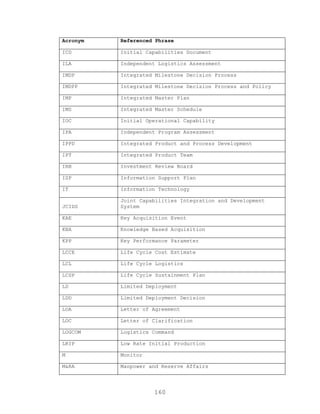
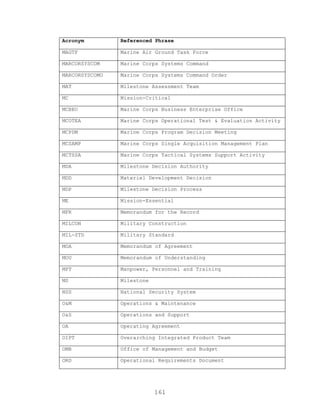
Enclosure (t). Glossary..................................... 157
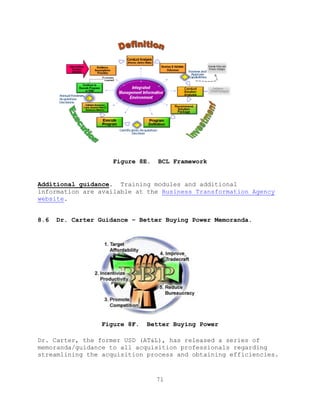
REFERENCES
a) MARCORSYSCOM Order 5401.1, 9 Aug 2011, Competency Aligned
Organization/Integrated Product Team Implementation
b) DoDI 5000.02, 8 Dec 2008, Operation of the Defense
Acquisition System
c) SECNAVINST 5000.2E, 1 Sep 2011, Implementation and
Operation of the Defense Acquisition System and the
Joint Capabilities Integration and Development System
d) Defense Acquisition Guidebook (DAG), 29 Jul 2011
e) MARCORSYSCOM Order 5000.3A, 8 Mar 2012, Implementation of
Marine Corps Systems Command (MARCORSYSCOM) Acquisition
Guidebook (MAG) and Probability of Program Success (PoPS)
Version 2 (V2) Procedures
f) Marine Corps Order 3900.17, 17 Oct 2008, The Marine Corps
Urgent Needs Process (UNP) and the Urgent Universal Needs
Statement (Urgent UNS)
g) Acquisition Policy Letter 08-07, 10 Oct 2007, Acquisition
Decision Memorandum (ADM) Procedures in response to Urgent
Statements of Need (USON)
h) CJCSI 3170.01G, 1 Mar 2009, Joint Capabilities Integration
and Development System
i) Joint Capabilities Integration and Development System Manual,
31 Jan 2011
j) Marine Corps Order 3900.15B, 10 Mar 2008, Marine Corps
Expeditionary Force Development System (EFDS)
k) DoDD 5000.01, 20 Nov 2007, The Defense Acquisition System
l) ASN RDA Memorandum, 18 Jul 2008, Implementation of
Systems Design Specification (SDS) Guidebook and
Associated System Specific Appendices
m) USMC Integrated Test and Evaluation Handbook, 6 May 2010
n) Acquisition Policy Letter 5-09, 17 Nov 2009, Fielding
Decision Process
o) USD AT&L Guide, 1 Oct 1999, Rules of the Road: A Guide for
Leading Successful Integrated Product Teams
p) Interim Policy Guidance for Transition to Acquisition
Strategy/Acquisition Plan (AS/AP), 20 Sep 2011
q) Integrated Master Plan and Integrated Master Schedule
Preparation and Use Guide V0.9, 21 Oct 2005
r) Risk Management Guide for DoD Acquisition Sixth Edition V1.0,
4 Aug 2006
s) USD AT&L Memorandum, 23 Jun 2011, Directive-Type
Memorandum (DTM) 11-009, Acquisition Policy for Defense
Business Systems (DBS)
t) Acquisition Policy Letter 02-09, 26 May 2009, Modifications
to Systems
u) Joint Program Managers Handbook Third Edition V1.0, Aug 2004
v) MCSC Technical Review Handbook V1.04, Apr 2009
w) MARCORSYSCOM Order 4130.1, 6 Jan 2010, Configuration
Management (CM) Policy
1
Chapter 1: EXECUTIVE SUMMARY
1.1 Scope of this Guidebook.
This Guidebook provides:
 A consolidated overview of internal Marine Corps Systems
Command (MARCORSYSCOM) acquisition processes. The
Guidebook is designed to leverage and support Competency
Aligned Organization (CAO) principles (Reference (a)).
 A quick, ready reference for identifying the major reviews,
approval levels, and documentation requirements.
 Helpful advice from our "corporate memory" to Program
Managers (PMs) and their Integrated Product Teams (IPTs),
as well as team members who are new to MARCORSYSCOM and/or
to the acquisition process. For example, Enclosure (o) of
this Guidebook ―12 Steps to Program Success - Tips for the
PM‖ provides lessons learned and advice to assist the PM in
executing a successful program.
 Hyperlinks to MARCORSYSCOM guidance and higher level policy
and references.
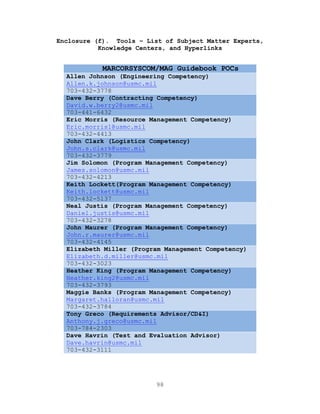
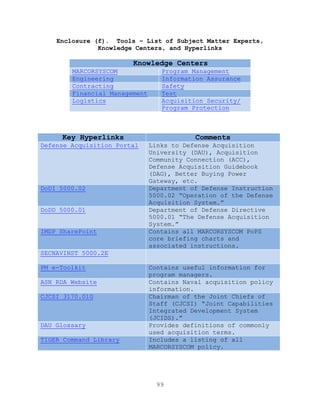
 A list of key acquisition experts and process managers to
assist the PMs/IPTs.
The content provided herein leverages and aligns with existing
higher level policy, guidance, and regulations.
This Guidebook does not:
 Apply to Program Executive Officer (PEO) Land Systems (LS).
 Supersede existing Instructions, Directives, Notices, or
otherwise established Department of Defense
(DoD)/Department of the Navy (DoN) or Marine Corps
Acquisition Policies.
 Describe every activity and/or document required to manage
a program within MARCORSYSCOM.
 Provide a "cookbook" approach to our acquisition process.
The uniqueness of each acquisition program precludes such
an approach.
This Guidebook supersedes the following MARCORSYSCOM orders,
policies, and guidance:
 Marine Corps Systems Command Order (MARCORSYSCOMO) 5000.3
Interim Implementation of MARCORSYSCOM PoPS Core Briefing
2
Charts and PoPS V2 for MARCORSYSCOM Acquisition Category
(ACAT) III & IV Programs (2010).
 Implementation of MARCORSYSCOM Probability of Program
Success (PoPS) Policy 3-09 (2009).
 Assignment of ACAT Designation and Delegation of Milestone
Decision Authority (MDA)/Program Decision Authority (PDA)
Policy 2-08 (2008).
 Project Team Leaders (PTL) Guide V1.3 (2007).
 Milestone Decision Process (MDP) Guide V3 (2006).
 Acquisition Procedures Handbook (APH) (2000).
1.2 When Should this Guidebook Be Used?
This Guidebook applies to all MARCORSYSCOM ACAT III, IV
programs, and Abbreviated Acquisition Programs (AAPs) as well as
efforts which have not yet received an ACAT designation.
It is the responsibility of the PM to use this Guidebook
together with:
 Guidance from the MDA, through Acquisition Decision
Memorandums (ADMs) or other direction, as applicable.
 The MARCORSYSCOM Integrated Milestone Decision Process
(IMDP) SharePoint site and MARCORSYSCOM PoPS core briefing
charts.
 Appropriate higher-level guidance (DoDI 5000.02 (Reference
(b)), SECNAVINST 5000.2E (Reference (c)), and other
applicable law, regulation and policy to include
MARCORSYSCOM policy and guidance).
 Applicable technical, engineering, logistics, financial,
contracting, test, and information assurance policy.
 The advice of the Milestone Assessment Team (MAT),
Strategic Business Team (SBT), and Assistant Commander,
Programs (ACPROG) Assessments as appropriate.
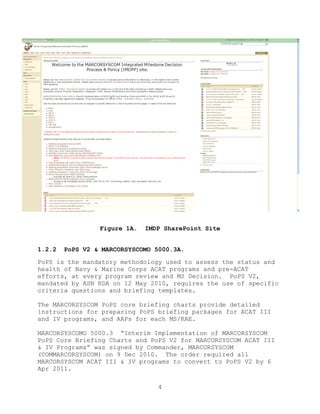
1.2.1 MARCORSYSCOM IMDP SharePoint.
All relevant information regarding the MARCORSYSCOM Milestone
Decision Process is located on the IMDP SharePoint site.
Materials include:
 MARCORSYSCOM tailored PoPS core briefing charts with
entrance and exit criteria for each Milestone (MS) and Key
Acquisition Event (KAE).
 Frequently Asked Questions (FAQs).
3
 Assistant Secretary of the Navy for Research, Development,
and Acquisition (ASN RDA) Naval PoPS instructions.
 Hyperlinks to:
o MARCORSYSCOM Competency Knowledge Centers and
documents (e.g. Deputy Commander, Systems Engineering,
Interoperability, Architectures, & Technology (DC
SIAT); Assistant Commander, Life Cycle Logistics (AC
LCL); AC Contracts; Deputy Commander, Resource
Management (DC RM), etc.).
o Defense Acquisition University (DAU) Acquisition
Community Connection (ACC) and Defense Acquisition
Portal (DAP).
o MARCORSYSCOM guidebooks and policies.
o Higher level guidance (e.g. the DoD 5000 series,
SECNAVINST 5000.2E, Defense Acquisition Guidebook
(DAG) (Reference (d)), Under Secretary of Defense for
Acquisition, Technology, and Logistics (USD AT&L)
memoranda and much, much more).
The IMDP SharePoint site is your “one stop shop” for
locating relevant acquisition information tailored to
MARCORSYSCOM programs.
4
Figure 1A. IMDP SharePoint Site
1.2.2 PoPS V2 & MARCORSYSCOMO 5000.3A.
PoPS is the mandatory methodology used to assess the status and
health of Navy & Marine Corps ACAT programs and pre-ACAT
efforts, at every program review and MS Decision. PoPS V2,
mandated by ASN RDA on 12 May 2010, requires the use of specific
criteria questions and briefing templates.
The MARCORSYSCOM PoPS core briefing charts provide detailed
instructions for preparing PoPS briefing packages for ACAT III
and IV programs, and AAPs for each MS/KAE.
MARCORSYSCOMO 5000.3 ―Interim Implementation of MARCORSYSCOM
PoPS Core Briefing Charts and PoPS V2 for MARCORSYSCOM ACAT III
& IV Programs‖ was signed by Commander, MARCORSYSCOM
(COMMARCORSYSCOM) on 9 Dec 2010. The order required all
MARCORSYSCOM ACAT III & IV programs to convert to PoPS V2 by 6
Apr 2011.
5
MARCORSYSCOMO 5000.3A ―Implementation of Marine Corps Systems
Command (MARCORSYSCOM) Acquisition Guidebook (MAG) and
Probability of Program Success (PoPS) Version 2 (V2) Procedures‖
(Reference (e)) supersedes MARCORSYSCOMO 5000.3. This order
encompasses all features of MARCORSYSCOMO 5000.3 and requires
the use of this Guidebook.
MARCORSYSCOMO 5000.3A and the MARCORSYSCOM PoPS core briefing
charts are located on the IMDP SharePoint site.
Additional guidance regarding MARCORSYSCOM implementation of
PoPS is provided in Chapter 3 of this Guidebook.
6
Chapter 2: MARCORSYSCOM IMPLEMENTATION OF THE
DEFENSE ACQUISITION MANAGEMENT SYSTEM
2.1 Transition of Requirements to the Acquisition Process.
Headquarters Marine Corps (HQMC) Combat Development and
Integration (CD&I) is assigned as the Marine Air Ground Task
Force (MAGTF)/Naval Integrator with the authority and
responsibility to conduct capabilities–based expeditionary force
development. As such, CD&I shall validate all requirements
submitted to Commander, Marine Corps Systems Command
(COMMARCORSYSCOM).
The Marine Corps Systems Command (MARCORSYSCOM) Assistant
Commander, Programs (ACPROG) Requirements Transition Team (RTT)
works with CD&I to facilitate the development and transition of
requirements into the acquisition process. The RTT consists of
a Requirements Transition Officer (RTO) from ACPROG, a
Requirements Transition Engineer from Systems Engineering,
Interoperability, Architectures, and Technology (SIAT), and a
Requirements Transition Logistician from Assistant Commander,
Life Cycle Logistics (AC LCL).
CD&I works with the RTT, key stakeholders, and prospective
Program Manager (PM) as early as possible to ensure that the
final requirement is clear, concise, executable, affordable, and
testable. This includes ensuring that there is adequate trade
space in cost, performance, and schedule targets to allow for
development of an affordable materiel solution.
Final requirements for all materiel solutions must be approved
by CD&I and may take the form of a standard Joint Capabilities
Integration and Development System (JCIDS) document (Initial
Capabilities Document (ICD), Capability Development Document
(CDD), or Capability Production Document (CPD)). In some cases,
CD&I may elect to issue a Statement of Need (SON) in lieu of a
JCIDS requirements document. In addition, a Letter of
Clarification (LOC) may be issued to update or revise an
existing ICD, CDD, CPD, or SON.
In the case of Defense Business Systems (DBS), the requirement
is referred to as a Problem Statement. Some older programs
(initiated prior to 2005) are based on a requirements document
referred to as an Operational Requirements Document (ORD). The
PM may not initiate or continue acquisition activities based on
an ORD unless CD&I has validated the currency and relevance of
7
the ORD within the past 36 months via LOC or other written
means.
The MARCORSYSCOM Requirements Transition Guide (under
development), the Chairman of the Joint Chiefs of Staff
Instruction CJCSI 3170.01G (Reference (h)), the JCIDS Manual
(Reference (i)), and Marine Corps Order MCO 3900.15B (Reference
(j)) provide detailed information regarding the requirements
process.
In most cases, CD&I generates and validates the requirement.
However, for some efforts, other HQMC Organizations may generate
the initial requirement in close collaboration with CD&I. In
these cases, the requirement must be validated by CD&I prior to
submission to COMMARCORSYSCOM for execution.
Once a requirement has been validated, it is submitted to the
MARCORSYSCOM RTT. The RTT formally accepts the requirement on
behalf of COMMARCORSYSCOM, and works with key stakeholders to
assign a lead Product Group Director (PGD) and supporting PGDs
if appropriate. In turn, the PGD will assign a PM. The PM is
responsible for executing program management and acquisition
activities to deliver a materiel solution consistent with the
validated requirement and Milestone Decision Authority (MDA)
guidance. Individual PMs are not authorized to formally accept
requirements on behalf of COMMARCORSYSCOM. All requirements to
include the original document and subsequent updates or
revisions must be provided to the RTT for review and assignment.
Where there is an urgent or compelling need to deliver
capability to the warfighter as quickly as possible, the
Commanders of the Operating Forces prepare and submit an Urgent
Universal Needs Statement (UUNS) to CD&I. In turn, CD&I will
provide the UUNS to COMMARCORSYSCOM. The UUNS process is
described in MCO 3900.17 (Reference (f)). The MARCORSYSCOM
process for accepting UUNS and the acquisition approach to
implement them is described in MARCORSYSCOM Acquisition Policy
Letter (APL) 08-07 (Reference (g)).
The SECNAVINST 5000.2E includes new processes for expedited
delivery of urgent capabilities to the warfighter. These are
described below.
 Rapid Deployment Capability (RDC) Process and Procedures.
The RDC process is a tailored approach for initiating and
managing development of a capability for rapid deployment
that may transition to an acquisition program. RDC
8
provides the ability to react immediately to a newly
discovered technology or potential enemy threat(s) or
urgent safety situations by using accelerated and
streamlined procedures. Candidate RDC efforts are
identified by CD&I and submitted for approval by Assistant
Secretary of the Navy for Research, Development, and
Acquisition (ASN RDA). For additional information see
SECNAVINST 5000.2E Chapter 1.8.2.
 Rapid Development and Deployment (RDD) Process and
Procedures. RDD efforts are established to demonstrate the
ability of new technologies to meet the urgent needs of
deployed forces. RDD efforts may be considered when a
validated Marine Corps UUNS cannot be satisfied with an
off-the-shelf solution and a prototype solution can be
developed within 18 months. Candidate RDD efforts are
identified by CD&I and submitted for approval by ASN RDA.
For additional information see SECNAVINST 5000.2E Chapter
1.8.3.
In addition, the SECNAVINST 5000.2E Chapter 1.1.2.3 provides
implementation guidance relative to the Information Technology
Box (IT Box) approach which streamlines the requirements process
for IT programs. The IT Box approach provides flexibility to
allow programs to incorporate evolving technologies. This
approach normally applies to systems that do not need to develop
hardware systems (i.e., they use commercial off-the-shelf (COTS)
hardware, or hardware has already been developed) and research
and development (R&D) funding is spent solely on software
development. However, some materiel development may be allowed.
The IT Box framework is defined by four critical elements:
 Definition of threshold capability levels based on current
technology.
 Defined process for oversight and approval of future
technology enhancements.
 Defined plan for delivering enhanced capabilities.
 Defined level of funding.
CD&I will identify programs where the IT Box may be applicable
and work closely with the MDA to ensure that all stakeholders
concur with the IT Box framework and program specific
implementation parameters.
9
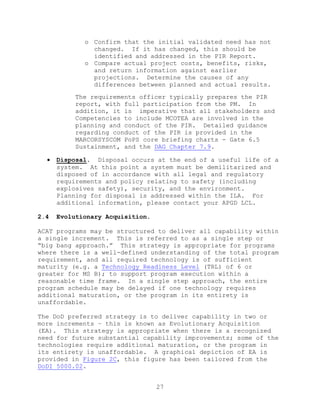
Figure 2A. Top Level View of the Requirements Process
2.2 Overview.
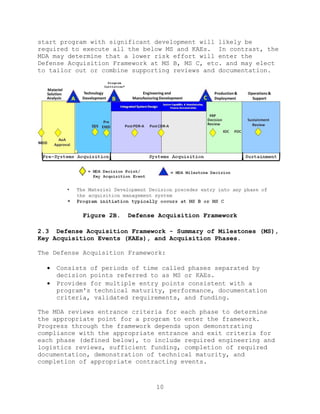
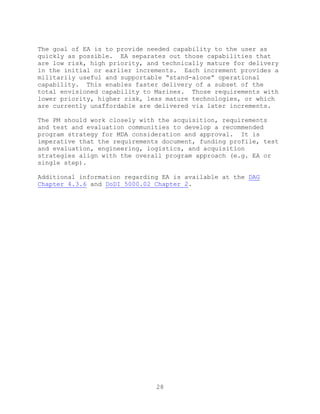
MARCORSYSCOM Acquisition Category (ACAT) programs and pre-ACAT
efforts follow the Defense Acquisition Framework shown in Figure
2B, established by DoDI 5000.02. Please note the formal
terminology for the Defense Acquisition Framework is the DoD
Integrated Defense Acquisition, Technology, and Logistics Life
Cycle Management System. We will use the term Defense
Acquisition Framework in this Guidebook for ease of reference.
The MDA tailors the Defense Acquisition Framework consistent
with the level of programmatic and technical risk, to provide
effective capability to the warfighter as fast as possible. The
MDA will tailor the specific Milestones (MS) and Key Acquisition
Events (KAEs) for each individual program.
In general, the MDA may require complex or high risk programs to
execute many, or all of the MS and KAEs. For example, a new
Operating Forces
identify their needs
MarineCorps Combat Developmentand
Integration Command (CD&I):
• Defines the requirements for CMC
• Executes the requirements
determination process
• ProvidesCOMMARCORSYSCOMwith a
validated requirement
MARCORSYSCOM
RTT workswith
CD&I and all
stakeholdersto
facilitate definition
of the requirement
Commandantof the Marine Corps(CMC)
determines and approvesrequirementsand
ensuresthe availability of funding and
personnelto fulfill those requirements
COMMARCORSYSCOM:
• Formally receivesvalidated and funded
requirements
• Exercises MDA authority, determines
ACATlevel and may delegate MDA if
appropriate
• Assigns PM
• Determines materiel solution
• Determines program& acquisition
strategy
• Executes acquisition process which
includes CD&I and all stakeholders
10
start program with significant development will likely be
required to execute all the below MS and KAEs. In contrast, the
MDA may determine that a lower risk effort will enter the
Defense Acquisition Framework at MS B, MS C, etc. and may elect
to tailor out or combine supporting reviews and documentation.
Figure 2B. Defense Acquisition Framework
2.3 Defense Acquisition Framework - Summary of Milestones (MS),
Key Acquisition Events (KAEs), and Acquisition Phases.
The Defense Acquisition Framework:
 Consists of periods of time called phases separated by
decision points referred to as MS or KAEs.
 Provides for multiple entry points consistent with a
program's technical maturity, performance, documentation
criteria, validated requirements, and funding.
The MDA reviews entrance criteria for each phase to determine
the appropriate point for a program to enter the framework.
Progress through the framework depends upon demonstrating
compliance with the appropriate entrance and exit criteria for
each phase (defined below), to include required engineering and
logistics reviews, sufficient funding, completion of required
documentation, demonstration of technical maturity, and
completion of appropriate contracting events.
11
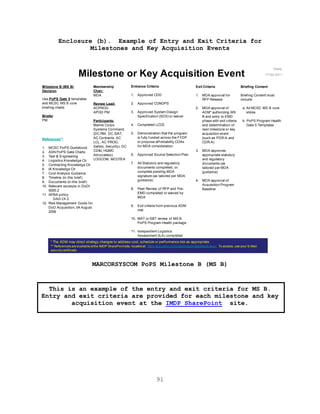
 Entrance Criteria - Entrance criteria are phase specific
accomplishments established by DoDI 5000.02 which must be
completed before a program is allowed to enter a particular
phase, MS, or KAE. This may include maturity, performance,
and documentation criteria. Entrance criteria for each MS
and KAE are shown on the MARCORSYSCOM Probability of
Program Success (PoPS) core briefing charts. A sample is
shown in Enclosure (b).
Entrance criteria should not be part of the Acquisition
Program Baseline (APB) and are not intended to repeat or
replace APB requirements or program specific exit criteria
established within the Acquisition Decision Memorandum
(ADM). Status of entrance criteria is reported to the MDA
via the MARCORSYSCOM PoPS core briefing charts.
 Exit Criteria - At each MS and KAE, the PM together with
the Milestone Assessment Team (MAT) or Strategic Business
Team (SBT), will develop and propose exit criteria for the
next phase, MS, or KAE. Exit criteria are approved by the
MDA and included in the ADM.
Exit criteria are specifically tailored for each unique
program. They normally track progress in important
technical, schedule, or management risk areas. Unless
waived, or modified by the MDA, exit criteria must be
satisfied for the program to proceed to the next MS or KAE.
Exit criteria should not be part of the APB and are not
intended to repeat or replace APB requirements or the
entrance criteria specified in DoDI 5000.02. Status of
approved exit criteria is reported to the MDA via the
MARCORSYSCOM PoPS core briefing charts.
Knowledge Based Acquisition (KBA). DoDD 5000.01 (Reference (k))
requires the MDA to ensure there is sufficient knowledge in
place (e.g. critical entrance criteria have been met) before
authorizing program initiation or proceeding to the next phase
or MS. This is referred to as Knowledge Based Acquisition
(KBA). Emphasis is placed on accurate assessments of technology
maturity, design maturity, production readiness, supportability,
and other criteria. The MARCORSYSCOM PoPS core briefing charts
are structured to support KBA as follows:
 A mandatory chart provides MDA visibility to required DoDI
5000.02 entrance criteria for each MS and KAE.
12
 The PM populates the entrance criteria chart with program
specific status for each entrance criterion.
Additional information is available in DAG Chapter 11.5.
2.3.1 Milestones and Key Acquisition Events.
Below is a brief summary of each MS and KAE, along with an
explanation of how they are typically tailored at MARCORSYSCOM
to address the unique characteristics of ACAT III and IV
programs, as well as AAPs.
Major Milestones. DoDI 5000.02 establishes three major
milestones during which the MDA authorizes the program to
proceed to the next phase of the acquisition process and/or
program initiation. These are:
 MS A - approves entry into the Technology Development (TD)
phase.
 MS B - approves entry into the Engineering and
Manufacturing Development (EMD) phase.
 MS C - approves entry into the Production and Deployment
(P&D) phase.
KAEs/MDA Decision Points. DoDI 5000.02 establishes several MDA
decisions which are not considered to be major MS Decisions.
These are commonly known as KAEs or MDA Decision Points. These
reviews are critical in that the progress of the program towards
the next major MS event or phase is assessed by the MDA. The
MDA determines which KAEs are applicable to an individual
program. These are:
 Materiel Development Decision (MDD) – approves entry into
the Materiel Solution Analysis phase (or subsequent phase
if appropriate).
 Analysis of Alternatives (AoA) Approval.
 System Design Specification (SDS) – DC SIAT approves the
SDS well in advance of the Pre-EMD Review. The MDA will
assess the status of the SDS at the Pre-EMD Review prior to
Request for Proposal (RFP) release. See ASN RDA
The MARCORSYSCOM PoPS core briefing charts provide a detailed
description of the entry criteria and output products for each
MS and KAE, along with required documents, briefing content, and
notional timelines.
13
Memorandum, 18 July 2008, (Reference (l)) and Chapter
2.3.2, for guidance regarding the SDS.
 Pre-Engineering and Manufacturing Development (Pre-EMD)
Review.
 RFP release – If RFP release is requested prior to MS B,
then MDA approval must be obtained.
 Preliminary Design Review Assessment (PDR-A).
 Critical Design Review Assessment (CDR-A).
 Full Rate Production Decision Review (FRP DR).
 Sustainment Review - authorizes entry into sustainment and
is typically combined with the Post Implementation Review
(PIR).
MDA Reviews and Acquisition Decision Memorandums (ADMs). At
each MS and KAE, the MDA will:
 Review the applicable MARCORSYSCOM PoPS core briefing
charts which highlight the following:
o Compliance with the entrance criteria established by
DoDI 5000.02.
o Compliance with the exit criteria established by the
previous ADM (if applicable).
o Status of required program documentation, events, and
other MS specific requirements such as engineering
reviews, Integrated Logistics Assessments (ILAs), test
and evaluation events, etc.
o Funding status.
o Risks and handling strategies.
o Status of the requirement and Concept of Operations
(CONOPS).
 Review the recommendation of the MAT for programs where
COMMARCORSYSCOM has retained MDA or the SBT for programs
where MDA has been delegated to a PGD.
 Review compliance of the program with previously
established cost and schedule performance parameters per
the APB.
After completion of the above, the MDA will issue an ADM. The
ADM will:
 Document the decision made.
 Establish the next MS or KAE and target date as
appropriate.
14
 Establish program unique exit criteria that must be met
before the next MS or KAE.
At any MS or KAE, the MDA may determine that a program is not
ready to proceed to a subsequent MS or KAE. In this case, the
MDA may elect to issue an ADM directing appropriate action to
include the development of specific metrics in support of a
―get-well‖ plan.
2.3.2 Summary of Acquisition Phases.
Phase One - Materiel Solution Analysis. This is the first phase
of the Defense Acquisition Framework. Prospective ACAT programs
(also referred to as pre-ACAT efforts) enter this phase after
MDD. This phase ends when the AoA has been completed, the MDA
has approved the content of the AoA, and selected a preferred
materiel solution.
 MDD Review. Prospective programs must proceed through a
MDD to ensure they are based on an approved requirement and
a rigorous assessment of alternatives. The MDD is the
first entry point into the acquisition process and is
mandatory.
At the MDD, the MDA will issue an ADM that:
o Approves the AoA study guidance or similar analytical
product (i.e. market research, business case analysis,
etc.) or, approves a waiver for the conduct of an AoA.
(Note: All recommendations regarding the AoA Study
Guidance and its conduct (to include waivers) must be
coordinated through the MARCORSYSCOM AoA Integrated
Product Team (IPT)). Additional guidance is provided
in the MARCORSYSCOM PoPS MDD core briefing charts.
o Approves entry into the appropriate acquisition phase
based on the program’s alignment with the specific
entrance criteria established for each phase in DoDI
5000.02 and determines the next MS or KAE.
o May assign an ACAT designation and delegate MDA if
sufficient information such as estimated cost, program
scope, potential impact to combat capability, and
complexity is available to support an informed
decision. If sufficient information is not available
at the time of the MDD, the ADM shall specify a
timeframe within which the PM shall return for an ACAT
designation.
15
The ADM will also typically include a requirement to
establish a Test & Evaluation (T&E Working Integrated
Product Team (WIPT)) per the USMC Integrated Test and
Evaluation Handbook (Reference (m)) and impose a limitation
on expenditures for the Materiel Solution Analysis Phase.
Limiting expenditures reduces the risk to the Marine Corps
by ensuring that only a limited quantity of funds are
expended before the MDA determines that the proposed effort
is executable and approves development of an approved
materiel solution or capability.
In most cases, the MDD decision is conducted by
COMMARCORSYSCOM. This is because the MDD typically occurs
prior to ACAT designation and before any delegation of MDA
from COMMARCORSYSCOM to a PGD. However, the PM may request
ACAT designation from COMMARCORSYSCOM prior to or
concurrently with the MDD when the following conditions are
met:
o The program is estimated to meet the AAP or ACAT IV
thresholds and definitions in Table 4A.
o The program is assessed as low risk in terms of cost,
schedule, and performance (C/S/P). For additional
information regarding risk determination see Chapter
8.2.
o The cost estimate is of sufficient fidelity to support
the MDA decision relative to ACAT level.
When COMMARCORSYSCOM elects to provide an ACAT designation
and delegation of MDA prior to the MDD, the ADM will
require the PGD to perform a MDD.
MDD vs. Program Initiation. The MDD decision does not
constitute program initiation. Program initiation occurs
when a prospective program or pre-ACAT effort formally
enters the DoDI 5000.02 Defense Acquisition Framework and
becomes an ACAT program. Program initiation usually occurs
when the MDA grants a MS B decision. There are two
exceptions to this standard as described below:
o Program Initiation may occur after MS B if the MDA
determines that a MS B decision is not required. In
this case, program initiation will occur at the first
MS decision such as MS C.
o Certain shipbuilding efforts enter the ACAT process at
MS A; this exception does not apply to MARCORSYSCOM
programs.
16
 AoA Approval. Programs must proceed to an AoA decision
brief with the MDA if directed by the MDD ADM. The AoA
assesses potential materiel solutions to satisfy the
capability gap documented in the approved requirements
document. The AoA decision brief provides the MDA with
visibility into the C/S/P risks and characteristics of each
alternative. At this review, the MDA shall:
o Approve the AoA and select a preferred alternative.
o Issue an ADM that documents the decision made,
establishes appropriate exit criteria and determines
the next MS or KAE.
(Note: the results of the AoA must be coordinated through
the MARCORSYSCOM AoA IPT). For additional guidance, please
reference the MARCORSYSCOM PoPS AoA core briefing charts.
Phase Two - Technology Development. This phase begins after
completion of the AoA and ends when an affordable program or
increment of militarily useful capability has been identified.
The purpose of this phase is to reduce technology risk and
determine the appropriate set of technologies to be integrated
into a full system. As such, this phase applies primarily to
programs which require extensive Research and Development (R&D).
In many cases, for programs with little or no R&D, the MDA may
direct entry into the Defense Acquisition Framework at a
subsequent phase.
 Milestone A. MS A is required for ACAT I programs.
Typically, a MS A decision is appropriate for those
programs with significant development efforts. Many
MARCORSYSCOM programs do not require extensive technology
development; therefore, a MS A decision is typically not
required. The PM should consult with the Assistant Product
Group Director (APGD) PM regarding applicability of MS A
for each specific program.
 Pre-EMD Review. The MDA conducts a formal program review
to authorize RFP release prior to the MS B decision. This
is called the Pre-EMD Review. The Pre-EMD Review is
conducted using the MARCORSYSCOM PoPS MS B core briefing
charts.
Key supporting documentation such as the Acquisition
Strategy (AS), draft RFP, Systems Engineering Plan (SEP),
Test and Evaluation Master Plan (TEMP), System Design
Specification (SDS), APB, and Life Cycle Cost Estimate
17
(LCCE) must be submitted for MDA review (may be in draft
form) at least 45 days prior to the MDA decision. The MDA
shall determine the documents to be reviewed for each
program.
For programs where COMMARCORSYSCOM has retained MDA, the
MAT shall review the draft ADM, PoPS core briefing charts,
and program documentation before they are submitted for MDA
approval. For programs where MDA has been delegated to a
PGD, the same process shall be followed except that the SBT
shall perform the review in lieu of the MAT.
RFP Peer Review. A Peer Review of the RFP shall be
conducted prior to the Pre-EMD review and at other
milestones as specified in DoD and Navy regulations. The
purpose of a Peer Review is to obtain an independent review
by external subject matter experts. For questions
regarding the Peer Review, please contact your Procurement
Contracting Officer (PCO).
The Dr. Carter (USD AT&L) memorandum of 23 June 2011
directs that Peer Reviews be conducted for all RFPs.
 The MDA shall determine the membership of each Peer
Review.
 Typically, membership will include representatives
from all competency areas and stakeholder
organizations; key members should be drawn from
organizations which have not participated in
development of the RFP.
 The PM should contact the PCO to begin planning for
the Peer Review at least 60 days prior to the
review.
 The Peer Review should be conducted at least 45 days
prior to the MDA review of the RFP.
 A Peer Review is required for all RFPs as described
below.
o Competitive acquisitions - the Peer Review must
be conducted prior to RFP release.
o Noncompetitive acquisitions - the Peer Review
must be conducted before beginning
negotiations.
 The results of the Peer Review must be incorporated
in the RFP (as applicable) prior to submitting the
RFP for MDA review.
18
The following resources provide additional information and
instructions regarding peer reviews:
 Director, DPAP memorandum Peer Reviews of Contracts
for Supplies and Services dated September 29, 2008.
 Department of Defense (DoD) Instruction 5000.02
Operation of the Defense Acquisition System dated
December 8, 2008.
 Director, DPAP memorandum Review Criteria for the
Acquisition of Services dated February 18, 2009.
 DPAP Peer Review Resources Webpage.
 Defense Federal Acquisition Regulation Supplement
(DFARS) 201.170,Peer Reviews.
 DFARS PGI 201.170 Peer Reviews.
 DASN(A&LM) memorandum Department of the Navy Peer
Review Program dated March 26, 2009.
 NMCARS Subparts 5201.170, Peer Reviews.
System Design Specification (SDS). All programs are
required to prepare a SDS prior to MS B. The SDS is a
tailored document that identifies technology development
risks, validates preferred system design solutions,
evaluates manufacturing processes, and refines system
requirements, in order to inform decision makers earlier in
the acquisition process. The SDS must be completed prior
to the Pre-EMD review. Questions regarding the SDS should
be addressed to the APGD ENG. If the Program Management
Office (PMO) believes an entire SDS is not appropriate for
their effort, a waiver may be requested from DC SIAT.
Additional guidance regarding preparation of the SDS is
located in the MARCORSYSCOM MS B core briefing charts and
SECNAVINST 5000.2E Annex 2A.
Phase Three – Engineering and Manufacturing Development (EMD).
This phase begins at MS B and consists of two sub-phases:
Integrated System Design and System Capability and Manufacturing
Process Demonstration.
19
 Milestone B. The MS B decision is typically the point at
which programs formally enter the acquisition process;
otherwise known as program initiation. At MS B, the MDA
approves the AS, APB, and RFP release. A program must be
―fully funded‖ to support the MS B decision. This means
that there is sufficient Research & Development (R&D) and
Procurement Marine Corps (PMC) over the Future Years
Defense Program (FYDP), or the MDA has approved a full
funding Course of Action (COA). Although Operations &
Maintenance (O&M) is not considered part of the above full
funding determination the status of O&M shall be presented
to the MDA and any gaps highlighted.
In those cases where the PM must prepare full funding COAs
as described above, the following process shall be used:
o The PM shall work with CD&I, key stakeholders, and all
competencies to prepare COAs which provide the MDA
with viable alternatives to deliver an operationally
relevant capability within funding constraints. At a
minimum, the PM shall:
 Identify the risks and benefits associated with
each COA.
 Highlight cost, schedule, and performance
implications of each COA.
 Review each COA prior to presentation to the MDA
to ensure that it is realistic and executable
within the overarching program strategy to
include contracting, financial, logistics,
engineering, and test.
 Identify any required changes to the program
strategy and documentation to enable
accomplishment of each COA.
 Review each COA to determine if it aligns with
existing requirements documentation. Highlight
any necessary changes to the requirements
documentation to support execution of each
applicable COA.
For additional guidance, please reference the MARCORSYSCOM
PoPS MS B core briefing charts. Subsequent to the MS B
decision, all ACAT III and IV programs are required to
20
begin posting program information in the ASN RDA DASHBOARD
system. At MS B, the ADM will determine the ACAT level and
delegation of MDA if appropriate (unless this has been
accomplished via a previous ADM).
Integrated Baseline Review (IBR). An IBR is a joint
assessment of the Performance Measurement Baseline (PMB)
conducted by the government PM and the contractor. The IBR
is not a one time event. It is a process, and the plan
should be continually evaluated as changes to the baseline
are made (modifications, restructuring, etc.). IBRs should
be used as necessary throughout the life of a project to
facilitate and maintain mutual understanding of:
 The scope of the PMB consistent with authorizing
documents.
 Management control processes.
 Risks in the PMB associated with cost, schedules, and
resources.
 Corrective actions where necessary.
IBRs should be scheduled as early as practicable and the
timing of the IBRs should take into consideration the
contract period of performance. The process will be
conducted no later than 180 calendar days (6 months) after:
(1) contract award, (2) the exercise of significant
contract options, and (3) the incorporation of major
modifications.
In addition, the PM will direct the conduct of an IBR
within a reasonable time after the occurrence of a major
event at any time during the life of a program. Major
events include preparation for or completion of a MS or
KAE, engineering reviews, or identification of C/S/P risks.
The PM should regularly assess the PMB to determine when a
new IBR should be conducted.
In accordance with the DoDI 5000.02, PMs are required to
conduct IBRs on all cost or incentive contracts that
require implementation of Earned Value Management (EVM).
For additional information relative to the conduct of an
IBR, please see DAG Chapter 11.3.1.3.
Integrated System Design Phase. A program enters
Integrated System Design subsequent to the MS B decision.
This sub-phase is intended to define system functionality
and interfaces, complete Hardware (HW)/Software (SW)
detailed designs, and reduce system level risk.
21
Post PDR Assessment (PDR-A). The PDR-A is a KAE
conducted by the MDA. The PDR itself is an
engineering event. The below provides a summary of
both the PDR and the PDR-A. Note: The latest version
of the DoDI 5000.02 has eliminated the PDR-A as a
separate MDA review. However, the PDR is still a
critical systems engineering event. In those cases
where the MDA anticipates substantive technical risk
the MDA may choose to conduct a PDR-A.
PDR. The purpose of the PDR is to inform requirements
trades; improve cost estimation; and identify
remaining design, integration, and manufacturing
risks. The PDR is conducted at the system level and
includes user representatives and certification
authorities.
The PDR establishes the allocated baseline (HW, SW,
human/support systems) and underlying architectures to
ensure that the system under review has a reasonable
expectation of satisfying the requirements within the
currently allocated budget and schedule. Functions
are allocated to each configuration item yielding
"design to" preliminary design specifications and
verification plans at the configuration item level.
The PDR is conducted after completion of the
appropriate requirements and engineering reviews as
directed by the APGD ENG.
The PDR may be conducted either before or after the MS
B decision. For most MARCORSYSCOM programs, the MDA
will direct the PDR be conducted after MS B. (A
successful PDR requires a minimum level of information
relative to the product design and baseline. For ACAT
III, IV, and AAPs, this is typically not available
until after MS B).
PDR-A. At the PDR-A, the MDA reviews the PDR results
and an integrated recommendation from the PM, all
competencies, and stakeholders regarding any
requirements trades necessary to achieve APB
objectives. A summary of the PDR report shall be
provided to the MDA as part of the PDR-A decision
briefing. The MDA issues an ADM which establishes the
next MS/KAE and directs any actions required to ensure
the program meets target C/S/P goals. For additional
22
guidance, please reference the MARCORSYSCOM PoPS PDR-A
core briefing charts.
Post CDR Assessment (CDR-A). The CDR-A is a KAE
conducted by the MDA. The CDR itself is an
engineering event. The below provides a summary of
both the CDR and the CDR-A.
CDR. The system level CDR provides the opportunity to
assess design maturity, maturity of critical
manufacturing processes, and system reliability.
The CDR establishes the initial product baseline to
ensure that the system under review has a reasonable
expectation of satisfying the requirements of the
Capability Development Document (CDD) within the
currently allocated budget. The CDR evaluates the
proposed baseline ("build to" documentation) to
determine if the system design documentation is
satisfactory to start initial manufacturing.
The PM provides a CDR summary to the MDA that
addresses the above, and identifies actions or
tradeoffs required to meet APB C/S/P goals.
CDR-A. At the CDR-A, the MDA reviews CDR results and
the PM’s assessment of any requirements trades
necessary to achieve APB objectives. The MDA issues
an ADM which establishes the next MS/KAE and directs
any actions required to ensure the program meets
target C/S/P goals. For additional guidance, please
reference the MARCORSYSCOM PoPS CDR-A core briefing
charts.
Successful completion of the post CDR-A ends the
Integrated System Design portion of the EMD phase.
Subsequent to the CDR-A, the program enters into the
System Capability and Manufacturing Process
Demonstration portion of EMD.
System Capability and Manufacturing Process Demonstration
Phase. This sub-phase begins upon completion of the Post
CDR-A and establishment of an initial product baseline. It
is intended to demonstrate the ability of the system to
operate in a useful way consistent with the approved Key
Performance Parameters (KPPs); and that system production
can be supported by demonstrated manufacturing processes.
The completion of this sub-phase occurs when the MDA
23
commits to the program at MS C or decides to end the
effort.
Phase Four - Production & Deployment (P&D). This phase begins
at MS C and ends when the MDA determines that the program has
entered the Operations and Support (O&S) phase via approval of a
PoPS Gate 6.5 sustainment decision.
 Milestone C. MS C authorizes entry into the P&D phase.
The MDA makes the decision to commit the Department of
Defense (DoD) to production at MS C, and documents this
decision, along with appropriate boundaries, in an ADM.
The ADM may authorize entry into Low Rate Initial
Production (LRIP), or into Full Rate Production (FRP) for
low risk systems that do not require LRIP. For SW
intensive systems with no production components, the LRIP
decision is referred to as Limited Deployment Decision
(LDD) and FRP is referred to as the Full Deployment
Decision (FDD).
For programs that receive a combined MS C/LRIP decision, a
separate FRP decision review with the MDA is required and
will be specified in the ADM. For additional guidance,
please reference the MARCORSYSCOM PoPS MS C core briefing
charts.
o LRIP. The purpose of LRIP is to effectively manage risk
by ensuring that the system is ready to proceed to FRP
prior to committing the government to the entire FRP
quantity. LRIP provides the government with the
opportunity to identify and resolve test deficiencies and
further mature production processes prior to the FRP
decision. LRIP quantities should be limited to the
minimum necessary to achieve the above goals.
As a rule of thumb, LRIP quantities should be limited to
10% of the total production quantity. The PM should
consult with Marine Corps Operational Test and Evaluation
Activity (MCOTEA) and the SBT when proposing LRIP
quantities for MDA consideration. The MDA may authorize
LRIP quantities, to include those in excess of 10%, at
the time of the MS C decision. If the PM wishes to
request LRIP quantities in excess of 10%, rationale
should be provided for MDA consideration. The ADM will
specify LRIP maximum quantities. Any subsequent increase
in LRIP quantities, beyond what is authorized in the
current ADM, must be approved by the MDA in a revised
ADM.
24
 FRP. FRP authorizes the delivery of the fully funded
quantity of systems or capability as well as supporting
materiel and services. Prior to the FRP decision programs
must demonstrate control of the manufacturing process,
acceptable reliability, and control of other critical
processes. In addition, test results must demonstrate that
all open deficiencies have been resolved, that the system
requirements have been met, and that the system is safe and
ready for fielding. The FRP ADM will provide guidance to
the PM relative to the conduct, timing, and exit criteria
for the fielding decision and Post Implementation Review
(PIR) as described below. For additional guidance, please
reference the MARCORSYSCOM PoPS FRP core briefing charts
and Chapter 2.3.3. In addition, declaration of Initial
Operational Capability/ Full Operaltional Capability
(IOC/FOC) will occur after the FRP decision as described in
Chapter 2.3.4.
2.3.3 Fielding.
Fielding is the process of initially deploying and transferring
systems, capabilities, and equipment from the acquisition
organization to the operating forces and supporting
establishments. The MARCORSYSCOM Fielding Decision Process is
described in APL 5-09 ―Fielding Decision Process‖ (Reference
(n)). The fielding process at MARCORSYSCOM is led by the AC
LCL. All competencies and stakeholders work together to support
AC LCL and the PM in the successful preparation for and
execution of the fielding decision.
The MDA issues an ADM (typically at MS C) which specifies both
the timing and entry/exit criteria for the fielding decision.
The ADM may direct:
 A stand alone fielding decision to occur subsequent to a MS
C decision.
 A combined MS C/Fielding decision.
 A combined FRP/Fielding decision.
The specific approach for each program shall be based upon the
recommendations of the PM, ILA chair, and MAT or SBT for
programs which have been delegated to PGD.
The Fielding Process for IT programs is tailored to reflect the
unique characteristics of IT. In many IT programs, a capability
and/or SW is delivered in lieu of a physical item. In addition,
25
the peripherals and SW which are often delivered under IT
acquisitions are subject to continuous refresh cycles. The ILA
chair will advise the PM regarding the development of a fielding
strategy tailored to address the unique characteristics of IT
programs. It should be noted that the terminology for IT
programs relative to the events that precede fielding is
different than that used for weapons systems. For example,
Limited Deployment (LD) is used instead of LRIP and Full
Deployment (FD) is used instead of FRP.
For additional guidance, please contact your ILA chair or APGD
LCL.
2.3.4 Initial Operational Capability (IOC) and Full Operational
Capability (FOC).
IOC. Attained when some of the end users scheduled to receive a
system or capability 1) have received it and 2) have the ability
to employ and maintain it.
FOC. Attained when all of the end users scheduled to receive a
system or capability 1) have received it and 2) have the ability
to employ and maintain it.
IOC and FOC are specifically defined for each program in the
applicable requirements document. In addition, the requirements
document will specify objective (best case) and threshold
(minimum acceptable) dates for attainment of IOC and FOC.
Attainment of IOC and FOC is tracked in the program APB.
Declaration of IOC and FOC. CD&I typically determines or
―declares‖ when IOC and FOC have been achieved. In some cases,
the program sponsor such as HQMC C4, PP&O, or I&L may declare
IOC. There is no prescribed format for declaration of IOC or
FOC. In most cases, a formal memorandum is issued by CD&I or
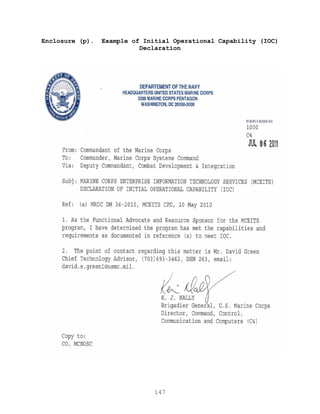
the program sponsor. An example is provided in Enclosure (p).
IOC and FOC will occur after the MS C/FRP decision. The
specific timeframes will vary for each program.
Achievement of IOC and FOC is a significant indicator of program
success. This provides tangible evidence that:
 A system is accomplishing its intended purpose (IOC).
 All required quantities have been delivered to the end
users (FOC).
26
 The appropriate logistics/training infrastructure is in
place to enable the users to employ the capability (IOC &
FOC).
Phase Five - Operations & Support (O&S). The purpose of the O&S
Phase is to provide continued support to the product or
capability subsequent to delivery to the intended user. During
this phase, the PM, IPT, and the Product Support Manager ensure
that:
 Materiel readiness and operational support performance
requirements are met (to include refresh of IT systems).
 The system is sustained in the most cost-effective manner
over its total life cycle.
Planning for this phase should begin prior to program initiation
and is reviewed via ILAs conducted throughout the life of the
program. O&S has two major sub-phases, Life Cycle Sustainment
and Disposal.
 Life Cycle Sustainment. Entry into life cycle sustainment
typically occurs after IOC has been achieved. During this
phase, the PM shall conduct continuing reviews of logistics
strategies and make required adjustments to meet
performance targets. The MDA performs on-going reviews of
program status during the sustainment phase which are
established at the FRP ADM and updated at each subsequent
review. This includes the conduct of periodic Program
Implementation Reviews (PIRs) as described below.
Additional information, to include entrance criteria can be
accessed via the ―Sustainment‖ tab located on the IMDP
SharePoint site.
o Post Implementation Review (PIR). DoDI 5000.02,
Tables 2-1 and 2-2, establishes a statutory
requirement that all ACAT programs be subjected to a
PIR. The PIR plan is presented to the MDA at the FRP
Decision Review, and the PIR Report is presented to
the MDA during the O&S phase, typically after
attainment of IOC and before FOC is achieved. The MDA
will specify the timeframe for review of the PIR
Report in the FRP ADM. The purpose of the PIR is to:
o Determine if the warfighter/user is satisfied
that the capability delivered meets their needs.
27
o Confirm that the initial validated need has not
changed. If it has changed, this should be
identified and addressed in the PIR Report.
o Compare actual project costs, benefits, risks,
and return information against earlier
projections. Determine the causes of any
differences between planned and actual results.
The requirements officer typically prepares the PIR
report, with full participation from the PM. In
addition, it is imperative that all stakeholders and
Competencies to include MCOTEA are involved in the
planning and conduct of the PIR. Detailed guidance
regarding conduct of the PIR is provided in the
MARCORSYSCOM PoPS core briefing charts - Gate 6.5
Sustainment, and the DAG Chapter 7.9.
 Disposal. Disposal occurs at the end of a useful life of a
system. At this point a system must be demilitarized and
disposed of in accordance with all legal and regulatory
requirements and policy relating to safety (including
explosives safety), security, and the environment.
Planning for disposal is addressed within the ILA. For
additional information, please contact your APGD LCL.
2.4 Evolutionary Acquisition.
ACAT programs may be structured to deliver all capability within
a single increment. This is referred to as a single step or
―big bang approach.‖ This strategy is appropriate for programs
where there is a well-defined understanding of the total program
requirement, and all required technology is of sufficient
maturity (e.g. a Technology Readiness Level (TRL) of 6 or
greater for MS B); to support program execution within a
reasonable time frame. In a single step approach, the entire
program schedule may be delayed if one technology requires
additional maturation, or the program in its entirety is
unaffordable.
The DoD preferred strategy is to deliver capability in two or
more increments – this is known as Evolutionary Acquisition
(EA). This strategy is appropriate when there is a recognized
need for future substantial capability improvements; some of the
technologies require additional maturation, or the program in
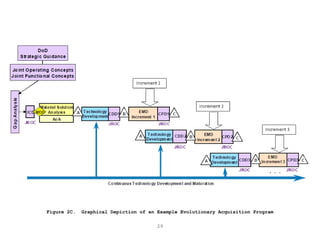
its entirety is unaffordable. A graphical depiction of EA is
provided in Figure 2C, this figure has been tailored from the
DoDI 5000.02.
28
The goal of EA is to provide needed capability to the user as
quickly as possible. EA separates out those capabilities that
are low risk, high priority, and technically mature for delivery
in the initial or earlier increments. Each increment provides a
militarily useful and supportable ―stand-alone‖ operational
capability. This enables faster delivery of a subset of the
total envisioned capability to Marines. Those requirements with
lower priority, higher risk, less mature technologies, or which
are currently unaffordable are delivered via later increments.
The PM should work closely with the acquisition, requirements
and test and evaluation communities to develop a recommended
program strategy for MDA consideration and approval. It is
imperative that the requirements document, funding profile, test
and evaluation, engineering, logistics, and acquisition
strategies align with the overall program approach (e.g. EA or
single step).
Additional information regarding EA is available at the DAG
Chapter 4.3.6 and DoDI 5000.02 Chapter 2.
29
Figure 2C. Graphical Depiction of an Example Evolutionary Acquisition Program
30
Chapter 3: MARCORSYSCOM PoPS IMPLEMENTATION
PROCEDURES
3.1 Background.
Probability of Program Success (PoPS) is the mandatory standard
methodology for assessing program health for all Navy and Marine
Corps Acquisition Category (ACAT) programs and pre-ACAT efforts.
As directed by Marine Corps Systems Command Order
(MARCORSYSCOMO) 5000.3A, all active ACAT III, IV, and
Abbreviated Acquisition Programs (AAPs) managed within Marine
Corps Systems Command (MARCORSYSCOM) shall use the tailored
MARCORSYSCOM PoPS Program Health Assessments throughout the
program lifecycle (Materiel Development Decision (MDD) through
Operations and Support (O&S)). The Program Decision Authority
(PDA) shall tailor the MARCORSYSCOM PoPS core briefing charts to
reflect the minimum level of detail required to accurately
assess the program health of an AAP. The PDA may request a
waiver from the Executive Director (ED) to exclude selected AAPs
from the PoPS methodology.
The PoPS methodology and MARCORSYSCOM PoPS core briefing charts
are applicable anytime a Program Manager (PM) discusses the
health of a program with the Commander, Executive Director, or
external stakeholders, in support of all:
 Milestone (MS) reviews.
 Key acquisition events (KAEs).
 DASHBOARD reviews.
 Program reviews.
 Portfolio sufficiency reviews.
Additional information and detailed instructions can be located
at the MARCORSYSCOM Integrated Milestone Decision Process (IMDP)
SharePoint site. Links to all Competency Domains and their
respective milestone guidance are provided on the IMDP
SharePoint site and contained within each MARCORSYSCOM PoPS core
briefing package and Enclosure (f).
3.1.1 PoPS Process Overview.
The PoPS Program Health Assessment consists of four levels:
 Level I: Overall Program Health. This provides a one page
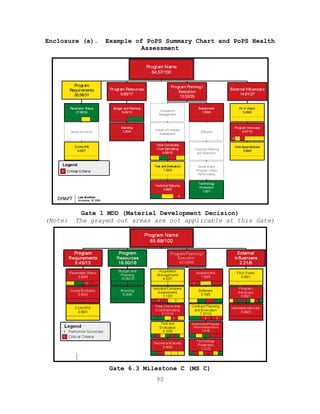
executive summary of overall program status. Enclosure (a)
shows a notional Level 1 PoPS Health Assessment with
31
numeric scores (0 to 100) and associated color codes (red,
yellow, and green).
 Level II: Categories (Requirements, Resources, Planning
and Execution, and External Influencers).
 Level III: Metrics (there are 17 metrics).
 Level IV: Criteria (questions) for each metric.
The criteria questions address issues specific to each phase in
the Defense Acquisition Framework. The content and relative
weight of the questions are established by Assistant Secretary
of the Navy for Research, Development, and Acquisition (ASN
RDA), and are tailored to address issues and risks specific to
each MS and KAE.
When answering the PoPS criteria questions the PM should consult
the Frequently Asked Questions (FAQs) sheet posted on the IMDP
SharePoint site. The FAQ sheet provides specific guidance
relative to interpreting the ASN RDA PoPS questions for ACAT
III, IV, and AAPs. The ASN RDA criteria questions were
constructed for ACAT I and II programs and in many cases do not
directly apply to lower level ACATs. As such, it is critical
that the PM use the FAQ sheet to assist in developing
appropriate responses.
A PM’s response to the criteria questions will generate an
initial baseline numeric score and color code (red/yellow/green)
for each level. All PMs should assume a start point of ―red‖
and must meet the specified criteria before moving to a ―yellow‖
or ―green‖ score. The PM shall include a brief rationale to
explain the rating for each criteria question to include green
ratings. For red or yellow ratings, the PM shall briefly
explain the rationale, mitigation strategy, and target date for
resolution (who, what, when).
PMs will present their initial PoPS baseline to the Milestone
Assessment Team (MAT)/respective Strategic Business Teams
(SBTs). The MAT/SBT shall review, revise, and establish the
program’s PoPS initial baseline. The PoPS initial baseline is
considered to be the validated PoPS baseline score upon
Milestone Decision Authority (MDA) approval. To change the
validated PoPS baseline score, the PM must submit appropriate
rationale and recommendations to the MAT/SBT for review, and MDA
approval. PMs shall be prepared to substantiate their scoring
based on the specified criteria. Logical links shall be made on
a holistic scale. For example, if requirements change, what is
the impact on cost, schedule, and performance (C/S/P)?
32
A "yellow" or ―red‖ score is not a performance measure of the
PM’s abilities. PMs should consider ―yellow‖ and ―red‖ scores
as a tool to surface critical issues to leadership and obtain
their approval and/or assistance in crafting a resolution
strategy. External factors outside the PM’s control have a
large influence on the PoPS score.
3.2 Tools for Implementing PoPS – SharePoint and PoPS Database.
SharePoint. All relevant information regarding the MARCORSYSCOM
Milestone Decision Process (to include PoPS) is located on the
IMDP SharePoint site.
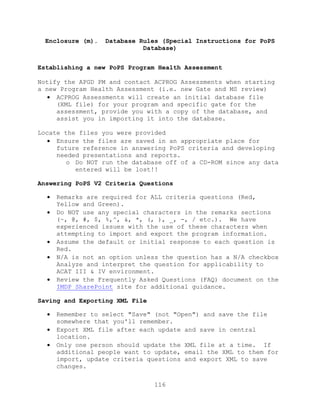
MARCORSYSCOM PoPS Database. The MARCORSYSCOM PoPS database
contains the supporting criteria questions for each MS and KAE.
To prepare a complete PoPS Program Health Assessment for the
MDA, the PM must populate:
 Appropriate criteria questions located on the MARCORSYSCOM
PoPS database.
 Associated MARCORSYSCOM PoPS core briefing charts located
on the IMDP SharePoint site.
Database Instructions. To request creation of your program’s
initial record in the MARCORSYSCOM PoPS database, provide
Assistant Commander, Programs (ACPROG) Assessments the below
information. The PM shall coordinate with the Assistant Product
Group Director (APGD) PM prior to submitting the request to
ACPROG.
 Program Name and Acronym.
 PM.
 Milestone Decision Authority (MDA).
 Product Group (PG)/Organization.
 Entry Gate and MS or KAE being reviewed (per program’s
previous Acquisition Decision Memorandum (ADM)).
 Associated Contractors and Government Performers (e.g.
system developers, system integrators. Important! Do not
list your CEOss contractor here. This field should be
populated with contractors or government performers which
directly support program execution, e.g. solution
providers. (For example, government performers may include
SPAWAR, NSWC Crane, etc.)).
 Indicate if earned value management (EVM) is applicable.
Please note that EVM typically applies to cost type
contracts in excess of $20 million. If you are unsure if
33
your contract is subject to EVM, please see your
Procurement Contracting Officer (PCO) for additional
information.
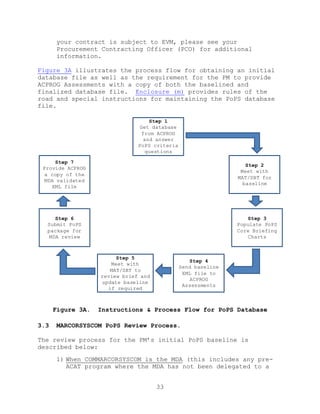
Figure 3A illustrates the process flow for obtaining an initial
database file as well as the requirement for the PM to provide
ACPROG Assessments with a copy of both the baselined and
finalized database file. Enclosure (m) provides rules of the
road and special instructions for maintaining the PoPS database
file.
Figure 3A. Instructions & Process Flow for PoPS Database
3.3 MARCORSYSCOM PoPS Review Process.
The review process for the PM’s initial PoPS baseline is
described below:
1) When COMMARCORSYSCOM is the MDA (this includes any pre-
ACAT program where the MDA has not been delegated to a
Step 1
Get database
from ACPROG
and answer
PoPS criteria
questions
Step 2
Meet with
MAT/SBT for
baseline
Step 3
Populate PoPS
Core Briefing
Charts
Step 4
Send baseline
XML file to
ACPROG
Assessments
Step 5
Meet with
MAT/SBT to
review brief and
update baseline
if required
Step 6
Submit PoPS
package for
MDA review
Step 7
Provide ACPROG
a copy of the
MDA validated
XML file
34
Product Group Director (PGD)), the MAT shall review the
initial baseline, make appropriate revisions, and provide
the PM with its position and recommendations regarding
the POPS initial baseline scoring. Subsequent changes to
the baseline must be reviewed by the MAT or ACPROG.
2) When the PGD is the MDA the SBT led by the APGD PM shall
review the initial baseline, make appropriate revisions,
and provide concurrence with the baseline scoring.
Subsequent changes to the baseline must be reviewed by
SBT.
3) Disagreements between the MDA staff/SBT and the PM shall
be resolved through discussion, available facts, and if
necessary, additional research and analysis. When
disagreements cannot be resolved, the MDA shall be the
final authority for PoPS baseline approval.
3.3.1 Gate Reviews.
SECNAVINST 5000.2E mandates a series of reviews called “Gates”
throughout the program lifecycle for ACAT I and II programs.
These reviews are conducted prior to each MS and KAE. Each Gate
review consists of briefing charts and criteria questions
tailored to the specific MS/KAE. As such, the specific content
of the briefing charts and criteria questions are different for
each gate. For MARCORSYSCOM ACAT III, IV, and AAPs, the Gate
review criteria are reflected within the PoPS core briefing
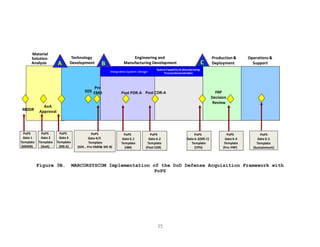
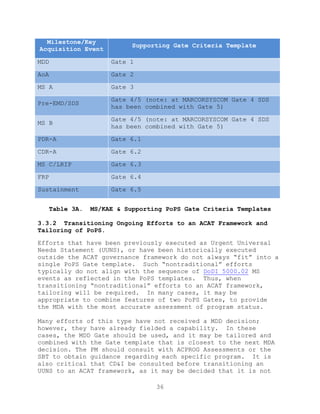
charts and criteria questions for each MS/KAE. Figure 3B and
Table 3A identify the MS/KAE and the supporting Gate criteria
templates.
3.3.1.1 Combat Development and Integration (CD&I) Gate Review
Responsibilities.
CD&I will conduct Gate reviews per their organizational policies
in accordance with SECNAVINST 5000.2E. Gate reviews should be
conducted prior to the appropriate MS or KAE. In many cases,
CD&I will participate concurrently in the MDA review of the MS
or KAE in lieu of holding a separate Gate review.
CD&I is required to validate that the requirement is sufficient
to support each MS or KAE. This may be accomplished by their
participation in the MAT for those programs where
COMMARCORSYSCOM has retained MDA, or the SBT for those programs
where COMMARCORSYSCOM has delegated MDA to a PGD. The MAT
process to include required participants is described in Chapter
6.
35
Figure 3B. MARCORSYSCOM Implementation of the DoD Defense Acquisition Framework with
PoPS
A
Materiel
Solution
Analysis
Technology
Development
Engineering and
Manufacturing Development
CDRPDR
C
Integrated System Design
System Capability & Manufacturing
ProcessDemonstration
MDDR
B
AoA
Approval
Production&
Deployment
Operations &
Support
FRP
Decision
Review
PoPS
Gate 1
Template
(MDDR)
PoPS
Gate 6.4
Template
(Pre-FRP)
PoPS
Gate 2
Template
(AoA)
PoPS
Gate 3
Template
(MS A)
PoPS
Gate 6.1
Template
(IBR)
PoPS
Gate 6.2
Template
(Post CDR)
PoPS
Gate 6.3(MS C)
Template
(CPD)
AA
Materiel
Solution
Analysis
Technology
Development
Engineering and
Manufacturing Development
Post PDR-A
CC
Integrated System Design
System Capability & Manufacturing
ProcessDemonstration
MDDR
B
AoA
Approval
Production&
Deployment
Operations &
Support
FRP
Decision
Review
PoPS
Gate 1
Template
(MDDR)
PoPS
Gate 6.4
Template
(Pre-FRP)
PoPS
Gate 2
Template
(AoA)
PoPS
Gate 4/5
Template
(SDS , Pre-EMD& MS B)
PoPS
Gate 3
Template
(MS A)
PoPS
Gate 6.1
Template
(IBR)
PoPS
Gate 6.2
Template
(Post CDR)
PoPS
Gate 6.3(MS C)
Template
(CPD)
Post CDR-A
Pre
EMD
PoPS
Gate 6.5
Template
(Sustainment)
SDS
36
Milestone/Key
Acquisition Event
Supporting Gate Criteria Template
MDD Gate 1
AoA Gate 2
MS A Gate 3
Pre-EMD/SDS
Gate 4/5 (note: at MARCORSYSCOM Gate 4 SDS
has been combined with Gate 5)
MS B
Gate 4/5 (note: at MARCORSYSCOM Gate 4 SDS
has been combined with Gate 5)
PDR-A Gate 6.1
CDR-A Gate 6.2
MS C/LRIP Gate 6.3
FRP Gate 6.4
Sustainment Gate 6.5
Table 3A. MS/KAE & Supporting PoPS Gate Criteria Templates
3.3.2 Transitioning Ongoing Efforts to an ACAT Framework and
Tailoring of PoPS.
Efforts that have been previously executed as Urgent Universal
Needs Statement (UUNS), or have been historically executed
outside the ACAT governance framework do not always ―fit‖ into a
single PoPS Gate template. Such ―nontraditional‖ efforts
typically do not align with the sequence of DoDI 5000.02 MS
events as reflected in the PoPS templates. Thus, when
transitioning ―nontraditional‖ efforts to an ACAT framework,
tailoring will be required. In many cases, it may be
appropriate to combine features of two PoPS Gates, to provide
the MDA with the most accurate assessment of program status.
Many efforts of this type have not received a MDD decision;
however, they have already fielded a capability. In these
cases, the MDD Gate should be used, and it may be tailored and
combined with the Gate template that is closest to the next MDA
decision. The PM should consult with ACPROG Assessments or the
SBT to obtain guidance regarding each specific program. It is
also critical that CD&I be consulted before transitioning an
UUNS to an ACAT framework, as it may be decided that it is not
37
an enduring requirement. If it is determined that the UUNS will
transition to an enduring requirement, then CD&I will prepare a
validated requirement as described in Chapter 2; and the PM
shall follow the procedures described in Chapter 5 for
requesting an ACAT/AAP designation.
38
Chapter 4: ACAT LEVELS
4.1 Background.
An acquisition program is defined as a directed, funded effort
designed to provide a new, improved, or continuing materiel,
weapon, or information system capability in response to a
validated operational or business need. Acquisition programs
are designated by the Milestone Decision Authority (MDA) to fall
within Acquisition Categories (ACATs) which are established to
facilitate decentralized decision-making, execution, and
compliance with statutory requirements.
Program Managers (PMs) and Product Group Directors (PGDs) are
responsible for ensuring that all funded efforts are managed as
ACAT programs, unless otherwise approved by Commander, Marine
Corps Systems Command (COMMARCORSYSCOM). (Note: Abbreviated
Acquisition Programs (AAPs) are considered to be ACAT programs).
Efforts executed outside an ACAT construct typically do not have
a validated requirement, are difficult to historically trace,
and lack performance metrics. However, these efforts consume
MARCORSYSCOM resources which could be used to support validated
ACAT programs. Therefore, the PM and PGD shall identify any
such efforts to COMMARCORSYSCOM. COMMARCORSYSCOM will then
determine if the effort should be subject to an ACAT designation
process, discontinued, or allowed to proceed in the absence of
an ACAT designation.
Pre-ACAT efforts or potential ACAT programs are defined as
efforts which are:
 Funded.
 Supported by a validated requirement.
 Provide a new, improved, or continuing materiel, weapon, or
information system capability but have not yet been granted
a Milestone (MS) B or any subsequent Milestone decision by
the MDA.
Potential ACAT programs shall not be artificially divided into
separate entities for the purpose of qualifying as lower ACATs
or as AAPs.
ACAT programs, to include AAPs shall not be initiated without
funding and a validated requirement issued by the appropriate
requirements organization.
39
COMMARCORSYSCOM will determine the ACAT level based on estimated
cost, complexity, and risk.
Note: Important Terminology Information - Program of Record
(POR). This term is not defined within the DoDI 5000 series or
supplementary guidance. It is commonly used to refer to a
program which has received a MS B decision, has a valid
requirement, and a unique funding line. This term should not be
used within any correspondence or briefings, as it is
interpreted differently by readers. The correct terminology is
depicted below.
4.2 ACAT Designation Criteria.
The SECNAVINST 5000.2E specifies the criteria for acquisition
categories and is summarized in Table 4A below. The MDA
designates programs as ACAT I, II, III, IV, or AAP as follows:
Table 4A. ACAT Categories
Acquisition
Category
Summary of ACAT Designation Criteria
per SECNAVINST 5000.2E
Decision Authority
ACAT I •Major Defense Acquisition Programs (MDAPs) (10 USC 2430)
•RDT&E > $365M or Procurement total > $2.190 B
•USD(AT&L) designation as special interest
ACAT ID: USD(AT&L)
ACAT IC: SECNAV, or if
delegated, ASN(RD&A
ACAT IA •Major Automated Information Systems (MAISs)
•Program costs/year > $32M, or total program costs > $126M, or
•Life-cycle costs > $378M
•ASD(NII) designation as special interest
ACAT IAM: ASD(NII)/DoD
CIO
ACAT IAC: ASN(RD&A),
ACAT II •RDT&E total > $140M, or Procurement total > $660M
•ASN(RD&A) designation as special interest
•Not applicable to IT programs
ASN(RD&A), or the
individual designated by
ASN(RD&A)
ACAT III •Weapon system programs:
-RDT&E total ≤ $140 million, or Procurement total ≤ $660 million, and
- Affects mission characteristics of ships or aircraft or combat capability
•IT system programs:
-Annual costs ≤ $32M;Total program costs ≤ $126M; life-cycle costs ≤ $378M
Cognizant PEO, SYSCOM
Commander, or
designated flag officer or
senior executive service
(SES) official.
ACAT IV(T) •Does not meet the criteria for ACAT III
•Weapon system programs:
-RDT&E total ≤ $140M or Procurement total ≤ $660M
IT system programs:
• Annual costs < $15M;Total program costs< $30M; life-cycle costs ≤ $378M
Same as ACAT III except
that authority may be
further delegated to a
PGD.
ACAT IV (M) •Same as ACAT IV(T) with two exceptions:
-Does not require operational test and evaluation
-Not applicable to IT system programs
Same as ACAT IV(T)
Abbreviated
Acquisition
Program
(AAP)
•Does not require operational test and evaluation as concurred with in writing by
MCOTEA
•Weapon system programs: R&D< $10M & Production expenditure < $50M
•IT system programs: Annual costs< $15M & Total program costs < $30M
Same as ACAT IV(T)
40
The PM shall review each program relative to the above ACAT
boundaries.
 The PM shall prepare an ACAT designation request to
COMMARCORSYSCOM as described in Chapter 5, for programs
anticipated to fall within the ACAT III, IV, or AAP
boundaries.
 The PM shall contact the Assistant Commander, Programs
(ACPROG) if the program is anticipated to fall within the
ACAT I or II boundaries as shown above. ACPROG will
coordinate appropriate notification to Assistant Secretary
of the Navy for Research, Development, and Acquisition (ASN
RDA) and Under Secretary of Defense for Acquisition,
Technology, and Logistics (USD AT&L).
 COMMARCORSYSCOM serves as MDA for ACAT III, IV, and AAPs
assigned to MARCORSYSCOM, and may delegate this authority
as described in Chapter 5.4. MDA authority for ACAT I and
II’s resides with ASN RDA or USD AT&L.
COMMARCORSYSCOM assigns appropriate ACAT III, IV, and AAP
designations based on the thresholds and definitions specified
in Table 4A as well as an assessment of overall program risk,
complexity, impact, and visibility. COMMARCORSYSCOM may elect
to elevate the ACAT designation beyond what is required by an
assessment of dollar thresholds in Table 4A. For example, a
program that meets AAP thresholds may be elevated to an ACAT
III, based on an assessment of visibility, risk, complexity, and
impact.
COMMARCORSYSCOM may at any time in the program lifecycle revisit
a previous ACAT designation and/or delegation. For example,
COMMARCORSYSCOM may elect to rescind delegation of MDA or revise
a previous ACAT designation based on program complexity, risk,
change in estimated cost, or other factors. For those programs
where MDA has been delegated to a PGD, the PGD shall
periodically review all assigned ACAT programs and make
appropriate recommendations to COMMARCORSYSCOM regarding ACAT
designation and delegation based upon the above factors.
4.3 Description of ACAT Categories.
ACAT III. COMMARCORSYSCOM designates ACAT III programs assigned
to MARCORSYSCOM and serves as the MDA. The Commander may elect
to delegate MDA for such programs to a designated flag officer
41
or Senior Executive Service (SES) official, but generally this
does not occur at MARCORSYSCOM.
ACAT IV. There are two categories of ACAT IV programs. ACAT
IV(T) (Test) programs require operational test and evaluation
(OT&E), while ACAT IV(M) (Monitor) programs do not. ACAT IV(M)
programs require developmental testing (DT), which is managed by
the PM. The Director, Marine Corps Operational Test and
Evaluation Activity (MCOTEA) may elect to monitor testing of
ACAT IV(M) programs.
COMMARCORSYSCOM will designate ACAT IV programs and may delegate
MDA for such programs to a PGD or SES official. MCOTEA must
concur in writing with all ACAT IV(M) designations.
AAPs. Acquisitions may be designated as AAPs if they do not
require OT&E and they meet the AAP dollar thresholds in Table
4A. MCOTEA must concur in writing that OT&E is not required.
In addition, the Director, Financial Management (DFM) must
concur that the program does not exceed AAP cost thresholds.
COMMARCORSYSCOM will designate AAPs and may delegate Program
Decision Authority (PDA) to a PGD or SES official. (Note: For
AAPs, the decision authority is referred to as the PDA and not
the MDA).
Programs should be of relatively low risk and complexity to be
considered for designation as an AAP. As such, required
documentation and review procedures should be appropriately
streamlined and tailored. A recommended streamlined AAP
documentation approach is provided in Chapter 7.2.
The PM shall meet with their respective Strategic Business Teams
(SBTs) to develop a tailored AAP documentation plan. Together
with the SBT, the PM shall make a recommendation to the PDA
regarding required program management events and documentation
to include content and format.
AAPs will be subjected to the appropriate level of DT required
to ensure the technical parameters and operational requirements
are met. DT is accomplished under the direction of the PM with
the advice and assistance of the APGD Engineering (ENG).
42
Chapter 5: ACAT DESIGNATION REQUESTS &
DELEGATION OF MDA/PDA
5.1 ACAT III, IV, and Abbreviated Acquisition Program (AAP)
Designation Requests.
Commander, Marine Corps Systems Command (COMMARCORSYSCOM) is the
ACAT designation authority for all programs assigned to the
MARCORSYSCOM. COMMARCORSYSCOM designates ACAT III and IV
programs as well as Abbreviated Acquisition Programs (AAPs).
This authority can only be delegated to the Executive Director
(ED), not to Product Group Directors (PGDs) or Program Managers
(PMs).
5.2 ACAT III, IV, and AAP Designation Process.
PMs shall submit ACAT designation requests to COMMARCORSYSCOM
via the PGD and Assistant Commander, Programs (ACPROG).
Enclosure (g) provides the format for an AAP designation
request. Enclosure (h) provides the format for ACAT III and IV
designation requests.
The Assistant Product Group Director (APGD) PM/Strategic
Business Team (SBT) is the PGD staff focal point for ACAT
designation requests. Below is a step by step description of
the process.
 The PM submits the draft ACAT designation request to the
APGD PM for review.
o If requesting an ACAT IV Monitor (M) designation,
the PM will obtain the Marine Corps Operational Test
and Evaluation Activity (MCOTEA) concurrence letter
shown in Enclosure (i), and provide MCOTEA with the
required documentation as prescribed on Page 12 of
the USMC Integrated Test and Evaluation Handbook.
o If requesting an AAP designation, the PM will obtain
the MCOTEA concurrence letter shown in Enclosure (i)
as well as the Director, Financial Management (DFM)
checklist shown in Enclosure (j).
 The APGD PM coordinates the internal SBT/PGD review.
 The PM submits the ACAT designation request for PGD
approval (signature) after SBT review and concurrence.
 The PM provides the PGD approved package to ACPROG for
action.
 ACPROG will assess the PM’s request and provide a
recommendation to COMMARCORSYSCOM. ACPROG will also
43
prepare an Acquisition Decision Memorandum (ADM) from
COMMARCORSYSCOM to the PGD as described below.
After review of the PM's proposed ACAT designation request and
the staff recommendation, COMMARCORSYSCOM will issue an ADM
which either:
1) Approves the request and delegates Milestone Decision
Authority (MDA) or Program Decision Authority (PDA).
2) Approves the request, and retains MDA or PDA at the
COMMARCORSYSCOM level.
3) Disapproves the request and directs other actions.
4) Disapproves the request and directs no action be taken to
execute the program.
The ADM will also provide guidance regarding any program
specific documentation requirements and exit criteria.
5.3 ACAT Change Requests.
After receipt of the initial ACAT designation from
COMMARCORSYSCOM, the PM shall continue to monitor the program to
ensure that it remains within the cost threshold (per Table 4A)
of the assigned ACAT designation. In addition, the PM shall
monitor other factors which may require a change to the initial
ACAT designation. For example, a program initially designated
as an ACAT IV(M) may subsequently be determined to require
operational test and evaluation; and require re-designation as
an ACAT IV(T). As soon as the PM is aware of a required change
to the existing ACAT designation, the PM shall prepare an ACAT
designation change request for COMMARCORSYSCOM approval. An
example is provided in Enclosure (h).
5.4 Delegation of MDA.
Fundamental to implementing the acquisition chain of command is
the identification of the MDA or PDA as the single focal point
for milestone decisions. SECNAVINST 5000.2E establishes
COMMARCORSYSCOM as the MDA for Marine Corps ACAT III & IV
programs and the PDA for AAPs. This authority may be delegated
for ACAT IVs or AAPs at the discretion of COMMARCORSYSCOM to a
PGD or Senior Executive Service (SES) official.
PGDs may request delegation of MDA for ACAT IV programs or PDA
for AAPs from COMMARCORSYSCOM. The request shall be submitted
within a memorandum to the COMMARCORSYSCOM via AC PROG, and
44
address how the program meets the below criteria for MDA/PDA
delegation:
 ACAT IV or AAP.
 Cost estimate of sufficient fidelity to support the
proposed/identified ACAT level.
 Low risk, visibility, impact, and complexity.
 Validated requirement.
The request for delegation of MDA may be combined with the
request for ACAT designation, or it may be submitted separately.
An example of an MDA delegation request is provided in
Enclosures (g) and (h).
Delegation of MDA or PDA shall be documented in an ADM prepared
by ACPROG from COMMARCORSYSCOM to the designated official.
45
Chapter 6: MANAGEMENT OF MARCORSYSCOM ACAT
PROGRAMS AND PRE-ACAT EFFORTS
6.1 DoD Process for Assigning MDA.
The below figure illustrates the flow of Milestone Decision
Authority (MDA) from Under Secretary of Defense for Acquisition,
Technology, and Logistics (USD AT&L) to Commander, Marine Corps
Systems Command (COMMARCORSYSCOM).
Figure 6A. Flow of MDA Authority to COMMARCORSYSCOM
SECNAVINST 5000.2E assigns SYSCOM Commanders the authority,
responsibility, and accountability for life cycle management of
all acquisition programs within their cognizance. It further
requires SYSCOM Commanders to implement appropriate management
controls to ensure compliance with DoDI 5000.02 and the
SECNAVINST 5000.2E.
COMMARCORSYCOM
ASN RDA
(Assistant Secretary of the Navy,
Research, Development,& Acquisition)
USD AT&L
(Under Secretary of Defense,
Acquisition Technology & Logistics)
Acquisition Authority to
COMMARCORSYSCOM
* Per SECNAVINST 5400.15 and SECNAVINST 5000.2
Flow of MDA Authority to
COMMARCORSYSCOM
• Serves as Milestone Decision
Authority (MDA) for assigned ACAT
III & IV programs and AAPs (may
delegate authority as appropriate
for low risk ACAT IV and AAPs).
• Conduct milestone reviews for all
assigned ACAT programs.
• Manage and wield close
programmatic oversight on assigned
programs and make forthright,
timely reports to ASN RDA.
• Establish standard policies and
processes where appropriate.
• Establish IPTs to manage program
execution and provide the MDA with
program recommendations.
Summary of MDA
Responsibilities*
COMMARCORSYSCOM
46
6.2 DoD Process for Managing ACAT Programs.
Integrated Product and Process Development (IPPD) is the
preferred Department of Defense (DoD) technique for the
management of acquisition programs.
The IPPD process has several key features:
 The management and assessment of Acquisition Category
(ACAT) programs and pre-ACAT efforts are accomplished via
multi-functional teams known as Integrated Product Teams
(IPTs).
 All key stakeholders and competencies are IPT members and
work as a team to:
o Concurrently review the progress of programs to the
next Milestone (MS) or Key Acquisition Event (KAE).
o Identify issues and risks early in the process and
develop an adjudication strategy.
 IPTs may be established at various levels.
o A strategy level IPT is established to review the
overall program and make recommendations to the MDA.
o Working Integrated Product Teams (WIPTs) are
established as appropriate to support the Program
Manager (PM) in the execution and management of the
program.
A key benefit of the IPPD process is all stakeholders work
together at the same time to provide feedback relative to the
program and develop a single recommendation to the Decision
Authority. In the past, programs were delayed due to sequential
or stovepipe reviews of programs.
MARCORSYSCOM implements IPPD by the Milestone Assessment Team
(MAT) process for programs where COMMARCORSYSCOM has retained
MDA. Product Group Directors (PGDs) implement IPPD principles
by use of the Strategic Business Team (SBT) to assist in program
reviews. In addition, multiple WIPTs are established throughout
MARCORSYSCOM.
Additional information regarding the IPPD process can be found
in The Rules of the Road: A Guide for Leading Successful
Integrated Product Teams (Reference (o)).
47
6.3 MDA/PDA Responsibilities.
The below principles apply to all MARCORSYSCOM programs.
Specific guidance for programs where COMMARCORSYSCOM serves as
MDA/Program Decision Authority (PDA) is provided in Chapter 6.4.
Guidance for programs where the PGD serves as MDA/PDA is
provided in Chapter 6.5.
The MDA/PDA shall:
 Review programs and pre-ACAT efforts at major MS and KAEs
to determine their suitability for entry into the next
phase of acquisition.
 Consider the recommendations of an integrated IPT (with
membership from all competencies and stakeholders)
regarding program status and readiness to proceed to the
next MS/KAE. The IPT shall align with IPPD principles.
 Implement appropriate interim reviews as well as governance
and management procedures to support effective execution of
all assigned programs.
 Conduct program reviews in accordance with this Guidebook
and MARCORSYSCOMO 5000.3A.
 Ensure compliance with DoDI 5000.02, SECNAVINST 5000.2E and
applicable law and regulation. (Note – the MARCORSYSCOM
Probability of Program Success (PoPS) core briefing charts
align with and include references and hyperlinks to higher
level guidance).
 Examine and, as appropriate, adopt innovative techniques
that reduce cycle time and cost, and encourage teamwork.
 Ensure accountability and maximize credibility in cost,
schedule, and performance (C/S/P) reporting.
 Document all program decisions. This includes, but is not
limited to PoPS briefing charts/reports/templates,
Acquisition Decision Memorandums (ADMs), Decision
Memorandums (DMs), Memorandum of Agreement (MOAs), and
Memorandums for the Record (MFRs).
 Comply with all required reporting requirements to include
The Online Project Information Center (TOPIC) and Assistant
48
Secretary of the Navy for Research, Development, and
Acquisition (ASN RDA) DASHBOARD as described in Chapter 9
of this Guidebook.
6.3.1 Program Manager Responsibilities.
The PM is accountable for program execution and management to
include development, production, and sustainment to meet the
user's operational needs. The PM shall:
 Prepare and execute all program documentation and ensure
compliance with reporting requirements.
 Provide the MDA with credible (C/S/P) reporting.
 Assist the MDA in executing the responsibilities defined
above.
6.4 Management Procedures for Programs Where COMMARCORSYSCOM
Serves as MDA/PDA.
6.4.1 General.
Assistant Commander, Programs (ACPROG) Assessments will serve as
the staff focal point for those programs for which
COMMARCORSYSCOM has elected to retain MDA/PDA. ACPROG will
execute all ADMs for COMMARCORSYSCOM signature, and lead the MAT
process as described below.
Figure 6B. MARCORSYSCOM Milestone Assessment Team (MAT) Process
Programs Where COMMARCORSYSCOM Serves as MDA
49
6.4.2 Milestone Assessment Team (MAT) Process.
The MAT shall be chaired by ACPROG and include:
 Combat Development and Integration (CD&I), Marine Corps
Operational Test and Evaluation Activity (MCOTEA), and
other key external stakeholder organizations.
 All MARCORSYSCOM Competency Directors (CDs).
 The respective PGD.
 PM.
ACPROG shall work with the PM to identify all external
stakeholders and ensure they are represented on the MAT. The
MDA shall approve the final recommended MAT membership.
The MAT provides the MDA with an integrated assessment of each
program. To be effective, all appropriate competencies and
stakeholders must work together as a team and provide the PM
with timely recommendations.
The MAT reviews the program events from an overarching
perspective to ensure the program strategy and schedule reflect
a realistic and integrated approach. This will include
identification of risks, dependencies between events across all
competencies, critical path or long lead items, and development
of recommended mitigation strategies as appropriate.
The MAT uses the MARCORSYSCOM PoPS core briefing charts and
criteria questions as the primary assessment tool, per
MARCORSYSCOMO 5000.3A.
Below provides a detailed description of MAT membership,
responsibilities and processes. In addition, Enclosure (k)
provides examples of the following MAT tools and artifacts:
MAT Recommendation to the MDA, Action Item Tracker, Plan of
Action and Milestones (POA&M), and Summary Assessment for MDA.
50
MAT Membership
Each organization may designate one or more
representatives as appropriate in consultation with the
MAT Chair.
Internal
AC PROG (Chair)
ACPROG Assessments chairs the MAT. ACPROG Cost &
Analysis (C&A) and ACPROG POM shall participate as
appropriate and provide their recommendations to the MAT
Chair.
DC SIAT
PGD
The APGDs shall participate concurrently in the MAT to
ensure a streamlined review cycle.
DC RM
AC LCL
AC Contracts
Safety
PM
External
HQMC – CD&I (mandatory)
Other HQMC participation
All HQMC organizations with an interest in the program
should be invited to participate.
MCOTEA (mandatory)
LOGCOM
Table 6A. MAT Membership
51
MAT Process Organizational Responsibilities
Organization: MARCORSYSCOM ACPROG (Chair)
 Work with the PM to determine MAT membership.
 Schedule meetings within appropriate timelines.
 Chair MAT and provide summary of each MAT meeting to include status
of actions to all MAT members.
 Coordinate staff inputs, facilitate the resolution of issues at the
lowest appropriate level.
 Objectively represent the views of the MAT members.
 Ensure that in cases of substantive disagreement between MAT
members and/or the PM, the issues are quickly framed and presented
to COMMARCORSYCOM so that programs are not delayed due to
disagreements over issues.
 Provide guidance to the PM regarding content of MDA decision
briefs.
 Prepare draft ADM and ensure staffing to appropriate stakeholders.
Ensure that senior leadership has reviewed and concurs with the ADM
and decision package prior to the pre-brief with the Executive
Director. This requires the MAT Chair to obtain written
confirmation (this may be electronic) from each MARCORSYSCOM CD,
MAT principal, and appropriate senior leadership.
 Prepare the MDA Summary Assessment. Ensure it provides objective
and complete data to enable COMMARCORSYSCOM to execute a fully
informed MDA decision. Ensure all MAT member perspectives
(including dissenting views) are accurately represented in the MDA
assessment.
Organization: MARCORSYSCOM DC SIAT, DC RM, AC Contracts, AC LCL, Safety,
MCOTEA, HQMC, LOGCOM, and PGD
 Ensure appropriate skill sets within each organization are
represented on the MAT. This may require multiple MAT members from
the same organization. For example, DC SIAT may appoint
representatives from both SE and IA.
 Ensure all MAT representatives are empowered to represent
leadership and fully participate in the MAT process. MAT
representatives must have sufficient expertise/seniority to provide
guidance relative to program strategy.
 Provide a timely response to ACPROG upon receipt of a request for
MAT participation.
Organization: MARCORSYSCOM PM
 Prepare all required products, briefings, and analysis to support
the MAT process.
 Provide a timely response to ACPROG upon receipt of a request for
MAT participation.
Table 6B. MAT Process Organizational Responsibilities
52
6.4.3 MAT Member Roles and Responsibilities.
MAT Member Roles and Responsibilities
1) Participate in all MAT meetings or assign an empowered
representative.
2) Review PoPS briefing packages and establish PoPS baseline
score for MDA consideration.
3) Surface/resolve issues as a group early in the process and
assist the PM in developing appropriate adjudication
strategies. It is a disservice to the programs and process
for issues to remain hidden or be surfaced unexpectedly at
senior-level decision meetings.
4) Foster early/effective communication between MARCORSYSCOM
leadership, internal and external stakeholders, and the
PM.
5) Ensure the program meets the requirements of DoDI 5000.02,
SECNAVINST 5000.2E, and MARCORSYSCOMO 5000.3A, and all
other appropriate logistics, test, engineering, financial,
and contracting guidance.
6) Review key program events and schedule for realism and
effectiveness and provide timely recommendations to the
PM.
7) Assist the PM in developing a tailoring strategy for MDA
approval.
8) Track and monitor all actions directed by the previous ADM
(exit criteria) and notify the MAT Chair of barriers to
completion.
9) Mentor the PM regarding completion of documents to ensure
they reflect sound planning and assessments before they
are submitted for final review.
10) Provide data needed to resolve issues and to support MDA
decisions in a timely manner.
11) Keep respective ACs, DCs, and other leadership informed of
progress/issues and ensure all key products such as ADMs,
PoPS Health Assessments, etc. are reviewed by leadership
well in advance of the decision pre-brief to the Executive
Director. Ensure that all comments are provided to the
MAT Chair within required timelines.
12) Provide a comprehensive recommendation to COMMARCORSYSCOM
prior to each MS/KAE. The recommendations shall be
focused on the key elements of program success. Success
is defined as affordable, executable programs that provide
the most value for the resources invested.
Table 6C. MAT Member Roles and Responsibilities
53
6.4.4 MAT Process Overview.
Step 1. PM/Program Team Lead informs SBT and ACPROG of upcoming
MS/KAE.
Step 2. ACPROG assigns MAT lead (MAT Chair).
Step 3. ACPROG MAT lead meets with PM to establish notional
timelines, MAT membership, required products to support conduct
of the MAT such as PoPS briefing templates, etc., and refine
overarching strategy. Typically the MAT process includes an
initial kick-off meeting, 1-3 interim MAT reviews, and a final
meeting prior to the MDA decision brief. The MAT lead will work
with the PM to establish an initial schedule tailored to the
risk and complexity of each individual program.
Step 4. ACPROG notifies prospective MAT members and
MARCORSYSCOM CDs and coordinates the MAT kick-off meeting.
Step 5. All organizations which have been requested to
participate within the MAT shall provide a response to ACPROG
within 5 working days.
Step 6. The initial MAT kick-off meeting shall be conducted and
establish the following:
 Validate MAT membership and review required roles and
responsibilities.
 Identify the next MS or KAE.
 Establish a POA&M required to support achievement of the
identified MS or KAE.
 Identify appropriate PoPS core briefing charts and
associated Gate templates.
 Review entrance criteria (to include statutory and
regulatory documentation) which is located in each
MARCORSYSCOM PoPS core briefing charts.
 Assess status of exit criteria from the previous ADM if
applicable.
 Review program status, strategy, schedule, documentation,
and risks as contained in the PoPS core briefing charts and
Gate criteria questions.
 Establish initial PoPS baseline score.
 Identify follow on MAT meetings, required pre-briefings,
and products required to support the MDA decision brief.
54
 Identify actions to be resolved prior to the MDA decision
brief to include responsible parties and required
resolution date.
Step 7. Conduct follow on MAT meetings per the POA&M
established at MAT kick-off.
 Review MARCORSYSCOM PoPS core briefing charts and
associated Gate criteria questions, update baseline score,
refine charts and rationale for criteria question
responses.
 Review status of program compliance with entrance criteria
to include documentation.
 Review status of program compliance with exit criteria
established at previous MS or KAE if applicable.
 Review actions previously identified by the MAT and update
status, establish new actions as appropriate along with
responsible parties and required resolution date(s).
 Review draft ADM language to include development of exit
criteria for the next MS or KAE. Ensure that all
stakeholders and CDs have reviewed the ADM and incorporate
comments as applicable.
 Update the MAT POA&M as appropriate to include the date and
agenda for the next MAT meeting.
Step 8. Conduct final MAT meeting and provide recommendation to
the MDA.
 Review status of program compliance with entrance criteria
and (if applicable) exit criteria established at previous
MS or KAE and frame results for MDA.
 Validate the documentation is complete or final pending MDA
signature.
 Finalize draft ADM language to include exit criteria for
the next MS or KAE.
 Validate that all MAT actions have been adjudicated,
deferred to the next MS, or addressed via ADM language.
 Review PoPS core briefing charts and associated Gate
criteria questions, finalize baseline score, refine charts
and rationale for criteria question responses.
 Frame open critical risks, issues, or concerns for MDA
consideration as appropriate.
 Make MS recommendation to MDA. Each MAT member will be
asked to confirm that the program should proceed or not
proceed to the Marine Corps Program Decision Meeting
(MCPDM) with COMMARCORSYSCOM. The MAT lead shall record
55
this vote and provide the record to the MDA. An example is
provided in Enclosure (k).
o MAT members may choose to concur that the program
should proceed to the decision brief with the MDA
contingent upon resolution of a specific issue. In
these cases, the MAT lead will frame the contingent
concurrence for MDA consideration.
o If a MAT member non-concurs that the program should
proceed to the MCPDM, the PM may elect to defer the
decision until the issue is resolved. However, the PM
may choose to proceed to the MCPDM. The MAT lead
shall frame the issue along with the PM recommended
mitigation for COMMARCORSYSCOM consideration.
Step 9. COMMARCORSYSCOM will review the MAT recommendations and
issue a decision at the MCPDM.
Figure 6C provides a top level depiction of the MAT process and
organizational roles and responsibilities.
56
days
-180
days
Step 1
Inform SBT &
ACPROG of
upcoming
MS/KAE
Step 7
Conduct follow on MAT
meetings per POA&M
established at MAT
kick-off
Step 5
Respond to
ACPROG within
5 days regarding
MAT participation
Step 3
Meet with PM
to establish
timelines,
MAT
membership
& required
products
Step 9
Conduct
MCPDM
120 - 260 Days
Notional Timeline
The MAT Process & associated events depicted below may vary based on program complexity
Milestone
Decision
Issue
ADM
Update PoPS
briefing charts,
documentation,
& MAT actions
Participate as MAT member
Step 2
Assign
MAT Lead
Step 4
Notify
prospective
MAT
members &
coordinate
kick-off
meeting
Step 6
Conduct
kick-off
meeting
Step 8
Conduct final
MAT meeting &
prepare MDA
recommendation
Prepare PoPS
core briefing
charts & other
required
documentation
MAT Lead
ACPROG
Commander
MAT
PGD, CDs,
SBT, & External
Stakeholders
PM/Project
Team
Leader
Develop draft ADM
for review by CDs &
Stakeholders
Adjudicate open
MAT actions,
finalize PoPS
baseline & ADM
Provide MS
recommendation
to MDA
Figure 6C. MAT Process Top Level Overview
57
6.4.5 MAT Issue Resolution Process.
The MAT shall:
 Identify required actions and responsible parties for
issues that can be fully addressed within the MAT process
and track each action to final resolution.
 Draft appropriate language for issues that can be resolved
by addition of ADM narrative.
 Frame other issues and recommendations for MDA
consideration. In the case of substantive issues, the MAT
(via the MAT Chair) shall schedule a meeting with
MARCORSYSCOM leadership and key stakeholders to ensure the
issues or risks are surfaced as soon as possible for
leadership review and decision.
 Provide the MDA with a summary of all identified issues and
status prior to each MS/KAE.
6.5 Management Procedures for Programs Where the PGD Serves as
MDA/PDA.
COMMARCORSYSCOM may delegate MDA/PDA to a PGD or Senior
Executive Service (SES) official. Delegation of MDA or PDA
shall be documented in an ADM from COMMARCORSYSCOM to the
designated official. Programs should be of relatively low risk
and complexity to be considered for delegation.
The MDA/PDA for delegated programs shall:
 Follow the procedures outlined in Chapter 6.3.
 Ensure that each program is subject to regularly scheduled
MDA/PDA reviews to assess the program’s compliance with
C/S/P goals as well as statutory and regulatory
requirements.
 Establish a review process which directly aligns with the
MAT process described in Chapter 6.4.
 Provide a copy of all ADMs to ACPROG.
 Ensure that records of all PoPS Health Assessments are
updated, maintained, and readily available to support
Command data calls.
 Provide ACPROG with the following every third Monday during
the 1st and 3rd quarter each fiscal year:
o A consolidated overview package of all ACAT programs
(to include Abbreviated Acquisition Programs (AAPs))
that have been delegated to the PGD. The template for
58
each delegated overview package is provided in
Enclosure (s).
o A summary of any pre-ACAT efforts and any other funded
efforts, in excess of $5M annually, which have not
been granted an ACAT designation by COMMARCORSYSCOM
and/or delegated to the PGD.
 Ensure compliance with reporting requirements to include
TOPIC and DASHBOARD as described in Chapter 9 of this
Guidebook.
59
Chapter 7: TAILORING & PROGRAM DOCUMENTATION
7.1 MDA Tailoring.
General. One of the major themes of recent memoranda issued by
the Under Secretary of Defense for Acquisition, Technology, and
Logistics (USD AT&L) and the DoDI 5000.02 is "tailoring in.‖
Tailoring in means that the documentation, reviews, and events
required for each program should be the minimum necessary to
ensure effective and disciplined program execution. The Marine
Corps has limited resources, and it is our responsibility to
manage them wisely. As such, we should not require any
documentation or event that does not contribute to the effective
management and oversight of the program. DoDD 5000.01 and DAG
Chapter 2.3.1.2 contain additional information regarding
tailoring.
Process. The Program Manager (PM) shall assess the cost,
complexity, and risk of each program and propose a tailoring
strategy for Milestone Decision Authority (MDA) approval that
addresses the following:
 Appropriate Milestones (MS) and Key Acquisition Events
(KAEs).
 Program, logistics, and engineering reviews, as well as,
test and evaluation events.
 Documentation required for each MS.
Each program is unique, and the tailoring strategy should be
constructed to address program specific complexity, risk,
technical maturity, etc. In general, lower risk programs will
have substantially fewer reviews and streamlined documentation.
For example, the suggested Abbreviated Acquisition Program (AAP)
tailoring approach is provided at Chapter 7.2 and reflects
minimal required documentation.
The MDA tailoring decision is captured via an Acquisition
Decision Memorandum (ADM). It is imperative that the tailoring
determination made at the initial MDA review is re-examined at
each subsequent MS and adjusted as appropriate to reflect
current program conditions. For programs where Commander,
Marine Corps Systems Command (COMMARCORSYSCOM) serves as the
MDA, the tailoring plan should be reviewed by the Milestone
Assessment Team (MAT) before presentation to the MDA. For
programs which have been delegated to a Product Group Director
(PGD), the Strategic Business Team (SBT) should review the plan
before presentation to the MDA.
60
Regulatory Requirements. Regulatory requirements are those
established by regulation, directive, or other policy
memorandum. The MDA may elect to streamline or eliminate
regulatory reports, documents, and events. This includes
program MS/KAEs, documentation, and supporting program
technical and logistics reviews. The MDA may also tailor
test and evaluation (T&E) events; except in the case of
Director, Operational Test and Evaluation (DOT&E)
oversight, live fire, or other statutory test events.
Statutory Requirements. Statutory requirements are
established by law, and typically embedded within federal
statutes. Tailoring or waiver of statutory documents,
reports, event requirements, and processes can only be done
in rare cases and may require justification to Congress.
If a PM wishes to request a waiver of any statutory
document or requirement, the request must be submitted via
the SBT and PGD to COMMARCORSYSCOM for review. In turn,
COMMARCORSYSCOM may reject the request or submit the
request via the Assistant Secretary of the Navy for
Research, Development, and Acquisition (ASN RDA) and USD
AT&L for approval by the appropriate authority.
Identification of Statutory vs. Regulatory Requirements.
The MARCORSYSCOM Probability of Program Success (PoPS) core
briefing charts (located on the Integrated Milestone
Decision Process (IMDP) SharePoint site) provide a complete
listing of statutory and regulatory documents and
requirements for each MS and KAE.
7.2 Program Documentation.
General. Documentation requirements for MARCORSYSCOM programs
are provided for each MS and KAE at the IMDP SharePoint site
within the MARCORSYSCOM PoPS core briefing charts. As soon as
possible, the PM should begin planning for execution of all
required program documentation. This includes execution of
documents identified as ―long lead‖, e.g. those that may require
in excess of five months to prepare, staff, and obtain approval.
These long lead documents are identified in the MARCORSYSCOM
PoPS core briefing charts for each MS and KAE within the
notional timeline chart.
7.2.1 AAP Documentation.
Recommended documentation and events for an AAP are described
below, and may be tailored by the MDA as described in Chapter
7.1.
61
 Validated Requirement. This may include a Statement Of
Need (SON), Letter Of Clarification (LOC), Problem
Statement for Business Systems, or an appropriate Joint
Capabilities Integration and Development System (JCIDS)
document. SECNAVINST 5000.2E Chapter 1.4.6 states that the
requirement for an AAP may take the form of a memorandum
from the resource sponsor (signed at the GO/SES/Flag
Officer level). This is referred to as the
Program/Resource Sponsor Requirements Memorandum.
 Acquisition Program Baseline (APB).
 Cost Analysis Requirements Document (CARD).
 Program Life Cycle Cost Estimate (PLCCE).
 Tailored Manpower, Personnel and Training (MPT) analysis.
 Strategies for:
o Test and evaluation.
o Systems engineering to include the conduct and
timing of technical reviews.
o Supportability.
o Acquisition plan.
o Configuration Management.
o Integrated planning and scheduling to include the
conduct and timing of all key program events.
 Tailored analysis of the system’s ability to operate in the
intended electromagnetic environment (per Military Standard
464 (MIL-STD-464)).
 System safety program tailored (per MIL-STD-882) to
identify Environment, Safety and Occupational Health (ESOH)
hazards.
 Clinger-Cohen Act (CCA) compliance and information
assurance strategy for Information Technology (IT) systems,
including National Security Systems (NSS).
 IT registration for Mission-Critical (MC) and Mission-
Essential (ME) IT systems, including NSS.
 Other regulatory or program information required by the
Program Decision Authority (PDA). This may include a
tailored Integrated Master Schedule (IMS).
7.2.2 Streamlining Documentation.
There are a number of MARCORSYSCOM documents which are currently
being reviewed to ensure compliance with recent OSD guidance
relative to streamlining. These include the Program Protection
Plan (PPP), System Engineering Plan (SEP), Marine Corps Single
Acquisition Management Plan (MCSAMP), and Life Cycle Sustainment
Plan (LCSP). As part of this process, the MCSAMP and LCSP have
been converted to align with Office of Secretary of Defense
62
(OSD) templates, to include transition of the MCSAMP to an
Acquisition Strategy/Acquisition Plan (AS/AP) (Reference (p)).
Updated versions of all documents and associated implementation
instructions will be provided in the MARCORSYSCOM PoPS core
briefing chart document listing and announced to the workforce
via TIGER. Please contact your SBT or ACPROG Assessments with
specific questions.
63
Chapter 8: TOOLS & ADDITIONAL GUIDANCE
8.1 Integrated Master Plan (IMP)/Integrated Master Schedule
(IMS).
The Integrated Master Plan (IMP) and Integrated Master Schedule
(IMS) are business tools that enhance the management of
acquisition programs. All Marine Corps Systems Command
(MARCORSYSCOM) programs and pre-Acquisition Category (ACAT)
efforts should prepare, use, and regularly update an IMP and IMS
to manage daily operations.
Below is a brief summary of the IMP and IMS as well as
associated definitions. Detailed guidance is provided within
the Defense Acquisition Guidebook (DAG) Chapter 4.5.2 and 4.5.3.
In addition, the Under Secretary of Defense for Acquisition,
Technology, and Logistics (USD AT&L) IMP and IMS Preparation and
Use Guide (Reference (q)) provides all information required to
initiate and manage an IMP and IMS. For MARCORSYSCOM programs,
the Program Manager (PM) should consult with the Strategic
Business Team (SBT) for guidance on implementation within each
specific program.
The level of detail for each IMP/IMS should be tailored to the
specific characteristics of each program. The tailoring process
is described in Chapter 7.1. In general, the IMP/IMS for
programs with high risk or complexity should show greater detail
to provide the PM enhanced visibility to program status and
underlying events. However, the more detailed the IMS, the
greater the cost to track and update the schedule. As such, the
PM should exercise sound business judgment when determining the
level of detail required in the IMP/IMS.
The below figure depicts many of the inputs the PM reviews to
begin populating the initial IMP/IMS. This includes the
requirements document, Work Breakdown Structure (WBS),
historical information, and planned key technical, logistics and
program events and documentation. In addition, the PM should
review the notional timeline charts contained in the
MARCORSYSCOM Probability of Program Success (PoPS) core briefing
charts. The initial schedule will be notional, and gain
fidelity over time as the program matures.
64
Figure 8A. Inputs Used to Develop Program Schedule (from PM e–
Toolkit)
IMP. An IMP is an event-based narrative plan consisting of a
hierarchy of program events. Each event is supported by
specific accomplishments with detailed criteria for completion.
The IMP is often included as part of the contract and in these
cases is contractually binding. The IMP should be included in
Statements of Work (SOWs) that are issued to government
performers.
IMS. The IMS is an integrated schedule of tasks required to
execute the program. The IMS includes all:
 IMP events, accomplishments, and supporting closure
criteria.
 All the elements required to develop, produce, deliver, and
sustain the final product. This includes: key program,
technical, logistics, integrated test and contracting
events and documents. (This should reflect the Milestone
Decision Authority (MDA) approved tailoring strategy as
described in Chapter 2 of this Guidebook).
65
The IMS enables the PM to build a realistic schedule and
identify, track, and manage program dependencies and critical
path events. The following concepts are provided to assist the
PM in developing a realistic schedule.
Critical Path. The critical path events are those which
will take the longest time to accomplish and require close
monitoring by the PM. The critical path will be identified
by the IMS, thus enabling the PM to actively manage
schedule drivers.
Risk Adjustment. This is the additional time built into
the schedule to accommodate unanticipated delays. A
realistic program schedule should include appropriate risk
adjusted timeframes (durations) since it is very rare for
all events to occur within originally planned timeframes.
Dependencies. Certain program events and documents are
dependent upon the accomplishment of prior events or
documentation. For example, the appropriate technical
reviews must be completed prior to a Milestone (MS). All
such dependencies should be built in to the IMP/IMS. This
provides the PM with a realistic schedule and enables
proactive management of schedule drivers.
Float. This is the amount of time that a task can be
delayed without impacting other tasks. Float is an
important element as it provides the PM insight into
schedule status especially in the case of critical path
schedule events.
8.2 Risk.
Overview. Effective risk management is a key to program
success. Program risks are future uncertainties which may
impact the program’s ability to meet cost, schedule, and
performance (C/S/P) goals. Effective risk management requires
the regular participation of all competencies and stakeholders.
It is recommended that the PM charter a Risk Management Board
(RMB) which will regularly meet to identify and manage risk.
The Risk Management Guide for DoD Acquisition (Reference (r))
identifies three components of risk:
 A future root cause (yet to happen), which, if eliminated
or corrected, would prevent a potential consequence from
occurring.
66
 A probability (or likelihood) of that future root cause
occurring.
 The consequence (or effect) of that future occurrence.
Risks vs. Issues. A risk is something that may occur in the
future. An issue is something that has already occurred or is
occurring.
8.2.1 Risk Reporting Matrix.
The below risk reporting matrix is used to illustrate the
various levels of program risk. The level of risk for each root
cause is reported as low (green), moderate (yellow), or high
(red). The risk level is determined by assessing the
consequence of the risk, together with the likelihood of it
occurring. This enables the PM to highlight those risks that
pose the greatest threat to overall program success.
Figure 8B. Graphical Representation of Risk Reporting Matrix
Additional information can be found in the Risk Management Guide
for DoD Acquisition.
In addition to the above risk cube, all MARCORSYSCOM programs
are required to populate a risk burn-down slide for any risk
identified as red. An example template is shown below and is
included in the MARCORSYSCOM PoPS core briefing charts for each
MS and Key Acquisition Event (KAE). The risk burn down slide
should include:
 A brief description of the risk.
 Mitigation steps (current and future). Numbered steps
should correspond to the graphic in demonstrating
envisioned mitigation across time.
67
 A checkmark for mitigation steps that are completed (as
appropriate).
The below figure provides an example of a risk burn-down chart.
Figure 8C. Risk Burn Down Chart
8.3 Clinger-Cohen Act (CCA).
The Clinger-Cohen Act (CCA) is a statutory requirement. All
programs should be evaluated to determine if they have any
information technology (IT) components and to determine the
applicability of CCA. If a program has Information Assurance
requirements it will likely need to be CCA compliant.
MARCORSYSCOM guidance can be obtained at MARCORSYSCOM Clinger
Cohen Act Guidance. Further information is also available in
the DAG Chapter 7.8.
8.4 Test and Evaluation Planning.
Integrated testing is fundamental to the effective execution of
all acquisition programs to include Abbreviated Acquisition
Programs (AAPs). The test and evaluation strategy and results
ensure that the product or capability we are acquiring meets its
intended purposes as defined in the requirements document. The
test and evaluation strategy is tailored to the specific
characteristics of each individual program. Lower risk programs
Jan08
1 2 3
4 5 6 7
8
Feb08 Mar08 Jun08 Dec08 Jan09 Mar09 Sept09
Each Red Risk Requires a Mitigation Plan
Description :
• The plan provides a brief description of the risk and its impact on program
cost/schedule/performance
Mitigation Steps/Resources Required :
1. Identify steps for mitigating the risk
2. Identify the resources (personnel, time, money, materials, etc.) needed to execute that step
3. Identify the drop dead time for executing that step
4. Identify the new risk level projection after executing the step
5. Flag completed steps by appending COMPLETE at end of step description and using the
black circle/white number format shown in the chart below
68
may require developmental test (DT) only. In a DT effort, the
PM develops and oversees all testing. The PM should ensure that
the appropriate rigor and discipline are applied to the planning
and execution of all DT. This includes ensuring that a senior
Government test advisor (preferably independent from the Program
Management Office (PMO)) oversees and monitors the development
of test and evaluation strategies, as well as the conduct of
test and evaluation events. This may be the SBT, Assistant
Product Group Director, Engineering (APGD ENG), Marine Corps
Operational Test and Evaluation Activity (MCOTEA) advisor, etc.
Some programs will warrant independent test and evaluation from
an independent Operational Test Agency (OTA). MCOTEA serves as
the OTA for most MARCORSYSCOM programs which require an OTA.
The PM shall assess the specific characteristics of each
proposed program and provide a recommendation regarding the
category of test required as described in Chapter 4. Additional
guidance regarding the test and evaluation process and
procedures are provided in the USMC Integrated Test and
Evaluation Handbook.
It is imperative that the PM begin planning for integrated test
and evaluation activities as early as possible in the program
lifecycle. In addition, the program test advisor or Test
Working Integrated Product Team (WIPT) should be involved in the
review of all program documentation to include requirements
documentation if possible. This will ensure that all test and
evaluation considerations have been planned for and are fully
addressed within the program schedule and budget. Additional
guidance can be found in the DAG Chapter 9.
8.5 Business Capability Lifecycle (BCL) Implementation.
Background. USD AT&L Memorandum dated 23 June 2011 Subject:
Directive-Type Memorandum (DTM) 11-009, Acquisition Policy for
Defense Business Systems (DBS) (Reference (s)) establishes
guidance requiring the use of the BCL model as the framework for
oversight and management of DBS.
Purpose. The below provides an overview of above policy and
potential impact on MARCORSYSCOM programs.
Definition. DBS - A DoD information system which supports
business activities such as acquisition, financial management,
logistics, strategic planning and budgeting, installations and
environment, human resource management, IT and information
69
assurance infrastructure. (National Security Systems (NSS) are
excluded).
Summary. The BCL framework applies to all DBS with a total cost
over $1,000,000. It is intended to streamline the DoD 5000
construct to allow for rapid delivery and updates to IT
capabilities. It is based upon statutory guidance and aligns
with Business Enterprise Architecture (BEA).
Key Features.
 MDA responsibilities and DoDI 5000 documentation and
reviews remain intact. However, there are now additional
reviews, certifications, and oversight councils that advise
the MDA prior to each MS. The level of membership varies
depending on ACAT level.
o Investment Review Board (IRB) – chaired by CIO
DoD/DoN/HQMC.
o Certification Authority (CA) and Pre-
Certification Authority (PCA).
o Defense Business Systems Management Council
(DBSMC).
 A problem statement format is used in lieu of traditional
Joint Capability Integration and Development Systems
(JCIDS) documents.
 Independent Risk Assessments are required.
 A Business Case is required in addition to the Analysis of
Alternatives (AoA).
 Service level implementation is evolving and updates will
be provided as available.
 The DoD 5000 Defense Acquisition Framework is modified to
reflect required reviews as shown below.
70
Figure 8D. BCL Process Overlay with DoDI 5000.02 Framework
8.5.1 MARCORSYSCOM BCL Implementation Plans.
A working group (BCL IPT) was chartered by the MARCORSYSCOM
Integrated Milestone Decision Process & Policy (IMDPP) IPT in
Apr 2011. The BCL IPT is analyzing the BCL framework (as shown
in Figure 8E), to identify impacted processes and recommend
policy updates as appropriate.
The BCL IPT is working with the Marine Corps Business Enterprise
Office (MCBEO) to develop DBS implementation policy for ACAT
III, IV programs, and AAPs. PG-10 is leading this IPT and will
execute pilot programs under the BCL construct. The resulting
lessons learned will be incorporated into MARCORSYSCOM policy
and guidance.
If you have questions regarding the BCL process, please contact
your APGD PM for guidance.
71
Figure 8E. BCL Framework
Additional guidance. Training modules and additional
information are available at the Business Transformation Agency
website.
8.6 Dr. Carter Guidance – Better Buying Power Memoranda.
Figure 8F. Better Buying Power
Dr. Carter, the former USD (AT&L), has released a series of
memoranda/guidance to all acquisition professionals regarding
streamlining the acquisition process and obtaining efficiencies.
72
All guidance relevant to MARCORSYSCOM programs has been
incorporated into the MARCORSYSCOM PoPS core briefing charts.
These charts include instructions to assist the PM in ensuring
compliance with Better Buying Power guidance. In addition,
copies of all Dr. Carter memoranda can be located within the
Defense Acquisition Portal via the Better Buying Power Gateway.
This provides information about all Better Buying Power
memoranda, to include lessons learned on implementation.
PMs are expected to review and apply the guidance as
appropriate. The PM shall populate the ―Dr. Carter Memo
Applicability‖ slide in the MARCORSYSCOM PoPS core briefing
charts for each MS or KAE. Below provides a brief summary of
key recent memoranda.
 14 Sep 2010 Office of the Secretary of Defense (OSD) AT&L
Memo – ―Better Buying Power.‖
This memo outlines direction regarding delivering better
value to the taxpayer and improving DoD business processes.
Key focus areas include:
o Targeting Affordability and Cost Growth.
o Incentivizing Productivity and Innovation in
Industry.
o Promoting Real Competition.
o Improving Tradecraft in Services Acquisition.
o Reducing Non-Productive Processes and
Bureaucracy.
 22 April 2011 Memo – ―Should-Cost‖ and ―Will-Cost.‖
This memo directs PMs to establish a should-cost goal that
reflects cost savings compared to the original program cost
estimate or ―will cost.‖ The PMs should also refer to
additional guidance within the ASN RDA Memorandum of 19
July 11, ―Implementation of Should-Cost Management.‖
Sample should-cost/will-cost briefing charts are included
in the MARCORSYSCOM PoPS core briefing charts. This
includes specific instructions regarding the identification
and management of key cost drivers.
 29 April 2011 Memo – ―Requirements for Life Cycle
Management and Product Support.‖
This memo implements section 805 of the FY10 National
Defense Authorization Act (Public Law 111-84), which
directed a number of changes to DoD policies to improve
73
weapon systems life cycle management and product support.
It mandates a Product Support Manager (PSM) for ACAT I and
ACAT II programs. Additional guidance is provided
regarding Life Cycle Sustainment Outcome Metrics, the Life
Cycle Sustainment Plan (LCSP), life cycle sustainment
governance, DoD product support initiatives and information
related to DoD Life Cycle Logistics workforce, tools, and
resources.
 11 May 2011 Memo – ―Improving Technology Readiness
Assessment Effectiveness.‖
This memo emphasizes that MDAs are required to ensure that
technology risk has been reduced to acceptable levels prior
to entering engineering development, design, or production.
 23 Jun 2011 Memo – ―Improving Milestone Process
Effectiveness.‖
This memo requires the MDA to conduct a formal program
review to authorize Request for Proposal (RFP) release
prior to the MS B decision. This is called the Pre-
Engineering and Manufacturing Development (EMD) Review.
Key supporting documentation must be submitted for MDA
review (may be in draft form) at least 45 days prior to the
MDA decision. It further establishes peer reviews of all
RFPs.
 18 July 2011 Memo - ―Document Streamlining - Program
Protection Plan (PPP).‖
This memo provides guidance relative to streamlining the
Program Protection Plan (PPP) and ensures integration
between program protection planning and the information
assurance process. A template for the streamlined PPP is
provided within the memorandum.
 19 July 2011 Memo - ―Roles and Responsibilities of Office
of the Secretary of Defense (OSD) Overarching Integrated
Product Team Leaders (OIPT Leaders), Teams, and Team
Members.‖
This memo provides guidance relative to the conduct of
program reviews via IPTs in cases where USD AT&L serves as
the MDA. The principles in this memorandum are applicable
to all ACAT programs and have been incorporated into this
74
Guidebook. Please note that at MARCORSYSCOM, our
equivalent to the OIPT is the MAT.
8.7 Memorandum of Agreement (MOA).
A MOA is used to formalize an association between organizations
and outline their responsibilities. The purpose of a MOA is to
establish a written agreement between parties. The term MOA is
generic and includes Memorandum of Understanding (MOU),
Operating Agreement (OA), Letter of Agreement (LOA) or other
similar documents. All MOAs must fully describe the
relationship and responsibilities of the parties, to include all
relevant expectations and resources (funding, personnel,
structure, facilities, etc.).
All stakeholders should be included in the development of a MOA.
An inclusive approach will help prevent inadvertently omitting a
potentially interested organization.
MOAs with organizations external to MARCORSYSCOM should be
submitted for Executive Director (ED) review. Prior to ED
review, MOAs should be staffed to the below organizations:
 Deputy Commander, Resource Management (DC RM) - Financial
issues, Personnel/Manpower issues.
 Assistant Commander, Contracts (AC Contracts) – Contracting
issues.
 Assistant Commander, Programs (AC PROG) - Programmatic or
Analytical issues.
 Deputy Commander, Systems Engineering, Interoperability,
Architectures, & Technology (DC SIAT) – Technical or
Engineering issues.
 Additional staffing through relevant Product Group
Directors (PGDs), APGDs, and Special Staff functions may be
required if the situation warrants.
 Command Counsel – Reviews all external MOAs.
All MOAs with external organizations shall reflect a fully
vetted corporate view of the relationship and responsibilities
being documented. The MOA shall specify a recurring review by
all signatories; during which the MOA will be updated,
cancelled, or continued. This recurring review may be triggered
by a specific timeframe or achievement of a key event.
75
Agreements between two or more parties internal to MARCORSYSCOM
typically do not require a MOA. However, if a MOA is needed
between two PMs, review by their respective PGDs is required.
If the agreement is between two PGDs, review by ACPROG is
required. An example of a MOA is included in Enclosure (r).
8.8 Modifications.
During the program life cycle, it is often necessary to make
configuration changes to an existing ACAT program. This is
typically accomplished via a modification. MARCORSYSCOM policy
regarding modifications is based on whether the system to be
modified is in development/production, or is out of production.
MARCORSYSCOM policy requires that modifications be treated with
the appropriate level of rigor and management oversight.
Detailed information and guidance is provided in Acquisition
Policy Letter 02-09 "Modification to Systems" (Reference (t)).
8.9 Acquisition Program Baseline (APB).
Below provides a brief summary of APB content and management.
Detailed guidance is provided within DAG Chapter 2.2.1.1 and
DoDI 5000.02. In addition, sample Acquisition Program Baseline
(APBs) are provided at Enclosure (n).
Description. The APB documents the program’s C/S/P goals. An
APB is required for all acquisition programs (including AAPs)
beginning at program initiation (typically MS B or MS C) and
throughout the program lifecycle. The APB shall be reviewed for
relevance at each MDA program review and KAE.
Approval. The MDA approves the APB. Prior to MDA signature,
the requirements organization (resource sponsor) concurs with
the APB.
APB Content – Objective and Threshold Values. Each C/S/P goal
must have an associated objective and threshold value.
 Threshold values are the minimum acceptable standard which
meets the user’s needs.
 Objective values reflect the ―best case‖ scenario. An
objective value may be the same as the threshold when
appropriate.
76
(Note – a program is successful if it meets threshold values for
C/S/P. The goal of the PM is to ensure that the program attains
threshold values for C/S/P).
APB Content - Performance Parameters. At a minimum, the Key
Performance Parameters (KPPs) contained within the requirements
document will be included in the APB. For each performance
parameter, if no objective is specified, the threshold value
will serve as the objective value, and vice-versa.
APB Content - Schedule Parameters. The APB shall include:
 Key schedule events from the requirements document, such as
Initial Operational Capability (IOC) and Full Operational
Capability (FOC).
 MS and KAEs such as Preliminary Design Review (PDR) and
Critical Design Review (CDR), per the program’s planned
overall schedule.
 Major testing events and other critical program events.
If no threshold value is specified in the requirements document
for IOC or FOC, the default threshold value is the objective
value schedule date plus 6 months. However, the PM may propose
an alternative default threshold value to optimize program trade
space, subject to MDA approval.
APB Content – Cost Parameters. Cost parameters are based on the
program’s life cycle cost estimate (or Program Office Estimate
if approved by the MDA). The APB contains cost parameters
(objectives and thresholds) for major elements of program life
cycle costs and Total Ownership Cost. This includes total
quantity, Research, Development, Test and Evaluation (RDT&E),
Military Construction (MILCON), Procurement (PMC), Operations
and Maintenance (O&M) and:
 Average Procurement Unit Cost (total procurement cost
divided by total procurement quantity). (Does not
typically apply to IT programs).
 Program Acquisition Unit Cost (total of all acquisition-
related appropriations divided by the total quantity of
fully configured end items). (Does not typically apply to
IT programs).
77
The objective cost parameters are shown in both base year (BY)
and then year (TY) dollars. The threshold parameters for cost
are shown in BY dollars. The base year is the year of program
initiation (typically MS B or C).
APB Management - Revisions. The APB is revised at milestone
decisions, and at the Full Rate Production (FRP) decision (full
deployment decision for IT programs). Revising the APB at these
events enables the PM to update cost and schedule parameters
based on the additional knowledge acquired during each phase.
Other than the above events, APBs may be revised only:
 as a result of major program restructure which is fully
funded and approved by the MDA.
 as a result of a program deviation (breach).
A record of all revisions will be shown on the APB to provide
the MDA with a historical record of all revisions and the
corresponding change in C/S/P values. This is reflected in the
example APBs (provided in Enclosure (n)).
The MDA will not authorize multiple revisions to the APB between
milestones since this is an indication that the program may not
be executable. The determination of whether to revise the APB
rests with the MDA.
APB Management – Deviations. The PM shall comply with the
following timeframes:
 Immediately notify the MDA when the PM estimates that one
or more APB threshold values for C/S/P are not achievable.
The PM should concurrently notify CD&I, SBT and program
sponsor and work with them to develop recommended actions.
 Within 30 days of occurrence of the deviation, the PM shall
inform the MDA of the reason for the deviation and planned
actions.
 Within 90 days of occurrence of the deviation, the PM shall
submit a revised proposed APB for MDA approval.
The MDA shall review the PM’s submission, and may approve the
revised APB, or elect to cancel or restructure the program.
78
APB Examples. Examples of APBs are provided in Enclosure (n).
This includes an example of an IT APB, a joint program APB, as
well as a sample weapon system APB. The examples are provided
for illustrative purposes only, the specific content of each APB
will be tailored to align with the specific program.
8.10 MARCORSYSCOM Program Objective Memorandum (POM) Process.
The POM is an annual resource allocation process designed to
build a balanced set of programs that responds to Office of the
Secretary of Defense (OSD), DON and Commandant of the Marine
Corps (CMC) guidance within published fiscal targets. When
completed, the POM provides a detailed five year projection of
force structure and supporting programs that becomes the Marine
Corps portion of the DON POM.
The associated budget submit converts the POM programmatic view
into the Congressional appropriation structure. Along with
additional budget justification documents, it is incorporated in
the President’s Budget Request to Congress after review by OSD
and the Office of Management and Budget (OMB).
The POM Branch in the office of the Assistant Commander,
Programs (PROG-POM) coordinates MARCORSYSCOM participation in
the Marine Corps POM process with assistance from the DC RM,
Program Executive Officer (PEO) Land Systems (LS), PGs, PMs, and
other staff offices.
The APGDs for Financial Management (FM) in the PG and PM offices
are the primary contacts for the POM process and are members of
the POM Coordinating Group (PCG) network within MARCORSYSCOM and
PEO LS. Individual PROG-POM analysts are also assigned to each
internal office as well as external customers, and are
identified in the bulletins and standing rosters.
Success in the POM process depends on engagement and expert
participation by PMs, Project Officers and their support staff
throughout the phases of:
1) Campaign Planning
2) Baseline Reviews
3) Initiative Development
4) POM build by 3-star Program Evaluation Boards
5) Approval of the Tentative POM (T-POM)
6) Transition to the Budget
79
PROG-POM publishes a series of bulletins and updates to provide
information, guidance and a framework for MARCORSYSCOM support
of and participation in the POM process. PROG-POM also provides
essential tools and training. For additional information,
please contact your PROG-POM analyst.
80
Chapter 9: REPORTING TOOLS (DASHBOARD/TOPIC)
9.1 Assistant Secretary of the Navy for Research, Development,
and Acquisition (ASN RDA) DASHBOARD Reporting.
9.1.1 Background and Overview.
Assistant Secretary of the Navy (ASN) DASHBOARD is a web-based
application that resides on the ASN Information System. It
serves as a repository of active acquisition category (ACAT)
programs within the Department of the Navy (DoN)/United States
Marine Corps (USMC).
An active ACAT program is defined as a program which is between
Milestone (MS) B and 90% expended/delivered. The 90%
expended/delivered refers to:
 Expenditure of at least 90% of total program investment
accounts (Research, Development, Test and Evaluation
(RDT&E), Procurement (PMC), Military Construction (MILCON),
etc. as defined in Section C of the Acquisition Program
Baseline (APB)).
 Delivery/acceptance of 90% of the program Approved
Acquisition Objective (AAO) per Section C of the APB.
DASHBOARD provides ASN RDA, Systems Command (SYSCOM) Commanders,
Program Executive Offices (PEOs), and Program Managers (PMs) a
tool to monitor the status of ACAT programs within a consistent
data framework throughout the chain of command. DASHBOARD is an
authoritative database for program information within the
Navy/USMC. As such, it is mandatory that PMs establish and
update DASHBOARD information on a regular basis.
DASHBOARD reporting requirements apply to ACAT I-IV programs.
PMs are not required to provide DASHBOARD information for
Abbreviated Acquisition Programs (AAPs).
9.1.2 Responsibilities for Creation and Update of DASHBOARD
Information.
9.1.2.1 PM Responsibilities.
Upon obtaining a MS B (or later MS, if entering the Defense
Acquisition Framework at a point beyond MS B), the PM shall
immediately provide the Assistant Commander, Programs (ACPROG) a
copy of the following three items:
1) Signed Acquisition Decision Memorandum (ADM) indicating
MS B (or later MS if applicable). The ADM should
81
contain language identifying the ACAT level of the
program. If the ACAT level was determined in another
ADM, then that ADM must also be provided.
2) Signed APB supporting the MS B (or later) MS decision.
3) Approved requirements document (signature page only).
In addition, the PM shall provide quarterly updates as described
below and obtain access to the DASHBOARD system at the following
link: https://asnrda.hq.navy.mil/login.asp.
9.1.2.2 ACPROG Responsibilities.
Provide ASN RDA with the information required to establish an
initial record in DASHBOARD after receipt of required
information from the PM. Provide guidance to the PMs relative
to the preparation and submission of all DASHBOARD information.
9.1.2.3 ASN RDA Responsibilities.
Upon receipt of the initial DASHBOARD information, ASN will
establish the program record in the DASHBOARD database. This
includes the C/S/P threshold and objective metrics from the
approved APB.
9.1.3 MARCORSYSCOM Required Quarterly DASHBOARD Reporting.
All MARCORSYSCOM ACAT I-IV programs are required to update
DASHBOARD in the months identified below:
ACAT I-III programs: January, April, July, and October
ACAT IV programs: March, June, September, and December
82
DASHBOARD Quarterly Responsibilities
Assistant Commander, Programs (ACPROG)
 Issue a reminder each reporting quarter to the SBT/APGD PM
identifying what day of the month updates must be completed.
 Prepare an Independent Program Assessment (IPA) that highlights
program issues, breeches, or major changes since the last
reporting period and proposes appropriate corrective actions.
 Forward the IPA report along with a copy of the program
DASHBOARD reports, to the Executive Director (ED) for review.
The DASHBOARD report is generated out of the DASHBOARD system
on the programs Main Page (―Generate Program Report‖).
 Coordinate DASHBOARD review meetings with the ED. (The ED
determines what programs are required to present a DASHBOARD
brief).
Program Manager (PM)
 Update DASHBOARD information on a quarterly basis. (This
requires that the PM access their program information in the
DASHBOARD system, and update all required fields). Note – In
most cases, the PM will provide an updated estimate relative to
approved APB metrics.
 Attend all DASHBOARD meetings with the ED as required.
 Ensure all program information is accurate and the issues are
identified and well explained.
Assistant Product Group Director for Program Management (APGD PM)
 Ensure all active ACAT I-IV programs within their Product Group
(PG) are entered into the DASHBOARD system.
 Notify PMs of quarterly DASHBOARD update deadlines.
Product Group Director (PGD)
 Review DASHBOARD information for accuracy and ensure that
program issues are identified and well explained.
 Attend all scheduled DASHBOARD meetings with the ED.
Executive Director (ED)
 Review DASHBOARD submissions and IPA and notify ACPROG of those
programs which require a face to face meeting.
 Conduct DASHBOARD review meeting and provide guidance to the
PMs.
Table 9A. DASHBOARD Quarterly Responsibilities
83
Any questions regarding the process and policy for MARCORSYSCOM
ASN RDA DASHBOARD reporting should be directed to ACPROG
Assessments.
9.2 TOPIC.
9.2.1 Background and Overview.
The Online Project Information Center (TOPIC) is the
MARCORSYSCOM authoritative source of acquisition and program
management data for all ACAT programs and pre-ACAT efforts.
TOPIC is a web-enabled repository of approved acquisition and
program management data. It assists the Command’s Leadership,
Product Group Directors (PGDs), Staff Organizations, and PMs by
providing visibility and access to program information and
documentation.
The information in TOPIC is used to generate reports and status
information for Commander, Marine Corps Systems Command
(COMMARCORSYSCOM) and is reported to external organizations. As
such, it is imperative that the data entered into TOPIC is
accurate and current.
9.2.2 PM Responsibilities.
PMs are required to post all approved program information in
TOPIC and ensure it is updated regularly to reflect currently
approved program schedules, plans, and events. This shall
include, but is not limited to, program documentation, ADMs,
Probability of Program Success (PoPS) reviews, Systems
Engineering Technical Reviews (SETRs), Integrated Logistics
Assessments (ILAs), etc. At a minimum, all information should
be posted within thirty days of approval. TOPIC may be accessed
via TIGER.
9.2.3 Future Plans - TOPIC 2.0.
An enhanced version of TOPIC (referred to as TOPIC 2.0) is
expected to be released in 2012. Upon release of TOPIC 2.0,
additional information and guidance will be provided to the PM
community.
84
Chapter 10: JOINT PROGRAMS
10.1 Overview.
A joint program is defined as any defense acquisition system,
subsystem, component, or technology program that involves formal
management or funding by more than one Department of Defense
(DoD) Service during any phase of a system’s life cycle.
Detailed guidance regarding the management of joint programs is
included in the Joint Program Managers Handbook (Reference (u))
and the Defense Acquisition Guidebook (DAG) Chapter 11.1.2.2.
There are many types of joint programs ranging from a joint
major defense acquisition program to one Service serving as a
procuring agent for another Service.
Marine Corps Systems Command (MARCORSYSCOM) participation in
joint programs can take a variety of forms. We may serve as the
lead Service for an acquisition category (ACAT) program, we may
participate in a joint program where another Service serves as
the lead Service, or we may simply leverage another Service’s
contracting vehicle. In each of these cases, a Memorandum of
Agreement (MOA) is required and must be submitted for
COMMARCORSYSCOM review and approval. The MOA defines the roles
and responsibilities of the individual Services. Examples of
MOAs are provided in the Joint Program Managers Handbook and
Enclosure (r) of this Guidebook.
The Program Manager (PM) shall consult with the Strategic
Business Team (SBT) and Assistant Commander, Programs (ACPROG)
Assessments before initiating or participating in any joint
program management scenario.
The following are some of the characteristics of joint programs:
 One lead PM from the lead Service. In most cases,
participating Services will appoint a PM to serve as
liaison.
 Milestone (MS) decisions rendered in the lead Service’s
chain of command. The other Services will participate in
the review process and preparation of MS documentation,
however, the approval authority resides within the lead
Service chain of command. The management focus should be
on minimizing duplication of documentation and reviews,
while maximizing the participation and influence of all
Services.
85
 A single set of documentation and reports (such as one
joint requirements document, one Information Support Plan
(ISP), one Test and Evaluation Master Plan (TEMP), one
Acquisition Program Baseline (APB), etc.). In some
cases, Service unique requirements will be addressed as
an annex within the overarching document or may be
managed separately by the individual Service. The
specific procedures for each joint program should be
included within the MOA.
 Joint participation established by MOA. For MARCORSYSCOM
programs the PM or prospective PM shall prepare and
submit a MOA for COMMARCORSYSCOM signature for those
programs where COMMARCORSYSCOM has retained Milestone
Decision Authority (MDA). If MDA has been delegated to
the Product Group Director (PGD), the PGD may serve as
the MARCORSYSCOM signatory on the MOA.
 Lead Service budgets for and manages the common Research,
Development, Test and Evaluation (RDT&E) effort (subject
to the MOA).
 Individual Services budget for unique requirements.
10.2 Request to Participate (RTP).
In some cases, MARCORSYSCOM PMs may recommend participation in
another Service’s program limited to leveraging the other
Service’s contracting vehicle(s). In these cases, the decision
to participate and forward funds to the other Service must be
approved by COMMARCORSYSCOM and documented within an Acquisition
Decision Memorandum (ADM).
To begin the process of obtaining COMMARCORSYSCOM approval for
participation, the PM shall execute the following steps:
 Draft a RTP per the sample provided in Enclosure (l).
 Submit the RTP to ACPROG Assessments via the SBT and PGD.
 ACPROG Assessments will prepare an ADM authorizing the
participation and submit it for review and approval by
COMMARCORSYSCOM.
 Upon approval of the ADM, the PM shall prepare a MOA which
outlines the roles and responsibilities of each Service.
The MOA must be submitted for MDA/Program Decision
Authority (PDA) approval and subsequent signature by the
other Service.
86
Chapter 11: REMOVAL OF PROGRAMS FROM ACTIVE ACAT
STATUS
The Program Manager (PM) may request, via the Assistant
Commander, Programs (ACPROG) Assessments, that a program be
removed from the Assistant Secretary of the Navy for Research,
Development, and Acquisition (ASN RDA) DASHBOARD and listing of
active Acquisition Category (ACAT) programs when the following
conditions have been met:
 The program has achieved Full Operational Capability (FOC)
and delivered greater than 90% of its total quantity.
 The program has expended greater than 90% of total program
cost, e.g. Research, Development, Test and Evaluation
(RDT&E) and Procurement as defined in the Acquisition
Program Baseline (APB).
87
Chapter 12: ROLES AND RESPONSIBILITIES
The below captures key Marine Corps Systems Command
(MARCORSYSCOM) organizational roles and responsibilities along
with key stakeholder organizations. Each entity listed below
supports the Milestone Decision Process (MDP) by participation
in:
 Command level Milestone Assessment Teams (MATs) where
Commander, MARCORSYSCOM (COMMARCORSYSCOM) serves as the
Milestone Decision Authority (MDA).
 Strategic Business Team (SBT) reviews in cases where the
Product Group Director (PGD) serves as the MDA.
Commander, MARCORSYSCOM (COMMARCORSYSCOM) – has authority,
responsibility, and accountability for life cycle management of
all acquisition programs within MARCORSYSCOM. COMMARCORSYSCOM
is responsible for establishing and implementing appropriate
management controls to ensure compliance with law and
regulation.
Program Manager (PM) – has the authority, responsibility and
accountability to manage a program from ―cradle to grave.‖ The
PM leads a team of acquisition professionals, including
specialists in engineering, financial management, logistics and
contracting.
Product Group Director (PGD) – manages a portfolio of related
programs to provide an integrated and sustainable warfighting
capability; milestone/program decision authority for some
programs within the portfolio may be delegated to the PGD.
Strategic Business Team (SBT) – provides the program offices and
project teams with expert level advice on approaches, problems
and issues. Other roles of the SBT members include advising the
PGD on program decisions for delegated programs, mentoring and
career counseling for members of their competency within the
product group, and providing information on new processes and
initiatives within their competencies to the product group.
Deputy Commander, Systems Engineering, Interoperability,
Architectures and Technology (DC SIAT) – is the technical
authority, the information assurance crediting authority, the
architect of the Marine Air-Ground Task Force (MAGTF), and the
coordinator of science and technology efforts. DC SIAT provides
system-of-systems engineering to ensure delivery of integrated
and effective capabilities to the operating forces and
88
supporting establishments.
Deputy Commander, Resource Management (DC RM) – provides both
financial support (Comptroller) and Workforce Management and
Development (WMD). The Comptroller provides financial policy,
advice, and services to ensure the Command’s budgets are
defensible and program resources are properly and efficiently
executed. WMD is responsible for manpower and personnel
management that support acquisition mission accomplishment and
related individual needs.
Assistant Commander, Programs (AC PROG) - serves as a primary
staff advisor to the Command's senior leadership and key
external customers in matters of program management, contract
support, POM development, and operations research.
Assistant Commander, Contracts (AC CT) – contributes to the
Marine Corps warfighting mission by providing procurement
solutions for Marine Corps customers.
Assistant Commander, Life Cycle Logistics (AC LCL) – provides
technical acquisition logistical support to PM offices
throughout MARCORSYSCOM to include Command Logistics Policies,
Training, and Documentation support via IPT participation.
Assistant Commander, Product Support (AC PS) – serves as the
Command’s principal agent in the implementation of Total Life
Cycle Systems Management of Marine Corps systems.
Marine Corps Tactical Systems Support Activity (MCTSSA) –
provides technical support to the Command throughout the
acquisition lifecycle to include engineering, test and
evaluation, and post deployment technical support to the
operating forces.
Safety Office – oversees the Commander’s Command requirements
for Environment, Safety and Occupational Health (ESOH) and
develops ESOH expertise and processes to enhance the testing and
fielding of safe and environmentally sound equipment.
Marine Corps Operational Test and Evaluation Activity (MCOTEA) –
serves as the independent operational testing (OT) activity
within the USMC. MCOTEA ensures that OT for all ACAT programs
is effectively planned, conducted, evaluated, and reported.
Serves as a key member on the T&E Working Integrated Product
Team (WIPT) and is critical to developing an integrated testing
plan that addresses risk at the appropriate time for the PM.
89
Headquarters Marine Corps (HQMC) – HQMC includes a variety of
organizations which provide advice to the Commandant of the
Marine Corps and participate in the planning, programming,
budgeting, and execution for MARCORSYSCOM programs. This
includes:
 Combat Development and Integration (CD&I)
 Intelligence
 Command, Control, Communication, and Computers (C4)
 Manpower and Reserve Affairs (M&RA)
 Plans, Policies, and Operations (PP&O)
 Programs and Resources (P&R)
 Installations and Logistics (I&L)
A complete description of the functions of each organization can
be found at the HQMC website.
Marine Corps Logistics Command (MCLC/MARCORLOGCOM) –
MARCORLOGCOM’s mission is to provide worldwide, integrated
logistics/supply chain and distribution management, maintenance
management, and strategic prepositioning capability in support
of the operating forces and other supported units to maximize
their readiness and sustainability and to support enterprise and
program level total life cycle management.
90
Enclosure (a). Example of PoPS Summary Chart and PoPS Health
Assessment
Gate 1 MDD (Materiel Development Decision)
(Note: The grayed out areas are not applicable at this Gate)
Gate 6.3 Milestone C (MS C)
DRAFT Last Modified
November 18, 2009
Legend
X Critical Criteria
Program Name
64.57/100
Program
Requirements
26.58/31
Program Resources
9.65/17
Program Planning /
Execution
13.53/25
External Influencers
14.81/27
Parameter Status
21.96/24
Scope Evolution
CONOPS
4.62/7
Budget and Planning
8.45/13
Manning
1.20/4
Acquisition
Management
Industry/Company
Assessment
Total Ownership
Cost Estimating
6.55/10
Test and Evaluation
1.32/2
Technical Maturity
2.86/6
X
Sustainment
1.80/6
Software
Contract Planning
and Execution
Government
Program Office
Performance
Technology
Protection
1.00/1
Fit in Vision
5.28/8
Program Advocacy
5.57/13
X
Interdependencies
3.96/6
DRAFT Last Modified
November 18, 2009
Legend
X Critical Criteria
Program Name
64.57/100
Program
Requirements
26.58/31
Program Resources
9.65/17
Program Planning /
Execution
13.53/25
External Influencers
14.81/27
Parameter Status
21.96/24
Scope Evolution
CONOPS
4.62/7
Budget and Planning
8.45/13
Manning
1.20/4
Acquisition
Management
Industry/Company
Assessment
Total Ownership
Cost Estimating
6.55/10
Test and Evaluation
1.32/2
Technical Maturity
2.86/6
X
Sustainment
1.80/6
Software
Contract Planning
and Execution
Government
Program Office
Performance
Technology
Protection
1.00/1
Fit in Vision
5.28/8
Program Advocacy
5.57/13
X
Interdependencies
3.96/6
91
Enclosure (b). Example of Entry and Exit Criteria for
Milestones and Key Acquisition Events
MARCORSYSCOM PoPS Milestone B (MS B)
This is an example of the entry and exit criteria for MS B.
Entry and exit criteria are provided for each milestone and key
acquisition event at the IMDP SharePoint site.
Milestone B (MS B)
Decision
Use PoPS Gate 5 templates
and MCSC MS B core
briefing charts
Briefer
PM
Membership
Chair:
MDA
Review Lead:
ACPROG
APGD PM
Participants:
Marine Corps
Systems Command
(DC RM, DC SIAT,
AC Contracts, AC
LCL, AC PROG,
Safety, Security), DC
CD&I, HQMC
Advocate(s),
LOGCOM, MCOTEA
Entrance Criteria
1. Approved CDD
2. Approved CONOPS
3. Approved System Design
Specification (SDS) or waiver
4. Completed LCCE
5. Demonstration that the program
is fully funded across the FYDP
or propose affordability COAs
for MDA consideration
6. Approved Source Selection Plan
7. All Statutory and regulatory
documents completed, or
complete pending MDA
signature (as tailored per MDA
guidance)
8. Peer Review of RFP and Pre-
EMD completed or waived by
MDA
9. Exit criteria from previous ADM
met
10. MAT or SBT review of MS B
PoPS Program Health package
11. Independent Logistics
Assessment (ILA) completed
Exit Criteria
1. MDA approval for
RFP Release
2. MDA approval of
ADM* authorizing MS
B and entry to EMD
phase with exit criteria
and determination of
next milestone or key
acquisition event
(such as PDR-A and
CDR-A)
3. MDA approves
appropriate statutory
and regulatory
documents (as
tailored per MDA
guidance)
4. MDA approval of
Acquisition Program
Baseline
Briefing Content
Briefing Content must
include:
a. All MCSC MS B core
slides
b. PoPS Program Health
Gate 5 Templates
Milestone or Key Acquisition Event
References**
1. MCSC PoPS Guidebook
2. ASN PoPS Gate Charts
3. Test & Engineering
4. Logistics Knowledge Ctr
5. Contracting Knowledge Ctr
6. IA Knowledge Ctr
7. Cost Analysis Guidance
8. Timeline (in this brief)
9. Documents (in this brief)
10. Relevant excerpts in DoDI
5000.2
11. APBA policy
DAG Ch 2
12. Risk Management Guide for
DoD Acquisition, 04 August
2006
* The ADM may direct strategy changes to address cost, schedule or performance risk as appropriate.
** References are available atthe IMDP SharePointsite, located at: https://ips.usmc.mil/sites/mcscimdp/default.aspx. To access, use your E-Mail
security certificate.
FINAL
17 Oct 2011
92
Enclosure (c). Example of Notional Timeline
Sequence of Products & Events Apprx Duration
(How long it typically takes to
prepare the product or
complete the event)
NLT Completion Date
(When must the event or product be
completed by to support the MDA
decision process)
Lead
1a. Schedule planning meeting with ACPROG Assessments &
SBT
1b. Meet with APGD ENG to determine TRAP schedule
1 day (for planning meeting)
Will encompass 9-12
months timeframe to MS B
MDA MS B Decision - 365 days PM
2. Begin development of Integrated Master Plan (IMP) and
Integrated Master Schedule (IMS) with dependencies, float,
resources, and critical path. Check with your SBT for guidance.
2 months initial (on-going
updates)
MDA MS B Decision - 300 days PM
3. Development of SDS and approval by DC SIAT (Note: if SRR is
required, the SDS must be completed prior to SRR)
4-6 months (if SRR required add
an additional 45 days)
RFP Release - 120 days PM
4. Begin preparation of critical documentation with extended
staff cycles (IA Strategy, DECAT worksheet, ISP & all required architectures,
TEMP, SEP, CARD,LCCE)
9-12 months MDA MS B Decision - 45 days PM
5. Exit criteria from previous ADM met 9-12 months MDA MS B Decision - 30 days PM
6. Peer Review of RFP 1 week RFP Release – 90 days PM/AC Contracts
7. Begin preparation for ILA and meet with APGD LOG to obtain
entry & exit criteria and required documentation
9-12 months MDA MS B Decision - 90 days PM
8. Begin preparation of all other MS & contractual
documentation not listed in #4 above
6-9 months MDA MS B Decision - 60 days PM
9. Final approved CDD or other Capabilities/Requirement
Document
3-6 months MDA MS B Decision - 120 days CD&I or Other Requirements
Organization
10. Begin CCA package which requires a DECAT worksheet,
approved CDD, draft ISP and IA strategy signed by HQMC DAA
4-6 months MDA MS B Decision - 45 days PM
11. Draft MS B Briefing Package/Pre-EMD Review
(MCSC Gate 5 Core Charts)
1 month MDA MS B Decision - 45 days PM
12. Formal MAT/SBT review of MS B package
(MCSC Gate 5 Core Charts and Draft ADM)
3 weeks MDA MS B Decision - 28 days MAT/SBT
13. ADM (prepared by ACPROG [non-delegated] or SBT
[delegated])
1 month MDA MS B Decision - 28 days ACPROG Assessments/SBT
14. Final MS B Briefing Package submitted for MDA approval**
(MCSC Gate 5 Core Charts and ADM)
2 weeks MDA MS B Decision - 21 days PM/ACPROG Assessments/
SBT
MCSC ACAT III & IV MS B Notional Timeline
This is a notional top-level initial timeline for planning purposes. Check with your MAT/SBT for further guidance. Timelines will vary dependent
on each program’s complexity. This does not include all events and activities required for MS B.
DO NOT INSERT THIS SLIDE
MARCORSYSCOM PoPS Milestone B (MS B) Notional Timeline
This is an example of a notional timeline for MS B. Notional
timelines are provided for each milestone and key acquisition
event at the IMDP SharePoint site.
93
Enclosure (d). Sample Schedule Chart
PROGRAM NAME
MS B Core Briefing
Charts
FOUO (U) 16
FOUO (U)
Program Schedule
Show as much detail as possible at this point: such as milestones, T&E and ENG reviews.
The PM should tailor this chart as appropriate and obtain SBT or MAT review.
This schedule should reflect and align with the Integrated Master Plan and Schedule.
Fiscal Year
Quarter
Acquisition/Milestone Events
Supporting PoPS Gate Template
Capabilities/Requirements
Systems Engineering
Logistics
Major Contract Events
*Note: MDA approval required prior to RFP
release
Test & Evaluation
Cost
IA
RDT&E
O&M
Procurements
Funding
Totals
Quantities
YY
Q1 Q2 Q3 Q4
$K
$K
$K
$K
YY
Q1 Q2 Q3 Q4
$K
$K
$K
$K
YY
Q1 Q2 Q3 Q4
$K
$K
$K
$K
YY
Q1 Q2 Q3 Q4
$K
$K
$K
$K
YY
Q1 Q2 Q3 Q4
$K
$K
$K
$K
YY
Q1 Q2 Q3 Q4
$K
$K
$K
$K
YY
Q1 Q2 Q3 Q4
$K
$K
$K
$K
YY
Q1 Q2 Q3 Q4
$K
$K
$K
$K
Note: For IT systems, limited deployment and full deployment are used in lieu of LRIP & FRP.
RFI
POE/
ROM
MDD
TES
2
ITR ASR
LCCE
CARD
MS A
3
SRR 2
ILA
SRR 1
TEMP
OA/DT/FUE
Refined SIP, C&A tasks
LFTE (Components)
Prototype Testing
RFI
M&S
CARD
LCCE
Affordability
Assessment
(AA)
L/Lead
If required
IATT
MS B
CDR
L/Lead
If required
6.26.1
PDR PRR
IBR
ILA
OA/DT/FUE
M&S
TEMP Update
TRR
Update
CARD Update
LCCE Update
AA
IATO
LFTE (Systems)
IOC FOC
PCR
MS C/
LRIP
Life Cycle Sustainment
6.5
Disposal
FRP DR
ILA
LRIP Lot 1/ IOTE support
IOT&E (if applicable)
IBR
ATO (Type Accreditation)
LRIP Lot 2
LFTE Report(if applicable)
•TEMP Update
Update
CARD Update
LCCE Update
AA
Capabilities / Req’t
Development
Materiel Solution
Analysis
Technology
Development
Engineering & Manufacturing
Development
Production &
Deployment
Operations &
Support
Legend
MDA Decision Approval (non-MS)
Milestone / Key Acquisition Event
Review
Assessments, Proposals
Documentation
5
FRP
OT&E
AoA Approval SDS Post-
PDR A
Post-
CDR A
RFP*RFP* RFP*
ICD
AoA
Update
CDD CPD
AoA
Update
CRR IACID
Approved IACID
DIP IV&V Plan C&A FISMA Reporting DATO
Refined, Staffing
FISMA Reporting
1 6.3 6.4
IA Strategy
IA Strategy
Update
Pre-
EMD
Peer
Review
Peer
Review
Peer
Review
NEW
NEW
NEW
NEW
94
Enclosure (e). Example of Document List for all ACAT III & IV Programs
1 [STATUTORY] Benefit Analysis and
Determination DAG Enclosure 4
Table 2-2
MDA PM
Applies only when the Acquisition is bundled. (This means that you have
combined two or more requirements; at least one of which was previously
set aside for small business). Code this as N/A for all nonbundled
acquisitions.
2 [STATUTORY] Clinger Cohen Act
Compliance (CCA)
DAG Chapter 7, Section
7.8
HQMC C4
DON CIO
PM
Applies to ALL IT programs OR programs with IT components.
MCSC guidance can be obtained at:
http://www.marcorsyscom.usmc.mil/sites/cca_compliance/
Note: Draft ISP and IA Strategy must be included in CCA package provided
to HQMC CIO.
NOTE: If an IA Certification is required then an IA Strategy, ISP, and CCA are
also required.
3 [STATUTORY] Competition Analysis
DAG Chapter 5, Section
2.1.3
MDA PM
Depot-Level maintenance $3M rule. Applies only when an alternative
methodology is being considered for depot maintenance workloads previously
accomplished at organic facilities with a value of at least 3 million dollars.
See your ILA chair for guidance.
Addressed in Acquisition Strategy/Acquisition Plan (AS/AP). Not a stand
alone document. Note: Depot maintenance workloads previously
accomplished at organic facilities, with a value of at least three million
dollars, must also be subjected to merit-based selection procedures when
deciding between alternative organic sources of repair. Additional information
including exceptions to the requirement can be found in DoDD 4151.18 and
DoD Instruction 4151.20.)
4 [STATUTORY] Cooperative Opportunities DAG Chapter 2, Section
2.3.6
MDA PM
Addressed in AS/AP. Not a stand alone document.
5 [STATUTORY] Core Logistics
Analysis/Source of Repair
DAG Chapter 5, Section
2.1.3
MDA PM
Reviewed during ILA
6 [STATUTORY] Industrial Capabilities
DoDI 5000.60 MDA PM
Addressed in AS/AP. Not a stand alone document.
Applicable if Industrial Capabilities Assessment is required per DoDI 5000.60
7 [STATUTORY] Information Assurance
Strategy (IAS) DAG Chapter 7, Section
7.2.4.4
HQMC C4
DON CIO
PM
Applies to ALL IT programs OR programs with IT components.
NOTE: If an IA Certification is required then an IA Strategy, ISP, and CCA are
also required.
Check with your IA Manager or APGD ENG to determine applicability.
8 [STATUTORY] Market Research DAG Chapter 2, Section
2.3.10
MDA PM
Addressed in AS/AP. Not a stand alone document.
9 [STATUTORY] Programmatic Environment
Safety and Occupational Health Evaluation
(PESHE) with National Environmental
Policy Act (NEPA)
DAG Chapter 6, Section
6.3.5.3
MDA/PM PM
PM Approves PESHE; MDA Approves AS/AP that includes or summarizes
PESHE.
10 [STATUTORY] Registration of Mission -
critical and mission essential information
systems
DAG Chapter 2, Section
2.3.20
PM PM
Applies to ALL IT programs OR programs with IT components.
Requires update on a quarterly basis after initial registration.
Check with your IA Manager or APGD ENG to determine applicability.
NOTE: If an IA Certification is required then an IA Strategy, ISP, and CCA are
also required.
11 [STATUTORY] Spectrum Certification
Compliance (DD Form 1494) DAG Chapter 7, Section
7.3.5.5
NTIA / MCEB PM
Applicable to all systems/equipment that require use of the electromagnetic
spectrum.
National Telecommunications and Information
Administration/Military Communications-Electronics Board (NTIA/MCEB).
No. Reference
Final
Approval
(Chain)
Document/ Tasker
Origin of Requirement/ Comments/ Rationale/ Actions to
Complete
Prepared By
Status
(See Legend)
MARCORSYSCOM ACAT III & IV Milestone B (MS B) Documentation (1 of 4)
Please see Chapter 7.2 for Abbreviated Acquisition Program (AAP) Documentation
95
Enclosure (e). Example of Document List for all ACAT III & IV Programs
12 Acquisition Decision Memorandum (ADM)
with exit criteria. The ADM should also
address LRIP quantities (if applicable).
DAG Chapter 10, Section
10.2.1
MDA
AC
PROG/SBT
Prepared by ACPROG for Programs where COMMARCORSYSCOM is the
MDA.
Prepared by SBT when MDA has been delegated to a PGD.
13 Acquisition Program Baseline (APB) DAG Chapter 2, Section
2.1.1
MDA PM
For ACAT III and IV programs, a copy of the signed APBA must be provided
to AC PROG Assessments for loading to ASN Dashboard.
14 Acquisition Strategy (AS)/Acquisition Plan
(AP)
DAG Chapter 2, Section
2.3
MDA PM
The AS/AP has replaced the MCSAMP for MARCORSYSCOM programs. A
template and instructions are posted on the IMDP SharePoint site. Note that
the transition from the MCSAMP to the AS/AP was approved on 20 Sept
2011. Programs with a pending Milestone decision after 20 March 2011 are
required to use the AS/AP in lieu of the MCSAMP. For exceptions to this
transition date PM should seek MDA approval.
15 Affordability Assessment
DAG Chapter 3, Section
3.2.2
PM
Independent
Activity
May be prepared by SBT, MAT, AC PROG, or HQMC P&R
Check with your APGD PM or AC PROG C&A analyst for specific guidance.
16 Analysis of Alternatives (AoA)
DAG Chapter 3, Section
3.3
MDA Independent
Activity
Check with your AC PROG C&A analyst or APGD PM to determine if an AoA
update is required.
An AoA is statutory for IT programs. For IT programs ensure that you check
with your SBT or ACPROG C&A analyst to determine an AoA update or
waiver is appropriate. This determination will be made by the MCSC AoA
IPT.
17 Capability Development Document (CDD)
CJCSI 3170 JROC/MROC
Capability/
Reqt Sponsor
The link provided is for CJCSI 3170-Joint Capabilities Integration and
Development System.
*Note: You may substitute a validated capability/requirements document (and
associated attributes) for the CDD, such as a SON, with the permission of
your PGD.
18 Concept of Operations (CONOPS)
CJCSI 3170
Capability/
Reqt Sponsor
Capability/
Reqt Sponsor
In some cases the Capability/Reqt Sponsor will refer to the CONOPS as a
Concept of Employment (COE).
19 Cost Analysis Requirements Document
(CARD)
Naval Center for Cost
Analysis Guidance
AC PROG
C&A Branch/
SBT
PM
Check with your AC PROG C&A analyst or APGD PM to obtain specific
guidance for your program.
20 DT& E Report
DAG Chapter 9, Section
9.3.1
PM PM
Applies only when DT results are available prior to MS B, may be deleted if
not applicable. An integrated planning execution cycle is absolutely
necessary via the T&E WIPT. See the USMC Integrated T&E Handbook for
specific guidance.
21 Earned Value Management Systems
(EVMS)
DAG Chapter 11, Section
11.3.1.1
PCO
Contractor
Implements/
PCO reviews
Required for Cost Contracts over $20M, Check with your PCO for applicability
and additional guidance.
No. Document/ Tasker Reference
Final
Approval
(Chain)
Prepared By
Status
(See Legend)
Origin of Requirement/ Comments/ Rationale/ Actions to
Complete
MARCORSYSCOM ACAT III & IV Milestone B (MS B) Documentation (2 of 4)
96
Enclosure (e). Example of Document List for all ACAT III & IV Programs
22 Information Support Plan (ISP)
DAG Chapter 7, Section
7.3.6.7
DC SIAT PM
The ISP is required for IT Programs or Programs with an IT component that
connects to the Communications or Information Infrastructure.
If CCA is required, an ISP must be prepared and submitted with the CCA
package for HQMC C4 approval.
If your Program has been designated OSD ISP oversight-add 120 days to
Marine Corps staff cycle.
Check with your APGD ENG to determine applicability.
23 Independent Logistics Assessment (ILA) MCSC ILA Guidance AC LCL PM
Check with your APGD LOG to determine timing of the ILA and to determine
if a Pre-ILA is required.
24 Integrated Master Plan & Schedule (IMP /
IMS)
DAG Chapter 4, Section
4.5.2
PM PM
Check with your APGD PM relative to tailoring. For additional guidance see
the USD AT&L IMP and IMS Preparation and Use Guide
http://www.acq.osd.mil/se/docs/IMP_IMS_Guide_v9.pdf.
25 Item Unique Identification Implementation
Plan
DAG Chapter 4, Section
4.4.20
AC LCL PM
This shall be reviewed as part of the ILA. See ILA chair for additional
guidance and instruction if required.
26 Life Cycle Cost Estimate
(LCCE)
DAG Chapter 5, Section
5.2.2
PM
ACPROG
C&A Branch
or SBT
approved
preparer
Check with your SBT or ACPROG C&A analyst for guidance.
You may wish to combine Contracting vehicles regarding LCCE/LRFS/CARD
efforts.
27 Life Cycle Signature Support Plan DAG Chapter 2, Section
2.3.16
Part of AS/AP PM
Summarized in AS/AP, not a stand-alone document. Applies only to
programs that use a sensor system or process that relies on signatures or
signature data to successfully perform a task or mission.
28 Life Cycle Sustainment Plan (LCSP)
DAG Chapter 5, Section
1.2.2
PM PM
Check with your ILA Chair or APGD LOG for additional guidance. A sample
LCSP outline is provided at the below link:
https://acc.dau.mil/adl/en-US/473039/file/60445/PDUSD-
Approved%20LCSP%20Outline%2009-14-2011.docx
29 Logistics Requirements Funding Summary
(LRFS)
DAG Chapter 2, Section
2.3.11
PM PM
Check with your ILA chair for guidance. LRFS will be assessed as part of the
ILA.
30 Manpower Personnel and Training Plan MCSC ILA Guidance
SECNAVINST 5000.2e
TECOM G-3 /
Dir TFSD
PM
Reviewed and approved during ILA.
Check with your ILA Chair for specific guidance and applicability. Meets
requirement for Manpower Estimate and Training Plan.
31 Net-Centric Data Strategy DAG Chapter 7, Section
7.4
Part of ISP PM
Not a stand-alone document. This approach is outlined in the ISP. Required
if an ISP is required. See DoD Directive 8320.02 for additional information.
Status
(See Legend)
Origin of Requirement/ Comments/ Rationale/ Actions to
Complete
Prepared ByNo. Document/ Tasker Reference
Final
Approval
(Chain)
MARCORSYSCOM ACAT III & IV Milestone B (MS B) Documentation (3 of 4)
97
Enclosure (e). Example of Document List for all ACAT III & IV Programs
32 PDR Report DAG Chapter 10, Section
10.5.3
MDA PM
Applicable only when the PDR is conducted prior to MS B.
33 PoPS Gate 5 Briefing Package (validated
by MAT or SBT)
IMDPP SharePoint (MSB) MAT/SBT PM
Validated by MAT for programs where COMMARCORSYSCOM is the MDA.
Validated by SBT for programs where PGD is the MDA.
34 Program Protection Plan (PPP)
DAG Chapter 8, Section
8.4.6
MAT/PM PM
For Programs where the COMMARCORSYSCOM is the MDA, DC SIAT will
review the PPP as part of the MAT process.
For delegated Programs where a PGD is the MDA check with your SBT for
additional guidance. A streamlined PPP template is available at the Better
Buying Power Gateway along with a copy of the 18 July 2011 Memo -
“Document Streamlining - Program Protection Plan (PPP)” at the below link:
https://dap.dau.mil/leadership/Pages/bbp.aspx.
35 Requirements Traceability Matrix (RTM) TIGER Systems
Engineering Knowledge
Center
APGD ENG PM
Check with your SBT for specific guidance.
36 Risk Assessment (RA) DAG Chapter 11, Section
11.4
MDA PM
Addressed in AS/AP.
Should also be included, and updated as appropriate, in the Risk
Management Plan.
37 System Design Specification (SDS) SDS Guidance DC SIAT PM
Check with your SBT for specific guidance.
SDS shall be completed at least 60 days prior to RFP release.
38 System Threat Assessment Report
(STAR)
DAG Chapter 8, Section
8.2.1.2
Intel Activity -
MCIA
MCIA
Requirements Organization or PM will provide Marine Corps Intelligence
Activity with sufficient information to enable MCIA to prepare the report.
39 Systems Engineering Plan
(SEP) DAG Chapter 4, Section
4.5.1
MDA PM
Check with your APGD ENG for specific guidance & the Systems
Engineering Plan (SEP) Outline of 20 April 2011 at the below link:
https://dap.dau.mil/policy/Lists/Policy%20Documents/Attachments/3283/PD
USD-Approved.SEP%20Outline.docx
40 Technology Readiness Assessment (TRA)
DAG Chapter 4, Section
4.3.2.4.2.4
DC SIAT
APGD ENG or
Independent
Activity
Check with your APGD ENG for specific guidance.
41 Test and Evaluation Master Plan (TEMP)
DAG Chapter 9, Section
9.6.2
MDA PM/MCOTEA
See the USMC Integrated Test and Evaluation Handbook, 6 May 2010 for
guidance. The T&E WIPT should be chartered as early as possible to enable
incorporation of test considerations into program planning.
Status
(See Legend)
Origin of Requirement/ Comments/ Rationale/ Actions to
Complete
No. Document/ Tasker Reference
Final
Approval
(Chain)
Prepared By
MARCORSYSCOM ACAT III & IV Milestone B (MS B) Documentation (4 of 4)
This is an example of a document list for MS B. Document lists
for each milestone and key acquisition event are provided at
the IMDP SharePoint site.
98
Enclosure (f). Tools – List of Subject Matter Experts,
Knowledge Centers, and Hyperlinks
MARCORSYSCOM/MAG Guidebook POCs
Allen Johnson (Engineering Competency)
Allen.k.johnson@usmc.mil
703-432-3778
Dave Berry (Contracting Competency)
David.w.berry2@usmc.mil
703-441-6432
Eric Morris (Resource Management Competency)
Eric.morris1@usmc.mil
703-432-4413
John Clark (Logistics Competency)
John.s.clark@usmc.mil
703-432-3779
Jim Solomon (Program Management Competency)
James.solomon@usmc.mil
703-432-4213
Keith Lockett(Program Management Competency)
Keith.lockett@usmc.mil
703-432-5137
Neal Justis (Program Management Competency)
Daniel.justis@usmc.mil
703-432-3278
John Maurer (Program Management Competency)
John.r.maurer@usmc.mil
703-432-4145
Elizabeth Miller (Program Management Competency)
Elizabeth.d.miller@usmc.mil
703-432-3023
Heather King (Program Management Competency)
Heather.king2@usmc.mil
703-432-3793
Maggie Banks (Program Management Competency)
Margaret.halloran@usmc.mil
703-432-3784
Tony Greco (Requirements Advisor/CD&I)
Anthony.j.greco@usmc.mil
703-784-2303
Dave Havrin (Test and Evaluation Advisor)
Dave.havrin@usmc.mil
703-432-3111
99
Enclosure (f). Tools – List of Subject Matter Experts,
Knowledge Centers, and Hyperlinks
Knowledge Centers
MARCORSYSCOM Program Management
Engineering Information Assurance
Contracting Safety
Financial Management Test
Logistics Acquisition Security/
Program Protection
Key Hyperlinks Comments
Defense Acquisition Portal Links to Defense Acquisition
University (DAU), Acquisition
Community Connection (ACC),
Defense Acquisition Guidebook
(DAG), Better Buying Power
Gateway, etc.
DoDI 5000.02 Department of Defense Instruction
5000.02 ―Operation of the Defense
Acquisition System.‖
DoDD 5000.01 Department of Defense Directive
5000.01 ―The Defense Acquisition
System.‖
IMDP SharePoint Contains all MARCORSYSCOM PoPS
core briefing charts and
associated instructions.
SECNAVINST 5000.2E
PM e-Toolkit Contains useful information for
program managers.
ASN RDA Website Contains Naval acquisition policy
information.
CJCSI 3170.01G Chairman of the Joint Chiefs of
Staff (CJCSI) ―Joint Capabilities
Integrated Development System
(JCIDS).‖
DAU Glossary Provides definitions of commonly
used acquisition terms.
TIGER Command Library Includes a listing of all
MARCORSYSCOM policy.
100
Enclosure (g). Sample ACAT Designation and Delegation Request
(AAP)
5000
PG-13
(Date)
MEMORANDUM
From: Product Group Director, Infantry Weapons Systems
To: Commander, Marine Corps Systems Command
Subj: AAP DESIGNATION REQUEST FOR (Program Name)
Ref: (a) SECNAVINST 5000.2E
Encl: (1) MCOTEA Concurrence Letter
(2) DFM Checklist
(3) Requirements Document e.g. Statement of Need,
Capability Development Document, etc. (this may
be provided as a reference if quite lengthy)
1. Purpose: Request AAP concurrence and designation.
2. Acquisition program short and long title.
3. Program description. (Provide a brief description of
the program, including its mission).
4. Planned cost and funding:
a. Appropriation (APPN):[repeat for each
appropriation]
(1) [Repeat for each program element (PE/Line Item
(LI)/sub-project (Sub)]
- Program Element (No./Title):
- Project Number/Line Item (No./Title):
- Sub-project/Line Item (No./Title):
- Dollars: ($000)
APPN FY FY FY FY FY FY To Complete Total
Required
Budget
Delta
101
Enclosure (g). Sample ACAT Designation and Delegation Request
(AAP)
5. A reference to, or a copy of, the validated requirement for
the program. The requirement must be validated by the
appropriate requirements organization (typically CD&I, or other
organization like PP&O or C4 for IT programs). For new-start
AAPs and IT AAPs, the requirement may take the form of a
Statement of Need or Capability Document such as an ICD, CDD, or
CPD which outlines the requirement.
6. Developmental testing planned or conducted on the
program.
7. Milestone status. (List completed milestones and their
dates; list scheduled milestones and dates.)
8. Rationale for AAP designation request or change, as
described in Chapter 5.2 of this Guidebook.
9. Recommended delegation strategy. This may include a
recommendation that MDA be delegated from COMMARCORSYSCOM
to the PGD. Rationale should be provided for any such
delegation request as described in Chapter 5.4 of this
Guidebook.
SIGNATURE
Copy to:
HQMC (DC, CD&I and key stakeholders such as HQMC C4, PP&O, etc.)
Dir, MCOTEA
Note: The AAP request must include the DRM
checklist (Enclosure (j)) and the MCOTEA
concurrence letter (Enclosure (i)).
102
Enclosure (h). Sample ACAT Designation and Delegation Request
(ACAT III & IV) (includes ACAT Change Request Instructions)
The memorandum requesting an acquisition category (ACAT) III or
IV designation for a weapon system or requesting a change in
ACAT designation shall be prepared by the Program Manager and
sent to the COMMARCORSYSCOM via the Product Group Director (PGD)
and Assistant Commander, Programs (ACPROG) and shall contain the
following information:
From: PM
To: COMMARCORSYSCOM
Via: (1) PGD
(2) ACPROG
Subj: ACAT DESIGNATION REQUEST FOR (Program Name)
Ref: (a) SECNAVINST 5000.2E
Encl: (1) MCOTEA Concurrence Letter (this is required only
for ACAT IV(M) designation requests)
(2) Requirements Document e.g. Statement of Need,
Capability Development Document, etc. (this may
be provided as a reference if quite lengthy)
(3) PoPS Summary Chart for the proposed next
milestone and key acquisition event
1. Acquisition program short and long title.
2. Prospective claimant/COMMARCORSYSCOM or PM.
3. Program description. (Provide a brief description of
the program, including its mission).
4. Prospective funding:
a. Appropriation (APPN):[repeat for each
appropriation]
(1) [Repeat for each program element (PE/Line Item
(LI)/sub-project (Sub)]
- Program Element (No./Title):
- Project Number/Line Item (No./Title):
- Sub-project/Line Item (No./Title):
- Dollars: ($000)
103
Enclosure (h). Sample ACAT Designation and Delegation Request
(ACAT III & IV) (includes ACAT Change Request Instructions)
APPN FY FY FY FY FY FY To Complete Total
Required
Budget
Delta
5. A reference to, or a copy of, the validated requirement for
the program. The requirement must be validated by the
appropriate requirements organization (typically CD&I, or other
organization like PP&O or C4 for IT programs).
6. Summary of testing planned or already conducted on the
program. For ACAT IVM designation requests, the planned DT
summary should be detailed enough to provide the MDA
visibility into the scope and appropriateness of the PM’s
test strategy.
7. Milestone status. (List completed milestones and their
dates; list scheduled milestones and dates).
8. Recommended ACAT assignment, or change, and rationale,
as described in Chapter 5 of this Guidebook.
9. Recommended delegation strategy. This may include a
recommendation that MDA be delegated from COMMARCORSYSCOM
to the PGD for ACAT IVs. Rationale should be provided for
any such delegation request as described in Chapter 5.4 of
this Guidebook.
SIGNATURE
Copy to:
HQMC (DC, CD&I, key stakeholders such as HQMC C4, PP&O, etc.)
Dir, MCOTEA
Note: ACAT IV(M) requests must include the MCOTEA
concurrence letter (Enclosure (i)).
104
Enclosure (i). Sample MCOTEA Concurrence Letter (applies to
ACAT IV(M) and AAP Requests)
5000
PG-13
Date
From: Commander, Marine Corps Systems Command
To: Director, Marine Corps Operational Test and Evaluation
Activity
Subj: PROPOSED ABBREVIATED ACQUISITION PROGRAM FOR XXXX (CTDS
#XXX)
Ref: (a) SECNAVINST 5000.2E
(b) Statement of Need/CDD/CPD
Encl: (1) Developmental test reports/market research or other
supporting documentation
1. In accordance with reference (a), this letter is to seek
your concurrence with our plan to execute the subject project as
Abbreviated Acquisition Program (AAP). The proposed AAP is
described as follows:
a. Summarize the required capability
b. Provide a rationale to convince MCOTEA why Operational
Testing is not required. Provide results of developmental
testing, current use in applications similar to Marine Corps
operational environments, SYSCOM managed Limited User
Evaluation, etc.
2. Invite MCOTEA participation.
3. Provide a point of contact from the Program Management Team.
S.M. REINWALD
By direction
105
Enclosure (j). Sample DFM Checklist (required only for AAPs)
Marine Corps Systems Command
Director for Financial Management
Abbreviated Acquisition Program Checklist
PART A: To be completed by the Program Manager.
PROPOSED AAP Name: ______________________________________
ESTIMATED COST: _______________________
FUNDING SOURCE: (then year $) (attach a separate sheet if more
space is required):
RDT&E, N: _________________
PMC: _________________
O&M, MC: _________________
PART B: To be completed by the Director for Financial Management
1. Does the funding source(s) cited above for the proposed
AAP:
a. contain adequate funds to support the estimated cost
of the upgrade? (Yes________ NO_________)
b. represent a proper expenditure of the type of funds
cited? (Yes ______________ No__________)
c. fall within the thresholds established for an AAP?
(Yes _____________ No____________)
2. The proposed (AAP) (Modification AAP) was planned for
during budget development or has otherwise been determined to be
an affordable effort with a sufficient funding priority to
warrant execution at this time? (Yes _________ No ________)
3. DFM is aware of no Congressional, OSD or Navy level
interest in the proposed AAP. (Yes __________ No ___________
DIRECTOR FOR FINANCIAL MANAGEMENT ___________________
106
Enclosure (k). Milestone Assessment Team Artifacts and Samples
Sample MAT Recommendation
Sample Issue Tracker
MCEITS MAT Recommendation21 Jun 11
# Organization Printed Name/Signature of Voting Member/Delegate*
Proceed to MS C/Limited
Deployment (LD)
Do Not Proceed to MS
C/Limited Deployment
(LD)
1 MCSC Security Benjamin, Mr. Stephen X
2 MCSC Safety Fenwick, Ms. Sandra/Harrover, Ms. Poppy X
3
MCSC PGD
(PG-10)
Davis, Ms. Karen/Cross, Mr. Lyle/Lockett, Mr. Keith X
4
MCSC AC Life Cycle
Logistics
Gibson, Ms. Kelly/Clark, Mr. John/Montgomery, Mr. Rod X
5 MCSC SIAT IA / JC Payne, Ms. Rachel X
6 MCSC SIAT (R&E)
Tice, Mr. Paul/Sawyer, Mr. Lloyd/Graver, Ms. Carmen/
Wills, Mr. John
X
7 MCSC SIAT (T&E) Havrin, Mr. Dave X
8 MCOTEA Scoffield Maj Antonio/Forward, Mr. James X
9 HQMC CD&I Ziek, Mr. Tom/Castro, Mr. Jeff X
10 HQMC C4 Parry, LtCol Koreen/Granger, Mr. Chris X
11 AC Contracts Famoso, Ms. Tammy X
12 AC PROG (Chair) Bates, Mr. Richard/Zoric, Mr. Steve/Miller, Ms. Elizabeth X
13 PM Olson, Ms. Deb/Kelliher Maj Kevin X
14 DRM Busansky, Ms. Melinda X
15 LOGCOM Holihan, Mr. Rich/Brassard, Mr. Ron X
MCEITS MS C MAT Actions
# Owner Description Status
R/Y/G/B
Comments
1 PM Provide Ms. Huebner (MCSC CCA Manager) with a copy of
the draft ISP with corrections as directed by HQMC C4.
Note that the corrected draft ISP must accompany the CCA
for final staffing to HQMC C4.
B
CCA Compliance Package approved 1 Nov
2010.
2 PM Full Funding COAs. All programs are required to be fully
funded at MS C. Currently, MCEITS is not fully funded for
the MS C decision.
B
MS C ADM language includes adjudication
strategy to ensure compliance with full funding
requirement. PM MCEITS is working with DRM
to address funding delta.
3 HQMC C4 /AC
PROG EBAT
Affordability Assessment. HQMC P&R is performing an AA
for MCEITS. Draft anticipated Jun 2011.
B
Affordability Assessment was received from
P&R on 19 May 2011.
4 PM/Test WIPT/
MCOTEA
TEMP has been delayed in staffing at MCOTEA. PoPS
criteria revised from green to yellow. B
TEMP approved by MDA 13 May 2011.
5 PM/Log WIPT ILA - Yellow findings
Y
MS C ADM language includes adjudication
strategy and has been approved by ILA Chair.
6 PM MS C date – requires revision and submission of revised
APBA to MDA B
APBA for Release 1, Rev 1 approved by MDA
on 13 Jun 2011. Revised MS C date is Jul
2011.
7 PM MCNOSC - staffing risks.
B
Open billets remain pending lifting of hiring
freeze. PM using GDIT to support functions.
No critical impact to the program.
Blue-Complete, Green-On Track, Yellow-Working Issues, Red-Critical Issues or Not Started
107
Enclosure (k). Milestone Assessment Team Artifacts and Samples
Sample Plan of Actions and Milestones (POA&M)
Date MCEITS POA&M to MS C /LD
Pre-MCPDM
#1
14 Jul 2010
• Review CDR-A ADM and Exit Criteria to MS C
• Review new program strategy & schedule (test events, engineering reviews, ILA)
• Risks
• Review & update MAT membership list
• Review Initial Document List for MS C
• Surface issues re documents, program strategy & exit criteria identify responsible parties and resolution path
• Initial PoPS Review and Baseline Score
• ILA results and adjudication strategy for red and yellow issues
Pre-MCPDM
#2
18 May 2011
(Notional)
• Status MAT Tool (CDR-A Exit criteria, MAT issues, Documents & MAT members)
• Risk Update & Test Update (DT/OA)
• Updated program strategy & schedule (test events, engineering reviews, ILA)
• MAT issues – review and update
• Establish PoPS V2 Baseline
• ILA results and adjudication strategy for yellow issues
• Review full funding COAs
MCPDM #3
21 Jun 2011
(Notional)
• PoPS Review and Update Score
• Risk Update & Test Update (DT/OA)
• Final Review of MATtool
– CDR-AADM Exit Criteria Met
–All MAT issues adjudicated or addressed via MS C ADM language
–All documents final or final pending MDAsignature
• ILA issues adjudicated or strategy in place
• Final MS C ADM language with exit criteria for fielding decision
• Make MS C Recommendation to MDA(vote)
30 Jun 2011 MS C
• MDAsignsADM
108
Enclosure (k). Milestone Assessment Team Artifacts and Samples
Marine Corps Enterprise Information Technology System (MCEITS)
Program Assessment
Milestone C/LD Decision
1. Purpose. Provide COMMARCORSYSCOM with an assessment of
the readiness of the MCEITS program for a Milestone C (MS
C)/Limited Deployment (LD) decision.
2. Scope of this Assessment. This assessment highlights key
focus areas for MDA consideration. It does not duplicate or
summarize all information included in the MCEITS PoPS MS C PoPS
briefing package. The briefing provides a complete description
of program status, funding, risks, issues, and associated
strategies and was presented to COMMARCORSYSCOM on 30 Jun 2011.
3. Background:
a. MCEITS was designated an ACAT III Information
Technology (IT) Program on 06 April 2009 by BGen Brogan.
COMMARCORSYSCOM serves as the MCEITS MDA. The last MDA
milestone decision for MCEITS was the Critical Design Review
assessment (CDR-A) of 20 November 2009. The next MDA milestone
decision will be Full Deployment/Fielding, targeted for 4Q FY
14.
b. The MCEITS Milestone Assessment Team (MAT) met on 21
Jun 11 to review the readiness of MCEITS to proceed to a MS C/LD
decision. The MAT includes representatives from DC SIAT, ACLCL,
AC PROG, AC Contracts, DRM, C4, MCOTEA, and CD&I. A complete
list of MAT members is attached.
c. The MAT validated the MCEITS PoPS Gate 6.4 baseline
score of 90.13 on 21 Jun 2011. This score reflects that the
program is well-prepared for the MS C/LD decision.
4. Milestone Assessment Team (MAT) Recommendation. The
MCEITS MAT recommends that COMMARCORSYSCOM sign the proposed ADM
which grants MCEITS a MS C/LD decision based on the following
rationale. MCEITS meets the entrance criteria established by
DoDI 5000.02 and SECNAVINST 5000.2E for a Milestone C/LD
decision. The program has:
- Met the exit criteria established by the previous ADM
(CDR-A).
109
Enclosure (k). Milestone Assessment Team Artifacts and Samples
- Demonstrated via independently observed (MCOTEA &
MCTSSA) test results that the system is effective and suitable
and meets or exceeds the KPP threshold requirements. There are
no critical test deficiencies. This is reflected in the MCOTEA
―quick look‖ test summary. It should be noted that two non-
critical issues were identified with the Kansas City (KC)
Enterprise Information Technology Center (EITC) relative to the
HVAC system and lack of a back-up generator. The PM has
implemented ―work-arounds‖ to fully mitigate the issues on a
short-term basis. This topic is discussed in detail in the
MCEITS MS C/LD PoPS briefing package.
- Completed all statutory and regulatory ACAT III MS C/LD
Documentation. (Note: Three documents have completed all
required staffing and are in final staffing for MDA signature.
These are the Acquisition Program Baseline (APB), Abbreviated
Program Protection Plan, and Acquisition Decision Memorandum
(ADM).
- Successfully completed all scheduled test, engineering
and logistics events as required by the SEP, MCSAMP and TEMP
with one exception. There is one outstanding yellow issue from
the Integrated Logistics Analysis - Performance Based Logistics
(PBL). Mr. Clark (MARCORSYSCOM ILA Chair) stated that AC LCL
would concur with the MCEITS MS C/LD decision if the MCEITS MS
C/LD ADM includes an adjudication strategy addressing the open
ILA issue. The proposed MS C/LD ADM requires the PM to
adjudicate any open ILA issues to the satisfaction of AC LCL
prior to the full deployment decision. Mr. Clark has reviewed,
and concurs with the ADM language.
- Demonstrated a full funding profile with the following
exceptions: There is an unfunded gap of $9.4M FY 15 PMC and a
FY 12 shortfall of $5.9M. The following mitigation strategies
are in place or will be authorized by COMMARCORSYSCOM signature
on the MCEITS MS C/LD ADM:
 The PM is actively engaged with DRM to address the
funding deficits. In addition, DRM is working closely
with P&R to address this matter.
 The program will request additional funding during POM
14.
 The proposed MS C ADM requires the PM to work with HQMC
C4 and CD&I to develop affordability COAs to address any
110
Enclosure (k). Milestone Assessment Team Artifacts and Samples
funding deficits still in place subsequent to POM 14.
The COAs will be presented for MDA Approval. If the
funding gap is not addressed via POM 14, enterprise
capability and system functionality will not be impaired.
The shortfall will be mitigated via
reprioritization/trade-offs of distributed and
expeditionary capabilities and presented for MDA approval
within the affordability COA framework described above.
5. Description of MS C/LD ADM. The MCEITS MAT has reviewed and
concurs with the proposed MCEITS MS C/LD ADM. The ADM:
-Requires the PM to develop affordability COAs for MDA
consideration subsequent to POM 14 (as applicable).
-Requires the PM to provide COMMARCORSYCOM with twice-
yearly program status updates.
-Establishes a target date for a combined FD/Fielding
decision of 4Q FY 14.
-Authorizes the PM to execute program events as summarized
in the below table:
MCEITS MS C/LD ADM – Summary of Key Events Authorized
Activity Test Event
Supporting
MS C
Decision
ADM Grants
authority
for
Return
Date
Next
Decision
Test Event
Supporting
Next
Decision
KC EITC
(scale &
operate to
host
operations)
DT (MCTSSA
and MCOTEA
independent
observation)
MS C/LD 4QFY14 FD/
Fielding
OT
ALBANY EITC
(Build,
integrate and
accredit)
Integrated
DT
Procurement
for Build
and
Integration
4QFY14 FD/
Fielding
Combined
DT/OT
P3I Pre-
planned
Product
improvement)
Distributed &
Expeditionary
Capability
N/A Planning
Activities
– Design
and
Engineering
4QFY13 Design
Build
Assessment
Review
Demo
111
Enclosure (k). Milestone Assessment Team Artifacts and Samples
6. Key Discussion Points for MDA Consideration:
- Requirements Stability. The long-term success of MCEITS
depends in large part on stable funding and requirements. This
includes the requirement to add High Availability/Disaster
recovery (HA/DR) capability via the Albany failover site. Many
of the most critical USMC applications scheduled to migrate to
MCEITS require HA/DR, and planned migration schedules will be
jeopardized without HA/DR capability in place. As such, the
stability of funding and requirements for MCEITS (especially
HA/DR) warrants continued ED and MDA focus.
-Development Environment (DE). A DE is a desired feature
of MCEITS per HQMC C4 and CD&I. However, this is NOT reflected
in the current MCEITS requirements documentation or program
costs. During the 18 May 2011 MAT meeting, the MAT emphasized
that a validated requirement (and associated funding) must be in
place before MCEITS can plan and execute a DE. Mr. Castro
(CD&I) stated that a Letter of Clarification (LOC) shall be
developed with C4 involvement to add the DE to the MCEITS
requirement. The MAT emphasized that the requirement must be of
sufficient fidelity to enable development of a realistic
schedule, technical assessment reviews, test strategy and
associated program costs. This issue warrants ongoing ED and
MDA focus, to enable stakeholder communication at the Executive
level. This will foster a common understanding that the DE is
not included in this MS C/LD decision, and that MARCORSYSCOM
requires a valid requirement and funding before execution of the
DE.
7. Recommendation. Respectfully recommend COMMARCORSYSCOM
signature on the MCEITS MS C/LD ADM.
112
Enclosure (l). Example of Request to Participate
Request to Participate (1 of 4)
113
Enclosure (l). Example of Request to Participate
Request to Participate (2 of 4)
114
Enclosure (l). Example of Request to Participate
Request to Participate (3 of 4)
115
Enclosure (l). Example of Request to Participate
Request to Participate (4 of 4)
116
Enclosure (m). Database Rules (Special Instructions for PoPS
Database)
Establishing a new PoPS Program Health Assessment
Notify the APGD PM and contact ACPROG Assessments when starting
a new Program Health Assessment (i.e. new Gate and MS review)
 ACPROG Assessments will create an initial database file
(XML file) for your program and specific gate for the
assessment, provide you with a copy of the database, and
assist you in importing it into the database.
Locate the files you were provided
 Ensure the files are saved in an appropriate place for
future reference in answering PoPS criteria and developing
needed presentations and reports.
o Do NOT run the database off of a CD-ROM since any data
entered will be lost!!
Answering PoPS V2 Criteria Questions
 Remarks are required for ALL criteria questions (Red,
Yellow and Green).
 Do NOT use any special characters in the remarks sections
(~, @, #, $, %,^, &, *, (, ), _, -, / etc.). We have
experienced issues with the use of these characters when
attempting to import and export the program information.
 Assume the default or initial response to each question is
Red.
 N/A is not an option unless the question has a N/A checkbox
Analyze and interpret the question for applicability to
ACAT III & IV environment.
 Review the Frequently Asked Questions (FAQ) document on the
IMDP SharePoint site for additional guidance.
Saving and Exporting XML File
 Remember to select "Save" (not "Open") and save the file
somewhere that you'll remember.
 Export XML file after each update and save in central
location.
 Only one person should update the XML file at a time. If
additional people want to update, email the XML to them for
import, update criteria questions and export XML to save
changes.
117
Enclosure (n). Sample Acquisition Program Baseline (APBs)
PROGRAM NAME
(Indicate what Milestone this APB is prepared for, or
identify the Revision # as a result of breach)
Date
Prepared by:
Program Manager, Program name
Product Group Name
For Official Use Only
118
Enclosure (n). Sample Acquisition Program Baseline (APBs)
ACQUISITION PROGRAM BASELINE AGREEMENT
Executive Summary:
In this section the Program Manager will provide a description of the program. Program description
should include a detailed description of the program in terms of capability the system(s) are providing.
Description should also include an overview of the program strategy to include addressing any
Incremental or Evolutionary approaches. As such, the enclosed sections A, B, and C must reflect, if
applicable, the incremental approach by providing Cost/Schedule/ and Performance metrics for each
Incremental release. The same is true for any changes to the APB resulting from a program breach.
If a change is required to the APB, all changes need to be identified and included as part of the Section
A, B and C exhibits as a separate column. Each column should be properly identified to reflect the
Incremental/Evolutionary approach, or any changes made throughout the lifecycle of the program.
Furthermore, this section should include a brief description of any changes to the APB, or reasons the
enclosed document is being staffed for revision/approval (e.g. Milestone decision, program deviation,
re-defined/increased AAO, etc.)
119
Enclosure (n). Sample Acquisition Program Baseline (APBs)
Section A: Performance
MS B
Proposed Baseline
Attribute: Objective Threshold
Length 20 Ft 25ft
Weight 50,000 lbs 65,000 lbs
Range 2500k 1800k
MTBF 100hrs 110hrs
Performance. The total number of performance parameters should be the minimum number needed to
characterize the major drivers of operational performance. Performance parameters should include the
key performance parameters identified in the capability needs document(s) (i.e., CDD and CPD), and the
values and meanings of thresholds and objectives should be consistent. (See also CJCS Instruction
3170.01G.) The number and specificity of performance parameters may change over time. Early in a
program, the APB should reflect broadly defined, operational-level measures of effectiveness or
measures of performance to describe needed capabilities. As a program matures, system-level
requirements become better defined.
120
Enclosure (n). Sample Acquisition Program Baseline (APBs)
Section B: SCHEDULE
MS B
Proposed Baseline
Event: Objective Threshold
Milestone B Jun 2011 Dec 2011
PDR Feb 2012 Apr 2012
CDR Apr 2012 Aug 2012
IOT&E Oct 2012 Feb 2013
MS C/LRIP Jun 2013 Dec 2013
FRP Dec 2013 Jun 2014
Fielding Feb 2014 Aug 2014
IOC Dec 2014 Feb 2015
FOC Jul 2015 Oct 2015
The above events are notional and can be combined at the discretion of the MDA. Furthermore, the
MDA can direct the PM to include additional program events if program risk warrants additional
oversight.
Note: Objective and Threshold dates are to be provided only in the format identified above and should
reflect the Month and Calendar Year the event will be accomplished. Standard time allowance between
Threshold and Objective is six (6) months. However, the time can be increased at the discretion of the
MDA if program risks justify the increased duration. Also, revisions to the APB should be reflected in a
new column to the right of the Proposed Baseline and identified as a revision.
121
Enclosure (n). Sample Acquisition Program Baseline (APBs)
Section C: COST
Then Year ($K)
Item Objective
Acquisition cost, RDT&E
Procurement costs (Acquisition), (e.g. PMC)
Acquisition cost, MILCON
Acquisition cost, O&M
Acquisition cost sub-total
Other RDT&E
Other Procurement
Other MILCON
Other O&M
Other cost Sub-total
Total
Base Year (FY20XX $K)
Item Objective Threshold
Acquisition cost, RDT&E
Procurement costs (Acquisition), (e.g. PMC)
Acquisition cost, MILCON
Acquisition cost, O&M
Acquisition cost sub-total
Other RDT&E
Other Procurement
Other MILCON
Other O&M
Other cost Sub-total
Total
Unit Cost (FY20XX $K)
Item Objective Threshold
Average Procurement Unit Cost (APUC)
Program Acquisition Unit Cost (PAUC)
Quantities
Procurement Quantity
Program Acquisition Quantity
NOTES:
8) PAUC is calculated by dividing the acquisition cost sub-total row (Base Year) by the Program Acquisition Quantity row.
2) Procurement costs (Acquisition, (PMC)) is defined as equal to the sum of the procurement cost for prime mission
equipment, the procurement cost for support items, and the procurement cost for initial spares. These are only costs
associated with program initiation through FOC.
3) Other (RDT&E, Procurement, MILCON, and O&M) is defined as all other costs associated with the respective
appropriation beyond FOC and those other costs not associated with any of the Acquisition costs for RDT&E, Procurement,
MILCON, and O&M.
4) Objective values for each appropriation equal the highest costs of the unadjusted point estimate, median, or mean.
5) Threshold values for each appropriation are at least 5% higher than the objective, no more than 10% higher than the
objective, and otherwise bounded by 80th cumulative probability distribution.
1) Acquisition cost (RDT&E, MILCON, and O&M) is defined as equal to the sum of the development cost for prime mission
equipment and support items and the system-specific facilities cost. These are only costs associated with program initiation
through FOC.
6) Program Acquisition Quantity is defined as the total number of fully configured end items (to include research and
development (R&D) units) a DoD component intends to buy through the life of the program, as approved by USD(AT&L). This
quantity may extend beyond the FYDP years but shall be consistent with the current approved program.
7) APUC is calculated by dividing the Procurement Costs (Acquisition) PMC row (Base Year) by the Procurement Quantity
row (this item is sometimes referred to Average Unit Procurement Cost (AUPC) and is calculated the same).
122
Enclosure (n). Sample Acquisition Program Baseline (APBs)
Section C: COST (continued)
Cost. Cost figures should reflect realistic cost estimates of the total program and/or increment.
Budgeted amounts should never exceed the total cost thresholds (i.e., maximum costs) in the APB. As
the program progresses, the PM can refine procurement costs based on contractor actual (return) costs
from Technology Development, Integrated System Design, System Capability and Manufacturing Process
Demonstration, and Low-Rate Initial Production.
The APB should contain cost parameters (objectives and thresholds) for major elements of program life
cycle costs (or total ownership costs). These elements include:
1. Research, development, test, and evaluation costs
2. Procurement costs (including the logistics cost elements required to implement the
approved sustainment strategy)
3. Military construction costs
4. Operations and maintenance (O&M) costs (that support the production and deployment
phase, as well as acquisition related (O&M)) if any
5. Total system quantity (to include both fully configured development and production
units)
6. Average Procurement Unit Cost defined as total procurement cost divided by total
procurement quantity (Note: This item and item 7 below do not usually apply to
business information technology systems or other software-intensive systems with no
production components)
7. Program Acquisition Unit Cost defined as the total of all acquisition-related
appropriations divided by the total quantity of fully configured end items
8. Any other cost objectives established by the Milestone Decision Authority (e.g.
Ownership cost)
The cost parameters are presented in both base year and then year dollars. The threshold
parameters for cost are only presented in base year dollars.
123
Enclosure (n). Sample Joint Service Acquisition Program
Baseline (APB)
ACQUISITION PROGRAM BASELINE AGREEMENT
With the objective of enhancing program stability and controlling cost growth, we, the
undersigned, approve this baseline document. Our intent is that the program be managed within
programmatic, schedule, and financial constraints identified. We agree to support the required
funding in the Planning, Programming, and Budgeting System (PPBS).
This baseline document is a summary and does not provide detailed program requirements or
content. It does, however, contain key performance, schedule, and cost parameters that are the
basis for satisfying an identified mission need. As long as the program is being managed within
the framework established by this baseline, in-phase reviews will not be held.
Prepared by: Endorsement:
______________________ ________ ________________________ ________
JPM-LW155 Date Dir, Fires and Maneuver Date:
Integration Division, CD&I
______________________ ________ ________________________ ________
PEO-GCS Date Deputy Commandant Date:
Program & Resources, HQMC
Endorsement:
_______________________________ ________
COMMARCORSYSCOM Date:
_______________________________ ________
Assistant Secretary of the Navy Date:
Research, Development & Acquisition
This is an example for an ACAT II program. Signatories will vary
by ACAT level, however MDA signature along with signature by CD&I
is required on all APBs. Please check with your APGD-PM for
guidance relative to your specific program.
124
Enclosure (n). Sample Joint Service Acquisition Program Baseline (APB)
125
Enclosure (n). Sample Joint Service Acquisition Program Baseline (APB)
126
Enclosure (n). Sample Joint Service Acquisition Program Baseline (APB)
127
Enclosure (n). Sample Joint Service Acquisition Program Baseline (APB)
128
Enclosure (n). Sample Joint Service Acquisition Program Baseline (APB)
129
Enclosure (n). Sample Joint Service Acquisition Program Baseline (APB)
130
Enclosure (n). Sample Joint Service Acquisition Program Baseline (APB)
131
Enclosure (n). Sample Joint Service Acquisition Program
Baseline (APB)
ACRONYMS
AAR Association of American Railroads
ALAP As Light As Possible
EMD Engineering, Manufacturing, and Development
EFC Equivalent Full Charge
FMTV Family of Medium Tactical Vehicles
FOC Full Operational Capability
FOTE Follow on Test and Evaluation
FRP Full Rate Production
GIC Gabarit International de Chargement
IOC Initial Operational Capability
JORD Joint Operational Requirements Document
km kilometer (s)
kph kilometers per hour
KPP Key Performance Parameter
lbs pounds
LCM-8 Landing Craft Medium
LVAD Low Velocity Aerial Delivery
max maximum
min minimum/minute (s)
MILCON Military Construction
MRBSA Mean Rounds Between System Abort
MTVR Medium Tactical Vehicle Replacement
O&S Operations & Support
ops Operations
Qtys quantities
RDTE Research, Development, Test and Engineering
RAM Reliability, Availability, Maintainability
RAP Rocket Assisted Projectile
rpm rounds per minute
sec second (s)
TAD Towed Artillery Digitization
Temp Temperature
TT Technical Test
w/ with
w/o without
YPG, AZ Yuma, Arizona
132
Enclosure (n). Sample IT Acquisition Program Baseline (APB)
133
Enclosure (n). Sample IT Acquisition Program Baseline (APB)
134
Enclosure (n). Sample IT Acquisition Program Baseline (APB)
135
Enclosure (n). Sample IT Acquisition Program Baseline (APB)
136
Enclosure (n). Sample IT Acquisition Program Baseline (APB)
137
Enclosure (n). Sample IT Acquisition Program Baseline (APB)
138
Enclosure (n). Sample IT Acquisition Program Baseline (APB)
139
Enclosure (n). Sample IT Acquisition Program Baseline (APB)
140
Enclosure (o). 12 Steps to Program Success Tips for the PM
1. Work with the Requirements Officer (RO), MCOTEA, and
Assistant Product Group Directors (APGDs) to ensure that
capabilities are well understood, achievable, and able to be
tested and evaluated. Stable and executable requirements are
the foundation of a successful program. A change in the
requirement will typically result in cost increases and schedule
delays. A recent General Accounting Office (GAO) Report found
that programs with requirement changes after system development
(MS B) had an average cost growth of 72%, while costs grew by an
average of 11% in programs with no requirements change. PMs
should work closely with:
 CD&I to highlight the importance of minimizing requirements
changes, and deferring non critical changes to future
increments.
 All APGDs to ensure the cost, supportability, and schedule
implications of the requirement are clearly understood.
This should include emphasis on the importance of adequate
―trade space‖ between threshold and objective target values
for cost, schedule, and performance (C/S/P) in the
requirements document. This provides the PM flexibility to
deliver a materiel solution that provides effective
capability to Marines within cost and schedule constraints.
 The APGD ENG and SBT to ensure that disciplined systems
engineering practices (Reference (v)) are used to analyze
the requirement to determine its reasonableness prior to
preparation of the System Design Specification (SDS) and
Request for Proposal (RFP).
2. Start Planning Early and Leverage MARCORSYSCOM Resources.
The PM should begin the planning process as soon as possible.
Consult the IMDP SharePoint site, the notional timelines, and
step by step instructions in the MARCORSYSCOM PoPS Core Briefing
charts for the desired Milestone (MS) or Key Acquisition Event
(KAE). If you are not certain which MS or KAE applies, consult
Chapter 2 of this Guidebook. As described in the notional
timelines chart the PM should:
 Meet with the SBT as soon as possible to ensure that all
competencies have concurrent input into the program
strategy.
141
Enclosure (o). 12 Steps to Program Success – Tips for the PM
 Meet with the APGD ENG to determine the appropriate
approach to establish and mature the technical baseline.
This will include the development of the Systems
Engineering Technical Review (SETR) strategy. This is
critical, as the integrated program strategy (acquisition,
logistics, financial, test, and contracting) must build
upon and align with the SETR strategy.
 Review this Guidebook, the MARCORSYSCOM IMDP SharePoint
site, and the PoPS Core Briefing charts as they are
structured to provide specific guidance to MARCORSYSCOM
PMs; and tailored to address the unique attributes of ACAT
III, IV, and AAPs.
 Develop a Life Cycle Cost Estimate (LCCE) that accurately
captures program costs. Understanding your program’s cost
drivers is essential to developing quality program plans,
program objective memorandum (POM) submissions, acquisition
program baseline (APB), and meaningful metrics.
3. Develop and Maintain a Realistic Integrated Plan and
Schedule. PMs should develop a realistic integrated program
schedule as soon as possible; that includes:
 Key program, technical, logistics, test and contracting
events and documents. (This should reflect the MDA
approved tailoring strategy as described in Chapter 2 of
this Guidebook).
 Key Dependencies. In many cases, delivery of a required
product, document or event cannot be accomplished until
supporting documentation or events have been completed.
Dependencies should be identified and tracked in the
schedule.
 Program’s Critical Path Schedule (events or documents that
take the longest to complete).
To begin populating the schedule, the PM should consult the
notional timelines provided for the applicable MS or KAE and the
sample schedule chart provided in the MARCORSYSCOM PoPS core
briefing charts, relevant historical information, and this
Guidebook (Chapter 8.1). The PM should:
142
Enclosure (o). 12 Steps to Program Success – Tips for the PM
 Regularly monitor status of schedule events, and take
appropriate action to address gaps in achieving target
dates.
 Update the schedule as additional information becomes
available over the program lifecycle.
 Ensure that all competencies have reviewed the schedule for
realism (both within the individual competency areas and
across competency lines).
4. Develop and Monitor Meaningful Metrics. The PM should
regularly monitor progress/status relative to:
 The C/S/P targets in the Acquisition Program Baseline
(APB).
 Technical, contracting, program & logistics reviews, test
events & resolution of any open deficiencies.
 Mitigation of red or yellow criteria identified in the
program PoPS Health assessment.
 Status of handling strategies to address critical risks.
 The program compliance with the entrance criteria for the
next MS or KAE (per the MARCORSYSCOM PoPS Core Briefing
Charts).
 Compliance with the exit criteria for the next MS or KAE
(per the program previous ADM).
 Financial Execution (obligation & expenditure rates vs. OSD
goals).
 Performance of prime contractors (to include both
Commercial sector AND Government performers) relative to
C/S/P/quality. In some cases Earned Value Management (EVM)
is used (for cost acquisitions over $20M). For programs
where EVM does not apply, appropriate metrics should be
used to ensure the PM has visibility into contract status
to include cost, schedule, progress towards completion of
key events or products required by the contract, status of
quality
143
Enclosure (o). 12 Steps to Program Success – Tips for the PM
metrics, and the identification and handling of risks and
issues.
 Program documentation and events required for the next MS
or KAE (especially those with extended staff/approval
cycles). The MARCORSYSCOM PoPS core briefing charts
contain notional timelines that identify documents with
lengthy staff/approval cycles.
5. Understand and Apply Knowledge Based Acquisition. GAO has
assessed multiple DoD programs and found the following factors
or ―knowledge points‖ critical to program success. These
factors are reflected in DoDI 5000.01, DoDI 5000.02 and the
MARCORSYSCOM PoPS core briefing charts mandatory entrance
criteria slides. However, the three most critical knowledge
based acquisition points are summarized below.
Program Initiation. There should be a match between the needed
capability and available resources before an effort receives a
MS B. This means:
o Technology has been demonstrated in a relevant
environment (TRL of 6 or higher).
o The requirement is reasonable and executable within
defined C/S/P parameters per the Acquisition Program
Baseline (APB).
o Sufficient funding is available.
 Post-Critical Design Review Assessment (CDR-A). Knowledge
should indicate that the product or capability can be built
consistent with APB C/S/P parameters. This means that the
design is of sufficient stability to support continuation
to testing, verification, and MS C.
 Production Decision. Based on demonstrated test results
the product or capability is operationally capable; and
producible within APB C/S/P targets. A key component of
this is demonstration that the manufacturing processes are
under process control.
6. Communicate with Leadership and Stakeholders Early and
Often. Identify key stakeholders and involve them in program
planning and decisions throughout the acquisition lifecycle.
This will include the requirements/capabilities sponsor’s
144
Enclosure (o). 12 Steps to Program Success – Tips for the PM
organization, SBT, MAT, HQMC program advocate, and MCOTEA. This
ensures a common understanding and buy-in to program strategy.
Programs that do not follow this principle are often delayed;
since one or more key stakeholders may non-concur with the
program approach, thus generating re-work.
Meet with decision makers up front to define the desired end-
state and obtain support for program strategy and schedule.
Surface bad news early and provide alternatives for MDA
consideration. Do not wait until a problem has occurred; be
proactive and present tradeoffs or alternatives required to meet
APB cost schedule or performance targets. Ensure that the
alternatives you present are worked in collaboration with all
stakeholders before presentation to the MDA.
7. Manage your risks. The PM should conduct regular risk
reviews, assess the effectiveness of the handling strategies,
and make appropriate adjustments. The risk board should include
representatives from all competencies and stakeholders. Note:
many MARCORSYSCOM programs are focused on the integration of
existing off the shelf products. Integration or introduction of
new/updated interfaces always introduces an element of risk to
program execution, and should be managed appropriately.
8. Manage to Threshold. The requirements document and APB
establish threshold (minimum acceptable) and objective (desired)
C/S/P targets. A program is deemed successful once it has met
all threshold C/S/P targets. As such, the PM should manage to
achieve threshold in all three areas. For example, a materiel
solution that meets threshold in all three areas is preferred to
a solution that meets objective performance; but cannot meet
threshold cost targets.
If a PM determines that the program will be unable to meet
either cost, schedule, or performance thresholds, this should be
immediately surfaced to leadership. The PM should propose
mitigation strategies and work with all key stakeholders to
prepare a recommendation for MDA consideration. This may be
accomplished via population of the PoPS core briefing charts.
In addition, the PM should reference Chapter 8 for instructions
relative to notifying the MDA regarding an anticipated APB
breach.
9. IPTs work – use them. No program decision occurs in a
vacuum. A change in any one area such as acquisition strategy
will impact all other program areas (e.g. technical, logistics,
contracting, budget, and test).
145
Enclosure (o). 12 Steps to Program Success – Tips for the PM
Thus, to make an effective decision, the PM should consult the
program IPT (with membership from all competencies and affected
stakeholders) to identify and assess the cost and benefits of
any program change or decision. This approach allows for the PM
to receive input from all competencies and stakeholders
concurrently, and develop a fully informed decision. Decisions
made without participation from all competencies are often
flawed; as they do not reflect consideration of all impacts and
consequences.
10. Incremental Acquisition works – Consider It. DoDI 5000.02
encourages an incremental or multiple step (phased) approach to
delivering full capability. In this scenario, a program may be
divided into several increments and/or phases. Each increment
provides a fully operational stand-alone capability. This is a
risk reduction tool because it enables the PM to quickly deliver
that capability which is based on mature technologies, is
affordable, and is of highest priority to the warfighter.
Capabilities which require further technology maturation, are
not currently affordable, or of lower user priority may be
delayed to later increments. PMs should carefully consider this
approach and consult with the requirements organization and SBT
regarding the applicability of an incremental approach as
opposed to a single step strategy where appropriate. It is
imperative that the requirements document align with and support
incremental delivery of capability where appropriate.
11. Establish Robust Configuration Management (CM) Processes.
A robust Configuration Management process should be established
very early in the acquisition cycle and include representatives
from all key stakeholder organizations and competencies. The CM
process will provide the PM with the information and tools to:
 Identify and understand the implications of requirements
changes.
 Identify strategies to mitigate the impact of necessary
changes, and reject other changes.
 Surface ―descoping‖ options to improve/preserve cost &
schedule.
 Guard against ―scope creep‖. (Scope creep occurs when a
series of small changes — none of which appear to affect
the program individually — can accumulate and have a
146
Enclosure (o). 12 Steps to Program Success – Tips for the PM
significant overall impact by increasing cost or delaying
schedule).
For specific guidance please reference MARCORSYSCOMO 4130.1
(Reference (w)).
12. Software Management. GAO found that roughly half of the
programs they studied with software development had at least 25%
growth in estimated lines of code after MS B. This results in
cost overruns and delayed schedules. PMs should work closely
with their APGD ENG to ensure that software has been
appropriately assessed, and accurately estimated prior to MS B.
147
Enclosure (p). Example of Initial Operational Capability (IOC)
Declaration
148
Enclosure (q). MARCORSYSCOM Decision Review Scheduling Process
PROCESS FOR SCHEDULING DECISION REVIEWS AND BRIEFINGS WITH
COMMARCORSYSCOM
Direct Questions to the MAT chair for programs where
COMMARCORSYSCOM has retained MDA. Questions regarding scheduling
of meetings for programs where MDA has been delegated to PGD should
be directed to the SBT.
CONTENTS DISCUSSION
STAFF
FOCAL
POINTS
1. For programs where MDA has been delegated to the PGD,
the APGD PM/SBT is the staff focal point for
requesting meetings with COMMARCORSYSCOM or the
Executive Director (ED).
2. For programs where MDA has been retained by
COMMARCORSYSCOM, the MAT chair is the staff focal
point for requesting meetings with COMMARCORSYSCOM or
the ED. If a MAT chair is not assigned, contact AC
PROG Assessments to obtain a staff focal point.
3. PMs shall coordinate with the appropriate staff focal
point at least 30 days prior to the desired meeting
date to schedule all meetings with COMMARCORSYSCOM and
the ED.
PROCESS
1. The staff focal point will contact the Command Group
point of contact, to schedule all briefings with
COMMARCORSYSCOM and the ED.
 Note: A pre-briefing with the ED must be
scheduled at least 3 calendar days prior to any
proposed briefing to COMMARCORSYSCOM.
2. The staff focal point will work with the PM to ensure
that:
 all required pre-briefs have been conducted
 all associated products, such as an ADM, PoPS
briefing charts, assessments, etc. have been
reviewed by the Competency Directors/MAT/SBT/PGD
as applicable.
The PM shall provide the briefing package to the staff
focal point for distribution as a read ahead to the
Command Group and all attendees by 0900 of the
calendar day prior to each scheduled briefing.
149
Enclosure (r). Example of Memorandum of Agreement (MOA)
This example is provided for illustration purposes only. Signatories
and content of each MOA will vary depending on purpose and ACAT level
of the program (if applicable). Please check with your APGD-PM for
guidance relative to your specific program.
150
Enclosure (r). Example of Memorandum of Agreement (MOA)
151
Enclosure (r). Example of Memorandum of Agreement (MOA)
152
Enclosure (r). Example of Memorandum of Agreement (MOA)
153
Enclosure (s). Delegated Program Review Templates
Slide (1 of 4)
154
Enclosure (s). Delegated Program Review Templates
Slide (2 of 4)
MARCORSYSCOM
Delegated Program
Overview
z
Program Overview
Full Program Name - ACRONYM
Description
• Capability Provided:
– Insert a Capability/Requirements description here.
• System Description:
– Insert a System description here.
• Integration/Interdependencies:
– Insert a Integration/Interdependency description here.
Acquisition Status
• ACAT: (insert ACAT here)
• Program Initiation Milestone & Date: MS, DD Mon YYYY
• Next Key Acquisition Event and Date: Event, DD Mon YYYY
• Contract Type & Approach:
• Government / Industry Performers:
• Next Demonstration/Test Event: (insert next major event & date)
• AAO: (insert AAO values here)
• Unit Cost: (insert unit cost here. If IT, modify to system cost)
• Service Life:
• Envisioned Disposal Date:
Milestone Objective Date Threshold Date PM Estimate Date
Milestone B 4/2008 10/2008 8/2008
SDD Contract Award 4/2008 10/2008 9/2008
Critical Design Review 7/2009 1/2010 12/2010
Milestone C 10/2010 4/2011 8/2011
LRIP Option Award 10/2010 4/2011 8/2011
IOT&E Start 4/2011 10/2011 10/2011
IOT&E Complete 7/2011 1/2012 12/2011
FRP Decision 10/2011 4/2012 2/2012
IOC 1/2013 7/2013 7/2012
FOC 1/2016 7/2016 4/2016
Milestone SchedulePrior
Years
Cur Yr
FY FY FY FY FY FY FY
RDT&E
Current $ (PB YY) 0.0 0.0 0.0 0.0 0.0 0.0 0.0 0.0 0.0 0.0 0.0
Required $ 0.0 0.0 0.0 0.0 0.0 0.0 0.0 0.0 0.0 0.0 0.0
Delta $ (Current - Required) 0.0 0.0 0.0 0.0 0.0 0.0 0.0 0.0 0.0 0.0 0.0
PROCUREMENT
Current $ (PB YY) 0.0 0.0 0.0 0.0 0.0 0.0 0.0 0.0 0.0 0.0 0.0
Required $ 0.0 0.0 0.0 0.0 0.0 0.0 0.0 0.0 0.0 0.0 0.0
Delta $ (Current - Required) 0.0 0.0 0.0 0.0 0.0 0.0 0.0 0.0 0.0 0.0 0.0
O&M
Current $ (PB YY) 0.0 0.0 0.0 0.0 0.0 0.0 0.0 0.0 0.0 0.0 0.0
Required $ 0.0 0.0 0.0 0.0 0.0 0.0 0.0 0.0 0.0 0.0 0.0
Delta $ (Current - Required) 0.0 0.0 0.0 0.0 0.0 0.0 0.0 0.0 0.0 0.0 0.0
MILCON
Current $ (PB YY) 0.0 0.0 0.0 0.0 0.0 0.0 0.0 0.0 0.0 0.0 0.0
Required $ 0.0 0.0 0.0 0.0 0.0 0.0 0.0 0.0 0.0 0.0 0.0
Delta $ (Current - Required) 0.0 0.0 0.0 0.0 0.0 0.0 0.0 0.0 0.0 0.0 0.0
TOTAL
Current $ (PB YY) 0.0 0.0 0.0 0.0 0.0 0.0 0.0 0.0 0.0 0.0 0.0
Required $ 0.0 0.0 0.0 0.0 0.0 0.0 0.0 0.0 0.0 0.0 0.0
Delta $ (Current - Required) 0.0 0.0 0.0 0.0 0.0 0.0 0.0 0.0 0.0 0.0 0.0
QUANTITIES
Current (PB YY) 0 0 0 0 0 0 0 0 0 0 0
Required Qty 0 0 0 0 0 0 0 0 0 0 0
Delta Qty (Current - Required) 0 0 0 0 0 0 0 0 0 0 0
Total
FYDP
Years
To Comp* Total
Budget FYDPExecution
($ in Millions / Then Year)
155
Enclosure (s). Delegated Program Review Templates
Slide (3 of 4)
MARCORSYSCOM
Delegated Program
Overview
z
Legend
◊ Performer Summary
X Critical Criteria
Program Name
65.69/100
Program
Requirements
5.45/13
Program Resources
16.00/16
Program Planning /
Execution
42.03/66
External Influencers
2.21/5
Parameter Status
3.89/9
X
Scope Evolution
0.90/3
CONOPS
0.66/1
Budget and
Planning
10.00/10
Manning
6.00/6
Acquisition
Management
4.62/7
Industry/Company
Assessment
2.13/3
◊ ◊
Total Ownership
Cost Estimating
5.12/10
X
Test and
Evaluation
6.33/9
Technical Maturity
5.90/9
Sustainment
1.80/5
X
Software
3.70/5
Contract Planning
and Execution
7.31/10
◊ ◊
Government
Program Office
Performance
3.91/6
Technology
Protection
1.21/2
Fit in Vision
0.66/1
Program
Advocacy
0.65/1
Interdependencies
0.90/3
Program Overview
Full Program Name - ACRONYM
156
Enclosure (s). Delegated Program Review Templates
Slide (4 of 4)
MARCORSYSCOM
Delegated Program
Overview
z
• Amplifying Program Status:
– Program Requirements:
• Metric (Color): Explanation of those areas under PoPS Program Requirements.
– Program Resources:
• Metric (Color): Explanation of those areas under PoPS Program Resources.
– Program Planning / Execution:
• Metric (Color): Explanation of those areas under PoPS Program Planning / execution.
– External Influencers:
• Metric (Color): Explanation of those areas under PoPS External Influencers.
– High-Interest Items:
• Metric (Color): Explanation of any high-interest, high-visibility interest items.
– Other Program Updates:
• Metric (Color): Explanation of any areas or status updates that the program wishes to high-light.
Program Explanations
Full Program Name - ACRONYM
Provide high-level explanations of YELLOW, RED, or other criteria / risks / high-
interest items below.
157
Enclosure (t). Glossary
Acronym Referenced Phrase
AAO Approved Acquisition Objective
AAP Abbreviated Acquisition Program
AC CT Assistant Commander, Contracts
AC LCL Assistant Commander, Life Cycle Logistics
AC PROG
ACPROG
Assistant Commander, Programs
Assistant Commander, Programs (organization)
AC PS Assistant Commander, Product Support
ACAT Acquisition Category
ACC Acquisition Community Connection
ACPROG C&A Assistant Commander, Programs Cost & Analysis
ADM Acquisition Decision Memorandum
AIS Automated Information System
AOA Analysis of Alternatives
AP Acquisition Plan
APB Acquisition Program Baseline
APBA Acquisition Program Baseline Agreement
APGD Assistant Product Group Director
APL Acquisition Policy Letter
AS Acquisition Strategy
ASN Assistant Secretary of the Navy
ASN RDA
Assistant Secretary of the Navy for Research,
Development, and Acquisition
AT&L Acquisition, Technology & Logistics
BCA Business Case Analysis
BCL Business Case Lifecycle
Please see the DAU Glossary for a more extensive listing of
acronyms.
158
Acronym Referenced Phrase
BEA Business Enterprise Architecture
BTA Business Transformation Agency
BY Base Year
C/S/P Cost/Schedule/Performance
C4 Command, Control, Communications, and Computers
CA Certification Authority
CAO Competency Aligned Organization
CARD Cost Analysis Requirements Description
CCA Clinger-Cohen Act
CD Competency Director
CD&I Combat Development & Integration
CDD Capability Development Document
CDR-A Critical Design Review Assessment
CJCSI Chairman of the Joint Chiefs of Staff Instruction
CM Configuration Management
CMC Commandant of the Marine Corps
COA Course of Action
COMMARCORSYSCOM Commander, Marine Corps Systems Command
CONOPS Concept of Operations
COTS Commercial Off-the-Shelf
CPD Capability Production Document
CT Contracts
DAG Defense Acquisition Guidebook
DAP Defense Acquisition Portal
DAU Defense Acquisition University
DBS Defense Business Systems
DBSMC Defense Business Systems Management Council
DC RM Deputy Commander, Resource Management
159
Acronym Referenced Phrase
DC SIAT
Deputy Commander, Systems Engineering,
Interoperability, Architectures, & Technology
DFM Director, Financial Management
DM Decision Memorandum
DoD Department of Defense
DoDD Department of Defense Directive
DoDI Department of Defense Instruction
DON Department of the Navy
DOT&E Director, Operational Test and Evaluation
DT Developmental Testing
DTM Directive-Type Memorandum
EA Evolutionary Acquisition
ED Executive Director
EMD Engineering and Manufacturing Development
ENG Engineering
ESOH Environment, Safety & Occupational Health
EVM Earned Value Management
FAQ Frequently Asked Question
FD Full Deployment
FDD Full Deployment Decision
FM Financial Management
FOC Full Operational Capability
FRP DR Full Rate Production Decision Review
FYDP Future Years Defense Program
GO General Officer
HQMC Headquarters, Marine Corps
HW Hardware
I&L Installations and Logistics
IBR Integrated Baseline Review
160
Acronym Referenced Phrase
ICD Initial Capabilities Document
ILA Independent Logistics Assessment
IMDP Integrated Milestone Decision Process
IMDPP Integrated Milestone Decision Process and Policy
IMP Integrated Master Plan
IMS Integrated Master Schedule
IOC Initial Operational Capability
IPA Independent Program Assessment
IPPD Integrated Product and Process Development
IPT Integrated Product Team
IRB Investment Review Board
ISP Information Support Plan
IT Information Technology
JCIDS
Joint Capabilities Integration and Development
System
KAE Key Acquisition Event
KBA Knowledge Based Acquisition
KPP Key Performance Parameter
LCCE Life Cycle Cost Estimate
LCL Life Cycle Logistics
LCSP Life Cycle Sustainment Plan
LD Limited Deployment
LDD Limited Deployment Decision
LOA Letter of Agreement
LOC Letter of Clarification
LOGCOM Logistics Command
LRIP Low Rate Initial Production
M Monitor
M&RA Manpower and Reserve Affairs
161
Acronym Referenced Phrase
MAGTF Marine Air Ground Task Force
MARCORSYSCOM Marine Corps Systems Command
MARCORSYSCOMO Marine Corps Systems Command Order
MAT Milestone Assessment Team
MC Mission-Critical
MCBEO Marine Corps Business Enterprise Office
MCOTEA Marine Corps Operational Test & Evaluation Activity
MCPDM Marine Corps Program Decision Meeting
MCSAMP Marine Corps Single Acquisition Management Plan
MCTSSA Marine Corps Tactical Systems Support Activity
MDA Milestone Decision Authority
MDD Materiel Development Decision
MDP Milestone Decision Process
ME Mission-Essential
MFR Memorandum for the Record
MILCON Military Construction
MIL-STD Military Standard
MOA Memorandum of Agreement
MOU Memorandum of Understanding
MPT Manpower, Personnel and Training
MS Milestone
NSS National Security System
O&M Operations & Maintenance
O&S Operations and Support
OA Operating Agreement
OIPT Overarching Integrated Product Team
OMB Office of Management and Budget
ORD Operational Requirements Document
162
Acronym Referenced Phrase
OSD Office of Secretary of Defense
OT&E Operational Test & Evaluation
OTA Operational Test Agency
P&D Production and Deployment
P&R Programs and Resources
PCA Pre-Certification Authority
PCG POM Coordinating Group
PCO Procurement Contracting Officer
PDA Program Decision Authority
PDR-A Preliminary Design Review Assessment
PEO LS Program Executive Officer Land Systems
PG Product Group
PGD Product Group Director
PIR Post Implementation Review
PLCCE Program Lifecycle Cost Estimate
PM Program Manager
PMB Performance Measurement Baseline
PMC Procurement Marine Corps
PMO Program Management Office
POA&M Plan of Action and Milestones
POM Program Objective Memorandum
PoPS Probability of Program Success
POR
Program of Record (do not use in official
correspondence or briefings)
PP&O Plans, Policies and Operations
PPP Program Protection Plan
PSM Product Support Manager
PTL Project Team Leaders
R&D Research & Development
163
Acronym Referenced Phrase
RDC Rapid Deployment Capability
RDD Rapid Development and Deployment
RDT&E Research, Development, Test and Evaluation
RFP Request for Proposal
RMB Risk Management Board
RTO Requirements Transition Officer
RTP Request to Participate
RTT Requirements Transition Team
SBT Strategic Business Team
SDS System Design Specification
SECNAVINST Secretary of the Navy Instruction
SEP Systems Engineering Plan
SES Senior Executive Service
SETR Systems Engineering Technical Review
SIAT
Systems Engineering, Interoperability,
Architectures, and Technology
SON Statement of Need
SOW Statement of Work
SW Software
SYSCOM Systems Command
T Test
T&E Test and Evaluation
TD Technology Development
TEMP Test and Evaluation Master Plan
TOPIC The Online Project Information Center
T-POM Tentative POM
TRL Technology Readiness Level
TY Then Year
164
Acronym Referenced Phrase
USD(AT&L)
Under Secretary of Defense for Acquisition,
Technology, Logistics
USMC United States Marine Corps
UUNS Urgent Universal Needs Statement
WBS Work Breakdown Structure
WIPT Working Integrated Product Team
WMD Workforce Management and Development

Marine Corps Systems Command Acquisition Guidebook - 2012

  • 2.
    TABLE OF CONTENTS Chapter1: EXECUTIVE SUMMARY ..............................1 1.1 Scope of this Guidebook................................... 1 1.2 When Should this Guidebook Be Used?....................... 2 1.2.1 MARCORSYSCOM IMDP SharePoint............................ 2 1.2.2 PoPS V2 & MARCORSYSCOMO 5000.3A......................... 4 Chapter 2: MARCORSYSCOM IMPLEMENTATION OF THE DEFENSE ACQUISITION MANAGEMENT SYSTEM ..................6 2.1 Transition of Requirements to the Acquisition Process..... 6 2.2 Overview.................................................. 9 2.3 Defense Acquisition Framework - Summary of Milestones (MS), Key Acquisition Events (KAEs), and Acquisition Phases.... 10 2.3.1 Milestones and Key Acquisition Events.................. 12 2.3.2 Summary of Acquisition Phases.......................... 14 2.3.3 Fielding............................................... 24 2.3.4 Initial Operational Capability (IOC) and Full Operational Capability (FOC)....................................... 25 2.4 Evolutionary Acquisition................................. 27 Chapter 3: MARCORSYSCOM PoPS IMPLEMENTATION PROCEDURES ...30 3.1 Background............................................... 30 3.1.1 PoPS Process Overview.................................. 30 3.2 Tools for Implementing PoPS – SharePoint and PoPS Database. 32 3.3 MARCORSYSCOM PoPS Review Process......................... 33 3.3.1 Gate Reviews........................................... 34 3.3.1.1 Combat Development and Integration (CD&I) Gate Review Responsibilities..................................... 34 3.3.2 Transitioning Ongoing Efforts to an ACAT Framework and Tailoring of PoPS...................................... 36 Chapter 4: ACAT LEVELS ...................................38 4.1 Background............................................... 38 4.2 ACAT Designation Criteria................................ 39 4.3 Description of ACAT Categories........................... 40 Chapter 5: ACAT DESIGNATION REQUESTS & DELEGATION OF MDA/PDA .......................................42
  • 3.
    5.1 ACAT III,IV, and Abbreviated Acquisition Program (AAP) Designation Requests..................................... 42 5.2 ACAT III, IV, and AAP Designation Process................ 42 5.3 ACAT Change Requests..................................... 43 5.4 Delegation of MDA........................................ 43 Chapter 6: MANAGEMENT OF MARCORSYSCOM ACAT PROGRAMS AND PRE-ACAT EFFORTS ..............................45 6.1 DoD Process for Assigning MDA............................ 45 6.2 DoD Process for Managing ACAT Programs................... 46 6.3 MDA/PDA Responsibilities................................. 47 6.3.1 Program Manager Responsibilities....................... 48 6.4 Management Procedures for Programs Where COMMARCORSYSCOM Serves as MDA/PDA........................................ 48 6.4.1 General................................................ 48 6.4.2 Milestone Assessment Team (MAT) Process................ 49 6.4.3 MAT Member Roles and Responsibilities.................. 52 6.4.4 MAT Process Overview................................... 53 6.4.5 MAT Issue Resolution Process........................... 57 6.5 Management Procedures for Programs Where the PGD Serves as MDA/PDA.................................................. 57 Chapter 7: TAILORING & PROGRAM DOCUMENTATION .............59 7.1 MDA Tailoring............................................ 59 7.2 Program Documentation.................................... 60 7.2.1 AAP Documentation...................................... 60 7.2.2 Streamlining Documentation............................. 61 Chapter 8: TOOLS & ADDITIONAL GUIDANCE ...................63 8.1 Integrated Master Plan (IMP)/Integrated Master Schedule (IMS).................................................... 63 8.2 Risk..................................................... 65 8.2.1 Risk Reporting Matrix.................................. 66 8.3 Clinger-Cohen Act (CCA).................................. 67 8.4 Test and Evaluation Planning............................. 67 8.5 Business Capability Lifecycle (BCL) Implementation....... 68 8.5.1 MARCORSYSCOM BCL Implementation Plans.................. 70
  • 4.
    8.6 Dr. CarterGuidance – Better Buying Power Memoranda...... 71 8.7 Memorandum of Agreement (MOA)............................ 74 8.8 Modifications............................................ 75 8.9 Acquisition Program Baseline (APB)....................... 75 8.10 MARCORSYSCOM Program Objective Memorandum (POM) Process. 78 Chapter 9: REPORTING TOOLS (DASHBOARD/TOPIC) .............80 9.1 Assistant Secretary of the Navy for Research, Development, and Acquisition (ASN RDA) DASHBOARD Reporting............ 80 9.1.1 Background and Overview................................ 80 9.1.2 Responsibilities for Creation and Update of DASHBOARD Information............................................ 80 9.1.2.1 PM Responsibilities.................................. 80 9.1.2.2 ACPROG Responsibilities.............................. 81 9.1.2.3 ASN RDA Responsibilities............................. 81 9.1.3 MARCORSYSCOM Required Quarterly DASHBOARD Reporting.... 81 9.2 TOPIC.................................................... 83 9.2.1 Background and Overview................................ 83 9.2.2 PM Responsibilities.................................... 83 9.2.3 Future Plans - TOPIC 2.0............................... 83 Chapter 10: JOINT PROGRAMS ...............................84 10.1 Overview................................................ 84 10.2 Request to Participate (RTP)............................ 85 Chapter 11: REMOVAL OF PROGRAMS FROM ACTIVE ACAT STATUS ..86 Chapter 12: ROLES AND RESPONSIBILITIES ...................87
  • 5.
    TABLES Table 3A. MS/KAE& Supporting PoPS Gate Criteria Templates... 36 Table 4A. ACAT Categories.................................... 39 Table 6A. MAT Membership..................................... 50 Table 6B. MAT Process Organizational Responsibilities........ 51 Table 6C. MAT Member Roles and Responsibilities.............. 52 Table 9A. DASHBOARD Quarterly Responsibilities............... 82 FIGURES Figure 1A. IMDP SharePoint Site............................... 4 Figure 2A. Top Level View of the Requirements Process......... 9 Figure 2B. Defense Acquisition Framework..................... 10 Figure 2C. Graphical Depiction of an Example Evolutionary Acquisition Program........................... 29 Figure 3A. Instructions & Process Flow for PoPS Database..... 33 Figure 3B. MARCORSYSCOM Implementation of the DoD Defense Acquisition Framework with PoPS............... 35 Figure 6A. Flow of MDA Authority to COMMARCORSYSCOM.......... 45 Figure 6B. MARCORSYSCOM Milestone Assessment Team (MAT) Process Programs Where COMMARCORSYSCOM Serves as MDA.. 48 Figure 6C. MAT Process Top Level Overview.................... 56 Figure 8A. Inputs Used to Develop Program Schedule (from PM e– Toolkit)...................................... 64 Figure 8B. Graphical Representation of Risk Reporting Matrix. 66 Figure 8C. Risk Burn Down Chart.............................. 67 Figure 8D. BCL Process Overlay with DoDI 5000.02 Framework... 70 Figure 8E. BCL Framework..................................... 71 Figure 8F. Better Buying Power............................... 71
  • 6.
    ENCLOSURES Enclosure (a). Exampleof PoPS Summary Chart and PoPS Health Assessment.................................... 90 Enclosure (b). Example of Entry and Exit Criteria for Milestones and Key Acquisition Events......... 91 Enclosure (c). Example of Notional Timeline.................. 92 Enclosure (d). Sample Schedule Chart......................... 93 Enclosure (e). Example of Document List for all ACAT III & IV Programs...................................... 94 Enclosure (f). Tools – List of Subject Matter Experts, Knowledge Centers, and Hyperlinks............. 98 Enclosure (g). Sample ACAT Designation and Delegation Request (AAP)........................................ 100 Enclosure (h). Sample ACAT Designation and Delegation Request (ACAT III & IV) (includes ACAT Change Request Instructions)................................ 102 Enclosure (i). Sample MCOTEA Concurrence Letter (applies to ACAT IV(M) and AAP Requests)................. 104 Enclosure (j). Sample DFM Checklist (required only for AAPs) 105 Enclosure (k). Milestone Assessment Team Artifacts and Samples ............................................. 106 Enclosure (l). Example of Request to Participate............ 112 Enclosure (m). Database Rules (Special Instructions for PoPS Database).................................... 116 Enclosure (n). Sample Acquisition Program Baseline (APBs)... 117 Enclosure (o). 12 Steps to Program Success Tips for the PM.. 140 Enclosure (p). Example of Initial Operational Capability (IOC) Declaration.................................. 147 Enclosure (q). MARCORSYSCOM Decision Review Scheduling Process ............................................. 148 Enclosure (r). Example of Memorandum of Agreement (MOA)..... 149 Enclosure (s). Delegated Program Review Templates........... 153 Enclosure (t). Glossary..................................... 157
  • 7.
    REFERENCES a) MARCORSYSCOM Order5401.1, 9 Aug 2011, Competency Aligned Organization/Integrated Product Team Implementation b) DoDI 5000.02, 8 Dec 2008, Operation of the Defense Acquisition System c) SECNAVINST 5000.2E, 1 Sep 2011, Implementation and Operation of the Defense Acquisition System and the Joint Capabilities Integration and Development System d) Defense Acquisition Guidebook (DAG), 29 Jul 2011 e) MARCORSYSCOM Order 5000.3A, 8 Mar 2012, Implementation of Marine Corps Systems Command (MARCORSYSCOM) Acquisition Guidebook (MAG) and Probability of Program Success (PoPS) Version 2 (V2) Procedures f) Marine Corps Order 3900.17, 17 Oct 2008, The Marine Corps Urgent Needs Process (UNP) and the Urgent Universal Needs Statement (Urgent UNS) g) Acquisition Policy Letter 08-07, 10 Oct 2007, Acquisition Decision Memorandum (ADM) Procedures in response to Urgent Statements of Need (USON) h) CJCSI 3170.01G, 1 Mar 2009, Joint Capabilities Integration and Development System i) Joint Capabilities Integration and Development System Manual, 31 Jan 2011 j) Marine Corps Order 3900.15B, 10 Mar 2008, Marine Corps Expeditionary Force Development System (EFDS) k) DoDD 5000.01, 20 Nov 2007, The Defense Acquisition System l) ASN RDA Memorandum, 18 Jul 2008, Implementation of Systems Design Specification (SDS) Guidebook and Associated System Specific Appendices m) USMC Integrated Test and Evaluation Handbook, 6 May 2010 n) Acquisition Policy Letter 5-09, 17 Nov 2009, Fielding Decision Process
  • 8.
    o) USD AT&LGuide, 1 Oct 1999, Rules of the Road: A Guide for Leading Successful Integrated Product Teams p) Interim Policy Guidance for Transition to Acquisition Strategy/Acquisition Plan (AS/AP), 20 Sep 2011 q) Integrated Master Plan and Integrated Master Schedule Preparation and Use Guide V0.9, 21 Oct 2005 r) Risk Management Guide for DoD Acquisition Sixth Edition V1.0, 4 Aug 2006 s) USD AT&L Memorandum, 23 Jun 2011, Directive-Type Memorandum (DTM) 11-009, Acquisition Policy for Defense Business Systems (DBS) t) Acquisition Policy Letter 02-09, 26 May 2009, Modifications to Systems u) Joint Program Managers Handbook Third Edition V1.0, Aug 2004 v) MCSC Technical Review Handbook V1.04, Apr 2009 w) MARCORSYSCOM Order 4130.1, 6 Jan 2010, Configuration Management (CM) Policy
  • 9.
    1 Chapter 1: EXECUTIVESUMMARY 1.1 Scope of this Guidebook. This Guidebook provides:  A consolidated overview of internal Marine Corps Systems Command (MARCORSYSCOM) acquisition processes. The Guidebook is designed to leverage and support Competency Aligned Organization (CAO) principles (Reference (a)).  A quick, ready reference for identifying the major reviews, approval levels, and documentation requirements.  Helpful advice from our "corporate memory" to Program Managers (PMs) and their Integrated Product Teams (IPTs), as well as team members who are new to MARCORSYSCOM and/or to the acquisition process. For example, Enclosure (o) of this Guidebook ―12 Steps to Program Success - Tips for the PM‖ provides lessons learned and advice to assist the PM in executing a successful program.  Hyperlinks to MARCORSYSCOM guidance and higher level policy and references.  A list of key acquisition experts and process managers to assist the PMs/IPTs. The content provided herein leverages and aligns with existing higher level policy, guidance, and regulations. This Guidebook does not:  Apply to Program Executive Officer (PEO) Land Systems (LS).  Supersede existing Instructions, Directives, Notices, or otherwise established Department of Defense (DoD)/Department of the Navy (DoN) or Marine Corps Acquisition Policies.  Describe every activity and/or document required to manage a program within MARCORSYSCOM.  Provide a "cookbook" approach to our acquisition process. The uniqueness of each acquisition program precludes such an approach. This Guidebook supersedes the following MARCORSYSCOM orders, policies, and guidance:  Marine Corps Systems Command Order (MARCORSYSCOMO) 5000.3 Interim Implementation of MARCORSYSCOM PoPS Core Briefing
  • 10.
    2 Charts and PoPSV2 for MARCORSYSCOM Acquisition Category (ACAT) III & IV Programs (2010).  Implementation of MARCORSYSCOM Probability of Program Success (PoPS) Policy 3-09 (2009).  Assignment of ACAT Designation and Delegation of Milestone Decision Authority (MDA)/Program Decision Authority (PDA) Policy 2-08 (2008).  Project Team Leaders (PTL) Guide V1.3 (2007).  Milestone Decision Process (MDP) Guide V3 (2006).  Acquisition Procedures Handbook (APH) (2000). 1.2 When Should this Guidebook Be Used? This Guidebook applies to all MARCORSYSCOM ACAT III, IV programs, and Abbreviated Acquisition Programs (AAPs) as well as efforts which have not yet received an ACAT designation. It is the responsibility of the PM to use this Guidebook together with:  Guidance from the MDA, through Acquisition Decision Memorandums (ADMs) or other direction, as applicable.  The MARCORSYSCOM Integrated Milestone Decision Process (IMDP) SharePoint site and MARCORSYSCOM PoPS core briefing charts.  Appropriate higher-level guidance (DoDI 5000.02 (Reference (b)), SECNAVINST 5000.2E (Reference (c)), and other applicable law, regulation and policy to include MARCORSYSCOM policy and guidance).  Applicable technical, engineering, logistics, financial, contracting, test, and information assurance policy.  The advice of the Milestone Assessment Team (MAT), Strategic Business Team (SBT), and Assistant Commander, Programs (ACPROG) Assessments as appropriate. 1.2.1 MARCORSYSCOM IMDP SharePoint. All relevant information regarding the MARCORSYSCOM Milestone Decision Process is located on the IMDP SharePoint site. Materials include:  MARCORSYSCOM tailored PoPS core briefing charts with entrance and exit criteria for each Milestone (MS) and Key Acquisition Event (KAE).  Frequently Asked Questions (FAQs).
  • 11.
    3  Assistant Secretaryof the Navy for Research, Development, and Acquisition (ASN RDA) Naval PoPS instructions.  Hyperlinks to: o MARCORSYSCOM Competency Knowledge Centers and documents (e.g. Deputy Commander, Systems Engineering, Interoperability, Architectures, & Technology (DC SIAT); Assistant Commander, Life Cycle Logistics (AC LCL); AC Contracts; Deputy Commander, Resource Management (DC RM), etc.). o Defense Acquisition University (DAU) Acquisition Community Connection (ACC) and Defense Acquisition Portal (DAP). o MARCORSYSCOM guidebooks and policies. o Higher level guidance (e.g. the DoD 5000 series, SECNAVINST 5000.2E, Defense Acquisition Guidebook (DAG) (Reference (d)), Under Secretary of Defense for Acquisition, Technology, and Logistics (USD AT&L) memoranda and much, much more). The IMDP SharePoint site is your “one stop shop” for locating relevant acquisition information tailored to MARCORSYSCOM programs.
  • 12.
    4 Figure 1A. IMDPSharePoint Site 1.2.2 PoPS V2 & MARCORSYSCOMO 5000.3A. PoPS is the mandatory methodology used to assess the status and health of Navy & Marine Corps ACAT programs and pre-ACAT efforts, at every program review and MS Decision. PoPS V2, mandated by ASN RDA on 12 May 2010, requires the use of specific criteria questions and briefing templates. The MARCORSYSCOM PoPS core briefing charts provide detailed instructions for preparing PoPS briefing packages for ACAT III and IV programs, and AAPs for each MS/KAE. MARCORSYSCOMO 5000.3 ―Interim Implementation of MARCORSYSCOM PoPS Core Briefing Charts and PoPS V2 for MARCORSYSCOM ACAT III & IV Programs‖ was signed by Commander, MARCORSYSCOM (COMMARCORSYSCOM) on 9 Dec 2010. The order required all MARCORSYSCOM ACAT III & IV programs to convert to PoPS V2 by 6 Apr 2011.
  • 13.
    5 MARCORSYSCOMO 5000.3A ―Implementationof Marine Corps Systems Command (MARCORSYSCOM) Acquisition Guidebook (MAG) and Probability of Program Success (PoPS) Version 2 (V2) Procedures‖ (Reference (e)) supersedes MARCORSYSCOMO 5000.3. This order encompasses all features of MARCORSYSCOMO 5000.3 and requires the use of this Guidebook. MARCORSYSCOMO 5000.3A and the MARCORSYSCOM PoPS core briefing charts are located on the IMDP SharePoint site. Additional guidance regarding MARCORSYSCOM implementation of PoPS is provided in Chapter 3 of this Guidebook.
  • 14.
    6 Chapter 2: MARCORSYSCOMIMPLEMENTATION OF THE DEFENSE ACQUISITION MANAGEMENT SYSTEM 2.1 Transition of Requirements to the Acquisition Process. Headquarters Marine Corps (HQMC) Combat Development and Integration (CD&I) is assigned as the Marine Air Ground Task Force (MAGTF)/Naval Integrator with the authority and responsibility to conduct capabilities–based expeditionary force development. As such, CD&I shall validate all requirements submitted to Commander, Marine Corps Systems Command (COMMARCORSYSCOM). The Marine Corps Systems Command (MARCORSYSCOM) Assistant Commander, Programs (ACPROG) Requirements Transition Team (RTT) works with CD&I to facilitate the development and transition of requirements into the acquisition process. The RTT consists of a Requirements Transition Officer (RTO) from ACPROG, a Requirements Transition Engineer from Systems Engineering, Interoperability, Architectures, and Technology (SIAT), and a Requirements Transition Logistician from Assistant Commander, Life Cycle Logistics (AC LCL). CD&I works with the RTT, key stakeholders, and prospective Program Manager (PM) as early as possible to ensure that the final requirement is clear, concise, executable, affordable, and testable. This includes ensuring that there is adequate trade space in cost, performance, and schedule targets to allow for development of an affordable materiel solution. Final requirements for all materiel solutions must be approved by CD&I and may take the form of a standard Joint Capabilities Integration and Development System (JCIDS) document (Initial Capabilities Document (ICD), Capability Development Document (CDD), or Capability Production Document (CPD)). In some cases, CD&I may elect to issue a Statement of Need (SON) in lieu of a JCIDS requirements document. In addition, a Letter of Clarification (LOC) may be issued to update or revise an existing ICD, CDD, CPD, or SON. In the case of Defense Business Systems (DBS), the requirement is referred to as a Problem Statement. Some older programs (initiated prior to 2005) are based on a requirements document referred to as an Operational Requirements Document (ORD). The PM may not initiate or continue acquisition activities based on an ORD unless CD&I has validated the currency and relevance of
  • 15.
    7 the ORD withinthe past 36 months via LOC or other written means. The MARCORSYSCOM Requirements Transition Guide (under development), the Chairman of the Joint Chiefs of Staff Instruction CJCSI 3170.01G (Reference (h)), the JCIDS Manual (Reference (i)), and Marine Corps Order MCO 3900.15B (Reference (j)) provide detailed information regarding the requirements process. In most cases, CD&I generates and validates the requirement. However, for some efforts, other HQMC Organizations may generate the initial requirement in close collaboration with CD&I. In these cases, the requirement must be validated by CD&I prior to submission to COMMARCORSYSCOM for execution. Once a requirement has been validated, it is submitted to the MARCORSYSCOM RTT. The RTT formally accepts the requirement on behalf of COMMARCORSYSCOM, and works with key stakeholders to assign a lead Product Group Director (PGD) and supporting PGDs if appropriate. In turn, the PGD will assign a PM. The PM is responsible for executing program management and acquisition activities to deliver a materiel solution consistent with the validated requirement and Milestone Decision Authority (MDA) guidance. Individual PMs are not authorized to formally accept requirements on behalf of COMMARCORSYSCOM. All requirements to include the original document and subsequent updates or revisions must be provided to the RTT for review and assignment. Where there is an urgent or compelling need to deliver capability to the warfighter as quickly as possible, the Commanders of the Operating Forces prepare and submit an Urgent Universal Needs Statement (UUNS) to CD&I. In turn, CD&I will provide the UUNS to COMMARCORSYSCOM. The UUNS process is described in MCO 3900.17 (Reference (f)). The MARCORSYSCOM process for accepting UUNS and the acquisition approach to implement them is described in MARCORSYSCOM Acquisition Policy Letter (APL) 08-07 (Reference (g)). The SECNAVINST 5000.2E includes new processes for expedited delivery of urgent capabilities to the warfighter. These are described below.  Rapid Deployment Capability (RDC) Process and Procedures. The RDC process is a tailored approach for initiating and managing development of a capability for rapid deployment that may transition to an acquisition program. RDC
  • 16.
    8 provides the abilityto react immediately to a newly discovered technology or potential enemy threat(s) or urgent safety situations by using accelerated and streamlined procedures. Candidate RDC efforts are identified by CD&I and submitted for approval by Assistant Secretary of the Navy for Research, Development, and Acquisition (ASN RDA). For additional information see SECNAVINST 5000.2E Chapter 1.8.2.  Rapid Development and Deployment (RDD) Process and Procedures. RDD efforts are established to demonstrate the ability of new technologies to meet the urgent needs of deployed forces. RDD efforts may be considered when a validated Marine Corps UUNS cannot be satisfied with an off-the-shelf solution and a prototype solution can be developed within 18 months. Candidate RDD efforts are identified by CD&I and submitted for approval by ASN RDA. For additional information see SECNAVINST 5000.2E Chapter 1.8.3. In addition, the SECNAVINST 5000.2E Chapter 1.1.2.3 provides implementation guidance relative to the Information Technology Box (IT Box) approach which streamlines the requirements process for IT programs. The IT Box approach provides flexibility to allow programs to incorporate evolving technologies. This approach normally applies to systems that do not need to develop hardware systems (i.e., they use commercial off-the-shelf (COTS) hardware, or hardware has already been developed) and research and development (R&D) funding is spent solely on software development. However, some materiel development may be allowed. The IT Box framework is defined by four critical elements:  Definition of threshold capability levels based on current technology.  Defined process for oversight and approval of future technology enhancements.  Defined plan for delivering enhanced capabilities.  Defined level of funding. CD&I will identify programs where the IT Box may be applicable and work closely with the MDA to ensure that all stakeholders concur with the IT Box framework and program specific implementation parameters.
  • 17.
    9 Figure 2A. TopLevel View of the Requirements Process 2.2 Overview. MARCORSYSCOM Acquisition Category (ACAT) programs and pre-ACAT efforts follow the Defense Acquisition Framework shown in Figure 2B, established by DoDI 5000.02. Please note the formal terminology for the Defense Acquisition Framework is the DoD Integrated Defense Acquisition, Technology, and Logistics Life Cycle Management System. We will use the term Defense Acquisition Framework in this Guidebook for ease of reference. The MDA tailors the Defense Acquisition Framework consistent with the level of programmatic and technical risk, to provide effective capability to the warfighter as fast as possible. The MDA will tailor the specific Milestones (MS) and Key Acquisition Events (KAEs) for each individual program. In general, the MDA may require complex or high risk programs to execute many, or all of the MS and KAEs. For example, a new Operating Forces identify their needs MarineCorps Combat Developmentand Integration Command (CD&I): • Defines the requirements for CMC • Executes the requirements determination process • ProvidesCOMMARCORSYSCOMwith a validated requirement MARCORSYSCOM RTT workswith CD&I and all stakeholdersto facilitate definition of the requirement Commandantof the Marine Corps(CMC) determines and approvesrequirementsand ensuresthe availability of funding and personnelto fulfill those requirements COMMARCORSYSCOM: • Formally receivesvalidated and funded requirements • Exercises MDA authority, determines ACATlevel and may delegate MDA if appropriate • Assigns PM • Determines materiel solution • Determines program& acquisition strategy • Executes acquisition process which includes CD&I and all stakeholders
  • 18.
    10 start program withsignificant development will likely be required to execute all the below MS and KAEs. In contrast, the MDA may determine that a lower risk effort will enter the Defense Acquisition Framework at MS B, MS C, etc. and may elect to tailor out or combine supporting reviews and documentation. Figure 2B. Defense Acquisition Framework 2.3 Defense Acquisition Framework - Summary of Milestones (MS), Key Acquisition Events (KAEs), and Acquisition Phases. The Defense Acquisition Framework:  Consists of periods of time called phases separated by decision points referred to as MS or KAEs.  Provides for multiple entry points consistent with a program's technical maturity, performance, documentation criteria, validated requirements, and funding. The MDA reviews entrance criteria for each phase to determine the appropriate point for a program to enter the framework. Progress through the framework depends upon demonstrating compliance with the appropriate entrance and exit criteria for each phase (defined below), to include required engineering and logistics reviews, sufficient funding, completion of required documentation, demonstration of technical maturity, and completion of appropriate contracting events.
  • 19.
    11  Entrance Criteria- Entrance criteria are phase specific accomplishments established by DoDI 5000.02 which must be completed before a program is allowed to enter a particular phase, MS, or KAE. This may include maturity, performance, and documentation criteria. Entrance criteria for each MS and KAE are shown on the MARCORSYSCOM Probability of Program Success (PoPS) core briefing charts. A sample is shown in Enclosure (b). Entrance criteria should not be part of the Acquisition Program Baseline (APB) and are not intended to repeat or replace APB requirements or program specific exit criteria established within the Acquisition Decision Memorandum (ADM). Status of entrance criteria is reported to the MDA via the MARCORSYSCOM PoPS core briefing charts.  Exit Criteria - At each MS and KAE, the PM together with the Milestone Assessment Team (MAT) or Strategic Business Team (SBT), will develop and propose exit criteria for the next phase, MS, or KAE. Exit criteria are approved by the MDA and included in the ADM. Exit criteria are specifically tailored for each unique program. They normally track progress in important technical, schedule, or management risk areas. Unless waived, or modified by the MDA, exit criteria must be satisfied for the program to proceed to the next MS or KAE. Exit criteria should not be part of the APB and are not intended to repeat or replace APB requirements or the entrance criteria specified in DoDI 5000.02. Status of approved exit criteria is reported to the MDA via the MARCORSYSCOM PoPS core briefing charts. Knowledge Based Acquisition (KBA). DoDD 5000.01 (Reference (k)) requires the MDA to ensure there is sufficient knowledge in place (e.g. critical entrance criteria have been met) before authorizing program initiation or proceeding to the next phase or MS. This is referred to as Knowledge Based Acquisition (KBA). Emphasis is placed on accurate assessments of technology maturity, design maturity, production readiness, supportability, and other criteria. The MARCORSYSCOM PoPS core briefing charts are structured to support KBA as follows:  A mandatory chart provides MDA visibility to required DoDI 5000.02 entrance criteria for each MS and KAE.
  • 20.
    12  The PMpopulates the entrance criteria chart with program specific status for each entrance criterion. Additional information is available in DAG Chapter 11.5. 2.3.1 Milestones and Key Acquisition Events. Below is a brief summary of each MS and KAE, along with an explanation of how they are typically tailored at MARCORSYSCOM to address the unique characteristics of ACAT III and IV programs, as well as AAPs. Major Milestones. DoDI 5000.02 establishes three major milestones during which the MDA authorizes the program to proceed to the next phase of the acquisition process and/or program initiation. These are:  MS A - approves entry into the Technology Development (TD) phase.  MS B - approves entry into the Engineering and Manufacturing Development (EMD) phase.  MS C - approves entry into the Production and Deployment (P&D) phase. KAEs/MDA Decision Points. DoDI 5000.02 establishes several MDA decisions which are not considered to be major MS Decisions. These are commonly known as KAEs or MDA Decision Points. These reviews are critical in that the progress of the program towards the next major MS event or phase is assessed by the MDA. The MDA determines which KAEs are applicable to an individual program. These are:  Materiel Development Decision (MDD) – approves entry into the Materiel Solution Analysis phase (or subsequent phase if appropriate).  Analysis of Alternatives (AoA) Approval.  System Design Specification (SDS) – DC SIAT approves the SDS well in advance of the Pre-EMD Review. The MDA will assess the status of the SDS at the Pre-EMD Review prior to Request for Proposal (RFP) release. See ASN RDA The MARCORSYSCOM PoPS core briefing charts provide a detailed description of the entry criteria and output products for each MS and KAE, along with required documents, briefing content, and notional timelines.
  • 21.
    13 Memorandum, 18 July2008, (Reference (l)) and Chapter 2.3.2, for guidance regarding the SDS.  Pre-Engineering and Manufacturing Development (Pre-EMD) Review.  RFP release – If RFP release is requested prior to MS B, then MDA approval must be obtained.  Preliminary Design Review Assessment (PDR-A).  Critical Design Review Assessment (CDR-A).  Full Rate Production Decision Review (FRP DR).  Sustainment Review - authorizes entry into sustainment and is typically combined with the Post Implementation Review (PIR). MDA Reviews and Acquisition Decision Memorandums (ADMs). At each MS and KAE, the MDA will:  Review the applicable MARCORSYSCOM PoPS core briefing charts which highlight the following: o Compliance with the entrance criteria established by DoDI 5000.02. o Compliance with the exit criteria established by the previous ADM (if applicable). o Status of required program documentation, events, and other MS specific requirements such as engineering reviews, Integrated Logistics Assessments (ILAs), test and evaluation events, etc. o Funding status. o Risks and handling strategies. o Status of the requirement and Concept of Operations (CONOPS).  Review the recommendation of the MAT for programs where COMMARCORSYSCOM has retained MDA or the SBT for programs where MDA has been delegated to a PGD.  Review compliance of the program with previously established cost and schedule performance parameters per the APB. After completion of the above, the MDA will issue an ADM. The ADM will:  Document the decision made.  Establish the next MS or KAE and target date as appropriate.
  • 22.
    14  Establish programunique exit criteria that must be met before the next MS or KAE. At any MS or KAE, the MDA may determine that a program is not ready to proceed to a subsequent MS or KAE. In this case, the MDA may elect to issue an ADM directing appropriate action to include the development of specific metrics in support of a ―get-well‖ plan. 2.3.2 Summary of Acquisition Phases. Phase One - Materiel Solution Analysis. This is the first phase of the Defense Acquisition Framework. Prospective ACAT programs (also referred to as pre-ACAT efforts) enter this phase after MDD. This phase ends when the AoA has been completed, the MDA has approved the content of the AoA, and selected a preferred materiel solution.  MDD Review. Prospective programs must proceed through a MDD to ensure they are based on an approved requirement and a rigorous assessment of alternatives. The MDD is the first entry point into the acquisition process and is mandatory. At the MDD, the MDA will issue an ADM that: o Approves the AoA study guidance or similar analytical product (i.e. market research, business case analysis, etc.) or, approves a waiver for the conduct of an AoA. (Note: All recommendations regarding the AoA Study Guidance and its conduct (to include waivers) must be coordinated through the MARCORSYSCOM AoA Integrated Product Team (IPT)). Additional guidance is provided in the MARCORSYSCOM PoPS MDD core briefing charts. o Approves entry into the appropriate acquisition phase based on the program’s alignment with the specific entrance criteria established for each phase in DoDI 5000.02 and determines the next MS or KAE. o May assign an ACAT designation and delegate MDA if sufficient information such as estimated cost, program scope, potential impact to combat capability, and complexity is available to support an informed decision. If sufficient information is not available at the time of the MDD, the ADM shall specify a timeframe within which the PM shall return for an ACAT designation.
  • 23.
    15 The ADM willalso typically include a requirement to establish a Test & Evaluation (T&E Working Integrated Product Team (WIPT)) per the USMC Integrated Test and Evaluation Handbook (Reference (m)) and impose a limitation on expenditures for the Materiel Solution Analysis Phase. Limiting expenditures reduces the risk to the Marine Corps by ensuring that only a limited quantity of funds are expended before the MDA determines that the proposed effort is executable and approves development of an approved materiel solution or capability. In most cases, the MDD decision is conducted by COMMARCORSYSCOM. This is because the MDD typically occurs prior to ACAT designation and before any delegation of MDA from COMMARCORSYSCOM to a PGD. However, the PM may request ACAT designation from COMMARCORSYSCOM prior to or concurrently with the MDD when the following conditions are met: o The program is estimated to meet the AAP or ACAT IV thresholds and definitions in Table 4A. o The program is assessed as low risk in terms of cost, schedule, and performance (C/S/P). For additional information regarding risk determination see Chapter 8.2. o The cost estimate is of sufficient fidelity to support the MDA decision relative to ACAT level. When COMMARCORSYSCOM elects to provide an ACAT designation and delegation of MDA prior to the MDD, the ADM will require the PGD to perform a MDD. MDD vs. Program Initiation. The MDD decision does not constitute program initiation. Program initiation occurs when a prospective program or pre-ACAT effort formally enters the DoDI 5000.02 Defense Acquisition Framework and becomes an ACAT program. Program initiation usually occurs when the MDA grants a MS B decision. There are two exceptions to this standard as described below: o Program Initiation may occur after MS B if the MDA determines that a MS B decision is not required. In this case, program initiation will occur at the first MS decision such as MS C. o Certain shipbuilding efforts enter the ACAT process at MS A; this exception does not apply to MARCORSYSCOM programs.
  • 24.
    16  AoA Approval.Programs must proceed to an AoA decision brief with the MDA if directed by the MDD ADM. The AoA assesses potential materiel solutions to satisfy the capability gap documented in the approved requirements document. The AoA decision brief provides the MDA with visibility into the C/S/P risks and characteristics of each alternative. At this review, the MDA shall: o Approve the AoA and select a preferred alternative. o Issue an ADM that documents the decision made, establishes appropriate exit criteria and determines the next MS or KAE. (Note: the results of the AoA must be coordinated through the MARCORSYSCOM AoA IPT). For additional guidance, please reference the MARCORSYSCOM PoPS AoA core briefing charts. Phase Two - Technology Development. This phase begins after completion of the AoA and ends when an affordable program or increment of militarily useful capability has been identified. The purpose of this phase is to reduce technology risk and determine the appropriate set of technologies to be integrated into a full system. As such, this phase applies primarily to programs which require extensive Research and Development (R&D). In many cases, for programs with little or no R&D, the MDA may direct entry into the Defense Acquisition Framework at a subsequent phase.  Milestone A. MS A is required for ACAT I programs. Typically, a MS A decision is appropriate for those programs with significant development efforts. Many MARCORSYSCOM programs do not require extensive technology development; therefore, a MS A decision is typically not required. The PM should consult with the Assistant Product Group Director (APGD) PM regarding applicability of MS A for each specific program.  Pre-EMD Review. The MDA conducts a formal program review to authorize RFP release prior to the MS B decision. This is called the Pre-EMD Review. The Pre-EMD Review is conducted using the MARCORSYSCOM PoPS MS B core briefing charts. Key supporting documentation such as the Acquisition Strategy (AS), draft RFP, Systems Engineering Plan (SEP), Test and Evaluation Master Plan (TEMP), System Design Specification (SDS), APB, and Life Cycle Cost Estimate
  • 25.
    17 (LCCE) must besubmitted for MDA review (may be in draft form) at least 45 days prior to the MDA decision. The MDA shall determine the documents to be reviewed for each program. For programs where COMMARCORSYSCOM has retained MDA, the MAT shall review the draft ADM, PoPS core briefing charts, and program documentation before they are submitted for MDA approval. For programs where MDA has been delegated to a PGD, the same process shall be followed except that the SBT shall perform the review in lieu of the MAT. RFP Peer Review. A Peer Review of the RFP shall be conducted prior to the Pre-EMD review and at other milestones as specified in DoD and Navy regulations. The purpose of a Peer Review is to obtain an independent review by external subject matter experts. For questions regarding the Peer Review, please contact your Procurement Contracting Officer (PCO). The Dr. Carter (USD AT&L) memorandum of 23 June 2011 directs that Peer Reviews be conducted for all RFPs.  The MDA shall determine the membership of each Peer Review.  Typically, membership will include representatives from all competency areas and stakeholder organizations; key members should be drawn from organizations which have not participated in development of the RFP.  The PM should contact the PCO to begin planning for the Peer Review at least 60 days prior to the review.  The Peer Review should be conducted at least 45 days prior to the MDA review of the RFP.  A Peer Review is required for all RFPs as described below. o Competitive acquisitions - the Peer Review must be conducted prior to RFP release. o Noncompetitive acquisitions - the Peer Review must be conducted before beginning negotiations.  The results of the Peer Review must be incorporated in the RFP (as applicable) prior to submitting the RFP for MDA review.
  • 26.
    18 The following resourcesprovide additional information and instructions regarding peer reviews:  Director, DPAP memorandum Peer Reviews of Contracts for Supplies and Services dated September 29, 2008.  Department of Defense (DoD) Instruction 5000.02 Operation of the Defense Acquisition System dated December 8, 2008.  Director, DPAP memorandum Review Criteria for the Acquisition of Services dated February 18, 2009.  DPAP Peer Review Resources Webpage.  Defense Federal Acquisition Regulation Supplement (DFARS) 201.170,Peer Reviews.  DFARS PGI 201.170 Peer Reviews.  DASN(A&LM) memorandum Department of the Navy Peer Review Program dated March 26, 2009.  NMCARS Subparts 5201.170, Peer Reviews. System Design Specification (SDS). All programs are required to prepare a SDS prior to MS B. The SDS is a tailored document that identifies technology development risks, validates preferred system design solutions, evaluates manufacturing processes, and refines system requirements, in order to inform decision makers earlier in the acquisition process. The SDS must be completed prior to the Pre-EMD review. Questions regarding the SDS should be addressed to the APGD ENG. If the Program Management Office (PMO) believes an entire SDS is not appropriate for their effort, a waiver may be requested from DC SIAT. Additional guidance regarding preparation of the SDS is located in the MARCORSYSCOM MS B core briefing charts and SECNAVINST 5000.2E Annex 2A. Phase Three – Engineering and Manufacturing Development (EMD). This phase begins at MS B and consists of two sub-phases: Integrated System Design and System Capability and Manufacturing Process Demonstration.
  • 27.
    19  Milestone B.The MS B decision is typically the point at which programs formally enter the acquisition process; otherwise known as program initiation. At MS B, the MDA approves the AS, APB, and RFP release. A program must be ―fully funded‖ to support the MS B decision. This means that there is sufficient Research & Development (R&D) and Procurement Marine Corps (PMC) over the Future Years Defense Program (FYDP), or the MDA has approved a full funding Course of Action (COA). Although Operations & Maintenance (O&M) is not considered part of the above full funding determination the status of O&M shall be presented to the MDA and any gaps highlighted. In those cases where the PM must prepare full funding COAs as described above, the following process shall be used: o The PM shall work with CD&I, key stakeholders, and all competencies to prepare COAs which provide the MDA with viable alternatives to deliver an operationally relevant capability within funding constraints. At a minimum, the PM shall:  Identify the risks and benefits associated with each COA.  Highlight cost, schedule, and performance implications of each COA.  Review each COA prior to presentation to the MDA to ensure that it is realistic and executable within the overarching program strategy to include contracting, financial, logistics, engineering, and test.  Identify any required changes to the program strategy and documentation to enable accomplishment of each COA.  Review each COA to determine if it aligns with existing requirements documentation. Highlight any necessary changes to the requirements documentation to support execution of each applicable COA. For additional guidance, please reference the MARCORSYSCOM PoPS MS B core briefing charts. Subsequent to the MS B decision, all ACAT III and IV programs are required to
  • 28.
    20 begin posting programinformation in the ASN RDA DASHBOARD system. At MS B, the ADM will determine the ACAT level and delegation of MDA if appropriate (unless this has been accomplished via a previous ADM). Integrated Baseline Review (IBR). An IBR is a joint assessment of the Performance Measurement Baseline (PMB) conducted by the government PM and the contractor. The IBR is not a one time event. It is a process, and the plan should be continually evaluated as changes to the baseline are made (modifications, restructuring, etc.). IBRs should be used as necessary throughout the life of a project to facilitate and maintain mutual understanding of:  The scope of the PMB consistent with authorizing documents.  Management control processes.  Risks in the PMB associated with cost, schedules, and resources.  Corrective actions where necessary. IBRs should be scheduled as early as practicable and the timing of the IBRs should take into consideration the contract period of performance. The process will be conducted no later than 180 calendar days (6 months) after: (1) contract award, (2) the exercise of significant contract options, and (3) the incorporation of major modifications. In addition, the PM will direct the conduct of an IBR within a reasonable time after the occurrence of a major event at any time during the life of a program. Major events include preparation for or completion of a MS or KAE, engineering reviews, or identification of C/S/P risks. The PM should regularly assess the PMB to determine when a new IBR should be conducted. In accordance with the DoDI 5000.02, PMs are required to conduct IBRs on all cost or incentive contracts that require implementation of Earned Value Management (EVM). For additional information relative to the conduct of an IBR, please see DAG Chapter 11.3.1.3. Integrated System Design Phase. A program enters Integrated System Design subsequent to the MS B decision. This sub-phase is intended to define system functionality and interfaces, complete Hardware (HW)/Software (SW) detailed designs, and reduce system level risk.
  • 29.
    21 Post PDR Assessment(PDR-A). The PDR-A is a KAE conducted by the MDA. The PDR itself is an engineering event. The below provides a summary of both the PDR and the PDR-A. Note: The latest version of the DoDI 5000.02 has eliminated the PDR-A as a separate MDA review. However, the PDR is still a critical systems engineering event. In those cases where the MDA anticipates substantive technical risk the MDA may choose to conduct a PDR-A. PDR. The purpose of the PDR is to inform requirements trades; improve cost estimation; and identify remaining design, integration, and manufacturing risks. The PDR is conducted at the system level and includes user representatives and certification authorities. The PDR establishes the allocated baseline (HW, SW, human/support systems) and underlying architectures to ensure that the system under review has a reasonable expectation of satisfying the requirements within the currently allocated budget and schedule. Functions are allocated to each configuration item yielding "design to" preliminary design specifications and verification plans at the configuration item level. The PDR is conducted after completion of the appropriate requirements and engineering reviews as directed by the APGD ENG. The PDR may be conducted either before or after the MS B decision. For most MARCORSYSCOM programs, the MDA will direct the PDR be conducted after MS B. (A successful PDR requires a minimum level of information relative to the product design and baseline. For ACAT III, IV, and AAPs, this is typically not available until after MS B). PDR-A. At the PDR-A, the MDA reviews the PDR results and an integrated recommendation from the PM, all competencies, and stakeholders regarding any requirements trades necessary to achieve APB objectives. A summary of the PDR report shall be provided to the MDA as part of the PDR-A decision briefing. The MDA issues an ADM which establishes the next MS/KAE and directs any actions required to ensure the program meets target C/S/P goals. For additional
  • 30.
    22 guidance, please referencethe MARCORSYSCOM PoPS PDR-A core briefing charts. Post CDR Assessment (CDR-A). The CDR-A is a KAE conducted by the MDA. The CDR itself is an engineering event. The below provides a summary of both the CDR and the CDR-A. CDR. The system level CDR provides the opportunity to assess design maturity, maturity of critical manufacturing processes, and system reliability. The CDR establishes the initial product baseline to ensure that the system under review has a reasonable expectation of satisfying the requirements of the Capability Development Document (CDD) within the currently allocated budget. The CDR evaluates the proposed baseline ("build to" documentation) to determine if the system design documentation is satisfactory to start initial manufacturing. The PM provides a CDR summary to the MDA that addresses the above, and identifies actions or tradeoffs required to meet APB C/S/P goals. CDR-A. At the CDR-A, the MDA reviews CDR results and the PM’s assessment of any requirements trades necessary to achieve APB objectives. The MDA issues an ADM which establishes the next MS/KAE and directs any actions required to ensure the program meets target C/S/P goals. For additional guidance, please reference the MARCORSYSCOM PoPS CDR-A core briefing charts. Successful completion of the post CDR-A ends the Integrated System Design portion of the EMD phase. Subsequent to the CDR-A, the program enters into the System Capability and Manufacturing Process Demonstration portion of EMD. System Capability and Manufacturing Process Demonstration Phase. This sub-phase begins upon completion of the Post CDR-A and establishment of an initial product baseline. It is intended to demonstrate the ability of the system to operate in a useful way consistent with the approved Key Performance Parameters (KPPs); and that system production can be supported by demonstrated manufacturing processes. The completion of this sub-phase occurs when the MDA
  • 31.
    23 commits to theprogram at MS C or decides to end the effort. Phase Four - Production & Deployment (P&D). This phase begins at MS C and ends when the MDA determines that the program has entered the Operations and Support (O&S) phase via approval of a PoPS Gate 6.5 sustainment decision.  Milestone C. MS C authorizes entry into the P&D phase. The MDA makes the decision to commit the Department of Defense (DoD) to production at MS C, and documents this decision, along with appropriate boundaries, in an ADM. The ADM may authorize entry into Low Rate Initial Production (LRIP), or into Full Rate Production (FRP) for low risk systems that do not require LRIP. For SW intensive systems with no production components, the LRIP decision is referred to as Limited Deployment Decision (LDD) and FRP is referred to as the Full Deployment Decision (FDD). For programs that receive a combined MS C/LRIP decision, a separate FRP decision review with the MDA is required and will be specified in the ADM. For additional guidance, please reference the MARCORSYSCOM PoPS MS C core briefing charts. o LRIP. The purpose of LRIP is to effectively manage risk by ensuring that the system is ready to proceed to FRP prior to committing the government to the entire FRP quantity. LRIP provides the government with the opportunity to identify and resolve test deficiencies and further mature production processes prior to the FRP decision. LRIP quantities should be limited to the minimum necessary to achieve the above goals. As a rule of thumb, LRIP quantities should be limited to 10% of the total production quantity. The PM should consult with Marine Corps Operational Test and Evaluation Activity (MCOTEA) and the SBT when proposing LRIP quantities for MDA consideration. The MDA may authorize LRIP quantities, to include those in excess of 10%, at the time of the MS C decision. If the PM wishes to request LRIP quantities in excess of 10%, rationale should be provided for MDA consideration. The ADM will specify LRIP maximum quantities. Any subsequent increase in LRIP quantities, beyond what is authorized in the current ADM, must be approved by the MDA in a revised ADM.
  • 32.
    24  FRP. FRPauthorizes the delivery of the fully funded quantity of systems or capability as well as supporting materiel and services. Prior to the FRP decision programs must demonstrate control of the manufacturing process, acceptable reliability, and control of other critical processes. In addition, test results must demonstrate that all open deficiencies have been resolved, that the system requirements have been met, and that the system is safe and ready for fielding. The FRP ADM will provide guidance to the PM relative to the conduct, timing, and exit criteria for the fielding decision and Post Implementation Review (PIR) as described below. For additional guidance, please reference the MARCORSYSCOM PoPS FRP core briefing charts and Chapter 2.3.3. In addition, declaration of Initial Operational Capability/ Full Operaltional Capability (IOC/FOC) will occur after the FRP decision as described in Chapter 2.3.4. 2.3.3 Fielding. Fielding is the process of initially deploying and transferring systems, capabilities, and equipment from the acquisition organization to the operating forces and supporting establishments. The MARCORSYSCOM Fielding Decision Process is described in APL 5-09 ―Fielding Decision Process‖ (Reference (n)). The fielding process at MARCORSYSCOM is led by the AC LCL. All competencies and stakeholders work together to support AC LCL and the PM in the successful preparation for and execution of the fielding decision. The MDA issues an ADM (typically at MS C) which specifies both the timing and entry/exit criteria for the fielding decision. The ADM may direct:  A stand alone fielding decision to occur subsequent to a MS C decision.  A combined MS C/Fielding decision.  A combined FRP/Fielding decision. The specific approach for each program shall be based upon the recommendations of the PM, ILA chair, and MAT or SBT for programs which have been delegated to PGD. The Fielding Process for IT programs is tailored to reflect the unique characteristics of IT. In many IT programs, a capability and/or SW is delivered in lieu of a physical item. In addition,
  • 33.
    25 the peripherals andSW which are often delivered under IT acquisitions are subject to continuous refresh cycles. The ILA chair will advise the PM regarding the development of a fielding strategy tailored to address the unique characteristics of IT programs. It should be noted that the terminology for IT programs relative to the events that precede fielding is different than that used for weapons systems. For example, Limited Deployment (LD) is used instead of LRIP and Full Deployment (FD) is used instead of FRP. For additional guidance, please contact your ILA chair or APGD LCL. 2.3.4 Initial Operational Capability (IOC) and Full Operational Capability (FOC). IOC. Attained when some of the end users scheduled to receive a system or capability 1) have received it and 2) have the ability to employ and maintain it. FOC. Attained when all of the end users scheduled to receive a system or capability 1) have received it and 2) have the ability to employ and maintain it. IOC and FOC are specifically defined for each program in the applicable requirements document. In addition, the requirements document will specify objective (best case) and threshold (minimum acceptable) dates for attainment of IOC and FOC. Attainment of IOC and FOC is tracked in the program APB. Declaration of IOC and FOC. CD&I typically determines or ―declares‖ when IOC and FOC have been achieved. In some cases, the program sponsor such as HQMC C4, PP&O, or I&L may declare IOC. There is no prescribed format for declaration of IOC or FOC. In most cases, a formal memorandum is issued by CD&I or the program sponsor. An example is provided in Enclosure (p). IOC and FOC will occur after the MS C/FRP decision. The specific timeframes will vary for each program. Achievement of IOC and FOC is a significant indicator of program success. This provides tangible evidence that:  A system is accomplishing its intended purpose (IOC).  All required quantities have been delivered to the end users (FOC).
  • 34.
    26  The appropriatelogistics/training infrastructure is in place to enable the users to employ the capability (IOC & FOC). Phase Five - Operations & Support (O&S). The purpose of the O&S Phase is to provide continued support to the product or capability subsequent to delivery to the intended user. During this phase, the PM, IPT, and the Product Support Manager ensure that:  Materiel readiness and operational support performance requirements are met (to include refresh of IT systems).  The system is sustained in the most cost-effective manner over its total life cycle. Planning for this phase should begin prior to program initiation and is reviewed via ILAs conducted throughout the life of the program. O&S has two major sub-phases, Life Cycle Sustainment and Disposal.  Life Cycle Sustainment. Entry into life cycle sustainment typically occurs after IOC has been achieved. During this phase, the PM shall conduct continuing reviews of logistics strategies and make required adjustments to meet performance targets. The MDA performs on-going reviews of program status during the sustainment phase which are established at the FRP ADM and updated at each subsequent review. This includes the conduct of periodic Program Implementation Reviews (PIRs) as described below. Additional information, to include entrance criteria can be accessed via the ―Sustainment‖ tab located on the IMDP SharePoint site. o Post Implementation Review (PIR). DoDI 5000.02, Tables 2-1 and 2-2, establishes a statutory requirement that all ACAT programs be subjected to a PIR. The PIR plan is presented to the MDA at the FRP Decision Review, and the PIR Report is presented to the MDA during the O&S phase, typically after attainment of IOC and before FOC is achieved. The MDA will specify the timeframe for review of the PIR Report in the FRP ADM. The purpose of the PIR is to: o Determine if the warfighter/user is satisfied that the capability delivered meets their needs.
  • 35.
    27 o Confirm thatthe initial validated need has not changed. If it has changed, this should be identified and addressed in the PIR Report. o Compare actual project costs, benefits, risks, and return information against earlier projections. Determine the causes of any differences between planned and actual results. The requirements officer typically prepares the PIR report, with full participation from the PM. In addition, it is imperative that all stakeholders and Competencies to include MCOTEA are involved in the planning and conduct of the PIR. Detailed guidance regarding conduct of the PIR is provided in the MARCORSYSCOM PoPS core briefing charts - Gate 6.5 Sustainment, and the DAG Chapter 7.9.  Disposal. Disposal occurs at the end of a useful life of a system. At this point a system must be demilitarized and disposed of in accordance with all legal and regulatory requirements and policy relating to safety (including explosives safety), security, and the environment. Planning for disposal is addressed within the ILA. For additional information, please contact your APGD LCL. 2.4 Evolutionary Acquisition. ACAT programs may be structured to deliver all capability within a single increment. This is referred to as a single step or ―big bang approach.‖ This strategy is appropriate for programs where there is a well-defined understanding of the total program requirement, and all required technology is of sufficient maturity (e.g. a Technology Readiness Level (TRL) of 6 or greater for MS B); to support program execution within a reasonable time frame. In a single step approach, the entire program schedule may be delayed if one technology requires additional maturation, or the program in its entirety is unaffordable. The DoD preferred strategy is to deliver capability in two or more increments – this is known as Evolutionary Acquisition (EA). This strategy is appropriate when there is a recognized need for future substantial capability improvements; some of the technologies require additional maturation, or the program in its entirety is unaffordable. A graphical depiction of EA is provided in Figure 2C, this figure has been tailored from the DoDI 5000.02.
  • 36.
    28 The goal ofEA is to provide needed capability to the user as quickly as possible. EA separates out those capabilities that are low risk, high priority, and technically mature for delivery in the initial or earlier increments. Each increment provides a militarily useful and supportable ―stand-alone‖ operational capability. This enables faster delivery of a subset of the total envisioned capability to Marines. Those requirements with lower priority, higher risk, less mature technologies, or which are currently unaffordable are delivered via later increments. The PM should work closely with the acquisition, requirements and test and evaluation communities to develop a recommended program strategy for MDA consideration and approval. It is imperative that the requirements document, funding profile, test and evaluation, engineering, logistics, and acquisition strategies align with the overall program approach (e.g. EA or single step). Additional information regarding EA is available at the DAG Chapter 4.3.6 and DoDI 5000.02 Chapter 2.
  • 37.
    29 Figure 2C. GraphicalDepiction of an Example Evolutionary Acquisition Program
  • 38.
    30 Chapter 3: MARCORSYSCOMPoPS IMPLEMENTATION PROCEDURES 3.1 Background. Probability of Program Success (PoPS) is the mandatory standard methodology for assessing program health for all Navy and Marine Corps Acquisition Category (ACAT) programs and pre-ACAT efforts. As directed by Marine Corps Systems Command Order (MARCORSYSCOMO) 5000.3A, all active ACAT III, IV, and Abbreviated Acquisition Programs (AAPs) managed within Marine Corps Systems Command (MARCORSYSCOM) shall use the tailored MARCORSYSCOM PoPS Program Health Assessments throughout the program lifecycle (Materiel Development Decision (MDD) through Operations and Support (O&S)). The Program Decision Authority (PDA) shall tailor the MARCORSYSCOM PoPS core briefing charts to reflect the minimum level of detail required to accurately assess the program health of an AAP. The PDA may request a waiver from the Executive Director (ED) to exclude selected AAPs from the PoPS methodology. The PoPS methodology and MARCORSYSCOM PoPS core briefing charts are applicable anytime a Program Manager (PM) discusses the health of a program with the Commander, Executive Director, or external stakeholders, in support of all:  Milestone (MS) reviews.  Key acquisition events (KAEs).  DASHBOARD reviews.  Program reviews.  Portfolio sufficiency reviews. Additional information and detailed instructions can be located at the MARCORSYSCOM Integrated Milestone Decision Process (IMDP) SharePoint site. Links to all Competency Domains and their respective milestone guidance are provided on the IMDP SharePoint site and contained within each MARCORSYSCOM PoPS core briefing package and Enclosure (f). 3.1.1 PoPS Process Overview. The PoPS Program Health Assessment consists of four levels:  Level I: Overall Program Health. This provides a one page executive summary of overall program status. Enclosure (a) shows a notional Level 1 PoPS Health Assessment with
  • 39.
    31 numeric scores (0to 100) and associated color codes (red, yellow, and green).  Level II: Categories (Requirements, Resources, Planning and Execution, and External Influencers).  Level III: Metrics (there are 17 metrics).  Level IV: Criteria (questions) for each metric. The criteria questions address issues specific to each phase in the Defense Acquisition Framework. The content and relative weight of the questions are established by Assistant Secretary of the Navy for Research, Development, and Acquisition (ASN RDA), and are tailored to address issues and risks specific to each MS and KAE. When answering the PoPS criteria questions the PM should consult the Frequently Asked Questions (FAQs) sheet posted on the IMDP SharePoint site. The FAQ sheet provides specific guidance relative to interpreting the ASN RDA PoPS questions for ACAT III, IV, and AAPs. The ASN RDA criteria questions were constructed for ACAT I and II programs and in many cases do not directly apply to lower level ACATs. As such, it is critical that the PM use the FAQ sheet to assist in developing appropriate responses. A PM’s response to the criteria questions will generate an initial baseline numeric score and color code (red/yellow/green) for each level. All PMs should assume a start point of ―red‖ and must meet the specified criteria before moving to a ―yellow‖ or ―green‖ score. The PM shall include a brief rationale to explain the rating for each criteria question to include green ratings. For red or yellow ratings, the PM shall briefly explain the rationale, mitigation strategy, and target date for resolution (who, what, when). PMs will present their initial PoPS baseline to the Milestone Assessment Team (MAT)/respective Strategic Business Teams (SBTs). The MAT/SBT shall review, revise, and establish the program’s PoPS initial baseline. The PoPS initial baseline is considered to be the validated PoPS baseline score upon Milestone Decision Authority (MDA) approval. To change the validated PoPS baseline score, the PM must submit appropriate rationale and recommendations to the MAT/SBT for review, and MDA approval. PMs shall be prepared to substantiate their scoring based on the specified criteria. Logical links shall be made on a holistic scale. For example, if requirements change, what is the impact on cost, schedule, and performance (C/S/P)?
  • 40.
    32 A "yellow" or―red‖ score is not a performance measure of the PM’s abilities. PMs should consider ―yellow‖ and ―red‖ scores as a tool to surface critical issues to leadership and obtain their approval and/or assistance in crafting a resolution strategy. External factors outside the PM’s control have a large influence on the PoPS score. 3.2 Tools for Implementing PoPS – SharePoint and PoPS Database. SharePoint. All relevant information regarding the MARCORSYSCOM Milestone Decision Process (to include PoPS) is located on the IMDP SharePoint site. MARCORSYSCOM PoPS Database. The MARCORSYSCOM PoPS database contains the supporting criteria questions for each MS and KAE. To prepare a complete PoPS Program Health Assessment for the MDA, the PM must populate:  Appropriate criteria questions located on the MARCORSYSCOM PoPS database.  Associated MARCORSYSCOM PoPS core briefing charts located on the IMDP SharePoint site. Database Instructions. To request creation of your program’s initial record in the MARCORSYSCOM PoPS database, provide Assistant Commander, Programs (ACPROG) Assessments the below information. The PM shall coordinate with the Assistant Product Group Director (APGD) PM prior to submitting the request to ACPROG.  Program Name and Acronym.  PM.  Milestone Decision Authority (MDA).  Product Group (PG)/Organization.  Entry Gate and MS or KAE being reviewed (per program’s previous Acquisition Decision Memorandum (ADM)).  Associated Contractors and Government Performers (e.g. system developers, system integrators. Important! Do not list your CEOss contractor here. This field should be populated with contractors or government performers which directly support program execution, e.g. solution providers. (For example, government performers may include SPAWAR, NSWC Crane, etc.)).  Indicate if earned value management (EVM) is applicable. Please note that EVM typically applies to cost type contracts in excess of $20 million. If you are unsure if
  • 41.
    33 your contract issubject to EVM, please see your Procurement Contracting Officer (PCO) for additional information. Figure 3A illustrates the process flow for obtaining an initial database file as well as the requirement for the PM to provide ACPROG Assessments with a copy of both the baselined and finalized database file. Enclosure (m) provides rules of the road and special instructions for maintaining the PoPS database file. Figure 3A. Instructions & Process Flow for PoPS Database 3.3 MARCORSYSCOM PoPS Review Process. The review process for the PM’s initial PoPS baseline is described below: 1) When COMMARCORSYSCOM is the MDA (this includes any pre- ACAT program where the MDA has not been delegated to a Step 1 Get database from ACPROG and answer PoPS criteria questions Step 2 Meet with MAT/SBT for baseline Step 3 Populate PoPS Core Briefing Charts Step 4 Send baseline XML file to ACPROG Assessments Step 5 Meet with MAT/SBT to review brief and update baseline if required Step 6 Submit PoPS package for MDA review Step 7 Provide ACPROG a copy of the MDA validated XML file
  • 42.
    34 Product Group Director(PGD)), the MAT shall review the initial baseline, make appropriate revisions, and provide the PM with its position and recommendations regarding the POPS initial baseline scoring. Subsequent changes to the baseline must be reviewed by the MAT or ACPROG. 2) When the PGD is the MDA the SBT led by the APGD PM shall review the initial baseline, make appropriate revisions, and provide concurrence with the baseline scoring. Subsequent changes to the baseline must be reviewed by SBT. 3) Disagreements between the MDA staff/SBT and the PM shall be resolved through discussion, available facts, and if necessary, additional research and analysis. When disagreements cannot be resolved, the MDA shall be the final authority for PoPS baseline approval. 3.3.1 Gate Reviews. SECNAVINST 5000.2E mandates a series of reviews called “Gates” throughout the program lifecycle for ACAT I and II programs. These reviews are conducted prior to each MS and KAE. Each Gate review consists of briefing charts and criteria questions tailored to the specific MS/KAE. As such, the specific content of the briefing charts and criteria questions are different for each gate. For MARCORSYSCOM ACAT III, IV, and AAPs, the Gate review criteria are reflected within the PoPS core briefing charts and criteria questions for each MS/KAE. Figure 3B and Table 3A identify the MS/KAE and the supporting Gate criteria templates. 3.3.1.1 Combat Development and Integration (CD&I) Gate Review Responsibilities. CD&I will conduct Gate reviews per their organizational policies in accordance with SECNAVINST 5000.2E. Gate reviews should be conducted prior to the appropriate MS or KAE. In many cases, CD&I will participate concurrently in the MDA review of the MS or KAE in lieu of holding a separate Gate review. CD&I is required to validate that the requirement is sufficient to support each MS or KAE. This may be accomplished by their participation in the MAT for those programs where COMMARCORSYSCOM has retained MDA, or the SBT for those programs where COMMARCORSYSCOM has delegated MDA to a PGD. The MAT process to include required participants is described in Chapter 6.
  • 43.
    35 Figure 3B. MARCORSYSCOMImplementation of the DoD Defense Acquisition Framework with PoPS A Materiel Solution Analysis Technology Development Engineering and Manufacturing Development CDRPDR C Integrated System Design System Capability & Manufacturing ProcessDemonstration MDDR B AoA Approval Production& Deployment Operations & Support FRP Decision Review PoPS Gate 1 Template (MDDR) PoPS Gate 6.4 Template (Pre-FRP) PoPS Gate 2 Template (AoA) PoPS Gate 3 Template (MS A) PoPS Gate 6.1 Template (IBR) PoPS Gate 6.2 Template (Post CDR) PoPS Gate 6.3(MS C) Template (CPD) AA Materiel Solution Analysis Technology Development Engineering and Manufacturing Development Post PDR-A CC Integrated System Design System Capability & Manufacturing ProcessDemonstration MDDR B AoA Approval Production& Deployment Operations & Support FRP Decision Review PoPS Gate 1 Template (MDDR) PoPS Gate 6.4 Template (Pre-FRP) PoPS Gate 2 Template (AoA) PoPS Gate 4/5 Template (SDS , Pre-EMD& MS B) PoPS Gate 3 Template (MS A) PoPS Gate 6.1 Template (IBR) PoPS Gate 6.2 Template (Post CDR) PoPS Gate 6.3(MS C) Template (CPD) Post CDR-A Pre EMD PoPS Gate 6.5 Template (Sustainment) SDS
  • 44.
    36 Milestone/Key Acquisition Event Supporting GateCriteria Template MDD Gate 1 AoA Gate 2 MS A Gate 3 Pre-EMD/SDS Gate 4/5 (note: at MARCORSYSCOM Gate 4 SDS has been combined with Gate 5) MS B Gate 4/5 (note: at MARCORSYSCOM Gate 4 SDS has been combined with Gate 5) PDR-A Gate 6.1 CDR-A Gate 6.2 MS C/LRIP Gate 6.3 FRP Gate 6.4 Sustainment Gate 6.5 Table 3A. MS/KAE & Supporting PoPS Gate Criteria Templates 3.3.2 Transitioning Ongoing Efforts to an ACAT Framework and Tailoring of PoPS. Efforts that have been previously executed as Urgent Universal Needs Statement (UUNS), or have been historically executed outside the ACAT governance framework do not always ―fit‖ into a single PoPS Gate template. Such ―nontraditional‖ efforts typically do not align with the sequence of DoDI 5000.02 MS events as reflected in the PoPS templates. Thus, when transitioning ―nontraditional‖ efforts to an ACAT framework, tailoring will be required. In many cases, it may be appropriate to combine features of two PoPS Gates, to provide the MDA with the most accurate assessment of program status. Many efforts of this type have not received a MDD decision; however, they have already fielded a capability. In these cases, the MDD Gate should be used, and it may be tailored and combined with the Gate template that is closest to the next MDA decision. The PM should consult with ACPROG Assessments or the SBT to obtain guidance regarding each specific program. It is also critical that CD&I be consulted before transitioning an UUNS to an ACAT framework, as it may be decided that it is not
  • 45.
    37 an enduring requirement.If it is determined that the UUNS will transition to an enduring requirement, then CD&I will prepare a validated requirement as described in Chapter 2; and the PM shall follow the procedures described in Chapter 5 for requesting an ACAT/AAP designation.
  • 46.
    38 Chapter 4: ACATLEVELS 4.1 Background. An acquisition program is defined as a directed, funded effort designed to provide a new, improved, or continuing materiel, weapon, or information system capability in response to a validated operational or business need. Acquisition programs are designated by the Milestone Decision Authority (MDA) to fall within Acquisition Categories (ACATs) which are established to facilitate decentralized decision-making, execution, and compliance with statutory requirements. Program Managers (PMs) and Product Group Directors (PGDs) are responsible for ensuring that all funded efforts are managed as ACAT programs, unless otherwise approved by Commander, Marine Corps Systems Command (COMMARCORSYSCOM). (Note: Abbreviated Acquisition Programs (AAPs) are considered to be ACAT programs). Efforts executed outside an ACAT construct typically do not have a validated requirement, are difficult to historically trace, and lack performance metrics. However, these efforts consume MARCORSYSCOM resources which could be used to support validated ACAT programs. Therefore, the PM and PGD shall identify any such efforts to COMMARCORSYSCOM. COMMARCORSYSCOM will then determine if the effort should be subject to an ACAT designation process, discontinued, or allowed to proceed in the absence of an ACAT designation. Pre-ACAT efforts or potential ACAT programs are defined as efforts which are:  Funded.  Supported by a validated requirement.  Provide a new, improved, or continuing materiel, weapon, or information system capability but have not yet been granted a Milestone (MS) B or any subsequent Milestone decision by the MDA. Potential ACAT programs shall not be artificially divided into separate entities for the purpose of qualifying as lower ACATs or as AAPs. ACAT programs, to include AAPs shall not be initiated without funding and a validated requirement issued by the appropriate requirements organization.
  • 47.
    39 COMMARCORSYSCOM will determinethe ACAT level based on estimated cost, complexity, and risk. Note: Important Terminology Information - Program of Record (POR). This term is not defined within the DoDI 5000 series or supplementary guidance. It is commonly used to refer to a program which has received a MS B decision, has a valid requirement, and a unique funding line. This term should not be used within any correspondence or briefings, as it is interpreted differently by readers. The correct terminology is depicted below. 4.2 ACAT Designation Criteria. The SECNAVINST 5000.2E specifies the criteria for acquisition categories and is summarized in Table 4A below. The MDA designates programs as ACAT I, II, III, IV, or AAP as follows: Table 4A. ACAT Categories Acquisition Category Summary of ACAT Designation Criteria per SECNAVINST 5000.2E Decision Authority ACAT I •Major Defense Acquisition Programs (MDAPs) (10 USC 2430) •RDT&E > $365M or Procurement total > $2.190 B •USD(AT&L) designation as special interest ACAT ID: USD(AT&L) ACAT IC: SECNAV, or if delegated, ASN(RD&A ACAT IA •Major Automated Information Systems (MAISs) •Program costs/year > $32M, or total program costs > $126M, or •Life-cycle costs > $378M •ASD(NII) designation as special interest ACAT IAM: ASD(NII)/DoD CIO ACAT IAC: ASN(RD&A), ACAT II •RDT&E total > $140M, or Procurement total > $660M •ASN(RD&A) designation as special interest •Not applicable to IT programs ASN(RD&A), or the individual designated by ASN(RD&A) ACAT III •Weapon system programs: -RDT&E total ≤ $140 million, or Procurement total ≤ $660 million, and - Affects mission characteristics of ships or aircraft or combat capability •IT system programs: -Annual costs ≤ $32M;Total program costs ≤ $126M; life-cycle costs ≤ $378M Cognizant PEO, SYSCOM Commander, or designated flag officer or senior executive service (SES) official. ACAT IV(T) •Does not meet the criteria for ACAT III •Weapon system programs: -RDT&E total ≤ $140M or Procurement total ≤ $660M IT system programs: • Annual costs < $15M;Total program costs< $30M; life-cycle costs ≤ $378M Same as ACAT III except that authority may be further delegated to a PGD. ACAT IV (M) •Same as ACAT IV(T) with two exceptions: -Does not require operational test and evaluation -Not applicable to IT system programs Same as ACAT IV(T) Abbreviated Acquisition Program (AAP) •Does not require operational test and evaluation as concurred with in writing by MCOTEA •Weapon system programs: R&D< $10M & Production expenditure < $50M •IT system programs: Annual costs< $15M & Total program costs < $30M Same as ACAT IV(T)
  • 48.
    40 The PM shallreview each program relative to the above ACAT boundaries.  The PM shall prepare an ACAT designation request to COMMARCORSYSCOM as described in Chapter 5, for programs anticipated to fall within the ACAT III, IV, or AAP boundaries.  The PM shall contact the Assistant Commander, Programs (ACPROG) if the program is anticipated to fall within the ACAT I or II boundaries as shown above. ACPROG will coordinate appropriate notification to Assistant Secretary of the Navy for Research, Development, and Acquisition (ASN RDA) and Under Secretary of Defense for Acquisition, Technology, and Logistics (USD AT&L).  COMMARCORSYSCOM serves as MDA for ACAT III, IV, and AAPs assigned to MARCORSYSCOM, and may delegate this authority as described in Chapter 5.4. MDA authority for ACAT I and II’s resides with ASN RDA or USD AT&L. COMMARCORSYSCOM assigns appropriate ACAT III, IV, and AAP designations based on the thresholds and definitions specified in Table 4A as well as an assessment of overall program risk, complexity, impact, and visibility. COMMARCORSYSCOM may elect to elevate the ACAT designation beyond what is required by an assessment of dollar thresholds in Table 4A. For example, a program that meets AAP thresholds may be elevated to an ACAT III, based on an assessment of visibility, risk, complexity, and impact. COMMARCORSYSCOM may at any time in the program lifecycle revisit a previous ACAT designation and/or delegation. For example, COMMARCORSYSCOM may elect to rescind delegation of MDA or revise a previous ACAT designation based on program complexity, risk, change in estimated cost, or other factors. For those programs where MDA has been delegated to a PGD, the PGD shall periodically review all assigned ACAT programs and make appropriate recommendations to COMMARCORSYSCOM regarding ACAT designation and delegation based upon the above factors. 4.3 Description of ACAT Categories. ACAT III. COMMARCORSYSCOM designates ACAT III programs assigned to MARCORSYSCOM and serves as the MDA. The Commander may elect to delegate MDA for such programs to a designated flag officer
  • 49.
    41 or Senior ExecutiveService (SES) official, but generally this does not occur at MARCORSYSCOM. ACAT IV. There are two categories of ACAT IV programs. ACAT IV(T) (Test) programs require operational test and evaluation (OT&E), while ACAT IV(M) (Monitor) programs do not. ACAT IV(M) programs require developmental testing (DT), which is managed by the PM. The Director, Marine Corps Operational Test and Evaluation Activity (MCOTEA) may elect to monitor testing of ACAT IV(M) programs. COMMARCORSYSCOM will designate ACAT IV programs and may delegate MDA for such programs to a PGD or SES official. MCOTEA must concur in writing with all ACAT IV(M) designations. AAPs. Acquisitions may be designated as AAPs if they do not require OT&E and they meet the AAP dollar thresholds in Table 4A. MCOTEA must concur in writing that OT&E is not required. In addition, the Director, Financial Management (DFM) must concur that the program does not exceed AAP cost thresholds. COMMARCORSYSCOM will designate AAPs and may delegate Program Decision Authority (PDA) to a PGD or SES official. (Note: For AAPs, the decision authority is referred to as the PDA and not the MDA). Programs should be of relatively low risk and complexity to be considered for designation as an AAP. As such, required documentation and review procedures should be appropriately streamlined and tailored. A recommended streamlined AAP documentation approach is provided in Chapter 7.2. The PM shall meet with their respective Strategic Business Teams (SBTs) to develop a tailored AAP documentation plan. Together with the SBT, the PM shall make a recommendation to the PDA regarding required program management events and documentation to include content and format. AAPs will be subjected to the appropriate level of DT required to ensure the technical parameters and operational requirements are met. DT is accomplished under the direction of the PM with the advice and assistance of the APGD Engineering (ENG).
  • 50.
    42 Chapter 5: ACATDESIGNATION REQUESTS & DELEGATION OF MDA/PDA 5.1 ACAT III, IV, and Abbreviated Acquisition Program (AAP) Designation Requests. Commander, Marine Corps Systems Command (COMMARCORSYSCOM) is the ACAT designation authority for all programs assigned to the MARCORSYSCOM. COMMARCORSYSCOM designates ACAT III and IV programs as well as Abbreviated Acquisition Programs (AAPs). This authority can only be delegated to the Executive Director (ED), not to Product Group Directors (PGDs) or Program Managers (PMs). 5.2 ACAT III, IV, and AAP Designation Process. PMs shall submit ACAT designation requests to COMMARCORSYSCOM via the PGD and Assistant Commander, Programs (ACPROG). Enclosure (g) provides the format for an AAP designation request. Enclosure (h) provides the format for ACAT III and IV designation requests. The Assistant Product Group Director (APGD) PM/Strategic Business Team (SBT) is the PGD staff focal point for ACAT designation requests. Below is a step by step description of the process.  The PM submits the draft ACAT designation request to the APGD PM for review. o If requesting an ACAT IV Monitor (M) designation, the PM will obtain the Marine Corps Operational Test and Evaluation Activity (MCOTEA) concurrence letter shown in Enclosure (i), and provide MCOTEA with the required documentation as prescribed on Page 12 of the USMC Integrated Test and Evaluation Handbook. o If requesting an AAP designation, the PM will obtain the MCOTEA concurrence letter shown in Enclosure (i) as well as the Director, Financial Management (DFM) checklist shown in Enclosure (j).  The APGD PM coordinates the internal SBT/PGD review.  The PM submits the ACAT designation request for PGD approval (signature) after SBT review and concurrence.  The PM provides the PGD approved package to ACPROG for action.  ACPROG will assess the PM’s request and provide a recommendation to COMMARCORSYSCOM. ACPROG will also
  • 51.
    43 prepare an AcquisitionDecision Memorandum (ADM) from COMMARCORSYSCOM to the PGD as described below. After review of the PM's proposed ACAT designation request and the staff recommendation, COMMARCORSYSCOM will issue an ADM which either: 1) Approves the request and delegates Milestone Decision Authority (MDA) or Program Decision Authority (PDA). 2) Approves the request, and retains MDA or PDA at the COMMARCORSYSCOM level. 3) Disapproves the request and directs other actions. 4) Disapproves the request and directs no action be taken to execute the program. The ADM will also provide guidance regarding any program specific documentation requirements and exit criteria. 5.3 ACAT Change Requests. After receipt of the initial ACAT designation from COMMARCORSYSCOM, the PM shall continue to monitor the program to ensure that it remains within the cost threshold (per Table 4A) of the assigned ACAT designation. In addition, the PM shall monitor other factors which may require a change to the initial ACAT designation. For example, a program initially designated as an ACAT IV(M) may subsequently be determined to require operational test and evaluation; and require re-designation as an ACAT IV(T). As soon as the PM is aware of a required change to the existing ACAT designation, the PM shall prepare an ACAT designation change request for COMMARCORSYSCOM approval. An example is provided in Enclosure (h). 5.4 Delegation of MDA. Fundamental to implementing the acquisition chain of command is the identification of the MDA or PDA as the single focal point for milestone decisions. SECNAVINST 5000.2E establishes COMMARCORSYSCOM as the MDA for Marine Corps ACAT III & IV programs and the PDA for AAPs. This authority may be delegated for ACAT IVs or AAPs at the discretion of COMMARCORSYSCOM to a PGD or Senior Executive Service (SES) official. PGDs may request delegation of MDA for ACAT IV programs or PDA for AAPs from COMMARCORSYSCOM. The request shall be submitted within a memorandum to the COMMARCORSYSCOM via AC PROG, and
  • 52.
    44 address how theprogram meets the below criteria for MDA/PDA delegation:  ACAT IV or AAP.  Cost estimate of sufficient fidelity to support the proposed/identified ACAT level.  Low risk, visibility, impact, and complexity.  Validated requirement. The request for delegation of MDA may be combined with the request for ACAT designation, or it may be submitted separately. An example of an MDA delegation request is provided in Enclosures (g) and (h). Delegation of MDA or PDA shall be documented in an ADM prepared by ACPROG from COMMARCORSYSCOM to the designated official.
  • 53.
    45 Chapter 6: MANAGEMENTOF MARCORSYSCOM ACAT PROGRAMS AND PRE-ACAT EFFORTS 6.1 DoD Process for Assigning MDA. The below figure illustrates the flow of Milestone Decision Authority (MDA) from Under Secretary of Defense for Acquisition, Technology, and Logistics (USD AT&L) to Commander, Marine Corps Systems Command (COMMARCORSYSCOM). Figure 6A. Flow of MDA Authority to COMMARCORSYSCOM SECNAVINST 5000.2E assigns SYSCOM Commanders the authority, responsibility, and accountability for life cycle management of all acquisition programs within their cognizance. It further requires SYSCOM Commanders to implement appropriate management controls to ensure compliance with DoDI 5000.02 and the SECNAVINST 5000.2E. COMMARCORSYCOM ASN RDA (Assistant Secretary of the Navy, Research, Development,& Acquisition) USD AT&L (Under Secretary of Defense, Acquisition Technology & Logistics) Acquisition Authority to COMMARCORSYSCOM * Per SECNAVINST 5400.15 and SECNAVINST 5000.2 Flow of MDA Authority to COMMARCORSYSCOM • Serves as Milestone Decision Authority (MDA) for assigned ACAT III & IV programs and AAPs (may delegate authority as appropriate for low risk ACAT IV and AAPs). • Conduct milestone reviews for all assigned ACAT programs. • Manage and wield close programmatic oversight on assigned programs and make forthright, timely reports to ASN RDA. • Establish standard policies and processes where appropriate. • Establish IPTs to manage program execution and provide the MDA with program recommendations. Summary of MDA Responsibilities* COMMARCORSYSCOM
  • 54.
    46 6.2 DoD Processfor Managing ACAT Programs. Integrated Product and Process Development (IPPD) is the preferred Department of Defense (DoD) technique for the management of acquisition programs. The IPPD process has several key features:  The management and assessment of Acquisition Category (ACAT) programs and pre-ACAT efforts are accomplished via multi-functional teams known as Integrated Product Teams (IPTs).  All key stakeholders and competencies are IPT members and work as a team to: o Concurrently review the progress of programs to the next Milestone (MS) or Key Acquisition Event (KAE). o Identify issues and risks early in the process and develop an adjudication strategy.  IPTs may be established at various levels. o A strategy level IPT is established to review the overall program and make recommendations to the MDA. o Working Integrated Product Teams (WIPTs) are established as appropriate to support the Program Manager (PM) in the execution and management of the program. A key benefit of the IPPD process is all stakeholders work together at the same time to provide feedback relative to the program and develop a single recommendation to the Decision Authority. In the past, programs were delayed due to sequential or stovepipe reviews of programs. MARCORSYSCOM implements IPPD by the Milestone Assessment Team (MAT) process for programs where COMMARCORSYSCOM has retained MDA. Product Group Directors (PGDs) implement IPPD principles by use of the Strategic Business Team (SBT) to assist in program reviews. In addition, multiple WIPTs are established throughout MARCORSYSCOM. Additional information regarding the IPPD process can be found in The Rules of the Road: A Guide for Leading Successful Integrated Product Teams (Reference (o)).
  • 55.
    47 6.3 MDA/PDA Responsibilities. Thebelow principles apply to all MARCORSYSCOM programs. Specific guidance for programs where COMMARCORSYSCOM serves as MDA/Program Decision Authority (PDA) is provided in Chapter 6.4. Guidance for programs where the PGD serves as MDA/PDA is provided in Chapter 6.5. The MDA/PDA shall:  Review programs and pre-ACAT efforts at major MS and KAEs to determine their suitability for entry into the next phase of acquisition.  Consider the recommendations of an integrated IPT (with membership from all competencies and stakeholders) regarding program status and readiness to proceed to the next MS/KAE. The IPT shall align with IPPD principles.  Implement appropriate interim reviews as well as governance and management procedures to support effective execution of all assigned programs.  Conduct program reviews in accordance with this Guidebook and MARCORSYSCOMO 5000.3A.  Ensure compliance with DoDI 5000.02, SECNAVINST 5000.2E and applicable law and regulation. (Note – the MARCORSYSCOM Probability of Program Success (PoPS) core briefing charts align with and include references and hyperlinks to higher level guidance).  Examine and, as appropriate, adopt innovative techniques that reduce cycle time and cost, and encourage teamwork.  Ensure accountability and maximize credibility in cost, schedule, and performance (C/S/P) reporting.  Document all program decisions. This includes, but is not limited to PoPS briefing charts/reports/templates, Acquisition Decision Memorandums (ADMs), Decision Memorandums (DMs), Memorandum of Agreement (MOAs), and Memorandums for the Record (MFRs).  Comply with all required reporting requirements to include The Online Project Information Center (TOPIC) and Assistant
  • 56.
    48 Secretary of theNavy for Research, Development, and Acquisition (ASN RDA) DASHBOARD as described in Chapter 9 of this Guidebook. 6.3.1 Program Manager Responsibilities. The PM is accountable for program execution and management to include development, production, and sustainment to meet the user's operational needs. The PM shall:  Prepare and execute all program documentation and ensure compliance with reporting requirements.  Provide the MDA with credible (C/S/P) reporting.  Assist the MDA in executing the responsibilities defined above. 6.4 Management Procedures for Programs Where COMMARCORSYSCOM Serves as MDA/PDA. 6.4.1 General. Assistant Commander, Programs (ACPROG) Assessments will serve as the staff focal point for those programs for which COMMARCORSYSCOM has elected to retain MDA/PDA. ACPROG will execute all ADMs for COMMARCORSYSCOM signature, and lead the MAT process as described below. Figure 6B. MARCORSYSCOM Milestone Assessment Team (MAT) Process Programs Where COMMARCORSYSCOM Serves as MDA
  • 57.
    49 6.4.2 Milestone AssessmentTeam (MAT) Process. The MAT shall be chaired by ACPROG and include:  Combat Development and Integration (CD&I), Marine Corps Operational Test and Evaluation Activity (MCOTEA), and other key external stakeholder organizations.  All MARCORSYSCOM Competency Directors (CDs).  The respective PGD.  PM. ACPROG shall work with the PM to identify all external stakeholders and ensure they are represented on the MAT. The MDA shall approve the final recommended MAT membership. The MAT provides the MDA with an integrated assessment of each program. To be effective, all appropriate competencies and stakeholders must work together as a team and provide the PM with timely recommendations. The MAT reviews the program events from an overarching perspective to ensure the program strategy and schedule reflect a realistic and integrated approach. This will include identification of risks, dependencies between events across all competencies, critical path or long lead items, and development of recommended mitigation strategies as appropriate. The MAT uses the MARCORSYSCOM PoPS core briefing charts and criteria questions as the primary assessment tool, per MARCORSYSCOMO 5000.3A. Below provides a detailed description of MAT membership, responsibilities and processes. In addition, Enclosure (k) provides examples of the following MAT tools and artifacts: MAT Recommendation to the MDA, Action Item Tracker, Plan of Action and Milestones (POA&M), and Summary Assessment for MDA.
  • 58.
    50 MAT Membership Each organizationmay designate one or more representatives as appropriate in consultation with the MAT Chair. Internal AC PROG (Chair) ACPROG Assessments chairs the MAT. ACPROG Cost & Analysis (C&A) and ACPROG POM shall participate as appropriate and provide their recommendations to the MAT Chair. DC SIAT PGD The APGDs shall participate concurrently in the MAT to ensure a streamlined review cycle. DC RM AC LCL AC Contracts Safety PM External HQMC – CD&I (mandatory) Other HQMC participation All HQMC organizations with an interest in the program should be invited to participate. MCOTEA (mandatory) LOGCOM Table 6A. MAT Membership
  • 59.
    51 MAT Process OrganizationalResponsibilities Organization: MARCORSYSCOM ACPROG (Chair)  Work with the PM to determine MAT membership.  Schedule meetings within appropriate timelines.  Chair MAT and provide summary of each MAT meeting to include status of actions to all MAT members.  Coordinate staff inputs, facilitate the resolution of issues at the lowest appropriate level.  Objectively represent the views of the MAT members.  Ensure that in cases of substantive disagreement between MAT members and/or the PM, the issues are quickly framed and presented to COMMARCORSYCOM so that programs are not delayed due to disagreements over issues.  Provide guidance to the PM regarding content of MDA decision briefs.  Prepare draft ADM and ensure staffing to appropriate stakeholders. Ensure that senior leadership has reviewed and concurs with the ADM and decision package prior to the pre-brief with the Executive Director. This requires the MAT Chair to obtain written confirmation (this may be electronic) from each MARCORSYSCOM CD, MAT principal, and appropriate senior leadership.  Prepare the MDA Summary Assessment. Ensure it provides objective and complete data to enable COMMARCORSYSCOM to execute a fully informed MDA decision. Ensure all MAT member perspectives (including dissenting views) are accurately represented in the MDA assessment. Organization: MARCORSYSCOM DC SIAT, DC RM, AC Contracts, AC LCL, Safety, MCOTEA, HQMC, LOGCOM, and PGD  Ensure appropriate skill sets within each organization are represented on the MAT. This may require multiple MAT members from the same organization. For example, DC SIAT may appoint representatives from both SE and IA.  Ensure all MAT representatives are empowered to represent leadership and fully participate in the MAT process. MAT representatives must have sufficient expertise/seniority to provide guidance relative to program strategy.  Provide a timely response to ACPROG upon receipt of a request for MAT participation. Organization: MARCORSYSCOM PM  Prepare all required products, briefings, and analysis to support the MAT process.  Provide a timely response to ACPROG upon receipt of a request for MAT participation. Table 6B. MAT Process Organizational Responsibilities
  • 60.
    52 6.4.3 MAT MemberRoles and Responsibilities. MAT Member Roles and Responsibilities 1) Participate in all MAT meetings or assign an empowered representative. 2) Review PoPS briefing packages and establish PoPS baseline score for MDA consideration. 3) Surface/resolve issues as a group early in the process and assist the PM in developing appropriate adjudication strategies. It is a disservice to the programs and process for issues to remain hidden or be surfaced unexpectedly at senior-level decision meetings. 4) Foster early/effective communication between MARCORSYSCOM leadership, internal and external stakeholders, and the PM. 5) Ensure the program meets the requirements of DoDI 5000.02, SECNAVINST 5000.2E, and MARCORSYSCOMO 5000.3A, and all other appropriate logistics, test, engineering, financial, and contracting guidance. 6) Review key program events and schedule for realism and effectiveness and provide timely recommendations to the PM. 7) Assist the PM in developing a tailoring strategy for MDA approval. 8) Track and monitor all actions directed by the previous ADM (exit criteria) and notify the MAT Chair of barriers to completion. 9) Mentor the PM regarding completion of documents to ensure they reflect sound planning and assessments before they are submitted for final review. 10) Provide data needed to resolve issues and to support MDA decisions in a timely manner. 11) Keep respective ACs, DCs, and other leadership informed of progress/issues and ensure all key products such as ADMs, PoPS Health Assessments, etc. are reviewed by leadership well in advance of the decision pre-brief to the Executive Director. Ensure that all comments are provided to the MAT Chair within required timelines. 12) Provide a comprehensive recommendation to COMMARCORSYSCOM prior to each MS/KAE. The recommendations shall be focused on the key elements of program success. Success is defined as affordable, executable programs that provide the most value for the resources invested. Table 6C. MAT Member Roles and Responsibilities
  • 61.
    53 6.4.4 MAT ProcessOverview. Step 1. PM/Program Team Lead informs SBT and ACPROG of upcoming MS/KAE. Step 2. ACPROG assigns MAT lead (MAT Chair). Step 3. ACPROG MAT lead meets with PM to establish notional timelines, MAT membership, required products to support conduct of the MAT such as PoPS briefing templates, etc., and refine overarching strategy. Typically the MAT process includes an initial kick-off meeting, 1-3 interim MAT reviews, and a final meeting prior to the MDA decision brief. The MAT lead will work with the PM to establish an initial schedule tailored to the risk and complexity of each individual program. Step 4. ACPROG notifies prospective MAT members and MARCORSYSCOM CDs and coordinates the MAT kick-off meeting. Step 5. All organizations which have been requested to participate within the MAT shall provide a response to ACPROG within 5 working days. Step 6. The initial MAT kick-off meeting shall be conducted and establish the following:  Validate MAT membership and review required roles and responsibilities.  Identify the next MS or KAE.  Establish a POA&M required to support achievement of the identified MS or KAE.  Identify appropriate PoPS core briefing charts and associated Gate templates.  Review entrance criteria (to include statutory and regulatory documentation) which is located in each MARCORSYSCOM PoPS core briefing charts.  Assess status of exit criteria from the previous ADM if applicable.  Review program status, strategy, schedule, documentation, and risks as contained in the PoPS core briefing charts and Gate criteria questions.  Establish initial PoPS baseline score.  Identify follow on MAT meetings, required pre-briefings, and products required to support the MDA decision brief.
  • 62.
    54  Identify actionsto be resolved prior to the MDA decision brief to include responsible parties and required resolution date. Step 7. Conduct follow on MAT meetings per the POA&M established at MAT kick-off.  Review MARCORSYSCOM PoPS core briefing charts and associated Gate criteria questions, update baseline score, refine charts and rationale for criteria question responses.  Review status of program compliance with entrance criteria to include documentation.  Review status of program compliance with exit criteria established at previous MS or KAE if applicable.  Review actions previously identified by the MAT and update status, establish new actions as appropriate along with responsible parties and required resolution date(s).  Review draft ADM language to include development of exit criteria for the next MS or KAE. Ensure that all stakeholders and CDs have reviewed the ADM and incorporate comments as applicable.  Update the MAT POA&M as appropriate to include the date and agenda for the next MAT meeting. Step 8. Conduct final MAT meeting and provide recommendation to the MDA.  Review status of program compliance with entrance criteria and (if applicable) exit criteria established at previous MS or KAE and frame results for MDA.  Validate the documentation is complete or final pending MDA signature.  Finalize draft ADM language to include exit criteria for the next MS or KAE.  Validate that all MAT actions have been adjudicated, deferred to the next MS, or addressed via ADM language.  Review PoPS core briefing charts and associated Gate criteria questions, finalize baseline score, refine charts and rationale for criteria question responses.  Frame open critical risks, issues, or concerns for MDA consideration as appropriate.  Make MS recommendation to MDA. Each MAT member will be asked to confirm that the program should proceed or not proceed to the Marine Corps Program Decision Meeting (MCPDM) with COMMARCORSYSCOM. The MAT lead shall record
  • 63.
    55 this vote andprovide the record to the MDA. An example is provided in Enclosure (k). o MAT members may choose to concur that the program should proceed to the decision brief with the MDA contingent upon resolution of a specific issue. In these cases, the MAT lead will frame the contingent concurrence for MDA consideration. o If a MAT member non-concurs that the program should proceed to the MCPDM, the PM may elect to defer the decision until the issue is resolved. However, the PM may choose to proceed to the MCPDM. The MAT lead shall frame the issue along with the PM recommended mitigation for COMMARCORSYSCOM consideration. Step 9. COMMARCORSYSCOM will review the MAT recommendations and issue a decision at the MCPDM. Figure 6C provides a top level depiction of the MAT process and organizational roles and responsibilities.
  • 64.
    56 days -180 days Step 1 Inform SBT& ACPROG of upcoming MS/KAE Step 7 Conduct follow on MAT meetings per POA&M established at MAT kick-off Step 5 Respond to ACPROG within 5 days regarding MAT participation Step 3 Meet with PM to establish timelines, MAT membership & required products Step 9 Conduct MCPDM 120 - 260 Days Notional Timeline The MAT Process & associated events depicted below may vary based on program complexity Milestone Decision Issue ADM Update PoPS briefing charts, documentation, & MAT actions Participate as MAT member Step 2 Assign MAT Lead Step 4 Notify prospective MAT members & coordinate kick-off meeting Step 6 Conduct kick-off meeting Step 8 Conduct final MAT meeting & prepare MDA recommendation Prepare PoPS core briefing charts & other required documentation MAT Lead ACPROG Commander MAT PGD, CDs, SBT, & External Stakeholders PM/Project Team Leader Develop draft ADM for review by CDs & Stakeholders Adjudicate open MAT actions, finalize PoPS baseline & ADM Provide MS recommendation to MDA Figure 6C. MAT Process Top Level Overview
  • 65.
    57 6.4.5 MAT IssueResolution Process. The MAT shall:  Identify required actions and responsible parties for issues that can be fully addressed within the MAT process and track each action to final resolution.  Draft appropriate language for issues that can be resolved by addition of ADM narrative.  Frame other issues and recommendations for MDA consideration. In the case of substantive issues, the MAT (via the MAT Chair) shall schedule a meeting with MARCORSYSCOM leadership and key stakeholders to ensure the issues or risks are surfaced as soon as possible for leadership review and decision.  Provide the MDA with a summary of all identified issues and status prior to each MS/KAE. 6.5 Management Procedures for Programs Where the PGD Serves as MDA/PDA. COMMARCORSYSCOM may delegate MDA/PDA to a PGD or Senior Executive Service (SES) official. Delegation of MDA or PDA shall be documented in an ADM from COMMARCORSYSCOM to the designated official. Programs should be of relatively low risk and complexity to be considered for delegation. The MDA/PDA for delegated programs shall:  Follow the procedures outlined in Chapter 6.3.  Ensure that each program is subject to regularly scheduled MDA/PDA reviews to assess the program’s compliance with C/S/P goals as well as statutory and regulatory requirements.  Establish a review process which directly aligns with the MAT process described in Chapter 6.4.  Provide a copy of all ADMs to ACPROG.  Ensure that records of all PoPS Health Assessments are updated, maintained, and readily available to support Command data calls.  Provide ACPROG with the following every third Monday during the 1st and 3rd quarter each fiscal year: o A consolidated overview package of all ACAT programs (to include Abbreviated Acquisition Programs (AAPs)) that have been delegated to the PGD. The template for
  • 66.
    58 each delegated overviewpackage is provided in Enclosure (s). o A summary of any pre-ACAT efforts and any other funded efforts, in excess of $5M annually, which have not been granted an ACAT designation by COMMARCORSYSCOM and/or delegated to the PGD.  Ensure compliance with reporting requirements to include TOPIC and DASHBOARD as described in Chapter 9 of this Guidebook.
  • 67.
    59 Chapter 7: TAILORING& PROGRAM DOCUMENTATION 7.1 MDA Tailoring. General. One of the major themes of recent memoranda issued by the Under Secretary of Defense for Acquisition, Technology, and Logistics (USD AT&L) and the DoDI 5000.02 is "tailoring in.‖ Tailoring in means that the documentation, reviews, and events required for each program should be the minimum necessary to ensure effective and disciplined program execution. The Marine Corps has limited resources, and it is our responsibility to manage them wisely. As such, we should not require any documentation or event that does not contribute to the effective management and oversight of the program. DoDD 5000.01 and DAG Chapter 2.3.1.2 contain additional information regarding tailoring. Process. The Program Manager (PM) shall assess the cost, complexity, and risk of each program and propose a tailoring strategy for Milestone Decision Authority (MDA) approval that addresses the following:  Appropriate Milestones (MS) and Key Acquisition Events (KAEs).  Program, logistics, and engineering reviews, as well as, test and evaluation events.  Documentation required for each MS. Each program is unique, and the tailoring strategy should be constructed to address program specific complexity, risk, technical maturity, etc. In general, lower risk programs will have substantially fewer reviews and streamlined documentation. For example, the suggested Abbreviated Acquisition Program (AAP) tailoring approach is provided at Chapter 7.2 and reflects minimal required documentation. The MDA tailoring decision is captured via an Acquisition Decision Memorandum (ADM). It is imperative that the tailoring determination made at the initial MDA review is re-examined at each subsequent MS and adjusted as appropriate to reflect current program conditions. For programs where Commander, Marine Corps Systems Command (COMMARCORSYSCOM) serves as the MDA, the tailoring plan should be reviewed by the Milestone Assessment Team (MAT) before presentation to the MDA. For programs which have been delegated to a Product Group Director (PGD), the Strategic Business Team (SBT) should review the plan before presentation to the MDA.
  • 68.
    60 Regulatory Requirements. Regulatoryrequirements are those established by regulation, directive, or other policy memorandum. The MDA may elect to streamline or eliminate regulatory reports, documents, and events. This includes program MS/KAEs, documentation, and supporting program technical and logistics reviews. The MDA may also tailor test and evaluation (T&E) events; except in the case of Director, Operational Test and Evaluation (DOT&E) oversight, live fire, or other statutory test events. Statutory Requirements. Statutory requirements are established by law, and typically embedded within federal statutes. Tailoring or waiver of statutory documents, reports, event requirements, and processes can only be done in rare cases and may require justification to Congress. If a PM wishes to request a waiver of any statutory document or requirement, the request must be submitted via the SBT and PGD to COMMARCORSYSCOM for review. In turn, COMMARCORSYSCOM may reject the request or submit the request via the Assistant Secretary of the Navy for Research, Development, and Acquisition (ASN RDA) and USD AT&L for approval by the appropriate authority. Identification of Statutory vs. Regulatory Requirements. The MARCORSYSCOM Probability of Program Success (PoPS) core briefing charts (located on the Integrated Milestone Decision Process (IMDP) SharePoint site) provide a complete listing of statutory and regulatory documents and requirements for each MS and KAE. 7.2 Program Documentation. General. Documentation requirements for MARCORSYSCOM programs are provided for each MS and KAE at the IMDP SharePoint site within the MARCORSYSCOM PoPS core briefing charts. As soon as possible, the PM should begin planning for execution of all required program documentation. This includes execution of documents identified as ―long lead‖, e.g. those that may require in excess of five months to prepare, staff, and obtain approval. These long lead documents are identified in the MARCORSYSCOM PoPS core briefing charts for each MS and KAE within the notional timeline chart. 7.2.1 AAP Documentation. Recommended documentation and events for an AAP are described below, and may be tailored by the MDA as described in Chapter 7.1.
  • 69.
    61  Validated Requirement.This may include a Statement Of Need (SON), Letter Of Clarification (LOC), Problem Statement for Business Systems, or an appropriate Joint Capabilities Integration and Development System (JCIDS) document. SECNAVINST 5000.2E Chapter 1.4.6 states that the requirement for an AAP may take the form of a memorandum from the resource sponsor (signed at the GO/SES/Flag Officer level). This is referred to as the Program/Resource Sponsor Requirements Memorandum.  Acquisition Program Baseline (APB).  Cost Analysis Requirements Document (CARD).  Program Life Cycle Cost Estimate (PLCCE).  Tailored Manpower, Personnel and Training (MPT) analysis.  Strategies for: o Test and evaluation. o Systems engineering to include the conduct and timing of technical reviews. o Supportability. o Acquisition plan. o Configuration Management. o Integrated planning and scheduling to include the conduct and timing of all key program events.  Tailored analysis of the system’s ability to operate in the intended electromagnetic environment (per Military Standard 464 (MIL-STD-464)).  System safety program tailored (per MIL-STD-882) to identify Environment, Safety and Occupational Health (ESOH) hazards.  Clinger-Cohen Act (CCA) compliance and information assurance strategy for Information Technology (IT) systems, including National Security Systems (NSS).  IT registration for Mission-Critical (MC) and Mission- Essential (ME) IT systems, including NSS.  Other regulatory or program information required by the Program Decision Authority (PDA). This may include a tailored Integrated Master Schedule (IMS). 7.2.2 Streamlining Documentation. There are a number of MARCORSYSCOM documents which are currently being reviewed to ensure compliance with recent OSD guidance relative to streamlining. These include the Program Protection Plan (PPP), System Engineering Plan (SEP), Marine Corps Single Acquisition Management Plan (MCSAMP), and Life Cycle Sustainment Plan (LCSP). As part of this process, the MCSAMP and LCSP have been converted to align with Office of Secretary of Defense
  • 70.
    62 (OSD) templates, toinclude transition of the MCSAMP to an Acquisition Strategy/Acquisition Plan (AS/AP) (Reference (p)). Updated versions of all documents and associated implementation instructions will be provided in the MARCORSYSCOM PoPS core briefing chart document listing and announced to the workforce via TIGER. Please contact your SBT or ACPROG Assessments with specific questions.
  • 71.
    63 Chapter 8: TOOLS& ADDITIONAL GUIDANCE 8.1 Integrated Master Plan (IMP)/Integrated Master Schedule (IMS). The Integrated Master Plan (IMP) and Integrated Master Schedule (IMS) are business tools that enhance the management of acquisition programs. All Marine Corps Systems Command (MARCORSYSCOM) programs and pre-Acquisition Category (ACAT) efforts should prepare, use, and regularly update an IMP and IMS to manage daily operations. Below is a brief summary of the IMP and IMS as well as associated definitions. Detailed guidance is provided within the Defense Acquisition Guidebook (DAG) Chapter 4.5.2 and 4.5.3. In addition, the Under Secretary of Defense for Acquisition, Technology, and Logistics (USD AT&L) IMP and IMS Preparation and Use Guide (Reference (q)) provides all information required to initiate and manage an IMP and IMS. For MARCORSYSCOM programs, the Program Manager (PM) should consult with the Strategic Business Team (SBT) for guidance on implementation within each specific program. The level of detail for each IMP/IMS should be tailored to the specific characteristics of each program. The tailoring process is described in Chapter 7.1. In general, the IMP/IMS for programs with high risk or complexity should show greater detail to provide the PM enhanced visibility to program status and underlying events. However, the more detailed the IMS, the greater the cost to track and update the schedule. As such, the PM should exercise sound business judgment when determining the level of detail required in the IMP/IMS. The below figure depicts many of the inputs the PM reviews to begin populating the initial IMP/IMS. This includes the requirements document, Work Breakdown Structure (WBS), historical information, and planned key technical, logistics and program events and documentation. In addition, the PM should review the notional timeline charts contained in the MARCORSYSCOM Probability of Program Success (PoPS) core briefing charts. The initial schedule will be notional, and gain fidelity over time as the program matures.
  • 72.
    64 Figure 8A. InputsUsed to Develop Program Schedule (from PM e– Toolkit) IMP. An IMP is an event-based narrative plan consisting of a hierarchy of program events. Each event is supported by specific accomplishments with detailed criteria for completion. The IMP is often included as part of the contract and in these cases is contractually binding. The IMP should be included in Statements of Work (SOWs) that are issued to government performers. IMS. The IMS is an integrated schedule of tasks required to execute the program. The IMS includes all:  IMP events, accomplishments, and supporting closure criteria.  All the elements required to develop, produce, deliver, and sustain the final product. This includes: key program, technical, logistics, integrated test and contracting events and documents. (This should reflect the Milestone Decision Authority (MDA) approved tailoring strategy as described in Chapter 2 of this Guidebook).
  • 73.
    65 The IMS enablesthe PM to build a realistic schedule and identify, track, and manage program dependencies and critical path events. The following concepts are provided to assist the PM in developing a realistic schedule. Critical Path. The critical path events are those which will take the longest time to accomplish and require close monitoring by the PM. The critical path will be identified by the IMS, thus enabling the PM to actively manage schedule drivers. Risk Adjustment. This is the additional time built into the schedule to accommodate unanticipated delays. A realistic program schedule should include appropriate risk adjusted timeframes (durations) since it is very rare for all events to occur within originally planned timeframes. Dependencies. Certain program events and documents are dependent upon the accomplishment of prior events or documentation. For example, the appropriate technical reviews must be completed prior to a Milestone (MS). All such dependencies should be built in to the IMP/IMS. This provides the PM with a realistic schedule and enables proactive management of schedule drivers. Float. This is the amount of time that a task can be delayed without impacting other tasks. Float is an important element as it provides the PM insight into schedule status especially in the case of critical path schedule events. 8.2 Risk. Overview. Effective risk management is a key to program success. Program risks are future uncertainties which may impact the program’s ability to meet cost, schedule, and performance (C/S/P) goals. Effective risk management requires the regular participation of all competencies and stakeholders. It is recommended that the PM charter a Risk Management Board (RMB) which will regularly meet to identify and manage risk. The Risk Management Guide for DoD Acquisition (Reference (r)) identifies three components of risk:  A future root cause (yet to happen), which, if eliminated or corrected, would prevent a potential consequence from occurring.
  • 74.
    66  A probability(or likelihood) of that future root cause occurring.  The consequence (or effect) of that future occurrence. Risks vs. Issues. A risk is something that may occur in the future. An issue is something that has already occurred or is occurring. 8.2.1 Risk Reporting Matrix. The below risk reporting matrix is used to illustrate the various levels of program risk. The level of risk for each root cause is reported as low (green), moderate (yellow), or high (red). The risk level is determined by assessing the consequence of the risk, together with the likelihood of it occurring. This enables the PM to highlight those risks that pose the greatest threat to overall program success. Figure 8B. Graphical Representation of Risk Reporting Matrix Additional information can be found in the Risk Management Guide for DoD Acquisition. In addition to the above risk cube, all MARCORSYSCOM programs are required to populate a risk burn-down slide for any risk identified as red. An example template is shown below and is included in the MARCORSYSCOM PoPS core briefing charts for each MS and Key Acquisition Event (KAE). The risk burn down slide should include:  A brief description of the risk.  Mitigation steps (current and future). Numbered steps should correspond to the graphic in demonstrating envisioned mitigation across time.
  • 75.
    67  A checkmarkfor mitigation steps that are completed (as appropriate). The below figure provides an example of a risk burn-down chart. Figure 8C. Risk Burn Down Chart 8.3 Clinger-Cohen Act (CCA). The Clinger-Cohen Act (CCA) is a statutory requirement. All programs should be evaluated to determine if they have any information technology (IT) components and to determine the applicability of CCA. If a program has Information Assurance requirements it will likely need to be CCA compliant. MARCORSYSCOM guidance can be obtained at MARCORSYSCOM Clinger Cohen Act Guidance. Further information is also available in the DAG Chapter 7.8. 8.4 Test and Evaluation Planning. Integrated testing is fundamental to the effective execution of all acquisition programs to include Abbreviated Acquisition Programs (AAPs). The test and evaluation strategy and results ensure that the product or capability we are acquiring meets its intended purposes as defined in the requirements document. The test and evaluation strategy is tailored to the specific characteristics of each individual program. Lower risk programs Jan08 1 2 3 4 5 6 7 8 Feb08 Mar08 Jun08 Dec08 Jan09 Mar09 Sept09 Each Red Risk Requires a Mitigation Plan Description : • The plan provides a brief description of the risk and its impact on program cost/schedule/performance Mitigation Steps/Resources Required : 1. Identify steps for mitigating the risk 2. Identify the resources (personnel, time, money, materials, etc.) needed to execute that step 3. Identify the drop dead time for executing that step 4. Identify the new risk level projection after executing the step 5. Flag completed steps by appending COMPLETE at end of step description and using the black circle/white number format shown in the chart below
  • 76.
    68 may require developmentaltest (DT) only. In a DT effort, the PM develops and oversees all testing. The PM should ensure that the appropriate rigor and discipline are applied to the planning and execution of all DT. This includes ensuring that a senior Government test advisor (preferably independent from the Program Management Office (PMO)) oversees and monitors the development of test and evaluation strategies, as well as the conduct of test and evaluation events. This may be the SBT, Assistant Product Group Director, Engineering (APGD ENG), Marine Corps Operational Test and Evaluation Activity (MCOTEA) advisor, etc. Some programs will warrant independent test and evaluation from an independent Operational Test Agency (OTA). MCOTEA serves as the OTA for most MARCORSYSCOM programs which require an OTA. The PM shall assess the specific characteristics of each proposed program and provide a recommendation regarding the category of test required as described in Chapter 4. Additional guidance regarding the test and evaluation process and procedures are provided in the USMC Integrated Test and Evaluation Handbook. It is imperative that the PM begin planning for integrated test and evaluation activities as early as possible in the program lifecycle. In addition, the program test advisor or Test Working Integrated Product Team (WIPT) should be involved in the review of all program documentation to include requirements documentation if possible. This will ensure that all test and evaluation considerations have been planned for and are fully addressed within the program schedule and budget. Additional guidance can be found in the DAG Chapter 9. 8.5 Business Capability Lifecycle (BCL) Implementation. Background. USD AT&L Memorandum dated 23 June 2011 Subject: Directive-Type Memorandum (DTM) 11-009, Acquisition Policy for Defense Business Systems (DBS) (Reference (s)) establishes guidance requiring the use of the BCL model as the framework for oversight and management of DBS. Purpose. The below provides an overview of above policy and potential impact on MARCORSYSCOM programs. Definition. DBS - A DoD information system which supports business activities such as acquisition, financial management, logistics, strategic planning and budgeting, installations and environment, human resource management, IT and information
  • 77.
    69 assurance infrastructure. (NationalSecurity Systems (NSS) are excluded). Summary. The BCL framework applies to all DBS with a total cost over $1,000,000. It is intended to streamline the DoD 5000 construct to allow for rapid delivery and updates to IT capabilities. It is based upon statutory guidance and aligns with Business Enterprise Architecture (BEA). Key Features.  MDA responsibilities and DoDI 5000 documentation and reviews remain intact. However, there are now additional reviews, certifications, and oversight councils that advise the MDA prior to each MS. The level of membership varies depending on ACAT level. o Investment Review Board (IRB) – chaired by CIO DoD/DoN/HQMC. o Certification Authority (CA) and Pre- Certification Authority (PCA). o Defense Business Systems Management Council (DBSMC).  A problem statement format is used in lieu of traditional Joint Capability Integration and Development Systems (JCIDS) documents.  Independent Risk Assessments are required.  A Business Case is required in addition to the Analysis of Alternatives (AoA).  Service level implementation is evolving and updates will be provided as available.  The DoD 5000 Defense Acquisition Framework is modified to reflect required reviews as shown below.
  • 78.
    70 Figure 8D. BCLProcess Overlay with DoDI 5000.02 Framework 8.5.1 MARCORSYSCOM BCL Implementation Plans. A working group (BCL IPT) was chartered by the MARCORSYSCOM Integrated Milestone Decision Process & Policy (IMDPP) IPT in Apr 2011. The BCL IPT is analyzing the BCL framework (as shown in Figure 8E), to identify impacted processes and recommend policy updates as appropriate. The BCL IPT is working with the Marine Corps Business Enterprise Office (MCBEO) to develop DBS implementation policy for ACAT III, IV programs, and AAPs. PG-10 is leading this IPT and will execute pilot programs under the BCL construct. The resulting lessons learned will be incorporated into MARCORSYSCOM policy and guidance. If you have questions regarding the BCL process, please contact your APGD PM for guidance.
  • 79.
    71 Figure 8E. BCLFramework Additional guidance. Training modules and additional information are available at the Business Transformation Agency website. 8.6 Dr. Carter Guidance – Better Buying Power Memoranda. Figure 8F. Better Buying Power Dr. Carter, the former USD (AT&L), has released a series of memoranda/guidance to all acquisition professionals regarding streamlining the acquisition process and obtaining efficiencies.
  • 80.
    72 All guidance relevantto MARCORSYSCOM programs has been incorporated into the MARCORSYSCOM PoPS core briefing charts. These charts include instructions to assist the PM in ensuring compliance with Better Buying Power guidance. In addition, copies of all Dr. Carter memoranda can be located within the Defense Acquisition Portal via the Better Buying Power Gateway. This provides information about all Better Buying Power memoranda, to include lessons learned on implementation. PMs are expected to review and apply the guidance as appropriate. The PM shall populate the ―Dr. Carter Memo Applicability‖ slide in the MARCORSYSCOM PoPS core briefing charts for each MS or KAE. Below provides a brief summary of key recent memoranda.  14 Sep 2010 Office of the Secretary of Defense (OSD) AT&L Memo – ―Better Buying Power.‖ This memo outlines direction regarding delivering better value to the taxpayer and improving DoD business processes. Key focus areas include: o Targeting Affordability and Cost Growth. o Incentivizing Productivity and Innovation in Industry. o Promoting Real Competition. o Improving Tradecraft in Services Acquisition. o Reducing Non-Productive Processes and Bureaucracy.  22 April 2011 Memo – ―Should-Cost‖ and ―Will-Cost.‖ This memo directs PMs to establish a should-cost goal that reflects cost savings compared to the original program cost estimate or ―will cost.‖ The PMs should also refer to additional guidance within the ASN RDA Memorandum of 19 July 11, ―Implementation of Should-Cost Management.‖ Sample should-cost/will-cost briefing charts are included in the MARCORSYSCOM PoPS core briefing charts. This includes specific instructions regarding the identification and management of key cost drivers.  29 April 2011 Memo – ―Requirements for Life Cycle Management and Product Support.‖ This memo implements section 805 of the FY10 National Defense Authorization Act (Public Law 111-84), which directed a number of changes to DoD policies to improve
  • 81.
    73 weapon systems lifecycle management and product support. It mandates a Product Support Manager (PSM) for ACAT I and ACAT II programs. Additional guidance is provided regarding Life Cycle Sustainment Outcome Metrics, the Life Cycle Sustainment Plan (LCSP), life cycle sustainment governance, DoD product support initiatives and information related to DoD Life Cycle Logistics workforce, tools, and resources.  11 May 2011 Memo – ―Improving Technology Readiness Assessment Effectiveness.‖ This memo emphasizes that MDAs are required to ensure that technology risk has been reduced to acceptable levels prior to entering engineering development, design, or production.  23 Jun 2011 Memo – ―Improving Milestone Process Effectiveness.‖ This memo requires the MDA to conduct a formal program review to authorize Request for Proposal (RFP) release prior to the MS B decision. This is called the Pre- Engineering and Manufacturing Development (EMD) Review. Key supporting documentation must be submitted for MDA review (may be in draft form) at least 45 days prior to the MDA decision. It further establishes peer reviews of all RFPs.  18 July 2011 Memo - ―Document Streamlining - Program Protection Plan (PPP).‖ This memo provides guidance relative to streamlining the Program Protection Plan (PPP) and ensures integration between program protection planning and the information assurance process. A template for the streamlined PPP is provided within the memorandum.  19 July 2011 Memo - ―Roles and Responsibilities of Office of the Secretary of Defense (OSD) Overarching Integrated Product Team Leaders (OIPT Leaders), Teams, and Team Members.‖ This memo provides guidance relative to the conduct of program reviews via IPTs in cases where USD AT&L serves as the MDA. The principles in this memorandum are applicable to all ACAT programs and have been incorporated into this
  • 82.
    74 Guidebook. Please notethat at MARCORSYSCOM, our equivalent to the OIPT is the MAT. 8.7 Memorandum of Agreement (MOA). A MOA is used to formalize an association between organizations and outline their responsibilities. The purpose of a MOA is to establish a written agreement between parties. The term MOA is generic and includes Memorandum of Understanding (MOU), Operating Agreement (OA), Letter of Agreement (LOA) or other similar documents. All MOAs must fully describe the relationship and responsibilities of the parties, to include all relevant expectations and resources (funding, personnel, structure, facilities, etc.). All stakeholders should be included in the development of a MOA. An inclusive approach will help prevent inadvertently omitting a potentially interested organization. MOAs with organizations external to MARCORSYSCOM should be submitted for Executive Director (ED) review. Prior to ED review, MOAs should be staffed to the below organizations:  Deputy Commander, Resource Management (DC RM) - Financial issues, Personnel/Manpower issues.  Assistant Commander, Contracts (AC Contracts) – Contracting issues.  Assistant Commander, Programs (AC PROG) - Programmatic or Analytical issues.  Deputy Commander, Systems Engineering, Interoperability, Architectures, & Technology (DC SIAT) – Technical or Engineering issues.  Additional staffing through relevant Product Group Directors (PGDs), APGDs, and Special Staff functions may be required if the situation warrants.  Command Counsel – Reviews all external MOAs. All MOAs with external organizations shall reflect a fully vetted corporate view of the relationship and responsibilities being documented. The MOA shall specify a recurring review by all signatories; during which the MOA will be updated, cancelled, or continued. This recurring review may be triggered by a specific timeframe or achievement of a key event.
  • 83.
    75 Agreements between twoor more parties internal to MARCORSYSCOM typically do not require a MOA. However, if a MOA is needed between two PMs, review by their respective PGDs is required. If the agreement is between two PGDs, review by ACPROG is required. An example of a MOA is included in Enclosure (r). 8.8 Modifications. During the program life cycle, it is often necessary to make configuration changes to an existing ACAT program. This is typically accomplished via a modification. MARCORSYSCOM policy regarding modifications is based on whether the system to be modified is in development/production, or is out of production. MARCORSYSCOM policy requires that modifications be treated with the appropriate level of rigor and management oversight. Detailed information and guidance is provided in Acquisition Policy Letter 02-09 "Modification to Systems" (Reference (t)). 8.9 Acquisition Program Baseline (APB). Below provides a brief summary of APB content and management. Detailed guidance is provided within DAG Chapter 2.2.1.1 and DoDI 5000.02. In addition, sample Acquisition Program Baseline (APBs) are provided at Enclosure (n). Description. The APB documents the program’s C/S/P goals. An APB is required for all acquisition programs (including AAPs) beginning at program initiation (typically MS B or MS C) and throughout the program lifecycle. The APB shall be reviewed for relevance at each MDA program review and KAE. Approval. The MDA approves the APB. Prior to MDA signature, the requirements organization (resource sponsor) concurs with the APB. APB Content – Objective and Threshold Values. Each C/S/P goal must have an associated objective and threshold value.  Threshold values are the minimum acceptable standard which meets the user’s needs.  Objective values reflect the ―best case‖ scenario. An objective value may be the same as the threshold when appropriate.
  • 84.
    76 (Note – aprogram is successful if it meets threshold values for C/S/P. The goal of the PM is to ensure that the program attains threshold values for C/S/P). APB Content - Performance Parameters. At a minimum, the Key Performance Parameters (KPPs) contained within the requirements document will be included in the APB. For each performance parameter, if no objective is specified, the threshold value will serve as the objective value, and vice-versa. APB Content - Schedule Parameters. The APB shall include:  Key schedule events from the requirements document, such as Initial Operational Capability (IOC) and Full Operational Capability (FOC).  MS and KAEs such as Preliminary Design Review (PDR) and Critical Design Review (CDR), per the program’s planned overall schedule.  Major testing events and other critical program events. If no threshold value is specified in the requirements document for IOC or FOC, the default threshold value is the objective value schedule date plus 6 months. However, the PM may propose an alternative default threshold value to optimize program trade space, subject to MDA approval. APB Content – Cost Parameters. Cost parameters are based on the program’s life cycle cost estimate (or Program Office Estimate if approved by the MDA). The APB contains cost parameters (objectives and thresholds) for major elements of program life cycle costs and Total Ownership Cost. This includes total quantity, Research, Development, Test and Evaluation (RDT&E), Military Construction (MILCON), Procurement (PMC), Operations and Maintenance (O&M) and:  Average Procurement Unit Cost (total procurement cost divided by total procurement quantity). (Does not typically apply to IT programs).  Program Acquisition Unit Cost (total of all acquisition- related appropriations divided by the total quantity of fully configured end items). (Does not typically apply to IT programs).
  • 85.
    77 The objective costparameters are shown in both base year (BY) and then year (TY) dollars. The threshold parameters for cost are shown in BY dollars. The base year is the year of program initiation (typically MS B or C). APB Management - Revisions. The APB is revised at milestone decisions, and at the Full Rate Production (FRP) decision (full deployment decision for IT programs). Revising the APB at these events enables the PM to update cost and schedule parameters based on the additional knowledge acquired during each phase. Other than the above events, APBs may be revised only:  as a result of major program restructure which is fully funded and approved by the MDA.  as a result of a program deviation (breach). A record of all revisions will be shown on the APB to provide the MDA with a historical record of all revisions and the corresponding change in C/S/P values. This is reflected in the example APBs (provided in Enclosure (n)). The MDA will not authorize multiple revisions to the APB between milestones since this is an indication that the program may not be executable. The determination of whether to revise the APB rests with the MDA. APB Management – Deviations. The PM shall comply with the following timeframes:  Immediately notify the MDA when the PM estimates that one or more APB threshold values for C/S/P are not achievable. The PM should concurrently notify CD&I, SBT and program sponsor and work with them to develop recommended actions.  Within 30 days of occurrence of the deviation, the PM shall inform the MDA of the reason for the deviation and planned actions.  Within 90 days of occurrence of the deviation, the PM shall submit a revised proposed APB for MDA approval. The MDA shall review the PM’s submission, and may approve the revised APB, or elect to cancel or restructure the program.
  • 86.
    78 APB Examples. Examplesof APBs are provided in Enclosure (n). This includes an example of an IT APB, a joint program APB, as well as a sample weapon system APB. The examples are provided for illustrative purposes only, the specific content of each APB will be tailored to align with the specific program. 8.10 MARCORSYSCOM Program Objective Memorandum (POM) Process. The POM is an annual resource allocation process designed to build a balanced set of programs that responds to Office of the Secretary of Defense (OSD), DON and Commandant of the Marine Corps (CMC) guidance within published fiscal targets. When completed, the POM provides a detailed five year projection of force structure and supporting programs that becomes the Marine Corps portion of the DON POM. The associated budget submit converts the POM programmatic view into the Congressional appropriation structure. Along with additional budget justification documents, it is incorporated in the President’s Budget Request to Congress after review by OSD and the Office of Management and Budget (OMB). The POM Branch in the office of the Assistant Commander, Programs (PROG-POM) coordinates MARCORSYSCOM participation in the Marine Corps POM process with assistance from the DC RM, Program Executive Officer (PEO) Land Systems (LS), PGs, PMs, and other staff offices. The APGDs for Financial Management (FM) in the PG and PM offices are the primary contacts for the POM process and are members of the POM Coordinating Group (PCG) network within MARCORSYSCOM and PEO LS. Individual PROG-POM analysts are also assigned to each internal office as well as external customers, and are identified in the bulletins and standing rosters. Success in the POM process depends on engagement and expert participation by PMs, Project Officers and their support staff throughout the phases of: 1) Campaign Planning 2) Baseline Reviews 3) Initiative Development 4) POM build by 3-star Program Evaluation Boards 5) Approval of the Tentative POM (T-POM) 6) Transition to the Budget
  • 87.
    79 PROG-POM publishes aseries of bulletins and updates to provide information, guidance and a framework for MARCORSYSCOM support of and participation in the POM process. PROG-POM also provides essential tools and training. For additional information, please contact your PROG-POM analyst.
  • 88.
    80 Chapter 9: REPORTINGTOOLS (DASHBOARD/TOPIC) 9.1 Assistant Secretary of the Navy for Research, Development, and Acquisition (ASN RDA) DASHBOARD Reporting. 9.1.1 Background and Overview. Assistant Secretary of the Navy (ASN) DASHBOARD is a web-based application that resides on the ASN Information System. It serves as a repository of active acquisition category (ACAT) programs within the Department of the Navy (DoN)/United States Marine Corps (USMC). An active ACAT program is defined as a program which is between Milestone (MS) B and 90% expended/delivered. The 90% expended/delivered refers to:  Expenditure of at least 90% of total program investment accounts (Research, Development, Test and Evaluation (RDT&E), Procurement (PMC), Military Construction (MILCON), etc. as defined in Section C of the Acquisition Program Baseline (APB)).  Delivery/acceptance of 90% of the program Approved Acquisition Objective (AAO) per Section C of the APB. DASHBOARD provides ASN RDA, Systems Command (SYSCOM) Commanders, Program Executive Offices (PEOs), and Program Managers (PMs) a tool to monitor the status of ACAT programs within a consistent data framework throughout the chain of command. DASHBOARD is an authoritative database for program information within the Navy/USMC. As such, it is mandatory that PMs establish and update DASHBOARD information on a regular basis. DASHBOARD reporting requirements apply to ACAT I-IV programs. PMs are not required to provide DASHBOARD information for Abbreviated Acquisition Programs (AAPs). 9.1.2 Responsibilities for Creation and Update of DASHBOARD Information. 9.1.2.1 PM Responsibilities. Upon obtaining a MS B (or later MS, if entering the Defense Acquisition Framework at a point beyond MS B), the PM shall immediately provide the Assistant Commander, Programs (ACPROG) a copy of the following three items: 1) Signed Acquisition Decision Memorandum (ADM) indicating MS B (or later MS if applicable). The ADM should
  • 89.
    81 contain language identifyingthe ACAT level of the program. If the ACAT level was determined in another ADM, then that ADM must also be provided. 2) Signed APB supporting the MS B (or later) MS decision. 3) Approved requirements document (signature page only). In addition, the PM shall provide quarterly updates as described below and obtain access to the DASHBOARD system at the following link: https://asnrda.hq.navy.mil/login.asp. 9.1.2.2 ACPROG Responsibilities. Provide ASN RDA with the information required to establish an initial record in DASHBOARD after receipt of required information from the PM. Provide guidance to the PMs relative to the preparation and submission of all DASHBOARD information. 9.1.2.3 ASN RDA Responsibilities. Upon receipt of the initial DASHBOARD information, ASN will establish the program record in the DASHBOARD database. This includes the C/S/P threshold and objective metrics from the approved APB. 9.1.3 MARCORSYSCOM Required Quarterly DASHBOARD Reporting. All MARCORSYSCOM ACAT I-IV programs are required to update DASHBOARD in the months identified below: ACAT I-III programs: January, April, July, and October ACAT IV programs: March, June, September, and December
  • 90.
    82 DASHBOARD Quarterly Responsibilities AssistantCommander, Programs (ACPROG)  Issue a reminder each reporting quarter to the SBT/APGD PM identifying what day of the month updates must be completed.  Prepare an Independent Program Assessment (IPA) that highlights program issues, breeches, or major changes since the last reporting period and proposes appropriate corrective actions.  Forward the IPA report along with a copy of the program DASHBOARD reports, to the Executive Director (ED) for review. The DASHBOARD report is generated out of the DASHBOARD system on the programs Main Page (―Generate Program Report‖).  Coordinate DASHBOARD review meetings with the ED. (The ED determines what programs are required to present a DASHBOARD brief). Program Manager (PM)  Update DASHBOARD information on a quarterly basis. (This requires that the PM access their program information in the DASHBOARD system, and update all required fields). Note – In most cases, the PM will provide an updated estimate relative to approved APB metrics.  Attend all DASHBOARD meetings with the ED as required.  Ensure all program information is accurate and the issues are identified and well explained. Assistant Product Group Director for Program Management (APGD PM)  Ensure all active ACAT I-IV programs within their Product Group (PG) are entered into the DASHBOARD system.  Notify PMs of quarterly DASHBOARD update deadlines. Product Group Director (PGD)  Review DASHBOARD information for accuracy and ensure that program issues are identified and well explained.  Attend all scheduled DASHBOARD meetings with the ED. Executive Director (ED)  Review DASHBOARD submissions and IPA and notify ACPROG of those programs which require a face to face meeting.  Conduct DASHBOARD review meeting and provide guidance to the PMs. Table 9A. DASHBOARD Quarterly Responsibilities
  • 91.
    83 Any questions regardingthe process and policy for MARCORSYSCOM ASN RDA DASHBOARD reporting should be directed to ACPROG Assessments. 9.2 TOPIC. 9.2.1 Background and Overview. The Online Project Information Center (TOPIC) is the MARCORSYSCOM authoritative source of acquisition and program management data for all ACAT programs and pre-ACAT efforts. TOPIC is a web-enabled repository of approved acquisition and program management data. It assists the Command’s Leadership, Product Group Directors (PGDs), Staff Organizations, and PMs by providing visibility and access to program information and documentation. The information in TOPIC is used to generate reports and status information for Commander, Marine Corps Systems Command (COMMARCORSYSCOM) and is reported to external organizations. As such, it is imperative that the data entered into TOPIC is accurate and current. 9.2.2 PM Responsibilities. PMs are required to post all approved program information in TOPIC and ensure it is updated regularly to reflect currently approved program schedules, plans, and events. This shall include, but is not limited to, program documentation, ADMs, Probability of Program Success (PoPS) reviews, Systems Engineering Technical Reviews (SETRs), Integrated Logistics Assessments (ILAs), etc. At a minimum, all information should be posted within thirty days of approval. TOPIC may be accessed via TIGER. 9.2.3 Future Plans - TOPIC 2.0. An enhanced version of TOPIC (referred to as TOPIC 2.0) is expected to be released in 2012. Upon release of TOPIC 2.0, additional information and guidance will be provided to the PM community.
  • 92.
    84 Chapter 10: JOINTPROGRAMS 10.1 Overview. A joint program is defined as any defense acquisition system, subsystem, component, or technology program that involves formal management or funding by more than one Department of Defense (DoD) Service during any phase of a system’s life cycle. Detailed guidance regarding the management of joint programs is included in the Joint Program Managers Handbook (Reference (u)) and the Defense Acquisition Guidebook (DAG) Chapter 11.1.2.2. There are many types of joint programs ranging from a joint major defense acquisition program to one Service serving as a procuring agent for another Service. Marine Corps Systems Command (MARCORSYSCOM) participation in joint programs can take a variety of forms. We may serve as the lead Service for an acquisition category (ACAT) program, we may participate in a joint program where another Service serves as the lead Service, or we may simply leverage another Service’s contracting vehicle. In each of these cases, a Memorandum of Agreement (MOA) is required and must be submitted for COMMARCORSYSCOM review and approval. The MOA defines the roles and responsibilities of the individual Services. Examples of MOAs are provided in the Joint Program Managers Handbook and Enclosure (r) of this Guidebook. The Program Manager (PM) shall consult with the Strategic Business Team (SBT) and Assistant Commander, Programs (ACPROG) Assessments before initiating or participating in any joint program management scenario. The following are some of the characteristics of joint programs:  One lead PM from the lead Service. In most cases, participating Services will appoint a PM to serve as liaison.  Milestone (MS) decisions rendered in the lead Service’s chain of command. The other Services will participate in the review process and preparation of MS documentation, however, the approval authority resides within the lead Service chain of command. The management focus should be on minimizing duplication of documentation and reviews, while maximizing the participation and influence of all Services.
  • 93.
    85  A singleset of documentation and reports (such as one joint requirements document, one Information Support Plan (ISP), one Test and Evaluation Master Plan (TEMP), one Acquisition Program Baseline (APB), etc.). In some cases, Service unique requirements will be addressed as an annex within the overarching document or may be managed separately by the individual Service. The specific procedures for each joint program should be included within the MOA.  Joint participation established by MOA. For MARCORSYSCOM programs the PM or prospective PM shall prepare and submit a MOA for COMMARCORSYSCOM signature for those programs where COMMARCORSYSCOM has retained Milestone Decision Authority (MDA). If MDA has been delegated to the Product Group Director (PGD), the PGD may serve as the MARCORSYSCOM signatory on the MOA.  Lead Service budgets for and manages the common Research, Development, Test and Evaluation (RDT&E) effort (subject to the MOA).  Individual Services budget for unique requirements. 10.2 Request to Participate (RTP). In some cases, MARCORSYSCOM PMs may recommend participation in another Service’s program limited to leveraging the other Service’s contracting vehicle(s). In these cases, the decision to participate and forward funds to the other Service must be approved by COMMARCORSYSCOM and documented within an Acquisition Decision Memorandum (ADM). To begin the process of obtaining COMMARCORSYSCOM approval for participation, the PM shall execute the following steps:  Draft a RTP per the sample provided in Enclosure (l).  Submit the RTP to ACPROG Assessments via the SBT and PGD.  ACPROG Assessments will prepare an ADM authorizing the participation and submit it for review and approval by COMMARCORSYSCOM.  Upon approval of the ADM, the PM shall prepare a MOA which outlines the roles and responsibilities of each Service. The MOA must be submitted for MDA/Program Decision Authority (PDA) approval and subsequent signature by the other Service.
  • 94.
    86 Chapter 11: REMOVALOF PROGRAMS FROM ACTIVE ACAT STATUS The Program Manager (PM) may request, via the Assistant Commander, Programs (ACPROG) Assessments, that a program be removed from the Assistant Secretary of the Navy for Research, Development, and Acquisition (ASN RDA) DASHBOARD and listing of active Acquisition Category (ACAT) programs when the following conditions have been met:  The program has achieved Full Operational Capability (FOC) and delivered greater than 90% of its total quantity.  The program has expended greater than 90% of total program cost, e.g. Research, Development, Test and Evaluation (RDT&E) and Procurement as defined in the Acquisition Program Baseline (APB).
  • 95.
    87 Chapter 12: ROLESAND RESPONSIBILITIES The below captures key Marine Corps Systems Command (MARCORSYSCOM) organizational roles and responsibilities along with key stakeholder organizations. Each entity listed below supports the Milestone Decision Process (MDP) by participation in:  Command level Milestone Assessment Teams (MATs) where Commander, MARCORSYSCOM (COMMARCORSYSCOM) serves as the Milestone Decision Authority (MDA).  Strategic Business Team (SBT) reviews in cases where the Product Group Director (PGD) serves as the MDA. Commander, MARCORSYSCOM (COMMARCORSYSCOM) – has authority, responsibility, and accountability for life cycle management of all acquisition programs within MARCORSYSCOM. COMMARCORSYSCOM is responsible for establishing and implementing appropriate management controls to ensure compliance with law and regulation. Program Manager (PM) – has the authority, responsibility and accountability to manage a program from ―cradle to grave.‖ The PM leads a team of acquisition professionals, including specialists in engineering, financial management, logistics and contracting. Product Group Director (PGD) – manages a portfolio of related programs to provide an integrated and sustainable warfighting capability; milestone/program decision authority for some programs within the portfolio may be delegated to the PGD. Strategic Business Team (SBT) – provides the program offices and project teams with expert level advice on approaches, problems and issues. Other roles of the SBT members include advising the PGD on program decisions for delegated programs, mentoring and career counseling for members of their competency within the product group, and providing information on new processes and initiatives within their competencies to the product group. Deputy Commander, Systems Engineering, Interoperability, Architectures and Technology (DC SIAT) – is the technical authority, the information assurance crediting authority, the architect of the Marine Air-Ground Task Force (MAGTF), and the coordinator of science and technology efforts. DC SIAT provides system-of-systems engineering to ensure delivery of integrated and effective capabilities to the operating forces and
  • 96.
    88 supporting establishments. Deputy Commander,Resource Management (DC RM) – provides both financial support (Comptroller) and Workforce Management and Development (WMD). The Comptroller provides financial policy, advice, and services to ensure the Command’s budgets are defensible and program resources are properly and efficiently executed. WMD is responsible for manpower and personnel management that support acquisition mission accomplishment and related individual needs. Assistant Commander, Programs (AC PROG) - serves as a primary staff advisor to the Command's senior leadership and key external customers in matters of program management, contract support, POM development, and operations research. Assistant Commander, Contracts (AC CT) – contributes to the Marine Corps warfighting mission by providing procurement solutions for Marine Corps customers. Assistant Commander, Life Cycle Logistics (AC LCL) – provides technical acquisition logistical support to PM offices throughout MARCORSYSCOM to include Command Logistics Policies, Training, and Documentation support via IPT participation. Assistant Commander, Product Support (AC PS) – serves as the Command’s principal agent in the implementation of Total Life Cycle Systems Management of Marine Corps systems. Marine Corps Tactical Systems Support Activity (MCTSSA) – provides technical support to the Command throughout the acquisition lifecycle to include engineering, test and evaluation, and post deployment technical support to the operating forces. Safety Office – oversees the Commander’s Command requirements for Environment, Safety and Occupational Health (ESOH) and develops ESOH expertise and processes to enhance the testing and fielding of safe and environmentally sound equipment. Marine Corps Operational Test and Evaluation Activity (MCOTEA) – serves as the independent operational testing (OT) activity within the USMC. MCOTEA ensures that OT for all ACAT programs is effectively planned, conducted, evaluated, and reported. Serves as a key member on the T&E Working Integrated Product Team (WIPT) and is critical to developing an integrated testing plan that addresses risk at the appropriate time for the PM.
  • 97.
    89 Headquarters Marine Corps(HQMC) – HQMC includes a variety of organizations which provide advice to the Commandant of the Marine Corps and participate in the planning, programming, budgeting, and execution for MARCORSYSCOM programs. This includes:  Combat Development and Integration (CD&I)  Intelligence  Command, Control, Communication, and Computers (C4)  Manpower and Reserve Affairs (M&RA)  Plans, Policies, and Operations (PP&O)  Programs and Resources (P&R)  Installations and Logistics (I&L) A complete description of the functions of each organization can be found at the HQMC website. Marine Corps Logistics Command (MCLC/MARCORLOGCOM) – MARCORLOGCOM’s mission is to provide worldwide, integrated logistics/supply chain and distribution management, maintenance management, and strategic prepositioning capability in support of the operating forces and other supported units to maximize their readiness and sustainability and to support enterprise and program level total life cycle management.
  • 98.
    90 Enclosure (a). Exampleof PoPS Summary Chart and PoPS Health Assessment Gate 1 MDD (Materiel Development Decision) (Note: The grayed out areas are not applicable at this Gate) Gate 6.3 Milestone C (MS C) DRAFT Last Modified November 18, 2009 Legend X Critical Criteria Program Name 64.57/100 Program Requirements 26.58/31 Program Resources 9.65/17 Program Planning / Execution 13.53/25 External Influencers 14.81/27 Parameter Status 21.96/24 Scope Evolution CONOPS 4.62/7 Budget and Planning 8.45/13 Manning 1.20/4 Acquisition Management Industry/Company Assessment Total Ownership Cost Estimating 6.55/10 Test and Evaluation 1.32/2 Technical Maturity 2.86/6 X Sustainment 1.80/6 Software Contract Planning and Execution Government Program Office Performance Technology Protection 1.00/1 Fit in Vision 5.28/8 Program Advocacy 5.57/13 X Interdependencies 3.96/6 DRAFT Last Modified November 18, 2009 Legend X Critical Criteria Program Name 64.57/100 Program Requirements 26.58/31 Program Resources 9.65/17 Program Planning / Execution 13.53/25 External Influencers 14.81/27 Parameter Status 21.96/24 Scope Evolution CONOPS 4.62/7 Budget and Planning 8.45/13 Manning 1.20/4 Acquisition Management Industry/Company Assessment Total Ownership Cost Estimating 6.55/10 Test and Evaluation 1.32/2 Technical Maturity 2.86/6 X Sustainment 1.80/6 Software Contract Planning and Execution Government Program Office Performance Technology Protection 1.00/1 Fit in Vision 5.28/8 Program Advocacy 5.57/13 X Interdependencies 3.96/6
  • 99.
    91 Enclosure (b). Exampleof Entry and Exit Criteria for Milestones and Key Acquisition Events MARCORSYSCOM PoPS Milestone B (MS B) This is an example of the entry and exit criteria for MS B. Entry and exit criteria are provided for each milestone and key acquisition event at the IMDP SharePoint site. Milestone B (MS B) Decision Use PoPS Gate 5 templates and MCSC MS B core briefing charts Briefer PM Membership Chair: MDA Review Lead: ACPROG APGD PM Participants: Marine Corps Systems Command (DC RM, DC SIAT, AC Contracts, AC LCL, AC PROG, Safety, Security), DC CD&I, HQMC Advocate(s), LOGCOM, MCOTEA Entrance Criteria 1. Approved CDD 2. Approved CONOPS 3. Approved System Design Specification (SDS) or waiver 4. Completed LCCE 5. Demonstration that the program is fully funded across the FYDP or propose affordability COAs for MDA consideration 6. Approved Source Selection Plan 7. All Statutory and regulatory documents completed, or complete pending MDA signature (as tailored per MDA guidance) 8. Peer Review of RFP and Pre- EMD completed or waived by MDA 9. Exit criteria from previous ADM met 10. MAT or SBT review of MS B PoPS Program Health package 11. Independent Logistics Assessment (ILA) completed Exit Criteria 1. MDA approval for RFP Release 2. MDA approval of ADM* authorizing MS B and entry to EMD phase with exit criteria and determination of next milestone or key acquisition event (such as PDR-A and CDR-A) 3. MDA approves appropriate statutory and regulatory documents (as tailored per MDA guidance) 4. MDA approval of Acquisition Program Baseline Briefing Content Briefing Content must include: a. All MCSC MS B core slides b. PoPS Program Health Gate 5 Templates Milestone or Key Acquisition Event References** 1. MCSC PoPS Guidebook 2. ASN PoPS Gate Charts 3. Test & Engineering 4. Logistics Knowledge Ctr 5. Contracting Knowledge Ctr 6. IA Knowledge Ctr 7. Cost Analysis Guidance 8. Timeline (in this brief) 9. Documents (in this brief) 10. Relevant excerpts in DoDI 5000.2 11. APBA policy DAG Ch 2 12. Risk Management Guide for DoD Acquisition, 04 August 2006 * The ADM may direct strategy changes to address cost, schedule or performance risk as appropriate. ** References are available atthe IMDP SharePointsite, located at: https://ips.usmc.mil/sites/mcscimdp/default.aspx. To access, use your E-Mail security certificate. FINAL 17 Oct 2011
  • 100.
    92 Enclosure (c). Exampleof Notional Timeline Sequence of Products & Events Apprx Duration (How long it typically takes to prepare the product or complete the event) NLT Completion Date (When must the event or product be completed by to support the MDA decision process) Lead 1a. Schedule planning meeting with ACPROG Assessments & SBT 1b. Meet with APGD ENG to determine TRAP schedule 1 day (for planning meeting) Will encompass 9-12 months timeframe to MS B MDA MS B Decision - 365 days PM 2. Begin development of Integrated Master Plan (IMP) and Integrated Master Schedule (IMS) with dependencies, float, resources, and critical path. Check with your SBT for guidance. 2 months initial (on-going updates) MDA MS B Decision - 300 days PM 3. Development of SDS and approval by DC SIAT (Note: if SRR is required, the SDS must be completed prior to SRR) 4-6 months (if SRR required add an additional 45 days) RFP Release - 120 days PM 4. Begin preparation of critical documentation with extended staff cycles (IA Strategy, DECAT worksheet, ISP & all required architectures, TEMP, SEP, CARD,LCCE) 9-12 months MDA MS B Decision - 45 days PM 5. Exit criteria from previous ADM met 9-12 months MDA MS B Decision - 30 days PM 6. Peer Review of RFP 1 week RFP Release – 90 days PM/AC Contracts 7. Begin preparation for ILA and meet with APGD LOG to obtain entry & exit criteria and required documentation 9-12 months MDA MS B Decision - 90 days PM 8. Begin preparation of all other MS & contractual documentation not listed in #4 above 6-9 months MDA MS B Decision - 60 days PM 9. Final approved CDD or other Capabilities/Requirement Document 3-6 months MDA MS B Decision - 120 days CD&I or Other Requirements Organization 10. Begin CCA package which requires a DECAT worksheet, approved CDD, draft ISP and IA strategy signed by HQMC DAA 4-6 months MDA MS B Decision - 45 days PM 11. Draft MS B Briefing Package/Pre-EMD Review (MCSC Gate 5 Core Charts) 1 month MDA MS B Decision - 45 days PM 12. Formal MAT/SBT review of MS B package (MCSC Gate 5 Core Charts and Draft ADM) 3 weeks MDA MS B Decision - 28 days MAT/SBT 13. ADM (prepared by ACPROG [non-delegated] or SBT [delegated]) 1 month MDA MS B Decision - 28 days ACPROG Assessments/SBT 14. Final MS B Briefing Package submitted for MDA approval** (MCSC Gate 5 Core Charts and ADM) 2 weeks MDA MS B Decision - 21 days PM/ACPROG Assessments/ SBT MCSC ACAT III & IV MS B Notional Timeline This is a notional top-level initial timeline for planning purposes. Check with your MAT/SBT for further guidance. Timelines will vary dependent on each program’s complexity. This does not include all events and activities required for MS B. DO NOT INSERT THIS SLIDE MARCORSYSCOM PoPS Milestone B (MS B) Notional Timeline This is an example of a notional timeline for MS B. Notional timelines are provided for each milestone and key acquisition event at the IMDP SharePoint site.
  • 101.
    93 Enclosure (d). SampleSchedule Chart PROGRAM NAME MS B Core Briefing Charts FOUO (U) 16 FOUO (U) Program Schedule Show as much detail as possible at this point: such as milestones, T&E and ENG reviews. The PM should tailor this chart as appropriate and obtain SBT or MAT review. This schedule should reflect and align with the Integrated Master Plan and Schedule. Fiscal Year Quarter Acquisition/Milestone Events Supporting PoPS Gate Template Capabilities/Requirements Systems Engineering Logistics Major Contract Events *Note: MDA approval required prior to RFP release Test & Evaluation Cost IA RDT&E O&M Procurements Funding Totals Quantities YY Q1 Q2 Q3 Q4 $K $K $K $K YY Q1 Q2 Q3 Q4 $K $K $K $K YY Q1 Q2 Q3 Q4 $K $K $K $K YY Q1 Q2 Q3 Q4 $K $K $K $K YY Q1 Q2 Q3 Q4 $K $K $K $K YY Q1 Q2 Q3 Q4 $K $K $K $K YY Q1 Q2 Q3 Q4 $K $K $K $K YY Q1 Q2 Q3 Q4 $K $K $K $K Note: For IT systems, limited deployment and full deployment are used in lieu of LRIP & FRP. RFI POE/ ROM MDD TES 2 ITR ASR LCCE CARD MS A 3 SRR 2 ILA SRR 1 TEMP OA/DT/FUE Refined SIP, C&A tasks LFTE (Components) Prototype Testing RFI M&S CARD LCCE Affordability Assessment (AA) L/Lead If required IATT MS B CDR L/Lead If required 6.26.1 PDR PRR IBR ILA OA/DT/FUE M&S TEMP Update TRR Update CARD Update LCCE Update AA IATO LFTE (Systems) IOC FOC PCR MS C/ LRIP Life Cycle Sustainment 6.5 Disposal FRP DR ILA LRIP Lot 1/ IOTE support IOT&E (if applicable) IBR ATO (Type Accreditation) LRIP Lot 2 LFTE Report(if applicable) •TEMP Update Update CARD Update LCCE Update AA Capabilities / Req’t Development Materiel Solution Analysis Technology Development Engineering & Manufacturing Development Production & Deployment Operations & Support Legend MDA Decision Approval (non-MS) Milestone / Key Acquisition Event Review Assessments, Proposals Documentation 5 FRP OT&E AoA Approval SDS Post- PDR A Post- CDR A RFP*RFP* RFP* ICD AoA Update CDD CPD AoA Update CRR IACID Approved IACID DIP IV&V Plan C&A FISMA Reporting DATO Refined, Staffing FISMA Reporting 1 6.3 6.4 IA Strategy IA Strategy Update Pre- EMD Peer Review Peer Review Peer Review NEW NEW NEW NEW
  • 102.
    94 Enclosure (e). Exampleof Document List for all ACAT III & IV Programs 1 [STATUTORY] Benefit Analysis and Determination DAG Enclosure 4 Table 2-2 MDA PM Applies only when the Acquisition is bundled. (This means that you have combined two or more requirements; at least one of which was previously set aside for small business). Code this as N/A for all nonbundled acquisitions. 2 [STATUTORY] Clinger Cohen Act Compliance (CCA) DAG Chapter 7, Section 7.8 HQMC C4 DON CIO PM Applies to ALL IT programs OR programs with IT components. MCSC guidance can be obtained at: http://www.marcorsyscom.usmc.mil/sites/cca_compliance/ Note: Draft ISP and IA Strategy must be included in CCA package provided to HQMC CIO. NOTE: If an IA Certification is required then an IA Strategy, ISP, and CCA are also required. 3 [STATUTORY] Competition Analysis DAG Chapter 5, Section 2.1.3 MDA PM Depot-Level maintenance $3M rule. Applies only when an alternative methodology is being considered for depot maintenance workloads previously accomplished at organic facilities with a value of at least 3 million dollars. See your ILA chair for guidance. Addressed in Acquisition Strategy/Acquisition Plan (AS/AP). Not a stand alone document. Note: Depot maintenance workloads previously accomplished at organic facilities, with a value of at least three million dollars, must also be subjected to merit-based selection procedures when deciding between alternative organic sources of repair. Additional information including exceptions to the requirement can be found in DoDD 4151.18 and DoD Instruction 4151.20.) 4 [STATUTORY] Cooperative Opportunities DAG Chapter 2, Section 2.3.6 MDA PM Addressed in AS/AP. Not a stand alone document. 5 [STATUTORY] Core Logistics Analysis/Source of Repair DAG Chapter 5, Section 2.1.3 MDA PM Reviewed during ILA 6 [STATUTORY] Industrial Capabilities DoDI 5000.60 MDA PM Addressed in AS/AP. Not a stand alone document. Applicable if Industrial Capabilities Assessment is required per DoDI 5000.60 7 [STATUTORY] Information Assurance Strategy (IAS) DAG Chapter 7, Section 7.2.4.4 HQMC C4 DON CIO PM Applies to ALL IT programs OR programs with IT components. NOTE: If an IA Certification is required then an IA Strategy, ISP, and CCA are also required. Check with your IA Manager or APGD ENG to determine applicability. 8 [STATUTORY] Market Research DAG Chapter 2, Section 2.3.10 MDA PM Addressed in AS/AP. Not a stand alone document. 9 [STATUTORY] Programmatic Environment Safety and Occupational Health Evaluation (PESHE) with National Environmental Policy Act (NEPA) DAG Chapter 6, Section 6.3.5.3 MDA/PM PM PM Approves PESHE; MDA Approves AS/AP that includes or summarizes PESHE. 10 [STATUTORY] Registration of Mission - critical and mission essential information systems DAG Chapter 2, Section 2.3.20 PM PM Applies to ALL IT programs OR programs with IT components. Requires update on a quarterly basis after initial registration. Check with your IA Manager or APGD ENG to determine applicability. NOTE: If an IA Certification is required then an IA Strategy, ISP, and CCA are also required. 11 [STATUTORY] Spectrum Certification Compliance (DD Form 1494) DAG Chapter 7, Section 7.3.5.5 NTIA / MCEB PM Applicable to all systems/equipment that require use of the electromagnetic spectrum. National Telecommunications and Information Administration/Military Communications-Electronics Board (NTIA/MCEB). No. Reference Final Approval (Chain) Document/ Tasker Origin of Requirement/ Comments/ Rationale/ Actions to Complete Prepared By Status (See Legend) MARCORSYSCOM ACAT III & IV Milestone B (MS B) Documentation (1 of 4) Please see Chapter 7.2 for Abbreviated Acquisition Program (AAP) Documentation
  • 103.
    95 Enclosure (e). Exampleof Document List for all ACAT III & IV Programs 12 Acquisition Decision Memorandum (ADM) with exit criteria. The ADM should also address LRIP quantities (if applicable). DAG Chapter 10, Section 10.2.1 MDA AC PROG/SBT Prepared by ACPROG for Programs where COMMARCORSYSCOM is the MDA. Prepared by SBT when MDA has been delegated to a PGD. 13 Acquisition Program Baseline (APB) DAG Chapter 2, Section 2.1.1 MDA PM For ACAT III and IV programs, a copy of the signed APBA must be provided to AC PROG Assessments for loading to ASN Dashboard. 14 Acquisition Strategy (AS)/Acquisition Plan (AP) DAG Chapter 2, Section 2.3 MDA PM The AS/AP has replaced the MCSAMP for MARCORSYSCOM programs. A template and instructions are posted on the IMDP SharePoint site. Note that the transition from the MCSAMP to the AS/AP was approved on 20 Sept 2011. Programs with a pending Milestone decision after 20 March 2011 are required to use the AS/AP in lieu of the MCSAMP. For exceptions to this transition date PM should seek MDA approval. 15 Affordability Assessment DAG Chapter 3, Section 3.2.2 PM Independent Activity May be prepared by SBT, MAT, AC PROG, or HQMC P&R Check with your APGD PM or AC PROG C&A analyst for specific guidance. 16 Analysis of Alternatives (AoA) DAG Chapter 3, Section 3.3 MDA Independent Activity Check with your AC PROG C&A analyst or APGD PM to determine if an AoA update is required. An AoA is statutory for IT programs. For IT programs ensure that you check with your SBT or ACPROG C&A analyst to determine an AoA update or waiver is appropriate. This determination will be made by the MCSC AoA IPT. 17 Capability Development Document (CDD) CJCSI 3170 JROC/MROC Capability/ Reqt Sponsor The link provided is for CJCSI 3170-Joint Capabilities Integration and Development System. *Note: You may substitute a validated capability/requirements document (and associated attributes) for the CDD, such as a SON, with the permission of your PGD. 18 Concept of Operations (CONOPS) CJCSI 3170 Capability/ Reqt Sponsor Capability/ Reqt Sponsor In some cases the Capability/Reqt Sponsor will refer to the CONOPS as a Concept of Employment (COE). 19 Cost Analysis Requirements Document (CARD) Naval Center for Cost Analysis Guidance AC PROG C&A Branch/ SBT PM Check with your AC PROG C&A analyst or APGD PM to obtain specific guidance for your program. 20 DT& E Report DAG Chapter 9, Section 9.3.1 PM PM Applies only when DT results are available prior to MS B, may be deleted if not applicable. An integrated planning execution cycle is absolutely necessary via the T&E WIPT. See the USMC Integrated T&E Handbook for specific guidance. 21 Earned Value Management Systems (EVMS) DAG Chapter 11, Section 11.3.1.1 PCO Contractor Implements/ PCO reviews Required for Cost Contracts over $20M, Check with your PCO for applicability and additional guidance. No. Document/ Tasker Reference Final Approval (Chain) Prepared By Status (See Legend) Origin of Requirement/ Comments/ Rationale/ Actions to Complete MARCORSYSCOM ACAT III & IV Milestone B (MS B) Documentation (2 of 4)
  • 104.
    96 Enclosure (e). Exampleof Document List for all ACAT III & IV Programs 22 Information Support Plan (ISP) DAG Chapter 7, Section 7.3.6.7 DC SIAT PM The ISP is required for IT Programs or Programs with an IT component that connects to the Communications or Information Infrastructure. If CCA is required, an ISP must be prepared and submitted with the CCA package for HQMC C4 approval. If your Program has been designated OSD ISP oversight-add 120 days to Marine Corps staff cycle. Check with your APGD ENG to determine applicability. 23 Independent Logistics Assessment (ILA) MCSC ILA Guidance AC LCL PM Check with your APGD LOG to determine timing of the ILA and to determine if a Pre-ILA is required. 24 Integrated Master Plan & Schedule (IMP / IMS) DAG Chapter 4, Section 4.5.2 PM PM Check with your APGD PM relative to tailoring. For additional guidance see the USD AT&L IMP and IMS Preparation and Use Guide http://www.acq.osd.mil/se/docs/IMP_IMS_Guide_v9.pdf. 25 Item Unique Identification Implementation Plan DAG Chapter 4, Section 4.4.20 AC LCL PM This shall be reviewed as part of the ILA. See ILA chair for additional guidance and instruction if required. 26 Life Cycle Cost Estimate (LCCE) DAG Chapter 5, Section 5.2.2 PM ACPROG C&A Branch or SBT approved preparer Check with your SBT or ACPROG C&A analyst for guidance. You may wish to combine Contracting vehicles regarding LCCE/LRFS/CARD efforts. 27 Life Cycle Signature Support Plan DAG Chapter 2, Section 2.3.16 Part of AS/AP PM Summarized in AS/AP, not a stand-alone document. Applies only to programs that use a sensor system or process that relies on signatures or signature data to successfully perform a task or mission. 28 Life Cycle Sustainment Plan (LCSP) DAG Chapter 5, Section 1.2.2 PM PM Check with your ILA Chair or APGD LOG for additional guidance. A sample LCSP outline is provided at the below link: https://acc.dau.mil/adl/en-US/473039/file/60445/PDUSD- Approved%20LCSP%20Outline%2009-14-2011.docx 29 Logistics Requirements Funding Summary (LRFS) DAG Chapter 2, Section 2.3.11 PM PM Check with your ILA chair for guidance. LRFS will be assessed as part of the ILA. 30 Manpower Personnel and Training Plan MCSC ILA Guidance SECNAVINST 5000.2e TECOM G-3 / Dir TFSD PM Reviewed and approved during ILA. Check with your ILA Chair for specific guidance and applicability. Meets requirement for Manpower Estimate and Training Plan. 31 Net-Centric Data Strategy DAG Chapter 7, Section 7.4 Part of ISP PM Not a stand-alone document. This approach is outlined in the ISP. Required if an ISP is required. See DoD Directive 8320.02 for additional information. Status (See Legend) Origin of Requirement/ Comments/ Rationale/ Actions to Complete Prepared ByNo. Document/ Tasker Reference Final Approval (Chain) MARCORSYSCOM ACAT III & IV Milestone B (MS B) Documentation (3 of 4)
  • 105.
    97 Enclosure (e). Exampleof Document List for all ACAT III & IV Programs 32 PDR Report DAG Chapter 10, Section 10.5.3 MDA PM Applicable only when the PDR is conducted prior to MS B. 33 PoPS Gate 5 Briefing Package (validated by MAT or SBT) IMDPP SharePoint (MSB) MAT/SBT PM Validated by MAT for programs where COMMARCORSYSCOM is the MDA. Validated by SBT for programs where PGD is the MDA. 34 Program Protection Plan (PPP) DAG Chapter 8, Section 8.4.6 MAT/PM PM For Programs where the COMMARCORSYSCOM is the MDA, DC SIAT will review the PPP as part of the MAT process. For delegated Programs where a PGD is the MDA check with your SBT for additional guidance. A streamlined PPP template is available at the Better Buying Power Gateway along with a copy of the 18 July 2011 Memo - “Document Streamlining - Program Protection Plan (PPP)” at the below link: https://dap.dau.mil/leadership/Pages/bbp.aspx. 35 Requirements Traceability Matrix (RTM) TIGER Systems Engineering Knowledge Center APGD ENG PM Check with your SBT for specific guidance. 36 Risk Assessment (RA) DAG Chapter 11, Section 11.4 MDA PM Addressed in AS/AP. Should also be included, and updated as appropriate, in the Risk Management Plan. 37 System Design Specification (SDS) SDS Guidance DC SIAT PM Check with your SBT for specific guidance. SDS shall be completed at least 60 days prior to RFP release. 38 System Threat Assessment Report (STAR) DAG Chapter 8, Section 8.2.1.2 Intel Activity - MCIA MCIA Requirements Organization or PM will provide Marine Corps Intelligence Activity with sufficient information to enable MCIA to prepare the report. 39 Systems Engineering Plan (SEP) DAG Chapter 4, Section 4.5.1 MDA PM Check with your APGD ENG for specific guidance & the Systems Engineering Plan (SEP) Outline of 20 April 2011 at the below link: https://dap.dau.mil/policy/Lists/Policy%20Documents/Attachments/3283/PD USD-Approved.SEP%20Outline.docx 40 Technology Readiness Assessment (TRA) DAG Chapter 4, Section 4.3.2.4.2.4 DC SIAT APGD ENG or Independent Activity Check with your APGD ENG for specific guidance. 41 Test and Evaluation Master Plan (TEMP) DAG Chapter 9, Section 9.6.2 MDA PM/MCOTEA See the USMC Integrated Test and Evaluation Handbook, 6 May 2010 for guidance. The T&E WIPT should be chartered as early as possible to enable incorporation of test considerations into program planning. Status (See Legend) Origin of Requirement/ Comments/ Rationale/ Actions to Complete No. Document/ Tasker Reference Final Approval (Chain) Prepared By MARCORSYSCOM ACAT III & IV Milestone B (MS B) Documentation (4 of 4) This is an example of a document list for MS B. Document lists for each milestone and key acquisition event are provided at the IMDP SharePoint site.
  • 106.
    98 Enclosure (f). Tools– List of Subject Matter Experts, Knowledge Centers, and Hyperlinks MARCORSYSCOM/MAG Guidebook POCs Allen Johnson (Engineering Competency) Allen.k.johnson@usmc.mil 703-432-3778 Dave Berry (Contracting Competency) David.w.berry2@usmc.mil 703-441-6432 Eric Morris (Resource Management Competency) Eric.morris1@usmc.mil 703-432-4413 John Clark (Logistics Competency) John.s.clark@usmc.mil 703-432-3779 Jim Solomon (Program Management Competency) James.solomon@usmc.mil 703-432-4213 Keith Lockett(Program Management Competency) Keith.lockett@usmc.mil 703-432-5137 Neal Justis (Program Management Competency) Daniel.justis@usmc.mil 703-432-3278 John Maurer (Program Management Competency) John.r.maurer@usmc.mil 703-432-4145 Elizabeth Miller (Program Management Competency) Elizabeth.d.miller@usmc.mil 703-432-3023 Heather King (Program Management Competency) Heather.king2@usmc.mil 703-432-3793 Maggie Banks (Program Management Competency) Margaret.halloran@usmc.mil 703-432-3784 Tony Greco (Requirements Advisor/CD&I) Anthony.j.greco@usmc.mil 703-784-2303 Dave Havrin (Test and Evaluation Advisor) Dave.havrin@usmc.mil 703-432-3111
  • 107.
    99 Enclosure (f). Tools– List of Subject Matter Experts, Knowledge Centers, and Hyperlinks Knowledge Centers MARCORSYSCOM Program Management Engineering Information Assurance Contracting Safety Financial Management Test Logistics Acquisition Security/ Program Protection Key Hyperlinks Comments Defense Acquisition Portal Links to Defense Acquisition University (DAU), Acquisition Community Connection (ACC), Defense Acquisition Guidebook (DAG), Better Buying Power Gateway, etc. DoDI 5000.02 Department of Defense Instruction 5000.02 ―Operation of the Defense Acquisition System.‖ DoDD 5000.01 Department of Defense Directive 5000.01 ―The Defense Acquisition System.‖ IMDP SharePoint Contains all MARCORSYSCOM PoPS core briefing charts and associated instructions. SECNAVINST 5000.2E PM e-Toolkit Contains useful information for program managers. ASN RDA Website Contains Naval acquisition policy information. CJCSI 3170.01G Chairman of the Joint Chiefs of Staff (CJCSI) ―Joint Capabilities Integrated Development System (JCIDS).‖ DAU Glossary Provides definitions of commonly used acquisition terms. TIGER Command Library Includes a listing of all MARCORSYSCOM policy.
  • 108.
    100 Enclosure (g). SampleACAT Designation and Delegation Request (AAP) 5000 PG-13 (Date) MEMORANDUM From: Product Group Director, Infantry Weapons Systems To: Commander, Marine Corps Systems Command Subj: AAP DESIGNATION REQUEST FOR (Program Name) Ref: (a) SECNAVINST 5000.2E Encl: (1) MCOTEA Concurrence Letter (2) DFM Checklist (3) Requirements Document e.g. Statement of Need, Capability Development Document, etc. (this may be provided as a reference if quite lengthy) 1. Purpose: Request AAP concurrence and designation. 2. Acquisition program short and long title. 3. Program description. (Provide a brief description of the program, including its mission). 4. Planned cost and funding: a. Appropriation (APPN):[repeat for each appropriation] (1) [Repeat for each program element (PE/Line Item (LI)/sub-project (Sub)] - Program Element (No./Title): - Project Number/Line Item (No./Title): - Sub-project/Line Item (No./Title): - Dollars: ($000) APPN FY FY FY FY FY FY To Complete Total Required Budget Delta
  • 109.
    101 Enclosure (g). SampleACAT Designation and Delegation Request (AAP) 5. A reference to, or a copy of, the validated requirement for the program. The requirement must be validated by the appropriate requirements organization (typically CD&I, or other organization like PP&O or C4 for IT programs). For new-start AAPs and IT AAPs, the requirement may take the form of a Statement of Need or Capability Document such as an ICD, CDD, or CPD which outlines the requirement. 6. Developmental testing planned or conducted on the program. 7. Milestone status. (List completed milestones and their dates; list scheduled milestones and dates.) 8. Rationale for AAP designation request or change, as described in Chapter 5.2 of this Guidebook. 9. Recommended delegation strategy. This may include a recommendation that MDA be delegated from COMMARCORSYSCOM to the PGD. Rationale should be provided for any such delegation request as described in Chapter 5.4 of this Guidebook. SIGNATURE Copy to: HQMC (DC, CD&I and key stakeholders such as HQMC C4, PP&O, etc.) Dir, MCOTEA Note: The AAP request must include the DRM checklist (Enclosure (j)) and the MCOTEA concurrence letter (Enclosure (i)).
  • 110.
    102 Enclosure (h). SampleACAT Designation and Delegation Request (ACAT III & IV) (includes ACAT Change Request Instructions) The memorandum requesting an acquisition category (ACAT) III or IV designation for a weapon system or requesting a change in ACAT designation shall be prepared by the Program Manager and sent to the COMMARCORSYSCOM via the Product Group Director (PGD) and Assistant Commander, Programs (ACPROG) and shall contain the following information: From: PM To: COMMARCORSYSCOM Via: (1) PGD (2) ACPROG Subj: ACAT DESIGNATION REQUEST FOR (Program Name) Ref: (a) SECNAVINST 5000.2E Encl: (1) MCOTEA Concurrence Letter (this is required only for ACAT IV(M) designation requests) (2) Requirements Document e.g. Statement of Need, Capability Development Document, etc. (this may be provided as a reference if quite lengthy) (3) PoPS Summary Chart for the proposed next milestone and key acquisition event 1. Acquisition program short and long title. 2. Prospective claimant/COMMARCORSYSCOM or PM. 3. Program description. (Provide a brief description of the program, including its mission). 4. Prospective funding: a. Appropriation (APPN):[repeat for each appropriation] (1) [Repeat for each program element (PE/Line Item (LI)/sub-project (Sub)] - Program Element (No./Title): - Project Number/Line Item (No./Title): - Sub-project/Line Item (No./Title): - Dollars: ($000)
  • 111.
    103 Enclosure (h). SampleACAT Designation and Delegation Request (ACAT III & IV) (includes ACAT Change Request Instructions) APPN FY FY FY FY FY FY To Complete Total Required Budget Delta 5. A reference to, or a copy of, the validated requirement for the program. The requirement must be validated by the appropriate requirements organization (typically CD&I, or other organization like PP&O or C4 for IT programs). 6. Summary of testing planned or already conducted on the program. For ACAT IVM designation requests, the planned DT summary should be detailed enough to provide the MDA visibility into the scope and appropriateness of the PM’s test strategy. 7. Milestone status. (List completed milestones and their dates; list scheduled milestones and dates). 8. Recommended ACAT assignment, or change, and rationale, as described in Chapter 5 of this Guidebook. 9. Recommended delegation strategy. This may include a recommendation that MDA be delegated from COMMARCORSYSCOM to the PGD for ACAT IVs. Rationale should be provided for any such delegation request as described in Chapter 5.4 of this Guidebook. SIGNATURE Copy to: HQMC (DC, CD&I, key stakeholders such as HQMC C4, PP&O, etc.) Dir, MCOTEA Note: ACAT IV(M) requests must include the MCOTEA concurrence letter (Enclosure (i)).
  • 112.
    104 Enclosure (i). SampleMCOTEA Concurrence Letter (applies to ACAT IV(M) and AAP Requests) 5000 PG-13 Date From: Commander, Marine Corps Systems Command To: Director, Marine Corps Operational Test and Evaluation Activity Subj: PROPOSED ABBREVIATED ACQUISITION PROGRAM FOR XXXX (CTDS #XXX) Ref: (a) SECNAVINST 5000.2E (b) Statement of Need/CDD/CPD Encl: (1) Developmental test reports/market research or other supporting documentation 1. In accordance with reference (a), this letter is to seek your concurrence with our plan to execute the subject project as Abbreviated Acquisition Program (AAP). The proposed AAP is described as follows: a. Summarize the required capability b. Provide a rationale to convince MCOTEA why Operational Testing is not required. Provide results of developmental testing, current use in applications similar to Marine Corps operational environments, SYSCOM managed Limited User Evaluation, etc. 2. Invite MCOTEA participation. 3. Provide a point of contact from the Program Management Team. S.M. REINWALD By direction
  • 113.
    105 Enclosure (j). SampleDFM Checklist (required only for AAPs) Marine Corps Systems Command Director for Financial Management Abbreviated Acquisition Program Checklist PART A: To be completed by the Program Manager. PROPOSED AAP Name: ______________________________________ ESTIMATED COST: _______________________ FUNDING SOURCE: (then year $) (attach a separate sheet if more space is required): RDT&E, N: _________________ PMC: _________________ O&M, MC: _________________ PART B: To be completed by the Director for Financial Management 1. Does the funding source(s) cited above for the proposed AAP: a. contain adequate funds to support the estimated cost of the upgrade? (Yes________ NO_________) b. represent a proper expenditure of the type of funds cited? (Yes ______________ No__________) c. fall within the thresholds established for an AAP? (Yes _____________ No____________) 2. The proposed (AAP) (Modification AAP) was planned for during budget development or has otherwise been determined to be an affordable effort with a sufficient funding priority to warrant execution at this time? (Yes _________ No ________) 3. DFM is aware of no Congressional, OSD or Navy level interest in the proposed AAP. (Yes __________ No ___________ DIRECTOR FOR FINANCIAL MANAGEMENT ___________________
  • 114.
    106 Enclosure (k). MilestoneAssessment Team Artifacts and Samples Sample MAT Recommendation Sample Issue Tracker MCEITS MAT Recommendation21 Jun 11 # Organization Printed Name/Signature of Voting Member/Delegate* Proceed to MS C/Limited Deployment (LD) Do Not Proceed to MS C/Limited Deployment (LD) 1 MCSC Security Benjamin, Mr. Stephen X 2 MCSC Safety Fenwick, Ms. Sandra/Harrover, Ms. Poppy X 3 MCSC PGD (PG-10) Davis, Ms. Karen/Cross, Mr. Lyle/Lockett, Mr. Keith X 4 MCSC AC Life Cycle Logistics Gibson, Ms. Kelly/Clark, Mr. John/Montgomery, Mr. Rod X 5 MCSC SIAT IA / JC Payne, Ms. Rachel X 6 MCSC SIAT (R&E) Tice, Mr. Paul/Sawyer, Mr. Lloyd/Graver, Ms. Carmen/ Wills, Mr. John X 7 MCSC SIAT (T&E) Havrin, Mr. Dave X 8 MCOTEA Scoffield Maj Antonio/Forward, Mr. James X 9 HQMC CD&I Ziek, Mr. Tom/Castro, Mr. Jeff X 10 HQMC C4 Parry, LtCol Koreen/Granger, Mr. Chris X 11 AC Contracts Famoso, Ms. Tammy X 12 AC PROG (Chair) Bates, Mr. Richard/Zoric, Mr. Steve/Miller, Ms. Elizabeth X 13 PM Olson, Ms. Deb/Kelliher Maj Kevin X 14 DRM Busansky, Ms. Melinda X 15 LOGCOM Holihan, Mr. Rich/Brassard, Mr. Ron X MCEITS MS C MAT Actions # Owner Description Status R/Y/G/B Comments 1 PM Provide Ms. Huebner (MCSC CCA Manager) with a copy of the draft ISP with corrections as directed by HQMC C4. Note that the corrected draft ISP must accompany the CCA for final staffing to HQMC C4. B CCA Compliance Package approved 1 Nov 2010. 2 PM Full Funding COAs. All programs are required to be fully funded at MS C. Currently, MCEITS is not fully funded for the MS C decision. B MS C ADM language includes adjudication strategy to ensure compliance with full funding requirement. PM MCEITS is working with DRM to address funding delta. 3 HQMC C4 /AC PROG EBAT Affordability Assessment. HQMC P&R is performing an AA for MCEITS. Draft anticipated Jun 2011. B Affordability Assessment was received from P&R on 19 May 2011. 4 PM/Test WIPT/ MCOTEA TEMP has been delayed in staffing at MCOTEA. PoPS criteria revised from green to yellow. B TEMP approved by MDA 13 May 2011. 5 PM/Log WIPT ILA - Yellow findings Y MS C ADM language includes adjudication strategy and has been approved by ILA Chair. 6 PM MS C date – requires revision and submission of revised APBA to MDA B APBA for Release 1, Rev 1 approved by MDA on 13 Jun 2011. Revised MS C date is Jul 2011. 7 PM MCNOSC - staffing risks. B Open billets remain pending lifting of hiring freeze. PM using GDIT to support functions. No critical impact to the program. Blue-Complete, Green-On Track, Yellow-Working Issues, Red-Critical Issues or Not Started
  • 115.
    107 Enclosure (k). MilestoneAssessment Team Artifacts and Samples Sample Plan of Actions and Milestones (POA&M) Date MCEITS POA&M to MS C /LD Pre-MCPDM #1 14 Jul 2010 • Review CDR-A ADM and Exit Criteria to MS C • Review new program strategy & schedule (test events, engineering reviews, ILA) • Risks • Review & update MAT membership list • Review Initial Document List for MS C • Surface issues re documents, program strategy & exit criteria identify responsible parties and resolution path • Initial PoPS Review and Baseline Score • ILA results and adjudication strategy for red and yellow issues Pre-MCPDM #2 18 May 2011 (Notional) • Status MAT Tool (CDR-A Exit criteria, MAT issues, Documents & MAT members) • Risk Update & Test Update (DT/OA) • Updated program strategy & schedule (test events, engineering reviews, ILA) • MAT issues – review and update • Establish PoPS V2 Baseline • ILA results and adjudication strategy for yellow issues • Review full funding COAs MCPDM #3 21 Jun 2011 (Notional) • PoPS Review and Update Score • Risk Update & Test Update (DT/OA) • Final Review of MATtool – CDR-AADM Exit Criteria Met –All MAT issues adjudicated or addressed via MS C ADM language –All documents final or final pending MDAsignature • ILA issues adjudicated or strategy in place • Final MS C ADM language with exit criteria for fielding decision • Make MS C Recommendation to MDA(vote) 30 Jun 2011 MS C • MDAsignsADM
  • 116.
    108 Enclosure (k). MilestoneAssessment Team Artifacts and Samples Marine Corps Enterprise Information Technology System (MCEITS) Program Assessment Milestone C/LD Decision 1. Purpose. Provide COMMARCORSYSCOM with an assessment of the readiness of the MCEITS program for a Milestone C (MS C)/Limited Deployment (LD) decision. 2. Scope of this Assessment. This assessment highlights key focus areas for MDA consideration. It does not duplicate or summarize all information included in the MCEITS PoPS MS C PoPS briefing package. The briefing provides a complete description of program status, funding, risks, issues, and associated strategies and was presented to COMMARCORSYSCOM on 30 Jun 2011. 3. Background: a. MCEITS was designated an ACAT III Information Technology (IT) Program on 06 April 2009 by BGen Brogan. COMMARCORSYSCOM serves as the MCEITS MDA. The last MDA milestone decision for MCEITS was the Critical Design Review assessment (CDR-A) of 20 November 2009. The next MDA milestone decision will be Full Deployment/Fielding, targeted for 4Q FY 14. b. The MCEITS Milestone Assessment Team (MAT) met on 21 Jun 11 to review the readiness of MCEITS to proceed to a MS C/LD decision. The MAT includes representatives from DC SIAT, ACLCL, AC PROG, AC Contracts, DRM, C4, MCOTEA, and CD&I. A complete list of MAT members is attached. c. The MAT validated the MCEITS PoPS Gate 6.4 baseline score of 90.13 on 21 Jun 2011. This score reflects that the program is well-prepared for the MS C/LD decision. 4. Milestone Assessment Team (MAT) Recommendation. The MCEITS MAT recommends that COMMARCORSYSCOM sign the proposed ADM which grants MCEITS a MS C/LD decision based on the following rationale. MCEITS meets the entrance criteria established by DoDI 5000.02 and SECNAVINST 5000.2E for a Milestone C/LD decision. The program has: - Met the exit criteria established by the previous ADM (CDR-A).
  • 117.
    109 Enclosure (k). MilestoneAssessment Team Artifacts and Samples - Demonstrated via independently observed (MCOTEA & MCTSSA) test results that the system is effective and suitable and meets or exceeds the KPP threshold requirements. There are no critical test deficiencies. This is reflected in the MCOTEA ―quick look‖ test summary. It should be noted that two non- critical issues were identified with the Kansas City (KC) Enterprise Information Technology Center (EITC) relative to the HVAC system and lack of a back-up generator. The PM has implemented ―work-arounds‖ to fully mitigate the issues on a short-term basis. This topic is discussed in detail in the MCEITS MS C/LD PoPS briefing package. - Completed all statutory and regulatory ACAT III MS C/LD Documentation. (Note: Three documents have completed all required staffing and are in final staffing for MDA signature. These are the Acquisition Program Baseline (APB), Abbreviated Program Protection Plan, and Acquisition Decision Memorandum (ADM). - Successfully completed all scheduled test, engineering and logistics events as required by the SEP, MCSAMP and TEMP with one exception. There is one outstanding yellow issue from the Integrated Logistics Analysis - Performance Based Logistics (PBL). Mr. Clark (MARCORSYSCOM ILA Chair) stated that AC LCL would concur with the MCEITS MS C/LD decision if the MCEITS MS C/LD ADM includes an adjudication strategy addressing the open ILA issue. The proposed MS C/LD ADM requires the PM to adjudicate any open ILA issues to the satisfaction of AC LCL prior to the full deployment decision. Mr. Clark has reviewed, and concurs with the ADM language. - Demonstrated a full funding profile with the following exceptions: There is an unfunded gap of $9.4M FY 15 PMC and a FY 12 shortfall of $5.9M. The following mitigation strategies are in place or will be authorized by COMMARCORSYSCOM signature on the MCEITS MS C/LD ADM:  The PM is actively engaged with DRM to address the funding deficits. In addition, DRM is working closely with P&R to address this matter.  The program will request additional funding during POM 14.  The proposed MS C ADM requires the PM to work with HQMC C4 and CD&I to develop affordability COAs to address any
  • 118.
    110 Enclosure (k). MilestoneAssessment Team Artifacts and Samples funding deficits still in place subsequent to POM 14. The COAs will be presented for MDA Approval. If the funding gap is not addressed via POM 14, enterprise capability and system functionality will not be impaired. The shortfall will be mitigated via reprioritization/trade-offs of distributed and expeditionary capabilities and presented for MDA approval within the affordability COA framework described above. 5. Description of MS C/LD ADM. The MCEITS MAT has reviewed and concurs with the proposed MCEITS MS C/LD ADM. The ADM: -Requires the PM to develop affordability COAs for MDA consideration subsequent to POM 14 (as applicable). -Requires the PM to provide COMMARCORSYCOM with twice- yearly program status updates. -Establishes a target date for a combined FD/Fielding decision of 4Q FY 14. -Authorizes the PM to execute program events as summarized in the below table: MCEITS MS C/LD ADM – Summary of Key Events Authorized Activity Test Event Supporting MS C Decision ADM Grants authority for Return Date Next Decision Test Event Supporting Next Decision KC EITC (scale & operate to host operations) DT (MCTSSA and MCOTEA independent observation) MS C/LD 4QFY14 FD/ Fielding OT ALBANY EITC (Build, integrate and accredit) Integrated DT Procurement for Build and Integration 4QFY14 FD/ Fielding Combined DT/OT P3I Pre- planned Product improvement) Distributed & Expeditionary Capability N/A Planning Activities – Design and Engineering 4QFY13 Design Build Assessment Review Demo
  • 119.
    111 Enclosure (k). MilestoneAssessment Team Artifacts and Samples 6. Key Discussion Points for MDA Consideration: - Requirements Stability. The long-term success of MCEITS depends in large part on stable funding and requirements. This includes the requirement to add High Availability/Disaster recovery (HA/DR) capability via the Albany failover site. Many of the most critical USMC applications scheduled to migrate to MCEITS require HA/DR, and planned migration schedules will be jeopardized without HA/DR capability in place. As such, the stability of funding and requirements for MCEITS (especially HA/DR) warrants continued ED and MDA focus. -Development Environment (DE). A DE is a desired feature of MCEITS per HQMC C4 and CD&I. However, this is NOT reflected in the current MCEITS requirements documentation or program costs. During the 18 May 2011 MAT meeting, the MAT emphasized that a validated requirement (and associated funding) must be in place before MCEITS can plan and execute a DE. Mr. Castro (CD&I) stated that a Letter of Clarification (LOC) shall be developed with C4 involvement to add the DE to the MCEITS requirement. The MAT emphasized that the requirement must be of sufficient fidelity to enable development of a realistic schedule, technical assessment reviews, test strategy and associated program costs. This issue warrants ongoing ED and MDA focus, to enable stakeholder communication at the Executive level. This will foster a common understanding that the DE is not included in this MS C/LD decision, and that MARCORSYSCOM requires a valid requirement and funding before execution of the DE. 7. Recommendation. Respectfully recommend COMMARCORSYSCOM signature on the MCEITS MS C/LD ADM.
  • 120.
    112 Enclosure (l). Exampleof Request to Participate Request to Participate (1 of 4)
  • 121.
    113 Enclosure (l). Exampleof Request to Participate Request to Participate (2 of 4)
  • 122.
    114 Enclosure (l). Exampleof Request to Participate Request to Participate (3 of 4)
  • 123.
    115 Enclosure (l). Exampleof Request to Participate Request to Participate (4 of 4)
  • 124.
    116 Enclosure (m). DatabaseRules (Special Instructions for PoPS Database) Establishing a new PoPS Program Health Assessment Notify the APGD PM and contact ACPROG Assessments when starting a new Program Health Assessment (i.e. new Gate and MS review)  ACPROG Assessments will create an initial database file (XML file) for your program and specific gate for the assessment, provide you with a copy of the database, and assist you in importing it into the database. Locate the files you were provided  Ensure the files are saved in an appropriate place for future reference in answering PoPS criteria and developing needed presentations and reports. o Do NOT run the database off of a CD-ROM since any data entered will be lost!! Answering PoPS V2 Criteria Questions  Remarks are required for ALL criteria questions (Red, Yellow and Green).  Do NOT use any special characters in the remarks sections (~, @, #, $, %,^, &, *, (, ), _, -, / etc.). We have experienced issues with the use of these characters when attempting to import and export the program information.  Assume the default or initial response to each question is Red.  N/A is not an option unless the question has a N/A checkbox Analyze and interpret the question for applicability to ACAT III & IV environment.  Review the Frequently Asked Questions (FAQ) document on the IMDP SharePoint site for additional guidance. Saving and Exporting XML File  Remember to select "Save" (not "Open") and save the file somewhere that you'll remember.  Export XML file after each update and save in central location.  Only one person should update the XML file at a time. If additional people want to update, email the XML to them for import, update criteria questions and export XML to save changes.
  • 125.
    117 Enclosure (n). SampleAcquisition Program Baseline (APBs) PROGRAM NAME (Indicate what Milestone this APB is prepared for, or identify the Revision # as a result of breach) Date Prepared by: Program Manager, Program name Product Group Name For Official Use Only
  • 126.
    118 Enclosure (n). SampleAcquisition Program Baseline (APBs) ACQUISITION PROGRAM BASELINE AGREEMENT Executive Summary: In this section the Program Manager will provide a description of the program. Program description should include a detailed description of the program in terms of capability the system(s) are providing. Description should also include an overview of the program strategy to include addressing any Incremental or Evolutionary approaches. As such, the enclosed sections A, B, and C must reflect, if applicable, the incremental approach by providing Cost/Schedule/ and Performance metrics for each Incremental release. The same is true for any changes to the APB resulting from a program breach. If a change is required to the APB, all changes need to be identified and included as part of the Section A, B and C exhibits as a separate column. Each column should be properly identified to reflect the Incremental/Evolutionary approach, or any changes made throughout the lifecycle of the program. Furthermore, this section should include a brief description of any changes to the APB, or reasons the enclosed document is being staffed for revision/approval (e.g. Milestone decision, program deviation, re-defined/increased AAO, etc.)
  • 127.
    119 Enclosure (n). SampleAcquisition Program Baseline (APBs) Section A: Performance MS B Proposed Baseline Attribute: Objective Threshold Length 20 Ft 25ft Weight 50,000 lbs 65,000 lbs Range 2500k 1800k MTBF 100hrs 110hrs Performance. The total number of performance parameters should be the minimum number needed to characterize the major drivers of operational performance. Performance parameters should include the key performance parameters identified in the capability needs document(s) (i.e., CDD and CPD), and the values and meanings of thresholds and objectives should be consistent. (See also CJCS Instruction 3170.01G.) The number and specificity of performance parameters may change over time. Early in a program, the APB should reflect broadly defined, operational-level measures of effectiveness or measures of performance to describe needed capabilities. As a program matures, system-level requirements become better defined.
  • 128.
    120 Enclosure (n). SampleAcquisition Program Baseline (APBs) Section B: SCHEDULE MS B Proposed Baseline Event: Objective Threshold Milestone B Jun 2011 Dec 2011 PDR Feb 2012 Apr 2012 CDR Apr 2012 Aug 2012 IOT&E Oct 2012 Feb 2013 MS C/LRIP Jun 2013 Dec 2013 FRP Dec 2013 Jun 2014 Fielding Feb 2014 Aug 2014 IOC Dec 2014 Feb 2015 FOC Jul 2015 Oct 2015 The above events are notional and can be combined at the discretion of the MDA. Furthermore, the MDA can direct the PM to include additional program events if program risk warrants additional oversight. Note: Objective and Threshold dates are to be provided only in the format identified above and should reflect the Month and Calendar Year the event will be accomplished. Standard time allowance between Threshold and Objective is six (6) months. However, the time can be increased at the discretion of the MDA if program risks justify the increased duration. Also, revisions to the APB should be reflected in a new column to the right of the Proposed Baseline and identified as a revision.
  • 129.
    121 Enclosure (n). SampleAcquisition Program Baseline (APBs) Section C: COST Then Year ($K) Item Objective Acquisition cost, RDT&E Procurement costs (Acquisition), (e.g. PMC) Acquisition cost, MILCON Acquisition cost, O&M Acquisition cost sub-total Other RDT&E Other Procurement Other MILCON Other O&M Other cost Sub-total Total Base Year (FY20XX $K) Item Objective Threshold Acquisition cost, RDT&E Procurement costs (Acquisition), (e.g. PMC) Acquisition cost, MILCON Acquisition cost, O&M Acquisition cost sub-total Other RDT&E Other Procurement Other MILCON Other O&M Other cost Sub-total Total Unit Cost (FY20XX $K) Item Objective Threshold Average Procurement Unit Cost (APUC) Program Acquisition Unit Cost (PAUC) Quantities Procurement Quantity Program Acquisition Quantity NOTES: 8) PAUC is calculated by dividing the acquisition cost sub-total row (Base Year) by the Program Acquisition Quantity row. 2) Procurement costs (Acquisition, (PMC)) is defined as equal to the sum of the procurement cost for prime mission equipment, the procurement cost for support items, and the procurement cost for initial spares. These are only costs associated with program initiation through FOC. 3) Other (RDT&E, Procurement, MILCON, and O&M) is defined as all other costs associated with the respective appropriation beyond FOC and those other costs not associated with any of the Acquisition costs for RDT&E, Procurement, MILCON, and O&M. 4) Objective values for each appropriation equal the highest costs of the unadjusted point estimate, median, or mean. 5) Threshold values for each appropriation are at least 5% higher than the objective, no more than 10% higher than the objective, and otherwise bounded by 80th cumulative probability distribution. 1) Acquisition cost (RDT&E, MILCON, and O&M) is defined as equal to the sum of the development cost for prime mission equipment and support items and the system-specific facilities cost. These are only costs associated with program initiation through FOC. 6) Program Acquisition Quantity is defined as the total number of fully configured end items (to include research and development (R&D) units) a DoD component intends to buy through the life of the program, as approved by USD(AT&L). This quantity may extend beyond the FYDP years but shall be consistent with the current approved program. 7) APUC is calculated by dividing the Procurement Costs (Acquisition) PMC row (Base Year) by the Procurement Quantity row (this item is sometimes referred to Average Unit Procurement Cost (AUPC) and is calculated the same).
  • 130.
    122 Enclosure (n). SampleAcquisition Program Baseline (APBs) Section C: COST (continued) Cost. Cost figures should reflect realistic cost estimates of the total program and/or increment. Budgeted amounts should never exceed the total cost thresholds (i.e., maximum costs) in the APB. As the program progresses, the PM can refine procurement costs based on contractor actual (return) costs from Technology Development, Integrated System Design, System Capability and Manufacturing Process Demonstration, and Low-Rate Initial Production. The APB should contain cost parameters (objectives and thresholds) for major elements of program life cycle costs (or total ownership costs). These elements include: 1. Research, development, test, and evaluation costs 2. Procurement costs (including the logistics cost elements required to implement the approved sustainment strategy) 3. Military construction costs 4. Operations and maintenance (O&M) costs (that support the production and deployment phase, as well as acquisition related (O&M)) if any 5. Total system quantity (to include both fully configured development and production units) 6. Average Procurement Unit Cost defined as total procurement cost divided by total procurement quantity (Note: This item and item 7 below do not usually apply to business information technology systems or other software-intensive systems with no production components) 7. Program Acquisition Unit Cost defined as the total of all acquisition-related appropriations divided by the total quantity of fully configured end items 8. Any other cost objectives established by the Milestone Decision Authority (e.g. Ownership cost) The cost parameters are presented in both base year and then year dollars. The threshold parameters for cost are only presented in base year dollars.
  • 131.
    123 Enclosure (n). SampleJoint Service Acquisition Program Baseline (APB) ACQUISITION PROGRAM BASELINE AGREEMENT With the objective of enhancing program stability and controlling cost growth, we, the undersigned, approve this baseline document. Our intent is that the program be managed within programmatic, schedule, and financial constraints identified. We agree to support the required funding in the Planning, Programming, and Budgeting System (PPBS). This baseline document is a summary and does not provide detailed program requirements or content. It does, however, contain key performance, schedule, and cost parameters that are the basis for satisfying an identified mission need. As long as the program is being managed within the framework established by this baseline, in-phase reviews will not be held. Prepared by: Endorsement: ______________________ ________ ________________________ ________ JPM-LW155 Date Dir, Fires and Maneuver Date: Integration Division, CD&I ______________________ ________ ________________________ ________ PEO-GCS Date Deputy Commandant Date: Program & Resources, HQMC Endorsement: _______________________________ ________ COMMARCORSYSCOM Date: _______________________________ ________ Assistant Secretary of the Navy Date: Research, Development & Acquisition This is an example for an ACAT II program. Signatories will vary by ACAT level, however MDA signature along with signature by CD&I is required on all APBs. Please check with your APGD-PM for guidance relative to your specific program.
  • 132.
    124 Enclosure (n). SampleJoint Service Acquisition Program Baseline (APB)
  • 133.
    125 Enclosure (n). SampleJoint Service Acquisition Program Baseline (APB)
  • 134.
    126 Enclosure (n). SampleJoint Service Acquisition Program Baseline (APB)
  • 135.
    127 Enclosure (n). SampleJoint Service Acquisition Program Baseline (APB)
  • 136.
    128 Enclosure (n). SampleJoint Service Acquisition Program Baseline (APB)
  • 137.
    129 Enclosure (n). SampleJoint Service Acquisition Program Baseline (APB)
  • 138.
    130 Enclosure (n). SampleJoint Service Acquisition Program Baseline (APB)
  • 139.
    131 Enclosure (n). SampleJoint Service Acquisition Program Baseline (APB) ACRONYMS AAR Association of American Railroads ALAP As Light As Possible EMD Engineering, Manufacturing, and Development EFC Equivalent Full Charge FMTV Family of Medium Tactical Vehicles FOC Full Operational Capability FOTE Follow on Test and Evaluation FRP Full Rate Production GIC Gabarit International de Chargement IOC Initial Operational Capability JORD Joint Operational Requirements Document km kilometer (s) kph kilometers per hour KPP Key Performance Parameter lbs pounds LCM-8 Landing Craft Medium LVAD Low Velocity Aerial Delivery max maximum min minimum/minute (s) MILCON Military Construction MRBSA Mean Rounds Between System Abort MTVR Medium Tactical Vehicle Replacement O&S Operations & Support ops Operations Qtys quantities RDTE Research, Development, Test and Engineering RAM Reliability, Availability, Maintainability RAP Rocket Assisted Projectile rpm rounds per minute sec second (s) TAD Towed Artillery Digitization Temp Temperature TT Technical Test w/ with w/o without YPG, AZ Yuma, Arizona
  • 140.
    132 Enclosure (n). SampleIT Acquisition Program Baseline (APB)
  • 141.
    133 Enclosure (n). SampleIT Acquisition Program Baseline (APB)
  • 142.
    134 Enclosure (n). SampleIT Acquisition Program Baseline (APB)
  • 143.
    135 Enclosure (n). SampleIT Acquisition Program Baseline (APB)
  • 144.
    136 Enclosure (n). SampleIT Acquisition Program Baseline (APB)
  • 145.
    137 Enclosure (n). SampleIT Acquisition Program Baseline (APB)
  • 146.
    138 Enclosure (n). SampleIT Acquisition Program Baseline (APB)
  • 147.
    139 Enclosure (n). SampleIT Acquisition Program Baseline (APB)
  • 148.
    140 Enclosure (o). 12Steps to Program Success Tips for the PM 1. Work with the Requirements Officer (RO), MCOTEA, and Assistant Product Group Directors (APGDs) to ensure that capabilities are well understood, achievable, and able to be tested and evaluated. Stable and executable requirements are the foundation of a successful program. A change in the requirement will typically result in cost increases and schedule delays. A recent General Accounting Office (GAO) Report found that programs with requirement changes after system development (MS B) had an average cost growth of 72%, while costs grew by an average of 11% in programs with no requirements change. PMs should work closely with:  CD&I to highlight the importance of minimizing requirements changes, and deferring non critical changes to future increments.  All APGDs to ensure the cost, supportability, and schedule implications of the requirement are clearly understood. This should include emphasis on the importance of adequate ―trade space‖ between threshold and objective target values for cost, schedule, and performance (C/S/P) in the requirements document. This provides the PM flexibility to deliver a materiel solution that provides effective capability to Marines within cost and schedule constraints.  The APGD ENG and SBT to ensure that disciplined systems engineering practices (Reference (v)) are used to analyze the requirement to determine its reasonableness prior to preparation of the System Design Specification (SDS) and Request for Proposal (RFP). 2. Start Planning Early and Leverage MARCORSYSCOM Resources. The PM should begin the planning process as soon as possible. Consult the IMDP SharePoint site, the notional timelines, and step by step instructions in the MARCORSYSCOM PoPS Core Briefing charts for the desired Milestone (MS) or Key Acquisition Event (KAE). If you are not certain which MS or KAE applies, consult Chapter 2 of this Guidebook. As described in the notional timelines chart the PM should:  Meet with the SBT as soon as possible to ensure that all competencies have concurrent input into the program strategy.
  • 149.
    141 Enclosure (o). 12Steps to Program Success – Tips for the PM  Meet with the APGD ENG to determine the appropriate approach to establish and mature the technical baseline. This will include the development of the Systems Engineering Technical Review (SETR) strategy. This is critical, as the integrated program strategy (acquisition, logistics, financial, test, and contracting) must build upon and align with the SETR strategy.  Review this Guidebook, the MARCORSYSCOM IMDP SharePoint site, and the PoPS Core Briefing charts as they are structured to provide specific guidance to MARCORSYSCOM PMs; and tailored to address the unique attributes of ACAT III, IV, and AAPs.  Develop a Life Cycle Cost Estimate (LCCE) that accurately captures program costs. Understanding your program’s cost drivers is essential to developing quality program plans, program objective memorandum (POM) submissions, acquisition program baseline (APB), and meaningful metrics. 3. Develop and Maintain a Realistic Integrated Plan and Schedule. PMs should develop a realistic integrated program schedule as soon as possible; that includes:  Key program, technical, logistics, test and contracting events and documents. (This should reflect the MDA approved tailoring strategy as described in Chapter 2 of this Guidebook).  Key Dependencies. In many cases, delivery of a required product, document or event cannot be accomplished until supporting documentation or events have been completed. Dependencies should be identified and tracked in the schedule.  Program’s Critical Path Schedule (events or documents that take the longest to complete). To begin populating the schedule, the PM should consult the notional timelines provided for the applicable MS or KAE and the sample schedule chart provided in the MARCORSYSCOM PoPS core briefing charts, relevant historical information, and this Guidebook (Chapter 8.1). The PM should:
  • 150.
    142 Enclosure (o). 12Steps to Program Success – Tips for the PM  Regularly monitor status of schedule events, and take appropriate action to address gaps in achieving target dates.  Update the schedule as additional information becomes available over the program lifecycle.  Ensure that all competencies have reviewed the schedule for realism (both within the individual competency areas and across competency lines). 4. Develop and Monitor Meaningful Metrics. The PM should regularly monitor progress/status relative to:  The C/S/P targets in the Acquisition Program Baseline (APB).  Technical, contracting, program & logistics reviews, test events & resolution of any open deficiencies.  Mitigation of red or yellow criteria identified in the program PoPS Health assessment.  Status of handling strategies to address critical risks.  The program compliance with the entrance criteria for the next MS or KAE (per the MARCORSYSCOM PoPS Core Briefing Charts).  Compliance with the exit criteria for the next MS or KAE (per the program previous ADM).  Financial Execution (obligation & expenditure rates vs. OSD goals).  Performance of prime contractors (to include both Commercial sector AND Government performers) relative to C/S/P/quality. In some cases Earned Value Management (EVM) is used (for cost acquisitions over $20M). For programs where EVM does not apply, appropriate metrics should be used to ensure the PM has visibility into contract status to include cost, schedule, progress towards completion of key events or products required by the contract, status of quality
  • 151.
    143 Enclosure (o). 12Steps to Program Success – Tips for the PM metrics, and the identification and handling of risks and issues.  Program documentation and events required for the next MS or KAE (especially those with extended staff/approval cycles). The MARCORSYSCOM PoPS core briefing charts contain notional timelines that identify documents with lengthy staff/approval cycles. 5. Understand and Apply Knowledge Based Acquisition. GAO has assessed multiple DoD programs and found the following factors or ―knowledge points‖ critical to program success. These factors are reflected in DoDI 5000.01, DoDI 5000.02 and the MARCORSYSCOM PoPS core briefing charts mandatory entrance criteria slides. However, the three most critical knowledge based acquisition points are summarized below. Program Initiation. There should be a match between the needed capability and available resources before an effort receives a MS B. This means: o Technology has been demonstrated in a relevant environment (TRL of 6 or higher). o The requirement is reasonable and executable within defined C/S/P parameters per the Acquisition Program Baseline (APB). o Sufficient funding is available.  Post-Critical Design Review Assessment (CDR-A). Knowledge should indicate that the product or capability can be built consistent with APB C/S/P parameters. This means that the design is of sufficient stability to support continuation to testing, verification, and MS C.  Production Decision. Based on demonstrated test results the product or capability is operationally capable; and producible within APB C/S/P targets. A key component of this is demonstration that the manufacturing processes are under process control. 6. Communicate with Leadership and Stakeholders Early and Often. Identify key stakeholders and involve them in program planning and decisions throughout the acquisition lifecycle. This will include the requirements/capabilities sponsor’s
  • 152.
    144 Enclosure (o). 12Steps to Program Success – Tips for the PM organization, SBT, MAT, HQMC program advocate, and MCOTEA. This ensures a common understanding and buy-in to program strategy. Programs that do not follow this principle are often delayed; since one or more key stakeholders may non-concur with the program approach, thus generating re-work. Meet with decision makers up front to define the desired end- state and obtain support for program strategy and schedule. Surface bad news early and provide alternatives for MDA consideration. Do not wait until a problem has occurred; be proactive and present tradeoffs or alternatives required to meet APB cost schedule or performance targets. Ensure that the alternatives you present are worked in collaboration with all stakeholders before presentation to the MDA. 7. Manage your risks. The PM should conduct regular risk reviews, assess the effectiveness of the handling strategies, and make appropriate adjustments. The risk board should include representatives from all competencies and stakeholders. Note: many MARCORSYSCOM programs are focused on the integration of existing off the shelf products. Integration or introduction of new/updated interfaces always introduces an element of risk to program execution, and should be managed appropriately. 8. Manage to Threshold. The requirements document and APB establish threshold (minimum acceptable) and objective (desired) C/S/P targets. A program is deemed successful once it has met all threshold C/S/P targets. As such, the PM should manage to achieve threshold in all three areas. For example, a materiel solution that meets threshold in all three areas is preferred to a solution that meets objective performance; but cannot meet threshold cost targets. If a PM determines that the program will be unable to meet either cost, schedule, or performance thresholds, this should be immediately surfaced to leadership. The PM should propose mitigation strategies and work with all key stakeholders to prepare a recommendation for MDA consideration. This may be accomplished via population of the PoPS core briefing charts. In addition, the PM should reference Chapter 8 for instructions relative to notifying the MDA regarding an anticipated APB breach. 9. IPTs work – use them. No program decision occurs in a vacuum. A change in any one area such as acquisition strategy will impact all other program areas (e.g. technical, logistics, contracting, budget, and test).
  • 153.
    145 Enclosure (o). 12Steps to Program Success – Tips for the PM Thus, to make an effective decision, the PM should consult the program IPT (with membership from all competencies and affected stakeholders) to identify and assess the cost and benefits of any program change or decision. This approach allows for the PM to receive input from all competencies and stakeholders concurrently, and develop a fully informed decision. Decisions made without participation from all competencies are often flawed; as they do not reflect consideration of all impacts and consequences. 10. Incremental Acquisition works – Consider It. DoDI 5000.02 encourages an incremental or multiple step (phased) approach to delivering full capability. In this scenario, a program may be divided into several increments and/or phases. Each increment provides a fully operational stand-alone capability. This is a risk reduction tool because it enables the PM to quickly deliver that capability which is based on mature technologies, is affordable, and is of highest priority to the warfighter. Capabilities which require further technology maturation, are not currently affordable, or of lower user priority may be delayed to later increments. PMs should carefully consider this approach and consult with the requirements organization and SBT regarding the applicability of an incremental approach as opposed to a single step strategy where appropriate. It is imperative that the requirements document align with and support incremental delivery of capability where appropriate. 11. Establish Robust Configuration Management (CM) Processes. A robust Configuration Management process should be established very early in the acquisition cycle and include representatives from all key stakeholder organizations and competencies. The CM process will provide the PM with the information and tools to:  Identify and understand the implications of requirements changes.  Identify strategies to mitigate the impact of necessary changes, and reject other changes.  Surface ―descoping‖ options to improve/preserve cost & schedule.  Guard against ―scope creep‖. (Scope creep occurs when a series of small changes — none of which appear to affect the program individually — can accumulate and have a
  • 154.
    146 Enclosure (o). 12Steps to Program Success – Tips for the PM significant overall impact by increasing cost or delaying schedule). For specific guidance please reference MARCORSYSCOMO 4130.1 (Reference (w)). 12. Software Management. GAO found that roughly half of the programs they studied with software development had at least 25% growth in estimated lines of code after MS B. This results in cost overruns and delayed schedules. PMs should work closely with their APGD ENG to ensure that software has been appropriately assessed, and accurately estimated prior to MS B.
  • 155.
    147 Enclosure (p). Exampleof Initial Operational Capability (IOC) Declaration
  • 156.
    148 Enclosure (q). MARCORSYSCOMDecision Review Scheduling Process PROCESS FOR SCHEDULING DECISION REVIEWS AND BRIEFINGS WITH COMMARCORSYSCOM Direct Questions to the MAT chair for programs where COMMARCORSYSCOM has retained MDA. Questions regarding scheduling of meetings for programs where MDA has been delegated to PGD should be directed to the SBT. CONTENTS DISCUSSION STAFF FOCAL POINTS 1. For programs where MDA has been delegated to the PGD, the APGD PM/SBT is the staff focal point for requesting meetings with COMMARCORSYSCOM or the Executive Director (ED). 2. For programs where MDA has been retained by COMMARCORSYSCOM, the MAT chair is the staff focal point for requesting meetings with COMMARCORSYSCOM or the ED. If a MAT chair is not assigned, contact AC PROG Assessments to obtain a staff focal point. 3. PMs shall coordinate with the appropriate staff focal point at least 30 days prior to the desired meeting date to schedule all meetings with COMMARCORSYSCOM and the ED. PROCESS 1. The staff focal point will contact the Command Group point of contact, to schedule all briefings with COMMARCORSYSCOM and the ED.  Note: A pre-briefing with the ED must be scheduled at least 3 calendar days prior to any proposed briefing to COMMARCORSYSCOM. 2. The staff focal point will work with the PM to ensure that:  all required pre-briefs have been conducted  all associated products, such as an ADM, PoPS briefing charts, assessments, etc. have been reviewed by the Competency Directors/MAT/SBT/PGD as applicable. The PM shall provide the briefing package to the staff focal point for distribution as a read ahead to the Command Group and all attendees by 0900 of the calendar day prior to each scheduled briefing.
  • 157.
    149 Enclosure (r). Exampleof Memorandum of Agreement (MOA) This example is provided for illustration purposes only. Signatories and content of each MOA will vary depending on purpose and ACAT level of the program (if applicable). Please check with your APGD-PM for guidance relative to your specific program.
  • 158.
    150 Enclosure (r). Exampleof Memorandum of Agreement (MOA)
  • 159.
    151 Enclosure (r). Exampleof Memorandum of Agreement (MOA)
  • 160.
    152 Enclosure (r). Exampleof Memorandum of Agreement (MOA)
  • 161.
    153 Enclosure (s). DelegatedProgram Review Templates Slide (1 of 4)
  • 162.
    154 Enclosure (s). DelegatedProgram Review Templates Slide (2 of 4) MARCORSYSCOM Delegated Program Overview z Program Overview Full Program Name - ACRONYM Description • Capability Provided: – Insert a Capability/Requirements description here. • System Description: – Insert a System description here. • Integration/Interdependencies: – Insert a Integration/Interdependency description here. Acquisition Status • ACAT: (insert ACAT here) • Program Initiation Milestone & Date: MS, DD Mon YYYY • Next Key Acquisition Event and Date: Event, DD Mon YYYY • Contract Type & Approach: • Government / Industry Performers: • Next Demonstration/Test Event: (insert next major event & date) • AAO: (insert AAO values here) • Unit Cost: (insert unit cost here. If IT, modify to system cost) • Service Life: • Envisioned Disposal Date: Milestone Objective Date Threshold Date PM Estimate Date Milestone B 4/2008 10/2008 8/2008 SDD Contract Award 4/2008 10/2008 9/2008 Critical Design Review 7/2009 1/2010 12/2010 Milestone C 10/2010 4/2011 8/2011 LRIP Option Award 10/2010 4/2011 8/2011 IOT&E Start 4/2011 10/2011 10/2011 IOT&E Complete 7/2011 1/2012 12/2011 FRP Decision 10/2011 4/2012 2/2012 IOC 1/2013 7/2013 7/2012 FOC 1/2016 7/2016 4/2016 Milestone SchedulePrior Years Cur Yr FY FY FY FY FY FY FY RDT&E Current $ (PB YY) 0.0 0.0 0.0 0.0 0.0 0.0 0.0 0.0 0.0 0.0 0.0 Required $ 0.0 0.0 0.0 0.0 0.0 0.0 0.0 0.0 0.0 0.0 0.0 Delta $ (Current - Required) 0.0 0.0 0.0 0.0 0.0 0.0 0.0 0.0 0.0 0.0 0.0 PROCUREMENT Current $ (PB YY) 0.0 0.0 0.0 0.0 0.0 0.0 0.0 0.0 0.0 0.0 0.0 Required $ 0.0 0.0 0.0 0.0 0.0 0.0 0.0 0.0 0.0 0.0 0.0 Delta $ (Current - Required) 0.0 0.0 0.0 0.0 0.0 0.0 0.0 0.0 0.0 0.0 0.0 O&M Current $ (PB YY) 0.0 0.0 0.0 0.0 0.0 0.0 0.0 0.0 0.0 0.0 0.0 Required $ 0.0 0.0 0.0 0.0 0.0 0.0 0.0 0.0 0.0 0.0 0.0 Delta $ (Current - Required) 0.0 0.0 0.0 0.0 0.0 0.0 0.0 0.0 0.0 0.0 0.0 MILCON Current $ (PB YY) 0.0 0.0 0.0 0.0 0.0 0.0 0.0 0.0 0.0 0.0 0.0 Required $ 0.0 0.0 0.0 0.0 0.0 0.0 0.0 0.0 0.0 0.0 0.0 Delta $ (Current - Required) 0.0 0.0 0.0 0.0 0.0 0.0 0.0 0.0 0.0 0.0 0.0 TOTAL Current $ (PB YY) 0.0 0.0 0.0 0.0 0.0 0.0 0.0 0.0 0.0 0.0 0.0 Required $ 0.0 0.0 0.0 0.0 0.0 0.0 0.0 0.0 0.0 0.0 0.0 Delta $ (Current - Required) 0.0 0.0 0.0 0.0 0.0 0.0 0.0 0.0 0.0 0.0 0.0 QUANTITIES Current (PB YY) 0 0 0 0 0 0 0 0 0 0 0 Required Qty 0 0 0 0 0 0 0 0 0 0 0 Delta Qty (Current - Required) 0 0 0 0 0 0 0 0 0 0 0 Total FYDP Years To Comp* Total Budget FYDPExecution ($ in Millions / Then Year)
  • 163.
    155 Enclosure (s). DelegatedProgram Review Templates Slide (3 of 4) MARCORSYSCOM Delegated Program Overview z Legend ◊ Performer Summary X Critical Criteria Program Name 65.69/100 Program Requirements 5.45/13 Program Resources 16.00/16 Program Planning / Execution 42.03/66 External Influencers 2.21/5 Parameter Status 3.89/9 X Scope Evolution 0.90/3 CONOPS 0.66/1 Budget and Planning 10.00/10 Manning 6.00/6 Acquisition Management 4.62/7 Industry/Company Assessment 2.13/3 ◊ ◊ Total Ownership Cost Estimating 5.12/10 X Test and Evaluation 6.33/9 Technical Maturity 5.90/9 Sustainment 1.80/5 X Software 3.70/5 Contract Planning and Execution 7.31/10 ◊ ◊ Government Program Office Performance 3.91/6 Technology Protection 1.21/2 Fit in Vision 0.66/1 Program Advocacy 0.65/1 Interdependencies 0.90/3 Program Overview Full Program Name - ACRONYM
  • 164.
    156 Enclosure (s). DelegatedProgram Review Templates Slide (4 of 4) MARCORSYSCOM Delegated Program Overview z • Amplifying Program Status: – Program Requirements: • Metric (Color): Explanation of those areas under PoPS Program Requirements. – Program Resources: • Metric (Color): Explanation of those areas under PoPS Program Resources. – Program Planning / Execution: • Metric (Color): Explanation of those areas under PoPS Program Planning / execution. – External Influencers: • Metric (Color): Explanation of those areas under PoPS External Influencers. – High-Interest Items: • Metric (Color): Explanation of any high-interest, high-visibility interest items. – Other Program Updates: • Metric (Color): Explanation of any areas or status updates that the program wishes to high-light. Program Explanations Full Program Name - ACRONYM Provide high-level explanations of YELLOW, RED, or other criteria / risks / high- interest items below.
  • 165.
    157 Enclosure (t). Glossary AcronymReferenced Phrase AAO Approved Acquisition Objective AAP Abbreviated Acquisition Program AC CT Assistant Commander, Contracts AC LCL Assistant Commander, Life Cycle Logistics AC PROG ACPROG Assistant Commander, Programs Assistant Commander, Programs (organization) AC PS Assistant Commander, Product Support ACAT Acquisition Category ACC Acquisition Community Connection ACPROG C&A Assistant Commander, Programs Cost & Analysis ADM Acquisition Decision Memorandum AIS Automated Information System AOA Analysis of Alternatives AP Acquisition Plan APB Acquisition Program Baseline APBA Acquisition Program Baseline Agreement APGD Assistant Product Group Director APL Acquisition Policy Letter AS Acquisition Strategy ASN Assistant Secretary of the Navy ASN RDA Assistant Secretary of the Navy for Research, Development, and Acquisition AT&L Acquisition, Technology & Logistics BCA Business Case Analysis BCL Business Case Lifecycle Please see the DAU Glossary for a more extensive listing of acronyms.
  • 166.
    158 Acronym Referenced Phrase BEABusiness Enterprise Architecture BTA Business Transformation Agency BY Base Year C/S/P Cost/Schedule/Performance C4 Command, Control, Communications, and Computers CA Certification Authority CAO Competency Aligned Organization CARD Cost Analysis Requirements Description CCA Clinger-Cohen Act CD Competency Director CD&I Combat Development & Integration CDD Capability Development Document CDR-A Critical Design Review Assessment CJCSI Chairman of the Joint Chiefs of Staff Instruction CM Configuration Management CMC Commandant of the Marine Corps COA Course of Action COMMARCORSYSCOM Commander, Marine Corps Systems Command CONOPS Concept of Operations COTS Commercial Off-the-Shelf CPD Capability Production Document CT Contracts DAG Defense Acquisition Guidebook DAP Defense Acquisition Portal DAU Defense Acquisition University DBS Defense Business Systems DBSMC Defense Business Systems Management Council DC RM Deputy Commander, Resource Management
  • 167.
    159 Acronym Referenced Phrase DCSIAT Deputy Commander, Systems Engineering, Interoperability, Architectures, & Technology DFM Director, Financial Management DM Decision Memorandum DoD Department of Defense DoDD Department of Defense Directive DoDI Department of Defense Instruction DON Department of the Navy DOT&E Director, Operational Test and Evaluation DT Developmental Testing DTM Directive-Type Memorandum EA Evolutionary Acquisition ED Executive Director EMD Engineering and Manufacturing Development ENG Engineering ESOH Environment, Safety & Occupational Health EVM Earned Value Management FAQ Frequently Asked Question FD Full Deployment FDD Full Deployment Decision FM Financial Management FOC Full Operational Capability FRP DR Full Rate Production Decision Review FYDP Future Years Defense Program GO General Officer HQMC Headquarters, Marine Corps HW Hardware I&L Installations and Logistics IBR Integrated Baseline Review
  • 168.
    160 Acronym Referenced Phrase ICDInitial Capabilities Document ILA Independent Logistics Assessment IMDP Integrated Milestone Decision Process IMDPP Integrated Milestone Decision Process and Policy IMP Integrated Master Plan IMS Integrated Master Schedule IOC Initial Operational Capability IPA Independent Program Assessment IPPD Integrated Product and Process Development IPT Integrated Product Team IRB Investment Review Board ISP Information Support Plan IT Information Technology JCIDS Joint Capabilities Integration and Development System KAE Key Acquisition Event KBA Knowledge Based Acquisition KPP Key Performance Parameter LCCE Life Cycle Cost Estimate LCL Life Cycle Logistics LCSP Life Cycle Sustainment Plan LD Limited Deployment LDD Limited Deployment Decision LOA Letter of Agreement LOC Letter of Clarification LOGCOM Logistics Command LRIP Low Rate Initial Production M Monitor M&RA Manpower and Reserve Affairs
  • 169.
    161 Acronym Referenced Phrase MAGTFMarine Air Ground Task Force MARCORSYSCOM Marine Corps Systems Command MARCORSYSCOMO Marine Corps Systems Command Order MAT Milestone Assessment Team MC Mission-Critical MCBEO Marine Corps Business Enterprise Office MCOTEA Marine Corps Operational Test & Evaluation Activity MCPDM Marine Corps Program Decision Meeting MCSAMP Marine Corps Single Acquisition Management Plan MCTSSA Marine Corps Tactical Systems Support Activity MDA Milestone Decision Authority MDD Materiel Development Decision MDP Milestone Decision Process ME Mission-Essential MFR Memorandum for the Record MILCON Military Construction MIL-STD Military Standard MOA Memorandum of Agreement MOU Memorandum of Understanding MPT Manpower, Personnel and Training MS Milestone NSS National Security System O&M Operations & Maintenance O&S Operations and Support OA Operating Agreement OIPT Overarching Integrated Product Team OMB Office of Management and Budget ORD Operational Requirements Document
  • 170.
    162 Acronym Referenced Phrase OSDOffice of Secretary of Defense OT&E Operational Test & Evaluation OTA Operational Test Agency P&D Production and Deployment P&R Programs and Resources PCA Pre-Certification Authority PCG POM Coordinating Group PCO Procurement Contracting Officer PDA Program Decision Authority PDR-A Preliminary Design Review Assessment PEO LS Program Executive Officer Land Systems PG Product Group PGD Product Group Director PIR Post Implementation Review PLCCE Program Lifecycle Cost Estimate PM Program Manager PMB Performance Measurement Baseline PMC Procurement Marine Corps PMO Program Management Office POA&M Plan of Action and Milestones POM Program Objective Memorandum PoPS Probability of Program Success POR Program of Record (do not use in official correspondence or briefings) PP&O Plans, Policies and Operations PPP Program Protection Plan PSM Product Support Manager PTL Project Team Leaders R&D Research & Development
  • 171.
    163 Acronym Referenced Phrase RDCRapid Deployment Capability RDD Rapid Development and Deployment RDT&E Research, Development, Test and Evaluation RFP Request for Proposal RMB Risk Management Board RTO Requirements Transition Officer RTP Request to Participate RTT Requirements Transition Team SBT Strategic Business Team SDS System Design Specification SECNAVINST Secretary of the Navy Instruction SEP Systems Engineering Plan SES Senior Executive Service SETR Systems Engineering Technical Review SIAT Systems Engineering, Interoperability, Architectures, and Technology SON Statement of Need SOW Statement of Work SW Software SYSCOM Systems Command T Test T&E Test and Evaluation TD Technology Development TEMP Test and Evaluation Master Plan TOPIC The Online Project Information Center T-POM Tentative POM TRL Technology Readiness Level TY Then Year
  • 172.
    164 Acronym Referenced Phrase USD(AT&L) UnderSecretary of Defense for Acquisition, Technology, Logistics USMC United States Marine Corps UUNS Urgent Universal Needs Statement WBS Work Breakdown Structure WIPT Working Integrated Product Team WMD Workforce Management and Development