Maps and the Geospatial Revolution
Lesson 2 – Lecture 2
Anthony C. Robinson, Ph.D
Lead Faculty for Online Geospatial Education
JohnA. Dutton e-Education Institute
Assistant Director, GeoVISTA Center
Department of Geography
The Pennsylvania State University
This content is licensed under a Creative Commons Attribution-NonCommercial 3.0 Unported License
Spatial Relationships
• You need some ground rules to establish what is
possible when it comes to spatial relationships
• SpatialTopology
– The set of relationships that spatial features can
have with one another
• Let’s consider how people relate to each other in
space
Spatial Relationships
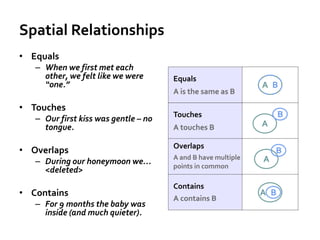
• Equals
– When we first met each
other, we felt like we were
“one.”
• Touches
– Our first kiss was gentle – no
tongue.
• Overlaps
– During our honeymoon we…
<deleted>
• Contains
– For 9 months the baby was
inside (and much quieter).
Spatial Relationships
• Disjoint
– Later on, we got sick of each
other and watchedTV from
opposite sides of the room.
• Covers
– The dog sleeps on top of me,
creating a huge amount of heat.
• Crosses
– Although we both know how to
find our way home from the
grocery store, the only routing
point we have in common is our
driveway.
Spatial Relationships
• What would happen if we ignored them?
– Things like Mapquest and Google Maps would
never be able to do anything useful
• For example
– Consider 500 road segments that encompass
your neighborhood and nearby region
Scale
• Two key concepts of scale are used in Geography
• Map scale
– Ratio of the distance on the map to the real distance on the
Earth
– Large scale = 1/1000 Small scale = 1/10,000,000
• Scale of analysis
– The specific geographic context used to understand a
problem
– Neighborhood, County, State, Country, Continent
What AboutTime?
• Spatial Relationships and Scale are really
important, but what would they mean
without consideringTime?
• Almost everything Geographic involves a
dynamic process of one type or another
• Maps often make it hard to see time as an
explicit factor
What AboutTime?
What AboutTime?
What AboutTime?
Part of the image is from 2012 from one sensor, and the other part is from
2013 from another sensor.
Maps and the Geospatial Revolution www.coursera.org/course/maps
Twitter @MapRevolution
Online Geospatial Education @ Penn State www.pennstategis.com
This content is licensed under a Creative Commons Attribution-NonCommercial 3.0 Unported License

Maps and the Geospatial Revolution: Lesson 2, Lecture 2

  • 1.
    Maps and theGeospatial Revolution Lesson 2 – Lecture 2 Anthony C. Robinson, Ph.D Lead Faculty for Online Geospatial Education JohnA. Dutton e-Education Institute Assistant Director, GeoVISTA Center Department of Geography The Pennsylvania State University This content is licensed under a Creative Commons Attribution-NonCommercial 3.0 Unported License
  • 2.
    Spatial Relationships • Youneed some ground rules to establish what is possible when it comes to spatial relationships • SpatialTopology – The set of relationships that spatial features can have with one another • Let’s consider how people relate to each other in space
  • 3.
    Spatial Relationships • Equals –When we first met each other, we felt like we were “one.” • Touches – Our first kiss was gentle – no tongue. • Overlaps – During our honeymoon we… <deleted> • Contains – For 9 months the baby was inside (and much quieter).
  • 4.
    Spatial Relationships • Disjoint –Later on, we got sick of each other and watchedTV from opposite sides of the room. • Covers – The dog sleeps on top of me, creating a huge amount of heat. • Crosses – Although we both know how to find our way home from the grocery store, the only routing point we have in common is our driveway.
  • 5.
    Spatial Relationships • Whatwould happen if we ignored them? – Things like Mapquest and Google Maps would never be able to do anything useful • For example – Consider 500 road segments that encompass your neighborhood and nearby region
  • 6.
    Scale • Two keyconcepts of scale are used in Geography • Map scale – Ratio of the distance on the map to the real distance on the Earth – Large scale = 1/1000 Small scale = 1/10,000,000 • Scale of analysis – The specific geographic context used to understand a problem – Neighborhood, County, State, Country, Continent
  • 7.
    What AboutTime? • SpatialRelationships and Scale are really important, but what would they mean without consideringTime? • Almost everything Geographic involves a dynamic process of one type or another • Maps often make it hard to see time as an explicit factor
  • 8.
  • 9.
  • 10.
    What AboutTime? Part ofthe image is from 2012 from one sensor, and the other part is from 2013 from another sensor.
  • 11.
    Maps and theGeospatial Revolution www.coursera.org/course/maps Twitter @MapRevolution Online Geospatial Education @ Penn State www.pennstategis.com This content is licensed under a Creative Commons Attribution-NonCommercial 3.0 Unported License