Grade 10 Term 2
Geography Mapwork Skills
____________________________________________________________________________________
______
What is Mapwork in Geography?
Mapwork is a practical section of Geography where you are required to apply all
the different skills, techniques, and the theory that you have learned. It consists
of the following sections:
• Mapwork calculations
• Reading, interpretation, and analysis of theory
• Geographical Information Systems (GIS)
____________________________________________________________________________________
______
Section 1: Application and Interpretation
Maps tell you a story about a place. Look at all the information given on the
map to interpret it:
 What is the name on the top of the map?
 Look at the latitude and longitude. Get an idea of where the map is. For
example, 20°S would indicate it is in Limpopo.
 Look at all the information provided (magnetic declination information,
scale of the map, contour interval, map projection used) in the ‘margins’
of the map.
 Look at the bottom of the map, for the diagram showing the map sheet
reference. It may show additional information such as oceans or borders.
221022461
 Notice where roads or railways go off the map. The town they lead to may
give you clues.
 Make use of the key/reference list to identify features. Remember, the
first word in the reference list refers to the first picture and not both
pictures.
Look for the following aspects on the map:
 Is this a high or low rainfall area? Is the rainfall seasonal?
This is indicated by the types of revers. Perennial rivers flow through
the year, even in winter. If there are a lot of perennial rivers on the
map, it means the area is a high rainfall area. If there are non-
perennial rivers, it means the area is a low rainfall area. Look at the
availability of dams, cultivated land, and other water indicators like
reservoirs. Refer to your reference sheet at the bottom of the map for
all the symbols of features.
 What kinds of rivers are visible and how many are there?
 Identify the urban and rural areas.
 Identify the different land uses in the mapped area, for example,
agricultural/industrial/built-up areas.
 What factors may have affected the location of various land uses? For
example, industry alongside a perennial river.
 Identify the type of farming – is it commercial or subsistence?
Subsistence farming: Grows food for the farmer's family to survive,
on small plots. Commercial farming: Aims for profit, growing large
quantities of crops or raising livestock for sale, often on vast lands
with machinery. Look at the Field size and shape of cultivated land:
Large, regularly shaped fields suggest commercial farming, while
smaller, irregular plots might indicate subsistence farming. Also look
at the Settlement patterns: Scattered farmsteads could be
221022461
subsistence farmers, while clustered settlements with larger buildings
might house commercial farms.
 Look at the relief – is it flat or hilly, are the slopes steep or gentle?
Look at the contour lines to determine this.
Look at the information given in the orthophoto:
 Is the orthophoto labelled? If not, check the numbers or letters in the
question, for example: ‘Identify land use labelled G on orthophoto’ – G
will only be on one of the photos.
 Is a rectangle drawn around the area covered by the orthophoto? If
not, orientate the photo to the map.
 Read the instructions carefully as you may need to use both the map
and the photograph to answer a question.
 Make use of all the information on the orthophoto, for example, road
names, heights, etc.
How is height shown on the map?
1. Contour lines.
a line on a map joining points of equal height above or below sea level.
A contour interval is the vertical distance or difference in elevation
between contour lines.
Here's what contour lines tell you:
 Elevation: The number labelled on a contour line indicates its height.
Closely spaced contours mean steeper slopes, while far-apart contours
mean gentler slopes.
 Shape of the land: By looking at the curves and loops of the contour
lines, you can visualize hills, valleys, ridges, and depressions.
221022461
Figure 1: Contour lines and elevation.
2. Spot height
A spot height is a specific point on a map that tells you the exact
elevation (height above sea level) of that particular spot.
Figure 2: Spot Height and elevation
3. Tri beacon
"Tri beacon" most likely refers to a "trigonometrical beacon," also
sometimes called a trig station or trig point. Always use height number
when working with calculations.
4. Benchmark
221022461
They are arrow-like with a height number near them and they are usually
placed next to a road. Look at Block D1 on the map of Ermelo.
Section 2: Mapwork Calculations
In this section, you will learn how to do various mapwork calculations on a
topographic map and an orthophoto. These calculations will be explained by
means of examples. When doing calculations, you will be required to give an
answer in kilometres or metres. Always take note of whether the calculation is
to be done from a topographic map or an orthophoto, as this will change your
scale. The orthophoto scale is larger and provides more detail.
Scale If the answer must be
in kilometres (km)
If the answer must be
in metres (m)
Topographic map
1:50 000
Multiply by 0,5 on a
topographic map
Multiply by 500 on a
topographic map
Orthophoto map 1:10
000
Multiply by 0,1 on an
orthophoto
Multiply by 100 on an
orthophoto
Calculating Distance on a straight line
This is the straight-line distance from one point to another or the actual
distance, e.g. distance along a road, railway, hiking trail, etc. We calculate the
distance to find out how far one place is from another.
Distance: Map Distance x converted scale
Step 1: Measure the map distance in centimetres.
221022461
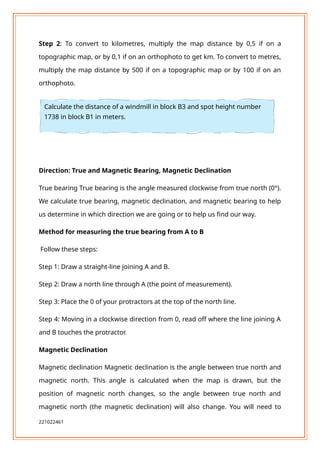
Step 2: To convert to kilometres, multiply the map distance by 0,5 if on a
topographic map, or by 0,1 if on an orthophoto to get km. To convert to metres,
multiply the map distance by 500 if on a topographic map or by 100 if on an
orthophoto.
Direction: True and Magnetic Bearing, Magnetic Declination
True bearing True bearing is the angle measured clockwise from true north (0°).
We calculate true bearing, magnetic declination, and magnetic bearing to help
us determine in which direction we are going or to help us find our way.
Method for measuring the true bearing from A to B
Follow these steps:
Step 1: Draw a straight-line joining A and B.
Step 2: Draw a north line through A (the point of measurement).
Step 3: Place the 0 of your protractors at the top of the north line.
Step 4: Moving in a clockwise direction from 0, read off where the line joining A
and B touches the protractor.
Magnetic Declination
Magnetic declination Magnetic declination is the angle between true north and
magnetic north. This angle is calculated when the map is drawn, but the
position of magnetic north changes, so the angle between true north and
magnetic north (the magnetic declination) will also change. You will need to
221022461
Calculate the distance of a windmill in block B3 and spot height number
1738 in block B1 in meters.
calculate what the magnetic declination is for the current year. You will find the
magnetic declination for the year the map was drawn on the map. This
information appears on a map on the left-hand side or at the bottom of the
map. You need this information to do the magnetic declination calculation.
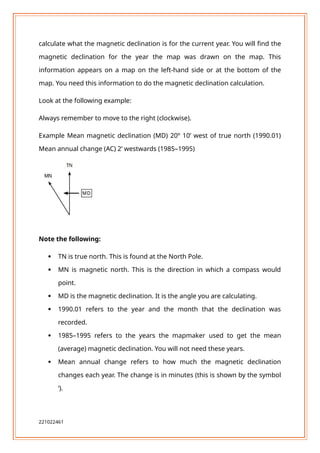
Look at the following example:
Always remember to move to the right (clockwise).
Example Mean magnetic declination (MD) 20º 10’ west of true north (1990.01)
Mean annual change (AC) 2’ westwards (1985–1995)
Note the following:
 TN is true north. This is found at the North Pole.
 MN is magnetic north. This is the direction in which a compass would
point.
 MD is the magnetic declination. It is the angle you are calculating.
 1990.01 refers to the year and the month that the declination was
recorded.
 1985–1995 refers to the years the mapmaker used to get the mean
(average) magnetic declination. You will not need these years.
 Mean annual change refers to how much the magnetic declination
changes each year. The change is in minutes (this is shown by the symbol
‘).
221022461
 The declination can change in a westerly (angle increases) or easterly
(angle decreases) direction.
Method for calculating magnetic declination.
Follow these steps:
Step 1: Work out the difference in years between the current year and the
year given on the map. Your answer must be in years. (Use the year that is
printed straight after the words ‘true north’. You can ignore the month that is
shown.)
Step 2: Multiply the number of years with the mean annual change (this is
given on the map) to get the change since the declination was recorded.
Step 3: If the mean annual change is eastwards, then you must subtract the
change from the magnetic declination given. If the mean annual change is
westwards, then you must add it to the given magnetic declination.
Step 4: Your answer is the magnetic declination for the current year.
Magnetic declination is always west of true north.
Magnetic bearing
Magnetic bearing is the angle measured clockwise from magnetic north.
The formula for magnetic bearing
Magnetic bearing = true bearing + magnetic declination MB = TB + MD
Position/co-ordinates
Co-ordinates are a set of two numbers that indicate the exact position of any
point on Earth. Latitude is the coordinate that specifies the north-south
position of a point on the Earth’s surface. Longitude is the coordinate that
221022461
specifies the east-west position of a point on the Earth’s surface. Co-
ordinates are useful as they tell us exactly where a place or landform is.
Example of position/co-ordinates
If you wanted to locate a house and only had the co-ordinates 35°S 29°E, you
would have to search an area of 6 084 km2. You would need to be more
specific when giving the location of a place.
Note the following about position/co-ordinates:
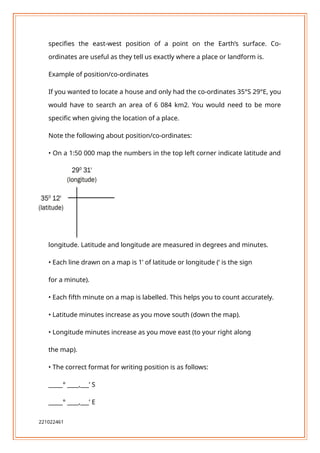
• On a 1:50 000 map the numbers in the top left corner indicate latitude and
longitude. Latitude and longitude are measured in degrees and minutes.
• Each line drawn on a map is 1’ of latitude or longitude (‘ is the sign
for a minute).
• Each fifth minute on a map is labelled. This helps you to count accurately.
• Latitude minutes increase as you move south (down the map).
• Longitude minutes increase as you move east (to your right along
the map).
• The correct format for writing position is as follows:
_____° ____,___’ S
_____° ____,___’ E
221022461
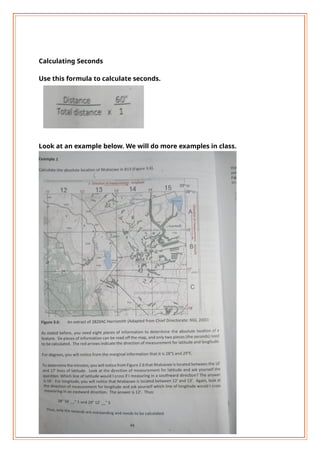
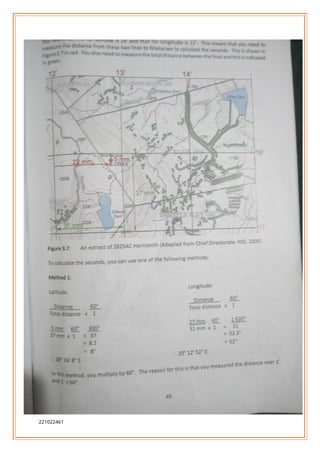
Calculating Seconds
Use this formula to calculate seconds.
Look at an example below. We will do more examples in class.
221022461
221022461
Section C: Geographic Information System
GIS is an organised collection of computers, computer programmes,
geographic data and people. This definition gives you the components that
make up GIS: People who know how to use computers (hardware) and
programmes (software) to provide information (from geographic data) are able
to solve a problem or answer a specific question.
Components of GIS
 Hardware (computers)
 software (computer programmes),
 data (information),
 people
 procedures/methods (how the data was collected)
Spatial data
Spatial data refers to the position of an object, in other words, its co-ordinates.
For example, the spatial data for a tree could be: 29°30,3' S; 19°10,8' E
Attribute data
Attribute data is information that describes or gives the characteristics of an
object. For example, the attribute data for a tree could be: It is an acacia tree,
which is 5 m tall.
Vector data
Spatial data stored in the form of co-ordinates, shown as point (spot height,
buildings, and trig. stations), line (rivers, roads, and walls) or polygon features
(cultivated land, built-up areas and dams).
Raster data
Spatial data stored in the form of pixels. Pixels are like the blocks found on a
topographic map (e.g. block A3). The size of the pixel (block) will determine in
221022461
how much detail an area will be shown. Smaller pixels show more detail. Larger
pixels show less detail.
Buffering
To demarcate (mark off) an area around an object. The marked-off area is the
buffer zone. Buffer zones often protect people from living in a dangerous area.
For example, along a river people should live above the 50-year flood line. The
50-year flood line is the height below which the river floods. The area below the
50-year flood line is the buffer zone for this area. If you live in the buffer zone
your home is likely to be affected when the river floods. If you take notice of the
buffer zone and live above the 50-year flood line, your home is likely to be safe
when the river floods.
Remote sensing
Taking a picture of something from far away, for example from a satellite.
Here are 5 simple reasons for the development of GIS:
1. Data overload: Traditional maps couldn't handle the growing amount of
geographic information.
2. Better analysis: GIS allows for analyzing data based on location, leading
to deeper insights.
3. Decision making: GIS helps visualize data, making it easier to
understand complex situations.
4. Efficiency boost: GIS automates tasks and simplifies data management,
saving time and resources.
5. New technologies: Advancements in computers and data collection
methods fueled the need for a system to handle it all.
221022461

Maps-and-map-interpretation.MAPWORK_SKILLS_NOTES.docx

  • 1.
    Grade 10 Term2 Geography Mapwork Skills ____________________________________________________________________________________ ______ What is Mapwork in Geography? Mapwork is a practical section of Geography where you are required to apply all the different skills, techniques, and the theory that you have learned. It consists of the following sections: • Mapwork calculations • Reading, interpretation, and analysis of theory • Geographical Information Systems (GIS) ____________________________________________________________________________________ ______ Section 1: Application and Interpretation Maps tell you a story about a place. Look at all the information given on the map to interpret it:  What is the name on the top of the map?  Look at the latitude and longitude. Get an idea of where the map is. For example, 20°S would indicate it is in Limpopo.  Look at all the information provided (magnetic declination information, scale of the map, contour interval, map projection used) in the ‘margins’ of the map.  Look at the bottom of the map, for the diagram showing the map sheet reference. It may show additional information such as oceans or borders. 221022461
  • 2.
     Notice whereroads or railways go off the map. The town they lead to may give you clues.  Make use of the key/reference list to identify features. Remember, the first word in the reference list refers to the first picture and not both pictures. Look for the following aspects on the map:  Is this a high or low rainfall area? Is the rainfall seasonal? This is indicated by the types of revers. Perennial rivers flow through the year, even in winter. If there are a lot of perennial rivers on the map, it means the area is a high rainfall area. If there are non- perennial rivers, it means the area is a low rainfall area. Look at the availability of dams, cultivated land, and other water indicators like reservoirs. Refer to your reference sheet at the bottom of the map for all the symbols of features.  What kinds of rivers are visible and how many are there?  Identify the urban and rural areas.  Identify the different land uses in the mapped area, for example, agricultural/industrial/built-up areas.  What factors may have affected the location of various land uses? For example, industry alongside a perennial river.  Identify the type of farming – is it commercial or subsistence? Subsistence farming: Grows food for the farmer's family to survive, on small plots. Commercial farming: Aims for profit, growing large quantities of crops or raising livestock for sale, often on vast lands with machinery. Look at the Field size and shape of cultivated land: Large, regularly shaped fields suggest commercial farming, while smaller, irregular plots might indicate subsistence farming. Also look at the Settlement patterns: Scattered farmsteads could be 221022461
  • 3.
    subsistence farmers, whileclustered settlements with larger buildings might house commercial farms.  Look at the relief – is it flat or hilly, are the slopes steep or gentle? Look at the contour lines to determine this. Look at the information given in the orthophoto:  Is the orthophoto labelled? If not, check the numbers or letters in the question, for example: ‘Identify land use labelled G on orthophoto’ – G will only be on one of the photos.  Is a rectangle drawn around the area covered by the orthophoto? If not, orientate the photo to the map.  Read the instructions carefully as you may need to use both the map and the photograph to answer a question.  Make use of all the information on the orthophoto, for example, road names, heights, etc. How is height shown on the map? 1. Contour lines. a line on a map joining points of equal height above or below sea level. A contour interval is the vertical distance or difference in elevation between contour lines. Here's what contour lines tell you:  Elevation: The number labelled on a contour line indicates its height. Closely spaced contours mean steeper slopes, while far-apart contours mean gentler slopes.  Shape of the land: By looking at the curves and loops of the contour lines, you can visualize hills, valleys, ridges, and depressions. 221022461
  • 4.
    Figure 1: Contourlines and elevation. 2. Spot height A spot height is a specific point on a map that tells you the exact elevation (height above sea level) of that particular spot. Figure 2: Spot Height and elevation 3. Tri beacon "Tri beacon" most likely refers to a "trigonometrical beacon," also sometimes called a trig station or trig point. Always use height number when working with calculations. 4. Benchmark 221022461
  • 5.
    They are arrow-likewith a height number near them and they are usually placed next to a road. Look at Block D1 on the map of Ermelo. Section 2: Mapwork Calculations In this section, you will learn how to do various mapwork calculations on a topographic map and an orthophoto. These calculations will be explained by means of examples. When doing calculations, you will be required to give an answer in kilometres or metres. Always take note of whether the calculation is to be done from a topographic map or an orthophoto, as this will change your scale. The orthophoto scale is larger and provides more detail. Scale If the answer must be in kilometres (km) If the answer must be in metres (m) Topographic map 1:50 000 Multiply by 0,5 on a topographic map Multiply by 500 on a topographic map Orthophoto map 1:10 000 Multiply by 0,1 on an orthophoto Multiply by 100 on an orthophoto Calculating Distance on a straight line This is the straight-line distance from one point to another or the actual distance, e.g. distance along a road, railway, hiking trail, etc. We calculate the distance to find out how far one place is from another. Distance: Map Distance x converted scale Step 1: Measure the map distance in centimetres. 221022461
  • 6.
    Step 2: Toconvert to kilometres, multiply the map distance by 0,5 if on a topographic map, or by 0,1 if on an orthophoto to get km. To convert to metres, multiply the map distance by 500 if on a topographic map or by 100 if on an orthophoto. Direction: True and Magnetic Bearing, Magnetic Declination True bearing True bearing is the angle measured clockwise from true north (0°). We calculate true bearing, magnetic declination, and magnetic bearing to help us determine in which direction we are going or to help us find our way. Method for measuring the true bearing from A to B Follow these steps: Step 1: Draw a straight-line joining A and B. Step 2: Draw a north line through A (the point of measurement). Step 3: Place the 0 of your protractors at the top of the north line. Step 4: Moving in a clockwise direction from 0, read off where the line joining A and B touches the protractor. Magnetic Declination Magnetic declination Magnetic declination is the angle between true north and magnetic north. This angle is calculated when the map is drawn, but the position of magnetic north changes, so the angle between true north and magnetic north (the magnetic declination) will also change. You will need to 221022461 Calculate the distance of a windmill in block B3 and spot height number 1738 in block B1 in meters.
  • 7.
    calculate what themagnetic declination is for the current year. You will find the magnetic declination for the year the map was drawn on the map. This information appears on a map on the left-hand side or at the bottom of the map. You need this information to do the magnetic declination calculation. Look at the following example: Always remember to move to the right (clockwise). Example Mean magnetic declination (MD) 20º 10’ west of true north (1990.01) Mean annual change (AC) 2’ westwards (1985–1995) Note the following:  TN is true north. This is found at the North Pole.  MN is magnetic north. This is the direction in which a compass would point.  MD is the magnetic declination. It is the angle you are calculating.  1990.01 refers to the year and the month that the declination was recorded.  1985–1995 refers to the years the mapmaker used to get the mean (average) magnetic declination. You will not need these years.  Mean annual change refers to how much the magnetic declination changes each year. The change is in minutes (this is shown by the symbol ‘). 221022461
  • 8.
     The declinationcan change in a westerly (angle increases) or easterly (angle decreases) direction. Method for calculating magnetic declination. Follow these steps: Step 1: Work out the difference in years between the current year and the year given on the map. Your answer must be in years. (Use the year that is printed straight after the words ‘true north’. You can ignore the month that is shown.) Step 2: Multiply the number of years with the mean annual change (this is given on the map) to get the change since the declination was recorded. Step 3: If the mean annual change is eastwards, then you must subtract the change from the magnetic declination given. If the mean annual change is westwards, then you must add it to the given magnetic declination. Step 4: Your answer is the magnetic declination for the current year. Magnetic declination is always west of true north. Magnetic bearing Magnetic bearing is the angle measured clockwise from magnetic north. The formula for magnetic bearing Magnetic bearing = true bearing + magnetic declination MB = TB + MD Position/co-ordinates Co-ordinates are a set of two numbers that indicate the exact position of any point on Earth. Latitude is the coordinate that specifies the north-south position of a point on the Earth’s surface. Longitude is the coordinate that 221022461
  • 9.
    specifies the east-westposition of a point on the Earth’s surface. Co- ordinates are useful as they tell us exactly where a place or landform is. Example of position/co-ordinates If you wanted to locate a house and only had the co-ordinates 35°S 29°E, you would have to search an area of 6 084 km2. You would need to be more specific when giving the location of a place. Note the following about position/co-ordinates: • On a 1:50 000 map the numbers in the top left corner indicate latitude and longitude. Latitude and longitude are measured in degrees and minutes. • Each line drawn on a map is 1’ of latitude or longitude (‘ is the sign for a minute). • Each fifth minute on a map is labelled. This helps you to count accurately. • Latitude minutes increase as you move south (down the map). • Longitude minutes increase as you move east (to your right along the map). • The correct format for writing position is as follows: _____° ____,___’ S _____° ____,___’ E 221022461
  • 10.
    Calculating Seconds Use thisformula to calculate seconds. Look at an example below. We will do more examples in class. 221022461
  • 11.
  • 12.
    Section C: GeographicInformation System GIS is an organised collection of computers, computer programmes, geographic data and people. This definition gives you the components that make up GIS: People who know how to use computers (hardware) and programmes (software) to provide information (from geographic data) are able to solve a problem or answer a specific question. Components of GIS  Hardware (computers)  software (computer programmes),  data (information),  people  procedures/methods (how the data was collected) Spatial data Spatial data refers to the position of an object, in other words, its co-ordinates. For example, the spatial data for a tree could be: 29°30,3' S; 19°10,8' E Attribute data Attribute data is information that describes or gives the characteristics of an object. For example, the attribute data for a tree could be: It is an acacia tree, which is 5 m tall. Vector data Spatial data stored in the form of co-ordinates, shown as point (spot height, buildings, and trig. stations), line (rivers, roads, and walls) or polygon features (cultivated land, built-up areas and dams). Raster data Spatial data stored in the form of pixels. Pixels are like the blocks found on a topographic map (e.g. block A3). The size of the pixel (block) will determine in 221022461
  • 13.
    how much detailan area will be shown. Smaller pixels show more detail. Larger pixels show less detail. Buffering To demarcate (mark off) an area around an object. The marked-off area is the buffer zone. Buffer zones often protect people from living in a dangerous area. For example, along a river people should live above the 50-year flood line. The 50-year flood line is the height below which the river floods. The area below the 50-year flood line is the buffer zone for this area. If you live in the buffer zone your home is likely to be affected when the river floods. If you take notice of the buffer zone and live above the 50-year flood line, your home is likely to be safe when the river floods. Remote sensing Taking a picture of something from far away, for example from a satellite. Here are 5 simple reasons for the development of GIS: 1. Data overload: Traditional maps couldn't handle the growing amount of geographic information. 2. Better analysis: GIS allows for analyzing data based on location, leading to deeper insights. 3. Decision making: GIS helps visualize data, making it easier to understand complex situations. 4. Efficiency boost: GIS automates tasks and simplifies data management, saving time and resources. 5. New technologies: Advancements in computers and data collection methods fueled the need for a system to handle it all. 221022461