1
Before starting the module, I want you to set aside other tasks which may disturb
you while enjoying the lessons. Read the simple instructions below to successfully
enjoy the objectives of this kit. Have fun!
1. Follow carefully all the contents and instructions indicated in every page of this
module.
2. Write on your notebook the concepts about the lessons. Writing enhances
learning, that is important to develop and keep in mind.
3. Perform all the provided activities in the module. Use separate sheet of paper in
answering the exercises.
4. Finish the task at hand before proceeding to the next page.
5. Analyze conceptually the posttest and apply what you have learned.
If you encounter any difficulty in answering the tasks in this module, do not hesitate
to ask help from your teacher. Enjoy studying!
HONESTY IS THE BEST POLICY!
EXPECTATION
At the end of this module, you are expected to describes the musical
characteristics of representative music selections from the lowlands of Luzon and analyze
the value of elements of music in creating a musical piece. You will also identify the
musical instruments and its characteristics while listening and looking for some examples
among the area of Luzon. You will also experience the kind of musical presentation of
what the people form the lowland Luzon is doing through imitation.
TO THE LEARNERS
QUARTER 1
SELF-LEARNING MODULE
GRADE 7
MOST
ESSENTIAL
LEARNING
COMPETENCIES
 Describes the musical characteristics of representative music selections from the
lowlands of Luzon after listening.
 Analyzes the musical elements of some Lowland vocal and instrumental music
selections.
 Explores ways of producing sounds on a variety of sources that is similar to the
instruments being studied
 Identifies the musical instruments and other sound sources from the lowlands of Luzon
WEEK 1
MUSIC
TOPICS  Music Of Lowlands of Luzon
 Classification ff Musical Instruments of Lowlands Of Luzon
 The Source of Music
2
BRIEF
INTRODUCTION
The music of the lowlands of Luzon is composed of Vocal and Instrumental music,
which varies in every province of Luzon. The rural folks of Lowlands lived as farmers,
fishermen, artisan, vendors, and traders. Their music reflects their daily life. The Practice of
their Religious and devotion rite as observed up to this present time is the impact of
Spanish colonization in their propagation of Christianity, leading to the introduction of
different Western forms of music. This module will give you better understanding on the
characteristics of Philippine folk songs and sacred song (Liturgy/Devotional music).
These are some of the characteristics of music:
 The styles and forms Of Philippine music are products of Western and traditional
folk music
 Secular Music refers to any music that is not religious in nature.
(Harana, Kumintang, Pandanggo, Polka, Balitaw, and Kundiman)
 Tempo refers to the rate of speed of the rhythm on a composition
 Meter is the grouping of beats. It is indicated by the bar lines.
 Timbre or Tone color refers to the quality of sound that distinguishes of
instrument/voice from another.
 Texture refers to a single or several layers of sound heard at the same time.
INSTRUMENTAL MUSIC
BRASS BAND INSTRUMENTS
These are instruments from the brass band musical ensemble that includes
woodwind, brasswind, and percussion instruments.
Woodwinds
Flute-is a blown musical instrument that
produces sounds from flow of air across an
opening.
https://en.wikipedia.org/wiki/Western_concert_f
lute#/media/File:Western_concert_flute.jpg
3
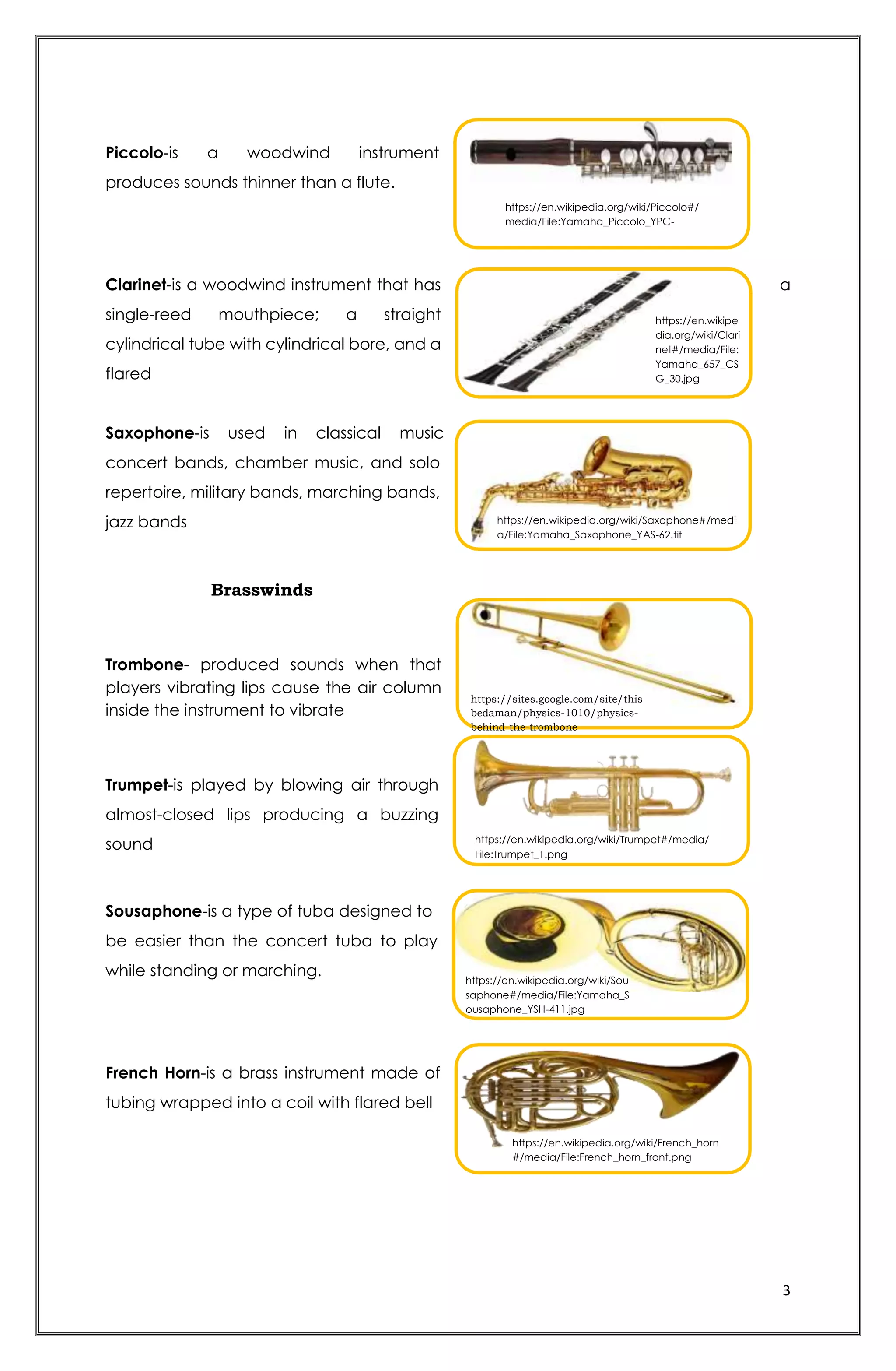
Piccolo-is a woodwind instrument
produces sounds thinner than a flute.
Clarinet-is a woodwind instrument that has a
single-reed mouthpiece; a straight
cylindrical tube with cylindrical bore, and a
flared
Saxophone-is used in classical music
concert bands, chamber music, and solo
repertoire, military bands, marching bands,
jazz bands
Brasswinds
Trombone- produced sounds when that
players vibrating lips cause the air column
inside the instrument to vibrate
Trumpet-is played by blowing air through
almost-closed lips producing a buzzing
sound
Sousaphone-is a type of tuba designed to
be easier than the concert tuba to play
while standing or marching.
French Horn-is a brass instrument made of
tubing wrapped into a coil with flared bell
https://en.wikipedia.org/wiki/Piccolo#/
media/File:Yamaha_Piccolo_YPC-
81.png
https://en.wikipe
dia.org/wiki/Clari
net#/media/File:
Yamaha_657_CS
G_30.jpg
https://en.wikipedia.org/wiki/Saxophone#/medi
a/File:Yamaha_Saxophone_YAS-62.tif
https://sites.google.com/site/this
bedaman/physics-1010/physics-
behind-the-trombone
https://en.wikipedia.org/wiki/Trumpet#/media/
File:Trumpet_1.png
https://en.wikipedia.org/wiki/Sou
saphone#/media/File:Yamaha_S
ousaphone_YSH-411.jpg
https://en.wikipedia.org/wiki/French_horn
#/media/File:French_horn_front.png
4
Percussions
Cymbals-consist of thin, normally round
plates of various alloys.
Snare Drum-is a percussion instrument known
sharp staccato sound when the head or the
skin is struck with a drum stick
Bass Drum-is a large drum that produces a
note of low definite or indefinite pitch
PANGKAT KAWAYAN INSTRUMENTS
These are non-traditional bamboo instruments in various sizes, shapes, and designs.
Pangkat Kawayan is also known as the ‘Singing Bamboos of the Philippines.
Angklung-is bamboo rattles tubes attached to a frame.
Kalatok (bamboo Knocker)-is a
percussion instrument made pieces of
bamboos that are strung together
https://www.shutterstock.com/image-photo/close-
prcussion-cymbals-leather-handle-isolated-558705085
https://depositphotos.com/stock-photos/snare-drum.html
https://www.123rf.com/stock-
photo/bass_drum.html?sti=oa9bx6d5cfxok7hg7q|&mediapop
up=55245487
https://www.123rf.c
om/photo_59980527
_angklung-an-
indonesian-s-
traditional-musical-
instrument-made-of-
bamboo.html
http://www.filcom.org/Banda%20Kawayan/TheInstru
ments.html
5
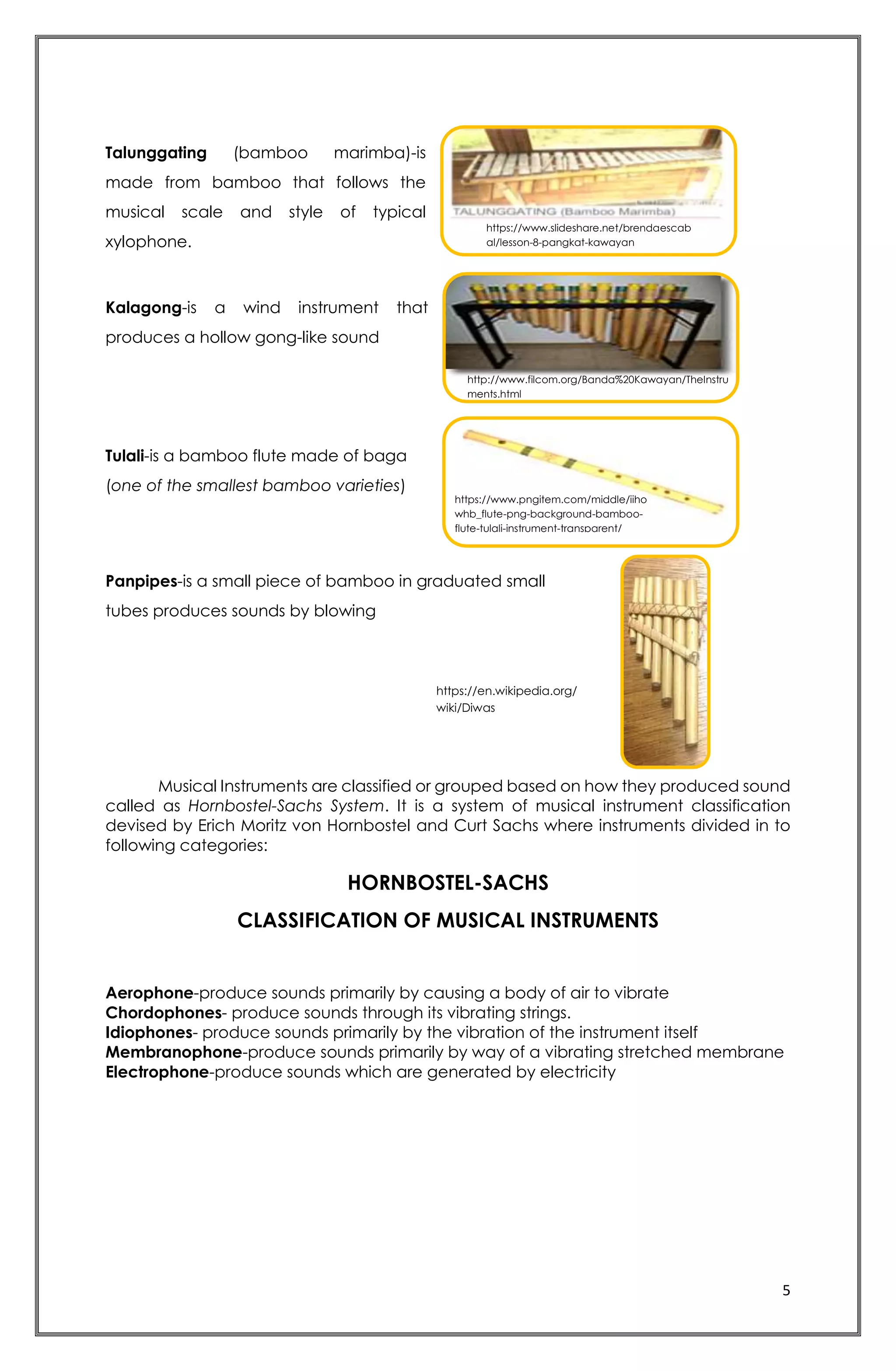
Talunggating (bamboo marimba)-is
made from bamboo that follows the
musical scale and style of typical
xylophone.
Kalagong-is a wind instrument that
produces a hollow gong-like sound
Tulali-is a bamboo flute made of baga
(one of the smallest bamboo varieties)
Panpipes-is a small piece of bamboo in graduated small
tubes produces sounds by blowing
Musical Instruments are classified or grouped based on how they produced sound
called as Hornbostel-Sachs System. It is a system of musical instrument classification
devised by Erich Moritz von Hornbostel and Curt Sachs where instruments divided in to
following categories:
HORNBOSTEL-SACHS
CLASSIFICATION OF MUSICAL INSTRUMENTS
Aerophone-produce sounds primarily by causing a body of air to vibrate
Chordophones- produce sounds through its vibrating strings.
Idiophones- produce sounds primarily by the vibration of the instrument itself
Membranophone-produce sounds primarily by way of a vibrating stretched membrane
Electrophone-produce sounds which are generated by electricity
http://www.filcom.org/Banda%20Kawayan/TheInstru
ments.html
https://en.wikipedia.org/
wiki/Diwas
https://www.slideshare.net/brendaescab
al/lesson-8-pangkat-kawayan
https://www.pngitem.com/middle/iiho
whb_flute-png-background-bamboo-
flute-tulali-instrument-transparent/
6
Song Mapping
Objective: Identify the place where the song is being sung in the Philippine Map
Materials: Philippine Map and recordings of the music or uploaded music in
Youtube
1. Atin Cu PungSingsing 6. Dios Te Salve
2. Bahay Kubo 7. ManangBiday
3. LeronLeronSinta 8. ParoParongBukid
4. Pasyon/Pabasa 9. Naraniag A bulan
5. Pamulinawen 10. Regina Coeli
Procedure:
1. Listen and sing along with the recording of folk and sacred songs listed above.
2. As you sing along with the song, try to remember the place where you often
hear the music.
3. Locate the origin place of the song or where the place you often hear the
music.
4. Write the title of the songs in the above places where song is being sung or the
origin place of the song.
ACTIVITY 1
7
Listen to Lola’s Play list songs (Grandma’s Playlist)
Objective: Analyze the Elements of Music (secular music)
Materials: Selected songs of the Lowlands of Luzon (Secular music) uploaded from
Youtube
Procedure:
1. Listen to the following music uploaded from YouTube
A. Dungawin mo Hirang
https://www.youtube.com/watch?v=avQVOliu2G8
B. Mutya ng Pasig
https://www.youtube.com/watch?v=hegm_WDSYe4
C. Pandanggo
https://www.youtube.com/watch?v=Bn4F_5jwSzM
D. Magtanim ay Di Biro
https://www.youtube.com/watch?v=f8TgQ0aagls
ACTIVITY 2
8
E. Sa Libis ng Nayon
https://www.youtube.com/watch?v=iX4ulhyu9Zs
F. Pilipinas kong Mahal
https://www.youtube.com/watch?v=RAjHJ65cAh8
2. Listen attentively and observe the elements of the music of each song.
3. Recall the definition of each element of music that you have studied before.
(You may read again your notes in Music)
4. Analyze the elements of music and fill in the table cells below.
5. Refer to the guide questions below as you fill in the table.
NOTE:
You may tune in to FM radio and listen to OPM music as a replacement to the
selected music in case you don’t have gadgets.
(Replace the title of the songs and proceed to analysis of elements of music)
Guide Questions:
1. How did you find the Tempo? Was it fast, slow, or moderate?
2. What is the meter of each song? Is it in duple, Triple or Quadruple?
3. What can you say about the Timbre of the song?
4. How many voices did you hear in the music selection?
5. Which of the songs are accompanied by instrument(s)?
6. What musical instruments did you hear in the music selections?
9
Direction: Group the different instruments mention above according to Hornbostel-
Sachs Classification of Musical Instruments.
Aerophone Chordophone Idiophone Membranophone
Activity 2.1 On the Right Group
Direction: Search and classify the different musical instruments of the following musical
group below.
Elements of Music Dungawin mo
Hirang
Mutya Ng
Pasig
Pandanggo Magtanim
ay Di Biro
Sa Libis ng
Nayon
Pilipinas
Kong
Mahal
Type of Secular music
Tempo (fast, slow,
moderate)
Meter (Duple,
Triple, Quadruple)
Timbre
(Headvoice, Chest
voice, nasal voice)
Texture
(monophonic,
Homophonic
Poliphonic)
Musical
accompaniment
(list down the
instruments heard in the
music)
ACTIVITY 3
Group of
Instruments
Aerophone Chordophone Idiophone Membranophone Electrophone
Combo
(Music
Band)
Drum and
Lyre
10
HORNBOSTEL-SACHS CLASSIFICATION (of Musical Instruments)
Objective: identify the sounds of the different musical instruments being produce based on hornbostel-
sachs system classification. .
Materials: Android phone or laptop/desktop computer, internet connection, Paper and pen.
Procedure:
1. Go to the link below:
https://www.youtube.com/watch?v=ka05bsVKqf0
2. Watch the YouTube video that appears.
3. Using the chart below, write the instruments and identify its sound using the system
classification.
Musical instruments Hornbostel-sachs system classification
1.
2.
3.
4.
5.
6.
7.
8.
9.
10.
Orchestra
ACTIVITY 4
11
 The styles and forms Of Philippine music are products of Western and traditional
folk music
 Secular Music refers to any music that is not religious in nature.
(Harana, Kumintang, Pandanggo, Polka, Balitaw, and Kundiman)
 Tempo refers to the rate of speed of the rhythm on a composition
 Meter is the grouping of beats. It is indicated by the bar lines.
 Timbre or Tone color refers to the quality of sound that distinguishes of
instrument/voice from another.
 Texture refers to a single or several layers of sound heard at the same time.
 Musical instruments perform either single, in small group, band, or part of the
ensemble or orchestra.
A. Read and answer the following questions.
1. What is folk song?
______________________________________________________________________________
______________________________________________________________________________
2. What are the difference between songs and Liturgy/Devotional Music?
______________________________________________________________________________
______________________________________________________________________________
3. What are the elements of music that make each song unique?
REMEMBER
CHECK YOUR
UNDERSTANDING

MAPEH 7 Q1 Week 1-Music.pdf

  • 1.
    1 Before starting themodule, I want you to set aside other tasks which may disturb you while enjoying the lessons. Read the simple instructions below to successfully enjoy the objectives of this kit. Have fun! 1. Follow carefully all the contents and instructions indicated in every page of this module. 2. Write on your notebook the concepts about the lessons. Writing enhances learning, that is important to develop and keep in mind. 3. Perform all the provided activities in the module. Use separate sheet of paper in answering the exercises. 4. Finish the task at hand before proceeding to the next page. 5. Analyze conceptually the posttest and apply what you have learned. If you encounter any difficulty in answering the tasks in this module, do not hesitate to ask help from your teacher. Enjoy studying! HONESTY IS THE BEST POLICY! EXPECTATION At the end of this module, you are expected to describes the musical characteristics of representative music selections from the lowlands of Luzon and analyze the value of elements of music in creating a musical piece. You will also identify the musical instruments and its characteristics while listening and looking for some examples among the area of Luzon. You will also experience the kind of musical presentation of what the people form the lowland Luzon is doing through imitation. TO THE LEARNERS QUARTER 1 SELF-LEARNING MODULE GRADE 7 MOST ESSENTIAL LEARNING COMPETENCIES  Describes the musical characteristics of representative music selections from the lowlands of Luzon after listening.  Analyzes the musical elements of some Lowland vocal and instrumental music selections.  Explores ways of producing sounds on a variety of sources that is similar to the instruments being studied  Identifies the musical instruments and other sound sources from the lowlands of Luzon WEEK 1 MUSIC TOPICS  Music Of Lowlands of Luzon  Classification ff Musical Instruments of Lowlands Of Luzon  The Source of Music
  • 2.
    2 BRIEF INTRODUCTION The music ofthe lowlands of Luzon is composed of Vocal and Instrumental music, which varies in every province of Luzon. The rural folks of Lowlands lived as farmers, fishermen, artisan, vendors, and traders. Their music reflects their daily life. The Practice of their Religious and devotion rite as observed up to this present time is the impact of Spanish colonization in their propagation of Christianity, leading to the introduction of different Western forms of music. This module will give you better understanding on the characteristics of Philippine folk songs and sacred song (Liturgy/Devotional music). These are some of the characteristics of music:  The styles and forms Of Philippine music are products of Western and traditional folk music  Secular Music refers to any music that is not religious in nature. (Harana, Kumintang, Pandanggo, Polka, Balitaw, and Kundiman)  Tempo refers to the rate of speed of the rhythm on a composition  Meter is the grouping of beats. It is indicated by the bar lines.  Timbre or Tone color refers to the quality of sound that distinguishes of instrument/voice from another.  Texture refers to a single or several layers of sound heard at the same time. INSTRUMENTAL MUSIC BRASS BAND INSTRUMENTS These are instruments from the brass band musical ensemble that includes woodwind, brasswind, and percussion instruments. Woodwinds Flute-is a blown musical instrument that produces sounds from flow of air across an opening. https://en.wikipedia.org/wiki/Western_concert_f lute#/media/File:Western_concert_flute.jpg
  • 3.
    3 Piccolo-is a woodwindinstrument produces sounds thinner than a flute. Clarinet-is a woodwind instrument that has a single-reed mouthpiece; a straight cylindrical tube with cylindrical bore, and a flared Saxophone-is used in classical music concert bands, chamber music, and solo repertoire, military bands, marching bands, jazz bands Brasswinds Trombone- produced sounds when that players vibrating lips cause the air column inside the instrument to vibrate Trumpet-is played by blowing air through almost-closed lips producing a buzzing sound Sousaphone-is a type of tuba designed to be easier than the concert tuba to play while standing or marching. French Horn-is a brass instrument made of tubing wrapped into a coil with flared bell https://en.wikipedia.org/wiki/Piccolo#/ media/File:Yamaha_Piccolo_YPC- 81.png https://en.wikipe dia.org/wiki/Clari net#/media/File: Yamaha_657_CS G_30.jpg https://en.wikipedia.org/wiki/Saxophone#/medi a/File:Yamaha_Saxophone_YAS-62.tif https://sites.google.com/site/this bedaman/physics-1010/physics- behind-the-trombone https://en.wikipedia.org/wiki/Trumpet#/media/ File:Trumpet_1.png https://en.wikipedia.org/wiki/Sou saphone#/media/File:Yamaha_S ousaphone_YSH-411.jpg https://en.wikipedia.org/wiki/French_horn #/media/File:French_horn_front.png
  • 4.
    4 Percussions Cymbals-consist of thin,normally round plates of various alloys. Snare Drum-is a percussion instrument known sharp staccato sound when the head or the skin is struck with a drum stick Bass Drum-is a large drum that produces a note of low definite or indefinite pitch PANGKAT KAWAYAN INSTRUMENTS These are non-traditional bamboo instruments in various sizes, shapes, and designs. Pangkat Kawayan is also known as the ‘Singing Bamboos of the Philippines. Angklung-is bamboo rattles tubes attached to a frame. Kalatok (bamboo Knocker)-is a percussion instrument made pieces of bamboos that are strung together https://www.shutterstock.com/image-photo/close- prcussion-cymbals-leather-handle-isolated-558705085 https://depositphotos.com/stock-photos/snare-drum.html https://www.123rf.com/stock- photo/bass_drum.html?sti=oa9bx6d5cfxok7hg7q|&mediapop up=55245487 https://www.123rf.c om/photo_59980527 _angklung-an- indonesian-s- traditional-musical- instrument-made-of- bamboo.html http://www.filcom.org/Banda%20Kawayan/TheInstru ments.html
  • 5.
    5 Talunggating (bamboo marimba)-is madefrom bamboo that follows the musical scale and style of typical xylophone. Kalagong-is a wind instrument that produces a hollow gong-like sound Tulali-is a bamboo flute made of baga (one of the smallest bamboo varieties) Panpipes-is a small piece of bamboo in graduated small tubes produces sounds by blowing Musical Instruments are classified or grouped based on how they produced sound called as Hornbostel-Sachs System. It is a system of musical instrument classification devised by Erich Moritz von Hornbostel and Curt Sachs where instruments divided in to following categories: HORNBOSTEL-SACHS CLASSIFICATION OF MUSICAL INSTRUMENTS Aerophone-produce sounds primarily by causing a body of air to vibrate Chordophones- produce sounds through its vibrating strings. Idiophones- produce sounds primarily by the vibration of the instrument itself Membranophone-produce sounds primarily by way of a vibrating stretched membrane Electrophone-produce sounds which are generated by electricity http://www.filcom.org/Banda%20Kawayan/TheInstru ments.html https://en.wikipedia.org/ wiki/Diwas https://www.slideshare.net/brendaescab al/lesson-8-pangkat-kawayan https://www.pngitem.com/middle/iiho whb_flute-png-background-bamboo- flute-tulali-instrument-transparent/
  • 6.
    6 Song Mapping Objective: Identifythe place where the song is being sung in the Philippine Map Materials: Philippine Map and recordings of the music or uploaded music in Youtube 1. Atin Cu PungSingsing 6. Dios Te Salve 2. Bahay Kubo 7. ManangBiday 3. LeronLeronSinta 8. ParoParongBukid 4. Pasyon/Pabasa 9. Naraniag A bulan 5. Pamulinawen 10. Regina Coeli Procedure: 1. Listen and sing along with the recording of folk and sacred songs listed above. 2. As you sing along with the song, try to remember the place where you often hear the music. 3. Locate the origin place of the song or where the place you often hear the music. 4. Write the title of the songs in the above places where song is being sung or the origin place of the song. ACTIVITY 1
  • 7.
    7 Listen to Lola’sPlay list songs (Grandma’s Playlist) Objective: Analyze the Elements of Music (secular music) Materials: Selected songs of the Lowlands of Luzon (Secular music) uploaded from Youtube Procedure: 1. Listen to the following music uploaded from YouTube A. Dungawin mo Hirang https://www.youtube.com/watch?v=avQVOliu2G8 B. Mutya ng Pasig https://www.youtube.com/watch?v=hegm_WDSYe4 C. Pandanggo https://www.youtube.com/watch?v=Bn4F_5jwSzM D. Magtanim ay Di Biro https://www.youtube.com/watch?v=f8TgQ0aagls ACTIVITY 2
  • 8.
    8 E. Sa Libisng Nayon https://www.youtube.com/watch?v=iX4ulhyu9Zs F. Pilipinas kong Mahal https://www.youtube.com/watch?v=RAjHJ65cAh8 2. Listen attentively and observe the elements of the music of each song. 3. Recall the definition of each element of music that you have studied before. (You may read again your notes in Music) 4. Analyze the elements of music and fill in the table cells below. 5. Refer to the guide questions below as you fill in the table. NOTE: You may tune in to FM radio and listen to OPM music as a replacement to the selected music in case you don’t have gadgets. (Replace the title of the songs and proceed to analysis of elements of music) Guide Questions: 1. How did you find the Tempo? Was it fast, slow, or moderate? 2. What is the meter of each song? Is it in duple, Triple or Quadruple? 3. What can you say about the Timbre of the song? 4. How many voices did you hear in the music selection? 5. Which of the songs are accompanied by instrument(s)? 6. What musical instruments did you hear in the music selections?
  • 9.
    9 Direction: Group thedifferent instruments mention above according to Hornbostel- Sachs Classification of Musical Instruments. Aerophone Chordophone Idiophone Membranophone Activity 2.1 On the Right Group Direction: Search and classify the different musical instruments of the following musical group below. Elements of Music Dungawin mo Hirang Mutya Ng Pasig Pandanggo Magtanim ay Di Biro Sa Libis ng Nayon Pilipinas Kong Mahal Type of Secular music Tempo (fast, slow, moderate) Meter (Duple, Triple, Quadruple) Timbre (Headvoice, Chest voice, nasal voice) Texture (monophonic, Homophonic Poliphonic) Musical accompaniment (list down the instruments heard in the music) ACTIVITY 3 Group of Instruments Aerophone Chordophone Idiophone Membranophone Electrophone Combo (Music Band) Drum and Lyre
  • 10.
    10 HORNBOSTEL-SACHS CLASSIFICATION (ofMusical Instruments) Objective: identify the sounds of the different musical instruments being produce based on hornbostel- sachs system classification. . Materials: Android phone or laptop/desktop computer, internet connection, Paper and pen. Procedure: 1. Go to the link below: https://www.youtube.com/watch?v=ka05bsVKqf0 2. Watch the YouTube video that appears. 3. Using the chart below, write the instruments and identify its sound using the system classification. Musical instruments Hornbostel-sachs system classification 1. 2. 3. 4. 5. 6. 7. 8. 9. 10. Orchestra ACTIVITY 4
  • 11.
    11  The stylesand forms Of Philippine music are products of Western and traditional folk music  Secular Music refers to any music that is not religious in nature. (Harana, Kumintang, Pandanggo, Polka, Balitaw, and Kundiman)  Tempo refers to the rate of speed of the rhythm on a composition  Meter is the grouping of beats. It is indicated by the bar lines.  Timbre or Tone color refers to the quality of sound that distinguishes of instrument/voice from another.  Texture refers to a single or several layers of sound heard at the same time.  Musical instruments perform either single, in small group, band, or part of the ensemble or orchestra. A. Read and answer the following questions. 1. What is folk song? ______________________________________________________________________________ ______________________________________________________________________________ 2. What are the difference between songs and Liturgy/Devotional Music? ______________________________________________________________________________ ______________________________________________________________________________ 3. What are the elements of music that make each song unique? REMEMBER CHECK YOUR UNDERSTANDING