Gas and Electric Energy Efficiency Programs and
       Services for Municipal Customers


                     November 15, 2012
                Matthew Foran, National Grid
      Elizabeth Cellucci, Columbia Gas of Massachusetts
                    Mark Rooney, NSTAR
Background


• Green Communities Act, July 2, 2008: to promote enhanced gas
  & electric energy efficiency throughout the Commonwealth
   – Program Administrators develop statewide energy efficiency plan
   – Streamlined contracting process that allows cities and towns to
     sole-source efficiency projects to a PA, or the PA’s delivery
     contractors, if the total work is less than $100,000.

• Three Year Plan providing for acquisition of all available cost
  effective energy efficiency
   – Aggressive, unprecedented savings goals
   – Gas/electric program integration and seamless delivery
   – Focus on going “deeper” (more comprehensive) in buildings; and
     “broader” (more customers participating)

                                  2
Who is Mass Save®


Mass Save® is a brand sponsored by Massachusetts’
gas and electric utilities and energy efficiency
service providers
Massachusetts EE Programs

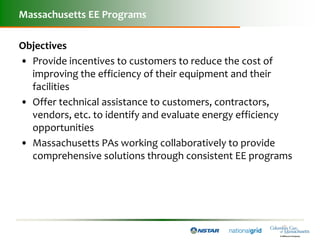
Objectives
• Provide incentives to customers to reduce the cost of
  improving the efficiency of their equipment and their
  facilities
• Offer technical assistance to customers, contractors,
  vendors, etc. to identify and evaluate energy efficiency
  opportunities
• Massachusetts PAs working collaboratively to provide
  comprehensive solutions through consistent EE programs
Massachusetts EE Programs

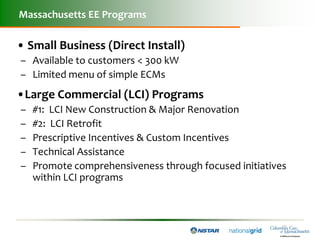
• Small Business (Direct Install)
– Available to customers < 300 kW
– Limited menu of simple ECMs
•Large Commercial (LCI) Programs
–   #1: LCI New Construction & Major Renovation
–   #2: LCI Retrofit
–   Prescriptive Incentives & Custom Incentives
–   Technical Assistance
–   Promote comprehensiveness through focused initiatives
    within LCI programs
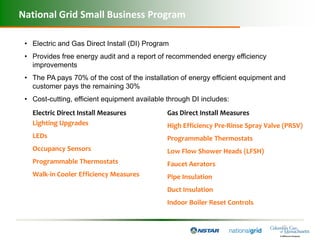
National Grid Small Business Program

 • Electric and Gas Direct Install (DI) Program
 • Provides free energy audit and a report of recommended energy efficiency
   improvements
 • The PA pays 70% of the cost of the installation of energy efficient equipment and
   customer pays the remaining 30%
 • Cost-cutting, efficient equipment available through DI includes:
   Electric Direct Install Measures            Gas Direct Install Measures
   Lighting Upgrades                           High Efficiency Pre-Rinse Spray Valve (PRSV)
   LEDs                                        Programmable Thermostats
   Occupancy Sensors                           Low Flow Shower Heads (LFSH)
   Programmable Thermostats                    Faucet Aerators
   Walk-in Cooler Efficiency Measures          Pipe Insulation
                                               Duct Insulation
                                               Indoor Boiler Reset Controls
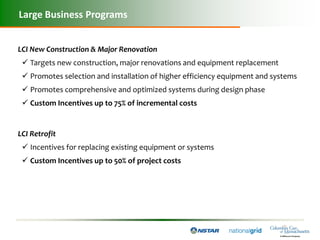
Large Business Programs


LCI New Construction & Major Renovation
  Targets new construction, major renovations and equipment replacement
  Promotes selection and installation of higher efficiency equipment and systems
  Promotes comprehensive and optimized systems during design phase
  Custom Incentives up to 75% of incremental costs


LCI Retrofit
  Incentives for replacing existing equipment or systems
  Custom Incentives up to 50% of project costs
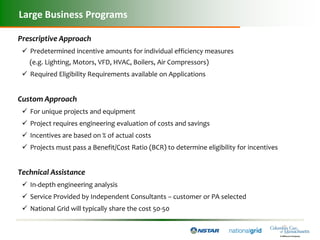
Large Business Programs

Prescriptive Approach
  Predetermined incentive amounts for individual efficiency measures
   (e.g. Lighting, Motors, VFD, HVAC, Boilers, Air Compressors)
  Required Eligibility Requirements available on Applications


Custom Approach
  For unique projects and equipment
  Project requires engineering evaluation of costs and savings
  Incentives are based on % of actual costs
  Projects must pass a Benefit/Cost Ratio (BCR) to determine eligibility for incentives


Technical Assistance
  In-depth engineering analysis
  Service Provided by Independent Consultants – customer or PA selected
  National Grid will typically share the cost 50-50
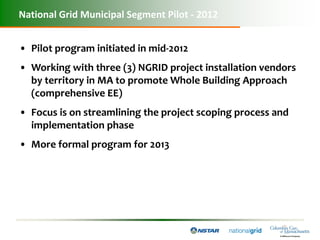
National Grid Municipal Segment Pilot - 2012


• Pilot program initiated in mid-2012
• Working with three (3) NGRID project installation vendors
  by territory in MA to promote Whole Building Approach
  (comprehensive EE)
• Focus is on streamlining the project scoping process and
  implementation phase
• More formal program for 2013
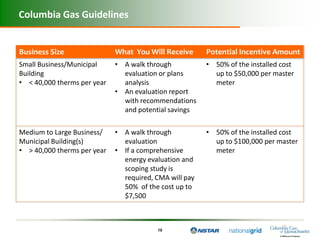
Columbia Gas Guidelines


Business Size                What You Will Receive Priorities Incentive Amount
                                   Overview 2008 Potential
                                             
Small Business/Municipal     • A walk through           • 50% of the installed cost
Building                       evaluation or plans        up to $50,000 per master
• < 40,000 therms per year     analysis                   meter
                             • An evaluation report
                               with recommendations
                               and potential savings

Medium to Large Business/    • A walk through           • 50% of the installed cost
Municipal Building(s)          evaluation                 up to $100,000 per master
• > 40,000 therms per year   • If a comprehensive         meter
                               energy evaluation and
                               scoping study is
                               required, CMA will pay
                               50% of the cost up to
                               $7,500


                                         10
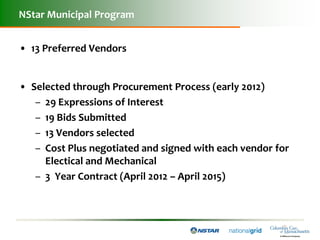
NStar Municipal Program


• 13 Preferred Vendors


• Selected through Procurement Process (early 2012)
   – 29 Expressions of Interest
   – 19 Bids Submitted
   – 13 Vendors selected
   – Cost Plus negotiated and signed with each vendor for
     Electical and Mechanical
   – 3 Year Contract (April 2012 – April 2015)
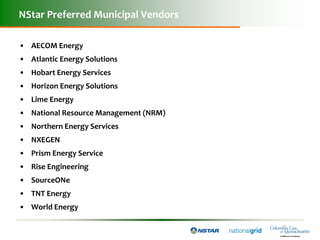
NStar Preferred Municipal Vendors

• AECOM Energy
• Atlantic Energy Solutions
• Hobart Energy Services
• Horizon Energy Solutions
• Lime Energy
• National Resource Management (NRM)
• Northern Energy Services
• NXEGEN
• Prism Energy Service
• Rise Engineering
• SourceONe
• TNT Energy
• World Energy
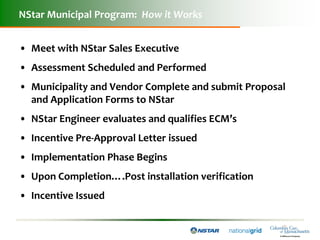
NStar Municipal Program: How it Works


• Meet with NStar Sales Executive
• Assessment Scheduled and Performed
• Municipality and Vendor Complete and submit Proposal
  and Application Forms to NStar
• NStar Engineer evaluates and qualifies ECM’s
• Incentive Pre-Approval Letter issued
• Implementation Phase Begins
• Upon Completion….Post installation verification
• Incentive Issued
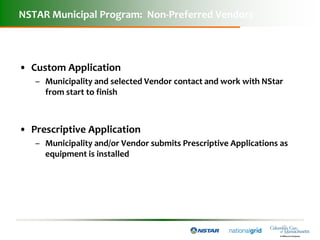
NSTAR Municipal Program: Non-Preferred Vendors


• Custom Application
   – Municipality and selected Vendor contact and work with NStar
     from start to finish


• Prescriptive Application
   – Municipality and/or Vendor submits Prescriptive Applications as
     equipment is installed
Contacts / Applications for Municipalities


•    Mark Rooney, Energy Efficiency Sales Executive
      – Mark.Rooney@nstar.com
      – 781-441-3416
•    Steve Grattan, Municipal Program Manager
      – Steven.Grattan@nstar.com
      – 781-441-8243
•    http://www.nstar.com/business/energy_efficiency/application_forms/application_forms.asp


Large Commercial Programs: 800-787-1706 or efficiency@nationalgrid.com
Small Business Program: 800-332-3333, or sign up online at www.nationalgridus.com/smallbusinessne


Paul Giguere, Manager of Commercial and Industrial Programs, 413.784.2142
http://www.columbiagasma.com
Working with ESCOs

• Bring PA onboard at conceptual stage
    – Ensures “A Meeting of Minds” on potential EE program rebate incentives
      & other offerings among all stakeholders.
    – Obtain utility input on additional cost-effective ECMs to incorporate into
      the project
• Without early collaboration with PA, ESCOs may only propose ECMs
  which detail a breakout of utility prescriptive incentives
• After Muni & ESCO finalize ECM performance contract, then ESCO
  provides all detailed transparent energy calculations to the utility
  representative and technical consultants for review
• After this technical review, project incentive may increase by
  combining all prescriptive ECMs with custom ECMs into a single,
  comprehensive offer.
• NOTE: The PAs are “vendor neutral” - ECMs are evaluated and
  incentives calculated on their energy-saving merits.

Panel 2: Utility Presentation

  • 1.
    Gas and ElectricEnergy Efficiency Programs and Services for Municipal Customers November 15, 2012 Matthew Foran, National Grid Elizabeth Cellucci, Columbia Gas of Massachusetts Mark Rooney, NSTAR
  • 2.
    Background • Green CommunitiesAct, July 2, 2008: to promote enhanced gas & electric energy efficiency throughout the Commonwealth – Program Administrators develop statewide energy efficiency plan – Streamlined contracting process that allows cities and towns to sole-source efficiency projects to a PA, or the PA’s delivery contractors, if the total work is less than $100,000. • Three Year Plan providing for acquisition of all available cost effective energy efficiency – Aggressive, unprecedented savings goals – Gas/electric program integration and seamless delivery – Focus on going “deeper” (more comprehensive) in buildings; and “broader” (more customers participating) 2
  • 3.
    Who is MassSave® Mass Save® is a brand sponsored by Massachusetts’ gas and electric utilities and energy efficiency service providers
  • 4.
    Massachusetts EE Programs Objectives •Provide incentives to customers to reduce the cost of improving the efficiency of their equipment and their facilities • Offer technical assistance to customers, contractors, vendors, etc. to identify and evaluate energy efficiency opportunities • Massachusetts PAs working collaboratively to provide comprehensive solutions through consistent EE programs
  • 5.
    Massachusetts EE Programs •Small Business (Direct Install) – Available to customers < 300 kW – Limited menu of simple ECMs •Large Commercial (LCI) Programs – #1: LCI New Construction & Major Renovation – #2: LCI Retrofit – Prescriptive Incentives & Custom Incentives – Technical Assistance – Promote comprehensiveness through focused initiatives within LCI programs
  • 6.
    National Grid SmallBusiness Program • Electric and Gas Direct Install (DI) Program • Provides free energy audit and a report of recommended energy efficiency improvements • The PA pays 70% of the cost of the installation of energy efficient equipment and customer pays the remaining 30% • Cost-cutting, efficient equipment available through DI includes: Electric Direct Install Measures Gas Direct Install Measures Lighting Upgrades High Efficiency Pre-Rinse Spray Valve (PRSV) LEDs Programmable Thermostats Occupancy Sensors Low Flow Shower Heads (LFSH) Programmable Thermostats Faucet Aerators Walk-in Cooler Efficiency Measures Pipe Insulation Duct Insulation Indoor Boiler Reset Controls
  • 7.
    Large Business Programs LCINew Construction & Major Renovation  Targets new construction, major renovations and equipment replacement  Promotes selection and installation of higher efficiency equipment and systems  Promotes comprehensive and optimized systems during design phase  Custom Incentives up to 75% of incremental costs LCI Retrofit  Incentives for replacing existing equipment or systems  Custom Incentives up to 50% of project costs
  • 8.
    Large Business Programs PrescriptiveApproach  Predetermined incentive amounts for individual efficiency measures (e.g. Lighting, Motors, VFD, HVAC, Boilers, Air Compressors)  Required Eligibility Requirements available on Applications Custom Approach  For unique projects and equipment  Project requires engineering evaluation of costs and savings  Incentives are based on % of actual costs  Projects must pass a Benefit/Cost Ratio (BCR) to determine eligibility for incentives Technical Assistance  In-depth engineering analysis  Service Provided by Independent Consultants – customer or PA selected  National Grid will typically share the cost 50-50
  • 9.
    National Grid MunicipalSegment Pilot - 2012 • Pilot program initiated in mid-2012 • Working with three (3) NGRID project installation vendors by territory in MA to promote Whole Building Approach (comprehensive EE) • Focus is on streamlining the project scoping process and implementation phase • More formal program for 2013
  • 10.
    Columbia Gas Guidelines BusinessSize What You Will Receive Priorities Incentive Amount Overview 2008 Potential  Small Business/Municipal • A walk through • 50% of the installed cost Building evaluation or plans up to $50,000 per master • < 40,000 therms per year analysis meter • An evaluation report with recommendations and potential savings Medium to Large Business/ • A walk through • 50% of the installed cost Municipal Building(s) evaluation up to $100,000 per master • > 40,000 therms per year • If a comprehensive meter energy evaluation and scoping study is required, CMA will pay 50% of the cost up to $7,500 10
  • 11.
    NStar Municipal Program •13 Preferred Vendors • Selected through Procurement Process (early 2012) – 29 Expressions of Interest – 19 Bids Submitted – 13 Vendors selected – Cost Plus negotiated and signed with each vendor for Electical and Mechanical – 3 Year Contract (April 2012 – April 2015)
  • 12.
    NStar Preferred MunicipalVendors • AECOM Energy • Atlantic Energy Solutions • Hobart Energy Services • Horizon Energy Solutions • Lime Energy • National Resource Management (NRM) • Northern Energy Services • NXEGEN • Prism Energy Service • Rise Engineering • SourceONe • TNT Energy • World Energy
  • 13.
    NStar Municipal Program:How it Works • Meet with NStar Sales Executive • Assessment Scheduled and Performed • Municipality and Vendor Complete and submit Proposal and Application Forms to NStar • NStar Engineer evaluates and qualifies ECM’s • Incentive Pre-Approval Letter issued • Implementation Phase Begins • Upon Completion….Post installation verification • Incentive Issued
  • 14.
    NSTAR Municipal Program:Non-Preferred Vendors • Custom Application – Municipality and selected Vendor contact and work with NStar from start to finish • Prescriptive Application – Municipality and/or Vendor submits Prescriptive Applications as equipment is installed
  • 15.
    Contacts / Applicationsfor Municipalities • Mark Rooney, Energy Efficiency Sales Executive – Mark.Rooney@nstar.com – 781-441-3416 • Steve Grattan, Municipal Program Manager – Steven.Grattan@nstar.com – 781-441-8243 • http://www.nstar.com/business/energy_efficiency/application_forms/application_forms.asp Large Commercial Programs: 800-787-1706 or efficiency@nationalgrid.com Small Business Program: 800-332-3333, or sign up online at www.nationalgridus.com/smallbusinessne Paul Giguere, Manager of Commercial and Industrial Programs, 413.784.2142 http://www.columbiagasma.com
  • 16.
    Working with ESCOs •Bring PA onboard at conceptual stage – Ensures “A Meeting of Minds” on potential EE program rebate incentives & other offerings among all stakeholders. – Obtain utility input on additional cost-effective ECMs to incorporate into the project • Without early collaboration with PA, ESCOs may only propose ECMs which detail a breakout of utility prescriptive incentives • After Muni & ESCO finalize ECM performance contract, then ESCO provides all detailed transparent energy calculations to the utility representative and technical consultants for review • After this technical review, project incentive may increase by combining all prescriptive ECMs with custom ECMs into a single, comprehensive offer. • NOTE: The PAs are “vendor neutral” - ECMs are evaluated and incentives calculated on their energy-saving merits.