RETROFITTING BUILDINGS
TO ACHIEVE ENERGY
EFFICIENCY
By Divya Kothari (BARCH/10014/16)
Breaking down the terms
Retrofitting
• Retrofitting a building
involves changing its
systems or structure
after its initial
construction and
occupation.
• This work can improve
amenities for the
building's occupants
and improve the
performance of the
building.
Energy Efficiency
• Energy efficiency measures
avoid wasteful use of energy
without much investment.
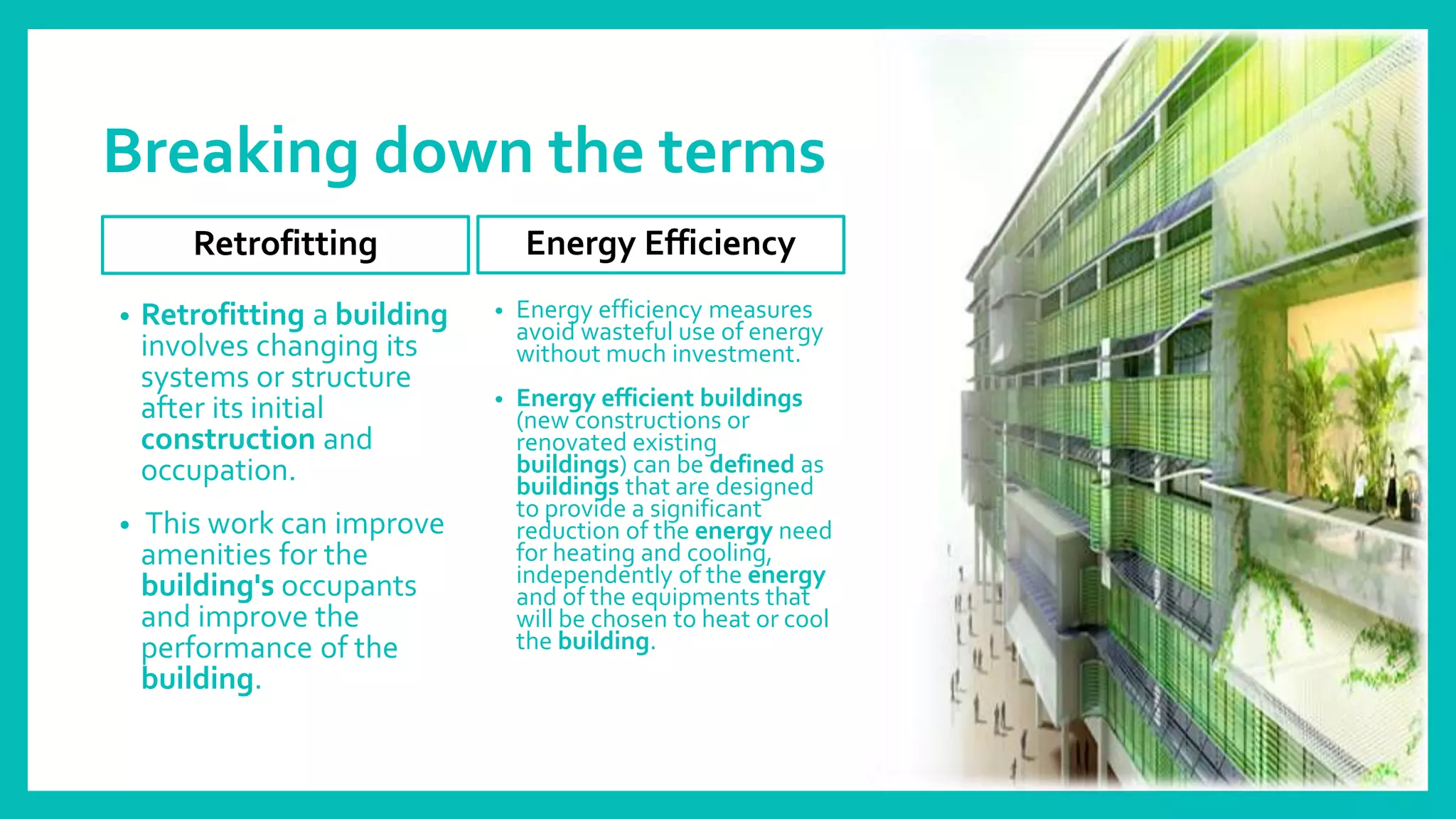
• Energy efficient buildings
(new constructions or
renovated existing
buildings) can be defined as
buildings that are designed
to provide a significant
reduction of the energy need
for heating and cooling,
independently of the energy
and of the equipments that
will be chosen to heat or cool
the building.
Why Retrofit Existing Buildings?
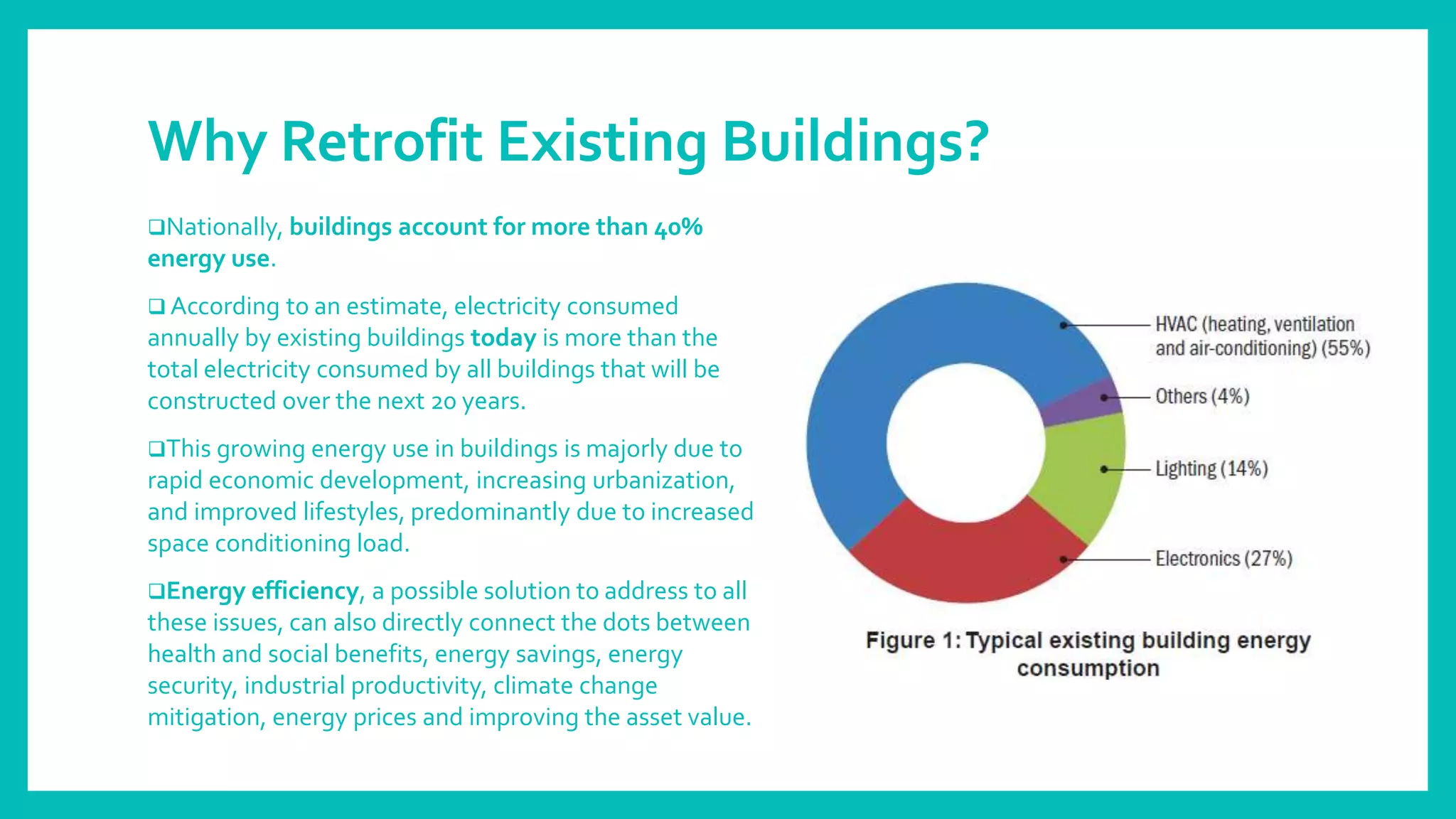
Nationally, buildings account for more than 40%
energy use.
 According to an estimate, electricity consumed
annually by existing buildings today is more than the
total electricity consumed by all buildings that will be
constructed over the next 20 years.
This growing energy use in buildings is majorly due to
rapid economic development, increasing urbanization,
and improved lifestyles, predominantly due to increased
space conditioning load.
Energy efficiency, a possible solution to address to all
these issues, can also directly connect the dots between
health and social benefits, energy savings, energy
security, industrial productivity, climate change
mitigation, energy prices and improving the asset value.
Roadmap for Retrofitting Existing Buildings
The goal of this roadmap is to define
various levels of efforts needed for energy
efficiency in existing commercial buildings
and thus provide a reference steps for
building owners, managers, government
entities and other consumers sharing
different levels for energy assessments &
procedures.
India’s Energy Retrofits Roadmap (TERI 2013)
Step 1: Internal Assessment
The internal assessment includes
1) determining the building total built-up area
2) Collecting utility bills for at least one year to calculate total energy used
3) Calculation of energy performance index (EPI) which is the ratio of total
annual energy used to the total built-up area (kWh/sq.m./year)
4) Comparison of the calculated EPI having similar characteristics with climatic
zones.
Step 2: Detailed Energy Survey
Next step for carrying out the retrofit measures, after assessing buildings’ energy performance for
energy conservation in the building is to carry out detailed energy survey with the help of
energy auditing team for understanding the energy system for the building.
The following steps are carried out for detailed energy survey:
Encourages
recognizing and
providing energy
savings in the
installed
electrical
systems.
The team should
include
professionals
from all
backgrounds
including
architects, HVAC
engineers and
electrical
engineers.
Energy mapping
is done to
determine how
much
energy is
consumed by the
building.
energy survey
is performed to
collect the
operating
condition details
of the building.
Historical
building energy
data needs to be
collected
for at least three
years to
determine
patterns.
Primary aim of
this presentation
is to review
recommendatio
ns and get their
feedback from
the
facility team.
Following is a list
of Data Collection
Parameters that
need to be
analysed while
developing
detailed survey
report:
Step 3:Technical Analysis
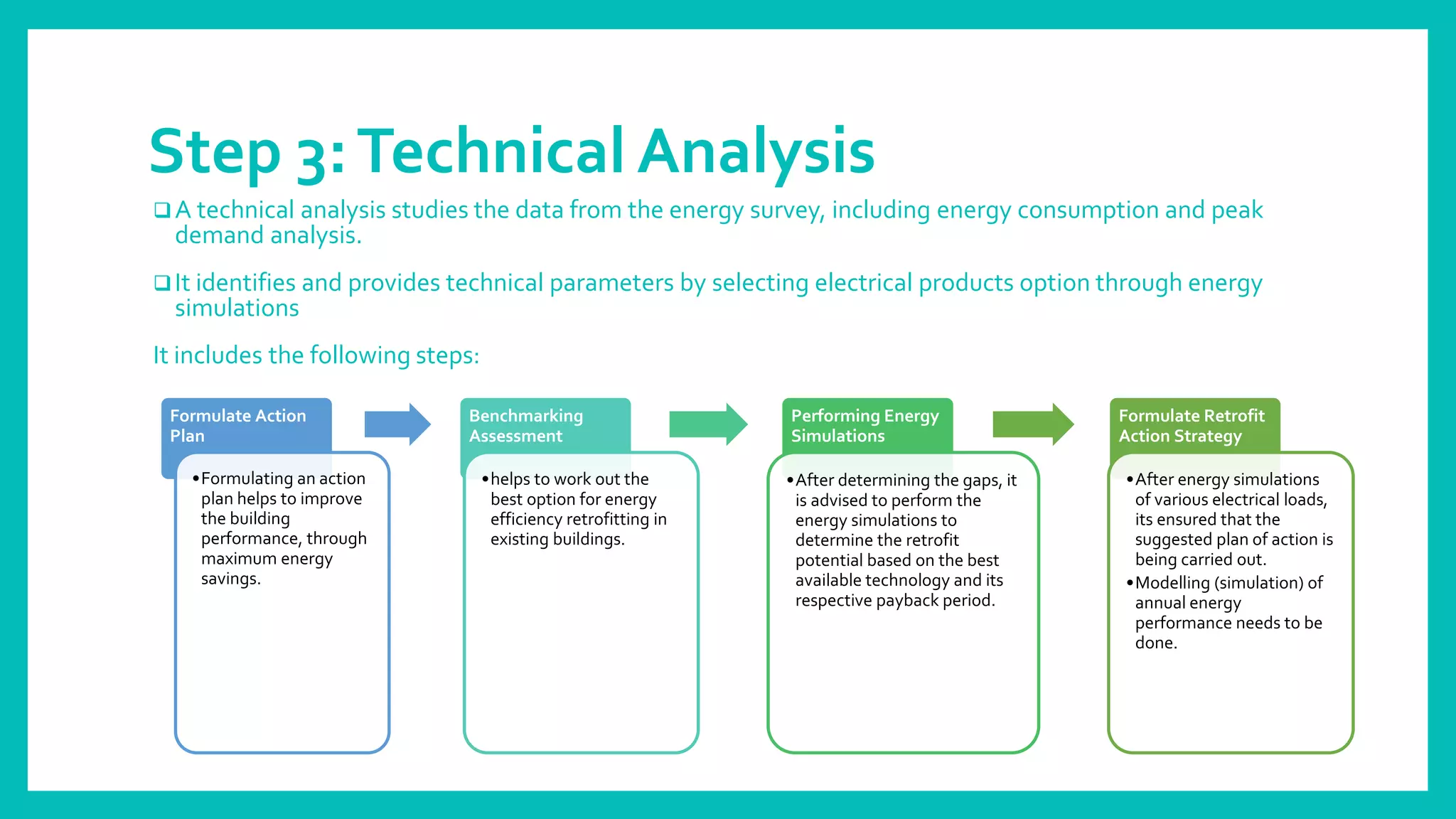
A technical analysis studies the data from the energy survey, including energy consumption and peak
demand analysis.
It identifies and provides technical parameters by selecting electrical products option through energy
simulations
It includes the following steps:
Formulate Action
Plan
•Formulating an action
plan helps to improve
the building
performance, through
maximum energy
savings.
Benchmarking
Assessment
•helps to work out the
best option for energy
efficiency retrofitting in
existing buildings.
Performing Energy
Simulations
•After determining the gaps, it
is advised to perform the
energy simulations to
determine the retrofit
potential based on the best
available technology and its
respective payback period.
Formulate Retrofit
Action Strategy
•After energy simulations
of various electrical loads,
its ensured that the
suggested plan of action is
being carried out.
•Modelling (simulation) of
annual energy
performance needs to be
done.
Following points have to be incorporated while doing the Benchmarking and Energy
Simulations:
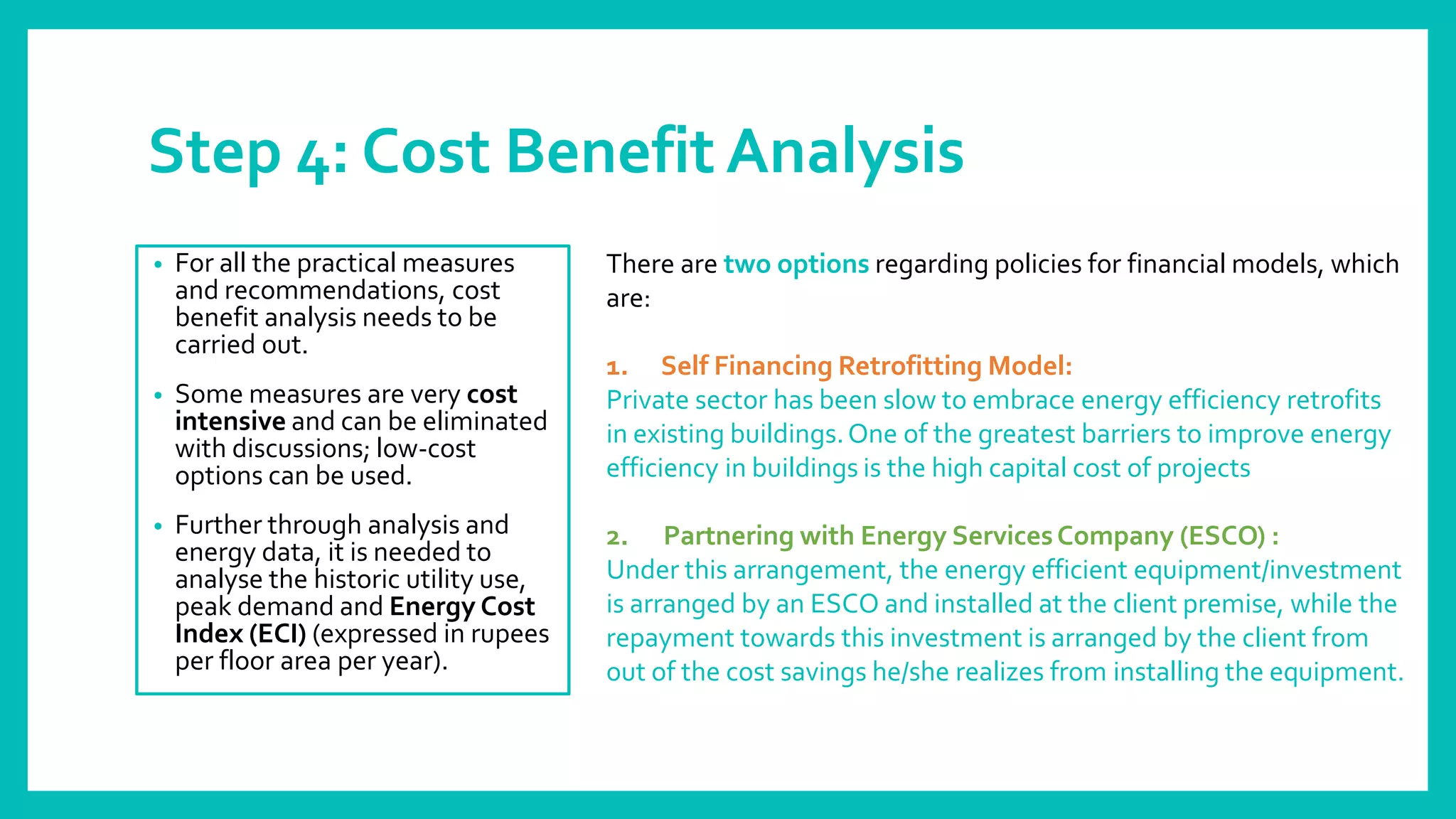
Step 4: Cost Benefit Analysis
• For all the practical measures
and recommendations, cost
benefit analysis needs to be
carried out.
• Some measures are very cost
intensive and can be eliminated
with discussions; low-cost
options can be used.
• Further through analysis and
energy data, it is needed to
analyse the historic utility use,
peak demand and Energy Cost
Index (ECI) (expressed in rupees
per floor area per year).
There are two options regarding policies for financial models, which
are:
1. Self Financing Retrofitting Model:
Private sector has been slow to embrace energy efficiency retrofits
in existing buildings.One of the greatest barriers to improve energy
efficiency in buildings is the high capital cost of projects
2. Partnering with Energy ServicesCompany (ESCO) :
Under this arrangement, the energy efficient equipment/investment
is arranged by an ESCO and installed at the client premise, while the
repayment towards this investment is arranged by the client from
out of the cost savings he/she realizes from installing the equipment.
Step 5: Implementation Plan of Energy
Efficiency Measures
• Once the retrofit plan is finalized after conducting a thorough cost benefit analysis, the team
should then work on implementing the retrofit.
• Proper project planning should be done in terms of assigning appropriate timelines,
understanding the commitment and involvement mechanism as well as project finance so that
the implementation is seamless.
• Discussion with the facility manager is a necessary step to understand the building performance
and areas of improvement.
• It is noteworthy to understand the set points of HVAC systems such as space temperature, space
humidity, lighting levels, boiler temperature, chillers temperature, etc., and their respective
schedules which can be made available through the control system.
• Site visits are an equally important part of any energy audit. During the site visit, information like
equipment condition, maintenance procedures and potential energy efficiency measures must
be provided to the auditors.
• In most buildings nowadays, a computer based control system are installed in buildings that
controls and monitors with centralized control system
Step 6: Operation, Maintenance andTraining
• To ensure recurring energy savings of a building, it is essential to include all the required
parameters within the gamut of operation and maintenance.
• Educating maintenance staff about building efficiency parameters along with financial and non-
financial benefits can prove the key measure in the EE in the existing buildings.
• Goal should be to maximize building operational efficiency with better health and comfort of
occupant.
• Operation & Maintenance staffs which are employed directly through some contract need to
inform for the assessment and data collection.
• Further, contractors play an important role in system maintenance like building management
system (BMS)
• In addition, building occupants play an important role in energy assessment and finalizing EE
measures.
• Data management is very important for the successful plan of EE measures.
POSSIBLE RETROFIT
STRATEGIES
Without retrofits
With retrofits
A systematic
approach for
sustainable
building
retrofits
Some
Challenges &
Solution during
Energy
Efficiency
Measures in
Existing
Buildings
Summary
References:
• T E R I. 2019; Existing Commercial Building Retrofit Guidelines, New Delhi:The
Energy and Resources Institute. 60 pp.
• TERI 2013
• Retrofitting Public Buildings for Energy andWater Efficiency: Part 2
Retrofitting Guidelines Progress Report No.1 (May 2016)
• https://www.altenergymag.com/article/2015/04/retrofitting-buildings-to-
improve-energy-efficiency/19349
THANKYOU
By Divya Kothari (BARCH/10014/16)

Retrofitting Buildings to Achieve Energy Efficiency

  • 1.
    RETROFITTING BUILDINGS TO ACHIEVEENERGY EFFICIENCY By Divya Kothari (BARCH/10014/16)
  • 2.
    Breaking down theterms Retrofitting • Retrofitting a building involves changing its systems or structure after its initial construction and occupation. • This work can improve amenities for the building's occupants and improve the performance of the building. Energy Efficiency • Energy efficiency measures avoid wasteful use of energy without much investment. • Energy efficient buildings (new constructions or renovated existing buildings) can be defined as buildings that are designed to provide a significant reduction of the energy need for heating and cooling, independently of the energy and of the equipments that will be chosen to heat or cool the building.
  • 3.
    Why Retrofit ExistingBuildings? Nationally, buildings account for more than 40% energy use.  According to an estimate, electricity consumed annually by existing buildings today is more than the total electricity consumed by all buildings that will be constructed over the next 20 years. This growing energy use in buildings is majorly due to rapid economic development, increasing urbanization, and improved lifestyles, predominantly due to increased space conditioning load. Energy efficiency, a possible solution to address to all these issues, can also directly connect the dots between health and social benefits, energy savings, energy security, industrial productivity, climate change mitigation, energy prices and improving the asset value.
  • 4.
    Roadmap for RetrofittingExisting Buildings The goal of this roadmap is to define various levels of efforts needed for energy efficiency in existing commercial buildings and thus provide a reference steps for building owners, managers, government entities and other consumers sharing different levels for energy assessments & procedures.
  • 5.
    India’s Energy RetrofitsRoadmap (TERI 2013)
  • 6.
    Step 1: InternalAssessment The internal assessment includes 1) determining the building total built-up area 2) Collecting utility bills for at least one year to calculate total energy used 3) Calculation of energy performance index (EPI) which is the ratio of total annual energy used to the total built-up area (kWh/sq.m./year) 4) Comparison of the calculated EPI having similar characteristics with climatic zones.
  • 7.
    Step 2: DetailedEnergy Survey Next step for carrying out the retrofit measures, after assessing buildings’ energy performance for energy conservation in the building is to carry out detailed energy survey with the help of energy auditing team for understanding the energy system for the building. The following steps are carried out for detailed energy survey: Encourages recognizing and providing energy savings in the installed electrical systems. The team should include professionals from all backgrounds including architects, HVAC engineers and electrical engineers. Energy mapping is done to determine how much energy is consumed by the building. energy survey is performed to collect the operating condition details of the building. Historical building energy data needs to be collected for at least three years to determine patterns. Primary aim of this presentation is to review recommendatio ns and get their feedback from the facility team.
  • 8.
    Following is alist of Data Collection Parameters that need to be analysed while developing detailed survey report:
  • 9.
    Step 3:Technical Analysis Atechnical analysis studies the data from the energy survey, including energy consumption and peak demand analysis. It identifies and provides technical parameters by selecting electrical products option through energy simulations It includes the following steps: Formulate Action Plan •Formulating an action plan helps to improve the building performance, through maximum energy savings. Benchmarking Assessment •helps to work out the best option for energy efficiency retrofitting in existing buildings. Performing Energy Simulations •After determining the gaps, it is advised to perform the energy simulations to determine the retrofit potential based on the best available technology and its respective payback period. Formulate Retrofit Action Strategy •After energy simulations of various electrical loads, its ensured that the suggested plan of action is being carried out. •Modelling (simulation) of annual energy performance needs to be done.
  • 10.
    Following points haveto be incorporated while doing the Benchmarking and Energy Simulations:
  • 11.
    Step 4: CostBenefit Analysis • For all the practical measures and recommendations, cost benefit analysis needs to be carried out. • Some measures are very cost intensive and can be eliminated with discussions; low-cost options can be used. • Further through analysis and energy data, it is needed to analyse the historic utility use, peak demand and Energy Cost Index (ECI) (expressed in rupees per floor area per year). There are two options regarding policies for financial models, which are: 1. Self Financing Retrofitting Model: Private sector has been slow to embrace energy efficiency retrofits in existing buildings.One of the greatest barriers to improve energy efficiency in buildings is the high capital cost of projects 2. Partnering with Energy ServicesCompany (ESCO) : Under this arrangement, the energy efficient equipment/investment is arranged by an ESCO and installed at the client premise, while the repayment towards this investment is arranged by the client from out of the cost savings he/she realizes from installing the equipment.
  • 12.
    Step 5: ImplementationPlan of Energy Efficiency Measures • Once the retrofit plan is finalized after conducting a thorough cost benefit analysis, the team should then work on implementing the retrofit. • Proper project planning should be done in terms of assigning appropriate timelines, understanding the commitment and involvement mechanism as well as project finance so that the implementation is seamless. • Discussion with the facility manager is a necessary step to understand the building performance and areas of improvement. • It is noteworthy to understand the set points of HVAC systems such as space temperature, space humidity, lighting levels, boiler temperature, chillers temperature, etc., and their respective schedules which can be made available through the control system. • Site visits are an equally important part of any energy audit. During the site visit, information like equipment condition, maintenance procedures and potential energy efficiency measures must be provided to the auditors. • In most buildings nowadays, a computer based control system are installed in buildings that controls and monitors with centralized control system
  • 13.
    Step 6: Operation,Maintenance andTraining • To ensure recurring energy savings of a building, it is essential to include all the required parameters within the gamut of operation and maintenance. • Educating maintenance staff about building efficiency parameters along with financial and non- financial benefits can prove the key measure in the EE in the existing buildings. • Goal should be to maximize building operational efficiency with better health and comfort of occupant. • Operation & Maintenance staffs which are employed directly through some contract need to inform for the assessment and data collection. • Further, contractors play an important role in system maintenance like building management system (BMS) • In addition, building occupants play an important role in energy assessment and finalizing EE measures. • Data management is very important for the successful plan of EE measures.
  • 14.
  • 18.
  • 19.
  • 20.
  • 21.
  • 22.
    References: • T ER I. 2019; Existing Commercial Building Retrofit Guidelines, New Delhi:The Energy and Resources Institute. 60 pp. • TERI 2013 • Retrofitting Public Buildings for Energy andWater Efficiency: Part 2 Retrofitting Guidelines Progress Report No.1 (May 2016) • https://www.altenergymag.com/article/2015/04/retrofitting-buildings-to- improve-energy-efficiency/19349
  • 23.
    THANKYOU By Divya Kothari(BARCH/10014/16)