Lifespan Psychology
MPC-002
Lifespan Psychology
(MPC002)
SPRING SEASON PUBLICATIONS
Navi Mumbai, INDIA
Free Distribution of this document, except the author, will
be considered as COPYRIGHT Violation.
As per Indian Copyrights Act 1957, Copyright
infringement is a cognizable offence and Copyright
owners can take legal action against any person or entity
that infringes on the copyright of a work. The copyright
owner can file a civil remedies case in a court having
jurisdiction and is entitled to remedies by way of
injunctions, damages and accounts.
Assignment Container: Lifespan Psychology (MPC002)
© Spring Season Publications 2019-2022
All Rights Reserved
First Published – 2019
Fourth Ed. - 2022
Spring Season Publications
Kharghar Sec 10, Navi Mumbai, MS, INDIA, 410210
www.springseason.in
All rights reserved. No part of this publication may be reproduced, stored in or introduced into a retrieval system, or
transmitted, in any form, or by any means (electrical, mechanical, Photocopying, recording or otherwise) without the prior
Written permission of the author.
All data were deemed correct at time of creation
Author/Publisher is not liable for errors or omissions
Only for PERSONAL USE not for PUBLIC Circulation
INR 99/-
www.springseason.in
Guidelines/Tips to Write MAPC Assignments
Using this Document
• Please note that the main aim of this document is to provide the guideline to write the assignment
• It is advisable not copy answers as it is from this document
• Write the answers in your own words
• Numbers of illustrations are also given in this document
Paper
• You need to use A4 ruled paper (with lines). You can also use the A4 note book and cover it with plain
and nice cover and put the desired information on it
• Also it is advisable to check with your resource/study center for any guidelines on the same and follow
if it is there
• However, contain of the assignment is important as compare to the paper used to write it (As per our
understanding)
Writing your Answers
• Assignment should be Hand written and you can use both the side of the page to write your answer
• Write the Section/Question number with each answer and please write all the questions
• Make sure that the answer is within the stipulated word limit
• You can use Blue/Black ink to write your assignment (Don’t use pencil in your assignment)
• Don’t use RED Pen in your assignment as normally it is used to check the assignment
• If you wish you can use light color pens for illustrations/brain maps for your assignment
• Number of pages required to write the answer depends on your handwriting. Below is the
approximately guideline for your reference
Word Limit 1000 400 50
Number of Lines in one paper 20 20 20
Words per line
(Big Hand Writing)
7 7 7
Total Pages required
(Front and Back)
7 3 0.3
Words per line
(Small Hand Writing)
10 10 10
Total Pages required
(Front and Back)
5 4 0.2
Content
1 Cognitive Development During Middle Childhood 1
2 Life Span Development 4
3 Psychosocial Challenges in Older Adults 6
4 Intellectual Disability 11
5 Marcia’s Identity Status 12
6 Ageing Process in Men and Women 13
7 Levinson’s Seasons of Life Theory 15
8 Cognitive Changes during Middle Adulthood 17
9 Exceptional Children 21
10 Cross-Sectional Method 21
11 Grammar and Pragmatics 21
12 Signs of Negative Self-Concept in Adolescents 21
13 Growth Spurt 22
14 New Egocentrism 22
15 Sociometric Rejections 22
16 Social Hazards during Early Childhood 23
17 Continuity Vs Discontinuity 23
18 High-Risk Behaviours during Adolescence 23
Assignment Container Lifespan Psychology (MPC-002)
Page 1 of 24 www.springseason.in
IGNOU MAPC
LIFESPAN PSYCHOLOGY (MPC-002)
Course Code: MPC-002
Assignment Code: MPC-002/ASST/TMA/2022-23
Marks: 100
Last Date of Submission: 30th April 2023 and 30th Sep 2023
SECTION-A
Answer the following question in about 1000 words (wherever applicable) each.
15 x 3 = 45 Marks
Q. No. 1 Discuss cognitive development during middle childhood
Answer: The mental (cognitive) changes children undergo during the middle childhood era are
often more pronounced and noticeable than their physical changes. Children’s ability to
consciously, thoughtfully and pro-actively choose to pursue goals (instead of simply reacting to
the environment) appears during this developmental period. In addition, children’s thinking style
gradually becomes more logical, organized, and flexible as they enter Piaget’s “Concrete
Operational” thinking stage.
According to Piaget, children in early childhood are in the preoperational stage of development in
which they learn to think symbolically about the world. From ages 7 to 11, the school-aged child
continues to develop in what Piaget referred to as the concrete operational stage of cognitive
development. This involves mastering the use of logic in concrete ways. The child can use logic
to solve problems tied to their own direct experience but has trouble solving hypothetical problems
or considering more abstract problems. The child uses inductive reasoning, which means thinking
that the world reflects one’s own personal experience. For example, a child has one friend who is
rude, another friend who is also rude, and the same is true for a third friend. Using inductive
reasoning, the child may conclude that friends are rude.
The word concrete refers to that which is tangible; that which can be seen or touched or
experienced directly. The concrete operational child is able to make use of logical principles in
solving problems involving the physical world. For example, the child can understand the
Assignment Container Lifespan Psychology (MPC-002)
Page 16 of 24 www.springseason.in
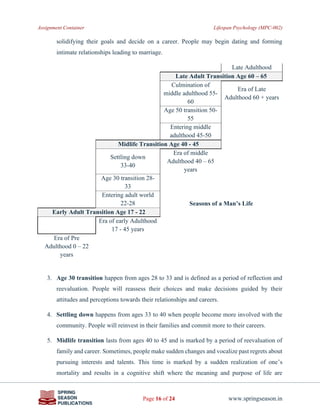
solidifying their goals and decide on a career. People may begin dating and forming
intimate relationships leading to marriage.
Late Adulthood
Late Adult Transition Age 60 – 65
Culmination of
middle adulthood 55-
60
Era of Late
Adulthood 60 + years
Age 50 transition 50-
55
Entering middle
adulthood 45-50
Midlife Transition Age 40 - 45
Settling down
33-40
Era of middle
Adulthood 40 – 65
years
Age 30 transition 28-
33
Entering adult world
22-28 Seasons of a Man’s Life
Early Adult Transition Age 17 - 22
Era of early Adulthood
17 - 45 years
Era of Pre
Adulthood 0 – 22
years
3. Age 30 transition happen from ages 28 to 33 and is defined as a period of reflection and
reevaluation. People will reassess their choices and make decisions guided by their
attitudes and perceptions towards their relationships and careers.
4. Settling down happens from ages 33 to 40 when people become more involved with the
community. People will reinvest in their families and commit more to their careers.
5. Midlife transition lasts from ages 40 to 45 and is marked by a period of reevaluation of
family and career. Sometimes, people make sudden changes and vocalize past regrets about
pursuing interests and talents. This time is marked by a sudden realization of one’s
mortality and results in a cognitive shift where the meaning and purpose of life are
Assignment Container Lifespan Psychology (MPC-002)
Page 18 of 24 www.springseason.in
Middle‐age adult thinking differs significantly from that of adolescents and young adults. Adults
are typically more focused in specific directions, having gained insight and understanding from
life events that adolescents and young adults have not yet experienced. No longer viewing the
world from an absolute and fixed perspective, middle adults have learned how to make
compromises, question the establishment, and work through disputes. Younger people, on the
hand, may still look for definitive answers.
Many middle‐age adults have attained Piaget’s stage of formal operations, which is characterized
by the ability to think abstractly, reason logically, and solve theoretical problems. Many of the
situations facing adults today require something more than formal operations. That is, the uncertain
areas of life may pose problems too ambiguous and inconsistent for such straightforward thinking
styles. Instead, middle adults may develop and employ postformal thinking, which is characterized
by the objective use of practical common sense to deal with unclear problems.
Spring Season Publications
Kharghar, Navi Mumbai, MS, INDIA, 410210
Visit us at
www.springseason.in
Rs. 99

MAPC IGNOU Assignment Lifespan 2023.pdf

  • 1.
  • 2.
    Lifespan Psychology (MPC002) SPRING SEASONPUBLICATIONS Navi Mumbai, INDIA
  • 3.
    Free Distribution ofthis document, except the author, will be considered as COPYRIGHT Violation. As per Indian Copyrights Act 1957, Copyright infringement is a cognizable offence and Copyright owners can take legal action against any person or entity that infringes on the copyright of a work. The copyright owner can file a civil remedies case in a court having jurisdiction and is entitled to remedies by way of injunctions, damages and accounts. Assignment Container: Lifespan Psychology (MPC002) © Spring Season Publications 2019-2022 All Rights Reserved First Published – 2019 Fourth Ed. - 2022 Spring Season Publications Kharghar Sec 10, Navi Mumbai, MS, INDIA, 410210 www.springseason.in All rights reserved. No part of this publication may be reproduced, stored in or introduced into a retrieval system, or transmitted, in any form, or by any means (electrical, mechanical, Photocopying, recording or otherwise) without the prior Written permission of the author. All data were deemed correct at time of creation Author/Publisher is not liable for errors or omissions Only for PERSONAL USE not for PUBLIC Circulation INR 99/-
  • 4.
    www.springseason.in Guidelines/Tips to WriteMAPC Assignments Using this Document • Please note that the main aim of this document is to provide the guideline to write the assignment • It is advisable not copy answers as it is from this document • Write the answers in your own words • Numbers of illustrations are also given in this document Paper • You need to use A4 ruled paper (with lines). You can also use the A4 note book and cover it with plain and nice cover and put the desired information on it • Also it is advisable to check with your resource/study center for any guidelines on the same and follow if it is there • However, contain of the assignment is important as compare to the paper used to write it (As per our understanding) Writing your Answers • Assignment should be Hand written and you can use both the side of the page to write your answer • Write the Section/Question number with each answer and please write all the questions • Make sure that the answer is within the stipulated word limit • You can use Blue/Black ink to write your assignment (Don’t use pencil in your assignment) • Don’t use RED Pen in your assignment as normally it is used to check the assignment • If you wish you can use light color pens for illustrations/brain maps for your assignment • Number of pages required to write the answer depends on your handwriting. Below is the approximately guideline for your reference Word Limit 1000 400 50 Number of Lines in one paper 20 20 20 Words per line (Big Hand Writing) 7 7 7 Total Pages required (Front and Back) 7 3 0.3 Words per line (Small Hand Writing) 10 10 10 Total Pages required (Front and Back) 5 4 0.2
  • 5.
    Content 1 Cognitive DevelopmentDuring Middle Childhood 1 2 Life Span Development 4 3 Psychosocial Challenges in Older Adults 6 4 Intellectual Disability 11 5 Marcia’s Identity Status 12 6 Ageing Process in Men and Women 13 7 Levinson’s Seasons of Life Theory 15 8 Cognitive Changes during Middle Adulthood 17 9 Exceptional Children 21 10 Cross-Sectional Method 21 11 Grammar and Pragmatics 21 12 Signs of Negative Self-Concept in Adolescents 21 13 Growth Spurt 22 14 New Egocentrism 22 15 Sociometric Rejections 22 16 Social Hazards during Early Childhood 23 17 Continuity Vs Discontinuity 23 18 High-Risk Behaviours during Adolescence 23
  • 7.
    Assignment Container LifespanPsychology (MPC-002) Page 1 of 24 www.springseason.in IGNOU MAPC LIFESPAN PSYCHOLOGY (MPC-002) Course Code: MPC-002 Assignment Code: MPC-002/ASST/TMA/2022-23 Marks: 100 Last Date of Submission: 30th April 2023 and 30th Sep 2023 SECTION-A Answer the following question in about 1000 words (wherever applicable) each. 15 x 3 = 45 Marks Q. No. 1 Discuss cognitive development during middle childhood Answer: The mental (cognitive) changes children undergo during the middle childhood era are often more pronounced and noticeable than their physical changes. Children’s ability to consciously, thoughtfully and pro-actively choose to pursue goals (instead of simply reacting to the environment) appears during this developmental period. In addition, children’s thinking style gradually becomes more logical, organized, and flexible as they enter Piaget’s “Concrete Operational” thinking stage. According to Piaget, children in early childhood are in the preoperational stage of development in which they learn to think symbolically about the world. From ages 7 to 11, the school-aged child continues to develop in what Piaget referred to as the concrete operational stage of cognitive development. This involves mastering the use of logic in concrete ways. The child can use logic to solve problems tied to their own direct experience but has trouble solving hypothetical problems or considering more abstract problems. The child uses inductive reasoning, which means thinking that the world reflects one’s own personal experience. For example, a child has one friend who is rude, another friend who is also rude, and the same is true for a third friend. Using inductive reasoning, the child may conclude that friends are rude. The word concrete refers to that which is tangible; that which can be seen or touched or experienced directly. The concrete operational child is able to make use of logical principles in solving problems involving the physical world. For example, the child can understand the
  • 8.
    Assignment Container LifespanPsychology (MPC-002) Page 16 of 24 www.springseason.in solidifying their goals and decide on a career. People may begin dating and forming intimate relationships leading to marriage. Late Adulthood Late Adult Transition Age 60 – 65 Culmination of middle adulthood 55- 60 Era of Late Adulthood 60 + years Age 50 transition 50- 55 Entering middle adulthood 45-50 Midlife Transition Age 40 - 45 Settling down 33-40 Era of middle Adulthood 40 – 65 years Age 30 transition 28- 33 Entering adult world 22-28 Seasons of a Man’s Life Early Adult Transition Age 17 - 22 Era of early Adulthood 17 - 45 years Era of Pre Adulthood 0 – 22 years 3. Age 30 transition happen from ages 28 to 33 and is defined as a period of reflection and reevaluation. People will reassess their choices and make decisions guided by their attitudes and perceptions towards their relationships and careers. 4. Settling down happens from ages 33 to 40 when people become more involved with the community. People will reinvest in their families and commit more to their careers. 5. Midlife transition lasts from ages 40 to 45 and is marked by a period of reevaluation of family and career. Sometimes, people make sudden changes and vocalize past regrets about pursuing interests and talents. This time is marked by a sudden realization of one’s mortality and results in a cognitive shift where the meaning and purpose of life are
  • 9.
    Assignment Container LifespanPsychology (MPC-002) Page 18 of 24 www.springseason.in Middle‐age adult thinking differs significantly from that of adolescents and young adults. Adults are typically more focused in specific directions, having gained insight and understanding from life events that adolescents and young adults have not yet experienced. No longer viewing the world from an absolute and fixed perspective, middle adults have learned how to make compromises, question the establishment, and work through disputes. Younger people, on the hand, may still look for definitive answers. Many middle‐age adults have attained Piaget’s stage of formal operations, which is characterized by the ability to think abstractly, reason logically, and solve theoretical problems. Many of the situations facing adults today require something more than formal operations. That is, the uncertain areas of life may pose problems too ambiguous and inconsistent for such straightforward thinking styles. Instead, middle adults may develop and employ postformal thinking, which is characterized by the objective use of practical common sense to deal with unclear problems.
  • 10.
    Spring Season Publications Kharghar,Navi Mumbai, MS, INDIA, 410210 Visit us at www.springseason.in Rs. 99