Your Interactive Guide
to the Digital World
Discovering
Computers 2012
Zaman University
Course: CS Application 102.01
Instructor: Mr. Mustafa Dur
Date: 04th June, 2014
Presenters :
Phanara Mao
Ibrohim Aripov
Contents
Communications and networks
Email (spam/phishing)
Net neutrality
Breaking trust
Internet censorship
Freedom of expression
Children and inappropriate content
Internet addiction
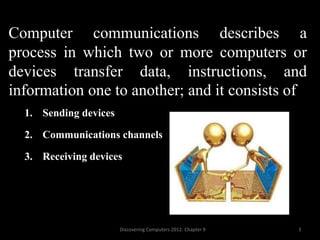
CommunicationsComputer communications describes a
process in which two or more computers or
devices transfer data, instructions, and
information one to another; and it consists of
1. Sending devices
2. Communications channels
3. Receiving devices
Discovering Computers 2012: Chapter 9 3Page 460
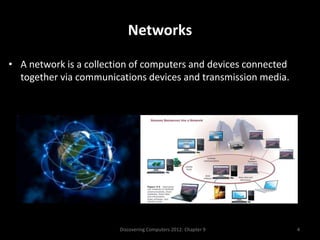
Networks
• A network is a collection of computers and devices connected
together via communications devices and transmission media.
Discovering Computers 2012: Chapter 9 4
Email (Spam/Phishing)
Spam-is the abuse of electronic messaging system
to send unsolicited bulk messaging indiscriminately
Types of spam :
• Emil spam
• IM Spam
• USENET Newsgroup Spam
• Web Searching Engine Spam
• Blog Spam
• Wiki Spam
• Mobile Phone Messaging Spam
Email (Spam/Phishing)
What can I do?
 Use Multiple email address
 Personal
 Business
 Spam
 Gmail
 Never just delete
 Report as Spam
 Never open an email that you think is spam
 Learn spam versus good
Phishing
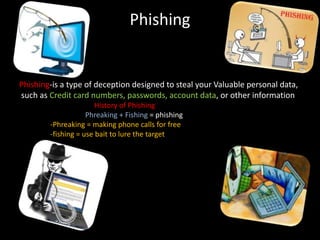
Phishing-is a type of deception designed to steal your Valuable personal data,
such as Credit card numbers, passwords, account data, or other information
History of Phishing
Phreaking + Fishing = phishing
-Phreaking = making phone calls for free
-fishing = use bait to lure the target
Phishing
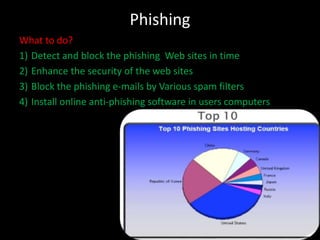
What to do?
1) Detect and block the phishing Web sites in time
2) Enhance the security of the web sites
3) Block the phishing e-mails by Various spam filters
4) Install online anti-phishing software in users computers
Net Neutrality
• Net neutrality-is the principle that ISP and
governments should treat all data on the Internet
equally.
• Net neutrality- is an important component of an
open internet.
• Without N.N hard to communicate online, but easier
for companies to censor our speech.
Net Neutrality
• Without Net Neutrality, ISPs like AT&T, Comcast,
Time Warner Cable and Verizon will be able to block
content and speech they don’t like.
Net Neutrality
• The open Internet rules, adopted in 2010,
were designed to prevent ISP.
Breaking Trust
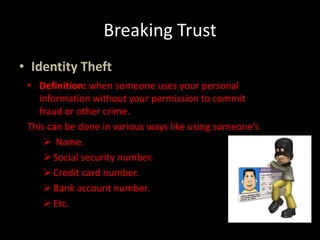
• Identity Theft
• Definition: when someone uses your personal
information without your permission to commit
fraud or other crime.
This can be done in various ways like using someone’s
 Name.
Social security number.
Credit card number.
Bank account number.
Etc.
Breaking Trust
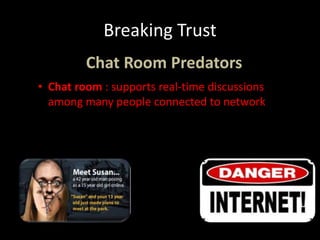
Chat Room Predators
• Chat room : supports real-time discussions
among many people connected to network
Breaking Trust
Cyber bullying
• What Is Cyber bullying?
• Cyber bullying is the use of technology to burn,
scare, confuse, or target another person.
• By definition, it occurs among young people.
When an adult is involved, it may meet the
definition of cyber-harassment or cyber-
stalking, a crime that can have legal
consequences and involve jail time.
Internet Censorship
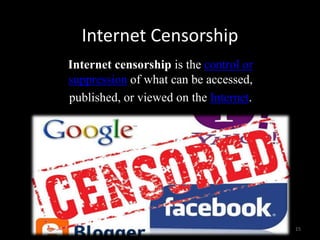
Internet censorship is the control or
suppression of what can be accessed,
published, or viewed on the Internet.
Discovering Computers 2012: Chapter 9 15
Internet Censorship
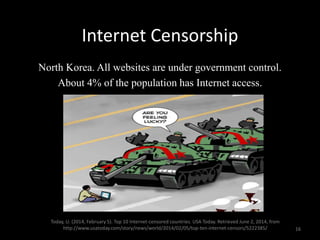
North Korea. All websites are under government control.
About 4% of the population has Internet access.
Today, U. (2014, February 5). Top 10 Internet-censored countries. USA Today. Retrieved June 2, 2014, from
http://www.usatoday.com/story/news/world/2014/02/05/top-ten-internet-censors/5222385/ 16
Internet Censorship
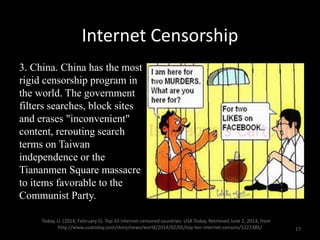
3. China. China has the most
rigid censorship program in
the world. The government
filters searches, block sites
and erases "inconvenient"
content, rerouting search
terms on Taiwan
independence or the
Tiananmen Square massacre
to items favorable to the
Communist Party.
Today, U. (2014, February 5). Top 10 Internet-censored countries. USA Today. Retrieved June 2, 2014, from
http://www.usatoday.com/story/news/world/2014/02/05/top-ten-internet-censors/5222385/ 17
Internet Censorship
Discovering Computers 2012: Chapter 9 18
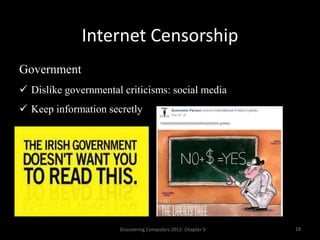
Government
 Dislike governmental criticisms: social media
 Keep information secretly
Internet Censorship
Discovering Computers 2012: Chapter 9 19
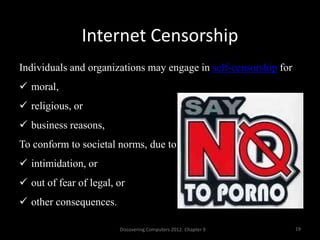
Individuals and organizations may engage in self-censorship for
 moral,
 religious, or
 business reasons,
To conform to societal norms, due to
 intimidation, or
 out of fear of legal, or
 other consequences.
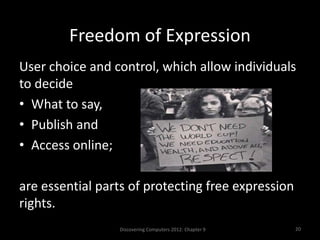
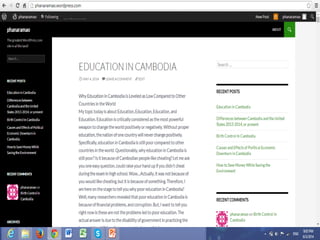
Freedom of Expression
User choice and control, which allow individuals
to decide
• What to say,
• Publish and
• Access online;
are essential parts of protecting free expression
rights.
Discovering Computers 2012: Chapter 9 20
Discovering Computers 2012: Chapter 9 21
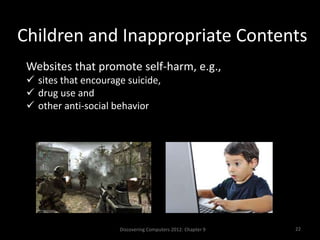
Children and Inappropriate Contents
Discovering Computers 2012: Chapter 9 22
Websites that promote self-harm, e.g.,
 sites that encourage suicide,
 drug use and
 other anti-social behavior
Discovering Computers 2012: Chapter 9 23
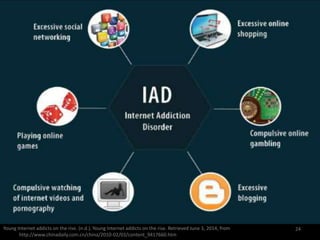
Internet addiction
24Young Internet addicts on the rise. (n.d.). Young Internet addicts on the rise. Retrieved June 3, 2014, from
http://www.chinadaily.com.cn/china/2010-02/03/content_9417660.htm
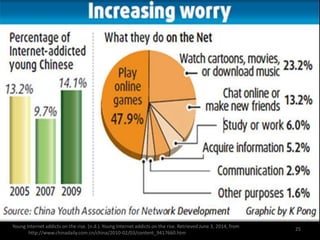
Internet addiction
Young Internet addicts on the rise. (n.d.). Young Internet addicts on the rise. Retrieved June 3, 2014, from
http://www.chinadaily.com.cn/china/2010-02/03/content_9417660.htm
25
Discovering Computers 2012: Chapter 9 27
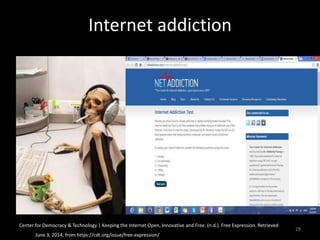
Internet addiction
Center for Democracy & Technology | Keeping the Internet Open, Innovative and Free. (n.d.). Free Expression. Retrieved
June 3, 2014, from https://cdt.org/issue/free-expression/
28
References
Center for Democracy & Technology | Keeping the Internet Open, Innovative
and Free. (n.d.). Free Expression. Retrieved June 3, 2014, from
https://cdt.org/issue/free-expression/
Dur, M. (Director) (2014, March 5). Networked Communication . General
Lectures. Lecture conducted from Zaman University, Phnom Penh.
Shelly, G. B., & Vermaat, M. (2010). Networked Communication . Discovering
computers (pp. 458-511). Boston: Nicole Pinard.
Today, U. (2014, February 5). Top 10 Internet-censored countries. USA Today.
Retrieved June 2, 2014, from http://www.usatoday.com/story/news/world
/2014/02/05/top-ten-internet-censors/5222385/
Young Internet addicts on the rise. (n.d.). Young Internet addicts on the rise.
Retrieved June 3, 2014, from
http://www.chinadaily.com.cn/china/2010-02/03/content_9417660.htm
Thank for listening!
It’s about time to have Q & A!

Mao p.cs.102.01

  • 1.
    Your Interactive Guide tothe Digital World Discovering Computers 2012 Zaman University Course: CS Application 102.01 Instructor: Mr. Mustafa Dur Date: 04th June, 2014 Presenters : Phanara Mao Ibrohim Aripov
  • 2.
    Contents Communications and networks Email(spam/phishing) Net neutrality Breaking trust Internet censorship Freedom of expression Children and inappropriate content Internet addiction
  • 3.
    CommunicationsComputer communications describesa process in which two or more computers or devices transfer data, instructions, and information one to another; and it consists of 1. Sending devices 2. Communications channels 3. Receiving devices Discovering Computers 2012: Chapter 9 3Page 460
  • 4.
    Networks • A networkis a collection of computers and devices connected together via communications devices and transmission media. Discovering Computers 2012: Chapter 9 4
  • 5.
    Email (Spam/Phishing) Spam-is theabuse of electronic messaging system to send unsolicited bulk messaging indiscriminately Types of spam : • Emil spam • IM Spam • USENET Newsgroup Spam • Web Searching Engine Spam • Blog Spam • Wiki Spam • Mobile Phone Messaging Spam
  • 6.
    Email (Spam/Phishing) What canI do?  Use Multiple email address  Personal  Business  Spam  Gmail  Never just delete  Report as Spam  Never open an email that you think is spam  Learn spam versus good
  • 7.
    Phishing Phishing-is a typeof deception designed to steal your Valuable personal data, such as Credit card numbers, passwords, account data, or other information History of Phishing Phreaking + Fishing = phishing -Phreaking = making phone calls for free -fishing = use bait to lure the target
  • 8.
    Phishing What to do? 1)Detect and block the phishing Web sites in time 2) Enhance the security of the web sites 3) Block the phishing e-mails by Various spam filters 4) Install online anti-phishing software in users computers
  • 9.
    Net Neutrality • Netneutrality-is the principle that ISP and governments should treat all data on the Internet equally. • Net neutrality- is an important component of an open internet. • Without N.N hard to communicate online, but easier for companies to censor our speech.
  • 10.
    Net Neutrality • WithoutNet Neutrality, ISPs like AT&T, Comcast, Time Warner Cable and Verizon will be able to block content and speech they don’t like.
  • 11.
    Net Neutrality • Theopen Internet rules, adopted in 2010, were designed to prevent ISP.
  • 12.
    Breaking Trust • IdentityTheft • Definition: when someone uses your personal information without your permission to commit fraud or other crime. This can be done in various ways like using someone’s  Name. Social security number. Credit card number. Bank account number. Etc.
  • 13.
    Breaking Trust Chat RoomPredators • Chat room : supports real-time discussions among many people connected to network
  • 14.
    Breaking Trust Cyber bullying •What Is Cyber bullying? • Cyber bullying is the use of technology to burn, scare, confuse, or target another person. • By definition, it occurs among young people. When an adult is involved, it may meet the definition of cyber-harassment or cyber- stalking, a crime that can have legal consequences and involve jail time.
  • 15.
    Internet Censorship Internet censorshipis the control or suppression of what can be accessed, published, or viewed on the Internet. Discovering Computers 2012: Chapter 9 15
  • 16.
    Internet Censorship North Korea.All websites are under government control. About 4% of the population has Internet access. Today, U. (2014, February 5). Top 10 Internet-censored countries. USA Today. Retrieved June 2, 2014, from http://www.usatoday.com/story/news/world/2014/02/05/top-ten-internet-censors/5222385/ 16
  • 17.
    Internet Censorship 3. China.China has the most rigid censorship program in the world. The government filters searches, block sites and erases "inconvenient" content, rerouting search terms on Taiwan independence or the Tiananmen Square massacre to items favorable to the Communist Party. Today, U. (2014, February 5). Top 10 Internet-censored countries. USA Today. Retrieved June 2, 2014, from http://www.usatoday.com/story/news/world/2014/02/05/top-ten-internet-censors/5222385/ 17
  • 18.
    Internet Censorship Discovering Computers2012: Chapter 9 18 Government  Dislike governmental criticisms: social media  Keep information secretly
  • 19.
    Internet Censorship Discovering Computers2012: Chapter 9 19 Individuals and organizations may engage in self-censorship for  moral,  religious, or  business reasons, To conform to societal norms, due to  intimidation, or  out of fear of legal, or  other consequences.
  • 20.
    Freedom of Expression Userchoice and control, which allow individuals to decide • What to say, • Publish and • Access online; are essential parts of protecting free expression rights. Discovering Computers 2012: Chapter 9 20
  • 21.
  • 22.
    Children and InappropriateContents Discovering Computers 2012: Chapter 9 22 Websites that promote self-harm, e.g.,  sites that encourage suicide,  drug use and  other anti-social behavior
  • 23.
  • 24.
    Internet addiction 24Young Internetaddicts on the rise. (n.d.). Young Internet addicts on the rise. Retrieved June 3, 2014, from http://www.chinadaily.com.cn/china/2010-02/03/content_9417660.htm
  • 25.
    Internet addiction Young Internetaddicts on the rise. (n.d.). Young Internet addicts on the rise. Retrieved June 3, 2014, from http://www.chinadaily.com.cn/china/2010-02/03/content_9417660.htm 25
  • 27.
  • 28.
    Internet addiction Center forDemocracy & Technology | Keeping the Internet Open, Innovative and Free. (n.d.). Free Expression. Retrieved June 3, 2014, from https://cdt.org/issue/free-expression/ 28
  • 29.
    References Center for Democracy& Technology | Keeping the Internet Open, Innovative and Free. (n.d.). Free Expression. Retrieved June 3, 2014, from https://cdt.org/issue/free-expression/ Dur, M. (Director) (2014, March 5). Networked Communication . General Lectures. Lecture conducted from Zaman University, Phnom Penh. Shelly, G. B., & Vermaat, M. (2010). Networked Communication . Discovering computers (pp. 458-511). Boston: Nicole Pinard. Today, U. (2014, February 5). Top 10 Internet-censored countries. USA Today. Retrieved June 2, 2014, from http://www.usatoday.com/story/news/world /2014/02/05/top-ten-internet-censors/5222385/ Young Internet addicts on the rise. (n.d.). Young Internet addicts on the rise. Retrieved June 3, 2014, from http://www.chinadaily.com.cn/china/2010-02/03/content_9417660.htm
  • 30.
    Thank for listening! It’sabout time to have Q & A!