MS SUPRIYA CHINCHPURE
Lecturer, SVCON
2
3
4
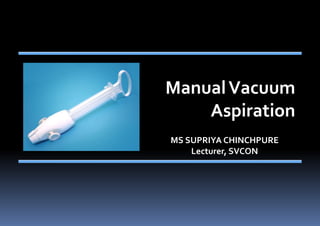
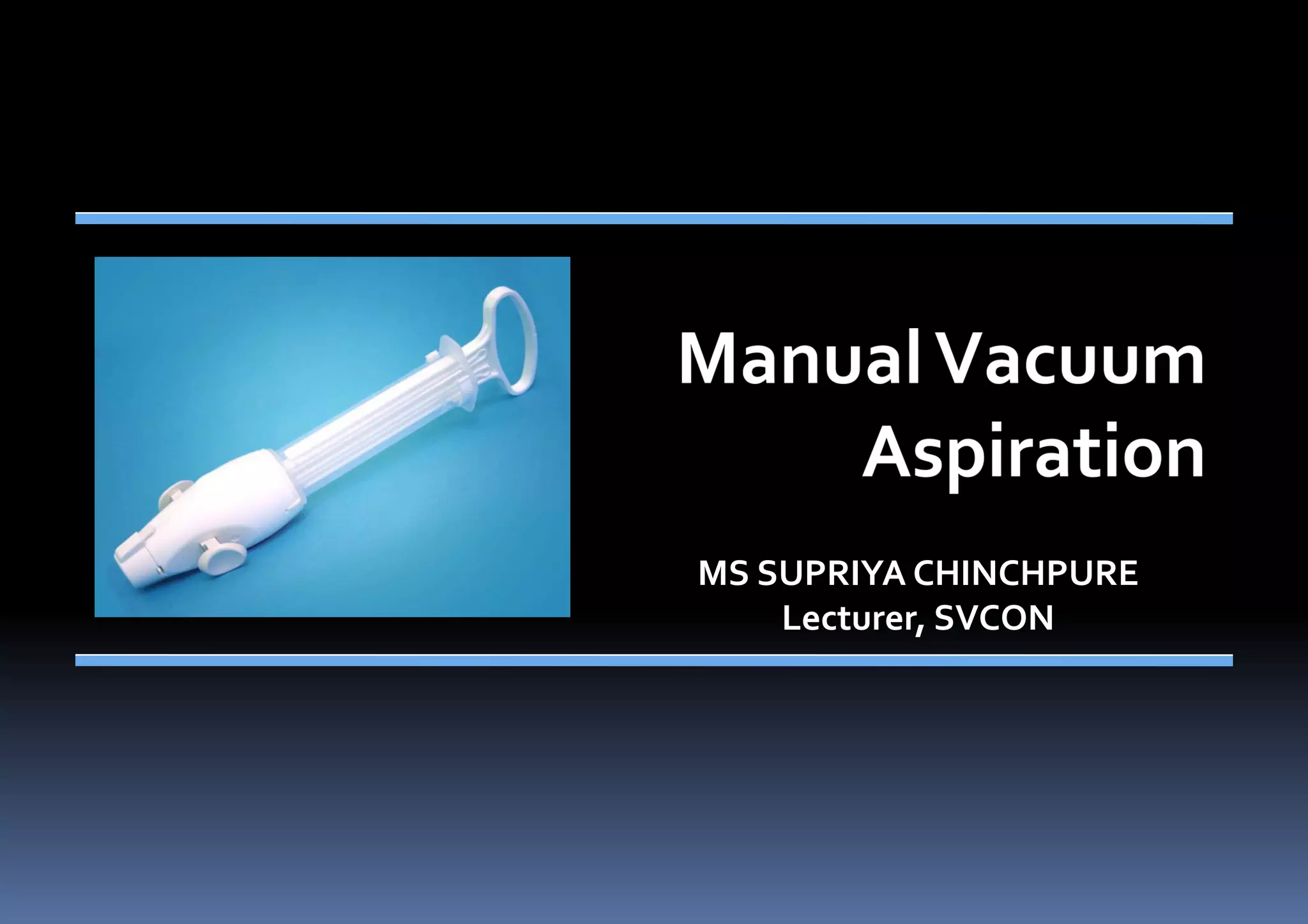
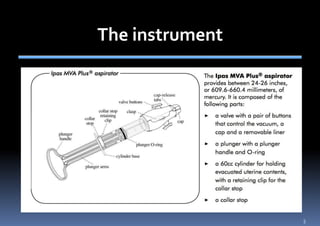
Double valve syringe
5
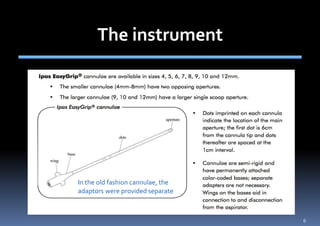
In the old fashion cannulae, the
adaptors were provided separate
6
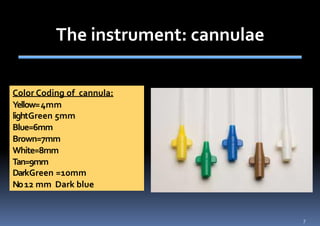
Color Coding of cannula:
Yellow=4mm
lightGreen 5mm
Blue=6mm
Brown=7mm
White=8mm
Tan=9mm
DarkGreen =10mm
No12 mm Dark blue
7
10
9
10
Pain Management during MVA
 Women’s responses to pain vary.
 Goal: reduce pain and anxiety, minimize risk.
 Plan should be based on woman’s individual needs and
preferences.
 Plan should be created by woman and provider.
 Psychological pain: anxiety, fear, apprehension
 Cervical pain due to dilatation.
 Uterine cramping due to manipulation.
Timing:
 Drug must be most effective at the time of the procedure.
 Administer drugs 30 to 45 minutes before the procedure.
Non- Pharmacological
 Gentle, respectful
interaction and
communication
 Verbal support and
reassurance
 Gentle, smooth
operative technique
 Can supplement but
not replace
medications
Pharmacological
 Anxiolytics /sedatives
relieve anxiety
(Diazepam).
 Analgesics relieve pain
(Ibuproffein).
 General anesthesia
should be reserved for
extreme cases
(paracervical block
using lidocaine ).
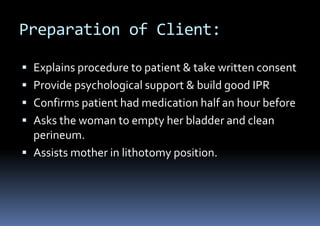
Preparation of Client:
 Explains procedure to patient & take written consent
 Provide psychological support & build good IPR
 Confirms patient had medication half an hour before
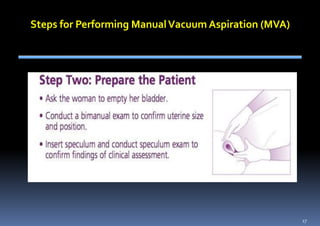
 Asks the woman to empty her bladder and clean
perineum.
 Assists mother in lithotomy position.
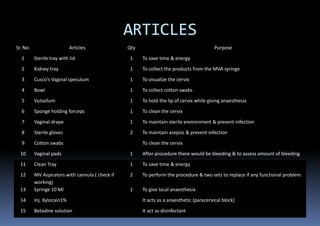
ARTICLES
Sr. No. Articles Qty Purpose
1 Sterile tray with lid 1 To save time & energy
2 Kidney tray 1 To collect the products from the MVA syringe
3 Cusco’s Vagi al speculu 1 To visualize the cervix
4 Bowl 1 To collect cotton swabs
5 Vulsellum 1 To hold the lip of cervix while giving anaesthesia
6 Sponge holding forceps 1 To clean the cervix
7 Vaginal drape 1 To maintain sterile environment & prevent infection
8 Sterile gloves 2 To maintain asepsis & prevent infection
9 Cotton swabs To clean the cervix
10 Vaginal pads 1 After procedure there would be bleeding & to assess amount of bleeding
11 Clean Tray 1 To save time & energy
12 MV Aspirators with cannula ( check if
working)
2 To perform the procedure & two sets to replace if any functional problem.
13 Syringe 10 Ml 1 To give local anaesthesia
14 Inj. Xylocain1% It acts as a anaesthetic (paracervical block)
15 Betadine solution It act as disinfectant
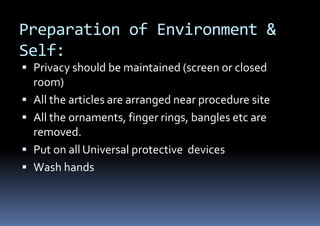
Preparation of Environment &
Self:
 Privacy should be maintained (screen or closed
room)
 All the articles are arranged near procedure site
 All the ornaments, finger rings, bangles etc are
removed.
 Put on all Universal protective devices
 Wash hands
16
17
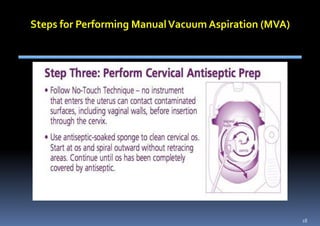
18
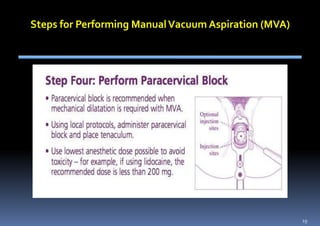
19
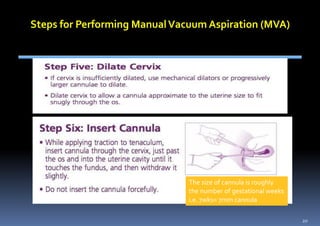
The size of cannula is roughly
the number of gestational weeks
i.e. 7wks= 7mm cannula
20
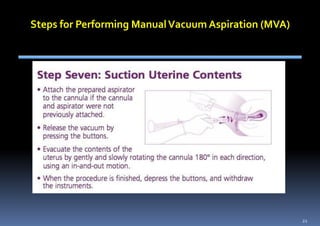
21
22
20
24
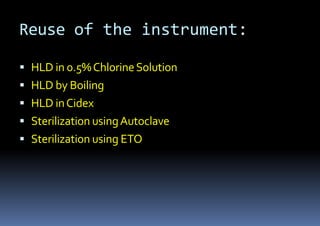
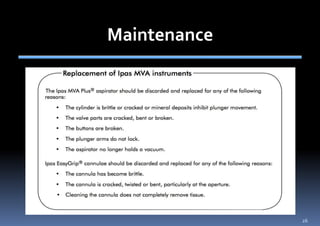
Reuse of the instrument:
 HLD in 0.5%ChlorineSolution
 HLD by Boiling
 HLD inCidex
 Sterilization usingAutoclave
 Sterilization using ETO
26
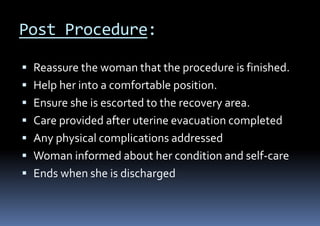
Post Procedure:
 Reassure the woman that the procedure is finished.
 Help her into a comfortable position.
 Ensure she is escorted to the recovery area.
 Care provided after uterine evacuation completed
 Any physical complications addressed
 Woman informed about her condition and self-care
 Ends when she is discharged
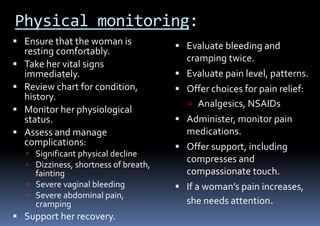
Physical monitoring:
 Ensure that the woman is
resting comfortably.
 Take her vital signs
immediately.
 Review chart for condition,
history.
 Monitor her physiological
status.
 Assess and manage
complications:
 Significant physical decline
 Dizziness, shortness of breath,
fainting
 Severe vaginal bleeding
 Severe abdominal pain,
cramping
 Support her recovery.
 Evaluate bleeding and
cramping twice.
 Evaluate pain level, patterns.
 Offer choices for pain relief:
 Analgesics, NSAIDs
 Administer, monitor pain
medications.
 Offer support, including
compresses and
compassionate touch.
 If a woman’s pain increases,
she needs attention.
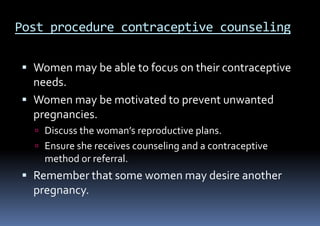
Post procedure contraceptive counseling
 Women may be able to focus on their contraceptive
needs.
 Women may be motivated to prevent unwanted
pregnancies.
 Discuss the woman’s reproductive plans.
 Ensure she receives counseling and a contraceptive
method or referral.
 Remember that some women may desire another
pregnancy.
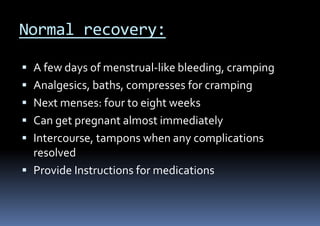
Normal recovery:
 A few days of menstrual-like bleeding, cramping
 Analgesics, baths, compresses for cramping
 Next menses: four to eight weeks
 Can get pregnant almost immediately
 Intercourse, tampons when any complications
resolved
 Provide Instructions for medications
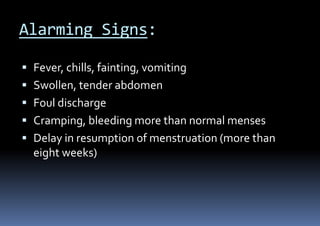
Alarming Signs:
 Fever, chills, fainting, vomiting
 Swollen, tender abdomen
 Foul discharge
 Cramping, bleeding more than normal menses
 Delay in resumption of menstruation (more than
eight weeks)
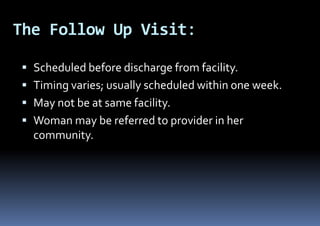
The Follow Up Visit:
 Scheduled before discharge from facility.
 Timing varies; usually scheduled within one week.
 May not be at same facility.
 Woman may be referred to provider in her
community.
33

Manual vaccum Aspiration

  • 1.
  • 2.
  • 3.
  • 4.
  • 5.
  • 6.
    In the oldfashion cannulae, the adaptors were provided separate 6
  • 7.
    Color Coding ofcannula: Yellow=4mm lightGreen 5mm Blue=6mm Brown=7mm White=8mm Tan=9mm DarkGreen =10mm No12 mm Dark blue 7
  • 8.
  • 9.
  • 10.
  • 11.
    Pain Management duringMVA  Women’s responses to pain vary.  Goal: reduce pain and anxiety, minimize risk.  Plan should be based on woman’s individual needs and preferences.  Plan should be created by woman and provider.  Psychological pain: anxiety, fear, apprehension  Cervical pain due to dilatation.  Uterine cramping due to manipulation. Timing:  Drug must be most effective at the time of the procedure.  Administer drugs 30 to 45 minutes before the procedure.
  • 12.
    Non- Pharmacological  Gentle,respectful interaction and communication  Verbal support and reassurance  Gentle, smooth operative technique  Can supplement but not replace medications Pharmacological  Anxiolytics /sedatives relieve anxiety (Diazepam).  Analgesics relieve pain (Ibuproffein).  General anesthesia should be reserved for extreme cases (paracervical block using lidocaine ).
  • 13.
    Preparation of Client: Explains procedure to patient & take written consent  Provide psychological support & build good IPR  Confirms patient had medication half an hour before  Asks the woman to empty her bladder and clean perineum.  Assists mother in lithotomy position.
  • 14.
    ARTICLES Sr. No. ArticlesQty Purpose 1 Sterile tray with lid 1 To save time & energy 2 Kidney tray 1 To collect the products from the MVA syringe 3 Cusco’s Vagi al speculu 1 To visualize the cervix 4 Bowl 1 To collect cotton swabs 5 Vulsellum 1 To hold the lip of cervix while giving anaesthesia 6 Sponge holding forceps 1 To clean the cervix 7 Vaginal drape 1 To maintain sterile environment & prevent infection 8 Sterile gloves 2 To maintain asepsis & prevent infection 9 Cotton swabs To clean the cervix 10 Vaginal pads 1 After procedure there would be bleeding & to assess amount of bleeding 11 Clean Tray 1 To save time & energy 12 MV Aspirators with cannula ( check if working) 2 To perform the procedure & two sets to replace if any functional problem. 13 Syringe 10 Ml 1 To give local anaesthesia 14 Inj. Xylocain1% It acts as a anaesthetic (paracervical block) 15 Betadine solution It act as disinfectant
  • 15.
    Preparation of Environment& Self:  Privacy should be maintained (screen or closed room)  All the articles are arranged near procedure site  All the ornaments, finger rings, bangles etc are removed.  Put on all Universal protective devices  Wash hands
  • 16.
  • 17.
  • 18.
  • 19.
  • 20.
    The size ofcannula is roughly the number of gestational weeks i.e. 7wks= 7mm cannula 20
  • 21.
  • 22.
  • 23.
  • 24.
  • 25.
    Reuse of theinstrument:  HLD in 0.5%ChlorineSolution  HLD by Boiling  HLD inCidex  Sterilization usingAutoclave  Sterilization using ETO
  • 26.
  • 27.
    Post Procedure:  Reassurethe woman that the procedure is finished.  Help her into a comfortable position.  Ensure she is escorted to the recovery area.  Care provided after uterine evacuation completed  Any physical complications addressed  Woman informed about her condition and self-care  Ends when she is discharged
  • 28.
    Physical monitoring:  Ensurethat the woman is resting comfortably.  Take her vital signs immediately.  Review chart for condition, history.  Monitor her physiological status.  Assess and manage complications:  Significant physical decline  Dizziness, shortness of breath, fainting  Severe vaginal bleeding  Severe abdominal pain, cramping  Support her recovery.  Evaluate bleeding and cramping twice.  Evaluate pain level, patterns.  Offer choices for pain relief:  Analgesics, NSAIDs  Administer, monitor pain medications.  Offer support, including compresses and compassionate touch.  If a woman’s pain increases, she needs attention.
  • 29.
    Post procedure contraceptivecounseling  Women may be able to focus on their contraceptive needs.  Women may be motivated to prevent unwanted pregnancies.  Discuss the woman’s reproductive plans.  Ensure she receives counseling and a contraceptive method or referral.  Remember that some women may desire another pregnancy.
  • 30.
    Normal recovery:  Afew days of menstrual-like bleeding, cramping  Analgesics, baths, compresses for cramping  Next menses: four to eight weeks  Can get pregnant almost immediately  Intercourse, tampons when any complications resolved  Provide Instructions for medications
  • 31.
    Alarming Signs:  Fever,chills, fainting, vomiting  Swollen, tender abdomen  Foul discharge  Cramping, bleeding more than normal menses  Delay in resumption of menstruation (more than eight weeks)
  • 32.
    The Follow UpVisit:  Scheduled before discharge from facility.  Timing varies; usually scheduled within one week.  May not be at same facility.  Woman may be referred to provider in her community.
  • 33.