BOOSTING SKILLSETS:
INCREASING THE EMPLOYABILITY OF THE YOUTH
SCOPE OF THE PROBLEM
•More than 80% of Indians do not possess identifiable marketable skills.
•Even educated students are finding it difficult to get jobs.
•There is an imbalance between interests, talents, abilities and qualifications when it comes to selecting a
career path, consequently leading to low job satisfaction.
•Indian employers are finding it difficult to reach equilibrium where their expectations from employees meet
the existing supply of qualified human resources.
CAUSES OF THE PROBLEM
•Lack of optimal utilization of abundant Indian population towards national and economic growth.
•High dependency on jobs is leading to decline in self- employment and development of entrepreneurial skills.
•Lack of vocational training.
•Lack of practical implementation of theoretical educational knowledge.
REASONS FOR SELECTING THIS TOPIC
•Being a part of a population which primarily comprises of the youth, it has been observed that majority of
young Indians get diffracted when it comes to opting a career, eventually leading to landing in a job/
profession mismatching their aptitude.
•By raising this issue, we would like to activate and energize this young India towards more specific and
productive avenues of employment that would improve the national economic indicators.
•The main agenda while dealing with this issue would be convert this underutilized Indian workforce into
profitable assets for the country.
PROBLEM
PROPOSED SOLUTION
•Setting up Indian Institute of Para- profession al and Vocational
Training(IIPV).
•Paraprofessional is a job title given to persons in various occupational
fields, who are trained to assist professionals but do not themselves
have professional licensure.
•Vocational education would impart practical knowledge that would be
based on employment/ occupation.
IIPV
•Setting up Skill Development Authority of India
•An organization that helps a person identify his marketable skill setsSDAI
•MTCs would be temporary setups that would conduct workshops for
agriculture and utility skill development.
MTC
• IIPV would provide certification courses in fields like healthcare, law and
accountancy & finance and other vocational courses.
• These certification courses would require lesser time and money as compared to
professional courses for Chartered Accountancy, Medicine and Law.
• The institute would also impart vocational training that would include courses in
community services, fashion, travel & tourism, design, textiles, etc.
• Minimum Qualification for Para-professional courses: The candidate must have
cleared higher secondary education. (XII)
• Minimum Qualification for other vocational courses: The candidate must have
cleared senior secondary education.(X)
• There would be one IIP built in every state according to the discretion of the
governing body.
• Faculty: For the initial years, retired professionals , industry veterans and well
qualified experts from their respective fields would be approached.
• Organizing guest lectures , workshops and other interactive sessions with industry
experts would also be on the agenda.
• BUDGET: IIPVs will be setup in the country, requiring higher capital outlay. They will
be self sufficient in some years. IIPs will be in the line of institutes like IITs and IIMs.
IIPV- Indian Institute of Para-profession and Vocational Training
IMPLEMENTATION
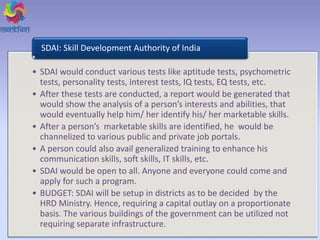
• SDAI would conduct various tests like aptitude tests, psychometric
tests, personality tests, interest tests, IQ tests, EQ tests, etc.
• After these tests are conducted, a report would be generated that
would show the analysis of a person’s interests and abilities, that
would eventually help him/ her identify his/ her marketable skills.
• After a person’s marketable skills are identified, he would be
channelized to various public and private job portals.
• A person could also avail generalized training to enhance his
communication skills, soft skills, IT skills, etc.
• SDAI would be open to all. Anyone and everyone could come and
apply for such a program.
• BUDGET: SDAI will be setup in districts as to be decided by the
HRD Ministry. Hence, requiring a capital outlay on a proportionate
basis. The various buildings of the government can be utilized not
requiring separate infrastructure.
SDAI: Skill Development Authority of India
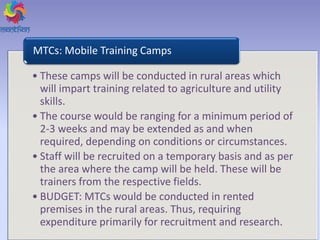
• These camps will be conducted in rural areas which
will impart training related to agriculture and utility
skills.
• The course would be ranging for a minimum period of
2-3 weeks and may be extended as and when
required, depending on conditions or circumstances.
• Staff will be recruited on a temporary basis and as per
the area where the camp will be held. These will be
trainers from the respective fields.
• BUDGET: MTCs would be conducted in rented
premises in the rural areas. Thus, requiring
expenditure primarily for recruitment and research.
MTCs: Mobile Training Camps
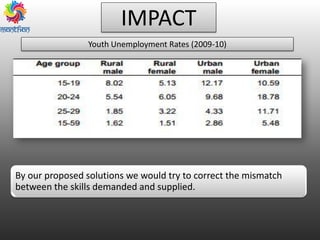
By our proposed solutions we would try to correct the mismatch
between the skills demanded and supplied.
IMPACT
Youth Unemployment Rates (2009-10)
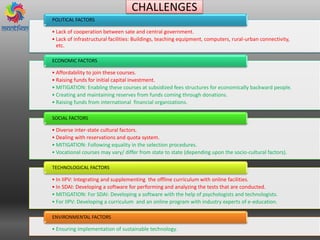
• Lack of cooperation between sate and central government.
• Lack of infrastructural facilities: Buildings, teaching equipment, computers, rural-urban connectivity,
etc.
POLITICAL FACTORS
• Affordability to join these courses.
• Raising funds for initial capital investment.
• MITIGATION: Enabling these courses at subsidized fees structures for economically backward people.
• Creating and maintaining reserves from funds coming through donations.
• Raising funds from international financial organizations.
ECONOMIC FACTORS
• Diverse inter-state cultural factors.
• Dealing with reservations and quota system.
• MITIGATION: Following equality in the selection procedures.
• Vocational courses may vary/ differ from state to state (depending upon the socio-cultural factors).
SOCIAL FACTORS
• In IIPV: Integrating and supplementing the offline curriculum with online facilities.
• In SDAI: Developing a software for performing and analyzing the tests that are conducted.
• MITIGATION: For SDAI: Developing a software with the help of psychologists and technologists.
• For IIPV: Developing a curriculum and an online program with industry experts of e-education.
TECHNOLOGICAL FACTORS
• Ensuring implementation of sustainable technology.
ENVIRONMENTAL FACTORS
CHALLENGES
APPENDIX
Youth Employment and Unemployment: an Indian
Perspective (ILO)
Youth Employment and Unemployment in India (Indira
Gandhi Institute of Development Research, Mumbai
April 2011)
http://en.wikipedia.org/wiki/Paraprofessional

BOOSTING SKILLSETS: INCREASING THE EMPLOYABILITY OF THE YOUTH

  • 1.
    BOOSTING SKILLSETS: INCREASING THEEMPLOYABILITY OF THE YOUTH
  • 2.
    SCOPE OF THEPROBLEM •More than 80% of Indians do not possess identifiable marketable skills. •Even educated students are finding it difficult to get jobs. •There is an imbalance between interests, talents, abilities and qualifications when it comes to selecting a career path, consequently leading to low job satisfaction. •Indian employers are finding it difficult to reach equilibrium where their expectations from employees meet the existing supply of qualified human resources. CAUSES OF THE PROBLEM •Lack of optimal utilization of abundant Indian population towards national and economic growth. •High dependency on jobs is leading to decline in self- employment and development of entrepreneurial skills. •Lack of vocational training. •Lack of practical implementation of theoretical educational knowledge. REASONS FOR SELECTING THIS TOPIC •Being a part of a population which primarily comprises of the youth, it has been observed that majority of young Indians get diffracted when it comes to opting a career, eventually leading to landing in a job/ profession mismatching their aptitude. •By raising this issue, we would like to activate and energize this young India towards more specific and productive avenues of employment that would improve the national economic indicators. •The main agenda while dealing with this issue would be convert this underutilized Indian workforce into profitable assets for the country. PROBLEM
  • 3.
    PROPOSED SOLUTION •Setting upIndian Institute of Para- profession al and Vocational Training(IIPV). •Paraprofessional is a job title given to persons in various occupational fields, who are trained to assist professionals but do not themselves have professional licensure. •Vocational education would impart practical knowledge that would be based on employment/ occupation. IIPV •Setting up Skill Development Authority of India •An organization that helps a person identify his marketable skill setsSDAI •MTCs would be temporary setups that would conduct workshops for agriculture and utility skill development. MTC
  • 4.
    • IIPV wouldprovide certification courses in fields like healthcare, law and accountancy & finance and other vocational courses. • These certification courses would require lesser time and money as compared to professional courses for Chartered Accountancy, Medicine and Law. • The institute would also impart vocational training that would include courses in community services, fashion, travel & tourism, design, textiles, etc. • Minimum Qualification for Para-professional courses: The candidate must have cleared higher secondary education. (XII) • Minimum Qualification for other vocational courses: The candidate must have cleared senior secondary education.(X) • There would be one IIP built in every state according to the discretion of the governing body. • Faculty: For the initial years, retired professionals , industry veterans and well qualified experts from their respective fields would be approached. • Organizing guest lectures , workshops and other interactive sessions with industry experts would also be on the agenda. • BUDGET: IIPVs will be setup in the country, requiring higher capital outlay. They will be self sufficient in some years. IIPs will be in the line of institutes like IITs and IIMs. IIPV- Indian Institute of Para-profession and Vocational Training IMPLEMENTATION
  • 5.
    • SDAI wouldconduct various tests like aptitude tests, psychometric tests, personality tests, interest tests, IQ tests, EQ tests, etc. • After these tests are conducted, a report would be generated that would show the analysis of a person’s interests and abilities, that would eventually help him/ her identify his/ her marketable skills. • After a person’s marketable skills are identified, he would be channelized to various public and private job portals. • A person could also avail generalized training to enhance his communication skills, soft skills, IT skills, etc. • SDAI would be open to all. Anyone and everyone could come and apply for such a program. • BUDGET: SDAI will be setup in districts as to be decided by the HRD Ministry. Hence, requiring a capital outlay on a proportionate basis. The various buildings of the government can be utilized not requiring separate infrastructure. SDAI: Skill Development Authority of India
  • 6.
    • These campswill be conducted in rural areas which will impart training related to agriculture and utility skills. • The course would be ranging for a minimum period of 2-3 weeks and may be extended as and when required, depending on conditions or circumstances. • Staff will be recruited on a temporary basis and as per the area where the camp will be held. These will be trainers from the respective fields. • BUDGET: MTCs would be conducted in rented premises in the rural areas. Thus, requiring expenditure primarily for recruitment and research. MTCs: Mobile Training Camps
  • 7.
    By our proposedsolutions we would try to correct the mismatch between the skills demanded and supplied. IMPACT Youth Unemployment Rates (2009-10)
  • 8.
    • Lack ofcooperation between sate and central government. • Lack of infrastructural facilities: Buildings, teaching equipment, computers, rural-urban connectivity, etc. POLITICAL FACTORS • Affordability to join these courses. • Raising funds for initial capital investment. • MITIGATION: Enabling these courses at subsidized fees structures for economically backward people. • Creating and maintaining reserves from funds coming through donations. • Raising funds from international financial organizations. ECONOMIC FACTORS • Diverse inter-state cultural factors. • Dealing with reservations and quota system. • MITIGATION: Following equality in the selection procedures. • Vocational courses may vary/ differ from state to state (depending upon the socio-cultural factors). SOCIAL FACTORS • In IIPV: Integrating and supplementing the offline curriculum with online facilities. • In SDAI: Developing a software for performing and analyzing the tests that are conducted. • MITIGATION: For SDAI: Developing a software with the help of psychologists and technologists. • For IIPV: Developing a curriculum and an online program with industry experts of e-education. TECHNOLOGICAL FACTORS • Ensuring implementation of sustainable technology. ENVIRONMENTAL FACTORS CHALLENGES
  • 9.
    APPENDIX Youth Employment andUnemployment: an Indian Perspective (ILO) Youth Employment and Unemployment in India (Indira Gandhi Institute of Development Research, Mumbai April 2011) http://en.wikipedia.org/wiki/Paraprofessional