TEAM OF NSIT, SRCC, Army Institute of Technology PUNE
NSIT: SRCC: AIT, Pune
Akshay Pruthi akshay.151291@gmail.com 9873515973
Abhay Pruthi pruthi.abhaynsit@gmail.com 8373933175
Anurag Khetan anurag.srcc@gmail.com 9953735275
Harsh Dandona harshdandona@gmail.com 7276535894
Akasnha Gupta akanksha.gsrcc@gmail.com 9953517100
Manthan Topic: Building SkillSets
Bridging the gap
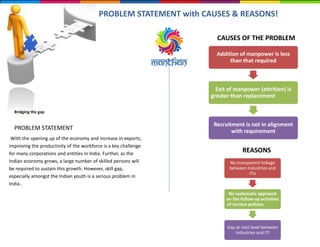
PROBLEM STATEMENT
With the opening up of the economy and increase in exports,
improving the productivity of the workforce is a key challenge
for many corporations and entities in India. Further, as the
Indian economy grows, a large number of skilled persons will
be required to sustain this growth. However, skill gap,
especially amongst the Indian youth is a serious problem in
India..
Addition of manpower is less
than that required
Exit of manpower (attrition) is
greater than replacement
Recruitment is not in alignment
with requirement
CAUSES OF THE PROBLEM
REASONS
No transparent linkage
between Industries and
ITIs
No systematic approach
on the follow-up activities
of various policies.
Gap at root level between
Industries and ITI
PROBLEM STATEMENT with CAUSES & REASONS!
Skill Development in India
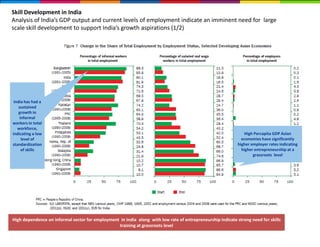
Analysis of India’s GDP output and current levels of employment indicate an imminent need for large
scale skill development to support India’s growth aspirations (1/2)
India has had a
sustained
growth in
informal
workers in total
workforce,
indicating a low
level of
standardization
of skills
High Percapita GDP Asian
economies have significantly
higher employer rates indicating
higher entrepreneurship at a
grassroots level
High dependence on informal sector for employment in India along with low rate of entrepreneurship indicate strong need for skills
training at grassroots level
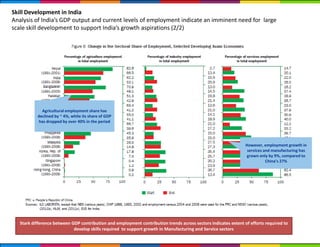
Stark difference between GDP contribution and employment contribution trends across sectors indicates extent of efforts required to
develop skills required to support growth in Manufacturing and Service sectors
Agricultural employment share has
declined by ~ 4%, while its share of GDP
has dropped by over 40% in the period
However, employment growth in
services and manufacturing has
grown only by 9%, compared to
China’s 27%
Skill Development in India
Analysis of India’s GDP output and current levels of employment indicate an imminent need for large
scale skill development to support India’s growth aspirations (2/2)
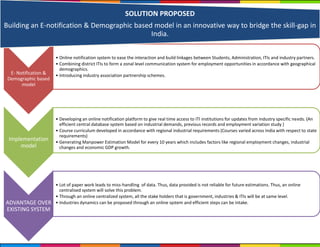
E- Notification &
Demographic based
model
• Online notification system to ease the interaction and build linkages between Students, Administration, ITIs and industry partners.
• Combining district ITIs to form a zonal level communication system for employment opportunities in accordance with geographical
demographics.
• Introducing industry association partnership schemes.
Implementation
model
• Developing an online notification platform to give real time access to ITI institutions for updates from industry specific needs. (An
efficient central database system based on industrial demands, previous records and employment variation study )
• Course curriculum developed in accordance with regional industrial requirements (Courses varied across India with respect to state
requirements)
• Generating Manpower Estimation Model for every 10 years which includes factors like regional employment changes, industrial
changes and economic GDP growth.
ADVANTAGE OVER
EXISTING SYSTEM
• Lot of paper work leads to miss-handling of data. Thus, data provided is not reliable for future estimations. Thus, an online
centralised system will solve this problem.
• Through an online centralized system, all the stake holders that is government, industries & ITIs will be at same level.
• Industries dynamics can be proposed through an online system and efficient steps can be intake.
SOLUTION PROPOSED
Building an E-notification & Demographic based model in an innovative way to bridge the skill-gap in
India.
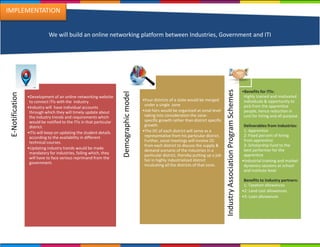
We will build an online networking platform between Industries, Government and ITI
E-Notification
•Development of an online networking website
to connect ITIs with the industry.
•Industry will have individual accounts
through which they will timely update about
the industry trends and requirements which
would be notified to the ITIs in that particular
district.
•ITIs will keep on updating the student details
according to the availability in different
technical courses.
•Updating industry trends would be made
mandatory for industries, failing which, they
will have to face serious reprimand from the
government.
Demographicmodel
•Four districts of a state would be merged
under a single zone
•Job fairs would be organized at zonal level
taking into consideration the zone-
specific growth rather than district specific
growth.
•The DC of each district will serve as a
representative from his particular district.
Further, zonal meetings will involve DC
from each district to discuss the supply &
demand scenario of the industries in a
particular district, thereby putting up a job
fair in highly industrialized district
inculcating all the districts of that zone.
IndustryAssociationProgramSchemes
•Benefits for ITIs:
Highly trained and motivated
individuals & opportunity to
pick from the apprentice
people, hence reduction in
cost for hiring and all purpose
Deliverables from Industries:
1: Apprentice
2: Fixed percent of hiring
from apprentice
3: Scholarship fund to the
best performer for the
apprentice
•Industrial training and market
dynamics sessions at school
and institute level
Benefits to Industry partners:
1: Taxation allowances
•2: Land cost allowances
•3: Loan allowances
IMPLEMENTATION
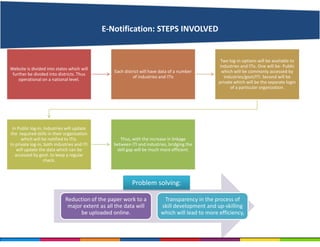
Reduction of the paper work to a
major extent as all the data will
be uploaded online.
Transparency in the process of
skill development and up-skilling
which will lead to more efficiency,
Problem solving:
Website is divided into states which will
further be divided into districts. Thus
operational on a national level.
Each district will have data of a number
of industries and ITIs
Two log-in options will be available to
industries and ITIs. One will be- Public
which will be commonly accessed by
industries/govt/ITI. Second will be
private which will be the separate login
of a particular organization.
In Public log-in, Industries will update
the required skills in their organization
which will be notified to ITIs.
In private log-in, both industries and ITI
will update the data which can be
accessed by govt. to keep a regular
check.
Thus, with the increase in linkage
between ITI and industries, bridging the
skill gap will be much more efficient.
E-Notification: STEPS INVOLVED
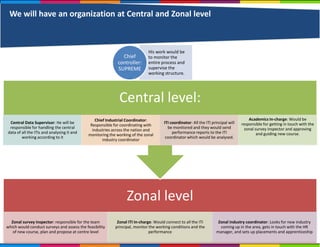
We will have an organization at Central and Zonal level
His work would be
to monitor the
entire process and
supervise the
working structure.
Chief
controller:
SUPREME
Zonal level
Zonal survey inspector: responsible for the team
which would conduct surveys and assess the feasibility
of new course, plan and propose at centre level
Zonal ITI In-charge: Would connect to all the ITI
principal, monitor the working conditions and the
performance
Zonal industry coordinator: Looks for new industry
coming up in the area, gets in touch with the HR
manager, and sets up placements and apprenticeship
Central level:
Central Data Supervisor: He will be
responsible for handling the central
data of all the ITIs and analysing it and
working according to it
Chief Industrial Coordinator:
Responsible for coordinating with
industries across the nation and
monitoring the working of the zonal
industry coordinator
ITI coordinator: All the ITI principal will
be monitored and they would send
performance reports to the ITI
coordinator which would be analysed.
Academics In-charge: Would be
responsible for getting in touch with the
zonal survey inspector and approving
and guiding new course.
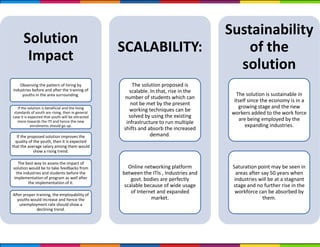
Solution
Impact
Observing the pattern of hiring by
industries before and after the training of
youths in the area surrounding.
If the solution is beneficial and the living
standards of youth are rising, then in general
case it is expected that youth will be attracted
more towards the ITI and hence the new
enrolments should go up.
If the proposed solution improves the
quality of the youth, then it is expected
that the average salary among them would
show a rising trend.
The best way to assess the impact of
solution would be to take feedbacks from
the industries and students before the
implementation of program as well after
the implementation of it.
After proper training, the employability of
youths would increase and hence the
unemployment rate should show a
declining trend.
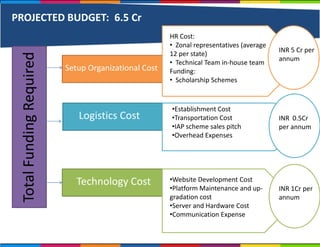
SCALABILITY:
The solution proposed is
scalable. In that, rise in the
number of students which can
not be met by the present
working techniques can be
solved by using the existing
infrastructure to run multiple
shifts and absorb the increased
demand.
Online networking platform
between the ITIs , Industries and
govt. bodies are perfectly
scalable because of wide usage
of Internet and expanded
market.
Sustainability
of the
solution
The solution is sustainable in
itself since the economy is in a
growing stage and the new
workers added to the work force
are being employed by the
expanding industries.
Saturation point may be seen in
areas after say 50 years when
industries will be at a stagnant
stage and no further rise in the
workforce can be absorbed by
them.
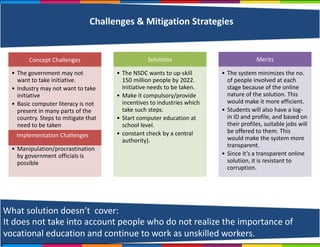
TotalFundingRequired
Setup Organizational Cost
Logistics Cost
Technology Cost •Website Development Cost
•Platform Maintenance and up-
gradation cost
•Server and Hardware Cost
•Communication Expense
•Establishment Cost
•Transportation Cost
•IAP scheme sales pitch
•Overhead Expenses
HR Cost:
• Zonal representatives (average
12 per state)
• Technical Team in-house team
Funding:
• Scholarship Schemes
INR 1Cr per
annum
INR 0.5Cr
per annum
INR 5 Cr per
annum
PROJECTED BUDGET: 6.5 Cr
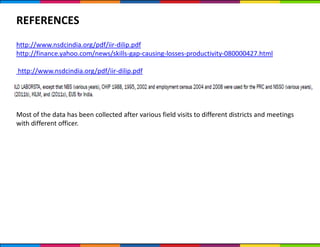
Concept Challenges
• The government may not
want to take initiative.
• Industry may not want to take
initiative
• Basic computer literacy is not
present in many parts of the
country. Steps to mitigate that
need to be taken
• Manipulation/procrastination
by government officials is
possible
Solutions
• The NSDC wants to up-skill
150 million people by 2022.
Initiative needs to be taken.
• Make it compulsory/provide
incentives to industries which
take such steps.
• Start computer education at
school level.
• constant check by a central
authority).
Merits
• The system minimizes the no.
of people involved at each
stage because of the online
nature of the solution. This
would make it more efficient.
• Students will also have a log-
in ID and profile, and based on
their profiles, suitable jobs will
be offered to them. This
would make the system more
transparent.
• Since it’s a transparent online
solution, it is resistant to
corruption.
It does not take into account people who do not realize the importance of
vocational education and continue to work as unskilled workers.
What solution doesn’t cover:
Challenges & Mitigation Strategies
Implementation Challenges
REFERENCES
http://www.nsdcindia.org/pdf/iir-dilip.pdf
http://finance.yahoo.com/news/skills-gap-causing-losses-productivity-080000427.html
http://www.nsdcindia.org/pdf/iir-dilip.pdf
Most of the data has been collected after various field visits to different districts and meetings
with different officer.

Tarang

  • 1.
    TEAM OF NSIT,SRCC, Army Institute of Technology PUNE NSIT: SRCC: AIT, Pune Akshay Pruthi akshay.151291@gmail.com 9873515973 Abhay Pruthi pruthi.abhaynsit@gmail.com 8373933175 Anurag Khetan anurag.srcc@gmail.com 9953735275 Harsh Dandona harshdandona@gmail.com 7276535894 Akasnha Gupta akanksha.gsrcc@gmail.com 9953517100 Manthan Topic: Building SkillSets
  • 2.
    Bridging the gap PROBLEMSTATEMENT With the opening up of the economy and increase in exports, improving the productivity of the workforce is a key challenge for many corporations and entities in India. Further, as the Indian economy grows, a large number of skilled persons will be required to sustain this growth. However, skill gap, especially amongst the Indian youth is a serious problem in India.. Addition of manpower is less than that required Exit of manpower (attrition) is greater than replacement Recruitment is not in alignment with requirement CAUSES OF THE PROBLEM REASONS No transparent linkage between Industries and ITIs No systematic approach on the follow-up activities of various policies. Gap at root level between Industries and ITI PROBLEM STATEMENT with CAUSES & REASONS!
  • 3.
    Skill Development inIndia Analysis of India’s GDP output and current levels of employment indicate an imminent need for large scale skill development to support India’s growth aspirations (1/2) India has had a sustained growth in informal workers in total workforce, indicating a low level of standardization of skills High Percapita GDP Asian economies have significantly higher employer rates indicating higher entrepreneurship at a grassroots level High dependence on informal sector for employment in India along with low rate of entrepreneurship indicate strong need for skills training at grassroots level
  • 4.
    Stark difference betweenGDP contribution and employment contribution trends across sectors indicates extent of efforts required to develop skills required to support growth in Manufacturing and Service sectors Agricultural employment share has declined by ~ 4%, while its share of GDP has dropped by over 40% in the period However, employment growth in services and manufacturing has grown only by 9%, compared to China’s 27% Skill Development in India Analysis of India’s GDP output and current levels of employment indicate an imminent need for large scale skill development to support India’s growth aspirations (2/2)
  • 5.
    E- Notification & Demographicbased model • Online notification system to ease the interaction and build linkages between Students, Administration, ITIs and industry partners. • Combining district ITIs to form a zonal level communication system for employment opportunities in accordance with geographical demographics. • Introducing industry association partnership schemes. Implementation model • Developing an online notification platform to give real time access to ITI institutions for updates from industry specific needs. (An efficient central database system based on industrial demands, previous records and employment variation study ) • Course curriculum developed in accordance with regional industrial requirements (Courses varied across India with respect to state requirements) • Generating Manpower Estimation Model for every 10 years which includes factors like regional employment changes, industrial changes and economic GDP growth. ADVANTAGE OVER EXISTING SYSTEM • Lot of paper work leads to miss-handling of data. Thus, data provided is not reliable for future estimations. Thus, an online centralised system will solve this problem. • Through an online centralized system, all the stake holders that is government, industries & ITIs will be at same level. • Industries dynamics can be proposed through an online system and efficient steps can be intake. SOLUTION PROPOSED Building an E-notification & Demographic based model in an innovative way to bridge the skill-gap in India.
  • 6.
    We will buildan online networking platform between Industries, Government and ITI E-Notification •Development of an online networking website to connect ITIs with the industry. •Industry will have individual accounts through which they will timely update about the industry trends and requirements which would be notified to the ITIs in that particular district. •ITIs will keep on updating the student details according to the availability in different technical courses. •Updating industry trends would be made mandatory for industries, failing which, they will have to face serious reprimand from the government. Demographicmodel •Four districts of a state would be merged under a single zone •Job fairs would be organized at zonal level taking into consideration the zone- specific growth rather than district specific growth. •The DC of each district will serve as a representative from his particular district. Further, zonal meetings will involve DC from each district to discuss the supply & demand scenario of the industries in a particular district, thereby putting up a job fair in highly industrialized district inculcating all the districts of that zone. IndustryAssociationProgramSchemes •Benefits for ITIs: Highly trained and motivated individuals & opportunity to pick from the apprentice people, hence reduction in cost for hiring and all purpose Deliverables from Industries: 1: Apprentice 2: Fixed percent of hiring from apprentice 3: Scholarship fund to the best performer for the apprentice •Industrial training and market dynamics sessions at school and institute level Benefits to Industry partners: 1: Taxation allowances •2: Land cost allowances •3: Loan allowances IMPLEMENTATION
  • 7.
    Reduction of thepaper work to a major extent as all the data will be uploaded online. Transparency in the process of skill development and up-skilling which will lead to more efficiency, Problem solving: Website is divided into states which will further be divided into districts. Thus operational on a national level. Each district will have data of a number of industries and ITIs Two log-in options will be available to industries and ITIs. One will be- Public which will be commonly accessed by industries/govt/ITI. Second will be private which will be the separate login of a particular organization. In Public log-in, Industries will update the required skills in their organization which will be notified to ITIs. In private log-in, both industries and ITI will update the data which can be accessed by govt. to keep a regular check. Thus, with the increase in linkage between ITI and industries, bridging the skill gap will be much more efficient. E-Notification: STEPS INVOLVED
  • 8.
    We will havean organization at Central and Zonal level His work would be to monitor the entire process and supervise the working structure. Chief controller: SUPREME Zonal level Zonal survey inspector: responsible for the team which would conduct surveys and assess the feasibility of new course, plan and propose at centre level Zonal ITI In-charge: Would connect to all the ITI principal, monitor the working conditions and the performance Zonal industry coordinator: Looks for new industry coming up in the area, gets in touch with the HR manager, and sets up placements and apprenticeship Central level: Central Data Supervisor: He will be responsible for handling the central data of all the ITIs and analysing it and working according to it Chief Industrial Coordinator: Responsible for coordinating with industries across the nation and monitoring the working of the zonal industry coordinator ITI coordinator: All the ITI principal will be monitored and they would send performance reports to the ITI coordinator which would be analysed. Academics In-charge: Would be responsible for getting in touch with the zonal survey inspector and approving and guiding new course.
  • 9.
    Solution Impact Observing the patternof hiring by industries before and after the training of youths in the area surrounding. If the solution is beneficial and the living standards of youth are rising, then in general case it is expected that youth will be attracted more towards the ITI and hence the new enrolments should go up. If the proposed solution improves the quality of the youth, then it is expected that the average salary among them would show a rising trend. The best way to assess the impact of solution would be to take feedbacks from the industries and students before the implementation of program as well after the implementation of it. After proper training, the employability of youths would increase and hence the unemployment rate should show a declining trend. SCALABILITY: The solution proposed is scalable. In that, rise in the number of students which can not be met by the present working techniques can be solved by using the existing infrastructure to run multiple shifts and absorb the increased demand. Online networking platform between the ITIs , Industries and govt. bodies are perfectly scalable because of wide usage of Internet and expanded market. Sustainability of the solution The solution is sustainable in itself since the economy is in a growing stage and the new workers added to the work force are being employed by the expanding industries. Saturation point may be seen in areas after say 50 years when industries will be at a stagnant stage and no further rise in the workforce can be absorbed by them.
  • 10.
    TotalFundingRequired Setup Organizational Cost LogisticsCost Technology Cost •Website Development Cost •Platform Maintenance and up- gradation cost •Server and Hardware Cost •Communication Expense •Establishment Cost •Transportation Cost •IAP scheme sales pitch •Overhead Expenses HR Cost: • Zonal representatives (average 12 per state) • Technical Team in-house team Funding: • Scholarship Schemes INR 1Cr per annum INR 0.5Cr per annum INR 5 Cr per annum PROJECTED BUDGET: 6.5 Cr
  • 11.
    Concept Challenges • Thegovernment may not want to take initiative. • Industry may not want to take initiative • Basic computer literacy is not present in many parts of the country. Steps to mitigate that need to be taken • Manipulation/procrastination by government officials is possible Solutions • The NSDC wants to up-skill 150 million people by 2022. Initiative needs to be taken. • Make it compulsory/provide incentives to industries which take such steps. • Start computer education at school level. • constant check by a central authority). Merits • The system minimizes the no. of people involved at each stage because of the online nature of the solution. This would make it more efficient. • Students will also have a log- in ID and profile, and based on their profiles, suitable jobs will be offered to them. This would make the system more transparent. • Since it’s a transparent online solution, it is resistant to corruption. It does not take into account people who do not realize the importance of vocational education and continue to work as unskilled workers. What solution doesn’t cover: Challenges & Mitigation Strategies Implementation Challenges
  • 12.