&
___________
_
Kawas is located in Alabel, Sarangani Province a 20 to 25 mins away ride
from the town proper of Gensan. It is a private owned land with abundant
mangroves along its both sides end of the beach, preserved and duly taken cared
of with the joined forces of local government of Sarangani and private owners of
the lands.
Kawas Beach is a beach and is located in Province of South Cotabato,
Soccsksargen, Philippines. The estimate terrain elevation above sea level is 3
metres. Variant forms of spelling for Kawas Beach or in other languages: Kawas
Beach (fil), Kawas Beach.
Latitude: 6°3'43.99"
Longitude: 125°16'33“
Temperature: 27 degree Celsius
Coconut
Name: Talisay Tree
Scientific Name: Terminalia catappa
Talisay Tree is a large tropical tree in the leadwood
tree family, Combretaceae, that grows mainly in the tropical
regions of Asia, Africa, and Australia. The tree grows to 35 m
(115 ft) tall, with an upright, symmetrical crown and horizontal
branches. Terminalia catappa has corky, light fruit that are
dispersed by water. The seed within the fruit is edible when
fully ripe, tasting almost like almond. As the tree gets older, its
crown becomes more flattened to form a spreading, vase
shape. Its branches are distinctively arranged in tiers.
Name: Coconut
Scientific Name: Cocos nucifera
Cocos nucifera is a large palm, growing
up to 30 m (98 ft) tall, with pinnate leaves 4–6 m
(13–20 ft) long, and pinnae 60–90 cm long; old
leaves break away cleanly, leaving
the trunk smooth.
The coconut tree (Cocos nucifera) is a
member of the family Arecaceae (palm family)
and the only species of the genus Cocos. The
term coconut can refer to the whole coconut
palm or the seed, or the fruit, which, botanically,
is a drupe, not a nut.
The coconut is not a nut at all,
but a stone fruit!
Name: Mangrove
Scientific Name: Rhizophora mangle
Mangrove is a shrub or small tree that
grows in coastal saline or brackish water. The
term is also used for tropical coastal
vegetation consisting of such species.
Mangroves occur worldwide in
the tropics and subtropics, mainly
between latitudes 25° N and 25° S.
Mangrove is called as the storm
buffers. It can decrease the effect of
wave and windy action on the
shoreline.
Name: Neem Tree
Scientific Name: Azadirachta indica
Neem Tree is a fast growing tree that
usually reaches a height of 15-20 m, and
under very favorable conditions up to
approximately 30-35 m. The trunk is relatively
short, straight and may reach a girth of 1.5-
3.5 m. The bark is hard fissured or scaly and
whitish-gray to reddish-brown. The sap wood
is grayish-white and the heart wood reddish.
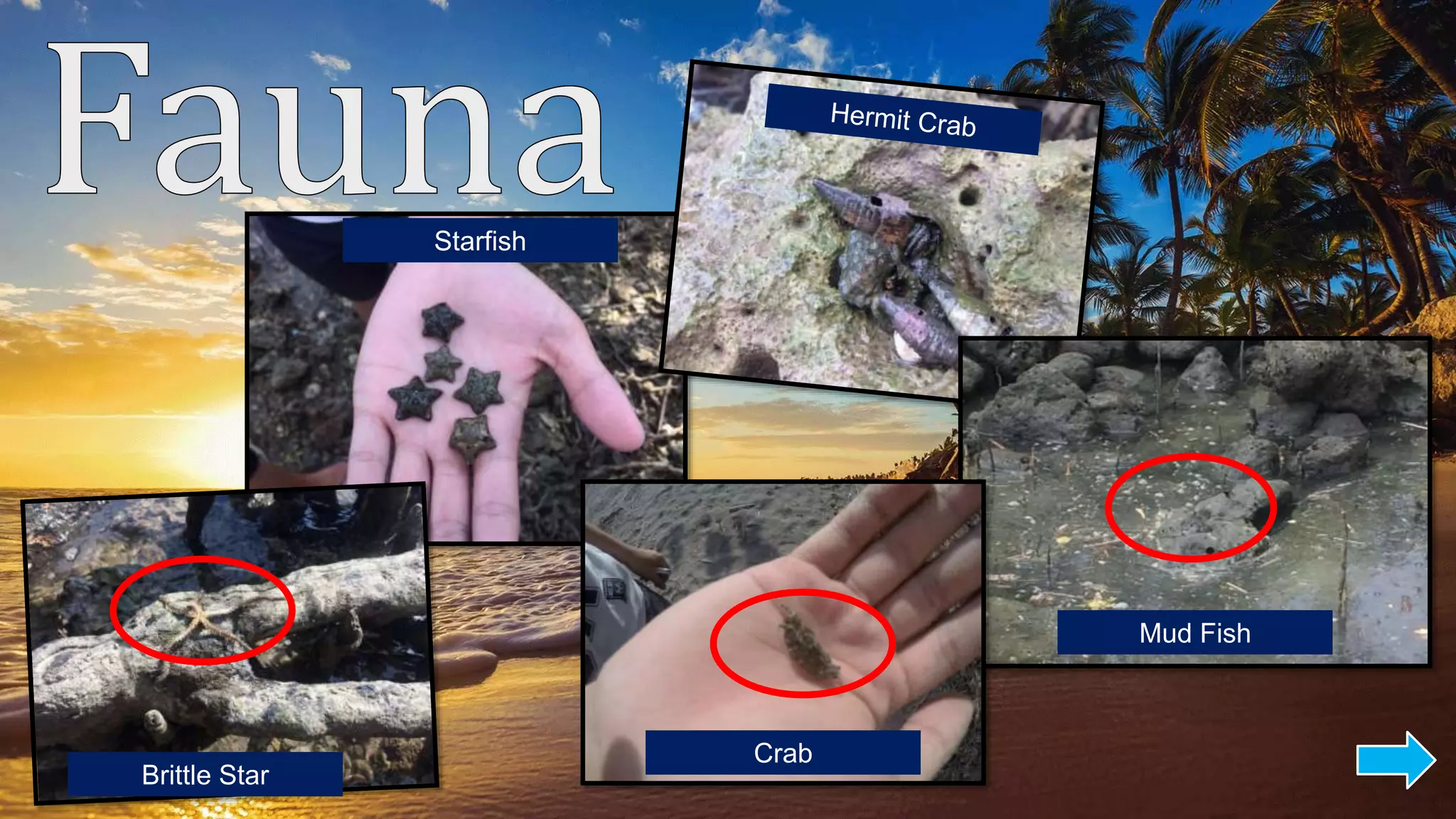
Starfish
Mud Fish
Crab
Brittle Star
Name: Starfish
Scientific Name: Asteroidea
The common starfish normally has five
arms, broad at their base and gradually
tapering to a point at their tips, which are often
turned up slightly. There is a line of short white
spines running along the centre of the aboral
(upper) surface of the arms with low, soft
mounds called papulae on either side.
TYPE: Invertebrates
DIET: Carnivores
AVERAGE LIFE SPAN IN THE WILD: Up to
35 years
SIZE: 4.7 to 9.4 in
WEIGHT: Up to 11 lbs Starfish don’t have blood. Sea stars have a
circulatory system made up primarily of sea
water.
Name: Crab
Scientific Name: Brachyura
Crab a crustacean with a broad
carapace, stalked eyes, and five pairs of
legs, the first pair of which are modified
as pincers. Crabs are abundant on many
shores, especially in the tropics, where
some have become adapted to life on
land.
The largest crab in the world is the giant
Japanese Spider Crab, which can measure up to
13 feet across
Name: Hermit crab
Scientific Name: Paguroidea
The hermit crab is a crustacean, but it is
very different from other crustaceans. While
most crustaceans are covered from head to tail
with a hard exoskeleton, the hermit crab is
missing part of its exoskeleton. The back part
where its abdomen is located, is soft
and squishy. Thus, the minute a hermit
crab molts into an adult, it sets out to find
a shell in which to live. To protect its soft body
the Common Hermit Crab uses shells of a
number of marine snail species. Hermit crabs
often exchange and occasionally fight with other
hermit crabs to conquer better shells.
Hermit crab is nocturnal creature. They hunt
at night!
Name: Mudfish
Scientific Name: Channa striata
An eelongated fish that are able to
survive long periods of drought by burrowing
in the mud. They can swim with an eel-like
motion that allows easy movement through
dense aquatic vegetation. They are brown in
color, they have darker stripes and splotches,
as well as gold flecks.
Mudfish can walk on water!
AMAZING!
Name: Brittle Star
Scientific Name: Ophiuroidea
Brittle stars are sea star cousins that
bury themselves for protection, leaving an arm
or two free to catch bits of food. Sometimes this
attracts a hungry fish but fortunately, a star can't
be tugged out by the arm. The arm snaps off,
and a new one grows from the stump.
They have generally have five long,
slender, whip-like arms which may reach up to
60 cm (24 in) in length on the largest
specimens.
A Starfish in not a fish. They’re actually
related to sand dollars and sea
urchins.
Flora and fauna
Flora and fauna
Flora and fauna
Flora and fauna

Flora and fauna

  • 2.
  • 3.
  • 4.
    Kawas is locatedin Alabel, Sarangani Province a 20 to 25 mins away ride from the town proper of Gensan. It is a private owned land with abundant mangroves along its both sides end of the beach, preserved and duly taken cared of with the joined forces of local government of Sarangani and private owners of the lands. Kawas Beach is a beach and is located in Province of South Cotabato, Soccsksargen, Philippines. The estimate terrain elevation above sea level is 3 metres. Variant forms of spelling for Kawas Beach or in other languages: Kawas Beach (fil), Kawas Beach. Latitude: 6°3'43.99" Longitude: 125°16'33“ Temperature: 27 degree Celsius
  • 7.
  • 8.
    Name: Talisay Tree ScientificName: Terminalia catappa Talisay Tree is a large tropical tree in the leadwood tree family, Combretaceae, that grows mainly in the tropical regions of Asia, Africa, and Australia. The tree grows to 35 m (115 ft) tall, with an upright, symmetrical crown and horizontal branches. Terminalia catappa has corky, light fruit that are dispersed by water. The seed within the fruit is edible when fully ripe, tasting almost like almond. As the tree gets older, its crown becomes more flattened to form a spreading, vase shape. Its branches are distinctively arranged in tiers.
  • 9.
    Name: Coconut Scientific Name:Cocos nucifera Cocos nucifera is a large palm, growing up to 30 m (98 ft) tall, with pinnate leaves 4–6 m (13–20 ft) long, and pinnae 60–90 cm long; old leaves break away cleanly, leaving the trunk smooth. The coconut tree (Cocos nucifera) is a member of the family Arecaceae (palm family) and the only species of the genus Cocos. The term coconut can refer to the whole coconut palm or the seed, or the fruit, which, botanically, is a drupe, not a nut. The coconut is not a nut at all, but a stone fruit!
  • 10.
    Name: Mangrove Scientific Name:Rhizophora mangle Mangrove is a shrub or small tree that grows in coastal saline or brackish water. The term is also used for tropical coastal vegetation consisting of such species. Mangroves occur worldwide in the tropics and subtropics, mainly between latitudes 25° N and 25° S. Mangrove is called as the storm buffers. It can decrease the effect of wave and windy action on the shoreline.
  • 12.
    Name: Neem Tree ScientificName: Azadirachta indica Neem Tree is a fast growing tree that usually reaches a height of 15-20 m, and under very favorable conditions up to approximately 30-35 m. The trunk is relatively short, straight and may reach a girth of 1.5- 3.5 m. The bark is hard fissured or scaly and whitish-gray to reddish-brown. The sap wood is grayish-white and the heart wood reddish.
  • 13.
  • 14.
    Name: Starfish Scientific Name:Asteroidea The common starfish normally has five arms, broad at their base and gradually tapering to a point at their tips, which are often turned up slightly. There is a line of short white spines running along the centre of the aboral (upper) surface of the arms with low, soft mounds called papulae on either side. TYPE: Invertebrates DIET: Carnivores AVERAGE LIFE SPAN IN THE WILD: Up to 35 years SIZE: 4.7 to 9.4 in WEIGHT: Up to 11 lbs Starfish don’t have blood. Sea stars have a circulatory system made up primarily of sea water.
  • 15.
    Name: Crab Scientific Name:Brachyura Crab a crustacean with a broad carapace, stalked eyes, and five pairs of legs, the first pair of which are modified as pincers. Crabs are abundant on many shores, especially in the tropics, where some have become adapted to life on land. The largest crab in the world is the giant Japanese Spider Crab, which can measure up to 13 feet across
  • 16.
    Name: Hermit crab ScientificName: Paguroidea The hermit crab is a crustacean, but it is very different from other crustaceans. While most crustaceans are covered from head to tail with a hard exoskeleton, the hermit crab is missing part of its exoskeleton. The back part where its abdomen is located, is soft and squishy. Thus, the minute a hermit crab molts into an adult, it sets out to find a shell in which to live. To protect its soft body the Common Hermit Crab uses shells of a number of marine snail species. Hermit crabs often exchange and occasionally fight with other hermit crabs to conquer better shells. Hermit crab is nocturnal creature. They hunt at night!
  • 18.
    Name: Mudfish Scientific Name:Channa striata An eelongated fish that are able to survive long periods of drought by burrowing in the mud. They can swim with an eel-like motion that allows easy movement through dense aquatic vegetation. They are brown in color, they have darker stripes and splotches, as well as gold flecks. Mudfish can walk on water! AMAZING!
  • 19.
    Name: Brittle Star ScientificName: Ophiuroidea Brittle stars are sea star cousins that bury themselves for protection, leaving an arm or two free to catch bits of food. Sometimes this attracts a hungry fish but fortunately, a star can't be tugged out by the arm. The arm snaps off, and a new one grows from the stump. They have generally have five long, slender, whip-like arms which may reach up to 60 cm (24 in) in length on the largest specimens. A Starfish in not a fish. They’re actually related to sand dollars and sea urchins.