Mancoosi: bridging communities to improve
         package-based systems

                Roberto Di Cosmo
    University Paris Diderot Paris 7 and INRIA
                    Fossa 2009


              November 18th, 2009
The promise of GNU/Linux distributions

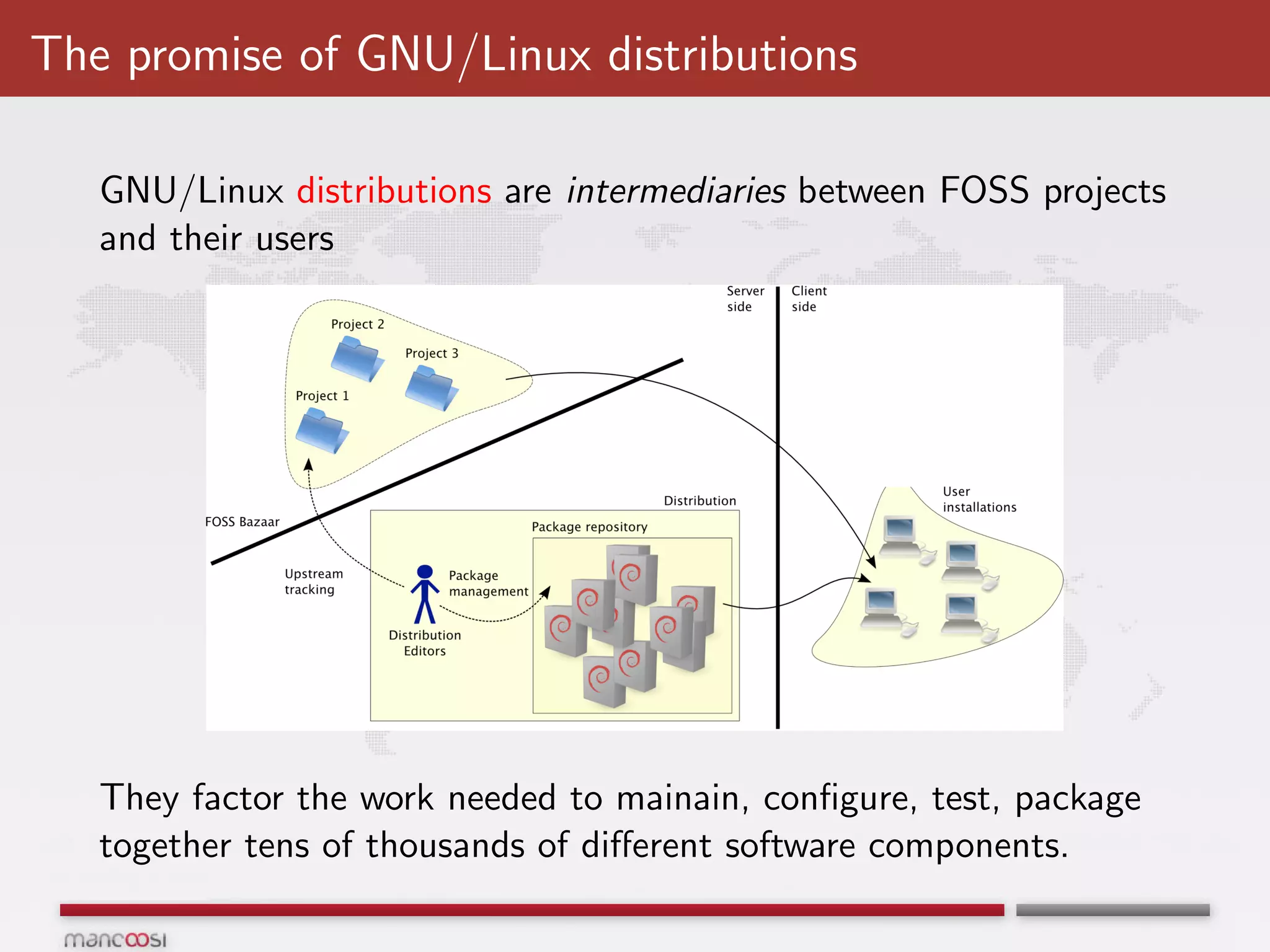
   GNU/Linux distributions are intermediaries between FOSS projects
   and their users


   They factor the work needed to mainain, configure, test, package
   together tens of thousands of different software components.
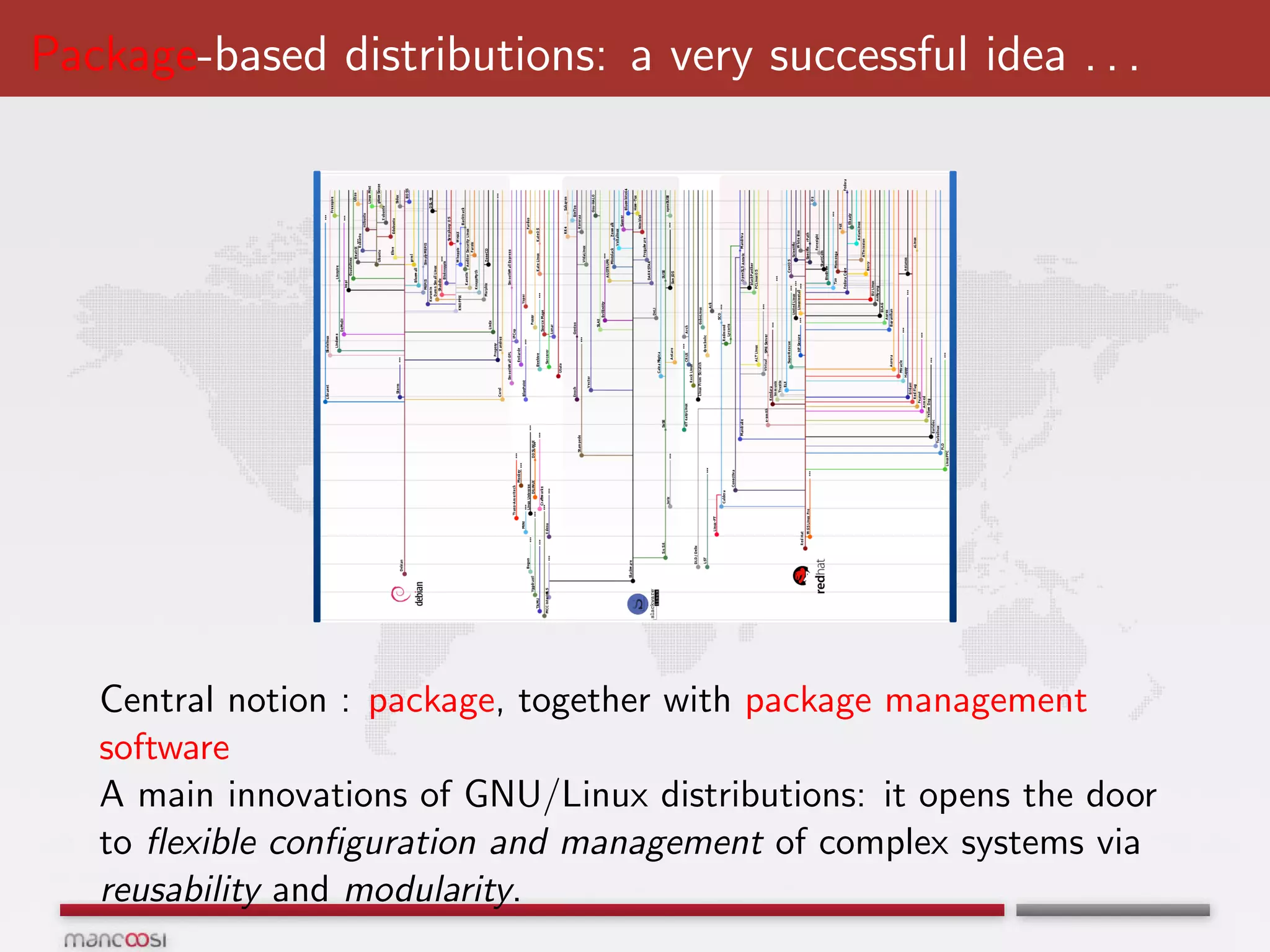
Package-based distributions: a very successful idea . . .


   Central notion : package, together with package management
   software
   A main innovations of GNU/Linux distributions: it opens the door
   to flexible configuration and management of complex systems via
   reusability and modularity.
Package management: a key industrial issue


   A few facts:
       In 2011, 80% of commercial software will contain Open
       Source code. . . 49,7% of critical application come from
       the Open Source world...
                                    Mark Driver (Gartner) sept.07

   A key industrial issue is to build faster, stronger, harder, better,
   more user oriented packaging technology, to master the challenge
   of the Open Source success.
   And yet, surprisingly little has been done in terms of R&D
   specifically related to package technology (as opposed to
   components or web services).
The Challenge of Distributions

   Mandriva, Debian, Ubuntu, and all other distribution editors are
   responsible for maintaining a free software distribution. It is a
   challenging task! (smooth upgrades, automatic dependency
   solving, up to date software . . . )

   Help is needed to build: better infrastructure for package
   maintainers and better package managers for final users.

   Two projects to the rescue:
         EDOS [2004–2007] aim: provide FOSS distribution editors
              with better QA tools
     Mancoosi [2008–2011] aim: provide with better package
              managers to improve their “platform management”
              experiences (upgrade, downgrade)
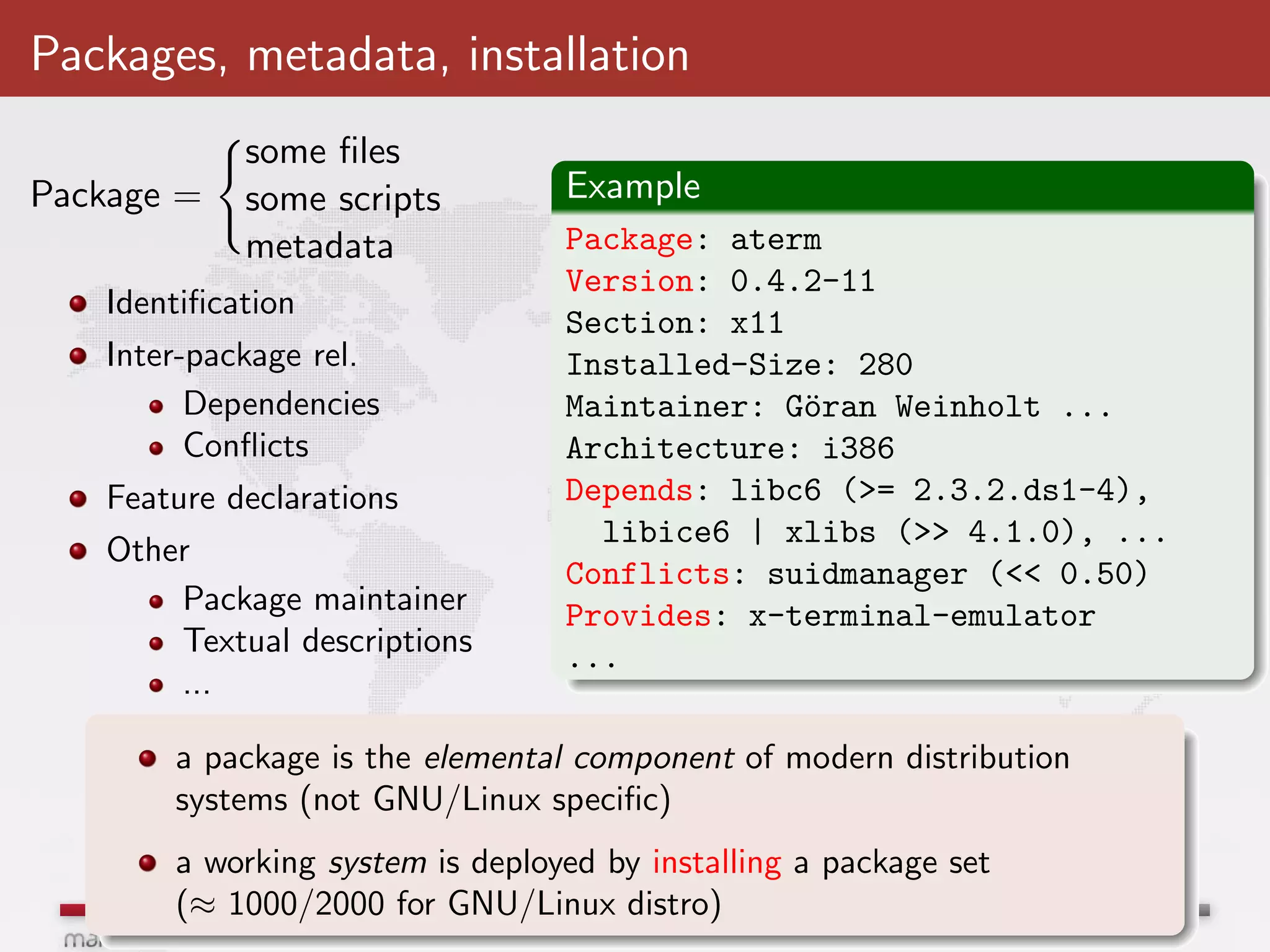
Packages, metadata, installation
            some files
Package =   some scripts         Example
            metadata             Package: aterm
                                 Version: 0.4.2-11
   Identification
                                 Section: x11
   Inter-package rel.            Installed-Size: 280
         Dependencies            Maintainer: G¨ran Weinholt ...
                                              o
         Conflicts                Architecture: i386
   Feature declarations          Depends: libc6 (>= 2.3.2.ds1-4),
                                   libice6 | xlibs (>> 4.1.0), ...
   Other
                                 Conflicts: suidmanager (<< 0.50)
       Package maintainer        Provides: x-terminal-emulator
       Textual descriptions      ...
       ...

       a package is the elemental component of modern distribution
       systems (not GNU/Linux specific)
       a working system is deployed by installing a package set
       (≈ 1000/2000 for GNU/Linux distro)
Sample installation
    Phase                   Trace
    User request            # apt-get install aterm
                            8Reading package lists... Done
                            >
                            >Building dependency tree... Done
                            >
                            >
                            >
                            >The following extra packages will be installed:
                            >
                            >
                            >
                            > libafterimage0
                            >
                            >
                            >
                            >The following NEW packages will be installed
                            <
    Constraint resolution       aterm libafterimage0
                            >
                            >0 upgraded, 2 newly installed, 0 to remove and 1786 not upgraded.
                            >
                            >
                            >Need to get 386kB of archives.
                            >
                            >
                            >
                            >After unpacking 807kB of additional disk space will be used.
                            >
                            >
                            >
                            >Do you want to continue [Y/n]? Y
                            >
                            :
                            8
                            >Get: 1 http://debian.ens-cachan.fr testing/main libafterimage0 2.2.8-2 [301kB]
                            <
    Package retrieval         Get: 2 http://debian.ens-cachan.fr testing/main aterm 1.0.1-4 [84.4kB]
                            >Fetched 386kB in 0s (410kB/s)
                            :
    Pre-configuration        {
                            8Selecting previously deselected package libafterimage0.
                            >
                            >(Reading database ... 294774 files and directories currently installed.)
                            >
                            >
                            <
                              Unpacking libafterimage0 (from .../libafterimage0_2.2.8-2_i386.deb) ...
    Unpacking
                            >Selecting previously deselected package aterm.
                            >
                            >Unpacking aterm (from .../aterm_1.0.1-4_i386.deb) ...
                            >
                            :
                            (
                              Setting up libafterimage0 (2.2.8-2) ...
    Configuration              Setting up aterm (1.0.1-4) ...


          each phase can fail (it actually happens quite often . . . )
          efforts are needed to identify errors as early as possible
One of EDOS outcomes: edos-debcheck

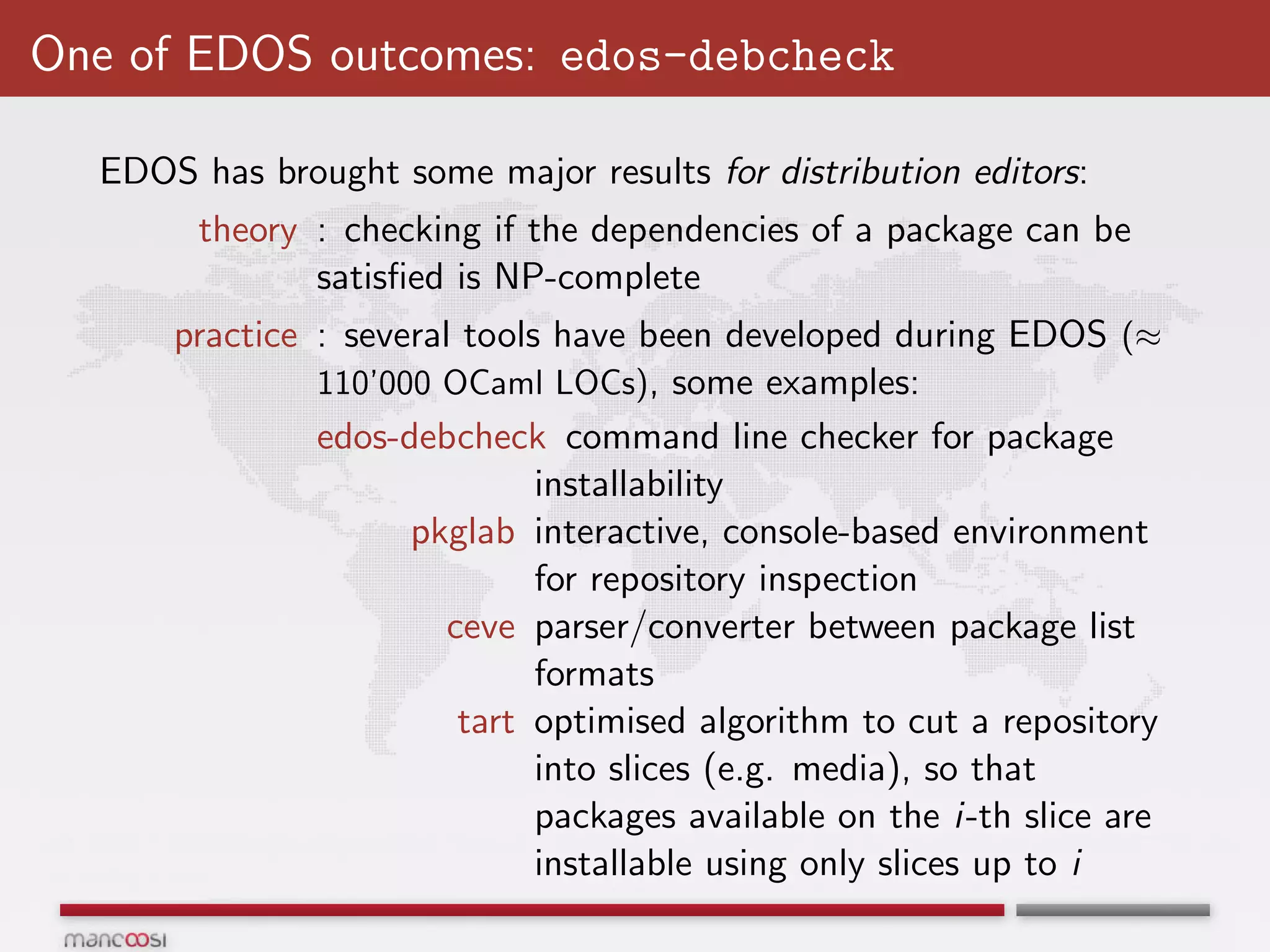
  EDOS has brought some major results for distribution editors:
        theory : checking if the dependencies of a package can be
               satisfied is NP-complete
      practice : several tools have been developed during EDOS (≈
               110’000 OCaml LOCs), some examples:
               edos-debcheck command line checker for package
                              installability
                     pkglab interactive, console-based environment
                              for repository inspection
                        ceve parser/converter between package list
                              formats
                         tart optimised algorithm to cut a repository
                              into slices (e.g. media), so that
                              packages available on the i-th slice are
                              installable using only slices up to i
Focus on edos-debcheck

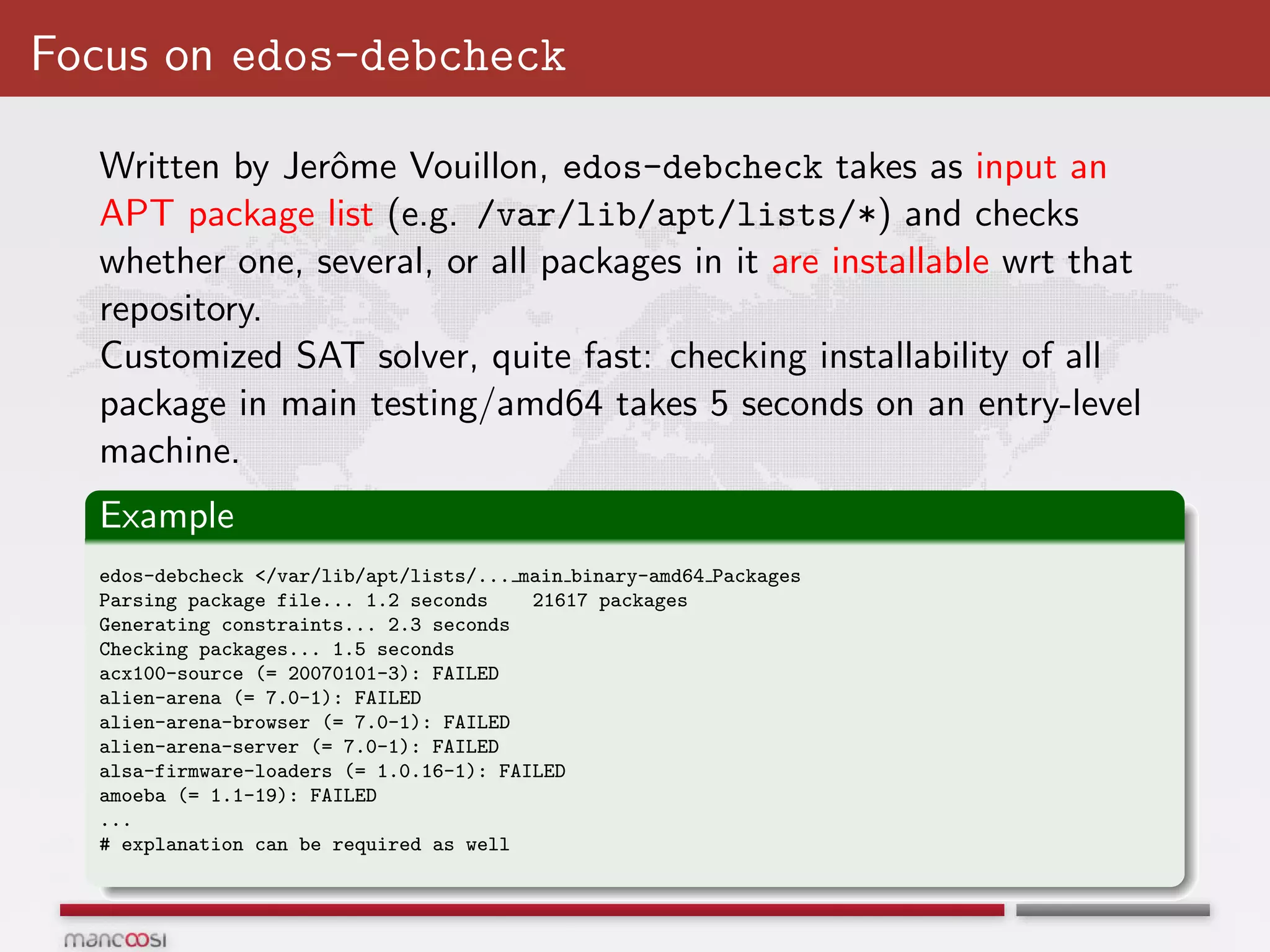
  Written by Jerˆme Vouillon, edos-debcheck takes as input an
                o
  APT package list (e.g. /var/lib/apt/lists/*) and checks
  whether one, several, or all packages in it are installable wrt that
  repository.
  Customized SAT solver, quite fast: checking installability of all
  package in main testing/amd64 takes 5 seconds on an entry-level
  machine.
  Example
  edos-debcheck </var/lib/apt/lists/... main binary-amd64 Packages
  Parsing package file... 1.2 seconds    21617 packages
  Generating constraints... 2.3 seconds
  Checking packages... 1.5 seconds
  acx100-source (= 20070101-3): FAILED
  alien-arena (= 7.0-1): FAILED
  alien-arena-browser (= 7.0-1): FAILED
  alien-arena-server (= 7.0-1): FAILED
  alsa-firmware-loaders (= 1.0.16-1): FAILED
  amoeba (= 1.1-19): FAILED
  ...
  # explanation can be required as well
The Mancoosi project            [ http://www.mancoosi.org ]


       project strep FP7 (2008–2011)
        focus coherence and maintenance of a FOSS distribution
              installation (user point of view)
      Tools for user-side package management (package managers /
      meta-installer)
          installation
          removal
          upgrade
          downgrade
          ...
An upgrade problem example
   # sudo apt-get install debhelper
   Reading Package Lists... Done
   Building Dependency Tree... Done
   The following extra packages will be installed:
    armagetron armagetron-common autoconf bonobo-activation codebreaker debconf
    debconf-i18n debconf-utils dialog esound-common fb-music-high fontconfig
    frozen-bubble-data grepmail gv intltool-debian libaiksaurus-data
    libaiksaurus0c102 libatk1.0-0 libatk1.0-dev libbonobo-activation4 libbonobo2-0
    libbonobo2-common libdb3 libdbd-mysql-perl libdbi-perl libeel2-data libesd0
    ...
   The following packages will be REMOVED:
     autoconf2.13 frozen-bubble frozen-bubble-lib gconf2 gnomemeeting itk3.1-dev
     libbonoboui2-0 libbonoboui2-common libdigest-md5-perl libforms0.89 libgconf2-4
     libgnome2-0 libgnome2-common libgnomeui-0 libgnomevfs2-0 libgnomevfs2-common
     libgtk1.2-dev libgtk2.0-0png3 libgtk2.0-dev libmime-base64-perl
     libpango1.0-dev libsdl-mixer1.2-dev libsdl-perl libsdl-ttf1.2-dev
     libsdl1.2-dev libsmpeg-dev libstorable-perl nautilus tk8.3-dev tktable-dev
     x-window-system x-window-system-core xaw3dg-dev xlib6g xlib6g-dev xlibmesa-dev
     xlibmesa3 xlibosmesa3 xlibs-dev xlibs-pic xpdf xpdf-reader
   The following NEW packages will be installed:
     armagetron-common debconf-i18n fb-music-high fontconfig intltool-debian
     libaiksaurus-data libaiksaurus0c102 libeel2-data libfilehandle-unget-perl
     libfontconfig1 libforms1 libgdbm3 libgnutls7 libgsf-1 libice-dev libice6
     libidl0 liblzo1 libmagick5.5.7 libmail-mbox-messageparser-perl
     libmysqlclient12 libncursesw5 libnet-daemon-perl libnewt0.51 libpaper1
     libplrpc-perl libsdl-console ...

   75 packages upgraded, 80 newly installed, 42 to remove and 858 not upgraded.
   Need to get 67.1MB of archives. After unpacking 26.9MB will be used.
   Do you want to continue? [Y/n] Abort.
Goals, approach and strategy

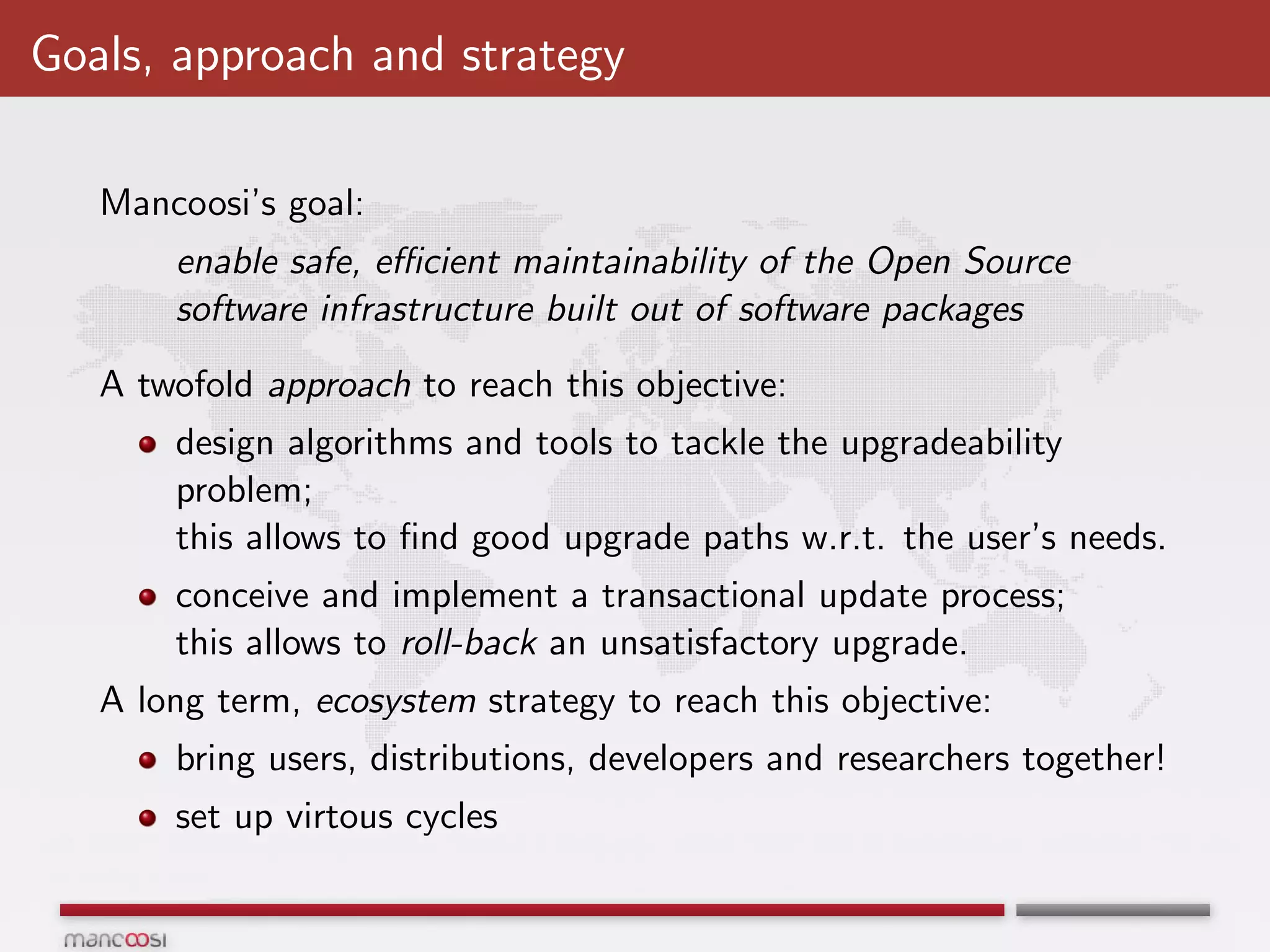
   Mancoosi’s goal:
       enable safe, efficient maintainability of the Open Source
       software infrastructure built out of software packages
   A twofold approach to reach this objective:
       design algorithms and tools to tackle the upgradeability
       problem;
       this allows to find good upgrade paths w.r.t. the user’s needs.
       conceive and implement a transactional update process;
       this allows to roll-back an unsatisfactory upgrade.
   A long term, ecosystem strategy to reach this objective:
       bring users, distributions, developers and researchers together!
       set up virtous cycles
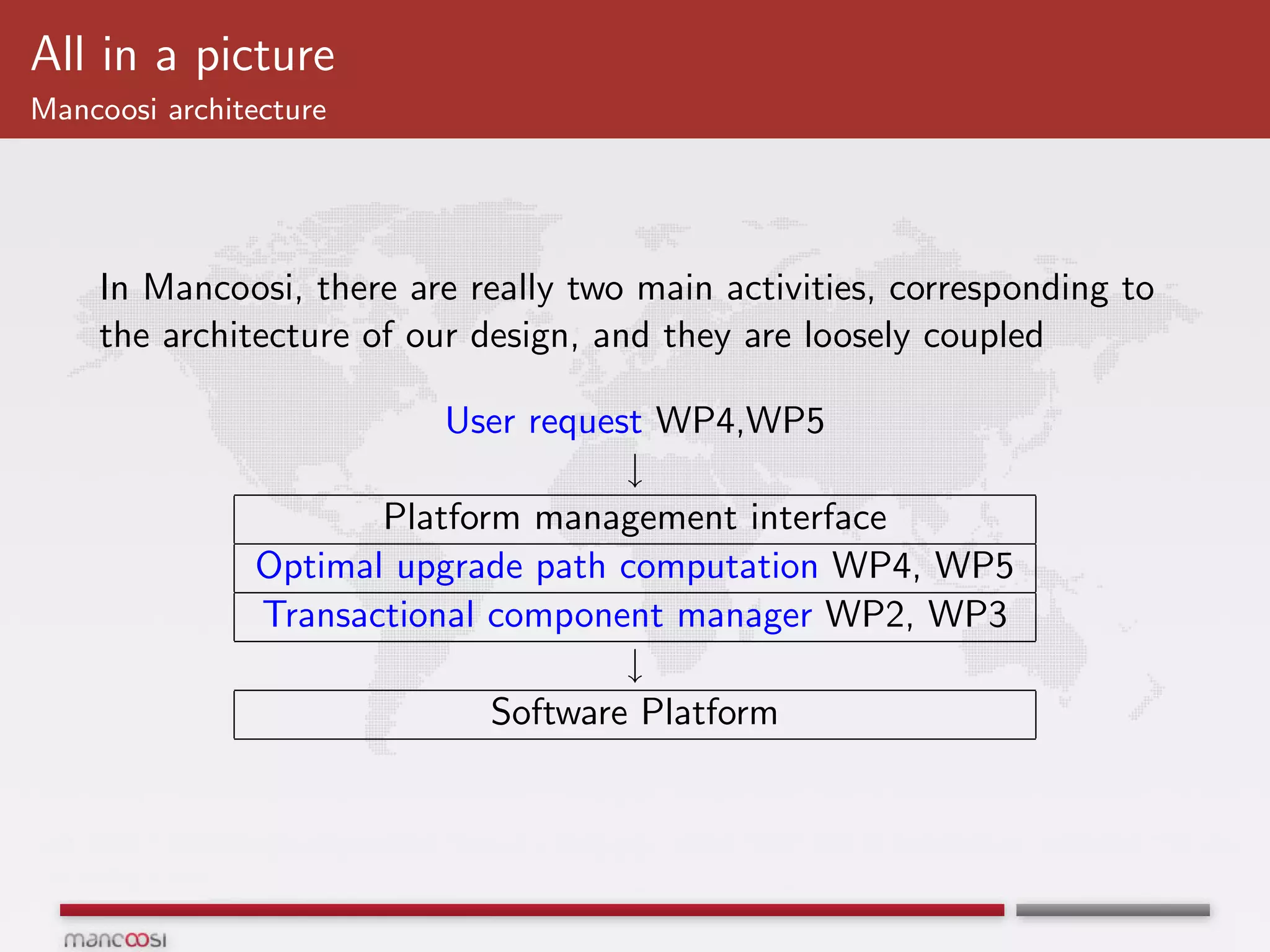
All in a picture
Mancoosi architecture


    In Mancoosi, there are really two main activities, corresponding to
    the architecture of our design, and they are loosely coupled

                          User request WP4,WP5
                                     ↓
                      Platform management interface
               Optimal upgrade path computation WP4, WP5
               Transactional component manager WP2, WP3
                                     ↓
                             Software Platform
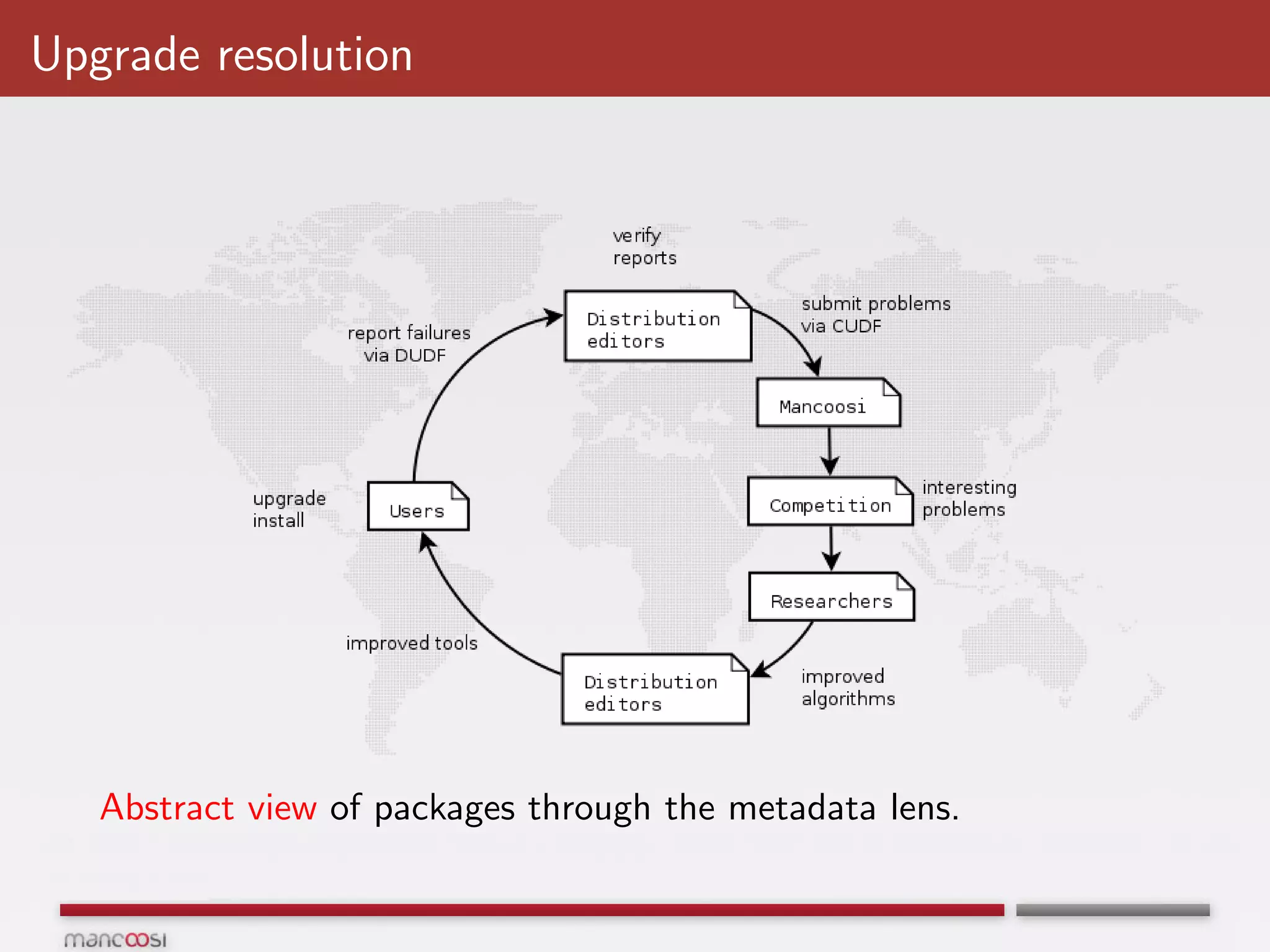
Upgrade resolution


   Abstract view of packages through the metadata lens.
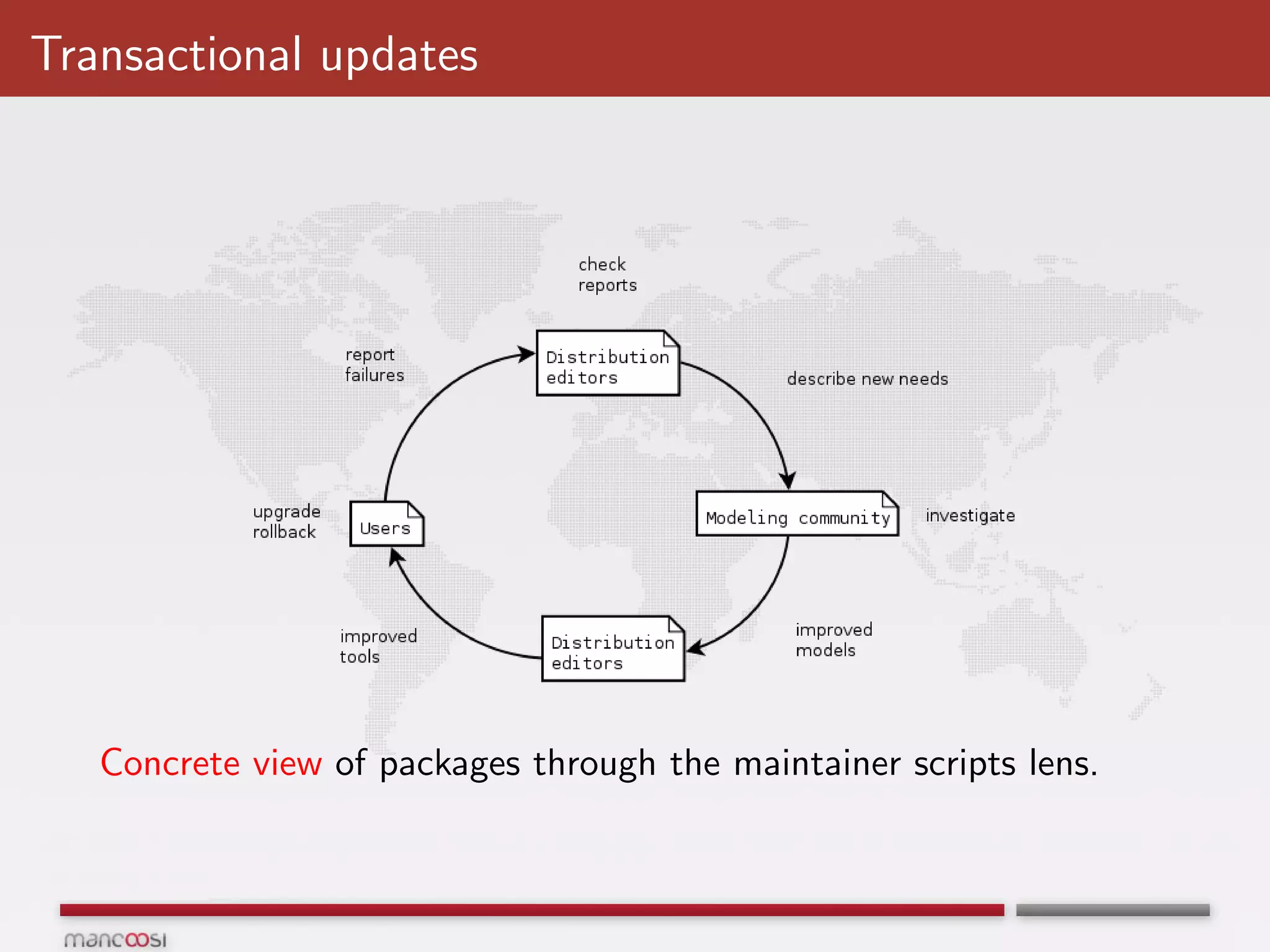
Transactional updates


   Concrete view of packages through the maintainer scripts lens.
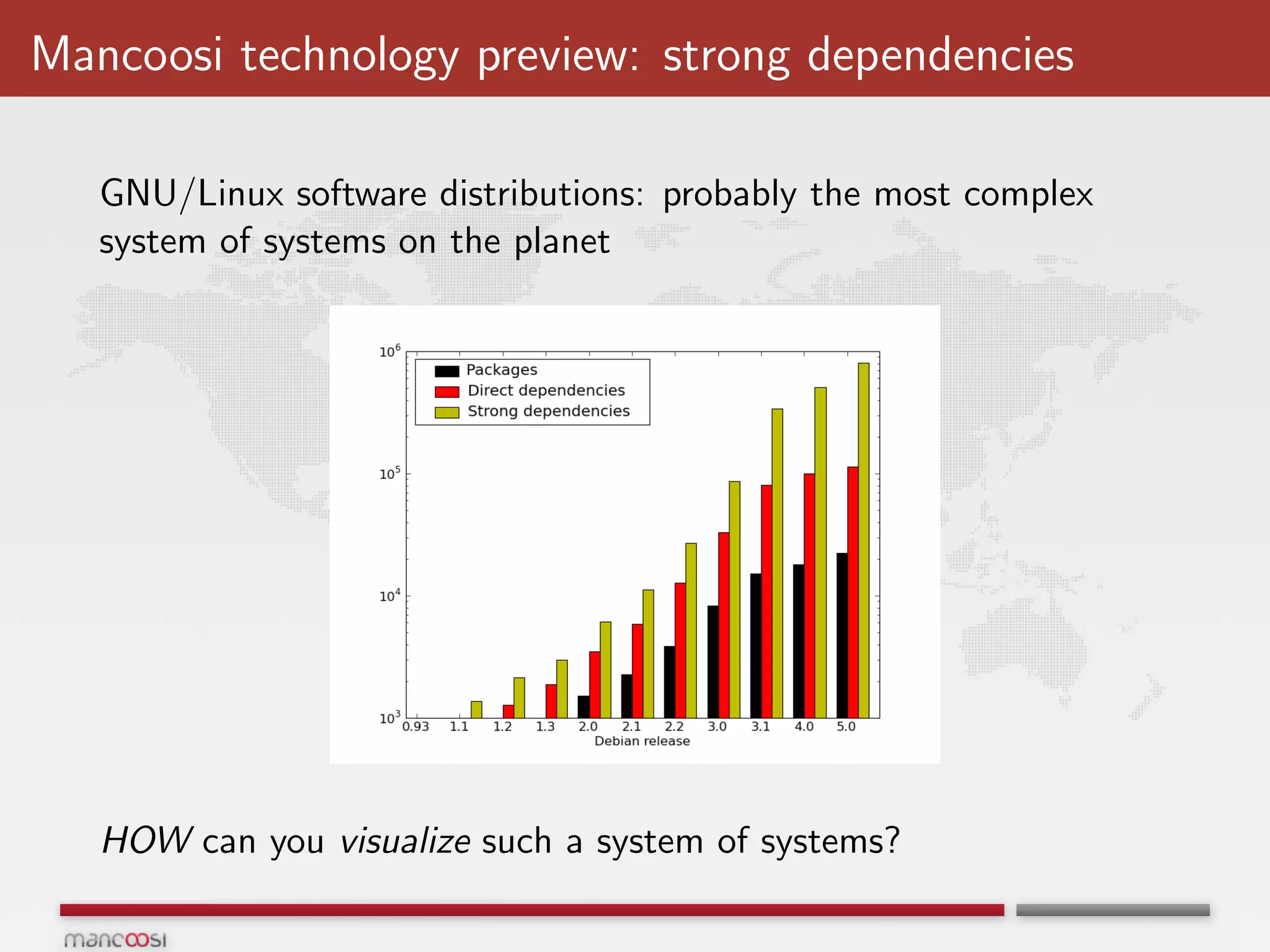
Mancoosi technology preview: strong dependencies

   GNU/Linux software distributions: probably the most complex
   system of systems on the planet


   HOW can you visualize such a system of systems?
Draw a graph, no deep knowledge


   kde-amusements and kde-toys in Debian 3.1 (aka sarge, 2005)
   were unnecessary components, overlapping kde-games and
   kde-edu.They are waste, and are gone today (2009).
   Should be easy to spot, only 244 components are concerned!
   Can you see this fact here?
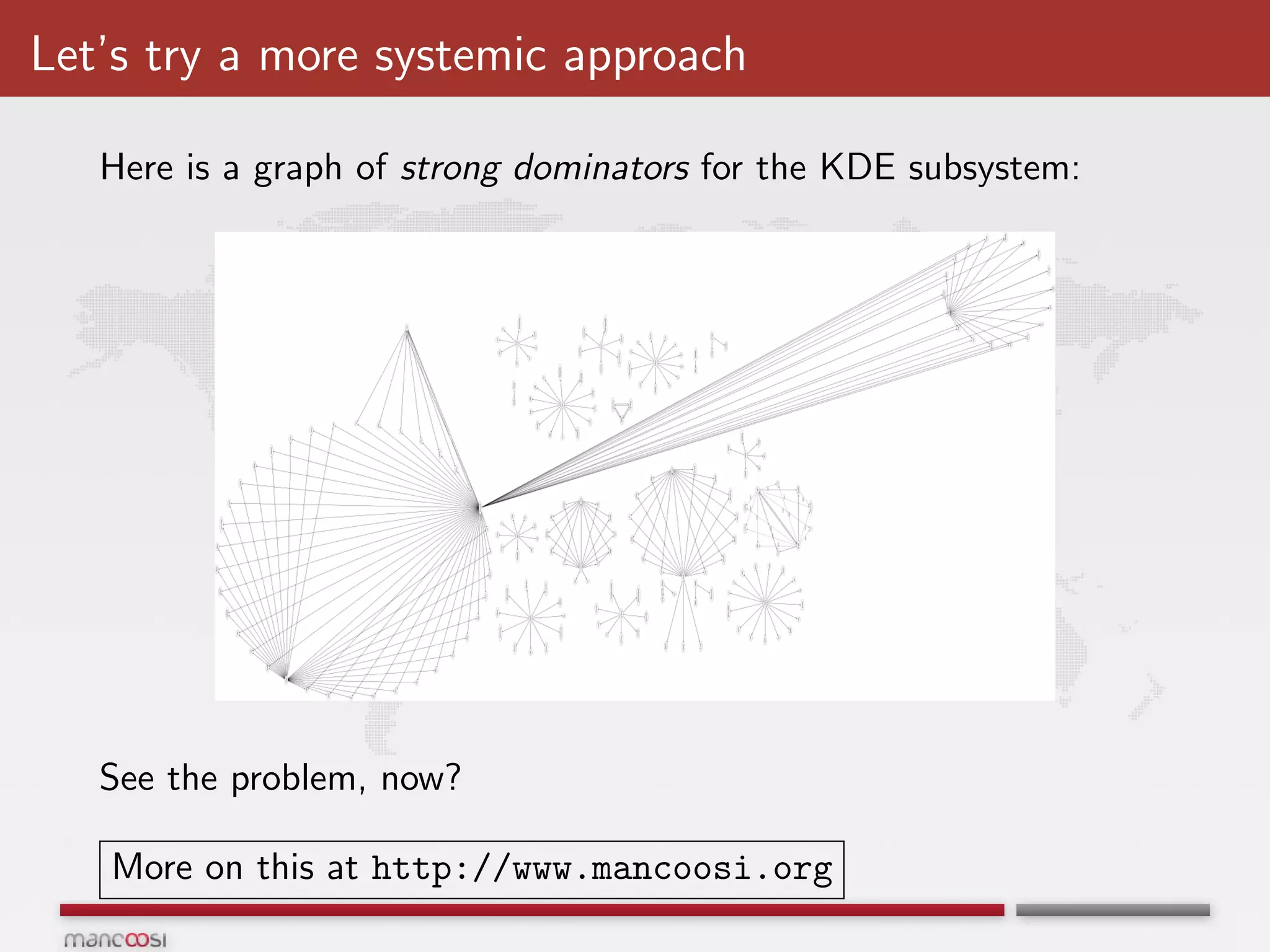
Let’s try a more systemic approach

   Here is a graph of strong dominators for the KDE subsystem:


   See the problem, now?

   More on this at http://www.mancoosi.org
Concluding remark


   Everything developed in Mancoosi is already relevant for some, and
   will be increasingly relevant to all component based technologies
         Linux : packages
        Eclipse : plugins
        Firefox : extensions
          Java : beans
   Web services : predictable service assembly
            ... ...
Project Partners
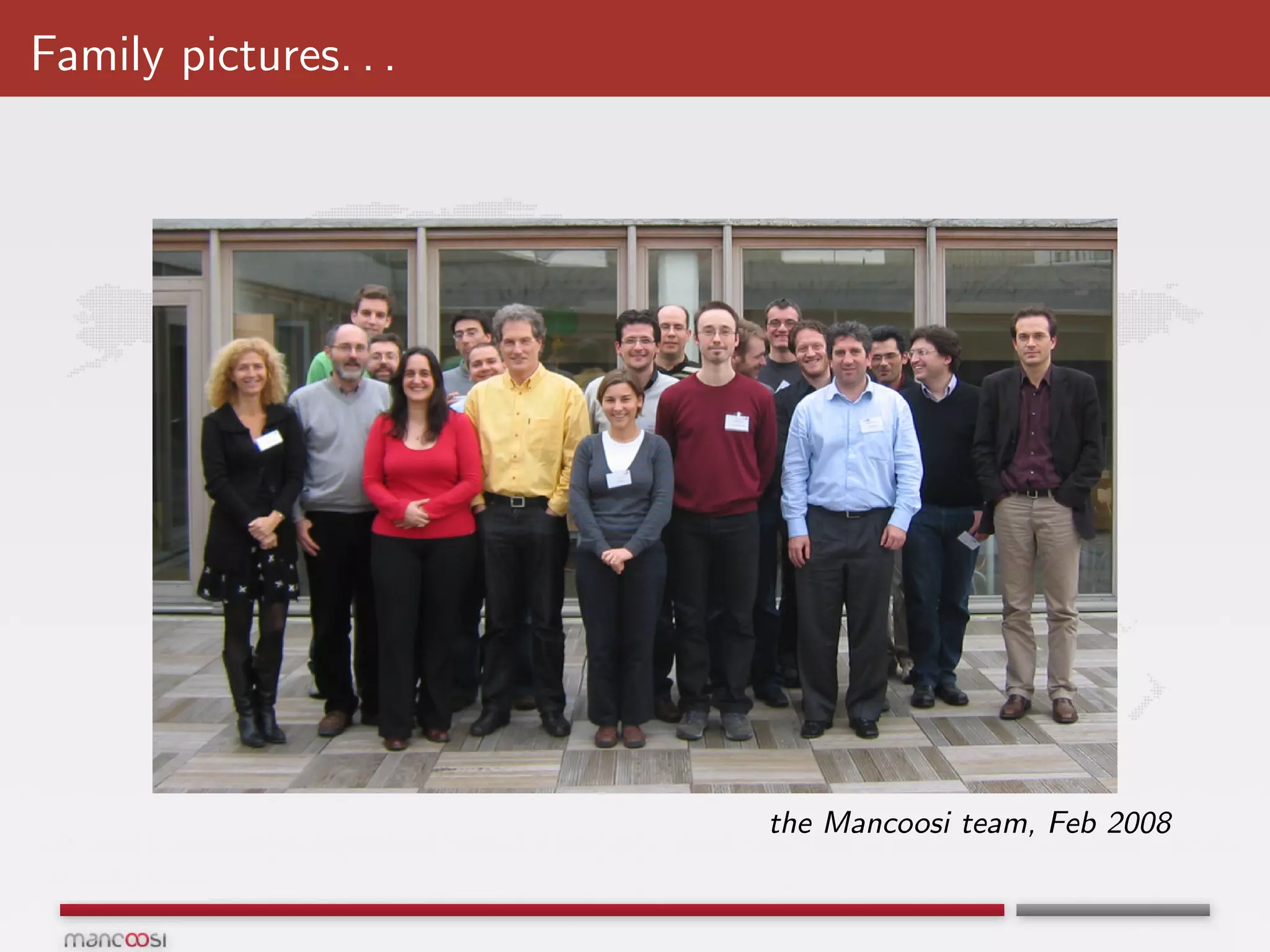
Family pictures. . .


                       the Mancoosi team, Feb 2008
Questions


            Thank you for your attention.

Mancoosi

  • 1.
    Mancoosi: bridging communitiesto improve package-based systems Roberto Di Cosmo University Paris Diderot Paris 7 and INRIA Fossa 2009 November 18th, 2009
  • 2.
    The promise ofGNU/Linux distributions GNU/Linux distributions are intermediaries between FOSS projects and their users They factor the work needed to mainain, configure, test, package together tens of thousands of different software components.
  • 3.
    Package-based distributions: avery successful idea . . . Central notion : package, together with package management software A main innovations of GNU/Linux distributions: it opens the door to flexible configuration and management of complex systems via reusability and modularity.
  • 4.
    Package management: akey industrial issue A few facts: In 2011, 80% of commercial software will contain Open Source code. . . 49,7% of critical application come from the Open Source world... Mark Driver (Gartner) sept.07 A key industrial issue is to build faster, stronger, harder, better, more user oriented packaging technology, to master the challenge of the Open Source success. And yet, surprisingly little has been done in terms of R&D specifically related to package technology (as opposed to components or web services).
  • 5.
    The Challenge ofDistributions Mandriva, Debian, Ubuntu, and all other distribution editors are responsible for maintaining a free software distribution. It is a challenging task! (smooth upgrades, automatic dependency solving, up to date software . . . ) Help is needed to build: better infrastructure for package maintainers and better package managers for final users. Two projects to the rescue: EDOS [2004–2007] aim: provide FOSS distribution editors with better QA tools Mancoosi [2008–2011] aim: provide with better package managers to improve their “platform management” experiences (upgrade, downgrade)
  • 6.
    Packages, metadata, installation some files Package = some scripts Example metadata Package: aterm Version: 0.4.2-11 Identification Section: x11 Inter-package rel. Installed-Size: 280 Dependencies Maintainer: G¨ran Weinholt ... o Conflicts Architecture: i386 Feature declarations Depends: libc6 (>= 2.3.2.ds1-4), libice6 | xlibs (>> 4.1.0), ... Other Conflicts: suidmanager (<< 0.50) Package maintainer Provides: x-terminal-emulator Textual descriptions ... ... a package is the elemental component of modern distribution systems (not GNU/Linux specific) a working system is deployed by installing a package set (≈ 1000/2000 for GNU/Linux distro)
  • 7.
    Sample installation Phase Trace User request # apt-get install aterm 8Reading package lists... Done > >Building dependency tree... Done > > > >The following extra packages will be installed: > > > > libafterimage0 > > > >The following NEW packages will be installed < Constraint resolution aterm libafterimage0 > >0 upgraded, 2 newly installed, 0 to remove and 1786 not upgraded. > > >Need to get 386kB of archives. > > > >After unpacking 807kB of additional disk space will be used. > > > >Do you want to continue [Y/n]? Y > : 8 >Get: 1 http://debian.ens-cachan.fr testing/main libafterimage0 2.2.8-2 [301kB] < Package retrieval Get: 2 http://debian.ens-cachan.fr testing/main aterm 1.0.1-4 [84.4kB] >Fetched 386kB in 0s (410kB/s) : Pre-configuration { 8Selecting previously deselected package libafterimage0. > >(Reading database ... 294774 files and directories currently installed.) > > < Unpacking libafterimage0 (from .../libafterimage0_2.2.8-2_i386.deb) ... Unpacking >Selecting previously deselected package aterm. > >Unpacking aterm (from .../aterm_1.0.1-4_i386.deb) ... > : ( Setting up libafterimage0 (2.2.8-2) ... Configuration Setting up aterm (1.0.1-4) ... each phase can fail (it actually happens quite often . . . ) efforts are needed to identify errors as early as possible
  • 8.
    One of EDOSoutcomes: edos-debcheck EDOS has brought some major results for distribution editors: theory : checking if the dependencies of a package can be satisfied is NP-complete practice : several tools have been developed during EDOS (≈ 110’000 OCaml LOCs), some examples: edos-debcheck command line checker for package installability pkglab interactive, console-based environment for repository inspection ceve parser/converter between package list formats tart optimised algorithm to cut a repository into slices (e.g. media), so that packages available on the i-th slice are installable using only slices up to i
  • 9.
    Focus on edos-debcheck Written by Jerˆme Vouillon, edos-debcheck takes as input an o APT package list (e.g. /var/lib/apt/lists/*) and checks whether one, several, or all packages in it are installable wrt that repository. Customized SAT solver, quite fast: checking installability of all package in main testing/amd64 takes 5 seconds on an entry-level machine. Example edos-debcheck </var/lib/apt/lists/... main binary-amd64 Packages Parsing package file... 1.2 seconds 21617 packages Generating constraints... 2.3 seconds Checking packages... 1.5 seconds acx100-source (= 20070101-3): FAILED alien-arena (= 7.0-1): FAILED alien-arena-browser (= 7.0-1): FAILED alien-arena-server (= 7.0-1): FAILED alsa-firmware-loaders (= 1.0.16-1): FAILED amoeba (= 1.1-19): FAILED ... # explanation can be required as well
  • 10.
    The Mancoosi project [ http://www.mancoosi.org ] project strep FP7 (2008–2011) focus coherence and maintenance of a FOSS distribution installation (user point of view) Tools for user-side package management (package managers / meta-installer) installation removal upgrade downgrade ...
  • 11.
    An upgrade problemexample # sudo apt-get install debhelper Reading Package Lists... Done Building Dependency Tree... Done The following extra packages will be installed: armagetron armagetron-common autoconf bonobo-activation codebreaker debconf debconf-i18n debconf-utils dialog esound-common fb-music-high fontconfig frozen-bubble-data grepmail gv intltool-debian libaiksaurus-data libaiksaurus0c102 libatk1.0-0 libatk1.0-dev libbonobo-activation4 libbonobo2-0 libbonobo2-common libdb3 libdbd-mysql-perl libdbi-perl libeel2-data libesd0 ... The following packages will be REMOVED: autoconf2.13 frozen-bubble frozen-bubble-lib gconf2 gnomemeeting itk3.1-dev libbonoboui2-0 libbonoboui2-common libdigest-md5-perl libforms0.89 libgconf2-4 libgnome2-0 libgnome2-common libgnomeui-0 libgnomevfs2-0 libgnomevfs2-common libgtk1.2-dev libgtk2.0-0png3 libgtk2.0-dev libmime-base64-perl libpango1.0-dev libsdl-mixer1.2-dev libsdl-perl libsdl-ttf1.2-dev libsdl1.2-dev libsmpeg-dev libstorable-perl nautilus tk8.3-dev tktable-dev x-window-system x-window-system-core xaw3dg-dev xlib6g xlib6g-dev xlibmesa-dev xlibmesa3 xlibosmesa3 xlibs-dev xlibs-pic xpdf xpdf-reader The following NEW packages will be installed: armagetron-common debconf-i18n fb-music-high fontconfig intltool-debian libaiksaurus-data libaiksaurus0c102 libeel2-data libfilehandle-unget-perl libfontconfig1 libforms1 libgdbm3 libgnutls7 libgsf-1 libice-dev libice6 libidl0 liblzo1 libmagick5.5.7 libmail-mbox-messageparser-perl libmysqlclient12 libncursesw5 libnet-daemon-perl libnewt0.51 libpaper1 libplrpc-perl libsdl-console ... 75 packages upgraded, 80 newly installed, 42 to remove and 858 not upgraded. Need to get 67.1MB of archives. After unpacking 26.9MB will be used. Do you want to continue? [Y/n] Abort.
  • 12.
    Goals, approach andstrategy Mancoosi’s goal: enable safe, efficient maintainability of the Open Source software infrastructure built out of software packages A twofold approach to reach this objective: design algorithms and tools to tackle the upgradeability problem; this allows to find good upgrade paths w.r.t. the user’s needs. conceive and implement a transactional update process; this allows to roll-back an unsatisfactory upgrade. A long term, ecosystem strategy to reach this objective: bring users, distributions, developers and researchers together! set up virtous cycles
  • 13.
    All in apicture Mancoosi architecture In Mancoosi, there are really two main activities, corresponding to the architecture of our design, and they are loosely coupled User request WP4,WP5 ↓ Platform management interface Optimal upgrade path computation WP4, WP5 Transactional component manager WP2, WP3 ↓ Software Platform
  • 14.
    Upgrade resolution Abstract view of packages through the metadata lens.
  • 15.
    Transactional updates Concrete view of packages through the maintainer scripts lens.
  • 16.
    Mancoosi technology preview:strong dependencies GNU/Linux software distributions: probably the most complex system of systems on the planet HOW can you visualize such a system of systems?
  • 17.
    Draw a graph,no deep knowledge kde-amusements and kde-toys in Debian 3.1 (aka sarge, 2005) were unnecessary components, overlapping kde-games and kde-edu.They are waste, and are gone today (2009). Should be easy to spot, only 244 components are concerned! Can you see this fact here?
  • 18.
    Let’s try amore systemic approach Here is a graph of strong dominators for the KDE subsystem: See the problem, now? More on this at http://www.mancoosi.org
  • 19.
    Concluding remark Everything developed in Mancoosi is already relevant for some, and will be increasingly relevant to all component based technologies Linux : packages Eclipse : plugins Firefox : extensions Java : beans Web services : predictable service assembly ... ...
  • 20.
  • 21.
    Family pictures. .. the Mancoosi team, Feb 2008
  • 22.
    Questions Thank you for your attention.