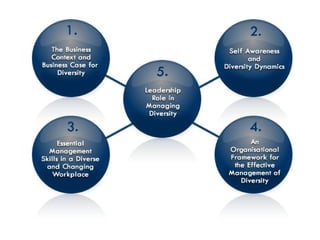
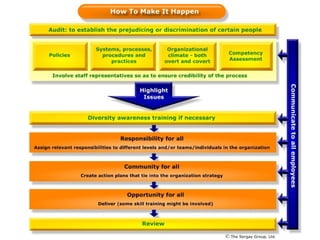
What do we mean by diversity in
the thought process ??????
Let’s find it out with a little magic
trick!
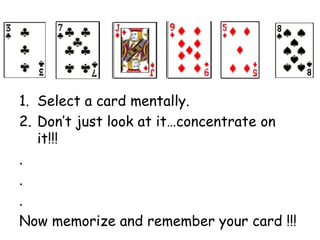
1. Select a card mentally.
2. Don’t just look at it…concentrate on
it!!!
.
.
.
Now memorize and remember your card !!!
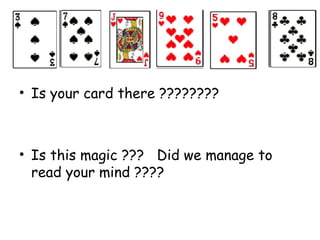
• Is your card there ????????
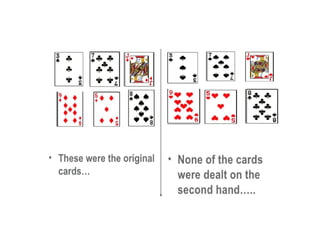
• Is this magic ??? Did we manage to
read your mind ????
• Well, the things are not always as they
appear and at times you need to see
moments, situations and things beyond
they appear.
• So what's the magic secret ???
• So did you consider the bigger and more
important aspects while selecting your card ?
• This happens when most of us think only of our
own objectives and miss the bigger picture…
• Diversity does not lie in gender, age, religion… it
actually lies in one’s thought process. So
perceiving a wider horizon is the key !!
• Conclusion : Never “hear” a person but
“understand” his point of view. It can be even
more difficult when the environment is more
diverse.
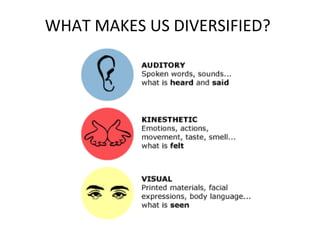
WHAT MAKES US DIVERSIFIED?
Are You a Seer? Hearer?
Feeler?
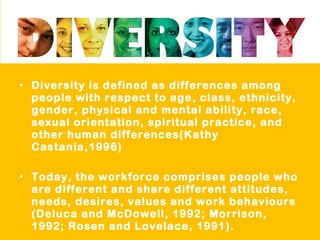
• Diversity is defined as differences among
people with respect to age, class, ethnicity,
gender, physical and mental ability, race,
sexual orientation, spiritual practice, and
other human differences(Kathy
Castania,1996)
• Today, the workforce comprises people who
are different and share different attitudes,
needs, desires, values and work behaviours
(Deluca and McDowell, 1992; Morrison,
1992; Rosen and Lovelace, 1991).
If we could reduce
the world's population
to a village of
precisely 100 people,
with all existing
human ratios
remaining the same,
the demographics
would look something
like this:
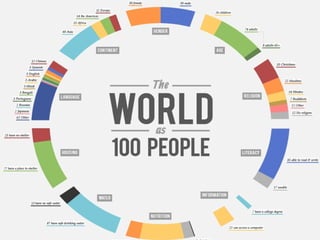
THE WHOLE WORLD AS 100
PEOPLE
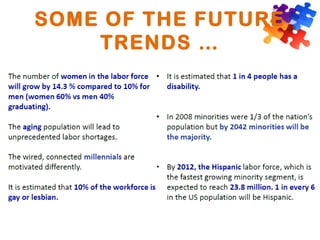
SOME OF THE FUTURE
TRENDS …
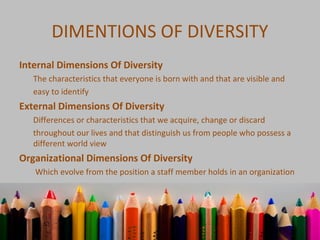
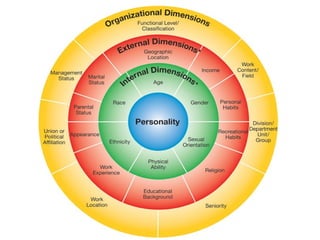
DIMENTIONS OF DIVERSITY
Internal Dimensions Of Diversity
The characteristics that everyone is born with and that are visible and
easy to identify
External Dimensions Of Diversity
Differences or characteristics that we acquire, change or discard
throughout our lives and that distinguish us from people who possess a
different world view
Organizational Dimensions Of Diversity
Which evolve from the position a staff member holds in an organization
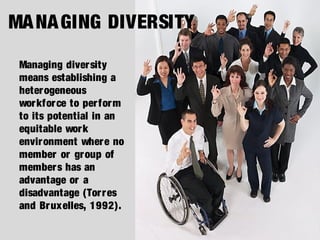
Managing diversity
means establishing a
heterogeneous
workforce to perform
to its potential in an
equitable work
environment where no
member or group of
members has an
advantage or a
disadvantage (Torres
and Bruxelles, 1992).
MANAGING DIVERSITY
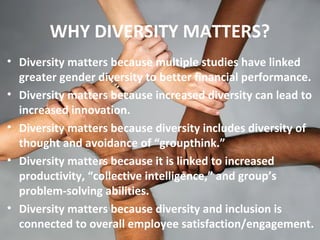
WHY DIVERSITY MATTERS?
• Diversity matters because multiple studies have linked
greater gender diversity to better financial performance.
• Diversity matters because increased diversity can lead to
increased innovation.
• Diversity matters because diversity includes diversity of
thought and avoidance of “groupthink.”
• Diversity matters because it is linked to increased
productivity, “collective intelligence,” and group’s
problem-solving abilities.
• Diversity matters because diversity and inclusion is
connected to overall employee satisfaction/engagement.
• Diversity matters because clients are demanding it.
• Diversity matters because it allows companies to fully
represent their client base and better connect with
different communities of people.
• Diversity matters because companies that don’t take
control of making diversity effective internally risk
expensive discrimination and harassment lawsuits, lower
company morale, and loss of reputation.
• Diversity matters because it has a positive impact on
recruitment, retention, and an organization’s ability to get
the best people (women and men).
Reference: Catalyst Information Center November 2, 2010
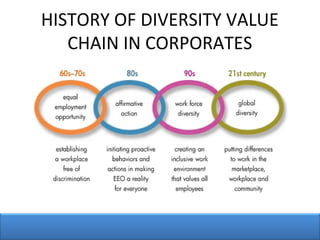
HISTORY OF DIVERSITY VALUE
CHAIN IN CORPORATES
• Corporates believe that diversity and inclusion are key drivers of
creativity, innovation and invention.
• The paradigm in the 1960s and 70s was to establish a workplace free of
discrimination, focusing on equal employment opportunity and
affirmative action.
• The focus in 80’s was directed to affirmative action by initiating
proactive behaviors and actions in making EEO a reality for everyone.
• The era of 90‘s was focusing on work force diversity by creating an
inclusive work environment that values all employees.
• The newest or 21st
century model for managing diversity lets the
organization internalize differences among employees so that it learns
and grows because of them. It ensures global diversity by putting
differences to work at the market place, work place and community.
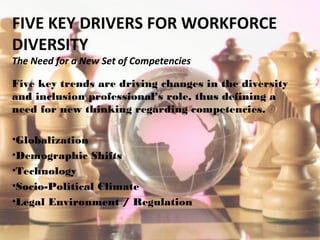
FIVE KEY DRIVERS FOR WORKFORCE
DIVERSITY
The Need for a New Set of Competencies
Five key trends are driving changes in the diversity
and inclusion professional’s role, thus defining a
need for new thinking regarding competencies.
•Globalization
•Demographic Shifts
•Technology
•Socio-Political Climate
•Legal Environment / Regulation
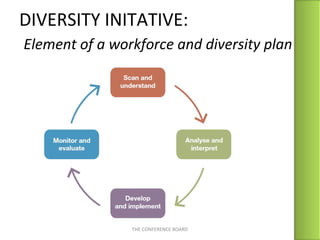
DIVERSITY INITATIVE:
Element of a workforce and diversity plan
THE CONFERENCE BOARD
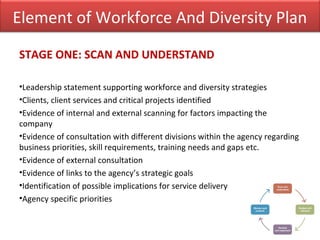
STAGE ONE: SCAN AND UNDERSTAND
•Leadership statement supporting workforce and diversity strategies
•Clients, client services and critical projects identified
•Evidence of internal and external scanning for factors impacting the
company
•Evidence of consultation with different divisions within the agency regarding
business priorities, skill requirements, training needs and gaps etc.
•Evidence of external consultation
•Evidence of links to the agency’s strategic goals
•Identification of possible implications for service delivery
•Agency specific priorities
Element of Workforce And Diversity Plan
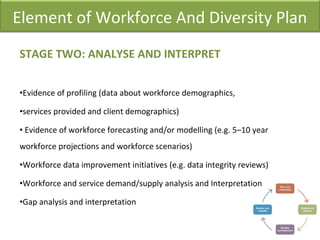
STAGE TWO: ANALYSE AND INTERPRET
•Evidence of profiling (data about workforce demographics,
•services provided and client demographics)
• Evidence of workforce forecasting and/or modelling (e.g. 5–10 year
workforce projections and workforce scenarios)
•Workforce data improvement initiatives (e.g. data integrity reviews)
•Workforce and service demand/supply analysis and Interpretation
•Gap analysis and interpretation
Element of Workforce And Diversity Plan
STAGE THREE: DEVELOP AND IMPLEMENT
•Diversity initiatives integrated in plan (to meet Equal Opportunity policies)
•Communication strategy included to engage all staff and key stakeholders
•Measures of success (which are specific, measurable, achievable, relevant,
time-bound [SMART]) for each initiative
•Inclusion of initiatives, timelines, responsibilities
•Evidence of commitment from different divisions within the agency to
implement the initiatives
Element of Workforce And Diversity Plan
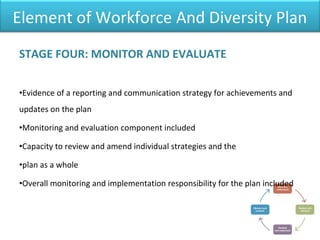
STAGE FOUR: MONITOR AND EVALUATE
•Evidence of a reporting and communication strategy for achievements and
updates on the plan
•Monitoring and evaluation component included
•Capacity to review and amend individual strategies and the
•plan as a whole
•Overall monitoring and implementation responsibility for the plan included
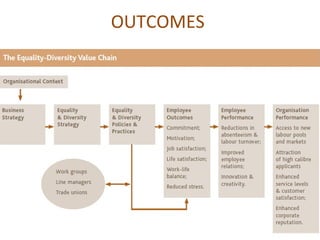
OUTCOMES
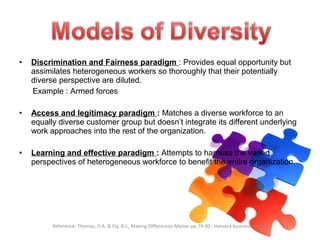
• Discrimination and Fairness paradigm : Provides equal opportunity but
assimilates heterogeneous workers so thoroughly that their potentially
diverse perspective are diluted.
Example : Armed forces
• Access and legitimacy paradigm : Matches a diverse workforce to an
equally diverse customer group but doesn’t integrate its different underlying
work approaches into the rest of the organization.
• Learning and effective paradigm : Attempts to harness the varied
perspectives of heterogeneous workforce to benefit the entire organization.
Reference: Thomas, D.A. & Ely, R.J., Making Differences Matter.pp.79-90 . Harvard business review
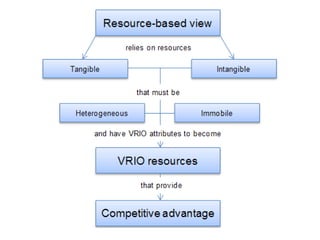
• According to the resource-based view, a firm can gain a sustained
competitive advantage if it takes advantage of its valuable, rare,
inimitable, and non-substitutable (VRIN) resources (Barney 1991).
• Workforce gender diversity is associated with resources that can provide a
firm with a sustained competitive advantage. These resources include
market insight, creativity and innovation, and improved problem-solving.
Men’s and women’s different experiences (Nkomo & Cox 1996) may
provide insights into the different needs of male and female customers.
Further, men and women may have different cognitive abilities, such as
men’s proficiency in mathematics and women’s proficiency in verbal and
interpersonal skills (Hoffman 1965; Maccoby & Jacklin 1974).
• A mix of cognitive abilities in a gender diverse team may enhance the
team’s overall creativity and innovation. Moreover, a gender diverse team
produces high quality decisions (Rogelberg & Rumery 1996).
http://www.strategicmanagementinsight.c
om/
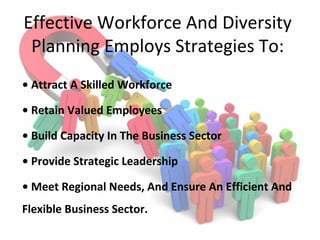
Effective Workforce And Diversity
Planning Employs Strategies To:
• Attract A Skilled Workforce
• Retain Valued Employees
• Build Capacity In The Business Sector
• Provide Strategic Leadership
• Meet Regional Needs, And Ensure An Efficient And
Flexible Business Sector.
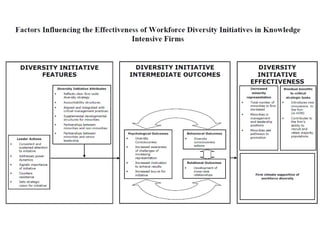
DIVERSITY INITIATIVE FEATURES
• Leadership Involvement as Agents of
Change
• Well-Articulated Diversity Strategy
• Partnerships Between Minorities and Non-
Minorities
• Supplemental Developmental Structures
for Minorities
• Alignment of Management Practices
• Accountability Structures
ROLE OF MANAGEMENT
Leadership Involvement as Agents of Change
Consistent and sustained attention and investment from the senior leaders
of the organization will have a positive impact on psychological outcomes
for employees which will increase the effectiveness of a workforce diversity
initiative:
•Having leaders who proactively address the power dynamics that hinder
progression for racial minorities in the firm
•Having leaders who signal the importance of the initiative to the firm
•Having leaders who counter resistance that can occur in reaction to the
diversity initiative
Defining the Attributes and Processes that Enhance the Effectiveness of Workforce
Diversity Initiatives in Knowledge Intensive Firms
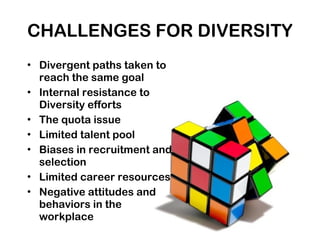
CHALLENGES FOR DIVERSITY
• Divergent paths taken to
reach the same goal
• Internal resistance to
Diversity efforts
• The quota issue
• Limited talent pool
• Biases in recruitment and
selection
• Limited career resources
• Negative attitudes and
behaviors in the
workplace
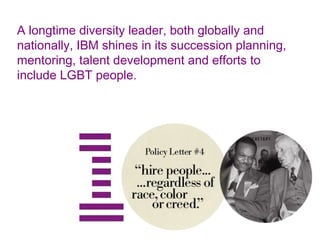
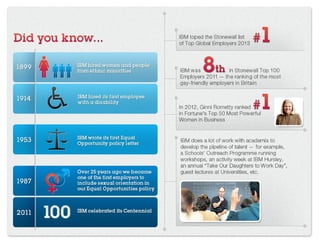
A longtime diversity leader, both globally and
nationally, IBM shines in its succession planning,
mentoring, talent development and efforts to
include LGBT people.
• IBM recognized Diversity as a market based issue its about
understanding markets which are diversified and multicultural
• IBM establishes a market development organization, They
relizaed that diversity was an untapped business resource
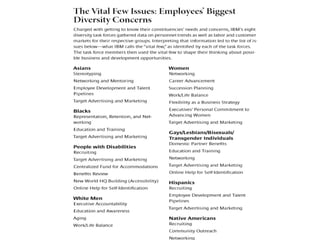
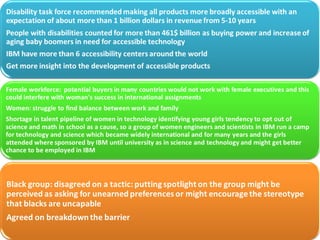
• In 1995 IBM created 8 executive led task forces each focused
on a different group from the diversity dimensions with the
goal of uncovering and understanding the differences among
the groups and find ways to appeal to a broader set of
employees and customers
• The organization activates counted for more than $300 million
in revenue in 2004 compared with 10 million in 1998
• CONSTRUCTIVE DISRUPTION: New approach of calling
attention to differences with the hope of learning from them
and making improvements to the business and it was a radical
departure.
MANAGEMENT SUPPORT
• To be eligible for the workforce task group: based on executive rank and
member of the constituency and groups with few representations got
exceptions like mid level managers
• The SVP of IBM supported the groups in their tasks
• The advantage of having a sponsor not from the same group means that they
will have to learn from their differences. The SVP had to dig deep into the
taskforce issues to represent its views to other WMC members
• The groups also got assigned with 2 hr. employees and 1 hr. senior executive
for administration support also with support from the child's global workforce
diversity organization who was responsible for the program
• The taskforces focused on : communication-staffing-employee benefits-
workplace flexibility training and education advertising and market place
opportunities and external relations
• The task forces received support from all the organization even each
employee by interacting with emails and evaluations and ides.
• They faced skepticism from within the company white and black executives.
http://hbr.org/2004/09/diversity-as-
strategy/ar/1
WHAT HAPPENED?
• The forces frequently met discussing issues and concluding the main issues
• In end of 1995, in 1 December, the management chose this date to send a
message to employees it was the 40th anniversary of Rosa parks refusal to
give up her seat in a bus to a white passenger which raised up the modern u.s.
civil rights movement. This date indicates the true desire for the radical new
approach to diversity
• The findings made it clear that the workforce diversryt was the bridge
between the workplace and the marketplace-greater diversity in workplace
could help ibm attract a more diverse customer set and it was a major
business opportunity
• After two years, they created THE network for diversity between employees.
• EXTERNAL INNTITATIVES: what can IBM do to influence your buying
decision? To become a preferred service provider? Found out: they were not
positioned well to minority entrepreneurs and females owned business : they
changed their sales and marketing strategies to support these segments
• Result: billions of dollars as revenues
• Appropriate representation of constitutions in all aspects of companies
marketing
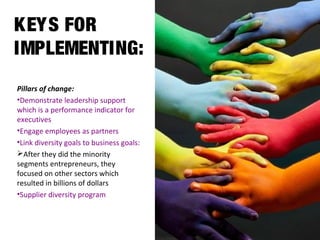
KEYS FOR
IMPLEMENTING:
Pillars of change:
•Demonstrate leadership support
which is a performance indicator for
executives
•Engage employees as partners
•Link diversity goals to business goals:
After they did the minority
segments entrepreneurs, they
focused on other sectors which
resulted in billions of dollars
•Supplier diversity program
SUPPLIER
DIVERSITY
•IBM’s supplier-diversity program, which started
in 1968
•IBM’s first-tier suppliers are required to have
supplier-diversity programs, to provide
opportunities to suppliers, and to track and report
resulting expenditures.  Flowing supplier-
diversity-program requirements through the
supply chain is the result.
•One example: IBM’s Technical Services business
council utilizes best-practice techniques for
ensuring the flow of supplier-diversity
requirements through the supply chain.
Additionally, a contractual requirement of
Technical Services’ large core suppliers is that 25
percent of their subcontracted spend that
supports IBM’s requirements be with diverse-
owned suppliers. Mid-sized core suppliers have a
15 percent requirement.
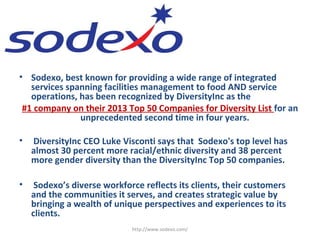
• Sodexo, best known for providing a wide range of integrated
services spanning facilities management to food AND service
operations, has been recognized by DiversityInc as the
#1 company on their 2013 Top 50 Companies for Diversity List for an
unprecedented second time in four years.
• DiversityInc CEO Luke Visconti says that Sodexo's top level has
almost 30 percent more racial/ethnic diversity and 38 percent
more gender diversity than the DiversityInc Top 50 companies.
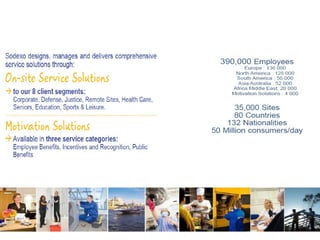
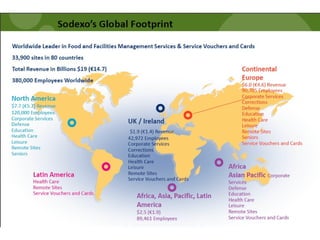
• Sodexo’s diverse workforce reflects its clients, their customers
and the communities it serves, and creates strategic value by
bringing a wealth of unique perspectives and experiences to its
clients.
http://www.sodexo.com/
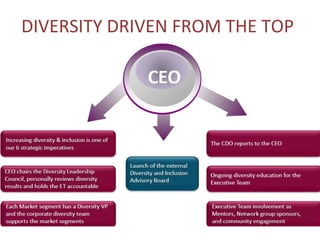
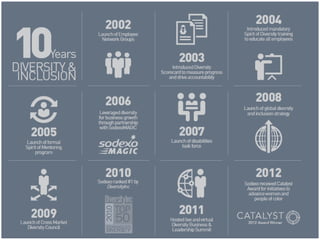
DIVERSITY DRIVEN FROM THE TOP
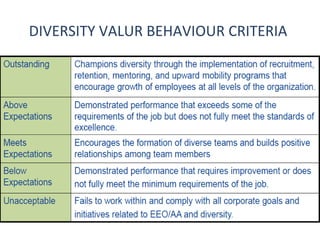
DIVERSITY VALUR BEHAVIOUR CRITERIA
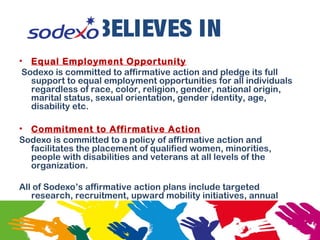
BELIEVES IN
• Equal Employment Opportunity
Sodexo is committed to affirmative action and pledge its full
support to equal employment opportunities for all individuals
regardless of race, color, religion, gender, national origin,
marital status, sexual orientation, gender identity, age,
disability etc.
• Commitment to Affirmative Action
Sodexo is committed to a policy of affirmative action and
facilitates the placement of qualified women, minorities,
people with disabilities and veterans at all levels of the
organization.
All of Sodexo’s affirmative action plans include targeted
research, recruitment, upward mobility initiatives, annual
goals and timetables for women and minorities.
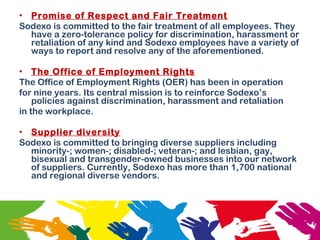
• Promise of Respect and Fair Treatment
Sodexo is committed to the fair treatment of all employees. They
have a zero-tolerance policy for discrimination, harassment or
retaliation of any kind and Sodexo employees have a variety of
ways to report and resolve any of the aforementioned.
• The Office of Employment Rights
The Office of Employment Rights (OER) has been in operation
for nine years. Its central mission is to reinforce Sodexo’s
policies against discrimination, harassment and retaliation
in the workplace.
• Supplier diversity
Sodexo is committed to bringing diverse suppliers including
minority-; women-; disabled-; veteran-; and lesbian, gay,
bisexual and transgender-owned businesses into our network
of suppliers. Currently, Sodexo has more than 1,700 national
and regional diverse vendors.
OTHER EFFORTS TO
DIVERSIFICATION
SodexoMAGIC, a joint venture between Sodexo and Magic Johnson
Enterprises, is dedicated to addressing the specific needs of
multicultural communities and improving the quality of life for those
served.
•Nana Management Services:
NANA Management Services (NMS) is a joint venture between Sodexo
and NANA Development Corporation. NMS is nationally certified as a
minority business enterprise and, for the past four years, has been
recognized by Diversity Business.com as “Top 50 Diversity Owned
Businesses in Alaska: #1”
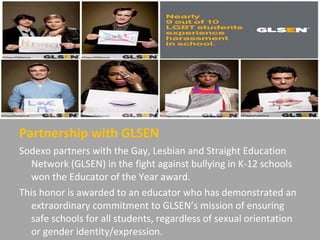
Partnership with GLSEN
Sodexo partners with the Gay, Lesbian and Straight Education
Network (GLSEN) in the fight against bullying in K-12 schools
won the Educator of the Year award.
This honor is awarded to an educator who has demonstrated an
extraordinary commitment to GLSEN’s mission of ensuring
safe schools for all students, regardless of sexual orientation
or gender identity/expression.
SO HOW IS DIVERSITY
MEASURED ??
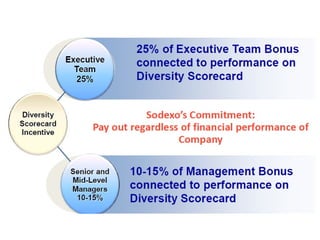
• Sodexo uses “Diversity Scorecard” which is a
strategic management tool that measures
company’s progress in increasing diversity and
inclusion within management.
• It allows to direct attention to key focus areas; 2
tiers Senior Leaders and Managers.
• It has indexes which are designed yearly to
workforce diversity for internal and external labor
force availability.
• Also measures diversity progress quarter-by-
quarter as well as year-over-year .
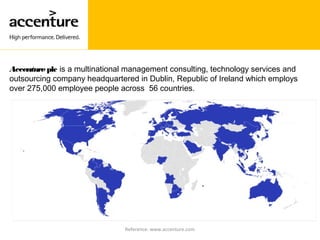
Accentureplc is a multinational management consulting, technology services and
outsourcing company headquartered in Dublin, Republic of Ireland which employs
over 275,000 employee people across 56 countries.
Reference: www.accenture.com
Accenture and Diversity
Accenture enjoys an authentically diverse culture. Its workforce spans
countries, cultures, languages, generations, perspectives, backgrounds
and educational experiences.
•36% of workforce—more than 90,000 people—are women
•In fiscal 2012, 40% of new hires were women.
•17% of managing directors and 17% of Global Management Committee
are women.
•Three women serve on Board of Directors.
•In fiscal 2012, directed USD$521 million—nearly 27%—of US
procurement spending to small and minority-, women- and otherdiversity
group-owned businesses.
•During fiscal 2012 (ended August 31, 2012), directed nearly to 27
percent of its procurement spending in the United States to diverse
businesses.
Reference: www.accenture.com
Diversity Programs
• Accenture in France offers a helpline, “Accent Sur Le Handicap,” that
any Accenture employee can call—anonymously and at no charge—
for information and advice on disability-related topics.
• Accenture in India host webinars and workshops featuring
motivational speakers and training on how to support the needs of
PwD.
• Through our procurement practices, we track and encourage
purchases with diverse suppliers.
• developed a number of networks designed to help attract talent that
has been traditionally underrepresented, for example, the Afro-
Caribbean Network, South-East Asian Network, and Chinese Network.
• Provide same-sex domestic partners with accompanied cross-border
assignment benefits and a global medical plan for long-term
assignments and some transfers.
• Each new employee receives an inclusion and diversity induction as
part of their welcome to the company.
• There is also a week long ‘‘inclusion and diversity’’ campaign called
‘‘ID Week’’.
Reference: www.accenture.com
Key Challenges
• A Changing culture :
Accenture has a chief leadership officer who reports directly to the
chairman and CEO, and senior figures all give their full support, making
the acceptance of the program unavoidable.
• Changing the perception that diversity was ‘‘non-critical’’:
Accenture reward employees who give their time to support diversity
initiatives.
• Gaining and sustaining momentum;
Accenture claim the key to this success has been the promotion of the
campaign both internally and externally, and that using employees as
ambassadors has encouraged involvement from other business areas.
Reference: Amla, I. (2008), ‘‘Managing and sustaining a world of workplace diversity: the Accenture experience’’
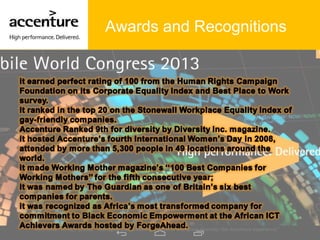
Awards and Recognitions
Reference: Amla, I. (2008), ‘‘Managing and sustaining a world of workplace diversity: the Accenture experience’’
ANDAND
SOME OFSOME OF
THEMTHEM
FAIL…FAIL…
Companies who were of the diversity leaders list, started
declining in position until they are pulled out of the list of
diversified companies…
• Company 1 : The main reason for the decline: a change in CEO resulting in
reduced efforts/accountability.
• Because the CDO did not track participation in employee-resource groups or
have metrics for mentoring and supplier diversity, there was no way to assess
what was working and what was not—and what ramifications it was having on
the bottom line. The chief diversity officer did not have frequent access to the
CEO or to his direct reports, reporting in two levels down to the head of HR. The
CDO was viewed strictly as a staff person whose business advice was not
considered.
• The Results: As other companies innovated and added diversity-management
practices (and the DiversityInc Top 50 changed to reflect the importance of these
new practices), this company actually dropped best practices. The CEO no longer
met with employee-resource groups or signed off on supplier-diversity goals.
Alternative career tracks for employees with long-term family concerns weren’t
offered. Management participation in formal, cross-cultural mentoring declined
dramatically.
http://www.diversityinc.com/
• Company 2: decided to eliminate any compensation pay
related to diversity because its leaders believed progress
would happen intrinsically. A new CEO decided not to
continue monitoring or signing off on executive
accountability. At the same time, the company eliminated
mandatory diversity training for its workforce, determining
it was no longer necessary. Its leaders used the phrase
“Diversity is in our DNA.”
• The Results: Representation percentages in the workforce,
new hires and management of Blacks and Asians have fallen
dramatically, at a time when competitors, especially in this
industry, have seen significant increases. The company is
committed to using its employee-resource groups as a
means of reaching multicultural customers, but their
participation numbers also are declining.
http://www.diversityinc.com/
• Company 3: this company’s CEO determined that diversity was a goal that had
already been accomplished and an enhanced effort wasn’t necessary, despite the
presence of increased competition.
• The Situation: This company’s lack of diverse representation at its senior levels
didn’t have a major impact five years ago because the other companies faced a
similar lack of diversity. But as other progressive companies instituted strong
efforts to develop diversity rapidly in their succession planning, this company did
not and felt it wasn’t necessary. The company also failed to keep pace with its
competitors, which increasingly rely on employee-resource groups as both sources
for talent development and to identify gaps in the corporate culture that need
addressing.
• The Results: Leadership at the top of the organization remains all white and 90
percent men, while other companies on the list have made significant inroads. The
2010 DiversityInc Top 50 average 14 percent Blacks, Latinos and Asians and 24
percent women at the top level—and those percentages increase each year and at
a higher rate than companies not on the list.
• This company has seen its percentage of employees participating in employee-
resource groups cut in half (from 10 percent to 5 percent) while the DiversityInc
Top 50 average has increased from 16 percent to 24 percent in the last year alone
(and was 5 percent five years ago).
http://www.diversityinc.com/
Recommendations
• Without constant attention, progress stalls—and can dissolve.
• Diversifying the diversity office : Don’t restrict leadership and involvement to
women and minorities. Create rotational tracks in roles that include employees
of all backgrounds, including white males.
• Acknowledge your own blind spots: Studies show that people make
approximately 11 judgments within the first seven seconds of meeting someone
new. Examine and neutralize any unconscious bias that may underlie your own
decision-making process.
• Start the dialogue: Demonstrate that diversity and an environment of
inclusion are important by initiating conversations. Often, leaders wait for
others to bring up those subjects, even in the form of complaints. The more
open and authentic the dialogues that take place, the easier it becomes to
promote change.
• Search for behaviors of exclusion: Whether exhibited by yourself or others,
many exclusionary behaviors are unintentional—or even well-intentioned, such
as assuming a working mother would refuse a weekend travel assignment.
Constantly seek out and eliminate such behaviors.
• Create an environment of advantages: Small, unintentional inequalities
can become pervasive in a culture. A culture of inclusion fosters an
environment of small advantages—such as candid feedback, special
assignments, and invitations to contribute at meetings—that are available to
all. Keep a record of those who are given such advantages and the impact
that it has. Make a conscious effort to include everyone on your team.
• Be a visible champion of cultural dexterity: Show your commitment by what
you say and do. Broaden your perspective by becoming involved with people and
groups outside your normal personal and professional social circles.
CONCLUSION
• Analyzing the aspects of Diversity and studying case studies, we can conclude
that profits gained from diversity management reflect in gains in productivity,
creativity, innovation and employee welfare. Although implementing diversity
management on a large scale and along all the groups, departments, levels and
areas of business is the most crucial factor.
• The management needs to understand that diversity is no longer limited to race
and gender but can affect individuals on basis of color, education, skill, sexual
orientation etc. They need to ensure trainings, seminars and performance
appraisals cover and include aspects of Diversity.
• In today's world of globalization with increasing markets, employees need to
hire people with demanding and specific skills to serve and deal customers from
all over the globe. As a result conglomerates are now aiming for diversity not
because of moral interests but from economic strategy.
Managing the Mosaic - Workforce Diversity

Managing the Mosaic - Workforce Diversity

  • 2.
    What do wemean by diversity in the thought process ??????
  • 3.
    Let’s find itout with a little magic trick!
  • 4.
    1. Select acard mentally. 2. Don’t just look at it…concentrate on it!!! . . . Now memorize and remember your card !!!
  • 5.
    • Is yourcard there ???????? • Is this magic ??? Did we manage to read your mind ????
  • 7.
    • Well, thethings are not always as they appear and at times you need to see moments, situations and things beyond they appear. • So what's the magic secret ???
  • 9.
    • So didyou consider the bigger and more important aspects while selecting your card ? • This happens when most of us think only of our own objectives and miss the bigger picture… • Diversity does not lie in gender, age, religion… it actually lies in one’s thought process. So perceiving a wider horizon is the key !! • Conclusion : Never “hear” a person but “understand” his point of view. It can be even more difficult when the environment is more diverse.
  • 10.
    WHAT MAKES USDIVERSIFIED?
  • 11.
    Are You aSeer? Hearer? Feeler?
  • 12.
    • Diversity isdefined as differences among people with respect to age, class, ethnicity, gender, physical and mental ability, race, sexual orientation, spiritual practice, and other human differences(Kathy Castania,1996) • Today, the workforce comprises people who are different and share different attitudes, needs, desires, values and work behaviours (Deluca and McDowell, 1992; Morrison, 1992; Rosen and Lovelace, 1991).
  • 13.
    If we couldreduce the world's population to a village of precisely 100 people, with all existing human ratios remaining the same, the demographics would look something like this:
  • 14.
    THE WHOLE WORLDAS 100 PEOPLE
  • 15.
    SOME OF THEFUTURE TRENDS …
  • 16.
    DIMENTIONS OF DIVERSITY InternalDimensions Of Diversity The characteristics that everyone is born with and that are visible and easy to identify External Dimensions Of Diversity Differences or characteristics that we acquire, change or discard throughout our lives and that distinguish us from people who possess a different world view Organizational Dimensions Of Diversity Which evolve from the position a staff member holds in an organization
  • 18.
    Managing diversity means establishinga heterogeneous workforce to perform to its potential in an equitable work environment where no member or group of members has an advantage or a disadvantage (Torres and Bruxelles, 1992). MANAGING DIVERSITY
  • 19.
    WHY DIVERSITY MATTERS? •Diversity matters because multiple studies have linked greater gender diversity to better financial performance. • Diversity matters because increased diversity can lead to increased innovation. • Diversity matters because diversity includes diversity of thought and avoidance of “groupthink.” • Diversity matters because it is linked to increased productivity, “collective intelligence,” and group’s problem-solving abilities. • Diversity matters because diversity and inclusion is connected to overall employee satisfaction/engagement.
  • 20.
    • Diversity mattersbecause clients are demanding it. • Diversity matters because it allows companies to fully represent their client base and better connect with different communities of people. • Diversity matters because companies that don’t take control of making diversity effective internally risk expensive discrimination and harassment lawsuits, lower company morale, and loss of reputation. • Diversity matters because it has a positive impact on recruitment, retention, and an organization’s ability to get the best people (women and men). Reference: Catalyst Information Center November 2, 2010
  • 22.
    HISTORY OF DIVERSITYVALUE CHAIN IN CORPORATES
  • 23.
    • Corporates believethat diversity and inclusion are key drivers of creativity, innovation and invention. • The paradigm in the 1960s and 70s was to establish a workplace free of discrimination, focusing on equal employment opportunity and affirmative action. • The focus in 80’s was directed to affirmative action by initiating proactive behaviors and actions in making EEO a reality for everyone. • The era of 90‘s was focusing on work force diversity by creating an inclusive work environment that values all employees. • The newest or 21st century model for managing diversity lets the organization internalize differences among employees so that it learns and grows because of them. It ensures global diversity by putting differences to work at the market place, work place and community.
  • 24.
    FIVE KEY DRIVERSFOR WORKFORCE DIVERSITY The Need for a New Set of Competencies Five key trends are driving changes in the diversity and inclusion professional’s role, thus defining a need for new thinking regarding competencies. •Globalization •Demographic Shifts •Technology •Socio-Political Climate •Legal Environment / Regulation
  • 25.
    DIVERSITY INITATIVE: Element ofa workforce and diversity plan THE CONFERENCE BOARD
  • 26.
    STAGE ONE: SCANAND UNDERSTAND •Leadership statement supporting workforce and diversity strategies •Clients, client services and critical projects identified •Evidence of internal and external scanning for factors impacting the company •Evidence of consultation with different divisions within the agency regarding business priorities, skill requirements, training needs and gaps etc. •Evidence of external consultation •Evidence of links to the agency’s strategic goals •Identification of possible implications for service delivery •Agency specific priorities Element of Workforce And Diversity Plan
  • 27.
    Element of WorkforceAnd Diversity Plan STAGE TWO: ANALYSE AND INTERPRET •Evidence of profiling (data about workforce demographics, •services provided and client demographics) • Evidence of workforce forecasting and/or modelling (e.g. 5–10 year workforce projections and workforce scenarios) •Workforce data improvement initiatives (e.g. data integrity reviews) •Workforce and service demand/supply analysis and Interpretation •Gap analysis and interpretation
  • 28.
    Element of WorkforceAnd Diversity Plan STAGE THREE: DEVELOP AND IMPLEMENT •Diversity initiatives integrated in plan (to meet Equal Opportunity policies) •Communication strategy included to engage all staff and key stakeholders •Measures of success (which are specific, measurable, achievable, relevant, time-bound [SMART]) for each initiative •Inclusion of initiatives, timelines, responsibilities •Evidence of commitment from different divisions within the agency to implement the initiatives
  • 29.
    Element of WorkforceAnd Diversity Plan STAGE FOUR: MONITOR AND EVALUATE •Evidence of a reporting and communication strategy for achievements and updates on the plan •Monitoring and evaluation component included •Capacity to review and amend individual strategies and the •plan as a whole •Overall monitoring and implementation responsibility for the plan included
  • 30.
  • 31.
    • Discrimination andFairness paradigm : Provides equal opportunity but assimilates heterogeneous workers so thoroughly that their potentially diverse perspective are diluted. Example : Armed forces • Access and legitimacy paradigm : Matches a diverse workforce to an equally diverse customer group but doesn’t integrate its different underlying work approaches into the rest of the organization. • Learning and effective paradigm : Attempts to harness the varied perspectives of heterogeneous workforce to benefit the entire organization. Reference: Thomas, D.A. & Ely, R.J., Making Differences Matter.pp.79-90 . Harvard business review
  • 32.
    • According tothe resource-based view, a firm can gain a sustained competitive advantage if it takes advantage of its valuable, rare, inimitable, and non-substitutable (VRIN) resources (Barney 1991). • Workforce gender diversity is associated with resources that can provide a firm with a sustained competitive advantage. These resources include market insight, creativity and innovation, and improved problem-solving. Men’s and women’s different experiences (Nkomo & Cox 1996) may provide insights into the different needs of male and female customers. Further, men and women may have different cognitive abilities, such as men’s proficiency in mathematics and women’s proficiency in verbal and interpersonal skills (Hoffman 1965; Maccoby & Jacklin 1974). • A mix of cognitive abilities in a gender diverse team may enhance the team’s overall creativity and innovation. Moreover, a gender diverse team produces high quality decisions (Rogelberg & Rumery 1996). http://www.strategicmanagementinsight.c om/
  • 34.
    Effective Workforce AndDiversity Planning Employs Strategies To: • Attract A Skilled Workforce • Retain Valued Employees • Build Capacity In The Business Sector • Provide Strategic Leadership • Meet Regional Needs, And Ensure An Efficient And Flexible Business Sector.
  • 35.
    DIVERSITY INITIATIVE FEATURES •Leadership Involvement as Agents of Change • Well-Articulated Diversity Strategy • Partnerships Between Minorities and Non- Minorities • Supplemental Developmental Structures for Minorities • Alignment of Management Practices • Accountability Structures
  • 37.
    ROLE OF MANAGEMENT LeadershipInvolvement as Agents of Change Consistent and sustained attention and investment from the senior leaders of the organization will have a positive impact on psychological outcomes for employees which will increase the effectiveness of a workforce diversity initiative: •Having leaders who proactively address the power dynamics that hinder progression for racial minorities in the firm •Having leaders who signal the importance of the initiative to the firm •Having leaders who counter resistance that can occur in reaction to the diversity initiative Defining the Attributes and Processes that Enhance the Effectiveness of Workforce Diversity Initiatives in Knowledge Intensive Firms
  • 39.
    CHALLENGES FOR DIVERSITY •Divergent paths taken to reach the same goal • Internal resistance to Diversity efforts • The quota issue • Limited talent pool • Biases in recruitment and selection • Limited career resources • Negative attitudes and behaviors in the workplace
  • 44.
    A longtime diversityleader, both globally and nationally, IBM shines in its succession planning, mentoring, talent development and efforts to include LGBT people.
  • 46.
    • IBM recognizedDiversity as a market based issue its about understanding markets which are diversified and multicultural • IBM establishes a market development organization, They relizaed that diversity was an untapped business resource • In 1995 IBM created 8 executive led task forces each focused on a different group from the diversity dimensions with the goal of uncovering and understanding the differences among the groups and find ways to appeal to a broader set of employees and customers • The organization activates counted for more than $300 million in revenue in 2004 compared with 10 million in 1998 • CONSTRUCTIVE DISRUPTION: New approach of calling attention to differences with the hope of learning from them and making improvements to the business and it was a radical departure.
  • 47.
    MANAGEMENT SUPPORT • Tobe eligible for the workforce task group: based on executive rank and member of the constituency and groups with few representations got exceptions like mid level managers • The SVP of IBM supported the groups in their tasks • The advantage of having a sponsor not from the same group means that they will have to learn from their differences. The SVP had to dig deep into the taskforce issues to represent its views to other WMC members • The groups also got assigned with 2 hr. employees and 1 hr. senior executive for administration support also with support from the child's global workforce diversity organization who was responsible for the program • The taskforces focused on : communication-staffing-employee benefits- workplace flexibility training and education advertising and market place opportunities and external relations • The task forces received support from all the organization even each employee by interacting with emails and evaluations and ides. • They faced skepticism from within the company white and black executives. http://hbr.org/2004/09/diversity-as- strategy/ar/1
  • 50.
    WHAT HAPPENED? • Theforces frequently met discussing issues and concluding the main issues • In end of 1995, in 1 December, the management chose this date to send a message to employees it was the 40th anniversary of Rosa parks refusal to give up her seat in a bus to a white passenger which raised up the modern u.s. civil rights movement. This date indicates the true desire for the radical new approach to diversity • The findings made it clear that the workforce diversryt was the bridge between the workplace and the marketplace-greater diversity in workplace could help ibm attract a more diverse customer set and it was a major business opportunity • After two years, they created THE network for diversity between employees. • EXTERNAL INNTITATIVES: what can IBM do to influence your buying decision? To become a preferred service provider? Found out: they were not positioned well to minority entrepreneurs and females owned business : they changed their sales and marketing strategies to support these segments • Result: billions of dollars as revenues • Appropriate representation of constitutions in all aspects of companies marketing
  • 51.
    KEYS FOR IMPLEMENTING: Pillars ofchange: •Demonstrate leadership support which is a performance indicator for executives •Engage employees as partners •Link diversity goals to business goals: After they did the minority segments entrepreneurs, they focused on other sectors which resulted in billions of dollars •Supplier diversity program
  • 52.
    SUPPLIER DIVERSITY •IBM’s supplier-diversity program,which started in 1968 •IBM’s first-tier suppliers are required to have supplier-diversity programs, to provide opportunities to suppliers, and to track and report resulting expenditures.  Flowing supplier- diversity-program requirements through the supply chain is the result. •One example: IBM’s Technical Services business council utilizes best-practice techniques for ensuring the flow of supplier-diversity requirements through the supply chain. Additionally, a contractual requirement of Technical Services’ large core suppliers is that 25 percent of their subcontracted spend that supports IBM’s requirements be with diverse- owned suppliers. Mid-sized core suppliers have a 15 percent requirement.
  • 57.
    • Sodexo, bestknown for providing a wide range of integrated services spanning facilities management to food AND service operations, has been recognized by DiversityInc as the #1 company on their 2013 Top 50 Companies for Diversity List for an unprecedented second time in four years. • DiversityInc CEO Luke Visconti says that Sodexo's top level has almost 30 percent more racial/ethnic diversity and 38 percent more gender diversity than the DiversityInc Top 50 companies. • Sodexo’s diverse workforce reflects its clients, their customers and the communities it serves, and creates strategic value by bringing a wealth of unique perspectives and experiences to its clients. http://www.sodexo.com/
  • 60.
  • 61.
  • 63.
    BELIEVES IN • EqualEmployment Opportunity Sodexo is committed to affirmative action and pledge its full support to equal employment opportunities for all individuals regardless of race, color, religion, gender, national origin, marital status, sexual orientation, gender identity, age, disability etc. • Commitment to Affirmative Action Sodexo is committed to a policy of affirmative action and facilitates the placement of qualified women, minorities, people with disabilities and veterans at all levels of the organization. All of Sodexo’s affirmative action plans include targeted research, recruitment, upward mobility initiatives, annual goals and timetables for women and minorities.
  • 64.
    • Promise ofRespect and Fair Treatment Sodexo is committed to the fair treatment of all employees. They have a zero-tolerance policy for discrimination, harassment or retaliation of any kind and Sodexo employees have a variety of ways to report and resolve any of the aforementioned. • The Office of Employment Rights The Office of Employment Rights (OER) has been in operation for nine years. Its central mission is to reinforce Sodexo’s policies against discrimination, harassment and retaliation in the workplace. • Supplier diversity Sodexo is committed to bringing diverse suppliers including minority-; women-; disabled-; veteran-; and lesbian, gay, bisexual and transgender-owned businesses into our network of suppliers. Currently, Sodexo has more than 1,700 national and regional diverse vendors.
  • 65.
    OTHER EFFORTS TO DIVERSIFICATION SodexoMAGIC,a joint venture between Sodexo and Magic Johnson Enterprises, is dedicated to addressing the specific needs of multicultural communities and improving the quality of life for those served. •Nana Management Services: NANA Management Services (NMS) is a joint venture between Sodexo and NANA Development Corporation. NMS is nationally certified as a minority business enterprise and, for the past four years, has been recognized by Diversity Business.com as “Top 50 Diversity Owned Businesses in Alaska: #1”
  • 66.
    Partnership with GLSEN Sodexopartners with the Gay, Lesbian and Straight Education Network (GLSEN) in the fight against bullying in K-12 schools won the Educator of the Year award. This honor is awarded to an educator who has demonstrated an extraordinary commitment to GLSEN’s mission of ensuring safe schools for all students, regardless of sexual orientation or gender identity/expression.
  • 67.
    SO HOW ISDIVERSITY MEASURED ?? • Sodexo uses “Diversity Scorecard” which is a strategic management tool that measures company’s progress in increasing diversity and inclusion within management. • It allows to direct attention to key focus areas; 2 tiers Senior Leaders and Managers. • It has indexes which are designed yearly to workforce diversity for internal and external labor force availability. • Also measures diversity progress quarter-by- quarter as well as year-over-year .
  • 72.
    Accentureplc is amultinational management consulting, technology services and outsourcing company headquartered in Dublin, Republic of Ireland which employs over 275,000 employee people across 56 countries. Reference: www.accenture.com
  • 73.
    Accenture and Diversity Accentureenjoys an authentically diverse culture. Its workforce spans countries, cultures, languages, generations, perspectives, backgrounds and educational experiences. •36% of workforce—more than 90,000 people—are women •In fiscal 2012, 40% of new hires were women. •17% of managing directors and 17% of Global Management Committee are women. •Three women serve on Board of Directors. •In fiscal 2012, directed USD$521 million—nearly 27%—of US procurement spending to small and minority-, women- and otherdiversity group-owned businesses. •During fiscal 2012 (ended August 31, 2012), directed nearly to 27 percent of its procurement spending in the United States to diverse businesses. Reference: www.accenture.com
  • 74.
    Diversity Programs • Accenturein France offers a helpline, “Accent Sur Le Handicap,” that any Accenture employee can call—anonymously and at no charge— for information and advice on disability-related topics. • Accenture in India host webinars and workshops featuring motivational speakers and training on how to support the needs of PwD. • Through our procurement practices, we track and encourage purchases with diverse suppliers. • developed a number of networks designed to help attract talent that has been traditionally underrepresented, for example, the Afro- Caribbean Network, South-East Asian Network, and Chinese Network. • Provide same-sex domestic partners with accompanied cross-border assignment benefits and a global medical plan for long-term assignments and some transfers. • Each new employee receives an inclusion and diversity induction as part of their welcome to the company. • There is also a week long ‘‘inclusion and diversity’’ campaign called ‘‘ID Week’’. Reference: www.accenture.com
  • 75.
    Key Challenges • AChanging culture : Accenture has a chief leadership officer who reports directly to the chairman and CEO, and senior figures all give their full support, making the acceptance of the program unavoidable. • Changing the perception that diversity was ‘‘non-critical’’: Accenture reward employees who give their time to support diversity initiatives. • Gaining and sustaining momentum; Accenture claim the key to this success has been the promotion of the campaign both internally and externally, and that using employees as ambassadors has encouraged involvement from other business areas. Reference: Amla, I. (2008), ‘‘Managing and sustaining a world of workplace diversity: the Accenture experience’’
  • 76.
    Awards and Recognitions Reference:Amla, I. (2008), ‘‘Managing and sustaining a world of workplace diversity: the Accenture experience’’
  • 78.
  • 79.
    Companies who wereof the diversity leaders list, started declining in position until they are pulled out of the list of diversified companies… • Company 1 : The main reason for the decline: a change in CEO resulting in reduced efforts/accountability. • Because the CDO did not track participation in employee-resource groups or have metrics for mentoring and supplier diversity, there was no way to assess what was working and what was not—and what ramifications it was having on the bottom line. The chief diversity officer did not have frequent access to the CEO or to his direct reports, reporting in two levels down to the head of HR. The CDO was viewed strictly as a staff person whose business advice was not considered. • The Results: As other companies innovated and added diversity-management practices (and the DiversityInc Top 50 changed to reflect the importance of these new practices), this company actually dropped best practices. The CEO no longer met with employee-resource groups or signed off on supplier-diversity goals. Alternative career tracks for employees with long-term family concerns weren’t offered. Management participation in formal, cross-cultural mentoring declined dramatically. http://www.diversityinc.com/
  • 80.
    • Company 2:decided to eliminate any compensation pay related to diversity because its leaders believed progress would happen intrinsically. A new CEO decided not to continue monitoring or signing off on executive accountability. At the same time, the company eliminated mandatory diversity training for its workforce, determining it was no longer necessary. Its leaders used the phrase “Diversity is in our DNA.” • The Results: Representation percentages in the workforce, new hires and management of Blacks and Asians have fallen dramatically, at a time when competitors, especially in this industry, have seen significant increases. The company is committed to using its employee-resource groups as a means of reaching multicultural customers, but their participation numbers also are declining. http://www.diversityinc.com/
  • 81.
    • Company 3:this company’s CEO determined that diversity was a goal that had already been accomplished and an enhanced effort wasn’t necessary, despite the presence of increased competition. • The Situation: This company’s lack of diverse representation at its senior levels didn’t have a major impact five years ago because the other companies faced a similar lack of diversity. But as other progressive companies instituted strong efforts to develop diversity rapidly in their succession planning, this company did not and felt it wasn’t necessary. The company also failed to keep pace with its competitors, which increasingly rely on employee-resource groups as both sources for talent development and to identify gaps in the corporate culture that need addressing. • The Results: Leadership at the top of the organization remains all white and 90 percent men, while other companies on the list have made significant inroads. The 2010 DiversityInc Top 50 average 14 percent Blacks, Latinos and Asians and 24 percent women at the top level—and those percentages increase each year and at a higher rate than companies not on the list. • This company has seen its percentage of employees participating in employee- resource groups cut in half (from 10 percent to 5 percent) while the DiversityInc Top 50 average has increased from 16 percent to 24 percent in the last year alone (and was 5 percent five years ago). http://www.diversityinc.com/
  • 82.
    Recommendations • Without constantattention, progress stalls—and can dissolve. • Diversifying the diversity office : Don’t restrict leadership and involvement to women and minorities. Create rotational tracks in roles that include employees of all backgrounds, including white males. • Acknowledge your own blind spots: Studies show that people make approximately 11 judgments within the first seven seconds of meeting someone new. Examine and neutralize any unconscious bias that may underlie your own decision-making process. • Start the dialogue: Demonstrate that diversity and an environment of inclusion are important by initiating conversations. Often, leaders wait for others to bring up those subjects, even in the form of complaints. The more open and authentic the dialogues that take place, the easier it becomes to promote change. • Search for behaviors of exclusion: Whether exhibited by yourself or others, many exclusionary behaviors are unintentional—or even well-intentioned, such as assuming a working mother would refuse a weekend travel assignment. Constantly seek out and eliminate such behaviors.
  • 83.
    • Create anenvironment of advantages: Small, unintentional inequalities can become pervasive in a culture. A culture of inclusion fosters an environment of small advantages—such as candid feedback, special assignments, and invitations to contribute at meetings—that are available to all. Keep a record of those who are given such advantages and the impact that it has. Make a conscious effort to include everyone on your team. • Be a visible champion of cultural dexterity: Show your commitment by what you say and do. Broaden your perspective by becoming involved with people and groups outside your normal personal and professional social circles.
  • 84.
    CONCLUSION • Analyzing theaspects of Diversity and studying case studies, we can conclude that profits gained from diversity management reflect in gains in productivity, creativity, innovation and employee welfare. Although implementing diversity management on a large scale and along all the groups, departments, levels and areas of business is the most crucial factor. • The management needs to understand that diversity is no longer limited to race and gender but can affect individuals on basis of color, education, skill, sexual orientation etc. They need to ensure trainings, seminars and performance appraisals cover and include aspects of Diversity. • In today's world of globalization with increasing markets, employees need to hire people with demanding and specific skills to serve and deal customers from all over the globe. As a result conglomerates are now aiming for diversity not because of moral interests but from economic strategy.