Innovation Governance Prof. Dr. Bernhard Katzy 2012
Agenda Mini-Test Innovation governance: objectives and trends Three models of innovation governance Some governance concepts Shift from government to governance Multi-level governance Innovation governance in practice: the case of the Electronic Health Record Wouter Mensink
Wouter Mensink
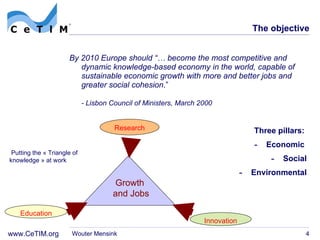
The objective By 2010 Europe should  “… become the most competitive and dynamic knowledge-based economy in the world, capable of sustainable economic growth with more and better jobs and greater social cohesion .”   - Lisbon Council of Ministers, March 2000 Three pillars:  Economic  Social Environmental Wouter Mensink Research Growth  and Jobs Education Innovation Putting the « Triangle of knowledge » at work
The  “Pro-Innovation Bias” “ It is often assumed by students of innovation phenomena that innovations are socially positive, and that individuals, organizations, and institutions desire the promotion of innovation. This is not necessarily the case, as the history of technical innovation suggests. While institutions can take actions along the lines noted above to encourage innovation, they also can take  actions that discourage innovation ”  (King et al., p. 158) Wouter Mensink
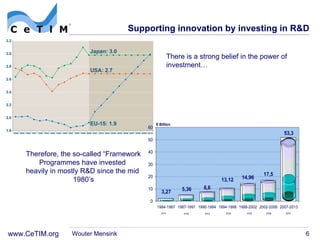
Supporting innovation by investing in R&D Wouter Mensink There is a strong belief in the power of investment… Therefore, the so-called  “Framework Programmes have invested  heavily in mostly R&D since the mid  1980’s FP6 FP5 FP4 FP2 FP3 FP1 FP7
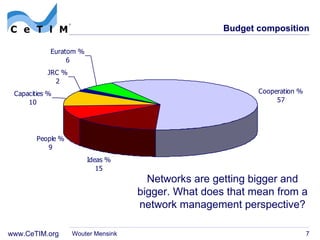
Budget composition Wouter Mensink Networks are getting bigger and bigger. What does that mean from a network management perspective?
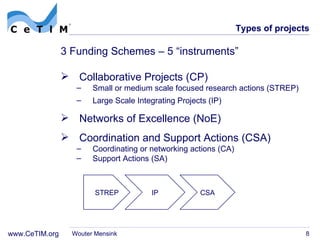
Types of projects Wouter Mensink 3 Funding Schemes – 5 “instruments” Collaborative Projects (CP) Small or medium scale focused research actions (STREP) Large Scale Integrating Projects (IP) Networks of Excellence (NoE) Coordination and Support Actions (CSA) Coordinating or networking actions (CA) Support Actions (SA) STREP IP CSA
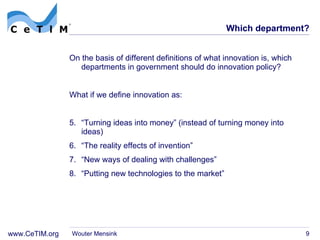
Which department? On the basis of different definitions of what innovation is, which departments in government should do innovation policy? What if we define innovation as: “ Turning ideas into money” (instead of turning money into ideas) “ The reality effects of invention” “ New ways of dealing with challenges” “ Putting new technologies to the market” Wouter Mensink
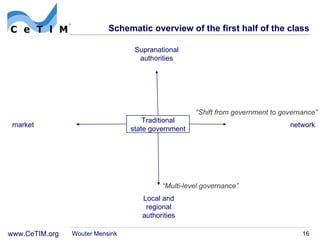
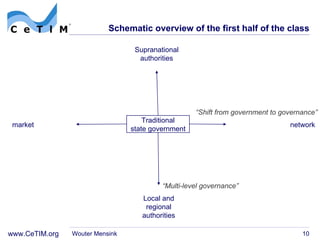
Schematic overview of the first half of the class Wouter Mensink Traditional   state government  Supranational authorities Local and regional authorities network market “ Multi-level governance” “ Shift from government to governance”
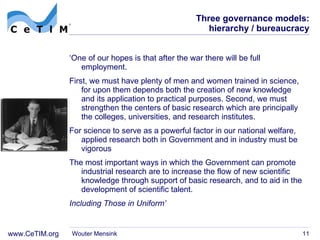
Three governance models: hierarchy / bureaucracy ‘ One of our hopes is that after the war there will be full employment. First, we must have plenty of men and women trained in science, for upon them depends both the creation of new knowledge and its application to practical purposes. Second, we must strengthen the centers of basic research which are principally the colleges, universities, and research institutes. For science to serve as a powerful factor in our national welfare, applied research both in Government and in industry must be vigorous The most important ways in which the Government can promote industrial research are to increase the flow of new scientific knowledge through support of basic research, and to aid in the development of scientific talent. Including Those in Uniform’ Wouter Mensink
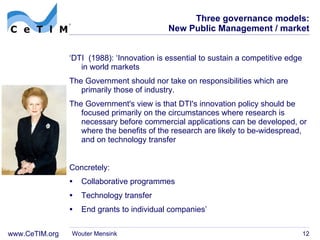
Three governance models: New Public Management / market ‘ DTI  (1988): ‘Innovation is essential to sustain a competitive edge in  world markets The Government  should nor take on responsibilities which are primarily those of industry. The Government's view is that DTI's innovation policy should be focused primarily on the circumstances where research is necessary before commercial applications can be developed, or where the benefits of the research are likely to be-widespread, and on technology transfer Concretely: Collaborative programmes Technology transfer End grants to individual companies ’ Wouter Mensink
Three governance models: Network ‘ Collaborative research will constitute the bulk and the core of Community research funding. The objective is to establish, in the major fields of advancement of knowledge, excellent research projects and networks able to attract researchers and investments from Europe and the entire world. The Seventh Framework Programme will be carried out to [..] strengthen industrial competitiveness and to meet the research needs of other Community policies, thereby contributing to the creation of a knowledge-based society, building on a European Research Area and complementing activities at a national and regional level. Funding schemes:  collaborative projects networks of excellence coordination/support actions ’ Wouter Mensink
Three governance models:  views on government and technology Wouter Mensink March 6, 2008 Bureaucracy Market / NPM Network View on the role of government Public provision of a function is more equitable, reliable and democratic than provision by a commercial or voluntary body - Dunsire, 1999,  p. 361 “ Government failure” or “public failure” argument replaces the traditional “market failure” argument: ‘[T]here is no market failure so bad that the US government and political process could not do even worse’  - Dixit (1993) in Moreau, 2004, p. 850 The role of public policy extends far beyond the mere correction of market failures [..] Public policy may facilitate the market process - Moreau, 2004,  p. 847 View on  technology Determinist technology- and industrial policy implies that policy-makers would consider certain technological paths to be inevitable - Williams & Edge,  1996 Instrumental and  ‘neutral’ view of technology: ‘technologies will just 'appear to order', in response to the demands of the market at any one time’ - Williams & Edge, 1996, p. 871 Constructionist view of technology: social/political construction of technology
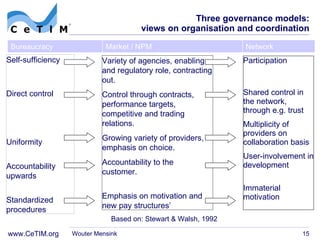
Three governance models: views on organisation and coordination Participation Shared control in the network, through e.g. trust Multiplicity of providers on collaboration basis User-involvement in development  Immaterial motivation Wouter Mensink Variety of agencies, enabling and regulatory role, contracting out. Control through contracts, performance targets, competitive and trading relations. Growing variety of providers, emphasis on choice. Accountability to the  customer.  Emphasis on motivation and new pay structures ’ Self-sufficiency  Direct control  Uniformity Accountability  upwards Standardized  procedures  Based on: Stewart & Walsh, 1992 Bureaucracy Market / NPM Network
Schematic overview of the first half of the class Wouter Mensink Traditional   state government  Supranational authorities Local and regional authorities network market “ Multi-level governance” “ Shift from government to governance”
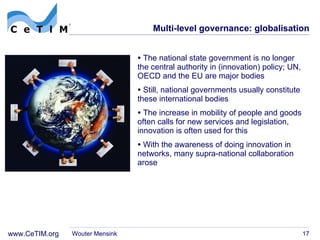
Multi-level governance: globalisation The national state government is no longer the central authority in (innovation) policy; UN, OECD and the EU are major bodies Still, national governments usually constitute these international bodies The increase in mobility of people and goods often calls for new services and legislation, innovation is often used for this With the awareness of doing innovation in networks, many supra-national collaboration arose Wouter Mensink Mytelka & Smith, 2002
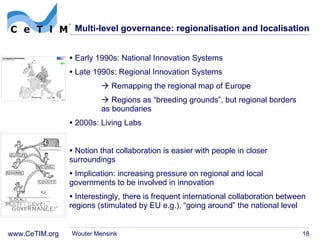
Multi-level governance: regionalisation and localisation Early 1990s: National Innovation Systems  Late 1990s: Regional Innovation Systems    Remapping the regional map of Europe    Regions as  “breeding grounds”, but regional borders  as boundaries 2000s: Living Labs Notion that collaboration is easier with people in closer surroundings Implication: increasing pressure on regional and local governments to be involved in innovation Interestingly, there is frequent international collaboration between regions (stimulated by EU e.g.),  “going around” the national level Wouter Mensink
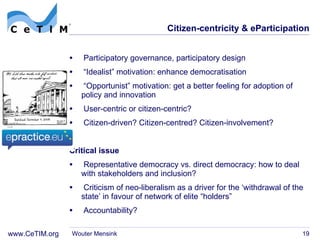
Citizen-centricity & eParticipation Participatory governance, participatory design “ Idealist” motivation: enhance democratisation  “ Opportunist” motivation: get a better feeling for adoption of policy and innovation User-centric or citizen-centric? Citizen-driven? Citizen-centred? Citizen-involvement? Critical issue Representative democracy vs. direct democracy: how to deal with stakeholders and inclusion? Criticism of neo-liberalism as a driver for the  ‘withdrawal of the state’ in favour of network of elite “holders” Accountability? Wouter Mensink
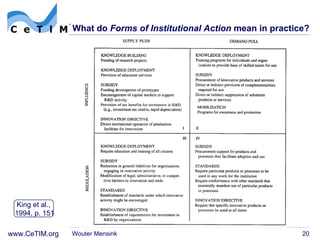
What do  Forms of Institutional Action  mean in practice? Wouter Mensink King et al.,  1994, p. 151
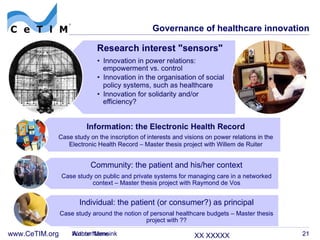
Governance of healthcare innovation Wouter Mensink Author Name XX XXXXX XXXX Community: the patient and his/her context Case study on public and private systems for managing care in a networked context – Master thesis project with Raymond de Vos Individual: the patient (or consumer?) as principal Case study around the notion of personal healthcare budgets – Master thesis project with ??
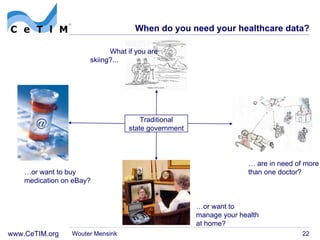
When do you need your healthcare data? Wouter Mensink Traditional   state government    What if you are  skiing?... …  are in need of more  …or want to buy than one doctor? medication on eBay?   … or want to   manage your health   at home?
Standardisation When you want to create interoperable health records, how do you standardise? Focus on standardising information, or communication? Focus on changing the supply, or demand-side of health care? Who do you want to enable to  “inscribe” their interests and visions in the future standard?   Industry?   Governments? Academia? Wouter Mensink Thesis: Willem de Ruiter
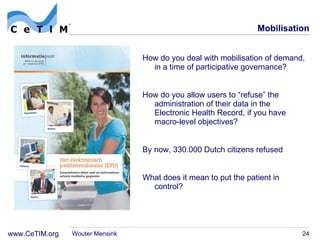
Mobilisation How do you deal with mobilisation of demand, in a time of participative governance? How do you allow users to  “refuse” the administration of their data in the Electronic Health Record, if you have macro-level objectives? By now, 330.000 Dutch citizens refused What does it mean to put the patient in control? Wouter Mensink
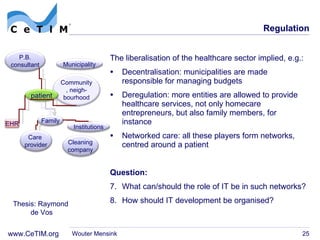
Regulation The liberalisation of the healthcare sector implied, e.g.: Decentralisation: municipalities are made responsible for managing budgets Deregulation: more entities are allowed to provide healthcare services, not only homecare entrepreneurs, but also family members, for instance Networked care: all these players form networks, centred around a patient Question: What can/should the role of IT be in such networks? How should IT development be organised? Wouter Mensink Thesis: Raymond  de Vos Community, neigh- bourhood patient Municipality P.B. consultant Care  provider Institutions EHR Cleaning company Family
Innovation directive The movement of disabled people ( “expert patients”) advocated strongly for having a personal budget, which they could manage to their own preference By now, the number of users of the scheme is almost 100.000 Despite satisfaction, there are also strong complaints when it comes to the budget: Administration is often too complex for people There have been some widely discussed cases of fraud by  “budget consultants” Question: How to regulate this?  Do you regulate on the demand-side (who is eligible)?  …  or on the supply-side (who can do consultancy)? Wouter Mensink
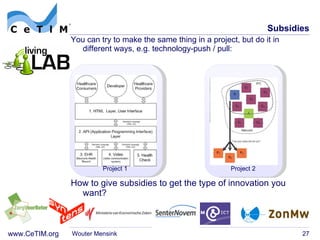
Subsidies You can try to make the same thing in a project, but do it in different ways, e.g. technology-push / pull: Project 1 Project 2 How to give subsidies to get the type of innovation you  want? Wouter Mensink
Papers referred to in this lecture Bush, V. (1945). Science: The Endless Frontier.  Transactions of the Kansas Academy of Science (1903-), 48,  231-264. Dept.of Trade and Industry & Britain, G. (1988).  DTI-the Department for Enterprise . HMSO. Dunsire, A. (1999). Then and Now: Public Administration, 1953-1999.  Political Studies, 47,  360-378. European Parliament & Council of the European Union (2006). Decision No 1982/2006/EC of the European Parliament and of the Council of 18 December 2006 concerning the Seventh Framework Programme of the European Community for research, technological development and demonstration activities (2007-2013).  Official Journal of the European Union, L 412/1 . King, J. L., Gurbaxani, V., Kraemer, K. L., McFarlan, F. W., Raman, K. S., & Yap, C. S. (1994). Institutional factors in information technology innovation.  Information Systems Research, 5,  139-169. Moreau, F. (2004). The role of the state in evolutionary economics.  Cambridge Journal of Economics, 28,  847-874. Stewart, J. & Walsh, K. (1992). Change in the management of public services.  Public Administration, 70,  499-518. Williams, R. & Edge, D. (1996). The social shaping of technology.  Research Policy, 25,  865-899. Wouter Mensink

Managing Innovation_innovation governance

  • 1.
    Innovation Governance Prof.Dr. Bernhard Katzy 2012
  • 2.
    Agenda Mini-Test Innovationgovernance: objectives and trends Three models of innovation governance Some governance concepts Shift from government to governance Multi-level governance Innovation governance in practice: the case of the Electronic Health Record Wouter Mensink
  • 3.
  • 4.
    The objective By2010 Europe should “… become the most competitive and dynamic knowledge-based economy in the world, capable of sustainable economic growth with more and better jobs and greater social cohesion .” - Lisbon Council of Ministers, March 2000 Three pillars: Economic Social Environmental Wouter Mensink Research Growth and Jobs Education Innovation Putting the « Triangle of knowledge » at work
  • 5.
    The “Pro-InnovationBias” “ It is often assumed by students of innovation phenomena that innovations are socially positive, and that individuals, organizations, and institutions desire the promotion of innovation. This is not necessarily the case, as the history of technical innovation suggests. While institutions can take actions along the lines noted above to encourage innovation, they also can take actions that discourage innovation ” (King et al., p. 158) Wouter Mensink
  • 6.
    Supporting innovation byinvesting in R&D Wouter Mensink There is a strong belief in the power of investment… Therefore, the so-called “Framework Programmes have invested heavily in mostly R&D since the mid 1980’s FP6 FP5 FP4 FP2 FP3 FP1 FP7
  • 7.
    Budget composition WouterMensink Networks are getting bigger and bigger. What does that mean from a network management perspective?
  • 8.
    Types of projectsWouter Mensink 3 Funding Schemes – 5 “instruments” Collaborative Projects (CP) Small or medium scale focused research actions (STREP) Large Scale Integrating Projects (IP) Networks of Excellence (NoE) Coordination and Support Actions (CSA) Coordinating or networking actions (CA) Support Actions (SA) STREP IP CSA
  • 9.
    Which department? Onthe basis of different definitions of what innovation is, which departments in government should do innovation policy? What if we define innovation as: “ Turning ideas into money” (instead of turning money into ideas) “ The reality effects of invention” “ New ways of dealing with challenges” “ Putting new technologies to the market” Wouter Mensink
  • 10.
    Schematic overview ofthe first half of the class Wouter Mensink Traditional state government Supranational authorities Local and regional authorities network market “ Multi-level governance” “ Shift from government to governance”
  • 11.
    Three governance models:hierarchy / bureaucracy ‘ One of our hopes is that after the war there will be full employment. First, we must have plenty of men and women trained in science, for upon them depends both the creation of new knowledge and its application to practical purposes. Second, we must strengthen the centers of basic research which are principally the colleges, universities, and research institutes. For science to serve as a powerful factor in our national welfare, applied research both in Government and in industry must be vigorous The most important ways in which the Government can promote industrial research are to increase the flow of new scientific knowledge through support of basic research, and to aid in the development of scientific talent. Including Those in Uniform’ Wouter Mensink
  • 12.
    Three governance models:New Public Management / market ‘ DTI (1988): ‘Innovation is essential to sustain a competitive edge in world markets The Government should nor take on responsibilities which are primarily those of industry. The Government's view is that DTI's innovation policy should be focused primarily on the circumstances where research is necessary before commercial applications can be developed, or where the benefits of the research are likely to be-widespread, and on technology transfer Concretely: Collaborative programmes Technology transfer End grants to individual companies ’ Wouter Mensink
  • 13.
    Three governance models:Network ‘ Collaborative research will constitute the bulk and the core of Community research funding. The objective is to establish, in the major fields of advancement of knowledge, excellent research projects and networks able to attract researchers and investments from Europe and the entire world. The Seventh Framework Programme will be carried out to [..] strengthen industrial competitiveness and to meet the research needs of other Community policies, thereby contributing to the creation of a knowledge-based society, building on a European Research Area and complementing activities at a national and regional level. Funding schemes: collaborative projects networks of excellence coordination/support actions ’ Wouter Mensink
  • 14.
    Three governance models: views on government and technology Wouter Mensink March 6, 2008 Bureaucracy Market / NPM Network View on the role of government Public provision of a function is more equitable, reliable and democratic than provision by a commercial or voluntary body - Dunsire, 1999, p. 361 “ Government failure” or “public failure” argument replaces the traditional “market failure” argument: ‘[T]here is no market failure so bad that the US government and political process could not do even worse’ - Dixit (1993) in Moreau, 2004, p. 850 The role of public policy extends far beyond the mere correction of market failures [..] Public policy may facilitate the market process - Moreau, 2004, p. 847 View on technology Determinist technology- and industrial policy implies that policy-makers would consider certain technological paths to be inevitable - Williams & Edge, 1996 Instrumental and ‘neutral’ view of technology: ‘technologies will just 'appear to order', in response to the demands of the market at any one time’ - Williams & Edge, 1996, p. 871 Constructionist view of technology: social/political construction of technology
  • 15.
    Three governance models:views on organisation and coordination Participation Shared control in the network, through e.g. trust Multiplicity of providers on collaboration basis User-involvement in development Immaterial motivation Wouter Mensink Variety of agencies, enabling and regulatory role, contracting out. Control through contracts, performance targets, competitive and trading relations. Growing variety of providers, emphasis on choice. Accountability to the customer. Emphasis on motivation and new pay structures ’ Self-sufficiency Direct control Uniformity Accountability upwards Standardized procedures Based on: Stewart & Walsh, 1992 Bureaucracy Market / NPM Network
  • 16.
    Schematic overview ofthe first half of the class Wouter Mensink Traditional state government Supranational authorities Local and regional authorities network market “ Multi-level governance” “ Shift from government to governance”
  • 17.
    Multi-level governance: globalisationThe national state government is no longer the central authority in (innovation) policy; UN, OECD and the EU are major bodies Still, national governments usually constitute these international bodies The increase in mobility of people and goods often calls for new services and legislation, innovation is often used for this With the awareness of doing innovation in networks, many supra-national collaboration arose Wouter Mensink Mytelka & Smith, 2002
  • 18.
    Multi-level governance: regionalisationand localisation Early 1990s: National Innovation Systems Late 1990s: Regional Innovation Systems  Remapping the regional map of Europe  Regions as “breeding grounds”, but regional borders as boundaries 2000s: Living Labs Notion that collaboration is easier with people in closer surroundings Implication: increasing pressure on regional and local governments to be involved in innovation Interestingly, there is frequent international collaboration between regions (stimulated by EU e.g.), “going around” the national level Wouter Mensink
  • 19.
    Citizen-centricity & eParticipationParticipatory governance, participatory design “ Idealist” motivation: enhance democratisation “ Opportunist” motivation: get a better feeling for adoption of policy and innovation User-centric or citizen-centric? Citizen-driven? Citizen-centred? Citizen-involvement? Critical issue Representative democracy vs. direct democracy: how to deal with stakeholders and inclusion? Criticism of neo-liberalism as a driver for the ‘withdrawal of the state’ in favour of network of elite “holders” Accountability? Wouter Mensink
  • 20.
    What do Forms of Institutional Action mean in practice? Wouter Mensink King et al., 1994, p. 151
  • 21.
    Governance of healthcareinnovation Wouter Mensink Author Name XX XXXXX XXXX Community: the patient and his/her context Case study on public and private systems for managing care in a networked context – Master thesis project with Raymond de Vos Individual: the patient (or consumer?) as principal Case study around the notion of personal healthcare budgets – Master thesis project with ??
  • 22.
    When do youneed your healthcare data? Wouter Mensink Traditional state government What if you are skiing?... … are in need of more …or want to buy than one doctor? medication on eBay? … or want to manage your health at home?
  • 23.
    Standardisation When youwant to create interoperable health records, how do you standardise? Focus on standardising information, or communication? Focus on changing the supply, or demand-side of health care? Who do you want to enable to “inscribe” their interests and visions in the future standard? Industry? Governments? Academia? Wouter Mensink Thesis: Willem de Ruiter
  • 24.
    Mobilisation How doyou deal with mobilisation of demand, in a time of participative governance? How do you allow users to “refuse” the administration of their data in the Electronic Health Record, if you have macro-level objectives? By now, 330.000 Dutch citizens refused What does it mean to put the patient in control? Wouter Mensink
  • 25.
    Regulation The liberalisationof the healthcare sector implied, e.g.: Decentralisation: municipalities are made responsible for managing budgets Deregulation: more entities are allowed to provide healthcare services, not only homecare entrepreneurs, but also family members, for instance Networked care: all these players form networks, centred around a patient Question: What can/should the role of IT be in such networks? How should IT development be organised? Wouter Mensink Thesis: Raymond de Vos Community, neigh- bourhood patient Municipality P.B. consultant Care provider Institutions EHR Cleaning company Family
  • 26.
    Innovation directive Themovement of disabled people ( “expert patients”) advocated strongly for having a personal budget, which they could manage to their own preference By now, the number of users of the scheme is almost 100.000 Despite satisfaction, there are also strong complaints when it comes to the budget: Administration is often too complex for people There have been some widely discussed cases of fraud by “budget consultants” Question: How to regulate this? Do you regulate on the demand-side (who is eligible)? … or on the supply-side (who can do consultancy)? Wouter Mensink
  • 27.
    Subsidies You cantry to make the same thing in a project, but do it in different ways, e.g. technology-push / pull: Project 1 Project 2 How to give subsidies to get the type of innovation you want? Wouter Mensink
  • 28.
    Papers referred toin this lecture Bush, V. (1945). Science: The Endless Frontier. Transactions of the Kansas Academy of Science (1903-), 48, 231-264. Dept.of Trade and Industry & Britain, G. (1988). DTI-the Department for Enterprise . HMSO. Dunsire, A. (1999). Then and Now: Public Administration, 1953-1999. Political Studies, 47, 360-378. European Parliament & Council of the European Union (2006). Decision No 1982/2006/EC of the European Parliament and of the Council of 18 December 2006 concerning the Seventh Framework Programme of the European Community for research, technological development and demonstration activities (2007-2013). Official Journal of the European Union, L 412/1 . King, J. L., Gurbaxani, V., Kraemer, K. L., McFarlan, F. W., Raman, K. S., & Yap, C. S. (1994). Institutional factors in information technology innovation. Information Systems Research, 5, 139-169. Moreau, F. (2004). The role of the state in evolutionary economics. Cambridge Journal of Economics, 28, 847-874. Stewart, J. & Walsh, K. (1992). Change in the management of public services. Public Administration, 70, 499-518. Williams, R. & Edge, D. (1996). The social shaping of technology. Research Policy, 25, 865-899. Wouter Mensink

Editor's Notes