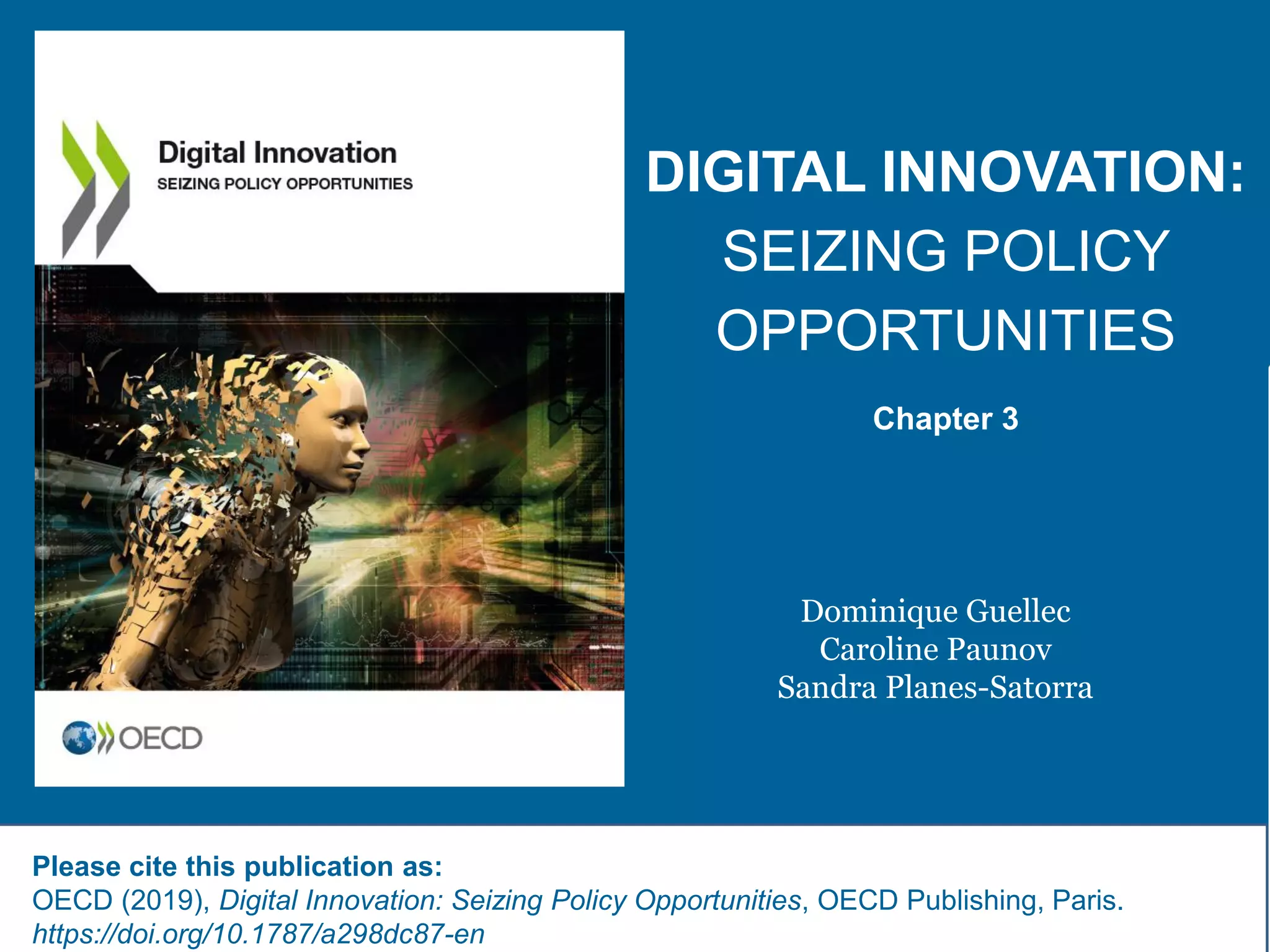
DIGITAL INNOVATION:
SEIZING POLICY
OPPORTUNITIES
Chapter 3
Please cite this publication as:
OECD (2019), Digital Innovation: Seizing Policy Opportunities, OECD Publishing, Paris.
https://doi.org/10.1787/a298dc87-en
Dominique Guellec
Caroline Paunov
Sandra Planes-Satorra
Questions addressed:
• Are existing innovation policies adequate to support
innovation in the digital age?
• If not, how should innovation policies change?
Chapter 3. How should innovation policies
be adapted to the digital age?
Chapter 3
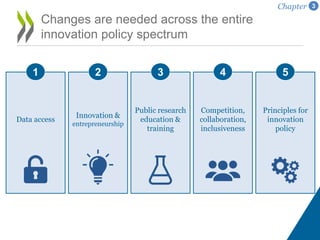
Changes are needed across the entire
innovation policy spectrum
Data access
Innovation &
entrepreneurship
Public research
education &
training
Competition,
collaboration,
inclusiveness
Principles for
innovation
policy
1 2 3 4 5
Chapter 3
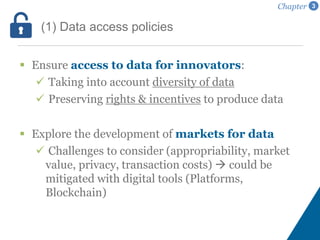
 Ensure access to data for innovators:
 Taking into account diversity of data
 Preserving rights & incentives to produce data
 Explore the development of markets for data
 Challenges to consider (appropriability, market
value, privacy, transaction costs)  could be
mitigated with digital tools (Platforms,
Blockchain)
(1) Data access policies
Chapter 3
 Ensure innovation policies are anticipatory,
responsive & agile, e.g.:
Policy experiments of small scale, to be scaled up or
abandoned following assessment of impact
Digital tools for policy design & monitoring
Accelerate application procedures (e.g. Pass French
Tech provides simplified access to services to start-ups)
Mission-oriented programmes that set goals without
imposing means to reach them (e.g. DARPA model)
Anticipatory regulation (e.g. as performed by the
UK Food Standards Agency)
(2) Innovation & entrepreneurship policies (i)
Chapter 3
 Support service innovation that implements
digital technologies (e.g. Smart and Digital Services
Initiative, Austria)
 Adapt IP systems (notably to AI challenges)
 Support development of generic digital
technologies to address societal challenges
E.g. Artificial Intelligence Forum in New Zealand
gathers industry, academia and government to
discuss socio-economic challenges of AI and develop
roadmaps to shape future impacts
(2) Innovation & entrepreneurship policies (ii)
Chapter 3
 Promote open science
 Support interdisciplinary research & education
 Support training in digital skills for researchers
 Ensure skills needed for digital innovation are
developed (e.g. revise university programmes)
 Invest in digital tools & infrastructure for science
 Creating spaces for co-creation with industry (e.g.
joint research labs)
(3) Public research, education & training policies
Chapter 3
 Collaborate with competition authorities in addressing
market power in the digital age
 Promote collaborative innovation ecosystems (more
in Chapter 4)
 Facilitate digital technology adoption by firms
(particularly SMEs) (more in Chapter 4)
 Support digital innovation to serve social &
environmental purposes
 Support social & territorial inclusiveness in digital
innovation activities (links to Innovation for Inclusive
Growth project; see paper)
(4) Policies to foster competitive, collaborative
& inclusive innovation ecosystems
Chapter 3
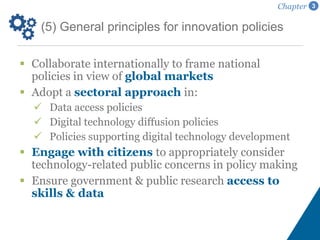
(5) General principles for innovation policies
Chapter 3
 Collaborate internationally to frame national
policies in view of global markets
 Adopt a sectoral approach in:
 Data access policies
 Digital technology diffusion policies
 Policies supporting digital technology development
 Engage with citizens to appropriately consider
technology-related public concerns in policy making
 Ensure government & public research access to
skills & data
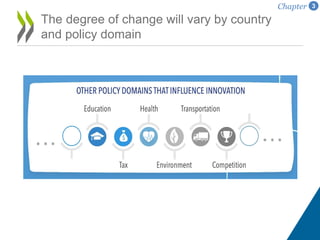
The degree of change will vary by country
and policy domain
Chapter 3
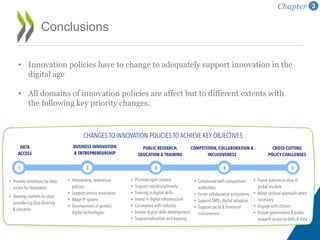
Conclusions
Chapter 3
• Innovation policies have to change to adequately support innovation in the
digital age
• All domains of innovation policies are affect but to different extents with
the following key priority changes:
Project website:
https://oe.cd/2xw
The report and all project materials
Please cite this publication as:
OECD (2019), Digital Innovation:
Seizing Policy Opportunities, OECD
Publishing, Paris.
https://doi.org/10.1787/a298dc87-en
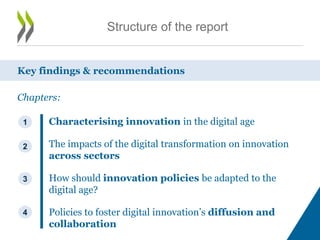
Structure of the report
Characterising innovation in the digital age
The impacts of the digital transformation on innovation
across sectors
How should innovation policies be adapted to the
digital age?
Policies to foster digital innovation’s diffusion and
collaboration
Key findings & recommendations
1
2
3
4
Chapters:
Project events
Netherlands
April 2018
Website
Summary
London
September 2017
Website
Summary
Paris
June 2017
Website
Summary
Paris
June 2018
Website
Summary
4 workshops Report launch event
London
April 2019
https://oe.cd/2xs
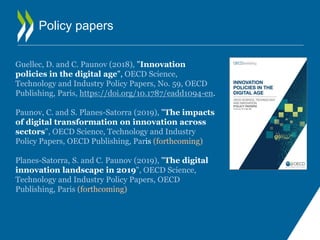
Policy papers
Guellec, D. and C. Paunov (2018), "Innovation
policies in the digital age", OECD Science,
Technology and Industry Policy Papers, No. 59, OECD
Publishing, Paris, https://doi.org/10.1787/eadd1094-en.
Paunov, C. and S. Planes-Satorra (2019), "The impacts
of digital transformation on innovation across
sectors", OECD Science, Technology and Industry
Policy Papers, OECD Publishing, Paris (forthcoming)
Planes-Satorra, S. and C. Paunov (2019), "The digital
innovation landscape in 2019", OECD Science,
Technology and Industry Policy Papers, OECD
Publishing, Paris (forthcoming)
Case studies
Find all country case study contributions at: https://oe.cd/2xP
Contact
Dominique Guellec, Dominique.Guellec@oecd.org
Caroline Paunov, Caroline.Paunov@oecd.org
Sandra Planes-Satorra, Sandra.PlanesSatorra@oecd.org

Oecd digital innovation_summaryreport_ch3_website

  • 1.
    DIGITAL INNOVATION: SEIZING POLICY OPPORTUNITIES Chapter3 Please cite this publication as: OECD (2019), Digital Innovation: Seizing Policy Opportunities, OECD Publishing, Paris. https://doi.org/10.1787/a298dc87-en Dominique Guellec Caroline Paunov Sandra Planes-Satorra
  • 2.
    Questions addressed: • Areexisting innovation policies adequate to support innovation in the digital age? • If not, how should innovation policies change? Chapter 3. How should innovation policies be adapted to the digital age? Chapter 3
  • 3.
    Changes are neededacross the entire innovation policy spectrum Data access Innovation & entrepreneurship Public research education & training Competition, collaboration, inclusiveness Principles for innovation policy 1 2 3 4 5 Chapter 3
  • 4.
     Ensure accessto data for innovators:  Taking into account diversity of data  Preserving rights & incentives to produce data  Explore the development of markets for data  Challenges to consider (appropriability, market value, privacy, transaction costs)  could be mitigated with digital tools (Platforms, Blockchain) (1) Data access policies Chapter 3
  • 5.
     Ensure innovationpolicies are anticipatory, responsive & agile, e.g.: Policy experiments of small scale, to be scaled up or abandoned following assessment of impact Digital tools for policy design & monitoring Accelerate application procedures (e.g. Pass French Tech provides simplified access to services to start-ups) Mission-oriented programmes that set goals without imposing means to reach them (e.g. DARPA model) Anticipatory regulation (e.g. as performed by the UK Food Standards Agency) (2) Innovation & entrepreneurship policies (i) Chapter 3
  • 6.
     Support serviceinnovation that implements digital technologies (e.g. Smart and Digital Services Initiative, Austria)  Adapt IP systems (notably to AI challenges)  Support development of generic digital technologies to address societal challenges E.g. Artificial Intelligence Forum in New Zealand gathers industry, academia and government to discuss socio-economic challenges of AI and develop roadmaps to shape future impacts (2) Innovation & entrepreneurship policies (ii) Chapter 3
  • 7.
     Promote openscience  Support interdisciplinary research & education  Support training in digital skills for researchers  Ensure skills needed for digital innovation are developed (e.g. revise university programmes)  Invest in digital tools & infrastructure for science  Creating spaces for co-creation with industry (e.g. joint research labs) (3) Public research, education & training policies Chapter 3
  • 8.
     Collaborate withcompetition authorities in addressing market power in the digital age  Promote collaborative innovation ecosystems (more in Chapter 4)  Facilitate digital technology adoption by firms (particularly SMEs) (more in Chapter 4)  Support digital innovation to serve social & environmental purposes  Support social & territorial inclusiveness in digital innovation activities (links to Innovation for Inclusive Growth project; see paper) (4) Policies to foster competitive, collaborative & inclusive innovation ecosystems Chapter 3
  • 9.
    (5) General principlesfor innovation policies Chapter 3  Collaborate internationally to frame national policies in view of global markets  Adopt a sectoral approach in:  Data access policies  Digital technology diffusion policies  Policies supporting digital technology development  Engage with citizens to appropriately consider technology-related public concerns in policy making  Ensure government & public research access to skills & data
  • 10.
    The degree ofchange will vary by country and policy domain Chapter 3
  • 11.
    Conclusions Chapter 3 • Innovationpolicies have to change to adequately support innovation in the digital age • All domains of innovation policies are affect but to different extents with the following key priority changes:
  • 12.
    Project website: https://oe.cd/2xw The reportand all project materials Please cite this publication as: OECD (2019), Digital Innovation: Seizing Policy Opportunities, OECD Publishing, Paris. https://doi.org/10.1787/a298dc87-en
  • 13.
    Structure of thereport Characterising innovation in the digital age The impacts of the digital transformation on innovation across sectors How should innovation policies be adapted to the digital age? Policies to foster digital innovation’s diffusion and collaboration Key findings & recommendations 1 2 3 4 Chapters:
  • 14.
    Project events Netherlands April 2018 Website Summary London September2017 Website Summary Paris June 2017 Website Summary Paris June 2018 Website Summary 4 workshops Report launch event London April 2019 https://oe.cd/2xs
  • 15.
    Policy papers Guellec, D.and C. Paunov (2018), "Innovation policies in the digital age", OECD Science, Technology and Industry Policy Papers, No. 59, OECD Publishing, Paris, https://doi.org/10.1787/eadd1094-en. Paunov, C. and S. Planes-Satorra (2019), "The impacts of digital transformation on innovation across sectors", OECD Science, Technology and Industry Policy Papers, OECD Publishing, Paris (forthcoming) Planes-Satorra, S. and C. Paunov (2019), "The digital innovation landscape in 2019", OECD Science, Technology and Industry Policy Papers, OECD Publishing, Paris (forthcoming)
  • 16.
    Case studies Find allcountry case study contributions at: https://oe.cd/2xP
  • 17.
    Contact Dominique Guellec, Dominique.Guellec@oecd.org CarolinePaunov, Caroline.Paunov@oecd.org Sandra Planes-Satorra, Sandra.PlanesSatorra@oecd.org