Session 2: Basic Innovation Concepts

                                                 Prof. Dr. Bernhard Katzy
                                                                    2012


www.CeTIM.org
Prof. Dr. Bernhard R. Katzy
Innovation Management

                                           Innovation
                                           System


           Organization of                                            Innovation
           innovation                                                 Governance
                                                 Innovation


                                           Transformation
                                           and
                                           entrepreneurship


                Basic innovation concepts                 Introduction to innovation
                Innovation Theory                         …

                Dominant theory, Main issues
                and developments of innovation
                research


www.CeTIM.org   Prof. Dr. Bernhard Katzy                14/02/12                       1
Session 2 – An Overview

                Agenda

                ● Mini-Test
                ● A brief history of thinking about innovation
                ● Summary and assignments


www.CeTIM.org   Prof. Dr. Bernhard Katzy    14/02/12                     2
Session 2 – Reading Engagement


                Mini-Test


www.CeTIM.org   Prof. Dr. Bernhard Katzy      14/02/12                  3
A brief history of thinking about innovation
                                   1930ies: Entrepreneurs innovate the economy

            CREATIVE DESTRUCTION OF SCHUMPETER'S ENTREPRENEUR

                • Schumpeter‟s definition on innovation:
                     A process of creative destruction
                      Driven by:
                      - New markets or products
                      - New equipment
                      - New methods of organization or management
                      - New methods of communication


                •     Schumpeter‟s business (technology) cycle
                      A circular flow which, excluding any innovations and innovative
                      activities, leads to a stationary state. The entrepreneur disturbs
                      this equilibrium and this is the cause of economic
                      development, which proceeds in cyclic fashions along several
                      time scales.

www.CeTIM.org       Prof. Dr. Bernhard Katzy        14/02/12                               4
A brief history of thinking about innovation
                               1930ies: Entrepreneurs innovate the economy


                         THE S MODEL OF TECHNOLOGY CYCLE
                          Maturity of
                         Technology


                                                  T
                                                   2
                                                            Substitution
                                   T
                                    1

                                                                           Time
                               Initiation   Take-off      Maturity

                                                                     [Source: Foster,1986]
www.CeTIM.org   Prof. Dr. Bernhard Katzy               14/02/12                              5
A brief history of thinking about innovation
                                1930ies: Entrepreneurs innovate the economy

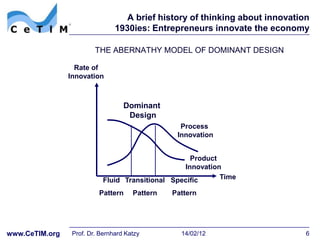
                         THE ABERNATHY MODEL OF DOMINANT DESIGN

                  Rate of
                Innovation


                                   Dominant
                                    Design
                                                  Process
                                                 Innovation


                                                    Product
                                                  Innovation
                            Fluid Transitional Specific     Time

                          Pattern     Pattern   Pattern


www.CeTIM.org    Prof. Dr. Bernhard Katzy         14/02/12                    6
A brief history of thinking about innovation
                               1930ies: Entrepreneurs innovate the economy
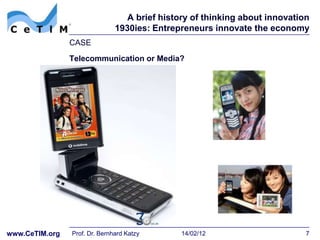
                CASE
                Telecommunication or Media?


www.CeTIM.org   Prof. Dr. Bernhard Katzy       14/02/12                      7
A brief history of thinking about innovation
                               1930ies: Entrepreneurs innovate the economy
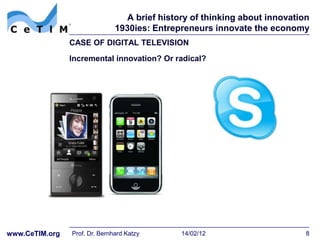
                CASE OF DIGITAL TELEVISION
                Incremental innovation? Or radical?


www.CeTIM.org   Prof. Dr. Bernhard Katzy       14/02/12                      8
A brief history of thinking about innovation
                               1930ies: Entrepreneurs innovate the economy
                ARCHITECTURAL INNOVATION


                                                          [Source: Henderson, Clark]

www.CeTIM.org   Prof. Dr. Bernhard Katzy       14/02/12                                9
A brief history of thinking about innovation
                                   1930ies: Entrepreneurs innovate the economy
          CREATIVE DESTRUCTION OF SCHUMPETER ‘S ENTREPRENEUR
          Definition on entrepreneurs (innovators):
          Individuals whose function is to carry new combination out
                •     The entrepreneur is the head of a firm and its employees
                •     The entrepreneur is never the risk bearer. Risk taking is in no
                      case an element of the entrepreneurial function, but may risk his
                      reputation
                •     First of all, there is the dream and the will to found a private
                      kingdom, usually, though not necessarily, also a dynasty;
                •     Then there is the will to conquer: the impulse to fight, to prove
                      oneself superior to others, to succeed for the sake, not of the
                      fruits of success, but of success itself;
                •     Finally , there is the joy of creating, of getting things done, or
                      simply of exercising one’s energy and ingenuity.


                                          Source :Schumpeter < the theory of economic development>

www.CeTIM.org       Prof. Dr. Bernhard Katzy             14/02/12                                10
A Brief history of thinking about innovation:
                            1950ies – Innovation through R&D Departments

                SCHUMPETER 2

                • Why this called Schumpeter 2 ?
                • The traditional paradigm for managing R&D
                   Bureaucracy in innovation departments dominant
                • Elements for innovation through R&D laboratories
                   paradigm
                    •    Main actors of R&D department
                    •    R&D laboratories : Philips since about 1914, the Bell Labs
                         in 1925…
                    •    Capital resources: funding from organization, or public
                         subsidies
                    •    Human resources: scientist, researchers……


www.CeTIM.org   Prof. Dr. Bernhard Katzy         14/02/12                             11
A Brief history of thinking about innovation:
                             1950ies – Innovation through R&D Departments
                EARLY CASES OF R&D LABS
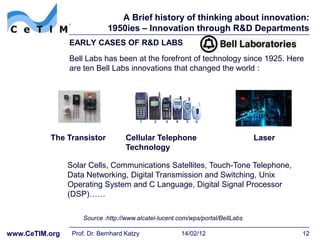
                Bell Labs has been at the forefront of technology since 1925. Here
                are ten Bell Labs innovations that changed the world :


          The Transistor            Cellular Telephone                          Laser
                                    Technology

                Solar Cells, Communications Satellites, Touch-Tone Telephone,
                Data Networking, Digital Transmission and Switching, Unix
                Operating System and C Language, Digital Signal Processor
                (DSP)……

                    Source :http://www.alcatel-lucent.com/wps/portal/BellLabs

www.CeTIM.org    Prof. Dr. Bernhard Katzy              14/02/12                         12
A Brief history of thinking about innovation:
                     1960ies: Innovation adoption of new ideas by society

                INNOVATION AS DIFFUSION OVER TIME

                • Diffusion is the process by which an innovation is
                   communicated through certain channels over time among the
                   members of a social system.
                • The decisions are not authoritative or collective, each member
                   of the social member of the social system faces his/her own
                   innovation-decision that follows a 5-step process:
                         -Knowledge
                         -Persuasion
                         -Decision
                         -Implementation
                         -Confirmation
                   For most members of a social system, the innovation-
                   decision depends heavily on the innovation-decisions of
                   the other members of the system


www.CeTIM.org    Prof. Dr. Bernhard Katzy      14/02/12                          13
A Brief history of thinking about innovation:
                    1960ies: Innovation adoption of new ideas by society

                INNOVATION AS DIFFUSION OVER TIME
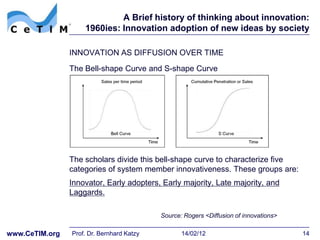
                The Bell-shape Curve and S-shape Curve


                The scholars divide this bell-shape curve to characterize five
                categories of system member innovativeness. These groups are:
                Innovator, Early adopters, Early majority, Late majority, and
                Laggards.

                                           Source: Rogers <Diffusion of innovations>

www.CeTIM.org   Prof. Dr. Bernhard Katzy          14/02/12                             14
A Brief history of thinking about innovation:
                    1960ies: Innovation adoption of new ideas by society
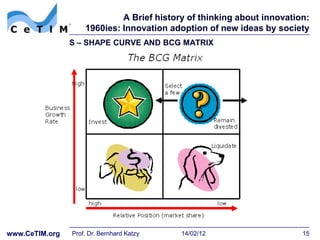
                S – SHAPE CURVE AND BCG MATRIX


www.CeTIM.org   Prof. Dr. Bernhard Katzy   14/02/12                     15
A Brief history of thinking about innovation:
                    1960ies: Innovation adoption of new ideas by society
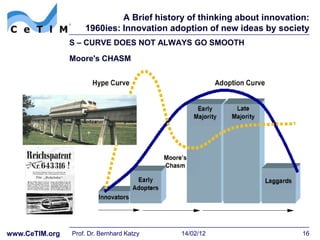
                S – CURVE DOES NOT ALWAYS GO SMOOTH
                Moore's CHASM


                            H3             H2              H1
www.CeTIM.org   Prof. Dr. Bernhard Katzy        14/02/12                16
A Brief history of thinking about innovation:
                                      1970ies: Innovation as a business strategy
                INNOVATION AS A STRATEGIC MEANS TO DIFFERENTIATE
                IN MATURE MARKETS
                National strategy
                - The relation ship between innovation and economic growth
                - Mainly concerns supporting small and medium sized enterprises in
                how to adopt innovations.
                - Policies and institutes such as TNO institute in Holland channelling
                more inventions through the process from basic to applied research
                and into production in firms.
                Innovation and organizational strategy
                - Viewing technology as a functional capability implies the need to
                develop a technology strategy, analogous to financial and human
                resource strategies
                - A set of interrelated decisions encompassing, among
                others, technology choice, level of technology competence, level of
                funding for technology development, timing of technology introduction
                in new products/ services, and organization for technology application
                and development (e.g., Maidique and Patch, 1978)

www.CeTIM.org      Prof. Dr. Bernhard Katzy        14/02/12                          17
A Brief history of thinking about innovation:
                      1980ies: Innovation as a profession and competence
                 INNOVATION AS A DISCIPLINE - DRUCKER
                                       Innovation
                                is an effect in economy
       Innovation                      and society                    Innovators
         is work
                                        Principles                     must build
                                                                   on their strength

                      The practice (discipline) of innovation:
                       „90% of Innovation is Transpiration‟
1 Analysis for                                                                   5
opportunities
              2                             Do‟s                              Gain
           Go out,                                            4            leadership
                                             3
       look and listen                                    Start small
   conception & perception             Be effective,
                                         simple
                                       and focused
                                                                   [Drucker, 1996]

www.CeTIM.org    Prof. Dr. Bernhard Katzy          14/02/12                          18
A Brief history of thinking about innovation
                    1990ies: Innovation through collaboration in networks


                INNOVATION THROUGH STRATEGIC COOPERATION IN
                INNOVATION SYSTEMS


                - Stresses that the flow of technology and information among
                  people, enterprises and institutions is key to an innovative
                  process. It contains the interaction between the actors who are
                  needed in order to turn an idea into a process, product or service
                  on the market.
                - Innovation systems have been categorized into national
                  innovation system, local innovation system, regional
                  innovation systems and sectoral innovation systems


www.CeTIM.org    Prof. Dr. Bernhard Katzy       14/02/12                           19
A Brief history of thinking about innovation
                        1990ies: Innovation through collaboration in network
                   INNOVATION SYSTEM

                    Sectoral
                   Innovation
                                                                                          Regional
                     System
                                                                                           Cluster
                                                                                       Industry and
                                                             Company                   Research
                                                                            Research
                                                                             Centre
                                                                                       Entities
                                 Publi
                                   c                       VPC              VPC
                                 Instit
                                 ution
                                              University
       National
      Innovation
        System
                                                            Living Lab                    LL client
                                                           community
                                          Social
                                                                                          New
                                          Comm                                          product/
                    Territory             unity                                         service
                   Social                                                               Co-
                   Settings           LL Collaborative                                  creation
                                     Infrastructure

                                                       Innovation system

                            [Katzy and Crownston 2008; Schuh, Katzy, Eisen 1997]

www.CeTIM.org      Prof. Dr. Bernhard Katzy                            14/02/12                       20
A Brief history of thinking about innovation:
                      2000: “open” Innovation in cooperation with the user
                 INNOVATION THROUGH OPEN INNOVATION

                         Research             licensing      Development
                                                                     Other firms’
                                                                     Market
                                                                       New Market
                                                      Spin-off
          Internal
          Technology Base                                              Current Market


                  External
                  Technology Base               Technology
                                                insourcing


                Labor mobility/ Venture Capital/ Numerous Start-ups/ research
                conducted at Universities/……
                                            [Source: Henry Chesbrough 2003]


www.CeTIM.org    Prof. Dr. Bernhard Katzy                 14/02/12                      21
A Brief history of thinking about innovation:
                     2000: “open” Innovation in cooperation with the user
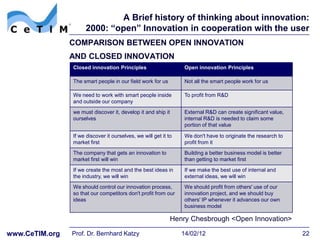
                COMPARISON BETWEEN OPEN INNOVATION
                AND CLOSED INNOVATION
                Closed innovation Principles                      Open innovation Principles

                The smart people in our field work for us         Not all the smart people work for us

                We need to work with smart people inside          To profit from R&D
                and outside our company
                we must discover it, develop it and ship it       External R&D can create significant value,
                ourselves                                         internal R&D is needed to claim some
                                                                  portion of that value

                If we discover it ourselves, we will get it to    We don't have to originate the research to
                market first                                      profit from it
                The company that gets an innovation to            Building a better business model is better
                market first will win                             than getting to market first
                If we create the most and the best ideas in       If we make the best use of internal and
                the industry, we will win                         external ideas, we will win
                We should control our innovation process,         We should profit from others' use of our
                so that our competitors don't profit from our     innovation project, and we should buy
                ideas                                             others' IP whenever it advances our own
                                                                  business model

                                                              Henry Chesbrough <Open Innovation>

www.CeTIM.org   Prof. Dr. Bernhard Katzy                         14/02/12                                      22
A Brief history of thinking about innovation:
                               2000: Innovation through Organization routines
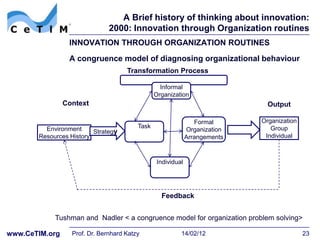
                 INNOVATION THROUGH ORGANIZATION ROUTINES
                 A congruence model of diagnosing organizational behaviour
                                     Transformation Process

                                                  Informal
                                                Organization
                Context                                                        Output

                                                                 Formal      Organization
         Environment                     Task                                   Group
                         Strategy                             Organization
       Resources History                                      Arrangements    Individual


                                                 Individual


                                                  Feedback


            Tushman and Nadler < a congruence model for organization problem solving>

www.CeTIM.org     Prof. Dr. Bernhard Katzy                14/02/12                          23
Summary and assignments


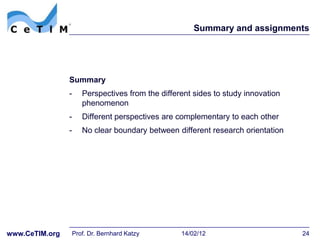
                Summary
                -      Perspectives from the different sides to study innovation
                       phenomenon
                -      Different perspectives are complementary to each other
                -      No clear boundary between different research orientation


www.CeTIM.org       Prof. Dr. Bernhard Katzy       14/02/12                        24
Readings for next sessions 3: Transformation and
                        Entrepreneurship and session 4:Organization of Innovation


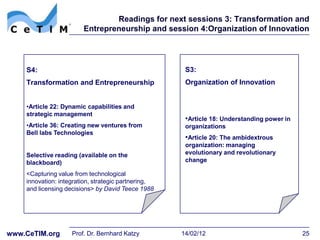
    S4:                                               S3:
    Transformation and Entrepreneurship               Organization of Innovation


    •Article 22: Dynamic capabilities and
    strategic management
                                                      •Article 18: Understanding power in
    •Article 36: Creating new ventures from           organizations
    Bell labs Technologies
                                                      •Article 20: The ambidextrous
                                                      organization: managing
    Selective reading (available on the               evolutionary and revolutionary
    blackboard)                                       change

    <Capturing value from technological
    innovation: integration, strategic partnering,
    and licensing decisions> by David Teece 1988


www.CeTIM.org       Prof. Dr. Bernhard Katzy         14/02/12                               25

Managing Innovation_innovation concepts

  • 1.
    Session 2: BasicInnovation Concepts Prof. Dr. Bernhard Katzy 2012 www.CeTIM.org Prof. Dr. Bernhard R. Katzy
  • 2.
    Innovation Management Innovation System Organization of Innovation innovation Governance Innovation Transformation and entrepreneurship Basic innovation concepts Introduction to innovation Innovation Theory … Dominant theory, Main issues and developments of innovation research www.CeTIM.org Prof. Dr. Bernhard Katzy 14/02/12 1
  • 3.
    Session 2 –An Overview Agenda ● Mini-Test ● A brief history of thinking about innovation ● Summary and assignments www.CeTIM.org Prof. Dr. Bernhard Katzy 14/02/12 2
  • 4.
    Session 2 –Reading Engagement Mini-Test www.CeTIM.org Prof. Dr. Bernhard Katzy 14/02/12 3
  • 5.
    A brief historyof thinking about innovation 1930ies: Entrepreneurs innovate the economy CREATIVE DESTRUCTION OF SCHUMPETER'S ENTREPRENEUR • Schumpeter‟s definition on innovation: A process of creative destruction Driven by: - New markets or products - New equipment - New methods of organization or management - New methods of communication • Schumpeter‟s business (technology) cycle A circular flow which, excluding any innovations and innovative activities, leads to a stationary state. The entrepreneur disturbs this equilibrium and this is the cause of economic development, which proceeds in cyclic fashions along several time scales. www.CeTIM.org Prof. Dr. Bernhard Katzy 14/02/12 4
  • 6.
    A brief historyof thinking about innovation 1930ies: Entrepreneurs innovate the economy THE S MODEL OF TECHNOLOGY CYCLE Maturity of Technology T 2 Substitution T 1 Time Initiation Take-off Maturity [Source: Foster,1986] www.CeTIM.org Prof. Dr. Bernhard Katzy 14/02/12 5
  • 7.
    A brief historyof thinking about innovation 1930ies: Entrepreneurs innovate the economy THE ABERNATHY MODEL OF DOMINANT DESIGN Rate of Innovation Dominant Design Process Innovation Product Innovation Fluid Transitional Specific Time Pattern Pattern Pattern www.CeTIM.org Prof. Dr. Bernhard Katzy 14/02/12 6
  • 8.
    A brief historyof thinking about innovation 1930ies: Entrepreneurs innovate the economy CASE Telecommunication or Media? www.CeTIM.org Prof. Dr. Bernhard Katzy 14/02/12 7
  • 9.
    A brief historyof thinking about innovation 1930ies: Entrepreneurs innovate the economy CASE OF DIGITAL TELEVISION Incremental innovation? Or radical? www.CeTIM.org Prof. Dr. Bernhard Katzy 14/02/12 8
  • 10.
    A brief historyof thinking about innovation 1930ies: Entrepreneurs innovate the economy ARCHITECTURAL INNOVATION [Source: Henderson, Clark] www.CeTIM.org Prof. Dr. Bernhard Katzy 14/02/12 9
  • 11.
    A brief historyof thinking about innovation 1930ies: Entrepreneurs innovate the economy CREATIVE DESTRUCTION OF SCHUMPETER ‘S ENTREPRENEUR Definition on entrepreneurs (innovators): Individuals whose function is to carry new combination out • The entrepreneur is the head of a firm and its employees • The entrepreneur is never the risk bearer. Risk taking is in no case an element of the entrepreneurial function, but may risk his reputation • First of all, there is the dream and the will to found a private kingdom, usually, though not necessarily, also a dynasty; • Then there is the will to conquer: the impulse to fight, to prove oneself superior to others, to succeed for the sake, not of the fruits of success, but of success itself; • Finally , there is the joy of creating, of getting things done, or simply of exercising one’s energy and ingenuity. Source :Schumpeter < the theory of economic development> www.CeTIM.org Prof. Dr. Bernhard Katzy 14/02/12 10
  • 12.
    A Brief historyof thinking about innovation: 1950ies – Innovation through R&D Departments SCHUMPETER 2 • Why this called Schumpeter 2 ? • The traditional paradigm for managing R&D Bureaucracy in innovation departments dominant • Elements for innovation through R&D laboratories paradigm • Main actors of R&D department • R&D laboratories : Philips since about 1914, the Bell Labs in 1925… • Capital resources: funding from organization, or public subsidies • Human resources: scientist, researchers…… www.CeTIM.org Prof. Dr. Bernhard Katzy 14/02/12 11
  • 13.
    A Brief historyof thinking about innovation: 1950ies – Innovation through R&D Departments EARLY CASES OF R&D LABS Bell Labs has been at the forefront of technology since 1925. Here are ten Bell Labs innovations that changed the world : The Transistor Cellular Telephone Laser Technology Solar Cells, Communications Satellites, Touch-Tone Telephone, Data Networking, Digital Transmission and Switching, Unix Operating System and C Language, Digital Signal Processor (DSP)…… Source :http://www.alcatel-lucent.com/wps/portal/BellLabs www.CeTIM.org Prof. Dr. Bernhard Katzy 14/02/12 12
  • 14.
    A Brief historyof thinking about innovation: 1960ies: Innovation adoption of new ideas by society INNOVATION AS DIFFUSION OVER TIME • Diffusion is the process by which an innovation is communicated through certain channels over time among the members of a social system. • The decisions are not authoritative or collective, each member of the social member of the social system faces his/her own innovation-decision that follows a 5-step process: -Knowledge -Persuasion -Decision -Implementation -Confirmation For most members of a social system, the innovation- decision depends heavily on the innovation-decisions of the other members of the system www.CeTIM.org Prof. Dr. Bernhard Katzy 14/02/12 13
  • 15.
    A Brief historyof thinking about innovation: 1960ies: Innovation adoption of new ideas by society INNOVATION AS DIFFUSION OVER TIME The Bell-shape Curve and S-shape Curve The scholars divide this bell-shape curve to characterize five categories of system member innovativeness. These groups are: Innovator, Early adopters, Early majority, Late majority, and Laggards. Source: Rogers <Diffusion of innovations> www.CeTIM.org Prof. Dr. Bernhard Katzy 14/02/12 14
  • 16.
    A Brief historyof thinking about innovation: 1960ies: Innovation adoption of new ideas by society S – SHAPE CURVE AND BCG MATRIX www.CeTIM.org Prof. Dr. Bernhard Katzy 14/02/12 15
  • 17.
    A Brief historyof thinking about innovation: 1960ies: Innovation adoption of new ideas by society S – CURVE DOES NOT ALWAYS GO SMOOTH Moore's CHASM H3 H2 H1 www.CeTIM.org Prof. Dr. Bernhard Katzy 14/02/12 16
  • 18.
    A Brief historyof thinking about innovation: 1970ies: Innovation as a business strategy INNOVATION AS A STRATEGIC MEANS TO DIFFERENTIATE IN MATURE MARKETS National strategy - The relation ship between innovation and economic growth - Mainly concerns supporting small and medium sized enterprises in how to adopt innovations. - Policies and institutes such as TNO institute in Holland channelling more inventions through the process from basic to applied research and into production in firms. Innovation and organizational strategy - Viewing technology as a functional capability implies the need to develop a technology strategy, analogous to financial and human resource strategies - A set of interrelated decisions encompassing, among others, technology choice, level of technology competence, level of funding for technology development, timing of technology introduction in new products/ services, and organization for technology application and development (e.g., Maidique and Patch, 1978) www.CeTIM.org Prof. Dr. Bernhard Katzy 14/02/12 17
  • 19.
    A Brief historyof thinking about innovation: 1980ies: Innovation as a profession and competence INNOVATION AS A DISCIPLINE - DRUCKER Innovation is an effect in economy Innovation and society Innovators is work Principles must build on their strength The practice (discipline) of innovation: „90% of Innovation is Transpiration‟ 1 Analysis for 5 opportunities 2 Do‟s Gain Go out, 4 leadership 3 look and listen Start small conception & perception Be effective, simple and focused [Drucker, 1996] www.CeTIM.org Prof. Dr. Bernhard Katzy 14/02/12 18
  • 20.
    A Brief historyof thinking about innovation 1990ies: Innovation through collaboration in networks INNOVATION THROUGH STRATEGIC COOPERATION IN INNOVATION SYSTEMS - Stresses that the flow of technology and information among people, enterprises and institutions is key to an innovative process. It contains the interaction between the actors who are needed in order to turn an idea into a process, product or service on the market. - Innovation systems have been categorized into national innovation system, local innovation system, regional innovation systems and sectoral innovation systems www.CeTIM.org Prof. Dr. Bernhard Katzy 14/02/12 19
  • 21.
    A Brief historyof thinking about innovation 1990ies: Innovation through collaboration in network INNOVATION SYSTEM Sectoral Innovation Regional System Cluster Industry and Company Research Research Centre Entities Publi c VPC VPC Instit ution University National Innovation System Living Lab LL client community Social New Comm product/ Territory unity service Social Co- Settings LL Collaborative creation Infrastructure Innovation system [Katzy and Crownston 2008; Schuh, Katzy, Eisen 1997] www.CeTIM.org Prof. Dr. Bernhard Katzy 14/02/12 20
  • 22.
    A Brief historyof thinking about innovation: 2000: “open” Innovation in cooperation with the user INNOVATION THROUGH OPEN INNOVATION Research licensing Development Other firms’ Market New Market Spin-off Internal Technology Base Current Market External Technology Base Technology insourcing Labor mobility/ Venture Capital/ Numerous Start-ups/ research conducted at Universities/…… [Source: Henry Chesbrough 2003] www.CeTIM.org Prof. Dr. Bernhard Katzy 14/02/12 21
  • 23.
    A Brief historyof thinking about innovation: 2000: “open” Innovation in cooperation with the user COMPARISON BETWEEN OPEN INNOVATION AND CLOSED INNOVATION Closed innovation Principles Open innovation Principles The smart people in our field work for us Not all the smart people work for us We need to work with smart people inside To profit from R&D and outside our company we must discover it, develop it and ship it External R&D can create significant value, ourselves internal R&D is needed to claim some portion of that value If we discover it ourselves, we will get it to We don't have to originate the research to market first profit from it The company that gets an innovation to Building a better business model is better market first will win than getting to market first If we create the most and the best ideas in If we make the best use of internal and the industry, we will win external ideas, we will win We should control our innovation process, We should profit from others' use of our so that our competitors don't profit from our innovation project, and we should buy ideas others' IP whenever it advances our own business model Henry Chesbrough <Open Innovation> www.CeTIM.org Prof. Dr. Bernhard Katzy 14/02/12 22
  • 24.
    A Brief historyof thinking about innovation: 2000: Innovation through Organization routines INNOVATION THROUGH ORGANIZATION ROUTINES A congruence model of diagnosing organizational behaviour Transformation Process Informal Organization Context Output Formal Organization Environment Task Group Strategy Organization Resources History Arrangements Individual Individual Feedback Tushman and Nadler < a congruence model for organization problem solving> www.CeTIM.org Prof. Dr. Bernhard Katzy 14/02/12 23
  • 25.
    Summary and assignments Summary - Perspectives from the different sides to study innovation phenomenon - Different perspectives are complementary to each other - No clear boundary between different research orientation www.CeTIM.org Prof. Dr. Bernhard Katzy 14/02/12 24
  • 26.
    Readings for nextsessions 3: Transformation and Entrepreneurship and session 4:Organization of Innovation S4: S3: Transformation and Entrepreneurship Organization of Innovation •Article 22: Dynamic capabilities and strategic management •Article 18: Understanding power in •Article 36: Creating new ventures from organizations Bell labs Technologies •Article 20: The ambidextrous organization: managing Selective reading (available on the evolutionary and revolutionary blackboard) change <Capturing value from technological innovation: integration, strategic partnering, and licensing decisions> by David Teece 1988 www.CeTIM.org Prof. Dr. Bernhard Katzy 14/02/12 25