




THE MANAGER’S TRAINING
Iftikhar A Chohan
Sameel Pharmaceuticals (Pvt)Ltd –Faisalabad
10/5/2020
1
THE MANAGER’S TRAINING
Iftikhar A Chohan
Sameel Pharmaceuticals (Pvt)Ltd –Faisalabad
DID YOU KNOW
 60% OF FIRST TIME MANAGERS FAIL.
 85% RECEIVE NO TRAINING PRIOR TO
SWITCHING TO THE ROLE OF MANAGER.
10/5/2020
2
WHAT IS MANAGEMENT
 Activities performed to achieve
objectives by systematically using
the people and resources.is called
management.
or
 management is a "process" i.e. a
systematic way of doing things
10/5/2020
3
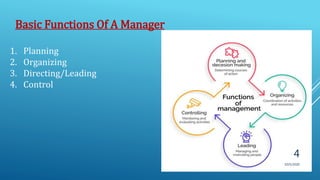
Basic Functions Of A Manager
10/5/2020
4
1. Planning
2. Organizing
3. Directing/Leading
4. Control
MANAGER AS A PROBLEM SOLVER
10/5/2020
5
THE MANAGER – AREA OF EXPERTISE
 The manager sets the course for the most
efficient system of objective achievement
 The successful manager inspires the team to
act
 An effective manager also possesses insight
into the personalities of his / her team.
 The manager is there to cultivate and refine
the talents of the people
10/5/2020
6
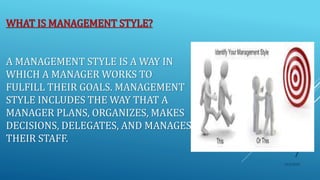
WHAT IS MANAGEMENT STYLE?
A MANAGEMENT STYLE IS A WAY IN
WHICH A MANAGER WORKS TO
FULFILL THEIR GOALS. MANAGEMENT
STYLE INCLUDES THE WAY THAT A
MANAGER PLANS, ORGANIZES, MAKES
DECISIONS, DELEGATES, AND MANAGES
THEIR STAFF.
10/5/2020
7
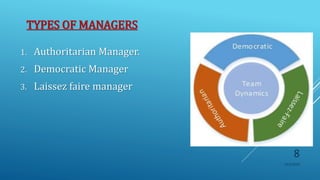
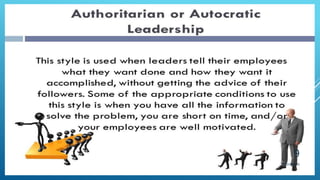
1. Authoritarian Manager.
2. Democratic Manager
3. Laissez faire manager
TYPES OF MANAGERS
10/5/2020
8
10/5/2020
9
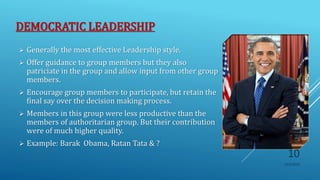
DEMOCRATIC LEADERSHIP
 Generally the most effective Leadership style.
 Offer guidance to group members but they also
patriciate in the group and allow input from other group
members.
 Encourage group members to participate, but retain the
final say over the decision making process.
 Members in this group were less productive than the
members of authoritarian group. But their contribution
were of much higher quality.
 Example: Barak Obama, Ratan Tata & ?
10/5/2020
10
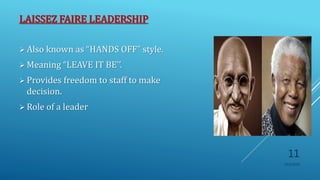
LAISSEZ FAIRE LEADERSHIP
 Also known as “HANDS OFF” style.
 Meaning “LEAVE IT BE’’.
 Provides freedom to staff to make
decision.
 Role of a leader
10/5/2020
11
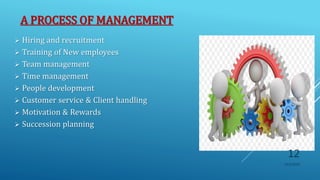
A PROCESS OF MANAGEMENT
 Hiring and recruitment
 Training of New employees
 Team management
 Time management
 People development
 Customer service & Client handling
 Motivation & Rewards
 Succession planning
10/5/2020
12
RECRUITING /HIRING PEOPLE
 Recruiting is not a one time event.
 It is a continual, ongoing process.
 The Manager should always have “a basket of
people” for immediate and timely
recruitment.
 He should be prepared to fill out vacancies as
soon as they occur.
 # Principle is “Merit based Hiring”
 Red flag resume/interview technic
10/5/2020
13
KEEPING THE ‘PIPELINE’ FILLED
 Interview a number of individuals each
month.
 Place an announcement in the
institutions/hospitals every few months
(whether you're hiring or not). This ensures a
continual supply of resumes for review.
 Enlist the help of the men and women in the
trenches. Good people usually know other
good people. 10/5/2020
14
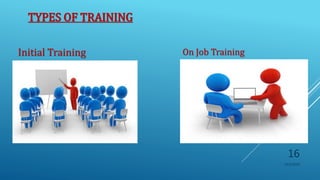
TRAINING – FOR NEWCOMERS AND VETERANS
Training really worth the
organization's investment of time
and money to:
 Enhanced performance
 Increased customer
satisfaction
 More effective sales/service
activities
 Reduced turnover
10/5/2020
15
TYPES OF TRAINING
Initial Training On Job Training
10/5/2020
16
TEAM
A team is a group of individuals
(human or non-human) working
together to achieve their goal..
10/5/2020
17
TEAMOLOGY
10/5/2020
18
5-KEYS TO MANAGE TEAM PERFORMANCE
1. Clear Vision for the Team
2. Set Goals & KPIs
3. Transparent Action
4. Regular 1:1 Meetings
5. Motivating Team Culture
10/5/2020
19
GOOD TEAM WORK VS BAD TEAM WORK
10/5/2020
20
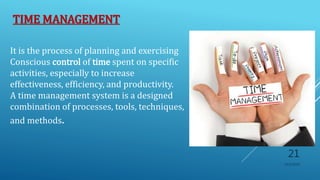
TIME MANAGEMENT
It is the process of planning and exercising
Conscious control of time spent on specific
activities, especially to increase
effectiveness, efficiency, and productivity.
A time management system is a designed
combination of processes, tools, techniques,
and methods.
10/5/2020
21
TIME MANAGEMENT TIPS
 Be intentional: keep a to-do list
 Be prioritized: rank your tasks
 Be focused: manage distractions
 Be structured: time block your work
 Be self-aware: track your time
10/5/2020
22
HOW TO STRUCTURE YOUR DAY
10/5/2020
23

BRANCH/DEPARTMENT MANAGERS ARE RESPONSIBLE
FOR OUTLINING STRATEGIC DEPARTMENTAL TARGETS,
ENSURING THE HIGHEST LEVEL OF QUALITY IS MET AND
CULTIVATING A COMFORTABLE AND PRODUCTIVE
WORKING ENVIRONMENT, AMONG OTHER DUTIES.
DEPARTMENT MANAGERS WILL NEED TO INSPIRE THEIR
STAFF TO ENABLE THEM TO PERFORM AT THEIR BEST
AND KEEP THEM MOTIVATED AT ALL TIMES, REQUIRING
EXCELLENT COMMUNICATIVE AND INTERPERSONAL
SKILLS.
10/5/2020
24
RESPONSIBILITIES OF BRANCH MANAGER.
 Direct all operational aspects including distribution operations, customer service, human resources,
administration and sales
 Assess local market conditions and identify current and prospective sales opportunities
 Meet goals and metrics
 Bring out the best of branch’s personnel by providing training, coaching, development and motivation
 Locate areas of improvement and propose corrective actions that meet challenges and leverage growth
opportunities
 Share knowledge with other branches and headquarters on effective practices, competitive intelligence,
business opportunities and needs
 Address customer and employee satisfaction issues promptly
 Adhere to high ethical standards, and comply with all regulations/applicable laws
 Network to improve the presence and reputation of the branch and company
 Stay abreast of competing markets and provide reports on market movement and penetration
10/5/2020
25
DEPARTMENT MANAGER
Department Managers will need to
inspire their staff to enable them to
perform at their best and keep them
motivated at all times, requiring
excellent communicative and
interpersonal skills.
10/5/2020
26
DEPARTMENT MANAGER RESPONSIBILITIES
 Recruiting, interviewing and orienting new staff members.
 Monitoring and evaluating staff performance.
 Setting strategic long and short-term departmental goals and
evaluating outcomes.
 Motivating and inspiring staff and facilitating personal
growth.
 Ensuring high levels of productivity are maintained.
 Ensuring the highest levels of quality are met.
 Communicating job expectations to staff.
 Conducting training and sessions for continued skills
improvement.
 Fostering a productive working environment.
 Ensuring adherence to company and industry regulations.
10/5/2020
27
5-TIPS TO SUCCEED AS A FIRST TIME
MANAGER
 You are manager Now: Believe it and behave like one
Since you have something special in you than your colleagues, you have been
promoted as a manager.
 Follow 70-20-10 rule.
You are not an individual contributor ,Now you have additional responsibility
of managing people.70% time for completing your own KRA 20% for
process improvement &10% for people management
 Over come fear of “I would be out of Touch with
technology”
Now you have to invest time in people management some managers feel that
they might lose touch with the job they were expert of. As you start climbing the
corporate ladder you need to balance technical mastery and people management.
Keep balance and Build a strong network of people. It is very difficult for you to be
“Wikipedia” for all technical stuff. Develop connect with people to address the
technical issues.
10/5/2020
28
5-TIPS TO SUCCEED AS A FIRST TIME
MANAGER
 Focus on ‘Developing people' and not ‘rescuing’ them
During your stint as an individual contributor you were star performer now
you are a manager and chances are high that no one deliver the work at your
speed and quality. You will be temped to rescue them by doing their work.
Instead invest time in developing them by building their competencies.
Remember people are people they have different needs ,emotion they are ‘Task
Robots’.be kind to them listen to them (YOU HAVE THE CHOICE TO DISAGREE)
 Get a Mentor for yourself.
You need a mentor to vent out your anger and discuss your concerns with
him.
Remember if you continue to do good work you will
become Manager of managers
10/5/2020
29
ACCOUNTABILITY & RECOGNITION
 Don't just say, 'Job well done' to your
subordinate. Praise them in public
meetings. Describe the specific
results of their performance.
 This demonstrates your confidence
in the team, as well as your high
expectations of them. When you
expect people to win, they usually
do."
10/5/2020
30
ACCOUNTABILITY & RECOGNITION
10/5/2020
31
 When people don't perform, hold
them accountable and provide them
direction to improve the situation.
 Recognizing top performers is
another vital function.
 Recognition doesn't have to be
expensive, but it should be ongoing.
It can range from a handwritten
note saluting a person's
performance to a luncheon or an
appreciation letter signed by the
superiors.
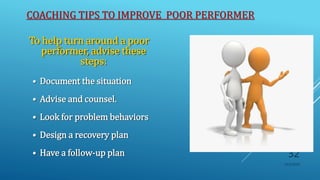
COACHING TIPS TO IMPROVE POOR PERFORMER
To help turn around a poor
performer, advise these
steps:
• Document the situation
• Advise and counsel.
• Look for problem behaviors
• Design a recovery plan
• Have a follow-up plan
10/5/2020
32
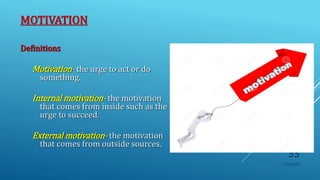
MOTIVATION
Definitions
Motivation- the urge to act or do
something.
Internal motivation- the motivation
that comes from inside such as the
urge to succeed.
External motivation- the motivation
that comes from outside sources.
10/5/2020
33
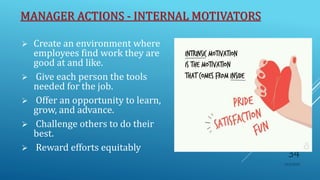
MANAGER ACTIONS - INTERNAL MOTIVATORS
 Create an environment where
employees find work they are
good at and like.
 Give each person the tools
needed for the job.
 Offer an opportunity to learn,
grow, and advance.
 Challenge others to do their
best.
 Reward efforts equitably
10/5/2020
34
CRITERIA EMPLOYEES USE TO
EVALUATE MANAGERS
 Open Communications
 Security
 Management Commitment
 Fairness
 Respect
 Development Opportunities
10/5/2020
35
CRITERIA EMPLOYEES USE TO EVALUATE MANAGERS
Criteria Definition Rating
Open Is the needed information available? _____
Communications
Security Am I safe from risks or threats? _____
Management Is my manager committed to a course ---------
Commitment of action?
10/5/2020
36
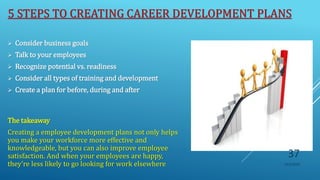
5 STEPS TO CREATING CAREER DEVELOPMENT PLANS
 Consider business goals
 Talk to your employees
 Recognize potential vs. readiness
 Consider all types of training and development
 Create a plan for before, during and after
The takeaway
Creating a employee development plans not only helps
you make your workforce more effective and
knowledgeable, but you can also improve employee
satisfaction. And when your employees are happy,
they’re less likely to go looking for work elsewhere 10/5/2020
37
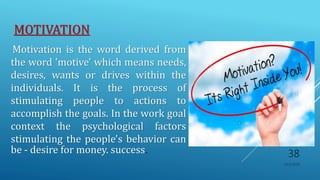
MOTIVATION
Motivation is the word derived from
the word 'motive' which means needs,
desires, wants or drives within the
individuals. It is the process of
stimulating people to actions to
accomplish the goals. In the work goal
context the psychological factors
stimulating the people's behavior can
be - desire for money. success.
10/5/2020
38
10/5/2020
39
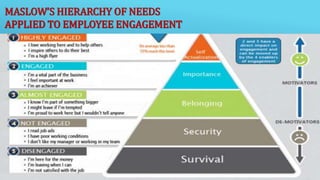
MASLOW’S HIERARCHY OF NEEDS
APPLIED TO EMPLOYEE ENGAGEMENT
SUCCESSION PLANNING
It takes years to build up a strong,
professional firm, but many businesses
can destroy this value quickly by failing
to plan for the succession of senior staff.
What is your
Have you considered how you will exit
your firm or manage the exit of one of
your colleagues should they get ill, seek
retirement, or face an unexpected
change of life?
10/5/2020
40
SUCCESSION PLAN FOR EMPLOYEES
10/5/2020
41
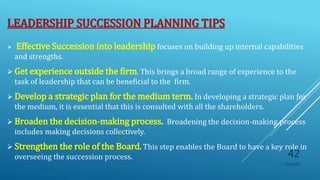
LEADERSHIP SUCCESSION PLANNING TIPS
 Effective Succession into leadership focuses on building up internal capabilities
and strengths.
 Get experience outside the firm. This brings a broad range of experience to the
task of leadership that can be beneficial to the firm.
 Develop a strategic plan for the medium term. In developing a strategic plan for
the medium, it is essential that this is consulted with all the shareholders.
 Broaden the decision-making process. Broadening the decision-making process
includes making decisions collectively.
 Strengthen the role of the Board. This step enables the Board to have a key role in
overseeing the succession process.
10/5/2020
42
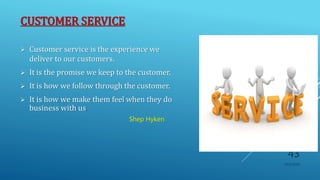
CUSTOMER SERVICE
 Customer service is the experience we
deliver to our customers.
 It is the promise we keep to the customer.
 It is how we follow through the customer.
 It is how we make them feel when they do
business with us.
Shep Hyken
10/5/2020
43
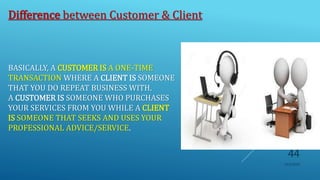
BASICALLY, A CUSTOMER IS A ONE-TIME
TRANSACTION WHERE A CLIENT IS SOMEONE
THAT YOU DO REPEAT BUSINESS WITH.
A CUSTOMER IS SOMEONE WHO PURCHASES
YOUR SERVICES FROM YOU WHILE A CLIENT
IS SOMEONE THAT SEEKS AND USES YOUR
PROFESSIONAL ADVICE/SERVICE.
10/5/2020
44
Difference between Customer & Client
IMPORTANCE OF CUSTOMER SERVICE
10/5/2020
45
INTERESTING FINDINGS
 Research suggests that more than 55% of your
clients will be willing to pay more for better client
service.
 In a typical business 42% of clients service
agents are unable to efficiently resolve customer
issues due to disconnected systems, archaic user
interfaces and multiple applications. Don’t close
yourself off in a golden cage of old structures. Take
the road less travelled.
 Your client is twice as likely to post a negative
review about your client relationship as opposed to
a positive one 10/5/2020
46
10/5/2020
47
10/5/2020
48
10/5/2020
49

The Manager's Training

  • 1.
    THE MANAGER’S TRAINING IftikharA Chohan Sameel Pharmaceuticals (Pvt)Ltd –Faisalabad 10/5/2020 1 THE MANAGER’S TRAINING Iftikhar A Chohan Sameel Pharmaceuticals (Pvt)Ltd –Faisalabad
  • 2.
    DID YOU KNOW 60% OF FIRST TIME MANAGERS FAIL.  85% RECEIVE NO TRAINING PRIOR TO SWITCHING TO THE ROLE OF MANAGER. 10/5/2020 2
  • 3.
    WHAT IS MANAGEMENT Activities performed to achieve objectives by systematically using the people and resources.is called management. or  management is a "process" i.e. a systematic way of doing things 10/5/2020 3
  • 4.
    Basic Functions OfA Manager 10/5/2020 4 1. Planning 2. Organizing 3. Directing/Leading 4. Control
  • 5.
    MANAGER AS APROBLEM SOLVER 10/5/2020 5
  • 6.
    THE MANAGER –AREA OF EXPERTISE  The manager sets the course for the most efficient system of objective achievement  The successful manager inspires the team to act  An effective manager also possesses insight into the personalities of his / her team.  The manager is there to cultivate and refine the talents of the people 10/5/2020 6
  • 7.
    WHAT IS MANAGEMENTSTYLE? A MANAGEMENT STYLE IS A WAY IN WHICH A MANAGER WORKS TO FULFILL THEIR GOALS. MANAGEMENT STYLE INCLUDES THE WAY THAT A MANAGER PLANS, ORGANIZES, MAKES DECISIONS, DELEGATES, AND MANAGES THEIR STAFF. 10/5/2020 7
  • 8.
    1. Authoritarian Manager. 2.Democratic Manager 3. Laissez faire manager TYPES OF MANAGERS 10/5/2020 8
  • 9.
  • 10.
    DEMOCRATIC LEADERSHIP  Generallythe most effective Leadership style.  Offer guidance to group members but they also patriciate in the group and allow input from other group members.  Encourage group members to participate, but retain the final say over the decision making process.  Members in this group were less productive than the members of authoritarian group. But their contribution were of much higher quality.  Example: Barak Obama, Ratan Tata & ? 10/5/2020 10
  • 11.
    LAISSEZ FAIRE LEADERSHIP Also known as “HANDS OFF” style.  Meaning “LEAVE IT BE’’.  Provides freedom to staff to make decision.  Role of a leader 10/5/2020 11
  • 12.
    A PROCESS OFMANAGEMENT  Hiring and recruitment  Training of New employees  Team management  Time management  People development  Customer service & Client handling  Motivation & Rewards  Succession planning 10/5/2020 12
  • 13.
    RECRUITING /HIRING PEOPLE Recruiting is not a one time event.  It is a continual, ongoing process.  The Manager should always have “a basket of people” for immediate and timely recruitment.  He should be prepared to fill out vacancies as soon as they occur.  # Principle is “Merit based Hiring”  Red flag resume/interview technic 10/5/2020 13
  • 14.
    KEEPING THE ‘PIPELINE’FILLED  Interview a number of individuals each month.  Place an announcement in the institutions/hospitals every few months (whether you're hiring or not). This ensures a continual supply of resumes for review.  Enlist the help of the men and women in the trenches. Good people usually know other good people. 10/5/2020 14
  • 15.
    TRAINING – FORNEWCOMERS AND VETERANS Training really worth the organization's investment of time and money to:  Enhanced performance  Increased customer satisfaction  More effective sales/service activities  Reduced turnover 10/5/2020 15
  • 16.
    TYPES OF TRAINING InitialTraining On Job Training 10/5/2020 16
  • 17.
    TEAM A team isa group of individuals (human or non-human) working together to achieve their goal.. 10/5/2020 17
  • 18.
  • 19.
    5-KEYS TO MANAGETEAM PERFORMANCE 1. Clear Vision for the Team 2. Set Goals & KPIs 3. Transparent Action 4. Regular 1:1 Meetings 5. Motivating Team Culture 10/5/2020 19
  • 20.
    GOOD TEAM WORKVS BAD TEAM WORK 10/5/2020 20
  • 21.
    TIME MANAGEMENT It isthe process of planning and exercising Conscious control of time spent on specific activities, especially to increase effectiveness, efficiency, and productivity. A time management system is a designed combination of processes, tools, techniques, and methods. 10/5/2020 21
  • 22.
    TIME MANAGEMENT TIPS Be intentional: keep a to-do list  Be prioritized: rank your tasks  Be focused: manage distractions  Be structured: time block your work  Be self-aware: track your time 10/5/2020 22
  • 23.
    HOW TO STRUCTUREYOUR DAY 10/5/2020 23
  • 24.
     BRANCH/DEPARTMENT MANAGERS ARERESPONSIBLE FOR OUTLINING STRATEGIC DEPARTMENTAL TARGETS, ENSURING THE HIGHEST LEVEL OF QUALITY IS MET AND CULTIVATING A COMFORTABLE AND PRODUCTIVE WORKING ENVIRONMENT, AMONG OTHER DUTIES. DEPARTMENT MANAGERS WILL NEED TO INSPIRE THEIR STAFF TO ENABLE THEM TO PERFORM AT THEIR BEST AND KEEP THEM MOTIVATED AT ALL TIMES, REQUIRING EXCELLENT COMMUNICATIVE AND INTERPERSONAL SKILLS. 10/5/2020 24
  • 25.
    RESPONSIBILITIES OF BRANCHMANAGER.  Direct all operational aspects including distribution operations, customer service, human resources, administration and sales  Assess local market conditions and identify current and prospective sales opportunities  Meet goals and metrics  Bring out the best of branch’s personnel by providing training, coaching, development and motivation  Locate areas of improvement and propose corrective actions that meet challenges and leverage growth opportunities  Share knowledge with other branches and headquarters on effective practices, competitive intelligence, business opportunities and needs  Address customer and employee satisfaction issues promptly  Adhere to high ethical standards, and comply with all regulations/applicable laws  Network to improve the presence and reputation of the branch and company  Stay abreast of competing markets and provide reports on market movement and penetration 10/5/2020 25
  • 26.
    DEPARTMENT MANAGER Department Managerswill need to inspire their staff to enable them to perform at their best and keep them motivated at all times, requiring excellent communicative and interpersonal skills. 10/5/2020 26
  • 27.
    DEPARTMENT MANAGER RESPONSIBILITIES Recruiting, interviewing and orienting new staff members.  Monitoring and evaluating staff performance.  Setting strategic long and short-term departmental goals and evaluating outcomes.  Motivating and inspiring staff and facilitating personal growth.  Ensuring high levels of productivity are maintained.  Ensuring the highest levels of quality are met.  Communicating job expectations to staff.  Conducting training and sessions for continued skills improvement.  Fostering a productive working environment.  Ensuring adherence to company and industry regulations. 10/5/2020 27
  • 28.
    5-TIPS TO SUCCEEDAS A FIRST TIME MANAGER  You are manager Now: Believe it and behave like one Since you have something special in you than your colleagues, you have been promoted as a manager.  Follow 70-20-10 rule. You are not an individual contributor ,Now you have additional responsibility of managing people.70% time for completing your own KRA 20% for process improvement &10% for people management  Over come fear of “I would be out of Touch with technology” Now you have to invest time in people management some managers feel that they might lose touch with the job they were expert of. As you start climbing the corporate ladder you need to balance technical mastery and people management. Keep balance and Build a strong network of people. It is very difficult for you to be “Wikipedia” for all technical stuff. Develop connect with people to address the technical issues. 10/5/2020 28
  • 29.
    5-TIPS TO SUCCEEDAS A FIRST TIME MANAGER  Focus on ‘Developing people' and not ‘rescuing’ them During your stint as an individual contributor you were star performer now you are a manager and chances are high that no one deliver the work at your speed and quality. You will be temped to rescue them by doing their work. Instead invest time in developing them by building their competencies. Remember people are people they have different needs ,emotion they are ‘Task Robots’.be kind to them listen to them (YOU HAVE THE CHOICE TO DISAGREE)  Get a Mentor for yourself. You need a mentor to vent out your anger and discuss your concerns with him. Remember if you continue to do good work you will become Manager of managers 10/5/2020 29
  • 30.
    ACCOUNTABILITY & RECOGNITION Don't just say, 'Job well done' to your subordinate. Praise them in public meetings. Describe the specific results of their performance.  This demonstrates your confidence in the team, as well as your high expectations of them. When you expect people to win, they usually do." 10/5/2020 30
  • 31.
    ACCOUNTABILITY & RECOGNITION 10/5/2020 31 When people don't perform, hold them accountable and provide them direction to improve the situation.  Recognizing top performers is another vital function.  Recognition doesn't have to be expensive, but it should be ongoing. It can range from a handwritten note saluting a person's performance to a luncheon or an appreciation letter signed by the superiors.
  • 32.
    COACHING TIPS TOIMPROVE POOR PERFORMER To help turn around a poor performer, advise these steps: • Document the situation • Advise and counsel. • Look for problem behaviors • Design a recovery plan • Have a follow-up plan 10/5/2020 32
  • 33.
    MOTIVATION Definitions Motivation- the urgeto act or do something. Internal motivation- the motivation that comes from inside such as the urge to succeed. External motivation- the motivation that comes from outside sources. 10/5/2020 33
  • 34.
    MANAGER ACTIONS -INTERNAL MOTIVATORS  Create an environment where employees find work they are good at and like.  Give each person the tools needed for the job.  Offer an opportunity to learn, grow, and advance.  Challenge others to do their best.  Reward efforts equitably 10/5/2020 34
  • 35.
    CRITERIA EMPLOYEES USETO EVALUATE MANAGERS  Open Communications  Security  Management Commitment  Fairness  Respect  Development Opportunities 10/5/2020 35
  • 36.
    CRITERIA EMPLOYEES USETO EVALUATE MANAGERS Criteria Definition Rating Open Is the needed information available? _____ Communications Security Am I safe from risks or threats? _____ Management Is my manager committed to a course --------- Commitment of action? 10/5/2020 36
  • 37.
    5 STEPS TOCREATING CAREER DEVELOPMENT PLANS  Consider business goals  Talk to your employees  Recognize potential vs. readiness  Consider all types of training and development  Create a plan for before, during and after The takeaway Creating a employee development plans not only helps you make your workforce more effective and knowledgeable, but you can also improve employee satisfaction. And when your employees are happy, they’re less likely to go looking for work elsewhere 10/5/2020 37
  • 38.
    MOTIVATION Motivation is theword derived from the word 'motive' which means needs, desires, wants or drives within the individuals. It is the process of stimulating people to actions to accomplish the goals. In the work goal context the psychological factors stimulating the people's behavior can be - desire for money. success. 10/5/2020 38
  • 39.
    10/5/2020 39 MASLOW’S HIERARCHY OFNEEDS APPLIED TO EMPLOYEE ENGAGEMENT
  • 40.
    SUCCESSION PLANNING It takesyears to build up a strong, professional firm, but many businesses can destroy this value quickly by failing to plan for the succession of senior staff. What is your Have you considered how you will exit your firm or manage the exit of one of your colleagues should they get ill, seek retirement, or face an unexpected change of life? 10/5/2020 40
  • 41.
    SUCCESSION PLAN FOREMPLOYEES 10/5/2020 41
  • 42.
    LEADERSHIP SUCCESSION PLANNINGTIPS  Effective Succession into leadership focuses on building up internal capabilities and strengths.  Get experience outside the firm. This brings a broad range of experience to the task of leadership that can be beneficial to the firm.  Develop a strategic plan for the medium term. In developing a strategic plan for the medium, it is essential that this is consulted with all the shareholders.  Broaden the decision-making process. Broadening the decision-making process includes making decisions collectively.  Strengthen the role of the Board. This step enables the Board to have a key role in overseeing the succession process. 10/5/2020 42
  • 43.
    CUSTOMER SERVICE  Customerservice is the experience we deliver to our customers.  It is the promise we keep to the customer.  It is how we follow through the customer.  It is how we make them feel when they do business with us. Shep Hyken 10/5/2020 43
  • 44.
    BASICALLY, A CUSTOMERIS A ONE-TIME TRANSACTION WHERE A CLIENT IS SOMEONE THAT YOU DO REPEAT BUSINESS WITH. A CUSTOMER IS SOMEONE WHO PURCHASES YOUR SERVICES FROM YOU WHILE A CLIENT IS SOMEONE THAT SEEKS AND USES YOUR PROFESSIONAL ADVICE/SERVICE. 10/5/2020 44 Difference between Customer & Client
  • 45.
    IMPORTANCE OF CUSTOMERSERVICE 10/5/2020 45
  • 46.
    INTERESTING FINDINGS  Researchsuggests that more than 55% of your clients will be willing to pay more for better client service.  In a typical business 42% of clients service agents are unable to efficiently resolve customer issues due to disconnected systems, archaic user interfaces and multiple applications. Don’t close yourself off in a golden cage of old structures. Take the road less travelled.  Your client is twice as likely to post a negative review about your client relationship as opposed to a positive one 10/5/2020 46
  • 47.
  • 48.
  • 49.