Unit 5
BUSINESS IDEAS, PROJECT
IDENTIFICATION AND FORMULATION
Megharaja E N
Forms of Business Ownership
• Forms of business ownership and types of businesses describe how they are
organized and run.
• The four main forms of business ownership are listed below
• Sole proprietorship
• Corporation
• Partnership
• Co-operatives
• A franchise is a combination, or hybrid, of the four forms of ownership.
Sole Proprietorship
• A sole proprietorship is a business owned by one person who is known
as the proprietor.
• The proprietor has a wide range of responsibilities including arranging
displays and selling to consumers to name a few.
• Fund to run the business usually come from the owner's savings,
friends, family, and from a bank loan.
• If the business prospers, the owner receives all the profits.
• If the business does poorly, the owner is responsible for its losses.
• This is called unlimited liability
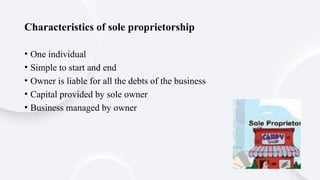
Characteristics of sole proprietorship
• One individual
• Simple to start and end
• Owner is liable for all the debts of the business
• Capital provided by sole owner
• Business managed by owner
Sole proprietorship
• Advantages
• No restrictions limit to capital
• Quick decision making
• Few legal requirements
• All profit belongs to owner
• Disadvantages
• No legal personality
• Feeling of isolation
• Unlimited liabilities
• Lack of continuity
Partnership
• A partnership refers to a type of business in which two or more
individuals share the costs and responsibilities of owning and operating
it.
• The terms of the partnership are recorded in the partnership agreement.
• The most common form of partnership is a general partnership,
• When two individuals form a limited partnership, the partners are only
responsible for the funds they both invested in the initial business.
• This is called limited liability.
Characteristics of Partnership
• Ownership- two or more person
• Legal requirements
• Each partner must make a contribution to the partnership
• Partners are jointly and severally liable for debts on the business
• Management
Types of partnership
• A general partnership:
A partnership in which all partnership have unlimited personal liability and full
responsibility for the management of the business
• Limited partnership:
A partnership in which the partners liability is limited to their investment
• Joint venture:
A partnership in which two companies joint to complete a specific project. The
partnership ends after a specified period of time
• Strategic Alliances:
A partnership in which two businesses work together for mutual business
Partnership
• Advantages
• Combination of new skills and ideas into a business
• Sharing responsibilities for decision making
• Share profits and are therefore motivated to work hard
• Few legal requirements
• Disadvantages
• Not a separate legal entity
• Liable for actions of the other partners
• Discussion between partners can slow down decision making
• Problems can arise if one or more partners are lazy, inefficient or dishonest
Corporation
• A corporation is a business granted legal status with rights, privileges, and
liabilities that are distinct from those of the people who work for the business.
• Corporations can be small such as one-person business or large such as a
multinational that conducts business in several different countries.
• Small portions of corporate ownership that are owned publically are called
stocks or shares.
• Individuals who own shares of a corporation are called shareholders and
become owners of the business.
• Shareholders have limited liability.
• A board of directors runs a corporation that is owned by shareholders.
• A publicly traded corporation that makes a profit may pay out dividends to
shareholders.
Characteristic features of a Company
• Corporate Body: A company needs to be registered under the Companies Act,
2013. Any other organisation incorporated with the Registrar of Companies, and
subsequently not registered cannot be considered as a company.
• Separate Legal Entity: A company exists as a separate legal entity which is
different from its shareholders and members. Due to this feature, shareholders can
enter into a contract with the company and can also sue the company and be sued by
the company.
• Limited Liability: As the company exists as a separate entity, members of the
company are not liable for the debts of the company. Liability of members of a
company is limited to the extent of the shares that are held by them or by the extent
of the guarantee amount
• Transferability of Shares: Shareholders of a public limited company can
transfer their shares as per the rules laid down in the articles of association.
However, in case of a private limited company, there might be some
restrictions on the transfer of shares.
• Common Seal: The firm is an artificial entity or a person, and therefore cannot
sign its name by itself. It creates the necessity of a common seal that can be
used for representing the decisions made on behalf of the company.
• Perpetual Succession: The company being an artificial person established by
law perpetuates to exist regardless of the differences in its membership. In
simple words, a company is an artificial person. Therefore, it does not have any
restrictions on age. The factors like death, insolvency, retirement or the insanity
of one or all of the members do not impact the company status.
• Number of Members: As per the Companies Act, 2013, the minimum
number of members required to start a public limited company is
seven while for a private limited company, it is two. The maximum
number of members for a public limited company can be unlimited
while it is restricted to 200 for a private limited company.
Types of Company Under Companies Act, 2013
• One Person Company
The Act introduced the concept of a One Person Company (OPC). As per the Act, an
OPC is a company that has only one member. The member can also be the director
of the company. Though the OPC should have only one member, it can have a
maximum of fifteen directors.
• Private Limited Company
A private limited company is a company where there cannot be more than 200
members. A minimum of two members are required to establish a private limited
company. The members cannot transfer their share, and it is suitable for businesses
that prefer to register as private entities. There needs to be a minimum of two
directors, and there can be a maximum of 15 directors in a private limited company.
• Public Limited Company
A public limited company means a company where the general public can hold the
company shares. There is no maximum shareholders limit for a public limited
company, but there needs to be a minimum of seven members to establish a public
company. The company needs to have two directors and can have a maximum of
fifteen directors.
• Section 8 Company (NGO)
An association of persons or individuals can register a company under section 8 of
the Act for charitable purposes. These companies are established to promote
commerce, science, art, education, sports, research, religion, social welfare, charity,
the protection of the environment, or such other objects. The company should apply
its profits and other incomes to promote its activities. Such companies intend to
prohibit any dividend payments to their members.
Types of Companies Based on Size
• Micro Companies
A micro company is a company whose investment in plant and machinery does not exceed
Rs.1 crore, and the annual turnover does not exceed Rs.5 crore.
• Small Companies
A small company is a company whose investment in plant and machinery does not exceed
Rs.10 crore, and the annual turnover does not exceed Rs.50 crore.
However, the Companies Act, 2013, also provides many benefits to small companies. A
company with a paid-up share capital of below Rs.2 crore and an annual turnover of below
Rs.20 crore is considered a small company under the Companies Act.
• Medium Companies
A medium company is a company whose investment in plant and machinery does not exceed
Rs.50 crore, and the annual turnover does not exceed Rs.250 crore.
• Large cap companies
Annual turnover more than 250 crore, and investment in plant and machinery 3xceeds 50 crore
Types of Company Based on Liability
• Limited By Shares
A company limited by shares means the liability of the company members is limited by the
Memorandum of Association (MOA). The company members are liable only for the unpaid amount on
the shares respectively held by them. The equity shares held by a member measure the shareholder’s
ownership in the company.
• Limited by Guarantee
A company limited by guarantee means the member’s liability is limited to the amount they guarantee
to contribute towards the company’s assets. The member’s liability is limited by the company MOA.
The members undertake in the MOA to contribute the guaranteed amount in the event of the company
being wound up. The percentage of the member’s ownership is based on the amount guaranteed by
them.
• Unlimited Company
An unlimited company means the company members do not have any limit on their liability. If any
debt arises, the member’s liability is unlimited and extends to their personal assets. Usually, the
company entrepreneurs choose not to incorporate this type of company.
Types of Company Based on Control
• Holding Company
A holding company is a company having the majority of voting powers of another
company (subsidiary company). The holding company is the parent company
controlling the subsidiary company’s policies, assets and management decisions.
However, it remains uninvolved in the subsidiary’s day-to-day activities.
• Subsidiary Company
A subsidiary company is owned by another company (holding company) either
partially or entirely. The holding company controls the composition of the board of
directors of the subsidiary company or more than 50% of its voting powers. Where a
single holding company holds 100% voting powers, the subsidiary is known as the
Wholly Owned Subsidiary (WOS) of the holding company.
Types of Company Based on Listing
Listed Company
A listed company is a company which is registered on various recognised stock exchanges
within or outside India. The shares of the listed companies are freely traded on the stock
exchanges. They have to follow the guidelines given by the Securities Exchange Board of India.
A company that wishes to list its shares on stock exchanges should issue a prospectus to the
general public for subscribing to its debentures or shares. A company can list its shares through
an Initial Public Offer (IPO), while an already listed company can make a Further Public Offer
(FPO).
Unlisted Company
An unlisted company is a company that is not listed on any recognised stock exchange, and its
shares are not freely tradable on the stock exchanges. These companies fulfil their capital
requirements by obtaining funds from friends, family members, relatives, financial institutions,
or private placement. An unlisted company must convert to a public company and issue a
prospectus if it wishes to list its securities on the stock exchanges.
Co-operatives
• A co-operative is owned by the workers or members who buy the
products or use the services that the business offers.
• This type of business is motivated by service and not profit.
• Adaptations of this business model include consumer, retail, and
worker co-operatives.
Alternative approaches to start business
• Buy an existing business
• Enter a family business
• Own a franchise business
Franchise
• The franchiser licenses the rights to its names, operating procedure, designs, and business
expertise to another business called the franchisee.
• A franchise agreement can provide the franchisee with:
• A ready made, fully operational business
• Brand recognition that is appealing to consumers
• Requirements before a franchise is awarded may include:
• Paying the franchise fee
• Agreeing to pay a monthly percentage fee as well as any national or local advertising
costs
• Purchasing all supplies centrally from the franchiser
• Participating in franchiser standards training
Issues in Selecting Forms of Ownership
• Cost and ease in setting up the organisation
• Liability
• Continuity
• Management ability
• Capital consideration
• Degree of control
• Scale of operation
• Capital requirements
• Division of profit
Environmental Analysis
• The political factors
such as tax policy, pending legislative changes or trade reforms.
• The economic factors
such as the existing budget, taxes due, interest rates and the current inflation rate.
• The cultural factors
such as societal attitudes toward certain issues, population demographics, or mobility.
• The technological factors
such as the new technologies, the technical limitations or the current developments in
research.
• The legal factors
such as the labor regulations, the regulatory framework or the health and safety laws.
• The environmental factors
such as geographical location, weather conditions or the likelihood of natural disasters.
Identifying Problems and Opportunities
1. Identify and evaluate opportunities
2. Develop business plan
3. Resource required
4. Manage the enterprise
Identify and evaluate opportunity
1. Opportunity Assessment
2. Opportunities and personal skill for goal setting
3. Competitive environment
Develop business plans
• Tittle page
• Table of contents
• Executive summary
• Major selections
• Description of business
• Description of industry
• Technology, financial, marketing
• Production plan
• Organisational or operational plans
• summary
Resource required
• Determine resource required(Land, Capital, Man power, Machines,
Technology etc)
• Determining existing resource
• Identify gap and suppliers
• Develop access to needed resource
Manage the enterprise
• Develop management style
• Understand key variable for success
• Identify problems
• Develop control system
• Develop growth strategy
Identify business opportunity (creating an
idea)
• Sources of business Idea
• Methods of generating idea
• Creative problem solving methods
• Product planning and development stages
Defining Business Idea
• A business Idea is a summary of ideas that will answer the following
questions:
• Who is my Customer? Who is going to buy my product/services?
• How is my idea unique?
• How to create value for the customers?
Opportunity defined
• An opportunity is a favourable set of circumstances that creates the
need for a new product, services or business ideas
• Most entrepreneurial firms are stated in one of two ways
• Some firms are internally stimulated. An entrepreneur decides to start a firm ,
searches for and recognize An opportunity then start a business
• Other firms are externally stimulated. An entrepreneur recognizes a problem
or An opportunity gap and create a business to fill it
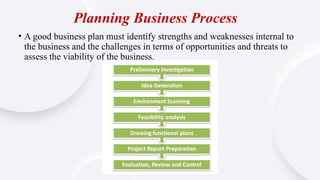
Planning Business Process
• A good business plan must identify strengths and weaknesses internal to
the business and the challenges in terms of opportunities and threats to
assess the viability of the business.
1. Preliminary investigation
In order to create an effective plan an entrepreneur must-
• Review available business plan
• Draw key business assumptions on which plan is based
• Scan the environment for strength, weaknesses opportunity and threats
• Seek professional advice
• Conduct a functional audit
2. Idea generation
It involves generation of a new concepts, products, services or value
addition to an existing product or services
Sources of ideas
Consumers
Existing companies
Research and development
Employees
Dealers/ retailers
Methods of generation of idea
• Brain storming
• Group discussions
• Data collections through questionnaire
• Invitation of ideas from professionals
• Value addition to existing product or service
• Market research etc.
3. Environmental scanning
The internal and external environment must be analysed to study the
prospective strengths, weaknesses, opportunities and threats of the
business.
4. Feasibility analysis
Feasibility Analysis is done to find out whether the proposed project
will be feasible or not. Various variables that are studied include
• Market Analysis
(Demand, estimated market share etc.)
• Technical or operational Analysis
(material availability, plant location, plant capacity, plant layout etc.
5. Drawing functional plans
• Marketing plans- marketing mix 4P’s
• Production or operation plan- location, physical layout, suppliers and
distributors, quality management, production scheduling etc.
• Organisational plan- ownership, norms, culture etc.
• Financial plan- cash flows, BEP, ratio analysis income statements,
balance sheet etc.
• Human resource plan- HRM, Organizational structure, Wages,
salaries, recruitment and selection etc.
7. Evaluation, Review and Control
It is written document that describes step by step, the strategies involved
in starting and operating a business. It is prepared when environment
scanning has been done and feasibility studies have been carried out.
6. Project Report Preparation
In order to keep up with the dynamic environment and successfully face global
competition a business must be continuously evaluated and reviewed. It is
necessary to periodically evaluate, control and review a business to keep up with
the technological changes and introduce changes in the business strategy
Project Management
• Project Management is the discipline of ensuring that the diverse
components of a project are produced at the agreed time, according to a
budget and to right standards
• It is interdisciplinary subject areas which require technical and
managerial skills
• Technical skills includes: scheduling and planning of the project, CPM,
PERT, resource budgeting, optimization of resource, control procedure,
reporting
• Managerial skills includes: HRM, Communication, Organization, team
building, environmental Management, cultural diversity, system thinking
Project Management
Project Management can be defined as, “the application of knowledge,
skills and Techniques towards organizing and managing project to
meet the project objectives.”
Following are the broad areas of project management
1. Establishing the project organization
2. Project planning
3. Project control
4. Management human resources
5. Managing project risk
Features of Project Management
• Scheduling and task management tools
• Collaboration and communication tools
• Integrations
• Real-time reporting
• Invoicing
• Time tracking
• Data analytics
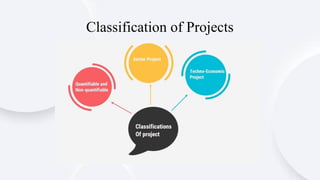
Classification of Projects
Quantifiable and Non-quantifiable
• Projects can be divided into two broader categories namely
quantifiable and non-quantifiable. In a quantifiable project, it is
possible to measure the end benefits or outcomes of the end
benefits or outcomes of the project. Examples: industrial
development, power generation fall in this category
• Whereas in the non-quantifiable end, the result cannot be
calculated properly. Non-quantifiable projects are those where
such assessment is not; possible e.g., Health education, defence
etc.
• The Planning Committee of India has classified projects for
various sectors.
• Agriculture sector.
• Irrigation & Power.
• Transport & Communication.
• Social Services.
Sector project
Here project is classified on the basis of technology & Economic Characteristics.
a) Factor intensity-oriented classification
In this category, projects are either capital-intensive or labour- intensive depending upon
their size & investment pattern. For eg: an IT project or service rendering project is labour-
intensive depending on its size and investment pattern.
b) Cause-oriented
In this category, projects are based on either the availability of raw materials or demand for
that project. For eg- A power project required, abundant water, steel plant required iron ore
as raw material.
C) Magnitude-oriented classification
Here the size of an investment is considered depending on the investment. A project can be
classified as a tiny unit investment of 25 lakhs Small-scale unit investment of up to 1 crore.
medium-scale enterprise investment up to 5 crores or more
Techno-Economic Project
Issues in Project Management
• Lack of communication
• Lack of clear goals and success criteria
• Budgeting issues
• Inadequate skills of team members
• Inadequate risk management
• Lack of accountability
• The limited engagement of stakeholders
• Unrealistic deadlines
• conflicts that occur unexpectedly during the lifecycle of a project
• Team dynamics
Project Identification
• Project Identification is the first step of a new venture. It is very
crucial to entrepreneurs to identify projects.
• To identify the projects/solutions for a particular problem based on
various factors is termed as project identification
• There could be a number of possible solutions for a single problem, so
having idea of that solution or identifying those various solutions is
project identification
• Project Identification is concerned with collection and analysis of
economic data for the eventual purpose of locating possible
opportunities for investment
Project Formulation
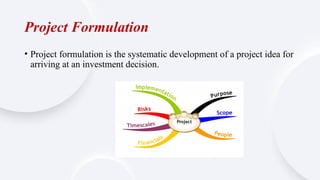
• Project formulation is the systematic development of a project idea for
arriving at an investment decision.
Project Design and Network Analysis
• The execution of a project follows a definitely path of planning,
scheduling and controlling.
• The first and foremost aspect of a project is the project design.
• It is in fact the heart of the project entity. It defines the individual
activities and their interrelationships with each other.
• Project design enables to identify the flow of event which mistake
place for the successful implementation of the project
Continued...
• Network comprise a set of exponents connected with each other in a
sequential relationship with each step till the completion of a project.
• Network Analysis is a system which plans both large and small
projects by analysing the project activities
Network Techniques
• PERT ( PROGRAM EVALUATION AND REVIEW TECHNIQUES)
• CPM ( CRITICAL PATH METHOD
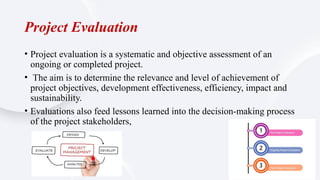
Project Evaluation
• Project evaluation is a systematic and objective assessment of an
ongoing or completed project.
• The aim is to determine the relevance and level of achievement of
project objectives, development effectiveness, efficiency, impact and
sustainability.
• Evaluations also feed lessons learned into the decision-making process
of the project stakeholders,
Project Appraisal
• Project appraisal means comparing or assessing the project's
credibility and viability to know the authenticity of a project.
• Project appraisal means assessment of project in terms of its
economic, Technical, financial and social viability
• The main need of project appraisal is to scan complete project.
• It’s need for best utilization of resources
• The project appraisal is the process of judging whether the project is
profitable or not to client.
Under economic analysis, the project aspects highlighted include
requirements for raw material, level of capacity utilization, anticipated
sales, anticipated expenses and the probable profits.
Economic Analysis
Financial Analysis
• Fixed capital (Land and buildings, plants and machinery, and
equipment’s are the familiar examples of fixed assets/fixed capital)
and
• working capital needs(working capital means excess of current assets
over current liabilities)
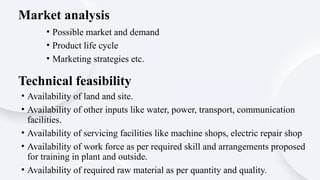
• Possible market and demand
• Product life cycle
• Marketing strategies etc.
Market analysis
Technical feasibility
• Availability of land and site.
• Availability of other inputs like water, power, transport, communication
facilities.
• Availability of servicing facilities like machine shops, electric repair shop
• Availability of work force as per required skill and arrangements proposed
for training in plant and outside.
• Availability of required raw material as per quantity and quality.
Management ability
Good managerial ability
Ability to handle workforce etc.
Management competencies
Project Report Preparation
• Project report is a document, which clearly narrates the various
aspects of Project in a prescribed form.
• A Project report may be defined as a document with respect to any
investment proposals based on certain information and factual data for
the purpose of appraising the project.
• It states as business is intended to be undertaken by the entrepreneur
and whether it would be physically possible, financially viable,
commercially profitable and socially desirable to do such a business
Content of Project Report
• General information- bio data of promoters, Industry profile,
constitution and Organisation
• Project description- location and site, physical infrastructure, raw
materials, electricity, fuel, Technical staff, machinery, equipment,
manufacturing process and technology
• Market potential- demand and supply position, product mix,
estimated annual sales, cost and price position, marketing strategy,
after sales services etc.
• Capital costs and sources of finance- estimated capital expenditure,
probable sources of finance
Content of Project Report
• Assessment of working capital requirements- estimation of working
capital requirements, arrangement
• Financial consideration- cost of production and profitability, Break
even Analysis, projected balance sheet and cash flows
• Economic and social consideration- costs to be incurred for
controlling the damage like pollution, emissions, generation of
employment utilization of local resources
• Enclosure and Annexures- to make the project realistic and practical
it is imperatives to enclose the necessary documents
Specimen of a Project Report. (Recent
Developments)

Business Ideas, project identification, project formulation.pptx

  • 1.
    Unit 5 BUSINESS IDEAS,PROJECT IDENTIFICATION AND FORMULATION Megharaja E N
  • 2.
    Forms of BusinessOwnership • Forms of business ownership and types of businesses describe how they are organized and run. • The four main forms of business ownership are listed below • Sole proprietorship • Corporation • Partnership • Co-operatives • A franchise is a combination, or hybrid, of the four forms of ownership.
  • 3.
    Sole Proprietorship • Asole proprietorship is a business owned by one person who is known as the proprietor. • The proprietor has a wide range of responsibilities including arranging displays and selling to consumers to name a few. • Fund to run the business usually come from the owner's savings, friends, family, and from a bank loan. • If the business prospers, the owner receives all the profits. • If the business does poorly, the owner is responsible for its losses. • This is called unlimited liability
  • 4.
    Characteristics of soleproprietorship • One individual • Simple to start and end • Owner is liable for all the debts of the business • Capital provided by sole owner • Business managed by owner
  • 5.
    Sole proprietorship • Advantages •No restrictions limit to capital • Quick decision making • Few legal requirements • All profit belongs to owner • Disadvantages • No legal personality • Feeling of isolation • Unlimited liabilities • Lack of continuity
  • 6.
    Partnership • A partnershiprefers to a type of business in which two or more individuals share the costs and responsibilities of owning and operating it. • The terms of the partnership are recorded in the partnership agreement. • The most common form of partnership is a general partnership, • When two individuals form a limited partnership, the partners are only responsible for the funds they both invested in the initial business. • This is called limited liability.
  • 7.
    Characteristics of Partnership •Ownership- two or more person • Legal requirements • Each partner must make a contribution to the partnership • Partners are jointly and severally liable for debts on the business • Management
  • 8.
    Types of partnership •A general partnership: A partnership in which all partnership have unlimited personal liability and full responsibility for the management of the business • Limited partnership: A partnership in which the partners liability is limited to their investment • Joint venture: A partnership in which two companies joint to complete a specific project. The partnership ends after a specified period of time • Strategic Alliances: A partnership in which two businesses work together for mutual business
  • 9.
    Partnership • Advantages • Combinationof new skills and ideas into a business • Sharing responsibilities for decision making • Share profits and are therefore motivated to work hard • Few legal requirements • Disadvantages • Not a separate legal entity • Liable for actions of the other partners • Discussion between partners can slow down decision making • Problems can arise if one or more partners are lazy, inefficient or dishonest
  • 10.
    Corporation • A corporationis a business granted legal status with rights, privileges, and liabilities that are distinct from those of the people who work for the business. • Corporations can be small such as one-person business or large such as a multinational that conducts business in several different countries. • Small portions of corporate ownership that are owned publically are called stocks or shares. • Individuals who own shares of a corporation are called shareholders and become owners of the business. • Shareholders have limited liability. • A board of directors runs a corporation that is owned by shareholders. • A publicly traded corporation that makes a profit may pay out dividends to shareholders.
  • 11.
    Characteristic features ofa Company • Corporate Body: A company needs to be registered under the Companies Act, 2013. Any other organisation incorporated with the Registrar of Companies, and subsequently not registered cannot be considered as a company. • Separate Legal Entity: A company exists as a separate legal entity which is different from its shareholders and members. Due to this feature, shareholders can enter into a contract with the company and can also sue the company and be sued by the company. • Limited Liability: As the company exists as a separate entity, members of the company are not liable for the debts of the company. Liability of members of a company is limited to the extent of the shares that are held by them or by the extent of the guarantee amount
  • 12.
    • Transferability ofShares: Shareholders of a public limited company can transfer their shares as per the rules laid down in the articles of association. However, in case of a private limited company, there might be some restrictions on the transfer of shares. • Common Seal: The firm is an artificial entity or a person, and therefore cannot sign its name by itself. It creates the necessity of a common seal that can be used for representing the decisions made on behalf of the company. • Perpetual Succession: The company being an artificial person established by law perpetuates to exist regardless of the differences in its membership. In simple words, a company is an artificial person. Therefore, it does not have any restrictions on age. The factors like death, insolvency, retirement or the insanity of one or all of the members do not impact the company status.
  • 13.
    • Number ofMembers: As per the Companies Act, 2013, the minimum number of members required to start a public limited company is seven while for a private limited company, it is two. The maximum number of members for a public limited company can be unlimited while it is restricted to 200 for a private limited company.
  • 14.
    Types of CompanyUnder Companies Act, 2013 • One Person Company The Act introduced the concept of a One Person Company (OPC). As per the Act, an OPC is a company that has only one member. The member can also be the director of the company. Though the OPC should have only one member, it can have a maximum of fifteen directors. • Private Limited Company A private limited company is a company where there cannot be more than 200 members. A minimum of two members are required to establish a private limited company. The members cannot transfer their share, and it is suitable for businesses that prefer to register as private entities. There needs to be a minimum of two directors, and there can be a maximum of 15 directors in a private limited company.
  • 15.
    • Public LimitedCompany A public limited company means a company where the general public can hold the company shares. There is no maximum shareholders limit for a public limited company, but there needs to be a minimum of seven members to establish a public company. The company needs to have two directors and can have a maximum of fifteen directors. • Section 8 Company (NGO) An association of persons or individuals can register a company under section 8 of the Act for charitable purposes. These companies are established to promote commerce, science, art, education, sports, research, religion, social welfare, charity, the protection of the environment, or such other objects. The company should apply its profits and other incomes to promote its activities. Such companies intend to prohibit any dividend payments to their members.
  • 16.
    Types of CompaniesBased on Size • Micro Companies A micro company is a company whose investment in plant and machinery does not exceed Rs.1 crore, and the annual turnover does not exceed Rs.5 crore. • Small Companies A small company is a company whose investment in plant and machinery does not exceed Rs.10 crore, and the annual turnover does not exceed Rs.50 crore. However, the Companies Act, 2013, also provides many benefits to small companies. A company with a paid-up share capital of below Rs.2 crore and an annual turnover of below Rs.20 crore is considered a small company under the Companies Act. • Medium Companies A medium company is a company whose investment in plant and machinery does not exceed Rs.50 crore, and the annual turnover does not exceed Rs.250 crore. • Large cap companies Annual turnover more than 250 crore, and investment in plant and machinery 3xceeds 50 crore
  • 17.
    Types of CompanyBased on Liability • Limited By Shares A company limited by shares means the liability of the company members is limited by the Memorandum of Association (MOA). The company members are liable only for the unpaid amount on the shares respectively held by them. The equity shares held by a member measure the shareholder’s ownership in the company. • Limited by Guarantee A company limited by guarantee means the member’s liability is limited to the amount they guarantee to contribute towards the company’s assets. The member’s liability is limited by the company MOA. The members undertake in the MOA to contribute the guaranteed amount in the event of the company being wound up. The percentage of the member’s ownership is based on the amount guaranteed by them. • Unlimited Company An unlimited company means the company members do not have any limit on their liability. If any debt arises, the member’s liability is unlimited and extends to their personal assets. Usually, the company entrepreneurs choose not to incorporate this type of company.
  • 18.
    Types of CompanyBased on Control • Holding Company A holding company is a company having the majority of voting powers of another company (subsidiary company). The holding company is the parent company controlling the subsidiary company’s policies, assets and management decisions. However, it remains uninvolved in the subsidiary’s day-to-day activities. • Subsidiary Company A subsidiary company is owned by another company (holding company) either partially or entirely. The holding company controls the composition of the board of directors of the subsidiary company or more than 50% of its voting powers. Where a single holding company holds 100% voting powers, the subsidiary is known as the Wholly Owned Subsidiary (WOS) of the holding company.
  • 19.
    Types of CompanyBased on Listing Listed Company A listed company is a company which is registered on various recognised stock exchanges within or outside India. The shares of the listed companies are freely traded on the stock exchanges. They have to follow the guidelines given by the Securities Exchange Board of India. A company that wishes to list its shares on stock exchanges should issue a prospectus to the general public for subscribing to its debentures or shares. A company can list its shares through an Initial Public Offer (IPO), while an already listed company can make a Further Public Offer (FPO). Unlisted Company An unlisted company is a company that is not listed on any recognised stock exchange, and its shares are not freely tradable on the stock exchanges. These companies fulfil their capital requirements by obtaining funds from friends, family members, relatives, financial institutions, or private placement. An unlisted company must convert to a public company and issue a prospectus if it wishes to list its securities on the stock exchanges.
  • 20.
    Co-operatives • A co-operativeis owned by the workers or members who buy the products or use the services that the business offers. • This type of business is motivated by service and not profit. • Adaptations of this business model include consumer, retail, and worker co-operatives.
  • 21.
    Alternative approaches tostart business • Buy an existing business • Enter a family business • Own a franchise business
  • 22.
    Franchise • The franchiserlicenses the rights to its names, operating procedure, designs, and business expertise to another business called the franchisee. • A franchise agreement can provide the franchisee with: • A ready made, fully operational business • Brand recognition that is appealing to consumers • Requirements before a franchise is awarded may include: • Paying the franchise fee • Agreeing to pay a monthly percentage fee as well as any national or local advertising costs • Purchasing all supplies centrally from the franchiser • Participating in franchiser standards training
  • 23.
    Issues in SelectingForms of Ownership • Cost and ease in setting up the organisation • Liability • Continuity • Management ability • Capital consideration • Degree of control • Scale of operation • Capital requirements • Division of profit
  • 24.
    Environmental Analysis • Thepolitical factors such as tax policy, pending legislative changes or trade reforms. • The economic factors such as the existing budget, taxes due, interest rates and the current inflation rate. • The cultural factors such as societal attitudes toward certain issues, population demographics, or mobility. • The technological factors such as the new technologies, the technical limitations or the current developments in research. • The legal factors such as the labor regulations, the regulatory framework or the health and safety laws. • The environmental factors such as geographical location, weather conditions or the likelihood of natural disasters.
  • 25.
    Identifying Problems andOpportunities 1. Identify and evaluate opportunities 2. Develop business plan 3. Resource required 4. Manage the enterprise
  • 26.
    Identify and evaluateopportunity 1. Opportunity Assessment 2. Opportunities and personal skill for goal setting 3. Competitive environment
  • 27.
    Develop business plans •Tittle page • Table of contents • Executive summary • Major selections • Description of business • Description of industry • Technology, financial, marketing • Production plan • Organisational or operational plans • summary
  • 28.
    Resource required • Determineresource required(Land, Capital, Man power, Machines, Technology etc) • Determining existing resource • Identify gap and suppliers • Develop access to needed resource
  • 29.
    Manage the enterprise •Develop management style • Understand key variable for success • Identify problems • Develop control system • Develop growth strategy
  • 30.
    Identify business opportunity(creating an idea) • Sources of business Idea • Methods of generating idea • Creative problem solving methods • Product planning and development stages
  • 31.
    Defining Business Idea •A business Idea is a summary of ideas that will answer the following questions: • Who is my Customer? Who is going to buy my product/services? • How is my idea unique? • How to create value for the customers?
  • 32.
    Opportunity defined • Anopportunity is a favourable set of circumstances that creates the need for a new product, services or business ideas • Most entrepreneurial firms are stated in one of two ways • Some firms are internally stimulated. An entrepreneur decides to start a firm , searches for and recognize An opportunity then start a business • Other firms are externally stimulated. An entrepreneur recognizes a problem or An opportunity gap and create a business to fill it
  • 33.
    Planning Business Process •A good business plan must identify strengths and weaknesses internal to the business and the challenges in terms of opportunities and threats to assess the viability of the business.
  • 34.
    1. Preliminary investigation Inorder to create an effective plan an entrepreneur must- • Review available business plan • Draw key business assumptions on which plan is based • Scan the environment for strength, weaknesses opportunity and threats • Seek professional advice • Conduct a functional audit
  • 35.
    2. Idea generation Itinvolves generation of a new concepts, products, services or value addition to an existing product or services Sources of ideas Consumers Existing companies Research and development Employees Dealers/ retailers
  • 36.
    Methods of generationof idea • Brain storming • Group discussions • Data collections through questionnaire • Invitation of ideas from professionals • Value addition to existing product or service • Market research etc.
  • 37.
    3. Environmental scanning Theinternal and external environment must be analysed to study the prospective strengths, weaknesses, opportunities and threats of the business.
  • 38.
    4. Feasibility analysis FeasibilityAnalysis is done to find out whether the proposed project will be feasible or not. Various variables that are studied include • Market Analysis (Demand, estimated market share etc.) • Technical or operational Analysis (material availability, plant location, plant capacity, plant layout etc.
  • 39.
    5. Drawing functionalplans • Marketing plans- marketing mix 4P’s • Production or operation plan- location, physical layout, suppliers and distributors, quality management, production scheduling etc. • Organisational plan- ownership, norms, culture etc. • Financial plan- cash flows, BEP, ratio analysis income statements, balance sheet etc. • Human resource plan- HRM, Organizational structure, Wages, salaries, recruitment and selection etc.
  • 40.
    7. Evaluation, Reviewand Control It is written document that describes step by step, the strategies involved in starting and operating a business. It is prepared when environment scanning has been done and feasibility studies have been carried out. 6. Project Report Preparation In order to keep up with the dynamic environment and successfully face global competition a business must be continuously evaluated and reviewed. It is necessary to periodically evaluate, control and review a business to keep up with the technological changes and introduce changes in the business strategy
  • 41.
    Project Management • ProjectManagement is the discipline of ensuring that the diverse components of a project are produced at the agreed time, according to a budget and to right standards • It is interdisciplinary subject areas which require technical and managerial skills • Technical skills includes: scheduling and planning of the project, CPM, PERT, resource budgeting, optimization of resource, control procedure, reporting • Managerial skills includes: HRM, Communication, Organization, team building, environmental Management, cultural diversity, system thinking
  • 42.
    Project Management Project Managementcan be defined as, “the application of knowledge, skills and Techniques towards organizing and managing project to meet the project objectives.” Following are the broad areas of project management 1. Establishing the project organization 2. Project planning 3. Project control 4. Management human resources 5. Managing project risk
  • 43.
    Features of ProjectManagement • Scheduling and task management tools • Collaboration and communication tools • Integrations • Real-time reporting • Invoicing • Time tracking • Data analytics
  • 44.
  • 45.
    Quantifiable and Non-quantifiable •Projects can be divided into two broader categories namely quantifiable and non-quantifiable. In a quantifiable project, it is possible to measure the end benefits or outcomes of the end benefits or outcomes of the project. Examples: industrial development, power generation fall in this category • Whereas in the non-quantifiable end, the result cannot be calculated properly. Non-quantifiable projects are those where such assessment is not; possible e.g., Health education, defence etc.
  • 46.
    • The PlanningCommittee of India has classified projects for various sectors. • Agriculture sector. • Irrigation & Power. • Transport & Communication. • Social Services. Sector project
  • 47.
    Here project isclassified on the basis of technology & Economic Characteristics. a) Factor intensity-oriented classification In this category, projects are either capital-intensive or labour- intensive depending upon their size & investment pattern. For eg: an IT project or service rendering project is labour- intensive depending on its size and investment pattern. b) Cause-oriented In this category, projects are based on either the availability of raw materials or demand for that project. For eg- A power project required, abundant water, steel plant required iron ore as raw material. C) Magnitude-oriented classification Here the size of an investment is considered depending on the investment. A project can be classified as a tiny unit investment of 25 lakhs Small-scale unit investment of up to 1 crore. medium-scale enterprise investment up to 5 crores or more Techno-Economic Project
  • 48.
    Issues in ProjectManagement • Lack of communication • Lack of clear goals and success criteria • Budgeting issues • Inadequate skills of team members • Inadequate risk management • Lack of accountability • The limited engagement of stakeholders • Unrealistic deadlines • conflicts that occur unexpectedly during the lifecycle of a project • Team dynamics
  • 49.
    Project Identification • ProjectIdentification is the first step of a new venture. It is very crucial to entrepreneurs to identify projects. • To identify the projects/solutions for a particular problem based on various factors is termed as project identification • There could be a number of possible solutions for a single problem, so having idea of that solution or identifying those various solutions is project identification • Project Identification is concerned with collection and analysis of economic data for the eventual purpose of locating possible opportunities for investment
  • 50.
    Project Formulation • Projectformulation is the systematic development of a project idea for arriving at an investment decision.
  • 51.
    Project Design andNetwork Analysis • The execution of a project follows a definitely path of planning, scheduling and controlling. • The first and foremost aspect of a project is the project design. • It is in fact the heart of the project entity. It defines the individual activities and their interrelationships with each other. • Project design enables to identify the flow of event which mistake place for the successful implementation of the project
  • 52.
    Continued... • Network comprisea set of exponents connected with each other in a sequential relationship with each step till the completion of a project. • Network Analysis is a system which plans both large and small projects by analysing the project activities Network Techniques • PERT ( PROGRAM EVALUATION AND REVIEW TECHNIQUES) • CPM ( CRITICAL PATH METHOD
  • 53.
    Project Evaluation • Projectevaluation is a systematic and objective assessment of an ongoing or completed project. • The aim is to determine the relevance and level of achievement of project objectives, development effectiveness, efficiency, impact and sustainability. • Evaluations also feed lessons learned into the decision-making process of the project stakeholders,
  • 54.
    Project Appraisal • Projectappraisal means comparing or assessing the project's credibility and viability to know the authenticity of a project. • Project appraisal means assessment of project in terms of its economic, Technical, financial and social viability • The main need of project appraisal is to scan complete project. • It’s need for best utilization of resources • The project appraisal is the process of judging whether the project is profitable or not to client.
  • 55.
    Under economic analysis,the project aspects highlighted include requirements for raw material, level of capacity utilization, anticipated sales, anticipated expenses and the probable profits. Economic Analysis Financial Analysis • Fixed capital (Land and buildings, plants and machinery, and equipment’s are the familiar examples of fixed assets/fixed capital) and • working capital needs(working capital means excess of current assets over current liabilities)
  • 56.
    • Possible marketand demand • Product life cycle • Marketing strategies etc. Market analysis Technical feasibility • Availability of land and site. • Availability of other inputs like water, power, transport, communication facilities. • Availability of servicing facilities like machine shops, electric repair shop • Availability of work force as per required skill and arrangements proposed for training in plant and outside. • Availability of required raw material as per quantity and quality.
  • 57.
    Management ability Good managerialability Ability to handle workforce etc. Management competencies
  • 58.
    Project Report Preparation •Project report is a document, which clearly narrates the various aspects of Project in a prescribed form. • A Project report may be defined as a document with respect to any investment proposals based on certain information and factual data for the purpose of appraising the project. • It states as business is intended to be undertaken by the entrepreneur and whether it would be physically possible, financially viable, commercially profitable and socially desirable to do such a business
  • 59.
    Content of ProjectReport • General information- bio data of promoters, Industry profile, constitution and Organisation • Project description- location and site, physical infrastructure, raw materials, electricity, fuel, Technical staff, machinery, equipment, manufacturing process and technology • Market potential- demand and supply position, product mix, estimated annual sales, cost and price position, marketing strategy, after sales services etc. • Capital costs and sources of finance- estimated capital expenditure, probable sources of finance
  • 60.
    Content of ProjectReport • Assessment of working capital requirements- estimation of working capital requirements, arrangement • Financial consideration- cost of production and profitability, Break even Analysis, projected balance sheet and cash flows • Economic and social consideration- costs to be incurred for controlling the damage like pollution, emissions, generation of employment utilization of local resources • Enclosure and Annexures- to make the project realistic and practical it is imperatives to enclose the necessary documents
  • 61.
    Specimen of aProject Report. (Recent Developments)