Copyright © 2010 Pearson Education, Inc. Publishing as Prentice Hall.
2015 Spring2015 Spring
Copyright © 2010 Pearson Education, Inc. Publishing as Prentice Hall.
Introduction to
Managerial Accounting
Chapter 1
2
Copyright © 2010 Pearson Education, Inc. Publishing as Prentice Hall.
Review --- what’s accounting
Why is financial accounting needed?
Why is managerial accounting needed?
Copyright © 2010 Pearson Education, Inc. Publishing as Prentice Hall.
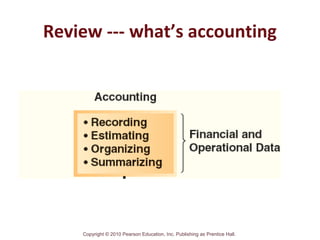
Review --- what’s accounting
Copyright © 2010 Pearson Education, Inc. Publishing as Prentice Hall.
Objective 1
Managers’ responsibilities
5
Copyright © 2010 Pearson Education, Inc. Publishing as Prentice Hall.
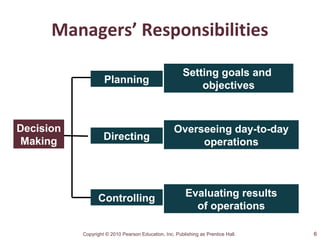
Managers’ Responsibilities
Setting goals and
objectives
Overseeing day-to-day
operations
Evaluating results
of operations
Directing
Controlling
Decision
Making
Planning
6
Copyright © 2010 Pearson Education, Inc. Publishing as Prentice Hall.
Planning
• Setting goals and objectives and how to
achieve them
• Examples of planning :
• Generate more sales via opening new
Starbucks stores in HKU main building
• Reduce labor costs by reducing store
hours of the Starbucks at the library
• Budgets
7
Copyright © 2010 Pearson Education, Inc. Publishing as Prentice Hall.
Directing
•Overseeing company’s day-to-day operations
•Examples:
• Using daily/weekly sales reports to adjust
marketing strategies
• Using product cost reports to adjust raw
material usage
8
Copyright © 2010 Pearson Education, Inc. Publishing as Prentice Hall.
Controlling
•Evaluating results of operations against plans
and making adjustments as needed
•Examples:
• Comparing budgeted sales with actual sales
to take corrective actions
• Comparing budgeted product costs against
actual product costs to take corrective
actions
9
Copyright © 2010 Pearson Education, Inc. Publishing as Prentice Hall.
Decision Making
•Management is continually making decisions
while it plans, directs, and controls operations
•Examples:
• Price setting or product offerings
• Renovation of facilities
• Operation openings or closings
•Managerial accounting gathers, summarizes,
and reports on the financial impact of each of
these decisions.
10
Copyright © 2010 Pearson Education, Inc. Publishing as Prentice Hall.
Objective 2
Distinguish financial accounting from
managerial accounting
11
Copyright © 2010 Pearson Education, Inc. Publishing as Prentice Hall.
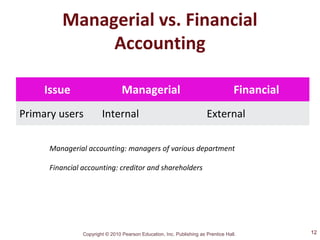
Managerial vs. Financial
Accounting
Issue Managerial Financial
Primary users Internal External
12
Managerial accounting: managers of various department
Financial accounting: creditor and shareholders
Copyright © 2010 Pearson Education, Inc. Publishing as Prentice Hall.
Managerial vs. Financial
Accounting
Issue Managerial Financial
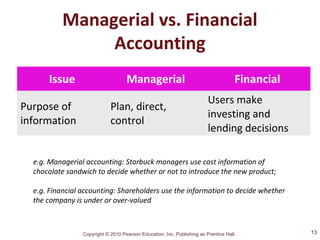
Purpose of
information
Plan, direct,
control
Users make
investing and
lending decisions
13
e.g. Managerial accounting: Starbuck managers use cost information of
chocolate sandwich to decide whether or not to introduce the new product;
e.g. Financial accounting: Shareholders use the information to decide whether
the company is under or over-valued
Copyright © 2010 Pearson Education, Inc. Publishing as Prentice Hall.
Managerial vs. Financial
Accounting
Issue Managerial Financial
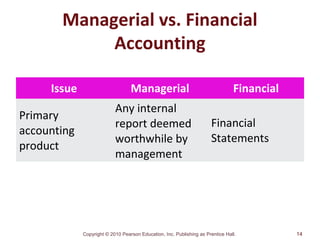
Primary
accounting
product
Any internal
report deemed
worthwhile by
management
Financial
Statements
14
Copyright © 2010 Pearson Education, Inc. Publishing as Prentice Hall.
Managerial vs. Financial
Accounting
Issue Managerial Financial
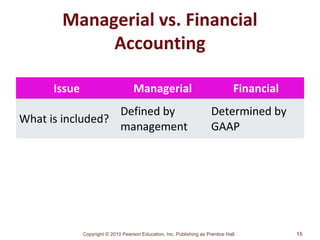
What is included?
Defined by
management
Determined by
GAAP
15
Copyright © 2010 Pearson Education, Inc. Publishing as Prentice Hall.
Managerial vs. Financial
Accounting
Issue Managerial Financial
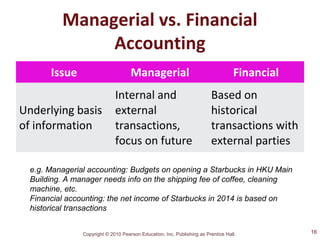
Underlying basis
of information
Internal and
external
transactions,
focus on future
Based on
historical
transactions with
external parties
16
e.g. Managerial accounting: Budgets on opening a Starbucks in HKU Main
Building. A manager needs info on the shipping fee of coffee, cleaning
machine, etc.
Financial accounting: the net income of Starbucks in 2014 is based on
historical transactions
Copyright © 2010 Pearson Education, Inc. Publishing as Prentice Hall.
Managerial vs. Financial
Accounting
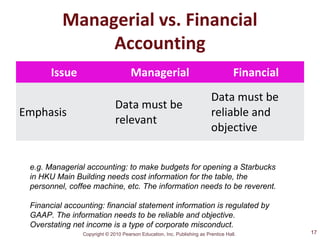
Issue Managerial Financial
Emphasis
Data must be
relevant
Data must be
reliable and
objective
17
e.g. Managerial accounting: to make budgets for opening a Starbucks
in HKU Main Building needs cost information for the table, the
personnel, coffee machine, etc. The information needs to be reverent.
Financial accounting: financial statement information is regulated by
GAAP. The information needs to be reliable and objective.
Overstating net income is a type of corporate misconduct.
Copyright © 2010 Pearson Education, Inc. Publishing as Prentice Hall.
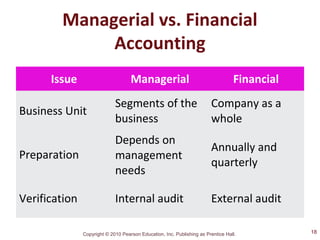
Managerial vs. Financial
Accounting
Issue Managerial Financial
Business Unit
Segments of the
business
Company as a
whole
Preparation
Depends on
management
needs
Annually and
quarterly
Verification Internal audit External audit
18
Copyright © 2010 Pearson Education, Inc. Publishing as Prentice Hall.
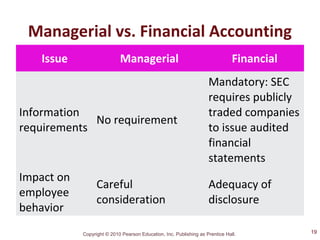
Managerial vs. Financial Accounting
Issue Managerial Financial
Information
requirements
No requirement
Mandatory: SEC
requires publicly
traded companies
to issue audited
financial
statements
Impact on
employee
behavior
Careful
consideration
Adequacy of
disclosure
19
Copyright © 2010 Pearson Education, Inc. Publishing as Prentice Hall.
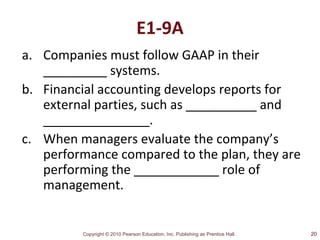
E1-9A
a. Companies must follow GAAP in their
_________ systems.
b. Financial accounting develops reports for
external parties, such as __________ and
_______________.
c. When managers evaluate the company’s
performance compared to the plan, they are
performing the ____________ role of
management.
20
Copyright © 2010 Pearson Education, Inc. Publishing as Prentice Hall.
E1-9A
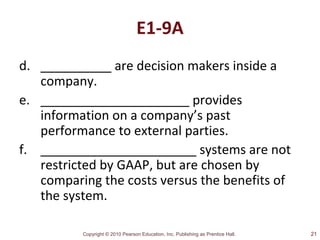
d. __________ are decision makers inside a
company.
e. _____________________ provides
information on a company’s past
performance to external parties.
f. ______________________ systems are not
restricted by GAAP, but are chosen by
comparing the costs versus the benefits of
the system.
21
Copyright © 2010 Pearson Education, Inc. Publishing as Prentice Hall.
E1-9A
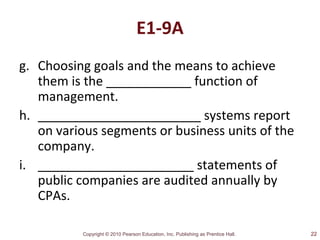
g. Choosing goals and the means to achieve
them is the ____________ function of
management.
h. _______________________ systems report
on various segments or business units of the
company.
i. ______________________ statements of
public companies are audited annually by
CPAs.
22
Copyright © 2010 Pearson Education, Inc. Publishing as Prentice Hall.
Objective 3
Describe organizational structure and the
roles and skills required of management
accountants within the organization
23
Copyright © 2010 Pearson Education, Inc. Publishing as Prentice Hall.
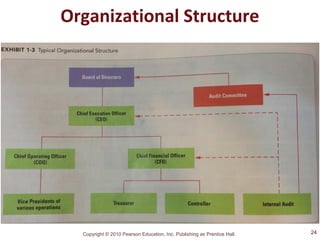
Organizational Structure
24
Copyright © 2010 Pearson Education, Inc. Publishing as Prentice Hall.
Changing Roles of Management
Accountants
• Impact of technology
• Ensuring accurate financial records
• Planning, analyzing, and interpreting
accounting data
• Providing decision support
25
Copyright © 2010 Pearson Education, Inc. Publishing as Prentice Hall.
Required Skills of Managerial
Accountants
• Knowledge of financial and managerial
accounting
• Analytical skills (critical thinking)
• Knowledge of how a business functions
• Ability to work on a team
• Oral and written communications skills
26
Copyright © 2010 Pearson Education, Inc. Publishing as Prentice Hall.
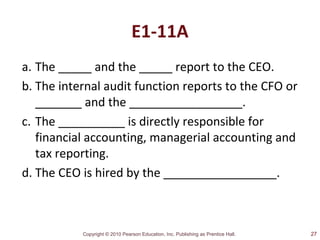
E1-11A
a. The _____ and the _____ report to the CEO.
b. The internal audit function reports to the CFO or
_______ and the _________________.
c. The __________ is directly responsible for
financial accounting, managerial accounting and
tax reporting.
d. The CEO is hired by the _________________.
27
Copyright © 2010 Pearson Education, Inc. Publishing as Prentice Hall.
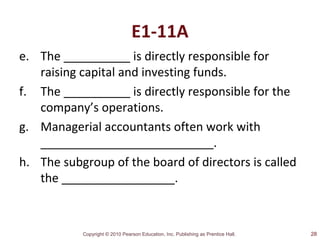
E1-11A
e. The __________ is directly responsible for
raising capital and investing funds.
f. The __________ is directly responsible for the
company’s operations.
g. Managerial accountants often work with
__________________________.
h. The subgroup of the board of directors is called
the _________________.
28
Copyright © 2010 Pearson Education, Inc. Publishing as Prentice Hall.
Objective 4
Describe the role of the Institute of
Management Accountants (IMA) and use its
ethical standards to make reasonable ethical
judgments
29
Copyright © 2010 Pearson Education, Inc. Publishing as Prentice Hall.
Institute of Management Accountants
(IMA)
• Professional association for management
accountants
• IMA’s functions
• Certification (CMA)
• Practice Development
• Education
• Networking
• Ethical Standards
• Public Education
30
Copyright © 2010 Pearson Education, Inc. Publishing as Prentice Hall.
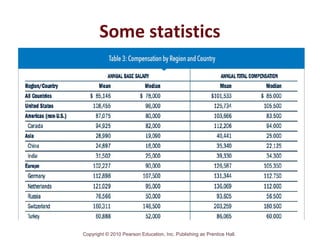
Some statistics
Copyright © 2010 Pearson Education, Inc. Publishing as Prentice Hall.
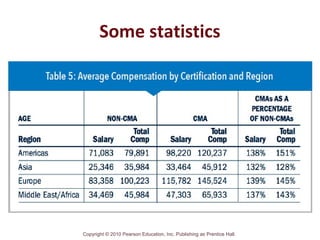
Some statistics
Copyright © 2010 Pearson Education, Inc. Publishing as Prentice Hall.
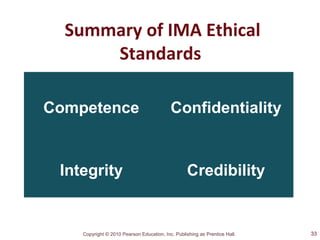
Summary of IMA Ethical
Standards
Competence Confidentiality
Integrity Credibility
33
Copyright © 2010 Pearson Education, Inc. Publishing as Prentice Hall.
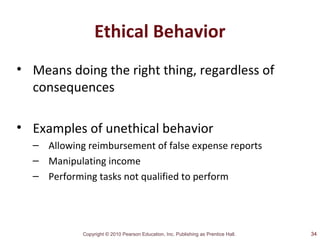
Ethical Behavior
• Means doing the right thing, regardless of
consequences
• Examples of unethical behavior
– Allowing reimbursement of false expense reports
– Manipulating income
– Performing tasks not qualified to perform
34
Copyright © 2010 Pearson Education, Inc. Publishing as Prentice Hall.
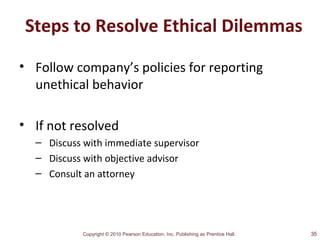
Steps to Resolve Ethical Dilemmas
• Follow company’s policies for reporting
unethical behavior
• If not resolved
– Discuss with immediate supervisor
– Discuss with objective advisor
– Consult an attorney
35
Copyright © 2010 Pearson Education, Inc. Publishing as Prentice Hall.
Unethical vs. Illegal Behavior
• Not all unethical behavior is illegal, but all
illegal behavior is unethical.
• Unethical behavior includes:
– Dishonesty
– Unfairness
– Lack objectivity
– Irresponsible
36
Copyright © 2010 Pearson Education, Inc. Publishing as Prentice Hall.
E1-12A
a. The ______ is the professional association
for management accountants.
b. The institute offers a professional
certification called the _______, which
focuses on managerial accounting topics,
economics, and business finance.
37
Copyright © 2010 Pearson Education, Inc. Publishing as Prentice Hall.
E1-12A
c. The institute find that people holding the
______ certification earn, on average,
______% more than those without the
certification.
d. The institute’s monthly publication, called
____________________, addresses current
topics of interest to management
accountants.
38
Copyright © 2010 Pearson Education, Inc. Publishing as Prentice Hall.
E1-12A
e. The institute says that approximately _____
percent of accountants work inside of
organizations, rather than at CPA firms.
39
Copyright © 2010 Pearson Education, Inc. Publishing as Prentice Hall.
Objective 5
Discuss and analyze the implications
of regulatory and business trends
40
Copyright © 2010 Pearson Education, Inc. Publishing as Prentice Hall.
Sarbanes-Oxley Act of 2002 (SOX)
• Background

High profile accounting scandals in early 2000s: Enron,
Tyco, and WorldCom
• Regulator’s response

The U.S. Congress enacted Sarbanes-Oxley Act in 2002
• Key provisions
1. Managers and auditors should establish internal controls
and provide evaluation on the weakness of those controls
2. Established Public Company Accounting Oversight Board
3. The Act requires both the CEO and CFO to certify in
writing that their company’s financial statements and
disclosures fairly represent the results of operations.
41
Copyright © 2010 Pearson Education, Inc. Publishing as Prentice Hall.
Sarbanes-Oxley Act of 2002 (SOX)
• Key provisions (continued)
3. The Act places the power to hire, compensate, and
terminate public accounting firms in the hands of the
audit committee.
4. The Act places restrictions on audit firms, such as
prohibiting public accounting firms from providing a
variety of non-audit services to an audit client.
5. The Act establishes severe penalties for certain
behaviors, such as:
• Up to 20 years in prison for altering or destroying any
documents that may eventually be used in an official
proceeding.
• Up to 10 years in prison for retaliating against a
“whistle blower.”
42
Copyright © 2010 Pearson Education, Inc. Publishing as Prentice Hall.
Corporate Social Sustainability and
Responsibility
• Growing movement toward sustainability and social
responsibility by both consumers and corporates
– Sustainability:
• The ability to meet the needs of the present without
compromising the ability of future generations to meet
their own needs
– Social Responsibility:
• Companies’ responsibility to carefully consider how their
business affects employees, consumers, and local citizens.
43
Copyright © 2010 Pearson Education, Inc. Publishing as Prentice Hall.
Tools for Time-Based
Competition
• Enterprise resource planning (ERP)
• E-commerce
• Supply-chain management
• Lean production
• Just-in-time (JIT)
• Total quality management (TQM)
44
Copyright © 2010 Pearson Education, Inc. Publishing as Prentice Hall.
Enterprise Resource Planning
(ERP)
• System that integrates a company’s functions,
departments, and data
• Advantages
• Streamline operations
• Respond quickly to changes
• Replace separate software systems
• Disadvantage -- expensive
45
Copyright © 2010 Pearson Education, Inc. Publishing as Prentice Hall.
E-Commerce
• Needed to survive in global economy
46
Copyright © 2010 Pearson Education, Inc. Publishing as Prentice Hall.
Supply-Chain Management
• Exchange of information with suppliers
• Reduce costs
• Improve quality
• Speed the delivery
47
Copyright © 2010 Pearson Education, Inc. Publishing as Prentice Hall.
Lean Production
• A philosophy and business strategy of
manufacturing without waste
• Lowers costs
• Increases competitive position
48
Copyright © 2010 Pearson Education, Inc. Publishing as Prentice Hall.
Just in Time Inventory (JIT)
• Manufacture “just in time” to fill orders
• Reduces:
–Raw materials inventory
–Finished goods inventory
–Storage costs
–Handling costs
49
Copyright © 2010 Pearson Education, Inc. Publishing as Prentice Hall.
TQM : Total Quality Management
• Goal to provide customers with superior
products and services
• Continually set higher goals for quality
• International Organization for
Standardization (ISO)
50
Copyright © 2010 Pearson Education, Inc. Publishing as Prentice Hall.
E1-15A
a. _______________________________
involves the exchange of information with
suppliers to reduce costs, improve quality,
and speed delivery of goods and services
from suppliers to the company and its
customers.
51
Copyright © 2010 Pearson Education, Inc. Publishing as Prentice Hall.
E1-15A
c. The _______________________________
was enacted to restore trust in publicly
traded corporations, their management,
their financial statements, and their auditors.
d. The goal of ___________________________
is to meet customers’ expectations by
providing them with superior products and
services by eliminating defects and waste
throughout the value chain.
52
Copyright © 2010 Pearson Education, Inc. Publishing as Prentice Hall.
E1-15A
e. Most of the costs of adopting ERP, expanding
into a foreign market, or improving quality
are incurred in the _______; but most of the
benefits occur in the _______.
f. ________________ is the time between
buying raw materials and selling the finished
products.
53
Copyright © 2010 Pearson Education, Inc. Publishing as Prentice Hall.
E1-15A
g. _______________________________ serves
the information needs of people in
accounting as well as people in marketing
and in the warehouse.
h. Firms adopt _______________ to conduct
business on the Internet.
i. Firms acquire the _________________
certification to demonstrate their
commitment to quality.
  
54
Copyright © 2010 Pearson Education, Inc. Publishing as Prentice Hall.
E1-15A
j. ___________________ is a philosophy that
embraces the concept that the lower the
company’s waste is, the lower the company’s
costs will be.
k. Toyota first pioneered an inventory philosophy
in which a product is manufactured
______________ to fill customer orders;
companies are able to substantially reduce the
quantity of raw materials and finished goods
inventories. 55
Copyright © 2010 Pearson Education, Inc. Publishing as Prentice Hall.
E1-15A
m. Toyota first pioneered an inventory
philosophy in which a product is
manufactured ______________ to fill
customer orders; companies are able to
substantially reduce the quantity of raw
materials and finished goods inventories.
56
Copyright © 2010 Pearson Education, Inc. Publishing as Prentice Hall.
E1-15A
n. ____________________________ is a
management philosophy of delighting
customers with superior products and
services by continually setting higher goals
and improving the performance of every
business function.
57
Copyright © 2010 Pearson Education, Inc. Publishing as Prentice Hall.
End of Chapter 1
58

Managerial Accounting ppt Lecture 1

  • 1.
    Copyright © 2010Pearson Education, Inc. Publishing as Prentice Hall. 2015 Spring2015 Spring
  • 2.
    Copyright © 2010Pearson Education, Inc. Publishing as Prentice Hall. Introduction to Managerial Accounting Chapter 1 2
  • 3.
    Copyright © 2010Pearson Education, Inc. Publishing as Prentice Hall. Review --- what’s accounting Why is financial accounting needed? Why is managerial accounting needed?
  • 4.
    Copyright © 2010Pearson Education, Inc. Publishing as Prentice Hall. Review --- what’s accounting
  • 5.
    Copyright © 2010Pearson Education, Inc. Publishing as Prentice Hall. Objective 1 Managers’ responsibilities 5
  • 6.
    Copyright © 2010Pearson Education, Inc. Publishing as Prentice Hall. Managers’ Responsibilities Setting goals and objectives Overseeing day-to-day operations Evaluating results of operations Directing Controlling Decision Making Planning 6
  • 7.
    Copyright © 2010Pearson Education, Inc. Publishing as Prentice Hall. Planning • Setting goals and objectives and how to achieve them • Examples of planning : • Generate more sales via opening new Starbucks stores in HKU main building • Reduce labor costs by reducing store hours of the Starbucks at the library • Budgets 7
  • 8.
    Copyright © 2010Pearson Education, Inc. Publishing as Prentice Hall. Directing •Overseeing company’s day-to-day operations •Examples: • Using daily/weekly sales reports to adjust marketing strategies • Using product cost reports to adjust raw material usage 8
  • 9.
    Copyright © 2010Pearson Education, Inc. Publishing as Prentice Hall. Controlling •Evaluating results of operations against plans and making adjustments as needed •Examples: • Comparing budgeted sales with actual sales to take corrective actions • Comparing budgeted product costs against actual product costs to take corrective actions 9
  • 10.
    Copyright © 2010Pearson Education, Inc. Publishing as Prentice Hall. Decision Making •Management is continually making decisions while it plans, directs, and controls operations •Examples: • Price setting or product offerings • Renovation of facilities • Operation openings or closings •Managerial accounting gathers, summarizes, and reports on the financial impact of each of these decisions. 10
  • 11.
    Copyright © 2010Pearson Education, Inc. Publishing as Prentice Hall. Objective 2 Distinguish financial accounting from managerial accounting 11
  • 12.
    Copyright © 2010Pearson Education, Inc. Publishing as Prentice Hall. Managerial vs. Financial Accounting Issue Managerial Financial Primary users Internal External 12 Managerial accounting: managers of various department Financial accounting: creditor and shareholders
  • 13.
    Copyright © 2010Pearson Education, Inc. Publishing as Prentice Hall. Managerial vs. Financial Accounting Issue Managerial Financial Purpose of information Plan, direct, control Users make investing and lending decisions 13 e.g. Managerial accounting: Starbuck managers use cost information of chocolate sandwich to decide whether or not to introduce the new product; e.g. Financial accounting: Shareholders use the information to decide whether the company is under or over-valued
  • 14.
    Copyright © 2010Pearson Education, Inc. Publishing as Prentice Hall. Managerial vs. Financial Accounting Issue Managerial Financial Primary accounting product Any internal report deemed worthwhile by management Financial Statements 14
  • 15.
    Copyright © 2010Pearson Education, Inc. Publishing as Prentice Hall. Managerial vs. Financial Accounting Issue Managerial Financial What is included? Defined by management Determined by GAAP 15
  • 16.
    Copyright © 2010Pearson Education, Inc. Publishing as Prentice Hall. Managerial vs. Financial Accounting Issue Managerial Financial Underlying basis of information Internal and external transactions, focus on future Based on historical transactions with external parties 16 e.g. Managerial accounting: Budgets on opening a Starbucks in HKU Main Building. A manager needs info on the shipping fee of coffee, cleaning machine, etc. Financial accounting: the net income of Starbucks in 2014 is based on historical transactions
  • 17.
    Copyright © 2010Pearson Education, Inc. Publishing as Prentice Hall. Managerial vs. Financial Accounting Issue Managerial Financial Emphasis Data must be relevant Data must be reliable and objective 17 e.g. Managerial accounting: to make budgets for opening a Starbucks in HKU Main Building needs cost information for the table, the personnel, coffee machine, etc. The information needs to be reverent. Financial accounting: financial statement information is regulated by GAAP. The information needs to be reliable and objective. Overstating net income is a type of corporate misconduct.
  • 18.
    Copyright © 2010Pearson Education, Inc. Publishing as Prentice Hall. Managerial vs. Financial Accounting Issue Managerial Financial Business Unit Segments of the business Company as a whole Preparation Depends on management needs Annually and quarterly Verification Internal audit External audit 18
  • 19.
    Copyright © 2010Pearson Education, Inc. Publishing as Prentice Hall. Managerial vs. Financial Accounting Issue Managerial Financial Information requirements No requirement Mandatory: SEC requires publicly traded companies to issue audited financial statements Impact on employee behavior Careful consideration Adequacy of disclosure 19
  • 20.
    Copyright © 2010Pearson Education, Inc. Publishing as Prentice Hall. E1-9A a. Companies must follow GAAP in their _________ systems. b. Financial accounting develops reports for external parties, such as __________ and _______________. c. When managers evaluate the company’s performance compared to the plan, they are performing the ____________ role of management. 20
  • 21.
    Copyright © 2010Pearson Education, Inc. Publishing as Prentice Hall. E1-9A d. __________ are decision makers inside a company. e. _____________________ provides information on a company’s past performance to external parties. f. ______________________ systems are not restricted by GAAP, but are chosen by comparing the costs versus the benefits of the system. 21
  • 22.
    Copyright © 2010Pearson Education, Inc. Publishing as Prentice Hall. E1-9A g. Choosing goals and the means to achieve them is the ____________ function of management. h. _______________________ systems report on various segments or business units of the company. i. ______________________ statements of public companies are audited annually by CPAs. 22
  • 23.
    Copyright © 2010Pearson Education, Inc. Publishing as Prentice Hall. Objective 3 Describe organizational structure and the roles and skills required of management accountants within the organization 23
  • 24.
    Copyright © 2010Pearson Education, Inc. Publishing as Prentice Hall. Organizational Structure 24
  • 25.
    Copyright © 2010Pearson Education, Inc. Publishing as Prentice Hall. Changing Roles of Management Accountants • Impact of technology • Ensuring accurate financial records • Planning, analyzing, and interpreting accounting data • Providing decision support 25
  • 26.
    Copyright © 2010Pearson Education, Inc. Publishing as Prentice Hall. Required Skills of Managerial Accountants • Knowledge of financial and managerial accounting • Analytical skills (critical thinking) • Knowledge of how a business functions • Ability to work on a team • Oral and written communications skills 26
  • 27.
    Copyright © 2010Pearson Education, Inc. Publishing as Prentice Hall. E1-11A a. The _____ and the _____ report to the CEO. b. The internal audit function reports to the CFO or _______ and the _________________. c. The __________ is directly responsible for financial accounting, managerial accounting and tax reporting. d. The CEO is hired by the _________________. 27
  • 28.
    Copyright © 2010Pearson Education, Inc. Publishing as Prentice Hall. E1-11A e. The __________ is directly responsible for raising capital and investing funds. f. The __________ is directly responsible for the company’s operations. g. Managerial accountants often work with __________________________. h. The subgroup of the board of directors is called the _________________. 28
  • 29.
    Copyright © 2010Pearson Education, Inc. Publishing as Prentice Hall. Objective 4 Describe the role of the Institute of Management Accountants (IMA) and use its ethical standards to make reasonable ethical judgments 29
  • 30.
    Copyright © 2010Pearson Education, Inc. Publishing as Prentice Hall. Institute of Management Accountants (IMA) • Professional association for management accountants • IMA’s functions • Certification (CMA) • Practice Development • Education • Networking • Ethical Standards • Public Education 30
  • 31.
    Copyright © 2010Pearson Education, Inc. Publishing as Prentice Hall. Some statistics
  • 32.
    Copyright © 2010Pearson Education, Inc. Publishing as Prentice Hall. Some statistics
  • 33.
    Copyright © 2010Pearson Education, Inc. Publishing as Prentice Hall. Summary of IMA Ethical Standards Competence Confidentiality Integrity Credibility 33
  • 34.
    Copyright © 2010Pearson Education, Inc. Publishing as Prentice Hall. Ethical Behavior • Means doing the right thing, regardless of consequences • Examples of unethical behavior – Allowing reimbursement of false expense reports – Manipulating income – Performing tasks not qualified to perform 34
  • 35.
    Copyright © 2010Pearson Education, Inc. Publishing as Prentice Hall. Steps to Resolve Ethical Dilemmas • Follow company’s policies for reporting unethical behavior • If not resolved – Discuss with immediate supervisor – Discuss with objective advisor – Consult an attorney 35
  • 36.
    Copyright © 2010Pearson Education, Inc. Publishing as Prentice Hall. Unethical vs. Illegal Behavior • Not all unethical behavior is illegal, but all illegal behavior is unethical. • Unethical behavior includes: – Dishonesty – Unfairness – Lack objectivity – Irresponsible 36
  • 37.
    Copyright © 2010Pearson Education, Inc. Publishing as Prentice Hall. E1-12A a. The ______ is the professional association for management accountants. b. The institute offers a professional certification called the _______, which focuses on managerial accounting topics, economics, and business finance. 37
  • 38.
    Copyright © 2010Pearson Education, Inc. Publishing as Prentice Hall. E1-12A c. The institute find that people holding the ______ certification earn, on average, ______% more than those without the certification. d. The institute’s monthly publication, called ____________________, addresses current topics of interest to management accountants. 38
  • 39.
    Copyright © 2010Pearson Education, Inc. Publishing as Prentice Hall. E1-12A e. The institute says that approximately _____ percent of accountants work inside of organizations, rather than at CPA firms. 39
  • 40.
    Copyright © 2010Pearson Education, Inc. Publishing as Prentice Hall. Objective 5 Discuss and analyze the implications of regulatory and business trends 40
  • 41.
    Copyright © 2010Pearson Education, Inc. Publishing as Prentice Hall. Sarbanes-Oxley Act of 2002 (SOX) • Background  High profile accounting scandals in early 2000s: Enron, Tyco, and WorldCom • Regulator’s response  The U.S. Congress enacted Sarbanes-Oxley Act in 2002 • Key provisions 1. Managers and auditors should establish internal controls and provide evaluation on the weakness of those controls 2. Established Public Company Accounting Oversight Board 3. The Act requires both the CEO and CFO to certify in writing that their company’s financial statements and disclosures fairly represent the results of operations. 41
  • 42.
    Copyright © 2010Pearson Education, Inc. Publishing as Prentice Hall. Sarbanes-Oxley Act of 2002 (SOX) • Key provisions (continued) 3. The Act places the power to hire, compensate, and terminate public accounting firms in the hands of the audit committee. 4. The Act places restrictions on audit firms, such as prohibiting public accounting firms from providing a variety of non-audit services to an audit client. 5. The Act establishes severe penalties for certain behaviors, such as: • Up to 20 years in prison for altering or destroying any documents that may eventually be used in an official proceeding. • Up to 10 years in prison for retaliating against a “whistle blower.” 42
  • 43.
    Copyright © 2010Pearson Education, Inc. Publishing as Prentice Hall. Corporate Social Sustainability and Responsibility • Growing movement toward sustainability and social responsibility by both consumers and corporates – Sustainability: • The ability to meet the needs of the present without compromising the ability of future generations to meet their own needs – Social Responsibility: • Companies’ responsibility to carefully consider how their business affects employees, consumers, and local citizens. 43
  • 44.
    Copyright © 2010Pearson Education, Inc. Publishing as Prentice Hall. Tools for Time-Based Competition • Enterprise resource planning (ERP) • E-commerce • Supply-chain management • Lean production • Just-in-time (JIT) • Total quality management (TQM) 44
  • 45.
    Copyright © 2010Pearson Education, Inc. Publishing as Prentice Hall. Enterprise Resource Planning (ERP) • System that integrates a company’s functions, departments, and data • Advantages • Streamline operations • Respond quickly to changes • Replace separate software systems • Disadvantage -- expensive 45
  • 46.
    Copyright © 2010Pearson Education, Inc. Publishing as Prentice Hall. E-Commerce • Needed to survive in global economy 46
  • 47.
    Copyright © 2010Pearson Education, Inc. Publishing as Prentice Hall. Supply-Chain Management • Exchange of information with suppliers • Reduce costs • Improve quality • Speed the delivery 47
  • 48.
    Copyright © 2010Pearson Education, Inc. Publishing as Prentice Hall. Lean Production • A philosophy and business strategy of manufacturing without waste • Lowers costs • Increases competitive position 48
  • 49.
    Copyright © 2010Pearson Education, Inc. Publishing as Prentice Hall. Just in Time Inventory (JIT) • Manufacture “just in time” to fill orders • Reduces: –Raw materials inventory –Finished goods inventory –Storage costs –Handling costs 49
  • 50.
    Copyright © 2010Pearson Education, Inc. Publishing as Prentice Hall. TQM : Total Quality Management • Goal to provide customers with superior products and services • Continually set higher goals for quality • International Organization for Standardization (ISO) 50
  • 51.
    Copyright © 2010Pearson Education, Inc. Publishing as Prentice Hall. E1-15A a. _______________________________ involves the exchange of information with suppliers to reduce costs, improve quality, and speed delivery of goods and services from suppliers to the company and its customers. 51
  • 52.
    Copyright © 2010Pearson Education, Inc. Publishing as Prentice Hall. E1-15A c. The _______________________________ was enacted to restore trust in publicly traded corporations, their management, their financial statements, and their auditors. d. The goal of ___________________________ is to meet customers’ expectations by providing them with superior products and services by eliminating defects and waste throughout the value chain. 52
  • 53.
    Copyright © 2010Pearson Education, Inc. Publishing as Prentice Hall. E1-15A e. Most of the costs of adopting ERP, expanding into a foreign market, or improving quality are incurred in the _______; but most of the benefits occur in the _______. f. ________________ is the time between buying raw materials and selling the finished products. 53
  • 54.
    Copyright © 2010Pearson Education, Inc. Publishing as Prentice Hall. E1-15A g. _______________________________ serves the information needs of people in accounting as well as people in marketing and in the warehouse. h. Firms adopt _______________ to conduct business on the Internet. i. Firms acquire the _________________ certification to demonstrate their commitment to quality.    54
  • 55.
    Copyright © 2010Pearson Education, Inc. Publishing as Prentice Hall. E1-15A j. ___________________ is a philosophy that embraces the concept that the lower the company’s waste is, the lower the company’s costs will be. k. Toyota first pioneered an inventory philosophy in which a product is manufactured ______________ to fill customer orders; companies are able to substantially reduce the quantity of raw materials and finished goods inventories. 55
  • 56.
    Copyright © 2010Pearson Education, Inc. Publishing as Prentice Hall. E1-15A m. Toyota first pioneered an inventory philosophy in which a product is manufactured ______________ to fill customer orders; companies are able to substantially reduce the quantity of raw materials and finished goods inventories. 56
  • 57.
    Copyright © 2010Pearson Education, Inc. Publishing as Prentice Hall. E1-15A n. ____________________________ is a management philosophy of delighting customers with superior products and services by continually setting higher goals and improving the performance of every business function. 57
  • 58.
    Copyright © 2010Pearson Education, Inc. Publishing as Prentice Hall. End of Chapter 1 58

Editor's Notes