
Copyright © 2009 by The McGraw-Hill Companies, Inc. All rights reserved.McGraw-Hill/Irwin
Chapter 1
The Changing Role
of Managerial
Accounting in a
Dynamic Business
Environment
Copyright © 2009 by The McGraw-Hill Companies, Inc. All rights reserved.McGraw-Hill/Irwin
Learning
Objective
1
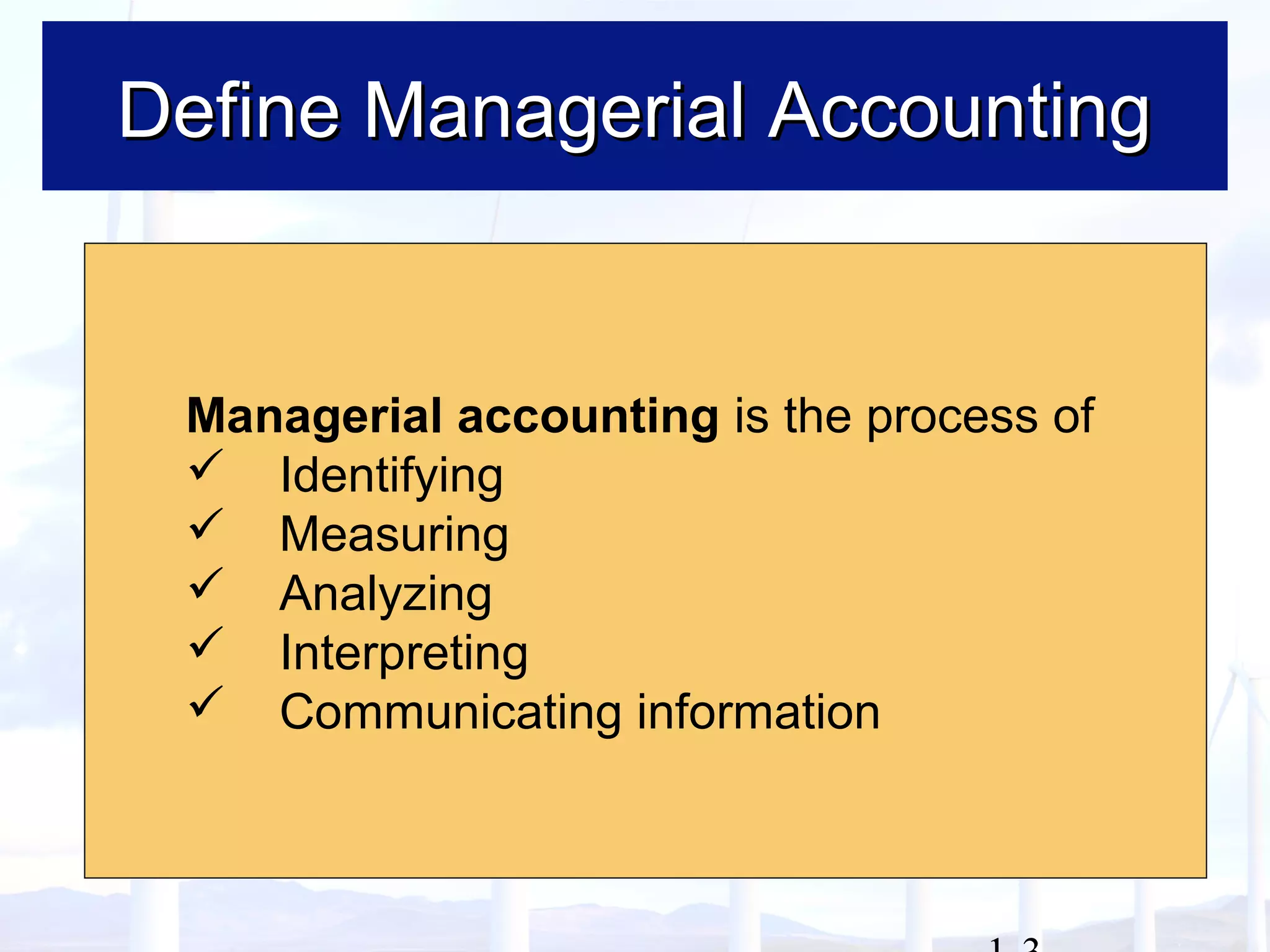
Managerial accounting is the process of
 Identifying
 Measuring
 Analyzing
 Interpreting
 Communicating information
Define Managerial AccountingDefine Managerial Accounting
Copyright © 2009 by The McGraw-Hill Companies, Inc. All rights reserved.McGraw-Hill/Irwin
Learning
Objective
2
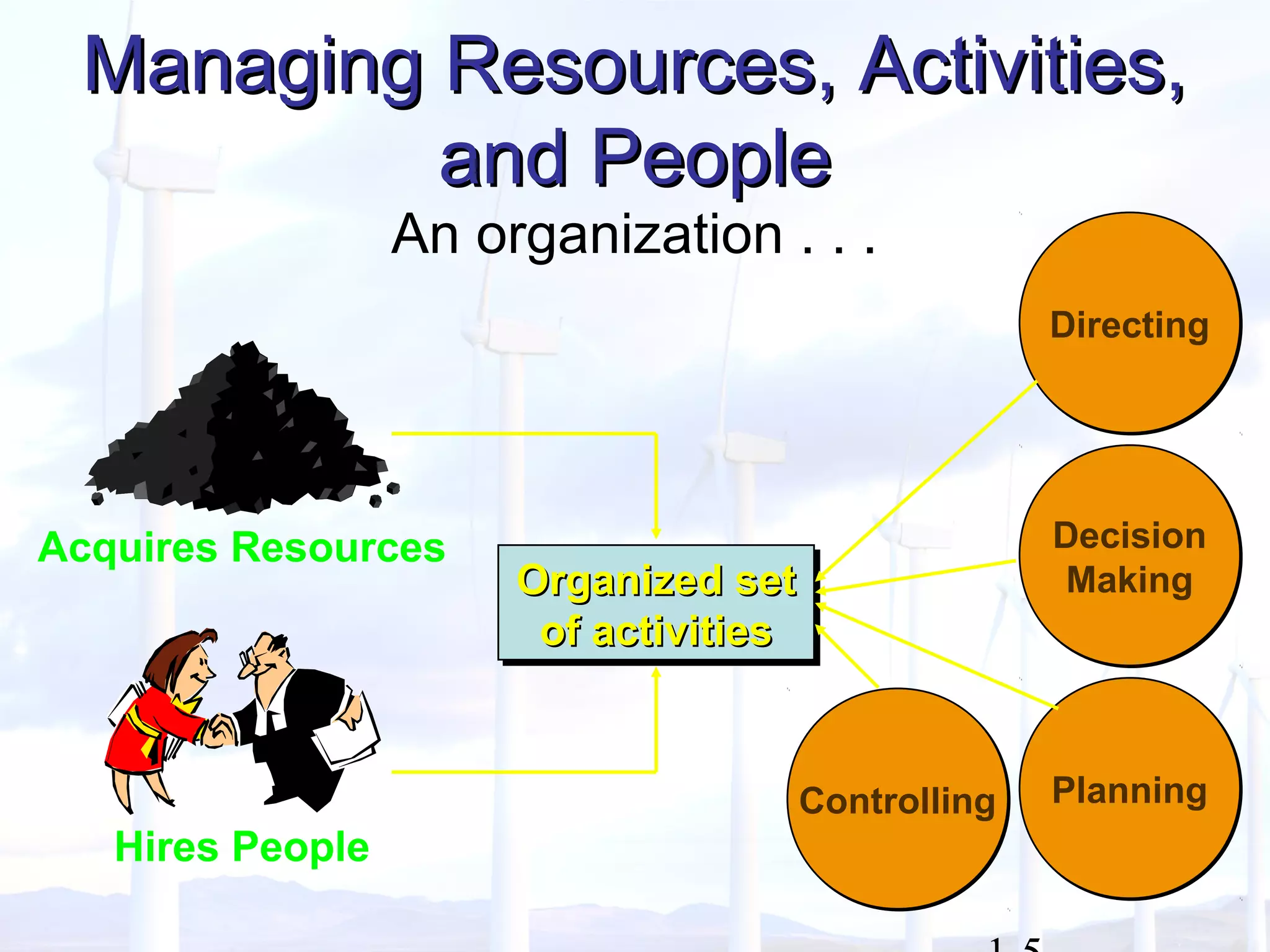
Managing Resources, Activities,Managing Resources, Activities,
and Peopleand People
An organization . . .
Acquires Resources
Hires People
Organized setOrganized set
of activitiesof activities
Organized setOrganized set
of activitiesof activities
Decision
Making
Decision
Making
PlanningPlanning
DirectingDirecting
ControllingControlling
Copyright © 2009 by The McGraw-Hill Companies, Inc. All rights reserved.McGraw-Hill/Irwin
Learning
Objective
3
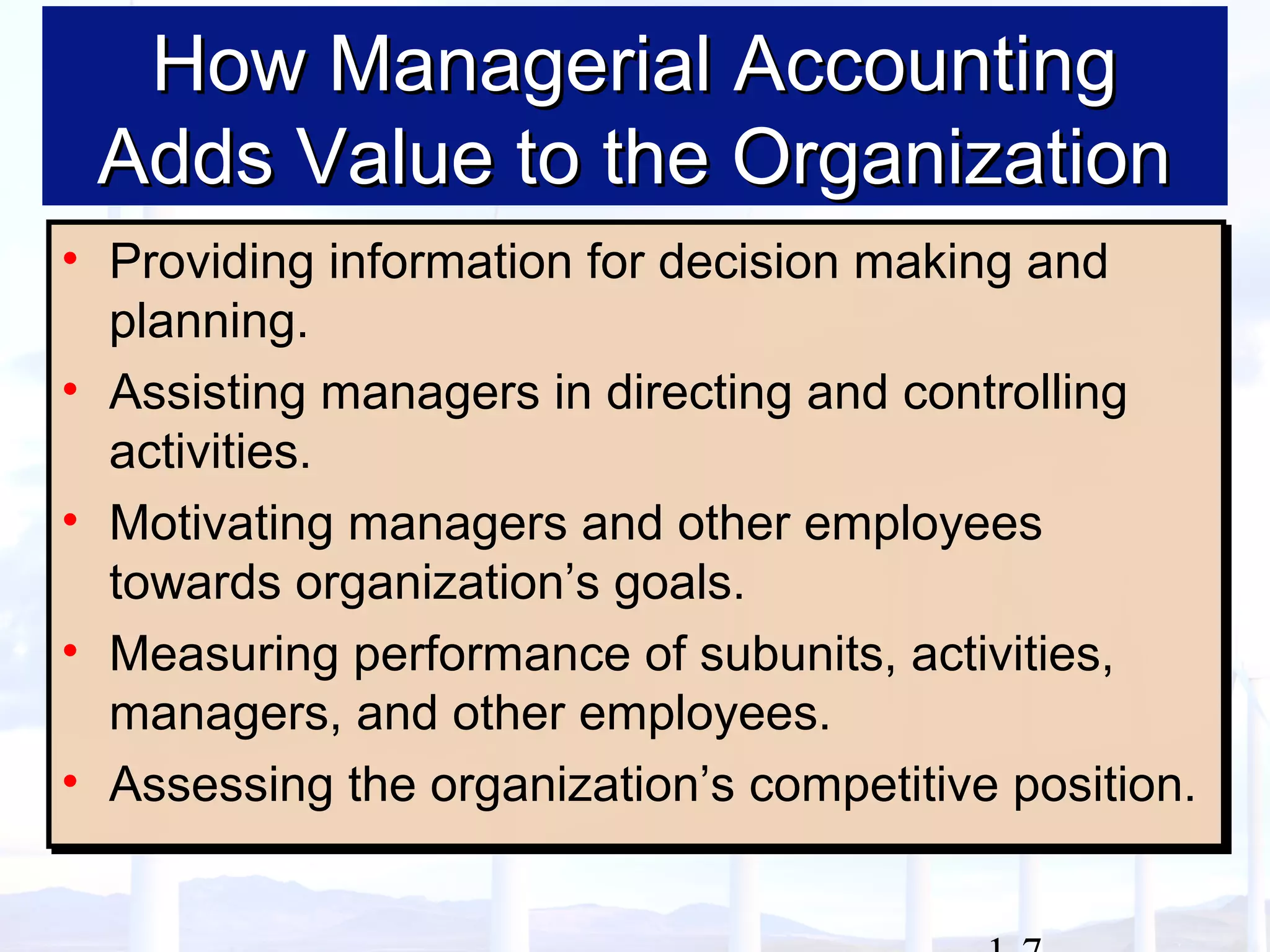
How Managerial AccountingHow Managerial Accounting
Adds Value to the OrganizationAdds Value to the Organization
• Providing information for decision making and
planning.
• Assisting managers in directing and controlling
activities.
• Motivating managers and other employees
towards organization’s goals.
• Measuring performance of subunits, activities,
managers, and other employees.
• Assessing the organization’s competitive position.
• Providing information for decision making and
planning.
• Assisting managers in directing and controlling
activities.
• Motivating managers and other employees
towards organization’s goals.
• Measuring performance of subunits, activities,
managers, and other employees.
• Assessing the organization’s competitive position.
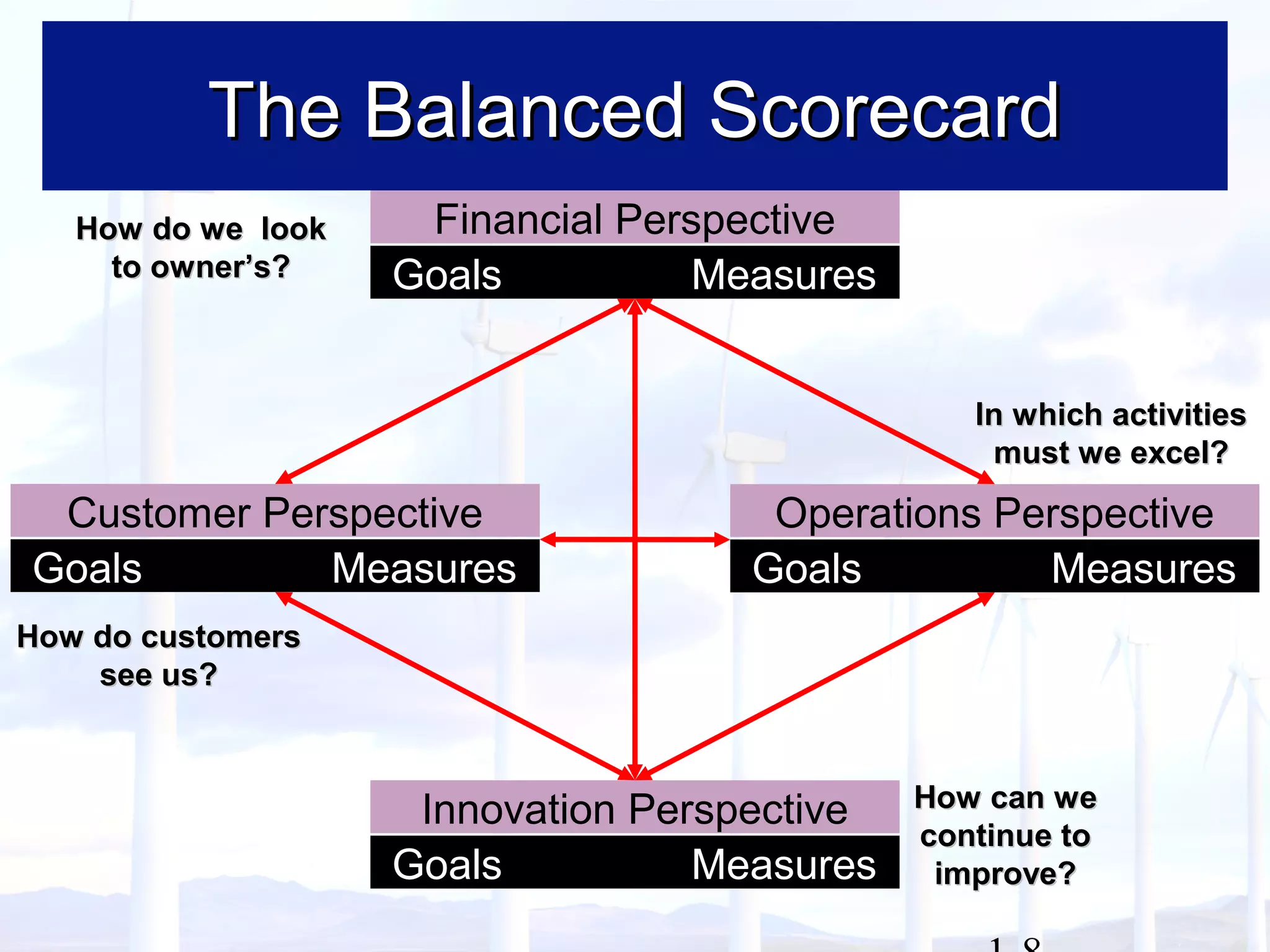
The Balanced ScorecardThe Balanced Scorecard
Financial Perspective
Goals Measures
Customer Perspective
Goals Measures
Operations Perspective
Goals Measures
Innovation Perspective
Goals Measures
How do we lookHow do we look
to owner’s?to owner’s?
How do customersHow do customers
see us?see us?
How can weHow can we
continue tocontinue to
improve?improve?
In which activitiesIn which activities
must we excel?must we excel?
Copyright © 2009 by The McGraw-Hill Companies, Inc. All rights reserved.McGraw-Hill/Irwin
Learning
Objective
4
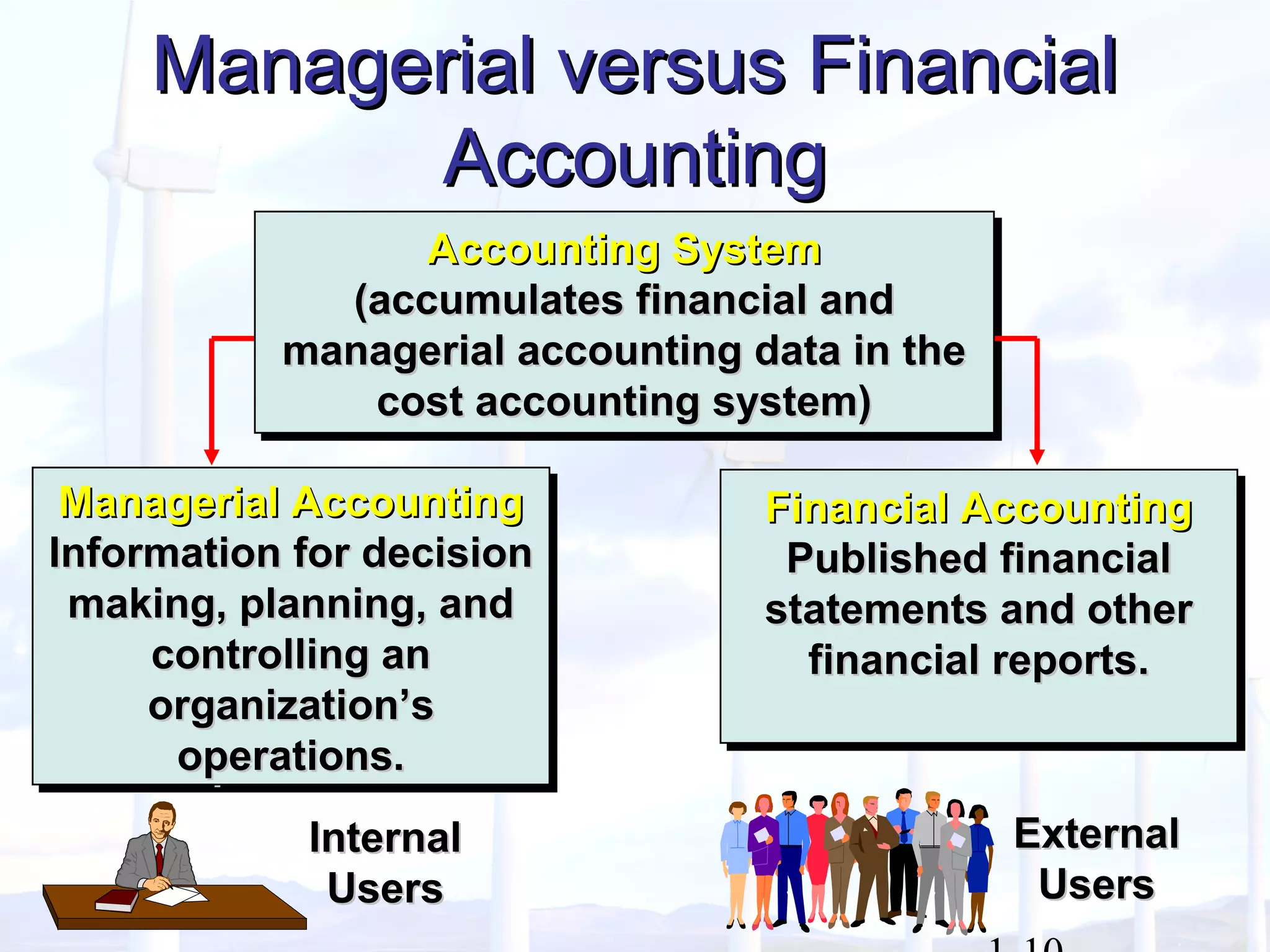
Managerial versus FinancialManagerial versus Financial
AccountingAccounting
Accounting SystemAccounting System
(accumulates financial and(accumulates financial and
managerial accounting data in themanagerial accounting data in the
cost accounting system)cost accounting system)
Accounting SystemAccounting System
(accumulates financial and(accumulates financial and
managerial accounting data in themanagerial accounting data in the
cost accounting system)cost accounting system)
Managerial AccountingManagerial Accounting
Information for decisionInformation for decision
making, planning, andmaking, planning, and
controlling ancontrolling an
organization’sorganization’s
operations.operations.
Managerial AccountingManagerial Accounting
Information for decisionInformation for decision
making, planning, andmaking, planning, and
controlling ancontrolling an
organization’sorganization’s
operations.operations.
Financial AccountingFinancial Accounting
Published financialPublished financial
statements and otherstatements and other
financial reports.financial reports.
Financial AccountingFinancial Accounting
Published financialPublished financial
statements and otherstatements and other
financial reports.financial reports.
InternalInternal
UsersUsers
ExternalExternal
UsersUsers
Managerial versus FinancialManagerial versus Financial
AccountingAccounting
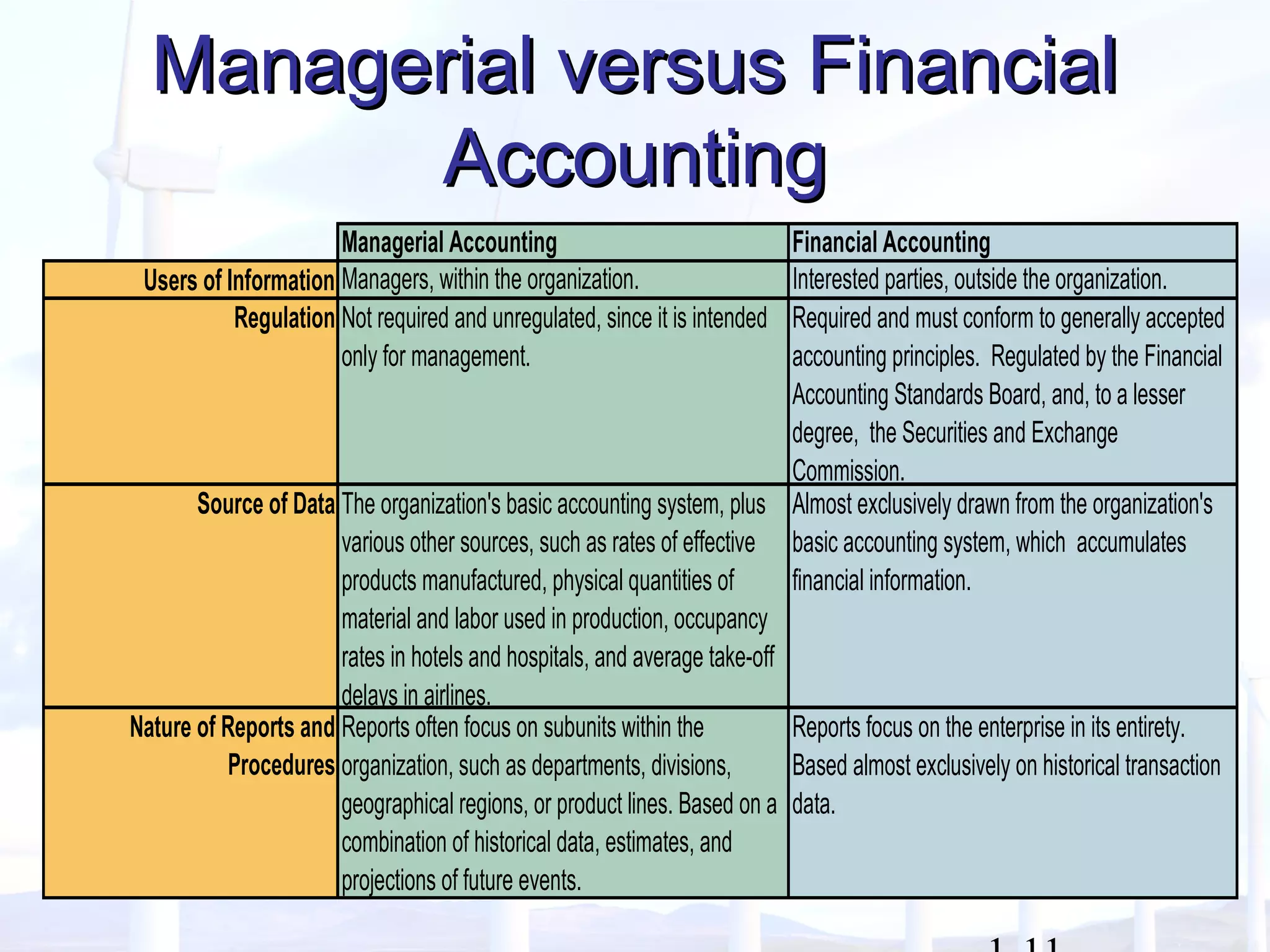
Managerial Accounting Financial Accounting
Users of Information Managers, within the organization. Interested parties, outside the organization.
Regulation Not required and unregulated, since it is intended
only for management.
Required and must conform to generally accepted
accounting principles. Regulated by the Financial
Accounting Standards Board, and, to a lesser
degree, the Securities and Exchange
Commission.
Source of Data The organization's basic accounting system, plus
various other sources, such as rates of effective
products manufactured, physical quantities of
material and labor used in production, occupancy
rates in hotels and hospitals, and average take-off
delays in airlines.
Almost exclusively drawn from the organization's
basic accounting system, which accumulates
financial information.
Nature of Reports and
Procedures
Reports often focus on subunits within the
organization, such as departments, divisions,
geographical regions, or product lines. Based on a
combination of historical data, estimates, and
projections of future events.
Reports focus on the enterprise in its entirety.
Based almost exclusively on historical transaction
data.
Copyright © 2009 by The McGraw-Hill Companies, Inc. All rights reserved.McGraw-Hill/Irwin
Learning
Objective
5
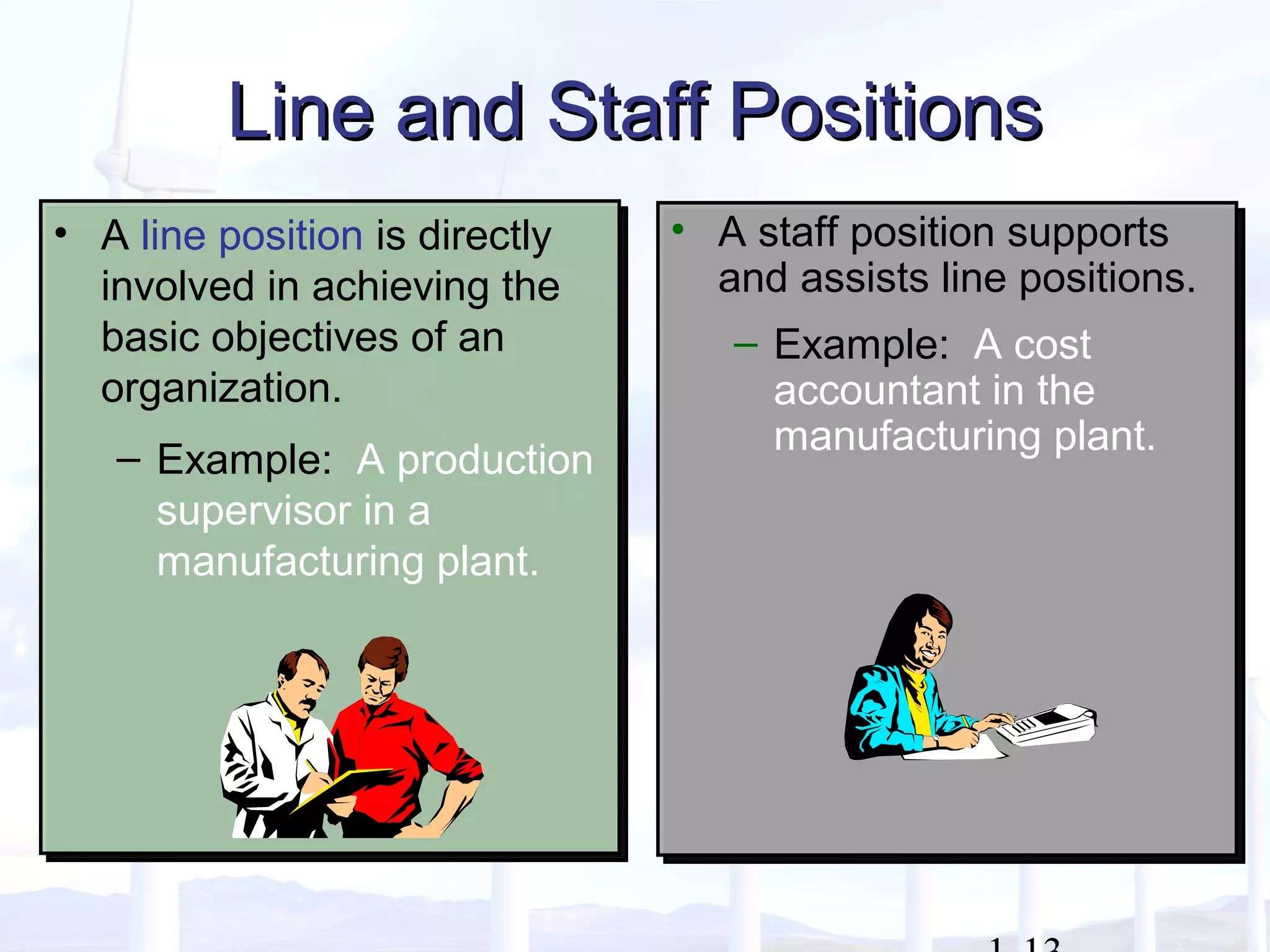
• A staff position supports
and assists line positions.
– Example: A cost
accountant in the
manufacturing plant.
• A staff position supports
and assists line positions.
– Example: A cost
accountant in the
manufacturing plant.
Line and Staff PositionsLine and Staff Positions
• A line position is directly
involved in achieving the
basic objectives of an
organization.
– Example: A production
supervisor in a
manufacturing plant.
• A line position is directly
involved in achieving the
basic objectives of an
organization.
– Example: A production
supervisor in a
manufacturing plant.
Copyright © 2009 by The McGraw-Hill Companies, Inc. All rights reserved.McGraw-Hill/Irwin
Learning
Objective
6
ControllerController
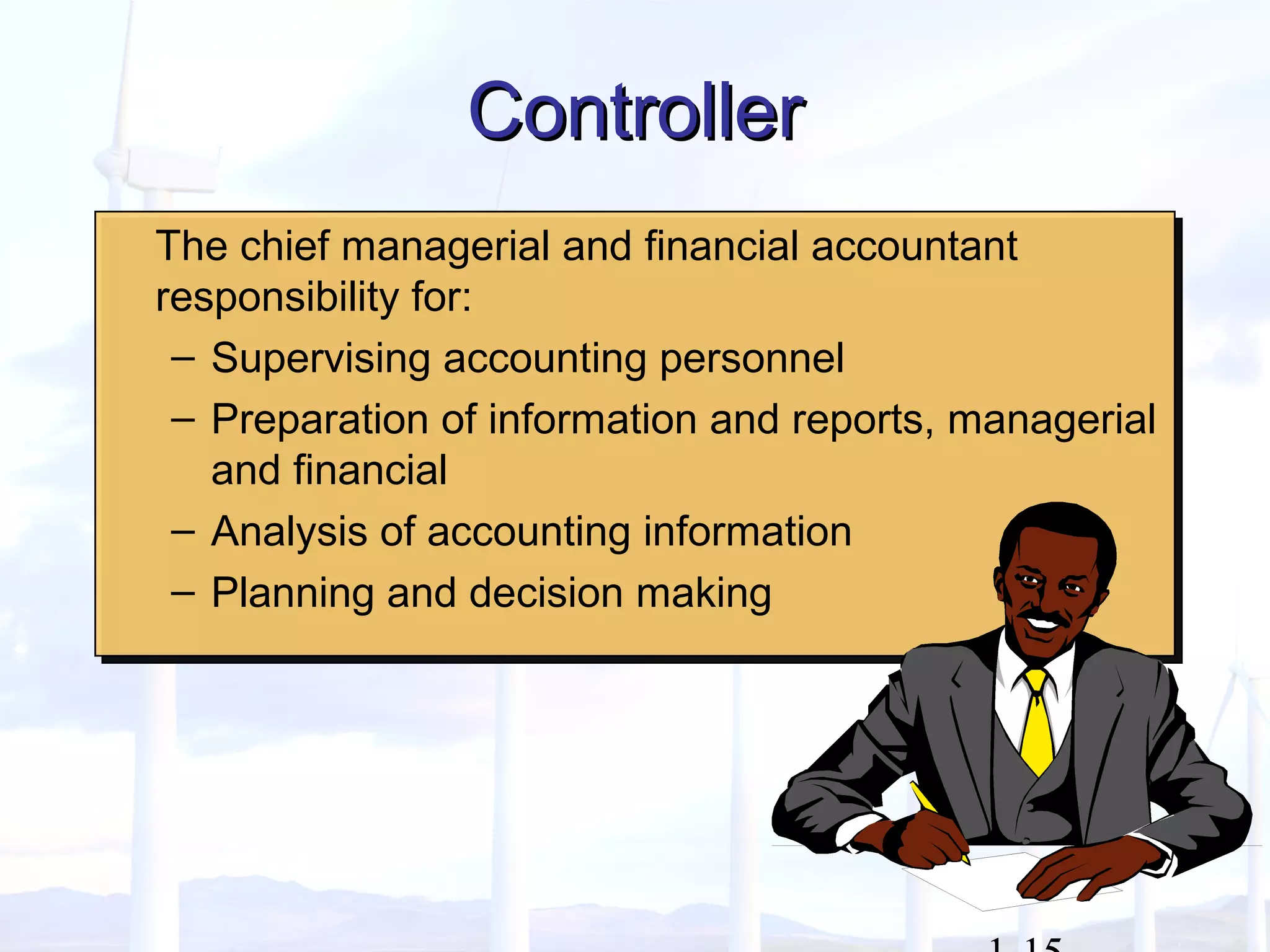
The chief managerial and financial accountant
responsibility for:
– Supervising accounting personnel
– Preparation of information and reports, managerial
and financial
– Analysis of accounting information
– Planning and decision making
The chief managerial and financial accountant
responsibility for:
– Supervising accounting personnel
– Preparation of information and reports, managerial
and financial
– Analysis of accounting information
– Planning and decision making
TreasurerTreasurer
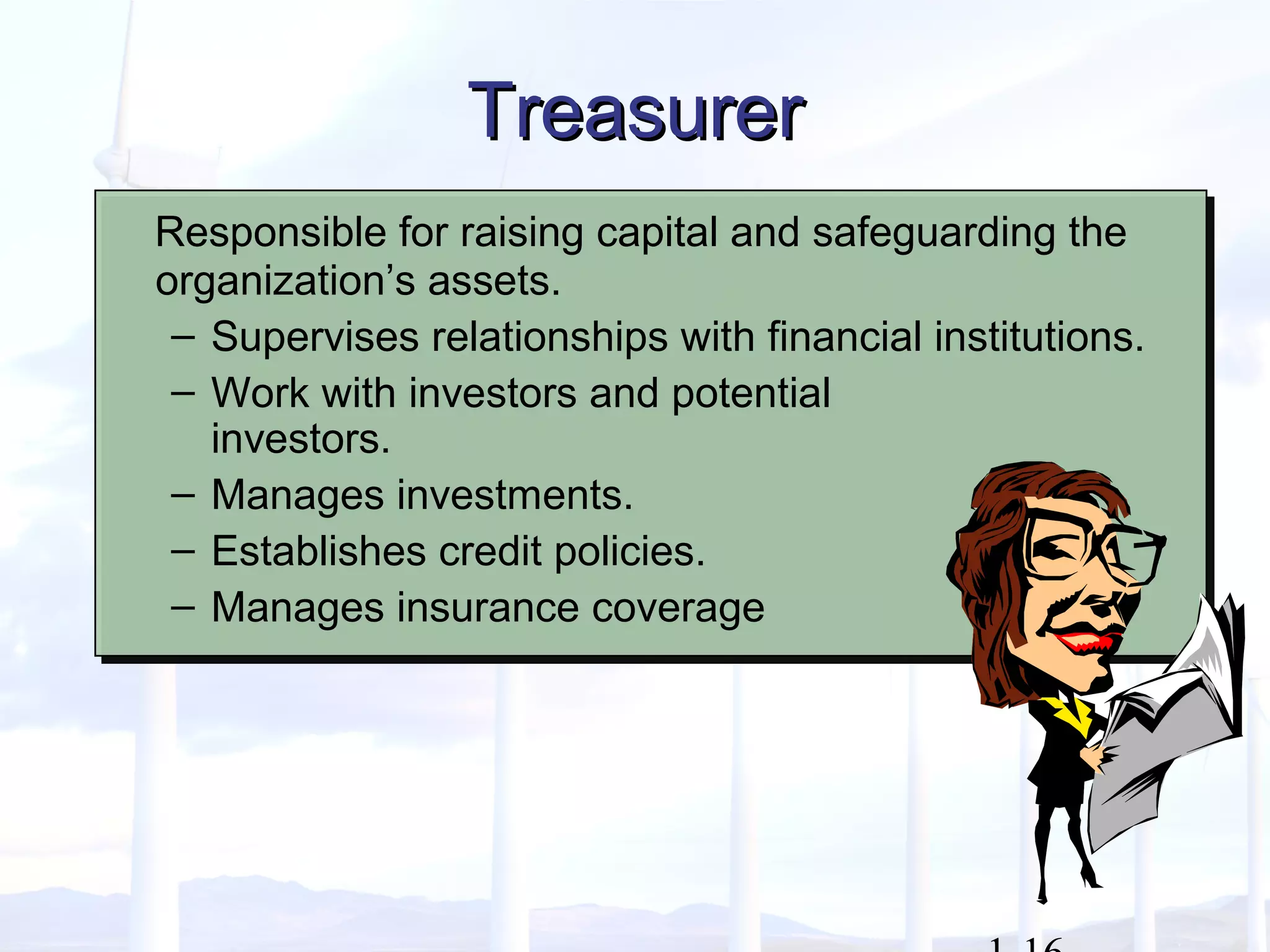
Responsible for raising capital and safeguarding the
organization’s assets.
– Supervises relationships with financial institutions.
– Work with investors and potential
investors.
– Manages investments.
– Establishes credit policies.
– Manages insurance coverage
Responsible for raising capital and safeguarding the
organization’s assets.
– Supervises relationships with financial institutions.
– Work with investors and potential
investors.
– Manages investments.
– Establishes credit policies.
– Manages insurance coverage
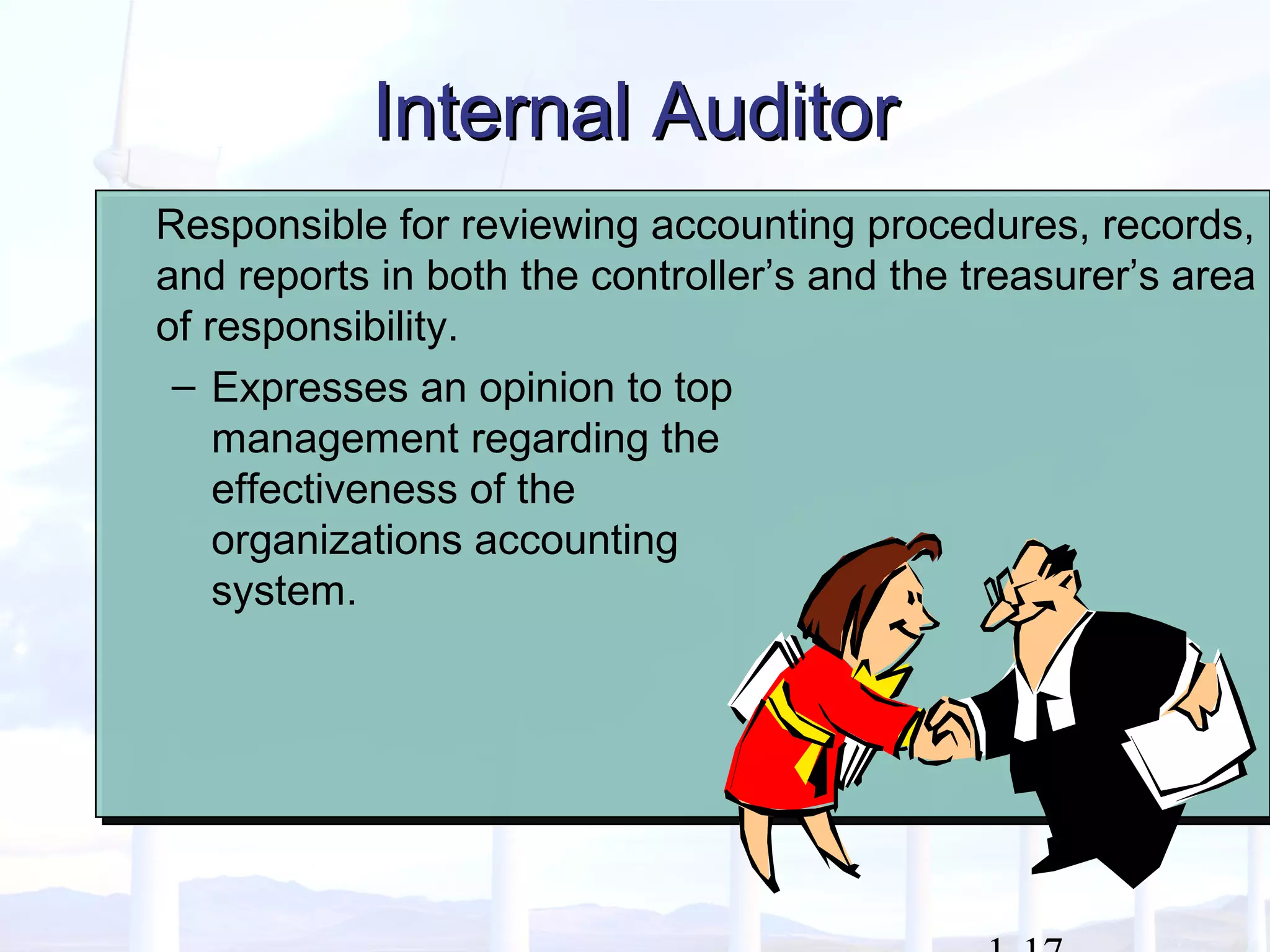
Internal AuditorInternal Auditor
Responsible for reviewing accounting procedures, records,
and reports in both the controller’s and the treasurer’s area
of responsibility.
– Expresses an opinion to top
management regarding the
effectiveness of the
organizations accounting
system.
Responsible for reviewing accounting procedures, records,
and reports in both the controller’s and the treasurer’s area
of responsibility.
– Expresses an opinion to top
management regarding the
effectiveness of the
organizations accounting
system.
Copyright © 2009 by The McGraw-Hill Companies, Inc. All rights reserved.McGraw-Hill/Irwin
Learning
Objective
7
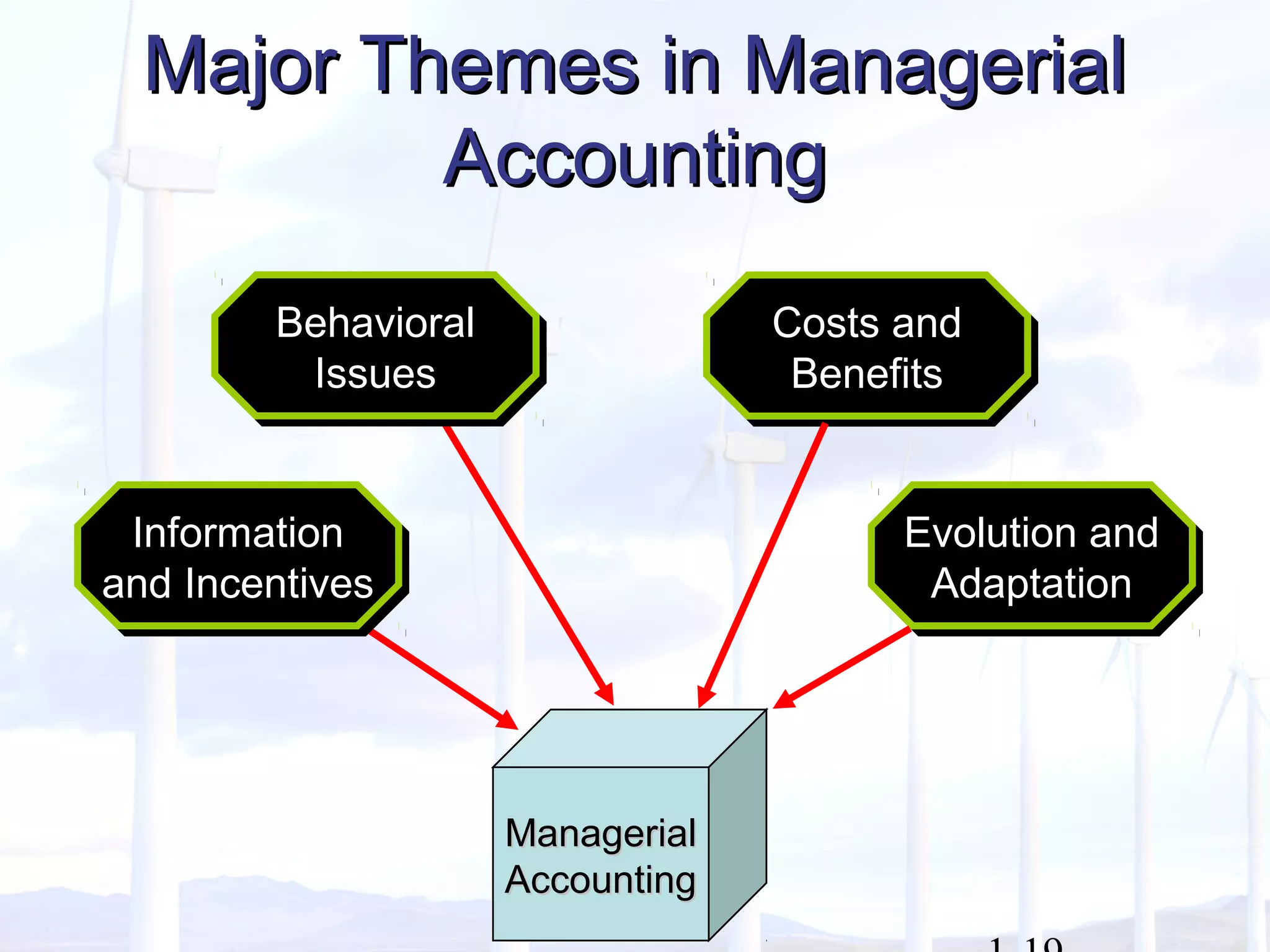
Major Themes in ManagerialMajor Themes in Managerial
AccountingAccounting
ManagerialManagerial
AccountingAccounting
Information
and Incentives
Information
and Incentives
Costs and
Benefits
Costs and
Benefits
Evolution and
Adaptation
Evolution and
Adaptation
Behavioral
Issues
Behavioral
Issues
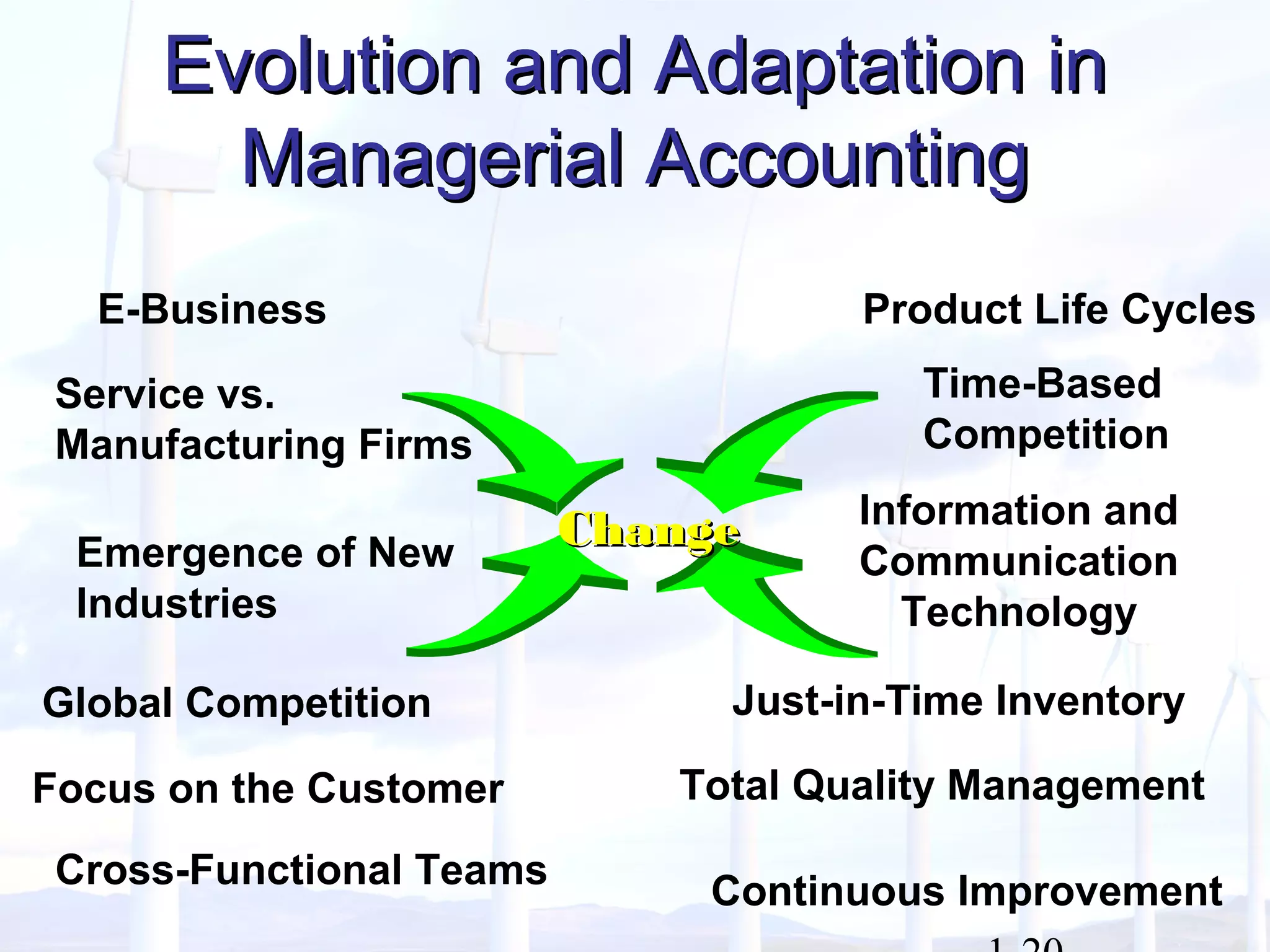
Evolution and Adaptation inEvolution and Adaptation in
Managerial AccountingManagerial Accounting
E-Business
Service vs.
Manufacturing Firms
Emergence of New
Industries
Global Competition
Focus on the Customer
Cross-Functional Teams
Product Life Cycles
Time-Based
Competition
Information and
Communication
Technology
Just-in-Time Inventory
Total Quality Management
Continuous Improvement
ChangeChange
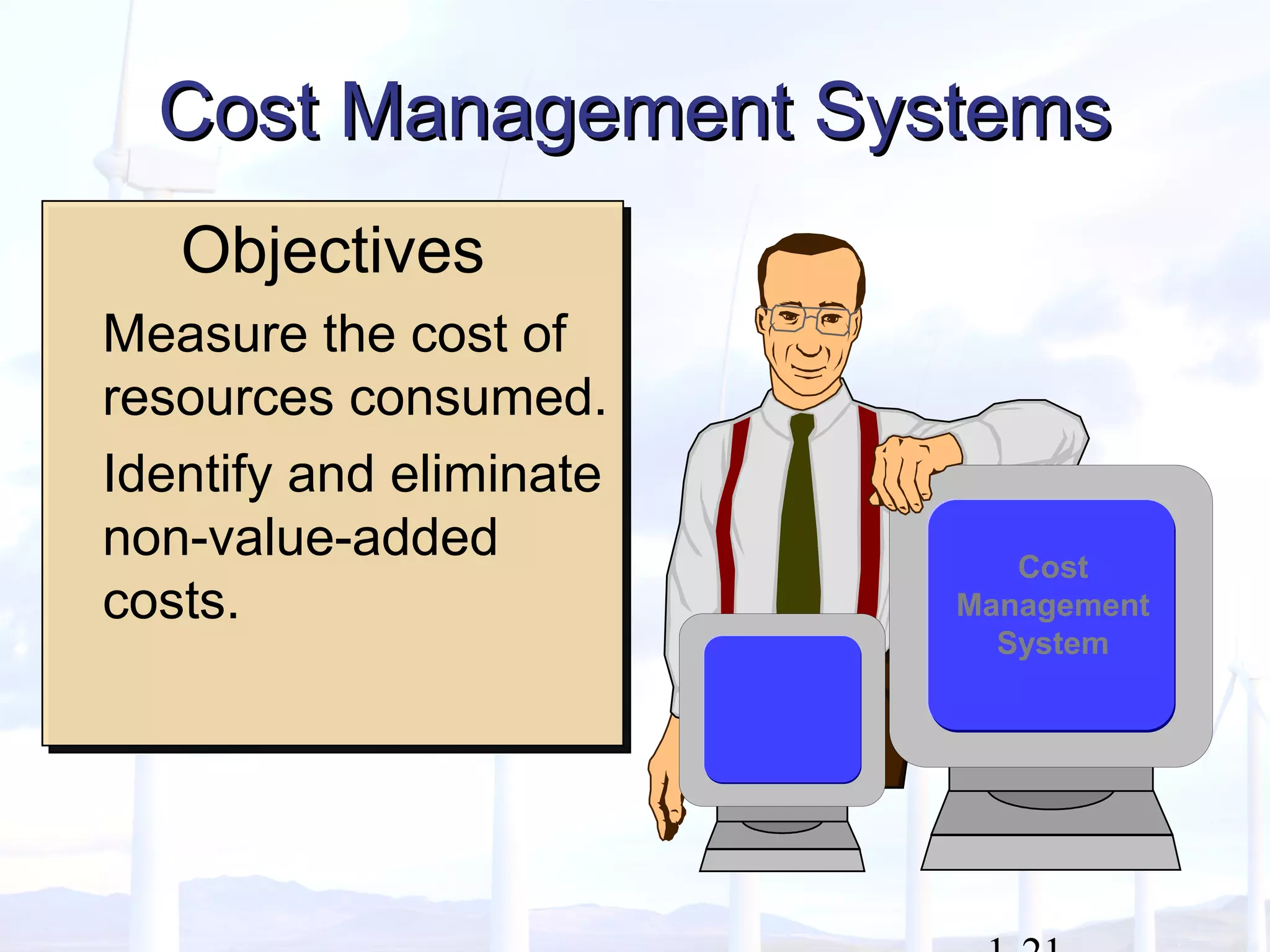
Objectives
Measure the cost of
resources consumed.
Identify and eliminate
non-value-added
costs.
Objectives
Measure the cost of
resources consumed.
Identify and eliminate
non-value-added
costs.
Cost Management SystemsCost Management Systems
Cost
Management
System
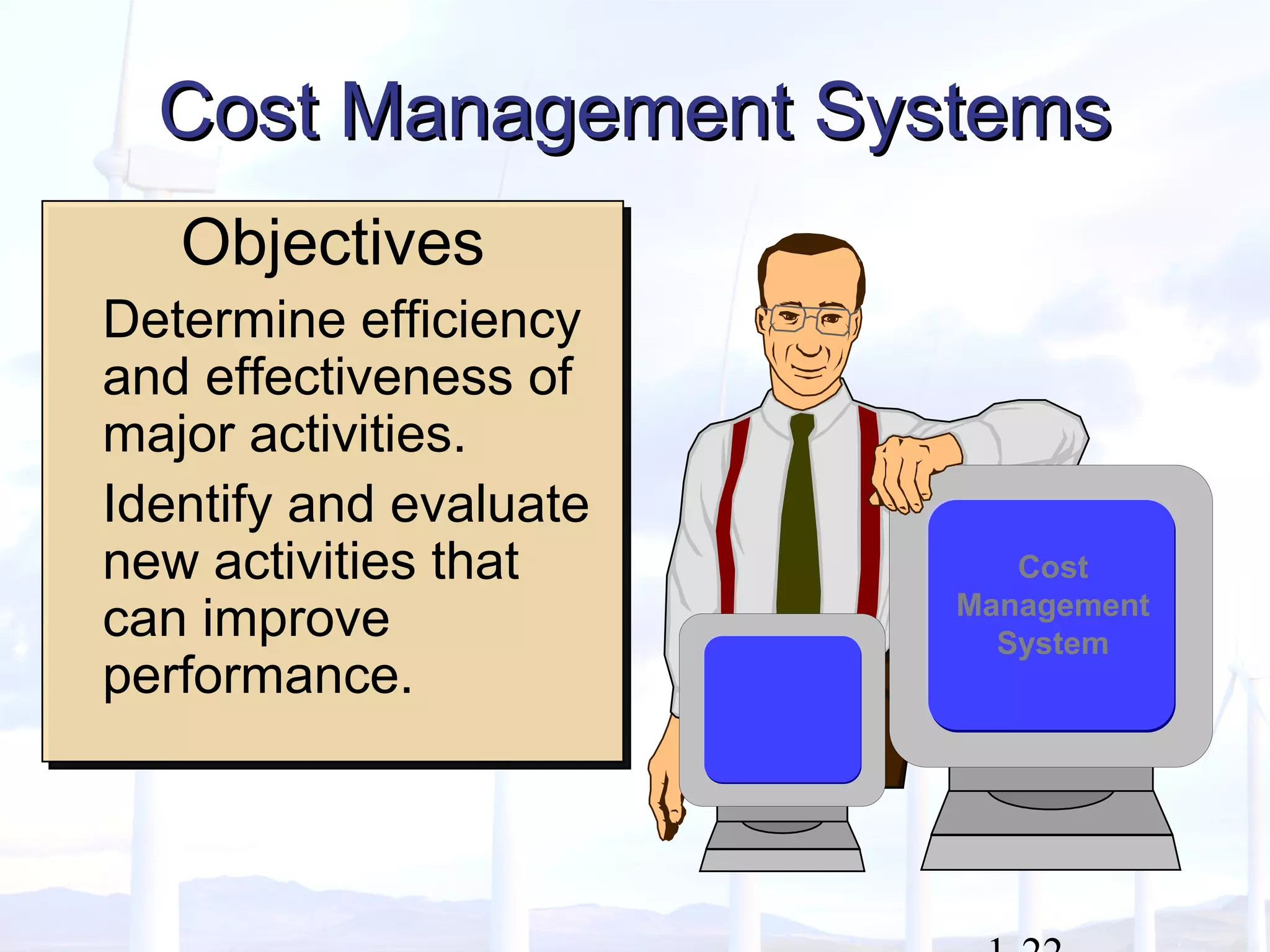
Objectives
Determine efficiency
and effectiveness of
major activities.
Identify and evaluate
new activities that
can improve
performance.
Objectives
Determine efficiency
and effectiveness of
major activities.
Identify and evaluate
new activities that
can improve
performance.
Cost Management SystemsCost Management Systems
Cost
Management
System
Copyright © 2009 by The McGraw-Hill Companies, Inc. All rights reserved.McGraw-Hill/Irwin
Learning
Objective
8
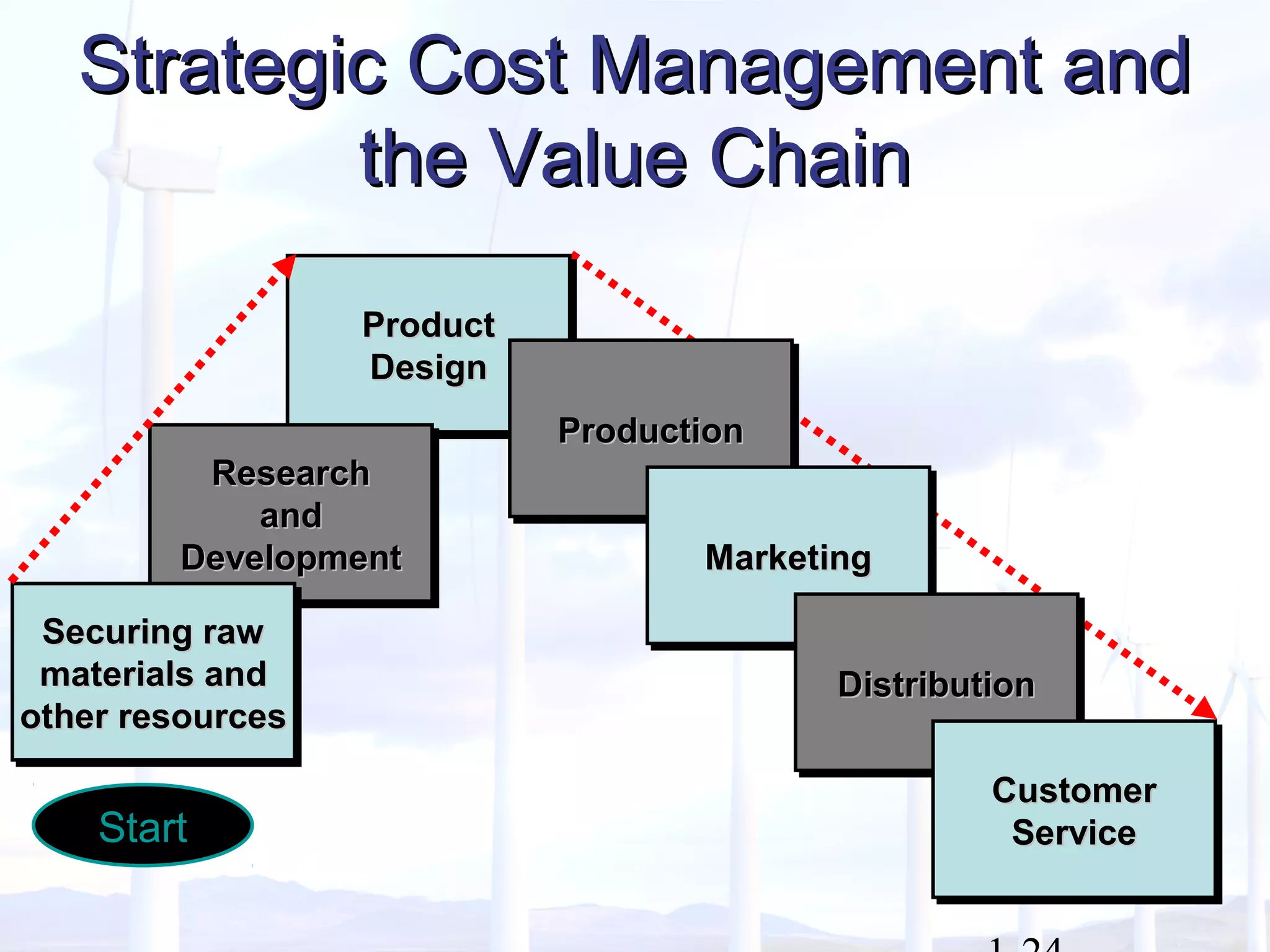
ProductProduct
DesignDesign
ProductProduct
DesignDesign
ResearchResearch
andand
DevelopmentDevelopment
ResearchResearch
andand
DevelopmentDevelopment
Strategic Cost Management andStrategic Cost Management and
the Value Chainthe Value Chain
Securing rawSecuring raw
materials andmaterials and
other resourcesother resources
Securing rawSecuring raw
materials andmaterials and
other resourcesother resources
ProductionProductionProductionProduction
MarketingMarketingMarketingMarketing
DistributionDistributionDistributionDistribution
CustomerCustomer
ServiceService
CustomerCustomer
ServiceServiceStartStart
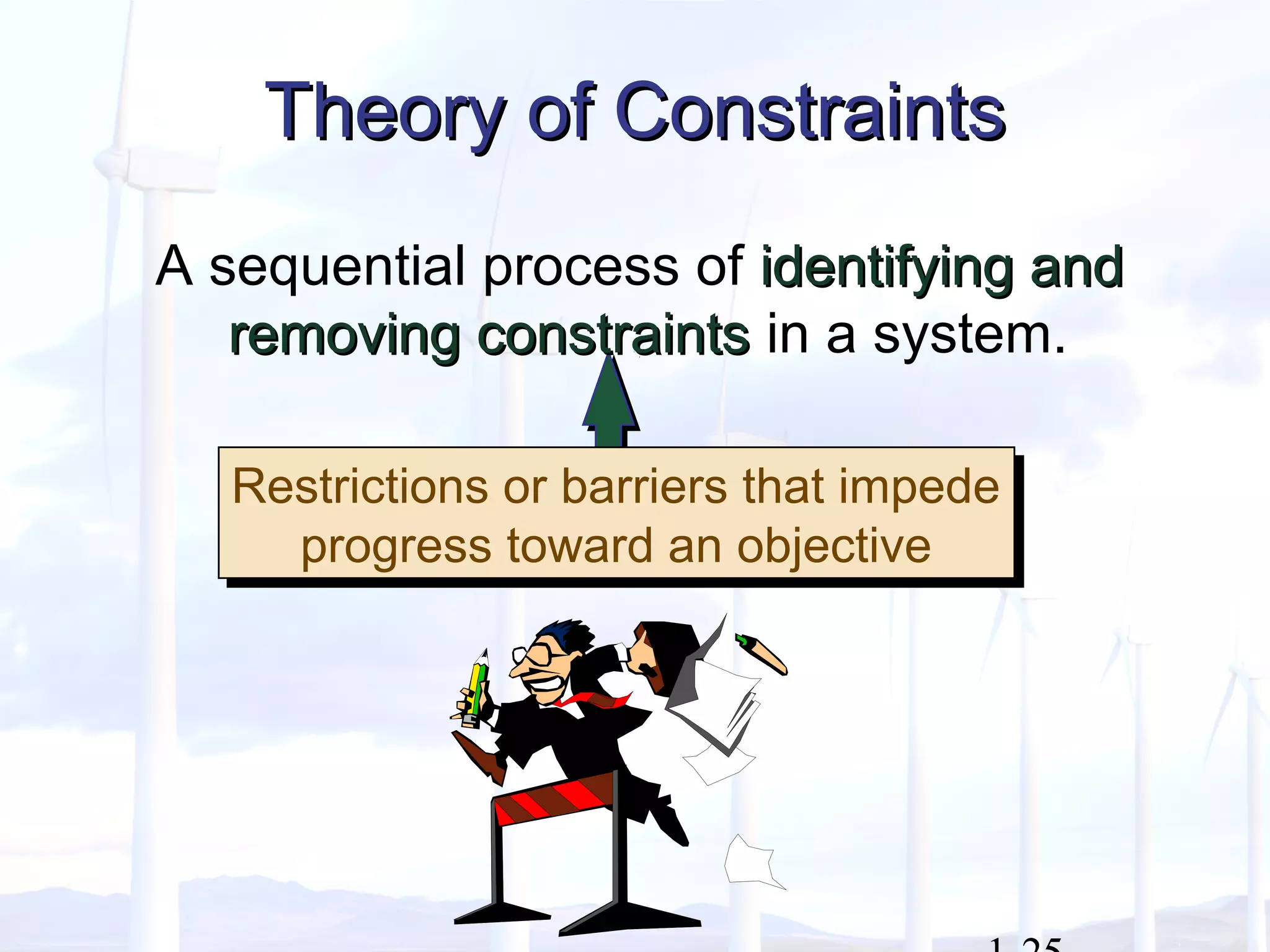
Theory of ConstraintsTheory of Constraints
A sequential process of identifying andidentifying and
removing constraintsremoving constraints in a system.
Restrictions or barriers that impede
progress toward an objective
Restrictions or barriers that impede
progress toward an objective
Copyright © 2009 by The McGraw-Hill Companies, Inc. All rights reserved.McGraw-Hill/Irwin
Learning
Objective
9
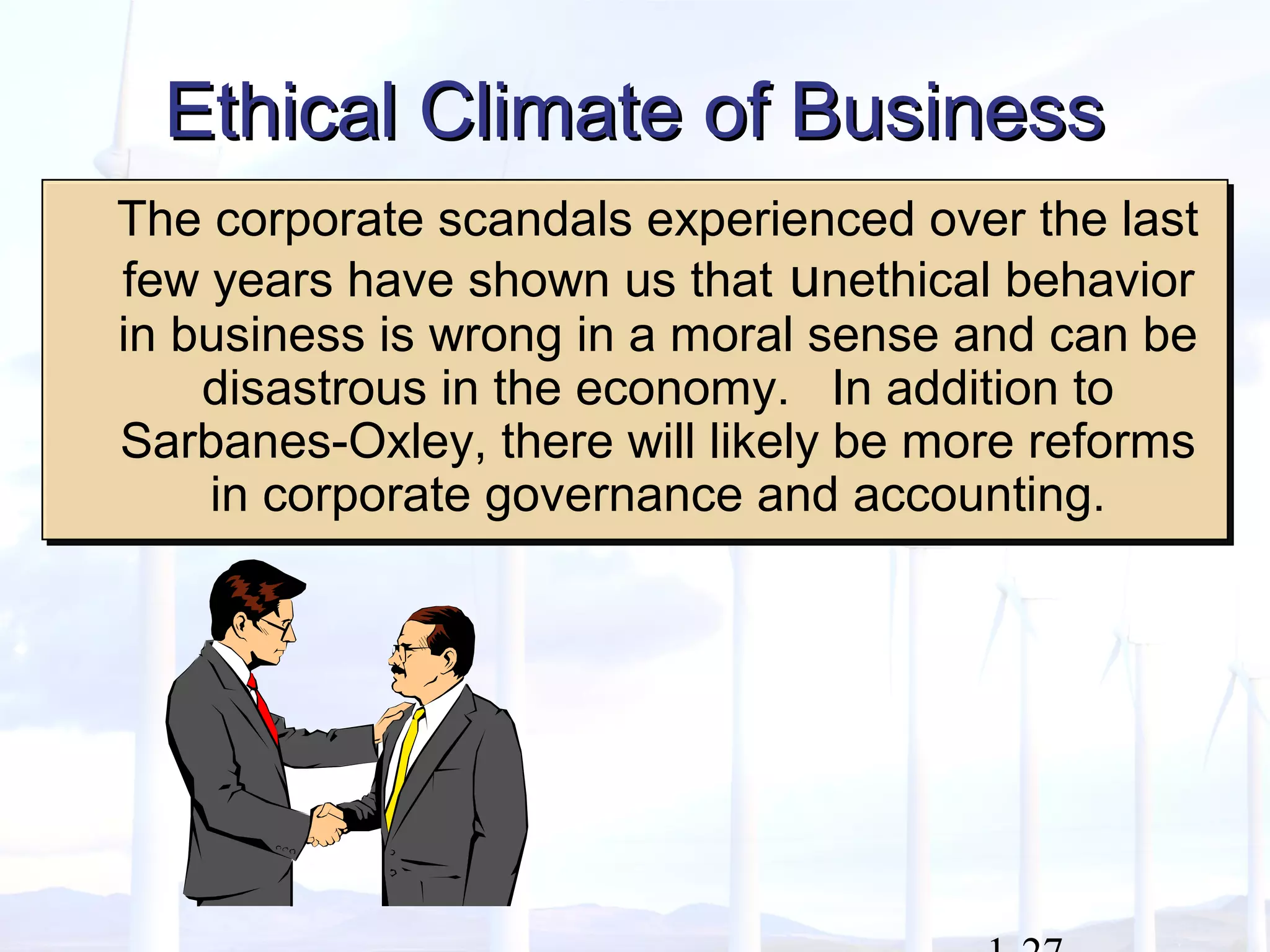
Ethical Climate of BusinessEthical Climate of Business
The corporate scandals experienced over the last
few years have shown us that unethical behavior
in business is wrong in a moral sense and can be
disastrous in the economy. In addition to
Sarbanes-Oxley, there will likely be more reforms
in corporate governance and accounting.
The corporate scandals experienced over the last
few years have shown us that unethical behavior
in business is wrong in a moral sense and can be
disastrous in the economy. In addition to
Sarbanes-Oxley, there will likely be more reforms
in corporate governance and accounting.
Copyright © 2009 by The McGraw-Hill Companies, Inc. All rights reserved.McGraw-Hill/Irwin
Learning
Objective
10
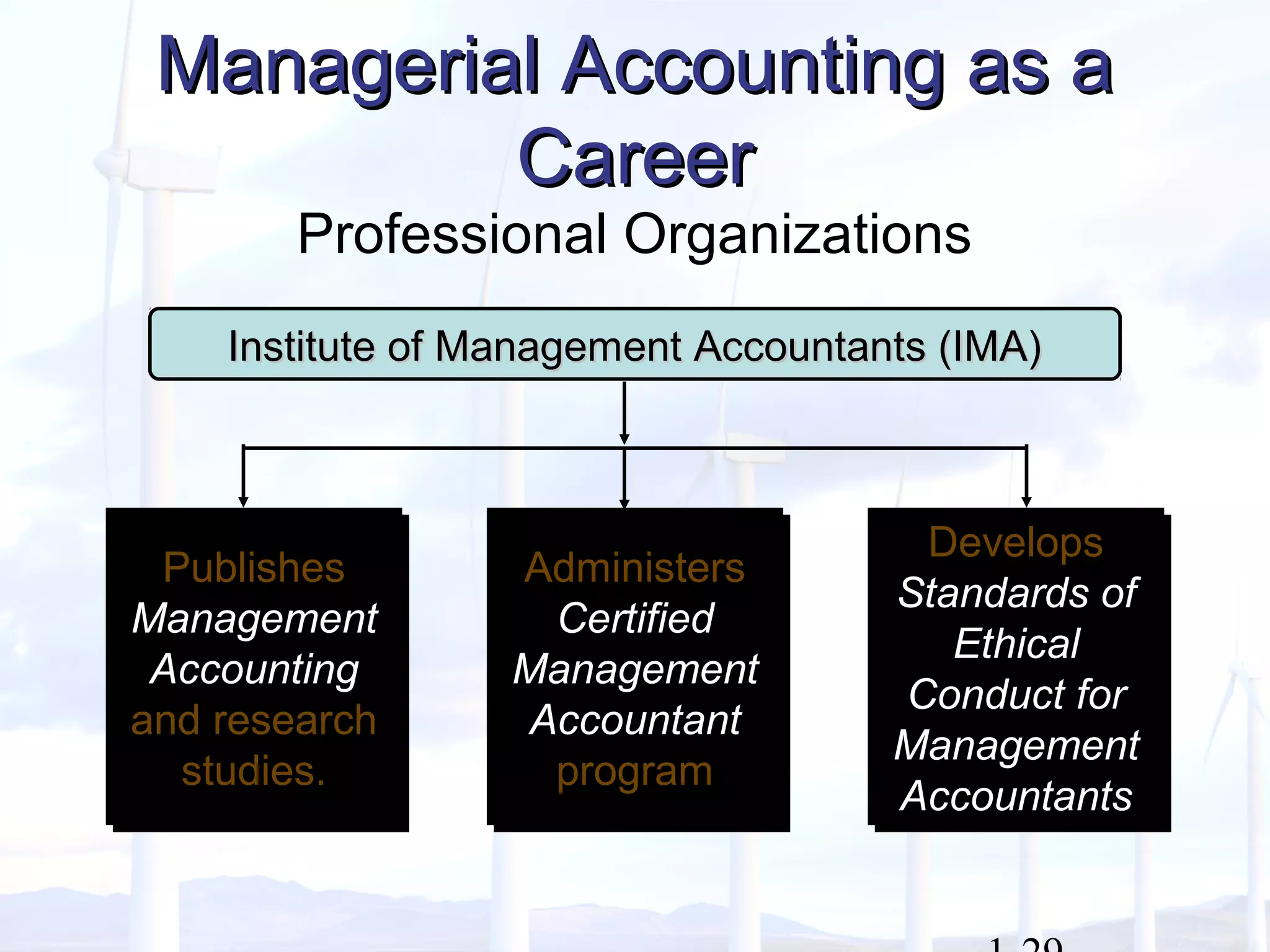
Managerial Accounting as aManagerial Accounting as a
CareerCareer
Professional Organizations
Institute of Management Accountants (IMA)Institute of Management Accountants (IMA)
PublishesPublishes
Management
Accounting
and researchand research
studies.studies.
PublishesPublishes
Management
Accounting
and researchand research
studies.studies.
AdministersAdministers
Certified
Management
Accountant
programprogram
AdministersAdministers
Certified
Management
Accountant
programprogram
DevelopsDevelops
Standards of
Ethical
Conduct for
Management
Accountants
DevelopsDevelops
Standards of
Ethical
Conduct for
Management
Accountants
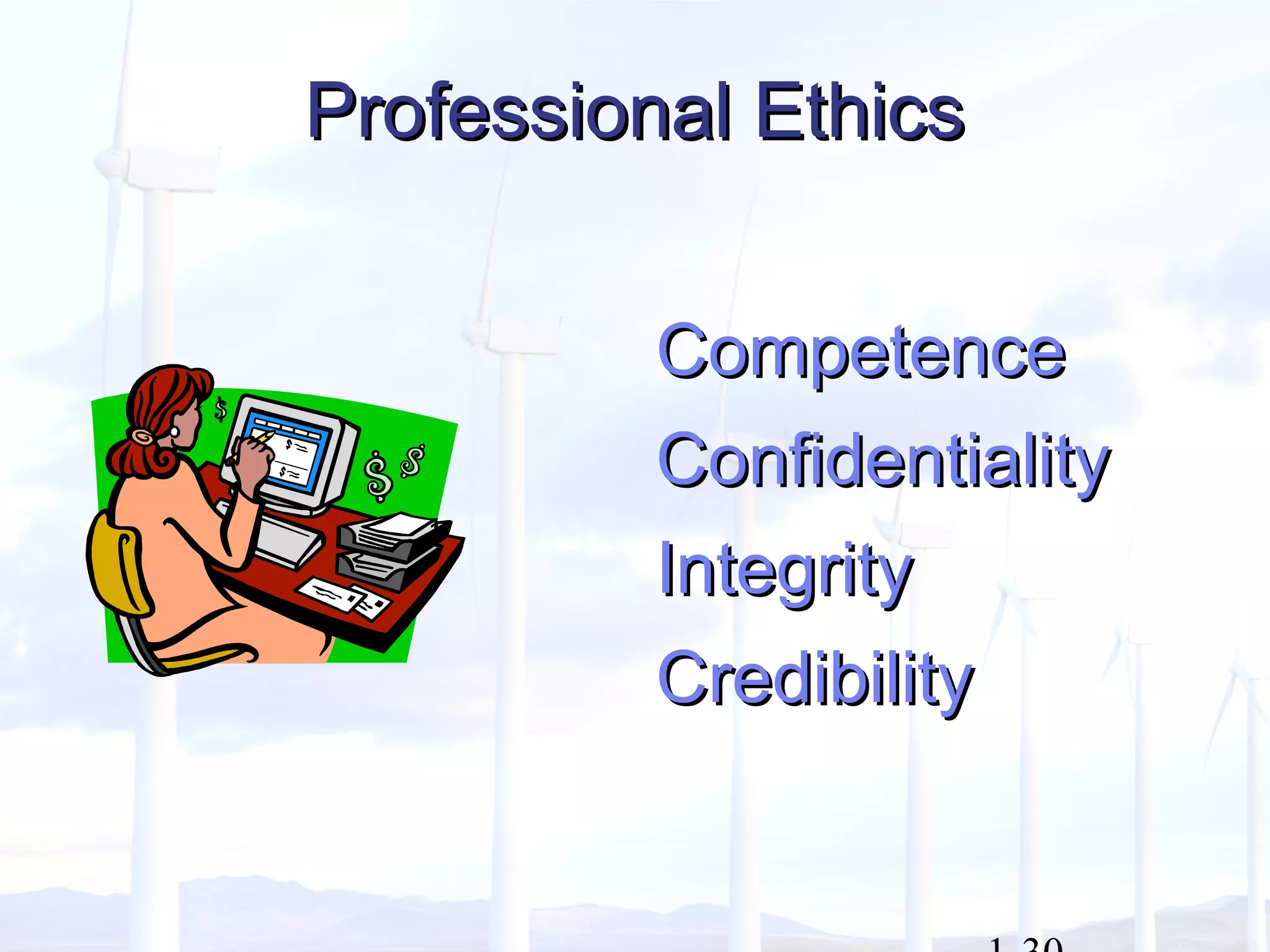
Professional EthicsProfessional Ethics
CompetenceCompetence
ConfidentialityConfidentiality
IntegrityIntegrity
CredibilityCredibility
End of Chapter 1End of Chapter 1

Chap001

  • 1.
    Copyright © 2009by The McGraw-Hill Companies, Inc. All rights reserved.McGraw-Hill/Irwin Chapter 1 The Changing Role of Managerial Accounting in a Dynamic Business Environment
  • 2.
    Copyright © 2009by The McGraw-Hill Companies, Inc. All rights reserved.McGraw-Hill/Irwin Learning Objective 1
  • 3.
    Managerial accounting isthe process of  Identifying  Measuring  Analyzing  Interpreting  Communicating information Define Managerial AccountingDefine Managerial Accounting
  • 4.
    Copyright © 2009by The McGraw-Hill Companies, Inc. All rights reserved.McGraw-Hill/Irwin Learning Objective 2
  • 5.
    Managing Resources, Activities,ManagingResources, Activities, and Peopleand People An organization . . . Acquires Resources Hires People Organized setOrganized set of activitiesof activities Organized setOrganized set of activitiesof activities Decision Making Decision Making PlanningPlanning DirectingDirecting ControllingControlling
  • 6.
    Copyright © 2009by The McGraw-Hill Companies, Inc. All rights reserved.McGraw-Hill/Irwin Learning Objective 3
  • 7.
    How Managerial AccountingHowManagerial Accounting Adds Value to the OrganizationAdds Value to the Organization • Providing information for decision making and planning. • Assisting managers in directing and controlling activities. • Motivating managers and other employees towards organization’s goals. • Measuring performance of subunits, activities, managers, and other employees. • Assessing the organization’s competitive position. • Providing information for decision making and planning. • Assisting managers in directing and controlling activities. • Motivating managers and other employees towards organization’s goals. • Measuring performance of subunits, activities, managers, and other employees. • Assessing the organization’s competitive position.
  • 8.
    The Balanced ScorecardTheBalanced Scorecard Financial Perspective Goals Measures Customer Perspective Goals Measures Operations Perspective Goals Measures Innovation Perspective Goals Measures How do we lookHow do we look to owner’s?to owner’s? How do customersHow do customers see us?see us? How can weHow can we continue tocontinue to improve?improve? In which activitiesIn which activities must we excel?must we excel?
  • 9.
    Copyright © 2009by The McGraw-Hill Companies, Inc. All rights reserved.McGraw-Hill/Irwin Learning Objective 4
  • 10.
    Managerial versus FinancialManagerialversus Financial AccountingAccounting Accounting SystemAccounting System (accumulates financial and(accumulates financial and managerial accounting data in themanagerial accounting data in the cost accounting system)cost accounting system) Accounting SystemAccounting System (accumulates financial and(accumulates financial and managerial accounting data in themanagerial accounting data in the cost accounting system)cost accounting system) Managerial AccountingManagerial Accounting Information for decisionInformation for decision making, planning, andmaking, planning, and controlling ancontrolling an organization’sorganization’s operations.operations. Managerial AccountingManagerial Accounting Information for decisionInformation for decision making, planning, andmaking, planning, and controlling ancontrolling an organization’sorganization’s operations.operations. Financial AccountingFinancial Accounting Published financialPublished financial statements and otherstatements and other financial reports.financial reports. Financial AccountingFinancial Accounting Published financialPublished financial statements and otherstatements and other financial reports.financial reports. InternalInternal UsersUsers ExternalExternal UsersUsers
  • 11.
    Managerial versus FinancialManagerialversus Financial AccountingAccounting Managerial Accounting Financial Accounting Users of Information Managers, within the organization. Interested parties, outside the organization. Regulation Not required and unregulated, since it is intended only for management. Required and must conform to generally accepted accounting principles. Regulated by the Financial Accounting Standards Board, and, to a lesser degree, the Securities and Exchange Commission. Source of Data The organization's basic accounting system, plus various other sources, such as rates of effective products manufactured, physical quantities of material and labor used in production, occupancy rates in hotels and hospitals, and average take-off delays in airlines. Almost exclusively drawn from the organization's basic accounting system, which accumulates financial information. Nature of Reports and Procedures Reports often focus on subunits within the organization, such as departments, divisions, geographical regions, or product lines. Based on a combination of historical data, estimates, and projections of future events. Reports focus on the enterprise in its entirety. Based almost exclusively on historical transaction data.
  • 12.
    Copyright © 2009by The McGraw-Hill Companies, Inc. All rights reserved.McGraw-Hill/Irwin Learning Objective 5
  • 13.
    • A staffposition supports and assists line positions. – Example: A cost accountant in the manufacturing plant. • A staff position supports and assists line positions. – Example: A cost accountant in the manufacturing plant. Line and Staff PositionsLine and Staff Positions • A line position is directly involved in achieving the basic objectives of an organization. – Example: A production supervisor in a manufacturing plant. • A line position is directly involved in achieving the basic objectives of an organization. – Example: A production supervisor in a manufacturing plant.
  • 14.
    Copyright © 2009by The McGraw-Hill Companies, Inc. All rights reserved.McGraw-Hill/Irwin Learning Objective 6
  • 15.
    ControllerController The chief managerialand financial accountant responsibility for: – Supervising accounting personnel – Preparation of information and reports, managerial and financial – Analysis of accounting information – Planning and decision making The chief managerial and financial accountant responsibility for: – Supervising accounting personnel – Preparation of information and reports, managerial and financial – Analysis of accounting information – Planning and decision making
  • 16.
    TreasurerTreasurer Responsible for raisingcapital and safeguarding the organization’s assets. – Supervises relationships with financial institutions. – Work with investors and potential investors. – Manages investments. – Establishes credit policies. – Manages insurance coverage Responsible for raising capital and safeguarding the organization’s assets. – Supervises relationships with financial institutions. – Work with investors and potential investors. – Manages investments. – Establishes credit policies. – Manages insurance coverage
  • 17.
    Internal AuditorInternal Auditor Responsiblefor reviewing accounting procedures, records, and reports in both the controller’s and the treasurer’s area of responsibility. – Expresses an opinion to top management regarding the effectiveness of the organizations accounting system. Responsible for reviewing accounting procedures, records, and reports in both the controller’s and the treasurer’s area of responsibility. – Expresses an opinion to top management regarding the effectiveness of the organizations accounting system.
  • 18.
    Copyright © 2009by The McGraw-Hill Companies, Inc. All rights reserved.McGraw-Hill/Irwin Learning Objective 7
  • 19.
    Major Themes inManagerialMajor Themes in Managerial AccountingAccounting ManagerialManagerial AccountingAccounting Information and Incentives Information and Incentives Costs and Benefits Costs and Benefits Evolution and Adaptation Evolution and Adaptation Behavioral Issues Behavioral Issues
  • 20.
    Evolution and AdaptationinEvolution and Adaptation in Managerial AccountingManagerial Accounting E-Business Service vs. Manufacturing Firms Emergence of New Industries Global Competition Focus on the Customer Cross-Functional Teams Product Life Cycles Time-Based Competition Information and Communication Technology Just-in-Time Inventory Total Quality Management Continuous Improvement ChangeChange
  • 21.
    Objectives Measure the costof resources consumed. Identify and eliminate non-value-added costs. Objectives Measure the cost of resources consumed. Identify and eliminate non-value-added costs. Cost Management SystemsCost Management Systems Cost Management System
  • 22.
    Objectives Determine efficiency and effectivenessof major activities. Identify and evaluate new activities that can improve performance. Objectives Determine efficiency and effectiveness of major activities. Identify and evaluate new activities that can improve performance. Cost Management SystemsCost Management Systems Cost Management System
  • 23.
    Copyright © 2009by The McGraw-Hill Companies, Inc. All rights reserved.McGraw-Hill/Irwin Learning Objective 8
  • 24.
    ProductProduct DesignDesign ProductProduct DesignDesign ResearchResearch andand DevelopmentDevelopment ResearchResearch andand DevelopmentDevelopment Strategic Cost ManagementandStrategic Cost Management and the Value Chainthe Value Chain Securing rawSecuring raw materials andmaterials and other resourcesother resources Securing rawSecuring raw materials andmaterials and other resourcesother resources ProductionProductionProductionProduction MarketingMarketingMarketingMarketing DistributionDistributionDistributionDistribution CustomerCustomer ServiceService CustomerCustomer ServiceServiceStartStart
  • 25.
    Theory of ConstraintsTheoryof Constraints A sequential process of identifying andidentifying and removing constraintsremoving constraints in a system. Restrictions or barriers that impede progress toward an objective Restrictions or barriers that impede progress toward an objective
  • 26.
    Copyright © 2009by The McGraw-Hill Companies, Inc. All rights reserved.McGraw-Hill/Irwin Learning Objective 9
  • 27.
    Ethical Climate ofBusinessEthical Climate of Business The corporate scandals experienced over the last few years have shown us that unethical behavior in business is wrong in a moral sense and can be disastrous in the economy. In addition to Sarbanes-Oxley, there will likely be more reforms in corporate governance and accounting. The corporate scandals experienced over the last few years have shown us that unethical behavior in business is wrong in a moral sense and can be disastrous in the economy. In addition to Sarbanes-Oxley, there will likely be more reforms in corporate governance and accounting.
  • 28.
    Copyright © 2009by The McGraw-Hill Companies, Inc. All rights reserved.McGraw-Hill/Irwin Learning Objective 10
  • 29.
    Managerial Accounting asaManagerial Accounting as a CareerCareer Professional Organizations Institute of Management Accountants (IMA)Institute of Management Accountants (IMA) PublishesPublishes Management Accounting and researchand research studies.studies. PublishesPublishes Management Accounting and researchand research studies.studies. AdministersAdministers Certified Management Accountant programprogram AdministersAdministers Certified Management Accountant programprogram DevelopsDevelops Standards of Ethical Conduct for Management Accountants DevelopsDevelops Standards of Ethical Conduct for Management Accountants
  • 30.
  • 31.
    End of Chapter1End of Chapter 1