SYSTEMS VIEW OFORGANIZATIONS
• Organizations can be considered as open systems that
continually interact with the external environment.
• The external environment is both a supplier of resources as
well as a source of consumers and
• significantly influences the operations and outcomes.
08/04/2025
2
3.
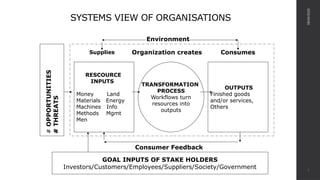
SYSTEMS VIEW OFORGANISATIONS
08/04/2025
3
#
OPPORTUNITIES
#
THREATS
RESCOURCE
INPUTS
Money Land
Materials Energy
Machines Info
Methods Mgmt
Men
OUTPUTS
Finished goods
and/or services,
Others
TRANSFORMATION
PROCESS
Workflows turn
resources into
outputs
Supplies
Environment
Organization creates Consumes
GOAL INPUTS OF STAKE HOLDERS
Investors/Customers/Employees/Suppliers/Society/Government
Consumer Feedback
4.
ORGANISATIONAL PERFORMANCE
PRODUCTIVITY,EFFICIENCY ANDEFFECTIVENESS
Resources and customers are two critical
elements of open system view of organizations.
For organizational success the resources must
be well utilized and customers well served.
The need for value creation is vital in this
context.
Value is created when resources are utilized in
the right way, at the right time and at minimum
cost.
08/04/2025
4
5.
ORGANISATIONAL PERFORMANCE.
• Iforganizations add value to the original cost of inputs then :
1)business organizations earn profit
2)non profit organizations add wealth to the society.
• All organizations utilize a variety of performance measures.
08/04/2025
5
6.
ORGANISATIONAL PERFORMANCE
Productivity
• Productivityis one of the most common indicators of
performance.
• Productivity is defined as the overall value of goods
and services produced divided by the value of inputs
needed to generate that output.
• Productivity is also linked to efficiency and
effectiveness
08/04/2025
6
7.
ORGANISATINAL PERFORMANCE
Efficiency andEffectiveness
• Efficiency is the relationship between inputs and outputs –
minimizing wastes and therefore cost of resources.
• Effectiveness is a measure of goal attainment.
• Summing up: ORGANIZATIONS NEED TO DO THE RIGHT
THINGS IN A RIGHT WAY
08/04/2025
7
8.
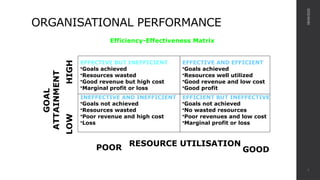
ORGANISATIONAL PERFORMANCE
Efficiency-Effectiveness Matrix
08/04/2025
8
INEFFECTIVEAND INEFFICIENT
•Goals not achieved
•Resources wasted
•Poor revenue and high cost
•Loss
EFFECTIVE AND EFFICIENT
•Goals achieved
•Resources well utilized
•Good revenue and low cost
•Good profit
EFFECTIVE BUT INEFFICIENT
•Goals achieved
•Resources wasted
•Good revenue but high cost
•Marginal profit or loss
EFFICIENT BUT INEFFECTIVE
•Goals not achieved
•No wasted resources
•Poor revenues and low cost
•Marginal profit or loss
GOAL
ATTAINMENT
HIGH
LOW
POOR GOOD
RESOURCE UTILISATION
9.
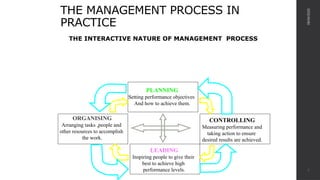
THE MANAGEMENT PROCESSIN
PRACTICE
THE INTERACTIVE NATURE OF MANAGEMENT PROCESS
08/04/2025
9
PLANNING
Setting performance objectives
And how to achieve them.
CONTROLLING
Measuring performance and
taking action to ensure
desired results are achieved.
ORGANISING
Arranging tasks ,people and
other resources to accomplish
the work.
LEADING
Inspiring people to give their
best to achieve high
performance levels.
10.
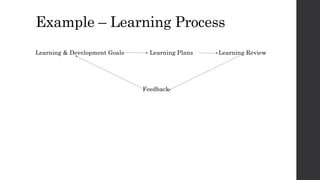
Example – LearningProcess
Learning & Development Goals Learning Plans Learning Review
Feedback
11.
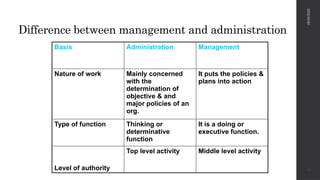
Difference between managementand administration
Basis Administration Management
Nature of work Mainly concerned
with the
determination of
objective & and
major policies of an
org.
It puts the policies &
plans into action
Type of function Thinking or
determinative
function
It is a doing or
executive function.
Level of authority
Top level activity Middle level activity
08/04/2025
11
12.
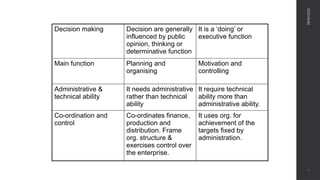
Decision making Decisionare generally
influenced by public
opinion, thinking or
determinative function
It is a ‘doing’ or
executive function
Main function Planning and
organising
Motivation and
controlling
Administrative &
technical ability
It needs administrative
rather than technical
ability
It require technical
ability more than
administrative ability.
Co-ordination and
control
Co-ordinates finance,
production and
distribution. Frame
org. structure &
exercises control over
the enterprise.
It uses org. for
achievement of the
targets fixed by
administration.
08/04/2025
12
13.
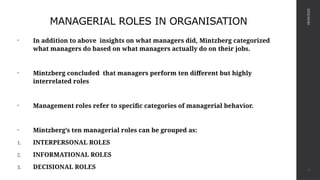
MANAGERIAL ROLES INORGANISATION
• In addition to above insights on what managers did, Mintzberg categorized
what managers do based on what managers actually do on their jobs.
• Mintzberg concluded that managers perform ten different but highly
interrelated roles
• Management roles refer to specific categories of managerial behavior.
• Mintzberg’s ten managerial roles can be grouped as:
1. INTERPERSONAL ROLES
2. INFORMATIONAL ROLES
3. DECISIONAL ROLES
08/04/2025
13
14.
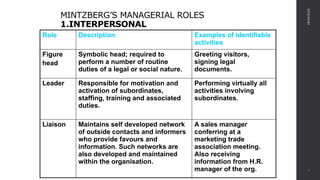
MINTZBERG’S MANAGERIAL ROLES
1.INTERPERSONAL
RoleDescription Examples of identifiable
activities
Figure
head
Symbolic head; required to
perform a number of routine
duties of a legal or social nature.
Greeting visitors,
signing legal
documents.
Leader Responsible for motivation and
activation of subordinates,
staffing, training and associated
duties.
Performing virtually all
activities involving
subordinates.
Liaison Maintains self developed network
of outside contacts and informers
who provide favours and
information. Such networks are
also developed and maintained
within the organisation.
A sales manager
conferring at a
marketing trade
association meeting.
Also receiving
information from H.R.
manager of the org.
08/04/2025
14
15.
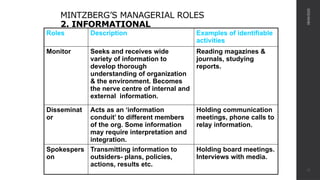
MINTZBERG’S MANAGERIAL ROLES
2.INFORMATIONAL
Roles Description Examples of identifiable
activities
Monitor Seeks and receives wide
variety of information to
develop thorough
understanding of organization
& the environment. Becomes
the nerve centre of internal and
external information.
Reading magazines &
journals, studying
reports.
Disseminat
or
Acts as an ‘information
conduit’ to different members
of the org. Some information
may require interpretation and
integration.
Holding communication
meetings, phone calls to
relay information.
Spokespers
on
Transmitting information to
outsiders- plans, policies,
actions, results etc.
Holding board meetings.
Interviews with media.
08/04/2025
15
16.
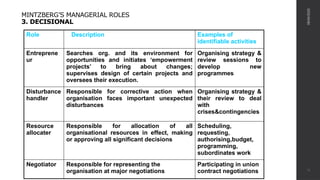
MINTZBERG’S MANAGERIAL ROLES
3.DECISIONAL
Role Description Examples of
identifiable activities
Entreprene
ur
Searches org. and its environment for
opportunities and initiates ‘empowerment
projects’ to bring about changes;
supervises design of certain projects and
oversees their execution.
Organising strategy &
review sessions to
develop new
programmes
Disturbance
handler
Responsible for corrective action when
organisation faces important unexpected
disturbances
Organising strategy &
their review to deal
with
crises&contingencies
Resource
allocater
Responsible for allocation of all
organisational resources in effect, making
or approving all significant decisions
Scheduling,
requesting,
authorising,budget,
programming,
subordinates work
Negotiator Responsible for representing the
organisation at major negotiations
Participating in union
contract negotiations
08/04/2025
16
17.
EVALUATION OF MINTZBERG’SFINDINGS
Follow up studies validate and support Mintzberg’s role categories:
1. Managers of all organizations & at all levels perform similar roles.
2. However emphasis on different roles may change with their
organizational levels eg. Roles of figurehead, disseminator, negotiator
are important at higher levels. Leader role is more important at lower
levels.
3. Most of Mintzberg’s roles align smoothly with the four functions
4. All managers do some work that is not purely managerial.
Mintzberg has clearly offered new insights into what managers actually
do .
08/04/2025
17
18.
MANAGERIAL SKILLS
• Askill is an individual’s ability to translate knowledge into action and is
manifested in the performance.
• People can be born with certain skills but it is very much possible to
develop them through appropriate training and experience.
• In order to discharge his roles successfully a manager should possess the
following three roles:
1. Conceptual skills,
2. Interpersonal skills and
3. Technical skills.
08/04/2025
18
Managerial skills refer to the abilities and competencies that managers use to perform their roles effectively. These skills help managers navigate the complexities
of running an organization, leading teams, making decisions, and solving problems. Effective managers combine different skills to accomplish organizational
goals, foster a positive work culture, and ensure efficient operations. The core idea behind managerial skills is that managing an organization or a team is not just
about having authority or power but involves the application of specific abilities that ensure success and growth. These skills are critical across all levels of
management, from first-line supervisors to top-level executives.
19.
Conceptual Skills
• Conceptualskill is the ability to think analytically and solve complex
problems. It involves the ability to break down problems into smaller parts,
and to recognize the influence or implications of any one problem on others.
• Managers are increasingly required to deal with more ambiguous problems,
that have many complications and long term consequences.
• The ability to understand the external and the internal environment,
conceptualize the issues involved directly and indirectly and come out with a
decision or solution.
08/04/2025
19
20.
Human Relations Skill
•Human relations skill is the ability to work well in co-operation with other
people at all levels.
• This skill develops in the manager an ability:
1. To recognize the feelings and sentiments of others,
2. To anticipate and judge the outcome of various actions envisaged to be
taken.
3. To examine his own concepts and values which may enable him to develop
correct attitudes
08/04/2025
20
21.
Technical Skills
• Atechnical skill is the ability to use a special proficiency or expertise in one’s
work.
• Engineers, doctors, tailors, accountants, market researchers for example
possess technical skills.
• Technical skills can be initially acquired thru’ formal education and are further
developed by training and experience.
08/04/2025
21
22.
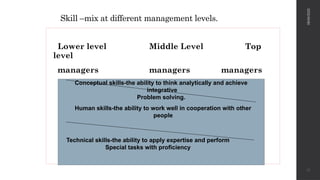
Skill –mix atdifferent management levels.
Lower level Middle Level Top
level
managers managers managers
08/04/2025
22
Conceptual skills-the ability to think analytically and achieve
integrative
Problem solving.
Human skills-the ability to work well in cooperation with other
people
Technical skills-the ability to apply expertise and perform
Special tasks with proficiency



![Principle of management_Chapter_01_T[1].ppt](https://cdn.slidesharecdn.com/ss_thumbnails/chapter01t1-250117060514-f4c2927a-thumbnail.jpg?width=640&height=640&fit=bounds)


