Running head: MANAGEMENT THEORY COMPARISON 1
Management Theory Comparison
Student’s Name
Institutional Affiliation
MANAGEMENT THEORY COMPARISON 2
Management Theory Comparison
Management theories help managers to perform their roles in an organization, and also
assist help employees to effectively relate to business goals, and implement effective strategies to
achieve the goals. The theories are categorized into four groups: traditional, foundational, current
and emerging global, and emerging e-commerce theories (Thompson, 2008). Management
theories undergo various changes to cope with the prevailing trends in business culture and
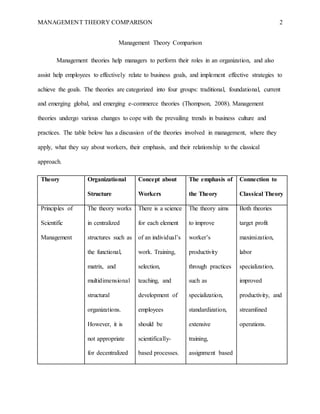
practices. The table below has a discussion of the theories involved in management, where they
apply, what they say about workers, their emphasis, and their relationship to the classical
approach.
Theory Organizational
Structure
Concept about
Workers
The emphasis of
the Theory
Connection to
Classical Theory
Principles of
Scientific
Management
The theory works
in centralized
structures such as
the functional,
matrix, and
multidimensional
structural
organizations.
However, it is
not appropriate
for decentralized
There is a science
for each element
of an individual’s
work. Training,
selection,
teaching, and
development of
employees
should be
scientifically-
based processes.
The theory aims
to improve
worker’s
productivity
through practices
such as
specialization,
standardization,
extensive
training,
assignment based
Both theories
target profit
maximization,
labor
specialization,
improved
productivity, and
streamlined
operations.
MANAGEMENT THEORY COMPARISON 3
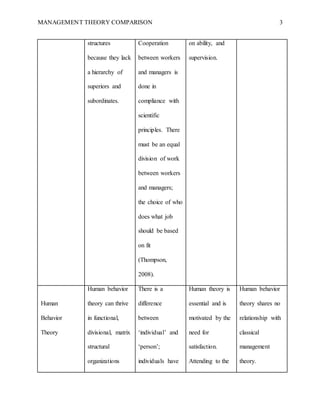
structures
because they lack
a hierarchy of
superiors and
subordinates.
Cooperation
between workers
and managers is
done in
compliance with
scientific
principles. There
must be an equal
division of work
between workers
and managers;
the choice of who
does what job
should be based
on fit
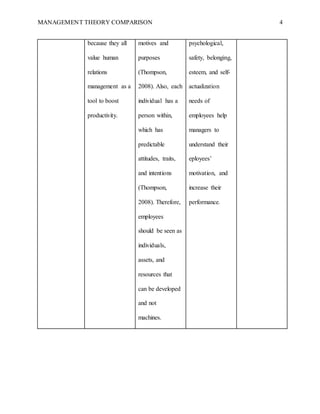
(Thompson,
2008).
on ability, and
supervision.
Human
Behavior
Theory
Human behavior
theory can thrive
in functional,
divisional, matrix
structural
organizations
There is a
difference
between
‘individual’ and
‘person’;
individuals have
Human theory is
essential and is
motivated by the
need for
satisfaction.
Attending to the
Human behavior
theory shares no
relationship with
classical
management
theory.
MANAGEMENT THEORY COMPARISON 4
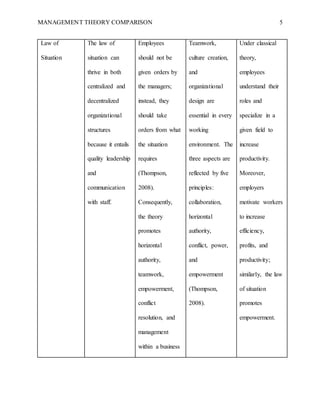
because they all
value human
relations
management as a
tool to boost
productivity.
motives and
purposes
(Thompson,
2008). Also, each
individual has a
person within,
which has
predictable
attitudes, traits,
and intentions
(Thompson,
2008). Therefore,
employees
should be seen as
individuals,
assets, and
resources that
can be developed
and not
machines.
psychological,
safety, belonging,
esteem, and self-
actualization
needs of
employees help
managers to
understand their
eployees’
motivation, and
increase their
performance.
MANAGEMENT THEORY COMPARISON 5
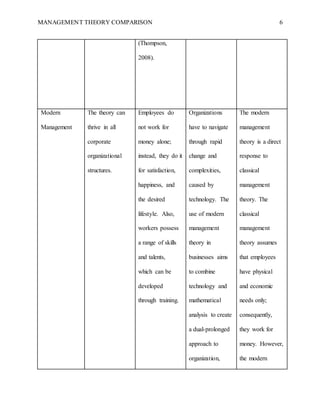
Law of
Situation
The law of
situation can
thrive in both
centralized and
decentralized
organizational
structures
because it entails
quality leadership
and
communication
with staff.
Employees
should not be
given orders by
the managers;
instead, they
should take
orders from what
the situation
requires
(Thompson,
2008).
Consequently,
the theory
promotes
horizontal
authority,
teamwork,
empowerment,
conflict
resolution, and
management
within a business
Teamwork,
culture creation,
and
organizational
design are
essential in every
working
environment. The
three aspects are
reflected by five
principles:
collaboration,
horizontal
authority,
conflict, power,
and
empowerment
(Thompson,
2008).
Under classical
theory,
employees
understand their
roles and
specialize in a
given field to
increase
productivity.
Moreover,
employers
motivate workers
to increase
efficiency,
profits, and
productivity;
similarly, the law
of situation
promotes
empowerment.
MANAGEMENT THEORY COMPARISON 6
(Thompson,
2008).
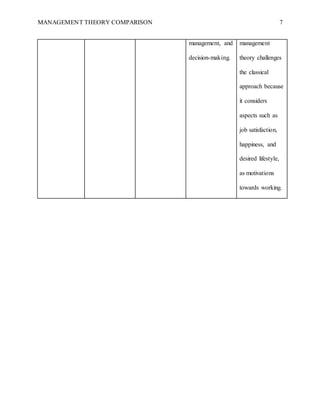
Modern
Management
The theory can
thrive in all
corporate
organizational
structures.
Employees do
not work for
money alone;
instead, they do it
for satisfaction,
happiness, and
the desired
lifestyle. Also,
workers possess
a range of skills
and talents,
which can be
developed
through training.
Organizations
have to navigate
through rapid
change and
complexities,
caused by
technology. The
use of modern
management
theory in
businesses aims
to combine
technology and
mathematical
analysis to create
a dual-prolonged
approach to
organization,
The modern
management
theory is a direct
response to
classical
management
theory. The
classical
management
theory assumes
that employees
have physical
and economic
needs only;
consequently,
they work for
money. However,
the modern
MANAGEMENT THEORY COMPARISON 7
management, and
decision-making.
management
theory challenges
the classical
approach because
it considers
aspects such as
job satisfaction,
happiness, and
desired lifestyle,
as motivations
towards working.
MANAGEMENT THEORY COMPARISON 8
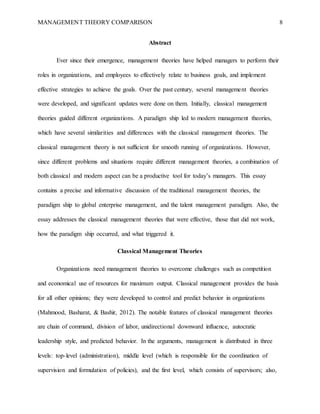
Abstract
Ever since their emergence, management theories have helped managers to perform their
roles in organizations, and employees to effectively relate to business goals, and implement
effective strategies to achieve the goals. Over the past century, several management theories
were developed, and significant updates were done on them. Initially, classical management
theories guided different organizations. A paradigm ship led to modern management theories,
which have several similarities and differences with the classical management theories. The
classical management theory is not sufficient for smooth running of organizations. However,
since different problems and situations require different management theories, a combination of
both classical and modern aspect can be a productive tool for today’s managers. This essay
contains a precise and informative discussion of the traditional management theories, the
paradigm ship to global enterprise management, and the talent management paradigm. Also, the
essay addresses the classical management theories that were effective, those that did not work,
how the paradigm ship occurred, and what triggered it.
Classical Management Theories
Organizations need management theories to overcome challenges such as competition
and economical use of resources for maximum output. Classical management provides the basis
for all other opinions; they were developed to control and predict behavior in organizations
(Mahmood, Basharat, & Bashir, 2012). The notable features of classical management theories
are chain of command, division of labor, unidirectional downward influence, autocratic
leadership style, and predicted behavior. In the arguments, management is distributed in three
levels: top-level (administration), middle level (which is responsible for the coordination of
supervision and formulation of policies), and the first level, which consists of supervisors; also,
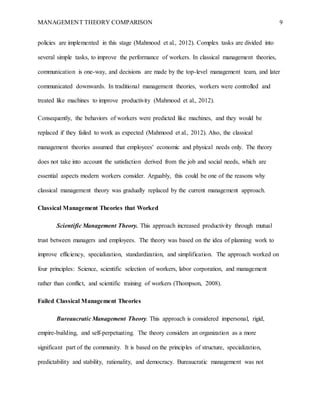
MANAGEMENT THEORY COMPARISON 9
policies are implemented in this stage (Mahmood et al., 2012). Complex tasks are divided into
several simple tasks, to improve the performance of workers. In classical management theories,
communication is one-way, and decisions are made by the top-level management team, and later
communicated downwards. In traditional management theories, workers were controlled and
treated like machines to improve productivity (Mahmood et al., 2012).
Consequently, the behaviors of workers were predicted like machines, and they would be
replaced if they failed to work as expected (Mahmood et al., 2012). Also, the classical
management theories assumed that employees' economic and physical needs only. The theory
does not take into account the satisfaction derived from the job and social needs, which are
essential aspects modern workers consider. Arguably, this could be one of the reasons why
classical management theory was gradually replaced by the current management approach.
Classical Management Theories that Worked
Scientific Management Theory. This approach increased productivity through mutual
trust between managers and employees. The theory was based on the idea of planning work to
improve efficiency, specialization, standardization, and simplification. The approach worked on
four principles: Science, scientific selection of workers, labor corporation, and management
rather than conflict, and scientific training of workers (Thompson, 2008).
Failed Classical Management Theories
Bureaucratic Management Theory. This approach is considered impersonal, rigid,
empire-building, and self-perpetuating. The theory considers an organization as a more
significant part of the community. It is based on the principles of structure, specialization,
predictability and stability, rationality, and democracy. Bureaucratic management was not
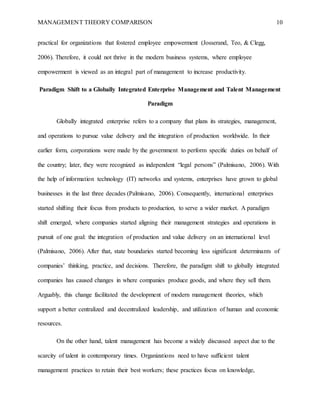
MANAGEMENT THEORY COMPARISON 10
practical for organizations that fostered employee empowerment (Josserand, Teo, & Clegg,
2006). Therefore, it could not thrive in the modern business systems, where employee
empowerment is viewed as an integral part of management to increase productivity.
Paradigm Shift to a Globally Integrated Enterprise Management and Talent Management
Paradigm
Globally integrated enterprise refers to a company that plans its strategies, management,
and operations to pursue value delivery and the integration of production worldwide. In their
earlier form, corporations were made by the government to perform specific duties on behalf of
the country; later, they were recognized as independent “legal persons” (Palmisano, 2006). With
the help of information technology (IT) networks and systems, enterprises have grown to global
businesses in the last three decades (Palmisano, 2006). Consequently, international enterprises
started shifting their focus from products to production, to serve a wider market. A paradigm
shift emerged, where companies started aligning their management strategies and operations in
pursuit of one goal: the integration of production and value delivery on an international level
(Palmisano, 2006). After that, state boundaries started becoming less significant determinants of
companies’ thinking, practice, and decisions. Therefore, the paradigm shift to globally integrated
companies has caused changes in where companies produce goods, and where they sell them.
Arguably, this change facilitated the development of modern management theories, which
support a better centralized and decentralized leadership, and utilization of human and economic
resources.
On the other hand, talent management has become a widely discussed aspect due to the
scarcity of talent in contemporary times. Organizations need to have sufficient talent
management practices to retain their best workers; these practices focus on knowledge,
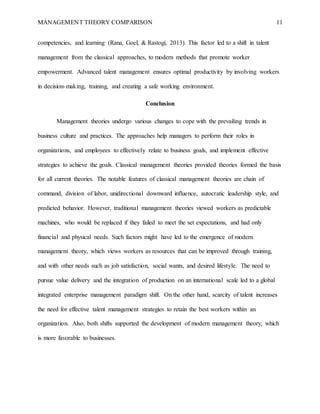
MANAGEMENT THEORY COMPARISON 11
competencies, and learning (Rana, Goel, & Rastogi, 2013). This factor led to a shift in talent
management from the classical approaches, to modern methods that promote worker
empowerment. Advanced talent management ensures optimal productivity by involving workers
in decision-making, training, and creating a safe working environment.
Conclusion
Management theories undergo various changes to cope with the prevailing trends in
business culture and practices. The approaches help managers to perform their roles in
organizations, and employees to effectively relate to business goals, and implement effective
strategies to achieve the goals. Classical management theories provided theories formed the basis
for all current theories. The notable features of classical management theories are chain of
command, division of labor, unidirectional downward influence, autocratic leadership style, and
predicted behavior. However, traditional management theories viewed workers as predictable
machines, who would be replaced if they failed to meet the set expectations, and had only
financial and physical needs. Such factors might have led to the emergence of modern
management theory, which views workers as resources that can be improved through training,
and with other needs such as job satisfaction, social wants, and desired lifestyle. The need to
pursue value delivery and the integration of production on an international scale led to a global
integrated enterprise management paradigm shift. On the other hand, scarcity of talent increases
the need for effective talent management strategies to retain the best workers within an
organization. Also, both shifts supported the development of modern management theory, which
is more favorable to businesses.
MANAGEMENT THEORY COMPARISON 12
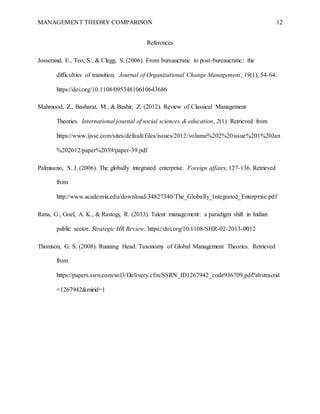
References
Josserand, E., Teo, S., & Clegg, S. (2006). From bureaucratic to post-bureaucratic: the
difficulties of transition. Journal of Organizational Change Management, 19(1), 54-64.
https://doi.org/10.1108/09534810610643686
Mahmood, Z., Basharat, M., & Bashir, Z. (2012). Review of Classical Management
Theories. International journal of social sciences & education, 2(1). Retrieved from
https://www.ijsse.com/sites/default/files/issues/2012/volume%202%20issue%201%20Jan
%202012/paper%2039/paper-39.pdf
Palmisano, S. J. (2006). The globally integrated enterprise. Foreign affairs, 127-136. Retrieved
from
http://www.academia.edu/download/34827340/The_Globally_Integrated_Enterprise.pdf
Rana, G., Goel, A. K., & Rastogi, R. (2013). Talent management: a paradigm shift in Indian
public sector. Strategic HR Review. https://doi.org/10.1108/SHR-02-2013-0012
Thomson, G. S. (2008). Running Head: Taxonomy of Global Management Theories. Retrieved
from
https://papers.ssrn.com/sol3/Delivery.cfm/SSRN_ID1267942_code936709.pdf?abstractid
=1267942&mirid=1

Management theory comparison

  • 1.
    Running head: MANAGEMENTTHEORY COMPARISON 1 Management Theory Comparison Student’s Name Institutional Affiliation
  • 2.
    MANAGEMENT THEORY COMPARISON2 Management Theory Comparison Management theories help managers to perform their roles in an organization, and also assist help employees to effectively relate to business goals, and implement effective strategies to achieve the goals. The theories are categorized into four groups: traditional, foundational, current and emerging global, and emerging e-commerce theories (Thompson, 2008). Management theories undergo various changes to cope with the prevailing trends in business culture and practices. The table below has a discussion of the theories involved in management, where they apply, what they say about workers, their emphasis, and their relationship to the classical approach. Theory Organizational Structure Concept about Workers The emphasis of the Theory Connection to Classical Theory Principles of Scientific Management The theory works in centralized structures such as the functional, matrix, and multidimensional structural organizations. However, it is not appropriate for decentralized There is a science for each element of an individual’s work. Training, selection, teaching, and development of employees should be scientifically- based processes. The theory aims to improve worker’s productivity through practices such as specialization, standardization, extensive training, assignment based Both theories target profit maximization, labor specialization, improved productivity, and streamlined operations.
  • 3.
    MANAGEMENT THEORY COMPARISON3 structures because they lack a hierarchy of superiors and subordinates. Cooperation between workers and managers is done in compliance with scientific principles. There must be an equal division of work between workers and managers; the choice of who does what job should be based on fit (Thompson, 2008). on ability, and supervision. Human Behavior Theory Human behavior theory can thrive in functional, divisional, matrix structural organizations There is a difference between ‘individual’ and ‘person’; individuals have Human theory is essential and is motivated by the need for satisfaction. Attending to the Human behavior theory shares no relationship with classical management theory.
  • 4.
    MANAGEMENT THEORY COMPARISON4 because they all value human relations management as a tool to boost productivity. motives and purposes (Thompson, 2008). Also, each individual has a person within, which has predictable attitudes, traits, and intentions (Thompson, 2008). Therefore, employees should be seen as individuals, assets, and resources that can be developed and not machines. psychological, safety, belonging, esteem, and self- actualization needs of employees help managers to understand their eployees’ motivation, and increase their performance.
  • 5.
    MANAGEMENT THEORY COMPARISON5 Law of Situation The law of situation can thrive in both centralized and decentralized organizational structures because it entails quality leadership and communication with staff. Employees should not be given orders by the managers; instead, they should take orders from what the situation requires (Thompson, 2008). Consequently, the theory promotes horizontal authority, teamwork, empowerment, conflict resolution, and management within a business Teamwork, culture creation, and organizational design are essential in every working environment. The three aspects are reflected by five principles: collaboration, horizontal authority, conflict, power, and empowerment (Thompson, 2008). Under classical theory, employees understand their roles and specialize in a given field to increase productivity. Moreover, employers motivate workers to increase efficiency, profits, and productivity; similarly, the law of situation promotes empowerment.
  • 6.
    MANAGEMENT THEORY COMPARISON6 (Thompson, 2008). Modern Management The theory can thrive in all corporate organizational structures. Employees do not work for money alone; instead, they do it for satisfaction, happiness, and the desired lifestyle. Also, workers possess a range of skills and talents, which can be developed through training. Organizations have to navigate through rapid change and complexities, caused by technology. The use of modern management theory in businesses aims to combine technology and mathematical analysis to create a dual-prolonged approach to organization, The modern management theory is a direct response to classical management theory. The classical management theory assumes that employees have physical and economic needs only; consequently, they work for money. However, the modern
  • 7.
    MANAGEMENT THEORY COMPARISON7 management, and decision-making. management theory challenges the classical approach because it considers aspects such as job satisfaction, happiness, and desired lifestyle, as motivations towards working.
  • 8.
    MANAGEMENT THEORY COMPARISON8 Abstract Ever since their emergence, management theories have helped managers to perform their roles in organizations, and employees to effectively relate to business goals, and implement effective strategies to achieve the goals. Over the past century, several management theories were developed, and significant updates were done on them. Initially, classical management theories guided different organizations. A paradigm ship led to modern management theories, which have several similarities and differences with the classical management theories. The classical management theory is not sufficient for smooth running of organizations. However, since different problems and situations require different management theories, a combination of both classical and modern aspect can be a productive tool for today’s managers. This essay contains a precise and informative discussion of the traditional management theories, the paradigm ship to global enterprise management, and the talent management paradigm. Also, the essay addresses the classical management theories that were effective, those that did not work, how the paradigm ship occurred, and what triggered it. Classical Management Theories Organizations need management theories to overcome challenges such as competition and economical use of resources for maximum output. Classical management provides the basis for all other opinions; they were developed to control and predict behavior in organizations (Mahmood, Basharat, & Bashir, 2012). The notable features of classical management theories are chain of command, division of labor, unidirectional downward influence, autocratic leadership style, and predicted behavior. In the arguments, management is distributed in three levels: top-level (administration), middle level (which is responsible for the coordination of supervision and formulation of policies), and the first level, which consists of supervisors; also,
  • 9.
    MANAGEMENT THEORY COMPARISON9 policies are implemented in this stage (Mahmood et al., 2012). Complex tasks are divided into several simple tasks, to improve the performance of workers. In classical management theories, communication is one-way, and decisions are made by the top-level management team, and later communicated downwards. In traditional management theories, workers were controlled and treated like machines to improve productivity (Mahmood et al., 2012). Consequently, the behaviors of workers were predicted like machines, and they would be replaced if they failed to work as expected (Mahmood et al., 2012). Also, the classical management theories assumed that employees' economic and physical needs only. The theory does not take into account the satisfaction derived from the job and social needs, which are essential aspects modern workers consider. Arguably, this could be one of the reasons why classical management theory was gradually replaced by the current management approach. Classical Management Theories that Worked Scientific Management Theory. This approach increased productivity through mutual trust between managers and employees. The theory was based on the idea of planning work to improve efficiency, specialization, standardization, and simplification. The approach worked on four principles: Science, scientific selection of workers, labor corporation, and management rather than conflict, and scientific training of workers (Thompson, 2008). Failed Classical Management Theories Bureaucratic Management Theory. This approach is considered impersonal, rigid, empire-building, and self-perpetuating. The theory considers an organization as a more significant part of the community. It is based on the principles of structure, specialization, predictability and stability, rationality, and democracy. Bureaucratic management was not
  • 10.
    MANAGEMENT THEORY COMPARISON10 practical for organizations that fostered employee empowerment (Josserand, Teo, & Clegg, 2006). Therefore, it could not thrive in the modern business systems, where employee empowerment is viewed as an integral part of management to increase productivity. Paradigm Shift to a Globally Integrated Enterprise Management and Talent Management Paradigm Globally integrated enterprise refers to a company that plans its strategies, management, and operations to pursue value delivery and the integration of production worldwide. In their earlier form, corporations were made by the government to perform specific duties on behalf of the country; later, they were recognized as independent “legal persons” (Palmisano, 2006). With the help of information technology (IT) networks and systems, enterprises have grown to global businesses in the last three decades (Palmisano, 2006). Consequently, international enterprises started shifting their focus from products to production, to serve a wider market. A paradigm shift emerged, where companies started aligning their management strategies and operations in pursuit of one goal: the integration of production and value delivery on an international level (Palmisano, 2006). After that, state boundaries started becoming less significant determinants of companies’ thinking, practice, and decisions. Therefore, the paradigm shift to globally integrated companies has caused changes in where companies produce goods, and where they sell them. Arguably, this change facilitated the development of modern management theories, which support a better centralized and decentralized leadership, and utilization of human and economic resources. On the other hand, talent management has become a widely discussed aspect due to the scarcity of talent in contemporary times. Organizations need to have sufficient talent management practices to retain their best workers; these practices focus on knowledge,
  • 11.
    MANAGEMENT THEORY COMPARISON11 competencies, and learning (Rana, Goel, & Rastogi, 2013). This factor led to a shift in talent management from the classical approaches, to modern methods that promote worker empowerment. Advanced talent management ensures optimal productivity by involving workers in decision-making, training, and creating a safe working environment. Conclusion Management theories undergo various changes to cope with the prevailing trends in business culture and practices. The approaches help managers to perform their roles in organizations, and employees to effectively relate to business goals, and implement effective strategies to achieve the goals. Classical management theories provided theories formed the basis for all current theories. The notable features of classical management theories are chain of command, division of labor, unidirectional downward influence, autocratic leadership style, and predicted behavior. However, traditional management theories viewed workers as predictable machines, who would be replaced if they failed to meet the set expectations, and had only financial and physical needs. Such factors might have led to the emergence of modern management theory, which views workers as resources that can be improved through training, and with other needs such as job satisfaction, social wants, and desired lifestyle. The need to pursue value delivery and the integration of production on an international scale led to a global integrated enterprise management paradigm shift. On the other hand, scarcity of talent increases the need for effective talent management strategies to retain the best workers within an organization. Also, both shifts supported the development of modern management theory, which is more favorable to businesses.
  • 12.
    MANAGEMENT THEORY COMPARISON12 References Josserand, E., Teo, S., & Clegg, S. (2006). From bureaucratic to post-bureaucratic: the difficulties of transition. Journal of Organizational Change Management, 19(1), 54-64. https://doi.org/10.1108/09534810610643686 Mahmood, Z., Basharat, M., & Bashir, Z. (2012). Review of Classical Management Theories. International journal of social sciences & education, 2(1). Retrieved from https://www.ijsse.com/sites/default/files/issues/2012/volume%202%20issue%201%20Jan %202012/paper%2039/paper-39.pdf Palmisano, S. J. (2006). The globally integrated enterprise. Foreign affairs, 127-136. Retrieved from http://www.academia.edu/download/34827340/The_Globally_Integrated_Enterprise.pdf Rana, G., Goel, A. K., & Rastogi, R. (2013). Talent management: a paradigm shift in Indian public sector. Strategic HR Review. https://doi.org/10.1108/SHR-02-2013-0012 Thomson, G. S. (2008). Running Head: Taxonomy of Global Management Theories. Retrieved from https://papers.ssrn.com/sol3/Delivery.cfm/SSRN_ID1267942_code936709.pdf?abstractid =1267942&mirid=1