Do you wantto edit this presentation?
2
Make a copy and edit in
Google Slides.
1. On the menu bar, click File and
then Make a copy and Entire
Presentation.
2. Type a name for the file.
3. Choose where to save it on your
Google Drive.
4. Click Ok.
5. A new tab will open. Wait for the
file to be completely loaded on a
new tab.
6. Once the file has loaded, edit this
presentation using Google Slides.
Download an offline copy and
edit in Microsoft PowerPoint.
1. On the menu bar, click File and then
Download as.
2. Choose a file type. Select Microsoft
PowerPoint (.pptx).
3. Wait for the file to be downloaded to your
local disk.
4. Once completely downloaded, open the file
and edit it using Microsoft PowerPoint or
any offline presentation program.
3.
Organizations are
composed ofpeople.
The management is
responsible for
coordinating the skills and
efforts of the employees for
them to achieve a common
goal.
3
4.
“Management is theart of getting things done
through people.” - Mary Parker Follet, 2013
4
4
The concept of
management has
gone through
significant changes
over the years.
Explore
Let’s
Connec
t Instructions:
1. Recallyour experience of observing an
organization.
2. Illustrate or sketch your observation of the
manager and the working environment in
the organization.
3. Be ready to share your sketch and its
interpretation in class.
7
Sketch it, Share it
8.
Explore
Let’s
Connec
t Guide Questions
1.What is the personality of the manager?
2. How did he or she respond to problems,
conflicts, or complaints by customers?
3. How did he or she treat his or her
subordinates?
4. What is your impression of the overall
working environment in the organization?
8
Sketch it, Share it
14
Evolution of ManagementTheories
● Classical Management Theory
● Behavioral Management
Theory
● Quantitative Management
Theory
● Modern Management Theory
The Four Main Theories
15.
15
Evolution of ManagementTheories
● Developed during the 19th century
● Introduced as a result of the industrial revolution
● Focuses on managing work efficiently through
systematic work processes and division of labor
Classical Management Theories
16.
16
Classical Management Theories
ScientificManagement Theory
● Created within the 1880s to the 1890s
● Frederick Taylor was the most well-
known proponent of this theory.
● He emphasized the need for a financial
rewards system to motivate the
workers.
17.
17
Classical Management Theories
FourPrinciples of Management
1. Conduct a scientific study of the task to replace the
rule-of-thumb method.
2. Conduct a Scientific selection, training, and
development of workers.
18.
18
Classical Management Theories
FourPrinciples of Management
3. Cultivate a culture of positive cooperation between
the management and the workers.
4. Create an equal sharing of work between the
management and the workers.
19.
19
Classical Management Theories
Frankand Lilian Gilbreths
● The Gilbreths suggested
that workers should
have definite days of
work, scheduled breaks,
& conducive working
conditions.
20.
20
Classical Management Theories
HenryGantt
● He created the “Gantt Chart”
which is a visual scheduling of
tasks to be done to complete a
project or work.
21.
21
Classical Management Theories
CharlesBedaux
● Bedaux introduced
the rating system
to measure the
productivity of
workers. He also
suggested to give
workers a rest
allowance.
22.
22
Evolution of ManagementTheories
● An approach developed by Max
Weber in 1905
● Focused on a hierarchical system
● Was deemed effective with
organizations that operate on a
large scale.
Bureaucratic Management Theory
23.
23
Bureaucratic Management Theories
FiveCharacteristics
1. Task Specialization - each of the employees has a
responsibility to fulfill.
2. Hierarchical Structure - those with lower positions are
subject to the orders of those with higher positions.
3. Formal Selection - skills and credentials are necessary in
deciding who is up for the position.
4. Rules and Requirements - ensures uniformity and unity.
5. Impersonality - creates detached relationships which
promotes objective decision making.
24.
24
Bureaucratic Management Theories
AdministrativeManagement Theory
● Henry Fayol created this theory in
1916.
● This theory is concerned with how
the management effectively
organizes and directs the employees.
25.
25
Administrative Management Theory
HenryFayol’s 14 Principles:
1. Division of Work -
specialization of workers can
increase the output.
2. Authority - superiors have
the right to give orders, but
they must also be responsible
for the consequences.
26.
26
Administrative Management Theory
HenryFayol’s 14 Principles:
3. Discipline - individuals
must display proper
conduct.
4. Unity of Command - an
employee must receive
orders from one
supervisor only to avoid
conflict.
27.
27
Administrative Management Theory
HenryFayol’s 14 Principles:
5. Unity of Direction -
employees must follow a
common objective.
6. Subordination of
Individual Interests -
common interest first
before personal interest.
28.
28
Administrative Management Theory
HenryFayol’s 14 Principles:
7. Remuneration -
compensation must be fair
and proper.
8. Degree of Centralization -
refers to the balance on who
should be making decision
in terms of company size.
29.
29
Administrative Management Theory
HenryFayol’s 14 Principles:
9. Scalar Chain - there must
be a clear chain of
command.
10.Order - a workplace must
be clean and tidy.
30.
30
Administrative Management Theory
HenryFayol’s 14 Principles:
11.Equity - all employees must
be treated fairly.
12.Stability of Tenure of
Personnel - employee
replacement must be limited
and should instead keep
their employees longer.
31.
31
Administrative Management Theory
HenryFayol’s 14 Principles:
13.Initiative - superiors must
encourage subordinates to
take initiative.
14.Esprit de Corps - managers
must boost employees’
morale to and promote team
spirit.
32.
32
Evolution of ManagementTheories
● Focused on the interests and needs of employees
● Gives importance to human behavioral factors to
strengthen unity and teamwork
Behavioral Management Theories
33.
33
Behavioral Management Theories
HumanRelations Theory
● Elton Mayo developed this theory between 1924 and
1933.
● This theory states that individuals perform better when
they feel that they are valued and belong to the group.
34.
34
Human Relations Theory
HawthorneEffect
● This states that workers
collaborate with their
colleagues and perform
their tasks better when
they are given special
attention.
35.
35
Behavioral Management Theories
TheoryX and Y
● Proposed by Douglas McGregor in the 1950s
● Theory X perceives workers as lazy and needs to be
controlled.
● Theory Y perceives workers as having a natural drive
to work and do not need to be ordered around.
36.
36
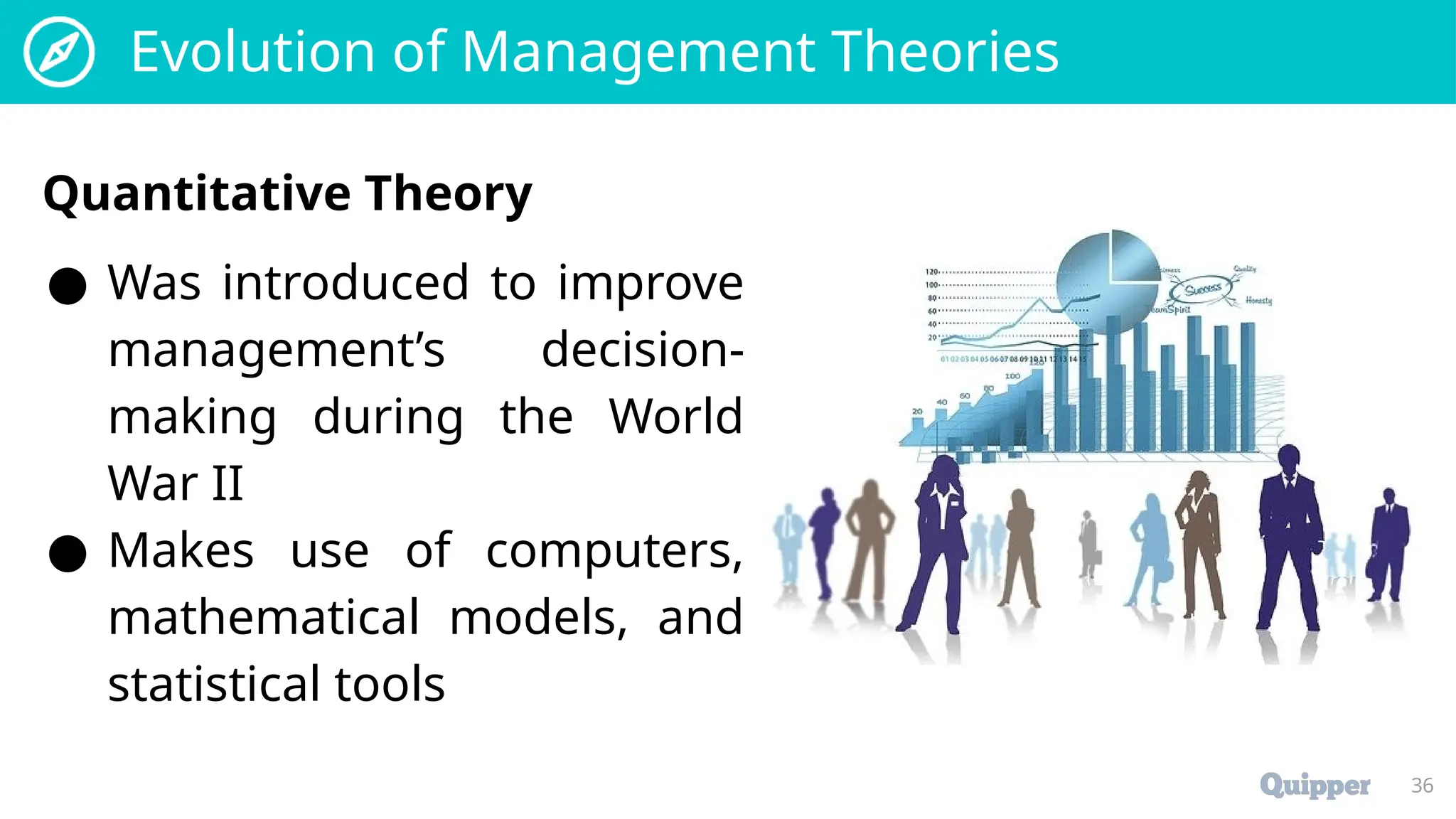
Evolution of ManagementTheories
● Was introduced to improve
management’s decision-
making during the World
War II
● Makes use of computers,
mathematical models, and
statistical tools
Quantitative Theory
37.
37
Evolution of ManagementTheories
● Takes advantage of technology and incorporates it with
classical approaches
● Utilizes statistical techniques to analyze, understand,
and compare the relationship between the management
and the workers
Modern Management Theories
38.
38
Modern Management Theories
SystemsTheory
● Proposed by Ludwig von Bertalanffy
● An idea that all departments are parts of an open
system which needs to interact with each other
39.
39
Modern Management Theories
ContingencyTheory
● Developed by Fred Fiedler
● Managers must be able to adapt to the changing
environments of the organization and must make
better decisions depending on the given situation.
Try This!
Try
This!
41
True orFalse. Read each statement carefully. Write
true if the statement is correct. Otherwise, write
false.
1. The industrial revolution led to the
evolution of the management
theories.
2. The systems and processes used by
the organizations before the
industrial revolution were also
used after this period.
____________
____________
42.
Try This!
Try
This!
42
True orFalse. Read each statement carefully. Write
true if the statement is correct. Otherwise, write
false.
3. The welfare of the workers was
promoted in classical management
theory.
4. The bureaucratic management theory
focused on an authoritative system.
5. The behavioral management theory is
more focused on the interest of the
organization.
____________
____________
____________
43.
Wrap-
Up ● Theevolution of the Management Theories
started during the industrial revolution.
● Four major categories:
○ Classical Management Theory
○ Behavioral Management Theory
○ Quantitative Management Theory
○ Modern Management Theory.
43
44.
Wrap-
Up
● The ClassicalManagement Theories:
○ Scientific Management Theory - emphasized
the scientific study of work methods to make
the worker more efficient.
○ Bureaucratic Management Theory - focused
on an authoritative system.
○ Administrative Management Theory -
concerned with how the management
organizes and directs the employees. 44
45.
Wrap-
Up
● The BehavioralManagement Theories
○ Human Relations Theory - highlighted the
idea that individuals perform better when
they feel that they belong to and are valued in
the team.
○ Theory X and Y - assumed that there are two
distinct types of workers in an organization.
One is the lazy type who needs to be
controlled while the other does his or her
work willingly.
45
46.
Wrap-
Up
● Quantitative ManagementTheory promotes the
use of sophisticated mathematical models and
statistical tools in enhancing management skills.
● The Modern Management Theory integrates
technology with management techniques.
○ Systems Theory promotes management as an
interrelated component of an organization.
○ Contingency Theory asserts that the
management must be adaptable and must
make decisions according to the given
situation. 46
Photo Credits
49
● Slideno. 16: Frederick Winslow Taylor by Beyond My Ken is licensed under Wikipedia via Wikimedia Commons
● Slide no. 19: Lilian Gilbreths by Smithsonian Institution is licensed under Commons:Licensing via
Wikimedia Commons
● Slide no. 19: Frank Gilbreths by Verne Equinox is licensed under Wikipedia via Wikimedia Commons
● Slide no. 20: Henry Gantt, by John R. Dunlap is licensed under Wikipedia via Wikimedia Commons
● Slide no. 21: Charles Bedaux by Ras67 is licensed under Wikipedia via Wikimedia Commons
● Slide no. 22: Max Weber by Unknown is licensed under Wikipedia via Wikimedia Commons
● Slide no. 24: Henry Fayol by Mdd is licensed under Wikipedia via Wikimedia Commons
50.
Bibliography
50
Angos, Kwok C.P.2014. The Evolution of Management Theories: A Literature Review. Accessed on August 18, 2020, Retrieved
at: https://www.researchgate.net/publication/307760441_The_Evolution_of_Management_Theories_A_Literature_Revi
ew
Follett, Mary P. Dynamic Administration: The Collected Papers of Mary Parker Follet. UK:Martino Fine Books, 2013.
Mintzberg, Henry. Mintzberg on Management: Inside our Strange World of Organizations. New York: Free Press, 1989.
Payos, Ranulfo P., et. al. Organization and Management. Sta. Mesa Heights, QC: Rex
Bookstore, 2016.
Wren, Daniel, et. al. The Evolution of Management Thought. Eighth Edition. Hoboken:Wiley, 2020.
Editor's Notes
#9 For the answer key, please refer to the answer key of the study guide provided in the Teacher's Content.
#10 For the answer key, please refer to the answer key of the study guide provided in the Teacher's Content.
#11 For the answer key, please refer to the answer key of the study guide provided in the Teacher's Content.
#12 For the answer key, please refer to the answer key of the study guide provided in the Teacher's Content.
#40 For the answer key, please refer to the answer key of the study guide provided in the Teacher's Content.
#41 For the answer key, please refer to the answer key of the study guide provided in the Teacher's Content.
#42 For the answer key, please refer to the answer key of the study guide provided in the Teacher's Content.
#48 For the answer key, please refer to the answer key of the study guide provided in the Teacher's Content.