PHYSICAL
EDUCATION
Unit 1 - Management of Sporting Events
Date - 24 March 2022
PLANNING IN SPORTS
 Meaning and Objectives of Planning.
 Functions of Sports Events Management (Planning, Organizing,
Staffing, Directing & Controlling)
 Various Committees & its Responsibilities
 Tournament - Knock-Out, League or Round Robin & Combination.
 Procedure to Draw Fixture - Knock-Out (Bye & Seeding) & League
(Staircase & Cyclic)
 Intramural & Extramural - Meaning, Objectives & its Significance.
 Specific Sports Programme (Sports Day, Health Run, Run for Fun,
Run for Specific Cause & Run for Unity).
 Planning plays a vital role in an individual’s life.
 In sports, planning is very important work.
 Planning is the process of arranging activities so that a certain goal or
target can be achieved.
 To achieve success in any competition it depends upon, how it is
organized and planned.
 In other words, we can say that the development of sports depends on
proper planning that is done well in advance.
Planning is the process of thinking about the activities required to achieve
a desired goal. It is the first and foremost activity to achieve desired
results.
 According to Alford and Beatt,
Planning is the thinking process, the organised foresight, the vision
based on fact and experience that is required for intelligent action.
 A plan is a trap laid to capture the future.
 Planning is a predetermined course of action to achieve a goal.
 In other words, planning is the process of thinking and organizing
the activities required to achieve a desired goal.
 The success of Physical education & sports programmes depends
upon efficient staff, food, direction, control, super vision,
co-ordination and minimize the chances of lapses.
 To make the event more interesting.
 To keep good control and to supervise all activities.
 To facilitate proper coordination among different committee.
 To avoid or to reduce the chances of mistakes.
 To make room for a new idea / innovation.
 To avoid last minute hassles / inconvenience.
 To get the best performance.
 To increase the efficiency
Management is described as the process of planning, organizing, directing,
staffing and controlling the efforts of organizational resources to achieve
specific goals.
Sport managers carry out these skills in a variety of organizational settings,
for example: college sports; professional sports; amateur sports including the
Olympics, sport marketing and management firms; sport communications
and news media firms; corporate sponsorship and advertising firms; sporting
goods firms; arenas, stadium, and civic centers; among many others.
According to (DeSensi, Kelley, Blanton and Beitel, 2003 : Sport management
involves any combination of skills related to planning, organizing, directing,
controlling, budgeting, leading, and evaluating within the context of an
organization or department whose primary product or service is related to sport
or physical activity.
According to Luther Guelick : “He Coined the word POSDCORB”.
• Planning • Organising • Staffing • Directing • Coordinating
• Reporting • Budget
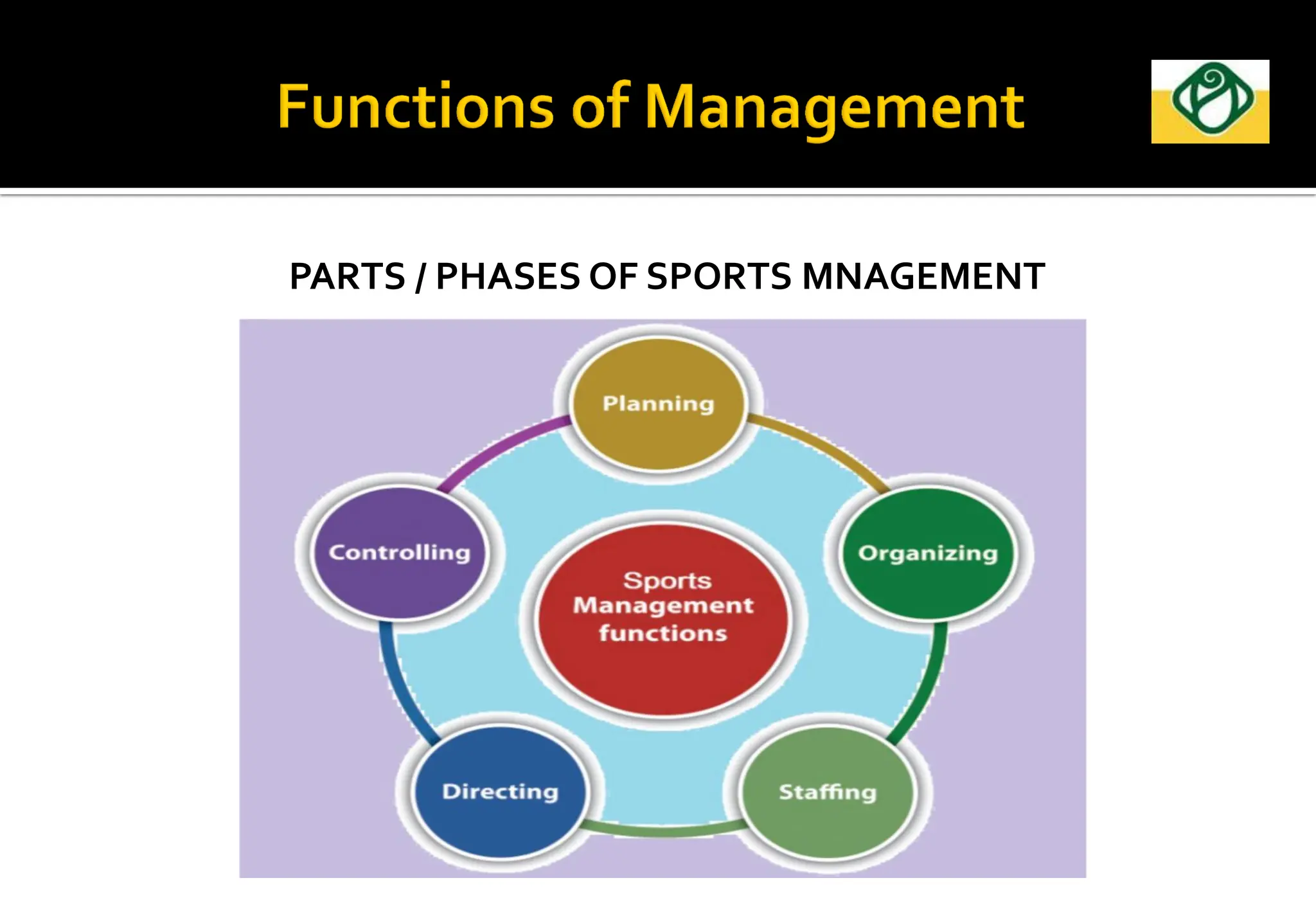
PARTS / PHASES OF SPORTS MNAGEMENT
PLANNING
Planning is the first managerial function to be performed in the process of
management. It is concerned with deciding in advance what is to be
done, when, where, how and by whom it is to be done.Thus, it is a pre-
determined course of action to achieve a specified aim or goal.
PROCESS OF PLANNING
• Follow-up action • Implementing the plan
• Setting Goals • Selecting an alternative
• Developing premises and events • Evaluating alternative course
ORGANIZING
Organizing is the function of management that involves developing an
organizational structure and allocating human resources to ensure the
accomplishment of objectives
(Organizing essentially consists of establishing a division of labor.The
managers divide the work among individuals and group of individuals. And then
they coordinate the activities of such individuals and groups to extract the best
outcome)
IMPORTANCE OF ORGANIZING
• Expansion and growth • Benefits of specialization
• Adaptation to change • Optimum utilization of resources
• Development of personnel
STAFFING
Staffing is the managerial function of recruitment, selection, training,
developing, promotion and compensation of personnel. Staffing may be
defined as the process of hiring and developing the required personnel to fill in
the various positions in the organization
(The managerial function of staffing involves managing the organization
structure through proper and effective selection, appraisal and development
of the personnel's to fill the roles assigned to the employers/workforce.)
IMPORTANCE OF STAFFING
• Staffing helps to ensure optimum utilization of the human resources.
• It improves job satisfaction.
• It ensures the continuous survival and growth of the enterprises.
• It helps in discovering and obtaining competent personal for various jobs.
• One can achieve higher performance, by putting right person in the right place.
DIRECTING
Directing function of management refers to the process of instructing, guiding,
counseling, motivating and leading people in the organisation to achieve its
objectives. It is one of the key managerial functions performed by every
manager.
(Directing is the heart of management function. All other functions of
management such as planning, organizing, and staffing have no importance
without directing. Leadership, motivation, supervision, communication are
various aspects of directing)
IMPORTANCE OF DIRECTING
Initiates Action, Ensures Co-Ordination, Improves Efficiency, Facilitates Change
and Assists Stability and Growth.
PRINCIPLES OF DIRECTING
It plays a very important role in management. Direction is just like the heart of
administration. Direction is the sum total of managerial efforts that is applied for guiding
and inspiring the sub-ordinates to make better accomplishments in the organization.
It is concerned with the motivate, leadership, supervision and commanding of sub-
ordinates and securing their best cooperation.
It is an art which is learned from a long experience.
PRINCIPLESOF CONTROLLING
Controlling can be defined as that function of management which helps to seek planned
results from the subordinates, managers and at all levels of an organization.The
controlling function helps in measuring the progress towards the organizational goals &
brings any deviations, & indicates corrective action.
(The control function can be viewed as a five-step process: (1) Establish standards,
(2) Measure performance, (3) Compare actual performance with standards and identify
any deviations, (4) Determine the reason for deviations, and
(5)Take corrective action, if needed)
IMPORTANCE OF CONTROLLING
Controlling helps managers monitor the effectiveness of their planning, organizing,
and leading activities.Controlling determines what is being accomplished — that is,
evaluating the performance and, if necessary, taking corrective measures so that the
performance takes place according to plans.
 Transport committee.
 Publicity / Marketing committee.
 Reception committee.
 Boarding and Lodging committee.
 Ground & Equipment committee.
 Refreshment and Entertainment committee.
 Decoration, Awards & Ceremonial committee.
 Announcement committee.
 Medical / First Aid committee.
 Technical committee.
 Finance committee etc…
Following duties performed before the start of any event. Such as:-
 To sit along with the authorities to prepare the Budget of the tournament.
 To prepare the Schedule of the tournament.
 To keep in mind the Level of Competition ( Senior, Junior, Open etc.)
 To prepare the Grounds / Courts and Sports Equipment.
 To keep the Medical / First Aid kit ready.
 To prepare Fixtures and sendTournament details to various teams.
 To make necessary arrangement regarding Lodging and Boarding of Players and
Officials.
 To arrange Prizes and Certificates.
Duties performed during the game are such as:-
 To ensure Proper Arrangements during Inauguration.
 To check playing Arena's & Equipments & also checking of Eligibility Form of
participating teams.
 To give Refreshments & Meals to Officials & Players.
 To provide next Event Schedule to the teams from time to time.
 To make necessary Announcements.
 To prepare Score Sheets and concerned Records of the teams.
 To maintain Discipline among spectators and provide First-Aid to injured players.
 To Co-ordinate with different working committees.
These are mostly the winding up duties of tournament :-
 To give away the Prizes and Certificates.
 To ensure Press Note (over all report of the tournament and results) and
send it to the concerned Media.
 To provide Security refunds to the departing teams.
 To ensure Payments to the officials and to the other concerned persons.
 To present Mementos to the chief guest and to the team escorts.
 To generate the exact Expenditure report.
 To Collect all Records related to the event from the officials.
 Make notes on the portion completed in this session.
 Go through the available material and make notes in your own word.
 Q.1 What is planning? Write any four objectives of planning.
 Q.2 What are the objectives of the planning or explain the objectives of
the planning?
 Q.3 Write down the role of the various committees post tournament.
 Q.4 Enlist the name of various committees during the Tournament?
Explain the Responsibilities' of any four committees.
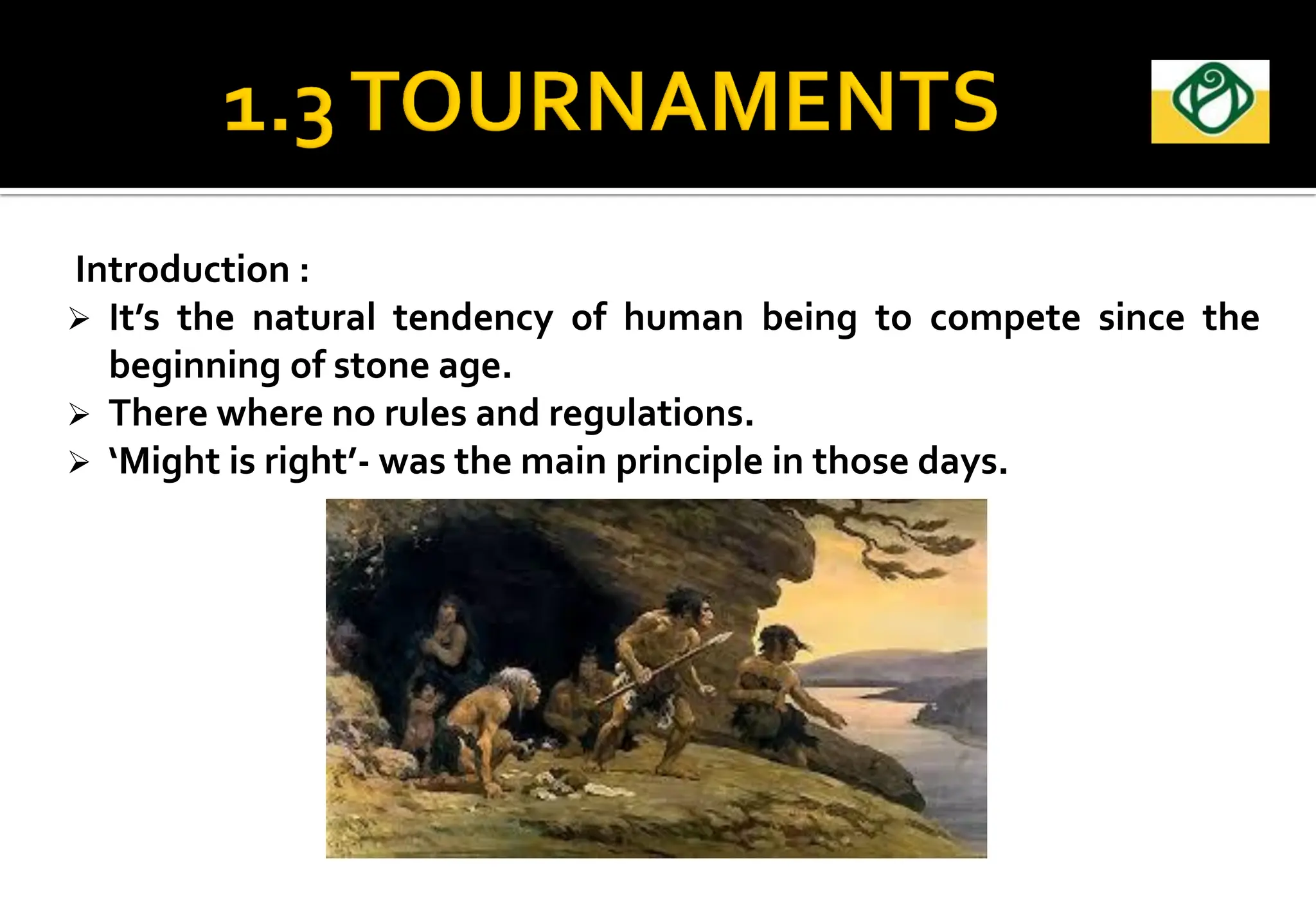
Introduction :
 It’s the natural tendency of human being to compete since the
beginning of stone age.
 There where no rules and regulations.
 ‘Might is right’- was the main principle in those days.
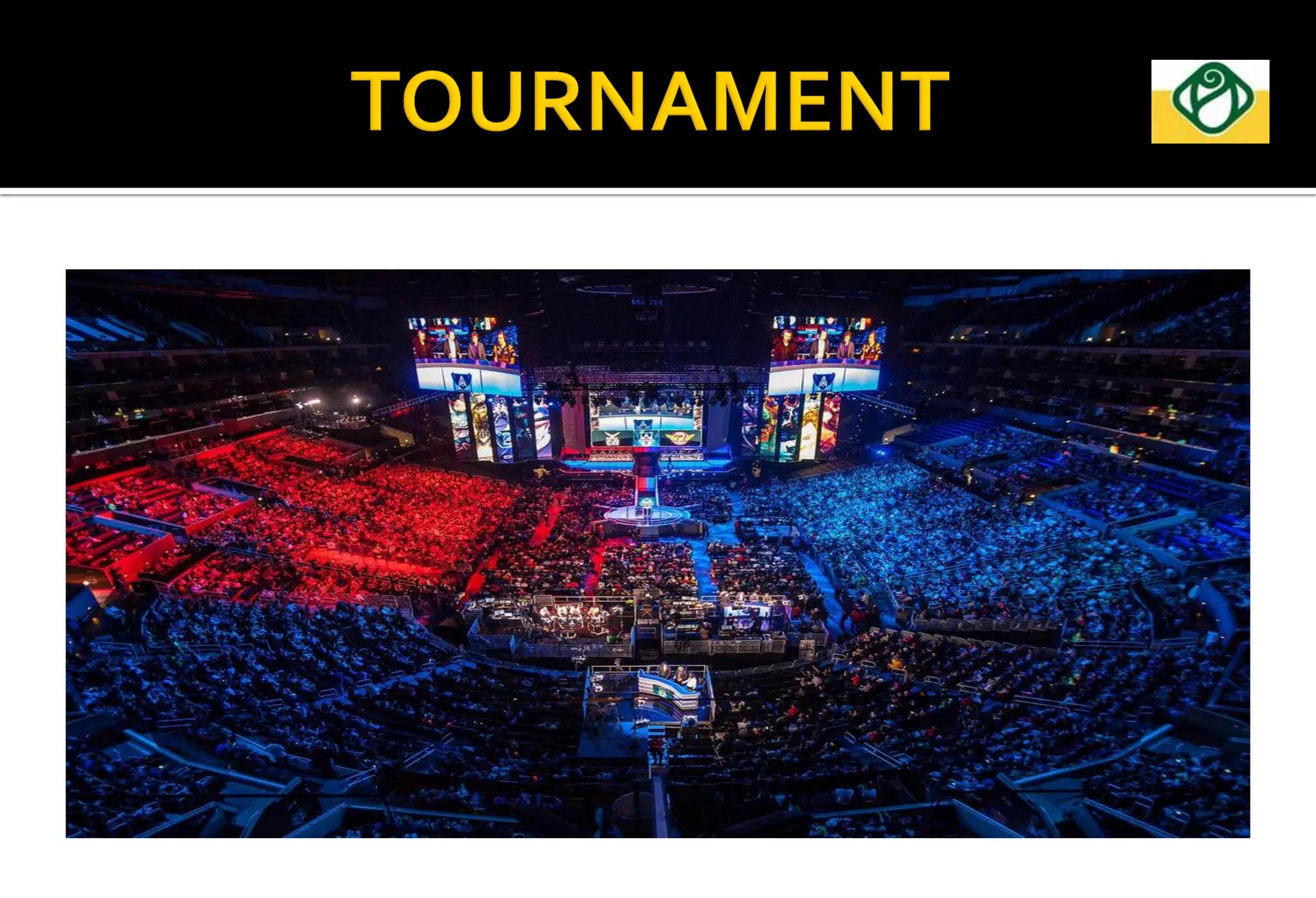
 A tournament is a type of competition in which several players / teams
participate in various rounds to get to the finals.
 Tournament is referred as healthy competition to decide the best team.
 It is the sports festival where team play against each other in systematic
way.
 In modern time tournament are organized in a civilized way with certain
rules and regulations which every team has to obey.
 A tournament provides good platform to display the talent and
perfection of skills, technique, tactics and strategies.
Meaning
Tournaments are an important feature of sports, it provides platforms
for demonstrating skills and abilities at any event or game. The salient
aspects of tournaments are:-
 Helps in Developing sporting skills
 Strengthening Sports Culture
 Development ofValues (Social, Moral, Ethical etc)
 To find out realTalent or helps in Selecting Sports Player
 Helps in Character building
 A big source of Recreation
 Promoting National & International Integration.
FourTypes ofTournaments
 Knock - out (EliminationTournament)
 League (Round RobinTournament)
 CombinationTournament (League cum knock out)
 ChallengeTournament (RankingTournament)
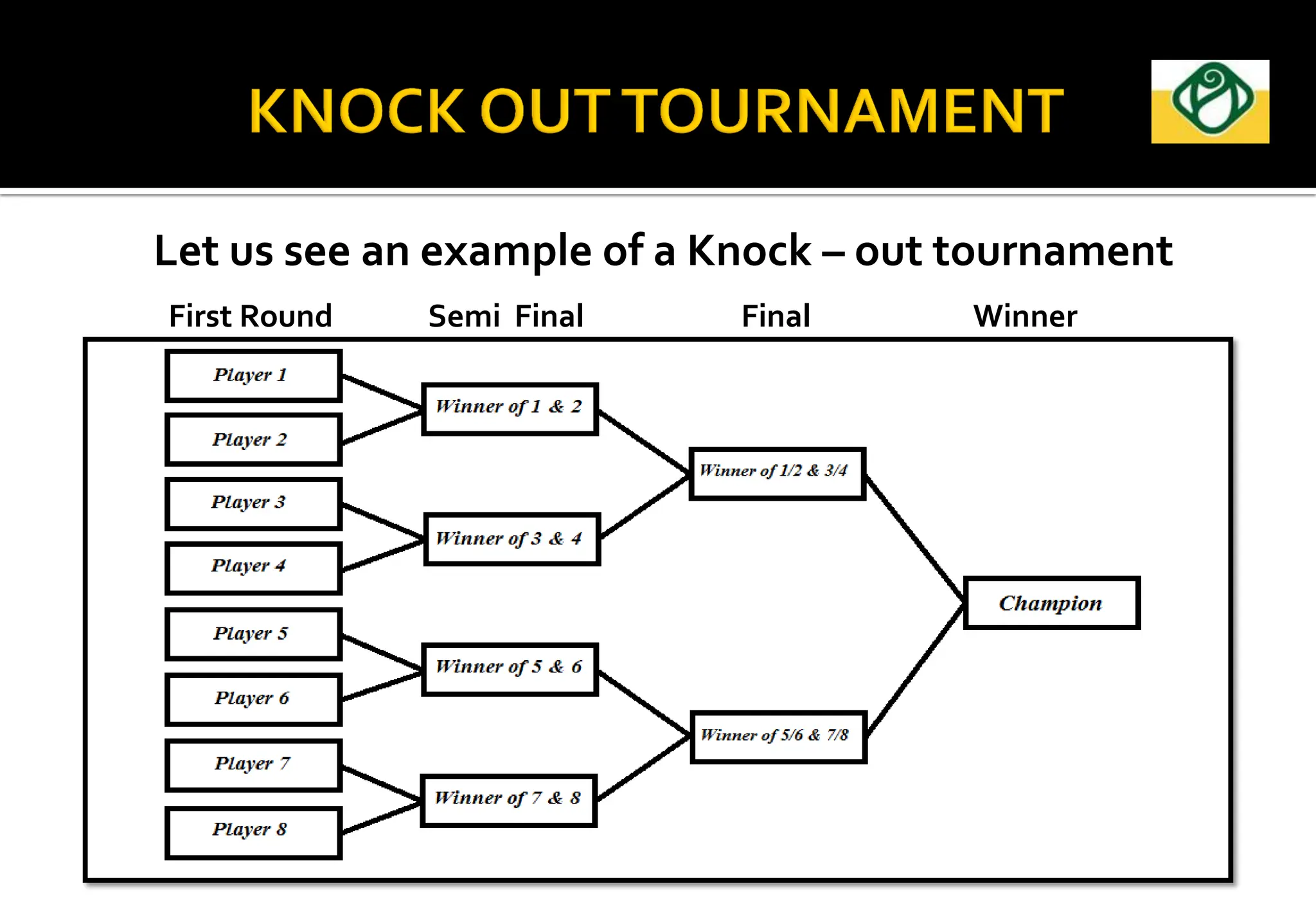
 Team once defeated is automatically eliminated from the
tournament.
 Winning teams continue to play till gets eliminated.
 In this tournament only the victorious team is allowed to play
further matches until one team emerges as winner.
 It is the fast method to know about the winner team in the
tournament.
 Knock out word is mostly used in Boxing, when an opponent is
knocked down and unable to rise and return to the game.
Let us see an example of a Knock – out tournament
First Round Semi Final Final Winner
 These are less expensive / It saves cost.
 It saves time / requires less time to complete the
tournament.
 It helps in improving the standard the of tournament.
 Minimum number of officials are required.
 It increases the excitement level of every remaining
matches.
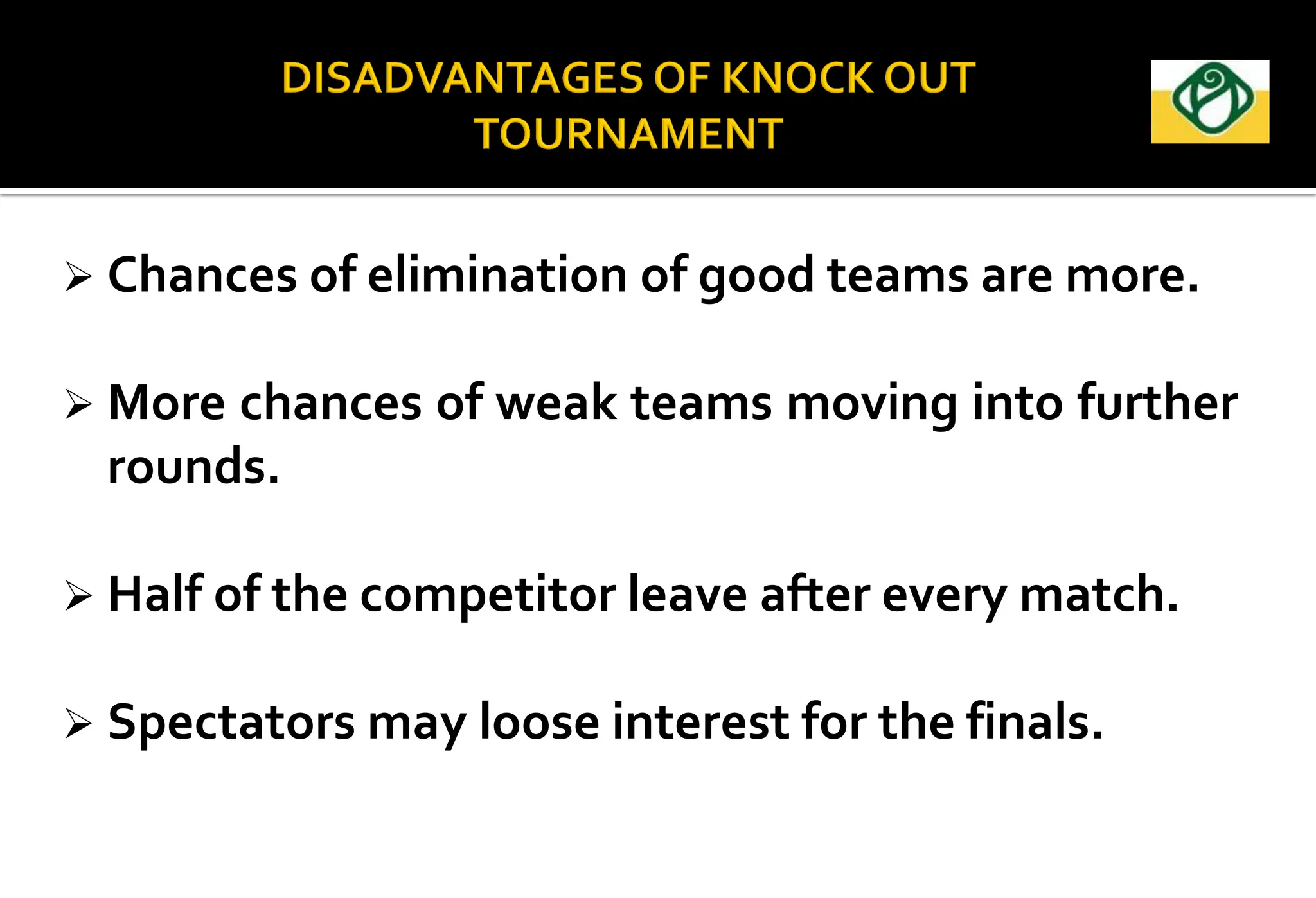
 Chances of elimination of good teams are more.
 More chances of weak teams moving into further
rounds.
 Half of the competitor leave after every match.
 Spectators may loose interest for the finals.
 Mr. Berger was the first person to imagine about this type of
tournament. So, its called as ‘Berger System’.
 In this tournament, each team plays with every other team.
 It can be called the best type of tournament because it
provides every team with the opportunity to show its best
performance.
 This tournament is played in two forms such as
SINGLE LEAGUE & DOUBLE LEAGUE
 Single LeagueTournament:-
 In this every team plays with every other team once and the total number of
matches is determined by formula:-
 N (N-l)/2 where N refers to the total number of teams.
 Example : If 8 teams are taking part, then total number of matches to be
played.
 N (N - I)/2
 = 8 (8 - 1)/2
 = 8 (7)/2
 = 56/2 = 28 matches
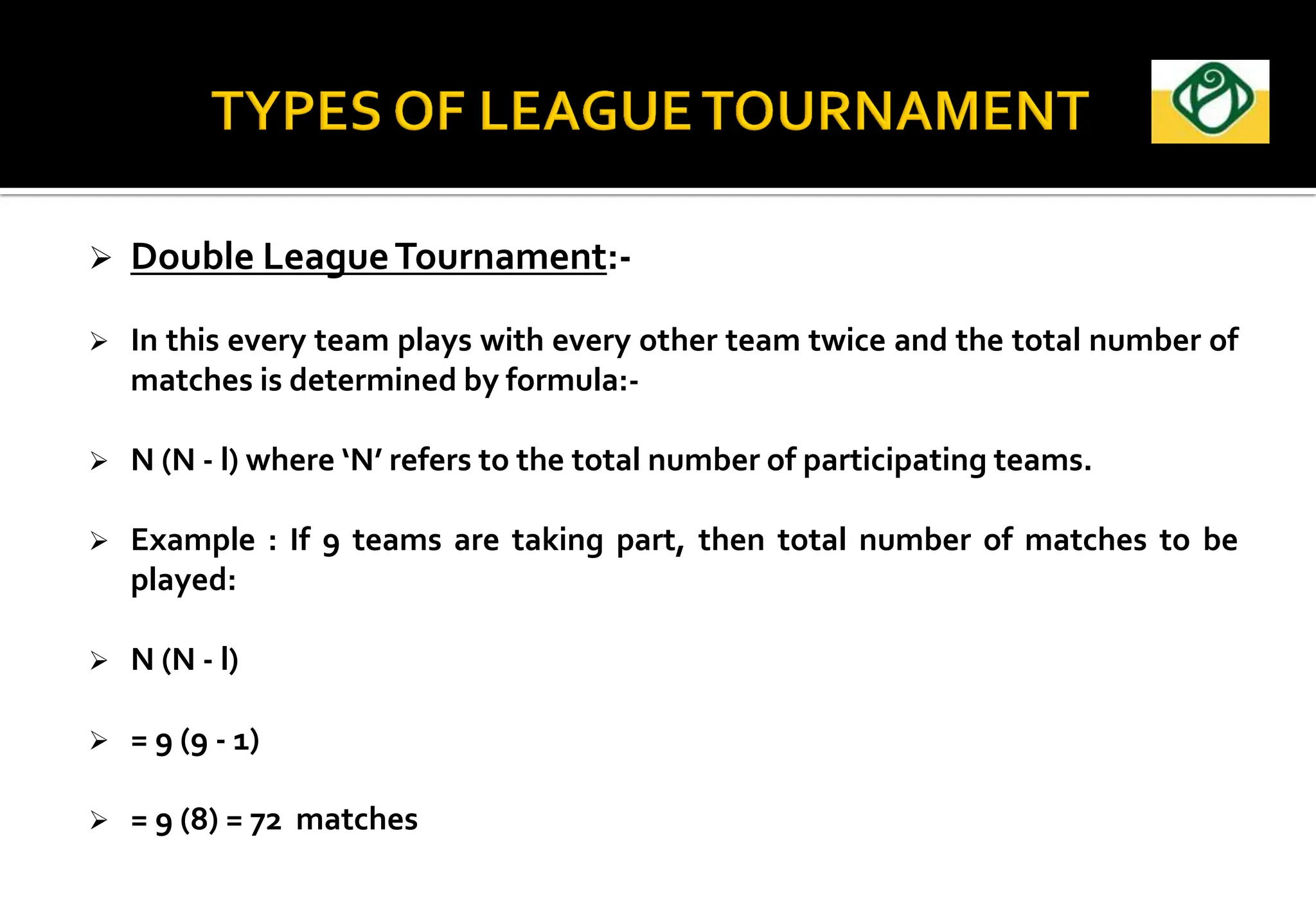
 Double LeagueTournament:-
 In this every team plays with every other team twice and the total number of
matches is determined by formula:-
 N (N - l) where ‘N’ refers to the total number of participating teams.
 Example : If 9 teams are taking part, then total number of matches to be
played:
 N (N - l)
 = 9 (9 - 1)
 = 9 (8) = 72 matches
 Only strong team moves ahead in the tournament to achieve
success / victory.
 Every team gets maximum opportunities to show its efficiency.
 Player get maximum number of matches where they can easily
improve their performance.
 Sports official can easily judge the performance of individuals or
teams / Easy to select good players.
 The spectators get opportunity to watch more matches.
 Waste of time / Requires more time.
 It costs more money wise also for weaker teams.
 It becomes more difficult for organizers to make
arrangements for teams and officials.
 Teams may lose their moral by the end of tournament.
 Combination tournaments are conducted when the matches are to be played on
zonal basis.
 The number of teams are divided into four equal zones.
 Each match is played on knock out basis within the zones.
 Then winner from each zone can participate at national level.
Combination tournaments are classified into following four types :
 Knock out cum Knock out
 League cum League
 Knock out cum League
 League cum Knock out ( 2 e.g. for each type)
 In Knock- Out Cum Knock out tournaments the number of teams are divided into
four groups.
 They compete with each other on the knockout basis.
 Winners of four groups are made to compete with each other on knock out
basis, then one group / team will be declared as winner.
 In League Cum League number of teams are divided into four groups.
 They compete with each other in their respective zones on league basis.
 One team from each zone will become a zonal winner.
 All zonal winner will compete with each other on league basis and one team out of it
will be declared as winner of inter zonal or group tournament
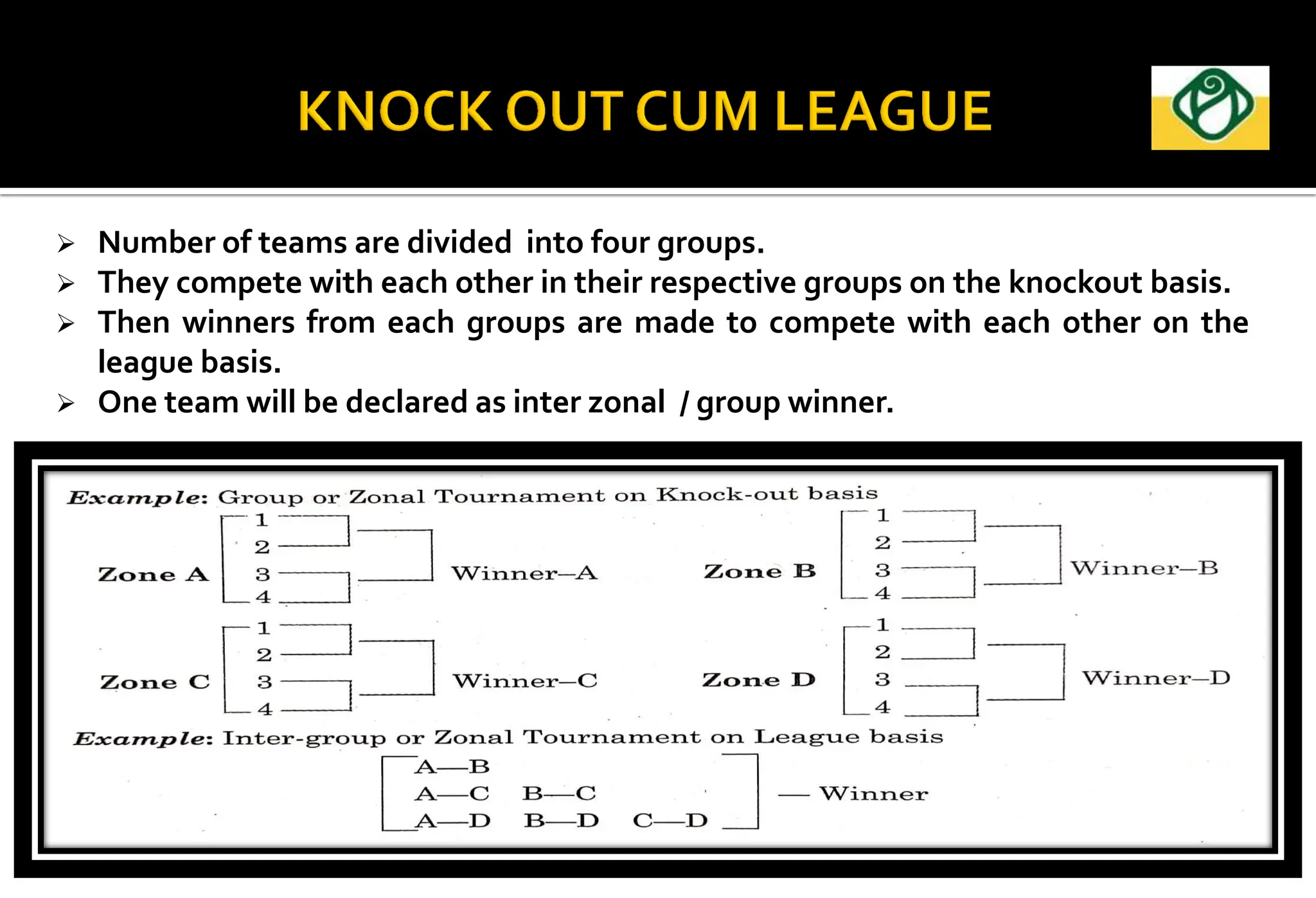
 Number of teams are divided into four groups.
 They compete with each other in their respective groups on the knockout basis.
 Then winners from each groups are made to compete with each other on the
league basis.
 One team will be declared as inter zonal / group winner.
 In League cum knockout , Number of teams are divided into four groups.
 They compete with each other in their respective groups on the league basis.
 Then winners from each groups are made to compete with each other on the
knock out basis.
 One team will be declared as inter zonal / group winner.
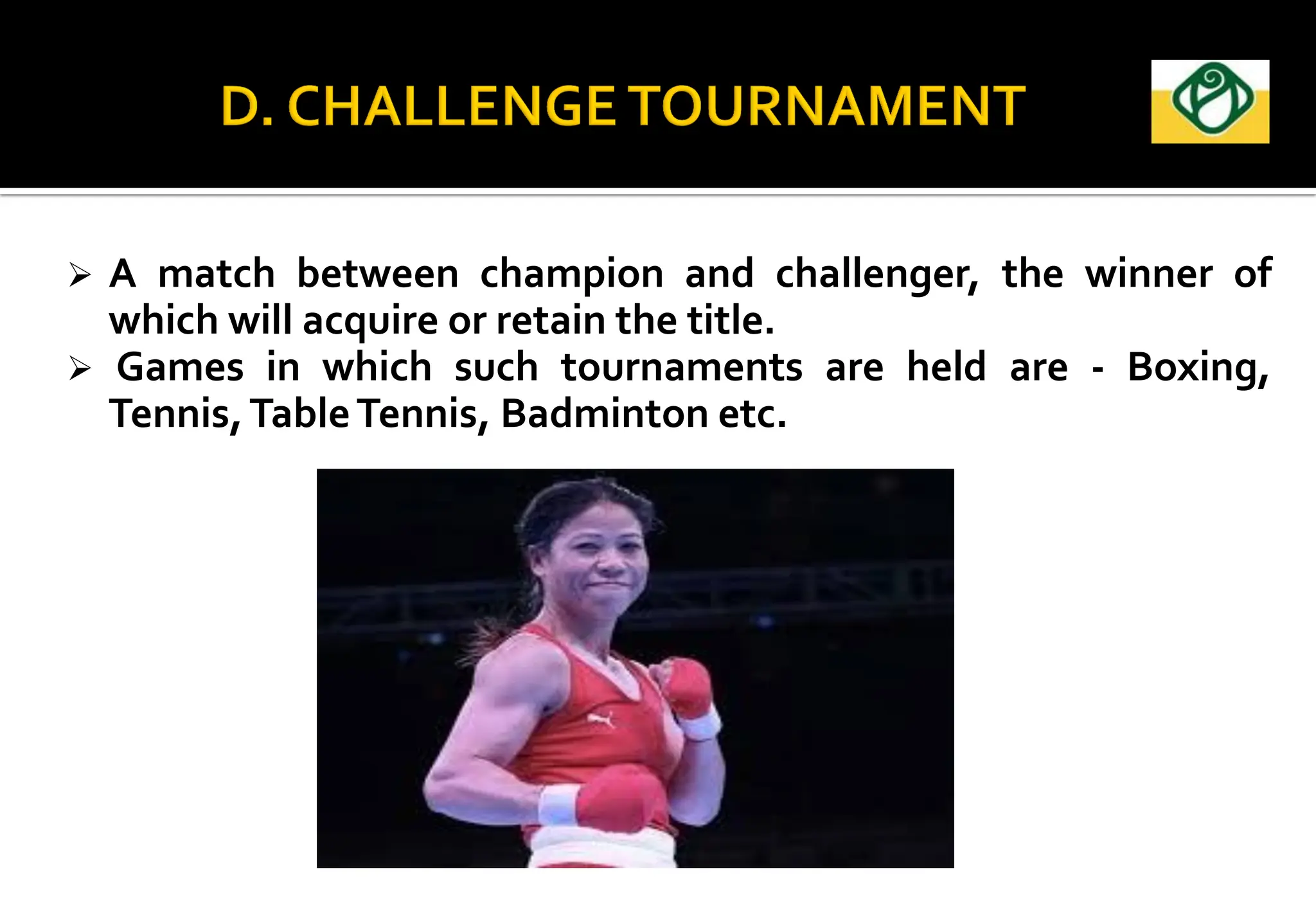
 A match between champion and challenger, the winner of
which will acquire or retain the title.
 Games in which such tournaments are held are - Boxing,
Tennis,TableTennis, Badminton etc.
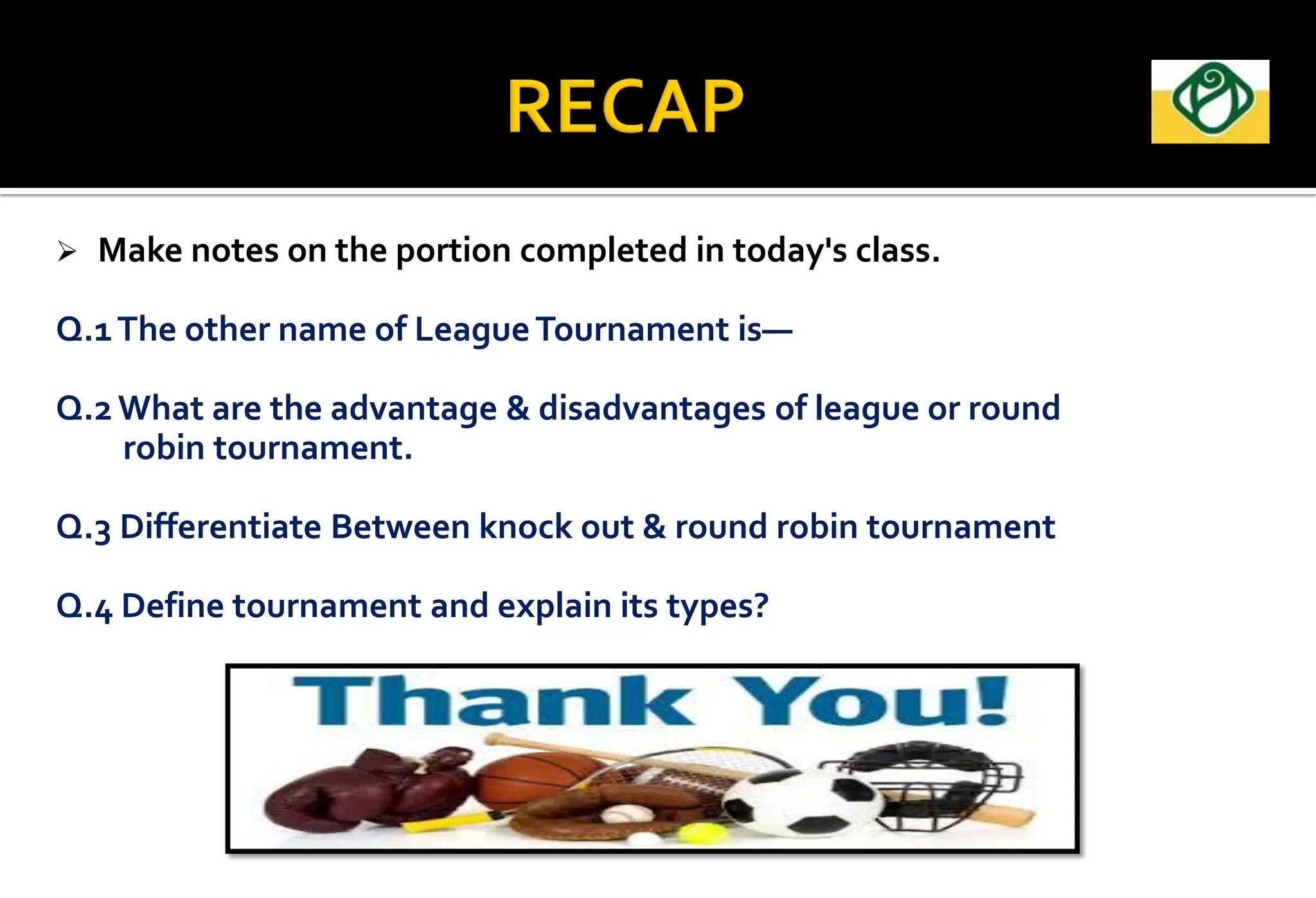
 Make notes on the portion completed in today's class.
Q.1The other name of LeagueTournament is—
Q.2 What are the advantage & disadvantages of league or round
robin tournament.
Q.3 Differentiate Between knock out & round robin tournament
Q.4 Define tournament and explain its types?
KNOCK OUT
The success of any tournament depends upon suitable Fixture.
Following points have to be taken into consideration while drawing fixtures for a
knock out tournament:
 Total number of participatingTeams / Players in the tournament.
 Number of teams in each Half or Quarter.
 Byes given.
 Number of byes to be given in each Half or Quarter..
 Total number of Matches to be played.
 Total number of Rounds to be played.
Step 1 :
 If number of teams are even or in the power of 2 than N/2
is used for each half.
 If the number of teams are in odd number or is not the
power of 2, then following procedure is applied:-
 Upper half = (N + l)/2
 Lower half = (N – l)/2
 Where ‘N’ is the total number of teams.
Step 2 :
 Bye - Means a team exempted from playing the first round.
 Gets an advantage to play directly in the next round.
 It is sort of privilege to a team who does not play the first round.
 When the number of entries in a knock-out tournament is not in the
power of two (2), we have to give byes to teams.
 Byes are given to a specific number of teams in the first round only.
Step 3 :
 Byes will be fixed in the following manner:
 First bye will be given to the last team of lower half.
 Second bye will be given to the first team of upper half.
 Third bye will be given to the first team of lower half.
 Fourth bye will be given to the last team of upper half.
 The same sequence will be followed while assigning the next bye or
byes.
Calculation of Byes :-
 Total number of byes (NB) = Next highest number which is the
power of 2 -Total number of team
 Example: For 12 team next higher value of 2 would be
 (2 × 2 × 2 × 2 = 16) then
 16 – 12 = 4 Bye.
 No. of byes in upper half = NB/2 = 4/2 = 2
 No. of byes in lower half = NB/2 = 4/2 = 2
Calculation of Byes :-
 Total number of byes (NB) = Next highest number which is the
power of 2 -Total number of team
 Example: For 11 team next higher value of 2 would be
 (2 × 2 × 2 × 2 = 16) then
 16 – 11 = 5 Bye.
 No. of byes in upper half = (NB – l)/2 = (5-1)/2 = 2
 No. of byes in lower half = (NB + l)/2 = (5+1)/2 = 3
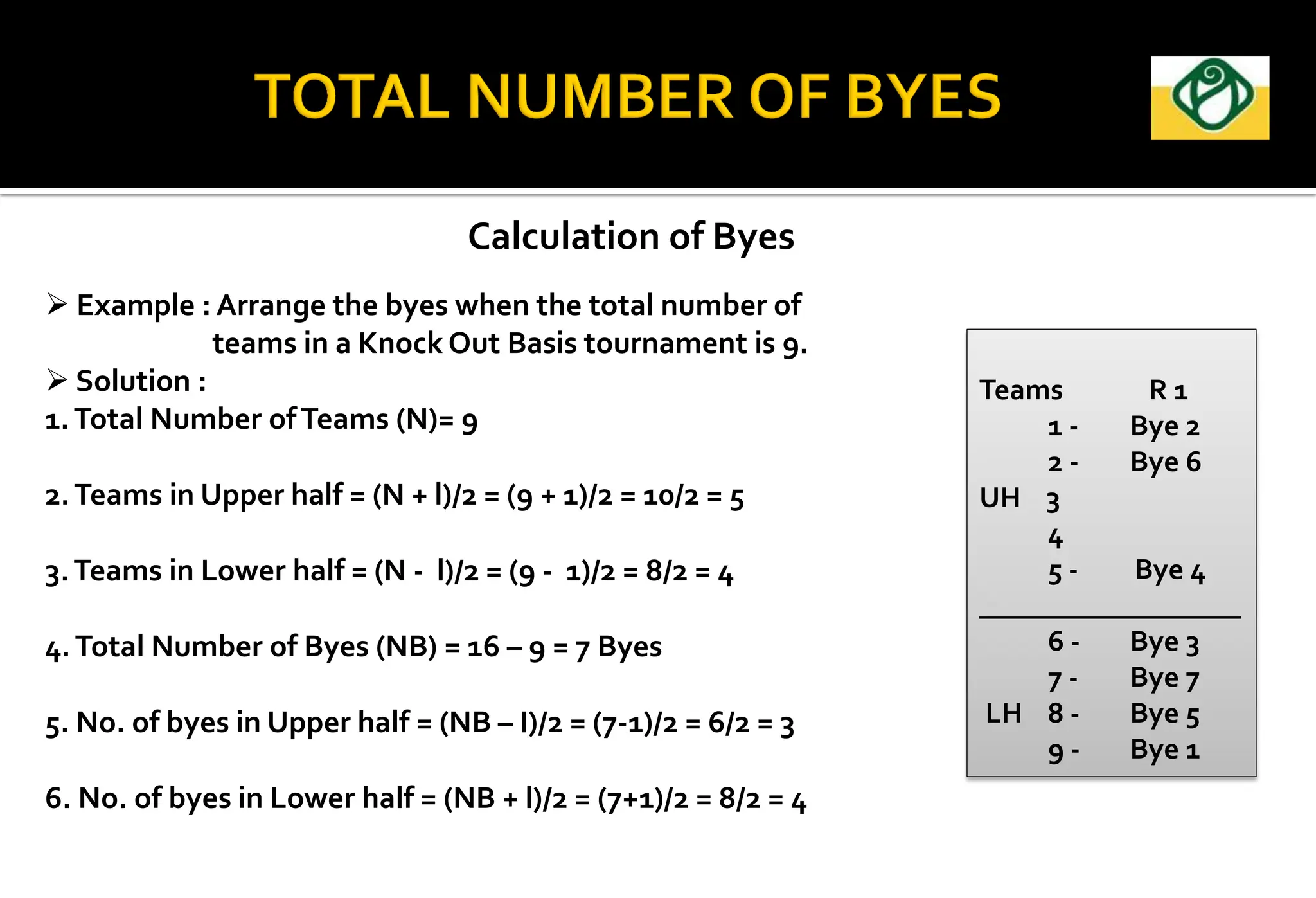
Calculation of Byes
 Example : Arrange the byes when the total number of
teams in a Knock Out Basis tournament is 9.
 Solution :
1.Total Number ofTeams (N)= 9
2.Teams in Upper half = (N + l)/2 = (9 + 1)/2 = 10/2 = 5
3.Teams in Lower half = (N - l)/2 = (9 - 1)/2 = 8/2 = 4
4.Total Number of Byes (NB) = 16 – 9 = 7 Byes
5. No. of byes in Upper half = (NB – I)/2 = (7-1)/2 = 6/2 = 3
6. No. of byes in Lower half = (NB + l)/2 = (7+1)/2 = 8/2 = 4
Teams R 1
1 - Bye 2
2 - Bye 6
UH 3
4
5 - Bye 4
__________________
6 - Bye 3
7 - Bye 7
LH 8 - Bye 5
9 - Bye 1
Calculation of Byes
Example 1: How many byes will be given when the total number of teams is 13?
Solution: Number of teams = 13
Next highest number which is the power of2 = 16
Total number of byes (NB)
= Next highest number which is the power of 2 -Total number of teams
(16 – 13) = 3 byes.
Example 2: How many byes will be given when the total number of teams is 28?
Solution:Total number of teams = 28
Next highest number which is the power of 2= 32
Total number of byes (NB)
= Next highest number which is the power of 2 -Total number of teams
(32 - 28) = 4 byes.
Example 3: How many byes will be given when the total number of teams is 16?
Solution: Bye wont be given because 16 itself is power of 2.
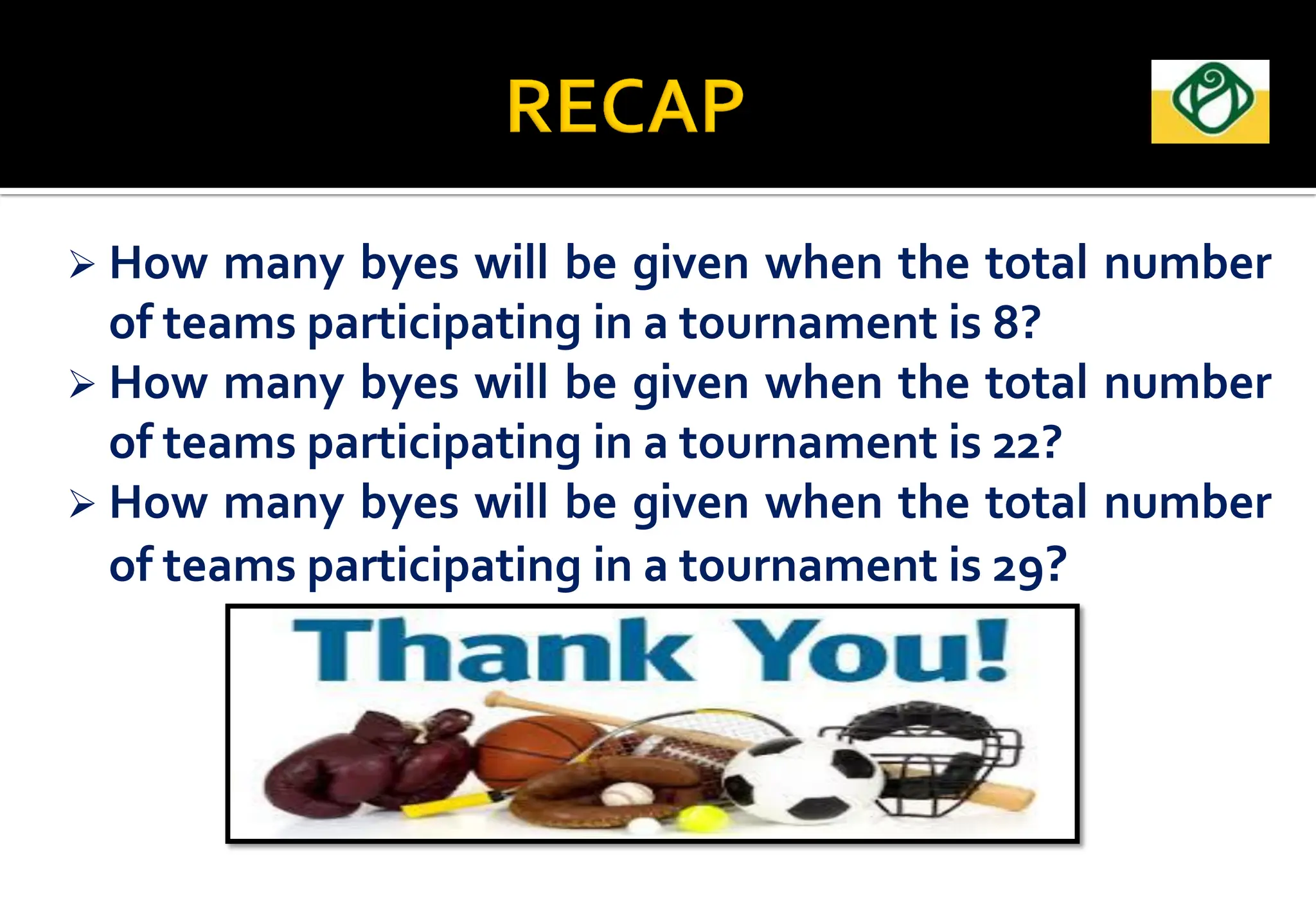
 How many byes will be given when the total number
of teams participating in a tournament is 8?
 How many byes will be given when the total number
of teams participating in a tournament is 22?
 How many byes will be given when the total number
of teams participating in a tournament is 29?
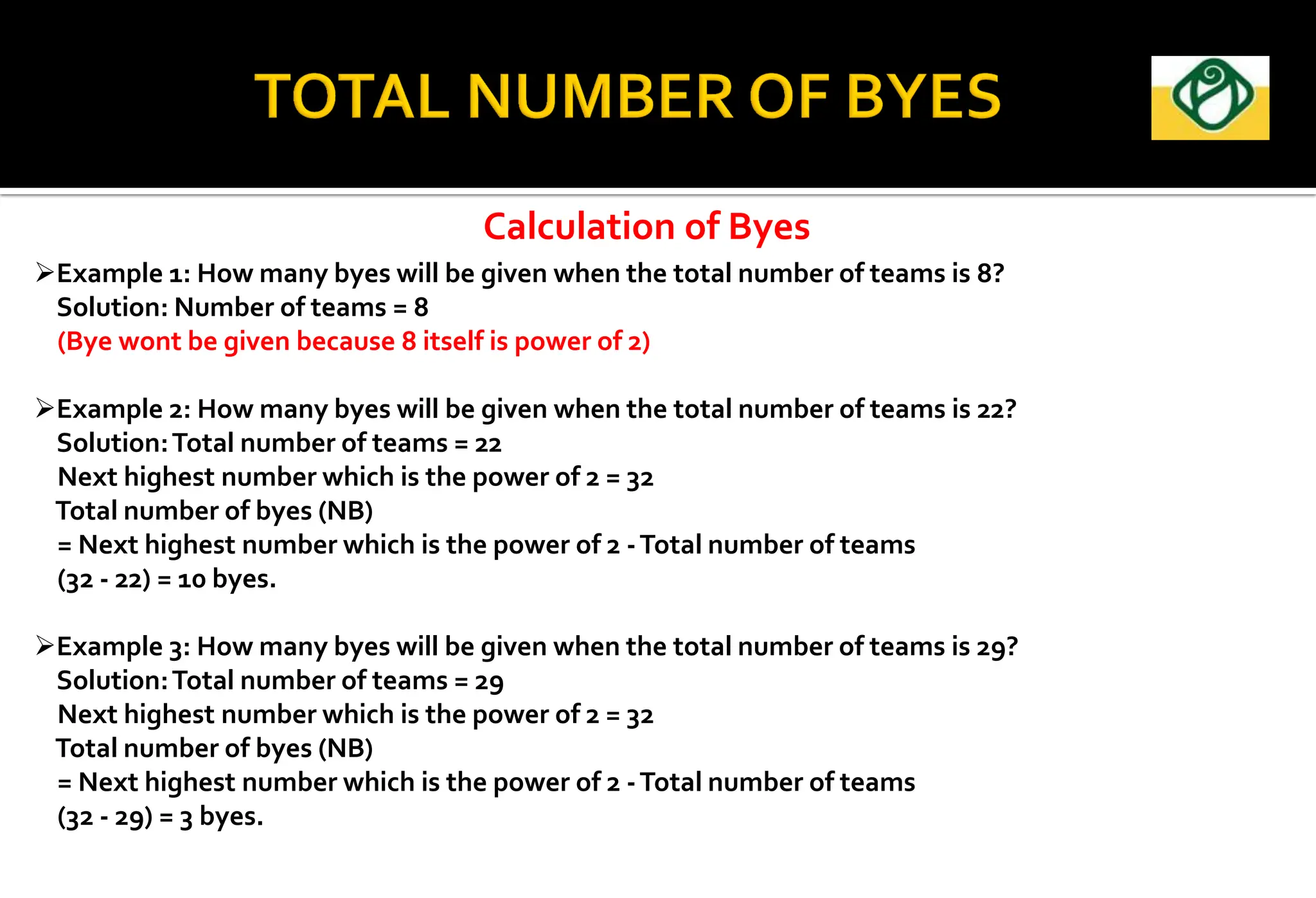
Calculation of Byes
Example 1: How many byes will be given when the total number of teams is 8?
Solution: Number of teams = 8
(Bye wont be given because 8 itself is power of 2)
Example 2: How many byes will be given when the total number of teams is 22?
Solution:Total number of teams = 22
Next highest number which is the power of 2 = 32
Total number of byes (NB)
= Next highest number which is the power of 2 -Total number of teams
(32 - 22) = 10 byes.
Example 3: How many byes will be given when the total number of teams is 29?
Solution:Total number of teams = 29
Next highest number which is the power of 2 = 32
Total number of byes (NB)
= Next highest number which is the power of 2 -Total number of teams
(32 - 29) = 3 byes.
 Total number of matches can be calculated by subtracting one from
the total number of teams.
 The number of matches is (N – l)
 Where ‘N’ denotes the total number of participating teams.
 For e.g., If 11 teams are participating, than the number of matches
will be
 N – l = 11 – 1 = 10 matches.
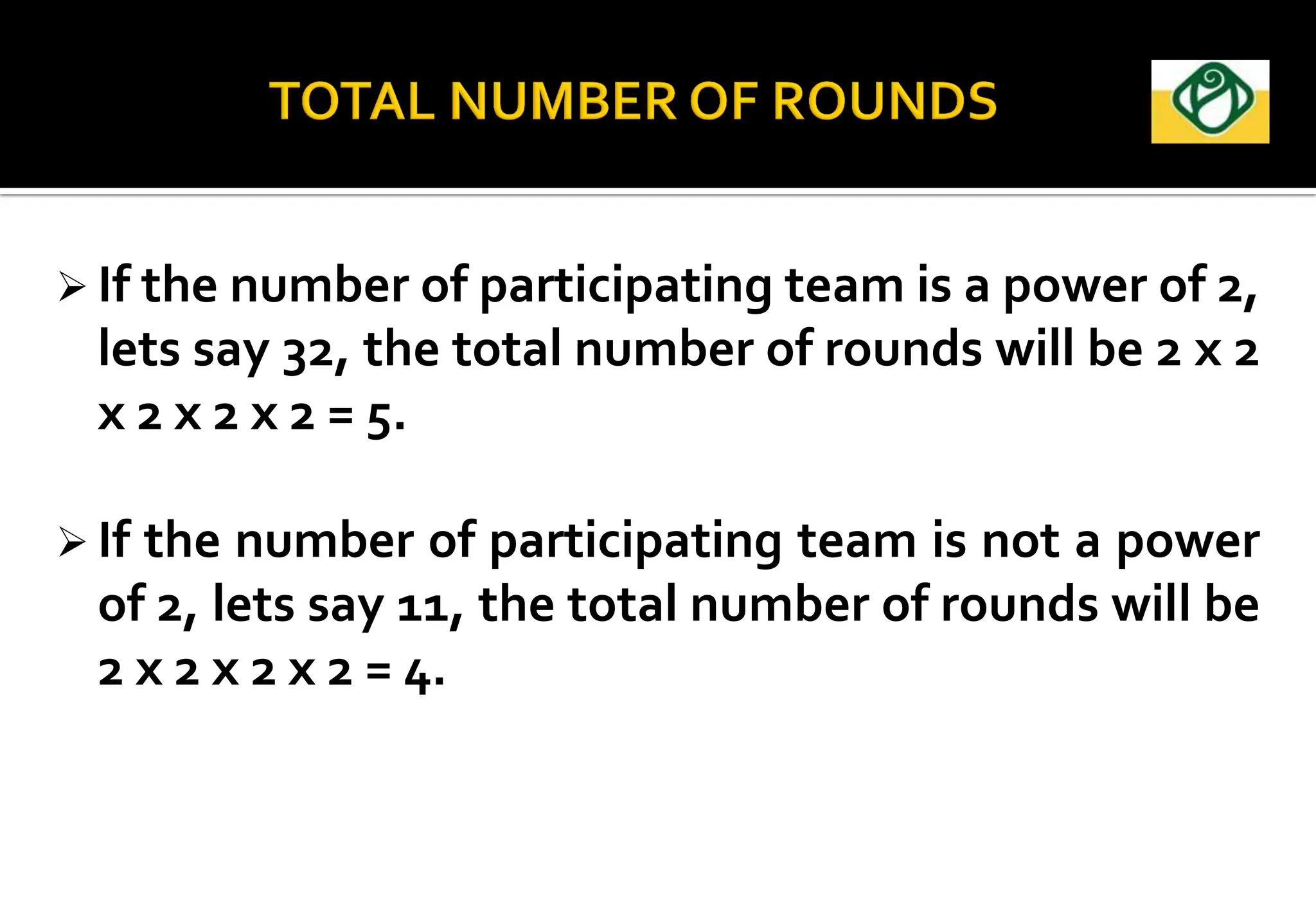
 If the number of participating team is a power of 2,
lets say 32, the total number of rounds will be 2 x 2
x 2 x 2 x 2 = 5.
 If the number of participating team is not a power
of 2, lets say 11, the total number of rounds will be
2 x 2 x 2 x 2 = 4.
Calculation of Byes, Matches & Rounds
Example 1 : Draw the fixture for 9 teams on knock out basis.
 Solution :
1.Total Number ofTeams (N) = 9
2.Teams in Upper half = (N + l)/2 = (9 + 1)/2 = 10/2 = 5
3.Teams in Lower half = (N - l)/2 = (9 - 1)/2 = 8/2 = 4
4.Total Number of Byes (NB) = 16 – 9 = 7 Byes
5. No. of byes in Upper half = (NB – I)/2 = (7-1)/2 = 6/2 = 3
6. No. of Byes in Lower half = (NB + l)/2 = (7+1)/2 = 8/2 = 4
7. No. of Matches = N - 1 = 9 - 1 = 8
8. No. of Rounds = 2 x 2 x 2 x 2 = 4
Teams R1 R2 R3 R4
1 - Bye 2
2 - Bye 6
3
4
5 - Bye 4
6 - Bye 3
7 - Bye 7
8 - Bye 5
9 - Bye 1
1
2
3
4
5
6
7
8 WINNER
U
H
L
H
TT
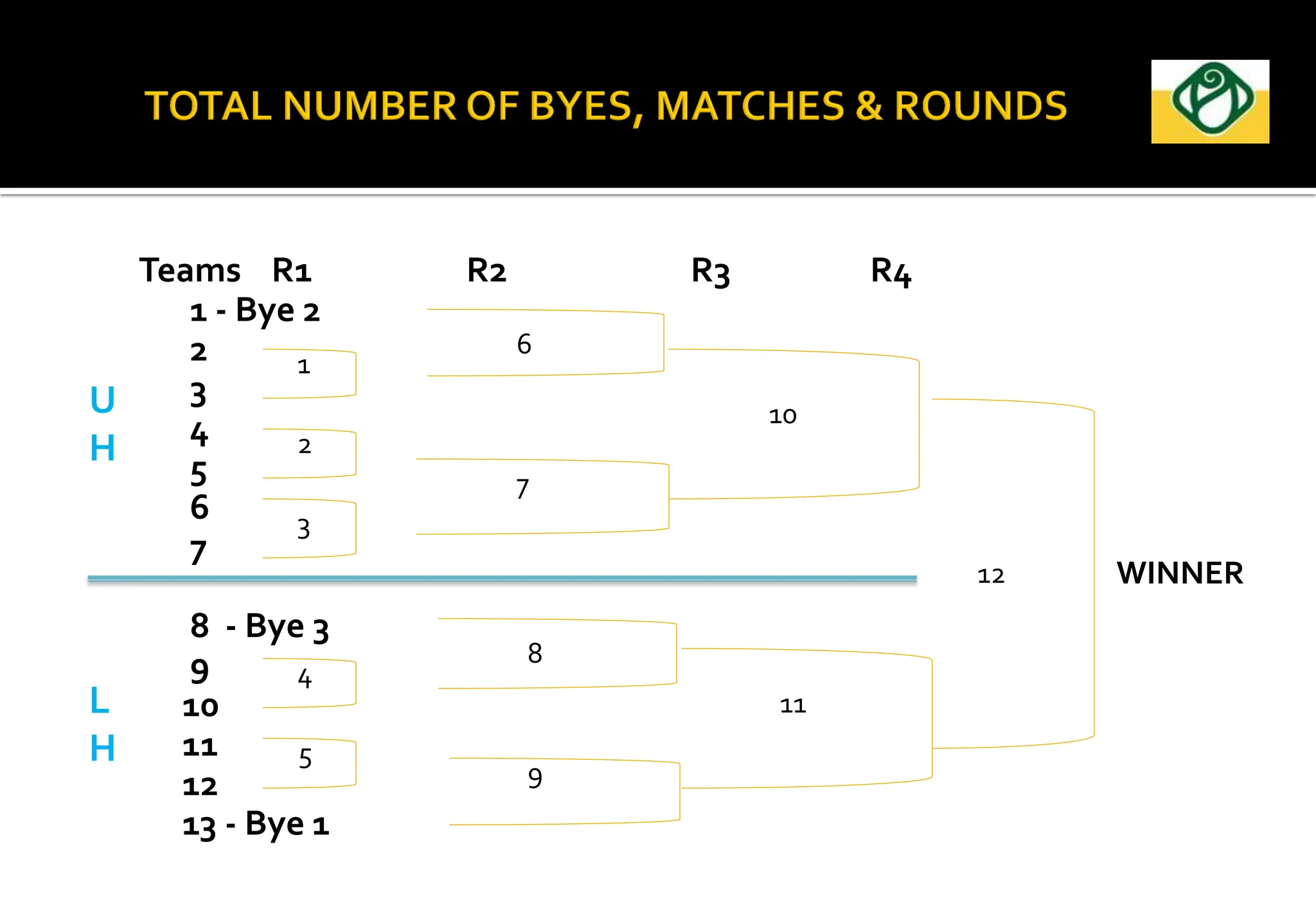
Calculation of Byes, Matches & Rounds
Example 2 : Draw the fixture for 13 teams on knock out basis.
 Solution :
1.Total Number ofTeams (N) = 13
2.Teams in Upper half = (N + l)/2 = (13 + 1)/2 = 14/2 = 7
3.Teams in Lower half = (N - l)/2 = (13 - 1)/2 = 12/2 = 6
4.Total Number of Byes (NB) = 16 –13 = 3 Byes
5. No. of byes in Upper half = (NB – I)/2 = (3-1)/2 = 2/2 = 1
6. No. of Byes in Lower half = (NB + l)/2 = (3+1)/2 = 4/2 = 2
7. No. of Matches = N - 1 = 13 - 1 = 12
8. No. of Rounds = 2 x 2 x 2 x 2 = 4
Teams R1 R2 R3 R4
1 - Bye 2
2
3
4
5
6
7
8 - Bye 3
9
10
11
12
13 - Bye 1
1
2
3
4
5
6
7
8
WINNER
U
H
L
H
TT
9
10
11
12
 We have completed how to give byes with few examples of drawing
fixtures on knock out basis.
 In next class we will try to solve more examples involving more
number of teams.
 1. Draw the fixtures for 16 teams on knock out basis.
 2. Draw the fixtures for 19 teams on knock out basis
 3. Draw the fixtures for 22 teams on knock out basis.
Calculation of Byes, Matches & Rounds
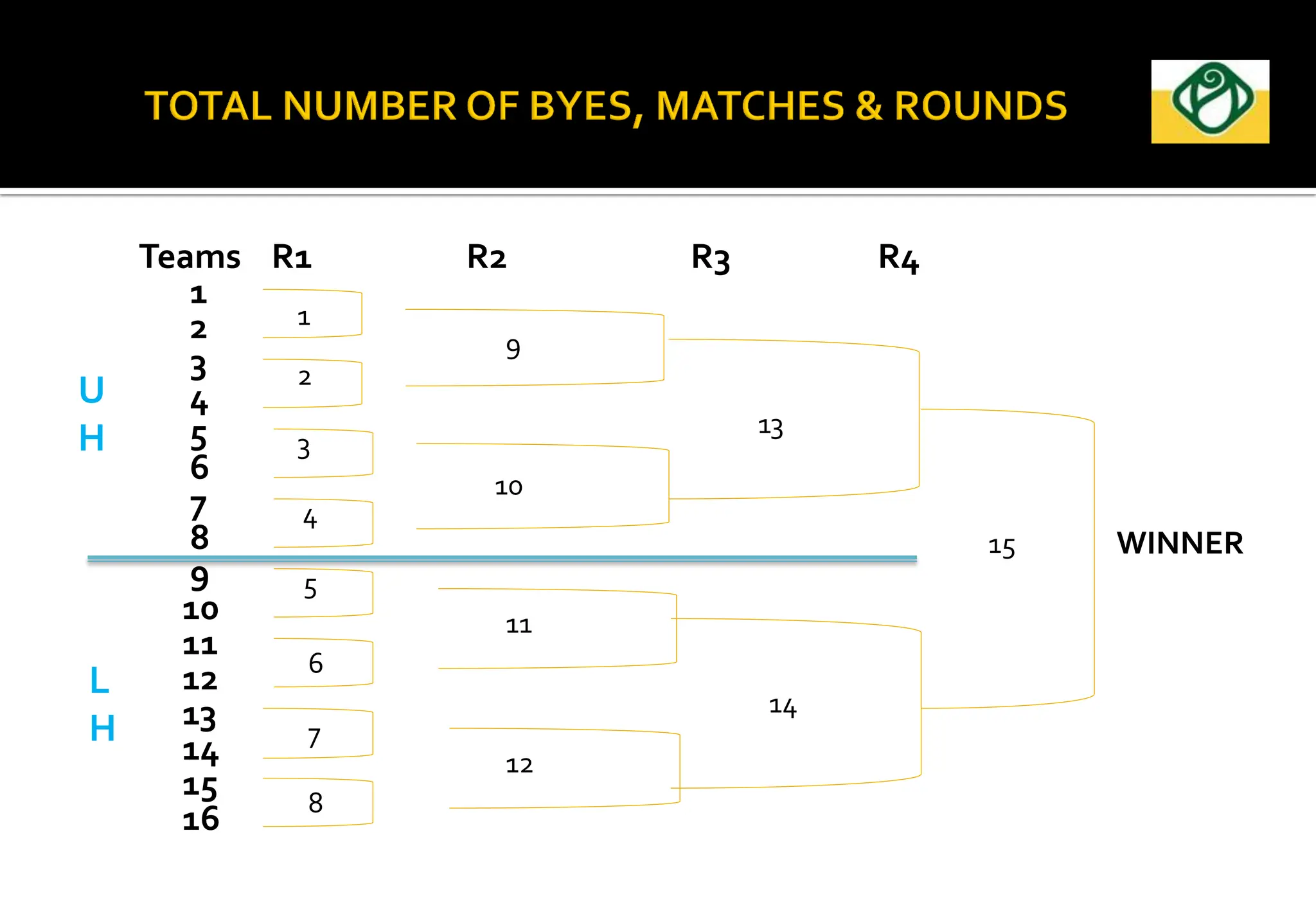
Example 1 : Draw the fixture for 16 teams on knock out basis.
 Solution :
1.Total Number ofTeams (N) = 16
2.Teams in Upper half = N/2 = 16/2 = 8
3.Teams in Lower half = N/2 = 16/2 = 8
4.Total Number of Byes (NB) = 16 – 16 = 0 Byes
5. No. of Matches = N - 1 = 16 - 1 = 15
6. No. of Rounds = 2 x 2 x 2 x 2 = 4
Teams R1 R2 R3 R4
1
2
3
4
5
6
7
8
9
10
11
12
13
14
15
16
1
2
3
4
5
6
7
8
WINNER
U
H
L
H
TT
9
10
11
12
13
14
15
Calculation of Byes, Matches & Rounds
Example 2 : Draw the fixture for 19 teams on knock out basis.
 Solution :
1.Total Number ofTeams (N) = 19
2.Teams in Upper half = (N + l)/2 = (19 + 1)/2 = 20/2 = 10
3.Teams in Lower half = (N - l)/2 = (19 - 1)/2 = 18/2 = 9
4.Total Number of Byes (NB) = 32 – 19 = 13 Byes
5. No. of byes in Upper half = (NB – I)/2 = (13 - 1)/2 = 12/2 = 6
6. No. of Byes in Lower half = (NB + l)/2 = (13 + 1)/2 = 14/2 = 7
7. No. of Matches = N - 1 = 19 - 1 = 18
8. No. of Rounds = 2 x 2 x 2 x 2 x 2 = 5
Teams R1 R2 R3 R4 R5
1 - Bye 2
2 - Bye 6
3 - Bye 10
4
5
6
7
8 - Bye 12
9 - Bye 8
10 - Bye 4
11 - Bye 3
12 - Bye 7
13 - Bye 11
14
15
16 - Bye 13
17 - Bye 9
18 - Bye 5
19 - Bye 1
1
2
3
4
5
6
7
8
WINNER
U
H
L
H
TT
9
10
11
12
13
14
15
16
17
18
Calculation of Byes, Matches & Rounds
Example 3 : Draw the fixture for 22 teams on knock out basis.
 Solution :
1.Total Number ofTeams (N) = 22
2.Teams in Upper half = N/2 = 22/2 = 11
3.Teams in Lower half = N/2 = 22/2 = 11
4.Total Number of Byes (NB) = 32 – 22 = 10 Byes
5. No. of byes in Upper half = NB/2 = 10/2 = 5
6. No. of Byes in Lower half = NB/2 = 10/2 = 5
7. No. of Matches = N - 1 = 22 - 1 = 21
8. No. of Rounds = 2 x 2 x 2 x 2 x 2 = 5
Teams R1 R2 R3 R4 R5
1 - Bye 2
2 - Bye 6
3 - Bye 10
4
5
6
7
8
9
10 - Bye 8
11 - Bye 4
12 - Bye 3
13 - Bye 7
14
15
16
17
18
19
20 - Bye 9
21 - Bye 5
22 - Bye 1
1
2
3
7
8
9
10
11
WINNER
U
H
L
H
TT
12
13
14
15
16
17
18
19
20
21
4
5
6
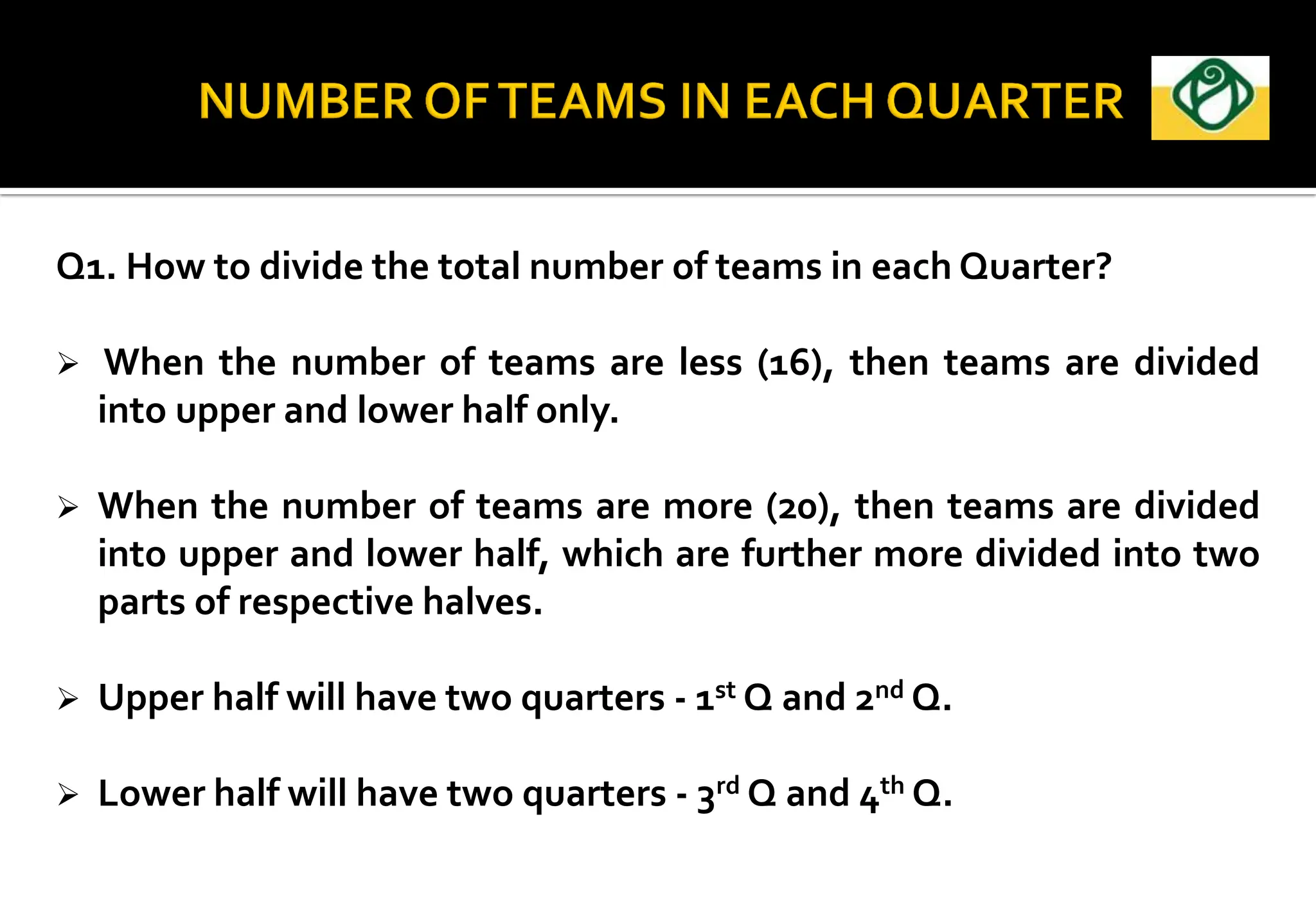
Q1. How to divide the total number of teams in each Quarter?
 When the number of teams are less (16), then teams are divided
into upper and lower half only.
 When the number of teams are more (20), then teams are divided
into upper and lower half, which are further more divided into two
parts of respective halves.
 Upper half will have two quarters - 1st Q and 2nd Q.
 Lower half will have two quarters - 3rd Q and 4th Q.
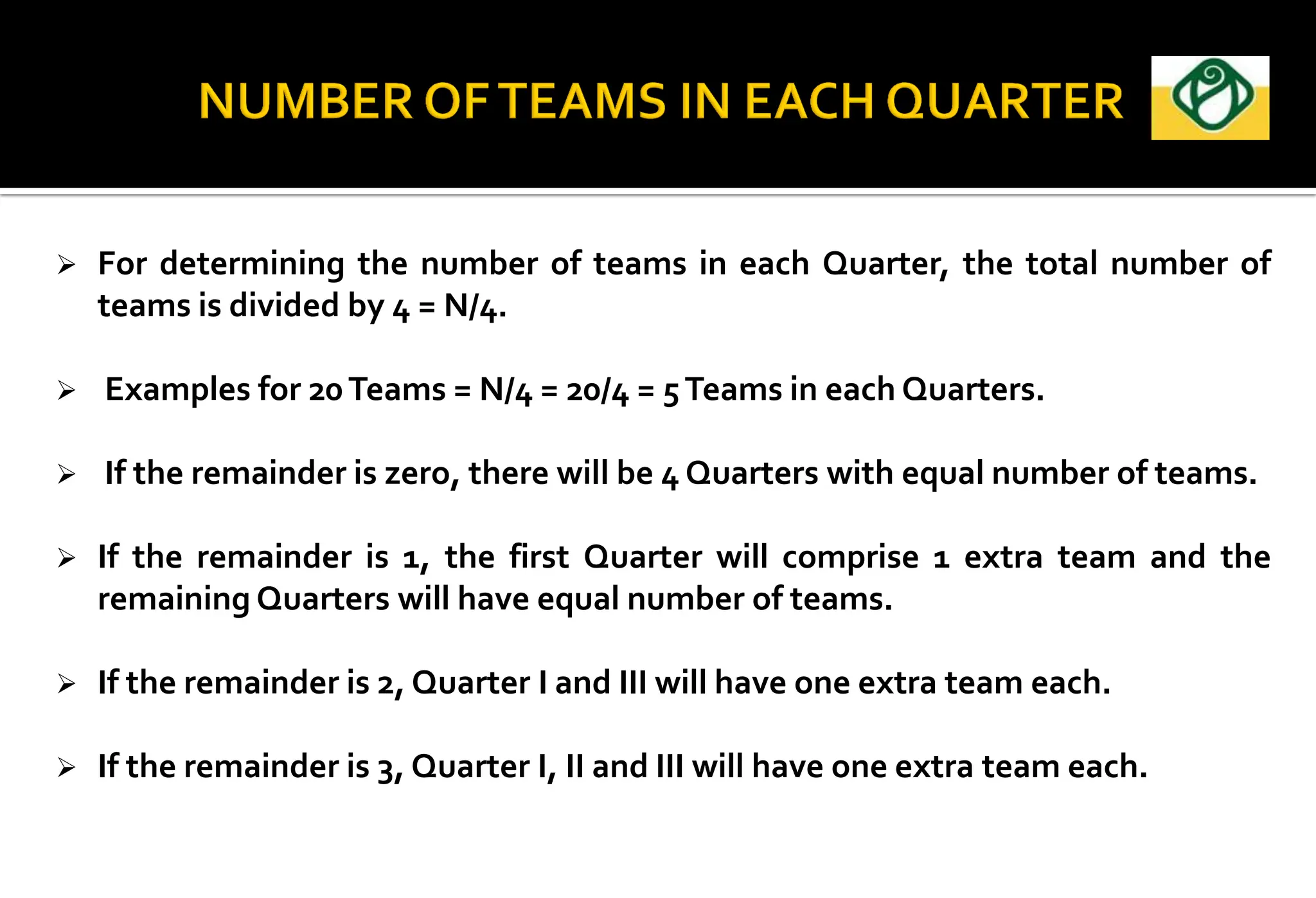
 For determining the number of teams in each Quarter, the total number of
teams is divided by 4 = N/4.
 Examples for 20Teams = N/4 = 20/4 = 5Teams in each Quarters.
 If the remainder is zero, there will be 4 Quarters with equal number of teams.
 If the remainder is 1, the first Quarter will comprise 1 extra team and the
remaining Quarters will have equal number of teams.
 If the remainder is 2, Quarter I and III will have one extra team each.
 If the remainder is 3, Quarter I, II and III will have one extra team each.
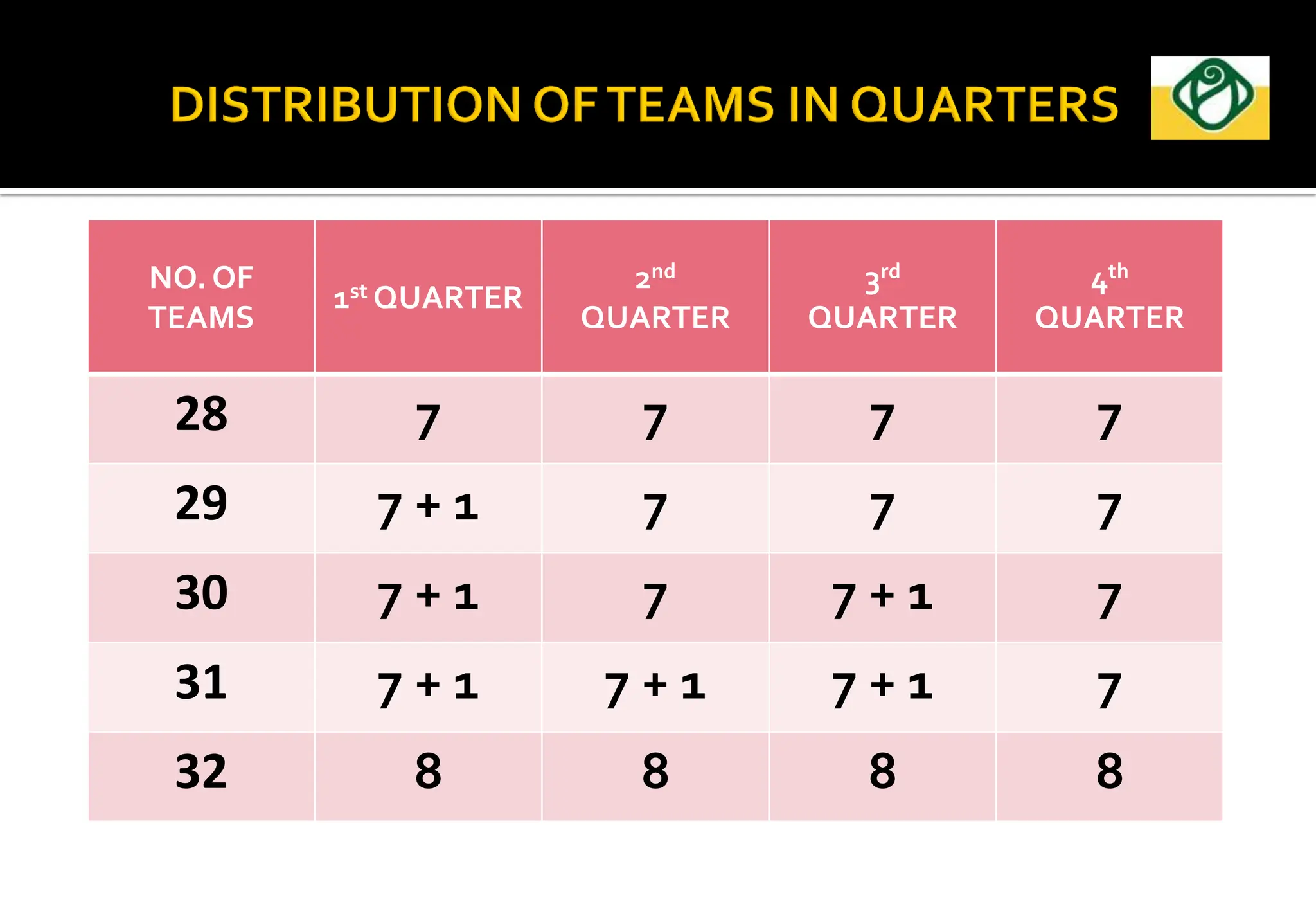
NO. OF
TEAMS
1st QUARTER
2nd
QUARTER
3rd
QUARTER
4th
QUARTER
28 7 7 7 7
29 7 + 1 7 7 7
30 7 + 1 7 7 + 1 7
31 7 + 1 7 + 1 7 + 1 7
32 8 8 8 8
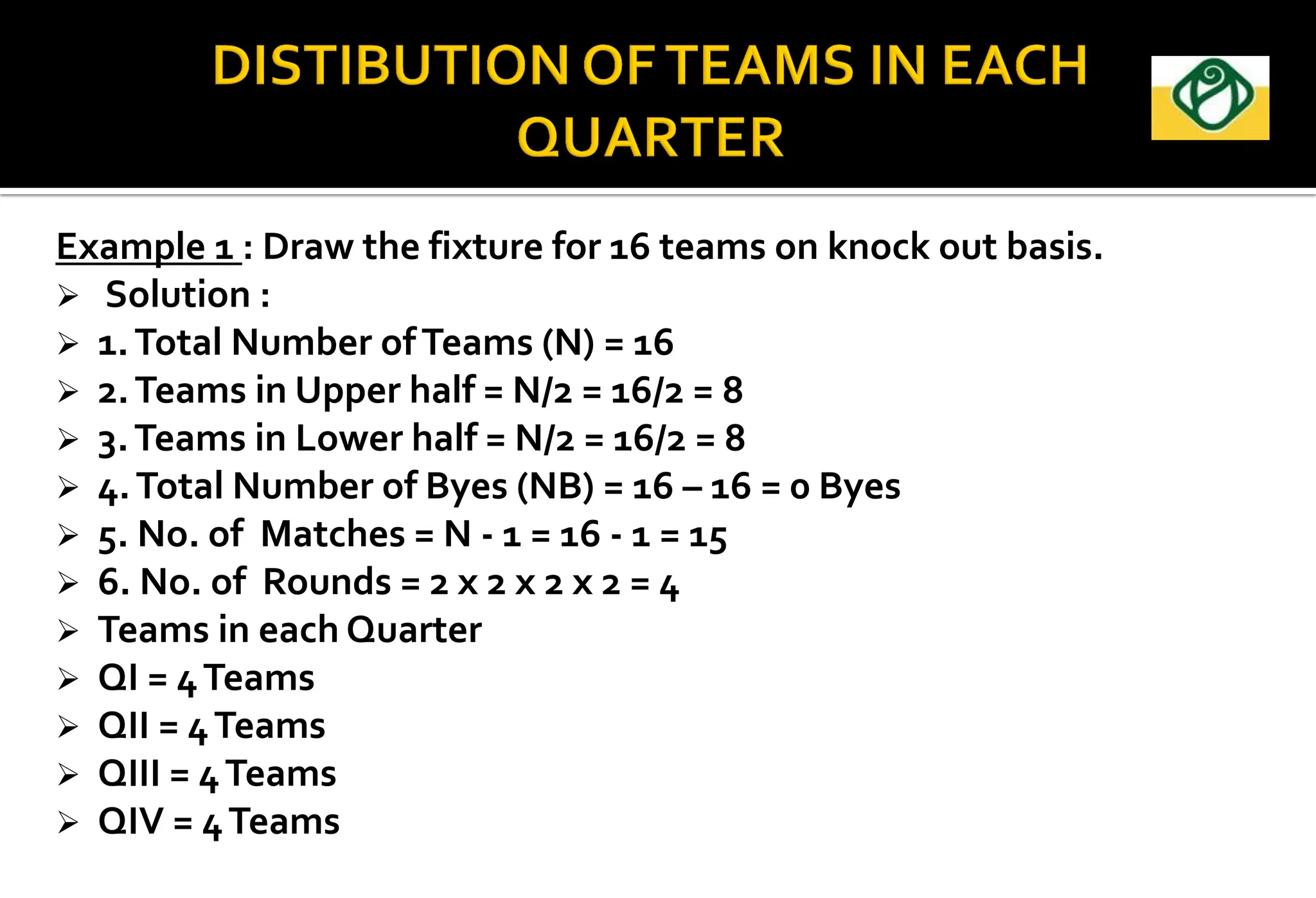
Example 1 : Draw the fixture for 16 teams on knock out basis.
 Solution :
 1.Total Number ofTeams (N) = 16
 2.Teams in Upper half = N/2 = 16/2 = 8
 3.Teams in Lower half = N/2 = 16/2 = 8
 4.Total Number of Byes (NB) = 16 – 16 = 0 Byes
 5. No. of Matches = N - 1 = 16 - 1 = 15
 6. No. of Rounds = 2 x 2 x 2 x 2 = 4
 Teams in each Quarter
 QI = 4Teams
 QII = 4Teams
 QIII = 4Teams
 QIV = 4Teams
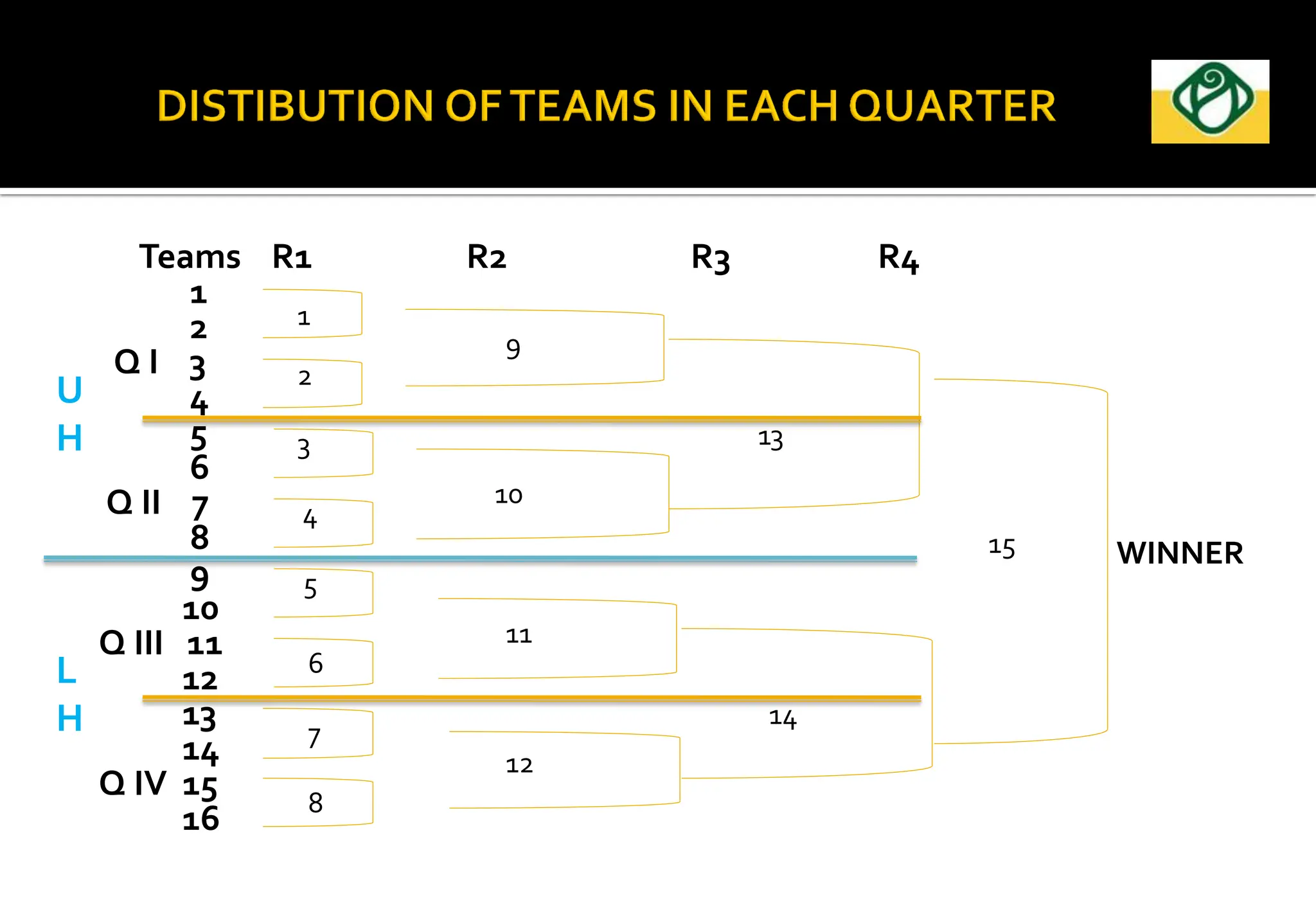
Teams R1 R2 R3 R4
1
2
Q I 3
4
5
6
Q II 7
8
9
10
Q III 11
12
13
14
Q IV 15
16
1
2
3
4
5
6
7
8
WINNER
U
H
L
H
TT
9
10
11
12
13
14
15
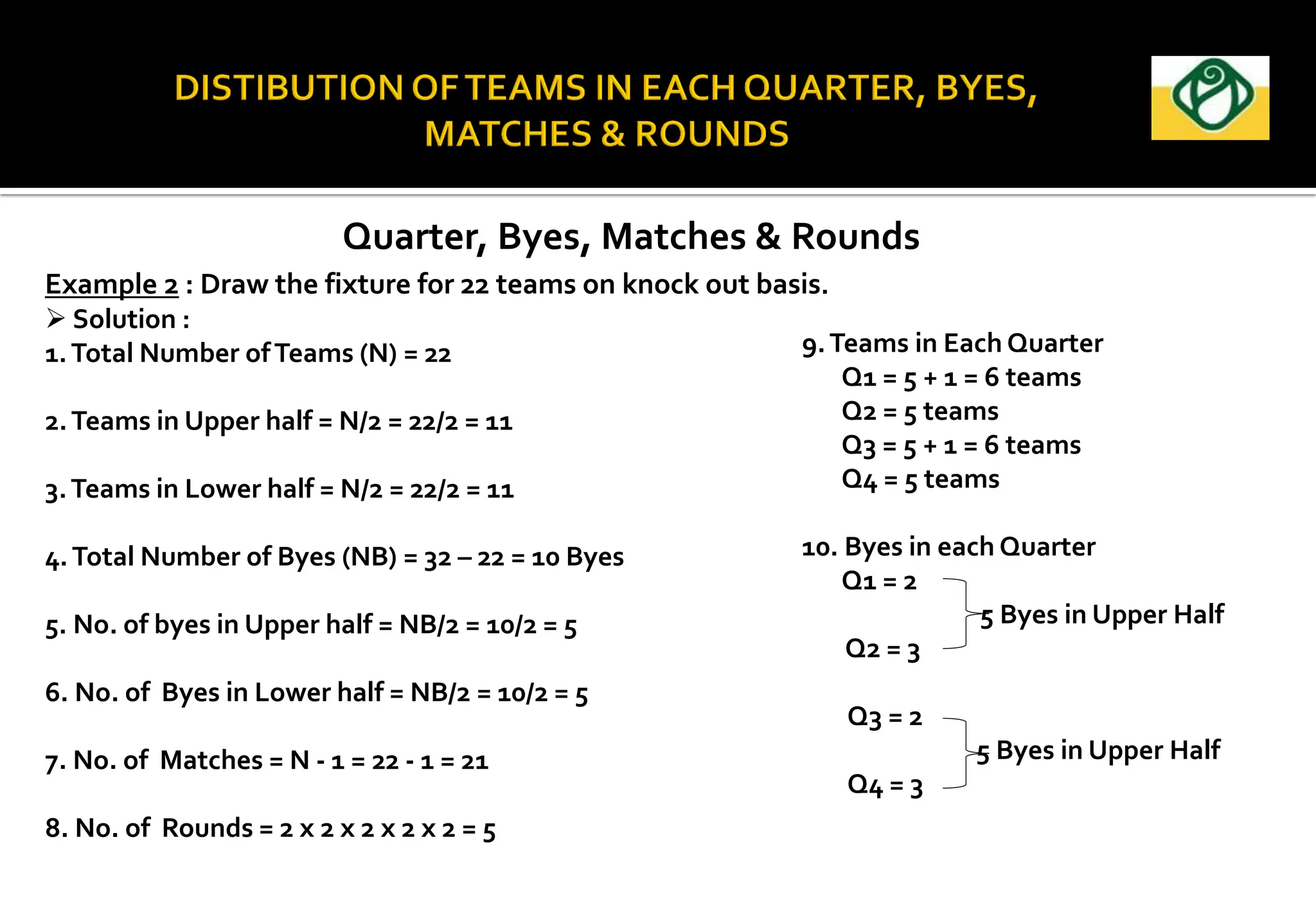
Quarter, Byes, Matches & Rounds
Example 2 : Draw the fixture for 22 teams on knock out basis.
 Solution :
1.Total Number ofTeams (N) = 22
2.Teams in Upper half = N/2 = 22/2 = 11
3.Teams in Lower half = N/2 = 22/2 = 11
4.Total Number of Byes (NB) = 32 – 22 = 10 Byes
5. No. of byes in Upper half = NB/2 = 10/2 = 5
6. No. of Byes in Lower half = NB/2 = 10/2 = 5
7. No. of Matches = N - 1 = 22 - 1 = 21
8. No. of Rounds = 2 x 2 x 2 x 2 x 2 = 5
9.Teams in Each Quarter
Q1 = 5 + 1 = 6 teams
Q2 = 5 teams
Q3 = 5 + 1 = 6 teams
Q4 = 5 teams
10. Byes in each Quarter
Q1 = 2
5 Byes in Upper Half
Q2 = 3
Q3 = 2
5 Byes in Upper Half
Q4 = 3
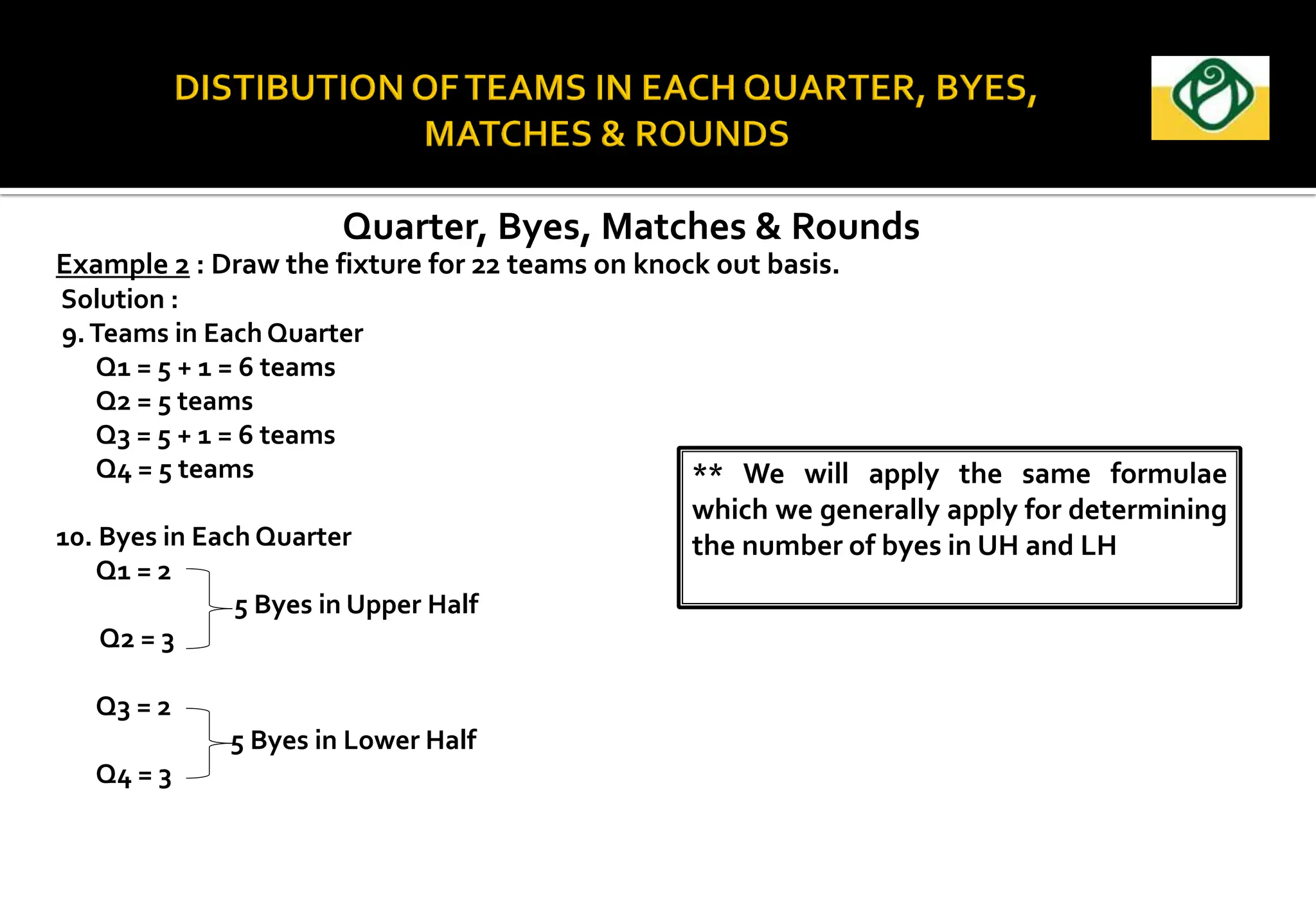
Quarter, Byes, Matches & Rounds
Example 2 : Draw the fixture for 22 teams on knock out basis.
Solution :
9.Teams in Each Quarter
Q1 = 5 + 1 = 6 teams
Q2 = 5 teams
Q3 = 5 + 1 = 6 teams
Q4 = 5 teams
10. Byes in Each Quarter
Q1 = 2
5 Byes in Upper Half
Q2 = 3
Q3 = 2
5 Byes in Lower Half
Q4 = 3
** We will apply the same formulae
which we generally apply for determining
the number of byes in UH and LH
Teams R1 R2 R3 R4 R5
1 - Bye 2
2
3
Q I 4
5
6 - Bye 4
7 - Bye 3
8
Q II 9
10 - Bye 5
11 - Bye 1
12 - Bye 2
13
14
Q III 15
16
17 - Bye 4
18 - Bye 3
19
Q IV 20
21 - Bye 5
22 - Bye 1
1
2
3
7
8
9
10
11
WINNER
U
H
L
H
TT
12
13
14
15
16
17
18
19
20
21
4
5
6
Quarter, Byes, Matches & Rounds
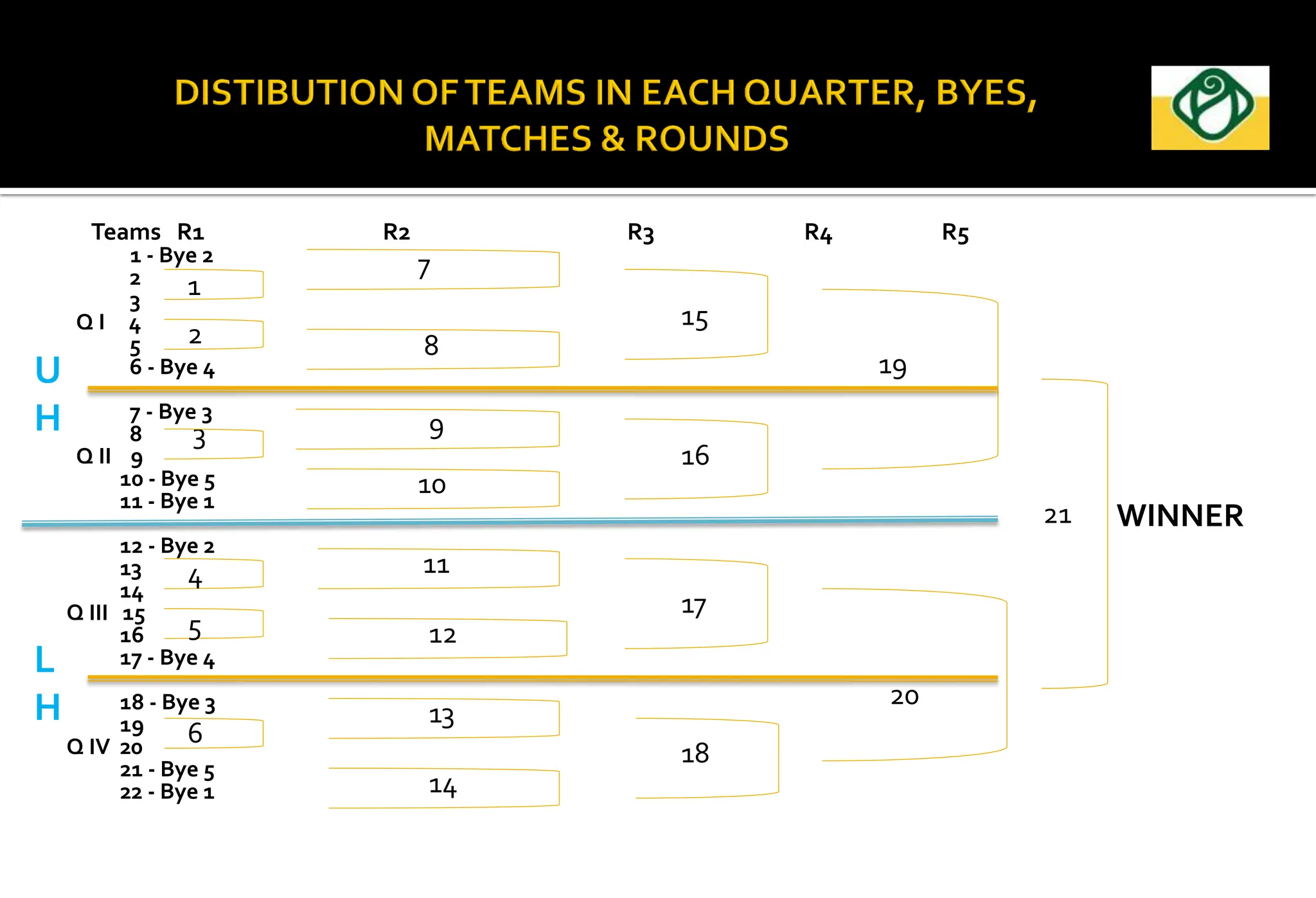
Example 3 : Draw the fixture for 17 teams on knock out basis.
 Solution :
1.Total Number ofTeams (N) = 17
2.Teams in Upper half = (N + l)/2 = (17 + 1)/2 = 18/2 = 9
3.Teams in Lower half = (N - l)/2 = (17 - 1)/2 = 16/2 = 8
4.Total Number of Byes (NB) = 32 – 17 = 15 Byes
5. No. of byes in Upper half = (NB – I)/2 = (15 - 1)/2 = 14/2 = 7
6. No. of Byes in Lower half = (NB + I)/2 = (15 + 1)/2 = 16/2 = 8
7. No. of Matches = N - 1 = 17 - 1 = 16
8. No. of Rounds = 2 x 2 x 2 x 2 x 2 = 5
Quarter, Byes, Matches & Rounds
Example 3 : Draw the fixture for 17 teams on knock out basis.
Solution :
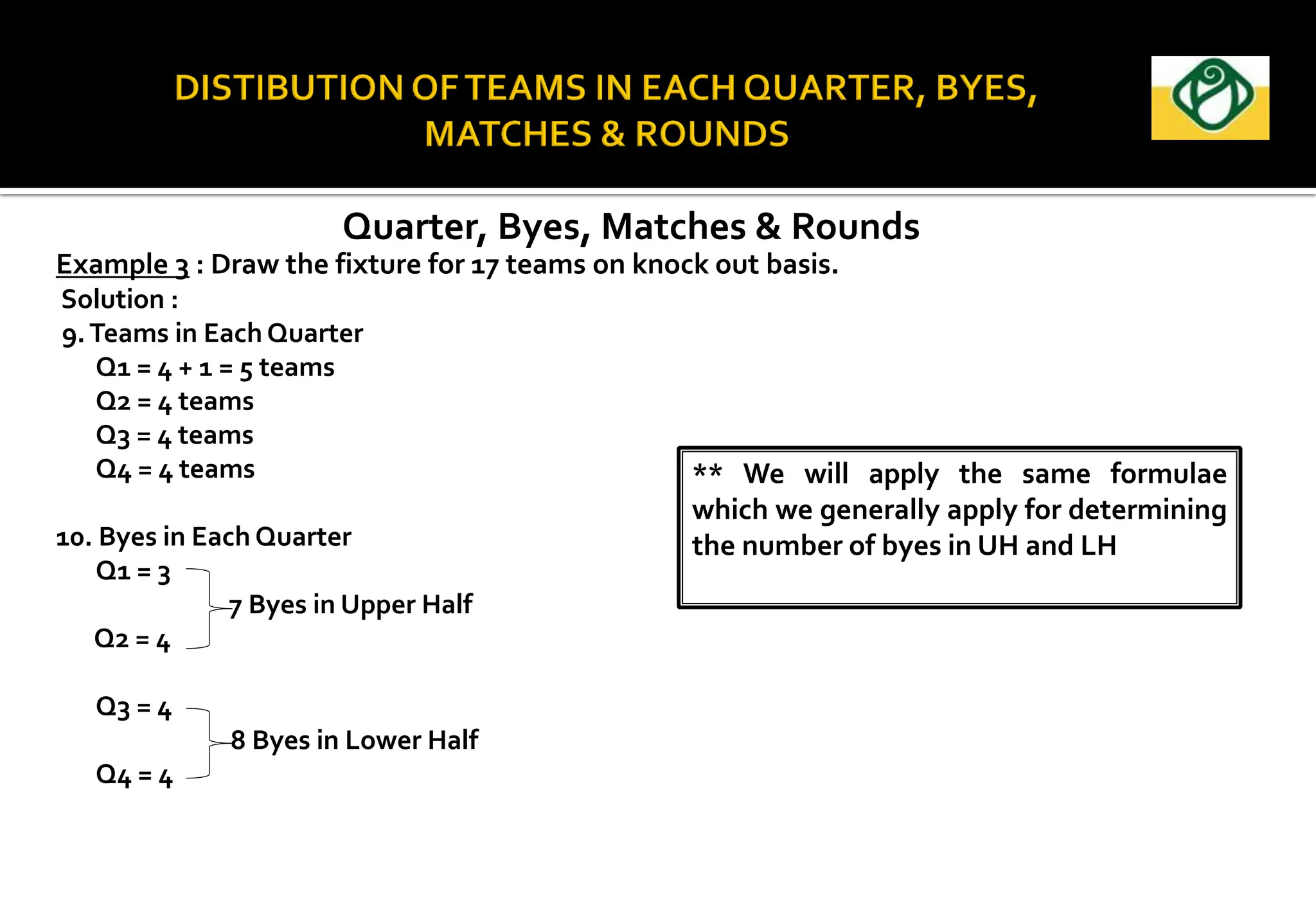
9.Teams in Each Quarter
Q1 = 4 + 1 = 5 teams
Q2 = 4 teams
Q3 = 4 teams
Q4 = 4 teams
10. Byes in Each Quarter
Q1 = 3
7 Byes in Upper Half
Q2 = 4
Q3 = 4
8 Byes in Lower Half
Q4 = 4
** We will apply the same formulae
which we generally apply for determining
the number of byes in UH and LH
Teams R1 R2 R3 R4 R5
1 - Bye 2
2
Q I 3
4 - Bye 3
5 - Bye 1
6 - Bye 2
Q II 7 - Bye 4
8 - Bye 3
9 - Bye 1
10 - Bye 2
11 - Bye 4
Q III 12 - Bye 3
13 - Bye 1
14 - Bye 2
15 - Bye 4
Q IV 16 - Bye 3
17 - Bye 1
1 2
3
4
5
6
7
8
WINNER
U
H
L
H
TT
10
11
12
13
14
15
16
9
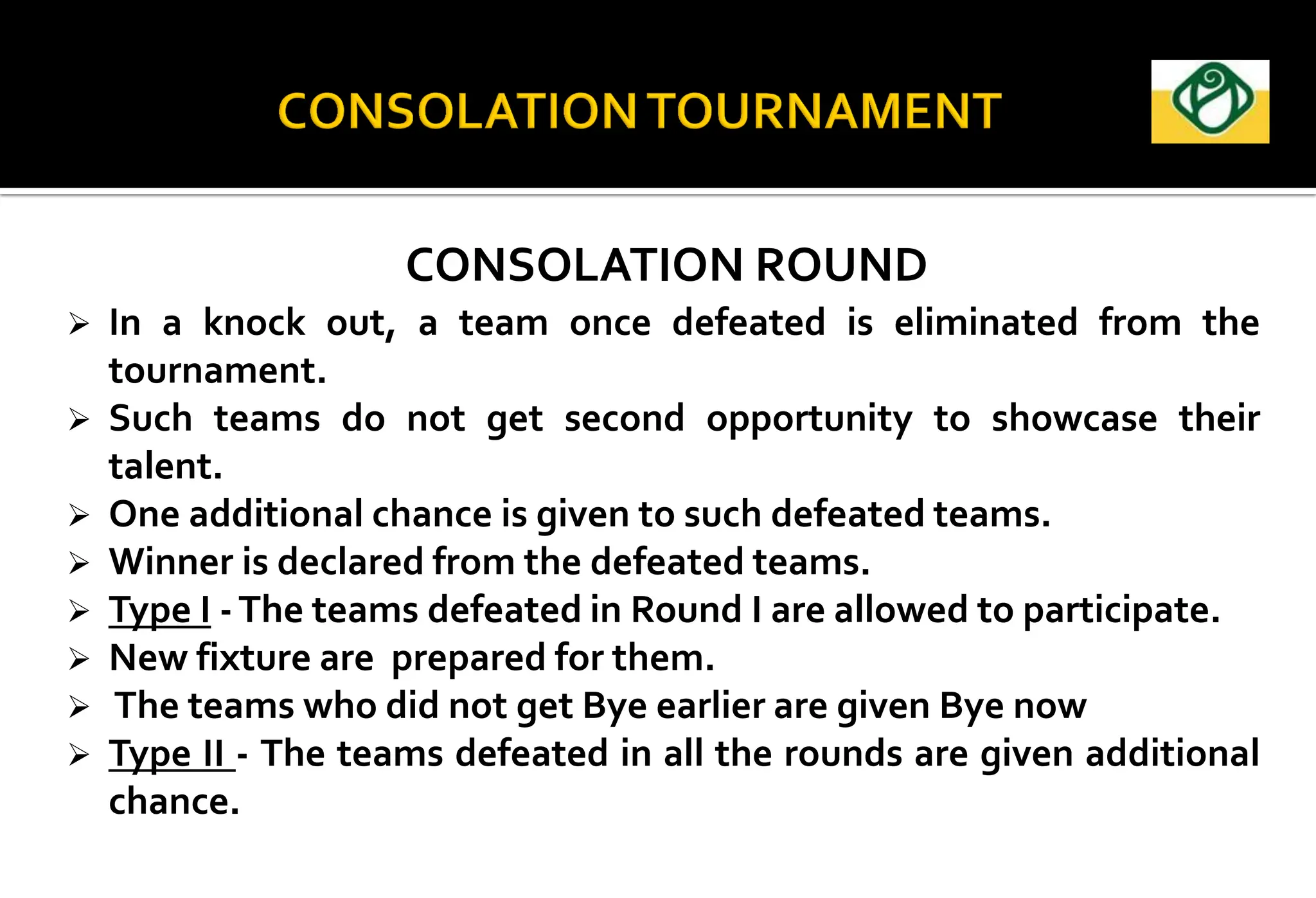
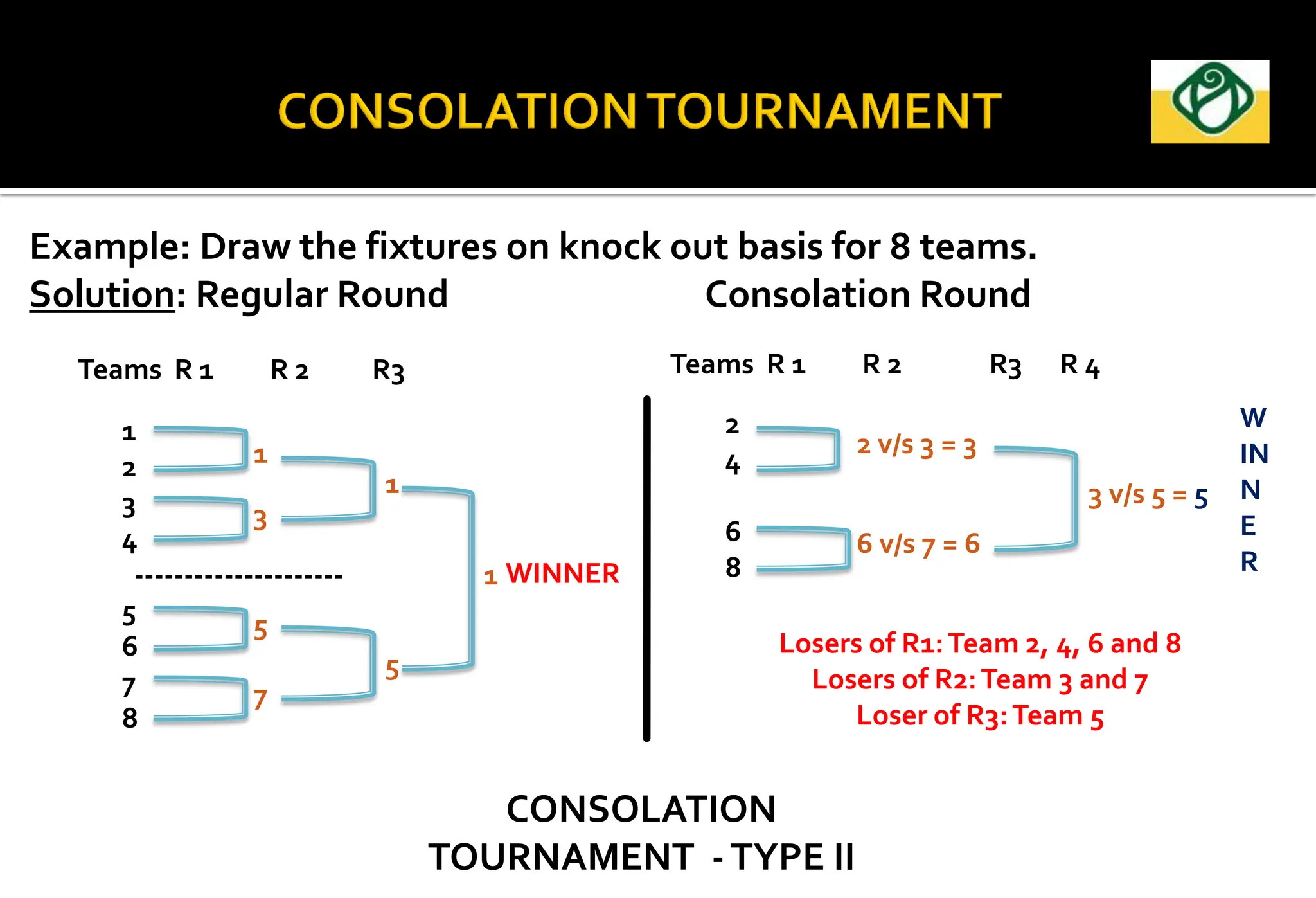
CONSOLATION ROUND
 In a knock out, a team once defeated is eliminated from the
tournament.
 Such teams do not get second opportunity to showcase their
talent.
 One additional chance is given to such defeated teams.
 Winner is declared from the defeated teams.
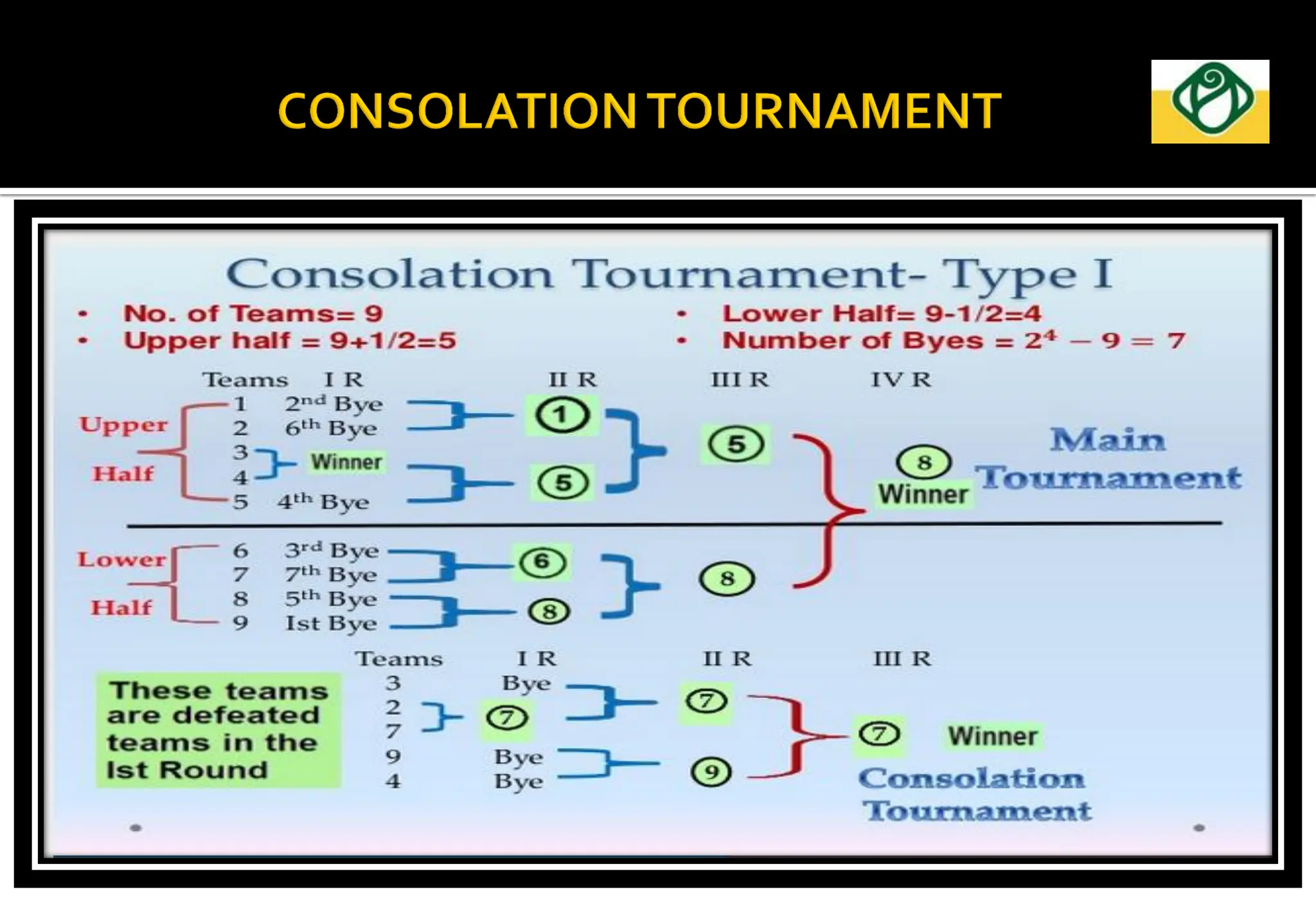
 Type I -The teams defeated in Round I are allowed to participate.
 New fixture are prepared for them.
 The teams who did not get Bye earlier are given Bye now
 Type II - The teams defeated in all the rounds are given additional
chance.
Example: Draw the fixtures on knock out basis for 8 teams.
Solution: Regular Round Consolation Round
1
2
3
4
---------------------
5
6
7
8
Teams R 1 R 2 R3
1
3
5
7
1
5
WINNER
2
4
6
8
Teams R 1 R 2 R3 R 4
2 v/s 3 = 3
6 v/s 7 = 6
1
3 v/s 5 = 5
W
IN
N
E
R
Losers of R1:Team 2, 4, 6 and 8
Losers of R2:Team 3 and 7
Loser of R3:Team 5
CONSOLATION
TOURNAMENT -TYPE II
What does it mean?
 In a knock out tournament strong teams may be paired with weak teams or all the strong
teams might have been grouped in either Upper Half or Lower Half.
 Due to this strong teams may get eliminated in the preliminary rounds.
 Strong teams are selected to keep them at appropriate place in the fixture.
 Placing the good teams (previous position holder) at beneficiary places in the knock out
fixture.
 Organizers should be well aware of the performances of the teams of the last year.
 Generally, the number of seeded teams shall be in the power of 2, i.e. 2,4,8,16 etc.
 All the teams except the seeded teams are kept in the fixture by lots.
How to arrange these teams at their deserving places in the fixtures?
 Winner team will be placed at the top of the Upper Half.
 Runner up team will be placed at the last spot of the Lower Half.
 If 4 teams are to be Seeded, then first two teams will be kept at the places
mentioned above.
 3rd Seeded team will be placed at the top of the Lower Half.
 4th Seeded team will be placed at the last spot of the Upper Half.
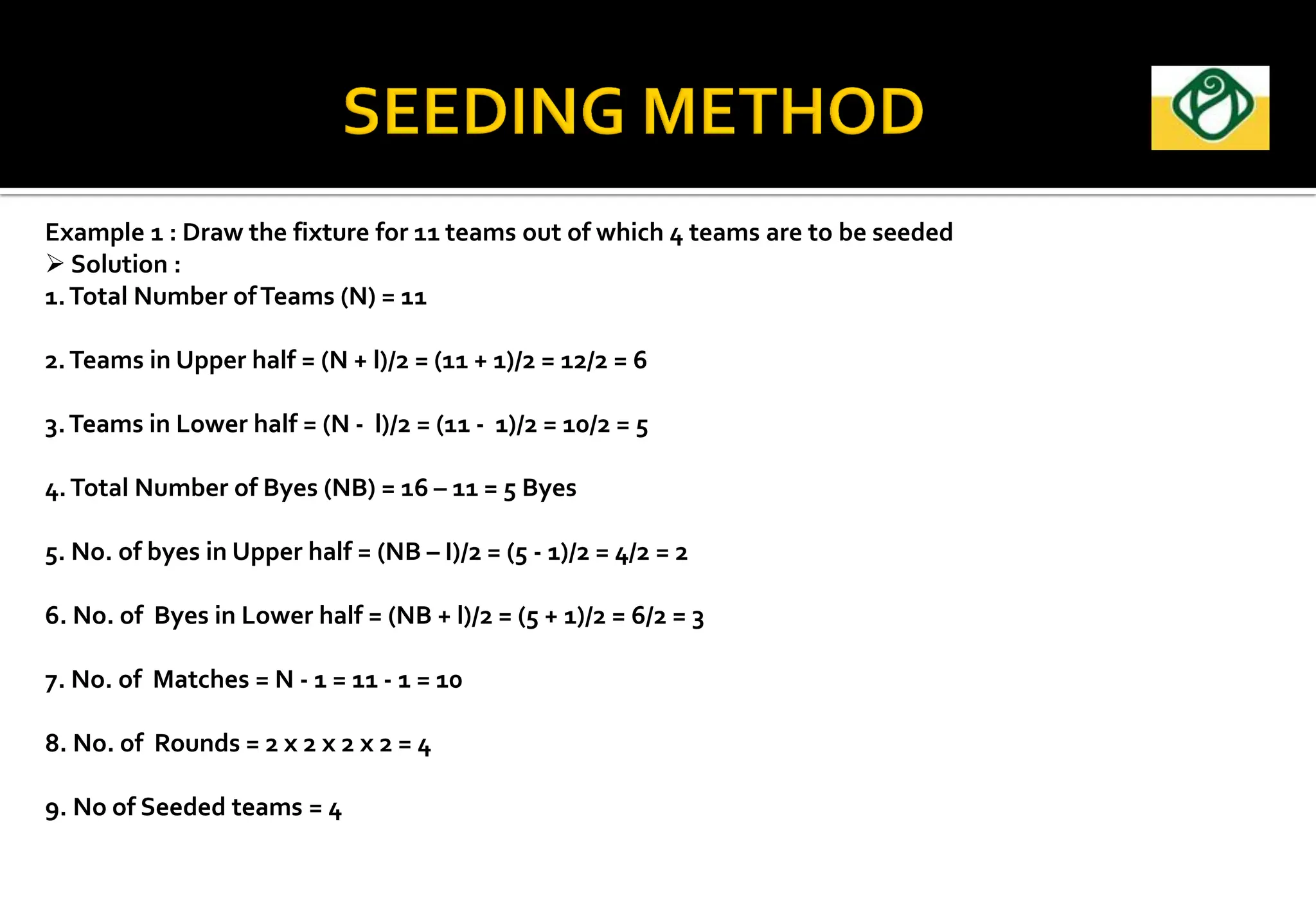
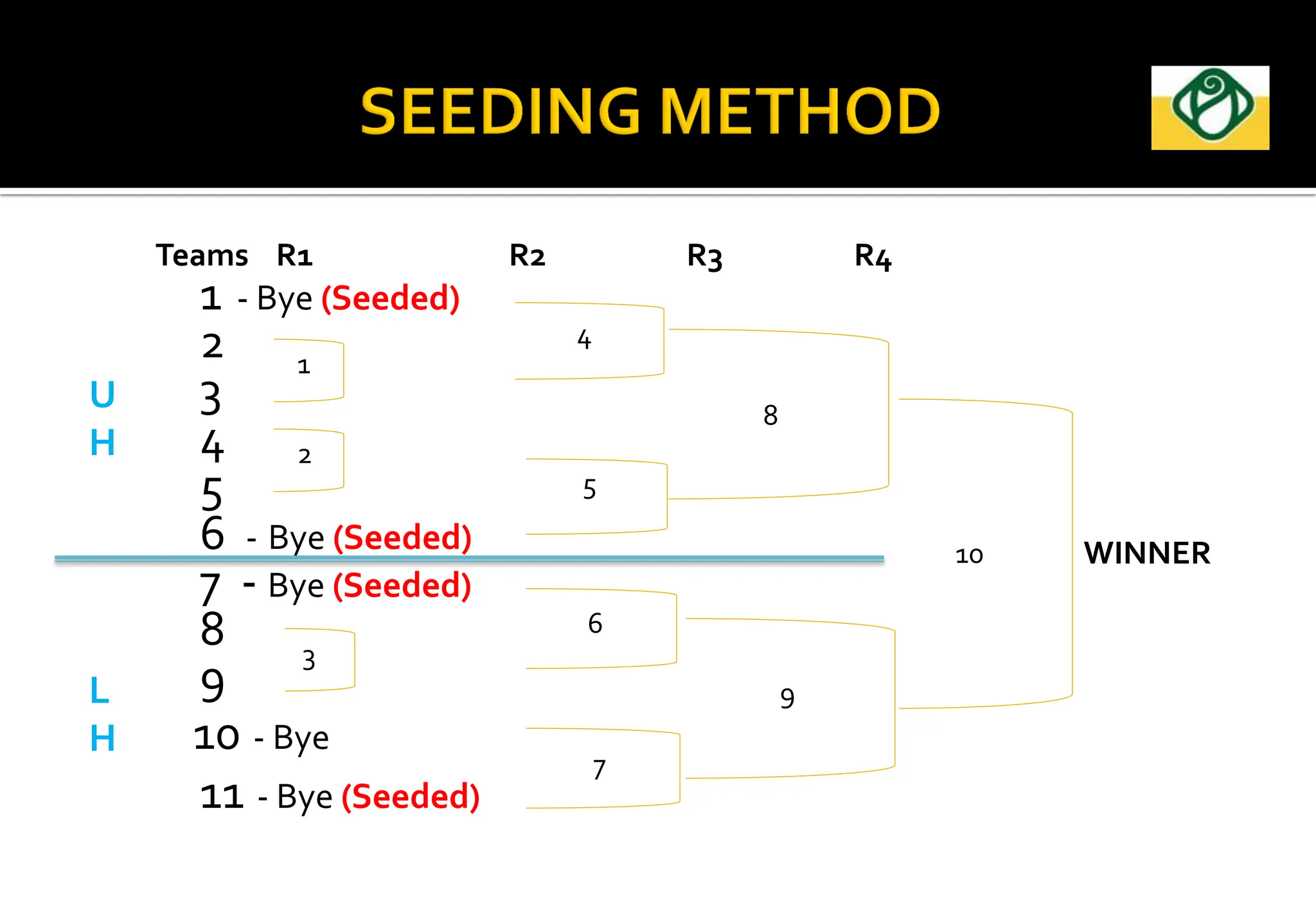
Example 1 : Draw the fixture for 11 teams out of which 4 teams are to be seeded
 Solution :
1.Total Number ofTeams (N) = 11
2.Teams in Upper half = (N + l)/2 = (11 + 1)/2 = 12/2 = 6
3.Teams in Lower half = (N - l)/2 = (11 - 1)/2 = 10/2 = 5
4.Total Number of Byes (NB) = 16 – 11 = 5 Byes
5. No. of byes in Upper half = (NB – I)/2 = (5 - 1)/2 = 4/2 = 2
6. No. of Byes in Lower half = (NB + l)/2 = (5 + 1)/2 = 6/2 = 3
7. No. of Matches = N - 1 = 11 - 1 = 10
8. No. of Rounds = 2 x 2 x 2 x 2 = 4
9. No of Seeded teams = 4
Teams R1 R2 R3 R4
1 - Bye (Seeded)
2
3
4
5
6 - Bye (Seeded)
7 - Bye (Seeded)
8
9
10 - Bye
11 - Bye (Seeded)
1
2
3
4
5
6
7
8
WINNER
U
H
L
H
TT
9
10
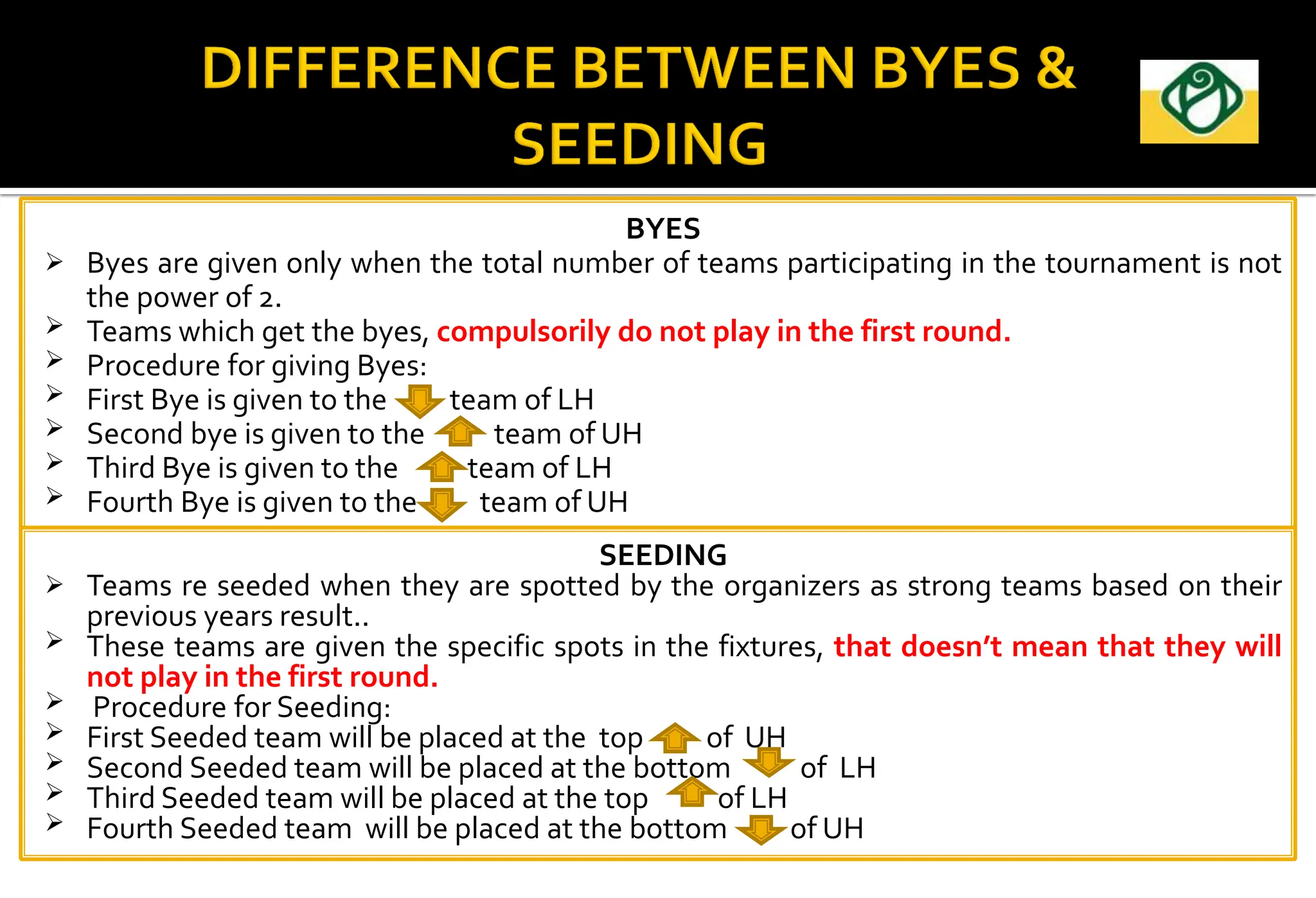
BYES
 Byes are given only when the total number of teams participating in the tournament is not
the power of 2.
 Teams which get the byes, compulsorily do not play in the first round.
 Procedure for giving Byes:
 First Bye is given to the team of LH
 Second bye is given to the team of UH
 Third Bye is given to the team of LH
 Fourth Bye is given to the team of UH
SEEDING
 Teams re seeded when they are spotted by the organizers as strong teams based on their
previous years result..
 These teams are given the specific spots in the fixtures, that doesn’t mean that they will
not play in the first round.
 Procedure for Seeding:
 First Seeded team will be placed at the top of UH
 Second Seeded team will be placed at the bottom of LH
 Third Seeded team will be placed at the top of LH
 Fourth Seeded team will be placed at the bottom of UH
 How to divide the total number of teams in each Quarter.
 How to divide the total number of byes in Upper Half & Lower Half.
 How to distribute the byes in all the Quarters.
 What is seeding.
 The difference between Byes and Seeding.
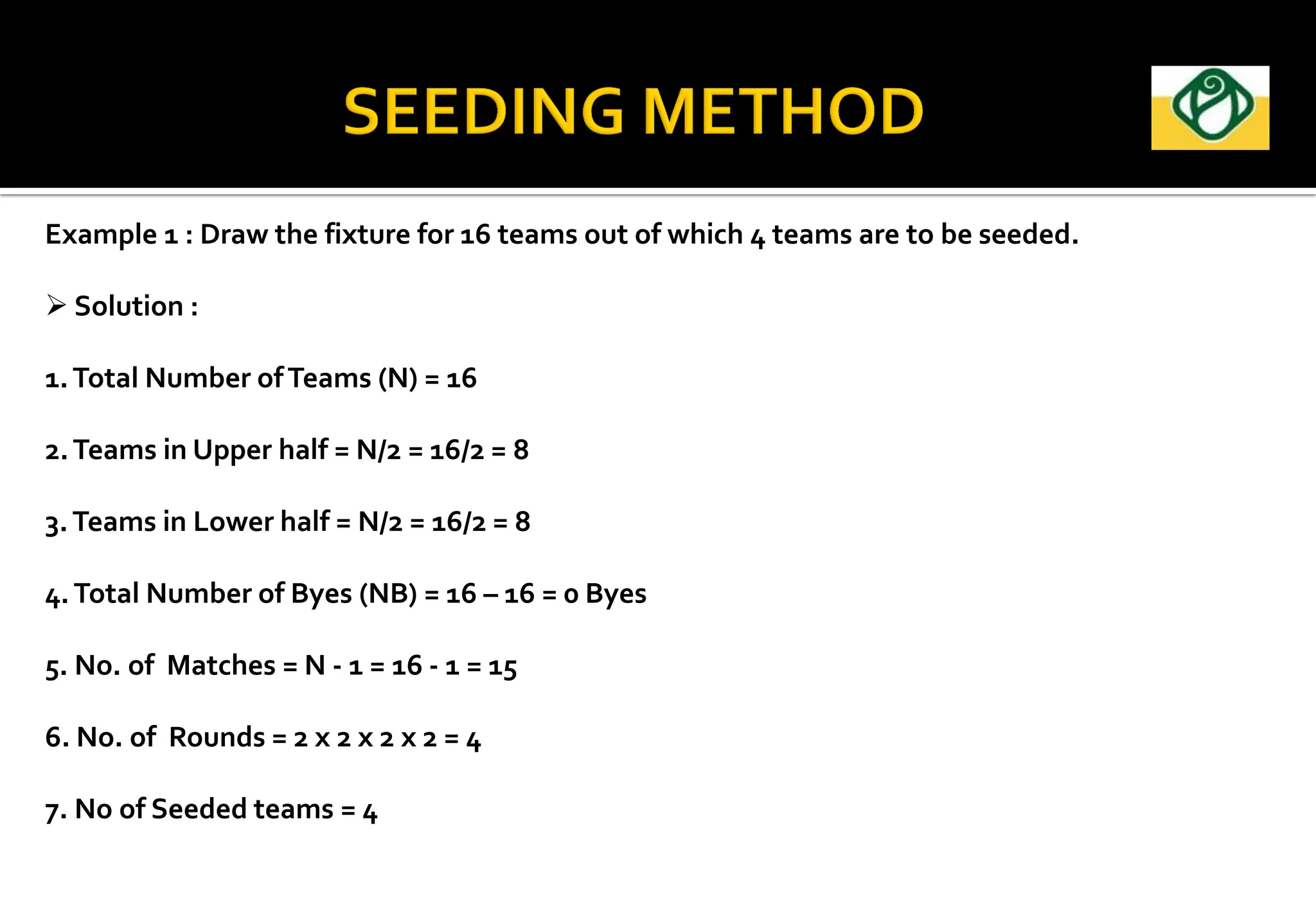
 Draw the fixture for 16 teams out of which 4 teams are to be seeded
Example 1 : Draw the fixture for 16 teams out of which 4 teams are to be seeded.
 Solution :
1.Total Number ofTeams (N) = 16
2.Teams in Upper half = N/2 = 16/2 = 8
3.Teams in Lower half = N/2 = 16/2 = 8
4.Total Number of Byes (NB) = 16 – 16 = 0 Byes
5. No. of Matches = N - 1 = 16 - 1 = 15
6. No. of Rounds = 2 x 2 x 2 x 2 = 4
7. No of Seeded teams = 4
Teams R1 R2 R3 R4
1 - (Seeded)
2
3
4
5
6
7
8 - (Seeded)
9 - (Seeded)
10
11
12
13
14
15
16 - (Seeded)
1
2
3
4
5
6
7
8
WINNER
U
H
L
H
TT
9
10
11
12
13
14
15
Example 2 : Draw the fixture for 20 teams out of which 4 teams are to be seeded.
 Solution :
1.Total Number ofTeams (N) = 20
2.Teams in Upper half = N/2 = 20/2 = 10
3.Teams in Lower half = N/2 = 20/2 = 10
4.Total Number of Byes (NB) = 32 – 20 = 12 Byes
5. No. of byes in Upper half = NB/2 = 12/2 = 6
6. No. of byes in Lower half = NB/2 = 12/2 = 6
5. No. of Matches = N - 1 = 20 - 1 = 19
6. No. of Rounds = 2 x 2 x 2 x 2 x 2 = 5
7. No of Seeded teams = 4
Teams R1 R2 R3 R4 R5
1 – Bye 2 (Seeded 1)
2 – Bye 6
3 – Bye 10
4
5
6
7
8 – Bye 12
9 – Bye 8
10 – Bye 4 (Seeded 4 )
11 – Bye 3 (Seeded 3 )
12 – Bye 7
13 – Bye 11
14
15
16
17
18 – Bye 9
19 – Bye 5
20 – Bye 1 (Seeded 2)
1
2
3
4
5
6
7
8
WINNER
U
H
L
H
TT
9
10
11
12
13
14
15
16
17
18
19
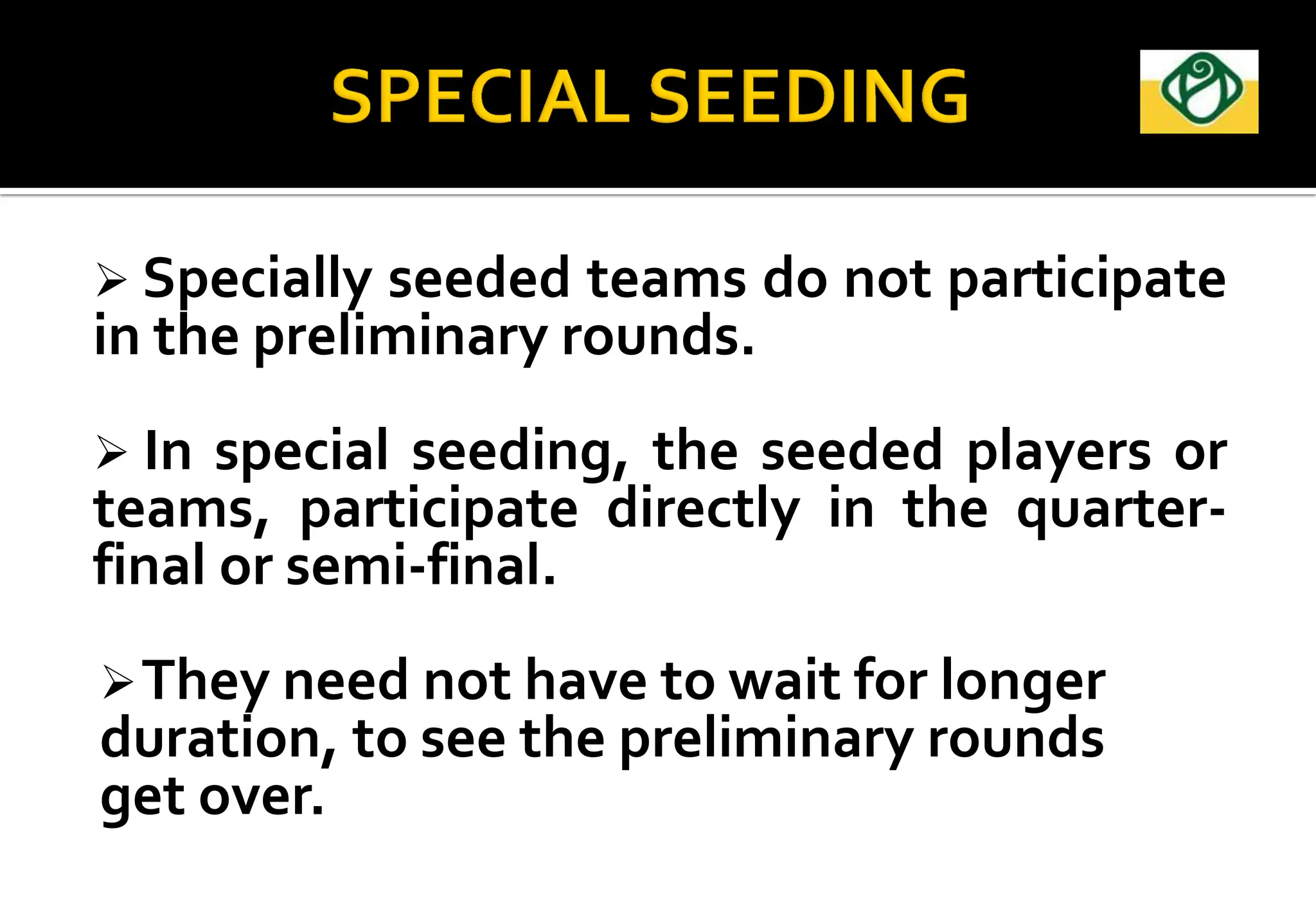
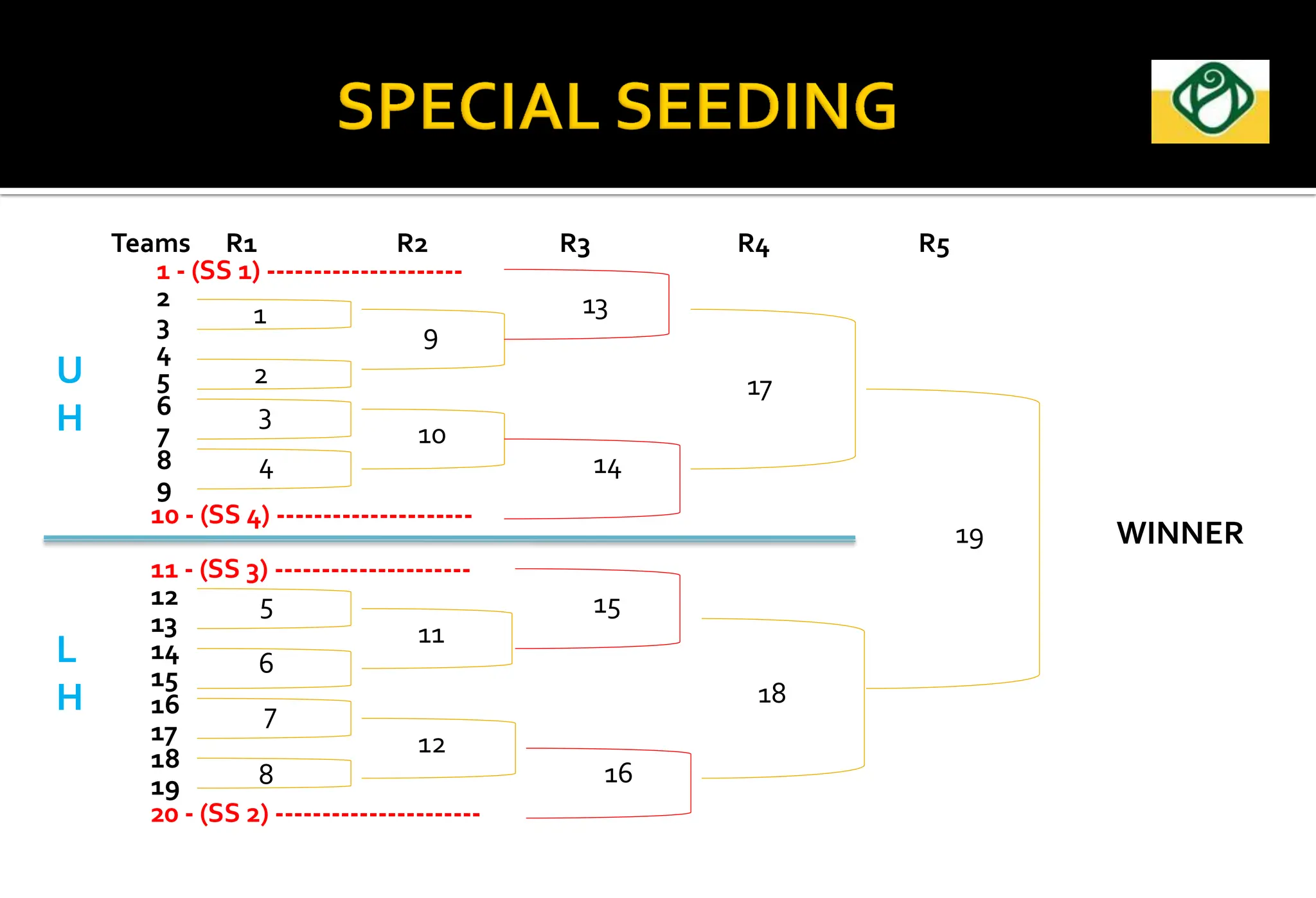
 Specially seeded teams do not participate
in the preliminary rounds.
 In special seeding, the seeded players or
teams, participate directly in the quarter-
final or semi-final.
They need not have to wait for longer
duration, to see the preliminary rounds
get over.
Difference between Seeding and Special Seeding
 Seeding is given to the place holders of last year’s season of the same
tournament whereas Special Seeding is given to the teams which are highly
recognized and internationally known.
 Seeded teams gets the advantage or are being placed at the specific spot
while drawing fixtures. If they don’t get byes for any reasons, these teams will
have to play their matches right from the first round, whereas Special Seeded
teams will directly play in the QF or SF round of the tournament.
Similarity between Seeding and Special Seeding
 Seeded / Specially seeded team 1 will be placed at the top of UH
 Seeded / Specially seeded team 2 will be placed at the bottom of LH
 Seeded / Specially seeded team 3 will be placed at the top of LH
 Seeded / Specially seeded team 4 will be placed at the bottom of UH
Example 1 : Draw the fixtures on knock out basis for 16 teams, out of which 2 teams
have to been given special seeding.
 Solution :
1.Total Number ofTeams (N) = 16
2. Number of seeded teams (SS) = 2
3.Teams in Upper half = N/2 = 16/2 = 8
4.Teams in Lower half = N/2 = 16/2 = 8
5.Total Number of Byes (NB) = 16 – 14= 2 (N – No of SS = 16 – 2 = *14)
6. No. of byes in Upper half = NB/2 = 2/2 = 1
7. No. of byes in Lower half = NB/2 = 2/2 = 1
8. No. of Matches = N - 1 = 16 - 1 = 15
9. No. of Rounds = 2 x 2 x 2 x 2 = 4 + 1 = 5
Teams R1 R2 R3 R4 R5
1 - (SS 1) ---------------------------------
2 - Bye 2
3
4
5
6
7
8
9
10
11
12
13
14
15 - Bye 1
16 - (SS 2)---------------------------------
1
2
3
4
5
6
7
8
WINNER
U
H
L
H
TT
9
10
11
12
13
14
15
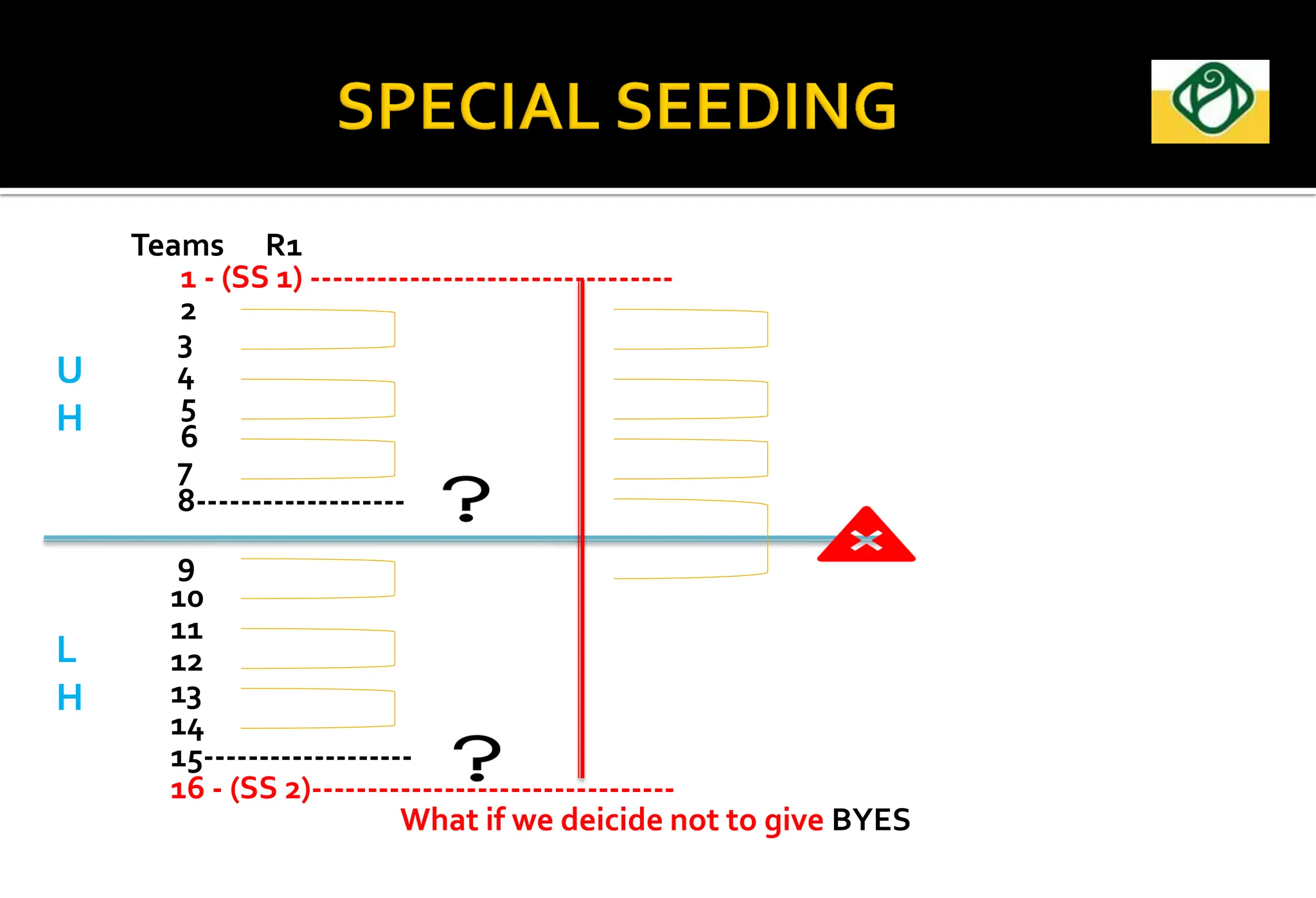
Teams R1
1 - (SS 1) ---------------------------------
2
3
4
5
6
7
8-------------------
9
10
11
12
13
14
15-------------------
16 - (SS 2)---------------------------------
What if we deicide not to give BYES
U
H
L
H
TT
Teams R1 R2 R3 R4
1 - (SS 1) ---------------------------
2 - Bye 2
3
4
5
6
7
8
9
10
11
12
13
14
15 - Bye 1
16 - (SS 2)---------------------------
What if we decide to make the Special SeededTeams play in the QF?
1
2
3
4
5
6
7
8
U
H
L
H
TT
9
10
SF
SF
Teams R1 R2 R3 R4 R5
1 - (SS 1) ---------------------------------
2 - Bye 2
3
4
5
6
7
8
9
10
11
12
13
14
15 - Bye 1
16 - (SS 2)---------------------------------
1
2
3
4
5
6
7
8
WINNER
U
H
L
H
TT
9
10
11
12
13
14
15
Example 2 : Draw the fixtures on knock out basis for 20 teams, out of which 4 teams
have to been given special seeding.
 Solution :
1.Total Number ofTeams (N) = 20
2. Number of seeded teams (SS) = 4
3.Teams in Upper half = N/2 = 20/2 = 10
4.Teams in Lower half = N/2 = 20/2 = 10
5.Total Number of Byes (NB) = 16 – 16 = 0 (N – No of SS = 20 – 4 = *16)
6. No. of Matches = N - 1 = 20 - 1 = 19
7. No. of Rounds = 2 x 2 x 2 x 2 = 4 + 1 = 5
Teams R1 R2 R3 R4 R5
1 - (SS 1) ---------------------
2
3
4
5
6
7
8
9
10 - (SS 4) ---------------------
11 - (SS 3) ---------------------
12
13
14
15
16
17
18
19
20 - (SS 2) ----------------------
1
2
3
4
5
6
7
8
WINNER
U
H
L
H
TT
9
10
11
12
13
14
15
16
17
18
19
 What is Special Seeding.
 The difference between Seeding and Special Seeding.
 Draw the fixtures on knock out basis for 25 teams, out of which 4 teams
have been given the special seeding.
 Draw the fixtures on knock out basis for 34 teams, out of which 2 teams
have been given the special seeding.
LEAGUE
The following methods are used for Fixtures in
LeagueTournament:
 Cyclic Method
 Staircase Method
 Tabular Method
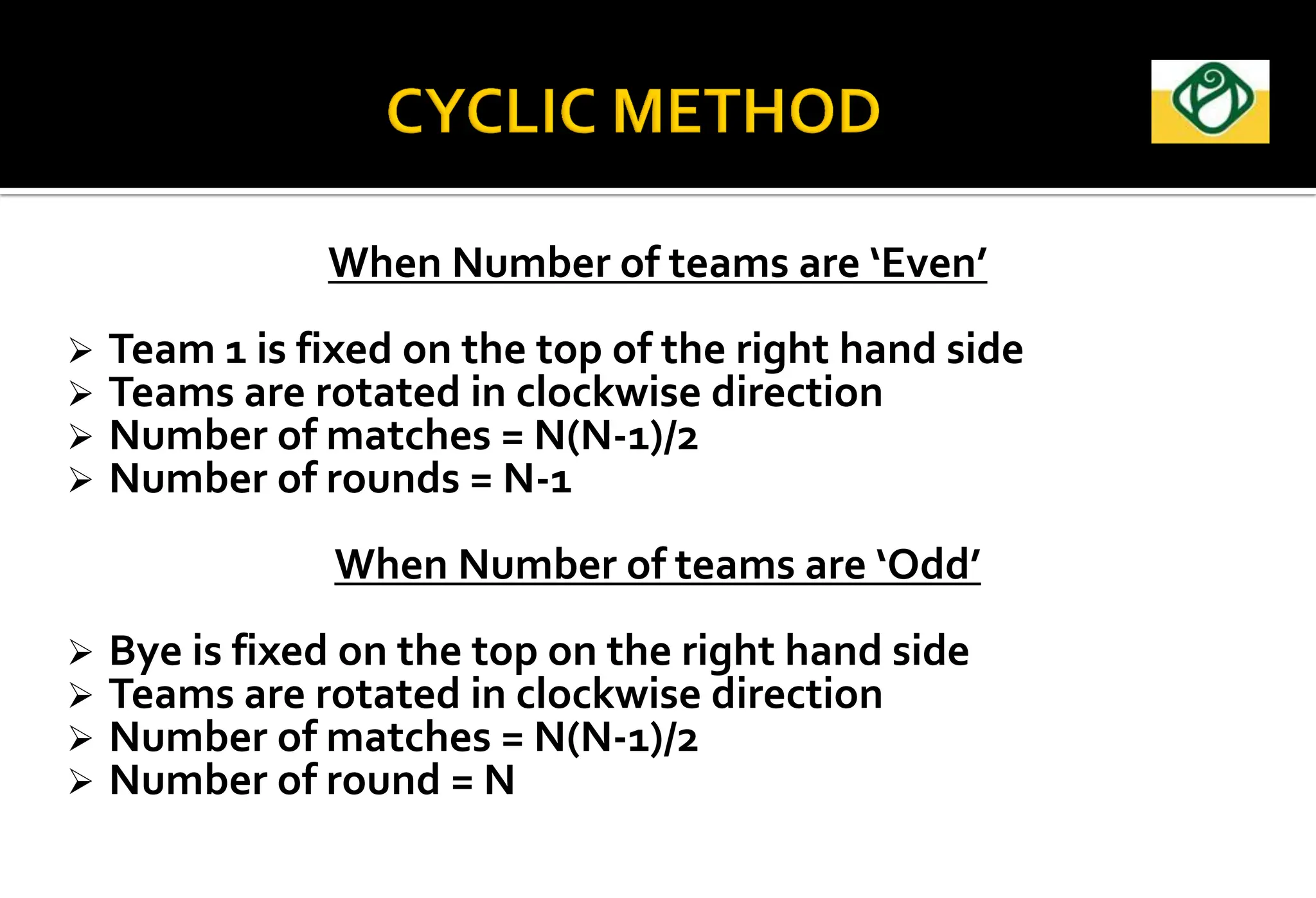
When Number of teams are ‘Even’
 Team 1 is fixed on the top of the right hand side
 Teams are rotated in clockwise direction
 Number of matches = N(N-1)/2
 Number of rounds = N-1
When Number of teams are ‘Odd’
 Bye is fixed on the top on the right hand side
 Teams are rotated in clockwise direction
 Number of matches = N(N-1)/2
 Number of round = N
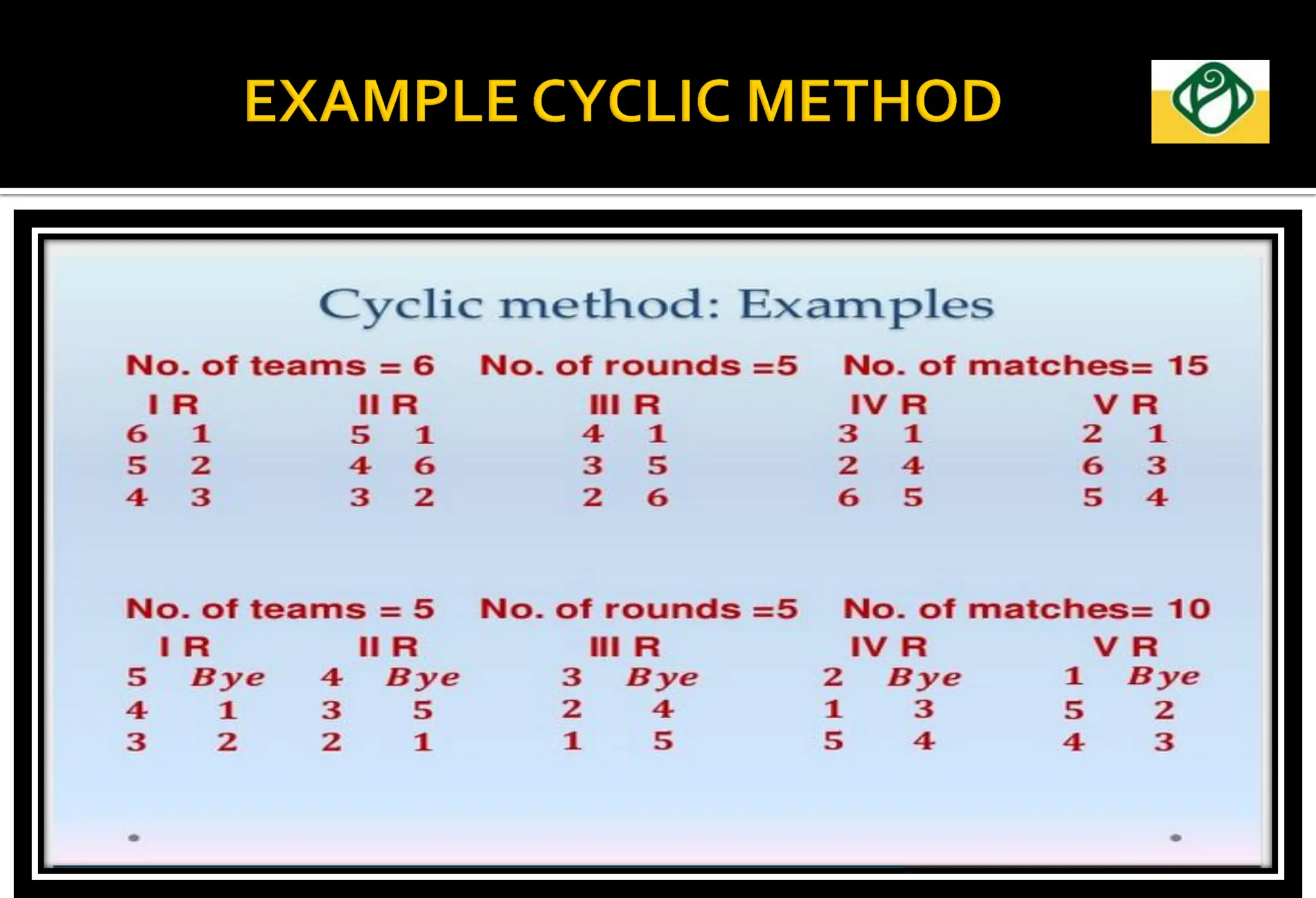
Total number of teams = 6 (EvenTeams)
Total Number of Matches = N(N – l)/2 = 15
Total Number of Rounds = N - 1 = 5
lR llR lllR lVR VR
6 1
5 2
4 3
5 1
4 6
3 2
4 1
3 5
2 6
3 1
2 4
6 5
2 1
6 3
5 4
Total number of teams = 5 (OddTeams)
Total Number of Matches = N(N – l)/2 = 10
Total Number of Rounds = N = 5
lR ll R lllR lVR VR
5 B
4 1
3 2
4 B
3 5
2 1
3 B
2 4
1 5
2 B
1 3
5 4
1 B
5 2
4 3
lR ll R lllR lVR VR
5 B
4 1
3 2
4 B
3 5
2 1
3 B
2 4
1 5
2 B
1 3
5 4
1 B
5 2
4 3
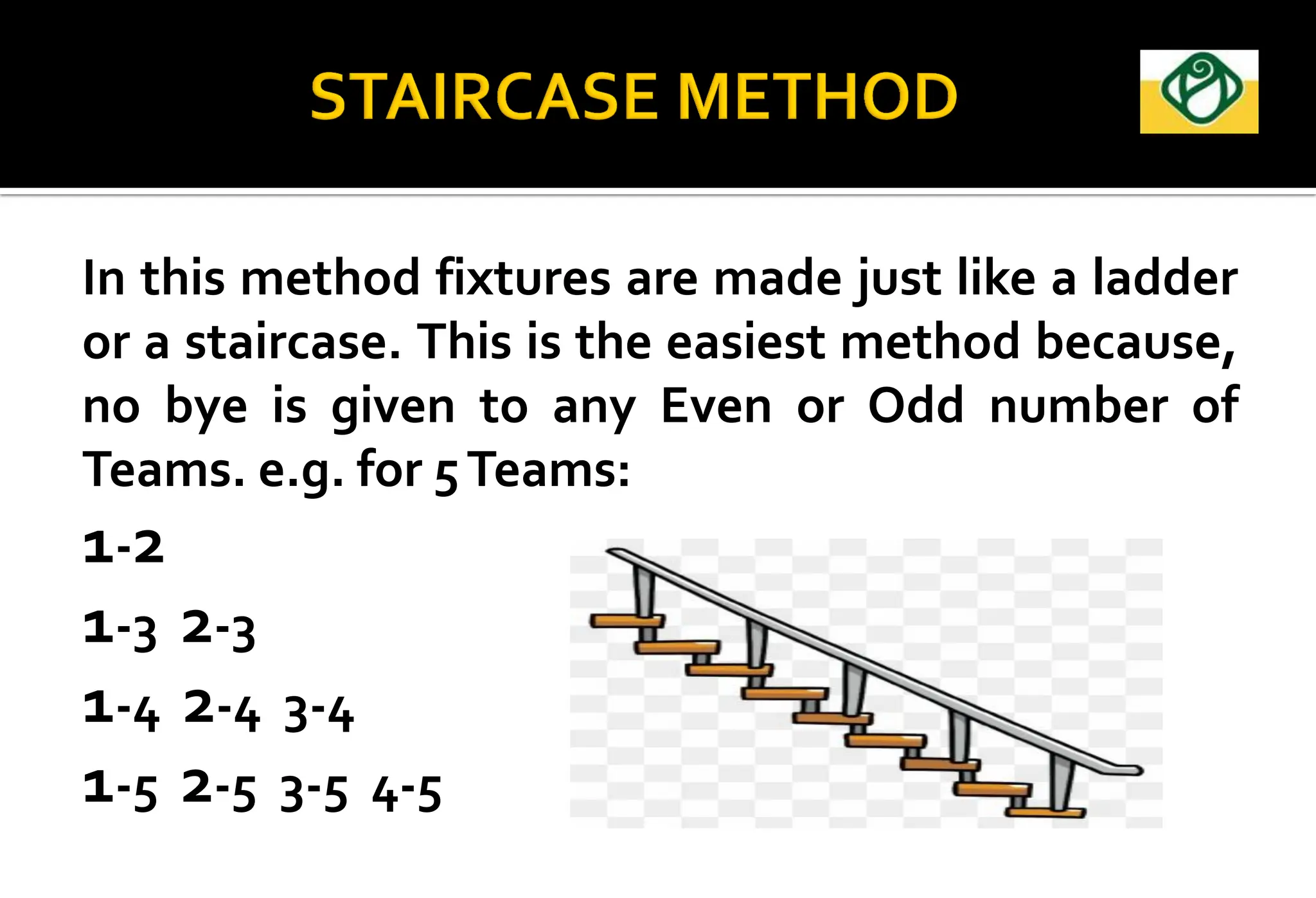
In this method fixtures are made just like a ladder
or a staircase. This is the easiest method because,
no bye is given to any Even or Odd number of
Teams. e.g. for 5Teams:
1-2
1-3 2-3
1-4 2-4 3-4
1-5 2-5 3-5 4-5
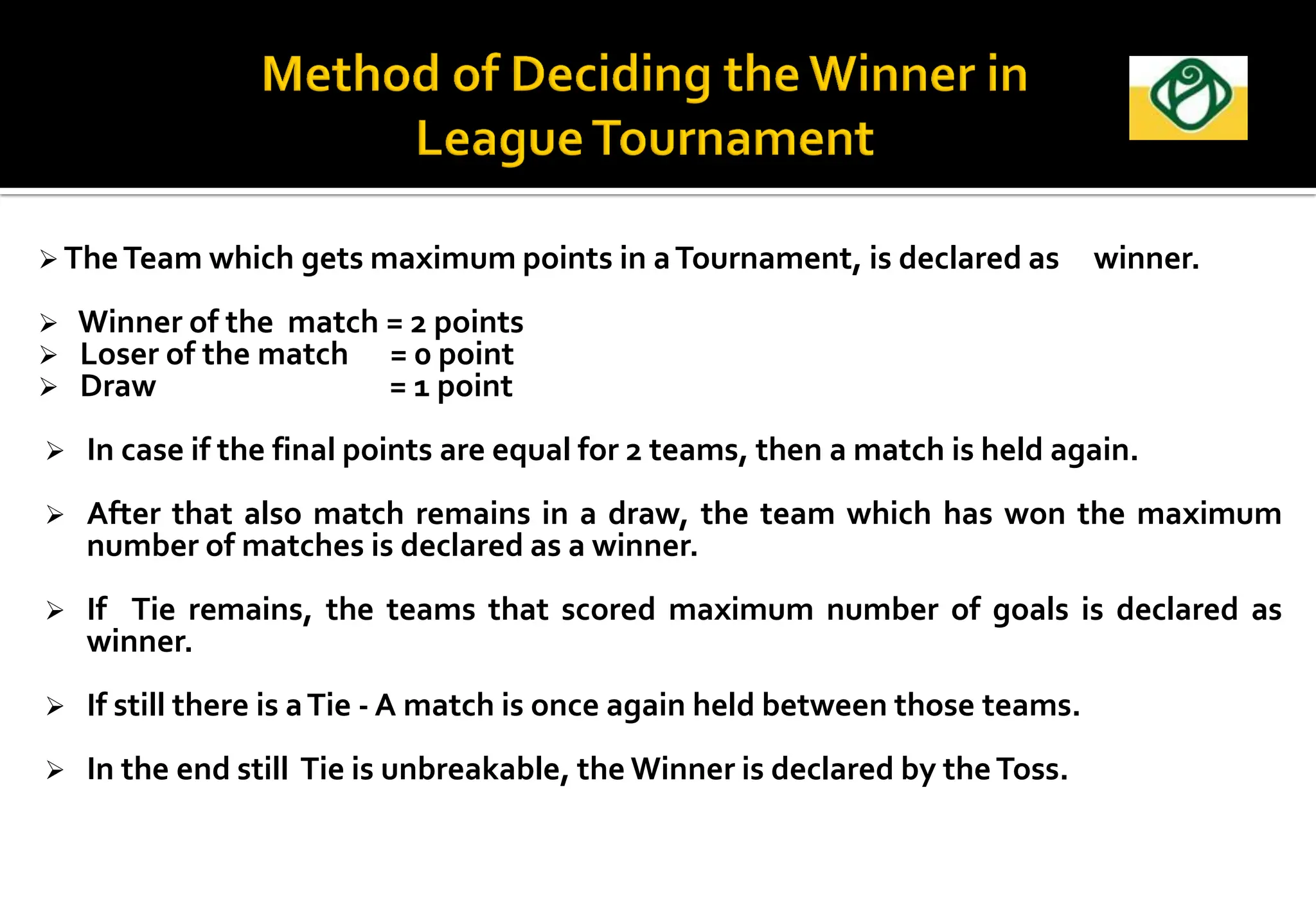
 TheTeam which gets maximum points in aTournament, is declared as winner.
 Winner of the match = 2 points
 Loser of the match = 0 point
 Draw = 1 point
 In case if the final points are equal for 2 teams, then a match is held again.
 After that also match remains in a draw, the team which has won the maximum
number of matches is declared as a winner.
 If Tie remains, the teams that scored maximum number of goals is declared as
winner.
 If still there is aTie - A match is once again held between those teams.
 In the end still Tie is unbreakable, the Winner is declared by theToss.
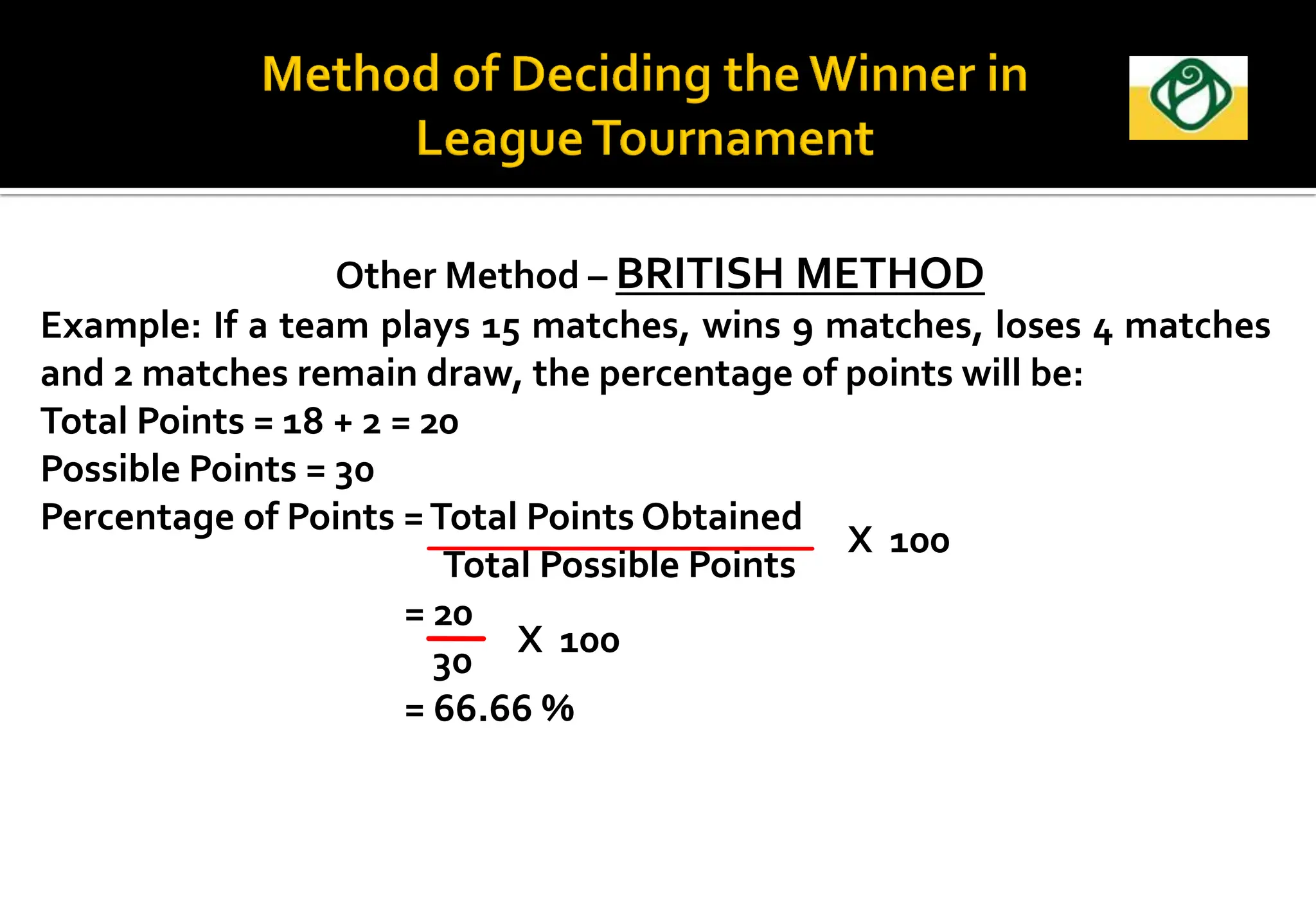
Other Method – BRITISH METHOD
Example: If a team plays 15 matches, wins 9 matches, loses 4 matches
and 2 matches remain draw, the percentage of points will be:
Total Points = 18 + 2 = 20
Possible Points = 30
Percentage of Points =Total Points Obtained
Total Possible Points
= 20
30
= 66.66 %
X 100
X 100
Other Method – AMERICAN METHOD
Example: If a team plays 16 matches, and wins 10 matches out of them,
the percentage of points will be:
Percentage of Points = Matches Won
Matches Played
= 10
16
= 62.5 %
In this method,Tie is not counted at all.
X 100
X 100
 Draw fixtures for 16 teams on league basis according to the Cyclic
Method.
 Draw fixtures for 13 teams on league basis according to the Cyclic
Method.
 Draw fixtures for 16 teams on league basis according to the
Staircase Method.
The word ‘Intramural’ is derived from the Latin words
‘Intra’ and ‘Muralis’
Intra means within the School or Campus.
Muralis means Wall.
It means that the activities which are performed within the walls or campus
of an institution are called ‘Intramurals’.
The motto of Intramural is “A game for each and each for a game”.
Intramural competition is one of the best means to motivate all the students
of an institution for taking part in Games and Sports.
 To provide opportunity to every one to participate in Games & Sports
 To develop the Leadership qualities
 To develop the feeling of Cooperation
 To provide Recreation
 To develop Sportsman spirit
 To provide opportunity to learn various Skills of different games
 To identifyTalent of sportsperson
 8.To develop Personality
 Intramural are Important for physical, mental, emotional and
social development of students.
 Stress on moral and ethical values.
 Development of health.
 To tone up fighting instinct of students.
 Provide opportunities to participate in games.
 Develop leadership qualities among the students.
 Ample opportunities for participation.
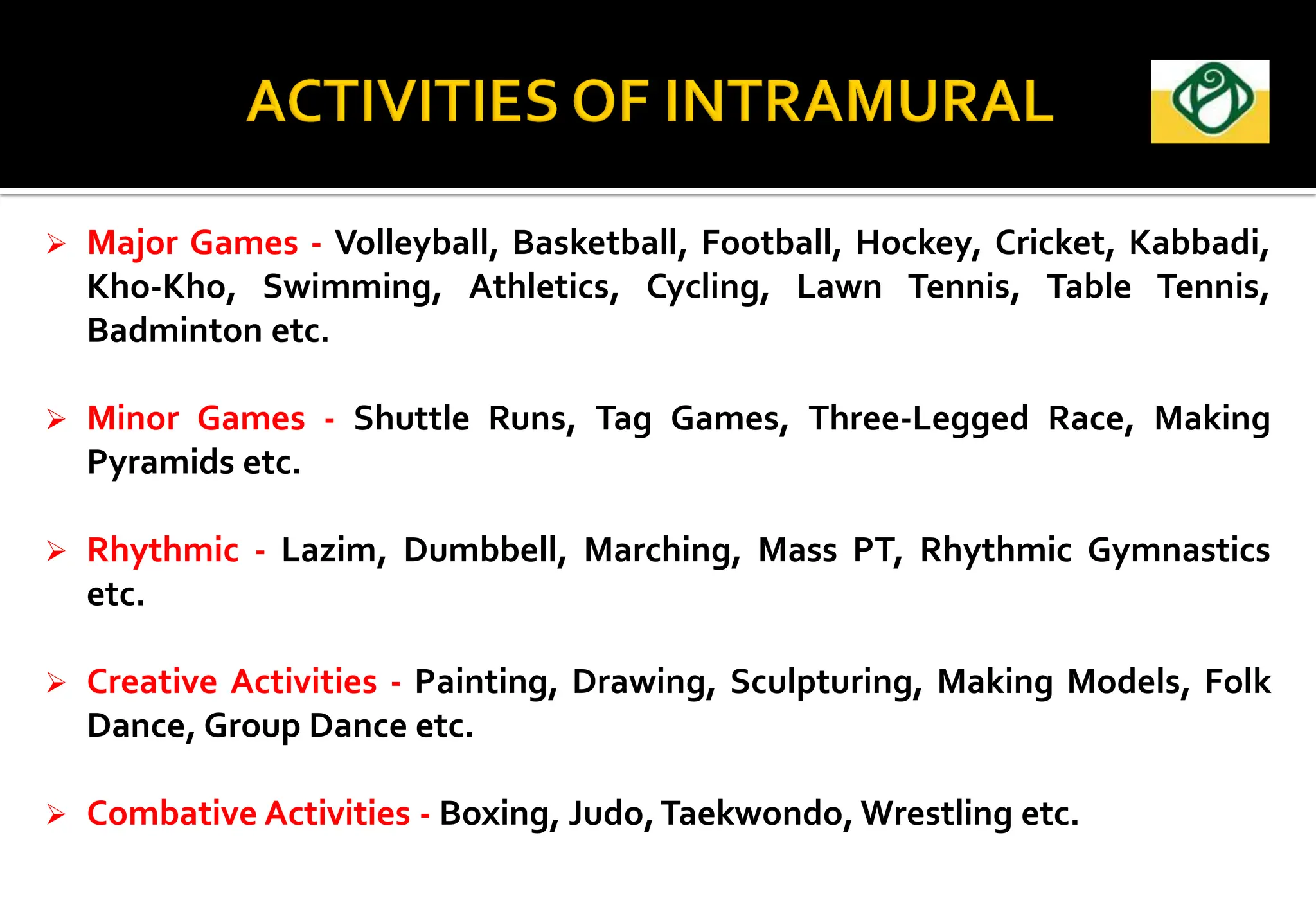
 Major Games - Volleyball, Basketball, Football, Hockey, Cricket, Kabbadi,
Kho-Kho, Swimming, Athletics, Cycling, Lawn Tennis, Table Tennis,
Badminton etc.
 Minor Games - Shuttle Runs, Tag Games, Three-Legged Race, Making
Pyramids etc.
 Rhythmic - Lazim, Dumbbell, Marching, Mass PT, Rhythmic Gymnastics
etc.
 Creative Activities - Painting, Drawing, Sculpturing, Making Models, Folk
Dance, Group Dance etc.
 Combative Activities - Boxing, Judo,Taekwondo, Wrestling etc.
The word ‘Extramural’ is derived from the Latin
words ‘Extra’ and ‘Muralis’
Extra means Outside School Campus.
Muralis means Wall.
It means the activities, which are performed outside
the walls of an institution or a school.
 It is also known as Inter-school competitions.
 To improve the standards of sports.
 To provide experience to students.
 To broaden the base of sports.
 To develop Sportsman spirit and fraternity.
 To provide the knowledge of new rules and advanced
techniques
 Enhance the Standard of sports.
 It helps in providing knowledge of new SportsTechnique.
 It provides opportunities to show their SportsTalent.
 Improve the standard of Sports in schools.
 It helps to improve Skill wise Games of the students.
 Various sports and recreational activities are part of Sports Day.
 A day is fixed in a calendar year for conducting Sports day.
 Time table for the events should be prepared.
 To conduct Sports day in a smooth manner various Committees are to be formed.
 The games which have to be part of Sports day
should be finalized.
 Arrangement for Refreshment should be made.
 Sports day is organized as part of Recreation.
 By participating in Sports day students develop leadership qualities.
 Other Social Qualities which takes place are such as Honesty, Brotherhood,
Friendship etc.
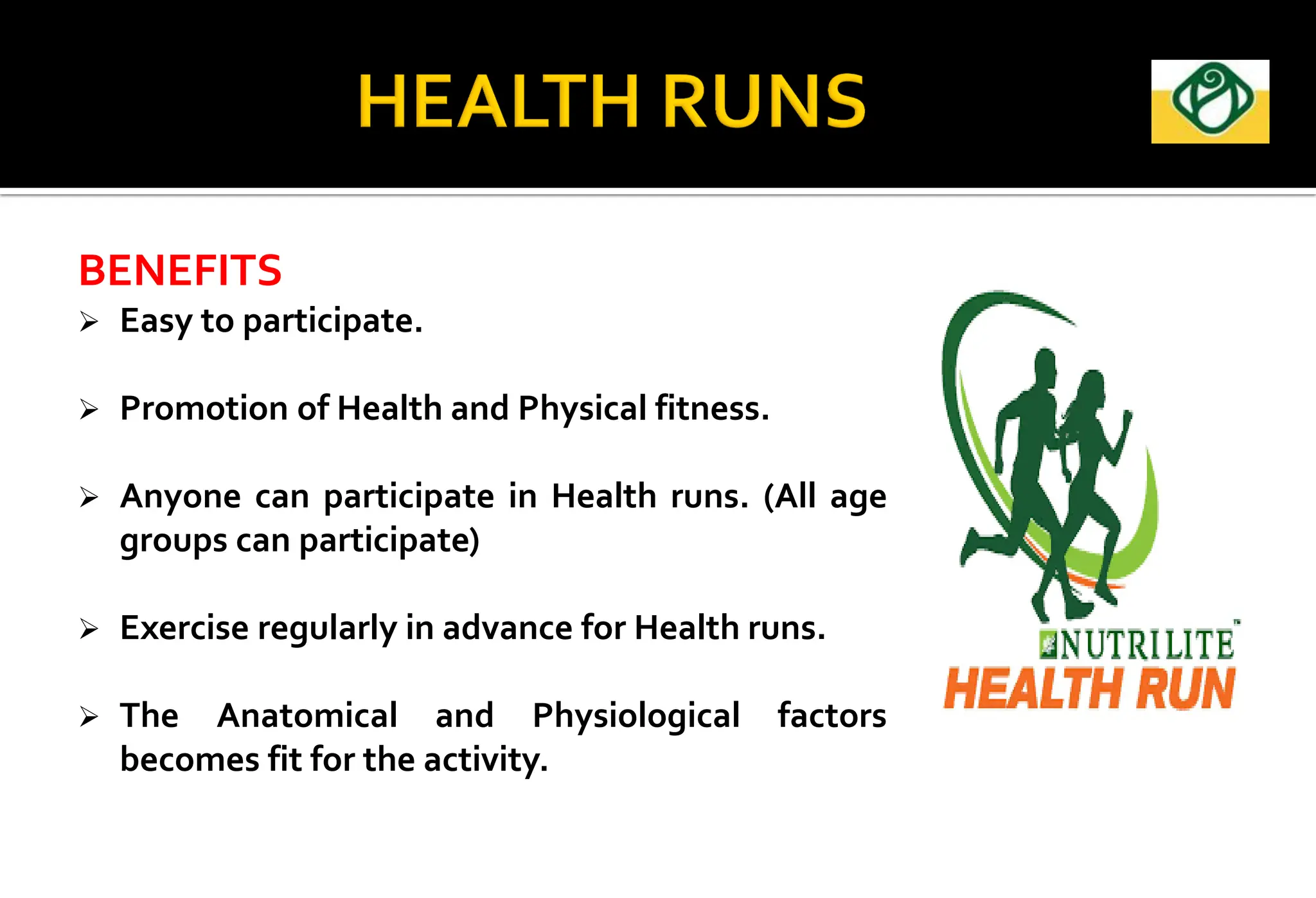
 Health Runs are organized to spread awareness and to improve
the Physical health of the members of Society or Community.
 Marathons – Full & Half or other distance Races
 They are planned and executed by the Health department,
Sports department or Social organizations focusing on Health.
BENEFITS
 Easy to participate.
 Promotion of Health and Physical fitness.
 Anyone can participate in Health runs. (All age
groups can participate)
 Exercise regularly in advance for Health runs.
 The Anatomical and Physiological factors
becomes fit for the activity.
 Run for fun is organized as the same as Health Runs to increase the sprit of Physical
Fitness in the public.
 It involves either Road running or Cross Country running
 Run For Fun is a friendly race.
 Runners take part in Cross Country running for the sake of recreation.
 Generally, such Race is organized to raise funds for charity
 There are many organizations and institutions who usually organize “Run For
Specific Cause.”
 Most of these programmes are organized by the various NGO’s.
 Many non-profit bodies organize these runs. e.g., Mumbai marathon, Chennai
marathon
 It means running or walking by the group of people for a specific cause.
 The objective of these programmes are mainly to raise funds & awareness for a
specific cause, such as Education, Health, Pollution, Safe water, Environment,
Aids, Cancer and other Diseases or causes etc.
 Run for Unity is organized by various organizations.
 The purpose for these runs may be National and International Integration.
 Run for Unity are held to bring people from different Communities, Caste and
Creeds together under one single Event to promote Peace, Harmony and Unity.
 In these Run lot of Celebrities and renowned personalities join the Event to
highlight the need for Respect.
 Briefly explain the objectives of intramural tournaments.
 Write down the importance of the extramural tournament.
 Discuss the need of Intramural & ExtramuralTournament.
 Explain the meaning of specific sport programs? Explain any four.
END OF PLANNING IN SPORTS

Management of sporting events - physical education

  • 1.
    PHYSICAL EDUCATION Unit 1 -Management of Sporting Events Date - 24 March 2022
  • 2.
  • 3.
     Meaning andObjectives of Planning.  Functions of Sports Events Management (Planning, Organizing, Staffing, Directing & Controlling)  Various Committees & its Responsibilities  Tournament - Knock-Out, League or Round Robin & Combination.  Procedure to Draw Fixture - Knock-Out (Bye & Seeding) & League (Staircase & Cyclic)  Intramural & Extramural - Meaning, Objectives & its Significance.  Specific Sports Programme (Sports Day, Health Run, Run for Fun, Run for Specific Cause & Run for Unity).
  • 4.
     Planning playsa vital role in an individual’s life.  In sports, planning is very important work.  Planning is the process of arranging activities so that a certain goal or target can be achieved.  To achieve success in any competition it depends upon, how it is organized and planned.  In other words, we can say that the development of sports depends on proper planning that is done well in advance. Planning is the process of thinking about the activities required to achieve a desired goal. It is the first and foremost activity to achieve desired results.
  • 5.
     According toAlford and Beatt, Planning is the thinking process, the organised foresight, the vision based on fact and experience that is required for intelligent action.  A plan is a trap laid to capture the future.  Planning is a predetermined course of action to achieve a goal.  In other words, planning is the process of thinking and organizing the activities required to achieve a desired goal.  The success of Physical education & sports programmes depends upon efficient staff, food, direction, control, super vision, co-ordination and minimize the chances of lapses.
  • 6.
     To makethe event more interesting.  To keep good control and to supervise all activities.  To facilitate proper coordination among different committee.  To avoid or to reduce the chances of mistakes.  To make room for a new idea / innovation.  To avoid last minute hassles / inconvenience.  To get the best performance.  To increase the efficiency
  • 7.
    Management is describedas the process of planning, organizing, directing, staffing and controlling the efforts of organizational resources to achieve specific goals. Sport managers carry out these skills in a variety of organizational settings, for example: college sports; professional sports; amateur sports including the Olympics, sport marketing and management firms; sport communications and news media firms; corporate sponsorship and advertising firms; sporting goods firms; arenas, stadium, and civic centers; among many others.
  • 8.
    According to (DeSensi,Kelley, Blanton and Beitel, 2003 : Sport management involves any combination of skills related to planning, organizing, directing, controlling, budgeting, leading, and evaluating within the context of an organization or department whose primary product or service is related to sport or physical activity. According to Luther Guelick : “He Coined the word POSDCORB”. • Planning • Organising • Staffing • Directing • Coordinating • Reporting • Budget
  • 9.
    PARTS / PHASESOF SPORTS MNAGEMENT
  • 10.
    PLANNING Planning is thefirst managerial function to be performed in the process of management. It is concerned with deciding in advance what is to be done, when, where, how and by whom it is to be done.Thus, it is a pre- determined course of action to achieve a specified aim or goal. PROCESS OF PLANNING • Follow-up action • Implementing the plan • Setting Goals • Selecting an alternative • Developing premises and events • Evaluating alternative course
  • 11.
    ORGANIZING Organizing is thefunction of management that involves developing an organizational structure and allocating human resources to ensure the accomplishment of objectives (Organizing essentially consists of establishing a division of labor.The managers divide the work among individuals and group of individuals. And then they coordinate the activities of such individuals and groups to extract the best outcome) IMPORTANCE OF ORGANIZING • Expansion and growth • Benefits of specialization • Adaptation to change • Optimum utilization of resources • Development of personnel
  • 12.
    STAFFING Staffing is themanagerial function of recruitment, selection, training, developing, promotion and compensation of personnel. Staffing may be defined as the process of hiring and developing the required personnel to fill in the various positions in the organization (The managerial function of staffing involves managing the organization structure through proper and effective selection, appraisal and development of the personnel's to fill the roles assigned to the employers/workforce.) IMPORTANCE OF STAFFING • Staffing helps to ensure optimum utilization of the human resources. • It improves job satisfaction. • It ensures the continuous survival and growth of the enterprises. • It helps in discovering and obtaining competent personal for various jobs. • One can achieve higher performance, by putting right person in the right place.
  • 13.
    DIRECTING Directing function ofmanagement refers to the process of instructing, guiding, counseling, motivating and leading people in the organisation to achieve its objectives. It is one of the key managerial functions performed by every manager. (Directing is the heart of management function. All other functions of management such as planning, organizing, and staffing have no importance without directing. Leadership, motivation, supervision, communication are various aspects of directing) IMPORTANCE OF DIRECTING Initiates Action, Ensures Co-Ordination, Improves Efficiency, Facilitates Change and Assists Stability and Growth.
  • 14.
    PRINCIPLES OF DIRECTING Itplays a very important role in management. Direction is just like the heart of administration. Direction is the sum total of managerial efforts that is applied for guiding and inspiring the sub-ordinates to make better accomplishments in the organization. It is concerned with the motivate, leadership, supervision and commanding of sub- ordinates and securing their best cooperation. It is an art which is learned from a long experience.
  • 15.
    PRINCIPLESOF CONTROLLING Controlling canbe defined as that function of management which helps to seek planned results from the subordinates, managers and at all levels of an organization.The controlling function helps in measuring the progress towards the organizational goals & brings any deviations, & indicates corrective action. (The control function can be viewed as a five-step process: (1) Establish standards, (2) Measure performance, (3) Compare actual performance with standards and identify any deviations, (4) Determine the reason for deviations, and (5)Take corrective action, if needed) IMPORTANCE OF CONTROLLING Controlling helps managers monitor the effectiveness of their planning, organizing, and leading activities.Controlling determines what is being accomplished — that is, evaluating the performance and, if necessary, taking corrective measures so that the performance takes place according to plans.
  • 16.
     Transport committee. Publicity / Marketing committee.  Reception committee.  Boarding and Lodging committee.  Ground & Equipment committee.  Refreshment and Entertainment committee.  Decoration, Awards & Ceremonial committee.  Announcement committee.  Medical / First Aid committee.  Technical committee.  Finance committee etc…
  • 17.
    Following duties performedbefore the start of any event. Such as:-  To sit along with the authorities to prepare the Budget of the tournament.  To prepare the Schedule of the tournament.  To keep in mind the Level of Competition ( Senior, Junior, Open etc.)  To prepare the Grounds / Courts and Sports Equipment.  To keep the Medical / First Aid kit ready.  To prepare Fixtures and sendTournament details to various teams.  To make necessary arrangement regarding Lodging and Boarding of Players and Officials.  To arrange Prizes and Certificates.
  • 18.
    Duties performed duringthe game are such as:-  To ensure Proper Arrangements during Inauguration.  To check playing Arena's & Equipments & also checking of Eligibility Form of participating teams.  To give Refreshments & Meals to Officials & Players.  To provide next Event Schedule to the teams from time to time.  To make necessary Announcements.  To prepare Score Sheets and concerned Records of the teams.  To maintain Discipline among spectators and provide First-Aid to injured players.  To Co-ordinate with different working committees.
  • 19.
    These are mostlythe winding up duties of tournament :-  To give away the Prizes and Certificates.  To ensure Press Note (over all report of the tournament and results) and send it to the concerned Media.  To provide Security refunds to the departing teams.  To ensure Payments to the officials and to the other concerned persons.  To present Mementos to the chief guest and to the team escorts.  To generate the exact Expenditure report.  To Collect all Records related to the event from the officials.
  • 20.
     Make noteson the portion completed in this session.  Go through the available material and make notes in your own word.  Q.1 What is planning? Write any four objectives of planning.  Q.2 What are the objectives of the planning or explain the objectives of the planning?  Q.3 Write down the role of the various committees post tournament.  Q.4 Enlist the name of various committees during the Tournament? Explain the Responsibilities' of any four committees.
  • 21.
    Introduction :  It’sthe natural tendency of human being to compete since the beginning of stone age.  There where no rules and regulations.  ‘Might is right’- was the main principle in those days.
  • 23.
     A tournamentis a type of competition in which several players / teams participate in various rounds to get to the finals.  Tournament is referred as healthy competition to decide the best team.  It is the sports festival where team play against each other in systematic way.  In modern time tournament are organized in a civilized way with certain rules and regulations which every team has to obey.  A tournament provides good platform to display the talent and perfection of skills, technique, tactics and strategies. Meaning
  • 24.
    Tournaments are animportant feature of sports, it provides platforms for demonstrating skills and abilities at any event or game. The salient aspects of tournaments are:-  Helps in Developing sporting skills  Strengthening Sports Culture  Development ofValues (Social, Moral, Ethical etc)  To find out realTalent or helps in Selecting Sports Player  Helps in Character building  A big source of Recreation  Promoting National & International Integration.
  • 25.
    FourTypes ofTournaments  Knock- out (EliminationTournament)  League (Round RobinTournament)  CombinationTournament (League cum knock out)  ChallengeTournament (RankingTournament)
  • 26.
     Team oncedefeated is automatically eliminated from the tournament.  Winning teams continue to play till gets eliminated.  In this tournament only the victorious team is allowed to play further matches until one team emerges as winner.  It is the fast method to know about the winner team in the tournament.  Knock out word is mostly used in Boxing, when an opponent is knocked down and unable to rise and return to the game.
  • 27.
    Let us seean example of a Knock – out tournament First Round Semi Final Final Winner
  • 28.
     These areless expensive / It saves cost.  It saves time / requires less time to complete the tournament.  It helps in improving the standard the of tournament.  Minimum number of officials are required.  It increases the excitement level of every remaining matches.
  • 29.
     Chances ofelimination of good teams are more.  More chances of weak teams moving into further rounds.  Half of the competitor leave after every match.  Spectators may loose interest for the finals.
  • 30.
     Mr. Bergerwas the first person to imagine about this type of tournament. So, its called as ‘Berger System’.  In this tournament, each team plays with every other team.  It can be called the best type of tournament because it provides every team with the opportunity to show its best performance.  This tournament is played in two forms such as SINGLE LEAGUE & DOUBLE LEAGUE
  • 31.
     Single LeagueTournament:- In this every team plays with every other team once and the total number of matches is determined by formula:-  N (N-l)/2 where N refers to the total number of teams.  Example : If 8 teams are taking part, then total number of matches to be played.  N (N - I)/2  = 8 (8 - 1)/2  = 8 (7)/2  = 56/2 = 28 matches
  • 32.
     Double LeagueTournament:- In this every team plays with every other team twice and the total number of matches is determined by formula:-  N (N - l) where ‘N’ refers to the total number of participating teams.  Example : If 9 teams are taking part, then total number of matches to be played:  N (N - l)  = 9 (9 - 1)  = 9 (8) = 72 matches
  • 33.
     Only strongteam moves ahead in the tournament to achieve success / victory.  Every team gets maximum opportunities to show its efficiency.  Player get maximum number of matches where they can easily improve their performance.  Sports official can easily judge the performance of individuals or teams / Easy to select good players.  The spectators get opportunity to watch more matches.
  • 34.
     Waste oftime / Requires more time.  It costs more money wise also for weaker teams.  It becomes more difficult for organizers to make arrangements for teams and officials.  Teams may lose their moral by the end of tournament.
  • 35.
     Combination tournamentsare conducted when the matches are to be played on zonal basis.  The number of teams are divided into four equal zones.  Each match is played on knock out basis within the zones.  Then winner from each zone can participate at national level. Combination tournaments are classified into following four types :  Knock out cum Knock out  League cum League  Knock out cum League  League cum Knock out ( 2 e.g. for each type)
  • 36.
     In Knock-Out Cum Knock out tournaments the number of teams are divided into four groups.  They compete with each other on the knockout basis.  Winners of four groups are made to compete with each other on knock out basis, then one group / team will be declared as winner.
  • 37.
     In LeagueCum League number of teams are divided into four groups.  They compete with each other in their respective zones on league basis.  One team from each zone will become a zonal winner.  All zonal winner will compete with each other on league basis and one team out of it will be declared as winner of inter zonal or group tournament
  • 38.
     Number ofteams are divided into four groups.  They compete with each other in their respective groups on the knockout basis.  Then winners from each groups are made to compete with each other on the league basis.  One team will be declared as inter zonal / group winner.
  • 39.
     In Leaguecum knockout , Number of teams are divided into four groups.  They compete with each other in their respective groups on the league basis.  Then winners from each groups are made to compete with each other on the knock out basis.  One team will be declared as inter zonal / group winner.
  • 40.
     A matchbetween champion and challenger, the winner of which will acquire or retain the title.  Games in which such tournaments are held are - Boxing, Tennis,TableTennis, Badminton etc.
  • 41.
     Make noteson the portion completed in today's class. Q.1The other name of LeagueTournament is— Q.2 What are the advantage & disadvantages of league or round robin tournament. Q.3 Differentiate Between knock out & round robin tournament Q.4 Define tournament and explain its types?
  • 42.
    KNOCK OUT The successof any tournament depends upon suitable Fixture. Following points have to be taken into consideration while drawing fixtures for a knock out tournament:  Total number of participatingTeams / Players in the tournament.  Number of teams in each Half or Quarter.  Byes given.  Number of byes to be given in each Half or Quarter..  Total number of Matches to be played.  Total number of Rounds to be played.
  • 43.
    Step 1 : If number of teams are even or in the power of 2 than N/2 is used for each half.  If the number of teams are in odd number or is not the power of 2, then following procedure is applied:-  Upper half = (N + l)/2  Lower half = (N – l)/2  Where ‘N’ is the total number of teams.
  • 44.
    Step 2 : Bye - Means a team exempted from playing the first round.  Gets an advantage to play directly in the next round.  It is sort of privilege to a team who does not play the first round.  When the number of entries in a knock-out tournament is not in the power of two (2), we have to give byes to teams.  Byes are given to a specific number of teams in the first round only.
  • 45.
    Step 3 : Byes will be fixed in the following manner:  First bye will be given to the last team of lower half.  Second bye will be given to the first team of upper half.  Third bye will be given to the first team of lower half.  Fourth bye will be given to the last team of upper half.  The same sequence will be followed while assigning the next bye or byes.
  • 46.
    Calculation of Byes:-  Total number of byes (NB) = Next highest number which is the power of 2 -Total number of team  Example: For 12 team next higher value of 2 would be  (2 × 2 × 2 × 2 = 16) then  16 – 12 = 4 Bye.  No. of byes in upper half = NB/2 = 4/2 = 2  No. of byes in lower half = NB/2 = 4/2 = 2
  • 47.
    Calculation of Byes:-  Total number of byes (NB) = Next highest number which is the power of 2 -Total number of team  Example: For 11 team next higher value of 2 would be  (2 × 2 × 2 × 2 = 16) then  16 – 11 = 5 Bye.  No. of byes in upper half = (NB – l)/2 = (5-1)/2 = 2  No. of byes in lower half = (NB + l)/2 = (5+1)/2 = 3
  • 48.
    Calculation of Byes Example : Arrange the byes when the total number of teams in a Knock Out Basis tournament is 9.  Solution : 1.Total Number ofTeams (N)= 9 2.Teams in Upper half = (N + l)/2 = (9 + 1)/2 = 10/2 = 5 3.Teams in Lower half = (N - l)/2 = (9 - 1)/2 = 8/2 = 4 4.Total Number of Byes (NB) = 16 – 9 = 7 Byes 5. No. of byes in Upper half = (NB – I)/2 = (7-1)/2 = 6/2 = 3 6. No. of byes in Lower half = (NB + l)/2 = (7+1)/2 = 8/2 = 4 Teams R 1 1 - Bye 2 2 - Bye 6 UH 3 4 5 - Bye 4 __________________ 6 - Bye 3 7 - Bye 7 LH 8 - Bye 5 9 - Bye 1
  • 49.
    Calculation of Byes Example1: How many byes will be given when the total number of teams is 13? Solution: Number of teams = 13 Next highest number which is the power of2 = 16 Total number of byes (NB) = Next highest number which is the power of 2 -Total number of teams (16 – 13) = 3 byes. Example 2: How many byes will be given when the total number of teams is 28? Solution:Total number of teams = 28 Next highest number which is the power of 2= 32 Total number of byes (NB) = Next highest number which is the power of 2 -Total number of teams (32 - 28) = 4 byes. Example 3: How many byes will be given when the total number of teams is 16? Solution: Bye wont be given because 16 itself is power of 2.
  • 50.
     How manybyes will be given when the total number of teams participating in a tournament is 8?  How many byes will be given when the total number of teams participating in a tournament is 22?  How many byes will be given when the total number of teams participating in a tournament is 29?
  • 51.
    Calculation of Byes Example1: How many byes will be given when the total number of teams is 8? Solution: Number of teams = 8 (Bye wont be given because 8 itself is power of 2) Example 2: How many byes will be given when the total number of teams is 22? Solution:Total number of teams = 22 Next highest number which is the power of 2 = 32 Total number of byes (NB) = Next highest number which is the power of 2 -Total number of teams (32 - 22) = 10 byes. Example 3: How many byes will be given when the total number of teams is 29? Solution:Total number of teams = 29 Next highest number which is the power of 2 = 32 Total number of byes (NB) = Next highest number which is the power of 2 -Total number of teams (32 - 29) = 3 byes.
  • 52.
     Total numberof matches can be calculated by subtracting one from the total number of teams.  The number of matches is (N – l)  Where ‘N’ denotes the total number of participating teams.  For e.g., If 11 teams are participating, than the number of matches will be  N – l = 11 – 1 = 10 matches.
  • 53.
     If thenumber of participating team is a power of 2, lets say 32, the total number of rounds will be 2 x 2 x 2 x 2 x 2 = 5.  If the number of participating team is not a power of 2, lets say 11, the total number of rounds will be 2 x 2 x 2 x 2 = 4.
  • 54.
    Calculation of Byes,Matches & Rounds Example 1 : Draw the fixture for 9 teams on knock out basis.  Solution : 1.Total Number ofTeams (N) = 9 2.Teams in Upper half = (N + l)/2 = (9 + 1)/2 = 10/2 = 5 3.Teams in Lower half = (N - l)/2 = (9 - 1)/2 = 8/2 = 4 4.Total Number of Byes (NB) = 16 – 9 = 7 Byes 5. No. of byes in Upper half = (NB – I)/2 = (7-1)/2 = 6/2 = 3 6. No. of Byes in Lower half = (NB + l)/2 = (7+1)/2 = 8/2 = 4 7. No. of Matches = N - 1 = 9 - 1 = 8 8. No. of Rounds = 2 x 2 x 2 x 2 = 4
  • 55.
    Teams R1 R2R3 R4 1 - Bye 2 2 - Bye 6 3 4 5 - Bye 4 6 - Bye 3 7 - Bye 7 8 - Bye 5 9 - Bye 1 1 2 3 4 5 6 7 8 WINNER U H L H TT
  • 56.
    Calculation of Byes,Matches & Rounds Example 2 : Draw the fixture for 13 teams on knock out basis.  Solution : 1.Total Number ofTeams (N) = 13 2.Teams in Upper half = (N + l)/2 = (13 + 1)/2 = 14/2 = 7 3.Teams in Lower half = (N - l)/2 = (13 - 1)/2 = 12/2 = 6 4.Total Number of Byes (NB) = 16 –13 = 3 Byes 5. No. of byes in Upper half = (NB – I)/2 = (3-1)/2 = 2/2 = 1 6. No. of Byes in Lower half = (NB + l)/2 = (3+1)/2 = 4/2 = 2 7. No. of Matches = N - 1 = 13 - 1 = 12 8. No. of Rounds = 2 x 2 x 2 x 2 = 4
  • 57.
    Teams R1 R2R3 R4 1 - Bye 2 2 3 4 5 6 7 8 - Bye 3 9 10 11 12 13 - Bye 1 1 2 3 4 5 6 7 8 WINNER U H L H TT 9 10 11 12
  • 58.
     We havecompleted how to give byes with few examples of drawing fixtures on knock out basis.  In next class we will try to solve more examples involving more number of teams.  1. Draw the fixtures for 16 teams on knock out basis.  2. Draw the fixtures for 19 teams on knock out basis  3. Draw the fixtures for 22 teams on knock out basis.
  • 59.
    Calculation of Byes,Matches & Rounds Example 1 : Draw the fixture for 16 teams on knock out basis.  Solution : 1.Total Number ofTeams (N) = 16 2.Teams in Upper half = N/2 = 16/2 = 8 3.Teams in Lower half = N/2 = 16/2 = 8 4.Total Number of Byes (NB) = 16 – 16 = 0 Byes 5. No. of Matches = N - 1 = 16 - 1 = 15 6. No. of Rounds = 2 x 2 x 2 x 2 = 4
  • 60.
    Teams R1 R2R3 R4 1 2 3 4 5 6 7 8 9 10 11 12 13 14 15 16 1 2 3 4 5 6 7 8 WINNER U H L H TT 9 10 11 12 13 14 15
  • 61.
    Calculation of Byes,Matches & Rounds Example 2 : Draw the fixture for 19 teams on knock out basis.  Solution : 1.Total Number ofTeams (N) = 19 2.Teams in Upper half = (N + l)/2 = (19 + 1)/2 = 20/2 = 10 3.Teams in Lower half = (N - l)/2 = (19 - 1)/2 = 18/2 = 9 4.Total Number of Byes (NB) = 32 – 19 = 13 Byes 5. No. of byes in Upper half = (NB – I)/2 = (13 - 1)/2 = 12/2 = 6 6. No. of Byes in Lower half = (NB + l)/2 = (13 + 1)/2 = 14/2 = 7 7. No. of Matches = N - 1 = 19 - 1 = 18 8. No. of Rounds = 2 x 2 x 2 x 2 x 2 = 5
  • 62.
    Teams R1 R2R3 R4 R5 1 - Bye 2 2 - Bye 6 3 - Bye 10 4 5 6 7 8 - Bye 12 9 - Bye 8 10 - Bye 4 11 - Bye 3 12 - Bye 7 13 - Bye 11 14 15 16 - Bye 13 17 - Bye 9 18 - Bye 5 19 - Bye 1 1 2 3 4 5 6 7 8 WINNER U H L H TT 9 10 11 12 13 14 15 16 17 18
  • 63.
    Calculation of Byes,Matches & Rounds Example 3 : Draw the fixture for 22 teams on knock out basis.  Solution : 1.Total Number ofTeams (N) = 22 2.Teams in Upper half = N/2 = 22/2 = 11 3.Teams in Lower half = N/2 = 22/2 = 11 4.Total Number of Byes (NB) = 32 – 22 = 10 Byes 5. No. of byes in Upper half = NB/2 = 10/2 = 5 6. No. of Byes in Lower half = NB/2 = 10/2 = 5 7. No. of Matches = N - 1 = 22 - 1 = 21 8. No. of Rounds = 2 x 2 x 2 x 2 x 2 = 5
  • 64.
    Teams R1 R2R3 R4 R5 1 - Bye 2 2 - Bye 6 3 - Bye 10 4 5 6 7 8 9 10 - Bye 8 11 - Bye 4 12 - Bye 3 13 - Bye 7 14 15 16 17 18 19 20 - Bye 9 21 - Bye 5 22 - Bye 1 1 2 3 7 8 9 10 11 WINNER U H L H TT 12 13 14 15 16 17 18 19 20 21 4 5 6
  • 65.
    Q1. How todivide the total number of teams in each Quarter?  When the number of teams are less (16), then teams are divided into upper and lower half only.  When the number of teams are more (20), then teams are divided into upper and lower half, which are further more divided into two parts of respective halves.  Upper half will have two quarters - 1st Q and 2nd Q.  Lower half will have two quarters - 3rd Q and 4th Q.
  • 66.
     For determiningthe number of teams in each Quarter, the total number of teams is divided by 4 = N/4.  Examples for 20Teams = N/4 = 20/4 = 5Teams in each Quarters.  If the remainder is zero, there will be 4 Quarters with equal number of teams.  If the remainder is 1, the first Quarter will comprise 1 extra team and the remaining Quarters will have equal number of teams.  If the remainder is 2, Quarter I and III will have one extra team each.  If the remainder is 3, Quarter I, II and III will have one extra team each.
  • 67.
    NO. OF TEAMS 1st QUARTER 2nd QUARTER 3rd QUARTER 4th QUARTER 287 7 7 7 29 7 + 1 7 7 7 30 7 + 1 7 7 + 1 7 31 7 + 1 7 + 1 7 + 1 7 32 8 8 8 8
  • 68.
    Example 1 :Draw the fixture for 16 teams on knock out basis.  Solution :  1.Total Number ofTeams (N) = 16  2.Teams in Upper half = N/2 = 16/2 = 8  3.Teams in Lower half = N/2 = 16/2 = 8  4.Total Number of Byes (NB) = 16 – 16 = 0 Byes  5. No. of Matches = N - 1 = 16 - 1 = 15  6. No. of Rounds = 2 x 2 x 2 x 2 = 4  Teams in each Quarter  QI = 4Teams  QII = 4Teams  QIII = 4Teams  QIV = 4Teams
  • 69.
    Teams R1 R2R3 R4 1 2 Q I 3 4 5 6 Q II 7 8 9 10 Q III 11 12 13 14 Q IV 15 16 1 2 3 4 5 6 7 8 WINNER U H L H TT 9 10 11 12 13 14 15
  • 70.
    Quarter, Byes, Matches& Rounds Example 2 : Draw the fixture for 22 teams on knock out basis.  Solution : 1.Total Number ofTeams (N) = 22 2.Teams in Upper half = N/2 = 22/2 = 11 3.Teams in Lower half = N/2 = 22/2 = 11 4.Total Number of Byes (NB) = 32 – 22 = 10 Byes 5. No. of byes in Upper half = NB/2 = 10/2 = 5 6. No. of Byes in Lower half = NB/2 = 10/2 = 5 7. No. of Matches = N - 1 = 22 - 1 = 21 8. No. of Rounds = 2 x 2 x 2 x 2 x 2 = 5 9.Teams in Each Quarter Q1 = 5 + 1 = 6 teams Q2 = 5 teams Q3 = 5 + 1 = 6 teams Q4 = 5 teams 10. Byes in each Quarter Q1 = 2 5 Byes in Upper Half Q2 = 3 Q3 = 2 5 Byes in Upper Half Q4 = 3
  • 71.
    Quarter, Byes, Matches& Rounds Example 2 : Draw the fixture for 22 teams on knock out basis. Solution : 9.Teams in Each Quarter Q1 = 5 + 1 = 6 teams Q2 = 5 teams Q3 = 5 + 1 = 6 teams Q4 = 5 teams 10. Byes in Each Quarter Q1 = 2 5 Byes in Upper Half Q2 = 3 Q3 = 2 5 Byes in Lower Half Q4 = 3 ** We will apply the same formulae which we generally apply for determining the number of byes in UH and LH
  • 72.
    Teams R1 R2R3 R4 R5 1 - Bye 2 2 3 Q I 4 5 6 - Bye 4 7 - Bye 3 8 Q II 9 10 - Bye 5 11 - Bye 1 12 - Bye 2 13 14 Q III 15 16 17 - Bye 4 18 - Bye 3 19 Q IV 20 21 - Bye 5 22 - Bye 1 1 2 3 7 8 9 10 11 WINNER U H L H TT 12 13 14 15 16 17 18 19 20 21 4 5 6
  • 73.
    Quarter, Byes, Matches& Rounds Example 3 : Draw the fixture for 17 teams on knock out basis.  Solution : 1.Total Number ofTeams (N) = 17 2.Teams in Upper half = (N + l)/2 = (17 + 1)/2 = 18/2 = 9 3.Teams in Lower half = (N - l)/2 = (17 - 1)/2 = 16/2 = 8 4.Total Number of Byes (NB) = 32 – 17 = 15 Byes 5. No. of byes in Upper half = (NB – I)/2 = (15 - 1)/2 = 14/2 = 7 6. No. of Byes in Lower half = (NB + I)/2 = (15 + 1)/2 = 16/2 = 8 7. No. of Matches = N - 1 = 17 - 1 = 16 8. No. of Rounds = 2 x 2 x 2 x 2 x 2 = 5
  • 74.
    Quarter, Byes, Matches& Rounds Example 3 : Draw the fixture for 17 teams on knock out basis. Solution : 9.Teams in Each Quarter Q1 = 4 + 1 = 5 teams Q2 = 4 teams Q3 = 4 teams Q4 = 4 teams 10. Byes in Each Quarter Q1 = 3 7 Byes in Upper Half Q2 = 4 Q3 = 4 8 Byes in Lower Half Q4 = 4 ** We will apply the same formulae which we generally apply for determining the number of byes in UH and LH
  • 75.
    Teams R1 R2R3 R4 R5 1 - Bye 2 2 Q I 3 4 - Bye 3 5 - Bye 1 6 - Bye 2 Q II 7 - Bye 4 8 - Bye 3 9 - Bye 1 10 - Bye 2 11 - Bye 4 Q III 12 - Bye 3 13 - Bye 1 14 - Bye 2 15 - Bye 4 Q IV 16 - Bye 3 17 - Bye 1 1 2 3 4 5 6 7 8 WINNER U H L H TT 10 11 12 13 14 15 16 9
  • 76.
    CONSOLATION ROUND  Ina knock out, a team once defeated is eliminated from the tournament.  Such teams do not get second opportunity to showcase their talent.  One additional chance is given to such defeated teams.  Winner is declared from the defeated teams.  Type I -The teams defeated in Round I are allowed to participate.  New fixture are prepared for them.  The teams who did not get Bye earlier are given Bye now  Type II - The teams defeated in all the rounds are given additional chance.
  • 78.
    Example: Draw thefixtures on knock out basis for 8 teams. Solution: Regular Round Consolation Round 1 2 3 4 --------------------- 5 6 7 8 Teams R 1 R 2 R3 1 3 5 7 1 5 WINNER 2 4 6 8 Teams R 1 R 2 R3 R 4 2 v/s 3 = 3 6 v/s 7 = 6 1 3 v/s 5 = 5 W IN N E R Losers of R1:Team 2, 4, 6 and 8 Losers of R2:Team 3 and 7 Loser of R3:Team 5 CONSOLATION TOURNAMENT -TYPE II
  • 79.
    What does itmean?  In a knock out tournament strong teams may be paired with weak teams or all the strong teams might have been grouped in either Upper Half or Lower Half.  Due to this strong teams may get eliminated in the preliminary rounds.  Strong teams are selected to keep them at appropriate place in the fixture.  Placing the good teams (previous position holder) at beneficiary places in the knock out fixture.  Organizers should be well aware of the performances of the teams of the last year.  Generally, the number of seeded teams shall be in the power of 2, i.e. 2,4,8,16 etc.  All the teams except the seeded teams are kept in the fixture by lots.
  • 80.
    How to arrangethese teams at their deserving places in the fixtures?  Winner team will be placed at the top of the Upper Half.  Runner up team will be placed at the last spot of the Lower Half.  If 4 teams are to be Seeded, then first two teams will be kept at the places mentioned above.  3rd Seeded team will be placed at the top of the Lower Half.  4th Seeded team will be placed at the last spot of the Upper Half.
  • 81.
    Example 1 :Draw the fixture for 11 teams out of which 4 teams are to be seeded  Solution : 1.Total Number ofTeams (N) = 11 2.Teams in Upper half = (N + l)/2 = (11 + 1)/2 = 12/2 = 6 3.Teams in Lower half = (N - l)/2 = (11 - 1)/2 = 10/2 = 5 4.Total Number of Byes (NB) = 16 – 11 = 5 Byes 5. No. of byes in Upper half = (NB – I)/2 = (5 - 1)/2 = 4/2 = 2 6. No. of Byes in Lower half = (NB + l)/2 = (5 + 1)/2 = 6/2 = 3 7. No. of Matches = N - 1 = 11 - 1 = 10 8. No. of Rounds = 2 x 2 x 2 x 2 = 4 9. No of Seeded teams = 4
  • 82.
    Teams R1 R2R3 R4 1 - Bye (Seeded) 2 3 4 5 6 - Bye (Seeded) 7 - Bye (Seeded) 8 9 10 - Bye 11 - Bye (Seeded) 1 2 3 4 5 6 7 8 WINNER U H L H TT 9 10
  • 83.
    BYES  Byes aregiven only when the total number of teams participating in the tournament is not the power of 2.  Teams which get the byes, compulsorily do not play in the first round.  Procedure for giving Byes:  First Bye is given to the team of LH  Second bye is given to the team of UH  Third Bye is given to the team of LH  Fourth Bye is given to the team of UH SEEDING  Teams re seeded when they are spotted by the organizers as strong teams based on their previous years result..  These teams are given the specific spots in the fixtures, that doesn’t mean that they will not play in the first round.  Procedure for Seeding:  First Seeded team will be placed at the top of UH  Second Seeded team will be placed at the bottom of LH  Third Seeded team will be placed at the top of LH  Fourth Seeded team will be placed at the bottom of UH
  • 84.
     How todivide the total number of teams in each Quarter.  How to divide the total number of byes in Upper Half & Lower Half.  How to distribute the byes in all the Quarters.  What is seeding.  The difference between Byes and Seeding.  Draw the fixture for 16 teams out of which 4 teams are to be seeded
  • 85.
    Example 1 :Draw the fixture for 16 teams out of which 4 teams are to be seeded.  Solution : 1.Total Number ofTeams (N) = 16 2.Teams in Upper half = N/2 = 16/2 = 8 3.Teams in Lower half = N/2 = 16/2 = 8 4.Total Number of Byes (NB) = 16 – 16 = 0 Byes 5. No. of Matches = N - 1 = 16 - 1 = 15 6. No. of Rounds = 2 x 2 x 2 x 2 = 4 7. No of Seeded teams = 4
  • 86.
    Teams R1 R2R3 R4 1 - (Seeded) 2 3 4 5 6 7 8 - (Seeded) 9 - (Seeded) 10 11 12 13 14 15 16 - (Seeded) 1 2 3 4 5 6 7 8 WINNER U H L H TT 9 10 11 12 13 14 15
  • 87.
    Example 2 :Draw the fixture for 20 teams out of which 4 teams are to be seeded.  Solution : 1.Total Number ofTeams (N) = 20 2.Teams in Upper half = N/2 = 20/2 = 10 3.Teams in Lower half = N/2 = 20/2 = 10 4.Total Number of Byes (NB) = 32 – 20 = 12 Byes 5. No. of byes in Upper half = NB/2 = 12/2 = 6 6. No. of byes in Lower half = NB/2 = 12/2 = 6 5. No. of Matches = N - 1 = 20 - 1 = 19 6. No. of Rounds = 2 x 2 x 2 x 2 x 2 = 5 7. No of Seeded teams = 4
  • 88.
    Teams R1 R2R3 R4 R5 1 – Bye 2 (Seeded 1) 2 – Bye 6 3 – Bye 10 4 5 6 7 8 – Bye 12 9 – Bye 8 10 – Bye 4 (Seeded 4 ) 11 – Bye 3 (Seeded 3 ) 12 – Bye 7 13 – Bye 11 14 15 16 17 18 – Bye 9 19 – Bye 5 20 – Bye 1 (Seeded 2) 1 2 3 4 5 6 7 8 WINNER U H L H TT 9 10 11 12 13 14 15 16 17 18 19
  • 89.
     Specially seededteams do not participate in the preliminary rounds.  In special seeding, the seeded players or teams, participate directly in the quarter- final or semi-final. They need not have to wait for longer duration, to see the preliminary rounds get over.
  • 90.
    Difference between Seedingand Special Seeding  Seeding is given to the place holders of last year’s season of the same tournament whereas Special Seeding is given to the teams which are highly recognized and internationally known.  Seeded teams gets the advantage or are being placed at the specific spot while drawing fixtures. If they don’t get byes for any reasons, these teams will have to play their matches right from the first round, whereas Special Seeded teams will directly play in the QF or SF round of the tournament. Similarity between Seeding and Special Seeding  Seeded / Specially seeded team 1 will be placed at the top of UH  Seeded / Specially seeded team 2 will be placed at the bottom of LH  Seeded / Specially seeded team 3 will be placed at the top of LH  Seeded / Specially seeded team 4 will be placed at the bottom of UH
  • 91.
    Example 1 :Draw the fixtures on knock out basis for 16 teams, out of which 2 teams have to been given special seeding.  Solution : 1.Total Number ofTeams (N) = 16 2. Number of seeded teams (SS) = 2 3.Teams in Upper half = N/2 = 16/2 = 8 4.Teams in Lower half = N/2 = 16/2 = 8 5.Total Number of Byes (NB) = 16 – 14= 2 (N – No of SS = 16 – 2 = *14) 6. No. of byes in Upper half = NB/2 = 2/2 = 1 7. No. of byes in Lower half = NB/2 = 2/2 = 1 8. No. of Matches = N - 1 = 16 - 1 = 15 9. No. of Rounds = 2 x 2 x 2 x 2 = 4 + 1 = 5
  • 92.
    Teams R1 R2R3 R4 R5 1 - (SS 1) --------------------------------- 2 - Bye 2 3 4 5 6 7 8 9 10 11 12 13 14 15 - Bye 1 16 - (SS 2)--------------------------------- 1 2 3 4 5 6 7 8 WINNER U H L H TT 9 10 11 12 13 14 15
  • 93.
    Teams R1 1 -(SS 1) --------------------------------- 2 3 4 5 6 7 8------------------- 9 10 11 12 13 14 15------------------- 16 - (SS 2)--------------------------------- What if we deicide not to give BYES U H L H TT
  • 94.
    Teams R1 R2R3 R4 1 - (SS 1) --------------------------- 2 - Bye 2 3 4 5 6 7 8 9 10 11 12 13 14 15 - Bye 1 16 - (SS 2)--------------------------- What if we decide to make the Special SeededTeams play in the QF? 1 2 3 4 5 6 7 8 U H L H TT 9 10 SF SF
  • 95.
    Teams R1 R2R3 R4 R5 1 - (SS 1) --------------------------------- 2 - Bye 2 3 4 5 6 7 8 9 10 11 12 13 14 15 - Bye 1 16 - (SS 2)--------------------------------- 1 2 3 4 5 6 7 8 WINNER U H L H TT 9 10 11 12 13 14 15
  • 96.
    Example 2 :Draw the fixtures on knock out basis for 20 teams, out of which 4 teams have to been given special seeding.  Solution : 1.Total Number ofTeams (N) = 20 2. Number of seeded teams (SS) = 4 3.Teams in Upper half = N/2 = 20/2 = 10 4.Teams in Lower half = N/2 = 20/2 = 10 5.Total Number of Byes (NB) = 16 – 16 = 0 (N – No of SS = 20 – 4 = *16) 6. No. of Matches = N - 1 = 20 - 1 = 19 7. No. of Rounds = 2 x 2 x 2 x 2 = 4 + 1 = 5
  • 97.
    Teams R1 R2R3 R4 R5 1 - (SS 1) --------------------- 2 3 4 5 6 7 8 9 10 - (SS 4) --------------------- 11 - (SS 3) --------------------- 12 13 14 15 16 17 18 19 20 - (SS 2) ---------------------- 1 2 3 4 5 6 7 8 WINNER U H L H TT 9 10 11 12 13 14 15 16 17 18 19
  • 98.
     What isSpecial Seeding.  The difference between Seeding and Special Seeding.  Draw the fixtures on knock out basis for 25 teams, out of which 4 teams have been given the special seeding.  Draw the fixtures on knock out basis for 34 teams, out of which 2 teams have been given the special seeding.
  • 99.
    LEAGUE The following methodsare used for Fixtures in LeagueTournament:  Cyclic Method  Staircase Method  Tabular Method
  • 100.
    When Number ofteams are ‘Even’  Team 1 is fixed on the top of the right hand side  Teams are rotated in clockwise direction  Number of matches = N(N-1)/2  Number of rounds = N-1 When Number of teams are ‘Odd’  Bye is fixed on the top on the right hand side  Teams are rotated in clockwise direction  Number of matches = N(N-1)/2  Number of round = N
  • 101.
    Total number ofteams = 6 (EvenTeams) Total Number of Matches = N(N – l)/2 = 15 Total Number of Rounds = N - 1 = 5 lR llR lllR lVR VR 6 1 5 2 4 3 5 1 4 6 3 2 4 1 3 5 2 6 3 1 2 4 6 5 2 1 6 3 5 4
  • 102.
    Total number ofteams = 5 (OddTeams) Total Number of Matches = N(N – l)/2 = 10 Total Number of Rounds = N = 5 lR ll R lllR lVR VR 5 B 4 1 3 2 4 B 3 5 2 1 3 B 2 4 1 5 2 B 1 3 5 4 1 B 5 2 4 3
  • 103.
    lR ll RlllR lVR VR 5 B 4 1 3 2 4 B 3 5 2 1 3 B 2 4 1 5 2 B 1 3 5 4 1 B 5 2 4 3
  • 104.
    In this methodfixtures are made just like a ladder or a staircase. This is the easiest method because, no bye is given to any Even or Odd number of Teams. e.g. for 5Teams: 1-2 1-3 2-3 1-4 2-4 3-4 1-5 2-5 3-5 4-5
  • 105.
     TheTeam whichgets maximum points in aTournament, is declared as winner.  Winner of the match = 2 points  Loser of the match = 0 point  Draw = 1 point  In case if the final points are equal for 2 teams, then a match is held again.  After that also match remains in a draw, the team which has won the maximum number of matches is declared as a winner.  If Tie remains, the teams that scored maximum number of goals is declared as winner.  If still there is aTie - A match is once again held between those teams.  In the end still Tie is unbreakable, the Winner is declared by theToss.
  • 106.
    Other Method –BRITISH METHOD Example: If a team plays 15 matches, wins 9 matches, loses 4 matches and 2 matches remain draw, the percentage of points will be: Total Points = 18 + 2 = 20 Possible Points = 30 Percentage of Points =Total Points Obtained Total Possible Points = 20 30 = 66.66 % X 100 X 100
  • 107.
    Other Method –AMERICAN METHOD Example: If a team plays 16 matches, and wins 10 matches out of them, the percentage of points will be: Percentage of Points = Matches Won Matches Played = 10 16 = 62.5 % In this method,Tie is not counted at all. X 100 X 100
  • 108.
     Draw fixturesfor 16 teams on league basis according to the Cyclic Method.  Draw fixtures for 13 teams on league basis according to the Cyclic Method.  Draw fixtures for 16 teams on league basis according to the Staircase Method.
  • 109.
    The word ‘Intramural’is derived from the Latin words ‘Intra’ and ‘Muralis’ Intra means within the School or Campus. Muralis means Wall. It means that the activities which are performed within the walls or campus of an institution are called ‘Intramurals’. The motto of Intramural is “A game for each and each for a game”. Intramural competition is one of the best means to motivate all the students of an institution for taking part in Games and Sports.
  • 110.
     To provideopportunity to every one to participate in Games & Sports  To develop the Leadership qualities  To develop the feeling of Cooperation  To provide Recreation  To develop Sportsman spirit  To provide opportunity to learn various Skills of different games  To identifyTalent of sportsperson  8.To develop Personality
  • 111.
     Intramural areImportant for physical, mental, emotional and social development of students.  Stress on moral and ethical values.  Development of health.  To tone up fighting instinct of students.  Provide opportunities to participate in games.  Develop leadership qualities among the students.  Ample opportunities for participation.
  • 112.
     Major Games- Volleyball, Basketball, Football, Hockey, Cricket, Kabbadi, Kho-Kho, Swimming, Athletics, Cycling, Lawn Tennis, Table Tennis, Badminton etc.  Minor Games - Shuttle Runs, Tag Games, Three-Legged Race, Making Pyramids etc.  Rhythmic - Lazim, Dumbbell, Marching, Mass PT, Rhythmic Gymnastics etc.  Creative Activities - Painting, Drawing, Sculpturing, Making Models, Folk Dance, Group Dance etc.  Combative Activities - Boxing, Judo,Taekwondo, Wrestling etc.
  • 113.
    The word ‘Extramural’is derived from the Latin words ‘Extra’ and ‘Muralis’ Extra means Outside School Campus. Muralis means Wall. It means the activities, which are performed outside the walls of an institution or a school.  It is also known as Inter-school competitions.
  • 114.
     To improvethe standards of sports.  To provide experience to students.  To broaden the base of sports.  To develop Sportsman spirit and fraternity.  To provide the knowledge of new rules and advanced techniques
  • 115.
     Enhance theStandard of sports.  It helps in providing knowledge of new SportsTechnique.  It provides opportunities to show their SportsTalent.  Improve the standard of Sports in schools.  It helps to improve Skill wise Games of the students.
  • 117.
     Various sportsand recreational activities are part of Sports Day.  A day is fixed in a calendar year for conducting Sports day.  Time table for the events should be prepared.  To conduct Sports day in a smooth manner various Committees are to be formed.  The games which have to be part of Sports day should be finalized.  Arrangement for Refreshment should be made.  Sports day is organized as part of Recreation.  By participating in Sports day students develop leadership qualities.  Other Social Qualities which takes place are such as Honesty, Brotherhood, Friendship etc.
  • 118.
     Health Runsare organized to spread awareness and to improve the Physical health of the members of Society or Community.  Marathons – Full & Half or other distance Races  They are planned and executed by the Health department, Sports department or Social organizations focusing on Health.
  • 119.
    BENEFITS  Easy toparticipate.  Promotion of Health and Physical fitness.  Anyone can participate in Health runs. (All age groups can participate)  Exercise regularly in advance for Health runs.  The Anatomical and Physiological factors becomes fit for the activity.
  • 120.
     Run forfun is organized as the same as Health Runs to increase the sprit of Physical Fitness in the public.  It involves either Road running or Cross Country running  Run For Fun is a friendly race.  Runners take part in Cross Country running for the sake of recreation.  Generally, such Race is organized to raise funds for charity
  • 121.
     There aremany organizations and institutions who usually organize “Run For Specific Cause.”  Most of these programmes are organized by the various NGO’s.  Many non-profit bodies organize these runs. e.g., Mumbai marathon, Chennai marathon  It means running or walking by the group of people for a specific cause.  The objective of these programmes are mainly to raise funds & awareness for a specific cause, such as Education, Health, Pollution, Safe water, Environment, Aids, Cancer and other Diseases or causes etc.
  • 122.
     Run forUnity is organized by various organizations.  The purpose for these runs may be National and International Integration.  Run for Unity are held to bring people from different Communities, Caste and Creeds together under one single Event to promote Peace, Harmony and Unity.  In these Run lot of Celebrities and renowned personalities join the Event to highlight the need for Respect.
  • 123.
     Briefly explainthe objectives of intramural tournaments.  Write down the importance of the extramural tournament.  Discuss the need of Intramural & ExtramuralTournament.  Explain the meaning of specific sport programs? Explain any four. END OF PLANNING IN SPORTS