Physical Education
UNIT 1 - MANAGEMENT OF
SPORTING EVENTS
BY MR.MILIND KURHADE
 Functions of Sports Events Management (Planning,
Organising, Staffing, Directing Controlling)
 Various Committees and their Responsibilities (pre;
during and post)
 Fixtures and its procedures – Knock-Out (Bye and
Seeding) and League (Staircase and Cyclic)
 Intramural and Extramural – Meaning, Objectives and its
Significance
 Community Sports – Purpose and benefits.
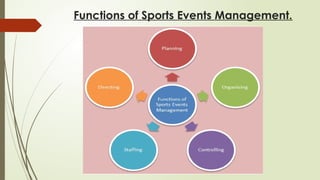
Functions of Sports Events Management.
PLANNING
 Planning
 Planning is the foremost function in sports as it gives a view of
future course of action. To be effective, a plan should be
specific, logical, flexible and complete in all aspects and should
assist in controlling future events. A plan must comprehend all
the other functions of management like organising, staffing,
directing and controlling in order to achieve the predetermined
goals.
 In sports and sports events, planning plays important role to
make the event run smoothly, effectively and remain free from
conflict. Effective planning must clearly define aims, goals and
objectives of the event. It should also explain the procedure or
method to achieve the target in simple and easy to understand
language. A sports plan should be prepared in a professional
manner incorporating the elements of commitment, enjoyment
and voluntary effort.
 Organising
 Organising is a next step after planning. It is a process of
execution of the plan. This includes distributing resources
and organising personnel in order to achieve the goals
established in the planning stage. Organising stage
determines the type of jobs and responsibility to achieve
planning objectives. Preparation of organisation chart
with various positions and reporting should be illustrated
in this stage.
Staffing
 This refers to identifying key staff positions, and ensuring that proper
talent is serving that specific job duty in order to achieve the aims and
objectives of an organization. In this process recruitment and selection
of qualified employees take place. After hiring personnel, orientation,
training and professional development are also parts of this stage. In
orientation new persons are introduced to the nature, goals and policies
of events to keep them tuned in to the goals of the organisation. Various
training programmes are conducted to provide professional training to
the staff at this stage.
 In sports events, recruitment of staff as per organisation’s needs should
be done. Example, the apex post may be for Director of the event, in
second line Deputy Director and then Assistant Director of Sports event
may be created.
Directing
Directing personnel is a leadership quality, and
includes letting staff know what needs to be done,
by whom and also by when. It includes supervision
of personnel while simultaneously motivating them.
Without directing, planning or organising has no
meaning. It is a function of guiding, inspiring and
instructing people to accomplish organizational
goals.
 Controlling
 Controlling refers to all the processes that leaders create to
monitor success. It involves establishing performance
standards, measuring actual performance and comparing
them for irregularities. It is a important function of
management as controlling involves imparting instructions to
employees and also ensuring that those instructions are
followed. To organise any sports event, instructions given to
members of the organising committee towards achieving
common goal i.e., organising a sports event in this case,
must be carried out sincerely for an event to be successful.
Higher order management people control lower order people
to ensure efficient and effective use to resources.
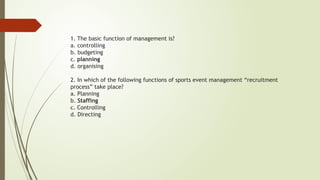
1. The basic function of management is?
a. controlling
b. budgeting
c. planning
d. organising
2. In which of the following functions of sports event management “recruitment
process” take place?
a. Planning
b. Staffing
c. Controlling
d. Directing
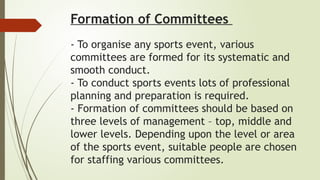
Formation of Committees
- To organise any sports event, various
committees are formed for its systematic and
smooth conduct.
- To conduct sports events lots of professional
planning and preparation is required.
- Formation of committees should be based on
three levels of management – top, middle and
lower levels. Depending upon the level or area
of the sports event, suitable people are chosen
for staffing various committees.
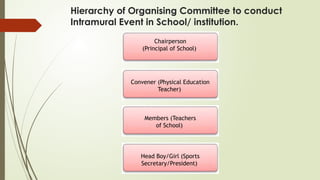
Hierarchy of Organising Committee to conduct
Intramural Event in School/ institution.
Chairperson
(Principal of School)
Convener (Physical Education
Teacher)
Members (Teachers
of School)
Head Boy/Girl (Sports
Secretary/President)
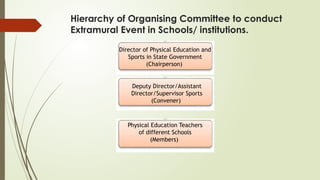
Hierarchy of Organising Committee to conduct
Extramural Event in Schools/ institutions.
Director of Physical Education and
Sports in State Government
(Chairperson)
Deputy Director/Assistant
Director/Supervisor Sports
(Convener)
Physical Education Teachers
of different Schools
(Members)
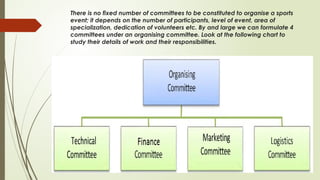
There is no fixed number of committees to be constituted to organise a sports
event; it depends on the number of participants, level of event, area of
specialization, dedication of volunteers etc. By and large we can formulate 4
committees under an organising committee. Look at the following chart to
study their details of work and their responsibilities.
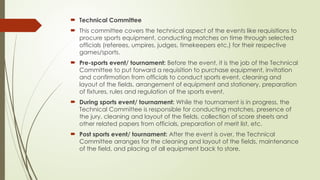
 Technical Committee
 This committee covers the technical aspect of the events like requisitions to
procure sports equipment, conducting matches on time through selected
officials (referees, umpires, judges, timekeepers etc.) for their respective
games/sports.
 Pre-sports event/ tournament: Before the event, it is the job of the Technical
Committee to put forward a requisition to purchase equipment, invitation
and confirmation from officials to conduct sports event, cleaning and
layout of the fields, arrangement of equipment and stationery, preparation
of fixtures, rules and regulation of the sports event.
 During sports event/ tournament: While the tournament is in progress, the
Technical Committee is responsible for conducting matches, presence of
the jury, cleaning and layout of the fields, collection of score sheets and
other related papers from officials, preparation of merit list, etc.
 Post sports event/ tournament: After the event is over, the Technical
Committee arranges for the cleaning and layout of the fields, maintenance
of the field, and placing of all equipment back to store.
 Logistics Committee
 This committee has a wider scope of work ranging from
transportation, boarding and lodging to refreshment, decoration
and conducting ceremonies that form a part of the event. This
committee may have various sub-committees as per requirement.
The Logistics Committee looks after the Opening Ceremony, hires
photographer/ videographer, makes arrangements for the Victory
Ceremony and the Closing Ceremony including arrangement of
refreshment, decoration, reception, entertainment, light and sound,
medical aspect etc.
 Pre sports event/ tournament: It is the duty of the Logistics
Committee to look after Placement/Arrangement/Requisition of
purchase of stationery, chairs, tables, souvenirs, light and sound
equipment, bouquets, sending invitations to stakeholders including
other schools/ institutions and VIP guests, requisition of purchase of
medals and certificates, arrangement of refreshments,
arrangement of boarding and lodging, selection of volunteers,
preparation of first aid kit and arrangement of medical facilities.
 During sports event/ tournament: While the event is in
progress, the Logistics Committee is responsible for the
conduct of the Opening and Closing Ceremonies,
checking registration, distribution of refreshment,
management of spectators, handing over of medals
and certificates, transportation of players/participants
from place of stay to the field and back.
 Post sports event/ tournament: After the event, the
Logistics Committee supervises cleaning of the venue,
and placing of the items back in their appointed places.
 Finance Committee
 The role of the Finance Committee is primarily to provide financial oversight
for the event. It is involved in all aspects related to the finances of the sports
event like planning, accounting, decision-making etc. Finalization of
sponsorship, keeping an eye on inflow and outflow of finances, purchase of
equipment and other items required for conducting the event, settling
payments of officials are key areas of focus of the committee. It is the
backbone of the sports tournament. It pitches to different companies and
attracts them for sponsorships for the event.
 Pre sports event/ tournament: Before the event, It is the responsibility of
Finance Committee to prepare the budget, to purchase sports equipment,
stationery, medals, certificates, and other requirements as desired by the
other committees, as well as preparing and finalizing the MoU with sponsors.
 During sports event/ tournament: During the course of the event, the
Finance Committee keeps a check on the outflow and inflow of finances
including payment and remuneration to officials.
 Post sports event/ tournament: Once the event is over, the Finance
Committee examines all records related to settlement of the bills and
accounts, and prepares the financial report.
 Marketing Committee
 The Marketing Committee develops plans and strategies to place the event
in the market with the purpose of generating publicity and sponsorships.
Publicity can be done through various modes like social media, print
media, TV, e-mail etc. and sponsorship can be generated in terms of cash
or kind by making media partners, food partners, drink partners etc. through
calling on, meeting various companies etc. Marketing Committee also
organises campaigns related to the event.
 Pre sports event/ tournament: The Marketing Committee prepares a
strategy for arranging for sponsorships, publicity of the event, arranging
meetings or calling on sponsors, preparation of MoUs for sponsorships etc.
 During sports event/ tournament: The Marketing Committee issues press
release(s), works with media, manages methods of communication, fulfils
the requirements of sponsors as per MoUs, arrangement for telecast of
event etc.
 Post sports event/ tournament: Once the event is over, the Committee
issues a press release, and may arrange for a re-telecast of the event.
Do You Know?
Check list to organising a sports event.
 1. Formation of Organising Committees
 2. Establishment of Objectives
 3. Theme of the event
 4. Date of the event
 5.Place of the event
 6. Budget
 7. Sponsorship
 8. Marketing (Campaign)
 9. Invitations to teams and guests
 10. Conformation of teams
 11. Logistics (Accommodations, Refreshments, Transportation, Medical Staff,
 Water, table, chairs, flags, notice board)
 12. Checking on the sponsors
 13. Drawing Fixtures and layout of field
 14. Rules and Regulations
 15. Arrangement of Equipment and score sheets
 16. Arrangement of Referees and Prizes
 17. Direction to the stadium (Sign posts)
 18. Briefing of Volunteers and staff
 19. Decorations
 20. Practice and warm up Area
 21. Security
 22. Photographers
 23. Approvals License and NOCs
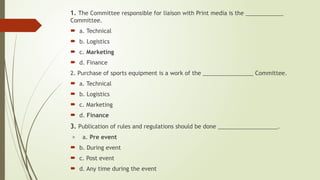
1. The Committee responsible for liaison with Print media is the ____________
Committee.
 a. Technical
 b. Logistics
 c. Marketing
 d. Finance
2. Purchase of sports equipment is a work of the ________________ Committee.
 a. Technical
 b. Logistics
 c. Marketing
 d. Finance
3. Publication of rules and regulations should be done ___________________.
> a. Pre event
 b. During event
 c. Post event
 d. Any time during the event
Fixtures & its procedures:
In sports, an individual generally supports a particular team or
player to win the game. Winning helps that team or player
reach the next round, and after a specified number of matches,
a player or a team wins the Championship. While watching a
tournament, you would have seen sometimes a player or team
lose a game, and get eliminated from the tournament. However,
in some tournaments they remain in the game despite losing.
Why is this so? Basically, there are different types of fixtures in
different tournaments based on duration, cost, manpower, level,
interest etc. that you will study here.
Tournaments
Tournament is a series of games or matches played
among players or teams to determine the winner. It
provides an opportunity to demonstrate skills,
evaluate one’s performance and motivate players to
perform well, attract people towards sports to
make sports popular and provide healthy
entertainment.
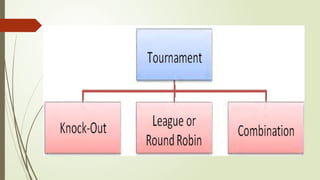
There are various types of tournament formats
based on advancement or elimination criteria of
players or teams. Study the three tournament
formats listed below.
Knock – Out Tournament: In a Knock-Out Tournament a
player or team continues to play matches until it is defeated.
In this type of format, players or teams have to consistently
give their best performance to avoid elimination. Such a
tournament saves cost and time and makes each match
intensive because of fear of elimination. Since fixtures are
drawn on the basis of lots, there is the possibility of a match
between two good teams or players even in the early stages.
In this system a good team can be eliminated even at the
earliest stage due to getting defeated by chance or by
accident.
League or Round Robin: In League or Round Robin
Tournament, a player or team will play the matches that
are allotted before the start of the tournament. Fixed
number of matches are given to players and teams.
Players or teams will get equal chance to play with each
other. Thus, the true winner emerges from this format
and ranking can be prepared for all participating players
or teams. However, this format involves more money,
time and facilities as compared to the Knock-Out
Tournament and there is no provision of seeding for
extraordinary teams and players.
Combination: They are the combination of Knock-Out
and League format. Depending upon the need and
importance of the tournament, Combination
Tournaments can be Knockout- League, League-
Knockout, Knockout-League-Knockout etc. These
tournaments are conducted when there are (a) a large
number of participants, (b) participants are spread in
different areas, (c) venues are in different
zones/places etc. In this format some of the demerits
of Knockout and League Tournaments can be
eliminated.
Fixtures, Byes and Seeding:
 We have learned about three types of tournaments, Now we will study
how we can draw the fixtures. In sports, the term fixtures refers to the
programme listing which team (Team A) will play whom (Team B), where
(venue), and when (time).
 Definitions:
 A fixture is “a sports event or its date.”
 “A sports match that has been arranged for a particular time and
place”
 ‘Fixture is a process of arrangement of the teams in systematic order in
various groups for competitive fights for physical activity’.
 Thus, tie or fixture or heat include multiple and progressive matches. In
athletics and swimming the term Heats is used, in Tennis, badminton and
other games we frequently use the terms Ties or Fixtures. For any
tournament, unbiased draws of fixtures is a road towards the success.
First, let us understand the words “bye” and “seed”.
Bye - means a team is not required to participate in the
primary round due to allotment of draws. It should be given to
any participating team through random lottery system. In a
tournament, bye is generally assigned to teams by the
organizing committee not to play a round due to one of the
several reasons:
- Uneven distribution of teams in tournament (In knock out
tournament, number of teams equals to power of two [e.g., 8,
16, 32, 64, ….] and in League tournament, if there is an odd
number of teams.
- Separate pooling of previous winners in same group to
create even competition,
- to avoid one team from playing more matches on a single
day than the other, so creating disadvantage for some.
Seeding - is a process in which teams will be
placed in such a manner that good teams that
have a ranking or previous year’s position etc.
do not meet another team at an early stage
of the tournament. This procedure is
generally implemented to reduce the chance
of elimination of good teams at an early
stage. Procedure of allotting seeding is the
same as given for byes.
Procedure for Drawing Knock - Out Fixture
To determine the total number of teams that will
participate in the Knockout tournament.
If the number of teams is: 2, 4, 8, 16, 32, 64, 128, …..
(Number being a multiple of Two) then there is no need
of byes. You may see the procedure in Illustration : 1
and 2. If the number of teams is other than the given
numbers, then byes will be given as per draw of lot.
Step 2
To determine the total number of matches to
be played in the tournament, following
formula will be used:
Total Number of Matches= Number of teams – 1
In case of 8 teams then 8-1= 7 matches (not
including third place match)
If number of teams are 12 then
12-1= 11 matches (not including third place
match) In case of 15 teams then 15-1=14 (not
including third place match)
Step 3
The total number of teams are to be divided into two halves,
namely Upper Half and Lower Half.
If the total number of participating teams are even in numbers
the Formula will be:
Number of teams 2 = Teams in Upper Half or Lower Half
If total number of teams is 12 then, 12/2 = 6, i.e., 6 teams will
be placed in Upper Half and the remaining 6 will be placed in
Lower Half.
If total number of participating teams are odd in numbers then
Formula will be
Number of teams + 1/2 = Teams in Upper Half
Number of teams – 1/2 = Teams in Lower Half
If number of teams is 15 then
15 + 1/2 = 8 Teams in Upper Half
15 – 1/2 = 7 Teams in Lower Half
Thus, 8 teams will be placed in Upper Half and remaining 7 will
be placed in Lower Half.
Step 4
After determining Upper and Lower Half Teams, byes will be
given. We can determine the byes by finding the difference
between the number of teams participating in the
Tournament and next power of 2 of participating Teams in
the Tournament. For example, if total number of Teams is 12,
then next power of 2 will be 16.
16-12= 4 Byes. For even numbers byes will be placed in
Upper and Lower Half.
4/2 = 2
If total number of Teams is 19, then next power will be 32
32-19 = 13 byes
For odd numbers byes will be placed
in Upper Half = 13-1/2 = 6
and Lower Half = 13+1/2 =7
Step 5
Allotment of byes in the fixture should be given in following
order. First bye will be given to last team of Lower Half,
Second bye will be given to first team of Upper Half, Third
bye will be given to last team of Upper Half, Fourth bye will
be given to first team of Lower Half, Same pattern will be
followed after fourth bye till the remaining byes have been
given.
OR
First bye will be given to last team of Lower Half, Second by
will be given to first team of Upper Half, Third bye will be
given to first team of Lower Half, Fourth bye will be given to
last team of Upper Half
Same pattern will be followed after fourth bye till the
remaining byes have been given.
Step 6
Write the serial number (number of participants)
in vertical order. Divide into two halves as per
Step 3.
Then place byes as per step 5.
Now place remaining teams through random
lottery system from top to bottom or same
pattern used to allot byes.
Teams having byes will not play their first-round
matches. Put Date, Time, Venue in front of the
matches in fixture.
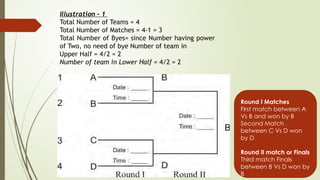
Illustration – 1
Total Number of Teams = 4
Total Number of Matches = 4-1 = 3
Total Number of Byes= since Number having power
of Two, no need of bye Number of team in
Upper Half = 4/2 = 2
Number of team in Lower Half = 4/2 = 2
Round I Matches
First match between A
Vs B and won by B
Second Match
between C Vs D won
by D
Round II match or Finals
Third match Finals
between B Vs D won by
B
Illustration – 2
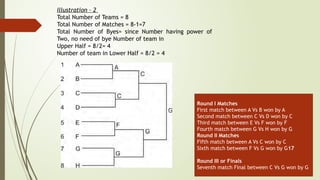
Total Number of Teams = 8
Total Number of Matches = 8-1=7
Total Number of Byes= since Number having power of
Two, no need of bye Number of team in
Upper Half = 8/2= 4
Number of team in Lower Half = 8/2 = 4
Round I Matches
First match between A Vs B won by A
Second match between C Vs D won by C
Third match between E Vs F won by F
Fourth match between G Vs H won by G
Round II Matches
Fifth match between A Vs C won by C
Sixth match between F Vs G won by G17
Round III or Finals
Seventh match Final between C Vs G won by G
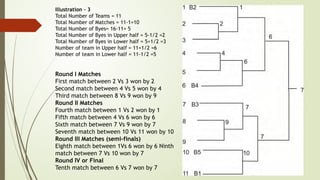
Illustration – 3
Total Number of Teams = 11
Total Number of Matches = 11-1=10
Total Number of Byes= 16-11= 5
Total Number of Byes in Upper half = 5-1/2 =2
Total Number of Byes in Lower half = 5+1/2 =3
Number of team in Upper half = 11+1/2 =6
Number of team in Lower half = 11-1/2 =5
Round I Matches
First match between 2 Vs 3 won by 2
Second match between 4 Vs 5 won by 4
Third match between 8 Vs 9 won by 9
Round II Matches
Fourth match between 1 Vs 2 won by 1
Fifth match between 4 Vs 6 won by 6
Sixth match between 7 Vs 9 won by 7
Seventh match between 10 Vs 11 won by 10
Round III Matches (semi-finals)
Eighth match between 1Vs 6 won by 6 Ninth
match between 7 Vs 10 won by 7
Round IV or Final
Tenth match between 6 Vs 7 won by 7
Procedure to Draw League or Round Robin Fixture
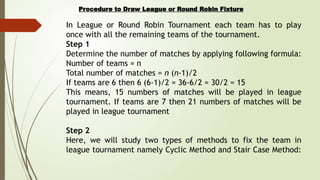
In League or Round Robin Tournament each team has to play
once with all the remaining teams of the tournament.
Step 1
Determine the number of matches by applying following formula:
Number of teams = n
Total number of matches = n (n-1)/2
If teams are 6 then 6 (6-1)/2 = 36-6/2 = 30/2 = 15
This means, 15 numbers of matches will be played in league
tournament. If teams are 7 then 21 numbers of matches will be
played in league tournament
Step 2
Here, we will study two types of methods to fix the team in
league tournament namely Cyclic Method and Stair Case Method:
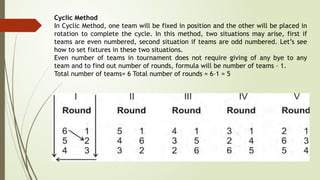
Cyclic Method
In Cyclic Method, one team will be fixed in position and the other will be placed in
rotation to complete the cycle. In this method, two situations may arise, first if
teams are even numbered, second situation if teams are odd numbered. Let’s see
how to set fixtures in these two situations.
Even number of teams in tournament does not require giving of any bye to any
team and to find out number of rounds, formula will be number of teams – 1.
Total number of teams= 6 Total number of rounds = 6–1 = 5
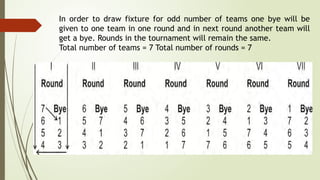
In order to draw fixture for odd number of teams one bye will be
given to one team in one round and in next round another team will
get a bye. Rounds in the tournament will remain the same.
Total number of teams = 7 Total number of rounds = 7
Staircase Method
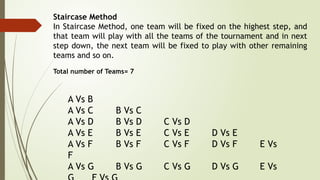
In Staircase Method, one team will be fixed on the highest step, and
that team will play with all the teams of the tournament and in next
step down, the next team will be fixed to play with other remaining
teams and so on.
Total number of Teams= 7
A Vs B
A Vs C B Vs C
A Vs D B Vs D C Vs D
A Vs E B Vs E C Vs E D Vs E
A Vs F B Vs F C Vs F D Vs F E Vs
F
A Vs G B Vs G C Vs G D Vs G E Vs
Details of Matches
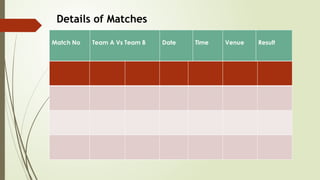
Match No Team A Vs Team B Date Time Venue Result
Step 3
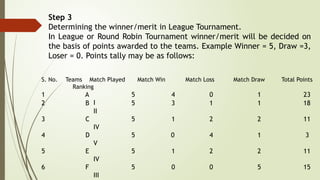
Determining the winner/merit in League Tournament.
In League or Round Robin Tournament winner/merit will be decided on
the basis of points awarded to the teams. Example Winner = 5, Draw =3,
Loser = 0. Points tally may be as follows:
S. No. Teams Match Played Match Win Match Loss Match Draw Total Points
Ranking
1 A 5 4 0 1 23
I
2 B 5 3 1 1 18
II
3 C 5 1 2 2 11
IV
4 D 5 0 4 1 3
V
5 E 5 1 2 2 11
IV
6 F 5 0 0 5 15
III
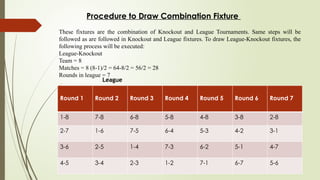
Procedure to Draw Combination Fixture
These fixtures are the combination of Knockout and League Tournaments. Same steps will be
followed as are followed in Knockout and League fixtures. To draw League-Knockout fixtures, the
following process will be executed:
League-Knockout
Team = 8
Matches = 8 (8-1)/2 = 64-8/2 = 56/2 = 28
Rounds in league = 7
League
Round 1 Round 2 Round 3 Round 4 Round 5 Round 6 Round 7
1-8 7-8 6-8 5-8 4-8 3-8 2-8
2-7 1-6 7-5 6-4 5-3 4-2 3-1
3-6 2-5 1-4 7-3 6-2 5-1 4-7
4-5 3-4 2-3 1-2 7-1 6-7 5-6
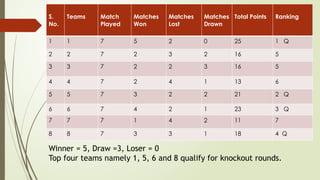
S.
No.
Teams Match
Played
Matches
Won
Matches
Lost
Matches
Drawn
Total Points Ranking
1 1 7 5 2 0 25 1 Q
2 2 7 2 3 2 16 5
3 3 7 2 2 3 16 5
4 4 7 2 4 1 13 6
5 5 7 3 2 2 21 2 Q
6 6 7 4 2 1 23 3 Q
7 7 7 1 4 2 11 7
8 8 7 3 3 1 18 4 Q
Winner = 5, Draw =3, Loser = 0
Top four teams namely 1, 5, 6 and 8 qualify for knockout rounds.
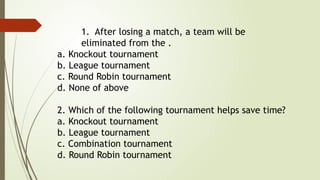
1. After losing a match, a team will be
eliminated from the .
a. Knockout tournament
b. League tournament
c. Round Robin tournament
d. None of above
2. Which of the following tournament helps save time?
a. Knockout tournament
b. League tournament
c. Combination tournament
d. Round Robin tournament

physical education unit 1 class 12 cbse.

  • 1.
    Physical Education UNIT 1- MANAGEMENT OF SPORTING EVENTS BY MR.MILIND KURHADE
  • 2.
     Functions ofSports Events Management (Planning, Organising, Staffing, Directing Controlling)  Various Committees and their Responsibilities (pre; during and post)  Fixtures and its procedures – Knock-Out (Bye and Seeding) and League (Staircase and Cyclic)  Intramural and Extramural – Meaning, Objectives and its Significance  Community Sports – Purpose and benefits.
  • 3.
    Functions of SportsEvents Management.
  • 4.
    PLANNING  Planning  Planningis the foremost function in sports as it gives a view of future course of action. To be effective, a plan should be specific, logical, flexible and complete in all aspects and should assist in controlling future events. A plan must comprehend all the other functions of management like organising, staffing, directing and controlling in order to achieve the predetermined goals.  In sports and sports events, planning plays important role to make the event run smoothly, effectively and remain free from conflict. Effective planning must clearly define aims, goals and objectives of the event. It should also explain the procedure or method to achieve the target in simple and easy to understand language. A sports plan should be prepared in a professional manner incorporating the elements of commitment, enjoyment and voluntary effort.
  • 5.
     Organising  Organisingis a next step after planning. It is a process of execution of the plan. This includes distributing resources and organising personnel in order to achieve the goals established in the planning stage. Organising stage determines the type of jobs and responsibility to achieve planning objectives. Preparation of organisation chart with various positions and reporting should be illustrated in this stage.
  • 6.
    Staffing  This refersto identifying key staff positions, and ensuring that proper talent is serving that specific job duty in order to achieve the aims and objectives of an organization. In this process recruitment and selection of qualified employees take place. After hiring personnel, orientation, training and professional development are also parts of this stage. In orientation new persons are introduced to the nature, goals and policies of events to keep them tuned in to the goals of the organisation. Various training programmes are conducted to provide professional training to the staff at this stage.  In sports events, recruitment of staff as per organisation’s needs should be done. Example, the apex post may be for Director of the event, in second line Deputy Director and then Assistant Director of Sports event may be created.
  • 7.
    Directing Directing personnel isa leadership quality, and includes letting staff know what needs to be done, by whom and also by when. It includes supervision of personnel while simultaneously motivating them. Without directing, planning or organising has no meaning. It is a function of guiding, inspiring and instructing people to accomplish organizational goals.
  • 8.
     Controlling  Controllingrefers to all the processes that leaders create to monitor success. It involves establishing performance standards, measuring actual performance and comparing them for irregularities. It is a important function of management as controlling involves imparting instructions to employees and also ensuring that those instructions are followed. To organise any sports event, instructions given to members of the organising committee towards achieving common goal i.e., organising a sports event in this case, must be carried out sincerely for an event to be successful. Higher order management people control lower order people to ensure efficient and effective use to resources.
  • 9.
    1. The basicfunction of management is? a. controlling b. budgeting c. planning d. organising 2. In which of the following functions of sports event management “recruitment process” take place? a. Planning b. Staffing c. Controlling d. Directing
  • 10.
    Formation of Committees -To organise any sports event, various committees are formed for its systematic and smooth conduct. - To conduct sports events lots of professional planning and preparation is required. - Formation of committees should be based on three levels of management – top, middle and lower levels. Depending upon the level or area of the sports event, suitable people are chosen for staffing various committees.
  • 11.
    Hierarchy of OrganisingCommittee to conduct Intramural Event in School/ institution. Chairperson (Principal of School) Convener (Physical Education Teacher) Members (Teachers of School) Head Boy/Girl (Sports Secretary/President)
  • 12.
    Hierarchy of OrganisingCommittee to conduct Extramural Event in Schools/ institutions. Director of Physical Education and Sports in State Government (Chairperson) Deputy Director/Assistant Director/Supervisor Sports (Convener) Physical Education Teachers of different Schools (Members)
  • 13.
    There is nofixed number of committees to be constituted to organise a sports event; it depends on the number of participants, level of event, area of specialization, dedication of volunteers etc. By and large we can formulate 4 committees under an organising committee. Look at the following chart to study their details of work and their responsibilities.
  • 14.
     Technical Committee This committee covers the technical aspect of the events like requisitions to procure sports equipment, conducting matches on time through selected officials (referees, umpires, judges, timekeepers etc.) for their respective games/sports.  Pre-sports event/ tournament: Before the event, it is the job of the Technical Committee to put forward a requisition to purchase equipment, invitation and confirmation from officials to conduct sports event, cleaning and layout of the fields, arrangement of equipment and stationery, preparation of fixtures, rules and regulation of the sports event.  During sports event/ tournament: While the tournament is in progress, the Technical Committee is responsible for conducting matches, presence of the jury, cleaning and layout of the fields, collection of score sheets and other related papers from officials, preparation of merit list, etc.  Post sports event/ tournament: After the event is over, the Technical Committee arranges for the cleaning and layout of the fields, maintenance of the field, and placing of all equipment back to store.
  • 15.
     Logistics Committee This committee has a wider scope of work ranging from transportation, boarding and lodging to refreshment, decoration and conducting ceremonies that form a part of the event. This committee may have various sub-committees as per requirement. The Logistics Committee looks after the Opening Ceremony, hires photographer/ videographer, makes arrangements for the Victory Ceremony and the Closing Ceremony including arrangement of refreshment, decoration, reception, entertainment, light and sound, medical aspect etc.  Pre sports event/ tournament: It is the duty of the Logistics Committee to look after Placement/Arrangement/Requisition of purchase of stationery, chairs, tables, souvenirs, light and sound equipment, bouquets, sending invitations to stakeholders including other schools/ institutions and VIP guests, requisition of purchase of medals and certificates, arrangement of refreshments, arrangement of boarding and lodging, selection of volunteers, preparation of first aid kit and arrangement of medical facilities.
  • 16.
     During sportsevent/ tournament: While the event is in progress, the Logistics Committee is responsible for the conduct of the Opening and Closing Ceremonies, checking registration, distribution of refreshment, management of spectators, handing over of medals and certificates, transportation of players/participants from place of stay to the field and back.  Post sports event/ tournament: After the event, the Logistics Committee supervises cleaning of the venue, and placing of the items back in their appointed places.
  • 17.
     Finance Committee The role of the Finance Committee is primarily to provide financial oversight for the event. It is involved in all aspects related to the finances of the sports event like planning, accounting, decision-making etc. Finalization of sponsorship, keeping an eye on inflow and outflow of finances, purchase of equipment and other items required for conducting the event, settling payments of officials are key areas of focus of the committee. It is the backbone of the sports tournament. It pitches to different companies and attracts them for sponsorships for the event.  Pre sports event/ tournament: Before the event, It is the responsibility of Finance Committee to prepare the budget, to purchase sports equipment, stationery, medals, certificates, and other requirements as desired by the other committees, as well as preparing and finalizing the MoU with sponsors.  During sports event/ tournament: During the course of the event, the Finance Committee keeps a check on the outflow and inflow of finances including payment and remuneration to officials.  Post sports event/ tournament: Once the event is over, the Finance Committee examines all records related to settlement of the bills and accounts, and prepares the financial report.
  • 18.
     Marketing Committee The Marketing Committee develops plans and strategies to place the event in the market with the purpose of generating publicity and sponsorships. Publicity can be done through various modes like social media, print media, TV, e-mail etc. and sponsorship can be generated in terms of cash or kind by making media partners, food partners, drink partners etc. through calling on, meeting various companies etc. Marketing Committee also organises campaigns related to the event.  Pre sports event/ tournament: The Marketing Committee prepares a strategy for arranging for sponsorships, publicity of the event, arranging meetings or calling on sponsors, preparation of MoUs for sponsorships etc.  During sports event/ tournament: The Marketing Committee issues press release(s), works with media, manages methods of communication, fulfils the requirements of sponsors as per MoUs, arrangement for telecast of event etc.  Post sports event/ tournament: Once the event is over, the Committee issues a press release, and may arrange for a re-telecast of the event.
  • 19.
    Do You Know? Checklist to organising a sports event.  1. Formation of Organising Committees  2. Establishment of Objectives  3. Theme of the event  4. Date of the event  5.Place of the event  6. Budget  7. Sponsorship  8. Marketing (Campaign)  9. Invitations to teams and guests  10. Conformation of teams  11. Logistics (Accommodations, Refreshments, Transportation, Medical Staff,  Water, table, chairs, flags, notice board)  12. Checking on the sponsors  13. Drawing Fixtures and layout of field  14. Rules and Regulations  15. Arrangement of Equipment and score sheets
  • 20.
     16. Arrangementof Referees and Prizes  17. Direction to the stadium (Sign posts)  18. Briefing of Volunteers and staff  19. Decorations  20. Practice and warm up Area  21. Security  22. Photographers  23. Approvals License and NOCs
  • 21.
    1. The Committeeresponsible for liaison with Print media is the ____________ Committee.  a. Technical  b. Logistics  c. Marketing  d. Finance 2. Purchase of sports equipment is a work of the ________________ Committee.  a. Technical  b. Logistics  c. Marketing  d. Finance 3. Publication of rules and regulations should be done ___________________. > a. Pre event  b. During event  c. Post event  d. Any time during the event
  • 22.
    Fixtures & itsprocedures: In sports, an individual generally supports a particular team or player to win the game. Winning helps that team or player reach the next round, and after a specified number of matches, a player or a team wins the Championship. While watching a tournament, you would have seen sometimes a player or team lose a game, and get eliminated from the tournament. However, in some tournaments they remain in the game despite losing. Why is this so? Basically, there are different types of fixtures in different tournaments based on duration, cost, manpower, level, interest etc. that you will study here.
  • 23.
    Tournaments Tournament is aseries of games or matches played among players or teams to determine the winner. It provides an opportunity to demonstrate skills, evaluate one’s performance and motivate players to perform well, attract people towards sports to make sports popular and provide healthy entertainment. There are various types of tournament formats based on advancement or elimination criteria of players or teams. Study the three tournament formats listed below.
  • 24.
    Knock – OutTournament: In a Knock-Out Tournament a player or team continues to play matches until it is defeated. In this type of format, players or teams have to consistently give their best performance to avoid elimination. Such a tournament saves cost and time and makes each match intensive because of fear of elimination. Since fixtures are drawn on the basis of lots, there is the possibility of a match between two good teams or players even in the early stages. In this system a good team can be eliminated even at the earliest stage due to getting defeated by chance or by accident.
  • 25.
    League or RoundRobin: In League or Round Robin Tournament, a player or team will play the matches that are allotted before the start of the tournament. Fixed number of matches are given to players and teams. Players or teams will get equal chance to play with each other. Thus, the true winner emerges from this format and ranking can be prepared for all participating players or teams. However, this format involves more money, time and facilities as compared to the Knock-Out Tournament and there is no provision of seeding for extraordinary teams and players.
  • 26.
    Combination: They arethe combination of Knock-Out and League format. Depending upon the need and importance of the tournament, Combination Tournaments can be Knockout- League, League- Knockout, Knockout-League-Knockout etc. These tournaments are conducted when there are (a) a large number of participants, (b) participants are spread in different areas, (c) venues are in different zones/places etc. In this format some of the demerits of Knockout and League Tournaments can be eliminated.
  • 28.
    Fixtures, Byes andSeeding:  We have learned about three types of tournaments, Now we will study how we can draw the fixtures. In sports, the term fixtures refers to the programme listing which team (Team A) will play whom (Team B), where (venue), and when (time).  Definitions:  A fixture is “a sports event or its date.”  “A sports match that has been arranged for a particular time and place”  ‘Fixture is a process of arrangement of the teams in systematic order in various groups for competitive fights for physical activity’.  Thus, tie or fixture or heat include multiple and progressive matches. In athletics and swimming the term Heats is used, in Tennis, badminton and other games we frequently use the terms Ties or Fixtures. For any tournament, unbiased draws of fixtures is a road towards the success. First, let us understand the words “bye” and “seed”.
  • 29.
    Bye - meansa team is not required to participate in the primary round due to allotment of draws. It should be given to any participating team through random lottery system. In a tournament, bye is generally assigned to teams by the organizing committee not to play a round due to one of the several reasons: - Uneven distribution of teams in tournament (In knock out tournament, number of teams equals to power of two [e.g., 8, 16, 32, 64, ….] and in League tournament, if there is an odd number of teams. - Separate pooling of previous winners in same group to create even competition, - to avoid one team from playing more matches on a single day than the other, so creating disadvantage for some.
  • 30.
    Seeding - isa process in which teams will be placed in such a manner that good teams that have a ranking or previous year’s position etc. do not meet another team at an early stage of the tournament. This procedure is generally implemented to reduce the chance of elimination of good teams at an early stage. Procedure of allotting seeding is the same as given for byes.
  • 31.
    Procedure for DrawingKnock - Out Fixture To determine the total number of teams that will participate in the Knockout tournament. If the number of teams is: 2, 4, 8, 16, 32, 64, 128, ….. (Number being a multiple of Two) then there is no need of byes. You may see the procedure in Illustration : 1 and 2. If the number of teams is other than the given numbers, then byes will be given as per draw of lot.
  • 32.
    Step 2 To determinethe total number of matches to be played in the tournament, following formula will be used: Total Number of Matches= Number of teams – 1 In case of 8 teams then 8-1= 7 matches (not including third place match) If number of teams are 12 then 12-1= 11 matches (not including third place match) In case of 15 teams then 15-1=14 (not including third place match)
  • 33.
    Step 3 The totalnumber of teams are to be divided into two halves, namely Upper Half and Lower Half. If the total number of participating teams are even in numbers the Formula will be: Number of teams 2 = Teams in Upper Half or Lower Half If total number of teams is 12 then, 12/2 = 6, i.e., 6 teams will be placed in Upper Half and the remaining 6 will be placed in Lower Half. If total number of participating teams are odd in numbers then Formula will be Number of teams + 1/2 = Teams in Upper Half Number of teams – 1/2 = Teams in Lower Half If number of teams is 15 then 15 + 1/2 = 8 Teams in Upper Half 15 – 1/2 = 7 Teams in Lower Half Thus, 8 teams will be placed in Upper Half and remaining 7 will be placed in Lower Half.
  • 34.
    Step 4 After determiningUpper and Lower Half Teams, byes will be given. We can determine the byes by finding the difference between the number of teams participating in the Tournament and next power of 2 of participating Teams in the Tournament. For example, if total number of Teams is 12, then next power of 2 will be 16. 16-12= 4 Byes. For even numbers byes will be placed in Upper and Lower Half. 4/2 = 2 If total number of Teams is 19, then next power will be 32 32-19 = 13 byes For odd numbers byes will be placed in Upper Half = 13-1/2 = 6 and Lower Half = 13+1/2 =7
  • 35.
    Step 5 Allotment ofbyes in the fixture should be given in following order. First bye will be given to last team of Lower Half, Second bye will be given to first team of Upper Half, Third bye will be given to last team of Upper Half, Fourth bye will be given to first team of Lower Half, Same pattern will be followed after fourth bye till the remaining byes have been given. OR First bye will be given to last team of Lower Half, Second by will be given to first team of Upper Half, Third bye will be given to first team of Lower Half, Fourth bye will be given to last team of Upper Half Same pattern will be followed after fourth bye till the remaining byes have been given.
  • 36.
    Step 6 Write theserial number (number of participants) in vertical order. Divide into two halves as per Step 3. Then place byes as per step 5. Now place remaining teams through random lottery system from top to bottom or same pattern used to allot byes. Teams having byes will not play their first-round matches. Put Date, Time, Venue in front of the matches in fixture.
  • 37.
    Illustration – 1 TotalNumber of Teams = 4 Total Number of Matches = 4-1 = 3 Total Number of Byes= since Number having power of Two, no need of bye Number of team in Upper Half = 4/2 = 2 Number of team in Lower Half = 4/2 = 2 Round I Matches First match between A Vs B and won by B Second Match between C Vs D won by D Round II match or Finals Third match Finals between B Vs D won by B
  • 38.
    Illustration – 2 TotalNumber of Teams = 8 Total Number of Matches = 8-1=7 Total Number of Byes= since Number having power of Two, no need of bye Number of team in Upper Half = 8/2= 4 Number of team in Lower Half = 8/2 = 4 Round I Matches First match between A Vs B won by A Second match between C Vs D won by C Third match between E Vs F won by F Fourth match between G Vs H won by G Round II Matches Fifth match between A Vs C won by C Sixth match between F Vs G won by G17 Round III or Finals Seventh match Final between C Vs G won by G
  • 39.
    Illustration – 3 TotalNumber of Teams = 11 Total Number of Matches = 11-1=10 Total Number of Byes= 16-11= 5 Total Number of Byes in Upper half = 5-1/2 =2 Total Number of Byes in Lower half = 5+1/2 =3 Number of team in Upper half = 11+1/2 =6 Number of team in Lower half = 11-1/2 =5 Round I Matches First match between 2 Vs 3 won by 2 Second match between 4 Vs 5 won by 4 Third match between 8 Vs 9 won by 9 Round II Matches Fourth match between 1 Vs 2 won by 1 Fifth match between 4 Vs 6 won by 6 Sixth match between 7 Vs 9 won by 7 Seventh match between 10 Vs 11 won by 10 Round III Matches (semi-finals) Eighth match between 1Vs 6 won by 6 Ninth match between 7 Vs 10 won by 7 Round IV or Final Tenth match between 6 Vs 7 won by 7
  • 40.
    Procedure to DrawLeague or Round Robin Fixture In League or Round Robin Tournament each team has to play once with all the remaining teams of the tournament. Step 1 Determine the number of matches by applying following formula: Number of teams = n Total number of matches = n (n-1)/2 If teams are 6 then 6 (6-1)/2 = 36-6/2 = 30/2 = 15 This means, 15 numbers of matches will be played in league tournament. If teams are 7 then 21 numbers of matches will be played in league tournament Step 2 Here, we will study two types of methods to fix the team in league tournament namely Cyclic Method and Stair Case Method:
  • 41.
    Cyclic Method In CyclicMethod, one team will be fixed in position and the other will be placed in rotation to complete the cycle. In this method, two situations may arise, first if teams are even numbered, second situation if teams are odd numbered. Let’s see how to set fixtures in these two situations. Even number of teams in tournament does not require giving of any bye to any team and to find out number of rounds, formula will be number of teams – 1. Total number of teams= 6 Total number of rounds = 6–1 = 5
  • 42.
    In order todraw fixture for odd number of teams one bye will be given to one team in one round and in next round another team will get a bye. Rounds in the tournament will remain the same. Total number of teams = 7 Total number of rounds = 7
  • 43.
    Staircase Method In StaircaseMethod, one team will be fixed on the highest step, and that team will play with all the teams of the tournament and in next step down, the next team will be fixed to play with other remaining teams and so on. Total number of Teams= 7 A Vs B A Vs C B Vs C A Vs D B Vs D C Vs D A Vs E B Vs E C Vs E D Vs E A Vs F B Vs F C Vs F D Vs F E Vs F A Vs G B Vs G C Vs G D Vs G E Vs
  • 44.
    Details of Matches MatchNo Team A Vs Team B Date Time Venue Result
  • 45.
    Step 3 Determining thewinner/merit in League Tournament. In League or Round Robin Tournament winner/merit will be decided on the basis of points awarded to the teams. Example Winner = 5, Draw =3, Loser = 0. Points tally may be as follows: S. No. Teams Match Played Match Win Match Loss Match Draw Total Points Ranking 1 A 5 4 0 1 23 I 2 B 5 3 1 1 18 II 3 C 5 1 2 2 11 IV 4 D 5 0 4 1 3 V 5 E 5 1 2 2 11 IV 6 F 5 0 0 5 15 III
  • 46.
    Procedure to DrawCombination Fixture These fixtures are the combination of Knockout and League Tournaments. Same steps will be followed as are followed in Knockout and League fixtures. To draw League-Knockout fixtures, the following process will be executed: League-Knockout Team = 8 Matches = 8 (8-1)/2 = 64-8/2 = 56/2 = 28 Rounds in league = 7 League Round 1 Round 2 Round 3 Round 4 Round 5 Round 6 Round 7 1-8 7-8 6-8 5-8 4-8 3-8 2-8 2-7 1-6 7-5 6-4 5-3 4-2 3-1 3-6 2-5 1-4 7-3 6-2 5-1 4-7 4-5 3-4 2-3 1-2 7-1 6-7 5-6
  • 47.
    S. No. Teams Match Played Matches Won Matches Lost Matches Drawn Total PointsRanking 1 1 7 5 2 0 25 1 Q 2 2 7 2 3 2 16 5 3 3 7 2 2 3 16 5 4 4 7 2 4 1 13 6 5 5 7 3 2 2 21 2 Q 6 6 7 4 2 1 23 3 Q 7 7 7 1 4 2 11 7 8 8 7 3 3 1 18 4 Q Winner = 5, Draw =3, Loser = 0 Top four teams namely 1, 5, 6 and 8 qualify for knockout rounds.
  • 48.
    1. After losinga match, a team will be eliminated from the . a. Knockout tournament b. League tournament c. Round Robin tournament d. None of above 2. Which of the following tournament helps save time? a. Knockout tournament b. League tournament c. Combination tournament d. Round Robin tournament