HEMOSTASIS
DR. GEORGE SKARIAH P
PROFESSOR AND HEAD OF DEPARTMENT
ORAL AND MAXILLOFACIAL SURGERY
11/30/2024
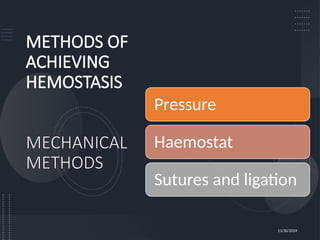
METHODS OF
ACHIEVING
HEMOSTASIS
MECHANICAL
METHODS
11/30/2024
Pressure
Haemostat
Sutures and ligation
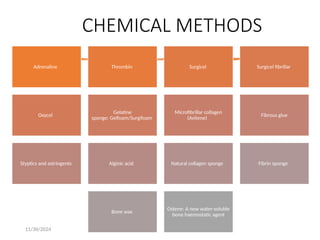
CHEMICAL METHODS
11/30/2024
Adrenaline Thrombin Surgicel Surgicel fibrillar
Oxycel
Gelatine
sponge: Gelfoam/Surgifoam
Microfibrillar collagen
(Avitene)
Fibrous glue
Styptics and astringents Alginic acid Natural collagen sponge Fibrin sponge
Bone wax
Ostene: A new water-soluble
bone haemostatic agent
THERMAL AGENTS
11/30/2024
Eletrocautery/Surgical
diathermy
Monopolar diathermy Bipolar diathermy
Cryosurgery Lasers
Mechanical
methods
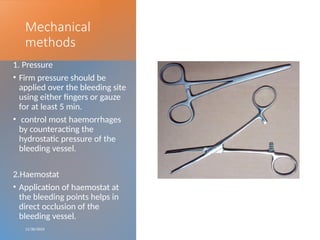
1. Pressure
• Firm pressure should be
applied over the bleeding site
using either fingers or gauze
for at least 5 min.
• control most haemorrhages
by counteracting the
hydrostatic pressure of the
bleeding vessel.
2.Haemostat
• Application of haemostat at
the bleeding points helps in
direct occlusion of the
bleeding vessel.
11/30/2024
Sutures and
ligation
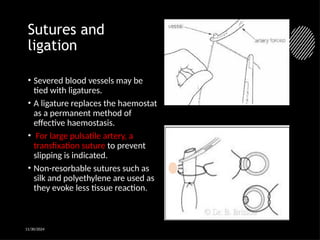
• Severed blood vessels may be
tied with ligatures.
• A ligature replaces the haemostat
as a permanent method of
effective haemostasis.
• For large pulsatile artery, a
transfixation suture to prevent
slipping is indicated.
• Non-resorbable sutures such as
silk and polyethylene are used as
they evoke less tissue reaction.
11/30/2024
CHEMICAL METHODS
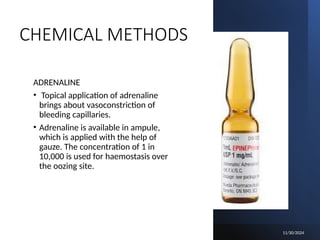
ADRENALINE
• Topical application of adrenaline
brings about vasoconstriction of
bleeding capillaries.
• Adrenaline is available in ampule,
which is applied with the help of
gauze. The concentration of 1 in
10,000 is used for haemostasis over
the oozing site.
11/30/2024
THROMBIN
Thrombin helps in converting
fibrinogen into fibrous clot and acts as
haemostat.
11/30/2024
SURGICEL
• oxidised cellulose polymer
• obtained by dissolving pure alpha-
cellulose in an alkaline solution
• It acts by forming acid products
from partial dissolution that
coagulates the plasma proteins to
form a black or brown sticky
gelatinous clot.
• The applied surgicel resorbs from
the site in 4 to 8 weeks.
• disadvantage is that the surgicel clot
is not formed by normal
physiological mechanism.
11/30/2024
SURGICEL FIBRILLAR
• modified surgicel or oxidised
regenerated cellulose in layers
• adapted to irregular surfaces and
inaccessible areas.
• Complete resorption occurs in 2
weeks.
11/30/2024
OXYCEL
• oxidised cellulose polymer product.
• absorbable haemostatic material
• controlled oxidation of cellulose
using nitrous dioxide.
• The cellulosic acid (cytotoxic acid)
present in oxycel has affinity for
haemoglobin which leads to the
formation of artificial clot.
• Bacteriostatic
• gauze form or pellet form.
• hollow ‘twisted tubule’ fibres in
comparison to the irregular
solid fibres of surgicel.
11/30/2024
GELATIN SPONGE
• gelfoam or surgifoam
• purified pork skin gelatine
• nonantigenic
• completely absorbable
material.
• capacity to absorb 45 times its
weight in blood.
• resorbs completely in 4 to 6
weeks.
11/30/2024
MICROFIBRILLAR
COLLAGEN
• Avitene
• Collagen derived from bovine
skin causes contact activation
in addition to direct platelet
aggregation.
• advantage -minimal swelling
• it tends to reduce platelet
count in normal individuals
• ineffective in
thrombocytopaenia. •
• absorption time is 3 months.
11/30/2024
FIBRIN GLUE
• It is a biological adhesive which
contains thrombin, fibrinogen,
factor VII, aprotinin.
11/30/2024
STYPTICS AND ASTRINGENTS
• Precipitates protein and arrests bleeding.
• Commonly used - Monsel’s solution containing ferric subsulphate and
tannic acid.
• Thrombin and gelatine sponge are now widely used.
• Alginic acid
• This is available in powder form in special 5-mg packages.
• It is placed over the bleeding sites, a protective film is formed over
the bleeding site, this film compresses the capillaries and stabilises
the blood clot in place.
11/30/2024
NATURAL
COLLAGEN
SPONGE
• white sponge material
• non-antigenic
• fully absorbable.
• stimulates the platelet aggregation thereby
enhancing haemostasis.
• activates coagulation factors XI and XIII.
• preferred in patients who are susceptible
for haemorrhage after dental surgical
procedures
11/30/2024
FIBRIN SPONGE
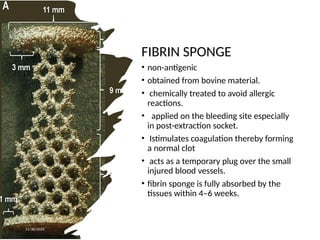
• non-antigenic
• obtained from bovine material.
• chemically treated to avoid allergic
reactions.
• applied on the bleeding site especially
in post-extraction socket.
• Istimulates coagulation thereby forming
a normal clot
• acts as a temporary plug over the small
injured blood vessels.
• fibrin sponge is fully absorbed by the
tissues within 4–6 weeks.
11/30/2024
BONE WAX
• sterilised,
• non-absorbable mix of waxes.
• consists of seven parts by weight of wax (white bees
wax, paraffin wax and an isopropyl ester of palmitic
acid),
• two parts of olive oil and one part of phenol.
• white and available as a solid rectangular plate
weighing 2.5 g.
• Indication- bleeding from the bone or from chipped
edges of bone.
• The bone wax is softened with the fingers to a
desirable consistency and then applied over the
bleeding site.
• haemostatic mechanism - mechanical obstruction of
the osseous cavity containing the bleeding vessels.
• Frequent use may lead to the formation of wax
granuloma (foreign body).
11/30/2024
OSTENE
a new water-soluble bone haemostatic agent
made of water-soluble alkylene oxide copolymers.
11/30/2024
THERMAL AGENTS
• Surgical cutting instruments have been
modified using thermal agents in order
to achieve haemostasis during surgery.
• Delivery of heat or cold during the
cutting can be done by electric current
(electrocautery), laser beam (like
argon), liquid nitrogen (cryosurgery),
radio frequency energy etc.
• coagulate and seal the blood vessels
as they cut achieving haemostasis and
a bloodless field during surgery.
• surgery of vascular
lesions like haemangiomas that can
potentially cause life
threatening intraoperative bleeding
11/30/2024
ELECTROCAUTERY
• surgical diathermy
• surgical technique that depends on
thermal effect of electric current.
• a high frequency current is applied to
a specific area of the body for the
purpose of removal of unwanted
tissue, coagulation, or to create a
surgical incision.
• cleaner, safer and more efficient
• Types of diathermy - Monopolar &
Bipolar
11/30/2024
CRYOSURGERY
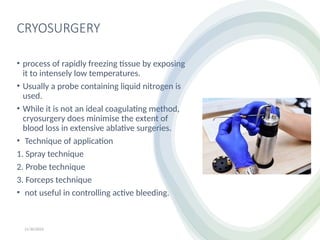
• process of rapidly freezing tissue by exposing
it to intensely low temperatures.
• Usually a probe containing liquid nitrogen is
used.
• While it is not an ideal coagulating method,
cryosurgery does minimise the extent of
blood loss in extensive ablative surgeries.
• Technique of application
1. Spray technique
2. Probe technique
3. Forceps technique
• not useful in controlling active bleeding.
11/30/2024
MANAGEMENT OF
MEDICALLY
COMPROMISED PATIENTS
MANAGEMENT OF
PATIENTS IN WHOM THE
DENTAL TREATMENT MAY
NEED MODIFICATION
ACCORDING TO THEIR
MEDICAL CONDITION
11/30/2024
GOLDEN
RULE
• No contraindication for any dental procedure if the
pt is controlled
• Give premedication of the pt preoperatively except
the anticoagulants
11/30/2024
HYPERTENSION • BP should be controlled before
elective dental treatment or the
opinion of a physician should be
sought.
• Endogenous adrenaline
(epinephrine) levels peak during
the morning hours and adverse
cardiac events are most likely in
the early morning, so patients are
best treated in the late morning.
• Those with stable hypertension
may receive dental care, in short,
minimally stressful appointments.
• It is essential to avoid anxiety and
pain, since endogenous adrenaline
released in response to pain or ear
may induce arrhythmias.
11/30/2024
• Under most circumstances, the use
of adrenaline in combination with LA
is not contraindicated in the
hypertensive patient unless the
systolic pressure is >200 mmHg
and/or the diastolic is >115 mmHg.
• Adrenaline-containing LA should not
be given in large doses to patients
taking beta-blockers.
• Lidocaine should be used with
caution in patients taking beta-
blockers.
• Adrenaline effects may be reversed in
patients taking alpha-blockers causing
vasodilatation.
• Gingival retraction cords containing
adrenaline should be avoided.
11/30/2024
• Continuous BP monitoring is
indicated.
• Raising the patient suddenly from
the supine position may cause
postural hypotension and loss of
consciousness if the patient is
using antihypertensive drugs such
as thiazides, furosemide or a CCB
• Facial palsy is an occasional
complication o malignant
hypertension.
11/30/2024
ANGINA PECTORIS
• Preoperative GTN and oral sedation
is advised.
• If a patient with a history of angina
experiences chest pain in the dental
surgery, dental treatment must be
stopped and the patient should be
given GTN sublingually and oxygen;
the patient should be kept sitting
upright.
• Vital signs should be monitored.
• The pain should be relieved in 2–3
minutes; the patient should then rest
and be accompanied home.
11/30/2024
• If chest pain is not relieved within about 3
minutes, MI is a possible cause and medical
help should be summoned.
• Pain that persists after three doses of GTN
given every 5 minutes, lasts more than 15–
20 minutes, or is associated with nausea,
vomiting, syncope or hypertension is highly
suggestive of MI.
• If pain persists, the patient should continue
on oxygen and chew 300 mg of aspirin .
11/30/2024
STABLE ANGINA
• minor treatment under LA, the physician should be consulted.
• Before dental treatment, patients with stable angina should be reassured and
possibly sedated with oral diazepam.
• Prophylactic administration of GTN may be indicated if the patient has angina
more than once a week.
UNSTABLE ANGINA
• Elective dental care should be de erred until a physician has agreed to it,
because of the risk of infarction.
• Preoperative GTN should be given, together with relative analgesia monitored
by pulse oximetry, and LA; however, such patients are best cared or in hospital,
as intravenous nitrates may be indicated.
• Emergency dental care should be the least invasive possible, using preoperative
GTN, together with relative analgesia monitored by pulse oximetry and LA;
however, such patients are best cared or in a hospital environment.
11/30/2024
MYOCARDIAL
INFARCTION
• patients within 6 months of an MI (recent MI) are at greatest risk of further MI,
chest pain, arrhythmias or other complications.
• classed as ASA class IV.
• Simple emergency dental treatment under LA may be given during the first 6
months after MI but the opinion of a physician should be sought first.
• monitoring of BP, ECG, pulse and oxygen saturation are indicated.
• Dental procedures should be stopped if there is chest pain, dyspnoea, a rise in
heart rate o 40 beats/min or more, a rise in the ST-segment displacement o
above 0.2 mV on ECG, arrhythmias, or a rise in systolic BP o more than 20
mmHg.
11/30/2024
RHEUMATIC FEVER
Most patients with chronic
rheumatic fever are
anticoagulated; treatment can
be done under LA in
consultation with the physician.
Conscious sedation with nitrous
oxide may be given if cardiac
function is good and with the
approval of the physician.
11/30/2024
INFECTIVE ENDOCARDITIS
• The cardiac endocarditis risk is now stratified
into high, moderate and low.
• The low-risk categories do not require
antibiotic prophylaxis or dental procedures
• However, in 2006, the BSAC recommended
antibiotic prophylaxis in only three (high-risk)
circumstances:
■ Previous IE
■ Prosthetic valves
■ Surgically constructed pulmonary shunts or
conduit
• . Antibiotic prophylaxis is now not
recommended for patients at risk of
endocarditis undergoing dental procedure.
11/30/2024
DIABETES MELLITUS
• diabetic patients are predisposed to infections and have more severe periodontal
disease than controls.
• Severe periodontitis may also upset glycaemic control.
• If diabetic control is poor, oral candidosis can develop
• The dentist should manage infections aggressively, as people with diabetes may
be immunocompromised -amoxicillin is the antibiotic of choice.
• In a well-controlled diabetic patient, it is feasible to carry out even minor surgical
procedures, such as simple single extractions under LA, as long as the procedure
is carried out within 2 hours o breakfast and the morning insulin injection, with
no change in the insulin regimen.
• multiple extractions, must only be carried out in hospital.
• Poorly controlled diabetics (whether type 1 or 2) should also be referred or
improved control of their blood glucose be ore non-emergency treatment is
performed.
11/30/2024
HYPOTHYROIDISM
precipitation of myxoedema coma by the use
of sedatives including diazepam or
midazolam, opioid analgesics (including
codeine) or tranquillizers.
These should there ore be either avoided or
given in a low dose.
LA is satisfactory or pain control.
CS can be carried out with nitrous oxide and
oxygen.
Diazepam or midazolam may precipitate
coma.
11/30/2024
HYPERTHYROIDISM
• LA is the main means of pain control,
especially if hypertension and arrhythmias
are present.
• CS is preferably carried out with nitrous
oxide and oxygen.
• GA may be challenging because of
cardiovascular complications and sensitivity
to muscle relaxants.
• Dental treatment in hyperparathyroidism
may be complicated by renal disease, peptic
ulceration, bone fragility or pluriglandular
disease
11/30/2024
EPILEPSY
• Dental treatment should be carried out in a
good phase of epilepsy, when attacks are in
frequent.
• Those who have in frequent seizures or who
depend on others (such
as those with a learning impairment) may fail to
take regular medication and thus be poorly
controlled.
• When dental treatment is being carried out in a
known epileptic, a strong mouth prop should
be kept in position and the oral cavity kept as
free as possible of debris.
• As much apparatus as possible should be kept
away from the area around the patient. Drugs
can be epileptogenic or interfere with
anticonvulsants, or can themselves be changed
by anticonvulsant therapy and may, therefore,
be contraindicated
11/30/2024
PLATELET DISORDERS
• Haemorrhage
• Platelets can be replaced or supplemented by platelet
transfusions.
• When given prophylactically, platelets should be given in
the following way: half just be ore surgery to control
capillary bleeding, and half at the end of the operation to
facilitate placement of adequate sutures.
• Platelets should be used within 6–24 hours of collection.
• Patients who should not have their medications stopped
or altered prior to dental surgical procedures in primary
care include those taking:
■ low-dose aspirin
■ clopidogrel
■ dipyridamole.
11/30/2024
THANKYOU
11/30/2024

hemostasis & mc (1) (1).pptx presentation

  • 1.
    HEMOSTASIS DR. GEORGE SKARIAHP PROFESSOR AND HEAD OF DEPARTMENT ORAL AND MAXILLOFACIAL SURGERY 11/30/2024
  • 2.
  • 3.
    CHEMICAL METHODS 11/30/2024 Adrenaline ThrombinSurgicel Surgicel fibrillar Oxycel Gelatine sponge: Gelfoam/Surgifoam Microfibrillar collagen (Avitene) Fibrous glue Styptics and astringents Alginic acid Natural collagen sponge Fibrin sponge Bone wax Ostene: A new water-soluble bone haemostatic agent
  • 4.
  • 5.
    Mechanical methods 1. Pressure • Firmpressure should be applied over the bleeding site using either fingers or gauze for at least 5 min. • control most haemorrhages by counteracting the hydrostatic pressure of the bleeding vessel. 2.Haemostat • Application of haemostat at the bleeding points helps in direct occlusion of the bleeding vessel. 11/30/2024
  • 6.
    Sutures and ligation • Severedblood vessels may be tied with ligatures. • A ligature replaces the haemostat as a permanent method of effective haemostasis. • For large pulsatile artery, a transfixation suture to prevent slipping is indicated. • Non-resorbable sutures such as silk and polyethylene are used as they evoke less tissue reaction. 11/30/2024
  • 7.
    CHEMICAL METHODS ADRENALINE • Topicalapplication of adrenaline brings about vasoconstriction of bleeding capillaries. • Adrenaline is available in ampule, which is applied with the help of gauze. The concentration of 1 in 10,000 is used for haemostasis over the oozing site. 11/30/2024
  • 8.
    THROMBIN Thrombin helps inconverting fibrinogen into fibrous clot and acts as haemostat. 11/30/2024
  • 9.
    SURGICEL • oxidised cellulosepolymer • obtained by dissolving pure alpha- cellulose in an alkaline solution • It acts by forming acid products from partial dissolution that coagulates the plasma proteins to form a black or brown sticky gelatinous clot. • The applied surgicel resorbs from the site in 4 to 8 weeks. • disadvantage is that the surgicel clot is not formed by normal physiological mechanism. 11/30/2024
  • 10.
    SURGICEL FIBRILLAR • modifiedsurgicel or oxidised regenerated cellulose in layers • adapted to irregular surfaces and inaccessible areas. • Complete resorption occurs in 2 weeks. 11/30/2024
  • 11.
    OXYCEL • oxidised cellulosepolymer product. • absorbable haemostatic material • controlled oxidation of cellulose using nitrous dioxide. • The cellulosic acid (cytotoxic acid) present in oxycel has affinity for haemoglobin which leads to the formation of artificial clot. • Bacteriostatic • gauze form or pellet form. • hollow ‘twisted tubule’ fibres in comparison to the irregular solid fibres of surgicel. 11/30/2024
  • 12.
    GELATIN SPONGE • gelfoamor surgifoam • purified pork skin gelatine • nonantigenic • completely absorbable material. • capacity to absorb 45 times its weight in blood. • resorbs completely in 4 to 6 weeks. 11/30/2024
  • 13.
    MICROFIBRILLAR COLLAGEN • Avitene • Collagenderived from bovine skin causes contact activation in addition to direct platelet aggregation. • advantage -minimal swelling • it tends to reduce platelet count in normal individuals • ineffective in thrombocytopaenia. • • absorption time is 3 months. 11/30/2024
  • 14.
    FIBRIN GLUE • Itis a biological adhesive which contains thrombin, fibrinogen, factor VII, aprotinin. 11/30/2024
  • 15.
    STYPTICS AND ASTRINGENTS •Precipitates protein and arrests bleeding. • Commonly used - Monsel’s solution containing ferric subsulphate and tannic acid. • Thrombin and gelatine sponge are now widely used. • Alginic acid • This is available in powder form in special 5-mg packages. • It is placed over the bleeding sites, a protective film is formed over the bleeding site, this film compresses the capillaries and stabilises the blood clot in place. 11/30/2024
  • 16.
    NATURAL COLLAGEN SPONGE • white spongematerial • non-antigenic • fully absorbable. • stimulates the platelet aggregation thereby enhancing haemostasis. • activates coagulation factors XI and XIII. • preferred in patients who are susceptible for haemorrhage after dental surgical procedures 11/30/2024
  • 17.
    FIBRIN SPONGE • non-antigenic •obtained from bovine material. • chemically treated to avoid allergic reactions. • applied on the bleeding site especially in post-extraction socket. • Istimulates coagulation thereby forming a normal clot • acts as a temporary plug over the small injured blood vessels. • fibrin sponge is fully absorbed by the tissues within 4–6 weeks. 11/30/2024
  • 18.
    BONE WAX • sterilised, •non-absorbable mix of waxes. • consists of seven parts by weight of wax (white bees wax, paraffin wax and an isopropyl ester of palmitic acid), • two parts of olive oil and one part of phenol. • white and available as a solid rectangular plate weighing 2.5 g. • Indication- bleeding from the bone or from chipped edges of bone. • The bone wax is softened with the fingers to a desirable consistency and then applied over the bleeding site. • haemostatic mechanism - mechanical obstruction of the osseous cavity containing the bleeding vessels. • Frequent use may lead to the formation of wax granuloma (foreign body). 11/30/2024
  • 19.
    OSTENE a new water-solublebone haemostatic agent made of water-soluble alkylene oxide copolymers. 11/30/2024
  • 20.
    THERMAL AGENTS • Surgicalcutting instruments have been modified using thermal agents in order to achieve haemostasis during surgery. • Delivery of heat or cold during the cutting can be done by electric current (electrocautery), laser beam (like argon), liquid nitrogen (cryosurgery), radio frequency energy etc. • coagulate and seal the blood vessels as they cut achieving haemostasis and a bloodless field during surgery. • surgery of vascular lesions like haemangiomas that can potentially cause life threatening intraoperative bleeding 11/30/2024
  • 21.
    ELECTROCAUTERY • surgical diathermy •surgical technique that depends on thermal effect of electric current. • a high frequency current is applied to a specific area of the body for the purpose of removal of unwanted tissue, coagulation, or to create a surgical incision. • cleaner, safer and more efficient • Types of diathermy - Monopolar & Bipolar 11/30/2024
  • 22.
    CRYOSURGERY • process ofrapidly freezing tissue by exposing it to intensely low temperatures. • Usually a probe containing liquid nitrogen is used. • While it is not an ideal coagulating method, cryosurgery does minimise the extent of blood loss in extensive ablative surgeries. • Technique of application 1. Spray technique 2. Probe technique 3. Forceps technique • not useful in controlling active bleeding. 11/30/2024
  • 23.
  • 24.
    MANAGEMENT OF PATIENTS INWHOM THE DENTAL TREATMENT MAY NEED MODIFICATION ACCORDING TO THEIR MEDICAL CONDITION 11/30/2024
  • 25.
    GOLDEN RULE • No contraindicationfor any dental procedure if the pt is controlled • Give premedication of the pt preoperatively except the anticoagulants 11/30/2024
  • 26.
    HYPERTENSION • BPshould be controlled before elective dental treatment or the opinion of a physician should be sought. • Endogenous adrenaline (epinephrine) levels peak during the morning hours and adverse cardiac events are most likely in the early morning, so patients are best treated in the late morning. • Those with stable hypertension may receive dental care, in short, minimally stressful appointments. • It is essential to avoid anxiety and pain, since endogenous adrenaline released in response to pain or ear may induce arrhythmias. 11/30/2024
  • 27.
    • Under mostcircumstances, the use of adrenaline in combination with LA is not contraindicated in the hypertensive patient unless the systolic pressure is >200 mmHg and/or the diastolic is >115 mmHg. • Adrenaline-containing LA should not be given in large doses to patients taking beta-blockers. • Lidocaine should be used with caution in patients taking beta- blockers. • Adrenaline effects may be reversed in patients taking alpha-blockers causing vasodilatation. • Gingival retraction cords containing adrenaline should be avoided. 11/30/2024
  • 28.
    • Continuous BPmonitoring is indicated. • Raising the patient suddenly from the supine position may cause postural hypotension and loss of consciousness if the patient is using antihypertensive drugs such as thiazides, furosemide or a CCB • Facial palsy is an occasional complication o malignant hypertension. 11/30/2024
  • 29.
    ANGINA PECTORIS • PreoperativeGTN and oral sedation is advised. • If a patient with a history of angina experiences chest pain in the dental surgery, dental treatment must be stopped and the patient should be given GTN sublingually and oxygen; the patient should be kept sitting upright. • Vital signs should be monitored. • The pain should be relieved in 2–3 minutes; the patient should then rest and be accompanied home. 11/30/2024
  • 30.
    • If chestpain is not relieved within about 3 minutes, MI is a possible cause and medical help should be summoned. • Pain that persists after three doses of GTN given every 5 minutes, lasts more than 15– 20 minutes, or is associated with nausea, vomiting, syncope or hypertension is highly suggestive of MI. • If pain persists, the patient should continue on oxygen and chew 300 mg of aspirin . 11/30/2024
  • 31.
    STABLE ANGINA • minortreatment under LA, the physician should be consulted. • Before dental treatment, patients with stable angina should be reassured and possibly sedated with oral diazepam. • Prophylactic administration of GTN may be indicated if the patient has angina more than once a week. UNSTABLE ANGINA • Elective dental care should be de erred until a physician has agreed to it, because of the risk of infarction. • Preoperative GTN should be given, together with relative analgesia monitored by pulse oximetry, and LA; however, such patients are best cared or in hospital, as intravenous nitrates may be indicated. • Emergency dental care should be the least invasive possible, using preoperative GTN, together with relative analgesia monitored by pulse oximetry and LA; however, such patients are best cared or in a hospital environment. 11/30/2024
  • 32.
    MYOCARDIAL INFARCTION • patients within6 months of an MI (recent MI) are at greatest risk of further MI, chest pain, arrhythmias or other complications. • classed as ASA class IV. • Simple emergency dental treatment under LA may be given during the first 6 months after MI but the opinion of a physician should be sought first. • monitoring of BP, ECG, pulse and oxygen saturation are indicated. • Dental procedures should be stopped if there is chest pain, dyspnoea, a rise in heart rate o 40 beats/min or more, a rise in the ST-segment displacement o above 0.2 mV on ECG, arrhythmias, or a rise in systolic BP o more than 20 mmHg. 11/30/2024
  • 33.
    RHEUMATIC FEVER Most patientswith chronic rheumatic fever are anticoagulated; treatment can be done under LA in consultation with the physician. Conscious sedation with nitrous oxide may be given if cardiac function is good and with the approval of the physician. 11/30/2024
  • 34.
    INFECTIVE ENDOCARDITIS • Thecardiac endocarditis risk is now stratified into high, moderate and low. • The low-risk categories do not require antibiotic prophylaxis or dental procedures • However, in 2006, the BSAC recommended antibiotic prophylaxis in only three (high-risk) circumstances: ■ Previous IE ■ Prosthetic valves ■ Surgically constructed pulmonary shunts or conduit • . Antibiotic prophylaxis is now not recommended for patients at risk of endocarditis undergoing dental procedure. 11/30/2024
  • 35.
    DIABETES MELLITUS • diabeticpatients are predisposed to infections and have more severe periodontal disease than controls. • Severe periodontitis may also upset glycaemic control. • If diabetic control is poor, oral candidosis can develop • The dentist should manage infections aggressively, as people with diabetes may be immunocompromised -amoxicillin is the antibiotic of choice. • In a well-controlled diabetic patient, it is feasible to carry out even minor surgical procedures, such as simple single extractions under LA, as long as the procedure is carried out within 2 hours o breakfast and the morning insulin injection, with no change in the insulin regimen. • multiple extractions, must only be carried out in hospital. • Poorly controlled diabetics (whether type 1 or 2) should also be referred or improved control of their blood glucose be ore non-emergency treatment is performed. 11/30/2024
  • 36.
    HYPOTHYROIDISM precipitation of myxoedemacoma by the use of sedatives including diazepam or midazolam, opioid analgesics (including codeine) or tranquillizers. These should there ore be either avoided or given in a low dose. LA is satisfactory or pain control. CS can be carried out with nitrous oxide and oxygen. Diazepam or midazolam may precipitate coma. 11/30/2024
  • 37.
    HYPERTHYROIDISM • LA isthe main means of pain control, especially if hypertension and arrhythmias are present. • CS is preferably carried out with nitrous oxide and oxygen. • GA may be challenging because of cardiovascular complications and sensitivity to muscle relaxants. • Dental treatment in hyperparathyroidism may be complicated by renal disease, peptic ulceration, bone fragility or pluriglandular disease 11/30/2024
  • 38.
    EPILEPSY • Dental treatmentshould be carried out in a good phase of epilepsy, when attacks are in frequent. • Those who have in frequent seizures or who depend on others (such as those with a learning impairment) may fail to take regular medication and thus be poorly controlled. • When dental treatment is being carried out in a known epileptic, a strong mouth prop should be kept in position and the oral cavity kept as free as possible of debris. • As much apparatus as possible should be kept away from the area around the patient. Drugs can be epileptogenic or interfere with anticonvulsants, or can themselves be changed by anticonvulsant therapy and may, therefore, be contraindicated 11/30/2024
  • 39.
    PLATELET DISORDERS • Haemorrhage •Platelets can be replaced or supplemented by platelet transfusions. • When given prophylactically, platelets should be given in the following way: half just be ore surgery to control capillary bleeding, and half at the end of the operation to facilitate placement of adequate sutures. • Platelets should be used within 6–24 hours of collection. • Patients who should not have their medications stopped or altered prior to dental surgical procedures in primary care include those taking: ■ low-dose aspirin ■ clopidogrel ■ dipyridamole. 11/30/2024
  • 40.