Assiut DDW 2010
Management of HCV
Practical guide lines
Hossam GHONEIM,MD
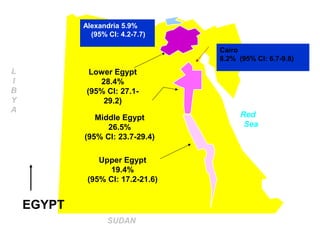
SUDAN
EGYPT
Upper Egypt
19.4%
(95% CI: 17.2-21.6)
Middle Egypt
26.5%
(95% CI: 23.7-29.4)
Alexandria 5.9%
(95% CI: 4.2-7.7)
Lower Egypt
28.4%
(95% CI: 27.1-
29.2)
Cairo
8.2% (95% CI: 6.7-9.8)
L
I
B
Y
A
Red
Sea
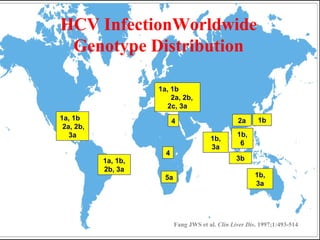
1a, 1b
2a, 2b,
2c, 3a
41a, 1b
2a, 2b,
3a
1a, 1b,
2b, 3a
4
5a
1b,
3a
1b,
6
2a 1b
1b,
3a
3b
Fang JWS et al. Clin Liver Dis. 1997;1:493-514
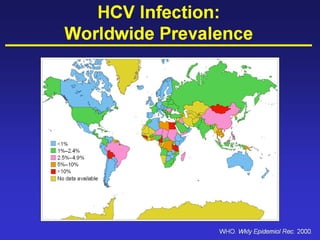
HCV InfectionWorldwide
Genotype Distribution
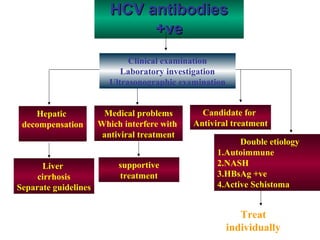
HCV antibodiesHCV antibodies
+ve+ve
Clinical examination
Laboratory investigation
Ultrasonographic examination
Hepatic
decompensation
Liver
cirrhosis
Separate guidelines
Medical problems
Which interfere with
antiviral treatment
Double etiology
1.Autoimmune
2.NASH
3.HBsAg +ve
4.Active Schistoma
Candidate for
Antiviral treatment
Treat
individually
supportive
treatment
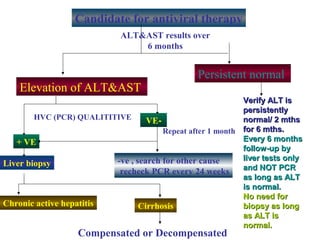
Candidate for antiviral therapy
ALT&AST results over
6 months
Elevation of ALT&AST
Persistent normal
Liver biopsy
Chronic active hepatitis Cirrhosis
-ve , search for other cause
recheck PCR every 24 weeks
+ VE
-VE
Repeat after 1 month
HVC (PCR) QUALITITIVE
Compensated or Decompensated
Verify ALT isVerify ALT is
persistentlypersistently
normal/ 2 mthsnormal/ 2 mths
for 6 mths.for 6 mths.
Every 6 monthsEvery 6 months
follow-up byfollow-up by
liver tests onlyliver tests only
and NOT PCRand NOT PCR
as long as ALTas long as ALT
is normal.is normal.
No need forNo need for
biopsy as longbiopsy as long
as ALT isas ALT is
normal.normal.
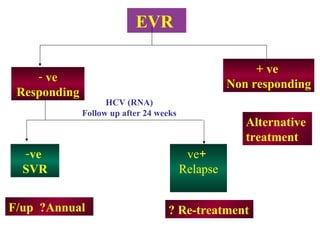
EVR
- ve
Responding
+ ve
Non responding
HCV (RNA)
Follow up after 24 weeks
-ve
SVR
+ve
Relapse
Alternative
treatment
? Re-treatmentF/up ?Annual
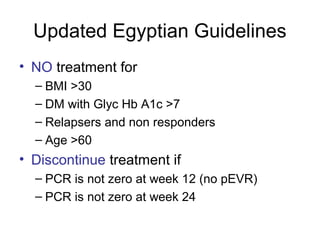
Updated Egyptian Guidelines
• NO treatment for
– BMI >30
– DM with Glyc Hb A1c >7
– Relapsers and non responders
– Age >60
• Discontinue treatment if
– PCR is not zero at week 12 (no pEVR)
– PCR is not zero at week 24
2nd
Egyptian Italian Meeting
HCV Group
Consensus statements
March 2008
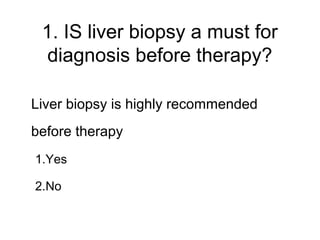
1. IS liver biopsy a must for
diagnosis before therapy?
Liver biopsy is highly recommended
before therapy
1.Yes
2.No
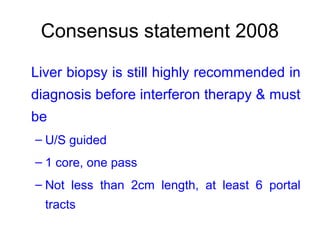
Consensus statement 2008
Liver biopsy is still highly recommended in
diagnosis before interferon therapy & must
be
– U/S guided
– 1 core, one pass
– Not less than 2cm length, at least 6 portal
tracts
2. What is the value of lab
markers and fibroscan ?
Fibroscan & laboratory markers could
replace liver biopsy
1. Yes
2. NO
Consensus statement 2008
• Fibromarkers and Fibroscan still do Not
replace liver biopsy
3. Is Genotyping mandatory in
Egypt ?
Genotype determination is most valuable
in :
1. Those who travel abroad.
2. Resistant to treat patients & relapsers
3. Immigrants
4. All of the above
5. All patients
6. None of the above
Consensus statement 2008
• No need to do genotyping for Egyptian
patients except for those
– who traveled abroad with history of risk
factors for exposure.
– for resistant to treat & relapsers.
– immigrants
4. Extremes of age ( elderly)
The maximum age to treat patients:
1. 50 years
2. 60 years
3. 70 years
4. No upper limit
Consensus Statement 2008
• No upper limit of age to be treated
according to usual standards
5. Extremes of age ( children)
Peg-IFN could be used safely in children
5 years old
1. Yes
2. No
Consensus statement 2008
• In spite of FDA non approval, Pegylated
INF can be used by experienced
pediatricians for children 5 years old
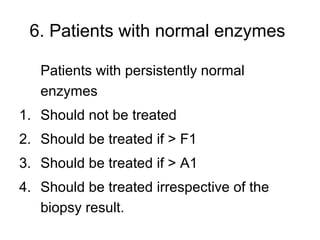
6. Patients with normal enzymes
Patients with persistently normal
enzymes
1. Should not be treated
2. Should be treated if > F1
3. Should be treated if > A1
4. Should be treated irrespective of the
biopsy result.
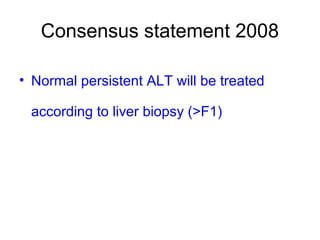
Consensus statement 2008
• Normal persistent ALT will be treated
according to liver biopsy (>F1)
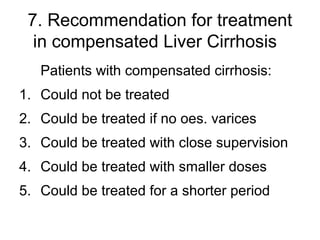
7. Recommendation for treatment
in compensated Liver Cirrhosis
Patients with compensated cirrhosis:
1. Could not be treated
2. Could be treated if no oes. varices
3. Could be treated with close supervision
4. Could be treated with smaller doses
5. Could be treated for a shorter period
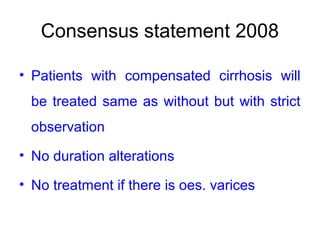
Consensus statement 2008
• Patients with compensated cirrhosis will
be treated same as without but with strict
observation
• No duration alterations
• No treatment if there is oes. varices
8. Doses of Ribavirin
In genotype 1 & 4, ribavirin dose can be
aimed to reach up to:
1. 10mg/kg BW
2. 15 mg/kg
3. The maximally tolerated dose
4. 1200 mg daily irrespective of body
weight
5. Dose can not affect the response rate
Consensus statement 2008
• In genotype 1 & 4, Ribavirin dose can be
aimed to reach up to 15 mg/kg (not up to
20 even if tolerated).
9. Dealing with complications of
treatment
Considering hematological complications
When should we change or stop treatment?
When should we add adjuvant treatment?
Consensus statement 2008
• Recommendation for Modification and / or discontinuation
of treatment will be changed according to:
– Hb level <10 dose reduction (Ribavirin) or Epirex, <8.5 discontinue
– Absolute neutrophilic count <750 dose reduction or CSF, <500
discontinue
– Platelet count <80,000 dose reduction, <50,000 discontinue
1. Use of CSF is cost/effective
2. To follow up international guidelines
3. According to patients need of treatment and response
10. Viral Kinetics
Should we do PCR at weeks 2,4,8
beside week 12
1. Week 4,12
2. week 4,8,12
3. week 2,4,12
Consensus statement 2008
• PCR to be done at weeks 4 and 12
11. Which technique is better in determining
ETR (TMA-Rt-PCR-Tackman)
1. TMA
2. Rt-PCR (real time )
3. Tackman
4. Any of them
Consensus statement 2008
• Our decision for continuing treatment must
be based on:
– Rt-PCR (real time)
at weeks 4, 12, 24
12. Shall we treat differently RVR
and pEVR
In patients with pEVR, we can:
1. stop treatment at 12 month & await
future therapy
2. Continue for 18 months
3. Continue for 24 months
Consensus statement 2008
• Patients with genotype 4 and have RVR
with base line viral load < 600,000 IU &
low fibrosis will be treated for only 6
months.
• Patients with genotype 4 with pEVR will be
treated for 18 months.
13. Long term follow up of SVR
Long term follow up of SVR:
1. Every 6 months
2. Yearly
3. Every 2 years
Consensus statement 2008
• SVR without cirrhosis will be followed by
LFT & PCR annually
• SVR with cirrhosis will be followed
according to the recommended regimen
AFP, US, LFT / 6 months and PCR-
annually
14. Non responders
1. No treatment
2. increase the dose of interferon
3. Give 3 months more of the same dose
4. Give Peg-IFN on shorter interval ( 5
days)
5. Special groups tailored approach
Consensus statement 2008
• No re-treatment for all non responders
15. Relapsers
1. re-treatment is justified & increase
duration to 18 months
2. Increase the dose of Ribavirin
3. Increase the dose of IFN
Consensus statement 2008
• Relapsers are to be re-treated, including
non compliant patients (second chance)
• On re-treatment
– No increase in Ribavirin doses
– No increase of IFN doses
– Duration increased to 18 months
16. HCV & HBV coinfection
First treat:
1. HCV
2. HBV
3. The active virus
Consensus statement 2008
• Treat The Active one
– HCV
– HBV
• If both are PCR+ve, we can treat by:
1. IFN single therapy
2. IFN, Ribavirin
3. IFN, nucleoside/tide analogue
4. IFN, Ribavirin & nucleoside/tide
analogue
Consensus statement 2008
• Patients with positive PCR for both HBV &
HCV can be treated by triple therapy (IFN,
Ribavirin, & nucleoside/tide analogue)
17. Impact of metabolic syndromes
(DM, obesity) on SVR
• In diabetic and obese patients:
1. Uncontrolled diabetes is an absolute
contraindication to therapy
2. Over weight will affect their response to
therapy
3. HbA 1 c level will affect their response to
therapy.
Consensus statement 2008
• Body Mass Index (BMI)
– Pt encouraged to loose wt & excersise (for IR)
in 6 months, then treat
– BMI 30 is preferable but no limits
• HbA1c must be less than 7 before starting
therapy
– Metformin is best
Thank You

Management of HCV Practical guide Lines

  • 1.
    Assiut DDW 2010 Managementof HCV Practical guide lines Hossam GHONEIM,MD
  • 3.
    SUDAN EGYPT Upper Egypt 19.4% (95% CI:17.2-21.6) Middle Egypt 26.5% (95% CI: 23.7-29.4) Alexandria 5.9% (95% CI: 4.2-7.7) Lower Egypt 28.4% (95% CI: 27.1- 29.2) Cairo 8.2% (95% CI: 6.7-9.8) L I B Y A Red Sea
  • 4.
    1a, 1b 2a, 2b, 2c,3a 41a, 1b 2a, 2b, 3a 1a, 1b, 2b, 3a 4 5a 1b, 3a 1b, 6 2a 1b 1b, 3a 3b Fang JWS et al. Clin Liver Dis. 1997;1:493-514 HCV InfectionWorldwide Genotype Distribution
  • 5.
    HCV antibodiesHCV antibodies +ve+ve Clinicalexamination Laboratory investigation Ultrasonographic examination Hepatic decompensation Liver cirrhosis Separate guidelines Medical problems Which interfere with antiviral treatment Double etiology 1.Autoimmune 2.NASH 3.HBsAg +ve 4.Active Schistoma Candidate for Antiviral treatment Treat individually supportive treatment
  • 6.
    Candidate for antiviraltherapy ALT&AST results over 6 months Elevation of ALT&AST Persistent normal Liver biopsy Chronic active hepatitis Cirrhosis -ve , search for other cause recheck PCR every 24 weeks + VE -VE Repeat after 1 month HVC (PCR) QUALITITIVE Compensated or Decompensated Verify ALT isVerify ALT is persistentlypersistently normal/ 2 mthsnormal/ 2 mths for 6 mths.for 6 mths. Every 6 monthsEvery 6 months follow-up byfollow-up by liver tests onlyliver tests only and NOT PCRand NOT PCR as long as ALTas long as ALT is normal.is normal. No need forNo need for biopsy as longbiopsy as long as ALT isas ALT is normal.normal.
  • 7.
    EVR - ve Responding + ve Nonresponding HCV (RNA) Follow up after 24 weeks -ve SVR +ve Relapse Alternative treatment ? Re-treatmentF/up ?Annual
  • 8.
    Updated Egyptian Guidelines •NO treatment for – BMI >30 – DM with Glyc Hb A1c >7 – Relapsers and non responders – Age >60 • Discontinue treatment if – PCR is not zero at week 12 (no pEVR) – PCR is not zero at week 24
  • 9.
    2nd Egyptian Italian Meeting HCVGroup Consensus statements March 2008
  • 10.
    1. IS liverbiopsy a must for diagnosis before therapy? Liver biopsy is highly recommended before therapy 1.Yes 2.No
  • 11.
    Consensus statement 2008 Liverbiopsy is still highly recommended in diagnosis before interferon therapy & must be – U/S guided – 1 core, one pass – Not less than 2cm length, at least 6 portal tracts
  • 12.
    2. What isthe value of lab markers and fibroscan ? Fibroscan & laboratory markers could replace liver biopsy 1. Yes 2. NO
  • 13.
    Consensus statement 2008 •Fibromarkers and Fibroscan still do Not replace liver biopsy
  • 14.
    3. Is Genotypingmandatory in Egypt ? Genotype determination is most valuable in : 1. Those who travel abroad. 2. Resistant to treat patients & relapsers 3. Immigrants 4. All of the above 5. All patients 6. None of the above
  • 15.
    Consensus statement 2008 •No need to do genotyping for Egyptian patients except for those – who traveled abroad with history of risk factors for exposure. – for resistant to treat & relapsers. – immigrants
  • 16.
    4. Extremes ofage ( elderly) The maximum age to treat patients: 1. 50 years 2. 60 years 3. 70 years 4. No upper limit
  • 17.
    Consensus Statement 2008 •No upper limit of age to be treated according to usual standards
  • 18.
    5. Extremes ofage ( children) Peg-IFN could be used safely in children 5 years old 1. Yes 2. No
  • 19.
    Consensus statement 2008 •In spite of FDA non approval, Pegylated INF can be used by experienced pediatricians for children 5 years old
  • 20.
    6. Patients withnormal enzymes Patients with persistently normal enzymes 1. Should not be treated 2. Should be treated if > F1 3. Should be treated if > A1 4. Should be treated irrespective of the biopsy result.
  • 21.
    Consensus statement 2008 •Normal persistent ALT will be treated according to liver biopsy (>F1)
  • 22.
    7. Recommendation fortreatment in compensated Liver Cirrhosis Patients with compensated cirrhosis: 1. Could not be treated 2. Could be treated if no oes. varices 3. Could be treated with close supervision 4. Could be treated with smaller doses 5. Could be treated for a shorter period
  • 23.
    Consensus statement 2008 •Patients with compensated cirrhosis will be treated same as without but with strict observation • No duration alterations • No treatment if there is oes. varices
  • 24.
    8. Doses ofRibavirin In genotype 1 & 4, ribavirin dose can be aimed to reach up to: 1. 10mg/kg BW 2. 15 mg/kg 3. The maximally tolerated dose 4. 1200 mg daily irrespective of body weight 5. Dose can not affect the response rate
  • 25.
    Consensus statement 2008 •In genotype 1 & 4, Ribavirin dose can be aimed to reach up to 15 mg/kg (not up to 20 even if tolerated).
  • 26.
    9. Dealing withcomplications of treatment Considering hematological complications When should we change or stop treatment? When should we add adjuvant treatment?
  • 27.
    Consensus statement 2008 •Recommendation for Modification and / or discontinuation of treatment will be changed according to: – Hb level <10 dose reduction (Ribavirin) or Epirex, <8.5 discontinue – Absolute neutrophilic count <750 dose reduction or CSF, <500 discontinue – Platelet count <80,000 dose reduction, <50,000 discontinue 1. Use of CSF is cost/effective 2. To follow up international guidelines 3. According to patients need of treatment and response
  • 28.
    10. Viral Kinetics Shouldwe do PCR at weeks 2,4,8 beside week 12 1. Week 4,12 2. week 4,8,12 3. week 2,4,12
  • 29.
    Consensus statement 2008 •PCR to be done at weeks 4 and 12
  • 30.
    11. Which techniqueis better in determining ETR (TMA-Rt-PCR-Tackman) 1. TMA 2. Rt-PCR (real time ) 3. Tackman 4. Any of them
  • 31.
    Consensus statement 2008 •Our decision for continuing treatment must be based on: – Rt-PCR (real time) at weeks 4, 12, 24
  • 32.
    12. Shall wetreat differently RVR and pEVR In patients with pEVR, we can: 1. stop treatment at 12 month & await future therapy 2. Continue for 18 months 3. Continue for 24 months
  • 33.
    Consensus statement 2008 •Patients with genotype 4 and have RVR with base line viral load < 600,000 IU & low fibrosis will be treated for only 6 months. • Patients with genotype 4 with pEVR will be treated for 18 months.
  • 34.
    13. Long termfollow up of SVR Long term follow up of SVR: 1. Every 6 months 2. Yearly 3. Every 2 years
  • 35.
    Consensus statement 2008 •SVR without cirrhosis will be followed by LFT & PCR annually • SVR with cirrhosis will be followed according to the recommended regimen AFP, US, LFT / 6 months and PCR- annually
  • 36.
    14. Non responders 1.No treatment 2. increase the dose of interferon 3. Give 3 months more of the same dose 4. Give Peg-IFN on shorter interval ( 5 days) 5. Special groups tailored approach
  • 37.
    Consensus statement 2008 •No re-treatment for all non responders
  • 38.
    15. Relapsers 1. re-treatmentis justified & increase duration to 18 months 2. Increase the dose of Ribavirin 3. Increase the dose of IFN
  • 39.
    Consensus statement 2008 •Relapsers are to be re-treated, including non compliant patients (second chance) • On re-treatment – No increase in Ribavirin doses – No increase of IFN doses – Duration increased to 18 months
  • 40.
    16. HCV &HBV coinfection First treat: 1. HCV 2. HBV 3. The active virus
  • 41.
    Consensus statement 2008 •Treat The Active one – HCV – HBV
  • 42.
    • If bothare PCR+ve, we can treat by: 1. IFN single therapy 2. IFN, Ribavirin 3. IFN, nucleoside/tide analogue 4. IFN, Ribavirin & nucleoside/tide analogue
  • 43.
    Consensus statement 2008 •Patients with positive PCR for both HBV & HCV can be treated by triple therapy (IFN, Ribavirin, & nucleoside/tide analogue)
  • 44.
    17. Impact ofmetabolic syndromes (DM, obesity) on SVR • In diabetic and obese patients: 1. Uncontrolled diabetes is an absolute contraindication to therapy 2. Over weight will affect their response to therapy 3. HbA 1 c level will affect their response to therapy.
  • 45.
    Consensus statement 2008 •Body Mass Index (BMI) – Pt encouraged to loose wt & excersise (for IR) in 6 months, then treat – BMI 30 is preferable but no limits • HbA1c must be less than 7 before starting therapy – Metformin is best
  • 46.