




Economies of Scale
Economies of Scale The advantages of large scale production that result in lower unit (average) costs (cost per unit) AC = TC / Q Economies of scale – spreads total costs over a greater range of output
Economies of Scale Internal – advantages that arise as a result of the growth of the firm Technical Commercial Financial Managerial Risk Bearing
Economies of Scale External economies of scale – the advantages firms can gain as a result  of the growth of the industry – normally associated with a particular area Supply of skilled labour Reputation Local knowledge and skills Infrastructure Training facilities
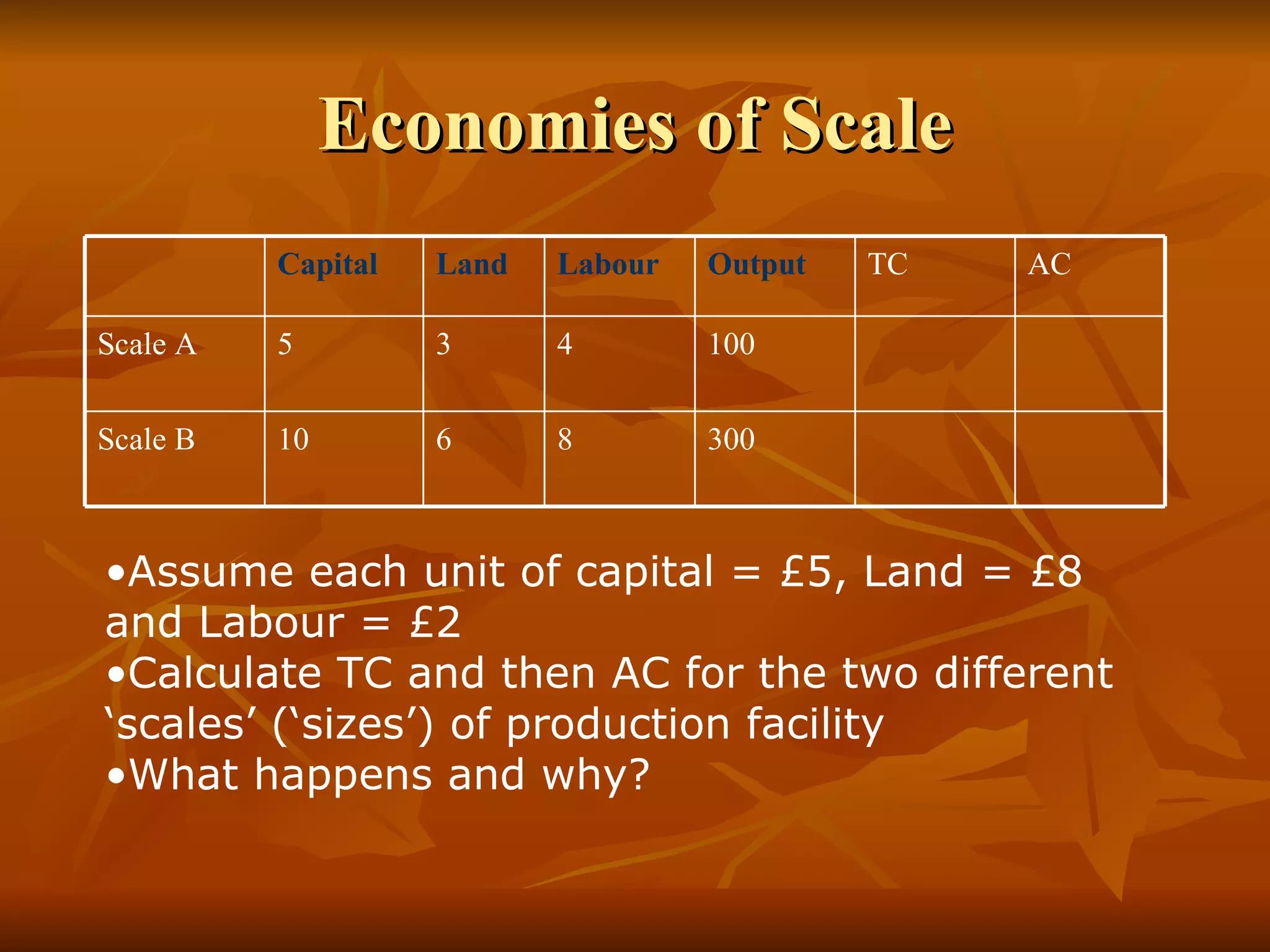
Economies of Scale Assume each unit of capital = £5, Land = £8 and Labour = £2 Calculate TC and then AC for the two different ‘scales’ (‘sizes’) of production facility What happens and why? Scale B Scale A 300 8 6 10 100 4 3 5 AC TC Output Labour Land Capital
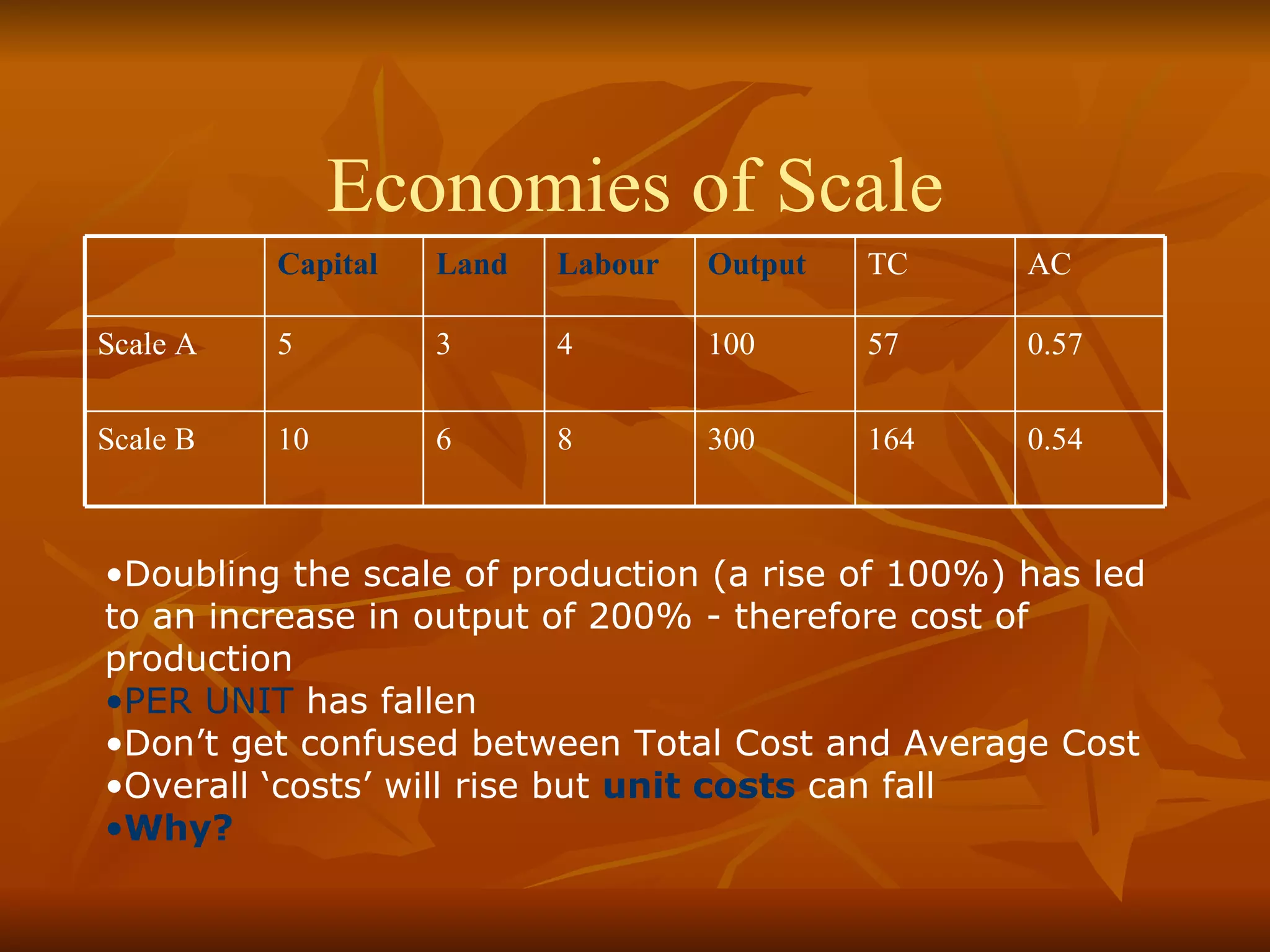
Economies of Scale Doubling the scale of production (a rise of 100%) has led to an increase in output of 200% - therefore cost of production  PER UNIT  has fallen Don’t get confused between Total Cost and Average Cost Overall ‘costs’ will rise but  unit costs   can fall Why? Scale B Scale A 0.54 164 300 8 6 10 0.57 57 100 4 3 5 AC TC Output Labour Land Capital
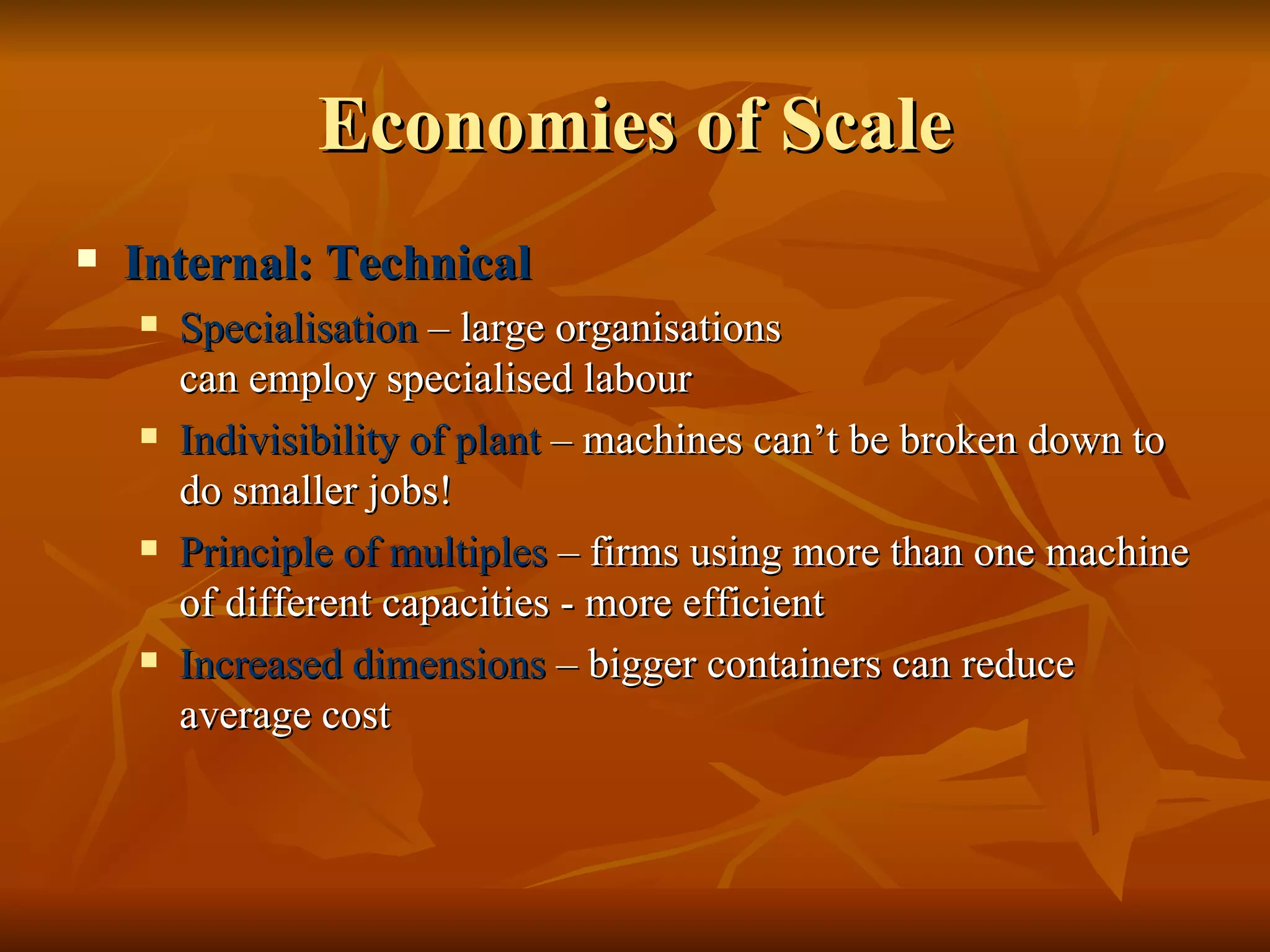
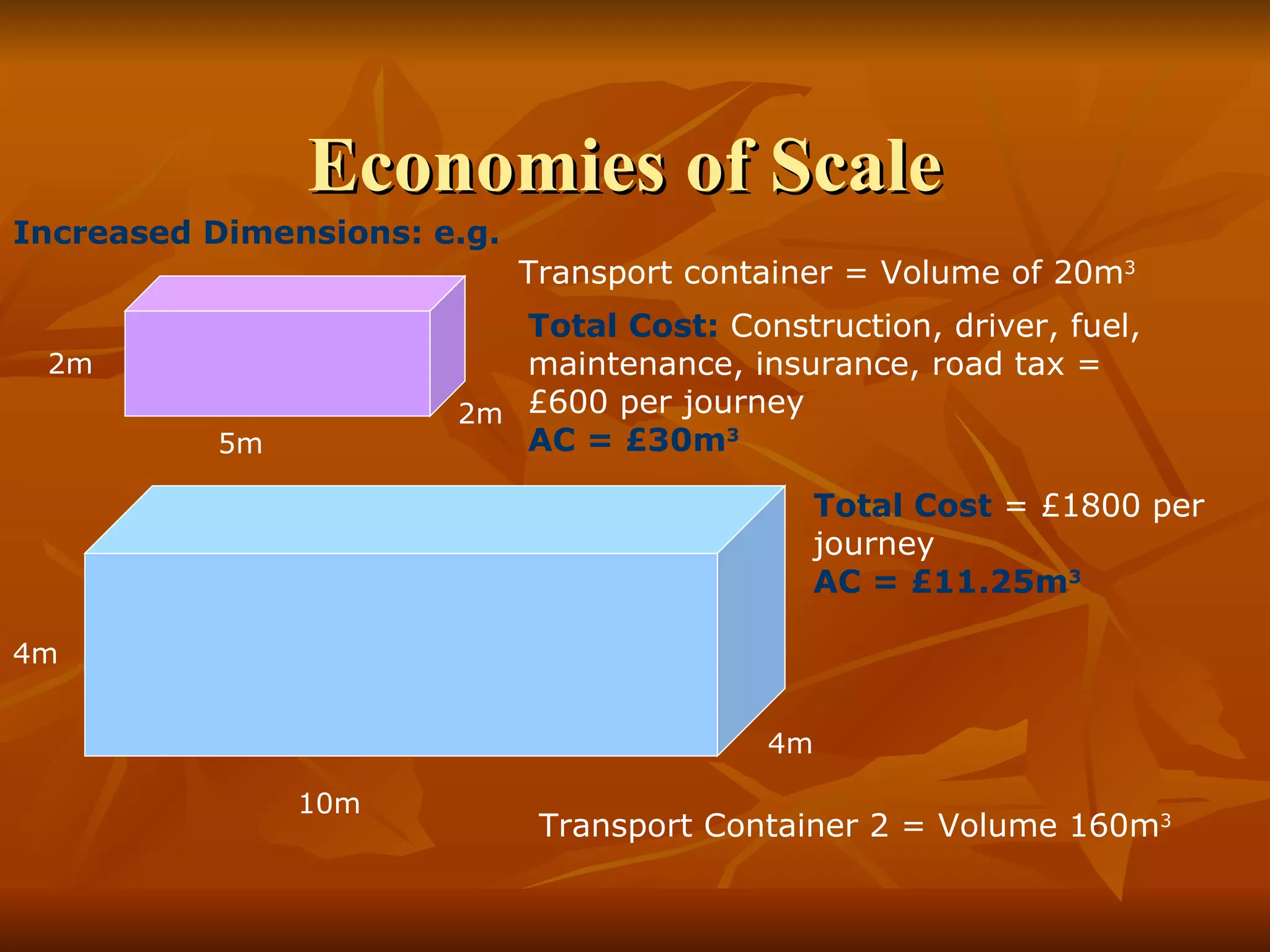
Economies of Scale Internal: Technical Specialisation  – large organisations  can employ specialised labour Indivisibility of plant  – machines can’t be broken down to do smaller jobs! Principle of multiples  – firms using more than one machine of different capacities - more efficient Increased dimensions  – bigger containers can reduce average cost
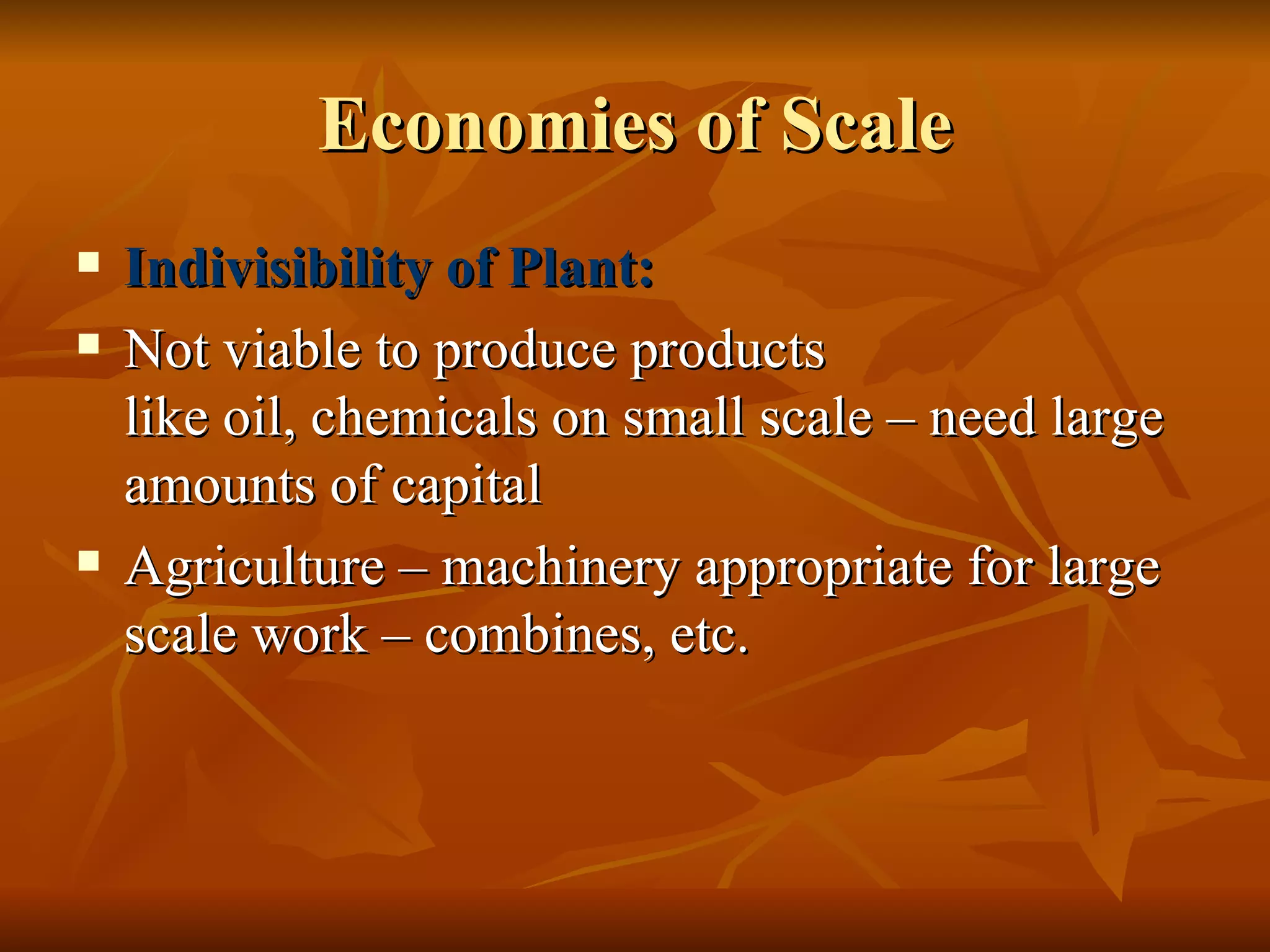
Economies of Scale Indivisibility of Plant: Not viable to produce products  like oil, chemicals on small scale – need large amounts of capital Agriculture – machinery appropriate for large scale work – combines, etc.
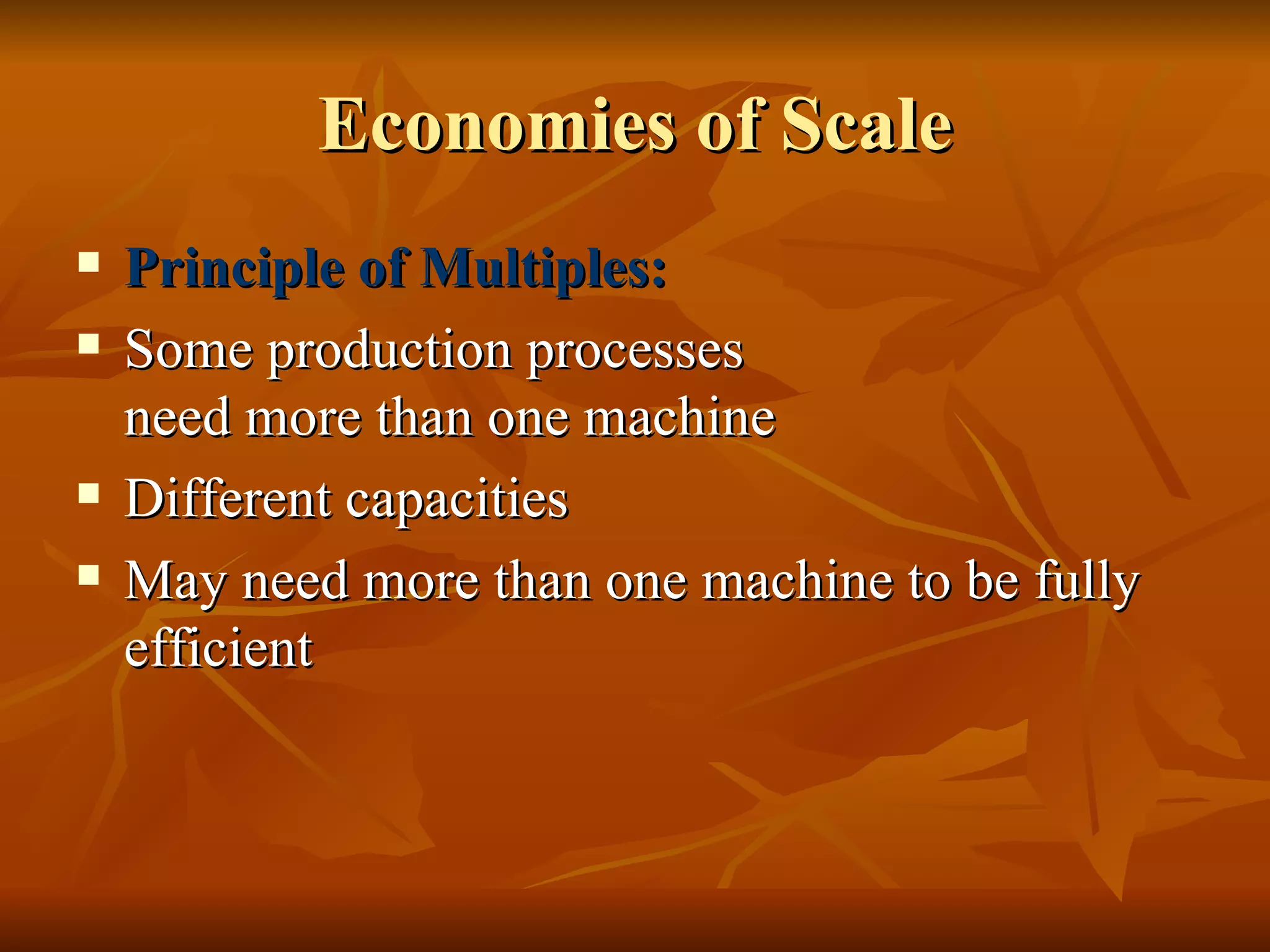
Economies of Scale Principle of Multiples: Some production processes  need more than one machine Different capacities May need more than one machine to be fully efficient
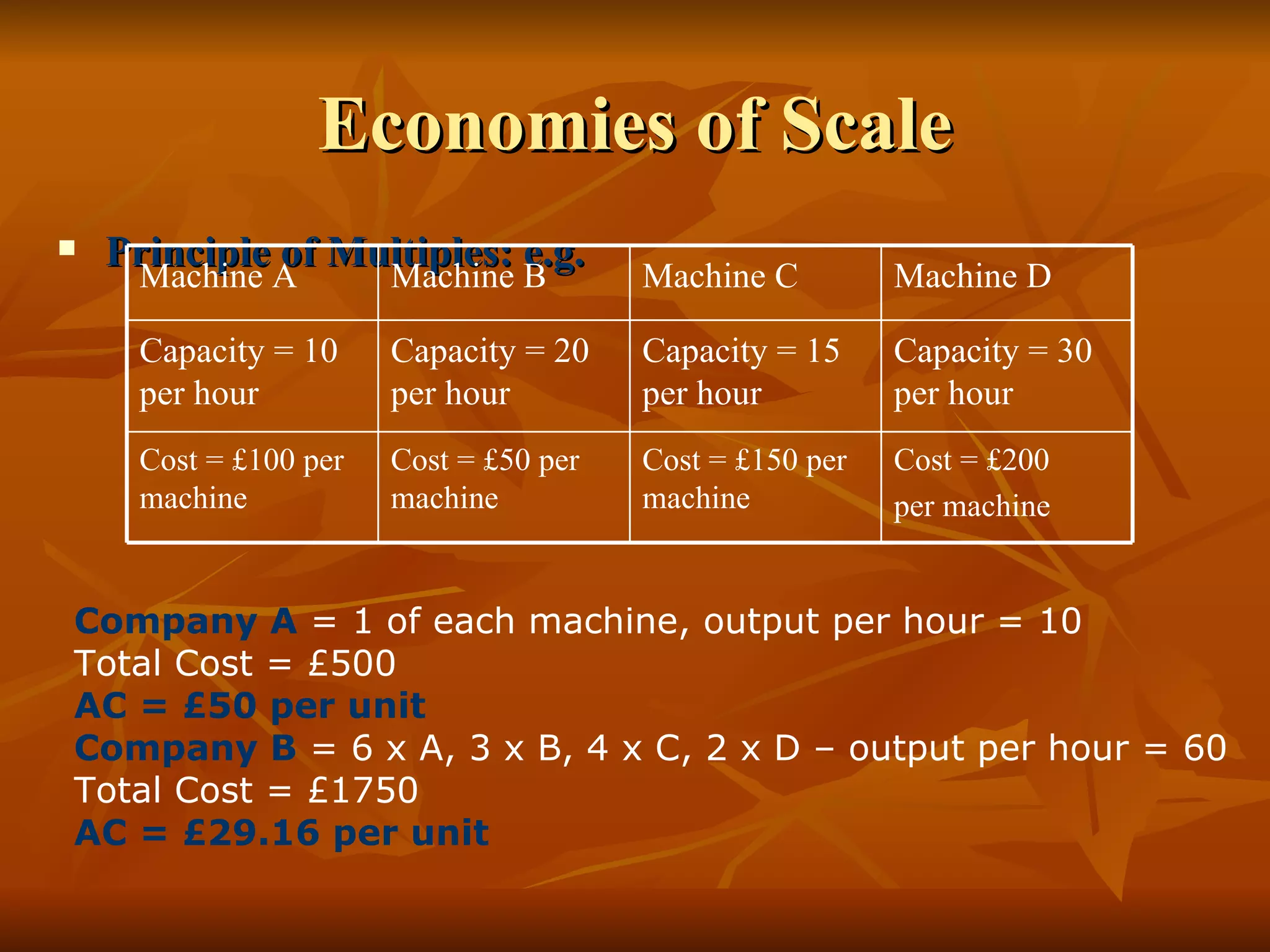
Economies of Scale Principle of Multiples: e.g. Company A  = 1 of each machine, output per hour = 10 Total Cost = £500 AC = £50 per unit  Company B  = 6 x A, 3 x B, 4 x C, 2 x D – output per hour = 60 Total Cost = £1750 AC = £29.16 per unit Cost = £200 per machine Cost = £150 per machine Cost = £50 per machine Cost = £100 per machine Capacity = 30 per hour Capacity = 15 per hour Capacity = 20 per hour Capacity = 10 per hour Machine D Machine C Machine B Machine A
Economies of Scale Increased Dimensions: e.g. 5m 2m 2m Transport container = Volume of 20m 3 Total Cost:  Construction, driver, fuel,  maintenance, insurance, road tax =  £600 per journey AC = £30m 3 4m 10m 4m Transport Container 2 = Volume 160m 3 Total Cost  = £1800 per journey AC = £11.25m 3
Economies of Scale Commercial Large firms can negotiate favourable prices as a result  of buying in bulk Large firms may have advantages in keeping prices higher because  of their market power
Economies of Scale Financial Large firms able to negotiate cheaper finance deals Large firms able to be more flexible about finance – share options, rights issues, etc.  Large firms able to utilise skills of merchant banks to arrange finance
Economies of Scale Managerial Use of specialists – accountants, marketing, lawyers, production, human resources, etc.
Economies of Scale Risk Bearing Diversification Markets across regions/countries Product ranges R&D
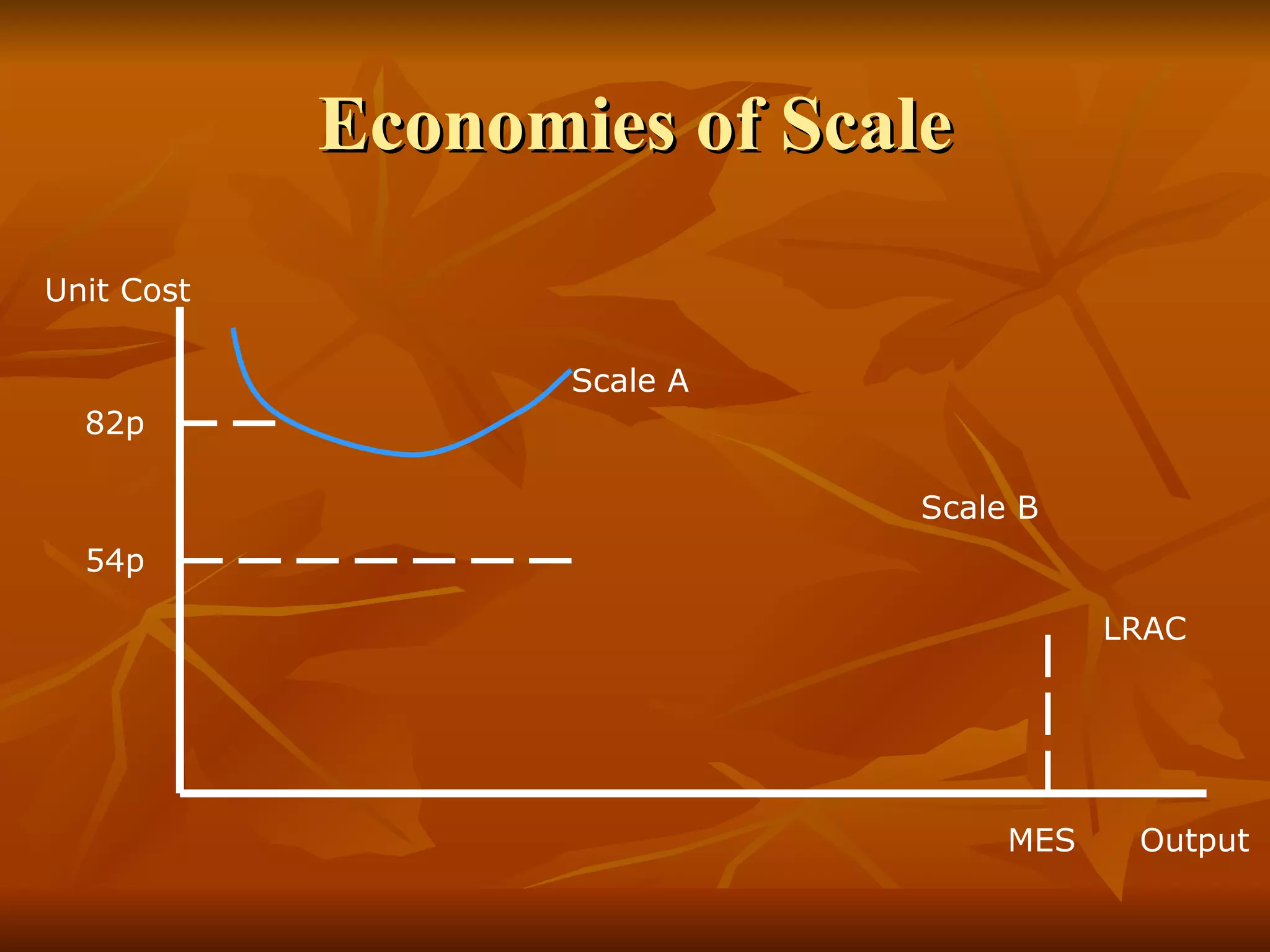
Economies of Scale Minimum Efficient Scale  – the point  at which the increase in the scale of production yields no significant unit cost benefits Minimum Efficient Plant Size  – the point where increasing the scale of production of an individual plant within the industry yields  no significant unit cost benefits
Economies of Scale Unit Cost Output Scale A Scale B LRAC MES 82p 54p
Diseconomies of Scale The disadvantages of large scale production that can lead to increasing average costs Problems of management Maintaining effective communication Co-ordinating activities – often across  the globe! De-motivation and alienation of staff Divorce of ownership and control

Economies Of Scaleppt

  • 1.
  • 2.
    Economies of ScaleThe advantages of large scale production that result in lower unit (average) costs (cost per unit) AC = TC / Q Economies of scale – spreads total costs over a greater range of output
  • 3.
    Economies of ScaleInternal – advantages that arise as a result of the growth of the firm Technical Commercial Financial Managerial Risk Bearing
  • 4.
    Economies of ScaleExternal economies of scale – the advantages firms can gain as a result of the growth of the industry – normally associated with a particular area Supply of skilled labour Reputation Local knowledge and skills Infrastructure Training facilities
  • 5.
    Economies of ScaleAssume each unit of capital = £5, Land = £8 and Labour = £2 Calculate TC and then AC for the two different ‘scales’ (‘sizes’) of production facility What happens and why? Scale B Scale A 300 8 6 10 100 4 3 5 AC TC Output Labour Land Capital
  • 6.
    Economies of ScaleDoubling the scale of production (a rise of 100%) has led to an increase in output of 200% - therefore cost of production PER UNIT has fallen Don’t get confused between Total Cost and Average Cost Overall ‘costs’ will rise but unit costs can fall Why? Scale B Scale A 0.54 164 300 8 6 10 0.57 57 100 4 3 5 AC TC Output Labour Land Capital
  • 7.
    Economies of ScaleInternal: Technical Specialisation – large organisations can employ specialised labour Indivisibility of plant – machines can’t be broken down to do smaller jobs! Principle of multiples – firms using more than one machine of different capacities - more efficient Increased dimensions – bigger containers can reduce average cost
  • 8.
    Economies of ScaleIndivisibility of Plant: Not viable to produce products like oil, chemicals on small scale – need large amounts of capital Agriculture – machinery appropriate for large scale work – combines, etc.
  • 9.
    Economies of ScalePrinciple of Multiples: Some production processes need more than one machine Different capacities May need more than one machine to be fully efficient
  • 10.
    Economies of ScalePrinciple of Multiples: e.g. Company A = 1 of each machine, output per hour = 10 Total Cost = £500 AC = £50 per unit Company B = 6 x A, 3 x B, 4 x C, 2 x D – output per hour = 60 Total Cost = £1750 AC = £29.16 per unit Cost = £200 per machine Cost = £150 per machine Cost = £50 per machine Cost = £100 per machine Capacity = 30 per hour Capacity = 15 per hour Capacity = 20 per hour Capacity = 10 per hour Machine D Machine C Machine B Machine A
  • 11.
    Economies of ScaleIncreased Dimensions: e.g. 5m 2m 2m Transport container = Volume of 20m 3 Total Cost: Construction, driver, fuel, maintenance, insurance, road tax = £600 per journey AC = £30m 3 4m 10m 4m Transport Container 2 = Volume 160m 3 Total Cost = £1800 per journey AC = £11.25m 3
  • 12.
    Economies of ScaleCommercial Large firms can negotiate favourable prices as a result of buying in bulk Large firms may have advantages in keeping prices higher because of their market power
  • 13.
    Economies of ScaleFinancial Large firms able to negotiate cheaper finance deals Large firms able to be more flexible about finance – share options, rights issues, etc. Large firms able to utilise skills of merchant banks to arrange finance
  • 14.
    Economies of ScaleManagerial Use of specialists – accountants, marketing, lawyers, production, human resources, etc.
  • 15.
    Economies of ScaleRisk Bearing Diversification Markets across regions/countries Product ranges R&D
  • 16.
    Economies of ScaleMinimum Efficient Scale – the point at which the increase in the scale of production yields no significant unit cost benefits Minimum Efficient Plant Size – the point where increasing the scale of production of an individual plant within the industry yields no significant unit cost benefits
  • 17.
    Economies of ScaleUnit Cost Output Scale A Scale B LRAC MES 82p 54p
  • 18.
    Diseconomies of ScaleThe disadvantages of large scale production that can lead to increasing average costs Problems of management Maintaining effective communication Co-ordinating activities – often across the globe! De-motivation and alienation of staff Divorce of ownership and control

Editor's Notes

  • #11 The aim here is to show a simple example of how a production process involving a combination of machines operating at different capacities can have an effect on unit costs. The example could be a bottling plant with each machine doing a different task – filling the bottles, labelling, putting the tops on and packaging. Company A being small can only afford 1 of each machine, it is constrained by the capacity of the slowest machine – machine A, the rest of the machines are not being used to their full capacity and so are wasted for some of the time. They still however represent a cost to the firm but there is no return coming in. The larger company can afford to buy multiples of each machine to ensure that they are all working to full capacity, the point to stress is that the total cost rises – obviously because there are more machines – by 2.5 times compared to company A but the output rises by 5 times the output level of company A hence AC falls. The point can be made that company A is at a significant cost disadvantage and hence this could affect its pricing structure and put it at a distinct competitive disadvantage.
  • #12 The explanation that accompanies this slide is fairly straight forward – The first container has a carrying capacity of 20 cubic metres. The cost of carrying the product involves the actual construction of the container/lorry etc, the cost of the maintenance, driver etc. This is assumed to be £600 per journey and as such gives an average cost of £30 per cubic metre. Doubling the dimensions of the container increases the carrying capacity by 8 times. However, the cost of the construction, maintenance etc is not likely to rise by 8 times. The example shows cost having risen 2 times. As a result the cost per unit is now £11.25 per cubic metre! Again the point about the relative competitive advantage is worth highlighting.