Introduction to Management and Organizations
Management is to supervise and coordinate the activities of a group in order to design and maintain an environment in which individuals of a group can accomplish their pre selected objectives.
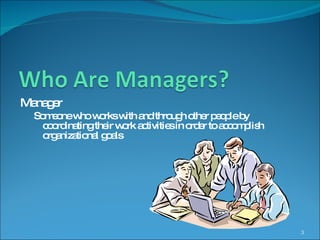
Manager Someone who works with and through other people by coordinating their work activities in order to accomplish organizational goals
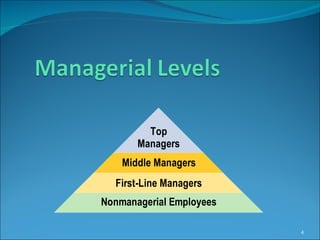
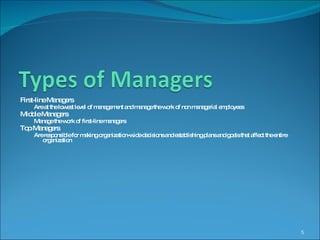
First-line Managers Are at the lowest level of management and manage the work of non managerial employees Middle Managers Manage the work of first-line managers Top Managers Are responsible for making organization-wide decisions and establishing plans and goals that affect the entire organization
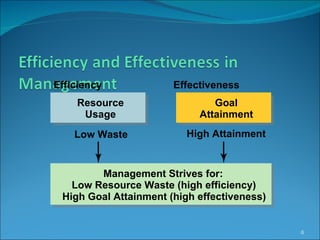
Goal Attainment Effectiveness  Resource Usage Management Strives for: Low Resource Waste (high efficiency) High Goal Attainment (high effectiveness) Efficiency  Low Waste High Attainment
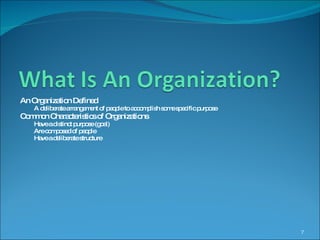
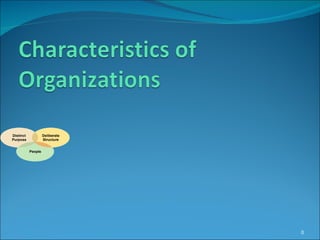
An Organization Defined A deliberate arrangement of people to accomplish some specific purpose Common Characteristics of Organizations Have a distinct purpose (goal) Are composed of people Have a deliberate structure
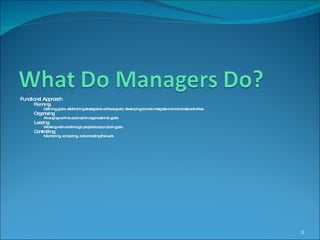
Functional Approach Planning Defining goals, establishing strategies to achieve goals, developing plans to integrate and coordinate activities Organizing Arranging work to accomplish organizational goals Leading Working with and through people to accomplish goals Controlling Monitoring, comparing, and correcting the work
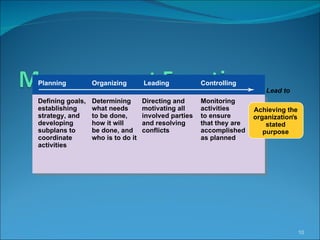
Planning Defining goals, establishing strategy, and developing subplans to coordinate activities Lead to Organizing Determining what needs to be done, how it will be done, and who is to do it Leading Directing and motivating all involved parties and resolving conflicts Controlling Monitoring activities to ensure that they are accomplished as planned Achieving the organization ’ s stated purpose
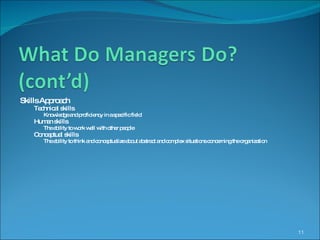
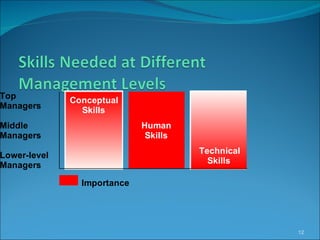
Skills Approach Technical skills Knowledge and proficiency in a specific field Human skills The ability to work well with other people Conceptual skills The ability to think and conceptualize about abstract and complex situations concerning the organization
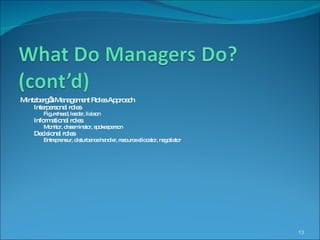
Mintzberg’s Management Roles Approach  Interpersonal roles Figurehead, leader, liaison Informational roles Monitor, disseminator, spokesperson Decisional roles Entrepreneur, disturbance handler, resource allocator, negotiator
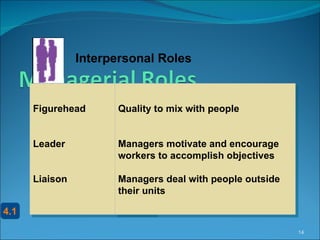
Figurehead Leader Liaison Quality to mix with people Managers motivate and encourage workers to accomplish objectives Managers deal with people outside their units 4.1 Interpersonal Roles
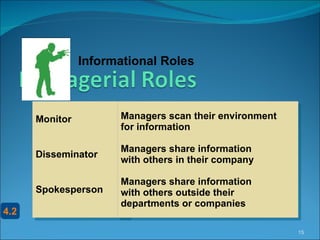
4.2 Informational Roles Monitor Disseminator Spokesperson Managers scan their environment for information Managers share information  with others in their company Managers share information with others outside their  departments or companies
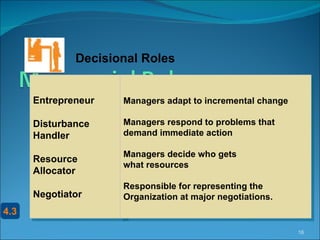
Entrepreneur Disturbance  Handler Resource  Allocator Negotiator 4.3 Managers adapt to incremental change Managers respond to problems that demand immediate action Managers decide who gets  what resources Responsible for representing the  Organization at major negotiations. Decisional Roles
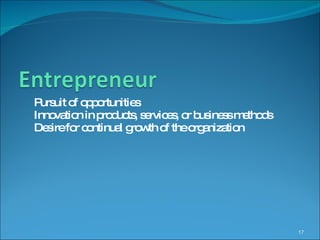
Pursuit of opportunities Innovation in products, services, or business methods Desire for continual growth of the organization

Management Ch # R 01

  • 1.
    Introduction to Managementand Organizations
  • 2.
    Management is tosupervise and coordinate the activities of a group in order to design and maintain an environment in which individuals of a group can accomplish their pre selected objectives.
  • 3.
    Manager Someone whoworks with and through other people by coordinating their work activities in order to accomplish organizational goals
  • 5.
    First-line Managers Areat the lowest level of management and manage the work of non managerial employees Middle Managers Manage the work of first-line managers Top Managers Are responsible for making organization-wide decisions and establishing plans and goals that affect the entire organization
  • 6.
    Goal Attainment Effectiveness Resource Usage Management Strives for: Low Resource Waste (high efficiency) High Goal Attainment (high effectiveness) Efficiency Low Waste High Attainment
  • 7.
    An Organization DefinedA deliberate arrangement of people to accomplish some specific purpose Common Characteristics of Organizations Have a distinct purpose (goal) Are composed of people Have a deliberate structure
  • 9.
    Functional Approach PlanningDefining goals, establishing strategies to achieve goals, developing plans to integrate and coordinate activities Organizing Arranging work to accomplish organizational goals Leading Working with and through people to accomplish goals Controlling Monitoring, comparing, and correcting the work
  • 10.
    Planning Defining goals,establishing strategy, and developing subplans to coordinate activities Lead to Organizing Determining what needs to be done, how it will be done, and who is to do it Leading Directing and motivating all involved parties and resolving conflicts Controlling Monitoring activities to ensure that they are accomplished as planned Achieving the organization ’ s stated purpose
  • 11.
    Skills Approach Technicalskills Knowledge and proficiency in a specific field Human skills The ability to work well with other people Conceptual skills The ability to think and conceptualize about abstract and complex situations concerning the organization
  • 13.
    Mintzberg’s Management RolesApproach Interpersonal roles Figurehead, leader, liaison Informational roles Monitor, disseminator, spokesperson Decisional roles Entrepreneur, disturbance handler, resource allocator, negotiator
  • 14.
    Figurehead Leader LiaisonQuality to mix with people Managers motivate and encourage workers to accomplish objectives Managers deal with people outside their units 4.1 Interpersonal Roles
  • 15.
    4.2 Informational RolesMonitor Disseminator Spokesperson Managers scan their environment for information Managers share information with others in their company Managers share information with others outside their departments or companies
  • 16.
    Entrepreneur Disturbance Handler Resource Allocator Negotiator 4.3 Managers adapt to incremental change Managers respond to problems that demand immediate action Managers decide who gets what resources Responsible for representing the Organization at major negotiations. Decisional Roles
  • 17.
    Pursuit of opportunitiesInnovation in products, services, or business methods Desire for continual growth of the organization

Editor's Notes

  • #15 Interpersonal Roles–interacting with others figurehead role : managers perform ceremonial duties leader role : managers motivate and encourage workers to accomplish organizational objectives liaison role : managers deal with people outside their units
  • #16 Informational Roles–obtaining and sharing information monitor role : managers scan their environment for information, actively contact others for information disseminator role : managers share the information they have collected with their subordinates and others in the company
  • #17 Decisional Roles–making good decisions entrepreneur role : managers adapt themselves, their subordinates, and their units to incremental change disturbance handler role : managers respond to pressures and problems so severe that they demand immediate attention and action resource allocator role : managers decide who will get what resources and how many resources they get negotiator role : managers negotiate schedules, projects, goals, outcomes, resources, and employee raises