
CHAPTER 1
              NATURE OF MANAGEMENT


14 May 2007         PRINCIPLES OF MANAGEMENT   1
Introduction
    A business develops in course of time with
    complexities. Management is not only essential to
    business concerns but also essential to Banks,
    Schools, Colleges, Hospitals, Hotels, Religious
    bodies etc. Every business unit has objectives of
    its won. These objectives can be achieved with
    the co-operative efforts of several personnel. As
    E. Demock has rightly said “ the management is
    not a matter of pressing a button, pulling a lever,
    issuing orders, scanning P & L statement,
    promulgating rules and regulations. Rather it is
    the power to determine what shall happen to the
    personalities and happiness of entire people, the
    power to shape the destiny of a nation and of all
    the nations which make up the world”
14 May 2007          PRINCIPLES OF MANAGEMENT         2
Principle of Management


14 May 2007   PRINCIPLES OF MANAGEMENT                   3
Meaning of Management

    Management is the art of getting things
    done by a group of people with the
    effective utilization of available resources.
    There are various definitions given by
    various management gurus but simply
    management is the process consisting of
    the functions of planning, organizing,
    staffing, directing and controlling the
    operations to achieve specified objectives
14 May 2007        PRINCIPLES OF MANAGEMENT     4
Features or Characteristics of
             Management
        Art as well as science
        Management is an activity
        Management is a continuous process
        Management achieving pre-determined
        objectives:
        Organized Activities
        Management is a factor of production
        Management as a system of activity
        Management is a discipline
        Management is a purposeful activity
        Management is a distinct entity


14 May 2007           PRINCIPLES OF MANAGEMENT   5
Features or Characteristics of
             Management
        Management aims at maximizing profit
        Decision – making
        Management is a profession
        Universal application
        Management is getting things done
        Management as a class or a team
        Management as a career
        Direction and control
        Dynamic
        Management is needed at all levels
        Leadership quality

14 May 2007           PRINCIPLES OF MANAGEMENT   6
Characteristics of Management
    Art as well as science: Management is
    both an art of possessing of managing skill
    by a person and a science because of
    developing certain principles or laws
    applicable in a place where a group of
    activities are co-coordinated.
    Management is an activity: It is a process
    of activity relating to the effective
    utilization of available resources.

14 May 2007        PRINCIPLES OF MANAGEMENT   7
Characteristics of Management

        Management is a continuous process: The
        process of management mainly consists of
        planning, organizing, directing and controlling
        the resources. The resources (men and money)
        of an organization should be used to the best
        advantages of the organization to achieve the
        objectives.
        Management         achieving    pre-determined
        objectives: The objectives of an organization
        are clearly laid down. Every managerial activity
        results in the achievement of objectives fixed
        well in advance.

14 May 2007            PRINCIPLES OF MANAGEMENT        8
Characteristics of Management
        Organized Activities : Management is a group of
        organized activities. It can be in the form of
        limited company or a small club. All the
        organizations have an objectives and these
        objectives is achieved through systematic way of
        organized activities.
        Management is a factor of production : The factors
        of production includes land, labor, capital and
        entrepreneurs. Land means a place where
        production is carried on. Labour refers to paid
        employees either skilled, unskilled, semi-skilled,
        manager, supervisor and the like. Capital refers to
        the working capital in the form of cash, raw
        material and finished goods and fixed capital as in
        the form of plant facilities and production facilities.
        These land, labour and capital can not achieve the
        organizations goals. It can be achieved only by an
        entrepreneur in case of small organization and by
        management in case of large organizations.
14 May 2007              PRINCIPLES OF MANAGEMENT          9
Characteristics of Management
        Management as a system of activity :
        Individuals are foundation of the management.
        Management ensures the goal congruence
        between      individuals   and     organization
        objectives.
        Management is a discipline: The boundaries of
        management are not exact like other physical
        science. It may be increased by continuous
        discovery of more aspects of business
        enterprise.
        Management       is   a   purposeful   activity:
        Management is concerned with objective
        achievement through planning, organizing,
        staffing, directing, controlling and decision
        making.
14 May 2007            PRINCIPLES OF MANAGEMENT       10
Characteristics of Management
        Management is a distinct entity: Management is
        distinct from its functional activity. As function
        is “to do” while management is to “ how to get
        things done”
        Management aims at maximizing profit: The
        available resources are properly utilized to get
        desired results.
        Decision – making: Decision making arises
        because there is availability courses of actions.
        The quality of decision taken determines the
        organization performance


14 May 2007             PRINCIPLES OF MANAGEMENT        11
Characteristics of Management
        Management is a profession: It posses
        the qualities of a profession.
        Universal     application:     The   same
        principles of management are applicable
        in every type of industry only the
        practice differs from one to another.
        Management is getting things done:
        Manager gets things done by others.
        Management as a class or a team: Class
        means      group     of   people   having
        homogeneous characteristics to achieve
        common objectives.
14 May 2007          PRINCIPLES OF MANAGEMENT   12
Characteristics of Management
        Management as a career: Now a day’s
        management is developed as a career focused
        on specialization like Finance, Marketing,
        Systems, Personal etc and they are appointed
        in the key posts of the management.
        Direction and control: Manager directs his
        subordinates in the performance whenever
        necessary. Direction & control deals with the
        activities of human effort.
        Dynamic: The management is not static in the
        ever changing fast developing business world
        as new techniques are developed and adopted
        by the management
14 May 2007           PRINCIPLES OF MANAGEMENT     13
Characteristics of Management
        Management is needed at all levels:
        The      functions     of    planning,
        organizing, directing, controlling
        and decision making is performed
        by all the level of organization.
        Leadership      quality:   Leadership
        quality is developed in the persons
        who are working in the top level
        management.
14 May 2007         PRINCIPLES OF MANAGEMENT   14
Functions of Management
The important functions of management are as
  below
  Planning
  Organizing
  Staffing
  Directing
  Co-coordinating
  Motivating or actuating
  Controlling
  Innovation
  Representation
  Decision Making
  Communication

14 May 2007          PRINCIPLES OF MANAGEMENT   15
Importance of Management
        Management meets the challenge of change
        Accomplishment of group goals
        Effective utilization of business
        Effective functioning of business
        Resource development
        Sound organization structure
        Management directs the organization
        Integrates various interests
        Stability
        Innovation
        Co-ordination and team spirit
        Tackling problems
        A tool for personality OF MANAGEMENT
14 May 2007               PRINCIPLES
                                     development   16
Luther Gullik classifies the functions
    of management as
    POSDCORB:
    Planning, Organising, Staffing,
    Directing, Co-ordinating, Reporting
    and Budgeting.


14 May 2007      PRINCIPLES OF MANAGEMENT    17
Importance of Management
        Management meets the challenge of change: In this ever
        changing business world, an efficient management saves
        the business brought by the challenges.
        Accomplishment of group goals: The achievement of
        objectives depends upon proper planning of available
        resources and quality of decision taken and control made
        by the unit.
        Effective utilization of business: In eight M’s man, money,
        materials, machines, methods, motivation, markets and
        management, management has control over remaining
        M’s.
        Effective functioning of business: Ability, experience,
        mutual understanding, co-ordination, motivation and
        supervision are the factors for effective functioning of
        business. Management utilizes the abilities of workers
        and fulfills their executions through motivation
        techniques.
14 May 2007                PRINCIPLES OF MANAGEMENT              18
Importance of Management
        Resource development: Resources like men, material,
        money and machines are identified and developed by the
        management.
        Sound organization structure: Sound organization
        structure clearly defines the authority and responsibility.
        Management directs the organization: Management
        directs and controls the org.
        Integrates various interests: Management takes steps to
        integrate various interests to achieve the objectives of an
        organization.
        Stability: The fluctuations caused by changing policy of
        the government, pressures from competitors and
        changing preferences by customers in the business are
        stabilized by the management.


14 May 2007                PRINCIPLES OF MANAGEMENT               19
Importance of Management
        Innovation: New ideas are developed by
        management and implemented in the
        organization.
        Co-ordination and team spirit: Management
        coordinates the activities of different
        departments and establishes team spirit to
        achieve the objectives.
        Tackling problems: Good management acts as a
        friend of workers while tackling problems.
        A tool for personality development:
        Management gives direction and training to the
        workers that help them to raise their efficiency
        and productivity

14 May 2007            PRINCIPLES OF MANAGEMENT       20
Administration and Management
    There are various opinions of writers
    for the meaning of administration
    and management. In general,
    administration is distinguished as a
    top level function while management
    as a lower level functions


14 May 2007      PRINCIPLES OF MANAGEMENT   21
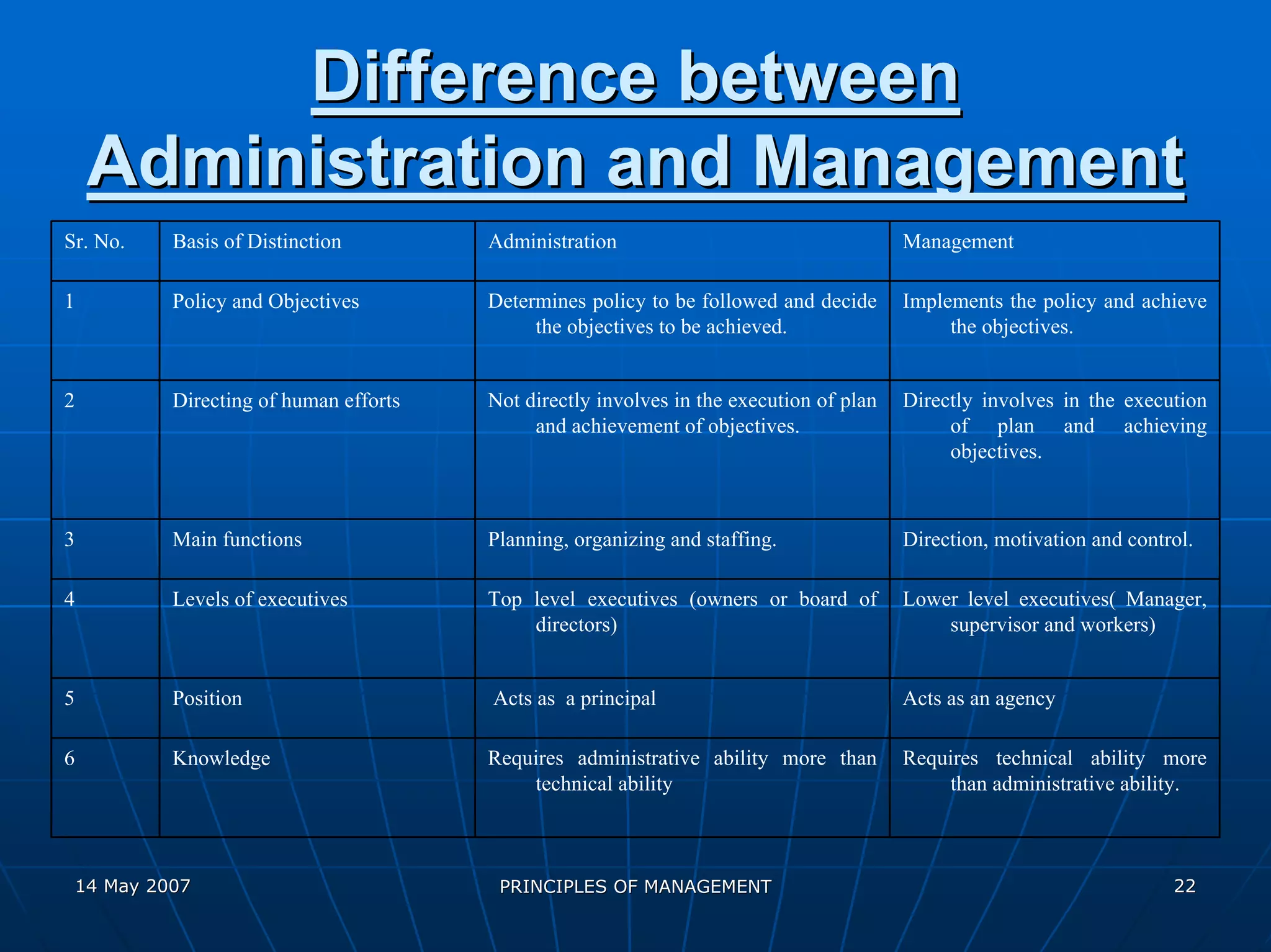
Difference between
    Administration and Management
Sr. No.   Basis of Distinction         Administration                                   Management

1         Policy and Objectives        Determines policy to be followed and decide      Implements the policy and achieve
                                            the objectives to be achieved.                   the objectives.


2         Directing of human efforts   Not directly involves in the execution of plan   Directly involves in the execution
                                            and achievement of objectives.                   of plan and achieving
                                                                                             objectives.


3         Main functions               Planning, organizing and staffing.               Direction, motivation and control.

4         Levels of executives         Top level executives (owners or board of         Lower level executives( Manager,
                                           directors)                                       supervisor and workers)


5         Position                     Acts as a principal                              Acts as an agency

6         Knowledge                    Requires administrative ability more than        Requires technical ability more
                                           technical ability                                than administrative ability.


 14 May 2007                            PRINCIPLES OF MANAGEMENT                                                       22

Principles of Management

  • 1.
    CHAPTER 1 NATURE OF MANAGEMENT 14 May 2007 PRINCIPLES OF MANAGEMENT 1
  • 2.
    Introduction A business develops in course of time with complexities. Management is not only essential to business concerns but also essential to Banks, Schools, Colleges, Hospitals, Hotels, Religious bodies etc. Every business unit has objectives of its won. These objectives can be achieved with the co-operative efforts of several personnel. As E. Demock has rightly said “ the management is not a matter of pressing a button, pulling a lever, issuing orders, scanning P & L statement, promulgating rules and regulations. Rather it is the power to determine what shall happen to the personalities and happiness of entire people, the power to shape the destiny of a nation and of all the nations which make up the world” 14 May 2007 PRINCIPLES OF MANAGEMENT 2
  • 3.
    Principle of Management 14May 2007 PRINCIPLES OF MANAGEMENT 3
  • 4.
    Meaning of Management Management is the art of getting things done by a group of people with the effective utilization of available resources. There are various definitions given by various management gurus but simply management is the process consisting of the functions of planning, organizing, staffing, directing and controlling the operations to achieve specified objectives 14 May 2007 PRINCIPLES OF MANAGEMENT 4
  • 5.
    Features or Characteristicsof Management Art as well as science Management is an activity Management is a continuous process Management achieving pre-determined objectives: Organized Activities Management is a factor of production Management as a system of activity Management is a discipline Management is a purposeful activity Management is a distinct entity 14 May 2007 PRINCIPLES OF MANAGEMENT 5
  • 6.
    Features or Characteristicsof Management Management aims at maximizing profit Decision – making Management is a profession Universal application Management is getting things done Management as a class or a team Management as a career Direction and control Dynamic Management is needed at all levels Leadership quality 14 May 2007 PRINCIPLES OF MANAGEMENT 6
  • 7.
    Characteristics of Management Art as well as science: Management is both an art of possessing of managing skill by a person and a science because of developing certain principles or laws applicable in a place where a group of activities are co-coordinated. Management is an activity: It is a process of activity relating to the effective utilization of available resources. 14 May 2007 PRINCIPLES OF MANAGEMENT 7
  • 8.
    Characteristics of Management Management is a continuous process: The process of management mainly consists of planning, organizing, directing and controlling the resources. The resources (men and money) of an organization should be used to the best advantages of the organization to achieve the objectives. Management achieving pre-determined objectives: The objectives of an organization are clearly laid down. Every managerial activity results in the achievement of objectives fixed well in advance. 14 May 2007 PRINCIPLES OF MANAGEMENT 8
  • 9.
    Characteristics of Management Organized Activities : Management is a group of organized activities. It can be in the form of limited company or a small club. All the organizations have an objectives and these objectives is achieved through systematic way of organized activities. Management is a factor of production : The factors of production includes land, labor, capital and entrepreneurs. Land means a place where production is carried on. Labour refers to paid employees either skilled, unskilled, semi-skilled, manager, supervisor and the like. Capital refers to the working capital in the form of cash, raw material and finished goods and fixed capital as in the form of plant facilities and production facilities. These land, labour and capital can not achieve the organizations goals. It can be achieved only by an entrepreneur in case of small organization and by management in case of large organizations. 14 May 2007 PRINCIPLES OF MANAGEMENT 9
  • 10.
    Characteristics of Management Management as a system of activity : Individuals are foundation of the management. Management ensures the goal congruence between individuals and organization objectives. Management is a discipline: The boundaries of management are not exact like other physical science. It may be increased by continuous discovery of more aspects of business enterprise. Management is a purposeful activity: Management is concerned with objective achievement through planning, organizing, staffing, directing, controlling and decision making. 14 May 2007 PRINCIPLES OF MANAGEMENT 10
  • 11.
    Characteristics of Management Management is a distinct entity: Management is distinct from its functional activity. As function is “to do” while management is to “ how to get things done” Management aims at maximizing profit: The available resources are properly utilized to get desired results. Decision – making: Decision making arises because there is availability courses of actions. The quality of decision taken determines the organization performance 14 May 2007 PRINCIPLES OF MANAGEMENT 11
  • 12.
    Characteristics of Management Management is a profession: It posses the qualities of a profession. Universal application: The same principles of management are applicable in every type of industry only the practice differs from one to another. Management is getting things done: Manager gets things done by others. Management as a class or a team: Class means group of people having homogeneous characteristics to achieve common objectives. 14 May 2007 PRINCIPLES OF MANAGEMENT 12
  • 13.
    Characteristics of Management Management as a career: Now a day’s management is developed as a career focused on specialization like Finance, Marketing, Systems, Personal etc and they are appointed in the key posts of the management. Direction and control: Manager directs his subordinates in the performance whenever necessary. Direction & control deals with the activities of human effort. Dynamic: The management is not static in the ever changing fast developing business world as new techniques are developed and adopted by the management 14 May 2007 PRINCIPLES OF MANAGEMENT 13
  • 14.
    Characteristics of Management Management is needed at all levels: The functions of planning, organizing, directing, controlling and decision making is performed by all the level of organization. Leadership quality: Leadership quality is developed in the persons who are working in the top level management. 14 May 2007 PRINCIPLES OF MANAGEMENT 14
  • 15.
    Functions of Management Theimportant functions of management are as below Planning Organizing Staffing Directing Co-coordinating Motivating or actuating Controlling Innovation Representation Decision Making Communication 14 May 2007 PRINCIPLES OF MANAGEMENT 15
  • 16.
    Importance of Management Management meets the challenge of change Accomplishment of group goals Effective utilization of business Effective functioning of business Resource development Sound organization structure Management directs the organization Integrates various interests Stability Innovation Co-ordination and team spirit Tackling problems A tool for personality OF MANAGEMENT 14 May 2007 PRINCIPLES development 16
  • 17.
    Luther Gullik classifiesthe functions of management as POSDCORB: Planning, Organising, Staffing, Directing, Co-ordinating, Reporting and Budgeting. 14 May 2007 PRINCIPLES OF MANAGEMENT 17
  • 18.
    Importance of Management Management meets the challenge of change: In this ever changing business world, an efficient management saves the business brought by the challenges. Accomplishment of group goals: The achievement of objectives depends upon proper planning of available resources and quality of decision taken and control made by the unit. Effective utilization of business: In eight M’s man, money, materials, machines, methods, motivation, markets and management, management has control over remaining M’s. Effective functioning of business: Ability, experience, mutual understanding, co-ordination, motivation and supervision are the factors for effective functioning of business. Management utilizes the abilities of workers and fulfills their executions through motivation techniques. 14 May 2007 PRINCIPLES OF MANAGEMENT 18
  • 19.
    Importance of Management Resource development: Resources like men, material, money and machines are identified and developed by the management. Sound organization structure: Sound organization structure clearly defines the authority and responsibility. Management directs the organization: Management directs and controls the org. Integrates various interests: Management takes steps to integrate various interests to achieve the objectives of an organization. Stability: The fluctuations caused by changing policy of the government, pressures from competitors and changing preferences by customers in the business are stabilized by the management. 14 May 2007 PRINCIPLES OF MANAGEMENT 19
  • 20.
    Importance of Management Innovation: New ideas are developed by management and implemented in the organization. Co-ordination and team spirit: Management coordinates the activities of different departments and establishes team spirit to achieve the objectives. Tackling problems: Good management acts as a friend of workers while tackling problems. A tool for personality development: Management gives direction and training to the workers that help them to raise their efficiency and productivity 14 May 2007 PRINCIPLES OF MANAGEMENT 20
  • 21.
    Administration and Management There are various opinions of writers for the meaning of administration and management. In general, administration is distinguished as a top level function while management as a lower level functions 14 May 2007 PRINCIPLES OF MANAGEMENT 21
  • 22.
    Difference between Administration and Management Sr. No. Basis of Distinction Administration Management 1 Policy and Objectives Determines policy to be followed and decide Implements the policy and achieve the objectives to be achieved. the objectives. 2 Directing of human efforts Not directly involves in the execution of plan Directly involves in the execution and achievement of objectives. of plan and achieving objectives. 3 Main functions Planning, organizing and staffing. Direction, motivation and control. 4 Levels of executives Top level executives (owners or board of Lower level executives( Manager, directors) supervisor and workers) 5 Position Acts as a principal Acts as an agency 6 Knowledge Requires administrative ability more than Requires technical ability more technical ability than administrative ability. 14 May 2007 PRINCIPLES OF MANAGEMENT 22