Type 2 Diabetes
Mellitus and
Increased Risk for
Malaria Infection
Ina Danquah, George Bedu-Addo,
and Frank P. Mockenhaupt
A case–control study of 1,466 urban adults in Ghana
found that patients with type 2 diabetes mellitus had a 46%
increased risk for infection with Plasmodium falciparum. In-
crease in diabetes mellitus prevalence may put more per-
sons at risk for malaria infection.
In sub-Saharan Africa, infectious diseases remain the pre-
dominant cause of illness and death. Plasmodium falci-
parum malaria alone causes an estimated 1 million deaths
annually (1). At the same time, sub-Saharan Africa faces
the world’s highest increase in type 2 diabetes mellitus; ad-
aptation to Western lifestyles and genetic predispositions
may accelerate this trend (2,3). A decade ago, type 2 dia-
betes mellitus prevalence in urban Ghana was 6.3% (4). By
2030, ≈20 million affected persons may live in sub-Saharan
Africa (2). Type 2 diabetes mellitus increases susceptibil-
ity to common infections (5). In sub-Saharan Africa, the
emerging co-occurrence of type 2 diabetes mellitus and
tropical infectious diseases thus may have substantial im-
plications. We describe prevalence of malaria infection in
adults with and without type 2 diabetes mellitus residing
in Kumasi, Ghana. Malaria transmission in Kumasi is low
but patchy; mosquito breeding sites also occur in urban
agricultural areas (6).
The Study
A case–control study of risk factors for type 2 dia-
betes and hypertension was conducted from August 2007
through June 2008 at Komfo-Anokye Teaching Hospital,
Kumasi, Ghana. The patients’ clinical and biochemical
signs and symptoms were secondary objectives (I. Dan-
quah et al., unpub. data). The study protocol was ap-
proved by the Ethics Committee, University of Science
and Technology, Kumasi, and participants gave informed
written consent.
Patients attending the diabetes (n = 495) or hyperten-
sion center (n = 451) were recruited. These patients pro-
moted participation as preliminary (i.e., to be confirmed)
controls to community members, neighbors, and friends (n
= 222). Further preliminary controls were recruited from
the outpatient department (n = 150) and among hospital
staff (n = 148).
Participants were told to fast, abstain from alcohol and
nicotine use, and avoid stressful and physical activities be-
ginning at 10:00 PM the day before examination. On the day
of examination, participants were asked about medical his-
tory and socioeconomic background, underwent physical
examination, and provided venous blood and urine samples
for laboratory testing.
Fasting plasma glucose (hereafter referred to as glu-
cose concentration; fluoride plasma at 4°C) and hemoglo-
bin (Hb) concentrations were measured (Glucose-201+
,
B-Hemoglobin; HemoCue, Angelhom, Sweden). Irrespec-
tive of symptoms, malaria parasites were counted per 500
leukocytes on Giemsa-stained thick blood films. Plasmo-
dium infection and species were ascertained by PCR that
included positive and negative controls (7).
Patients with type 2 diabetes mellitus were defined as
those receiving documented treatment with antidiabetes
medication or having a glucose concentration >7 mmol/L
(8); patients with hypertension were defined as those re-
ceiving documented antihypertension treatment or having
mean blood pressure >140/90 mm Hg for 3 measurements
(9). Controls had neither condition.
Between-group comparisons were performed by the
Mann-Whitney U, χ2
, and Fisher exact tests. Logistic re-
gression produced adjusted odds ratios (aORs), and 95%
confidence intervals (CIs).
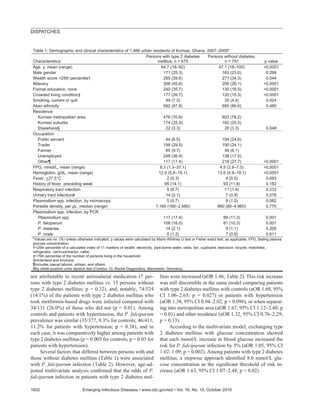
Of the 1,466 study participants, 675 (46%) had type
2 diabetes (Table 1). Among these, 655 (97.0%) received
antidiabetes treatment, but 317 (47.0%) had increased glu-
cose concentration (>7 mmol/L). The 414 patients with hy-
pertension but not diabetes and 377 controls with neither
condition were grouped despite differences, e.g., in age and
socioeconomic parameters (data not shown); however, glu-
cose concentration was similar for the 2 groups (mean 4.51
vs. 4.56 mmol/L; p = 0.53).
According to microscopic examination, 13 (0.9%) of
all participants had malaria parasites at low density (me-
dian 880/μL, range 80–4,960/μL). Reexamination by PCR
showed that 206 (14.1%) were infected with Plasmodium
spp., largely P. falciparum (189, 12.9%). Infected persons
were afebrile, but mean hemoglobin was reduced (–0.4 g/
dL; p = 0.004).
More Plasmodium spp. infections were observed in
persons with type 2 diabetes mellitus than in those without
the disease (Table 1); most infections were caused by P.
falciparum (16% vs. 10%; p = 0.001). This difference was
Emerging Infectious Diseases • www.cdc.gov/eid • Vol. 16, No. 10, October 2010 1601
Author affiliations: Institute of Tropical Medicine and International
Health, Berlin, Germany (I. Danquah, F.P. Mockenhaupt); and
Kwame Nkrumah University of Science and Technology, Kumasi,
Ghana (G. Bedu-Addo)
DOI: 10.3201/eid1610.100399
not attributable to recent antimalarial medication (7 per-
sons with type 2 diabetes mellitus vs. 13 persons without
type 2 diabetes mellitus; p = 0.32), and, notably, 74/524
(14.1%) of the patients with type 2 diabetes mellitus who
took metformin-based drugs were infected compared with
34/131 (26.0%) of those who did not (p = 0.01). Among
controls and patients with hypertension, the P. falciparum
prevalence was similar (35/377, 9.3% for controls; 46/411,
11.2% for patients with hypertension; p = 0.38), and in
each case, it was comparatively higher among patients with
type 2 diabetes mellitus (p = 0.003 for controls; p = 0.03 for
patients with hypertension).
Several factors that differed between persons with and
those without diabetes mellitus (Table 1) were associated
with P. falciparum infection (Table 2). However, age-ad-
justed multivariate analysis confirmed that the odds of P.
falciparum infection in patients with type 2 diabetes mel-
litus were increased (aOR 1.46; Table 2). This risk increase
was still discernible in the same model comparing patients
with type 2 diabetes mellitus with controls (aOR 1.68, 95%
CI 1.06–2.65; p = 0.027) or patients with hypertension
(aOR 1.38, 95% CI 0.94–2.02; p = 0.096), or when separat-
ing into metropolitan area (aOR 1.67, 95% CI 1.12–2.48; p
= 0.01) and other residence (aOR 1.32, 95% CI 0.76–2.29;
p = 0.33).
According to the multivariate model, exchanging type
2 diabetes mellitus with glucose concentration showed
that each mmol/L increase in blood glucose increased the
risk for P. falciparum infection by 5% (aOR 1.05, 95% CI
1.02–1.09; p = 0.002). Among patients with type 2 diabetes
mellitus, a stepwise approach identified 8.6 mmol/L glu-
cose concentration as the significant threshold of risk in-
crease (aOR 1.63, 95% CI 1.07–2.48; p = 0.02).
DISPATCHES
1602 Emerging Infectious Diseases • www.cdc.gov/eid • Vol. 16, No. 10, October 2010
Table 1. Demographic and clinical characteristics of 1,466 urban residents of Kumasi, Ghana, 2007–2008*
Characteristics
Persons with type 2 diabetes
mellitus, n = 675
Persons without diabetes,
n = 791 p value
Age, y, mean (range) 54.7 (18–92) 47.1 (18–100) <0.0001
Male gender 171 (25.3) 182 (23.0) 0.299
Wealth score <25th percentile† 265 (39.6) 271 (34.3) 0.044
Illiteracy 308 (45.8) 206 (26.1) <0.0001
Formal education, none 240 (35.7) 130 (16.5) <0.0001
Crowded living condition‡ 177 (26.7) 120 (15.3) <0.0001
Smoking, current or quit 49 (7.3) 35 (4.4) 0.024
Akan ethnicity 592 (87.8) 685 (86.6) 0.480
Residence
Kumasi metropolitan area 476 (70.8) 603 (76.2)
Kumasi suburbs 174 (25.9) 162 (20.5)
Elsewhere§ 22 (3.3) 26 (3.3) 0.048
Occupation
Public servant 44 (6.5) 194 (24.6)
Trader 198 (29.5) 190 (24.1)
Farmer 65 (9.7) 48 (6.1)
Unemployed 248 (36.9) 138 (17.5)
Other¶ 117 (17.4) 218 (27.7) <0.0001
FPG, mmol/L, mean (range) 8.3 (1.3–37.1) 4.5 (2.9–7.0) <0.0001
Hemoglobin, g/dL, mean (range) 12.9 (5.8–19.1) 13.6 (4.9–19.1) <0.0001
Fever, >37.5°C 2 (0.3) 4 (0.5) 0.693
History of fever, preceding week 95 (14.1) 93 (11.8) 0.182
Respiratory tract infection 5 (0.7) 11 (1.4) 0.232
Urinary tract infection# 14 (2.1) 7 (0.9) 0.076
Plasmodium spp. infection, by microscopy 5 (0.7) 8 (1.0) 0.582
Parasite density, per μL, median (range) 1,160 (160–2,480) 860 (80–4,960) 0.770
Plasmodium spp. infection, by PCR
Plasmodium spp. 117 (17.4) 89 (11.3) 0.001
P. falciparum 108 (16.0) 81 (10.3) 0.001
P. malariae 14 (2.1) 9 (1.1) 0.205
P. ovale 8 (1.2) 7 (0.9) 0.611
*Values are no. (%) unless otherwise indicated. p values were calculated by Mann-Whitney U test or Fisher exact test, as applicable. FPG, fasting plasma
glucose concentration.
†<25th percentile of a calculated index of 11 markers of wealth: electricity, pipe-borne water, radio, fan, cupboard, television, bicycle, motorbike,
refrigerator, car/truck/tractor, cattle.
‡>75th percentile of the number of persons living in the household.
§Hinterland and environs.
¶Includes casual laborer, artisan, and others.
#By nitrite-positive urine dipstick test (Combur 10, Roche Diagnostics, Mannheim, Germany).
Type 2 Diabetes and Malaria Infection
Conclusions
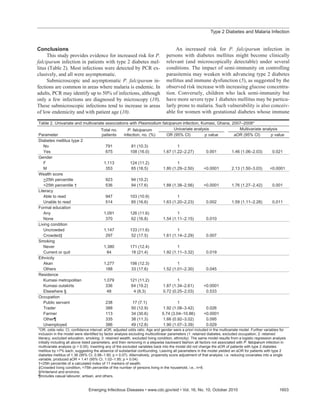
This study provides evidence for increased risk for P.
falciparum infection in patients with type 2 diabetes mel-
litus (Table 2). Most infections were detected by PCR ex-
clusively, and all were asymptomatic.
Submicroscopic and asymptomatic P. falciparum in-
fections are common in areas where malaria is endemic. In
adults, PCR may identify up to 50% of infections, although
only a few infections are diagnosed by microscopy (10).
These submicroscopic infections tend to increase in areas
of low endemicity and with patient age (10).
An increased risk for P. falciparum infection in
persons with diabetes mellitus might become clinically
relevant (and microscopically detectable) under several
conditions. The impact of semi-immunity on controlling
parasitemia may weaken with advancing type 2 diabetes
mellitus and immune dysfunction (5), as suggested by the
observed risk increase with increasing glucose concentra-
tion. Conversely, children who lack semi-immunity but
have more severe type 1 diabetes mellitus may be particu-
larly prone to malaria. Such vulnerability is also conceiv-
able for women with gestational diabetes whose immune
Emerging Infectious Diseases • www.cdc.gov/eid • Vol. 16, No. 10, October 2010 1603
Table 2. Univariate and multivariate associations with Plasmodium falciparum infection, Kumasi, Ghana, 2007–2008*
Parameter
Total no.
patients
P. falciparum
infection, no. (%)
Univariate analysis Multivariate analysis
OR (95% CI) p value aOR (95% CI) p value
Diabetes mellitus type 2
No 791 81 (10.3) 1
Yes 675 108 (16.0) 1.67 (1.22–2.27) 0.001 1.46 (1.06–2.03) 0.021
Gender
F 1,113 124 (11.2) 1
M 353 65 (18.5) 1.80 (1.29–2.50) <0.0001 2.13 (1.50–3.03) <0.0001
Wealth score
>25th percentile 923 94 (10.2)
<25th percentile † 536 94 (17.6) 1.88 (1.38–2.56) <0.0001 1.76 (1.27–2.42) 0.001
Literacy
Able to read 947 103 (10.9) 1
Unable to read 514 85 (16.6) 1.63 (1.20–2.23) 0.002 1.59 (1.11–2.28) 0.011
Formal education
Any 1,091 126 (11.6) 1
None 370 62 (16.8) 1.54 (1.11–2.15) 0.010
Living condition
Uncrowded 1,147 133 (11.6) 1
Crowded‡ 297 52 (17.5) 1.61 (1.14–2.29) 0.007
Smoking
Never 1,380 171 (12.4) 1
Current or quit 84 18 (21.4) 1.92 (1.11–3.32) 0.019
Ethnicity
Akan 1,277 156 (12.3) 1
Others 188 33 (17.6) 1.52 (1.01–2.30) 0.045
Residence
Kumasi metropolitan 1,079 121 (11.2) 1
Kumasi outskirts 336 64 (19.2) 1.87 (1.34–2.61) <0.0001
Elsewhere § 48 4 (8.3) 0.72 (0.25–2.03) 0.533
Occupation
Public servant 238 17 (7.1) 1
Trader 388 50 (12.9) 1.92 (1.08–3.42) 0.026
Farmer 113 34 (30.6) 5.74 (3.04–10.86) <0.0001
Other¶ 335 38 (11.3) 1.66 (0.92–3.02) 0.095
Unemployed 386 49 (12.8) 1.90 (1.07–3.39) 0.029
*OR, odds ratio; CI, confidence interval; aOR, adjusted odds ratio. Age and gender were a priori included in the multivariate model. Further variables for
inclusion in the model were identified by factor analysis excluding multicollinear parameters (1: retained diabetes, excluded occupation; 2: retained
literacy, excluded education, smoking; 3: retained wealth, excluded living condition, ethnicity). The same model results from a logistic regression analysis
initially including all above listed parameters, and then removing in a stepwise backward fashion all factors not associated with P. falciparum infection in
multivariate analysis (p > 0.05). Inserting any of the excluded variables back into the model did not change the aOR of patients with type 2 diabetes
mellitus by >7% each, suggesting the absence of substantial confounding. Leaving all parameters in the model yielded an aOR for patients with type 2
diabetes mellitus of 1.36 (95% CI, 0.98–1.90; p = 0.07). Alternatively, propensity score adjustment of that analysis, i.e. reducing covariates into a single
variable, produced aOR = 1.41 (95% CI, 1.02–1.95; p = 0.04).
†<25th percentile of a calculated index of 11 markers of wealth.
‡Crowded living condition, >75th percentile of the number of persons living in the household, i.e., n>8.
§Hinterland and environs.
¶Includes casual labourer, artisan, and others.
systems are relatively naive with regard to pregnancy-spe-
cific P. falciparum (11). Moreover, low-level infections
in patients with type 2 diabetes mellitus may constitute an
unrecognized infectious reservoir in areas where malaria
is endemic (10). The lowered P. falciparum prevalence
under metformin medication accords with the biguanides’
antimalarial efficacy (12).
Our data stem from a study that was not designed to
assess influences on P. falciparum infection in a heteroge-
neous population. Multivariate analysis cannot exclude un-
measured confounders, and association does not mean cau-
sality. As a limitation, factors influencing infection were
not specifically identified during recruitment and thus were
not included in analysis. Also, despite adjusting for proxy
indicators, e.g., wealth, exposure to infection might still
have differed between the study groups, considering the
patchy malaria transmission in Kumasi (6). Nonetheless,
increased odds of P. falciparum in patients with type 2 dia-
betes mellitus were found after stratification by subgroups
or residence. Ultimate corroboration would need a prospec-
tive, longitudinal study controlling for exposure (possibly
monitored by serologic markers of transmission).
Although the actual reasons for the increase of P. fal-
ciparum infection are unclear, the risk increase with rising
glucose concentration is a sign of biologic plausibility. Such
risk could result from impaired defense against liver and/
or blood-stage parasites and from prolonged persistence.
In type 2 diabetes mellitus, decreased T cell–mediated im-
munity but limited impact on humoral responses are dis-
cussed (5). Mechanistically, increased glucose availability
may feed P. falciparum growth as seen in vitro (13). Also,
patients with diabetes might receive more infectious mos-
quito bites: olfactory signals mediate mosquito attraction
(14), and these, including expiration, are subtly altered in
persons with type 2 diabetes mellitus (15).
The rapid proliferation of type 2 diabetes mellitus in
sub-Saharan Africa may put an increasing number of per-
sons at risk for Plasmodium infection and malaria. Thus,
the magnitude of both diabetes mellitus and malaria in sub-
Saharan Africa warrants further investigation into the rel-
evance and causes of our finding
Acknowledgments
We thank all participants at Komfo Anokye Teaching Hos-
pital and acknowledge the study team of the Kumasi Diabetes and
Hypertension Study for on-site recruitment, data and sample col-
lection, and laboratory analyses.
This study was supported by Charité Universitätsmedizin
Berlin (grant 89539150) and HemoCue, Germany (photometers
and consumables).
Ms Danquah is a nutrition scientist at the Institute of Tropical
Medicine and International Health, Berlin. Her research interests
include nutritional aspects in susceptibility to infectious diseases
and in noncommunicable diseases in sub-Saharan Africa.
References
1. Lopez AD, Mathers CD, Ezzati M, Jamison DT, Murray CJ. Global
and regional burden of disease and risk factors, 2001: systematic
analysis of population health data. Lancet. 2006;367:1747–57. DOI:
10.1016/S0140-6736(06)68770-9
2. Wild S, Roglic G, Green A, Sicree R, King H. Global preva-
lence of diabetes: estimates for the year 2000 and projections for
the year 2030. Diabetes Care. 2004;27:1047–53. DOI: 10.2337/
diacare.27.5.1047
3. Brancati FL, Kao WHL, Folsom AR, Watson RL, Szklo M. In-
cident type 2 diabetes mellitus in African American and white
adults: the Atherosclerosis Risk in Communities study. JAMA.
2000;283:2253–9. DOI: 10.1001/jama.283.17.2253
4. Amoah AG, Owusu SK, Adjei S. Diabetes in Ghana: a community
based prevalence study in Greater Accra. Diabetes Res Clin Pract.
2002;56:197–205. DOI: 10.1016/S0168-8227(01)00374-6
5. Muller LM, Gorter KJ, Hak E, Goudzwaard WL, Schellevis FG,
Hoepelman AI, et al. Increased risk of common infections in pa-
tients with type 1 and type 2 diabetes mellitus. Clin Infect Dis.
2005;41:281–8. DOI: 10.1086/431587
6. Afrane YA, Klinkenberg E, Drechsel P, Owusu-Daaku K, Garms R,
Kruppa T. Does irrigated urban agriculture influence the transmission
of malaria in the city of Kumasi, Ghana? Acta Trop. 2004;89:125–
34. DOI: 10.1016/j.actatropica.2003.06.001
7. Snounou G, Viriyakosol S, Jarra W, Thaithong S, Brown KN. Iden-
tification of the four human malaria parasite species in field samples
by the polymerase chain reaction and detection of a high prevalence
of mixed infections. Mol Biochem Parasitol. 1993;58:283–92. DOI:
10.1016/0166-6851(93)90050-8
8. World Health Organization. Definition, diagnosis and classification
of diabetes mellitus and its complications: report of a WHO con-
sultation. Part 1: diagnosis and classification of diabetes mellitus.
Geneva: The Organization; 1999
9. World Health Organization/International Society of Hyperten-
sion. Guidelines for the management of hypertension. J Hypertens.
1999;17:151–83.
10. Okell LC, Ghani AC, Lyons E, Drakeley CJ. Submicroscopic infec-
tion in Plasmodium falciparum–endemic populations: a systematic
review and meta-analysis. J Infect Dis. 2009;200:1509–17. DOI:
10.1086/644781
11. Fried M, Nosten F, Brockman A, Brabin BJ, Duffy PE. Mater-
nal antibodies block malaria. Nature. 1998;395:851–2. DOI:
10.1038/27570
12. Jones K, Ward SA. Biguanide-atovaquone synergy against Plas-
modium falciparum in vitro. Antimicrob Agents Chemother.
2002;46:2700–3. DOI: 10.1128/AAC.46.8.2700-2703.2002
13. Jensen MD, Conley M, Helstowski LD. Culture of Plasmo-
dium falciparum: the role of pH, glucose, and lactate. J Parasitol.
1983;69:1060–7. DOI: 10.2307/3280864
14. Takken W, Knols BG. Odor-mediated behavior of Afrotropical
malaria mosquitoes. Annu Rev Entomol. 1999;44:131–57. DOI:
10.1146/annurev.ento.44.1.131
15. Dalton P, Gelperin A, Preti G. Volatile metabolic monitoring of gly-
cemic status in diabetes using electronic olfaction. Diabetes Technol
Ther. 2004;6:534–44. DOI: 10.1089/1520915041705992
Address for correspondence: Frank P. Mockenhaupt, Institute of Tropical
Medicine and International Health Berlin, Charité–University Medicine
Berlin, Spandauer Damm 130, 14050 Berlin, Germany; email: frank.
mockenhaupt@charite.de
DISPATCHES
1604 Emerging Infectious Diseases • www.cdc.gov/eid • Vol. 16, No. 10, October 2010

Malaria and diabetes

  • 1.
    Type 2 Diabetes Mellitusand Increased Risk for Malaria Infection Ina Danquah, George Bedu-Addo, and Frank P. Mockenhaupt A case–control study of 1,466 urban adults in Ghana found that patients with type 2 diabetes mellitus had a 46% increased risk for infection with Plasmodium falciparum. In- crease in diabetes mellitus prevalence may put more per- sons at risk for malaria infection. In sub-Saharan Africa, infectious diseases remain the pre- dominant cause of illness and death. Plasmodium falci- parum malaria alone causes an estimated 1 million deaths annually (1). At the same time, sub-Saharan Africa faces the world’s highest increase in type 2 diabetes mellitus; ad- aptation to Western lifestyles and genetic predispositions may accelerate this trend (2,3). A decade ago, type 2 dia- betes mellitus prevalence in urban Ghana was 6.3% (4). By 2030, ≈20 million affected persons may live in sub-Saharan Africa (2). Type 2 diabetes mellitus increases susceptibil- ity to common infections (5). In sub-Saharan Africa, the emerging co-occurrence of type 2 diabetes mellitus and tropical infectious diseases thus may have substantial im- plications. We describe prevalence of malaria infection in adults with and without type 2 diabetes mellitus residing in Kumasi, Ghana. Malaria transmission in Kumasi is low but patchy; mosquito breeding sites also occur in urban agricultural areas (6). The Study A case–control study of risk factors for type 2 dia- betes and hypertension was conducted from August 2007 through June 2008 at Komfo-Anokye Teaching Hospital, Kumasi, Ghana. The patients’ clinical and biochemical signs and symptoms were secondary objectives (I. Dan- quah et al., unpub. data). The study protocol was ap- proved by the Ethics Committee, University of Science and Technology, Kumasi, and participants gave informed written consent. Patients attending the diabetes (n = 495) or hyperten- sion center (n = 451) were recruited. These patients pro- moted participation as preliminary (i.e., to be confirmed) controls to community members, neighbors, and friends (n = 222). Further preliminary controls were recruited from the outpatient department (n = 150) and among hospital staff (n = 148). Participants were told to fast, abstain from alcohol and nicotine use, and avoid stressful and physical activities be- ginning at 10:00 PM the day before examination. On the day of examination, participants were asked about medical his- tory and socioeconomic background, underwent physical examination, and provided venous blood and urine samples for laboratory testing. Fasting plasma glucose (hereafter referred to as glu- cose concentration; fluoride plasma at 4°C) and hemoglo- bin (Hb) concentrations were measured (Glucose-201+ , B-Hemoglobin; HemoCue, Angelhom, Sweden). Irrespec- tive of symptoms, malaria parasites were counted per 500 leukocytes on Giemsa-stained thick blood films. Plasmo- dium infection and species were ascertained by PCR that included positive and negative controls (7). Patients with type 2 diabetes mellitus were defined as those receiving documented treatment with antidiabetes medication or having a glucose concentration >7 mmol/L (8); patients with hypertension were defined as those re- ceiving documented antihypertension treatment or having mean blood pressure >140/90 mm Hg for 3 measurements (9). Controls had neither condition. Between-group comparisons were performed by the Mann-Whitney U, χ2 , and Fisher exact tests. Logistic re- gression produced adjusted odds ratios (aORs), and 95% confidence intervals (CIs). Of the 1,466 study participants, 675 (46%) had type 2 diabetes (Table 1). Among these, 655 (97.0%) received antidiabetes treatment, but 317 (47.0%) had increased glu- cose concentration (>7 mmol/L). The 414 patients with hy- pertension but not diabetes and 377 controls with neither condition were grouped despite differences, e.g., in age and socioeconomic parameters (data not shown); however, glu- cose concentration was similar for the 2 groups (mean 4.51 vs. 4.56 mmol/L; p = 0.53). According to microscopic examination, 13 (0.9%) of all participants had malaria parasites at low density (me- dian 880/μL, range 80–4,960/μL). Reexamination by PCR showed that 206 (14.1%) were infected with Plasmodium spp., largely P. falciparum (189, 12.9%). Infected persons were afebrile, but mean hemoglobin was reduced (–0.4 g/ dL; p = 0.004). More Plasmodium spp. infections were observed in persons with type 2 diabetes mellitus than in those without the disease (Table 1); most infections were caused by P. falciparum (16% vs. 10%; p = 0.001). This difference was Emerging Infectious Diseases • www.cdc.gov/eid • Vol. 16, No. 10, October 2010 1601 Author affiliations: Institute of Tropical Medicine and International Health, Berlin, Germany (I. Danquah, F.P. Mockenhaupt); and Kwame Nkrumah University of Science and Technology, Kumasi, Ghana (G. Bedu-Addo) DOI: 10.3201/eid1610.100399
  • 2.
    not attributable torecent antimalarial medication (7 per- sons with type 2 diabetes mellitus vs. 13 persons without type 2 diabetes mellitus; p = 0.32), and, notably, 74/524 (14.1%) of the patients with type 2 diabetes mellitus who took metformin-based drugs were infected compared with 34/131 (26.0%) of those who did not (p = 0.01). Among controls and patients with hypertension, the P. falciparum prevalence was similar (35/377, 9.3% for controls; 46/411, 11.2% for patients with hypertension; p = 0.38), and in each case, it was comparatively higher among patients with type 2 diabetes mellitus (p = 0.003 for controls; p = 0.03 for patients with hypertension). Several factors that differed between persons with and those without diabetes mellitus (Table 1) were associated with P. falciparum infection (Table 2). However, age-ad- justed multivariate analysis confirmed that the odds of P. falciparum infection in patients with type 2 diabetes mel- litus were increased (aOR 1.46; Table 2). This risk increase was still discernible in the same model comparing patients with type 2 diabetes mellitus with controls (aOR 1.68, 95% CI 1.06–2.65; p = 0.027) or patients with hypertension (aOR 1.38, 95% CI 0.94–2.02; p = 0.096), or when separat- ing into metropolitan area (aOR 1.67, 95% CI 1.12–2.48; p = 0.01) and other residence (aOR 1.32, 95% CI 0.76–2.29; p = 0.33). According to the multivariate model, exchanging type 2 diabetes mellitus with glucose concentration showed that each mmol/L increase in blood glucose increased the risk for P. falciparum infection by 5% (aOR 1.05, 95% CI 1.02–1.09; p = 0.002). Among patients with type 2 diabetes mellitus, a stepwise approach identified 8.6 mmol/L glu- cose concentration as the significant threshold of risk in- crease (aOR 1.63, 95% CI 1.07–2.48; p = 0.02). DISPATCHES 1602 Emerging Infectious Diseases • www.cdc.gov/eid • Vol. 16, No. 10, October 2010 Table 1. Demographic and clinical characteristics of 1,466 urban residents of Kumasi, Ghana, 2007–2008* Characteristics Persons with type 2 diabetes mellitus, n = 675 Persons without diabetes, n = 791 p value Age, y, mean (range) 54.7 (18–92) 47.1 (18–100) <0.0001 Male gender 171 (25.3) 182 (23.0) 0.299 Wealth score <25th percentile† 265 (39.6) 271 (34.3) 0.044 Illiteracy 308 (45.8) 206 (26.1) <0.0001 Formal education, none 240 (35.7) 130 (16.5) <0.0001 Crowded living condition‡ 177 (26.7) 120 (15.3) <0.0001 Smoking, current or quit 49 (7.3) 35 (4.4) 0.024 Akan ethnicity 592 (87.8) 685 (86.6) 0.480 Residence Kumasi metropolitan area 476 (70.8) 603 (76.2) Kumasi suburbs 174 (25.9) 162 (20.5) Elsewhere§ 22 (3.3) 26 (3.3) 0.048 Occupation Public servant 44 (6.5) 194 (24.6) Trader 198 (29.5) 190 (24.1) Farmer 65 (9.7) 48 (6.1) Unemployed 248 (36.9) 138 (17.5) Other¶ 117 (17.4) 218 (27.7) <0.0001 FPG, mmol/L, mean (range) 8.3 (1.3–37.1) 4.5 (2.9–7.0) <0.0001 Hemoglobin, g/dL, mean (range) 12.9 (5.8–19.1) 13.6 (4.9–19.1) <0.0001 Fever, >37.5°C 2 (0.3) 4 (0.5) 0.693 History of fever, preceding week 95 (14.1) 93 (11.8) 0.182 Respiratory tract infection 5 (0.7) 11 (1.4) 0.232 Urinary tract infection# 14 (2.1) 7 (0.9) 0.076 Plasmodium spp. infection, by microscopy 5 (0.7) 8 (1.0) 0.582 Parasite density, per μL, median (range) 1,160 (160–2,480) 860 (80–4,960) 0.770 Plasmodium spp. infection, by PCR Plasmodium spp. 117 (17.4) 89 (11.3) 0.001 P. falciparum 108 (16.0) 81 (10.3) 0.001 P. malariae 14 (2.1) 9 (1.1) 0.205 P. ovale 8 (1.2) 7 (0.9) 0.611 *Values are no. (%) unless otherwise indicated. p values were calculated by Mann-Whitney U test or Fisher exact test, as applicable. FPG, fasting plasma glucose concentration. †<25th percentile of a calculated index of 11 markers of wealth: electricity, pipe-borne water, radio, fan, cupboard, television, bicycle, motorbike, refrigerator, car/truck/tractor, cattle. ‡>75th percentile of the number of persons living in the household. §Hinterland and environs. ¶Includes casual laborer, artisan, and others. #By nitrite-positive urine dipstick test (Combur 10, Roche Diagnostics, Mannheim, Germany).
  • 3.
    Type 2 Diabetesand Malaria Infection Conclusions This study provides evidence for increased risk for P. falciparum infection in patients with type 2 diabetes mel- litus (Table 2). Most infections were detected by PCR ex- clusively, and all were asymptomatic. Submicroscopic and asymptomatic P. falciparum in- fections are common in areas where malaria is endemic. In adults, PCR may identify up to 50% of infections, although only a few infections are diagnosed by microscopy (10). These submicroscopic infections tend to increase in areas of low endemicity and with patient age (10). An increased risk for P. falciparum infection in persons with diabetes mellitus might become clinically relevant (and microscopically detectable) under several conditions. The impact of semi-immunity on controlling parasitemia may weaken with advancing type 2 diabetes mellitus and immune dysfunction (5), as suggested by the observed risk increase with increasing glucose concentra- tion. Conversely, children who lack semi-immunity but have more severe type 1 diabetes mellitus may be particu- larly prone to malaria. Such vulnerability is also conceiv- able for women with gestational diabetes whose immune Emerging Infectious Diseases • www.cdc.gov/eid • Vol. 16, No. 10, October 2010 1603 Table 2. Univariate and multivariate associations with Plasmodium falciparum infection, Kumasi, Ghana, 2007–2008* Parameter Total no. patients P. falciparum infection, no. (%) Univariate analysis Multivariate analysis OR (95% CI) p value aOR (95% CI) p value Diabetes mellitus type 2 No 791 81 (10.3) 1 Yes 675 108 (16.0) 1.67 (1.22–2.27) 0.001 1.46 (1.06–2.03) 0.021 Gender F 1,113 124 (11.2) 1 M 353 65 (18.5) 1.80 (1.29–2.50) <0.0001 2.13 (1.50–3.03) <0.0001 Wealth score >25th percentile 923 94 (10.2) <25th percentile † 536 94 (17.6) 1.88 (1.38–2.56) <0.0001 1.76 (1.27–2.42) 0.001 Literacy Able to read 947 103 (10.9) 1 Unable to read 514 85 (16.6) 1.63 (1.20–2.23) 0.002 1.59 (1.11–2.28) 0.011 Formal education Any 1,091 126 (11.6) 1 None 370 62 (16.8) 1.54 (1.11–2.15) 0.010 Living condition Uncrowded 1,147 133 (11.6) 1 Crowded‡ 297 52 (17.5) 1.61 (1.14–2.29) 0.007 Smoking Never 1,380 171 (12.4) 1 Current or quit 84 18 (21.4) 1.92 (1.11–3.32) 0.019 Ethnicity Akan 1,277 156 (12.3) 1 Others 188 33 (17.6) 1.52 (1.01–2.30) 0.045 Residence Kumasi metropolitan 1,079 121 (11.2) 1 Kumasi outskirts 336 64 (19.2) 1.87 (1.34–2.61) <0.0001 Elsewhere § 48 4 (8.3) 0.72 (0.25–2.03) 0.533 Occupation Public servant 238 17 (7.1) 1 Trader 388 50 (12.9) 1.92 (1.08–3.42) 0.026 Farmer 113 34 (30.6) 5.74 (3.04–10.86) <0.0001 Other¶ 335 38 (11.3) 1.66 (0.92–3.02) 0.095 Unemployed 386 49 (12.8) 1.90 (1.07–3.39) 0.029 *OR, odds ratio; CI, confidence interval; aOR, adjusted odds ratio. Age and gender were a priori included in the multivariate model. Further variables for inclusion in the model were identified by factor analysis excluding multicollinear parameters (1: retained diabetes, excluded occupation; 2: retained literacy, excluded education, smoking; 3: retained wealth, excluded living condition, ethnicity). The same model results from a logistic regression analysis initially including all above listed parameters, and then removing in a stepwise backward fashion all factors not associated with P. falciparum infection in multivariate analysis (p > 0.05). Inserting any of the excluded variables back into the model did not change the aOR of patients with type 2 diabetes mellitus by >7% each, suggesting the absence of substantial confounding. Leaving all parameters in the model yielded an aOR for patients with type 2 diabetes mellitus of 1.36 (95% CI, 0.98–1.90; p = 0.07). Alternatively, propensity score adjustment of that analysis, i.e. reducing covariates into a single variable, produced aOR = 1.41 (95% CI, 1.02–1.95; p = 0.04). †<25th percentile of a calculated index of 11 markers of wealth. ‡Crowded living condition, >75th percentile of the number of persons living in the household, i.e., n>8. §Hinterland and environs. ¶Includes casual labourer, artisan, and others.
  • 4.
    systems are relativelynaive with regard to pregnancy-spe- cific P. falciparum (11). Moreover, low-level infections in patients with type 2 diabetes mellitus may constitute an unrecognized infectious reservoir in areas where malaria is endemic (10). The lowered P. falciparum prevalence under metformin medication accords with the biguanides’ antimalarial efficacy (12). Our data stem from a study that was not designed to assess influences on P. falciparum infection in a heteroge- neous population. Multivariate analysis cannot exclude un- measured confounders, and association does not mean cau- sality. As a limitation, factors influencing infection were not specifically identified during recruitment and thus were not included in analysis. Also, despite adjusting for proxy indicators, e.g., wealth, exposure to infection might still have differed between the study groups, considering the patchy malaria transmission in Kumasi (6). Nonetheless, increased odds of P. falciparum in patients with type 2 dia- betes mellitus were found after stratification by subgroups or residence. Ultimate corroboration would need a prospec- tive, longitudinal study controlling for exposure (possibly monitored by serologic markers of transmission). Although the actual reasons for the increase of P. fal- ciparum infection are unclear, the risk increase with rising glucose concentration is a sign of biologic plausibility. Such risk could result from impaired defense against liver and/ or blood-stage parasites and from prolonged persistence. In type 2 diabetes mellitus, decreased T cell–mediated im- munity but limited impact on humoral responses are dis- cussed (5). Mechanistically, increased glucose availability may feed P. falciparum growth as seen in vitro (13). Also, patients with diabetes might receive more infectious mos- quito bites: olfactory signals mediate mosquito attraction (14), and these, including expiration, are subtly altered in persons with type 2 diabetes mellitus (15). The rapid proliferation of type 2 diabetes mellitus in sub-Saharan Africa may put an increasing number of per- sons at risk for Plasmodium infection and malaria. Thus, the magnitude of both diabetes mellitus and malaria in sub- Saharan Africa warrants further investigation into the rel- evance and causes of our finding Acknowledgments We thank all participants at Komfo Anokye Teaching Hos- pital and acknowledge the study team of the Kumasi Diabetes and Hypertension Study for on-site recruitment, data and sample col- lection, and laboratory analyses. This study was supported by Charité Universitätsmedizin Berlin (grant 89539150) and HemoCue, Germany (photometers and consumables). Ms Danquah is a nutrition scientist at the Institute of Tropical Medicine and International Health, Berlin. Her research interests include nutritional aspects in susceptibility to infectious diseases and in noncommunicable diseases in sub-Saharan Africa. References 1. Lopez AD, Mathers CD, Ezzati M, Jamison DT, Murray CJ. Global and regional burden of disease and risk factors, 2001: systematic analysis of population health data. Lancet. 2006;367:1747–57. DOI: 10.1016/S0140-6736(06)68770-9 2. Wild S, Roglic G, Green A, Sicree R, King H. Global preva- lence of diabetes: estimates for the year 2000 and projections for the year 2030. Diabetes Care. 2004;27:1047–53. DOI: 10.2337/ diacare.27.5.1047 3. Brancati FL, Kao WHL, Folsom AR, Watson RL, Szklo M. In- cident type 2 diabetes mellitus in African American and white adults: the Atherosclerosis Risk in Communities study. JAMA. 2000;283:2253–9. DOI: 10.1001/jama.283.17.2253 4. Amoah AG, Owusu SK, Adjei S. Diabetes in Ghana: a community based prevalence study in Greater Accra. Diabetes Res Clin Pract. 2002;56:197–205. DOI: 10.1016/S0168-8227(01)00374-6 5. Muller LM, Gorter KJ, Hak E, Goudzwaard WL, Schellevis FG, Hoepelman AI, et al. Increased risk of common infections in pa- tients with type 1 and type 2 diabetes mellitus. Clin Infect Dis. 2005;41:281–8. DOI: 10.1086/431587 6. Afrane YA, Klinkenberg E, Drechsel P, Owusu-Daaku K, Garms R, Kruppa T. Does irrigated urban agriculture influence the transmission of malaria in the city of Kumasi, Ghana? Acta Trop. 2004;89:125– 34. DOI: 10.1016/j.actatropica.2003.06.001 7. Snounou G, Viriyakosol S, Jarra W, Thaithong S, Brown KN. Iden- tification of the four human malaria parasite species in field samples by the polymerase chain reaction and detection of a high prevalence of mixed infections. Mol Biochem Parasitol. 1993;58:283–92. DOI: 10.1016/0166-6851(93)90050-8 8. World Health Organization. Definition, diagnosis and classification of diabetes mellitus and its complications: report of a WHO con- sultation. Part 1: diagnosis and classification of diabetes mellitus. Geneva: The Organization; 1999 9. World Health Organization/International Society of Hyperten- sion. Guidelines for the management of hypertension. J Hypertens. 1999;17:151–83. 10. Okell LC, Ghani AC, Lyons E, Drakeley CJ. Submicroscopic infec- tion in Plasmodium falciparum–endemic populations: a systematic review and meta-analysis. J Infect Dis. 2009;200:1509–17. DOI: 10.1086/644781 11. Fried M, Nosten F, Brockman A, Brabin BJ, Duffy PE. Mater- nal antibodies block malaria. Nature. 1998;395:851–2. DOI: 10.1038/27570 12. Jones K, Ward SA. Biguanide-atovaquone synergy against Plas- modium falciparum in vitro. Antimicrob Agents Chemother. 2002;46:2700–3. DOI: 10.1128/AAC.46.8.2700-2703.2002 13. Jensen MD, Conley M, Helstowski LD. Culture of Plasmo- dium falciparum: the role of pH, glucose, and lactate. J Parasitol. 1983;69:1060–7. DOI: 10.2307/3280864 14. Takken W, Knols BG. Odor-mediated behavior of Afrotropical malaria mosquitoes. Annu Rev Entomol. 1999;44:131–57. DOI: 10.1146/annurev.ento.44.1.131 15. Dalton P, Gelperin A, Preti G. Volatile metabolic monitoring of gly- cemic status in diabetes using electronic olfaction. Diabetes Technol Ther. 2004;6:534–44. DOI: 10.1089/1520915041705992 Address for correspondence: Frank P. Mockenhaupt, Institute of Tropical Medicine and International Health Berlin, Charité–University Medicine Berlin, Spandauer Damm 130, 14050 Berlin, Germany; email: frank. mockenhaupt@charite.de DISPATCHES 1604 Emerging Infectious Diseases • www.cdc.gov/eid • Vol. 16, No. 10, October 2010