Making SMARTA Objectives
By FRANKLIN CARRASCO
English Teacher with a TESOL Certificate
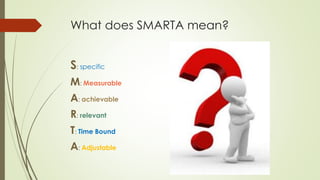
What does SMARTA mean?
S: specific
M: Measurable
A: achievable
R: relevant
T: Time Bound
A: Adjustable
Specific
 What: What do I want to accomplish?
 Why: Specific reasons, purpose or benefits of accomplishing the
goal.
 Is your goal specific?, does it look for details?, where? How often?
To Whom?
Measurable
 How much?
 How many?
 How will I know when it is completed?
 In other words the teacher ask himself if the outcome of the goal/objective
is possible to achieve, how it will be accomplished, what will you see, know,
feel or be able to do?
Achievable
 How can the goal be accomplished?
It concerns more on what my students will do, the kind of strategies,
task, activities to be done.
Relevant
When we refer to relevant we come up with MEANINFUL. Is
this meaningful, important, of interest, real for you and my
students
Does this match our goals?
Time-bound
When?
What teachers have to ask themselves
Will I acomplished what I designed?
Will you be able to do it in specific amount of time that you have?
How long will it take?
When we write smarta objectives time is crucial to get final results. You will
have to take into account your group characteristics, age etc.
ADJUSTABLE
 Here you will see if the outcome is adjustable or flexible. To do this you have
to think how you could adjust your goal if your students are doing faster or
lower than you expected.
Sometimes teachers have more tan one group and the first is different from
the second one.
Examples
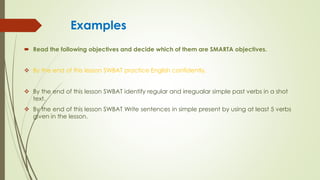
 Read the following objectives and decide which of them are SMARTA objectives.
 By the end of this lesson SWBAT practice English confidently.
 By the end of this lesson SWBAT identify regular and irregualar simple past verbs in a shot
text.
 By the end of this lesson SWBAT Write sentences in simple present by using at least 5 verbs
given in the lesson.
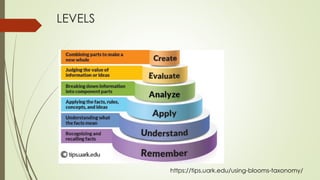
LEVELS
https://tips.uark.edu/using-blooms-taxonomy/
Actions verbs for Specific Learning
based on Bloom´s taxonomy
Knowledge comprehension Application Analysis Synthesis Evaluation
Define Discuss Apply Contrast Categorize Assess
Describe Assossiate Illustrate Combine Generate Justify
Name Infer Modify Debate Create Determine
Recognize Summarize Practice Relate Order Value
Write Give Change compare Explain Rank
Many Thanks

Making smarta obejctives

  • 1.
    Making SMARTA Objectives ByFRANKLIN CARRASCO English Teacher with a TESOL Certificate
  • 2.
    What does SMARTAmean? S: specific M: Measurable A: achievable R: relevant T: Time Bound A: Adjustable
  • 3.
    Specific  What: Whatdo I want to accomplish?  Why: Specific reasons, purpose or benefits of accomplishing the goal.  Is your goal specific?, does it look for details?, where? How often? To Whom?
  • 4.
    Measurable  How much? How many?  How will I know when it is completed?  In other words the teacher ask himself if the outcome of the goal/objective is possible to achieve, how it will be accomplished, what will you see, know, feel or be able to do?
  • 5.
    Achievable  How canthe goal be accomplished? It concerns more on what my students will do, the kind of strategies, task, activities to be done.
  • 6.
    Relevant When we referto relevant we come up with MEANINFUL. Is this meaningful, important, of interest, real for you and my students Does this match our goals?
  • 7.
    Time-bound When? What teachers haveto ask themselves Will I acomplished what I designed? Will you be able to do it in specific amount of time that you have? How long will it take? When we write smarta objectives time is crucial to get final results. You will have to take into account your group characteristics, age etc.
  • 8.
    ADJUSTABLE  Here youwill see if the outcome is adjustable or flexible. To do this you have to think how you could adjust your goal if your students are doing faster or lower than you expected. Sometimes teachers have more tan one group and the first is different from the second one.
  • 9.
    Examples  Read thefollowing objectives and decide which of them are SMARTA objectives.  By the end of this lesson SWBAT practice English confidently.  By the end of this lesson SWBAT identify regular and irregualar simple past verbs in a shot text.  By the end of this lesson SWBAT Write sentences in simple present by using at least 5 verbs given in the lesson.
  • 10.
  • 11.
    Actions verbs forSpecific Learning based on Bloom´s taxonomy Knowledge comprehension Application Analysis Synthesis Evaluation Define Discuss Apply Contrast Categorize Assess Describe Assossiate Illustrate Combine Generate Justify Name Infer Modify Debate Create Determine Recognize Summarize Practice Relate Order Value Write Give Change compare Explain Rank
  • 12.