Making Sense of…
community engagement,
partnering, impacts and outcomes
Viv Read and Marcia Dwonczyk
Metropolitan Water Directorate
Showcase
May 19 2015
w w w . c o m p l e x a b i l i t y . c o m . a u
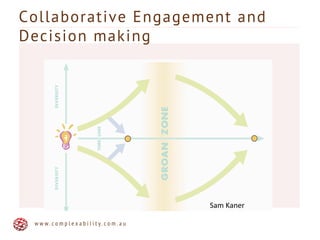
Collaborative Engagement and
Decision making
w w w . c o m p l e x a b i l i t y . c o m . a u
Sam	
  Kaner	
  
What do we know about the way
People ‘see’ the world?
w w w . c o m p l e x a b i l i t y . c o m . a u
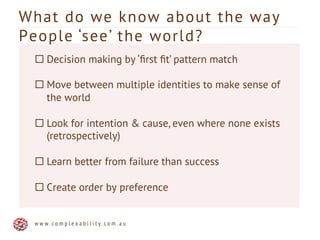
¨ Decision making by ‘first fit’ pattern match
¨ Move between multiple identities to make sense of
the world
¨ Look for intention & cause, even where none exists
(retrospectively)
¨ Learn better from failure than success
¨ Create order by preference
Why Complex Methods?
w w w . c o m p l e x a b i l i t y . c o m . a u
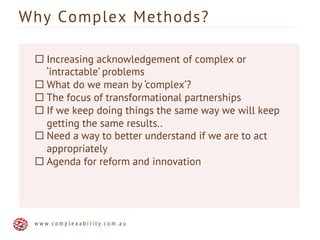
¨ Increasing acknowledgement of complex or
‘intractable’ problems
¨ What do we mean by ‘complex’?
¨ The focus of transformational partnerships
¨ If we keep doing things the same way we will keep
getting the same results..
¨ Need a way to better understand if we are to act
appropriately
¨ Agenda for reform and innovation
Key characteristics of
complex systems
w w w . c o m p l e x a b i l i t y . c o m . a u
¨ Where parts of the system are so interdependent
that the relationship between them will be at best
partially known
¨ Where the characteristics or attributes that arise
from the interaction are not predictable or
controllable
¨ Context will determine what options emerge in a
particular situation
¨ There are multiple options and possibilities
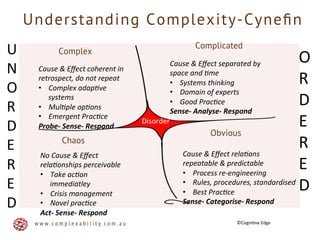
Understanding Complexity-Cynefin
w w w . c o m p l e x a b i l i t y . c o m . a u
Complex
Complicated
Obvious
Chaos
Cause	
  &	
  Effect	
  separated	
  by	
  
space	
  and	
  2me	
  
•  Systems	
  thinking	
  
•  Domain	
  of	
  experts	
  
•  Good	
  Prac2ce	
  
Sense-­‐	
  Analyse-­‐	
  Respond	


Cause	
  &	
  Effect	
  rela2ons	
  
repeatable	
  &	
  predictable	
  
•  Process	
  re-­‐engineering	
  
•  Rules,	
  procedures,	
  standardised	
  
•  Best	
  Prac2ce	
  
Sense-­‐	
  Categorise-­‐	
  Respond	
  
No	
  Cause	
  &	
  Effect	
  	
  
rela2onships	
  perceivable	
  
•  Take	
  ac2on	
  
immediatley	
  
•  Crisis	
  management	
  
•  Novel	
  prac2ce	
  
Act-­‐	
  Sense-­‐	
  Respond	
  	
  
Cause	
  &	
  Effect	
  coherent	
  in	
  
retrospect,	
  do	
  not	
  repeat	
  
•  Complex	
  adap2ve	
  
systems	
  
•  Mul2ple	
  op2ons	
  
•  Emergent	
  Prac2ce	
  
Probe-­‐	
  Sense-­‐	
  Respond	
  
Disorder	
  
O
R
D
E
R
E
D
U
N
O
R
D
E
R
E
D
©Cogni6ve	
  Edge	
  
Sense-making
q  Cynefin is a sense making framework not a
categorisation model… how do we make sense of
the world so that we can act in it
q  Naturalising sense-making
q  revert to the natural sciences
q  Work with humans as they evolved to be
q  bounded diversity: most things are right, but within
boundaries
q  Critical Sense making questions
q  Do we see the data?
q  Do we attend to it?
q  Do we act on it?
w w w . c o m p l e x a b i l i t y . c o m . a u
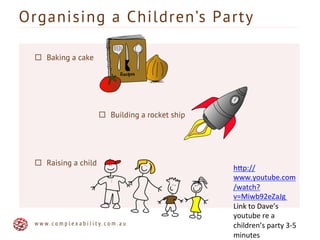
Organising a Children’s Party
w w w . c o m p l e x a b i l i t y . c o m . a u
¨  Baking a cake
¨  Building a rocket ship
¨  Raising a child
h9p://
www.youtube.com
/watch?
v=Miwb92eZaJg	
  	
  
Link	
  to	
  Dave’s	
  
youtube	
  re	
  a	
  
children’s	
  party	
  3-­‐5	
  
minutes	
  
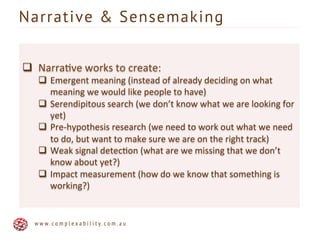
q  Narra6ve	
  works	
  to	
  create:	
  
q  Emergent	
  meaning	
  (instead	
  of	
  already	
  deciding	
  on	
  what	
  
meaning	
  we	
  would	
  like	
  people	
  to	
  have)	
  	
  
q  Serendipitous	
  search	
  (we	
  don’t	
  know	
  what	
  we	
  are	
  looking	
  for	
  
yet)	
  
q  Pre-­‐hypothesis	
  research	
  (we	
  need	
  to	
  work	
  out	
  what	
  we	
  need	
  
to	
  do,	
  but	
  want	
  to	
  make	
  sure	
  we	
  are	
  on	
  the	
  right	
  track)	
  
q  Weak	
  signal	
  detec6on	
  (what	
  are	
  we	
  missing	
  that	
  we	
  don’t	
  
know	
  about	
  yet?)	
  
q  Impact	
  measurement	
  (how	
  do	
  we	
  know	
  that	
  something	
  is	
  
working?)	
  
Narrative & Sensemaking
w w w . c o m p l e x a b i l i t y . c o m . a u
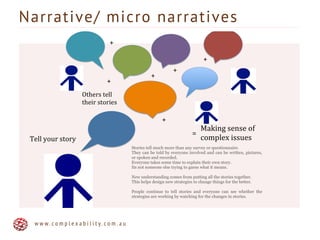
Narrative/ micro narratives
w w w . c o m p l e x a b i l i t y . c o m . a u
!
!
!
!
!
!+!
!
+!
+!
+!
+!
+!
Tell!your!story!
=!
Making!sense!of!
complex!issues!
Stories tell much more than any survey or questionnaire.
They can be told by everyone involved and can be written, pictures,
or spoken and recorded.
Everyone takes some time to explain their own story.
Its not someone else trying to guess what it means.
New understanding comes from putting all the stories together.
This helps design new strategies to change things for the better.
People continue to tell stories and everyone can see whether the
strategies are working by watching for the changes in stories.
!
Others!tell!
their!stories!
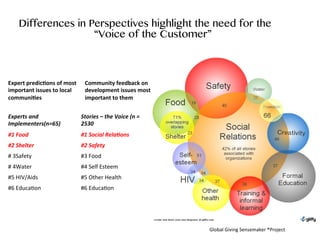
Differences in Perspectives highlight the need for the
“Voice of the Customer”
Expert	
  predic+ons	
  of	
  most	
  
important	
  issues	
  to	
  local	
  
communi+es	
  	
  
Community	
  feedback	
  on	
  
development	
  issues	
  most	
  
important	
  to	
  them	
  	
  
Experts	
  and	
  
Implementers(n=65)	
  
Stories	
  –	
  the	
  Voice	
  (n	
  =	
  
2530	
  
#1	
  Food	
   #1	
  Social	
  RelaIons	
  
#2	
  Shelter	
   #2	
  Safety	
  
#	
  3Safety	
   #3	
  Food	
  
#	
  4Water	
   #4	
  Self	
  Esteem	
  
#5	
  HIV/Aids	
   #5	
  Other	
  Health	
  
#6	
  Educa6on	
   #6	
  Educa6on	
  
Global	
  Giving	
  Sensemaker	
  ®Project	
  
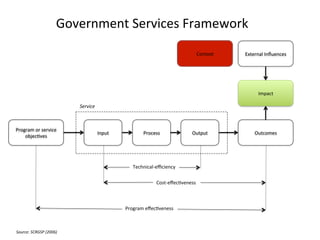
Government	
  Services	
  Framework	
  
Program	
  or	
  service	
  
objec6ves	
  
Input	
   Process	
   Output	
   Outcomes	
  
Impact	
  
External	
  Influences	
  
Program	
  effec6veness	
  
Cost-­‐effec6veness	
  
Technical-­‐efficiency	
  
Service	
  
Source:	
  SCRGSP	
  (2006)	
  
Context	
  
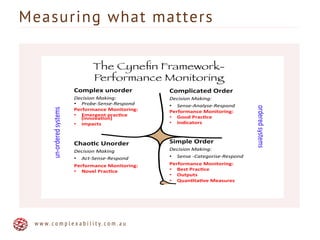
Measuring what matters
w w w . c o m p l e x a b i l i t y . c o m . a u
Simple'Order'
Decision(Making: ((
•  Sense(/Categorise/Respond(
Performance'Monitoring:'
•  Best'Prac7ce''
•  Outputs'
•  Quan7ta7ve'Measures'
Complicated'Order'
Decision(Making:(
•  Sense/Analyse/Respond(
Performance'Monitoring:'
•  Good'Prac7ce''
•  Indicators'
Complex'unorder'
Decision(Making:(
•  Probe/Sense/Respond(
Performance'Monitoring:'
•  Emergent'prac7ce'
(innova7on)'
•  impacts'
Chao7c'Unorder'
Decision(Making(
•  Act/Sense/Respond(
Performance'Monitoring:'
•  Novel'Prac7ce'
The Cynefin Framework-
Performance Monitoring
ordered%systems%
un,ordered%systems%
!
!
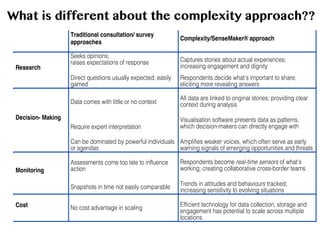
Traditional consultation/ survey
approaches
Complexity/SenseMaker® approach
Research
Seeks opinions;
raises expectations of response Captures stories about actual experiences;
increasing engagement and dignity
Direct questions usually expected; easily
gamed
Respondents decide what’s important to share;
eliciting more revealing answers
Decision- Making
Data comes with little or no context
All data are linked to original stories; providing clear
context during analysis
Require expert interpretation
Visualisation software presents data as patterns,
which decision-makers can directly engage with
Can be dominated by powerful individuals
or agendas
Amplifies weaker voices, which often serve as early
warning signals of emerging opportunities and threats
Monitoring
Assessments come too late to influence
action
Respondents become real-time sensors of what’s
working; creating collaborative cross-border teams
Snapshots in time not easily comparable
Trends in attitudes and behaviours tracked;
increasing sensitivity to evolving situations
Cost No cost advantage in scaling Efficient technology for data collection, storage and
engagement has potential to scale across multiple
locations
What is different about the complexity approach??
w w w . c o m p l e x a b i l i t y . c o m . a u
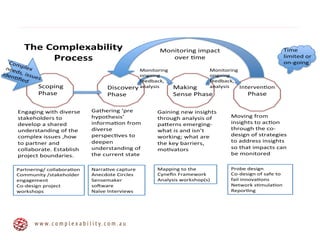
Scoping(
Phase(
Discovery(
Phase(
Making(
Sense(Phase(
Interven6on(
Phase(
Gaining(new(insights(
through(analysis(of(
pa<erns(emerging>(
what(is(and(isn’t(
working;(what(are(
the(key(barriers,(
mo6vators(
The$Complexability$
Process$
Engaging(with(diverse(
stakeholders(to(
develop(a(shared(
understanding(of(the(
complex(issues(,how(
to(partner(and(
collaborate.(Establish(
project(boundaries.(
Complex(needs,(issues(
iden6fied(
Monitoring(impact(
over(6me(
Monitoring(
ongoing(
feedback,(
analysis(
Monitoring(
ongoing(
feedback,(
analysis(
Gathering(‘pre(
hypothesis’(
informa6on(from(
diverse(
perspec6ves(to(
deepen(
understanding(of(
the(current(state(
Moving(from(
insights(to(ac6on(
through(the(co>
design(of(strategies(
to(address(insights(
so(that(impacts(can(
be(monitored(
Partnering/(collabora6on(
Community(/stakeholder(
engagement(
Co>design(project(
workshops(
Narra6ve(capture(
Anecdote(Circles(
Sensemaker(
soNware(
Naïve(Interviews(
Mapping(to(the(
Cynefin(Framework(
Analysis(workshop(s)(
Probe(design(
Co>design(of(safe(to(
fail(innova6ons(
Network(s6mula6on(
Repor6ng(
Time(
limited(or(
on>going(
Want	
  to	
  know	
  more??	
  
•  viv.read@complexability.com.au	
  
•  0414294339	
  
•  marcia@complexability.com.au	
  
•  0408602222	
  
•  www.complexability.com.au	
  
w w w . c o m p l e x a b i l i t y . c o m . a u

Making sense of community engagement, impacts and outcomes

  • 1.
    Making Sense of… communityengagement, partnering, impacts and outcomes Viv Read and Marcia Dwonczyk Metropolitan Water Directorate Showcase May 19 2015 w w w . c o m p l e x a b i l i t y . c o m . a u
  • 2.
    Collaborative Engagement and Decisionmaking w w w . c o m p l e x a b i l i t y . c o m . a u Sam  Kaner  
  • 3.
    What do weknow about the way People ‘see’ the world? w w w . c o m p l e x a b i l i t y . c o m . a u ¨ Decision making by ‘first fit’ pattern match ¨ Move between multiple identities to make sense of the world ¨ Look for intention & cause, even where none exists (retrospectively) ¨ Learn better from failure than success ¨ Create order by preference
  • 4.
    Why Complex Methods? ww w . c o m p l e x a b i l i t y . c o m . a u ¨ Increasing acknowledgement of complex or ‘intractable’ problems ¨ What do we mean by ‘complex’? ¨ The focus of transformational partnerships ¨ If we keep doing things the same way we will keep getting the same results.. ¨ Need a way to better understand if we are to act appropriately ¨ Agenda for reform and innovation
  • 5.
    Key characteristics of complexsystems w w w . c o m p l e x a b i l i t y . c o m . a u ¨ Where parts of the system are so interdependent that the relationship between them will be at best partially known ¨ Where the characteristics or attributes that arise from the interaction are not predictable or controllable ¨ Context will determine what options emerge in a particular situation ¨ There are multiple options and possibilities
  • 6.
    Understanding Complexity-Cynefin w ww . c o m p l e x a b i l i t y . c o m . a u Complex Complicated Obvious Chaos Cause  &  Effect  separated  by   space  and  2me   •  Systems  thinking   •  Domain  of  experts   •  Good  Prac2ce   Sense-­‐  Analyse-­‐  Respond     Cause  &  Effect  rela2ons   repeatable  &  predictable   •  Process  re-­‐engineering   •  Rules,  procedures,  standardised   •  Best  Prac2ce   Sense-­‐  Categorise-­‐  Respond   No  Cause  &  Effect     rela2onships  perceivable   •  Take  ac2on   immediatley   •  Crisis  management   •  Novel  prac2ce   Act-­‐  Sense-­‐  Respond     Cause  &  Effect  coherent  in   retrospect,  do  not  repeat   •  Complex  adap2ve   systems   •  Mul2ple  op2ons   •  Emergent  Prac2ce   Probe-­‐  Sense-­‐  Respond   Disorder   O R D E R E D U N O R D E R E D ©Cogni6ve  Edge  
  • 7.
    Sense-making q  Cynefin isa sense making framework not a categorisation model… how do we make sense of the world so that we can act in it q  Naturalising sense-making q  revert to the natural sciences q  Work with humans as they evolved to be q  bounded diversity: most things are right, but within boundaries q  Critical Sense making questions q  Do we see the data? q  Do we attend to it? q  Do we act on it? w w w . c o m p l e x a b i l i t y . c o m . a u
  • 8.
    Organising a Children’sParty w w w . c o m p l e x a b i l i t y . c o m . a u ¨  Baking a cake ¨  Building a rocket ship ¨  Raising a child h9p:// www.youtube.com /watch? v=Miwb92eZaJg     Link  to  Dave’s   youtube  re  a   children’s  party  3-­‐5   minutes  
  • 9.
    q  Narra6ve  works  to  create:   q  Emergent  meaning  (instead  of  already  deciding  on  what   meaning  we  would  like  people  to  have)     q  Serendipitous  search  (we  don’t  know  what  we  are  looking  for   yet)   q  Pre-­‐hypothesis  research  (we  need  to  work  out  what  we  need   to  do,  but  want  to  make  sure  we  are  on  the  right  track)   q  Weak  signal  detec6on  (what  are  we  missing  that  we  don’t   know  about  yet?)   q  Impact  measurement  (how  do  we  know  that  something  is   working?)   Narrative & Sensemaking w w w . c o m p l e x a b i l i t y . c o m . a u
  • 10.
    Narrative/ micro narratives ww w . c o m p l e x a b i l i t y . c o m . a u ! ! ! ! ! !+! ! +! +! +! +! +! Tell!your!story! =! Making!sense!of! complex!issues! Stories tell much more than any survey or questionnaire. They can be told by everyone involved and can be written, pictures, or spoken and recorded. Everyone takes some time to explain their own story. Its not someone else trying to guess what it means. New understanding comes from putting all the stories together. This helps design new strategies to change things for the better. People continue to tell stories and everyone can see whether the strategies are working by watching for the changes in stories. ! Others!tell! their!stories!
  • 11.
    Differences in Perspectiveshighlight the need for the “Voice of the Customer” Expert  predic+ons  of  most   important  issues  to  local   communi+es     Community  feedback  on   development  issues  most   important  to  them     Experts  and   Implementers(n=65)   Stories  –  the  Voice  (n  =   2530   #1  Food   #1  Social  RelaIons   #2  Shelter   #2  Safety   #  3Safety   #3  Food   #  4Water   #4  Self  Esteem   #5  HIV/Aids   #5  Other  Health   #6  Educa6on   #6  Educa6on   Global  Giving  Sensemaker  ®Project  
  • 12.
    Government  Services  Framework   Program  or  service   objec6ves   Input   Process   Output   Outcomes   Impact   External  Influences   Program  effec6veness   Cost-­‐effec6veness   Technical-­‐efficiency   Service   Source:  SCRGSP  (2006)   Context  
  • 13.
    Measuring what matters ww w . c o m p l e x a b i l i t y . c o m . a u Simple'Order' Decision(Making: (( •  Sense(/Categorise/Respond( Performance'Monitoring:' •  Best'Prac7ce'' •  Outputs' •  Quan7ta7ve'Measures' Complicated'Order' Decision(Making:( •  Sense/Analyse/Respond( Performance'Monitoring:' •  Good'Prac7ce'' •  Indicators' Complex'unorder' Decision(Making:( •  Probe/Sense/Respond( Performance'Monitoring:' •  Emergent'prac7ce' (innova7on)' •  impacts' Chao7c'Unorder' Decision(Making( •  Act/Sense/Respond( Performance'Monitoring:' •  Novel'Prac7ce' The Cynefin Framework- Performance Monitoring ordered%systems% un,ordered%systems% !
  • 14.
    ! Traditional consultation/ survey approaches Complexity/SenseMaker®approach Research Seeks opinions; raises expectations of response Captures stories about actual experiences; increasing engagement and dignity Direct questions usually expected; easily gamed Respondents decide what’s important to share; eliciting more revealing answers Decision- Making Data comes with little or no context All data are linked to original stories; providing clear context during analysis Require expert interpretation Visualisation software presents data as patterns, which decision-makers can directly engage with Can be dominated by powerful individuals or agendas Amplifies weaker voices, which often serve as early warning signals of emerging opportunities and threats Monitoring Assessments come too late to influence action Respondents become real-time sensors of what’s working; creating collaborative cross-border teams Snapshots in time not easily comparable Trends in attitudes and behaviours tracked; increasing sensitivity to evolving situations Cost No cost advantage in scaling Efficient technology for data collection, storage and engagement has potential to scale across multiple locations What is different about the complexity approach??
  • 15.
    w w w. c o m p l e x a b i l i t y . c o m . a u Scoping( Phase( Discovery( Phase( Making( Sense(Phase( Interven6on( Phase( Gaining(new(insights( through(analysis(of( pa<erns(emerging>( what(is(and(isn’t( working;(what(are( the(key(barriers,( mo6vators( The$Complexability$ Process$ Engaging(with(diverse( stakeholders(to( develop(a(shared( understanding(of(the( complex(issues(,how( to(partner(and( collaborate.(Establish( project(boundaries.( Complex(needs,(issues( iden6fied( Monitoring(impact( over(6me( Monitoring( ongoing( feedback,( analysis( Monitoring( ongoing( feedback,( analysis( Gathering(‘pre( hypothesis’( informa6on(from( diverse( perspec6ves(to( deepen( understanding(of( the(current(state( Moving(from( insights(to(ac6on( through(the(co> design(of(strategies( to(address(insights( so(that(impacts(can( be(monitored( Partnering/(collabora6on( Community(/stakeholder( engagement( Co>design(project( workshops( Narra6ve(capture( Anecdote(Circles( Sensemaker( soNware( Naïve(Interviews( Mapping(to(the( Cynefin(Framework( Analysis(workshop(s)( Probe(design( Co>design(of(safe(to( fail(innova6ons( Network(s6mula6on( Repor6ng( Time( limited(or( on>going(
  • 16.
    Want  to  know  more??   •  viv.read@complexability.com.au   •  0414294339   •  marcia@complexability.com.au   •  0408602222   •  www.complexability.com.au   w w w . c o m p l e x a b i l i t y . c o m . a u