Becoming
WhiteA Workshop for
PCC’S Whiteness History Month
With Sharece M. Bunn
What do we mean by
“Becoming White?”
!  Becoming White is the process of understanding
whiteness and how us white folks fit into the
racial dynamics of the U.S. and the world.
!  Becoming White includes the process of white
identity development as researched by Janet
Helms.
Our Goals for Today:
!  Deliberate our racial identities and think about
how they fit into the racial dynamics of the
communities in which we reside.
!  Connect with other folks and learn about how
they have developed their racial identities.
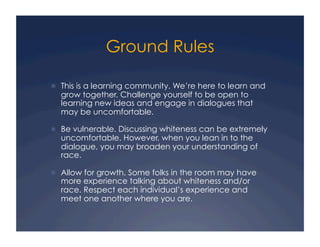
Ground Rules
!  This is a learning community. We’re here to learn and
grow together. Challenge yourself to be open to
learning new ideas and engage in dialogues that
may be uncomfortable.
!  Be vulnerable. Discussing whiteness can be extremely
uncomfortable. However, when you lean in to the
dialogue, you may broaden your understanding of
race.
!  Allow for growth. Some folks in the room may have
more experience talking about whiteness and/or
race. Respect each individual’s experience and
meet one another where you are.
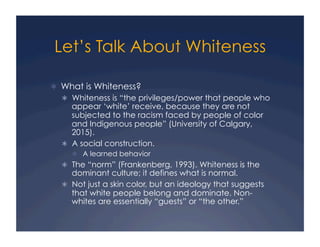
Let’s Talk About Whiteness
!  What is Whiteness?
!  Whiteness is “the privileges/power that people who
appear ‘white’ receive, because they are not
subjected to the racism faced by people of color
and Indigenous people” (University of Calgary,
2015).
!  A social construction.
!  A learned behavior
!  The “norm” (Frankenberg, 1993). Whiteness is the
dominant culture; it defines what is normal.
!  Not just a skin color, but an ideology that suggests
that white people belong and dominate. Non-
whites are essentially “guests” or “the other.”
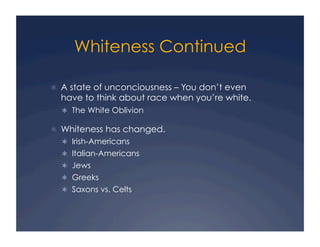
Whiteness Continued
!  A state of unconciousness – You don’t even
have to think about race when you’re white.
!  The White Oblivion
!  Whiteness has changed.
!  Irish-Americans
!  Italian-Americans
!  Jews
!  Greeks
!  Saxons vs. Celts
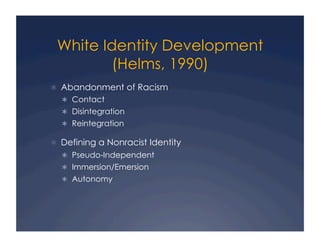
White Identity Development
(Helms, 1990)
!  Abandonment of Racism
!  Contact
!  Disintegration
!  Reintegration
!  Defining a Nonracist Identity
!  Pseudo-Independent
!  Immersion/Emersion
!  Autonomy
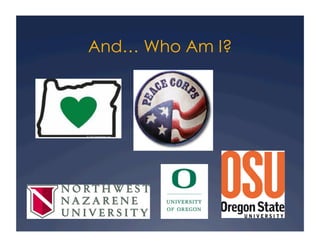
And… Who Am I?
Stepping into White
Consciousness
!  Social Justice Retreat – September 2013
!  Student Development Theory
!  Multicultural Issues Course
!  Reintegration – I couldn’t work for a
historically black college, because they
wouldn’t hire me.
!  Educational & Social Reform in South
Africa
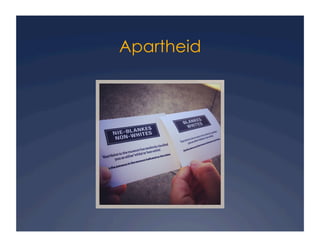
!  Apartheid Museum
!  University of Pretoria
Apartheid
Let’s get talk about our own
racial identities.
!  Take a minute to write down when you
remember first learning about your race. What
happened? Who spoke to you about it? What
did you do after that first experience?
Ground Rules
!  This is a learning community. We’re here to learn and
grow together. Challenge yourself to be open to
learning new ideas and engage in dialogues that
may be uncomfortable.
!  Be vulnerable. Discussing whiteness can be extremely
uncomfortable. However, when you lean in to the
dialogue, you may broaden your understanding of
race.
!  Allow for growth. Some folks in the room may have
more experience talking about whiteness and/or
race. Respect each individual’s experience and
meet one another where you are.
What box do I check?
!  U.S. Census Racial Categories:
!  White, Black or African American, American Indian
or Alaska Native, Asian, Native Hawaiian or Other
Pacific Islander
!  Please fill in the box of your race. Then, for the
next three minutes, write about what this means
to you. What memories, thoughts, or ideas go
through your head? How do you feel?
Discussion
!  Share about checking the box.
!  What did you write about today?
!  What are thoughts that have come up in the
past when you’ve filled out this box?
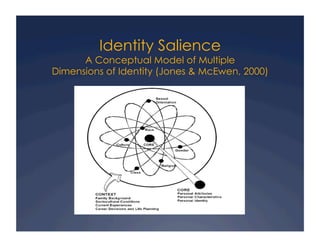
Identity Salience
A Conceptual Model of Multiple
Dimensions of Identity (Jones & McEwen, 2000)
Common Traps
!  Colorblindness
!  “I don’t see color.”
!  “But we’re all equal.”
!  The White Oblivion
!  “It’s shocking that these things are still happening.”
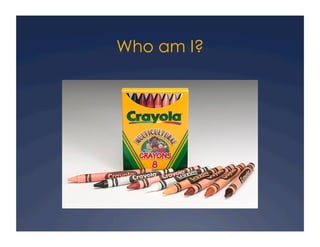
!  Color Crayons
!  When it comes to white folks, you might pick pink,
peach, white, but then when you want to draw a
person of color, you’ll pick brown or black
immediately without trying to match the shade…
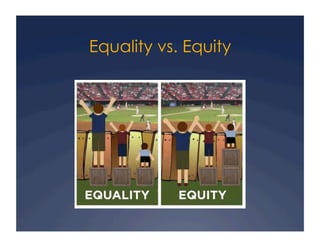
Equality vs. Equity
Common Traps
!  Colorblindness
!  “I don’t see color.”
!  “But we’re all equal.”
!  The White Oblivion
!  “It’s shocking that these things are still happening.”
!  Color Crayons
!  When it comes to white folks, you might pick pink,
peach, white, but then when you want to draw a
person of color, you’ll pick brown or black
immediately without trying to match the shade…
Who am I?
Socialization Reflection
!  What’s a memory you have from childhood or
early adulthood when you started to wonder
about what your race meant?
!  Or, what do you remember learning about race
in your early years?
What does it mean to be white?
!  What is white culture?
!  What images come to mind when you think
about whiteness and white folks?
!  How do you define what it means to be white?
Confronting Whiteness
!  What has white supremacy done for me?
!  White supremacy: “the belief, theory, or doctrine that white people
are inherently superior to people from all other
racial groups, especially black people, and are
therefore rightfully the dominant group in any society.” (Dictionary.com,
2016).
!  How have you benefited from racial privilege?
Or, how has racial privilege affected my life?
So…
!  If the prevalence of white supremacy in our
society makes me feel bad, why should I focus
on it?
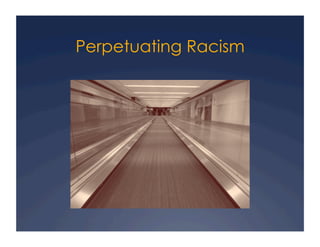
Perpetuating Racism
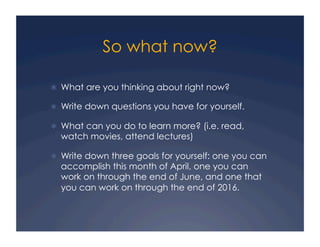
So what now?
!  What are you thinking about right now?
!  Write down questions you have for yourself.
!  What can you do to learn more? (i.e. read,
watch movies, attend lectures)
!  Write down three goals for yourself: one you can
accomplish this month of April, one you can
work on through the end of June, and one that
you can work on through the end of 2016.
Thank you!
!  I appreciate all of you!
!  Thanks for coming to this session.
!  Thanks for talking about your racial identities and
for your vulnerability throughout the process.
!  Thanks for connecting with your co-participants!
Please exchange information with one another!
Contact Info
!  Sharece Bunn
!  Linn-Benton Community College
!  International Student Coordinator
!  bunns@linnbenton.edu
!  541-917-4813
Questions?
References & Works Consulted
!  Blay, Z. (2016, January 20). 4 ‘reverse racism’ myths that need to stop. Huffpost Black Voices. Retrieved from
www.huffingtonpost.com.
!  DiAngelo, R. (2014, August 14). What does it mean to be white? The Seattle Times. Retrieved from www.seattletimes.com
!  Estrada, I. (2012, November 17). Crayola doesn’t understand the meaning of “Multicultural.” Latino Rebels. Retrieved
from www.latinorebels.com.
!  Frankenberg, R. (1993). White women, race matters: The social construction of whiteness. Minneapolis, MN: University of
Minnesota Press.
!  Helms, J. E. (1990). Toward a model of White racial identity development. In Ed. J. Helms. Black and White racial identity:
Theory, research, and practice. New York: Greenwood Press.
!  Johnson, A. G. (2006). Privilege, power, and difference. Boston: McGraw-Hill.
!  Painter, N. I. (2015, June 20). What is whiteness? The New York Times. Retrieved from www.nytimes.com.
!  Tatum, B. D. (2013). Defining racism: Can we talk? In Adams, M., Blumenfeld, W. J., Castaneda, C., Hackman, H. W.,
Peters, M. L. & Zuniga, X. Readings for diversity and social justice. New York: Routledge.
!  University of Calgary. (2015). Understanding whiteness. Calgary Anti-Racism Education. Retrieved from
www.ucalgary.ca.
!  Villalpando, O. (2003). Self-segregation or self-preservation? A critical race theory and Latina/o critical theory analysis of
a study of Chicana/o college students. International Journal of Qualitative Studies in Education, 16, 619-646. doi:
10.1080/0951839032000142922

Becoming White Final

  • 1.
    Becoming WhiteA Workshop for PCC’SWhiteness History Month With Sharece M. Bunn
  • 2.
    What do wemean by “Becoming White?” !  Becoming White is the process of understanding whiteness and how us white folks fit into the racial dynamics of the U.S. and the world. !  Becoming White includes the process of white identity development as researched by Janet Helms.
  • 3.
    Our Goals forToday: !  Deliberate our racial identities and think about how they fit into the racial dynamics of the communities in which we reside. !  Connect with other folks and learn about how they have developed their racial identities.
  • 4.
    Ground Rules !  Thisis a learning community. We’re here to learn and grow together. Challenge yourself to be open to learning new ideas and engage in dialogues that may be uncomfortable. !  Be vulnerable. Discussing whiteness can be extremely uncomfortable. However, when you lean in to the dialogue, you may broaden your understanding of race. !  Allow for growth. Some folks in the room may have more experience talking about whiteness and/or race. Respect each individual’s experience and meet one another where you are.
  • 5.
    Let’s Talk AboutWhiteness !  What is Whiteness? !  Whiteness is “the privileges/power that people who appear ‘white’ receive, because they are not subjected to the racism faced by people of color and Indigenous people” (University of Calgary, 2015). !  A social construction. !  A learned behavior !  The “norm” (Frankenberg, 1993). Whiteness is the dominant culture; it defines what is normal. !  Not just a skin color, but an ideology that suggests that white people belong and dominate. Non- whites are essentially “guests” or “the other.”
  • 6.
    Whiteness Continued !  Astate of unconciousness – You don’t even have to think about race when you’re white. !  The White Oblivion !  Whiteness has changed. !  Irish-Americans !  Italian-Americans !  Jews !  Greeks !  Saxons vs. Celts
  • 7.
    White Identity Development (Helms,1990) !  Abandonment of Racism !  Contact !  Disintegration !  Reintegration !  Defining a Nonracist Identity !  Pseudo-Independent !  Immersion/Emersion !  Autonomy
  • 8.
  • 9.
    Stepping into White Consciousness ! Social Justice Retreat – September 2013 !  Student Development Theory !  Multicultural Issues Course !  Reintegration – I couldn’t work for a historically black college, because they wouldn’t hire me. !  Educational & Social Reform in South Africa !  Apartheid Museum !  University of Pretoria
  • 10.
  • 11.
    Let’s get talkabout our own racial identities. !  Take a minute to write down when you remember first learning about your race. What happened? Who spoke to you about it? What did you do after that first experience?
  • 12.
    Ground Rules !  Thisis a learning community. We’re here to learn and grow together. Challenge yourself to be open to learning new ideas and engage in dialogues that may be uncomfortable. !  Be vulnerable. Discussing whiteness can be extremely uncomfortable. However, when you lean in to the dialogue, you may broaden your understanding of race. !  Allow for growth. Some folks in the room may have more experience talking about whiteness and/or race. Respect each individual’s experience and meet one another where you are.
  • 13.
    What box doI check? !  U.S. Census Racial Categories: !  White, Black or African American, American Indian or Alaska Native, Asian, Native Hawaiian or Other Pacific Islander !  Please fill in the box of your race. Then, for the next three minutes, write about what this means to you. What memories, thoughts, or ideas go through your head? How do you feel?
  • 14.
    Discussion !  Share aboutchecking the box. !  What did you write about today? !  What are thoughts that have come up in the past when you’ve filled out this box?
  • 15.
    Identity Salience A ConceptualModel of Multiple Dimensions of Identity (Jones & McEwen, 2000)
  • 16.
    Common Traps !  Colorblindness ! “I don’t see color.” !  “But we’re all equal.” !  The White Oblivion !  “It’s shocking that these things are still happening.” !  Color Crayons !  When it comes to white folks, you might pick pink, peach, white, but then when you want to draw a person of color, you’ll pick brown or black immediately without trying to match the shade…
  • 17.
  • 18.
    Common Traps !  Colorblindness ! “I don’t see color.” !  “But we’re all equal.” !  The White Oblivion !  “It’s shocking that these things are still happening.” !  Color Crayons !  When it comes to white folks, you might pick pink, peach, white, but then when you want to draw a person of color, you’ll pick brown or black immediately without trying to match the shade…
  • 19.
  • 20.
    Socialization Reflection !  What’sa memory you have from childhood or early adulthood when you started to wonder about what your race meant? !  Or, what do you remember learning about race in your early years?
  • 21.
    What does itmean to be white? !  What is white culture? !  What images come to mind when you think about whiteness and white folks? !  How do you define what it means to be white?
  • 22.
    Confronting Whiteness !  Whathas white supremacy done for me? !  White supremacy: “the belief, theory, or doctrine that white people are inherently superior to people from all other racial groups, especially black people, and are therefore rightfully the dominant group in any society.” (Dictionary.com, 2016). !  How have you benefited from racial privilege? Or, how has racial privilege affected my life?
  • 23.
    So… !  If theprevalence of white supremacy in our society makes me feel bad, why should I focus on it?
  • 24.
  • 25.
    So what now? ! What are you thinking about right now? !  Write down questions you have for yourself. !  What can you do to learn more? (i.e. read, watch movies, attend lectures) !  Write down three goals for yourself: one you can accomplish this month of April, one you can work on through the end of June, and one that you can work on through the end of 2016.
  • 26.
    Thank you! !  Iappreciate all of you! !  Thanks for coming to this session. !  Thanks for talking about your racial identities and for your vulnerability throughout the process. !  Thanks for connecting with your co-participants! Please exchange information with one another!
  • 27.
    Contact Info !  ShareceBunn !  Linn-Benton Community College !  International Student Coordinator !  bunns@linnbenton.edu !  541-917-4813
  • 28.
  • 29.
    References & WorksConsulted !  Blay, Z. (2016, January 20). 4 ‘reverse racism’ myths that need to stop. Huffpost Black Voices. Retrieved from www.huffingtonpost.com. !  DiAngelo, R. (2014, August 14). What does it mean to be white? The Seattle Times. Retrieved from www.seattletimes.com !  Estrada, I. (2012, November 17). Crayola doesn’t understand the meaning of “Multicultural.” Latino Rebels. Retrieved from www.latinorebels.com. !  Frankenberg, R. (1993). White women, race matters: The social construction of whiteness. Minneapolis, MN: University of Minnesota Press. !  Helms, J. E. (1990). Toward a model of White racial identity development. In Ed. J. Helms. Black and White racial identity: Theory, research, and practice. New York: Greenwood Press. !  Johnson, A. G. (2006). Privilege, power, and difference. Boston: McGraw-Hill. !  Painter, N. I. (2015, June 20). What is whiteness? The New York Times. Retrieved from www.nytimes.com. !  Tatum, B. D. (2013). Defining racism: Can we talk? In Adams, M., Blumenfeld, W. J., Castaneda, C., Hackman, H. W., Peters, M. L. & Zuniga, X. Readings for diversity and social justice. New York: Routledge. !  University of Calgary. (2015). Understanding whiteness. Calgary Anti-Racism Education. Retrieved from www.ucalgary.ca. !  Villalpando, O. (2003). Self-segregation or self-preservation? A critical race theory and Latina/o critical theory analysis of a study of Chicana/o college students. International Journal of Qualitative Studies in Education, 16, 619-646. doi: 10.1080/0951839032000142922