FUNDAMENTALS OF NURSING
11/6/2019prepared by JONES H.M-MBA
Learning Objectives
 At the end of the topic, students should be able to:
 Discuss the client’s unit and the ward and environment
for the clients.
 Discuss the patient and the health care team.
 Describe infection prevention and control.
 Explain the rational use of medical supplies and
materials.
 Discuss body mechanics.
 Discuss bed making
11/6/2019prepared by JONES H.M-MBA
Clients’ Unit
 Most of the hospitals are made in such a way that the
patient’s/client’s privacy and dignity is maintained
through certain provisions such as cubicals, screens
and side - wards.
 The patient/client has a place of his/her own known as
Patint’s/Client’s Unit.
 This is a small section of the ward inhabited or used by
the patient most of the time.
11/6/2019prepared by JONES H.M-MBA
 It has a bed, beddings, a locker, cardiac table and a
small cupboard or a ward robe.
 This small unit is only a part of bigger unit known as
Ward.
 A safe and comfortable environment is important to
the recovery of the patient and all efforts should be
directed at maintaining such an environment.
11/6/2019prepared by JONES H.M-MBA
 The wards should be well lit, decorated and furnished
in cheerful colours and flowers, unless indicated
medically.
 The floors should not be too slippery to avoid slipping
and falling.
 Dangerous objects like broken windows, chairs, tables
etc should also be removed to avoid unnecessary
accidents.
11/6/2019prepared by JONES H.M-MBA
 All furniture and fittings should be in good condition
and clean.
 Provision of ward robes is important to prevent
hanging of clothes on lockers.
 The patient should be allowed have a reasonable
number of personal items like photos, flowers, cards
etc to make their unit attractive and to cheer them up.
11/6/2019prepared by JONES H.M-MBA
 The ward staff should strive to maintain a
harmonious atmosphere at all times as most of the
people becomes sensitive to these things when
they are sick.
 Noise should be kept at low level.
 All nursing and cleaning equipment should be
removed from the immediately after use.
 Those which are left in the ward should be clean
and odourless and covered when not in use.
11/6/2019prepared by JONES H.M-MBA
 Use sprays and refreshners to kill nasty smells.
 The curtains should be drawn around the bed
whenever attending to a patient, not only for privacy
but also to protect other patients from distressing
sight.
 Ventilation should be good without droughts, chilling
with a comfortable temperature and good lighting.
11/6/2019prepared by JONES H.M-MBA
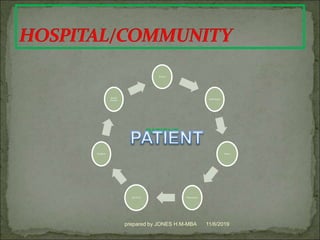
Doctor
Radiologist
Nurse
PharmacistLab Tech
Chaplain
Social
Worker
11/6/2019prepared by JONES H.M-MBA
PATIENT
Client /Patient and The Health Care Team
 The patient is the centre of all the activities in the
hospital and should be noted that this patient is an
individual and should be treated as such.
 There should be good communication with the
patient whether young or old.
 All patient’s fears related to the hospital, known or
unknown should be dispelled by a proper and kind
welcome.
11/6/2019prepared by JONES H.M-MBA
 The patient should be well oriented to his/her
knew environment to ensure quick settling and
reduce stress.
 At all times patient’s integrity should be
maintained as well as his/her respect to ensure full
co-orperation and gain his confidence.
 Being in the centre of the Health Care Team, the
patient experiences confusion and the nurse being
the person in constant contact, should reassure the
patient and ensure patient gets comprehensive
care.
11/6/2019prepared by JONES H.M-MBA
Ventilation
 A well ventilated room should contain a comfortable
amount of moisture.
 The environment should be free from odors and
tolerable temperatures.
 Adequate ventilation is important when there is more
than one person in the room.
11/6/2019prepared by JONES H.M-MBA
IMPORITANCE OF VENTILATION
 Foul air is replaced by fresh pure air.
 Moisture laden air is replaced by air containing less
moisture.
 Movement of air on the skin stimulates nerve endings.
11/6/2019prepared by JONES H.M-MBA
METHODS OF PROVIDING VENTILATION
 Natural ventilation from wind or breeze through doors
and windows.
 Artificial ventilation from air conditioners and fans.
 Good ventilation reduces air borne contaminants by
regulating air movements.
11/6/2019prepared by JONES H.M-MBA
LIGHTING
 Adequate lighting reduces physical hazards by illuminating areas in
which the client moves and works. It is necessary for growth,
development and production of vitamin D and healing of wounds.
TYPES OF LIGHTING
 Natural lighting from the sun through doors, windows and glass roofs.
 Artificial lighting from electric lights and heaters.
 Adequate lighting is essential for preservation of sight, safety and
accurate assessment and care should be taken to avoid glare sharpie
contrast and clinkering lights.
 NAKED LIGHTS ARE DANGEROUS IN THE PRESENCE OF
OXYGEN.
11/6/2019prepared by JONES H.M-MBA
ELIMINATION OF NOISE
 Noise is a public nuisance and a pt. seems to be more
aware of noise.
 Toleration of noise varies among individuals.
CAUSES OF NOISE IN THE HOSPITAL
 The health staff and visitors- this is through talking, noisy
shoes when walking and slimming doors.
 Equipments used in hospitals such as trolleys, respiratory
machines, telephones, Television sets etc.
 Pt's can also be a source of noise through coughing,
groaning, admissions and emergency treatment of pt.'s.
11/6/2019prepared by JONES H.M-MBA
EFFECTS OF NOISE
 Noise is detrimental to health and it interferes with
the following;
 Rest and sleep
 It provokes nervous tensions
 It hinders concentration and is irritating.
11/6/2019prepared by JONES H.M-MBA
PREVETION OF NOISE
 Cleaning and oiling of trolley wheels and wheel
chairs.
 Repair of running taps.
 Keeping telephones in offices and not in corridors.
 Keep television sound as low as possible.
 Visitors to talk and walk quietly.
 Hospital staff should work quietly, wear soled
shoes and avoid approaching pt.'s quietly
especially at night. 11/6/2019prepared by JONES H.M-MBA
MAINTENANCE OF ROOM TEMPERATURES
 In an ideal temperature, a person does not feel chilly
or sweating.
 Heating requirements vary from person to person, and
this depends on the times of the year, the condition of
the pt. and the amount of ventilation.
 An average temperature of about 18'c – 25'c is
advisable.
11/6/2019prepared by JONES H.M-MBA
METHODS OF HEATING IN HOSPITAL
 The sun provides natural heat.
 Convector heaters or air/ wall heaters.
 Central heating system.
11/6/2019prepared by JONES H.M-MBA
ROLES OF A NURSE IN PROVIDING ADEQUATE
HEAT
 Check and report for any electrical faults.
 Observe rules for preventing fires.
 For economy always switch off lights when not
required.
 In climates where temperatures are high and
humid, sun blinds and funs are essential.
 Polanski glass can be used to avoid direct strong
sunlight.
11/6/2019prepared by JONES H.M-MBA
 ODOURS
 These are smells which are not pleasant to an
individual.
 Disagreeable odors sometimes cause nausea and
vomiting.
 The odors may come from the environment or
equipment used in hospitals like bed pans.
 To prevent these odors, identify the source and
remove it.
 Also proper ventilation is required.
11/6/2019prepared by JONES H.M-MBA
SAFETY MEASURES
 Providing a safe environment involves the pt. visitors
and health care providers.
A. MECHANICAL INJURY
 The most common types of mechanical injuries are
falls from beds, wheel chairs, stretchers if no much
protection, falls on slippery floors wheel walking or
tangled cords.
11/6/2019prepared by JONES H.M-MBA
PREVENTION
 Lower beds when not in the pt.'s room.
 Tell pt.'s who are weak to seek help when getting out of bed.
 Avoid debris on the floors and wipe split water or any liquids on the
floors. Floor covers or mates should be fixed firmly.
 Put signs for slippery areas.
 Put all pt.'s articles within reach.
 Lock wheel chairs and stretchers, they should also be in a good
condition.
 Have periodic checks of equipment to ensure safety.
 Keep bed side rails up for confused, unconscious, elderly and surgical
pt.'s.
11/6/2019prepared by JONES H.M-MBA
B. THERMAL INJURY
 It may be caused by fires or burns. Fire may occur when a pt. is smoking in bed
or near the oxygen apparatus.
 Burns may occur from application of the heat eg. hot water bottles, giving hot
drinks especially to the elderly and the young, and hot baths.
PREVENTION
 Obey the signs for NO SMOKING anywhere on the ward. These signs should
be put where there is an oxygen source.
 Proper use of hot water bottles or hot compresses.
 Check all electrical equipment routinely.
 4. Evacuation of pt.'s during a fire by following hospital policy and also being
familiar on the use of fire extinguishers.
11/6/2019prepared by JONES H.M-MBA
C. CHEMICAL INJURY
 It may be caused by use of too much or strong chemicals on the skin.
This may be due to wrong or poor dilution of chemicals used for
disinfection or treating wounds.
PREVENTION
 Keep all medicines locked up.
 All drug bottles should be labeled; therefore you have to keep topical
and oral drugs separately.
 Calculate dosage of drugs before administration as well as disinfectants
before use.
 Keep poisons separately from medicines.
11/6/2019prepared by JONES H.M-MBA
E. BACTERIOLOGICAL INJURY
 It is caused by disease causing micro-organisms.
Micro-organisms cause all diseases that can be
spread from person to person and also all
infections.
 [The hospital infection is caused by
staphylococcus, which is normally found on the
skin and mucus membranes. It may be transmitted
by body contact or discharge].
 Organisms are spread more by hands than any
other method. 11/6/2019prepared by JONES H.M-MBA
OTHER RARE INJURES
 ELECTRICAL INJURY
 These results in burns form electric current e.g. by
defective wiring or defective equipment. Touching
electrical equipment with wet hands may produce a burn
or a shock.
 PREVENTION
 Do not overload sockets.
 Report all defective wiring and never use equipment
without plagues.
 Switch off electricity when dusting with a dump cloth or
changing bulbs. 11/6/2019prepared by JONES H.M-MBA
RADIATION INJURY
 This occurs from over exposure to rays of x-rays or
radium.
PREVENTION
 By having trained operators in-change of the machines
or dives used for administering these x-rays.
11/6/2019prepared by JONES H.M-MBA
INJURY FROM ALLERGIES
 This may result from insect bites or from materials
in the environment such as feathers, mattresses,
food, cosmetics, powder, soap etc. Allergies
manifests by skin reactions such as rash,
 Sneezing, irritation of mucus membranes,
coughing, watery eyes or difficulties in breathing.
 PREVENTION
 Cover all pillows and mattresses with plastics.
 Dump dust all surfaces daily.
11/6/2019prepared by JONES H.M-MBA
INFECTION PREVENTION AND CONTROL
DEFINITION
 This is a series of activities done to control or limit the transfer of
micro-organisms from one point to another or from person to person.
 MODES OF SPREAD AND CONTROL
 Direct contact- between infected person or susceptible host e.g.
turning clients giving baths, sex with infected person.
 Indirect contact- personal contact of susceptible host with
contaminated inanimate objects e.g. Needles, bed pans, urinals,
instruments, dressings, linen, dishes etc.
 Droplet contact in the eyes, nose, and mouth etc, dust contains
infectious agents.
11/6/2019prepared by JONES H.M-MBA
PRINCIPLES OF INFECTION CONTROL
 Consider every person infectious [client and staff inclusive] (MoH,
2009).
 HAND WASHING- This is the most practical procedure for preventing
cross contamination from person to person. Hand wash before and
after contact with every client even if gloves are worn.
 WEAR GLOVES before touching anything wet eg. broken skin, mucous
membranes, blood fluids, secretions or excretions or soiled
instruments and other items.
 USE BARRIERS- These include personal protective equipment like
protective goggles, face masks and aprons if splashes or spills of any
blood, body fluids, secretions or excretion are anticipated.
11/6/2019prepared by JONES H.M-MBA
 USE SAFE WORK PRACTICES such as not recapping or bending
needles, safely passing sharp instruments and disposing of sharps in
puncture proof containers.
 PROCESS INSTUMENTS and other items that come in contact with
blood, body fluids, etc by decontamination, cleaning, and sterilizing or
high level disinfection, following recommended I.P. PRACTICES.
 -DOCTAMINATION of all instruments and surfaces that have been in
contact with body fluids or mucus membranes for 10minutes in 0.5%
chlorine solution.
 DISPOSE contaminated instruments and contaminated waste
thoroughly and properly, i.e safe and proper waste management.
 ISOLATION- Isolate pt.'s only if secretions or excretions (urine or
feces) can not be contained. follow proper isolation precautions for
highly infectious cases.
11/6/2019prepared by JONES H.M-MBA
 PROPER HANDING OF SHARPS especially needles and
syringes to protect health workers, cleaners and the
community.
 *Thorough washing and rinsing of instruments and items
or surfaces to remove any caked blood or residual tissue
before sterilization or high-level disinfection.
 -CORRECT STERILIZATION or when STERILIZATION is
not possible, proper HIGH LEVEL DISINFECTION is done.
 -Proper storage and handing of processed instruments.
 10. Appropriate management of traffic flow and activity
patterns.
11/6/2019prepared by JONES H.M-MBA
 INFECTION- This is the invasion and
multiplication of micro-organisms in body tissues
capable of producing disease.
 TYPES OF INFECTIONS
 Air borne infections are by inhalation of
organisms suspended in air.
 Cross infection is transmitted between pt.'s
infected with different pathogenic micro-
organisms.
 Hospital acquired infections (Nosocomial)- These
are acquired during hospitalization.11/6/2019prepared by JONES H.M-MBA
 ISOLATION- This is the separation of a person with
an infectious disease from those who are non-
infectious.
 Isolation period (quarantine) is the length of time
during which a pt. with an infectious disease is
considered capable of infecting others by contact.
11/6/2019prepared by JONES H.M-MBA
TYPES OF GLOVES
1. CLEAN/DISPOSABLE/EXAMINATION GLOVES
 This type of gloves is used when performing medical examinations or when
carrying out clean procedures like dump dusting, bed making etc.
2. STERILE GLOVES
 These are used when performing sterile procedures like surgical operations,
Lumber puncture, wound dressing etc.
3. HEAVY DUTY OR UTILITY GLOVES
 These are also used for clean procedures like cleaning instruments, dump
dusting mopping etc. If utility gloves are not available for mopping, double
gloving of clean gloves protects the user.
 Before removing gloves, immerse hands briefly in 0.5% chlorine or other locally
available and approved disinfectants.
 If gloves are to be discarded, remove and dispose in an appropriate
contaminated waste container.
11/6/2019prepared by JONES H.M-MBA
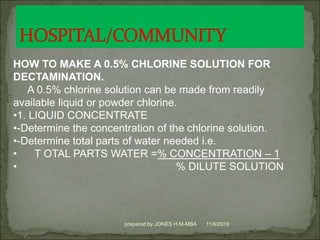
HOW TO MAKE A 0.5% CHLORINE SOLUTION FOR
DECTAMINATION.
A 0.5% chlorine solution can be made from readily
available liquid or powder chlorine.
•1. LIQUID CONCENTRATE
•-Determine the concentration of the chlorine solution.
•-Determine total parts of water needed i.e.
• T OTAL PARTS WATER =% CONCENTRATION – 1
• % DILUTE SOLUTION
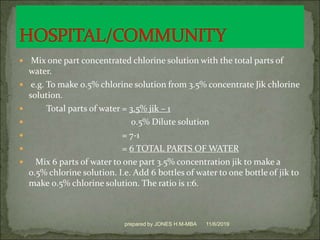
 Mix one part concentrated chlorine solution with the total parts of
water.
 e.g. To make 0.5% chlorine solution from 3.5% concentrate Jik chlorine
solution.
 Total parts of water = 3.5% jik – 1
 0.5% Dilute solution
 = 7-1
 = 6 TOTAL PARTS OF WATER
 Mix 6 parts of water to one part 3.5% concentration jik to make a
0.5% chlorine solution. I.e. Add 6 bottles of water to one bottle of jik to
make 0.5% chlorine solution. The ratio is 1:6.
11/6/2019prepared by JONES H.M-MBA
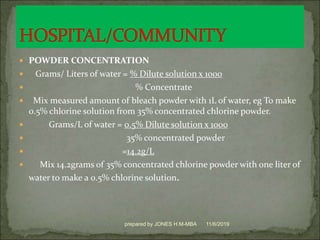
 POWDER CONCENTRATION
 Grams/ Liters of water = % Dilute solution x 1000
 % Concentrate
 Mix measured amount of bleach powder with 1L of water, eg To make
0.5% chlorine solution from 35% concentrated chlorine powder.
 Grams/L of water = 0.5% Dilute solution x 1000
 35% concentrated powder
 =14.2g/L
 Mix 14.2grams of 35% concentrated chlorine powder with one liter of
water to make a 0.5% chlorine solution.
11/6/2019prepared by JONES H.M-MBA
SAFE DISPOSAL OF WASTE
 Waste must be properly handled before it is taken
for incineration, burial or other disposal, to protect
the client, staff, and the community. Waste from
health care facilities may be non contaminated or
contaminated.
A. UNCONTAMINATED WASTE
 It poses no infectious risks to people who handle
them eg. paper, boxes, bottles, plastic containers.
11/6/2019prepared by JONES H.M-MBA
B. CONTAMINATED WASTE
 These are infectious or toxic if not disposed off properly eg. blood, body
fluids, secretions and excretions and items that have come in contact
with them, such as sharps and used dressings, as well as other
chemicals that may be toxic.
 Contaminated and uncontaminated waste should be separated at
original site to reduce the volume of contaminated waste and minimize
the cost to the institution for more expensive procedures required to
manage and dispose off contaminated wastes properly.
 Use separate containers for contaminated and non-contaminated
wastes. Never sort through contaminated wastes, i.e. do not try to
separate uncontaminated from contaminated wastes after they have
been combined.
11/6/2019prepared by JONES H.M-MBA
 Dispose off contaminated wastes separately from uncontaminated
wastes because contaminated wastes need special handling.
 Contaminated wastes should be disposed off immediately after a
procedure.
 There should be a sufficient number of waste containers in convenient
locations, to minimize carrying contaminated wastes from place to
place.
 Waste containers should be washed with 0.5% chlorine solution and
rinsed with water between each use.
 Anyone handling waste containers should wear heavy duty gloves and
appropriate personal protective clothing to prevent contamination.
11/6/2019prepared by JONES H.M-MBA
DISPOSAL OF WASTES
 proper disposal of contaminated waste minimizes the spread of
infection to health personal and to local community. The waste should
be buried or incinerated (burnt).The disposal sites should be fenced
with a gate and lock to prevent scavenging by both animals and people.
This is so because contaminated waste sites:
 Pose infection risks and fire hazards.
 Produce foul odors
 Attracts insects
 Are unsightly
 - Heavy duty gloves should be decontaminated and cleaned between
uses, and wash hands after handling contaminated wastes always.
11/6/2019prepared by JONES H.M-MBA
SHARPS DISPOSAL
 The principle for sharps disposal is to prevent potential injury and
transmission of disease through injury with a contaminated sharp
object.
 Sharps should always be disposed off in a puncture-resistant container.
 Sharps should be disposed off directly without manipulation eg. do not
recap, disconnect or bend needles. Only use one hand if there is need
to recap to avoid needle prick.
 Sharps containers should be readily available and conveniently located
so that workers do not have to carry sharp items any distance before
disposal.
 Do not over-fill the sharps containers to prevent needle stick injuries,
they should only be three quarters full.
11/6/2019prepared by JONES H.M-MBA
CARE OF WARD AND EQIUPMENT
 SWEEPING should be done whenever necessary, but it
should not disturb the ward routine. Then maids should
report early before the day staff come in so that they do
thoroughly sweeping and mopping of the floors. This
should be repeated after bed making if possible. The
cleaning should also be done before lunch and after lunch,
finally after visiting hour. This continues in the night.
 DUSTING of the lockers, beds, cardiac tables, chairs and all
surfaces is normally done using a dump cloth. It is done by
nurses, students and ward attendants after bed making
daily.
11/6/2019prepared by JONES H.M-MBA
CLEANING AND MAINTENANCE OF EQUIPMENT
 Cleaning and maintenance of ward equipment after use or
when a pt. is discharged or dies is the duty of all care givers.
This reduces micro-organisms and prevents cross infection.
The nursing staff should closely supervise the cleaning and
know the times when it is done in order to plan for other
procedures especially sterile procedures.
 The TUB AND TOILET for pt. should be cleaned
thoroughly with an antiseptic. Cleaning materials should
be available for use to clean the tub after each pt. baths.
The toilets should be cleaned whenever they are dirty. The
toilet brush should be kept in the toilet room.
11/6/2019prepared by JONES H.M-MBA
 The SLUICE is area or a room where dirty linen, bed
pans and urinals are kept.
 This room should be lockable for security purposes.
 Urinals and bed pans are disinfected daily by soaking
them in a disinfectant before cleaning them. The same
applies to sputum mugs.
11/6/2019prepared by JONES H.M-MBA
CARE OF LINEN
 All dirty linen should be packed into laundry bags ready for
transportation to the laundry department. However, soiled
linen should be rinsed or sluiced before sending it to
laundry. Linen used on an infectious pt. should be
disinfected before sending it to laundry.
 Before linen is taken to laundry, it should be counted and
recorded on a laundry form or in the book for
accountability. All hospital linen should be labeled to
ensure that its not sent to a different ward or department
after being washed.
11/6/2019prepared by JONES H.M-MBA
 Supply of clean linen is supposed to be on a daily basis.
This will also depend on how often linen is sent to
laundry from a particular ward. Linen should be
packed according to types e.g. Blankets, bed sheets,
pillowslips etc. The shelves to be tided daily before and
after bed making. The linen room should be locked at
all times for security of linen. Mattresses and pillows
should be covered with plastics for easy washing and
drying after each pt.
11/6/2019prepared by JONES H.M-MBA
Sweeping, Dusting, Mopping
 Sweeping of the ward should be done whenever
necessary but not to disturb the ward routine.
 The maids should be coming early like 06-07 hours
before the day staff come in.
 They should sweep thoroughly and mop the floors.
 The again it can be done after bed making then
after lunch and visiting hours.
11/6/2019prepared by JONES H.M-MBA
Cleaning and Maintenance of Equipment
 Cleaning and maintenance of all the ward equipment
after use or when a patient is discharged is the duty of
every care giver.
 The nursing staff should closely supervise this
cleaning and know the time it should be done in order
to plan for other procedures.
11/6/2019prepared by JONES H.M-MBA
 The patients’ taps and toilets should be thoroughly
cleaned with antiseptics and enough cleaning material
should be made available.
 Broken equipment should be taken the workshop for
repair.
11/6/2019prepared by JONES H.M-MBA
Care of Linen
 Torn linen should be taken to laundry.
 Very old torn dirty linen should be disposed off
according to hospital policy for disposing items.
 All dirty linen should be put in bags and taken to
laundry for washing.
 Soiled linen should be sluiced in the ward and taken to
laundry for washing.
11/6/2019prepared by JONES H.M-MBA
 Pillow slips should be removed and pillows left for
airing in direct sunlight whenever the patient is
discharged.
 Pillows covered with plastics should be washed with
soap and water and dried up before use.
11/6/2019prepared by JONES H.M-MBA
Rational use of material and supplies
 Hospital economy is the concern of every member of
staff in the hospital.
 So unnecessary expenditure of time, energy, resources
should be avoided.
 This can be done through proper planning, assembling
of necessary equipment you need for certain
procedures.
11/6/2019prepared by JONES H.M-MBA
 Avoid unnecessary movements, working in
partnership, maintaining a correct posture, avoiding
wasting of substances, use of material only for the
purpose of which they are meant for.
 Therefore you have to be economical ie use everything
in the hospital sparingly.
11/6/2019prepared by JONES H.M-MBA
Definition
 Term used to describe physical coordination of all
parts of the body to ensure correct posture and
balanced effective movement.
11/6/2019prepared by JONES H.M-MBA
Principles of Body Mechanics
 A wide base of support provides greater stability
(placing your feet slightly apart in the direction of
movement).
 Large muscles do not become fatigued as quickly as
small muscles, therefore the knees should be flexed
when lifting heavy objects.
11/6/2019prepared by JONES H.M-MBA
 Less effort when a heavy weight is held close to the
body.
 Prolonged use of any group of muscles result in
fatigue.
 Disuse of muscles and inactivity cause muscle wasting.
11/6/2019prepared by JONES H.M-MBA
Posture
 Good posture is achieved when all parts of the body
are in correct alignment.
 This assist to reduce strain on muscles and joints.
 In addition internal organs are able to function
without interference.
 It will improve your energy as well.
11/6/2019prepared by JONES H.M-MBA
Good posture is achieved:
 When standing holding the body erect with the
shoulders backward, then tightening the muscles of
the abdomen and buttocks to maintain a normal
spinal curve maintained and shoulders backwards.
 The place your feet side by side on the floor.
11/6/2019prepared by JONES H.M-MBA
Movement
 Can be active or passive.
 This is achieved by muscle contractions, relaxation
and flexion of joints or rotation.
Lifting and moving patients
 When necessary for nurses to move patients there are
several techniques which may be used.
11/6/2019prepared by JONES H.M-MBA
 To explain the procedure to the patient and you have to
ask for necessary help and identify the type of method
you are going to use.
 There are a number of methods that are used.
11/6/2019prepared by JONES H.M-MBA
Shoulder lift
 This requires two nurses.
 Indications
 When you need to put patient on bed pan.
 When transferring patient from a bed to a chair.
11/6/2019prepared by JONES H.M-MBA
Cradle /Orthodox
 Almost similar to shoulder lift.
 Two nurses are needed.
 Indications
 Mostly used where one can not use shoulder lift.
Mechanicals
 When machines are used to lift patients from one place to the
other, privacy should be maintained.
11/6/2019prepared by JONES H.M-MBA
Assisting a patient to walk
 Patient may need help when walking for a number of
reasons:
 Due to long illness
 Due to partial disability e.g having stroke
 Early ambulation to prevent complications
11/6/2019prepared by JONES H.M-MBA
 Always remember that a nurse should stand close to
the patient and give support in such a way that she is
able to give patients full weight.
 Support should be provided on the unaffected side.
 Then a broad base of support increases stability, so
the nurse should move in unison with the patient’s
steps.
11/6/2019prepared by JONES H.M-MBA
 Ensure that a patient is in a well fitting shoe and
let patient proceed at their own pace.
Positions Used in Nursing
 Patients confined to bed should be nursed in a
position most comfortable, unless therapeutically
advisable for the patient to be in a specified
position.
 Principles should be applied regardless of position
the patient is nursed in to prevent complications.
11/6/2019prepared by JONES H.M-MBA
How to prevent complications of prolonged bed
rest
 Good body alignment with all parts of the body as
close as possible to the normal anatomical position.
 Natural vertebral column should be maintained with
full support.
 Slight flexion of joints should be done to prevent
muscle straining.
11/6/2019prepared by JONES H.M-MBA
 Frequent change of position is essential to prevent
prolonged pressure on one area.
 All patients should be given some form of exercise
passively or actively, unless advised therapeutically.
 Always observe onset of complications like pressure
sore and chest infections.
11/6/2019prepared by JONES H.M-MBA
Complications of prolonged bed rest
 Prolonged confinement to bed can lead to
complications, mainly due to reduced physical activity.
 These complications include:
 Constipation and urinary tract infections.
 Pressure sore formation to areas which are subject to
pressure.
11/6/2019prepared by JONES H.M-MBA
 Postural deformity due to contractures, loss of
muscle tone and abnormal position of a part of the
body.
 Deep vein thrombosis caused by slowing down of
venous return blood.
 Chest infections like hypostatic pneumonia due to
accumulation of secretions in the lungs.
 Pyschological problems like depression, anxiety
and worry.
11/6/2019prepared by JONES H.M-MBA
Positioning techniques
 Clients with impaired nervous, skeletal or muscular
system functioning and increased weakness,
frequently require assistance from the nurses to attain
proper body alignment.
 There are a number of supporting devices which a
nurse can use to maintain good body alignment.
11/6/2019prepared by JONES H.M-MBA
 These include:
 Pillows
 Sand bags – used to immolise certain parts of the body e.g
limbs
 Bed cradles – used to lift away linen from patients body.
 Backrest – for propping up patient.
 Foot board – used to prevent foot drop.
 Fracture board – prevents sagging of the bed
 Airings – used to prevent pressure sores.
11/6/2019prepared by JONES H.M-MBA
Positions used in nursing
Fowlers position
 Head of bed raised at an angle of 45*
 Patient’s head rested on a pillow and extra pillows used
to support hands and arms, if patient is unable to
support himself.
 Pillows can also be used under the thighs.
 Foot board placed at the bottom to support feet.
11/6/2019prepared by JONES H.M-MBA
Prone position
 Patient rolled over with elbows straight and hands
under hips.
 Abdomen placed in centre of bed with head
turned to one side supported by a small pillow.
Supine position
 Patient placed on his back with head of bed flat
(no pillow) pillow placed under shoulders and
small towel under the lumber area.
 Foot boards can be used if necessary.
11/6/2019prepared by JONES H.M-MBA
Trendelenburg position
 Entire bed tilted down with head of bed down.
 Used for postural drainage to encourage secretions to
drip.
 Can also be used in parenteral nutrition.
 A reverse of this position helps to promote emptying
of gastric contents.
11/6/2019prepared by JONES H.M-MBA
Dorsal position
 This is merely less like supine position, except patient
will be facing upwards and have one or two pillows and
legs in a flexed position.
 This position is mainly used for relaxation,
Gynaecological examination, vaginal douching
(washout) and catheterisation.
11/6/2019prepared by JONES H.M-MBA
Recumbent position
 Almost same as supine.
 Patient will be lying on her back with hands on the
pillow or on the abdomen
 Used for relaxation and on physical assessment.
11/6/2019prepared by JONES H.M-MBA
Semi-prone
 Also known as comatose or recovery position.
 Patient is put in half way prone position with head
well extended backward to ensure a clear airway.
 Used in unconscious patients and those recovering
from anaesthesia.
11/6/2019prepared by JONES H.M-MBA
Lithotomy position
 Patient lies on her back with thighs flexed and
abducted and feet resting in stirups.
 Used mainly in obstetrics and gynae.
Lateral position
 Patient lies on one side with major position of
body on the hip and shoulder.
 Pillow placed under patient’s head, both arms
placed in slightly flexed position.
11/6/2019prepared by JONES H.M-MBA
 Used in normal sleeping position, can also be used in
unconscious patients and for vaginal and rectal
examination.
Sim’s position
 Patient lies on the anterior ilium, humerus and
clavicle.
 Upper arm rested on bed at the level of shoulder, while
under arm is pushed behind.
11/6/2019prepared by JONES H.M-MBA
 Lower leg remains straight and upper leg is flexed to
prevent rolling.
 Pillow can also be put in between legs to prevent
friction.
 Used mainly in vaginal examination.
Orthopnoeic position
 Patient sits in upright position.
11/6/2019prepared by JONES H.M-MBA
Importance
 Rest and sleep are two essential factors in the
treatment of illness, therefore the patient’s bed is an
important equipment.
 Most patients spend ¾ of the day in bed while others
are confined to bed for 24 hours.
11/6/2019prepared by JONES H.M-MBA
Effect of unskilled bed making
 Loss of sleep
 Pain and discomfort
 Postural deformities
 Formation of pressure sores
11/6/2019prepared by JONES H.M-MBA
Principles
 All the equipment needed for the procedure should be
gathered.
 Bed making should not be carried out while other
procedures are being done nearby which involve the use of
sterile equipment.
 Two nurses should work together when an occupied bed is
made so that the patient makes less effort.
 There should be minimal handling of linen to lessen risk of
airbone crossinfection.
11/6/2019prepared by JONES H.M-MBA
 Bed clothes should not be shaken.
 Bed linen should not be allowed to touch the floor.
 Bed linen and pillows should be held away from the
nurse’s uniform.
 Patches in linen should be place where they cannot
cause discomfort and formation of pressure sores.
11/6/2019prepared by JONES H.M-MBA
 Used linen should be placed on the bed side chair or a
soiled linen container.
 When making an occupied bed, ensure that the
patient is covered at all time.
 Finished bed should be free from cresses or wrinkles.
 Linen taken to the bed side but not used should be
taken back to the laundry.
11/6/2019prepared by JONES H.M-MBA
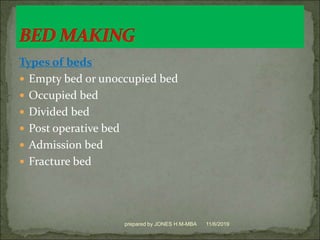
Types of beds
 Empty bed or unoccupied bed
 Occupied bed
 Divided bed
 Post operative bed
 Admission bed
 Fracture bed
11/6/2019prepared by JONES H.M-MBA
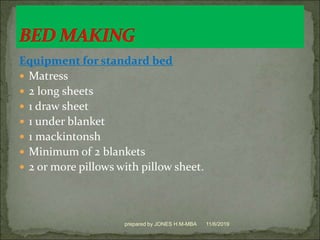
Equipment for standard bed
 Matress
 2 long sheets
 1 draw sheet
 1 under blanket
 1 mackintonsh
 Minimum of 2 blankets
 2 or more pillows with pillow sheet.
11/6/2019prepared by JONES H.M-MBA
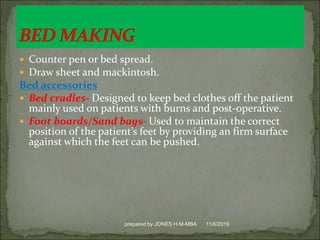
 Counter pen or bed spread.
 Draw sheet and mackintosh.
Bed accessories
 Bed cradles- Designed to keep bed clothes off the patient
mainly used on patients with burns and post-operative.
 Foot boards/Sand bags- Used to maintain the correct
position of the patient’s feet by providing an firm surface
against which the feet can be pushed.
11/6/2019prepared by JONES H.M-MBA
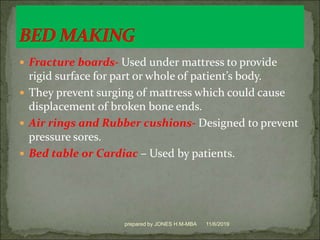
 Fracture boards- Used under mattress to provide
rigid surface for part or whole of patient’s body.
 They prevent surging of mattress which could cause
displacement of broken bone ends.
 Air rings and Rubber cushions- Designed to prevent
pressure sores.
 Bed table or Cardiac – Used by patients.
11/6/2019prepared by JONES H.M-MBA
 Bed elevators- Used to raise foot of bed; mainly used
by patients in shock.
 Trapele – It has a suspended chain and handle to aid
patients in lifting themselves; mainly used by patients
on traction.
11/6/2019prepared by JONES H.M-MBA
 Huband.S (2006), Nursing and Midwifery: A Practical
Approach, macmillan, Malaysia.
 Smith.S and Duell.D (1982),Nursing Skills and Evaluation,
National Nursing Review, Kingsport Press, Califonia:USA.
 Kozier.B and Oliven.R. (1991) Fundamentals of Nursing,
London: Churchill Livingstone.
 Linda.T etal (2003) Infection Prevention: Guidelines for
Health Care Facilities with Limited Resources, JHPIEGO,
USA.
 MoH (2009),Integrated Technical Guidelines For Frontline
Health Workers, Government Printers, Lusaka: Zambia.
11/6/2019prepared by JONES H.M-MBA

MAKING A SAFE ENVIRONMENT FOR A PATIENT

  • 1.
  • 2.
    Learning Objectives  Atthe end of the topic, students should be able to:  Discuss the client’s unit and the ward and environment for the clients.  Discuss the patient and the health care team.  Describe infection prevention and control.  Explain the rational use of medical supplies and materials.  Discuss body mechanics.  Discuss bed making 11/6/2019prepared by JONES H.M-MBA
  • 3.
    Clients’ Unit  Mostof the hospitals are made in such a way that the patient’s/client’s privacy and dignity is maintained through certain provisions such as cubicals, screens and side - wards.  The patient/client has a place of his/her own known as Patint’s/Client’s Unit.  This is a small section of the ward inhabited or used by the patient most of the time. 11/6/2019prepared by JONES H.M-MBA
  • 4.
     It hasa bed, beddings, a locker, cardiac table and a small cupboard or a ward robe.  This small unit is only a part of bigger unit known as Ward.  A safe and comfortable environment is important to the recovery of the patient and all efforts should be directed at maintaining such an environment. 11/6/2019prepared by JONES H.M-MBA
  • 5.
     The wardsshould be well lit, decorated and furnished in cheerful colours and flowers, unless indicated medically.  The floors should not be too slippery to avoid slipping and falling.  Dangerous objects like broken windows, chairs, tables etc should also be removed to avoid unnecessary accidents. 11/6/2019prepared by JONES H.M-MBA
  • 6.
     All furnitureand fittings should be in good condition and clean.  Provision of ward robes is important to prevent hanging of clothes on lockers.  The patient should be allowed have a reasonable number of personal items like photos, flowers, cards etc to make their unit attractive and to cheer them up. 11/6/2019prepared by JONES H.M-MBA
  • 7.
     The wardstaff should strive to maintain a harmonious atmosphere at all times as most of the people becomes sensitive to these things when they are sick.  Noise should be kept at low level.  All nursing and cleaning equipment should be removed from the immediately after use.  Those which are left in the ward should be clean and odourless and covered when not in use. 11/6/2019prepared by JONES H.M-MBA
  • 8.
     Use spraysand refreshners to kill nasty smells.  The curtains should be drawn around the bed whenever attending to a patient, not only for privacy but also to protect other patients from distressing sight.  Ventilation should be good without droughts, chilling with a comfortable temperature and good lighting. 11/6/2019prepared by JONES H.M-MBA
  • 9.
  • 10.
    Client /Patient andThe Health Care Team  The patient is the centre of all the activities in the hospital and should be noted that this patient is an individual and should be treated as such.  There should be good communication with the patient whether young or old.  All patient’s fears related to the hospital, known or unknown should be dispelled by a proper and kind welcome. 11/6/2019prepared by JONES H.M-MBA
  • 11.
     The patientshould be well oriented to his/her knew environment to ensure quick settling and reduce stress.  At all times patient’s integrity should be maintained as well as his/her respect to ensure full co-orperation and gain his confidence.  Being in the centre of the Health Care Team, the patient experiences confusion and the nurse being the person in constant contact, should reassure the patient and ensure patient gets comprehensive care. 11/6/2019prepared by JONES H.M-MBA
  • 12.
    Ventilation  A wellventilated room should contain a comfortable amount of moisture.  The environment should be free from odors and tolerable temperatures.  Adequate ventilation is important when there is more than one person in the room. 11/6/2019prepared by JONES H.M-MBA
  • 13.
    IMPORITANCE OF VENTILATION Foul air is replaced by fresh pure air.  Moisture laden air is replaced by air containing less moisture.  Movement of air on the skin stimulates nerve endings. 11/6/2019prepared by JONES H.M-MBA
  • 14.
    METHODS OF PROVIDINGVENTILATION  Natural ventilation from wind or breeze through doors and windows.  Artificial ventilation from air conditioners and fans.  Good ventilation reduces air borne contaminants by regulating air movements. 11/6/2019prepared by JONES H.M-MBA
  • 15.
    LIGHTING  Adequate lightingreduces physical hazards by illuminating areas in which the client moves and works. It is necessary for growth, development and production of vitamin D and healing of wounds. TYPES OF LIGHTING  Natural lighting from the sun through doors, windows and glass roofs.  Artificial lighting from electric lights and heaters.  Adequate lighting is essential for preservation of sight, safety and accurate assessment and care should be taken to avoid glare sharpie contrast and clinkering lights.  NAKED LIGHTS ARE DANGEROUS IN THE PRESENCE OF OXYGEN. 11/6/2019prepared by JONES H.M-MBA
  • 16.
    ELIMINATION OF NOISE Noise is a public nuisance and a pt. seems to be more aware of noise.  Toleration of noise varies among individuals. CAUSES OF NOISE IN THE HOSPITAL  The health staff and visitors- this is through talking, noisy shoes when walking and slimming doors.  Equipments used in hospitals such as trolleys, respiratory machines, telephones, Television sets etc.  Pt's can also be a source of noise through coughing, groaning, admissions and emergency treatment of pt.'s. 11/6/2019prepared by JONES H.M-MBA
  • 17.
    EFFECTS OF NOISE Noise is detrimental to health and it interferes with the following;  Rest and sleep  It provokes nervous tensions  It hinders concentration and is irritating. 11/6/2019prepared by JONES H.M-MBA
  • 18.
    PREVETION OF NOISE Cleaning and oiling of trolley wheels and wheel chairs.  Repair of running taps.  Keeping telephones in offices and not in corridors.  Keep television sound as low as possible.  Visitors to talk and walk quietly.  Hospital staff should work quietly, wear soled shoes and avoid approaching pt.'s quietly especially at night. 11/6/2019prepared by JONES H.M-MBA
  • 19.
    MAINTENANCE OF ROOMTEMPERATURES  In an ideal temperature, a person does not feel chilly or sweating.  Heating requirements vary from person to person, and this depends on the times of the year, the condition of the pt. and the amount of ventilation.  An average temperature of about 18'c – 25'c is advisable. 11/6/2019prepared by JONES H.M-MBA
  • 20.
    METHODS OF HEATINGIN HOSPITAL  The sun provides natural heat.  Convector heaters or air/ wall heaters.  Central heating system. 11/6/2019prepared by JONES H.M-MBA
  • 21.
    ROLES OF ANURSE IN PROVIDING ADEQUATE HEAT  Check and report for any electrical faults.  Observe rules for preventing fires.  For economy always switch off lights when not required.  In climates where temperatures are high and humid, sun blinds and funs are essential.  Polanski glass can be used to avoid direct strong sunlight. 11/6/2019prepared by JONES H.M-MBA
  • 22.
     ODOURS  Theseare smells which are not pleasant to an individual.  Disagreeable odors sometimes cause nausea and vomiting.  The odors may come from the environment or equipment used in hospitals like bed pans.  To prevent these odors, identify the source and remove it.  Also proper ventilation is required. 11/6/2019prepared by JONES H.M-MBA
  • 23.
    SAFETY MEASURES  Providinga safe environment involves the pt. visitors and health care providers. A. MECHANICAL INJURY  The most common types of mechanical injuries are falls from beds, wheel chairs, stretchers if no much protection, falls on slippery floors wheel walking or tangled cords. 11/6/2019prepared by JONES H.M-MBA
  • 24.
    PREVENTION  Lower bedswhen not in the pt.'s room.  Tell pt.'s who are weak to seek help when getting out of bed.  Avoid debris on the floors and wipe split water or any liquids on the floors. Floor covers or mates should be fixed firmly.  Put signs for slippery areas.  Put all pt.'s articles within reach.  Lock wheel chairs and stretchers, they should also be in a good condition.  Have periodic checks of equipment to ensure safety.  Keep bed side rails up for confused, unconscious, elderly and surgical pt.'s. 11/6/2019prepared by JONES H.M-MBA
  • 25.
    B. THERMAL INJURY It may be caused by fires or burns. Fire may occur when a pt. is smoking in bed or near the oxygen apparatus.  Burns may occur from application of the heat eg. hot water bottles, giving hot drinks especially to the elderly and the young, and hot baths. PREVENTION  Obey the signs for NO SMOKING anywhere on the ward. These signs should be put where there is an oxygen source.  Proper use of hot water bottles or hot compresses.  Check all electrical equipment routinely.  4. Evacuation of pt.'s during a fire by following hospital policy and also being familiar on the use of fire extinguishers. 11/6/2019prepared by JONES H.M-MBA
  • 26.
    C. CHEMICAL INJURY It may be caused by use of too much or strong chemicals on the skin. This may be due to wrong or poor dilution of chemicals used for disinfection or treating wounds. PREVENTION  Keep all medicines locked up.  All drug bottles should be labeled; therefore you have to keep topical and oral drugs separately.  Calculate dosage of drugs before administration as well as disinfectants before use.  Keep poisons separately from medicines. 11/6/2019prepared by JONES H.M-MBA
  • 27.
    E. BACTERIOLOGICAL INJURY It is caused by disease causing micro-organisms. Micro-organisms cause all diseases that can be spread from person to person and also all infections.  [The hospital infection is caused by staphylococcus, which is normally found on the skin and mucus membranes. It may be transmitted by body contact or discharge].  Organisms are spread more by hands than any other method. 11/6/2019prepared by JONES H.M-MBA
  • 28.
    OTHER RARE INJURES ELECTRICAL INJURY  These results in burns form electric current e.g. by defective wiring or defective equipment. Touching electrical equipment with wet hands may produce a burn or a shock.  PREVENTION  Do not overload sockets.  Report all defective wiring and never use equipment without plagues.  Switch off electricity when dusting with a dump cloth or changing bulbs. 11/6/2019prepared by JONES H.M-MBA
  • 29.
    RADIATION INJURY  Thisoccurs from over exposure to rays of x-rays or radium. PREVENTION  By having trained operators in-change of the machines or dives used for administering these x-rays. 11/6/2019prepared by JONES H.M-MBA
  • 30.
    INJURY FROM ALLERGIES This may result from insect bites or from materials in the environment such as feathers, mattresses, food, cosmetics, powder, soap etc. Allergies manifests by skin reactions such as rash,  Sneezing, irritation of mucus membranes, coughing, watery eyes or difficulties in breathing.  PREVENTION  Cover all pillows and mattresses with plastics.  Dump dust all surfaces daily. 11/6/2019prepared by JONES H.M-MBA
  • 31.
    INFECTION PREVENTION ANDCONTROL DEFINITION  This is a series of activities done to control or limit the transfer of micro-organisms from one point to another or from person to person.  MODES OF SPREAD AND CONTROL  Direct contact- between infected person or susceptible host e.g. turning clients giving baths, sex with infected person.  Indirect contact- personal contact of susceptible host with contaminated inanimate objects e.g. Needles, bed pans, urinals, instruments, dressings, linen, dishes etc.  Droplet contact in the eyes, nose, and mouth etc, dust contains infectious agents. 11/6/2019prepared by JONES H.M-MBA
  • 32.
    PRINCIPLES OF INFECTIONCONTROL  Consider every person infectious [client and staff inclusive] (MoH, 2009).  HAND WASHING- This is the most practical procedure for preventing cross contamination from person to person. Hand wash before and after contact with every client even if gloves are worn.  WEAR GLOVES before touching anything wet eg. broken skin, mucous membranes, blood fluids, secretions or excretions or soiled instruments and other items.  USE BARRIERS- These include personal protective equipment like protective goggles, face masks and aprons if splashes or spills of any blood, body fluids, secretions or excretion are anticipated. 11/6/2019prepared by JONES H.M-MBA
  • 33.
     USE SAFEWORK PRACTICES such as not recapping or bending needles, safely passing sharp instruments and disposing of sharps in puncture proof containers.  PROCESS INSTUMENTS and other items that come in contact with blood, body fluids, etc by decontamination, cleaning, and sterilizing or high level disinfection, following recommended I.P. PRACTICES.  -DOCTAMINATION of all instruments and surfaces that have been in contact with body fluids or mucus membranes for 10minutes in 0.5% chlorine solution.  DISPOSE contaminated instruments and contaminated waste thoroughly and properly, i.e safe and proper waste management.  ISOLATION- Isolate pt.'s only if secretions or excretions (urine or feces) can not be contained. follow proper isolation precautions for highly infectious cases. 11/6/2019prepared by JONES H.M-MBA
  • 34.
     PROPER HANDINGOF SHARPS especially needles and syringes to protect health workers, cleaners and the community.  *Thorough washing and rinsing of instruments and items or surfaces to remove any caked blood or residual tissue before sterilization or high-level disinfection.  -CORRECT STERILIZATION or when STERILIZATION is not possible, proper HIGH LEVEL DISINFECTION is done.  -Proper storage and handing of processed instruments.  10. Appropriate management of traffic flow and activity patterns. 11/6/2019prepared by JONES H.M-MBA
  • 35.
     INFECTION- Thisis the invasion and multiplication of micro-organisms in body tissues capable of producing disease.  TYPES OF INFECTIONS  Air borne infections are by inhalation of organisms suspended in air.  Cross infection is transmitted between pt.'s infected with different pathogenic micro- organisms.  Hospital acquired infections (Nosocomial)- These are acquired during hospitalization.11/6/2019prepared by JONES H.M-MBA
  • 36.
     ISOLATION- Thisis the separation of a person with an infectious disease from those who are non- infectious.  Isolation period (quarantine) is the length of time during which a pt. with an infectious disease is considered capable of infecting others by contact. 11/6/2019prepared by JONES H.M-MBA
  • 37.
    TYPES OF GLOVES 1.CLEAN/DISPOSABLE/EXAMINATION GLOVES  This type of gloves is used when performing medical examinations or when carrying out clean procedures like dump dusting, bed making etc. 2. STERILE GLOVES  These are used when performing sterile procedures like surgical operations, Lumber puncture, wound dressing etc. 3. HEAVY DUTY OR UTILITY GLOVES  These are also used for clean procedures like cleaning instruments, dump dusting mopping etc. If utility gloves are not available for mopping, double gloving of clean gloves protects the user.  Before removing gloves, immerse hands briefly in 0.5% chlorine or other locally available and approved disinfectants.  If gloves are to be discarded, remove and dispose in an appropriate contaminated waste container. 11/6/2019prepared by JONES H.M-MBA
  • 38.
    11/6/2019prepared by JONESH.M-MBA HOW TO MAKE A 0.5% CHLORINE SOLUTION FOR DECTAMINATION. A 0.5% chlorine solution can be made from readily available liquid or powder chlorine. •1. LIQUID CONCENTRATE •-Determine the concentration of the chlorine solution. •-Determine total parts of water needed i.e. • T OTAL PARTS WATER =% CONCENTRATION – 1 • % DILUTE SOLUTION
  • 39.
     Mix onepart concentrated chlorine solution with the total parts of water.  e.g. To make 0.5% chlorine solution from 3.5% concentrate Jik chlorine solution.  Total parts of water = 3.5% jik – 1  0.5% Dilute solution  = 7-1  = 6 TOTAL PARTS OF WATER  Mix 6 parts of water to one part 3.5% concentration jik to make a 0.5% chlorine solution. I.e. Add 6 bottles of water to one bottle of jik to make 0.5% chlorine solution. The ratio is 1:6. 11/6/2019prepared by JONES H.M-MBA
  • 40.
     POWDER CONCENTRATION Grams/ Liters of water = % Dilute solution x 1000  % Concentrate  Mix measured amount of bleach powder with 1L of water, eg To make 0.5% chlorine solution from 35% concentrated chlorine powder.  Grams/L of water = 0.5% Dilute solution x 1000  35% concentrated powder  =14.2g/L  Mix 14.2grams of 35% concentrated chlorine powder with one liter of water to make a 0.5% chlorine solution. 11/6/2019prepared by JONES H.M-MBA
  • 41.
    SAFE DISPOSAL OFWASTE  Waste must be properly handled before it is taken for incineration, burial or other disposal, to protect the client, staff, and the community. Waste from health care facilities may be non contaminated or contaminated. A. UNCONTAMINATED WASTE  It poses no infectious risks to people who handle them eg. paper, boxes, bottles, plastic containers. 11/6/2019prepared by JONES H.M-MBA
  • 42.
    B. CONTAMINATED WASTE These are infectious or toxic if not disposed off properly eg. blood, body fluids, secretions and excretions and items that have come in contact with them, such as sharps and used dressings, as well as other chemicals that may be toxic.  Contaminated and uncontaminated waste should be separated at original site to reduce the volume of contaminated waste and minimize the cost to the institution for more expensive procedures required to manage and dispose off contaminated wastes properly.  Use separate containers for contaminated and non-contaminated wastes. Never sort through contaminated wastes, i.e. do not try to separate uncontaminated from contaminated wastes after they have been combined. 11/6/2019prepared by JONES H.M-MBA
  • 43.
     Dispose offcontaminated wastes separately from uncontaminated wastes because contaminated wastes need special handling.  Contaminated wastes should be disposed off immediately after a procedure.  There should be a sufficient number of waste containers in convenient locations, to minimize carrying contaminated wastes from place to place.  Waste containers should be washed with 0.5% chlorine solution and rinsed with water between each use.  Anyone handling waste containers should wear heavy duty gloves and appropriate personal protective clothing to prevent contamination. 11/6/2019prepared by JONES H.M-MBA
  • 44.
    DISPOSAL OF WASTES proper disposal of contaminated waste minimizes the spread of infection to health personal and to local community. The waste should be buried or incinerated (burnt).The disposal sites should be fenced with a gate and lock to prevent scavenging by both animals and people. This is so because contaminated waste sites:  Pose infection risks and fire hazards.  Produce foul odors  Attracts insects  Are unsightly  - Heavy duty gloves should be decontaminated and cleaned between uses, and wash hands after handling contaminated wastes always. 11/6/2019prepared by JONES H.M-MBA
  • 45.
    SHARPS DISPOSAL  Theprinciple for sharps disposal is to prevent potential injury and transmission of disease through injury with a contaminated sharp object.  Sharps should always be disposed off in a puncture-resistant container.  Sharps should be disposed off directly without manipulation eg. do not recap, disconnect or bend needles. Only use one hand if there is need to recap to avoid needle prick.  Sharps containers should be readily available and conveniently located so that workers do not have to carry sharp items any distance before disposal.  Do not over-fill the sharps containers to prevent needle stick injuries, they should only be three quarters full. 11/6/2019prepared by JONES H.M-MBA
  • 46.
    CARE OF WARDAND EQIUPMENT  SWEEPING should be done whenever necessary, but it should not disturb the ward routine. Then maids should report early before the day staff come in so that they do thoroughly sweeping and mopping of the floors. This should be repeated after bed making if possible. The cleaning should also be done before lunch and after lunch, finally after visiting hour. This continues in the night.  DUSTING of the lockers, beds, cardiac tables, chairs and all surfaces is normally done using a dump cloth. It is done by nurses, students and ward attendants after bed making daily. 11/6/2019prepared by JONES H.M-MBA
  • 47.
    CLEANING AND MAINTENANCEOF EQUIPMENT  Cleaning and maintenance of ward equipment after use or when a pt. is discharged or dies is the duty of all care givers. This reduces micro-organisms and prevents cross infection. The nursing staff should closely supervise the cleaning and know the times when it is done in order to plan for other procedures especially sterile procedures.  The TUB AND TOILET for pt. should be cleaned thoroughly with an antiseptic. Cleaning materials should be available for use to clean the tub after each pt. baths. The toilets should be cleaned whenever they are dirty. The toilet brush should be kept in the toilet room. 11/6/2019prepared by JONES H.M-MBA
  • 48.
     The SLUICEis area or a room where dirty linen, bed pans and urinals are kept.  This room should be lockable for security purposes.  Urinals and bed pans are disinfected daily by soaking them in a disinfectant before cleaning them. The same applies to sputum mugs. 11/6/2019prepared by JONES H.M-MBA
  • 49.
    CARE OF LINEN All dirty linen should be packed into laundry bags ready for transportation to the laundry department. However, soiled linen should be rinsed or sluiced before sending it to laundry. Linen used on an infectious pt. should be disinfected before sending it to laundry.  Before linen is taken to laundry, it should be counted and recorded on a laundry form or in the book for accountability. All hospital linen should be labeled to ensure that its not sent to a different ward or department after being washed. 11/6/2019prepared by JONES H.M-MBA
  • 50.
     Supply ofclean linen is supposed to be on a daily basis. This will also depend on how often linen is sent to laundry from a particular ward. Linen should be packed according to types e.g. Blankets, bed sheets, pillowslips etc. The shelves to be tided daily before and after bed making. The linen room should be locked at all times for security of linen. Mattresses and pillows should be covered with plastics for easy washing and drying after each pt. 11/6/2019prepared by JONES H.M-MBA
  • 51.
    Sweeping, Dusting, Mopping Sweeping of the ward should be done whenever necessary but not to disturb the ward routine.  The maids should be coming early like 06-07 hours before the day staff come in.  They should sweep thoroughly and mop the floors.  The again it can be done after bed making then after lunch and visiting hours. 11/6/2019prepared by JONES H.M-MBA
  • 52.
    Cleaning and Maintenanceof Equipment  Cleaning and maintenance of all the ward equipment after use or when a patient is discharged is the duty of every care giver.  The nursing staff should closely supervise this cleaning and know the time it should be done in order to plan for other procedures. 11/6/2019prepared by JONES H.M-MBA
  • 53.
     The patients’taps and toilets should be thoroughly cleaned with antiseptics and enough cleaning material should be made available.  Broken equipment should be taken the workshop for repair. 11/6/2019prepared by JONES H.M-MBA
  • 54.
    Care of Linen Torn linen should be taken to laundry.  Very old torn dirty linen should be disposed off according to hospital policy for disposing items.  All dirty linen should be put in bags and taken to laundry for washing.  Soiled linen should be sluiced in the ward and taken to laundry for washing. 11/6/2019prepared by JONES H.M-MBA
  • 55.
     Pillow slipsshould be removed and pillows left for airing in direct sunlight whenever the patient is discharged.  Pillows covered with plastics should be washed with soap and water and dried up before use. 11/6/2019prepared by JONES H.M-MBA
  • 56.
    Rational use ofmaterial and supplies  Hospital economy is the concern of every member of staff in the hospital.  So unnecessary expenditure of time, energy, resources should be avoided.  This can be done through proper planning, assembling of necessary equipment you need for certain procedures. 11/6/2019prepared by JONES H.M-MBA
  • 57.
     Avoid unnecessarymovements, working in partnership, maintaining a correct posture, avoiding wasting of substances, use of material only for the purpose of which they are meant for.  Therefore you have to be economical ie use everything in the hospital sparingly. 11/6/2019prepared by JONES H.M-MBA
  • 58.
    Definition  Term usedto describe physical coordination of all parts of the body to ensure correct posture and balanced effective movement. 11/6/2019prepared by JONES H.M-MBA
  • 59.
    Principles of BodyMechanics  A wide base of support provides greater stability (placing your feet slightly apart in the direction of movement).  Large muscles do not become fatigued as quickly as small muscles, therefore the knees should be flexed when lifting heavy objects. 11/6/2019prepared by JONES H.M-MBA
  • 60.
     Less effortwhen a heavy weight is held close to the body.  Prolonged use of any group of muscles result in fatigue.  Disuse of muscles and inactivity cause muscle wasting. 11/6/2019prepared by JONES H.M-MBA
  • 61.
    Posture  Good postureis achieved when all parts of the body are in correct alignment.  This assist to reduce strain on muscles and joints.  In addition internal organs are able to function without interference.  It will improve your energy as well. 11/6/2019prepared by JONES H.M-MBA
  • 62.
    Good posture isachieved:  When standing holding the body erect with the shoulders backward, then tightening the muscles of the abdomen and buttocks to maintain a normal spinal curve maintained and shoulders backwards.  The place your feet side by side on the floor. 11/6/2019prepared by JONES H.M-MBA
  • 63.
    Movement  Can beactive or passive.  This is achieved by muscle contractions, relaxation and flexion of joints or rotation. Lifting and moving patients  When necessary for nurses to move patients there are several techniques which may be used. 11/6/2019prepared by JONES H.M-MBA
  • 64.
     To explainthe procedure to the patient and you have to ask for necessary help and identify the type of method you are going to use.  There are a number of methods that are used. 11/6/2019prepared by JONES H.M-MBA
  • 65.
    Shoulder lift  Thisrequires two nurses.  Indications  When you need to put patient on bed pan.  When transferring patient from a bed to a chair. 11/6/2019prepared by JONES H.M-MBA
  • 66.
    Cradle /Orthodox  Almostsimilar to shoulder lift.  Two nurses are needed.  Indications  Mostly used where one can not use shoulder lift. Mechanicals  When machines are used to lift patients from one place to the other, privacy should be maintained. 11/6/2019prepared by JONES H.M-MBA
  • 67.
    Assisting a patientto walk  Patient may need help when walking for a number of reasons:  Due to long illness  Due to partial disability e.g having stroke  Early ambulation to prevent complications 11/6/2019prepared by JONES H.M-MBA
  • 68.
     Always rememberthat a nurse should stand close to the patient and give support in such a way that she is able to give patients full weight.  Support should be provided on the unaffected side.  Then a broad base of support increases stability, so the nurse should move in unison with the patient’s steps. 11/6/2019prepared by JONES H.M-MBA
  • 69.
     Ensure thata patient is in a well fitting shoe and let patient proceed at their own pace. Positions Used in Nursing  Patients confined to bed should be nursed in a position most comfortable, unless therapeutically advisable for the patient to be in a specified position.  Principles should be applied regardless of position the patient is nursed in to prevent complications. 11/6/2019prepared by JONES H.M-MBA
  • 70.
    How to preventcomplications of prolonged bed rest  Good body alignment with all parts of the body as close as possible to the normal anatomical position.  Natural vertebral column should be maintained with full support.  Slight flexion of joints should be done to prevent muscle straining. 11/6/2019prepared by JONES H.M-MBA
  • 71.
     Frequent changeof position is essential to prevent prolonged pressure on one area.  All patients should be given some form of exercise passively or actively, unless advised therapeutically.  Always observe onset of complications like pressure sore and chest infections. 11/6/2019prepared by JONES H.M-MBA
  • 72.
    Complications of prolongedbed rest  Prolonged confinement to bed can lead to complications, mainly due to reduced physical activity.  These complications include:  Constipation and urinary tract infections.  Pressure sore formation to areas which are subject to pressure. 11/6/2019prepared by JONES H.M-MBA
  • 73.
     Postural deformitydue to contractures, loss of muscle tone and abnormal position of a part of the body.  Deep vein thrombosis caused by slowing down of venous return blood.  Chest infections like hypostatic pneumonia due to accumulation of secretions in the lungs.  Pyschological problems like depression, anxiety and worry. 11/6/2019prepared by JONES H.M-MBA
  • 74.
    Positioning techniques  Clientswith impaired nervous, skeletal or muscular system functioning and increased weakness, frequently require assistance from the nurses to attain proper body alignment.  There are a number of supporting devices which a nurse can use to maintain good body alignment. 11/6/2019prepared by JONES H.M-MBA
  • 75.
     These include: Pillows  Sand bags – used to immolise certain parts of the body e.g limbs  Bed cradles – used to lift away linen from patients body.  Backrest – for propping up patient.  Foot board – used to prevent foot drop.  Fracture board – prevents sagging of the bed  Airings – used to prevent pressure sores. 11/6/2019prepared by JONES H.M-MBA
  • 76.
    Positions used innursing Fowlers position  Head of bed raised at an angle of 45*  Patient’s head rested on a pillow and extra pillows used to support hands and arms, if patient is unable to support himself.  Pillows can also be used under the thighs.  Foot board placed at the bottom to support feet. 11/6/2019prepared by JONES H.M-MBA
  • 77.
    Prone position  Patientrolled over with elbows straight and hands under hips.  Abdomen placed in centre of bed with head turned to one side supported by a small pillow. Supine position  Patient placed on his back with head of bed flat (no pillow) pillow placed under shoulders and small towel under the lumber area.  Foot boards can be used if necessary. 11/6/2019prepared by JONES H.M-MBA
  • 78.
    Trendelenburg position  Entirebed tilted down with head of bed down.  Used for postural drainage to encourage secretions to drip.  Can also be used in parenteral nutrition.  A reverse of this position helps to promote emptying of gastric contents. 11/6/2019prepared by JONES H.M-MBA
  • 79.
    Dorsal position  Thisis merely less like supine position, except patient will be facing upwards and have one or two pillows and legs in a flexed position.  This position is mainly used for relaxation, Gynaecological examination, vaginal douching (washout) and catheterisation. 11/6/2019prepared by JONES H.M-MBA
  • 80.
    Recumbent position  Almostsame as supine.  Patient will be lying on her back with hands on the pillow or on the abdomen  Used for relaxation and on physical assessment. 11/6/2019prepared by JONES H.M-MBA
  • 81.
    Semi-prone  Also knownas comatose or recovery position.  Patient is put in half way prone position with head well extended backward to ensure a clear airway.  Used in unconscious patients and those recovering from anaesthesia. 11/6/2019prepared by JONES H.M-MBA
  • 82.
    Lithotomy position  Patientlies on her back with thighs flexed and abducted and feet resting in stirups.  Used mainly in obstetrics and gynae. Lateral position  Patient lies on one side with major position of body on the hip and shoulder.  Pillow placed under patient’s head, both arms placed in slightly flexed position. 11/6/2019prepared by JONES H.M-MBA
  • 83.
     Used innormal sleeping position, can also be used in unconscious patients and for vaginal and rectal examination. Sim’s position  Patient lies on the anterior ilium, humerus and clavicle.  Upper arm rested on bed at the level of shoulder, while under arm is pushed behind. 11/6/2019prepared by JONES H.M-MBA
  • 84.
     Lower legremains straight and upper leg is flexed to prevent rolling.  Pillow can also be put in between legs to prevent friction.  Used mainly in vaginal examination. Orthopnoeic position  Patient sits in upright position. 11/6/2019prepared by JONES H.M-MBA
  • 85.
    Importance  Rest andsleep are two essential factors in the treatment of illness, therefore the patient’s bed is an important equipment.  Most patients spend ¾ of the day in bed while others are confined to bed for 24 hours. 11/6/2019prepared by JONES H.M-MBA
  • 86.
    Effect of unskilledbed making  Loss of sleep  Pain and discomfort  Postural deformities  Formation of pressure sores 11/6/2019prepared by JONES H.M-MBA
  • 87.
    Principles  All theequipment needed for the procedure should be gathered.  Bed making should not be carried out while other procedures are being done nearby which involve the use of sterile equipment.  Two nurses should work together when an occupied bed is made so that the patient makes less effort.  There should be minimal handling of linen to lessen risk of airbone crossinfection. 11/6/2019prepared by JONES H.M-MBA
  • 88.
     Bed clothesshould not be shaken.  Bed linen should not be allowed to touch the floor.  Bed linen and pillows should be held away from the nurse’s uniform.  Patches in linen should be place where they cannot cause discomfort and formation of pressure sores. 11/6/2019prepared by JONES H.M-MBA
  • 89.
     Used linenshould be placed on the bed side chair or a soiled linen container.  When making an occupied bed, ensure that the patient is covered at all time.  Finished bed should be free from cresses or wrinkles.  Linen taken to the bed side but not used should be taken back to the laundry. 11/6/2019prepared by JONES H.M-MBA
  • 90.
    Types of beds Empty bed or unoccupied bed  Occupied bed  Divided bed  Post operative bed  Admission bed  Fracture bed 11/6/2019prepared by JONES H.M-MBA
  • 91.
    Equipment for standardbed  Matress  2 long sheets  1 draw sheet  1 under blanket  1 mackintonsh  Minimum of 2 blankets  2 or more pillows with pillow sheet. 11/6/2019prepared by JONES H.M-MBA
  • 92.
     Counter penor bed spread.  Draw sheet and mackintosh. Bed accessories  Bed cradles- Designed to keep bed clothes off the patient mainly used on patients with burns and post-operative.  Foot boards/Sand bags- Used to maintain the correct position of the patient’s feet by providing an firm surface against which the feet can be pushed. 11/6/2019prepared by JONES H.M-MBA
  • 93.
     Fracture boards-Used under mattress to provide rigid surface for part or whole of patient’s body.  They prevent surging of mattress which could cause displacement of broken bone ends.  Air rings and Rubber cushions- Designed to prevent pressure sores.  Bed table or Cardiac – Used by patients. 11/6/2019prepared by JONES H.M-MBA
  • 94.
     Bed elevators-Used to raise foot of bed; mainly used by patients in shock.  Trapele – It has a suspended chain and handle to aid patients in lifting themselves; mainly used by patients on traction. 11/6/2019prepared by JONES H.M-MBA
  • 95.
     Huband.S (2006),Nursing and Midwifery: A Practical Approach, macmillan, Malaysia.  Smith.S and Duell.D (1982),Nursing Skills and Evaluation, National Nursing Review, Kingsport Press, Califonia:USA.  Kozier.B and Oliven.R. (1991) Fundamentals of Nursing, London: Churchill Livingstone.  Linda.T etal (2003) Infection Prevention: Guidelines for Health Care Facilities with Limited Resources, JHPIEGO, USA.  MoH (2009),Integrated Technical Guidelines For Frontline Health Workers, Government Printers, Lusaka: Zambia. 11/6/2019prepared by JONES H.M-MBA