Making a difference with
technology-enhanced learning
Sarah Knight, Senior co-design manager
Making a difference with technology-enhanced learning
» What kind of difference can technology enhanced learning make?
» What’s the current state of play?
» What are students saying?
» What’s the challenge?
7/13/2016 Making a difference with technology-enhanced learning
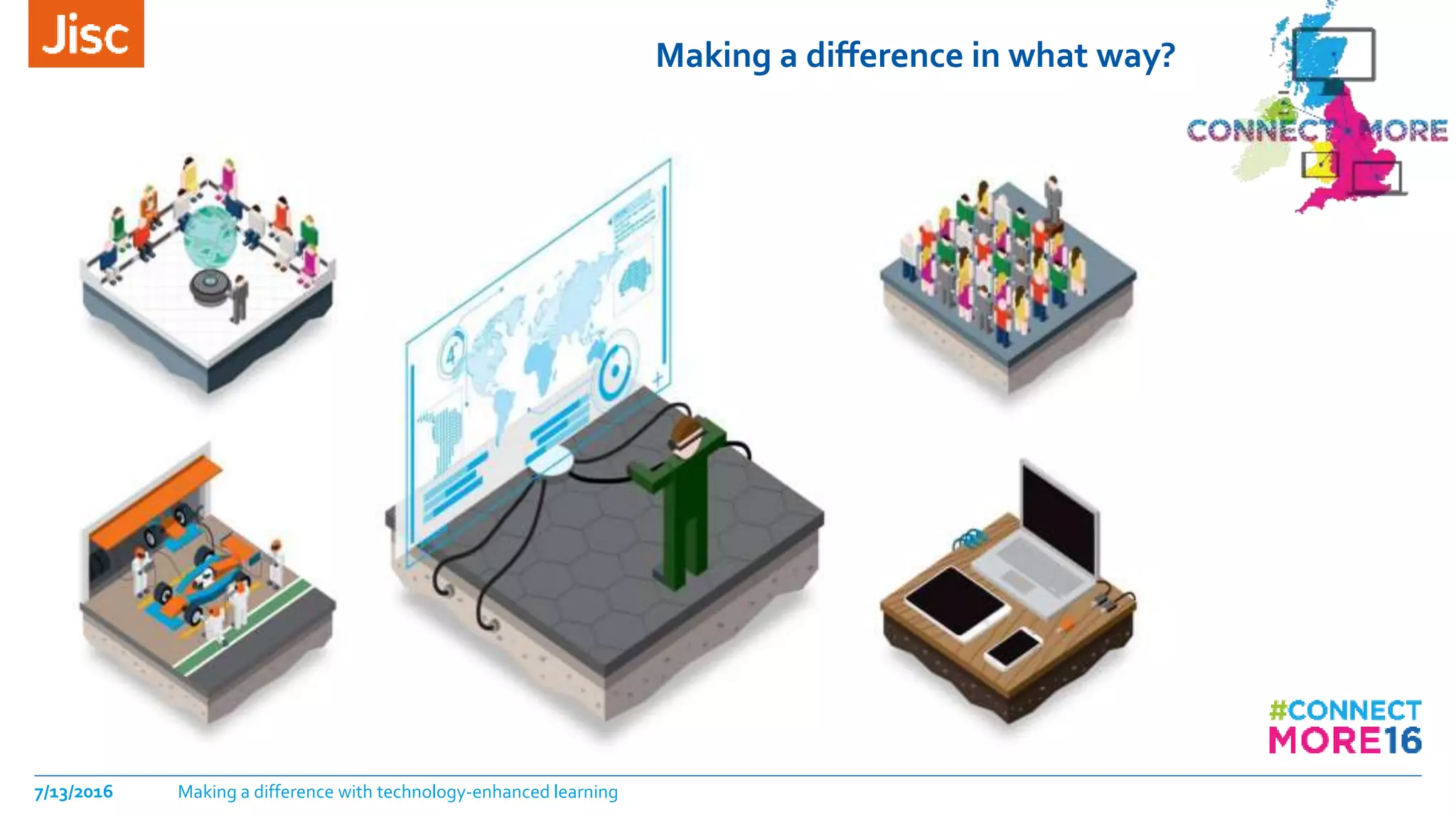
Making a difference in what way?
7/13/2016 Making a difference with technology-enhanced learning
What’s the current state of play?
» Increased focus on getting the basics right
» Lots of pockets of innovative technology-enhanced practice –
often led by individuals or course teams
» Some examples of large-scale institutional moves to change
delivery models
› Flipped learning
› Online modules or regular online sessions
Looking at strategic, institution-wide use of technology…
7/13/2016 Making a difference with technology-enhanced learning
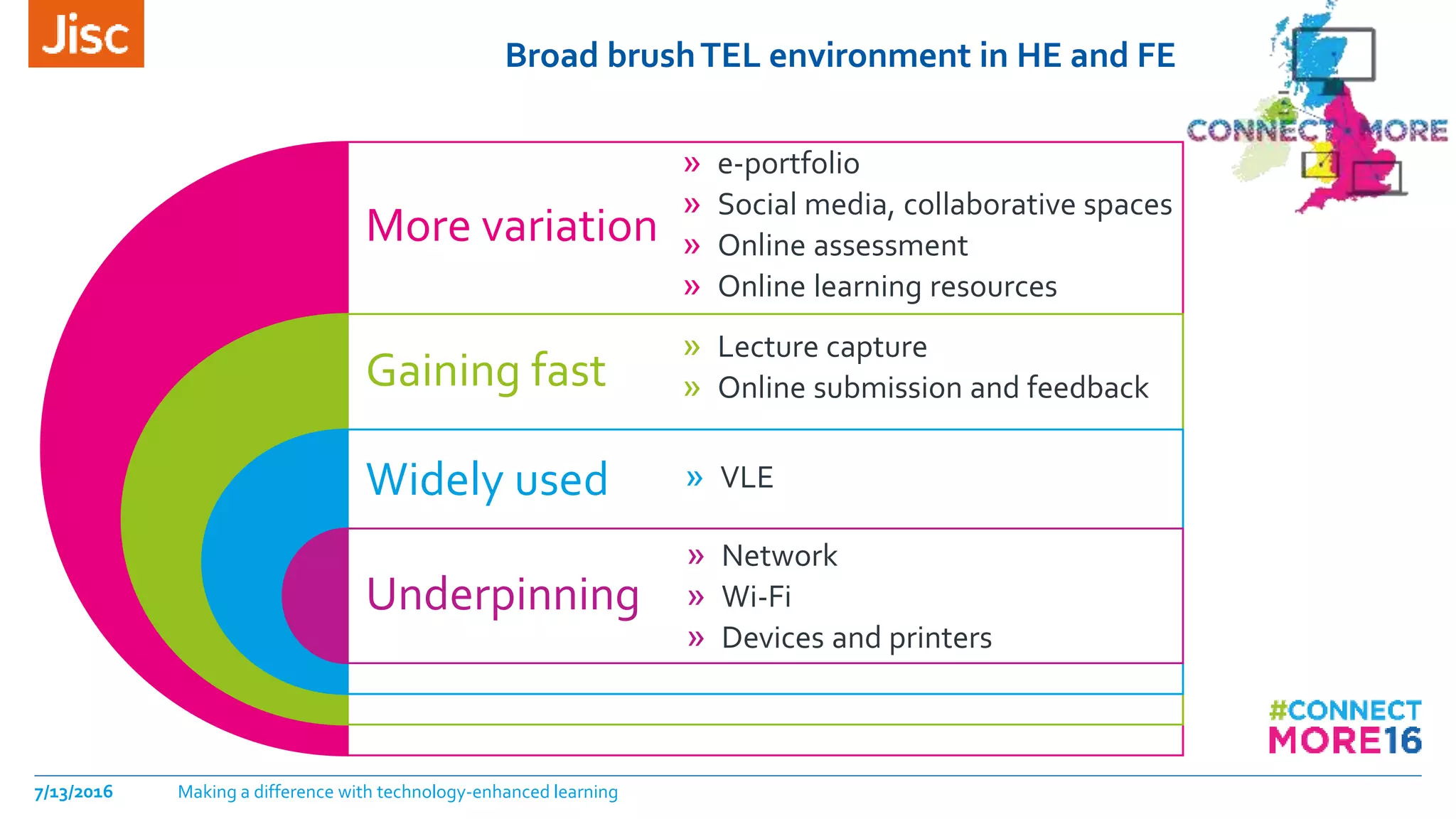
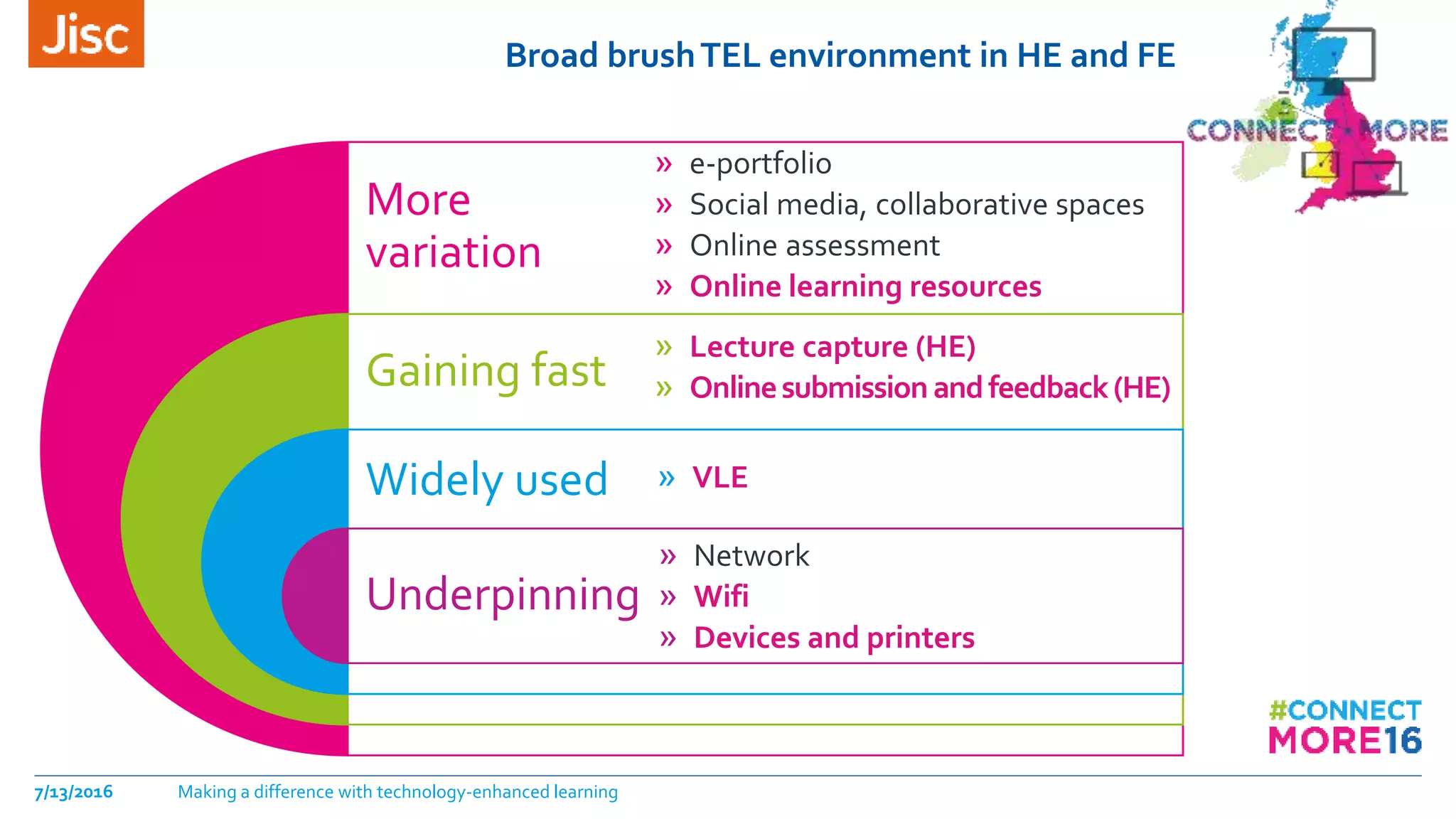
Broad brushTEL environment in HE and FE
7/13/2016 Making a difference with technology-enhanced learning
More variation
Gaining fast
Widely used
Underpinning
» e-portfolio
» Social media, collaborative spaces
» Online assessment
» Online learning resources
» Lecture capture
» Online submission and feedback
» VLE
» Network
» Wi-Fi
» Devices and printers
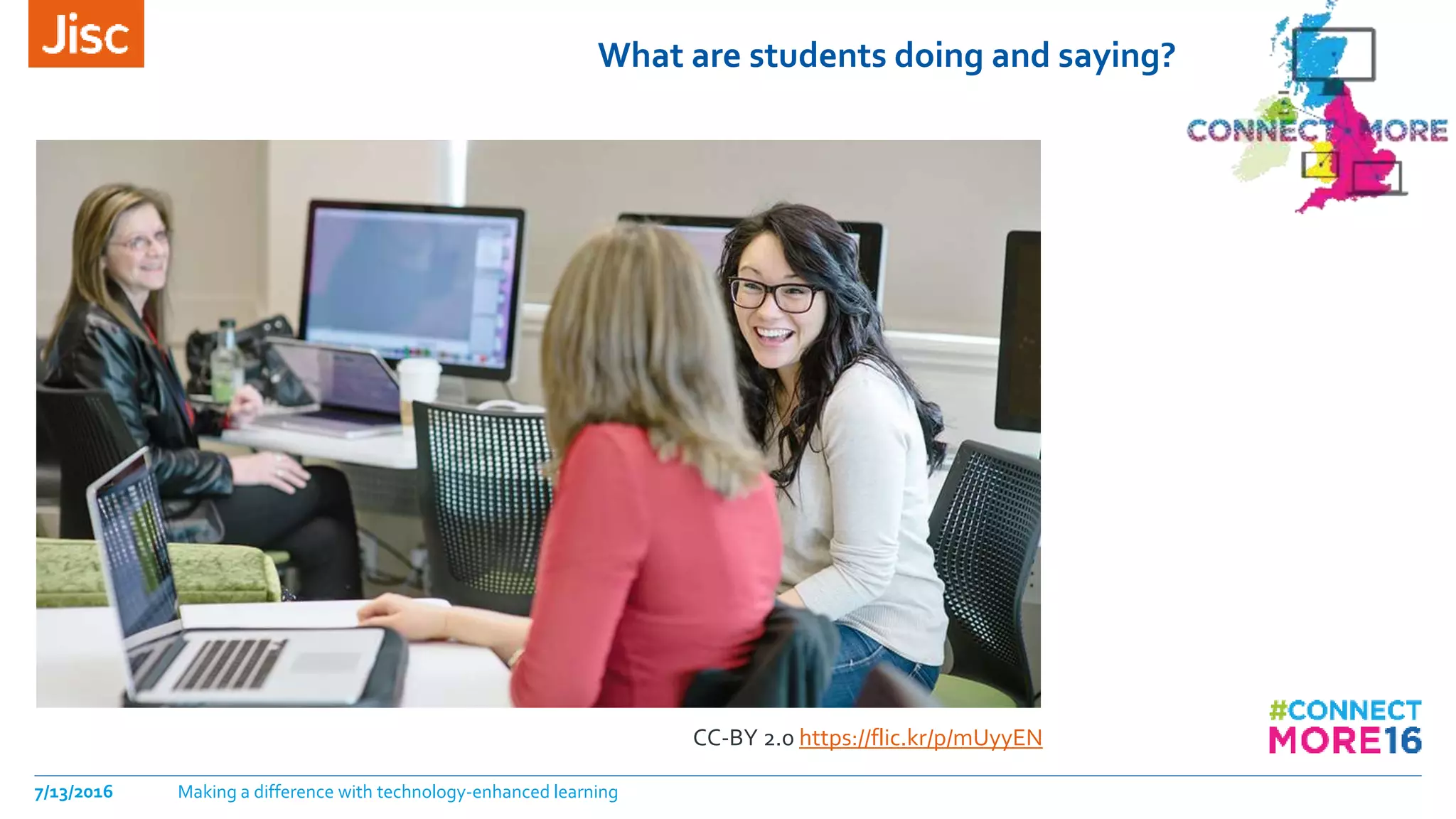
What are students doing and saying?
7/13/2016 Making a difference with technology-enhanced learning
CC-BY 2.0 https://flic.kr/p/mUyyEN
Jisc student digital experience tracker data
» Data from the pilot of the Jisc student digital experience tracker
» Designed to provide a snapshot of students' digital experience
» February-April 2016
» 10,753 students across HE, FE and skills
» http://bit.ly/student-tracker-report
7/13/2016 9
What are students doing and saying?
7/13/2016 Making a difference with technology-enhanced learning
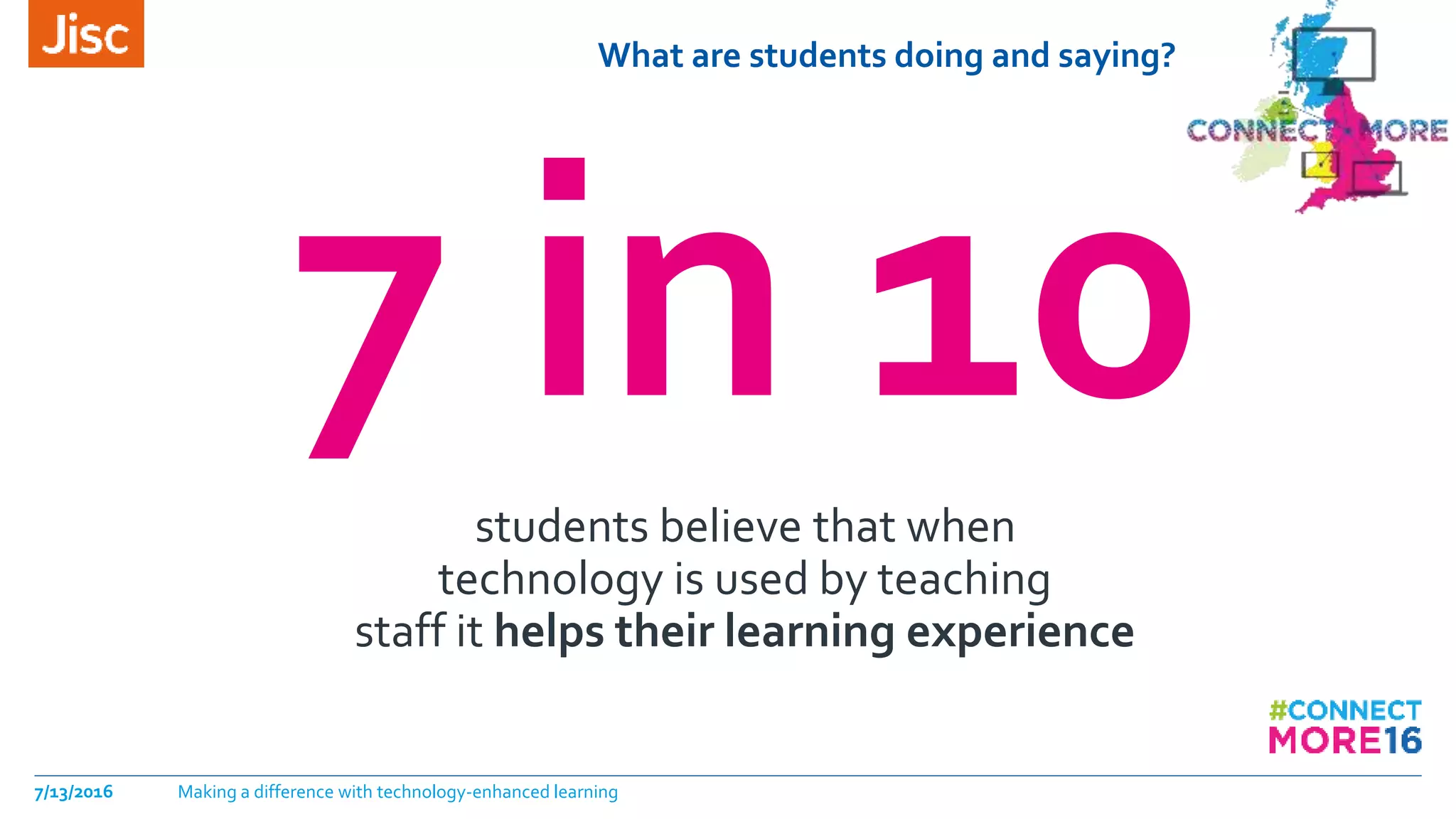
7 in 10students believe that when
technology is used by teaching
staff it helps their learning experience
In the previous six weeks of their course…
7/13/2016 Making a difference with technology-enhanced learning
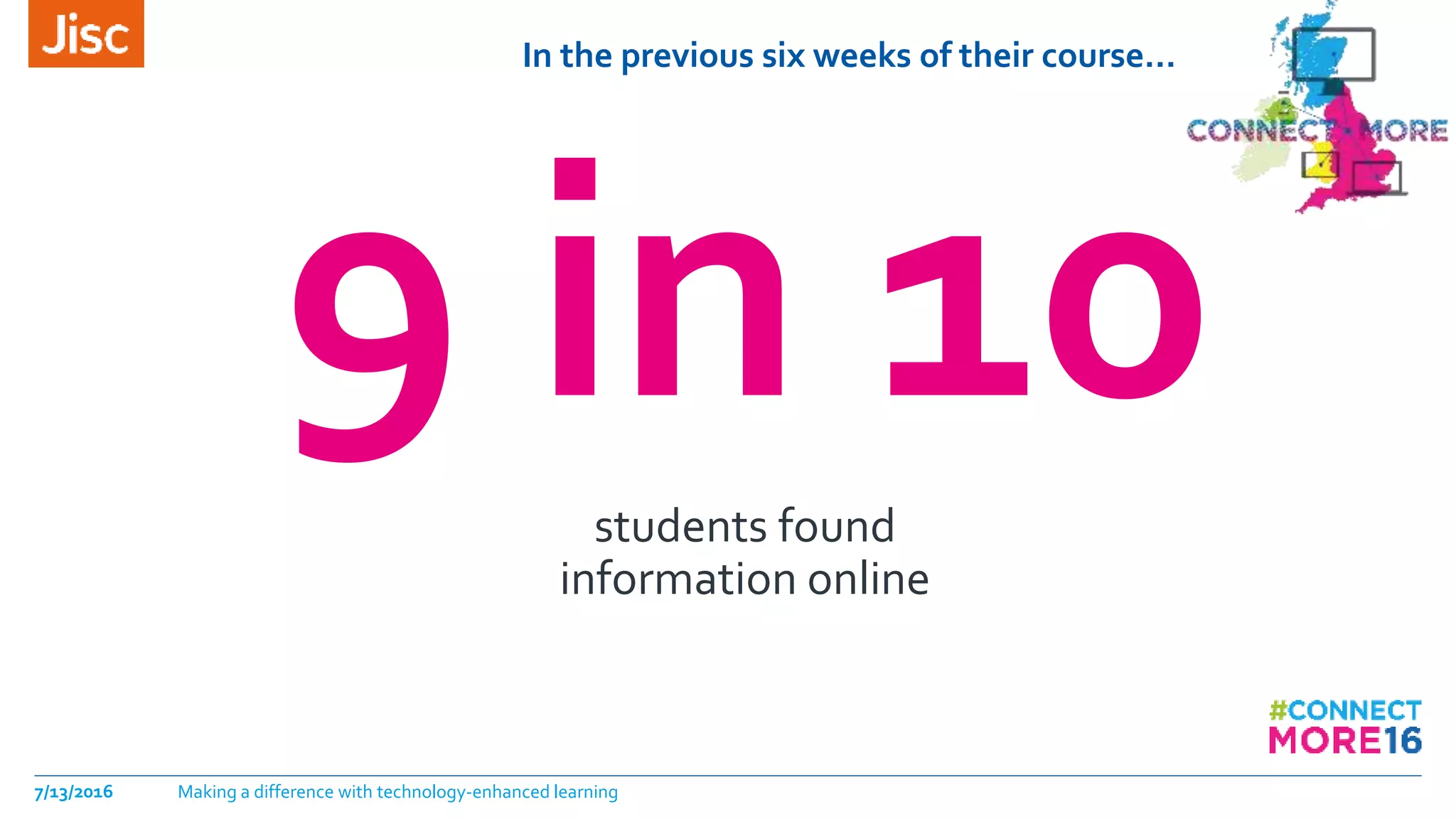
9 in 10students found
information online
In the previous six weeks of their course…
7/13/2016 Making a difference with technology-enhanced learning
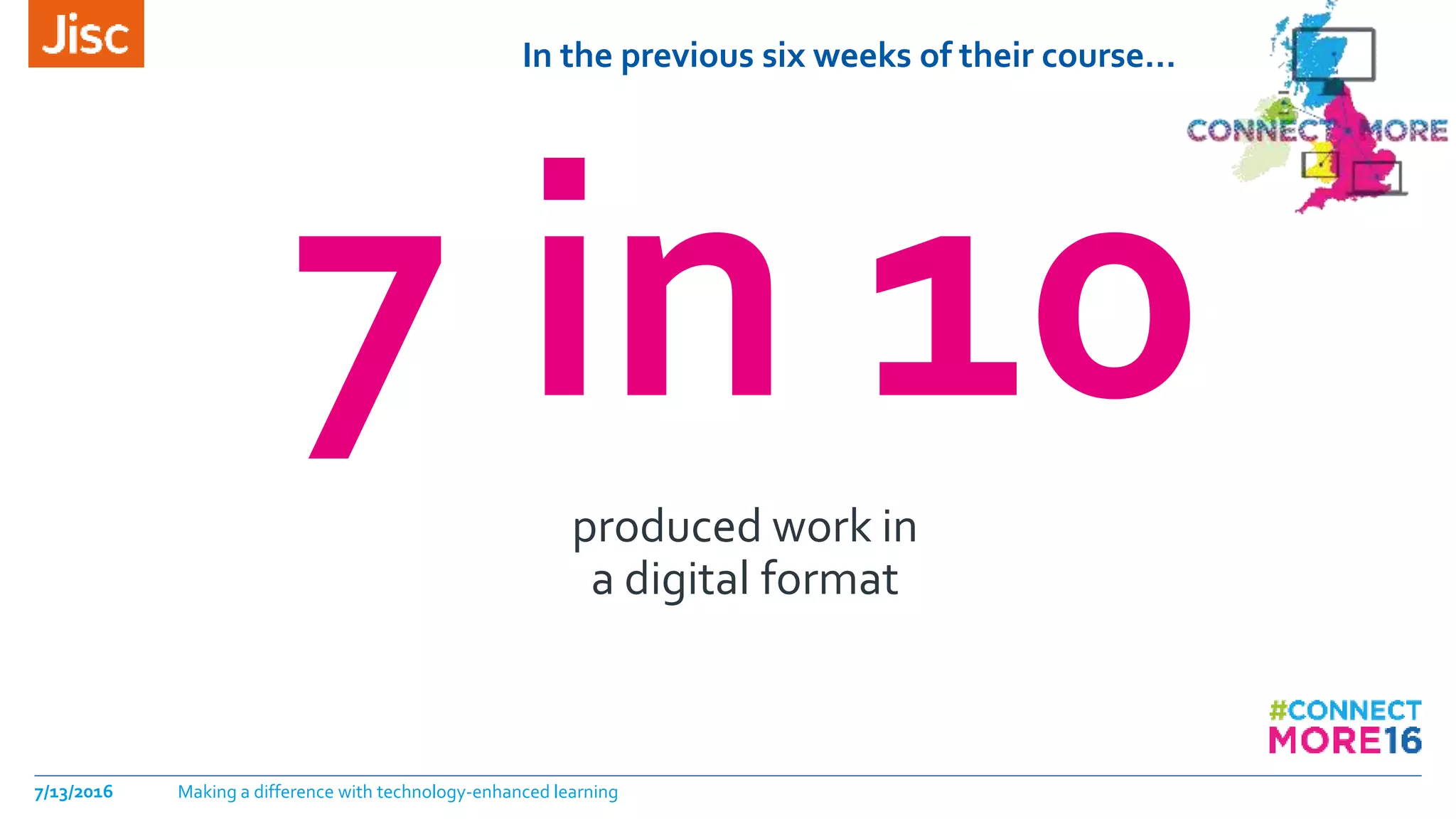
7 in 10produced work in
a digital format
In the previous six weeks of their course…
7/13/2016 Making a difference with technology-enhanced learning
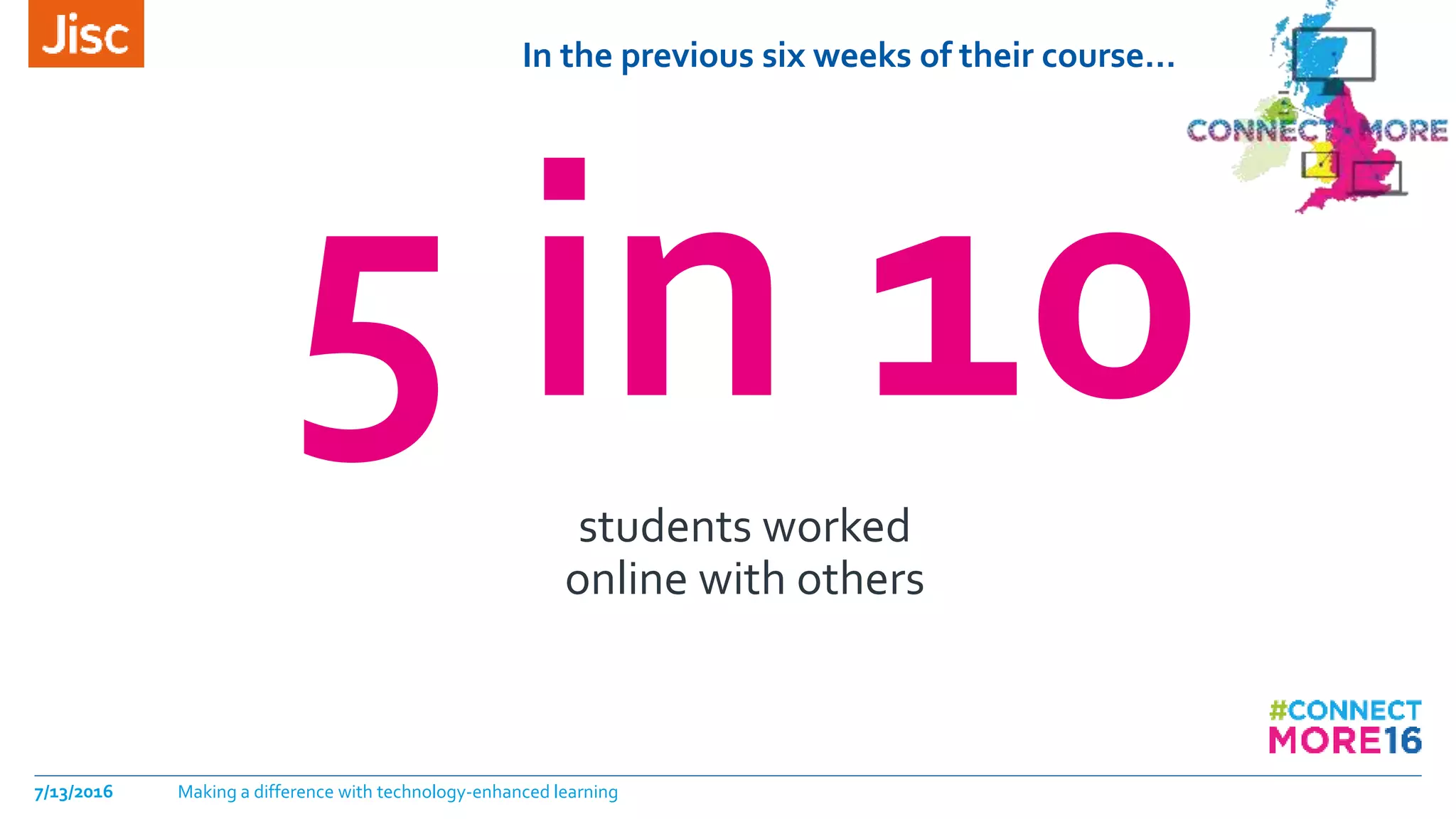
5 in 10students worked
online with others
In the previous six weeks of their course…
7/13/2016 Making a difference with technology-enhanced learning
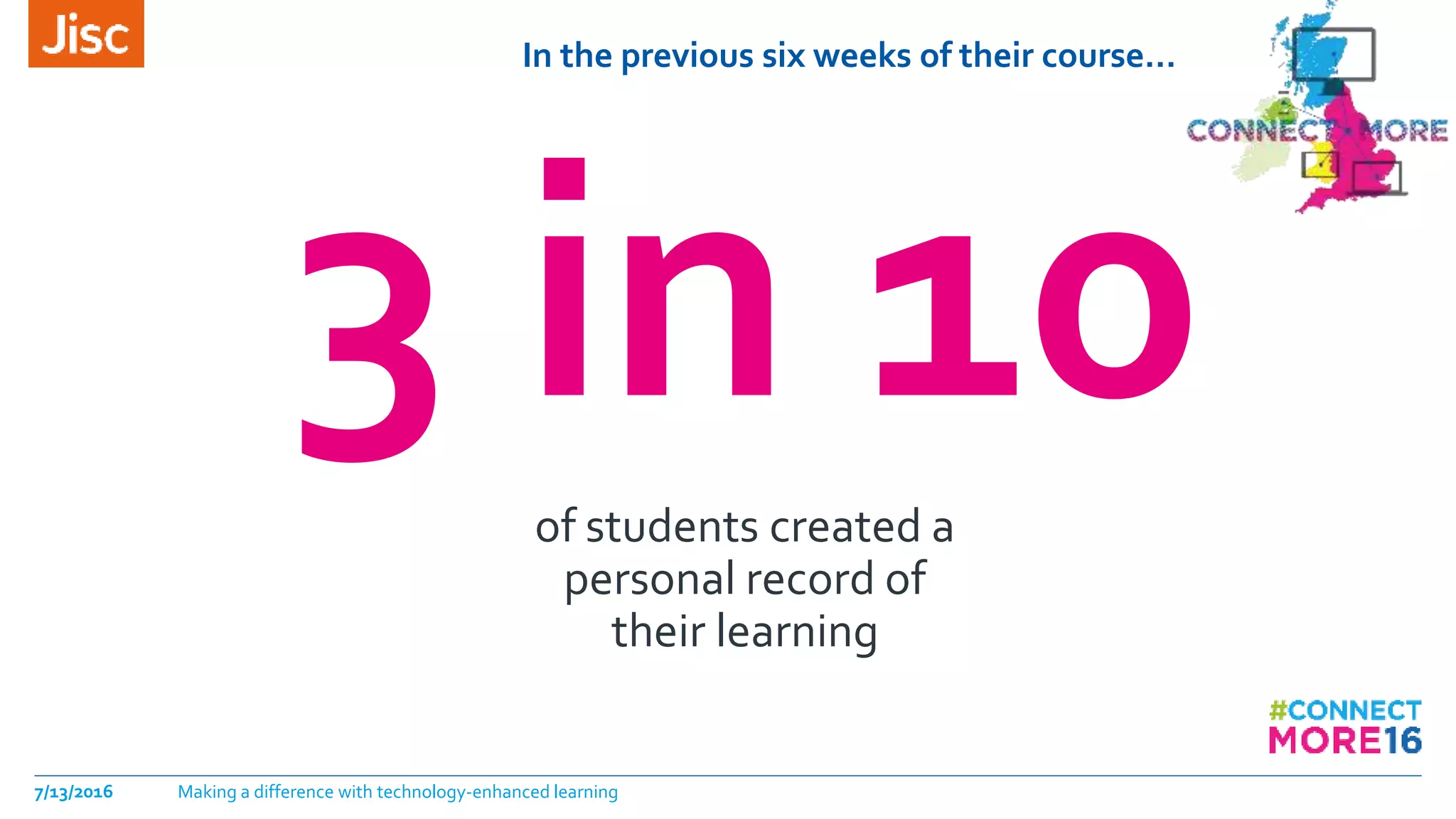
3 in 10of students created a
personal record of
their learning
Broad brushTEL environment in HE and FE
7/13/2016 Making a difference with technology-enhanced learning
More
variation
Gaining fast
Widely used
Underpinning
» e-portfolio
» Social media, collaborative spaces
» Online assessment
» Online learning resources
» Lecture capture (HE)
» Onlinesubmission andfeedback(HE)
» VLE
» Network
» Wifi
» Devices and printers
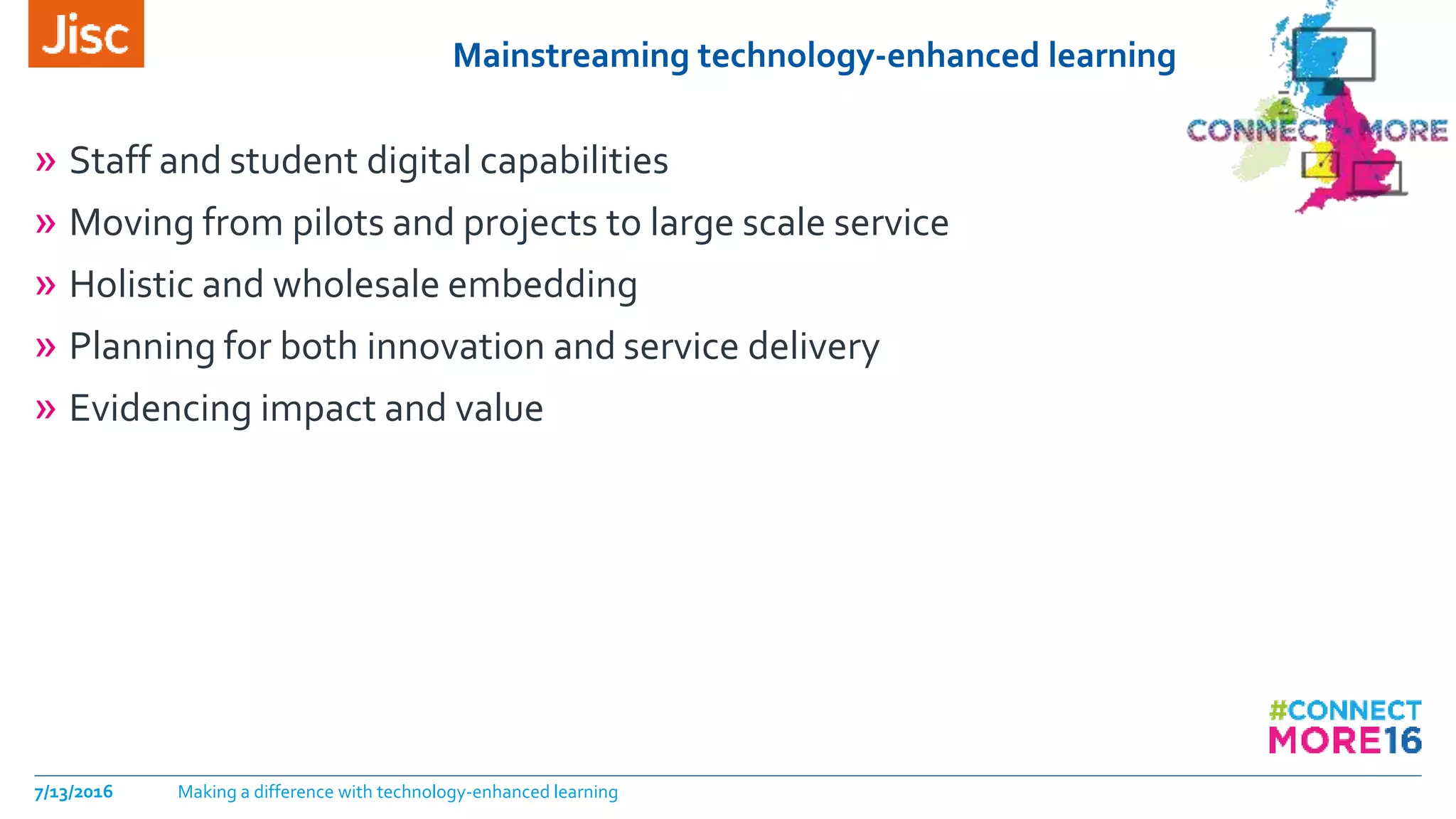
Mainstreaming technology-enhanced learning
» Staff and student digital capabilities
» Moving from pilots and projects to large scale service
» Holistic and wholesale embedding
» Planning for both innovation and service delivery
» Evidencing impact and value
7/13/2016 Making a difference with technology-enhanced learning
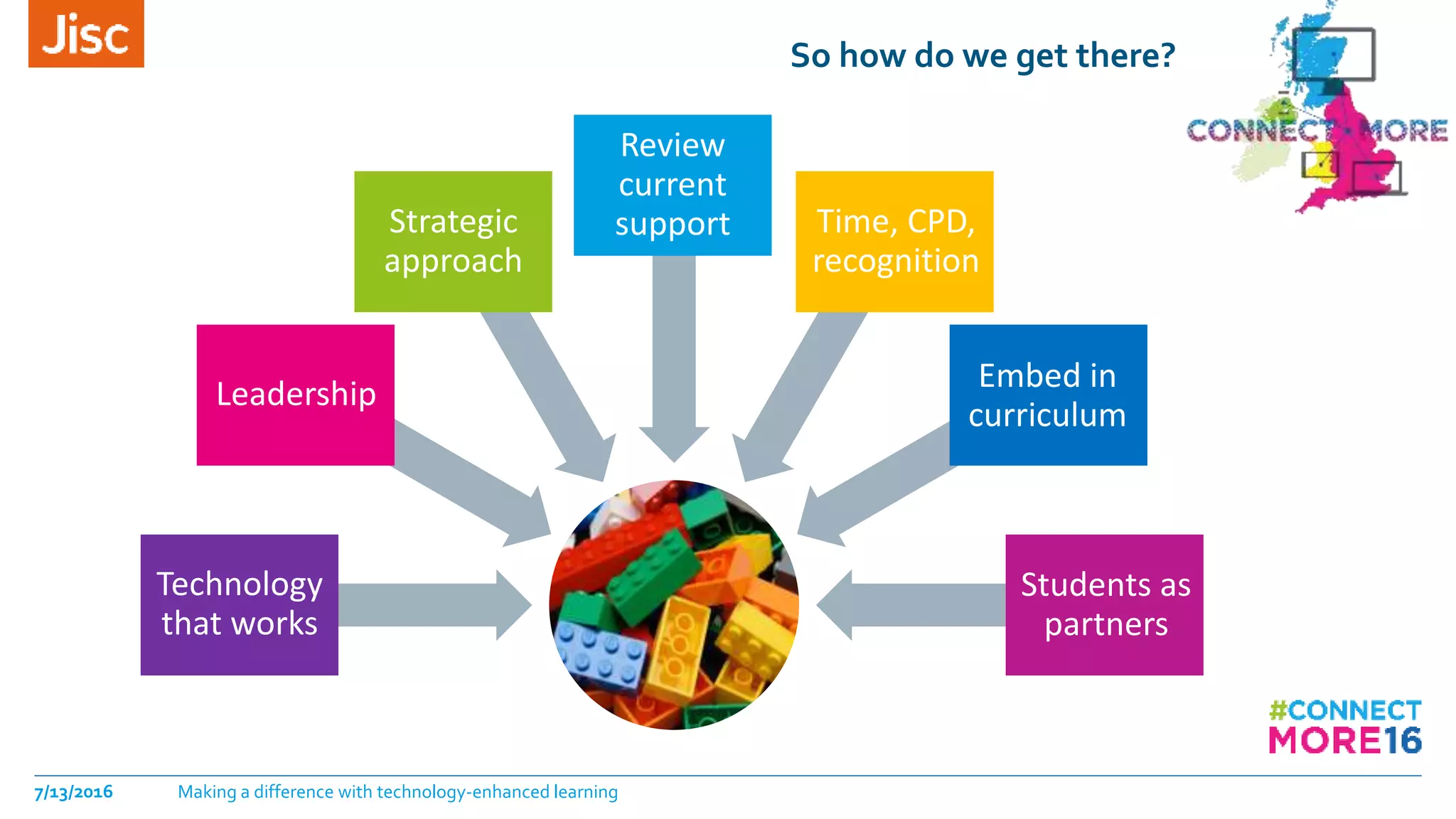
So how do we get there?
Technology
that works
Leadership
Strategic
approach
Review
current
support Time, CPD,
recognition
Embed in
curriculum
Students as
partners
7/13/2016 Making a difference with technology-enhanced learning
Sources of guidance and inspiration
http://bit.ly/telconnectmore
7/13/2016 Making a difference with technology-enhanced learning
jisc.ac.uk
Sarah Knight
Senior co-design manager
Sarah.knight@jisc.ac.uk
7/13/2016 Making a difference with technology-enhanced learning
jisc.ac.uk
Making a difference with technology-
enhanced learning
Sarabjit Borrill
Lead Tutor (English) Leicestershire Adult Learning
https://prezi.com/6udtcun7fe9i/making-a-difference-with-
technology-enhanced-learning-by-
sar/?utm_campaign=share&utm_medium=copy
7/13/2016 Making a difference with technology-enhanced learning

Making a difference with technology-enhanced learning - Sarah Knight and Sarabjit Borrill

  • 2.
    Making a differencewith technology-enhanced learning Sarah Knight, Senior co-design manager
  • 3.
    Making a differencewith technology-enhanced learning » What kind of difference can technology enhanced learning make? » What’s the current state of play? » What are students saying? » What’s the challenge? 7/13/2016 Making a difference with technology-enhanced learning
  • 4.
    Making a differencein what way? 7/13/2016 Making a difference with technology-enhanced learning
  • 5.
    What’s the currentstate of play? » Increased focus on getting the basics right » Lots of pockets of innovative technology-enhanced practice – often led by individuals or course teams » Some examples of large-scale institutional moves to change delivery models › Flipped learning › Online modules or regular online sessions Looking at strategic, institution-wide use of technology… 7/13/2016 Making a difference with technology-enhanced learning
  • 6.
    Broad brushTEL environmentin HE and FE 7/13/2016 Making a difference with technology-enhanced learning More variation Gaining fast Widely used Underpinning » e-portfolio » Social media, collaborative spaces » Online assessment » Online learning resources » Lecture capture » Online submission and feedback » VLE » Network » Wi-Fi » Devices and printers
  • 7.
    What are studentsdoing and saying? 7/13/2016 Making a difference with technology-enhanced learning CC-BY 2.0 https://flic.kr/p/mUyyEN
  • 8.
    Jisc student digitalexperience tracker data » Data from the pilot of the Jisc student digital experience tracker » Designed to provide a snapshot of students' digital experience » February-April 2016 » 10,753 students across HE, FE and skills » http://bit.ly/student-tracker-report 7/13/2016 9
  • 9.
    What are studentsdoing and saying? 7/13/2016 Making a difference with technology-enhanced learning 7 in 10students believe that when technology is used by teaching staff it helps their learning experience
  • 10.
    In the previoussix weeks of their course… 7/13/2016 Making a difference with technology-enhanced learning 9 in 10students found information online
  • 11.
    In the previoussix weeks of their course… 7/13/2016 Making a difference with technology-enhanced learning 7 in 10produced work in a digital format
  • 12.
    In the previoussix weeks of their course… 7/13/2016 Making a difference with technology-enhanced learning 5 in 10students worked online with others
  • 13.
    In the previoussix weeks of their course… 7/13/2016 Making a difference with technology-enhanced learning 3 in 10of students created a personal record of their learning
  • 14.
    Broad brushTEL environmentin HE and FE 7/13/2016 Making a difference with technology-enhanced learning More variation Gaining fast Widely used Underpinning » e-portfolio » Social media, collaborative spaces » Online assessment » Online learning resources » Lecture capture (HE) » Onlinesubmission andfeedback(HE) » VLE » Network » Wifi » Devices and printers
  • 15.
    Mainstreaming technology-enhanced learning »Staff and student digital capabilities » Moving from pilots and projects to large scale service » Holistic and wholesale embedding » Planning for both innovation and service delivery » Evidencing impact and value 7/13/2016 Making a difference with technology-enhanced learning
  • 16.
    So how dowe get there? Technology that works Leadership Strategic approach Review current support Time, CPD, recognition Embed in curriculum Students as partners 7/13/2016 Making a difference with technology-enhanced learning
  • 17.
    Sources of guidanceand inspiration http://bit.ly/telconnectmore 7/13/2016 Making a difference with technology-enhanced learning
  • 18.
    jisc.ac.uk Sarah Knight Senior co-designmanager Sarah.knight@jisc.ac.uk 7/13/2016 Making a difference with technology-enhanced learning
  • 20.
    jisc.ac.uk Making a differencewith technology- enhanced learning Sarabjit Borrill Lead Tutor (English) Leicestershire Adult Learning https://prezi.com/6udtcun7fe9i/making-a-difference-with- technology-enhanced-learning-by- sar/?utm_campaign=share&utm_medium=copy 7/13/2016 Making a difference with technology-enhanced learning

Editor's Notes

  • #5 Quick summary of some of the many potential benefits of effective use of TEL (use any other better image you can find – or ask Damian to tint/make transparent the bg of this one.) Meeting student expectations Preparing students for the digital world of work Bringing to life things that would be impossible or too expensive to do for real in the classroom Enabling flexibility for students – place, pace, mode of delivery Helping learning providers reach larger cohorts – and for HE, a worldwide student body Supporting accessibility Efficiency (though covered in morning presentation) Enhancement – eg enabling more productive f2f time; enabling various types of collaborative task, etc.
  • #6 Need to look at mainstreamed/institution-wide uses as it’s the only way you’re going to be able to systematically make the kind of differences we were talking about on the previous slide. Focus on getting the basics right – this does tend to be organisation-wide and recognises the importance of consistency and meeting student expectations Some examples of large-scale moves – I think there’s more of this per size of sector in Scotland than elsewhere, particularly in HE.
  • #7 YOU MAY NOT WANT TO USE THIS – I’VE LEFT IT IN JUST IN CASE This refers to the strategic, institution-wide use of technology. Need to look at mainstreamed/institution-wide uses as it’s the only way you’re going to be able to systematically make the kind of differences we were talking about on the benefits slide. We’re seeing an increased focus on getting the basics right – this does tend to be organisation-wide and recognises the importance of consistency and meeting student expectations – using things like minimum VLE standards, suite of common tools, lecture capture (mainly HE, etc.) VLE – pretty much ubiquitous in FE and HE – not sure about skills???? Note lecture capture and online submission are particularly widely used in HE, though interest in FE in these is also gaining ground. The variation on the top group can be due to sector or subject differences – eg e-portfolios often very widely used in vocational subjects and apprenticeships, online assessment usually (though not exclusively) STEM subjects, etc. That’s fine and to be encouraged, - no point in tech for tech’s sake. But can also be caused by staff not engaging or having the skills. Wifi and Network – wifi less widespread in FE and network is a challenge in skills.
  • #8 Data taken from the recent pilot of the Jisc student digital experience tracker – (info below just FYI) Jisc developed a set of 11 questions, designed to provide a snapshot of students' digital experience while engaged in a course of study In Feb-April 2016 Jisc delivered two versions of the questions (HE and FE & Skills) as a pilot Tracker service for institutions The questions were delivered in BOS and piloted across 24 institutions (12 x HE and 12 x FE & Skills, the latter including two Specialist Colleges) Pilot sites were supported through the process with identical guidance to simulate a real-world service delivery setting and to ensure equivalence of data A total of 10,753 students completed the Tracker questions We have a reliable snapshot of the situation with respect to device ownership and use, access to digital services, typical digital activities on course, and how students rate different aspects of their digital experience
  • #11 7 out of 10 students (HE, FE and skills) believe that when technology is used by teaching staff it helps their learning experience
  • #12 During the last 6 weeks of their course: 9 in every 10 students found information online
  • #13 7 During the last 6 weeks of their course: 7 in 10 students produced work in a digital format
  • #14 During the last 6 weeks of their course: 5 in every 10 students worked online with others
  • #15 During the last 6 weeks of their course: 3 in every 10 students created a personal record of their learning
  • #16 Students’ free text answers to a question on what they would like their institution to start doing largely confirm the importance of getting the basics right for student satisfaction VLE – better use of, consistence across courses, more online materials and activities
  • #17 The need for consistency (where useful – not complete standardisation) emphasises the importance of mainstreaming innovations so they don’t just remain in pockets or lose impetus when key member of staff leaves. Students mentioned the need to support the development of both student and staff digital skills and competence
  • #18 Note also how Jisc can help with these areas – particularly digital capability, which is one of the earlier parallel sessions – the digital capability service and the digital leadership programme (running in the autumn, opening for registration to FE and HE v soon.)