Majority World Report 2013
Risks & Rewards
@cape
Dublin Web Summit, 2013
Some home truths about business of innovation
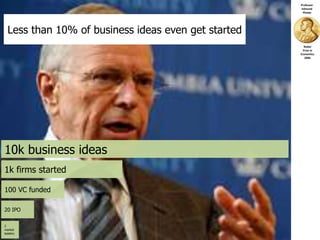
10k business ideas
1k firms started
100 VC funded
20 IPO
2
market
leaders
Nobel
Prize in
Economics
2006
Professor
Edmund
Phelps
Less than 10% of business ideas even get started
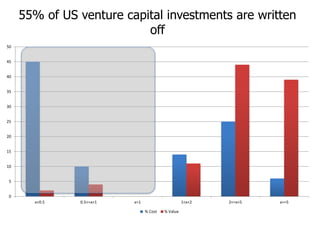
55% of US venture capital investments are written
off
0
5
10
15
20
25
30
35
40
45
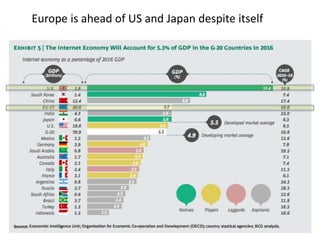
50
x<0.5 0.5<=x<1 x=1 1<x<2 2<=x<5 x>=5
% Cost % Value
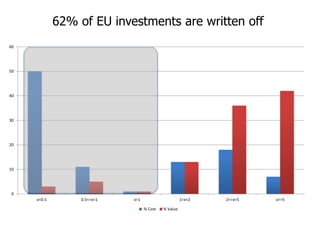
62% of EU investments are written off
0
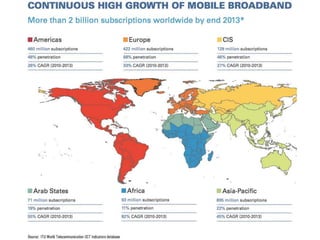
10
20
30
40
50
60
x<0.5 0.5<=x<1 x=1 1<x<2 2<=x<5 x>=5
% Cost % Value
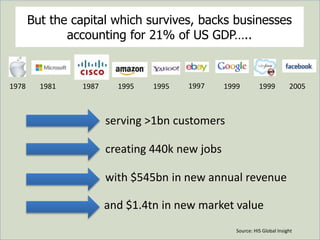
But the capital which survives, backs businesses
accounting for 21% of US GDP…..
1978 1981 1987 1995 1995 1997 1999 1999 2005
and $1.4tn in new market value
creating 440k new jobs
with $545bn in new annual revenue
serving >1bn customers
Source: HIS Global Insight
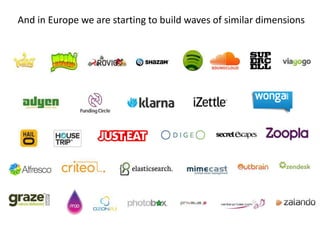
And in Europe we are starting to build waves of similar dimensions
So are venture capitalists just bad at assessing risk
or do they really understand innovation economics?
Aren’t accelerators just applying logic of venture
economics even more aggressively….?
And marketplaces adding further scale to open up risk adjusted
and scaleable funding to new sectors…..
Creative & Consumer Electronics Startups
Microfinance SMEs
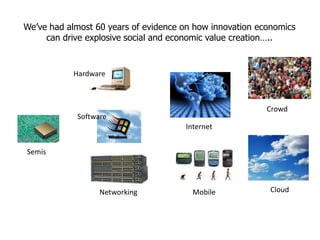
We’ve had almost 60 years of evidence on how innovation economics
can drive explosive social and economic value creation…..
Semis
Hardware
Software
Internet
Mobile CloudNetworking
Crowd
But can venture’s real legacy be a broader understanding
and application of innovation economics?
Extreme risk of 62% write-offs is definitely
not for everyone, including many
entrepreneurs and venture investors…..
.
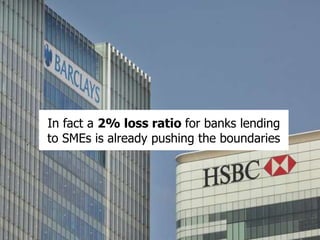
In fact a 2% loss ratio for banks lending
to SMEs is already pushing the boundaries.
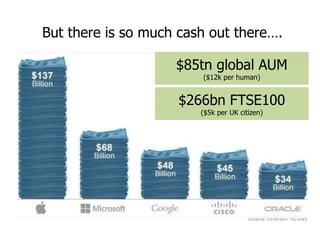
But there is so much cash out there….
$266bn FTSE100
($5k per UK citizen)
$85tn global AUM
($12k per human)
Can’t we be more adventurous on how we
allocate and manage it?
We know 7% of small companies create
>50% of new jobs
.
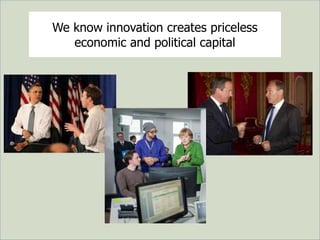
We know innovation creates priceless
economic and political capital
.
So given the evidence, shouldn’t we be
prepared to risk more on radical innovation?
.
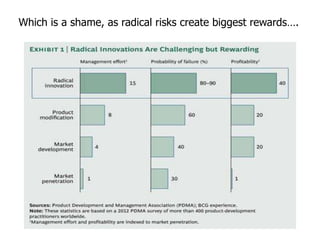
Even in the US we are still falling short
Which is a shame, as radical risks create biggest rewards….
.
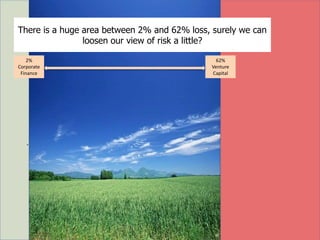
There is a huge area between 2% and 62% loss, surely we can
loosen our view of risk a little?
2%
Corporate
Finance
62%
Venture
Capital
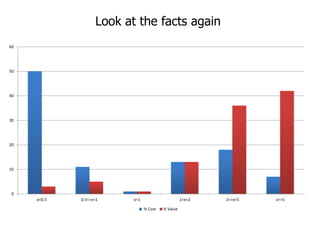
Look at the facts again
0
10
20
30
40
50
60
x<0.5 0.5<=x<1 x=1 1<x<2 2<=x<5 x>=5
% Cost % Value
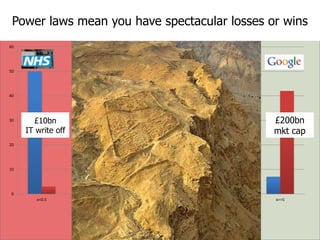
Power laws mean you have spectacular losses or wins
0
10
20
30
40
50
60
x<0.5 0.5<=x<1 x=1 1<x<2 2<=x<5 x>=5
% Cost % Value
£10bn
IT write off
£200bn
mkt cap
If you feel comfortable managing risk, you might
as well shoot for the moon
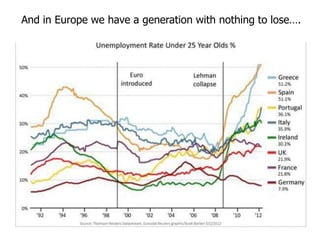
And in Europe we have a generation with nothing to lose….
.
But how can we expect people to embrace risk when large
corporates, governments and educators won’t?
2%
Corporate
62%
Venture
We have grown up in cultures with relative excellence
in health, education, security and political stability
But what skills have we developed to navigate this
new chaotic and risky environment?
Almost none
Europe is ahead of US and Japan despite itself
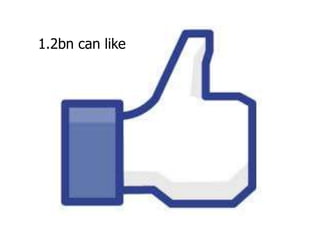
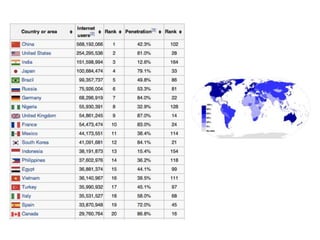
1.2bn can like
> 1bn can search
>500m can pay
>750m can Tweet, Skype, Whatsapp or
Snapchat
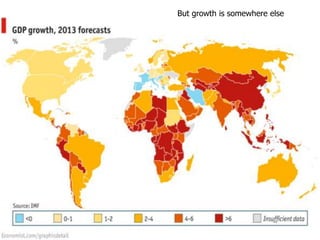
But growth is somewhere else
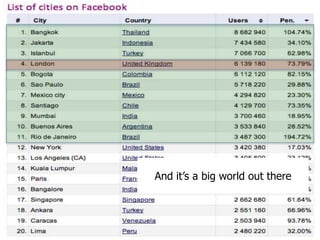
And it’s a big world out there
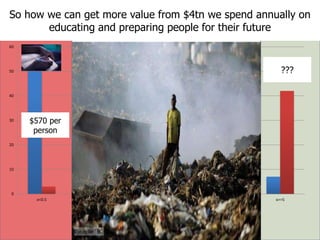
So how we can get more value from $4tn we spend annually on
educating and preparing people for their future
0
10
20
30
40
50
60
x<0.5 0.5<=x<1 x=1 1<x<2 2<=x<5 x>=5
% Cost % Value
$570 per
person
???
So how can you help
yourself?
Learn to work on the network
Get out there and explore
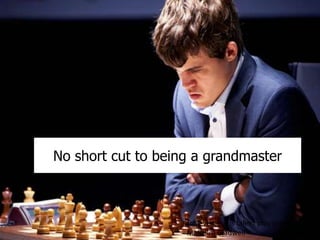
No short cut to being a grandmaster
“achievement is talent plus preparation.”
- Malcolm Gladwell
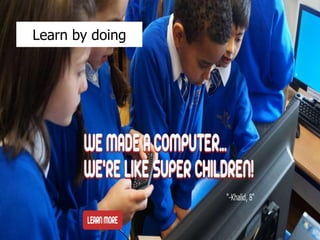
Learn by doing
Use your time – do tasks
Use your expertise in almost any field you can
imagine – curate, contribute, consult, teach
Use your talent – write, make music, take
pictures, make movies, make stuff
Invest and share your major assets –
savings, car, house
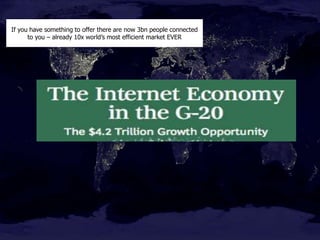
If you have something to offer there are now 3bn people connected
to you – already 10x world’s most efficient market EVER
Some advice for your trip
You have to learn take risks
Time Emotions Money
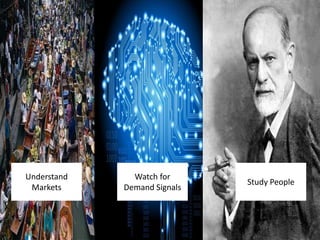
Understand
Markets
Watch for
Demand Signals
Study People
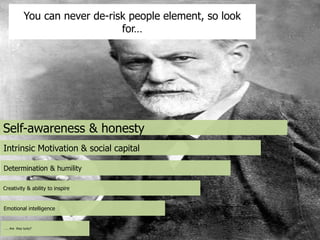
Self-awareness & honesty
Intrinsic Motivation & social capital
Determination & humility
Creativity & ability to inspire
….. Are they lucky?
Emotional intelligence
You can never de-risk people element, so look
for…
Take your losses as early and cheaply as you can and move on
0
10
20
30
40
50
60
x<0.5 0.5<=x<1 x=1 1<x<2 2<=x<5 x>=5
% Cost % Value
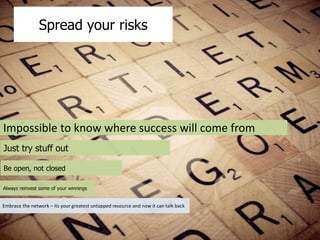
Impossible to know where success will come from
Just try stuff out
Be open, not closed
Embrace the network – its your greatest untapped resource and now it can talk back
Spread your risks
Always reinvest some of your winnings
But if you find the wave and you know what you’re doing, you
can climb the power curve, and win – spectacularly and globally
So aim too high.
The prize is huge and we all have an
amazing start just by being here
Embrace
your 62%
@cape
♯risk62
Majority World Report 2013

Majority World Report 2013

  • 1.
    Majority World Report2013 Risks & Rewards @cape Dublin Web Summit, 2013
  • 2.
    Some home truthsabout business of innovation
  • 3.
    10k business ideas 1kfirms started 100 VC funded 20 IPO 2 market leaders Nobel Prize in Economics 2006 Professor Edmund Phelps Less than 10% of business ideas even get started
  • 4.
    55% of USventure capital investments are written off 0 5 10 15 20 25 30 35 40 45 50 x<0.5 0.5<=x<1 x=1 1<x<2 2<=x<5 x>=5 % Cost % Value
  • 5.
    62% of EUinvestments are written off 0 10 20 30 40 50 60 x<0.5 0.5<=x<1 x=1 1<x<2 2<=x<5 x>=5 % Cost % Value
  • 6.
    But the capitalwhich survives, backs businesses accounting for 21% of US GDP….. 1978 1981 1987 1995 1995 1997 1999 1999 2005 and $1.4tn in new market value creating 440k new jobs with $545bn in new annual revenue serving >1bn customers Source: HIS Global Insight
  • 7.
    And in Europewe are starting to build waves of similar dimensions
  • 8.
    So are venturecapitalists just bad at assessing risk or do they really understand innovation economics?
  • 9.
    Aren’t accelerators justapplying logic of venture economics even more aggressively….?
  • 10.
    And marketplaces addingfurther scale to open up risk adjusted and scaleable funding to new sectors….. Creative & Consumer Electronics Startups Microfinance SMEs
  • 11.
    We’ve had almost60 years of evidence on how innovation economics can drive explosive social and economic value creation….. Semis Hardware Software Internet Mobile CloudNetworking Crowd
  • 12.
    But can venture’sreal legacy be a broader understanding and application of innovation economics?
  • 13.
    Extreme risk of62% write-offs is definitely not for everyone, including many entrepreneurs and venture investors….. .
  • 14.
    In fact a2% loss ratio for banks lending to SMEs is already pushing the boundaries.
  • 15.
    But there isso much cash out there…. $266bn FTSE100 ($5k per UK citizen) $85tn global AUM ($12k per human)
  • 16.
    Can’t we bemore adventurous on how we allocate and manage it?
  • 17.
    We know 7%of small companies create >50% of new jobs .
  • 18.
    We know innovationcreates priceless economic and political capital .
  • 19.
    So given theevidence, shouldn’t we be prepared to risk more on radical innovation? .
  • 20.
    Even in theUS we are still falling short
  • 21.
    Which is ashame, as radical risks create biggest rewards….
  • 22.
    . There is ahuge area between 2% and 62% loss, surely we can loosen our view of risk a little? 2% Corporate Finance 62% Venture Capital
  • 23.
    Look at thefacts again 0 10 20 30 40 50 60 x<0.5 0.5<=x<1 x=1 1<x<2 2<=x<5 x>=5 % Cost % Value
  • 24.
    Power laws meanyou have spectacular losses or wins 0 10 20 30 40 50 60 x<0.5 0.5<=x<1 x=1 1<x<2 2<=x<5 x>=5 % Cost % Value £10bn IT write off £200bn mkt cap
  • 25.
    If you feelcomfortable managing risk, you might as well shoot for the moon
  • 26.
    And in Europewe have a generation with nothing to lose….
  • 27.
    . But how canwe expect people to embrace risk when large corporates, governments and educators won’t? 2% Corporate 62% Venture
  • 28.
    We have grownup in cultures with relative excellence in health, education, security and political stability
  • 29.
    But what skillshave we developed to navigate this new chaotic and risky environment?
  • 30.
  • 31.
    Europe is aheadof US and Japan despite itself
  • 33.
  • 34.
    > 1bn cansearch
  • 35.
  • 36.
    >750m can Tweet,Skype, Whatsapp or Snapchat
  • 37.
    But growth issomewhere else
  • 38.
    And it’s abig world out there
  • 39.
    So how wecan get more value from $4tn we spend annually on educating and preparing people for their future 0 10 20 30 40 50 60 x<0.5 0.5<=x<1 x=1 1<x<2 2<=x<5 x>=5 % Cost % Value $570 per person ???
  • 41.
    So how canyou help yourself?
  • 42.
    Learn to workon the network
  • 43.
    Get out thereand explore
  • 44.
    No short cutto being a grandmaster “achievement is talent plus preparation.” - Malcolm Gladwell
  • 45.
  • 46.
    Use your time– do tasks
  • 47.
    Use your expertisein almost any field you can imagine – curate, contribute, consult, teach
  • 48.
    Use your talent– write, make music, take pictures, make movies, make stuff
  • 49.
    Invest and shareyour major assets – savings, car, house
  • 50.
    If you havesomething to offer there are now 3bn people connected to you – already 10x world’s most efficient market EVER
  • 51.
    Some advice foryour trip
  • 52.
    You have tolearn take risks Time Emotions Money
  • 53.
  • 54.
    Self-awareness & honesty IntrinsicMotivation & social capital Determination & humility Creativity & ability to inspire ….. Are they lucky? Emotional intelligence You can never de-risk people element, so look for…
  • 55.
    Take your lossesas early and cheaply as you can and move on 0 10 20 30 40 50 60 x<0.5 0.5<=x<1 x=1 1<x<2 2<=x<5 x>=5 % Cost % Value
  • 56.
    Impossible to knowwhere success will come from Just try stuff out Be open, not closed Embrace the network – its your greatest untapped resource and now it can talk back Spread your risks Always reinvest some of your winnings
  • 57.
    But if youfind the wave and you know what you’re doing, you can climb the power curve, and win – spectacularly and globally
  • 58.
    So aim toohigh. The prize is huge and we all have an amazing start just by being here
  • 59.

Editor's Notes

  • #4 A way of describing the odds: Edmund Phelps, a Columbia economics professor and Nobel laureate, described the odds in his new book, “Mass Flourishing: How Grassroots Innovation Created Jobs, Challenge and Change” as “from 10,000 business ideas, as 1,000 firms are founded, 100 receive venture capital, 20 go on to raise capital in an initial public offering, and two become market leaders.” 
  • #7 According to the venture impact study, IHS Global Insight, originally VC-backed companies accounted for 11.87m jobs and over $3.1 trn in revenue in the US in 2011—accounting for 21% of GDP and 11% of private-sector employment. At Index, our portfolio companies alone have generated $4bn worth of revenue, while growing on average by more than 75%, creating 20k jobs with 1k positions currently open People say VC doesn’t add anythign but maybe when we look back on this cambrian explosion of innovation from 1960s (semis) to 2020s (cloud connected services in every sector) – the broadscale application and understanding of venture economics will be the true legacy of venture rather than Apple, Cisco, Facebook, Google, Microsoft, Salesforce, Skype and Twitter DATA: https://docs.google.com/a/indexventures.com/spreadsheet/ccc?key=0ArWfM5OOjmKZdDJ4QWcwcHh5UFZSYm9KSENDRHBONWc&usp=drive_web#gid=0
  • #10 Seedcamp stats: 93 companies since 2007 - 83% start-ups raised capital $120m total raised 76 operational 6 acquired 11 closed 850 jobs created YC stats: 511 companies since 2005 Average value of a YC-financed start-up is $22.4m 37 start-ups have either sold for, or are now worth, more than $40m. If you take last two years of classes out of these numbers (given that it takes time for a company to grow), and you look at 300 companies in YC instead of 511, that means the odds of +$40m success are about 1 in 10. As of 2011, YC had 25 companies of 316 acquired. Of these, 5 exits for over $10 million, and the combined value of the top 21 companies was $4.7bn. TechStars stats: 256 companies since 2007 71% companies funded $400m raised 204 operational 24 acquired 28 failed - 1,882 jobs created Based on new realities: - Cost of company creation - cloud/SaaS, open source, platforms, Capital efficiency of scale up -> Global markets (talent, customers, finance) YC numbers in 2011: http://ycombinator.com/nums.html WAYRA stats: (297 start-ups, €9.7m total investment, 70% commercially trading)
  • #11 Kickstarter: $810m total dollars pledged 49,355 successfully funded projects 4.9m total backers 1.4m repeat backers 11.2m total pledges Funding Circle: £156m successful loans £39m principal repaid £113m loans outstanding, with 98.5% repayments coming in on time 5.8% average net return (before tax) 55k people in UK have joined to lend to businesses Angelist: $200m investments $186m through introductions $14m through direct “invest online” product 21k investors on platform 1,300 companies successfully raised funding
  • #15 US: A study by three students at Columbia business school looked at the expected rate of credit losses on banks’ loan portfolios and came up with a benchmark of sorts: For our sample (Q4:1996-Q2:2012), the average (median) ALLL is 1.54% (1.37%) of gross loans held for investment: (http://www4.gsb.columbia.edu/filemgr?&file_id=7221887). EUROPE: According to the IMF, the level of non-performing loans as a share of total loans made in 2012 in Europe, was quite high– around 6% in the EU27. EU SMEs rely heavily on banks for funding. Around 75% of corporate financing in the EU is obtained from banks, compared to about 30% in the US. The EU crisis has now highlighted that this is a huge vulnerability for SMEs in Europe. KR: European banking report: http://www.ebf-fbe.eu/uploads/FF2012.pdf) http://www.zyyne.com/zh5/100747#p=7
  • #16 Major corporates are hoarding cash– a more granular look at point you’re making. In fact, tech titans Apple, Microsoft, Google, Cisco (CSCO), Oracle (ORCL), Intel (INTC) and Big Pharma giants Pfizer (PFE), Merck (MRK), Johnson & Johnson (JNJ) and Amgen (AMGN) collectively have more than $435 billion in cash on their balance sheets. (Feb 2013, Fortune, http://buzz.money.cnn.com/2013/02/12/apple-cash/) FTSE 100 numbers: market cap: $2.7 trillion Revenues: $280 billion Staff: 6.5 million Cash on balance sheets: $266 billion IT budgets: 1-8%
  • #18 Kauffman report, 2012:  Looking into its portfolio of nearly 100 VC funds, including what it says are some of the most notable and exclusive names (confidentiality agreements barred it from naming them), the foundation found that only 20 of them beat a public-market equivalent by more than 3% annually, and half of those started investing before 1995. “There are not enough strong VC investors with above-market returns to absorb even our limited investment capital,” the Kauffman Foundation concludes HBS research: Research by HBS which look at US venture returns from 2004-2010 says that about 75% of VC firms don’t return investors capital, based on data from 2,000 companies that received venture funding of at least $1m
  • #19 Kauffman report, 2012:  Looking into its portfolio of nearly 100 VC funds, including what it says are some of the most notable and exclusive names (confidentiality agreements barred it from naming them), the foundation found that only 20 of them beat a public-market equivalent by more than 3% annually, and half of those started investing before 1995. “There are not enough strong VC investors with above-market returns to absorb even our limited investment capital,” the Kauffman Foundation concludes HBS research: Research by HBS which look at US venture returns from 2004-2010 says that about 75% of VC firms don’t return investors capital, based on data from 2,000 companies that received venture funding of at least $1m
  • #20 Kauffman report, 2012:  Looking into its portfolio of nearly 100 VC funds, including what it says are some of the most notable and exclusive names (confidentiality agreements barred it from naming them), the foundation found that only 20 of them beat a public-market equivalent by more than 3% annually, and half of those started investing before 1995. “There are not enough strong VC investors with above-market returns to absorb even our limited investment capital,” the Kauffman Foundation concludes HBS research: Research by HBS which look at US venture returns from 2004-2010 says that about 75% of VC firms don’t return investors capital, based on data from 2,000 companies that received venture funding of at least $1m
  • #22 KR: A recent study by the Product Development and Management Association found that radical innovation accounted for only 10 percent of an average company’s innovation portfolio, down from 21 percent in 1990. As the new productivity measures gained traction, managers naturally gravitated to projects that succeeded under the new constraints. More and more, breakthrough projects with high failure rates and less predictability lost out when investment priorities were set. (BCG, Managing the Unmanageable: Radical Innovation, 2013) (KR has PDF from David Dean)
  • #25 Power laws are a fundamental departure from how we have come to understand the world. The fact that they will only show up more often means no matter what we do, we need to understand how they work and what causes them. http://en.wikipedia.org/wiki/Power_law
  • #26 iPhone Self-driving cars Health
  • #27 What did these governments spend in a year on DEFENSE, EDUCATION, HEALTH: See google doc for this data: https://docs.google.com/a/indexventures.com/spreadsheet/ccc?key=0ArWfM5OOjmKZdDJ4QWcwcHh5UFZSYm9KSENDRHBONWc&usp=drive_web#gid=1
  • #45 ORIGINAL STUDY…http://digitalcollections.library.cmu.edu/awweb/awarchive?type=file&item=44582 Forty years ago, in a paper in American Scientist, Herbert Simon and William Chase drew one of the most famous conclusions in the study of expertise: There are no instant experts in chess—certainly no instant masters or grandmasters. There appears not to be on record any case (including Bobby Fischer) where a person reached grandmaster level with less than about a decade's intense preoccupation with the game. We would estimate, very roughly, that a master has spent perhaps 10,000 to 50,000 hours staring at chess positions… KR: After Simon and Chase’s paper, for example, the psychologist John Hayes looked at seventy-six famous classical composers and found that, in almost every case, those composers did not create their greatest work until they had been composing for at least ten years. 
  • #47 (Fiverr, Taskrabbit)
  • #48 http://englishjobsturkey.com/download-esl-lesson-plans/ http://www.educationdive.com/news/teacher-claims-she-made-1m-selling-lesson-plans-to-other-teachers/59021/ http://pandodaily.com/2013/07/08/lessons-from-the-first-millionaire-online-teacher/ Elance, one of many online freelance hubs that matches freelancers with clients, recently announced that hiring by businesses through its site increased by 60% last year. In its Annual Impact Report, conducted by the the third-party research firm Imperative, 74% of employers said they expected to enlist more freelancers in 2013. (Forbes)
  • #54 Open source  Github Creative - Youtube, Soundcloud, Wordpress, Shapeways Funding - Kickstarter, Quirky, Funding Circle Metrics - Google, Facebook, Twitter, YouTube Optimization - Chartbeat, Surveymonkey, Qualaroo, Kissmetrics