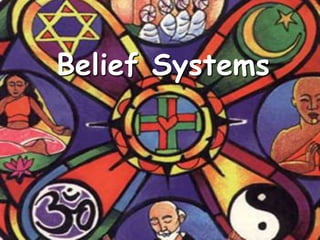
Belief Systems
What you will learn
today
What are the characteristics of major religions?
How are they similar and different?
How have major religions affected culture?
How have belief systems spread over large areas?
Animism
Animism is the belief that all
living and nonliving things in
nature have a spirit.
Animism was the belief system of
many early civilizations.
Animism in early civilizations was
often combined with ancestor
worship.
Animism dates back to earliest
humans and still exists. It can be
practiced by anyone who
believes in spirituality, but does
not proscribe to an organized
religion. Animist gods and beliefs
often explain natural earthly
things. The presence of holy
men or women, visions, trances,
dancing, sacred items and places
are often characteristic of animist
societies. Animism exists in
traditional African, Asian,
American and Aboriginal
cultures.
Hinduism
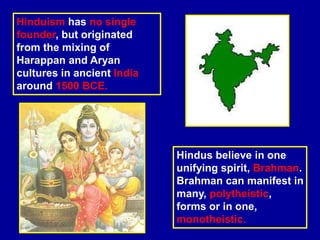
Hinduism has no single
founder, but originated
from the mixing of
Harappan and Aryan
cultures in ancient India
around 1500 BCE.
Hindus believe in one
unifying spirit, Brahman.
Brahman can manifest in
many, polytheistic,
forms or in one,
monotheistic.
Hinduism is based on
the concept of
reincarnation (Spirits
return to earth many
times in different forms
trying to become one
with Brahman). The soul
moves up or down a
hierarchy depending on
their behavior in life.
A person moves closer
to Brahman by obeying
the law of karma. Karma
is the sum of all your
deeds, good and bad.
Good deeds involve
following your dharma,
or duties dependent on
your position, gender
and occupation.
The caste system (outlawed since 1948) was an
important part of Hinduism. Castes are social classes
into which a person is born and lives their entire life. If
a person has a good karma they may be reincarnated
into a higher caste.
This life Next life
Born into
A caste
Good Karma
Bad Karma
Higher caste
Lower caste
The caste system separated Indian society
into distinct social classes in which everyone
knew their place and believed that if they
followed the dharma of their caste, they would
be reincarnated into a better caste.
Brahmin
Kshatriya
Vaisya
Sudra
Untouchables
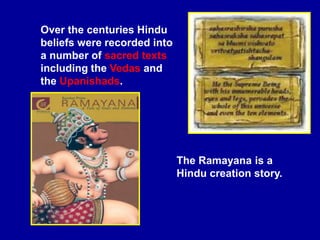
Over the centuries Hindu
beliefs were recorded into
a number of sacred texts
including the Vedas and
the Upanishads.
The Ramayana is a
Hindu creation story.
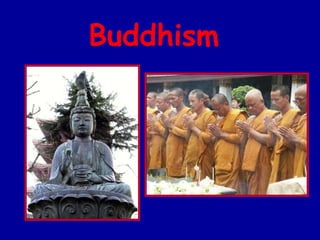
Buddhism
• Buddhism was
founded by
Siddhartha Gautama
in northern India
around 560 BCE.
• Gautama was born
into a wealthy Hindu
family, but renounced
his wealth to seek
spiritual
enlightenment.
~Buddhism spread
through cultural
diffusion to
eastern Asia,
including China,
Thailand, Korea
and Japan.
~In other areas,
Buddhism was
adapted and took
on new forms.
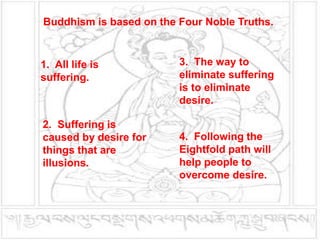
Buddhism is based on the Four Noble Truths.
1. All life is
suffering.
2. Suffering is
caused by desire for
things that are
illusions.
3. The way to
eliminate suffering
is to eliminate
desire.
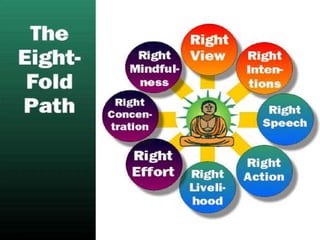
4. Following the
Eightfold path will
help people to
overcome desire.
Buddhism like
Hinduism:
Reincarnation
Karma
Dharma
But not
Caste system
Hindu gods
Hindu
priesthood
Buddhism has much in common with Hinduism,
but important differences.
Buddha did not record his teachings, but after he
died, his followers collected them into the
Tripitaka.
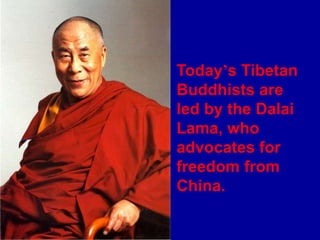
Today’s Tibetan
Buddhists are
led by the Dalai
Lama, who
advocates for
freedom from
China.
Judaism
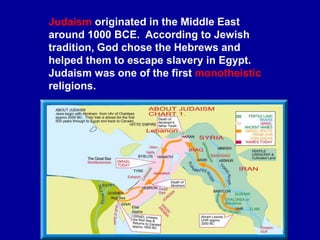
Judaism originated in the Middle East
around 1000 BCE. According to Jewish
tradition, God chose the Hebrews and
helped them to escape slavery in Egypt.
Judaism was one of the first monotheistic
religions.
Basic Beliefs of Judaism
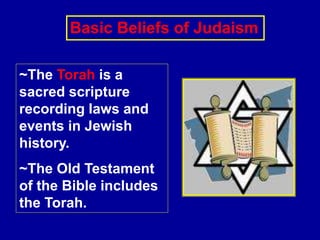
~The Torah is a
sacred scripture
recording laws and
events in Jewish
history.
~The Old Testament
of the Bible includes
the Torah.
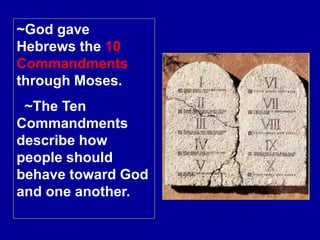
~God gave
Hebrews the 10
Commandments
through Moses.
~The Ten
Commandments
describe how
people should
behave toward God
and one another.
God made a covenant,
or promise to Abraham
to be the God of the
Hebrews.
Judaism had a great
influence on the later
development of
Christianity and Islam.
Jews were discriminated against in the Roman Empire
and eventually kicked out of their homeland, Israel, in
what is known as the Diaspora.
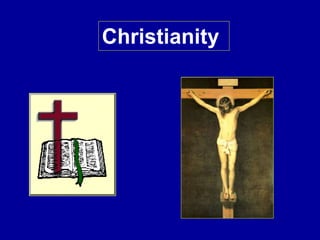
Christianity
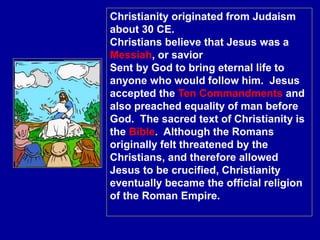
Christianity originated from Judaism
about 30 CE.
Christians believe that Jesus was a
Messiah, or savior
Sent by God to bring eternal life to
anyone who would follow him. Jesus
accepted the Ten Commandments and
also preached equality of man before
God. The sacred text of Christianity is
the Bible. Although the Romans
originally felt threatened by the
Christians, and therefore allowed
Jesus to be crucified, Christianity
eventually became the official religion
of the Roman Empire.
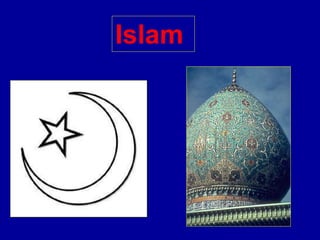
Islam
Islam originated in
the Middle East
around 622 CE
with the Prophet,
Muhammad.
Muhammad was
born in Mecca and
traveled to Medina
in a journey called
the hijra, that
became the
founding of Islam.
Muslim
worshippers
follow scriptures
called the
Quran, or Koran.
The collection of
Islamic laws is
also known as
the Sharia.
Five Pillars of Islam
1. Faith in one God, Allah—monotheism
2. Five times daily prayer toward Mecca
3. Help for the poor
4. Fasting during the holy month of
Ramadan
5. Pilgrimage to holy city of Mecca
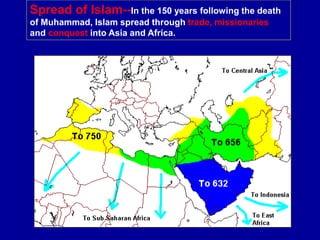
Spread of Islam--In the 150 years following the death
of Muhammad, Islam spread through trade, missionaries
and conquest into Asia and Africa.
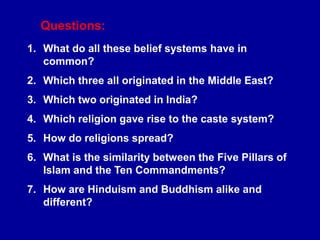
Questions:
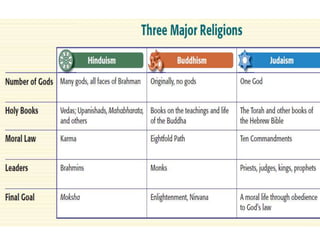
1. What do all these belief systems have in
common?
2. Which three all originated in the Middle East?
3. Which two originated in India?
4. Which religion gave rise to the caste system?
5. How do religions spread?
6. What is the similarity between the Five Pillars of
Islam and the Ten Commandments?
7. How are Hinduism and Buddhism alike and
different?

world_religions.ppt

  • 1.
  • 2.
    What you willlearn today What are the characteristics of major religions? How are they similar and different? How have major religions affected culture? How have belief systems spread over large areas?
  • 3.
    Animism Animism is thebelief that all living and nonliving things in nature have a spirit. Animism was the belief system of many early civilizations. Animism in early civilizations was often combined with ancestor worship.
  • 4.
    Animism dates backto earliest humans and still exists. It can be practiced by anyone who believes in spirituality, but does not proscribe to an organized religion. Animist gods and beliefs often explain natural earthly things. The presence of holy men or women, visions, trances, dancing, sacred items and places are often characteristic of animist societies. Animism exists in traditional African, Asian, American and Aboriginal cultures.
  • 5.
  • 6.
    Hinduism has nosingle founder, but originated from the mixing of Harappan and Aryan cultures in ancient India around 1500 BCE. Hindus believe in one unifying spirit, Brahman. Brahman can manifest in many, polytheistic, forms or in one, monotheistic.
  • 7.
    Hinduism is basedon the concept of reincarnation (Spirits return to earth many times in different forms trying to become one with Brahman). The soul moves up or down a hierarchy depending on their behavior in life. A person moves closer to Brahman by obeying the law of karma. Karma is the sum of all your deeds, good and bad. Good deeds involve following your dharma, or duties dependent on your position, gender and occupation.
  • 8.
    The caste system(outlawed since 1948) was an important part of Hinduism. Castes are social classes into which a person is born and lives their entire life. If a person has a good karma they may be reincarnated into a higher caste. This life Next life Born into A caste Good Karma Bad Karma Higher caste Lower caste
  • 9.
    The caste systemseparated Indian society into distinct social classes in which everyone knew their place and believed that if they followed the dharma of their caste, they would be reincarnated into a better caste. Brahmin Kshatriya Vaisya Sudra Untouchables
  • 10.
    Over the centuriesHindu beliefs were recorded into a number of sacred texts including the Vedas and the Upanishads. The Ramayana is a Hindu creation story.
  • 11.
  • 12.
    • Buddhism was foundedby Siddhartha Gautama in northern India around 560 BCE. • Gautama was born into a wealthy Hindu family, but renounced his wealth to seek spiritual enlightenment.
  • 13.
    ~Buddhism spread through cultural diffusionto eastern Asia, including China, Thailand, Korea and Japan. ~In other areas, Buddhism was adapted and took on new forms.
  • 14.
    Buddhism is basedon the Four Noble Truths. 1. All life is suffering. 2. Suffering is caused by desire for things that are illusions. 3. The way to eliminate suffering is to eliminate desire. 4. Following the Eightfold path will help people to overcome desire.
  • 17.
    Buddhism like Hinduism: Reincarnation Karma Dharma But not Castesystem Hindu gods Hindu priesthood Buddhism has much in common with Hinduism, but important differences.
  • 18.
    Buddha did notrecord his teachings, but after he died, his followers collected them into the Tripitaka.
  • 19.
    Today’s Tibetan Buddhists are ledby the Dalai Lama, who advocates for freedom from China.
  • 20.
  • 21.
    Judaism originated inthe Middle East around 1000 BCE. According to Jewish tradition, God chose the Hebrews and helped them to escape slavery in Egypt. Judaism was one of the first monotheistic religions.
  • 22.
    Basic Beliefs ofJudaism ~The Torah is a sacred scripture recording laws and events in Jewish history. ~The Old Testament of the Bible includes the Torah.
  • 23.
    ~God gave Hebrews the10 Commandments through Moses. ~The Ten Commandments describe how people should behave toward God and one another.
  • 24.
    God made acovenant, or promise to Abraham to be the God of the Hebrews. Judaism had a great influence on the later development of Christianity and Islam.
  • 25.
    Jews were discriminatedagainst in the Roman Empire and eventually kicked out of their homeland, Israel, in what is known as the Diaspora.
  • 27.
  • 28.
    Christianity originated fromJudaism about 30 CE. Christians believe that Jesus was a Messiah, or savior Sent by God to bring eternal life to anyone who would follow him. Jesus accepted the Ten Commandments and also preached equality of man before God. The sacred text of Christianity is the Bible. Although the Romans originally felt threatened by the Christians, and therefore allowed Jesus to be crucified, Christianity eventually became the official religion of the Roman Empire.
  • 29.
  • 30.
    Islam originated in theMiddle East around 622 CE with the Prophet, Muhammad. Muhammad was born in Mecca and traveled to Medina in a journey called the hijra, that became the founding of Islam. Muslim worshippers follow scriptures called the Quran, or Koran. The collection of Islamic laws is also known as the Sharia.
  • 31.
    Five Pillars ofIslam 1. Faith in one God, Allah—monotheism 2. Five times daily prayer toward Mecca 3. Help for the poor 4. Fasting during the holy month of Ramadan 5. Pilgrimage to holy city of Mecca
  • 32.
    Spread of Islam--Inthe 150 years following the death of Muhammad, Islam spread through trade, missionaries and conquest into Asia and Africa.
  • 33.
    Questions: 1. What doall these belief systems have in common? 2. Which three all originated in the Middle East? 3. Which two originated in India? 4. Which religion gave rise to the caste system? 5. How do religions spread? 6. What is the similarity between the Five Pillars of Islam and the Ten Commandments? 7. How are Hinduism and Buddhism alike and different?