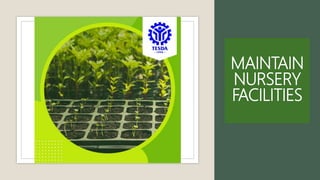
MAINTAIN
NURSERY
FACILITIES
Learning Competencies:
Perform maintenance of nursery cleanliness and sanitation
Perform repair and maintenance of nursery facilities to maximize their efficiency and
effectiveness
Apply preventive measures for inclement weather and practice safety measures
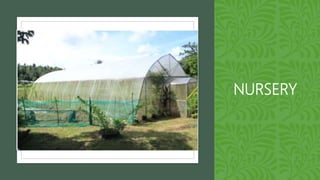
NURSERY
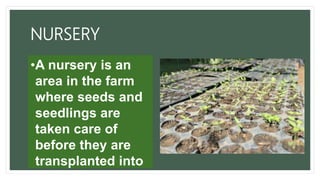
NURSERY
•A nursery is an
area in the farm
where seeds and
seedlings are
taken care of
before they are
transplanted into
Advantages of Keeping a Nursery
•maximizes germination
•lessens mortality from harsh
weather conditions
•protects young plants from pests
•saves cost from seed and input
waste
Considerations in Designing a Plant
Nursery
•Size
•Site
•Watering System
•Sunlight Transmission
•Ventilation
•Protection
•Labor
•Cost Efficiency
CONSTRUCTION MATERIALS
•FOUNDATION
bamboo poles, wooden post, steel
•ROOFING AND WALLS
mosquito net, UV plastic,
polycarbonate
•FLOORING
gravel, sawdust, stepping stones,
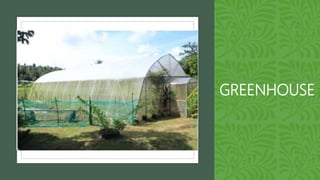
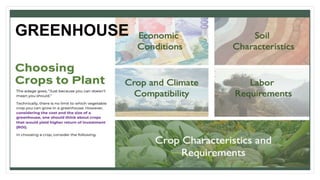
GREENHOUSE
GREENHOUSE
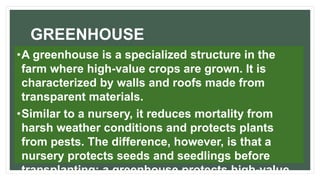
•A greenhouse is a specialized structure in the
farm where high-value crops are grown. It is
characterized by walls and roofs made from
transparent materials.
•Similar to a nursery, it reduces mortality from
harsh weather conditions and protects plants
from pests. The difference, however, is that a
nursery protects seeds and seedlings before
transplanting; a greenhouse protects high-value
GREENHOUSE
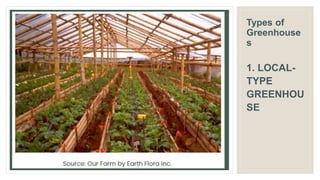
Types of
Greenhouse
s
1. LOCAL-
TYPE
GREENHOU
SE
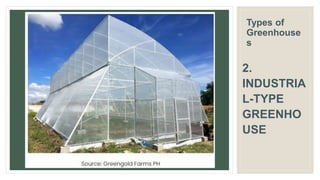
Types of
Greenhouse
s
2.
INDUSTRIA
L-TYPE
GREENHO
USE
Types of
Greenhouse
s
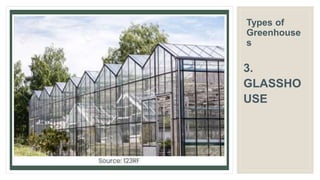
3.
GLASSHO
USE
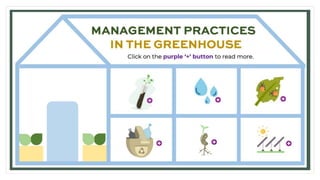
MANAGEMENT PRACTICES IN THE NURSERY
Soil Testing
• Soils in the greenhouse should be analyzed for their pH and salinity.
Amendments may be applied to ensure that the soil is fit for planting.
Irrigation
• Greenhouses usually require specialized irrigation systems such as the
drip, overhead, etc.
• Rainwater Collection
• Since greenhouses are built with roofs, rainwater does not reach the
crops inside. You can install fixtures around the roofs or put up drums
outside the greenhouse to collect rainwater.
MANAGEMENT PRACTICES IN THE NURSERY
Pest Management
• Weeds, insects, and animals destroy or take nutrition from crops.
• Use insect-proof materials.
• Cut the foliage around the greenhouse to destroy pest habitats.
• Regularly inspect your greenhouse for possible holes created by larger
pests.
• Remove weeds around your crops.
• Use only organic concoctions as pesticides.
Waste Management
• Practice the 3Rs: Reduce, Reuse, Recycle. Collect organic wastes and
use them for compost.
MANAGEMENT PRACTICES IN THE NURSERY
Disease Control
• Control the spread of plant diseases by doing the following:
• Choose seeds of resistant varieties.
• Practice rouging or removing inferior or infected plants.
• Improve soil fertility to decrease susceptibility of the plants.
• Apply organic extracts from plants, animals, and beneficial micro-
organisms.
Energy Conservation
• Conserve any form of energy as much as you can.
QUIZ
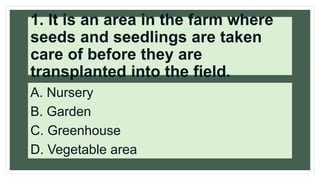
1. It is an area in the farm where
seeds and seedlings are taken
care of before they are
transplanted into the field.
A. Nursery
B. Garden
C. Greenhouse
D. Vegetable area
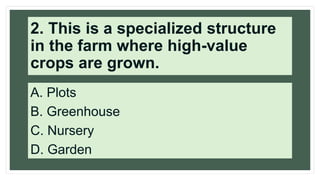
2. This is a specialized structure
in the farm where high-value
crops are grown.
A. Plots
B. Greenhouse
C. Nursery
D. Garden
3. The following are the
advantages of a nursery EXCEPT.
A. Maximizes germination
B. Lessens mortality from harsh weather
conditions
C. Protects young plants from pests
D. Allows beneficial organisms to work
4. Which of the following is NOT a
consideration in designing a
plant nursery?
A. Size
B. Plants
C. Water system
D. Ventilation
5. The following are safety
measures in the nursery EXCEPT.
A. Remove weeds around your crops.
B. Collect organic wastes and use them for compost.
C. Use synthetic pesticide to effectively kill all insects.
D. Practice rouging or removing inferior or infected
plants.
THANK YOU!
renante.mirasol@deped.gov.ph

MAINTAIN NURSERY FACILITIES.pptx

  • 1.
  • 2.
    Learning Competencies: Perform maintenanceof nursery cleanliness and sanitation Perform repair and maintenance of nursery facilities to maximize their efficiency and effectiveness Apply preventive measures for inclement weather and practice safety measures
  • 3.
  • 4.
    NURSERY •A nursery isan area in the farm where seeds and seedlings are taken care of before they are transplanted into
  • 5.
    Advantages of Keepinga Nursery •maximizes germination •lessens mortality from harsh weather conditions •protects young plants from pests •saves cost from seed and input waste
  • 6.
    Considerations in Designinga Plant Nursery •Size •Site •Watering System •Sunlight Transmission •Ventilation •Protection •Labor •Cost Efficiency
  • 7.
    CONSTRUCTION MATERIALS •FOUNDATION bamboo poles,wooden post, steel •ROOFING AND WALLS mosquito net, UV plastic, polycarbonate •FLOORING gravel, sawdust, stepping stones,
  • 8.
  • 9.
    GREENHOUSE •A greenhouse isa specialized structure in the farm where high-value crops are grown. It is characterized by walls and roofs made from transparent materials. •Similar to a nursery, it reduces mortality from harsh weather conditions and protects plants from pests. The difference, however, is that a nursery protects seeds and seedlings before transplanting; a greenhouse protects high-value
  • 10.
  • 11.
  • 12.
  • 13.
  • 15.
    MANAGEMENT PRACTICES INTHE NURSERY Soil Testing • Soils in the greenhouse should be analyzed for their pH and salinity. Amendments may be applied to ensure that the soil is fit for planting. Irrigation • Greenhouses usually require specialized irrigation systems such as the drip, overhead, etc. • Rainwater Collection • Since greenhouses are built with roofs, rainwater does not reach the crops inside. You can install fixtures around the roofs or put up drums outside the greenhouse to collect rainwater.
  • 16.
    MANAGEMENT PRACTICES INTHE NURSERY Pest Management • Weeds, insects, and animals destroy or take nutrition from crops. • Use insect-proof materials. • Cut the foliage around the greenhouse to destroy pest habitats. • Regularly inspect your greenhouse for possible holes created by larger pests. • Remove weeds around your crops. • Use only organic concoctions as pesticides. Waste Management • Practice the 3Rs: Reduce, Reuse, Recycle. Collect organic wastes and use them for compost.
  • 17.
    MANAGEMENT PRACTICES INTHE NURSERY Disease Control • Control the spread of plant diseases by doing the following: • Choose seeds of resistant varieties. • Practice rouging or removing inferior or infected plants. • Improve soil fertility to decrease susceptibility of the plants. • Apply organic extracts from plants, animals, and beneficial micro- organisms. Energy Conservation • Conserve any form of energy as much as you can.
  • 18.
  • 19.
    1. It isan area in the farm where seeds and seedlings are taken care of before they are transplanted into the field. A. Nursery B. Garden C. Greenhouse D. Vegetable area
  • 20.
    2. This isa specialized structure in the farm where high-value crops are grown. A. Plots B. Greenhouse C. Nursery D. Garden
  • 21.
    3. The followingare the advantages of a nursery EXCEPT. A. Maximizes germination B. Lessens mortality from harsh weather conditions C. Protects young plants from pests D. Allows beneficial organisms to work
  • 22.
    4. Which ofthe following is NOT a consideration in designing a plant nursery? A. Size B. Plants C. Water system D. Ventilation
  • 23.
    5. The followingare safety measures in the nursery EXCEPT. A. Remove weeds around your crops. B. Collect organic wastes and use them for compost. C. Use synthetic pesticide to effectively kill all insects. D. Practice rouging or removing inferior or infected plants.
  • 24.